



Abstract
Objectives:
Workplace safety is essential to occupational health practices among healthcare providers, especially for nurses vulnerable to work-related hazards such as needle stick and sharp injuries. In Yemen, the underestimation and absence of reporting system and lack of health supplies in a collapsed health system exacerbated the needle stick and sharp injuries. This study aimed to identify the prevalence and associated factors of needle stick and sharp injuries among nurses in Taiz, Yemen.
Methods:
A cross-sectional study was conducted on a sample of 151 nurses working in three public hospitals in Taiz City. A semi-structured questionnaire was designed and delivered to the participants.
Results:
The prevalence of needle stick and sharp injuries among nurses was very high (95.36%), and around half were injured more than five times. Female nurses and those in an emergency department were more likely to be subjected to needle stick and sharp injuries (p = 0.018 and 0.021, respectively). Needle stick was the most common cause of injury (62.77%), and the fingers were the most exposed injury site (79.17%). Non-reporting injuries were very high (73.61%), and only one-third (34.21%) of them proceeded in the process of management, and less than one-quarter (23.68%) had been vaccinated.
Conclusion:
The prevalence of needle stick and sharp injuries among nurses in Taiz was very high, and determined by gender and place of work. Post-injury reporting and precautions were poor, which may increase the prevalence of hospital-acquired infections among clients and healthcare providers.
Introduction
Nurses are exposed to injury by multiple types of sharp objects in their work settings. They usually deal with injury-related objects such as syringe needles, lancets, surgical scalpels, cutting needles, blood vacuum tubes, broken vials, razors, and scissors. 1 In healthcare settings, needle sticks and sharp injuries (NSSIs) are still among the most common injuries; the Centre for Diseases Control and Prevention (CDC) reported that more than 1 million events of NSSIs have happened annually and represent 8% of in-hospital injuries. However, only half of them were reported. 2 NSSIs are defined as any transcutaneous contact with a sharp instrument or penetration of a sharp object or needle that may cause contact with blood or other body fluids. 3
Workplace safety is an essential aspect of occupational health practice, and all health care providers should routinely follow the barrier precautions to prevent exposure during contact with any patient’s blood or body fluids. 4 Unfortunately, NSSIs are still an unavoidable issue, and at least 20 different highly virulent pathogens such as hepatitis B virus (HBV), hepatitis C virus (HCV), and human immunodeficiency virus (HIV) are transmitted by these injuries. 3 For healthcare workers worldwide, the attributable fractions for work-related infections exposed to HBV, HCV, and HIV are 37%, 39%, and 4.4%, respectively. The CDC reported that over 5000 health care providers become infected by HBV annually due to work-related infections. These events have increased the health care burden as they have severe consequences, including long-term illness, disability, and death. 5
Nurses are considered the most significant work group of healthcare providers in most countries, with a percentage between 60% and 65%, and they usually stand on the frontlines in direct contact with patients. Therefore, they are repeatedly exposed to sharp object injuries, intensive emotional distress, unsafe circumstances, and anxiety that may decrease their professional commitment, lower quality of health services, occupational dysfunction, and behavioral changes. Moreover, severe psychological comorbidities such as depression and post-traumatic stress disorder may occur as long-term outcomes. 1
Environmental conditions play a significant role in the occurrence of NSSIs. Nurses who work in acute health care settings such as operating rooms, emergency departments, and intensive care units may be exposed to more events of injuries. 6 In addition, studies have shown that increased workload, staff shortages, a range of invasive activities, critical patient conditions, stressors, and multiple invasive procedures may increase the risk of injuries among nurses working in those settings. 7 Likewise, developing countries, particularly those with collapsed health systems and war, have additional factors such as a lack of facilities, including personal protective equipment and waste disposal, and the absence of infection control policies.
In Yemen, a study revealed that 44% of nurses had poor knowledge regarding needle stick injury preventive measures. 4 A more recent study in Sana’a revealed that 22% of clinical laboratory staff had received a biosafety manual, and 60% had been injured while working in laboratory. 8 A similar study reported that 55% of laboratory staff in the three reference laboratories (Sana’a) had been injured. 9 Guidelines for the prevention of NSSIs have been prepared by CDC, 10 but unfortunately, these guidelines have not yet been recruited in Yemen, and the NSSIs have not been well considered. Moreover, to our knowledge, the prevalence of NSSIs among nurses in Taiz has not been studied yet. Therefore, the present study was designed to identify the prevalence and associated factors of NSSIs among nurses in Taiz, Yemen, as one of the effective efforts that shed light on this issue and provide a scientific rationale for decision makers in order to build up strategic plans aiming to reduce the incidence of NSSIs and related complications.
Methods
Study design and sampling
A cross-sectional study was conducted in three public hospitals in Taiz governorate (Althawra, Aljumhori, and Swedish Children’s Hospital), Yemen, from April to June 2021. The number of nurses who are working in Taiz city is limited, there were no authenticated medical records as well, as many nurses immigrated outside the city due to the ongoing civil war in Yemen, so all nurses who had been working in the intended hospitals were targeted as a whole sample and included in the present study. These hospitals receive patients referred from emergency departments, rural hospitals, and primary care units. Taiz is one of the most populous cities (about 3,000,000 inhabitants) and is located in the southwest of Yemen (44.01°E, 13.34°N), about 280 km from Sana’a, the capital of Yemen. This study fulfilled the reasonable numbers of STROBE guidelines. 11
Data collection
A self-administered multiple-choice questionnaire with 16 questions was developed after reviewing the literature.4,12 The pre-trained co-workers delivered this questionnaire to 221 nurses while giving back 160; nine were excluded due to incomplete recording (missing data); hence the response rate is 68.32%. The questionnaire consists of two main parts; the first part (5 questions) was about sociodemographic and professional data (e.g., qualifications, experiences, training), and the second part (11 questions) was about the environment and circumstances of injury events. The questionnaire was developed in Arabic as the study samples (nurses) are Arabic native speakers. Five experts examined and reviewed the questionnaire; their suggestions were considered accordingly. This questionnaire was pilot-tested in 25 nurses, and the internal consistency was estimated by calculating Cronbach’s alpha. This study considered a Cronbach’s alpha of 0.7 or greater acceptable.
Ethical considerations
Ethical approval was obtained from the Research Ethics Committee at the Faculty of Medical Sciences, Al Janad University for Sciences and Technology (JustMed 03/2021). In addition, written informed consent was obtained from the participants after explaining the study’s purposes. The anonymity, confidentiality, and autonomy of the participants were ensured. Ethical conduct was maintained during data collection and throughout the research process.
Data analysis
The Statistical Packages for Social Sciences (SPSS), version 21, was utilized for data analysis. Descriptive statistics of the study variables, including sociodemographic characteristics, were expressed as frequency n and percentage (%). Fisher’s Exact test was employed to determine the association between NSSIs and sociodemographic characteristics. p value ⩽ 0.05 was considered to be significant.
Results
Sociodemographic characteristics of the respondents
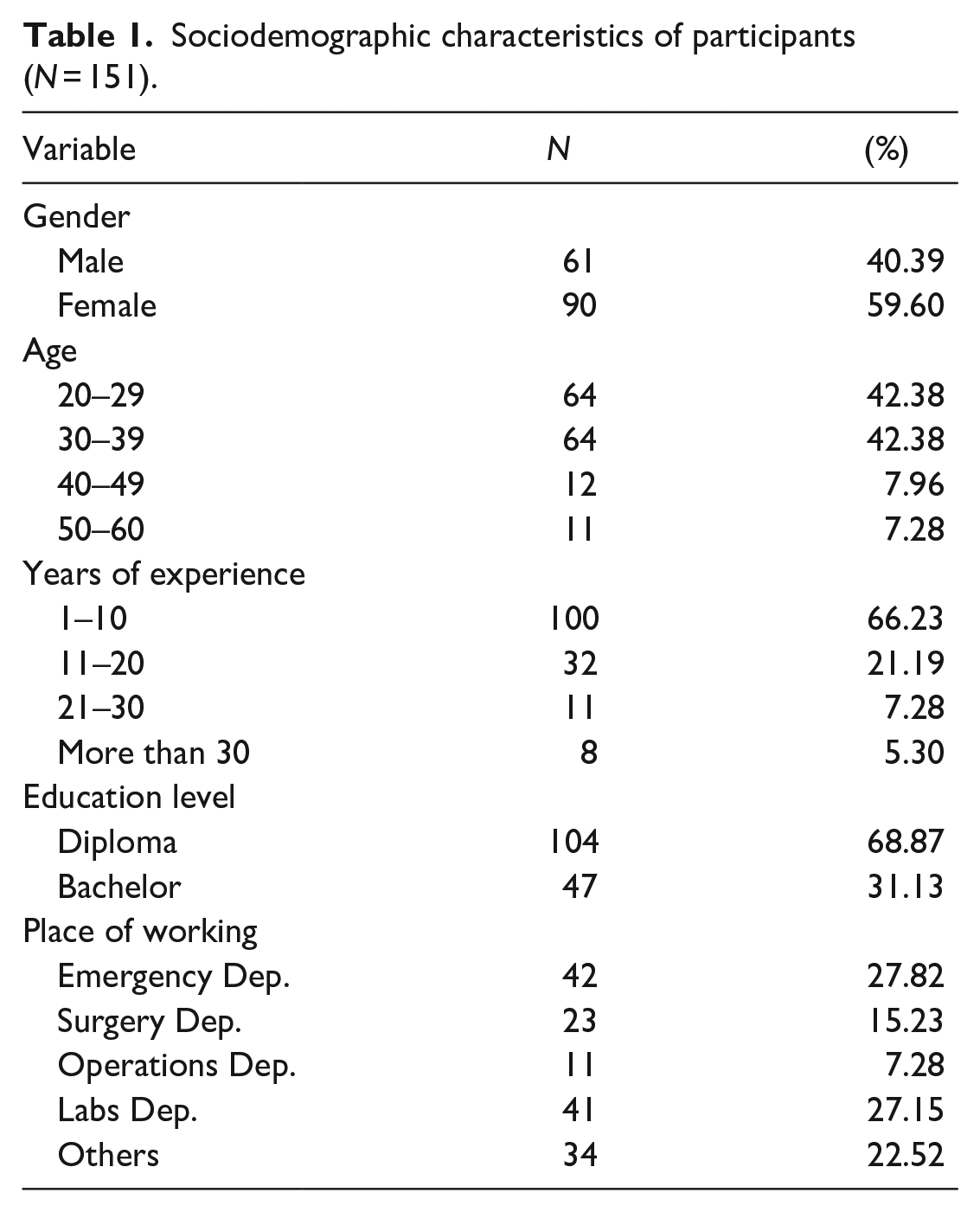
The sociodemographic characteristics of the respondents have been presented in Table 1. Of the 151 respondents, 40.40% were males, while 59.60% were females. Most respondents (84.77%) were in the age group of 20–39 years, while 15.23% were in the 40–60 years age group. Approximately two-thirds of the respondents had a diploma (68.87%) and less than 10 years of experience (66.22%). The highest percent (27.82%) of nurses worked at emergency department while lowest (7.28%) worked at the operations department.
Sociodemographic characteristics of participants (N = 151).
Environmental and circumstances feature related to NSSIs
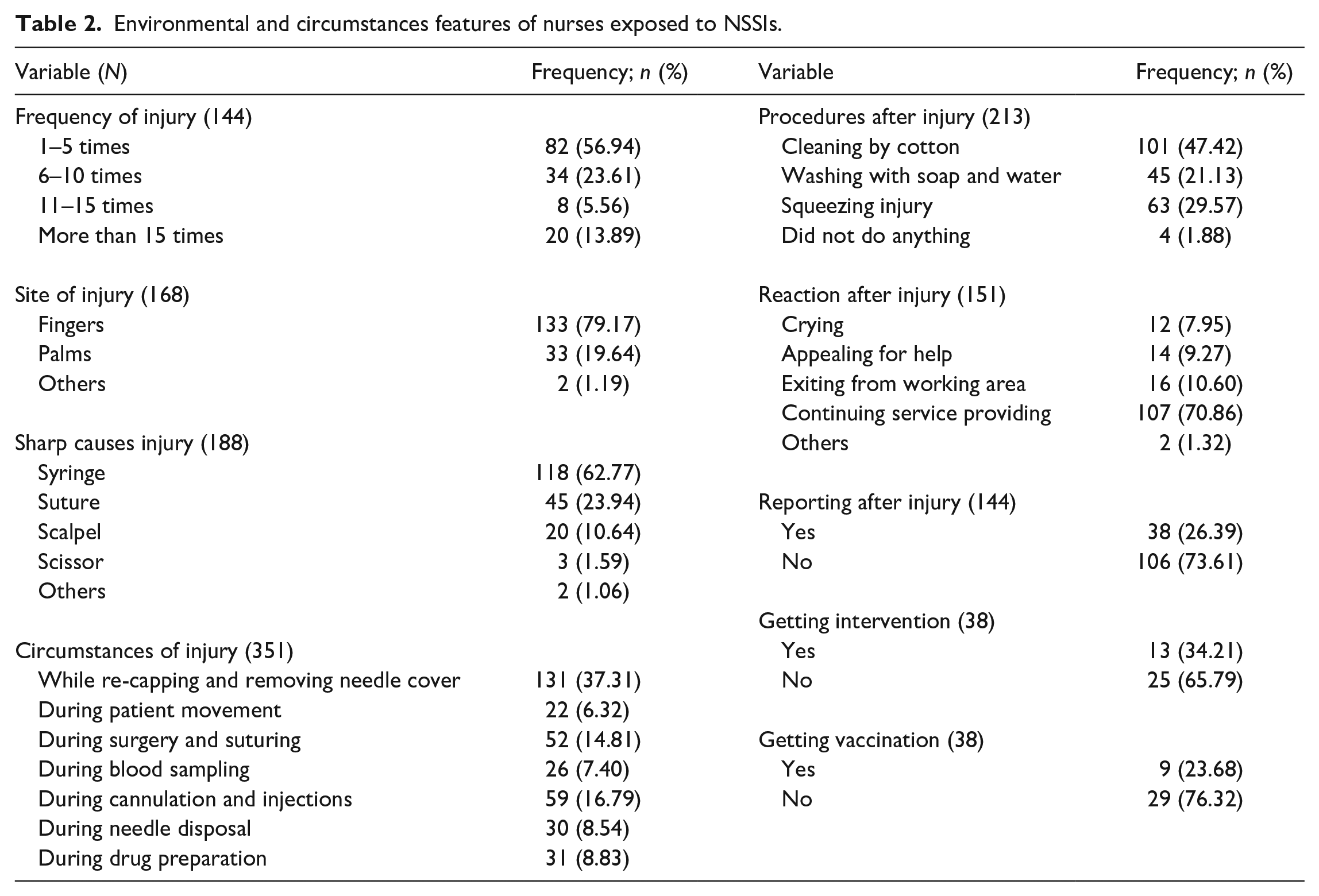
According to the results presented in Table 2, more than half of the injured nurses suffered injuries 1–5 times during their work, fingers were the most common site of injury (79.17%) along with needle sticks, which were the most common cause of injury (62.77%). The table also shows that recapping and removing needle cover (37.31%) were the most common circumstances of injuries. Regarding the initial procedure after injury, most nurses (70.86%) continued to provide care after injury. 47.42% of respondents had used cotton to clean the injured site. Meanwhile, only 26% of the injured nurses had informed their direct managers about the injury, 34% had received general intervention, and 23.68% had received the related vaccine.
Environmental and circumstances features of nurses exposed to NSSIs.
NSSI associated factors
The results presented in Table 3 showed that the prevalence of NSSIs was significantly associated with female nurses (p = 0.018) and those working in an emergency department (p = 0.021) regardless of their age, experience, and level of education.
Relationship between NSSIs and socio-demographic characteristics of participants.

Fisher’s Exact test.
Statistically significant (p < 0.05).
Table S1 shows the relationship between the factors anticipated to be associated with the frequencies of NSSIs. It displayed that most nurses were exposed to NSSIs at least 1–5 times regardless of gender, age, experience, education level, training course, and working area. Regarding gender, it also showed that females have more susceptibility to frequent exposure to the NSSIs either 1–5 times or 5–10 times. In the same line, the young and middle age categories group appeared to have more susceptibility to frequency of 1–5 times (p = 0.008), while the elderly nurses (50–60 years old) were exposed to a high frequency of injuries (⩾15).
Discussion
NSSIs are a significant risk of work-related infections, forming about 44.5% among HCPs.1,3 This prevalence was substantially varied between regions, ranging from 7.7% in South America to 43.2% in Asia. A systematic review and meta-analysis reported that the pooled global 1-year prevalence of percutaneous injuries among HCPs was 36.4%. 13 The NSSIs cause significant, potential, and intangible costs.
In this study, a high percentage of the respondents (95.36%) had been exposed to NSSIs during their work at healthcare facilities; half of them were frequently injured 1–5 times. The frequent events indicate insufficient reporting, absence of preventive policies, and poor professional practices. The prevalence of NSSIs was reported in many studies; a study conducted in Iran reported that 81.7% of healthcare personnel were injured during hospital work. 14 Similarly, another cross-sectional study in Turkey found that 79.7% of nurses at a Turkish hospital experienced NSSIs. 15 Also, studies from Ghana, South Korea, and India reported 74%, 70.4%, and 68.3%, respectively.16–19
In the middle east region, 74.57% of NSSIs were reported among nurses at Zagazig university hospitals (Egypt), and 36.86% of them were exposed more than once 20 ; other studies in Egypt reported that 35.6%–67.9% of nurses were exposed to NSSIs at least one time in a year.21–24 Furthermore, an Iranian systematic review and meta-analysis included 21 articles reported that the estimated overall 1-year period prevalence of NSSIs was 44%, 25 while, in a more recent review that included 62 articles reported that the prevalence of NSSIs was 51.1% 26 Similar result (53%) was reported in the United Arab Emirates (UAE), 27 and 32.90% in Saudi Arabia. 28 According to a study conducted in Saudi Arabia, nurses are the most affected group, which showed that nurses represent 56.5% of injured healthcare workers. 1
Lower percentages were reported in studies conducted in Ethiopia and Malaysia (36.2% and 23%, respectively) that may be related to continuous in-work training, in addition to the application of safety measures and the availability of safety boxes in their work settings.7,29 The highest prevalence of NSSIs in the current study may be attributed to: the extreme shortage of trained nurses, absence of safety policy, lack of administrative supervision, and increased pressure on health care during the conflict in Yemen.
Regarding gender, the present study found that females (98.89%) were significantly more exposed to NSSIs than males (90.16%); this result agrees with other cross-sectional studies conducted in Saudi Arabia, Malaysia, and Iraq.1,3,29 On the contrary, a study in Ethiopia found that male nurses were exposed to NSSIs more than female nurses (50.65% vs 30.36%). 7 In the present study, Nurses were at risk for NSSIs regardless of age; this finding agreed with two studies conducted in Johannesburg 30 and US, 31 which found that age is not an associated factor with NSSIs. On the other hand, other studies reported a significant association between age and NSSIs and noted that older HCWs were more exposed to NSSIs.32,33
Nurses with more than 10 years of experience were less exposed to NSSI than those without experience. Likewise, a study in Egypt reported a negative correlation between NSSIs and years of experience, and the highest rate of NSSIs was among HCWs who had 5–10 years of experience. 33 Furthermore, a study conducted in Ghana 16 found that the long working experience was significantly associated with the increasing risk of NSSIs exposure. This finding could be attributed to the fact that a longer career would expose nurses to more NSSIs events.30,34
Regarding the qualifications, no differences between NSSIs and the qualifications were revealed in the current study. In contrast to our finding, a significant relationship between NSSIs and educational level was reported in previous studies.3,32 Low education level was one of the most significant predictors of NSSIs among nurses. 20
Nurses in the emergency department were less likely to be subjected to NSSI than nurses in other departments. This finding agrees with a descriptive cross-sectional study on HCWs at tertiary hospitals in Ghana; it found that the emergency room was one of the lowest places of NSSIs, 16 which may refer to applying some precautions in an emergency more than other departments.
Fingers were the most exposed to injury (79.17%); nurses used the traditional manual preparation of drugs and procedures, and the absence of a safety policy exposed their fingers to injury. Many studies also reported the same findings.7,35,36 In addition, finger exposure to NSSIs could be related to the substantial role of the fingers in handling and recapping the needles, suturing, and setting intravenous lines. 7 The syringe was the most common cause of NSSIs among the respondents in the present study; specifically, recapping was the most circumstance-related injury in NSSIs cases. Safe and proper handling of injection needles and following safety protocol could minimize and prevent the syringe-related NSSIs among nurses. 34
The situation and circumstances by which the injury has happened are varied. In the present study, incidents during recapping and removing the needle cover (37.31%) were the most frequent circumstances that caused injury, followed by incidents during surgery and suturing, preparation of drugs, and needle disposal, respectively. A similar finding was reported in a study carried out in Saudi Arabia; it showed that 28% of NSSIs cases happened during recapping needles, 37 similar to what was reported in the studies from India and Egypt 20 ; as they also found that needle recapping was the most frequent procedures (62.87% and 66.3% respectively). On the contrary, one study revealed that only 1.6% of NSSIs occurred during recapping of the needle. 38 In contrast, another study found that opening ampules was the most common way nurses were exposed to injuries. 39 These findings could be attributed to the absence of safety protocols, training, and infection control program. In addition, a lack of facilities, staff shortage, and increased workload are also attributable. 14
Post-injury procedures were concluded in this study as follows: cleaning the injury site with cotton (47.42%) followed by squeezing the injury (29.57%) and washing the injury site with water and soap (21.13%). In contrast with these findings, washing the injured site with water and soap was reported among 46.5% of participants in Manipur, India, 38 and washing the injury site with an antiseptic solution and letting blood flow after exposure were reported in a study conducted in Egypt. 20
As for the intervention after injuries, immediate reaction and incident reports are typically technical and administrative steps that should be implemented when NSSIs occur. In the present study, only near to one-quarter (26.39%) of the injured nurses reported the incident of injuries, 34.21% of them had received interventions, and 23.68% of them had received vaccination. Reporting injuries is an indispensable procedure and must be mandatory to ensure legal and ethical responsibility. The rate of reported injuries was higher in many studies; 63.2%, 57%, and 38%.38,40,41 The most common factors for not reporting are the increased workload, fear of job loss, and lack of awareness.3,42 In order to manage NSSIs among HCWs, an effective reporting system and sufficient education on occupational safety should be implemented by the relevant institutions. 43
However, this is the first cross-sectional study reporting the NSSIs and associated factors at Taiz, Yemen. The main limitations of this study are the small sample size, low response rate, and limited information sources (3 hospitals). Furthermore, the complications of NSSIs were not well-addressed. Also, the influence of providing first aid on reducing NSSI incidence was not investigated. In addition, some variables were addressed in only qualitative patterns, so addressing these variables in a quantitative pattern is recommended in future investigations.
Conclusion
NSSIs are highly prevalent among nurses in Taiz, Yemen. Needle stick is the common cause of injury, and needle recapping is the primary injury circumstance. However, one-third of nurses have taken training about NSSIs and infection control; the training does not make sense regarding the reduction of NSSIs times, and this may be attributed to the implementation of insufficient and ineffective training courses. Lack of protective equipment supplies and the absence of infection control and safety policies in healthcare facilities may be the main reasons behind highly prevalent NSSIs. An effective reporting system and sufficient occupational safety education should be implemented to manage NSSI incidence.
Supplemental Material
sj-docx-1-smo-10.1177_20503121231221445 – Supplemental material for Prevalence and associated factors of needle stick and sharp injuries among nurses: A cross-sectional study
Supplemental material, sj-docx-1-smo-10.1177_20503121231221445 for Prevalence and associated factors of needle stick and sharp injuries among nurses: A cross-sectional study by Mokhtar Abdo Almoliky, Hala A. Elzilal, Eman Alzahrani, Hala M. Abo-Dief, Khalil A. Saleh, Sameer A. Alkubati, Mousa S. Saad and Mujeeb A. Sultan in SAGE Open Medicine
Footnotes
Acknowledgements
The researchers would like to acknowledge deanship of scientific research, Taif University for funding this work.
Author contributions
MAS, MAA, EA, and HAE conceived and designed the research. MAS, SAA, and MSS were responsible for data collection. HAE, HMA-D, EA, SAA, and MAS were involved in the data analysis, drafting the manuscript. All authors read and approved the final manuscript
Declaration of conflicting interests
The author(s) declared no potential conflicts of interest with respect to the research, authorship, and/or publication of this article.
Funding
The author(s) disclosed receipt of the following financial support for the research, authorship, and/or publication of this article: The research was funded by deanship of scientific research, Taif University, Taif, Saudi Arabia
Informed consent
Written informed consent was obtained from the participants after explaining the study’s purposes. The anonymity, confidentiality, and autonomy of the participants were ensured. Ethical conduct was maintained during data collection and throughout the research process.
Trial registration
Not applicable.

Supplemental material
Supplemental material for this article is available online.
References
Supplementary Material
Please find the following supplemental material available below.
For Open Access articles published under a Creative Commons License, all supplemental material carries the same license as the article it is associated with.
For non-Open Access articles published, all supplemental material carries a non-exclusive license, and permission requests for re-use of supplemental material or any part of supplemental material shall be sent directly to the copyright owner as specified in the copyright notice associated with the article.
