




Abstract
Sharp weapons are common homicide weapons. However, in rare cases, unusual weapons are used for crimes and can pose a challenging task to the forensic pathologist during autopsy. Darat is an indigenous agricultural tool used in the hilly regions of India. Darat is a modified sickle, and literature on injury patterns caused by it is exceptionally rare. This case report describes a double homicide involving a 72-year-old man and his 65-year-old wife, who were killed by a Darat. Autopsy findings revealed multiple chop, stab and incised wounds to the head, neck, and shoulders, consistent with heavy, sharp, and curved weapons. A patterned contusion, probably produced by a nail and washer on the weapon handle, as well as characteristic injuries, provided critical evidence for identifying the Darat as the murder weapon. The correlation between the dimensions of the weapon blade and the wounds can be influenced by several factors, including skin elasticity, the angle of the weapon relative to the skin surface, postmortem changes, and the degree of applied force. A detailed analysis of injury patterns and weapon-specific characteristics is crucial for identifying the weapon and linking it to crimes.
Introduction
Sharp-edged weapons are commonly used to cause violent deaths, particularly in countries where the use of firearms is restricted. 1 In India, sharp weapons are the second most commonly used tools for homicide. 2 Sharp force injuries include stab, chop, and incised wounds, typically caused by weapons such as knives, swords, machetes, and sickles.3,4 Although stab wounds are typically associated with pointed sharp objects such as knives, certain blunt pointed instruments may also cause similar penetrating injuries under forceful application.
The Darat is a modified version of the sickle, featuring a curved iron-metal blade with a longer wooden handle. It is commonly used in the hilly regions of India for agricultural tasks such as cutting grass and crops. While the sickle is a lightweight, sharp, curved-edged weapon, 5 the Darat is a heavier, sharp-edged weapon capable of causing deep chop wounds and, in some cases, cutting through underlying bone. Literature on homicides caused by sickles and sickle-like weapons is very uncommon. 6
Patterned injuries are distinctive and may replicate the characteristics of the weapon used. Sometimes, the peculiarities of the weapon leave characteristic patterned imprints on the victim’s body. These patterned imprints can assist in predicting and identifying suspected weapons.7,8
This case report emphasises the importance of meticulous forensic examination in a double homicide caused by a Darat. It focuses on the pattern, direction, edges, and depth of injuries, as well as associated internal injuries. These patterned injuries helped in predicting the murder weapon, which further assisted the investigating officer in weapon identification. This case report offers valuable insights to forensic experts in evaluating and interpreting such injuries and is helpful in weapon prediction. All identifying information has been anonymised to ensure confidentiality. Our institution does not require ethical approval for reporting individual case reports.
Case
A 72-year-old Indian man and his 65-year-old wife were found dead in a cowshed located in front of their house. The discovery was made early in the morning by a neighbour, and signs of robbery were evident. Both bodies were stained with blood and cow dung.
On postmortem examination, the male victim measured 165 cm in length and weighed 75 kg, with an average build. Hypostasis was faintly present on the left side of the face, neck, and chest, and was fixed. Rigor mortis was strongly present throughout the body. Multiple chop wounds were inflicted on the body by a heavy, sharp, curved weapon. Two consecutive curved chop wounds, inflicted one after the other and separated by a skin flap, measuring 12 × 5 and 14 × 6 cm, respectively, were present on the right side of the neck. These wounds started anteriorly from just below the right angle of the mandible and extended to the back of the neck at the midline (Figure 1(a), injury no. 1). Two curved elliptical stab wounds were observed below these injuries, measuring 3 × 1 and 4 × 1.5 cm, respectively, penetrating through muscles and blood vessels (Figure 1(a), injury nos. 2 and 3, respectively). A superficial incised wound measuring 5 × 2 cm was present on the top of the right shoulder, with a corresponding cut on the shirt (Figure 1(b), injury no. 4). A large curved chop wound measuring 14 × 5 cm was found on the back of the head, cutting through a flap of the scalp (Figure 1(c), injury no. 5). Another curved chop wound measuring 17 × 2 cm was located obliquely above the vertex of the head, with a clean cut through the bone (Figure 1(d), injury no. 6). A chop wound measuring 6 × 0.5 cm was observed along the coronal plane of the head. At the intersection of these two wounds, a triangular defect in the skull was identified (Figure 1(d), injury no. 7). Upon reflection of the scalp, a linear fracture measuring 13 cm in length was noted on the right parietal bone. A clean-cut, triangular-shaped piece of skull bone measuring 8 × 7 × 5 cm was found at the anterior end, with the dura and underlying brain matter incised (Figure 1(e)).
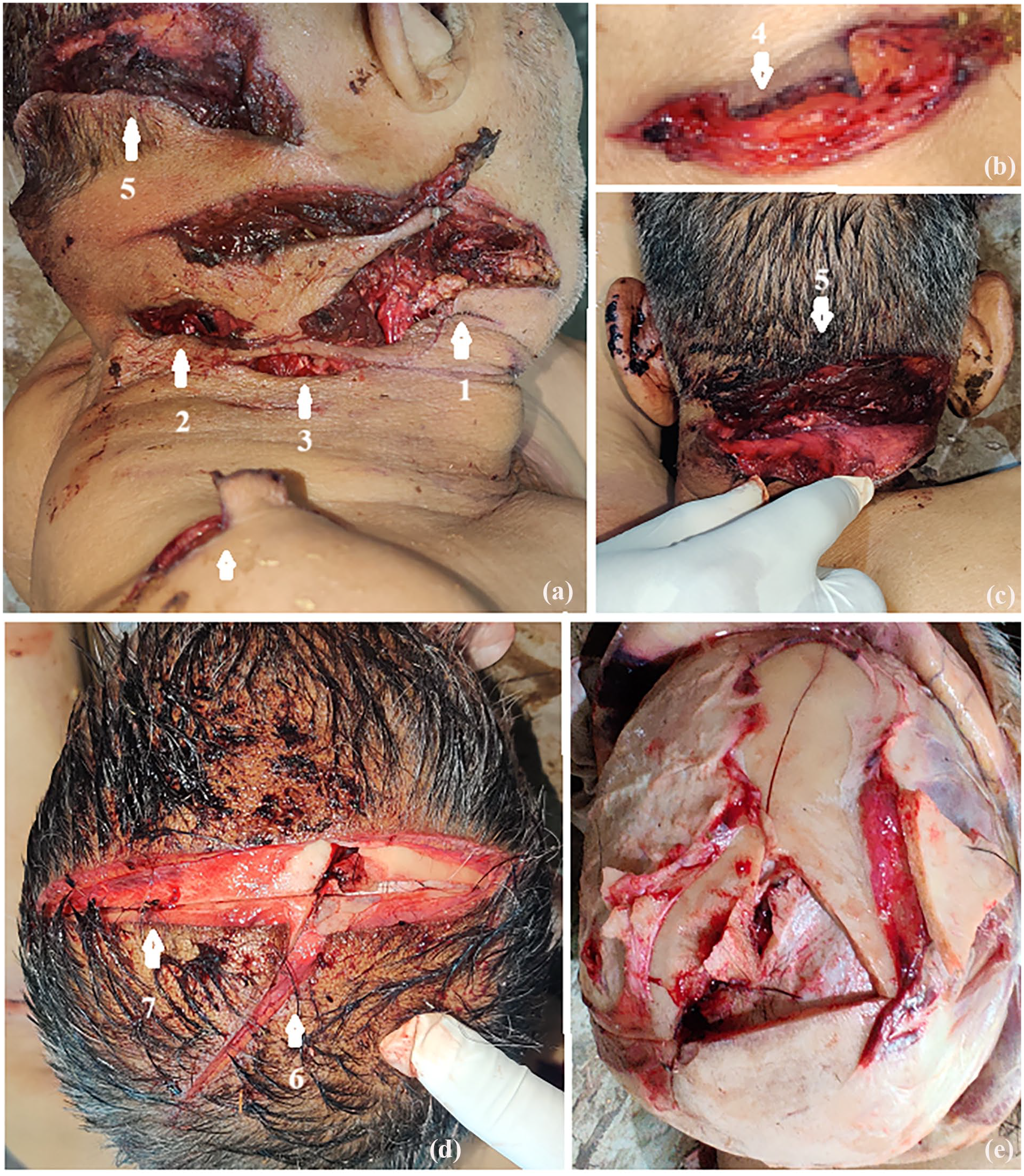
Pattern of injuries on the male victim.
The female victim measured 165 cm in length and weighed 67 kg, with an average build. Faint hypostasis was observed over the back of the body and was fixed. Three consecutive curved chop wounds, inflicted one after the other and separated by a skin flap, started anteriorly from the left side of the nose and extended to variable lengths: the first wound (20 × 4 cm) terminated just below the left ear; the second wound (16 × 4 cm) ended 2 cm below the left mastoid; and the third wound (30 × 4 cm) extended up to the right mastoid. These wounds severed the vertebral column at the C3 level, damaged major blood vessels, and cut through the left mandible and maxilla (Figure 2(a)–(c), injury no. 1). A curved incised wound, 7 × 2 cm in size and subcutaneously deep, was located at the base of the left side of the neck, extending towards the medial border of the left scapula (Figure 2(d), injury no. 2). A circular contusion measuring 2 cm in diameter with a central pale area was noted on the back of the left shoulder (Figure 2(d) and (e), injury no. 3). This contusion was probably caused by the nail and washer of the Darat.

(a–e) Pattern of injuries on the female victim. (f, g) Murder weapon—Darat; the position of the nail and washer is indicated by an arrow.
In all the chop wounds on both victims, which were located over the neck and shoulder regions, the bevelling of the tissue was directed downwards, indicating the direction of force. No defensive wounds were present on either body. In both cases, there was damage to major blood vessels in the neck region, and the internal organs appeared pale due to extensive blood loss. The cause of death was determined to be shock and haemorrhage secondary to multiple chop wounds inflicted on the head and neck regions by a sharp-edged weapon. Viscera samples tested negative for poison and alcohol. The weapon was sent for forensic examination, and a report was subsequently issued.
Weapon examination
The weapon was recovered by the police from the accused’s home, and the information we provided about the possible weapon helped in the identification of the alleged weapon. However, as the weapon was already washed, no genetic analysis or eyewitness account strengthens the conclusion that Darat was the murder weapon. The weapon is a modified version of a typical sickle, featuring a curved metallic blade and an extended wooden handle, fixed with nails and a washer measuring 1.8 cm in diameter, positioned 14 cm from the base of the handle. The metallic blade is single-edged, curved, sharp on the inner side, and has a pointed end. The weapon weighs 662 grams, with a total length of 50 cm. The metallic blade measures 21 cm in length (Figure 2(f) and (g)). Injury no. 3 on the female victim is a patterned contusion, probably caused by the nail and washer on the handle of the Darat. The nail and washer protruded ~5 mm from the surface, which was sufficient to cause the observed imprint.
Discussion
Homicide is defined as the unlawful killing of one person by another. 9 Sharp weapon injuries are a relatively common cause of homicide. 10 Sickles are primarily used for agricultural purposes, such as cutting grass and weeds. 6 The curved edge of a sickle or similar weapon produces curved chop wounds, creating a characteristic pattern of injuries.6,11 The pointed end of the metallic blade can cause penetrating stab wounds to the neck and skull, 12 similar to the injuries observed in our case report.
The thorax, head, and neck are the most common sites for homicidal sharp force injuries.13–15 However, in cases involving heavy, sharp weapons such as the Darat, the head is the most frequently affected site.11,16,17 In our case report, no defensive wounds were observed on either victim, which can be attributed to the surprise nature of the attack. 16 Injuries caused by unusual or atypical weapons, such as those encountered in our case report, can pose a challenge for forensic experts if the weapon is not recovered from the crime scene. 6 In such cases, a detailed examination of the injuries can guide investigators towards searching for similar atypical weapons, increasing the likelihood of identifying the weapon used in the homicide. 18
In our case report, the protruding nail and washer used to fix the metallic blade to the wooden handle produced a distinctive imprint contusion, along with classical curved chop and incised wounds consistent with injuries caused by the alleged weapon brought for examination. The unique characteristics of a weapon can sometimes result in patterned injuries, aiding in weapon identification and expediting justice.19,20 The correlation between the dimensions of the weapon blade and the stab wound can be influenced by several factors, including skin elasticity, the angle of the weapon relative to the skin surface, postmortem changes, and the degree of applied force.21–24 In addition, if the victim is clothed during the assault, the clothing may exhibit cuts corresponding to the injuries, as seen in our case report, where the shirt was incised at the right shoulder in line with the underlying wound. 25
In our case report, multiple fatal wounds were inflicted on both victims. Several factors could explain this: the assailant may have intended to ensure the victims’ death, or the victim may have continued to resist even after sustaining multiple fatal wounds. 26 The brutality of the attack, characterised by numerous fatal chop wounds and the use of a heavy, sharp weapon such as the Darat, an uncommon choice for robbery, suggests premeditation or vengeful intent, typically observed in cases involving close or known relationships. 27
While comparing the injury patterns produced by different sharp and heavy weapons, we observed both distinct and comparable findings. The pickaxe produced blunt, hacking, and sharp force injuries depending on which side of the weapon was used. The injury pattern included chop wounds, blunt trauma to the skull bones, and deep penetrating injuries to the hands and abdomen. 28 The axe produced slash, stab, cut, and contused lacerations, along with neurocranial fragmentation and extensive brain contusion. 29 An experimental study on pig limbs and bones wounded with axes and hatchets described various fracture types, such as curved transverse and spiral fractures in femur and longitudinal fractures in fibulae. 30 In comparison, the Darat produced consistent chop and incised wounds to the head, neck, and shoulders, without any features suggestive of blunt trauma.
Conclusion
The Darat, a rare and unusual weapon, is a modified version of a sickle, categorised as a heavy, sharp weapon commonly used for agricultural purposes in the hilly regions of India. This case report presents a classical scenario of double murder, with multiple fatal, distinctive curved chop and stab injuries inflicted over the head and neck region, produced by the Darat. The distinct patterned contusion on the female victim was probably produced by the nail and washer present on the handle of the Darat. The findings of this report can be useful to forensic pathologists in injury recognition and weapon prediction.
Footnotes
Acknowledgements
None.

Ethical Considerations
Our institution does not require ethical approval for reporting individual cases or case series.
Consent for Publication
Written informed consent was obtained from a legally authorised representative(s) for anonymised patient information to be published in this article.
Author Contributions
Yatiraj Singi: conceptualisation, data acquisition, interpretation of findings, and critical revision of the manuscript. Dipen Dabhi: data acquisition, literature review, and drafting of the initial manuscript. Nirmal Nagar: conceptualisation, supervision, critical analysis, manuscript writing and revision, and corresponding author responsibilities. Jasmine Jain: supervision, literature review, image documentation, and assistance in manuscript editing. All authors have read and approved the final manuscript.
Funding
The author(s) received no financial support for the research, authorship, and/or publication of this article.
Declaration of Conflicting Interests
The author(s) declared no potential conflicts of interest with respect to the research, authorship, and/or publication of this article.