



Abstract
Generating accurate epidemiological data on the magnitude of anemia in malnourished children is a vital step for health policymakers. Therefore, this study is aimed to synthesize the overall magnitude of anemia in African malnourished pre-school children. We have searched the databases PubMed/MEDLINE, Embase, Scopus, Web of Science, Google Scholar, and Google to identify relevant articles. Joana Brigg’s Institute critical appraisal tool was used to assess the quality of articles. A random-effects model was applied to estimate the pooled prevalence of anemia in malnourished children. The I2 statistics were used to examine heterogeneity among the included studies. In the presence of heterogeneity, a subgroup analysis has been used. The funnel plot analysis and Egger’s tests were used to investigate the presence of publication bias. A total of 15 articles with 12,211 study participants were included in this study. Anemia was observed in 57.53% (95% CI: 47.05, 68.01) of African malnourished pre-school children. Moreover, the prevalence of anemia was 58.52% (95% CI: 43.04, 73.81) and 56.18% (95% CI: 40.24, 72.13) in HemoCue and auto-machine diagnosis method of anemia, respectively. This review showed that the magnitude of anemia was high among African malnourished pre-school children. Therefore, planning preventive measures to decrease anemia and its complications in malnourished children in Africa is an important step.
Introduction
Malnutrition is defined as a deficiency, excess, or imbalance in a person’s energy and/or specific nutrients in relation to their requirements. 1 It is one of the most significant problems facing mankind today. Rapid population growth, inadequate food production, poverty, regional conflicts, and social, political, and educational factors have significant role in malnutrition. Protein-energy malnutrition (PEM) of varying degrees is the most common form, affecting mainly young children. 2 Children’s physical and cognitive abilities could be affected with malnutrition. Moreover, it may damage the children’s immune systems. 3 As a result, the children would be vulnerable to various communicable diseases such as helminthic infections, HIV infection, and malaria infection. 4 Infections also aggravate malnutrition by decreasing appetite, inducing catabolism, and increasing demand for nutrients. Although it has been debated whether malnutrition increases incidence of infections, or whether it only increases severity of disease, solid data indicate that malnourished children are at higher risk of dying once infected.5,6
Globally, in 2020, 149 million under-five children were estimated to be stunted (too short for age), 45 million were estimated to be wasted (too thin for height), and 38.9 million were overweight or obese. 7 According to the state of food security and nutrition report, the prevalence of undernutrition was 21% in Africa. The report also indicated that 52 million were under-five children, with mortality rate of 45%. 8 This indicates that developing nations are vulnerable to malnutrition. 9 Undernutrition is a leading cause of illness and mortality in pre-school children. 10
Anemia due to PEM can be caused by metabolic changes in the red blood cell (RBC), protein deficiency and adaptation anemia, iron deficiency, vitamin deficiency (folic acid, B12, E, pyridoxine, and riboflavin) or trace elements (copper, selenium, and zinc), erythropoietin deficiency, infection, chronic inflammation, and parasitic infections. Hence, any reduction of these micro elements causes anemia. 11 Physiologically, anemia is identified as any disease in which the patient experiences tissue hypoxia. 12 Besides, it can also be defined as a reduction in the hemoglobin (Hgb) value. 13 Anemia results when the production of RBCs is outpaced by their destruction or loss. Thus, the factors that can affect the development of anemia act by decreasing production of RBC or increasing their destruction or loss, or in some cases both phenomena may occur. 14 Anemia is a public health problem that affects more than one-third of the world’s population in both developing and developed nations. But, it is higher in developing continents like Africa. 15
According to the World Health Organization (WHO) report, anemia is the most prevalent hematologic manifestation. 15 In 2019, global anemia prevalence was 39.8% in children aged 6–59 months, equivalent to 269 million children with anemia. The prevalence of anemia (60.2%) in under-five children was the highest in the African Region. 16 Anemia lowers immunity, making children more vulnerable to communicable diseases and putting them at risk of dying, and anemia’s consequences have an effect on a country’s social and economic growth. 17 Moreover, its consequences are severe in children as their bodies develop, and it has been linked to stunted growth, reduced psychomotor growth, and decreased social, emotional, and cognitive functioning in youngsters. 18
There were a lot of studies that reported the prevalence of anemia in malnourished children in different countries in Africa. However, there is no official continent-based survey or health registry that has to date estimated the prevalence of anemia in malnourished children in the continent. Therefore, this systematic review and meta-analysis aimed to determine the prevalence of anemia among malnourished under-five children in Africa. This will provide comprehensive evidence for decision-makers and stakeholders to set effective preventive and curative management strategies.
Methods
Study setting and design
This is a systematic review and meta-analysis of published articles on the prevalence of anemia in malnourished pre-school children in Africa. The continent has more than 400 million children. Of them, more than 251 million are malnourished. 9 The Preferred Reporting Items for Systematic Reviews and Meta-analysis (PRISMA) guideline was used to develop this study (PRISMA-P 2015 Guidelines) 19 (Supplementary Table 1).
Eligibility criteria
Inclusion criteria
Inclusion criteria were as follows: (1) studies that revealed the magnitude of anemia, (2) published in the English language, (3) defined undernutrition based on the WHO child growth standards (anthropometric indices less than −2 standard deviations), (4) defined wasting, stunting, and underweight as weight-for-height Z-score (WHZ), height-for-age Z-score (HAZ), and weight-for-age Z-score (WAZ), respectively, < −2 standard deviations, (5) defined severe acute malnutrition as either the presence of severe wasting or bilateral pitting edema of both feet or mid-upper arm circumference (MUAC) of below 11.5 cm (for only children older than 6 months), (6) diagnosed severe wasting, stunting, and underweight as WHZ, HAZ, and WAZ, respectively, as < −3 standard deviations, and (7) had a minimum of data about anemia status and sample size were included in this study.
Exclusion criteria
Articles were excluded from the meta-analysis, if they were (1) review articles, conference abstracts, editorials, and case series with fewer than 30 participants; (2) used the Sahli-Hellige method, copper sulfate densitometer, and MBS Hgb meter color scale to diagnose anemia; (3) they had no information on the tool used to diagnose anemia; (4) they were conducted in a population with a high incidence of hemolytic anemia; (5) they were published only with the abstract but did not provide full information; and (6) published in another language other than English.
Search strategy
Up to January 2021, a systematic literature search was performed to gather studies on the magnitude of anemia among African malnourished pre-school children. The following electronic bibliographic databases were systematically searched: Google, Google Scholar, Cochrane Library, Embase, Scopus, Web of Science, Science Direct, and PubMed/MEDLINE. The search term used in this review was derived from PubMed advanced search engine. Moreover, a broad electronic bibliographic database searching by the keyword “anemia, malnourished, and preschool children” was used. The bibliographies of the publications that were recognized and considered as important were hand-searched for further relevant papers. Searching terms used in this review in the free text were “anemia,” “anemia,” “iron deficiency anemia,” “nutritional anemia,” “hemoglobin,” “haemoglobin,” “Hgb,” “Hb,” “nutritional status,” “hematological parameters,” “children,” “malnourished,” “under-nourished,” “determinant factors of anemia,” “associated factors of anemia,” “pre-school,” and “Africa.” A mixture of Boolean operators was used to obtain the above terms (AND and OR). From the extracted papers, a reference search was performed to get additional relevant articles for inclusion.
Operational definitions of outcomes
The main outcome of interest was the prevalence of anemia among undernourished, African pre-school children. Anemia is defined based on the Hgb values <11 g/dL for children aged <5 years. 20
Study selection and quality appraisal
Retrieved articles were imported to EndNote X7 for the removal of duplicates. Two writers (M.A. and E.S.) separately scrutinized the titles and abstracts of the selected articles. Furthermore, disagreements among the authors were resolved through mutual consensus, and a third review author (B.E.) was involved if required. A quality assessment was conducted based on the Joana Briggs Institute (JBI) critical appraisal checklist for simple prevalence studies. Articles of high and medium quality were included in the final analysis (Supplementary Table 2).
Data extraction
Two writers (M.A. and Y.G.) separately collected the first author’s name, year of publication, study area/region, the mean age of the children, study design, sample size, the prevalence of anemia with its 95% confidence interval, and Hgb diagnosis technique using the Microsoft Excel. In this meta-analysis, we have used the baseline data (for anemia prevalence) from repeated cross-sectional and prospective cohort investigations.
Statistical analysis
The data were collected and entered into Microsoft Excel before being exported to Stata 14 for analysis. Three authors (M.A., T.A., and Y.G.) worked together to analyze the data. The index of heterogeneity has been used to analyze the degree of heterogeneity between the selected articles (I2 statistics). Low, medium, and high heterogeneity are supposed to be represented by I2 values of 25%, 50%, and 75%, respectively. 21 The random-effects model which assesses the variability within and between studies was applied to estimate the pooled prevalence of anemia and the OR with their 95% CIs. A sensitivity and subgroup analysis was performed to explore the potential sources of heterogeneity. The visual funnel plot and Egger’s regression test were used to assess publication bias.
Results
Study selection
During the systematic literature search, a total of 2,716 studies were discovered. Following the exclusion of duplication and filtering, 1,645 articles were screened. Out of which, 1013 studies were excluded by reading their titles, 33 studies were removed by reading their abstracts, and 6 were excluded by reading the full-text article in the quantitative analysis. Finally, 15 articles were chosen for the final analysis after the irrelevant articles were removed (Figure 1).

Flow chart to describe the selection of studies for a systematic review and meta-analysis.
Study characteristics
Of the total 15 articles, 8 of them were from Ethiopia, 2 from Uganda, 2 from Nigeria, 1 was in West Africa region, 1 in Rwanda, and 1 in Togo. According to the study design, 9 of them were cross-sectional studies, 2 of them were randomized control test (RCT), 2 of them were demographic health service (DHS) data, and 2 of them were retrospective study. The majority of studies (9/15; 60%) were used automated hematology analyzer for the diagnosis of anemia. This study comprised a total of 12,211 malnourished children, with 7029 of them being anemic (Table 1).
Characteristics of the included studies for the prevalence of anemia in African malnourished pre-school children.

RCT: randomized control trial; DHS: Demographic and Health Survey.
Prevalence of anemia in malnourished children
A total of 15 articles were included in this systematic review and meta-analysis to estimate the pooled prevalence of anemia among African malnourished children. The maximum and minimum prevalence rates of anemia were 80.6% in Togo and 12.5% in Ethiopia, respectively. Using a random-effects model, the overall magnitude of anemia in malnourished African children was 57.53.97% (95% CI = 471.05, 68.01) (Figure 2).

Forest plot of the pooled prevalence of anemia among undernourished pre-school children in Africa.
Subgroup analysis
To explore the source of heterogeneity, we have done a subgroup analysis based on study setting, anemia diagnosis platform, and study design. Based on the study area, the pooled magnitude of anemia was found to be 54.83% (95% CI = 42.51, 67.16) and 65.16% (95% CI = 48.70, 81.63) in East Africa and West Africa, respectively (Figure 3). We have also analyzed the prevalence of anemia based on anemia diagnosis platform. Accordingly, the prevalence of anemia was higher in auto-machine (58.52% (95% CI = 43.04, 73.81)) than HemoCue (56.18% (95% CI = 40.24, 72.13)) method (Figure 4). However, the overall magnitude of anemia based on study design was 55.47% (95% CI = 43.74, 67.21), 36.97% (95% CI = −11.25, 85.16), 72.76% (95% CI = 70.04, 75.48), and 71.68% (95% CI = 54.29, 89.07) in cross-sectional, retrospective, RCT, and DHS studies, respectively (Figure 5).

Subgroup analysis by study area among undernourished pre-school children in Africa.
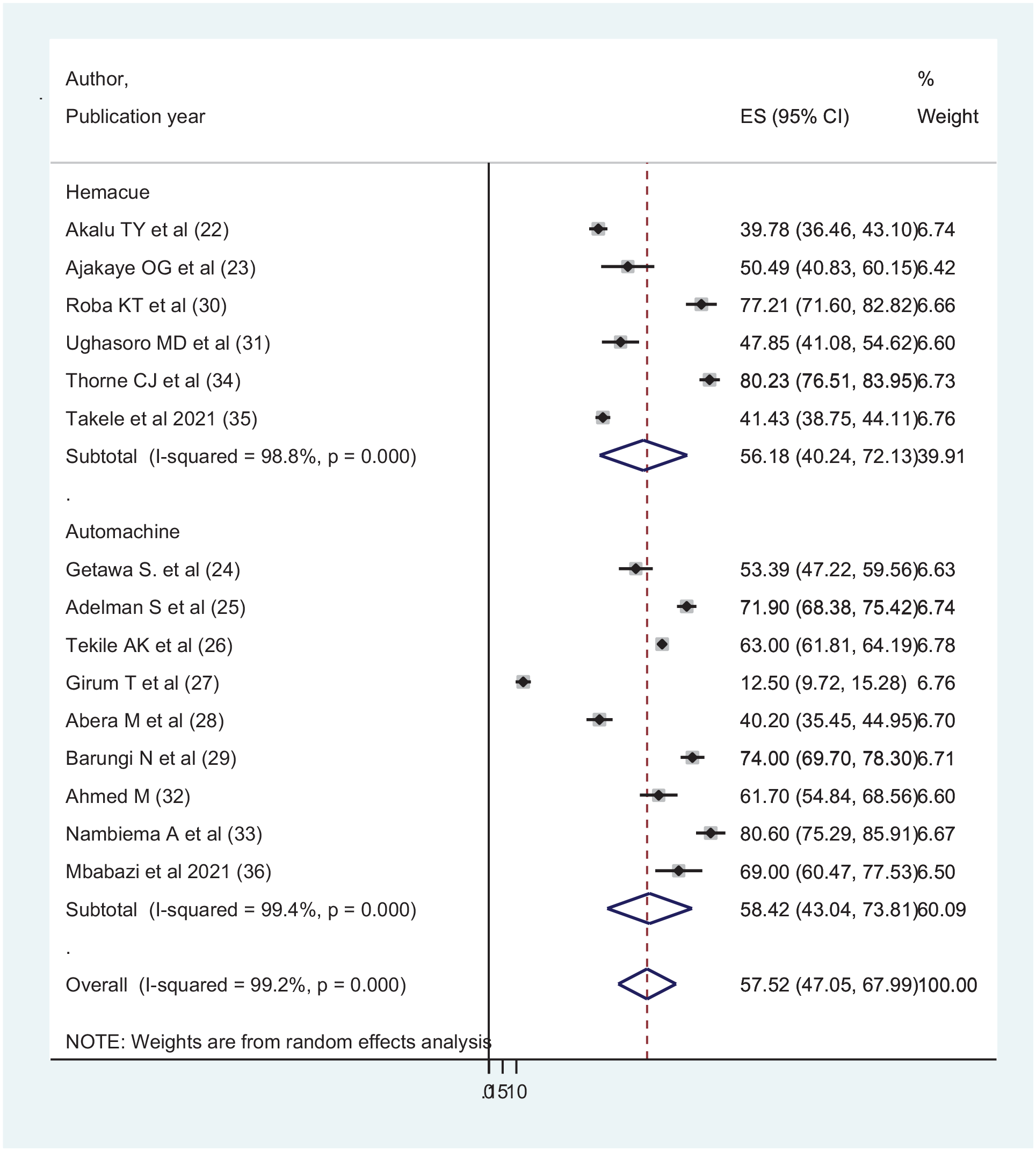
Subgroup analysis by diagnosis method of anemia among undernourished pre-school children in Africa.

Subgroup analysis by study design among undernourished pre-school children in Africa.
Publication bias
The visual funnel plot and Egger’s regression test were used to explore the presence of publication bias. The funnel plot was symmetric, indicating the absence of publication bias (Figure 6). Egger’s regression test also confirmed the absence of publication bias (p = 0.606).

Funnel plot of included studies on the prevalence of anemia among undernourished pre-school children in Africa.
Sensitivity analysis
To elucidate the effect of each study on the pooled effect size, a sensitivity analysis was conducted by excluding each study one at a time. The sensitivity analysis, however, revealed that excluded studies did not have a significant effect on the overall magnitude of anemia in malnourished pre-school African children (Figure 7).

Sensitivity analysis.
Discussion
Anemia is a hematological disorder that could happen to all ages of individuals, even so it is most prevalent and severe among reproductive-age women, under-five children, and children suffering from nutritional deficiency disorders. 37 In the current systematic review and meta-analysis, we aimed to determine the pooled prevalence of anemia among undernourished African pre-school children. Accordingly, the overall prevalence of anemia among undernourished, African pre-school children was 57.53% (95% CI = 47.05, 68.01). According to the WHO guideline for the diagnosis and assessment of severity of anemia, this study affirmed that anemia is a severe public health problem in undernourished, African pre-school children. 20 Anemia is an indicator of both poor nutrition and poor health. It is problematic on its own, but it can also impact other nutritional concerns such as stunting and wasting due to lack of energy to exercise. School performance in children and reduced work productivity in adults as a result of anemia can have further social and economic impacts for the individual and family. 38
Anemia is considered to be harmful to one’s health, especially for mothers and young children. 39 Despite the fact that anemia has long been recognized as a public health issue, no progress has been documented, and the global prevalence of anemia remains unacceptably high. As a result, the WHO and the United Nations Children’s Fund emphasize the need of knowing anemia’s multifaceted etiology in order to establish effective management programs. Strategies for mother and child health, integrated management of childhood disease, and deworming should be incorporated into the primary healthcare system and current programs. Furthermore, solutions should be evidence-based, adapted to local conditions, and take into account the cause and incidence of anemia in a particular context and demographic group. 40 Therefore, anemic undernourished African children need special care about anemia treatment and follow-up.
In developing nations with limited food supplies, macronutrient and micronutrient deficiencies are major public health concerns. Children’s health has been affected by stunting and wasting, both signs of chronic and acute malnutrition. Anemia, for instance, can be attributed to a lack of vitamins A, B2 (riboflavin), B6 (pyridoxine), C, D, and E, as well as copper, due to their unique roles in the formation of Hgb.14,17 Furthermore, malnutrition lowers immunity, making youngsters more susceptible to infectious diseases. The condition could result in nutrient loss, malnutrition, underutilization of bioavailable nutrients, blood loss, and immune-mediated RBC destruction, all of which have been linked to a low Hgb level. 41
The magnitude of anemia in the current meta-analysis was 57.53%, which is relatively higher than the anemia in the general pediatric population of Ethiopia without malnutrition (44.83% of the children were anemic). 41 Another systematic review and meta-analysis conducted in Ethiopia showed that anemia is detected in 34.4% of children without malnutrition. 41 The discrepancies might be because of the inclusion of apparently healthy children in the former studies in Ethiopia. However, this study was conducted in malnourished children. Similarly, a systematic review and meta-analysis conducted in Latin America and the Caribbean reported that a lower magnitude of anemia (32.93%) than this study. 41 This variability might be related to socio-economic difference in the population.
In the subgroup analysis, the prevalence of anemia was 58.52% and 56.18% in HemoCue and auto machine, respectively. This found that HemoCue seems to have a greater prevalence of anemia than the automated analyzers. The Cyanmethemoglobin method was recommended as a standard method for measuring Hgb by the International Committee for Standardization in Hematology (ICSH) and the WHO. The automated method, however, is time-consuming and costly. Because it is portable, easy to use, and very inexpensive, the HemoCue device has been utilized routinely in this context where resources are limited. 42 According to Adam et al, the average Hgb value in the HemoCue method was greater than in automated analyzers. The study also discovered that HemoCue® Hgb concentrations obtained from venous or capillary blood samples had a lower level of precision and were not comparable to those obtained from an automated hematology analyzer. 43 Hinnouho et al. 42 found that the HemoCue method results in a much decreased prevalence of anemia when compared to automated hematology analyzers.
The subgroup analysis based on the study setting revealed that a higher prevalence of anemia was found in West (65.62%) than East Africa (54.83%). A study by Magalhães indicated that the mean Hgb concentration was significantly lower in Western than in Eastern Africa. The study also showed that the proportion of children with Hgb <110 g/L was the highest in Western Africa. 44 The pooled prevalence of anemia based on study design classification were 55.47%, 36.97%, 72.76%, and 71.68% in cross-sectional study, retrospective study, RCT, and DHS, respectively. From the above study designs, the RCT had a higher prevalence of anemia than other study designs. This might be due to the ability of the RCT study design to assess the cases among total study participants. This is also the strongest method to explore cause–effect relation and is considered as a gold standard.
Strengths and limitations
This study conducts extensive searches utilizing a variety of databases and search methodologies (manual and electronic). To reduce bias, data were retrieved using a predetermined method and extracted independently by two authors. Two separate writers also evaluated the quality of the studies, which found that all of them were of moderate or high quality. As a limitation, data on the magnitude of anemia was obtained from only a few countries in Africa (West and East Africa), which compromises the target population. Thus, there is a paucity of evidence in some parts of Africa (North, South, and Central Africa), the pooled prevalence may not adequately reflect the prevalence of anemia in Africa. There is also high heterogeneity among the included studies.
Conclusion
Anemia was a significant health problem in malnourished pre-school children in Africa. This research supports the need for population-based interventions including vitamin supplementation, food fortification, and nutrition education to make things better. The findings will help the African government and policymakers to take the necessary steps and design appropriate interventions for children under the age of 5 and their parents.
Supplemental Material
sj-doc-1-smo-10.1177_20503121221088433 – Supplemental material for Anemia in African malnourished pre-school children: A systematic review and meta-analysis
Supplemental material, sj-doc-1-smo-10.1177_20503121221088433 for Anemia in African malnourished pre-school children: A systematic review and meta-analysis by Melak Aynalem, Elias Shiferaw, Tiruneh Adane, Yemataw Gelaw and Bamlaku Enawgaw in SAGE Open Medicine
Supplemental Material
sj-docx-2-smo-10.1177_20503121221088433 – Supplemental material for Anemia in African malnourished pre-school children: A systematic review and meta-analysis
Supplemental material, sj-docx-2-smo-10.1177_20503121221088433 for Anemia in African malnourished pre-school children: A systematic review and meta-analysis by Melak Aynalem, Elias Shiferaw, Tiruneh Adane, Yemataw Gelaw and Bamlaku Enawgaw in SAGE Open Medicine
Footnotes
Acknowledgements
The authors acknowledge all the authors of the included studies in this review and meta-analysis.
Author contributions
M.A. participated in the design of the study, data collection, performed the statistical analysis, and drafted the manuscript. E.S., Y.G., T.A., and B.E. analyze and interpreted the data, and wrote the manuscript. All authors read and approved the final document.
Availability of data and materials
All data supporting these findings are contained within the manuscript.
Declaration of conflicting interests
The author(s) declared no potential conflicts of interest with respect to the research, authorship, and/or publication of this article.
Ethics approval
Ethical approval was not sought for this study because the study does not contain any animal or human participants. It is a systematic review and meta-analysis.
Funding
The author(s) received no financial support for the research, authorship, and/or publication of this article.
Informed consent
Informed consent was not sought for this study because the study does not contain any animal or human participants. It is a systematic review and meta-analysis.

Supplemental material
Supplemental material for this article is available online.
References
Supplementary Material
Please find the following supplemental material available below.
For Open Access articles published under a Creative Commons License, all supplemental material carries the same license as the article it is associated with.
For non-Open Access articles published, all supplemental material carries a non-exclusive license, and permission requests for re-use of supplemental material or any part of supplemental material shall be sent directly to the copyright owner as specified in the copyright notice associated with the article.
