



Abstract
Background:
In Ethiopia, diabetes is estimated to affect about half a million people. About 35% of individuals with diabetes are complicated by microvascular diseases like retinopathy, nephropathy, cardiovascular, and anemia. Even though there are some studies conducted on prevalence and associated factors of anemia in diabetic patients, their findings were variable. Therefore, this meta-analysis is aimed to determine the pooled prevalence and factors associated with anemia among diabetic patients.
Methods:
PubMed, CINAHL, POPLINE, ScienceDirect, African Journals Online, and Google Scholar were systematically searched to identify related studies. The heterogeneity of studies was assessed using Cochran’s Q test and I2 tests. A random-effects model was used to estimate the pooled prevalence of anemia among diabetic patients in Ethiopia. Publication bias was evaluated by employing Egger’s tests.
Results:
After reviewing 503 articles, 6 articles fulfilled inclusion criteria and remained for the final meta-analysis. The pooled prevalence of anemia among diabetic patients was 24.81% (95% confidence interval: 19.38–30.25). Age greater than 60 years old (pooled odds ratio, 95% confidence interval: 3.73 (2.23–6.77)), glomerular filtration rate less than 60 mL/min/1.73 m2 (pooled odds ratio, 95% confidence interval: 12.65 (8.71–18.37)), and being diabetic for more than 10 years (pooled odds ratio, 95% confidence interval: 10.21 (7.00–15.04)) were found to be determinants of anemia among diabetic patients in Ethiopia.
Conclusion:
Overall, one in four diabetic patients develops anemia in Ethiopia. Age, glomerular filtration rate, and duration of being diabetic are factors significantly associated with the occurrence of anemia in diabetic patients.
Background
Diabetes mellitus is increasing rapidly worldwide and reached 463 million people in 2019. 1 Available data were indicating a rapid increment in the prevalence of diabetes in Africa, which is estimated to increase by twofold in 2030 as overweight, fast-food consumption, and urbanization increase. 2 In Ethiopia, diabetes is estimated to affect half a million people. 3 About 35% of individuals with diabetes are complicated by microvascular complications like retinopathy, nephropathy, cardiovascular, and anemia.4,5
Anemia is one of the complications of patients with diabetes.6–8 It occurs more frequently in many chronic diseases but is not recognized. 9 Diabetes is one of the common causes of anemia.10,11 Some studies identified anemia as two times more likely among diabetic than non-diabetic patients.12,13 Besides, hematological indices were shown to affect blood glucose levels.14,15
Anemia is also becoming an indicator of nephropathy in diabetic patients.16–18 It is also identified as a determinant factor for prognosis and microvascular complications in diabetic patients. 8 The degree of anemia roughly estimates the stage of renal failure, and the presence of anemia increases the risk of developing end-stage renal failure in type 2 diabetic patients.18,19 Prevalence of anemia was also shown to increase in diabetic patients even without renal impairment. 20
The occurrence of anemia in diabetic patients was affected by factors like age, glomerular filtration rate, serum creatinine, early glycemic control, albuminuria, and nutritional status.7,12,21,22 Anemia occurs five times more likely among diabetics with a glomerular filtration rate less than <60 mL/min/1.73 m2. 23 Anemia among diabetic was shown to affect men more than women. 19
The pathophysiologic mechanism of anemia among diabetic patient was stated to vary, as causes of anemia are multifactorial. Reduction in erythropoietin production was among the commonly mentioned causes of anemia in a diabetic patient at any glomerular filtration rate. 24 A decrease in erythropoietin production was associated with microvascular complications.24,25 In addition, renal impairment by itself will decrease erythropoietin production which will end up in anemia. 21 The presence of diabetes will predispose to systemic inflammation that affects interstitial tissue of the kidney that in turn will cause anemia. 26 Inflammation is also stated to affect iron metabolism either by induction of autoimmune disorders27,28 or by the release of multiple inflammatory cytokines and free radicals that increase hepcidin. 29 Hepcidin increases ferroprotein degradation and results in iron deficiency anemia. 30 Furthermore, the degradation of ferroprotein results in a blockade of the duodenal iron transfer. 31
Early diagnosis and management of anemia in diabetes were shown to have improvement of complications, 32 as it happens early in the progression of diabetic nephropathy and other complications. 33 In Ethiopia, some studies have been conducted on the magnitude and associated factors of anemia among patients with diabetes, but their findings were inconsistent ranging from 17.9% 34 to 34.8%. 35 Therefore, this meta-analysis is aimed to determine the pooled prevalence and factors associated with anemia among diabetic patients.
Methods
Study design and reporting
A review and meta-analysis were conducted to determine the pooled prevalence of anemia among diabetic patients. This meta-analysis was conducted according to the guidelines of Preferred Reporting Items for Systematic Reviews and Meta-Analyses (Supplementary File 1).
Eligibility criteria
Studies that were conducted in Ethiopia to determine the prevalence and associated factors of anemia among diabetic patients and that satisfied the following conditions were recruited for the final analysis.
Study area: Any studies conducted in Ethiopia were involved.
Population: All studies that had reported prevalence and associated factors of anemia among adult diabetic patients were involved.
Study designs: Observational studies reporting the prevalence and associated factors of anemia among diabetic patients were eligible for this systematic review and meta-analysis.
Publication status: Published articles were considered.
Year of publication: All publications reported up to January 31, 2021, were considered.
Exclusion criteria: Studies that reported complication of diabetes but do not have separate outcomes for anemia were excluded.
The outcome of this systematic review and meta-analysis
Prevalence of anemia in adult (age ⩾18 years) diabetic patients: Number of diabetic patients reported hemoglobin <12 mg/dL for females and <13 mg/dL for males 36 per total number of diabetic patients × 100.
Search strategy
A systematic search of the literature was conducted by the authors to identify all relevant primary studies. All articles on the prevalence of anemia among diabetic patients in Ethiopia were identified through a literature search. The databases used to search for studies were PubMed, ScienceDirect, Google Scholar, CINAHL, POPLINE, Cochrane Library, and African Journals Online (AJOL), and gray literature was searched on Google until 31 January 2021. The key search terms and Medical Subject Headings [MeSH]—“prevalence” OR “magnitude” AND “anemia” AND “diabetic patient” AND “Ethiopia [MeSH]”—were used separately or in combination with the Boolean operator’s terms “AND” and “OR” (Supplementary File 2). Moreover, the reference lists of the retrieved studies were also scanned to access additional articles and screened against our eligibility criteria.
Study selection
In this review, all the searched articles were exported into the EndNote version X8 software, and subsequently, the duplicate articles were removed. Screening of retrieved article titles, abstracts, and the full text was conducted independently by two review authors (D.A. and Z.T.) based on the eligibility criteria. Afterward, full-text articles were retrieved and appraised to approve eligibility. Finally, the screened articles were compiled together by the two investigators.
Risk of bias assessment
The qualities of the included studies were assessed, and the risks for biases were judged using the Joanna Briggs Institute (JBI) quality assessment tool for the prevalence studies. Two reviewers (D.A. and Z.T.) assess the quality of included studies independently, and a discrepancy between the two reviewers resolved with discussion. The evaluation tool comprises nine parameters: (1) appropriate sampling frame, (2) correct sampling technique, (3) acceptable sample size, (4) study subject and location explanation, (5) appropriate data investigation, (6) use of valid methods for the identified conditions, (7) valid measurement for all participants, (8) using appropriate statistical analysis, and (9) adequate response rate. 37 Failure to satisfy each parameter was scored as 1 if not 0. When the information provided was not satisfactory to assist in deciding on a specific item, we agreed to grade that item as 1 (failure). The risks for biases were classified as either low (total score: 0–2), moderate (total score: 3 or 4), or high (total score: 5–9) (Supplementary Figure 3).
Data extraction
The selected articles were thoroughly reviewed, and the required information for the systematic review was extracted and summarized using an extraction table in Microsoft Office Excel software. The data extraction was conducted by the two authors (D.A. and Z.T.) based on prespecified headings that are agreed upon by discussion. The data extraction tool consists of the name of the author(s), year of publication, region, study design, study setting, subtype of diabetes, sample size, prevalence, odds ratio with 95% confidence interval (CI), risk of bias, and results of associated factors in diabetic patients.
Statistical methods and analysis
The extracted data were imported into STATA version 14 software for statistical analysis. The heterogeneity among all included studies was assessed by I2 statistics and Cochran’s Q test. In this meta-analysis, the tests indicate the presence of significant heterogeneity among included studies (I2 = 87.7%, p < 0.001). Thus, a random-effect model was used to analyze the data. Pooled prevalence along their corresponding 95% CI was presented using a forest plot. Subgroup analyses for the prevalence of anemia among diabetic patients was performed. Meta-regression analysis was used to evaluate the association between the prevalence of anemia among diabetic patients and publication year and sample size in the selected studies. To determine the associated factors, data extracted were manually entered into Review Manager version 5.3 software, and fixed-effect model pooled odds ratios (PORs) with 95% CI were used to declare the association. In this meta-analysis, the presence of publication bias was evaluated using funnel plots and Egger’s tests at a significance level of less than 0.05.
Results
Description of included studies
About 503 studies were retrieved from initial electronic searches using international databases and Google search. The databases included PubMed (n = 18), ScienceDirect (n = 236), Google Scholar (n = 23), and AJOL (n = 224), and the remaining (n = 2) studies were identified through manual search. Of these, 333 duplicates were removed, the remaining 170 articles were screened by title, and 161 articles were excluded after reading their titles. Nine full-text articles remained and were further assessed for their eligibility. Finally, based on the predefined inclusion and exclusion criteria, a total of six articles were included in the meta-analysis, and data were extracted for the final analysis (Figure 1).

Flow diagram of systematic review and meta-analysis on the prevalence of anemia among diabetic patients in Ethiopia, 2021.
Characteristics of the included studies
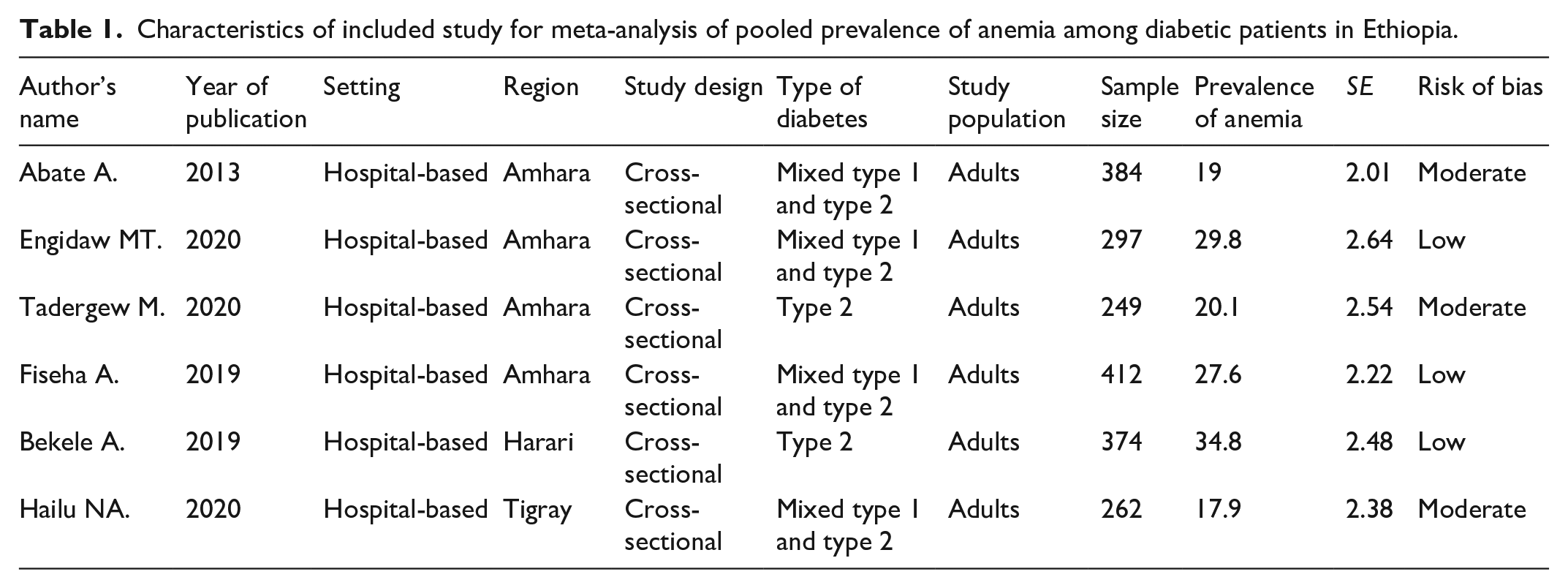
A total number of 1978 diabetic patients participated in the study. All included studies are cross-sectional and hospital-based. The latest study was published in 2020, 38 and the earliest study was published in 2013. 39 Depending on sample size, two studies have a sample size greater than or equal to 384,39,40 and four studies have a sample size less than 384.34,35,38,41 Four studies were conducted in the Amhara region,38–41 one study in the Harari region, 35 and one study in the Tigray region 34 Table 1). The common associated factors reported by included studies were glomerular filtration rate, sex, duration of diabetes, and age of diabetic patients (Table 2).
Characteristics of included study for meta-analysis of pooled prevalence of anemia among diabetic patients in Ethiopia.
Characteristics of included study for meta-analysis of factors associated with anemia among diabetic patients in Ethiopia.

OR: odds ratio; CI: confidence interval.
The publication biases
The presence of publication bias was evaluated using funnel plots and Egger’s tests at a significance level of less than 0.05. The findings revealed that publication bias was not significant for the studies on the prevalence of anemia in diabetic patients (p = 0.38; Figure 2).

Forest plot showing the publication bias of study on anemia among diabetic patients in Ethiopia.
Prevalence of anemia in diabetic patients in Ethiopia
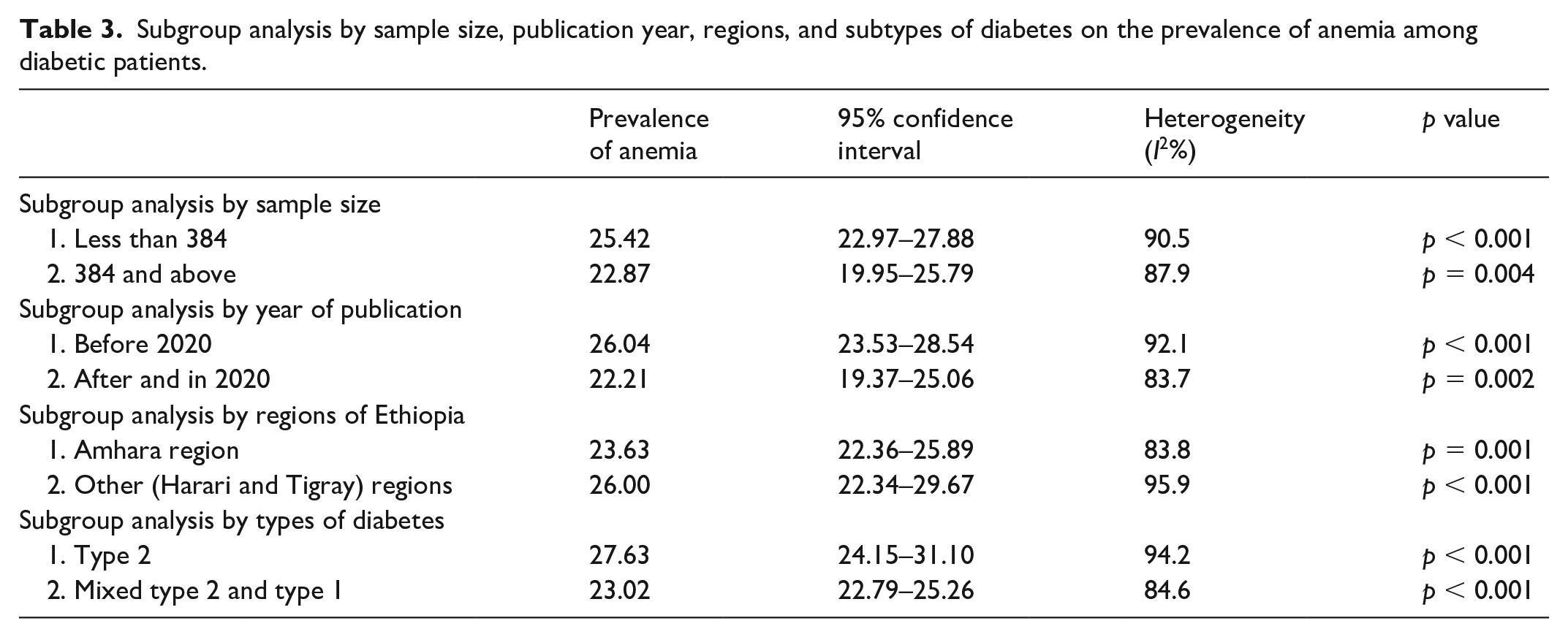
The pooled prevalence of anemia in diabetic patients in Ethiopia using the random-effects model was estimated to be 24.81% (95% CI: 19.38–30.25) with a significant level of heterogeneity (I2 = 87.9 %, p < 0.001; Figure 3). Subgroup analysis was conducted by the risk of bias, sample size, type of diabetes, year of publication, and region of studies. The prevalence of anemia in diabetes was identified to be 18.96% (95% CI: 16.38–21.53) among moderate-risk bias of studies and 30.65% (95% CI: 26.38–34.93) among low-risk bias of studies. The heterogeneity was shown to decrease to 58.5% after subgroup analysis (Figure 4). The prevalence of anemia was 25.40% (95% CI: 22.97–27.88) among studies having a sample size of less than 384, and 22.87% (95% CI: 19.95–25.79) among studies with a sample size of greater than or equal to 384. Studies published before 2020 were shown to have a higher prevalence of anemia 26.04 % (95% CI: 23.53–28.54). Subgroup analysis conducted on the prevalence of anemia was higher among studies conducted in type 2 diabetic patients (27.63%) when compared with studies conducted on both type 1 and type 2 diabetic patients (23.02%) (Table 3).

Forest plot showing a pooled prevalence of anemia among diabetic patients in Ethiopia.

Forest plot showing subgroup analysis of anemia among diabetic patients by risk of bias in Ethiopia.
Subgroup analysis by sample size, publication year, regions, and subtypes of diabetes on the prevalence of anemia among diabetic patients.
Factors associated with anemia in diabetic patients
The determinant factors included in this analysis were age, sex, duration of being diabetes, and glomerular filtration rate. A separate analysis was conducted for each variable.
Age and anemia in diabetic patients
Four studies34,39,40,41 examined the association between the age of diabetic patients and the occurrence of anemia. The POR indicated that diabetic patients aged greater than 60 years old were four times more likely to have anemia (POR, 95% CI: 3.73 (2.23–6.77)). The studies showed moderate heterogeneity (I2 = 74.0%, p < 0.001; Figure 5).

Forest plot showing the association between anemia and age among diabetic patients in Ethiopia.
Glomerular filtration rate and anemia in diabetes
The association of glomerular filtration rate and anemia was examined based on the findings from three studies.39–41 The POR indicated that diabetic patients with glomerular filtration rate less than 60 mL/min/1.73 m2 were 13 times more likely to develop anemia than glomerular filtration rate greater than 60 mL/min/1.73 m2 (POR, 95% CI: 12.65 (8.71–18.37)). The studies showed significant heterogeneity (I2 = 93.0%, p < 0.001). Hence, a random-effects model was considered for the final analysis (Figure 6).

Forest plot showing the association between anemia and sex among diabetic patients in Ethiopia.
Duration of being diabetic and anemia
This meta-analysis was employed on three studies,39–41 and POR revealed that exposure to high blood glucose level for more than 10 years was 10 times more likely to develop anemia than those who were exposed less than 10 years for diabetes (POR, 95% CI: 10.21 (7.00–15.04)). The studies showed low heterogeneity (I2 = 14.0%, p = 0.21; Figure 7).

Forest plot showing the association between anemia and GFR among diabetic patients in Ethiopia.
Sex of diabetic patient and anemia
Four studies34,35,38,40 included in the meta-analysis have revealed that there was no difference among male and female diabetic patients on the occurrence of anemia (POR, 95% CI: 1.2 (0.94–1.52)) with a significant level of heterogeneity (I2 = 89%, p < 0.001; Figure 8).

Forest plot showing the association between anemia and duration of diabetes among diabetic patients in Ethiopia.
Sensitivity analysis
To detect the source of heterogeneity, a leave-one-out sensitivity analysis was employed. The result of sensitivity analysis using the random-effects model revealed that there was no single study that influenced the overall prevalence of anemia among diabetic patients (Supplementary File 4).
Meta-regression
In a meta-regression analysis, the publication year and sample size were not significant sources of heterogeneity for the prevalence of anemia in diabetic patients. In this study, no significant relationship was identified between the prevalence of anemia and the publication year (b = 0.08, SE = 0.04, and p = 0.15), and sample size (b = 1.87, SE =1.07, and p = 0.18).
Discussion
This meta-analysis is conducted to determine the pooled prevalence and associated factors of anemia in diabetic patients. The pooled prevalence of anemia among diabetic patients was 24.81% (95% CI: 19.38–30.25) in Ethiopia. The pooled prevalence of anemia among diabetics in Ethiopia is almost similar to a survey conducted in Chinese diabetic patients (22%). 12 Similarly, the study was supported by another study conducted in Bangladesh in 2018 (21%). This may be due to almost similar poor glycemic control levels among countries: 34% in Ethiopia, 42 32% in Bangladesh, 43 and 32.5% in China. 44 The current finding is significantly lower than the prevalence reported in Pakistan (63%). 45 This can be explained by the difference in poor glycemic control levels among countries: 34% in Ethiopia 42 and 46.7% in Pakistan. 45
Among determinant factors investigated in this review and meta-analysis, the age of diabetic patients, duration of diabetes, and glomerular filtration rate have shown a significant association. Diabetic patients aged greater than 60 years old were four times more likely to have anemia than those with age less than 60 years old. This study is supported by different individual studies conducted worldwide.18,19 This may be due to higher red blood cell turnover increases with advanced age, and compensatory mechanisms become inadequate which leads to the development of anemia. The situation is exacerbated in a patient with diabetes mellitus. 46 Furthermore, erythropoietin secretion will be depleted as age increases. 47
Diabetic patients with glomerular filtration rates less than 60 mL/min/1.73 m2 were 13 times more likely to develop anemia than with glomerular filtration rates greater than 60 mL/min/1.73 m2. This result is supported by a pooled result conducted in 2020 that showed patients with Stage 5 chronic kidney diseases were 13 times more likely to develop anemia when compared with Stage 1 chronic kidney disease. 48 This can be explained by the depletion of erythropoietin which stimulates the erythropoiesis process as a result of kidney impairment by renal fibrosis. 49 Furthermore, erythropoietin proportionally decreases with a decrease in the glomerular filtration rate. 50
The duration of being diabetic for more than 10 years was 10 times more likely to develop anemia than those who were exposed less than 10 years to diabetes. This may be explained by microvascular complications occurring after a long time of exposure to hyperglycemia.51,52 In addition, as the duration of exposure for hyperglycemia increases, the glomerular filtration rate will decrease which may decrease the level of erythropoietin. 53
There are some limitations to this review that may inform future research. First, we pooled only six studies due to the absence of original published studies. Second, our pooled finding represents only published studies because many Ethiopian universities and research institutes do not have repositories that are easily available online. Third, even if the subgroup analysis has been conducted based on the type of diabetes, the pooled result of type 1 and type 2 diabetes is not comparable, which might affect the pooled prevalence of anemia among diabetic patients.
Conclusion
Generally, one in four diabetic patients develops anemia in Ethiopia. Age, glomerular filtration rate, and duration of being diabetic are factors significantly associated with the occurrence of anemia in diabetic patients. Therefore, early screening and management of anemia are important to decrease mortality and morbidity related to microvascular complications of diabetic patients.
We recommend the Minister of Health to incorporate anemia screening as one of the component of diabetic patient care in Ethiopia. The health facilities should provide anemia screening priority to diabetic patients as they are one of the commonly affected groups by anemia.
It is recommended that researchers conduct primary studies separately for type 1 and type 2 diabetes in Ethiopia as the two populations may not be equally affected by anemia.
Supplemental Material
sj-doc-1-smo-10.1177_20503121211031126 – Supplemental material for Magnitude and factors associated with anemia among diabetic patients in Ethiopia: A systematic review and meta-analysis
Supplemental material, sj-doc-1-smo-10.1177_20503121211031126 for Magnitude and factors associated with anemia among diabetic patients in Ethiopia: A systematic review and meta-analysis by Daniel Atlaw and Zerihun Tariku in SAGE Open Medicine
Supplemental Material
sj-docx-2-smo-10.1177_20503121211031126 – Supplemental material for Magnitude and factors associated with anemia among diabetic patients in Ethiopia: A systematic review and meta-analysis
Supplemental material, sj-docx-2-smo-10.1177_20503121211031126 for Magnitude and factors associated with anemia among diabetic patients in Ethiopia: A systematic review and meta-analysis by Daniel Atlaw and Zerihun Tariku in SAGE Open Medicine
Supplemental Material
sj-xlsx-3-smo-10.1177_20503121211031126 – Supplemental material for Magnitude and factors associated with anemia among diabetic patients in Ethiopia: A systematic review and meta-analysis
Supplemental material, sj-xlsx-3-smo-10.1177_20503121211031126 for Magnitude and factors associated with anemia among diabetic patients in Ethiopia: A systematic review and meta-analysis by Daniel Atlaw and Zerihun Tariku in SAGE Open Medicine
Supplemental Material
sj-docx-4-smo-10.1177_20503121211031126 – Supplemental material for Magnitude and factors associated with anemia among diabetic patients in Ethiopia: A systematic review and meta-analysis
Supplemental material, sj-docx-4-smo-10.1177_20503121211031126 for Magnitude and factors associated with anemia among diabetic patients in Ethiopia: A systematic review and meta-analysis by Daniel Atlaw and Zerihun Tariku in SAGE Open Medicine
Footnotes
Acknowledgements
We sincerely thank all the authors of original articles who have responded timely to our queries through emails. We are also grateful to Madda Walabu University Goba Referral Hospital, for providing evidence-based training that was helpful for this meta-analysis.
Author contributions
D.A. conceptualized study protocol, data extraction, and analysis, and wrote the original draft of the manuscript. D.A. and Z.T. conducted study design, literature review, statistical analysis of the review, critical appraisal, data extraction, and critically revised the manuscript. Both the authors read and approved the final version before submission.
Availability of data and materials
The part of the data analyzed during this study is included in this manuscript. Other data will be available from the corresponding author upon reasonable request.
Declaration of conflicting interests
The author(s) declared no potential conflicts of interest with respect to the research, authorship, and/or publication of this article.
Funding
The author(s) received no financial support for the research, authorship, and/or publication of this article.

Supplemental material
Supplemental material for this article is available online.
References
Supplementary Material
Please find the following supplemental material available below.
For Open Access articles published under a Creative Commons License, all supplemental material carries the same license as the article it is associated with.
For non-Open Access articles published, all supplemental material carries a non-exclusive license, and permission requests for re-use of supplemental material or any part of supplemental material shall be sent directly to the copyright owner as specified in the copyright notice associated with the article.
