



Abstract
Objectives:
Puerperal sepsis is a life-threatening condition that can lead to death and long-term morbidities of postnatal women, such as chronic pelvic pain, pelvic inflammatory disease, and secondary infertility. Therefore, the study aimed to assess the knowledge and practice of postnatal women at Debre Markos town health facilities toward the prevention of puerperal sepsis and its associated factors.
Methods:
A multicenter cross-sectional study was conducted from 1 to 30 July 2020. In all, 404 sampled postnatal women took part in the study. A systematic random sampling technique was employed to select each study participant. Data were entered into Epi data 4.6 and analyzed by statistical package for social sciences 25. Multivariate logistic regression was carried out for variables with a p value less than 0.25 in bivariate logistic regression to determine significant associations between the outcome and independent variables. The statistical significance was determined using a 95% confidence interval with a p value of less than 0.05.
Results:
The study reported that 44.6% and 40.8% of postnatal women had adequate knowledge, and good practice toward the prevention of puerperal sepsis, respectively. Factors associated with knowledge were urban residence [adjusted odds ratio = 5.84, 95% confidence interval = (3.54–9.46)], primiparity [adjusted odds ratio = 1.85, 95% confidence interval = (1.19–2.89)], and attending formal education [adjusted odds ratio = 2.41, 95% confidence interval = (1.11–5.22)] of study participants. Attending formal education [adjusted odds ratio = 2.46, 95% confidence interval = (1.13–5.37)] and having adequate knowledge [adjusted odds ratio = 2.34, 95% confidence interval = (1.49–3.67)] were factors associated with the prevention practice of postnatal women toward puerperal sepsis.
Conclusion:
Less than half of postnatal women had adequate knowledge and good practice to prevent puerperal sepsis. As a result, obstetric caregivers and other concerned bodies should consider strategies to increase the awareness level of women about puerperal sepsis. Interventions to improve the community’s educational level should also be considered.
Introduction
Puerperal sepsis is an infection of the genital tract occurring at any time after 24 h of delivery up to the 42nd day of postpartum. 1 It is a life-threatening condition defined as organ dysfunction due to postpartum infection. 2 Globally, 6 million women had developed puerperal sepsis, and around 77,000 mothers lost their lives because of it. 3 Compared with women in developed countries, women in developing countries are 120 times more likely to die over their lifetime from causes related to pregnancy and childbirth. In 2017, 808 women died each day due to pregnancy and delivery complications. Almost all these deaths occurred in developing countries. About 540 of the 808 daily maternal deaths occurred in sub-Saharan Africa and 225 in Asia, compared with only 4 in high-income countries. 4
Puerperal sepsis is a common life-threatening condition in the postnatal period. Early diagnosis and proper treatment of puerperal sepsis contribute to the difference between life and death. 5 Despite the under-reporting trend, puerperal sepsis remains a leading cause of preventable maternal death worldwide. 6 Undetected or poorly managed maternal infections can lead to sepsis, death, or disability for the mother and an increased likelihood of early neonatal infection and other adverse outcomes. 2
A study conducted in Bangladesh reported that only 39.3% of study participants had adequate knowledge about the preventive practice of puerperal sepsis. 7 A study in India revealed that postnatal women had inadequate knowledge and poor practice about the preventive measures of puerperal sepsis. 8 Another study in India found that health practices need to be improved in postnatal women during the postnatal period to prevent puerperal sepsis. 9
Even if puerperal sepsis is one of the leading causes of maternal death, it received less attention, research, and programming. 2 According to a study conducted in India, postpartum women also suffer from various types of infection due to lack of knowledge, ignorance, customs, and social practices. 9 Puerperal sepsis education and knowledge level play a vital role in preventing puerperal sepsis in women of childbearing age. 10 Moreover, very limited evidence is available in Ethiopia regarding the knowledge and practice of postnatal women and associated factors toward the prevention of puerperal sepsis. Therefore, this study aimed to assess the knowledge and practice of postnatal women toward the prevention of puerperal sepsis and associated factors at Debre Markos town health facilities, Northwest Ethiopia.
Method
Study area and period
The study was conducted at public health facilities of Debre Markos town from 1 to 30 June 2020. Debre Markos town is the capital city of the East Gojjam zone, which is 265 km far from Bahir Dar, the capital city of the Amhara region, and 299 km far from Addis Ababa, the capital city of Ethiopia. There are three public health centers (Wuseta, Hidase, and Debre Markos Health Centers) and one comprehensive specialized hospital (Debre Markos comprehensive specialized hospital) at Debre Markos town. It is the only specialized hospital in the East Gojjam zone, with a catchment population of more than 5 million people.
Study design
A multicenter cross-sectional study was conducted.
Source population
All postnatal women visited Debre Markos town public health facilities for postnatal care (PNC) services.
Study population
All postnatal women visited Debre Markos town public health facilities for PNC services during the study period.
Inclusion/exclusion criteria
Postnatal women who were mentally and/or physically unable to communicate were excluded from the study.
Sample size determination and sampling procedure
The sample size of the study was determined using a single population proportion formula based on the following assumptions: Proportion of postnatal women with adequate knowledge and good practices about the prevention of puerperal sepsis 50%, 95% confidence level, 5% margin of error (absolute level of precision). Thus n = (Za/2)2
By considering a 5% nonresponse rate, the final sample size was 404, and proportional allocation of the sample size for each health facility was done. The first postnatal woman interviewed was selected through a simple random lottery method. Then the next woman to be interviewed was selected by a systematic random sampling method (every two units).
Data collection tools and procedures
Data were collected using structured questionnaires adapted and modified after reviewing relevant literature.7,9,11,12 The content validity of the questionnaire was checked by obstetrics and gynecological experts with a Cronbach’s alpha value of 0.81. 12 The components were questionnaires with sociodemographic characteristics, reproductive history, knowledge, and practice of postnatal women toward the prevention of puerperal sepsis. The questionnaire was designed first in English and then translated into Amharic (local language) to be understood by the data collectors. The questionnaires were also translated into English to check the consistency. Four diploma midwives and two BSc midwives acted as data collectors and supervisors in the data collection process.
Data quality control
Data collectors and supervisors were trained about the aim of the study and data collection procedure to ensure data quality. The data collection tool was translated from English to Amharic and then translated into English to check the consistency. The quality of the collected data was checked by doing a pretest among 5% of postnatal women at Fintoselam referral hospital. It is the nearest referral hospital to Debre Markos town. It is a referral site for public health facilities for west Gojjam zone public facilities. In the case of overload, it shares the burden of public health facilities of Debre Markos town. During data collection time, supervision has done regularly. The questionnaire was reviewed and checked for completeness and consistency by supervisors and researchers.
Statistical analysis
The completeness and consistency of the collected data were checked and entered into Epi data 4.6 for cleaning and exported to Statistical Package for Social Sciences (SPSS) 25 for further analysis. Descriptive statistics were calculated to determine the frequency and percentages. A score of 1 (one) and 0 (zero) scoring system was used for correct and incorrect answers, respectively, to closed-ended questions of knowledge and practice-related questions of postnatal women about the prevention of puerperal sepsis. When postnatal women answered mean and above mean (50 or more) knowledge-related questions correctly, they had adequate knowledge. An inadequate practice among postnatal women was considered if they answered correctly less than the mean (<50%) of practice-related questions. Multivariate logistic regression was carried out for variables with a p value < 0.25 in bivariate logistic regression to determine a significant association between the outcome and independent variables. Statistical significance was stated within a 95% confidence interval with a p value less than 0.05.
Results
A total of 390 postnatal women fully responded to the questionnaires with a response rate of 96.5%. Among the total respondents, 103(26.4%) were in the age group of 25–29 years old. The mean age of the study participants was 28.78 ± 6.20 years. This study revealed that more than 90% (353) of the study participants were orthodox Christian followers. In all, 253 (64.9%) of the postnatal women were urban residents. Regarding the educational status, only 43(11%) of postnatal women did not attend formal education. Out of all the study participants, 45(11.5%) had a monthly income of ⩽1000 ETB (Table 1).
Sociodemographic characteristics of study participants at Debre Markos town public health facilities, Northwest Ethiopia, 2020 (N = 390).

Reproductive characteristics of participants
Out of 390 postnatal women, about 218 (55.9%) had two or more children. Regarding the frequency of antenatal care (ANC) visits, about 365 (93.6%) had visited a public health facility at least one time and more. During the ANC visit, 87.2% (340) of the participants received nutrition counseling. The majority, 329 (84.4%) of postpartum women, received no education about postpartum fever during the ANC. A total of 293 (75.1%) postnatal women were giving birth at the hospital, while 22 (5.7%) women were giving birth at home (Table 2).
Reproductive characteristics of study participants at Debre Markos town health facilities, Northwest Ethiopia, 2020 (N = 390).

ANC: antenatal care; PROM: premature rupture of membrane.
Knowledge of study participants toward prevention of puerperal sepsis
According to this study, about 267 (68.5%) postnatal women had heard about puerperal sepsis. Of those who had heard about puerperal sepsis, 227 (85%) of them got information about it from health caregivers and 264 (98.9%) reported that having ANC follow-up that contributed to the prevention of puerperal sepsis. More than 95% (262) of postnatal women who had heard about it knew that maintaining proper perineal hygiene could prevent puerperal sepsis. In all, 254 (95.1%) of the study participants reported that using and frequently changing the soft sanitary pad prevents puerperal sepsis. A total of 246 (92.1%) postnatal women revealed that ensuring a balanced diet prevents puerperal sepsis.
In all, 201 (75.3%) reported that drinking a sufficient amount of fluid should be considered to prevent puerperal sepsis. More than three-quarters (77.2%) of postnatal knew that seeking immediate medical care for wounds and infections was pertinent to prevent puerperal sepsis. Only 56 (21%) postnatal women knew that maintaining normal hemoglobin levels prevent puerperal sepsis. Even if premature rupture membrane (PROM) and frequent vaginal examination (PV) are risk factors for puerperal sepsis, 13 only 75 (28.1%) and 82 (30.7%) of respondents knew them as risk factors of puerperal sepsis, respectively. Two-third (63.7%) of postnatal women reported that giving birth at home had a high risk of puerperal sepsis. A total of 98 (36.7%) of the postnatal woman revealed that giving birth by cesarean section (C/S) had a higher risk of puerperal sepsis than spontaneous vaginal delivery (SVD) (Table 3).
Knowledge of postnatal women about prevention puerperal sepsis at Debre Markos town public health facilities, Northwest Ethiopia, 2020 (N = 390).

Others: Social media, radio, television; PROM: premature rupture of membrane; SVD: spontaneous vaginal delivery.
In this study, out of the total study participants, 174 (44.6%) of postnatal women had adequate knowledge about the prevention of puerperal sepsis with (95% confidence interval (CI) = 39.66–49.53), the rest 216 (55.4%) study participants had inadequate knowledge about prevention of puerperal sepsis.
Practice of study participants about prevention of puerperal sepsis
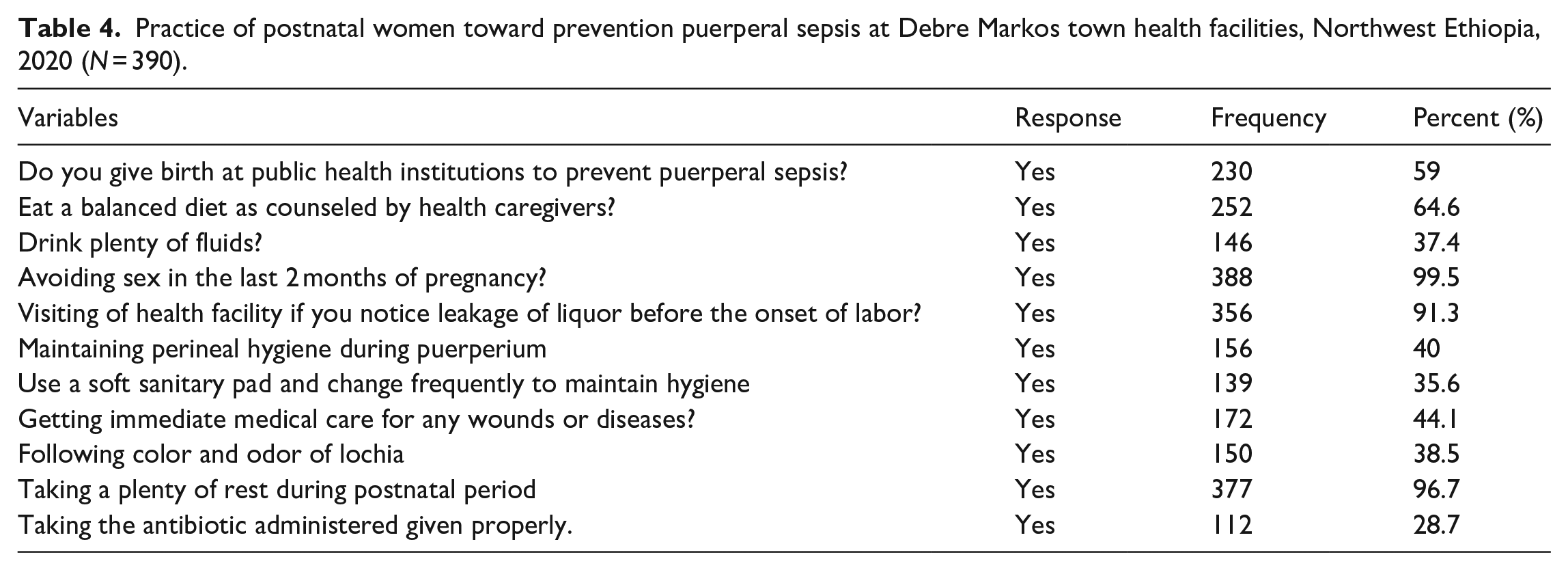
Regarding the practice of postnatal women about the prevention of puerperal sepsis, 230 (59%) of the respondents revealed that giving birth at public health facilities prevents puerperal sepsis. In all, 252 (64.6%) postnatal women ate a balanced diet, and 146 (37.4%) took plenty of fluids. Almost all respondents, 388 (99.5%), abstained from sexual activity in the past 2 months of pregnancy, and 356 (91.3%) visited the health facility as they noticed leakage of liquor immediately.
Even if 40% (156) of study participants maintained perineal hygiene during the puerperium, only 35.6% (139) of them used and replaced soft sanitary pads to maintain hygiene. More than 60% (240) of the respondents did not monitor the color and odor of lochia. This study reported that 172 (44.1%) of study participants seek medical care for any disease or wound during the puerperium period. But only 112 (28.7%) of study participants took the prescribed antibiotics correctly. In all, 377 (96.7%) took plenty of rest during the postnatal period (Table 4).
Practice of postnatal women toward prevention puerperal sepsis at Debre Markos town health facilities, Northwest Ethiopia, 2020 (N = 390).
According to this study, out of the total respondents, 159 (40.8%) of postnatal women had good practice toward prevention of puerperal sepsis with 95% CI (35.92–45.67), the rest 231 (58.2%) respondents had inadequate practice toward prevention of puerperal sepsis.
Factors associated with knowledge of postnatal women toward prevention puerperal sepsis
Urban residence, having ANC follow-up, being primipara, and attending formal education were associated knowledge of postnatal women about prevention of puerperal sepsis in bivariate logistic regression. But only living in urban, being primipara, and attending formal education were remained significantly associated with knowledge of postnatal women about prevention of puerperal sepsis in multivariate logistic regression.
This study revealed that postnatal women who lived in urban were 5.84 times more likely to be knowledgeable than postnatal women who lived in rural [adjusted odds ratio (AOR) = 5.84, 95% CI = (3.54–9.46)]. According to this study, primipara women were 1.85 times more likely to be knowledgeable about the prevention of puerperal sepsis than multipara women [AOR = 1.85, 95% CI = (1.19–2.89)]. This study also revealed that postnatal women who attend formal education were 2.41 times more likely to be knowledgeable than those who did not attend formal education [AOR = 2.41, 95% CI = (1.11–5.22)] (Table 5).
Factors associated with knowledge of postnatal women toward prevention puerperal sepsis at Debre Markos town public health facilities, Northwest Ethiopia, 2020 (N = 390).

CI: confidence interval; AOR: adjusted odds ratio; COR: crude odds ratio.
Significance at a p value < 0.05.
Factors associated with the practice of postnatal women toward prevention puerperal sepsis
Residence, level of education, and knowledge of postnatal women were associated factors with the preventive practice of puerperal sepsis in bivariate logistic regression. Finally, attending formal education [AOR = 2.46, 95% CI = (1.13–5.37)], and knowledge of postnatal women about the prevention of puerperal sepsis [AOR = 2.34, 95% CI = (1.49–3.67)] were factors that remained significantly associated with the practice of women toward prevention of puerperal sepsis (Table 6).
Factors associated with the practice of postnatal women toward prevention puerperal sepsis at Debre Markos town public health facilities, Northwest Ethiopia, 2020 (N = 390).

CI: confidence interval; AOR: adjusted odds ratio; COR: crude odds ratio.
Discussion
As puerperal sepsis remains the one major cause of maternal mortality, this study aimed to assess the knowledge and practice of postnatal women toward the prevention of puerperal sepsis and the associated factors at Debre Markos town health facilities in Northwest Ethiopia.
This study revealed that about (26.4%) of the study participants were in the age group of 25–29 years old. This result is inconsistent with studies done in Bangladesh and India.7,8 But this result is consistent with a study in Ethiopia that reported the majority of respondents were in the age groups of 25–29 years old. 3 This study also revealed that the majority of (64.9%) study participants were living in urban areas. This result is comparable to a study in Bangladesh, in which the majority of study participants (62%) were living in urban areas. 7
In this study, about 44.6% of postnatal women had adequate knowledge about the preventive practice of puerperal sepsis. This finding is higher than studies from Egypt (17.3%) 12 and India (35%) 8 of postnatal women had adequate levels of knowledge toward the prevention of puerperal sepsis. The result is comparable with a study in Bangladesh, in which 39.3% of study participants had adequate knowledge. 7 This result is lower than a study in India in which 50% of study participants had adequate knowledge of the prevention of puerperal sepsis. 9 Differences in sociodemographic characteristics of study participants, time differences between studies, and changes in postnatal women’s awareness level through times due to accessibility and utilization of maternal health services may contribute to this inconsistency. The difference in the quality of maternal health services provided may also contribute to this difference.
This study found that postnatal women living in urban were 5.84 times more likely to be knowledgeable than those living in rural. This result is inconsistent with a study done in Bangladesh. 7 This difference may be because urban residents may have better access to health information and maternal health services compared with rural residents, as most of the study participants in this study were from urban residents. But this result is in line with a study in India as the residence of postnatal women statistically was significant with the knowledge level of postnatal women about prevention of puerperal sepsis. 8
In this study, primipara postnatal women were 1.85 times more likely to be knowledgeable than multipara. The possible reason may be that primipara needs intensive education and emotional support to alleviate the difficulties associated with their first childbirth 14 that contribute to their high level of knowledge. 15 This result is incomparable with a study in India knowledge score was not significantly associated with parity of postnatal women. 8 This discrepancy may be due to the difference in sociodemographic characteristics of study participants.
The current study found that postnatal women who attended formal education were 2.41 times more likely to be knowledgeable compared with counterparts. The result is consistent with a study in India 8 and Bangladesh. 7 The reason may be women’s education levels increase, exposure to information about puerperal sepsis will increase. The more educated women may be motivated to know about the health, risk factors, and prevention means, as higher education among women provides an opportunity for easy access to health information to become aware of their health. 16
The study found that 40.8% of postpartum women had good practice against puerperal sepsis. This finding is in line with a study done in Bangladesh that 43.3% of postnatal women had good practice against puerperal sepsis. 7 But this result is higher than studies in India in which 62% and 94% of mothers had poor preventive measures against puerperal sepsis.8,9 This result is inconsistent with a study in Egypt that 74.7% had poor preventive practice of puerperal sepsis. 12 This discrepancy may be due to time difference between studies and variation in the scale of measurement of the overall prevention practice of postnatal women against puerperal sepsis.
The study revealed that postnatal women who attended formal education and had adequate knowledge were 2.46 and 2.34 times more likely to have good preventive practice against puerperal sepsis compared with counterparts, respectively. The reason is that the knowledge and practice of preventing infection in the early postpartum period affect each other positively. 9
Limitation of the study
The study did not assess the perspectives of postnatal women in private health facilities and partner/relative perspectives. The study’s cross-sectional nature limits the determination of causation between independent variables factors and the outcome variable. Moreover, the study did not include the rural population, which restricts its scope.
Conclusion
Since there is no published study in Ethiopia in a similar study setting, this study aimed to assess the knowledge and practices of postnatal women about the prevention of puerperal sepsis and the associated factors. Less than half of postnatal women had adequate knowledge and good preventive practice of puerperal sepsis. Postnatal women’s residence, parity, and education level had shown statistical significance with knowledge toward puerperal sepsis prevention. Attending formal education and being knowledgeable was associated with good preventive practices among postnatal women. Therefore, appropriate health education packages on risk factors of puerperal sepsis during ANC and labor and delivery by health caregivers and other concerned bodies should be considered to improve the knowledge of postnatal women. Interventions to raise the community’s educational level should be considered.
Supplemental Material
sj-docx-1-smo-10.1177_20503121221085842 – Supplemental material for Prevention of puerperal sepsis in northwest Ethiopia: Knowledge and practice of postnatal women; A multicenter cross-sectional study
Supplemental material, sj-docx-1-smo-10.1177_20503121221085842 for Prevention of puerperal sepsis in northwest Ethiopia: Knowledge and practice of postnatal women; A multicenter cross-sectional study by Keralem Anteneh Bishaw, Shewangzaw Worku and Melkamu Tilahun in SAGE Open Medicine
Footnotes
Acknowledgements
The authors are indebted to Debre Markos University, School Medicine & College Health Sciences, and Dept. of Midwifery for its technical support. They are also very grateful to the East Gojjam Zone health bureau staff for their kind assistance during the entire process of the study. Special thanks go to the research assistants who participated in data collection.
Author contributions
K.A.B. and S.W. conceptualized the proposal, searched the literature, trained field researchers for data collection, and wrote the “Results” and “Discussion” sections. K.A.B. also prepared the draft for the first manuscript. K.A.B. and M.T. contributed to the design of the study, data interpretation, and analysis. K.A.B. also critically reviewed and edited the manuscript. All the authors read and approved the final manuscript.
Availability of data and materials
All the data included in the manuscript can be accessed from the corresponding author at the email address
Declaration of conflicting interests
The author(s) declared no potential conflicts of interest with respect to the research, authorship, and/or publication of this article.
Ethical approval
Ethical clearance was obtained from the school of Medicine Ethical Review Committee, Debre Markos University (Ref. No. S/R/T 25/03/20). A permission letter was secured from the East Gojjam Zone health bureau and Debre Markos town health office. This study was conducted in accordance with the Declaration of Helsinki.
Funding
The author(s) received no financial support for the research, authorship, and/or publication of this article.
Informed consent
Written informed consent was obtained from all participants before the study. In addition, written informed consent was also obtained from legally authorized representative of the minor (aged less than 18 years) subjects included in the study. The method was approved by the Ethical Review Committee. Confidentiality of information and privacy of study participants was respected.

Supplemental material
Supplemental material for this article is available online.
References
Supplementary Material
Please find the following supplemental material available below.
For Open Access articles published under a Creative Commons License, all supplemental material carries the same license as the article it is associated with.
For non-Open Access articles published, all supplemental material carries a non-exclusive license, and permission requests for re-use of supplemental material or any part of supplemental material shall be sent directly to the copyright owner as specified in the copyright notice associated with the article.
