



Abstract
Introduction:
Pain management is a very important aspect of nursing care. However, due to a lack of overall understanding, it is not uncommon to see inadequate pain management by health workers. Therefore, the knowledge and attitude of nurses are important factors for the effective management of pain in children. Thus, the objectives were to determine the knowledge and attitude toward pediatric pain management among the nurses in the University of Gondar Comprehensive Specialized Hospital, Northwest Ethiopia.
Methods:
An institutional-based cross-sectional study was conducted from 1 to 30 March 2020 among 393 participants. A simple random sampling technique was used to select the study subjects. The data were collected by using a structured, pre-tested, self-administered questionnaire. The data were entered into EpiData version 3.02 and exported into SPSS version 22 for analysis. Bivariable and multivariable logistic regressions were computed to identify the factors associated with the knowledge and attitude of nurses. An adjusted odds ratio with a 95% confidence interval was computed, and variables with a p-value < 0.05 in the multivariable analysis were used to declare the significance and strength of association.
Result:
A total of 267 (67.94%) of the respondents had good knowledge and 262 (66.7%) had a favorable attitude toward pediatric pain management. Working in the outpatient department (AOR = 0.48; 95% CI = 0.23–0.98) had a significant association with knowledge. Nurses who were trained (AOR = 2.47; 95% CI = 1.53–3.99), having good knowledge level (AOR = 2.16; 95% CI = 1.34–3.50), having 6–10 years of work experience (AOR = 2.64; 95% CI = 1.23–5.63), and >10 years of work experience (AOR = 9.02; 95% CI = 2.50–32.74) were significantly associated with the attitude toward pediatric pain management.
Conclusion:
The majority of nurses had good knowledge and a favorable attitude toward pediatric pain. Working in the outpatient department was associated with poor knowledge. Trained nurses, having good knowledge, and having >6 years of work experience were associated with favorable attitudes.
Introduction
Pain is a subjective and unpleasant stimulus that is mostly experienced by children who have physical, emotional, perceptive, and behavioral components that are interconnected with environmental, developmental, sociocultural, and background factors. 1 It is mostly considered ineffectively assessed and undertreated. Pain is one stressful experience that is reflected to be a worldwide health problem, and children are the most exposed and under-served population. Even though there is an exponential increase in scientific proof for pediatric pain in the last few decades, there are many barriers to managing pain in children. As a result, children still experience unnecessary pain during hospitalization due to ineffective and inefficient pain management. 2
Pain management is a very important aspect of nursing care and according to the International Association for the Study of Pain (IASP) and Special Interest Group on Pain in Childhood, pain relief is a human right. 3 Overall, 20%−35% of children and adolescents are affected by moderate-to-severe pain worldwide. 4 These figures indicate that pain is one of the most common problems which needs medical attention in children. 4 On the contrary, pain management services are not easily available to children in the developing world, where there is difficult to give standard care. 5 Pediatric pain management has been left largely unaddressed due to factors such as limited resources, inadequate training, as well as cultural diversity and language barriers which made sick and injured children not receive basic pain care. 6
The role of a nurse in pain management encompasses the entire nursing process. The nurse assesses for the presence of pain, plans pharmacological and non-pharmacological pain management strategies with the medical team, implements the plan, and evaluates the effectiveness of the interventions. 1 However, inadequate pain management is evident across all ages. Reports have found that children receive less analgesia than adults, which indicates that a significant number of hospitalized children experience unacceptable levels of pain. 7 Inadequate treatment is more common in the emergency department where a majority of cases experience pain, children get insufficient analgesia than adults, and at the same time younger children receive fewer anti-inflammatory drugs than older children. 8
Poor understanding of healthcare professionals is one of the most common problems in children’s pain management. Learning about pain management and children’s pain behavior might also improve nurses’ ability to manage pain in children.7,9–11 A previous study also mentioned that not only the knowledge level but also the attitudes of nurses can affect their ability to give effective pediatric pain management. 12
Barriers to effective pain management include the absence of pain education and assessment tools, parents’ reluctance to report pain, and insufficient prescription of analgesia by physicians. 13 Moreover, lack of knowledge about opioids, negative attitudes toward prescribing opioids, inadequate pain-assessment skills, and lack of communication skills create major barriers to pain relief. 14 Inadequately treated pain leads to experience unnecessary suffering due to poorly controlled pain, increasing their risk of chronic persistent pain in their adult lives. Undertreated pain also may increase morbidity and mortality, while persistent and severe pain may change the nervous system in a way that intensifies spread and prolongs the pain, medical phobias, delayed wound healing, and behavioral changes in children.10,15
Research related to nurses’ knowledge regarding pain assessment and management in hospitalized children also remains limited in the study area. To improve both the quality of care and healthcare outcomes, it is essential to explore the level of knowledge and attitude related to pain management. So, this article aims to identify nurses’ knowledge, attitude, and associated factors toward pediatric pain management in the University of Gondar Comprehensive Specialized Hospital, Northwest Ethiopia.
Methods and materials
Study setting
This study was conducted at the University of Gondar Comprehensive Specialized Hospital, Northwest Ethiopia, which is located in Gondar town. Gondar town is about 750 km far from Addis Ababa, the capital city of Ethiopia. The University of Gondar Comprehensive Specialized Hospital is a teaching hospital, which serves more than 5 million people and contains different kinds of wards with abroad services. In the hospital, there are more than 920 healthcare professionals. Of them, about 500 are nurses who are assigned to different units. The pediatric care department has the main ward, emergency unit, malnutrition and oncology ward, and outpatient department (OPD).
Study design, period, and population
An institutional-based cross-sectional study was conducted from 1 to 30 March 2020. The source populations for this study were all nurses working in the Gondar University Comprehensive Specialized Hospital. The study populations were all nurses who are working in the Gondar University Comprehensive Specialized Hospital during the study period.
Sample size determination and procedure
The required sample size was determined by using a single population proportion formula by considering 95% confidence interval (CI), 5% margin of error, proportion = knowledge = 58.6%, 16 and 10% of the calculated sample size was added to compensate the non-response rate:

where N is the sample size, Z is the value corresponding to a 95% level of significance of 1.96, p is the prevalence in the previous study (i.e. 58.6% = 0.586), q = (1 – p) = (1 – 0.58) = 0.414, and d is the margin of error assumed to be 5%.
Therefore, based on the above single population proportion formula, the sample size was calculated as
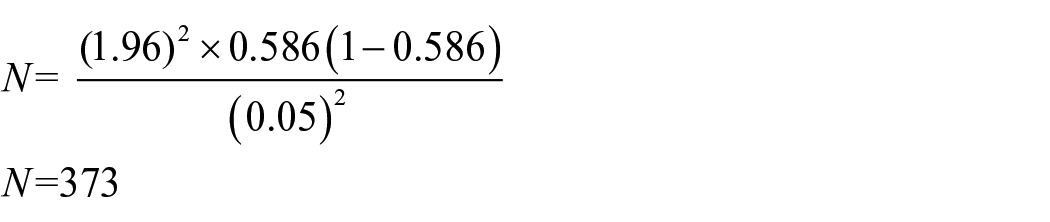
Finally, after adding a 10% non-response rate, the estimated total sample size became 411. A computer-generated simple random sampling technique was used to select the study participants after proportional allocation within each working unit in the hospital, including pediatrics, medical, surgical, ophthalmology, fistula, dialysis, oncology, and OPDs.
Operational definition
Good knowledge: knowledge status of nurses when they scored mean and above;
Poor knowledge: knowledge status of nurses when they scored less than mean;
Favorable attitude: attitude status of nurses when they scored mean and above;
Unfavorable attitude: attitude status of nurses when they scored less than mean.
Data collection tool, procedures, and quality control measures
Data were collected using a structured and pre-tested self-administered questionnaire among the nurses working in the University of Gondar Specialized Hospital. The pretest was done on 10% of the nurses who were working in Debark Hospital. The questionnaire was adopted from Pediatric Nurses’ Knowledge and Attitudes Survey Regarding Pain (PNKAS) which is a validated tool. 12 The questionnaire had four parts: sociodemographic characteristics of respondents, knowledge-related questions, attitude-related questions, and factors associated with the knowledge and attitude of pediatric pain management–related questions. There were 10 questions to assess the knowledge and 10 questions to assess the attitude. Scoring and interpretation were done as mentioned in the “Operational definition” section.
The questionnaires were distributed for selected samples by data collectors while they were on their duty and asked to fill and return after 1 day. Four trained BSc nurses and one MSc nurse supervisor were recruited and participated throughout the data collection procedures. The training was given for data collectors for 1 day to ensure all the group members had the same understanding of the data collection tool. The completeness, accuracy, and consistency of the collected data were checked daily.
Statistical analysis
The data were entered into EpiData version 3.02 and then exported to SPSS version 22 for analysis. The descriptive statistics were identified to describe the study participants and presented with tables, graphs, and charts.
There were 10 questions to assess the knowledge level and attitude level separately, each having one correct answer. Therefore, the possible total knowledge level could be 0–10. The mean knowledge and attitude level was used as the cutoff point to classify as poor/unfavorable or good/favorable knowledge and attitude.
Since attitude questions had three categories (agree, not sure, and disagree), for final analysis, the response was dichotomized into “agree” in one category and the remaining two groups (not sure and disagree) into another category.
Both bivariable and multivariable binary logistic regression models were used to identify the independent predictors of good knowledge and favorable attitude toward pediatric pain management. Odds ratios and their 95% CIs were computed, and variables with p-values ⩽ 0.05 were considered statistically significant.
Results
Participant characteristics
A total of 393 nurses participated in the study, with a 95.4% response rate. More than half of the participants (255, 64.9%) were in the age range of 22–30 years (mean age ± SD = 30.49 ± 5.83) and female (221, 56.2%). Slightly more than one-third of the respondents (138, 35.1%) had 3–5 years of work experience. Regarding the academic qualification of the respondents, 7 (1.8%), 366 (93.1%), and 20 (5.1%) had a diploma, bachelor’s, and master’s degree, respectively (Table 1).
Sociodemographic and other characteristics of nurses working in the University of Gondar Comprehensive Specialized Hospital, Northwest Ethiopia, 2020 (N = 393).

Knowledge of nurses toward pediatric pain management
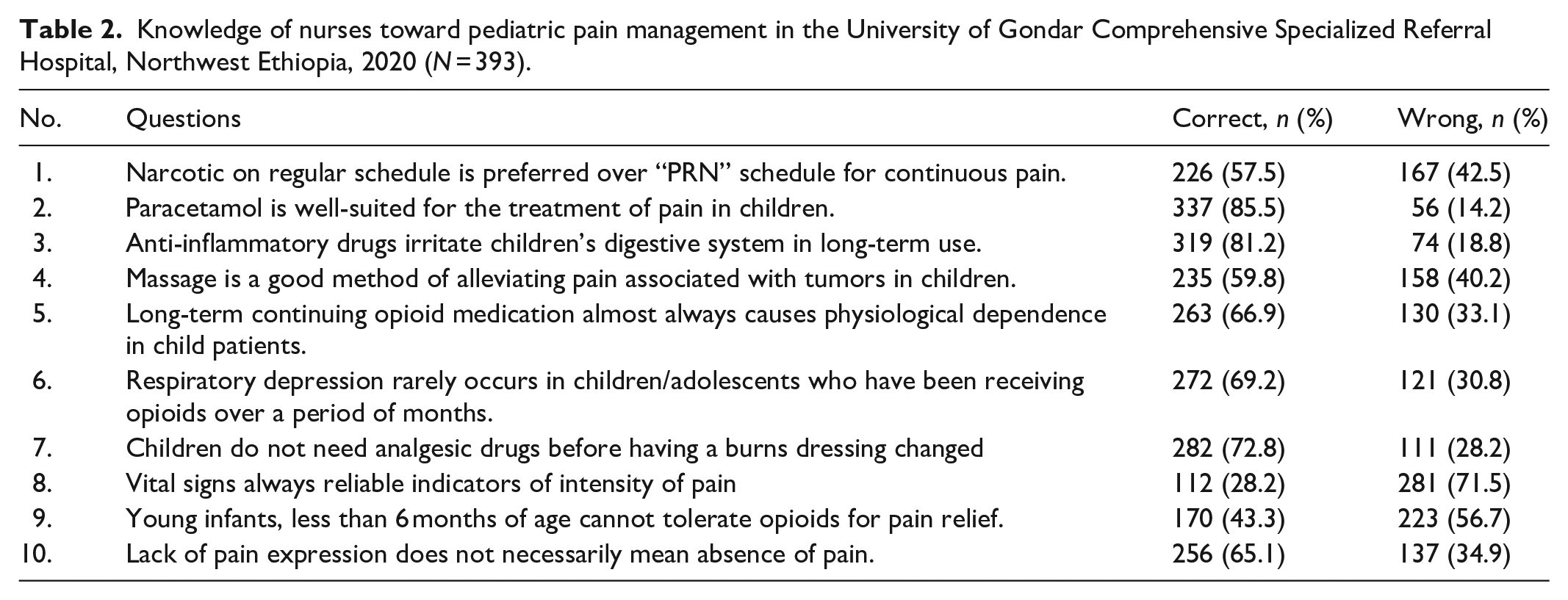
In this study, the minimum and maximum scores were 1 and 10 out of 10, respectively, with a mean score of 6.29 (SD = 1.74). The majority 337 (85.5%) responded that paracetamol is well-suited for the treatment of pain in children and also 319 (81.2%) agreed that the long-term use of anti-inflammatory drugs irritates the children’s digestive system. In total, 256 (65.1%) respondents answered that children do not need analgesic drugs before having burn dressing changed. About 88.8% of the respondents knew that frequently assessing and documenting pain is important, whereas 11.2% responded not important for patients who can communicate (Table 2). About 67.94% (95% CI = 63.5–72.6) had good knowledge about pain management in children (Figure 1).
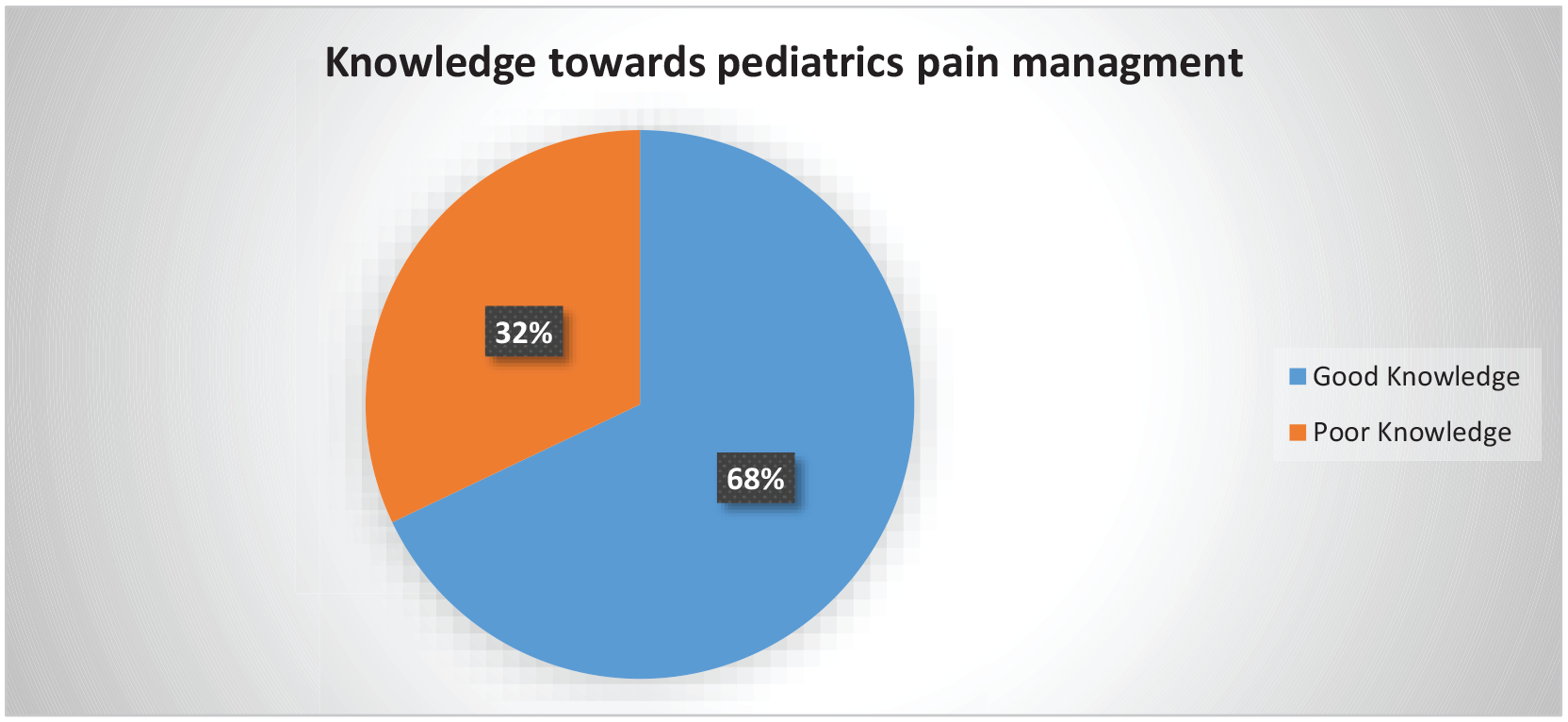
Knowledge toward pediatric pain management among the nurses working in the University of Gondar Comprehensive Specialized Hospital, Northwest Ethiopia, 2020 (N = 393).
Knowledge of nurses toward pediatric pain management in the University of Gondar Comprehensive Specialized Referral Hospital, Northwest Ethiopia, 2020 (N = 393).
Factors associated with the knowledge of nurses toward pediatric pain management
In the multivariable logistic analysis model, only the working ward had a significant association with the knowledge of pediatric pain management; however, age, work experience, ever worked in the pediatric ward, reading guidelines, and rotation did not. Nurses who worked on the OPD were 52% less likely to have good knowledge compared to nurses who worked in the pediatric ward (Table 3).
Factors associated with the knowledge of nurses for pediatric pain management in the University of Gondar Comprehensive Specialized Hospital, 2020 (N = 393).

CI: confidence interval; OR: odds ratio; COR: Crude odds ratio; AOR: adjusted odds ratio.
Statistically significant at p-value ⩽ 0.05, other = fistula, dialysis, and ophthalmology.
Nurses’ attitude toward pediatric pain management
The majority of nurses (351, 89.3%) agreed with the statement that pain management and pain relief are of priority in children. More than three-fourth of participants agreed that play therapy (313, 79.6%) and pain-assessment tools (312, 79.4%) are essential in children’s pain management. In total, 210 (53.4%) respondents disagreed with the statement that children tolerate pain better than adults; however, a substantial number of participants (127, 32.3%) agreed. Overall, 66.7% (95% CI = 61.7–72.1) of respondents had a favorable attitude about pain management with a mean score of 25.856 (± 2.95 SD). The maximum and the minimum scores of the participants were 30 and 14, respectively (Table 4).
Attitude of nurses according to their degree of agreement in the University of Gondar Comprehensive Specialized Hospital, 2020 (N = 393).

Factors associated with the attitude of nurses toward pediatric pain management
In multivariable analysis, variables such as in-service training, years of working experience, and knowledge level had a significant association with the attitude of nurses.
Our findings revealed that nurses trained in pain management had a more favorable attitude compared to those nurses who did not take training (AOR = 2.47; 95% CI = 1.53–3.99). Similarly, nurses with working experience of 6–10 years (AOR = 2.64; 95% CI = 1.23–5.63) and more than 10 years (AOR = 9.02; 95% CI = 2.50–32.74) had, respectively, 2 and 9 times exceeding positive attitude as compared to those with less than 2 years of experience. Finally, nurses who had good knowledge were 2.16 times more likely to have a favorable attitude than those who had poor knowledge (AOR = 2.16; 95% CI = 1.34–3.50) (Table 5).
Factors associated with the attitude of nurses for pediatric pain management in the University of Gondar Comprehensive Specialized Hospital, 2020 (N = 393).

CI: confidence interval; OR: odds ratio; COR: Crude odds ratio; AOR: adjusted odds ratio; OPD: outpatient department.
Statistically significant at p-value ⩽ 0.05.
Discussion
Pain is a major source of distress for children and their families as well as healthcare providers. In this study, 67.94% of nurses had good knowledge about pain management and this finding was consistent with the studies done in Bangladesh (66.79%). 17 This might be due to the similarity of the study design, study setting, and study population. However, the finding of this study was lower than a study conducted in Australia (77.56%). 9 The possible justification for this difference might be due to the differences in the study setting. The study conducted in Australia included only those nurses who were working in pediatric surgical wards, which might increase their knowledge of the subject matter because of the recent exposure to pain management in children. In addition, the study done in Australia included nurses who were working only in a tertiary pediatric hospital, and did not include other nurses, which might escalate their knowledge level.
However, the result of this study also showed that nurses’ knowledge toward pain management was higher than the studies done in Mekelle city (58.6%), 16 Nigeria Calabar Metropolis health center (60%), 10 and Uganda Mulago Hospital (41%). 18 The reason behind this inconsistent finding between these studies might be due to the differences in the study setting, educational level of nurses, and the data collection tool. A study done in Mekelle city includes three public hospitals which is a multicenter study and the participants were diploma and bachelor holders, whereas this study was done in a single referral hospital and includes also MSc degree holders. In addition, studies performed in Nigeria and Uganda used a comprehensive tool to assess the knowledge of pain management for all patients regardless of age category, whereas this study focused on pediatric pain management.
Based on the multivariable logistic regression model, only the current working area or ward was significantly associated with knowledge. Nurses working in the OPD were 52% less likely to have good knowledge as compared to those nurses working in the pediatric ward. This is because of the reason that nurses working in the pediatric ward had more theoretical and practical exposure to pain management in children as compared to nurses working in the outpatient unit. Unlike this, a study done in Mekelle city stated that nurses who had pediatric pain management protocols were more likely to be knowledgeable than their counterparts. 16 In this study, however, in line with other studies, no statistically significant association was found between nurses’ knowledge and their age, gender, years of working as pediatric nurses, or educational level. 19
Regarding attitude, in this study, more than half (66.7%) of the participants had a favorable attitude. This finding was analogous to a study done in Bangladesh (66.79%) 17 and lower than a study done in Uganda (75%), 20 Australia (72.46%), 9 and Malaysia (78.5%). 21 Nevertheless, our study finding was higher than the studies done in Western Ethiopia (49.8%) 22 and Zimbabwe (56%). 23 This variation might be due to the differences in the study setting and assessment tool. A study conducted in Western Ethiopia had a multicenter setting (23 health centers), whereas our study was conducted in a single institution which is a tertiary-level hospital and had also MSc degree nurses. In a study done in Zimbabwe, the clinical setting of participants was only a medical ward, whereas our study included all clinical setting areas.
Based on multivariable analysis, trained nurses (AOR = 2.47; 95% CI = 1.53–3.99), those who had good knowledge level and 6–10 years (AOR = 2.64; 95% CI = 1.23–5.63) and more than 10 years (AOR = 9.02; 95% CI = 2.50–32.74) of working experience, had a favorable attitude on pediatric pain management. In our study, trained nurses were 2 times more likely to have a favorable attitude as compared to those nurses who did not take training. Similarly, nurses who had good knowledge were 2.16 times more likely to have a favorable attitude than those who had poor knowledge. This was supported by a study done in Egypt in which nurses who were not attending the course, seminar, or lecture on pain were less likely to have a favorable attitude than those who were attending the course, seminar, or lecture. 24 Similarly, a study done in Jordan also reports that nurses with previous education on pediatric pain management got higher mean scores and had a favorable attitude than those nurses who were not exposed to pain education. 25
Finally, nurses with work experience of 6–10 years and more than 10 years were, respectively, 2 and 9 times more likely to have a favorable attitude as compared to those nurses with less than 2 years of experience. This finding contradicts a study done in Turkey in which those nurses with work experience of 1–5 years scored significantly higher than the nurses who had ⩾10 years of experience. 26 This variation might be because the nursing education is raised to bachelor’s degrees, and the less experienced nurses have bachelor’s and master’s degrees in Turkey. 26
However, this study is not without limitations. The following should be considered while interpreting the findings. First, since this is a cross-sectional study, it does not show the cause-and-effect relationship between the independent variables with the knowledge and attitude of pediatric pain management. Second, since this is a self-reported study, survey respondents’ bias is possible. Besides, this study was done through a quantitative approach, so it lacks to incorporate other determinant factors of knowledge and attitude toward pediatric pain management.
Conclusion and recommendation
According to this study, the majority of the respondents had good knowledge and a favorable attitude toward pediatric pain management. Working in OPDs has a negative significant association with the knowledge of pediatric pain management. Having good knowledge about pediatric pain management, increased working experience, and getting in-service training had a significant positive association with the attitude toward pain management. Therefore, for better pediatric pain management, it is recommended to provide updated documents, materials, and continuous training for nurses.
Footnotes
Acknowledgements
First, the authors would like to thank the University of Gondar College of Medicine and Health Sciences for allowing them to conduct this study. They would also like to thank the managers of the University of Gondar Referral Hospital for their support. Finally, they would like to thank the data collectors, supervisors, and study participants. Above all, the authors are grateful to thank the Almighty God.
Author contributions
E.L. conceived and designed the study and prepared the manuscript. M.B. and S.F.K. reviewed the manuscript, provided constructive feedback in the designing phase of the study, and involved in the analysis. All the authors read the manuscript before giving the final approval for publication.
Availability of data and material
All data generated or analyzed during this study are included in this article.
Declaration of conflicting interests
The author(s) declared no potential conflicts of interest with respect to the research, authorship, and/or publication of this article.
Funding
The author(s) received no financial support for the research, authorship, and/or publication of this article.
Ethical approval
Ethical clearance was obtained following the tenets of the Declaration of Helsinki. It was obtained from the University of Gondar College of Medicine and Health Sciences Ethical Review Committee (reference no. 1855/02/2020). A permission letter was also obtained from the University of Gondar Comprehensive Specialized Hospital management office. The data abstraction tool did not contain any kind of personally identifying information and confidentiality was assured during all phases of research activities.
Informed consent
Written informed consent was obtained from all participants before the study.
