




Abstract
The results of numerous studies indicate that male students achieve better results on economic knowledge tests than their female classmates. Although this phenomenon has been known for a long time, the gender-specific mechanisms of this gap have not been explored in depth. According to social and educational scientific theories and the current state of research, interest and media use could be related to gender. In this study, we administered a German adaption of the internationally accepted Test of Economic Literacy to explore the gender gap in the economic knowledge of 983 students from 62 classes at 7 vocational secondary schools and commercial vocational schools specializing in business and economics in Germany to determine whether it is significantly influenced by interest and media use. The results indicate that a considerable part of the gender gap can be clarified by effects of interest in economic topics and the use of media to research them. Implications for social and economic education are discussed.
Introduction
It has been known for years that there is great disparity in the performance of students at regular secondary schools in Germany (Matthewes, 2018) and that these differences continue into tertiary education and professional life (Hochschulrektorenkonferenz (HRK), 2016; Morgan, 2012; Zwick, 2012). Even at vocational schools that students choose to attend because of their interest in a particular subject, some significant differences in performance have been found (Billet, 2011; Jacob and Solga, 2015). This is the case for economic knowledge, which plays a central role at vocational secondary schools and commercial vocational schools in Germany, 1 where the primary aim is to develop students’ practical vocational skills and theoretical knowledge of business and economics. These differences in performance continue into tertiary education, as shown by the results of studies of higher education students’ economic knowledge (Brückner et al., 2015; Förster et al., 2015; Happ et al., 2016b). In addition to characteristics such as social background (Bartlett, 2012) and migration background (Happ et al., 2018; Hurrelmann, 2009), gender plays a major role in the acquisition of economic knowledge.
The gender gap in economic knowledge, which is in favor of males, has been found in numerous studies over a very long research period in several countries (Beck, 1993; Brandlmaier et al., 2006; Jackstadt and Grootaert, 1980; Müller et al., 2007; Schumann and Eberle, 2014; Walstad et al., 2013). The reasons for male test takers’ better performance on knowledge tests of economics have not been sufficiently researched (e.g. Asarta et al., 2014). Factors in addition to gender have been found to influence economic knowledge but have received little attention in research. For example, interest in a topic (cf. Krapp and Ryan, 2002) and use of media to research a topic (cf. Wirth, 1997; Würth and Klein, 2001) have been found to correlate with knowledge in that topic. Furthermore, both interest in a topic and the use of media to research a topic could be connected to gender (see Würth and Klein, 2001). The aim of this article is to determine whether the gender gap in the economic knowledge of students at vocational schools in Germany can be explained in part by interest in economic topics and by the use of media to research such topics.
First, we explore the construct of economic knowledge and present theories about and current findings on the gender effect in economic knowledge as well as the relationship among interest in economic topics, media use, and economic knowledge. Second, we formulate hypotheses in line with the current state of research. Third, we describe the test instrument administered to gather data on students’ economic knowledge as well as our sample of students from vocational secondary schools and commercial vocational schools specializing in business and economics in Germany. Fourth, we discuss the results of multi-level models and test our hypotheses. Finally, we draw conclusions about the results, discuss implications for vocational training, present limitations of the study, and offer an outlook for future research on economic education.
State of research and hypotheses
Economic knowledge
Economic knowledge is defined as the understanding about current concepts and basic principles of economics (based on Beck, 1993). Knowledge in 20 sub-themes such as shortage, supply and demand curve, and opportunity costs is included in this definition (Council for Economic Education (CEE), 2010). Economic knowledge is, thus, part of “economic-civic competence” (cf. Ackermann and Siegfried in this issue; Eberle et al., 2016) and as such can be distinguished from vocational and business-related knowledge and competences. In a global world with increasingly complex economic relations and processes, economic knowledge is needed to be able to participate actively in society, and it helps people understand and assess the economically shaped conditions in which they live (Albers, 1994; Kaminski, 1996; Seeber et al., 2012) and subsequently make meaningful decisions for their future and overall well-being. Furthermore, economic knowledge is considered essential in vocational training because an understanding of basic principles of economics is needed to be able to perform many tasks in companies. Results of studies of higher education indicate that knowledge developed at school forms an important basis for acquiring knowledge in post-secondary education programs (Beck and Wuttke, 2004; Happ et al., 2016b). This means that the economic knowledge students gain at vocational secondary schools or in commercial vocational training programs plays an important role in the acquisition of their economic knowledge later on (for gender-specific differences during transition from secondary school to post-secondary studies, see Jüttler and Schumann in this issue). For these reasons, economic knowledge has received increasing attention in research in the fields of social sciences and economics.
The gender effect on economic knowledge
Studies have revealed that male students in the United States usually achieve higher scores on economic knowledge tests than female students (cf. Asarta et al., 2014; Davies et al., 2005; Makridou-Bousiou, 2006; Owen, 2012; Walstad and Robson, 1997; Williams et al., 1992). In studies conducted in Germany, the same relationship with partly significantly stronger effects in favor of male test takers has been found (for high school students, see Beck, 1993; Lüdecke-Plümer and Sczesny, 1998; for university entry students, see Beck and Wuttke, 2004; Happ et al., 2016a; for Switzerland, see Schumann and Eberle, 2014; Schumann et al., 2013). In these studies, the strength of the gender effect differed according to country even though the same (adapted) test instrument was administered (Brückner et al., 2015; Förster et al., 2015). Nevertheless, across the countries in which the studies were conducted gender-related differences in the socialization of young adults were observed. Results of previous studies (Schmitt et al., 2017) underline that gender role patterns can affect knowledge acquisition. 2 It is to be expected that differences in knowledge acquisition between the genders will affect the level of economic knowledge in a test situation. On this basis, our first hypothesis (H1) about the effect of gender on economic knowledge is formulated as follows:
H1. Male students will exhibit greater economic knowledge than female students.
Correlation among interest, media use, and economic knowledge
The correlation among interest, media use, and the acquisition of knowledge can be well explained by the person–object theory (cf. Krapp, 1992, 2000; Schiefele et al., 1983), which maintains that great interest in a particular topic leads to intensive engagement with it and subsequently to a higher level of knowledge of that topic. Accordingly, in this study, interest in economic topics can be expected to have an effect on the engagement with economic content in the form of media use, as formulated in our second hypothesis (H2):
H2. Interest in economic topics will result in greater use of media for researching economic topics.
Economic knowledge is needed to be able to participate in current social and political discussions. Not all economic issues are covered or covered in depth in the school curricula. Thus, the development of economic knowledge in informal learning contexts is becoming increasingly important (cf. Macha et al., 2011: 5; Schuhen and Neubauer, 2015). The use of media is important in the development of the “responsible economic citizen” (cf. Schumann et al., 2013: 38). In addition, the media, particularly the Internet, offer relatively inexpensive and quick access to economics-related information (Lee and Xenos, 2019: 19). Results of research on media effectiveness indicate that there are media-specific differences in the acquisition of knowledge. In television, visualizations and simplifications (referred to as the spotlight function) often make it difficult to acquire in-depth knowledge (cf. Jäckel, 2011: 335). Print media and online journals, on the contrary, lend to the active procurement of information, as they are chosen carefully by the reader (cf. Zillien, 2006: 206). Therefore, print and online media usually have a more sustainable effect on knowledge acquisition and therefore are the focus of this article. Intensive engagement with economic topics in the form of media use should lead to increased economic knowledge, as formulated in our third hypothesis (H3):
H3. Using media to research economic topics will result in greater economic knowledge.
Using media is one way to explore economic issues. Interest can also be expected to lead to increased communication about economic topics with peers and/or family members. In numerous studies conducted in a wide variety of domains, a correlation between interest and knowledge has been identified (cf. Dolan, 2011; Köller et al., 2001; Förster et al., 2018; Rotgans and Schmidt, 2017; Tobias, 1994). 3 Studies of the relationship between interest and knowledge have also been conducted in the domain of economics (cf. Rosendahl and Straka, 2011). The fact that using media is merely one way to satisfy an interest in economic topics is taken into account in the assumption that interest is directly related to the state of economic knowledge, as formulated in our fourth hypothesis (H4):
H4. Interest in economic topics will lead to greater economic knowledge.
Influence of gender on interest and media use
Male students tend to exhibit or express greater interest in economic topics than female students (see Rosendahl and Straka, 2011; Walstad and Soper, 1989; Watts, 1987). The use of media to research economic topics has also been found to vary according to gender. In numerous studies, young male adults have been found to use media more frequently than young female adults to research economic topics (cf. Bickart and Schindler, 2001; Treumann et al., 2007; Vincent and Basil, 1997). Accordingly, our fifth and sixth hypotheses (H5 and H6) are formulated as follows:
H5. Male students will exhibit greater interest in economic topics than female students.
H6. Male students will use media to research economic topics more frequently than female students.
Ostensibly, no investigation has been made into the interaction effects among gender, interest in economics, media use to research economic topics, and economic knowledge. The question arises as to whether there are (empirical) indications that gender has a differential effect on students’ economic knowledge in connection with their interest in economic topics and the frequency of their use of media to research economic topics. For example, it is conceivable that female students, despite having the same amount of interest, use media more or less frequently than male students, and that they use different forms of media to satisfy their interests. It is also conceivable that, if male students and female students use media equally as frequently to research economic topics, they may use different forms of media to research economic topics. Consequently, male students and female students might perform differently on tests of economic knowledge. In this study, we explore these possible interaction effects by addressing the following two questions (F1 and F2):
F1. Does the correlation between interest and media use differ according to the gender of the students?
F2. Does the correlation between media use and economic knowledge differ according to the gender of the students?
Figure 1 presents a summary of our hypotheses and research questions. The type of correlations to be expected (positive or negative) is also visualized in Figure 1, according to the theoretical assumptions.
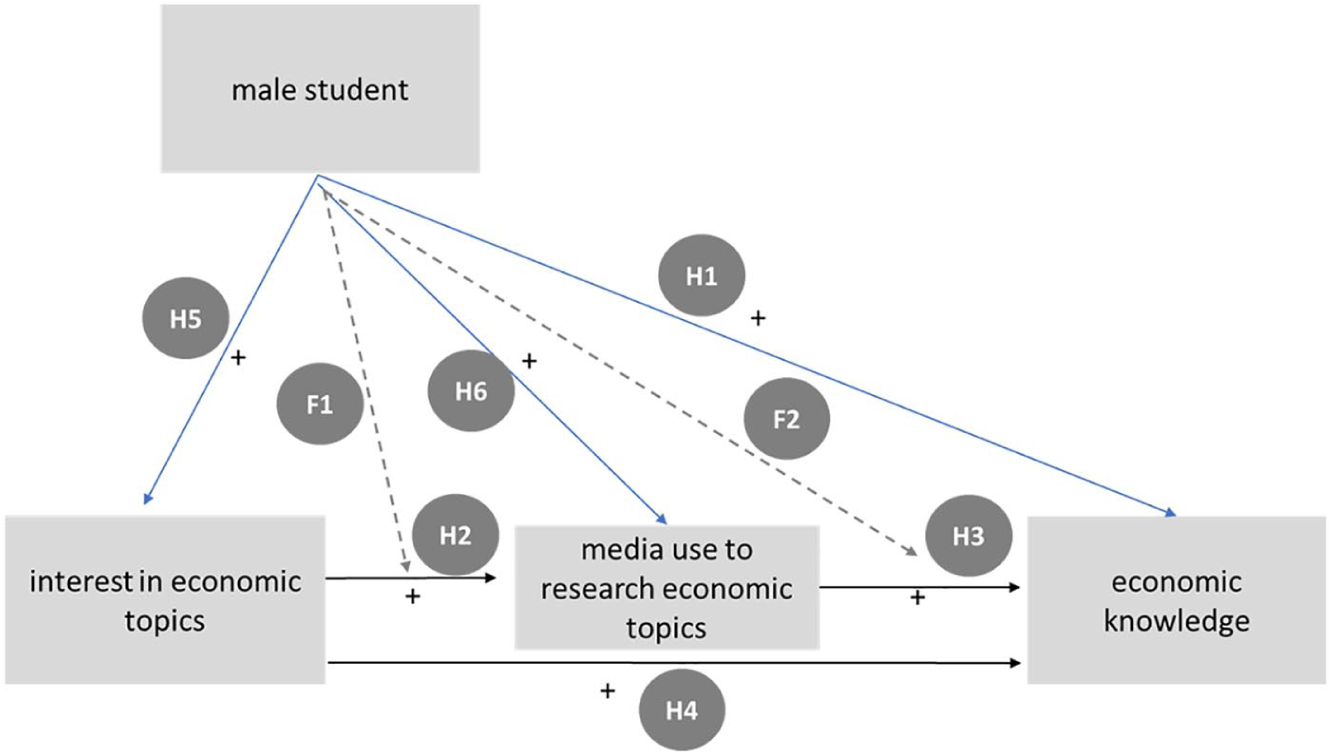
Summary of hypotheses.
Design and sample
Test instruments
The fourth edition of the Test of Economic Literacy (TEL4, Walstad et al., 2013) was used to assess economic knowledge. This test was developed by the US-American CEE. The US-American TEL4 was adapted and made available for use in German-speaking countries (TEL4-G) after a 6-month translation and adaptation process (Happ et al., 2016a). In this study, test version A of the TEL4-G was used. Thus, all test takers worked on the same 45 items. To control for the effects of the item positioning, version A was distributed once for items 1 to 45 and once for items 45 to 1.
The items of the TEL4 cover 20 content standard economic topics including core concepts such as market, price, money, shortage, and inflation. These 20 topics can be assigned to four sub-dimensions (basic economic principles, microeconomics, macroeconomics, and international relations). The test developers (Walstad et al., 2013) constructed the items to assess economic literacy at three cognitive levels: (1) knowledge, (2) understanding, and (3) application. These are oriented toward the theoretical modeling by Anderson and Krathwohl (2001).
The reliability of the scale can be described as good with a Cronbach’s alpha of 0.814. Dimensionality analyses both on the basis of item response theory (IRT, see Gonzalez et al., 1997; Swaminathan et al., 2007) and confirmatory factor analysis (CFA, see Byrne, 2012; Kline, 2005) confirm that a one-dimensional model for economic knowledge has a very good fit (Chi² = 1127.947; df = 945; root mean square error of approximation (RMSEA) = 0.014; comparative fit index (CFI) = 0.970; Tucker–Lewis index (TLI) = 0.968; expected a posteriori/plausible value (EAP/PV) = 0.83).
In addition to completing the items of the TEL4-G, the test takers indicated on a five-point Likert-type scale ranging from “not interested at all” to “very much interested” how interested they were in economic topics. In addition, they indicated on a nine-point scale ranging from “never”, “more than once a week” to “daily” how often they read daily newspapers, news magazines, and online journals to research economic topics. 4 Finally, in the sociodemographic part of the survey test takers provided personal data concerning, for example, family language, parents’ origin, age, and so on.
Sample
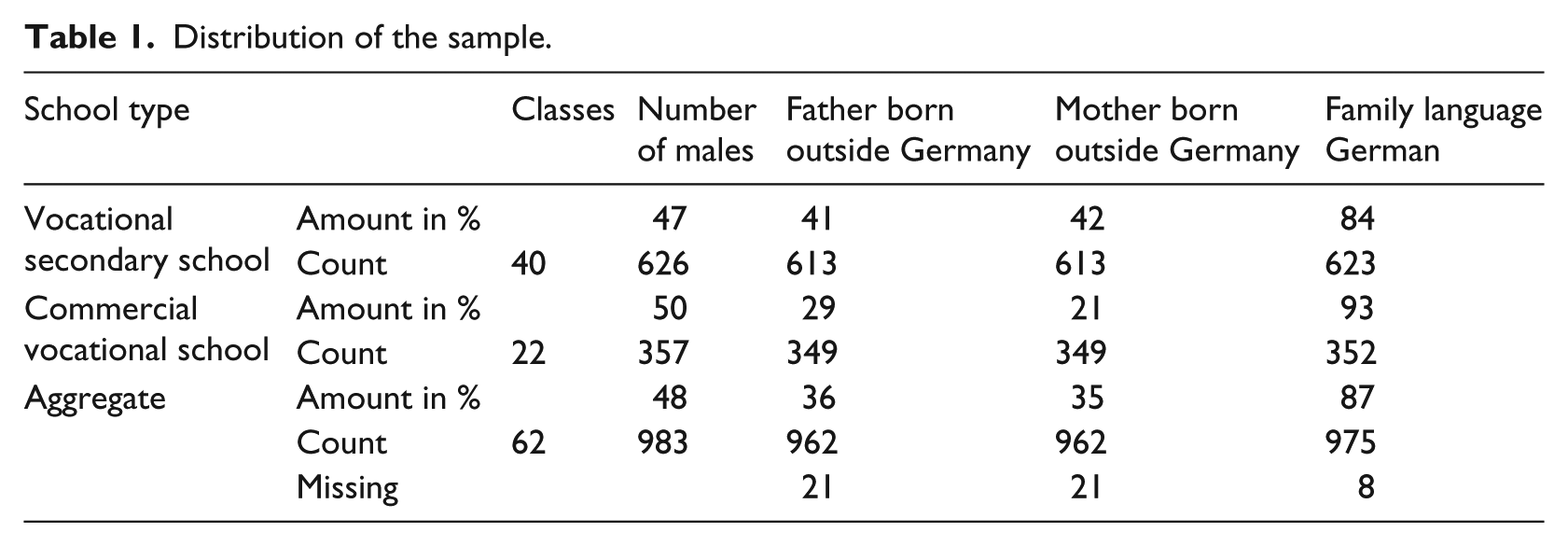
The survey took place in the second half of the second school term in 2016 (April to June 2016) at seven schools in the federal state of Rhineland-Palatinate. Distribution, completion, and collection of the paper–pencil questionnaire took one school lesson (45 minutes). A total of 62 school classes from the vocational school sector specializing in business and economics were included in the sample, 40 of which were at vocational secondary schools. While 625 students were attending vocational secondary schools, 357 students in 22 classes were in training at commercial vocational schools. 5 Table 1 gives an overview of the descriptive distribution of key variables related to the sample. In terms of school type, gender was nearly equally distributed. Two indicators were chosen to assess migration background (Happ and Förster, 2019): the origin of the parents (father and mother) and the family language. If the origin of one of the two parents and/or the family language of the test taker was not German, he or she was considered to have a migration background. The proportion of test takers with a migration background on the basis of these two indicators was lower in the commercial vocational school than in the vocational secondary school (for analysis of the effect of migration background on economic and financial knowledge, see Happ et al., 2018; Happ and Förster, 2019).
Distribution of the sample.
Empirical analysis
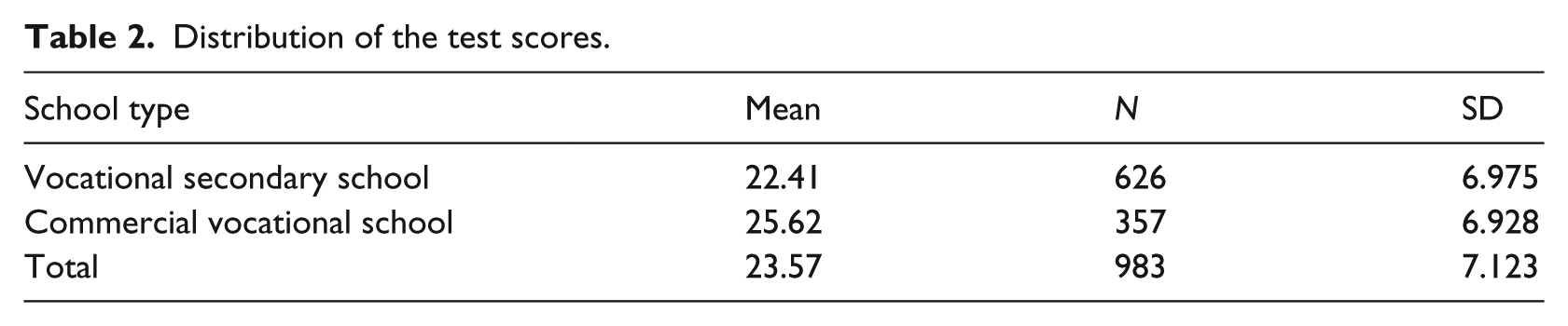
A missing value for an item on the TEL4-G was regarded as non-knowledge and thus rated as 0 points. For each item, the test taker could obtain one point and therefore a maximum of 45 points on the entire knowledge test. Missing personal data were estimated using model-based multiple imputations of 20 data sets with all relevant variables (including covariates) with the Mplus software (Muthén and Muthén, 1998–2014). For information on missing data, see Table 1. For the distribution of the test scores, see Table 2.
Distribution of the test scores.
With the nested data structure, in which students can be allocated to their school classes, it can be assumed that students are more similar to students in their own class than to students in different classes. To avoid this lack of independence of the students, multi-level path models were estimated, which can incorporate these effects at several levels of the modeling (level 1 and level 2).
Results
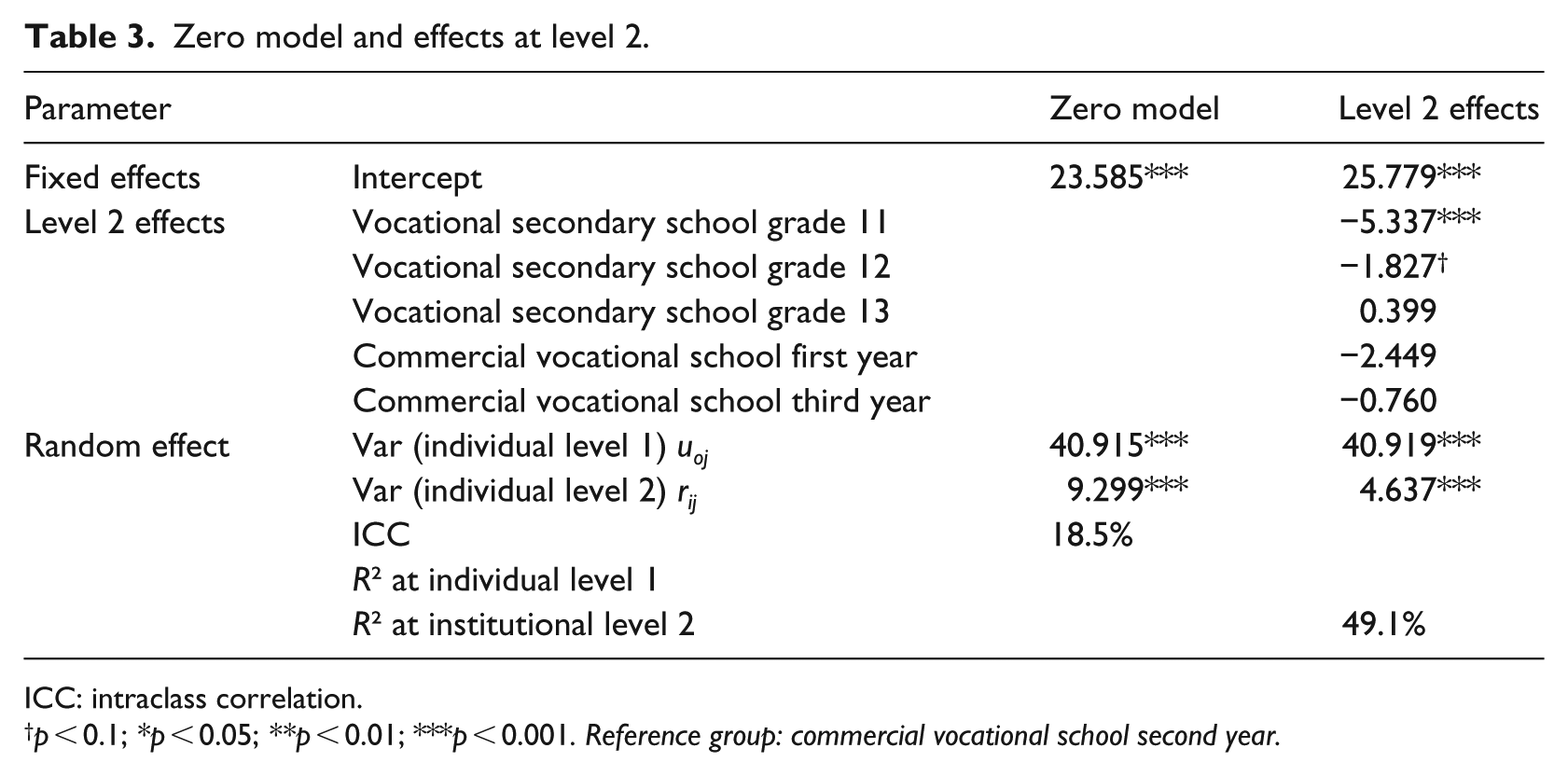
Before discussing the relevant individual effects at level 1, the results at level 2 are examined in more detail (see Table 3).
Zero model and effects at level 2.
ICC: intraclass correlation.
p < 0.1; *p < 0.05; **p < 0.01; ***p < 0.001. Reference group: commercial vocational school second year.
The intraclass correlation (ICC) was 18.5%, meaning slightly less than one fifth of the variance in economic knowledge differed by class affiliation (see zero model). When the type of school was controlled for (vocational secondary school or commercial vocational school) as well as the class levels, a variance of approximately 49% at the second level could be explained. When the second-year students at the commercial vocational school were chosen as the reference group, it became evident that the grade 11 students at the vocational secondary school answered 5.3 fewer questions on the TEL4-G correctly and the grade 12 students answered 1.82 fewer questions correctly. The grade 13 students answered approximately 0.4 more questions correctly than the second-year reference group at the commercial vocational school. In line with our expectations, commercial vocational students in their first year of training obtained 2.45 points less than the reference group. The poorer performance of the students in their third year of training (0.760 fewer points achieved) compared to the students in their second year of training was not in line with expectations. This might be explained by the small sample size, which does not allow an exact estimation and the differences are not significant. The poorer performance only indicates that the difference across students in grade 11 at the vocational secondary school (5%), the differences across students in grade 12 at the vocational secondary school and across students in their first year of commercial vocational school (10% significance level) varied significantly from the reference group.
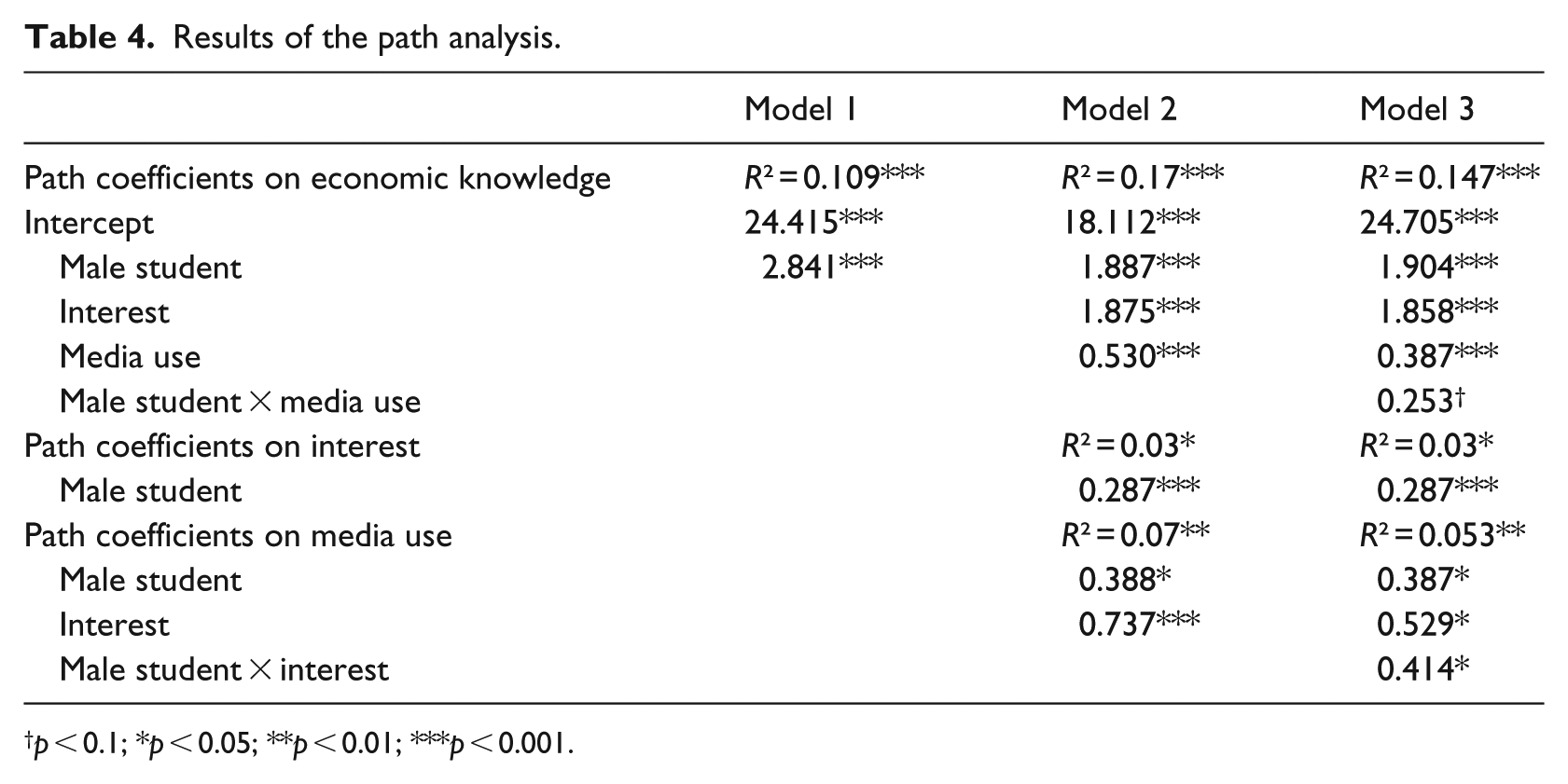
In the following, the results at level 1 are reported. A step-by-step approach is taken to assess the gender effect. The simple gender effect on economic knowledge (H1) was considered in model 1. When no predictors other than gender were integrated into the analysis, male students were found to answer 2.841 more questions correctly than their female classmates. This effect was highly significant at p < 0.001. Gender alone accounted for more than 10% of the variance in economic knowledge (R² = 0.109).
In model 2, all direct effects were included (Table 4). The hypotheses based on the person–object theory were supported. We found greater interest to be related to more use of media (H2), and more use of media to be related to greater economic knowledge (H3). Gender, interest, and use of media explained 17% of the variance in economic knowledge. We examined the extent to which gender influenced interest in economic topics and media use (H5 and H6). In line with our expectations, gender had an influence on interest in economic topics. The significant effect (p < 0.001) indicated that male students were more interested in economic topics than female students. Gender alone explained 3% of the variance in interest. Furthermore, gender had an influence on media use: male students researched economic-related content in print media more frequently (0.388, p < 0.05) than female students. Thus, H6 can be confirmed. Gender and interest explained 7% of the variance in media use (Table 4).
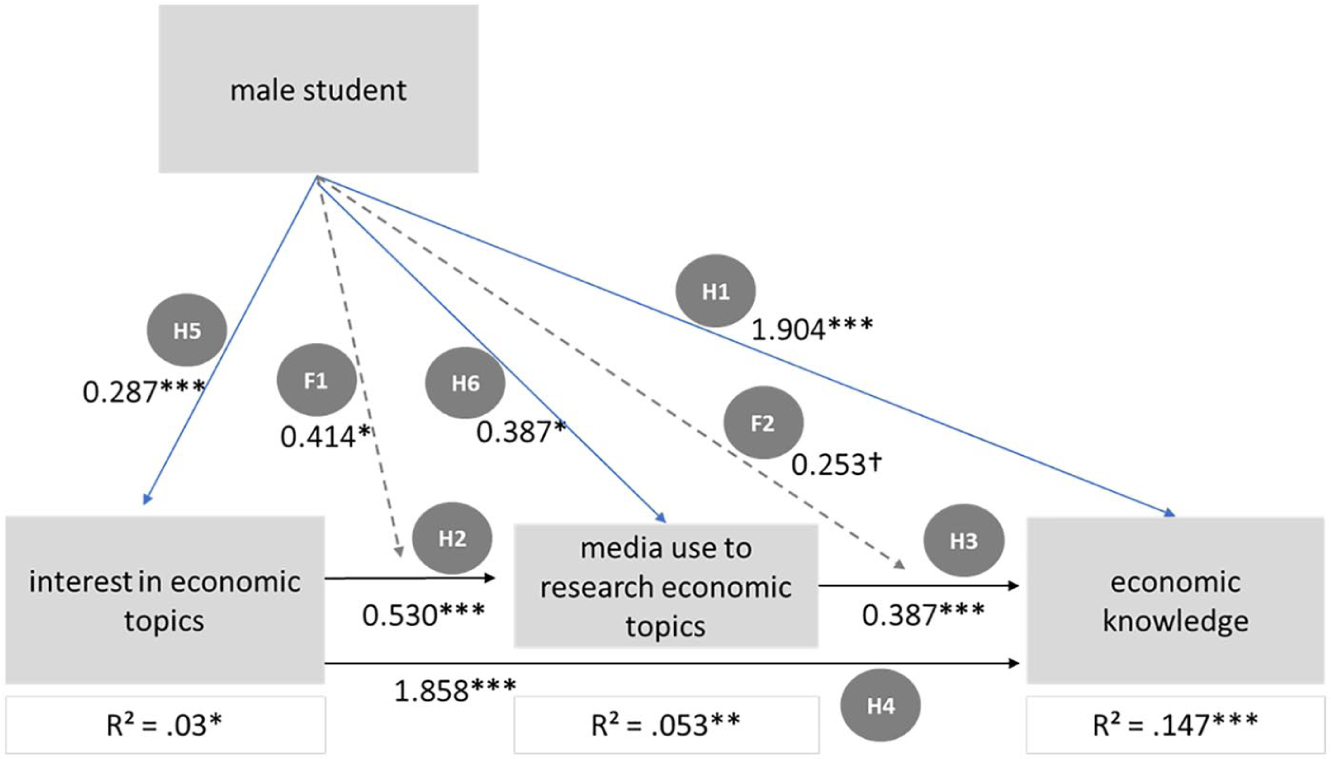
Model with interaction effects.
Results of the path analysis.
p < 0.1; *p < 0.05; **p < 0.01; ***p < 0.001.
The results of model 3 also allude to two possible moderation effects of gender. Indications of the first moderation are revealed in the correlation between the independent variables gender and interest on media use. It became apparent that when the male students became increasingly interested in economic topics, they used media significantly more often than the female students did even when they had the same amount of interest. Therefore, the gap in media use between the male students and the female students diverged even further as interest increased.
Model 3 also shows that male students who used media increasingly more had greater economic knowledge than the female students who used media as often as the males. Thus, media use had different effects on the economic knowledge of the male students and of the female students. However, this effect was only significant at a 10% significance level, not at a 5% significance level.
Finally, the mediation effects were analyzed. It became apparent that part of the variance in the gender effect was mediated by the effects of interest and media use. With the inclusion of interest and media use, the effect of gender on economic knowledge decreased from 2.841 in model 1 to 1.901 in model 3 (Table 4). In conjunction with the aforementioned effects of gender on the predictors of economic knowledge, the results suggest an overall mediation effect. In terms of content, this means that part of the gender effect in economic knowledge might be explained by the fact that male students are more interested in economic topics and use print and online media related to economic topics more frequently than their female classmates. These two factors, as previously explained, in turn have an influence on economic knowledge.
Discussion and limitations
While interpreting the findings of this study, it should be kept in mind that only students from vocational schools specializing in business and economics in Germany were surveyed; therefore, the results of this study are not representative of all students in Germany or of students in the general education sector. Because economic content has been insufficiently anchored in the curriculum in the general education school sector in Germany (for curricular analyses, see Happ and Förster, 2017), studying a sample of students in the general education school sector would be recommended for further research.
One assumption about the plausibility of the findings of this study is that males and females are socialized differently concerning economics-related topics. According to Boudon (1974), primary and secondary effects of origin can be differentiated (Erikson, 2007; Karlson and Anders, 2011; Stocké, 2007). The secondary effects that result in decisions related to education and choice of school tracks do not need to be examined here, since vocational secondary school and commercial vocational school were under investigation in this study, and they are personally chosen by students; therefore, the students in our sample had already made several education-related decisions. They had consciously opted for school types that focus on economic education. However, the primary effects of migration background need to be examined more closely, as gender-related socialization at home could influence students’ interest and knowledge (Shute et al., 2011). It is conceivable, for example, that different role models and thus different interests in economic topics could be conveyed differently at home depending on socioeconomic background (Kolodziej et al., 2014).
At the same time, results of a US-American study indicate that women and men are unequally represented in introductory economics textbooks, in which 90% of the examples of economists, business leaders, and policy makers are male (Stevenson and Zlotnik, 2018). The extent to which such distortions predominate in German textbooks or teaching examples and the effect they might have on the understanding of the roles of students remains to be investigated. Gender-specific effects on economic knowledge and the cognition of economic content may result from the gender perspective (Porter and Serra, 2017).
This study was cross-sectional. Accordingly, cause and effect correlations for the three central constructs (economic knowledge, interest in economic topics, and use of media use to research economic topics) cannot be evaluated based on these data. With reference to evaluating interest in economic topics and media use, it should be noted that only the frequency of media use was examined in detail in this study. From the perspective of research on media effectiveness, the question arises as to the extent to which women and men show different media use behavior. Studies of media use indicate differences in this regard between the genders (Bickart and Schindler, 2001; Treumann et al., 2007; Vincent and Basil, 1997). In this study, we did not explore the kind of media the students preferred or the exact topics they researched using those media. However, the interaction effects could be interpreted as an indicator that males interact with media differently or respond to business-related content differently from females. However, these differences cannot be investigated in depth based on the questions we asked to assess media use. More comprehensive modeling of the two constructs should be an aim of further research.
At the same time, it is conceivable that person–object theory could be confirmed for economics. Consequently, schools should make more effort to promote students’ interest in economic topics. This applies especially to girls, who generally have less interest in economics than their male classmates. We did not investigate which teaching methods were used to convey the relevant content (if they were conveyed at all). Exactly those holistic forms of teaching such as problem- and case-based learning have the potential to promote interest (e.g. Knogler, 2014), but teacher-centered approaches still predominate. The findings also point to the fact that the difference in economic knowledge between the genders is there regardless of interest and media use. To this point, reference can be made to current research on item format (see the contributions by Siegfried and Wuttke in this issue; Ackermann and Siegfried in this issue). Furthermore, in recent studies the influence of test anxiety and test motivation in knowledge assessment has been explored, and gender-specific differences in test anxiety have been found (Núñez-Peñaa et al., 2016). Results of these studies indicate that female test participants have a higher number of missing results on economic knowledge tests, which can be seen as an indicator that women take fewer guesses than men (Happ and Förster, 2018).
