




Abstract
Study-related prior knowledge plays a decisive role in business and economics degree courses. Prior knowledge has a significant influence on knowledge acquisition in higher education, and teachers need information on it to plan their introductory courses accordingly. Very few studies have been conducted of first-year students’ prior economic knowledge or differences among students in such knowledge. In this article, the prior economic knowledge and the influence of personal factors on first-year students’ prior economic knowledge are examined. For this purpose, an adaptation of the fourth, revised edition of the American Test of Economic Literacy was administered, which was adapted in 2014 according to the Test and Adaptation Guidelines for use in higher education in Germany. We present findings based from an assessment conducted in higher education in Germany in the summer term of 2014; the subsample for this study comprises first-year students of business and economics. Findings indicate that there are significant differences in prior economic knowledge among first-year students within universities. Influence factors include economic learning experiences prior to starting university, gender, and mother tongue. The article closes with implications for teaching and degree program design.
Introduction
Numerous studies of teaching–learning emphasize the fundamental importance of prior knowledge in the accumulative process of knowledge acquisition (see Alexander and Jetton, 2003; Anderson, 2005; Schaap et al., 2011). In higher education, first-year students’ subject-related prior knowledge is especially important as it affects their knowledge acquisition throughout the course of their studies (see Happ et al., in press; Lopus, 1997). For the field of economics, we demonstrated on the basis of findings from a panel study (see Happ et al., in press) that prior knowledge significantly influenced students’ success in degree courses in economics and deficits in prior economic knowledge at the beginning of their studies could not be compensated for sufficiently over the course of their studies. However, first-year students with a higher level of economic knowledge at the beginning of their studies maintained a higher level of economic knowledge over the course of their studies, as they were more efficient in acquiring new knowledge (Happ et al., in press).
Awareness of the heterogeneous preconditions and prior knowledge of first-year students is important particularly for teachers in higher education (Morgan, 2012) as it can help them identify knowledge deficits from the start and design appropriate and sufficient learning opportunities accordingly (see Anderson et al., 1994; Arnold and Straten, 2012). To foster students’ knowledge acquisition in a degree program, teachers need to be aware of heterogeneity in students’ preconditions, so they can tailor their lessons according to the students’ level of prior knowledge (see Brackenbury, 2012; Smart et al., 2012). First-year higher education students’ prior knowledge can be influenced by individual learning experiences as well as personal characteristics such as general intellectual ability. Knowing students’ level of economic knowledge at the beginning of their studies and the corresponding influence factors can help university teachers and administrators not only design effective courses and degree programs for groups of students with heterogeneous preconditions but also manage these groups during transition from secondary-level to tertiary-level education (on the organization of the introductory study phase, see Gale and Parker, 2012; Krause et al., 2005; Rodger and Tremblay, 2003).
In this article, we examine students’ level of prior economic knowledge at the beginning of a business and economics degree program and analyze personal factors that might have influenced it. An investigation into the current state of research (see section ‘Influences on prior economic knowledge’) indicates that significant explanatory factors can include students’ personal characteristics (such as intellectual abilities) and previous economics-related learning experiences (e.g. economics classes in secondary school; see Gill and Gratton-Lavoie, 2011). Thus, in this article, we examine the extent to which intellectual ability, gender, mother tongue, and economic learning experiences at secondary school influence students’ level of economic knowledge at the beginning of their higher education studies (on factors influencing economic knowledge, see Siegfried and Walstad, 2014). Based on findings from an assessment of economic knowledge in higher education conducted in Germany in 2014, suggestions have been made to address heterogeneity in students’ prior knowledge, one of which is that universities offer first-year students tutorials addressing deficits in their prior economic knowledge. 1
In section ‘Operationalization and assessment of prior economic knowledge’, we describe the instrument used to assess first-year students’ economic knowledge. In section ‘Influences on prior economic knowledge’, we examine students’ personal characteristics as well as their economic learning experiences prior to university, both of which should influence the prior economic knowledge of first-year students. In section ‘Empirical findings’, we formulate hypotheses and test them by means of a regression analysis for a subsample of first-year students in business and economics assessed at the beginning of the summer term 2014. In section ‘Implications for further research and practices in economics education’, we draw conclusions, present implications for higher education teachers and administrators, outline limitations of the study, and discuss approaches for future research.
Operationalization and assessment of prior economic knowledge
There are only a few standardized instruments to assess economic knowledge that provide results generalizable across institutions. The American Council for Economic Education (CEE) aims to advance the development of instruments to assess economic content knowledge (Saunders, 2012: 8). Today, the CEE offers a number of instruments to measure economic knowledge of students in various age groups. The CEE sets standards for economic knowledge and defines the requirements test-takers in different age groups should meet. According to Meszaros and Siegfried (1997: 247), the CEE’s standards describe the fundamental propositional knowledge of economics relevant to adolescents. The CEE has updated its standards and test instruments to reflect current changes in the field of economic education (Shiller, 2010). The Voluntary National Content Standards in Economics for high schools in the United States were published in 1997 and updated by the CEE in 2010 (Grimes, 2012: 263). The CEE also updated test instruments to reflect new developments in subject-matter orientation in economic education (Asarta and Rebeck, 2012: 314).
In this study, the prior economic knowledge of students at the beginning of an economics degree course at university was assessed using an instrument designed for assessment of economic knowledge at the end of secondary education. The fourth and revised edition of the Test of Economic Literacy (TEL), published in 2013 by Walstad et al., seemed especially suitable for this purpose. The second version had been adapted for use in Germany (Soper and Walstad, 1987) and named Wirtschaftskundlicher Bildungstest (Beck et al., 1998). However, review of the test items of the second and fourth editions revealed that the items had been modified extensively, and a series of new test items had been added (Walstad et al., 2013) to reflect significant structural changes made to economic content presented during secondary-level and tertiary-level education. Schneider (2012) presents an argument as to which content should be taught in foundation courses in economics at high schools in the United States to prepare students for transition to college and which changes have become evident over the past few years. The financial crisis of 2008–2009 has been the most prominent, but not the only reason, for changes to the content of economic education (Blinder, 2010; Shiller, 2010). Technical advances following the introduction of the Internet as a mass product have played a role in this as well, as they have facilitated the expansion of international trade and have changed the focus of the content of economics courses (Madsen, 2013). We adapted the fourth edition of the TEL for use in Germany (see also Förster et al., 2015c) to ensure the instrument reflected current trends in economic education and to enable compatibility with international research.
The TEL4 consists of two parallel versions with 45 items each, which are connected with 10 anchor items. All items of the TEL are in multiple-choice format (Walstad et al., 2013) and consist of a brief description of a situation and four response options, one of which is correct, while the other three are distractors. The items are based on 20 core content standards by the CEE (2014) and categorized into three cognitive levels: 6 of the 45 items for each test version are attributed to the knowledge level, 14 to the comprehension level, and 25 to the application level (Walstad et al., 2013). The quality criteria of the American test have been examined in comprehensive studies according to classical test theory (Walstad et al., 2013). For internal consistency of the original American test, reliability was very good with Cronbach’s alpha = 0.90 (Version A) and 0.91 (Version B) (Walstad et al., 2013).
At the end of 2013, the TEL4 was translated and adapted into German (TEL4-G) and was validated comprehensively for use in higher education in Germany. The TEL4-G generally follows the English-medium original, while cultural aspects were adapted for Germany in agreement with the test developers as well as experts in economic education in Germany (on the principles of test adaptation, see Hambleton et al., 2005). Subsequently, comprehensive analyses were conducted including curricular analyses, cognitive interviews with students, factor analyses, and so on (see also Förster et al., 2015b) with a particular focus on the validation of test content, cognitive processes, and internal structure (see American Educational Research Association (AERA) et al., 2014).
The aim of the translation and adaptation process was to create comprehensive functional equivalence between TEL4 and TEL4-G (Bray et al., 2007). To this end, we followed the internationally established translation, review, adjudication, pretesting, and documentation (TRAPD) process model (Harkness, 2008) in connection with a number of validation steps so as to ensure that the adapted test would assess the same content as the original. To guarantee a professional adaptation according to the Test Adaptation Guidelines (International Test Commission, 2010), experts of translation studies 2 were consulted. 3
All 45 items from Versions A and B of the TEL4 were adapted successfully into German. To ensure that the item content designed for high schools in the United States was applicable to economic education in Germany, we surveyed lecturers of principles of economics courses. They evaluated the extent to which the item content was curricularly valid in the sense of representing economic knowledge that first-year students of business and economics in Germany should have at the beginning of their studies. Moreover, textbook analyses were conducted to evaluate the extent to which the content of the TEL4-G represented content of textbooks for first-year studies of business and economics in Germany (e.g. Mankiw and Taylor, 2012). Results of these analyses indicated that the TEL4-G measures study-relevant economic knowledge in Germany and is therefore an appropriate tool to assess first-year students of business and economics.
Influences on prior economic knowledge
Economic learning experiences prior to higher education
In Germany, students can learn economic content prior to entering a higher education institution depending on the educational path they choose (Brückner et al., 2015a: 439). The majority of school students in Germany graduate from general secondary schools (Federal Statistical Office, 2014), where economic content is not taught systematically, but rather, for the most part, included in other subjects such as social studies. Economics is offered as a separate subject at general secondary schools in only a few federal states in Germany. 4 One opportunity for students to learn economic content prior to starting a degree program is to attend a commercial upper secondary school, where business and economics are taught as separate major or minor subjects. 5
Another option is to complete a commercial vocational training program in economics before starting a higher education program in economics. Commercial vocational training programs involve learning about theoretical concepts during in-school courses as well as gaining practical experience. Findings from various studies have indicated that completion of a commercial vocational training program or a major course in economics at a specialized upper secondary school can influence first-year students’ level of economic knowledge (for the field of economics, see Brückner et al., 2015a; for accounting, see Fritsch et al., 2015; for financing, see Förster et al., 2015a). Hence, we formulated the following hypotheses:
H1. Students who have completed commercial vocational training have a higher level of economic knowledge at the beginning of their studies.
H2. Students who have attended a major course in economics at a specialized upper secondary school have a higher level of economic knowledge at the beginning of their studies.
Grade upon leaving school
A student’s grade upon leaving school is the most common criterion for admission to universities and universities of applied sciences in Germany (Uthmann, 2009). This is linked to the expectation that a student’s grade upon leaving school correlates with his or her intellectual abilities (Happ et al., in press). With a view to the field of study of business and economics, Rindermann and Oubaid (1999) confirmed the explanatory power of a student’s grade upon leaving school as an influence on his or her knowledge acquisition. However, to date, the extent to which a better grade upon leaving school correlates with a higher level of study-relevant prior economic knowledge scarcely has been examined. Hence, we formulated the following hypothesis:
H3. A better grade upon leaving school correlates positively with prior economic knowledge at the beginning of studies.
Gender
Numerous studies have shown that male students obtain higher test scores than their female fellow students on assessments of economic content knowledge with standardized test instruments (see Asarta et al., 2014; Förster et al., 2015c; Happ and Zlatkin-Troitschanskaia, 2014; Heath, 1989; Siegfried, 1979; Walstad et al., 2007; Watts, 1987; Williams et al., 1992). To date, there has been little research on the reasons behind this gender gap (Asarta et al., 2014). Additionally, in many of these studies, students were not assessed at the beginning of their studies in higher education. The extent to which the differences between male students and female students exist prior to starting their higher education studies has only rarely been subject to examination and is examined in this study:
H4. Male students show a higher level of prior economic knowledge than their female fellow students when assessed with the TEL4-G.
Mother tongue
In recent years, higher education in Germany has seen an increase in numbers of first-year students who are not native speakers of German, for example, because they or their parents immigrated to Germany (Middendorff et al., 2013). 6 Anderson (2005) points out that language is of fundamental importance for knowledge acquisition. Regarding secondary education in Germany, studies indicate that, on average, students whose mother tongue is not German perform less well in school (Chudaske, 2012). For higher education and especially for the field of economics, positive effects on the knowledge level have been observed for native speakers of German (Happ et al., in press). 7 In the following, we investigate whether first-year students in economics show the same effect and how pronounced the effect is.
H5. Students with German as their mother tongue show a higher level of economic knowledge at the beginning of their studies than students with a different mother tongue.
Empirical findings
Sample
At the beginning of the summer term 2014, students of business and economics at universities in Germany were assessed using the TEL4-G, and a subsample of 241 first-year students completed test Version A. 8 The assessment was conducted of students enrolled in introductory courses before the beginning of the semester to ensure that students had not yet acquired any content knowledge at university. In the subsample, 12.4% of first-year students had completed commercial vocational training before starting university, and 37.5% had completed a major course in economics at a specialized upper secondary school. 9 Male students constituted 59.3% of the sample. The average grade upon leaving school was 2.2 (with a standard deviation of 0.43) and the span of grades upon leaving school ranged from 1.0 to 3.3, which is a wide range (1.0 = best grade, 4.0 = lowest pass grade). It is also notable that the average grade upon leaving school was 2.25 for male students and 2.13 for female students, which was a significant mean difference (p < 0.05) to the benefit of the female students. At this higher education institution, 17.8% of the test participants stated that their mother tongue was not German. Thus, the sample showed significant heterogeneity in the entry conditions of first-year students. Whether these had an effect on students’ prior economic knowledge is examined in the following.
Regression analyses
In the following statistical analyses, the sum score of the TEL4-G served as the dependent variable in a multiple linear regression analysis. The highest possible score was 45 points; the mean score on the TEL4-G for all 241 participants at this university was 29.64 points (with a standard deviation of 6.96 points). The skewness was −0.617 (with a standard deviation of 0.157) and the kurtosis was −0.221 (with a standard deviation of 0.312). Figure 1 shows the distribution of test scores in a histogram.
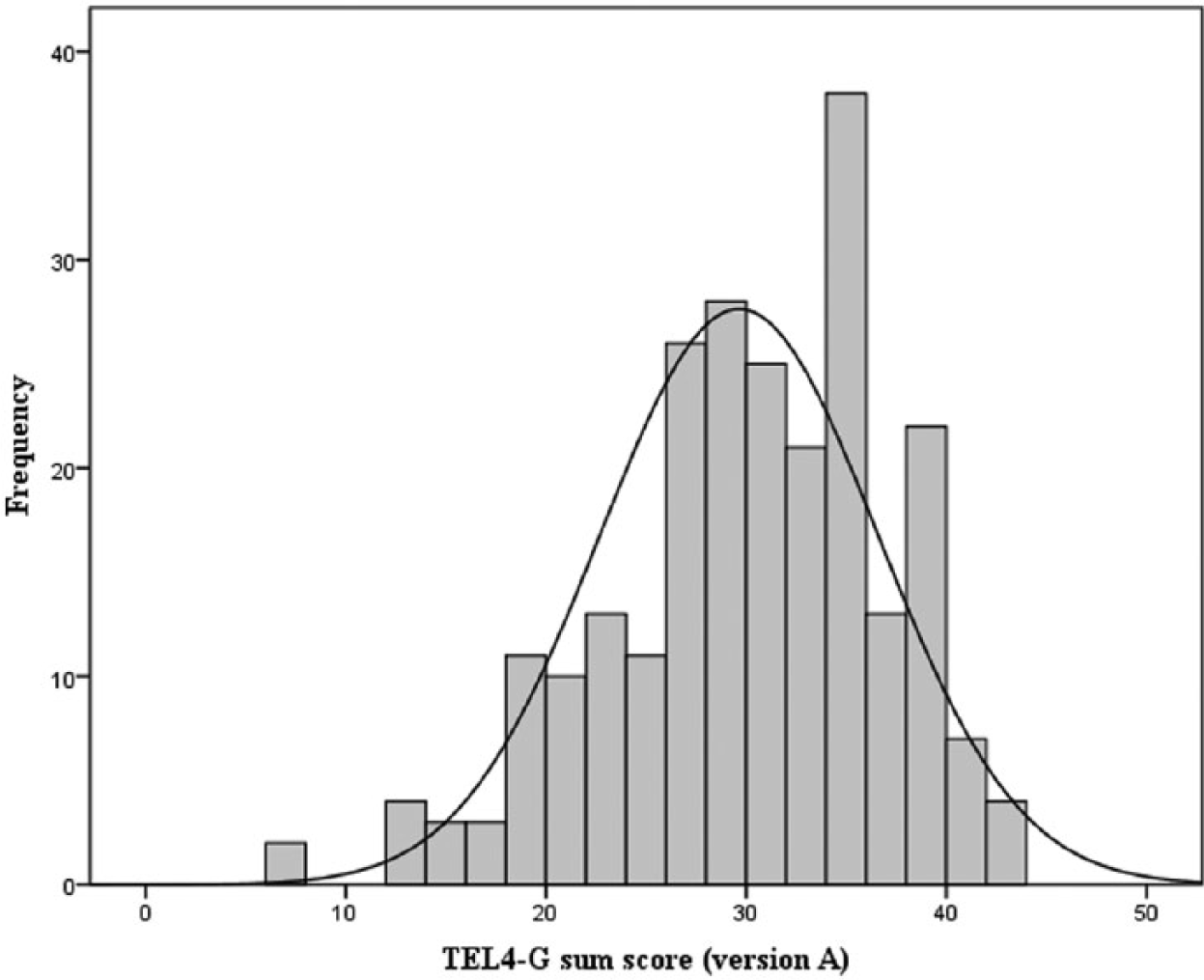
Histogram of the Test of Economic Literacy (TEL)4-G (Version A).
To test H1 and H2, we examined the influence of economic learning experiences students had prior to their studies, that is, the effects of completion of a commercial vocational training program or a major course in economics at a specialized upper secondary school, at the economic knowledge level. Both were coded as dichotomous variables depending on whether or not students had completed them. Furthermore, the students’ grades upon leaving school (H3) were included. The grades upon leaving school were interpreted as a quasi-metric scale. 10 The gender of first-year students (H4) and their mother tongue (H5) were included in the regression analyses as dichotomous variables. Table 1 shows the findings from the linear multiple regression analysis.
Regression on the TEL4-G sum score for Version A.
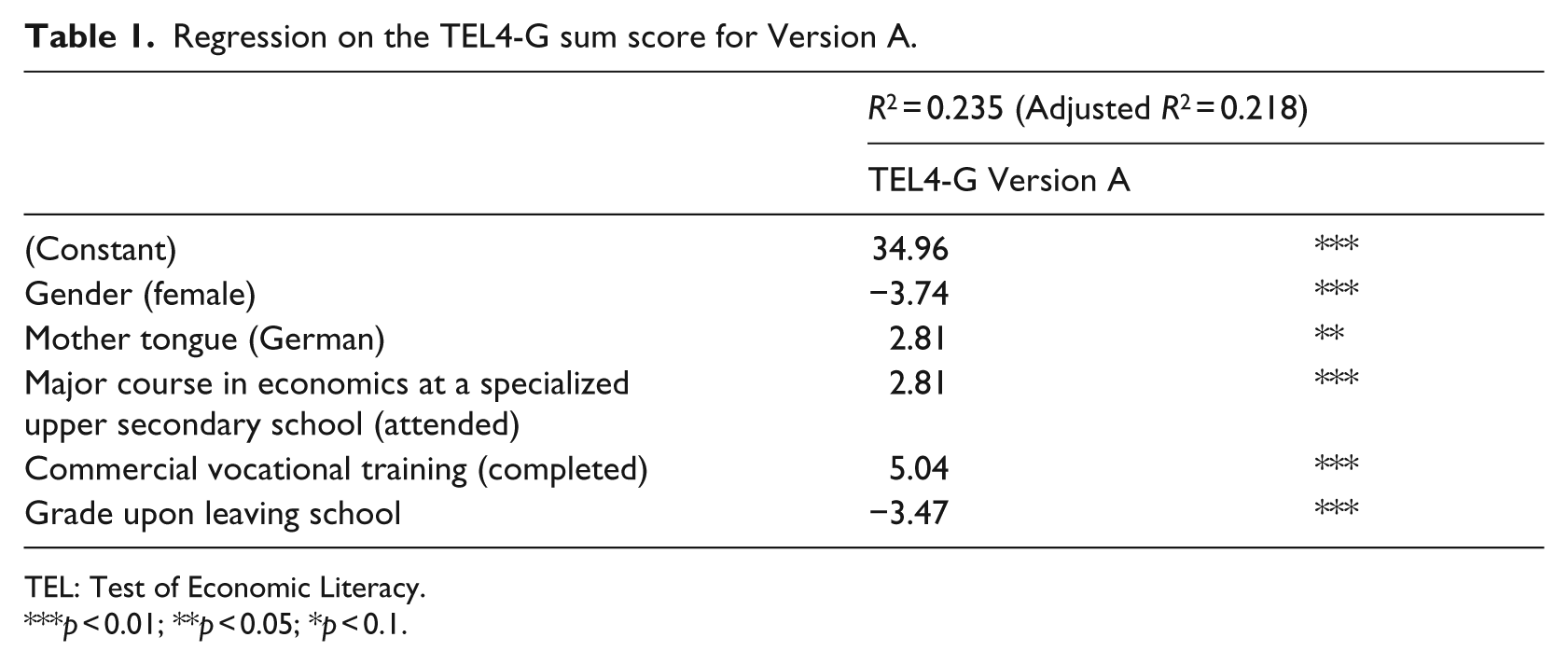
TEL: Test of Economic Literacy.
p < 0.01; **p < 0.05; *p < 0.1.
These variables explained 23.5% (adjusted 21.8%) of the variance in scores on the TEL4-G Version A. First-year students who had not previously completed an economic course or program had a lower level of prior economic knowledge. Students who had completed a major course in economics at a specialized upper secondary school responded correctly to an average of 2.5 items more than their peers who had not, and students who had completed a commercial vocational training program responded correctly to an average of five items more than their peers who had not. Thus, the first two hypotheses were confirmed; the results indicated a positive effect of economic learning experiences prior to university. The hypothesis of a positive correlation between grade upon leaving school and prior economic knowledge (H3) also was confirmed. The negative sign indicates that students responded correctly to an average of 3.47 items more for each grade point their school leaving grade was better (i.e. lower) than their peers’ grade. Moreover, as expected, we found large gender (H4) and language effects (H5). Male students had 3.74 points more than female students. This still applied when we controlled for other relevant influence factors such as grade upon leaving school and previous learning experience. The regression analysis on the TEL4-G Version A also indicated that first-year students whose mother tongue was German responded correctly to an average of 2.8 items more than their fellow students with other mother tongues.
Implications for further research and practices in economics education
When considering the effects found in our study in Germany in the light of findings from the TEL4 in the United States (Walstad et al., 2013), we see significant parallels: Results of the studies conducted in Germany and the United States indicated a gender influence in favor of male participants. Similarly, in both countries, there were significant differences in test scores relating to whether or not students had completed economic training in school (Walstad et al., 2013: 34). In both countries, participants obtained better scores if the test language was their mother tongue. These parallels between Germany and the United States regarding influence factors on prior economic knowledge need to be examined in greater detail in further international comparative analyses (for cross-national comparisons using the TEL3, see Yamaoka et al., 2007; for international findings on the Test of Understanding in College Economics (TUCE Version 4), see Brückner et al., 2015a; Förster et al., 2015c).
To date, the literature offers no clear indications of the reasons for differences between male students and female students (Asarta et al., 2014; Brückner et al., 2015b). In a few studies, the item format (multiple-choice) was examined as a potential explanation (Ben-Sakar and Sinai, 1991). Multiple-choice items are used in numerous performance assessments in schools as well as in universities, especially in fields of study with very large numbers of students such as economics. Biggs (1999) suggested that the higher test scores of male students were a result of a systematic bias of multiple-choice items in favor of male students. This, however, can by no means be considered proven in the literature. Given that the TEL4 is widely used in economic education, the gender gap in test scores should be examined in further studies.
The influence of German as a mother tongue on test scores on the TEL4-G was confirmed. In the United States, participants who rated their language skills in English better than in any other language scored better on the American test (Walstad et al., 2013: 34). The question arises as to how higher education institutions can use these findings to support learning. An important question would be whether measures of the acquisition of economic knowledge can be improved by offering preparatory language courses for non-native speakers or language courses and support over the course of studies (Collier, 1987; Kaplan, 2010; Swain, 1985). In further studies, the linguistic abilities of students need to be assessed by means of language tests in order to gain an objective picture of possible linguistic disadvantages of non-native German speakers.
With a view to the findings from the TEL4-G regarding gender and mother tongue, the following approach is certainly of interest for future research. While students’ mother tongues may contribute to differences in students’ German-language knowledge and test performance, gender-related differences in students’ ability to respond correctly to multiple-choice items may depend on their language skills. Discussion on the gender gap could turn into one on students’ linguistic abilities in connection to their gender. This approach has been taken, for example, by Schwabe et al. (2014) with promising results. Follow-up studies using the TEL4-G to assess economic knowledge could address the question of whether the gender gap can be explained in terms of differences in linguistic comprehension between the genders.
The results discussed here are of a study conducted at one university. It is important to investigate whether the findings can be replicated in a larger sample across several higher education institutions. By means of multilevel analyses (see Hox, 2010; Rabe-Hesketh and Skrondal, 2012), future research could examine whether selection effects concerning economic knowledge occur as early as during transition from secondary school to university. Moreover, a longitudinal study could show whether differences among groups of students decrease, remain the same, or even increase over the course of their studies at higher education institutions (see Arnold and Straten, 2012; Happ et al., in press).
Although the findings are from one higher education institution only, we can discuss implications for higher education in general. After controlling for well-known socioeconomic and aptitude factors, the main conclusion to be drawn from the positive and significant contribution of completing either a major course in economics at a specialized upper secondary school or a commercial vocational training program is that learning about economics prior to attending university courses in the field makes a difference in students’ economic knowledge acquisition over the course of their studies. This conclusion is consistent with knowledge production models (Krohn and O’Connor, 2005). The implications for higher and secondary education are related to commitment to economics and are as follows: First, university students’ fundamental knowledge of economics should be enhanced by completing economics courses at upper secondary school, where such courses should be integrated into the core curriculum. Second, as evidence from the United States suggests (Allgood and Walstad, 1999; Watts and Bosshardt, 1991), instructors’ economic knowledge may have an enhancing effect on student performance. Hence, the economic knowledge and teaching abilities of school teachers of various subjects that include economic content should be assessed.
Footnotes
Declaration of Conflicting Interests
The author(s) declared no potential conflicts of interest with respect to the research, authorship, and/or publication of this article.
Funding
The author(s) received no financial support for the research, authorship, and/or publication of this article.