




Abstract
How can creative teaching in economics education be identified and explored? A construct that assists understanding in this area is pedagogical content knowledge (PCK). It represents the merging of content and pedagogy to understand how particular topics or lessons are organised, represented, and adapted to students’ diverse interests and abilities. This paper draws upon the author's research that explores teaching and learning in school economics to discuss this epistemological concept that blends the traditionally separated knowledge bases of content and pedagogy. The research involved interviewing and observing school economics teachers and student focus group interviews. Thematic analysis was employed to analyse the data. In this paper, I discuss the emergent theme of how teachers communicated their understanding of subject knowledge by developing their PCK to engage their students in learning. The considerations raised can assist lecturers, teachers, teacher educators, and researchers in enacting the teaching and learning process in economics and other disciplines.
Introduction
Teaching is a complex activity that draws upon various knowledge bases for teaching (Banks et al., 1999, 2005; Deng, 2018, 2020; Hashweh, 2005; Mishra and Koehler, 2006; Mizzi, 2022; Moore, 2004; Shulman, 1987; Stobart, 2014). There prevails, however, a lack of awareness and celebration of teacher knowledge and expertise (Mizzi, 2022; Stobart, 2014), perhaps because teaching tends to be under-valued but also because much of teachers’ knowledge is tacit. It can be a challenge to articulate teachers’ knowledge, and in a form that is transferable to others, such as student teachers. There exists, for instance, a dearth of studies on teaching practices in economics education for preservice and inservice teachers and what constitutes expert teaching in the discipline (Mizzi, 2023b; Ayers, 2015, 2016, 2017, 2018; Brant, 2022; Davies and Brant, 2006; Joshi and Marri, 2006; Shanks, 2020).
This paper aims to contribute to the scant research evidence in school economics education by exploring and making explicit teachers’ specialist knowledge that provides young people access to economics knowledge. Shulman (1986a, 1986b, 1987, 2004, 2005) provides a construct that offers a framework for exploring and understanding the teaching and learning process in the economics classroom.
Shulman's notion of PCK
Shulman (1986a, 1986b, 1987) develops the idea of pedagogical content knowledge (PCK), arguing that what is missing in teacher knowledge research is the study of the interaction between subject content and pedagogy. He claims that these are often treated as mutually exclusive domains. His vision is to redress a perceived imbalance between teachers’ knowledge of subject content and their lack of specific knowledge of how to transform it into a repertoire of representations that enhance students’ learning (Shulman, 1986a, 1986b, 1987, 2004, 2005).
In his two papers, ‘Those who understand: Knowledge growth in teaching’ and ‘Knowledge and teaching: Foundations of the new reform’, Shulman formulates a relationship between content knowledge and pedagogical knowledge. He emphasises the existence of a distinctive form of teachers’ professional knowledge: PCK. This is represented diagrammatically as in Figure 1. The interplay between pedagogy and content transforms content into pedagogically powerful forms. It contains within it the most regularly taught topics in one's subject area, the most useful forms of representation of those ideas, the most powerful analogies, illustrations, examples, explanations, and demonstrations - in a word, the ways of representing and formulating the subject that make it comprehensible to others. (Shulman, 1986b: 6) it identifies the distinctive bodies of knowledge for teaching. It represents the blending of content and pedagogy into an understanding of how particular topics, problems, or issues are organised, represented, and adapted to the diverse interests and abilities of learners, and presented for instruction. (p. 8)
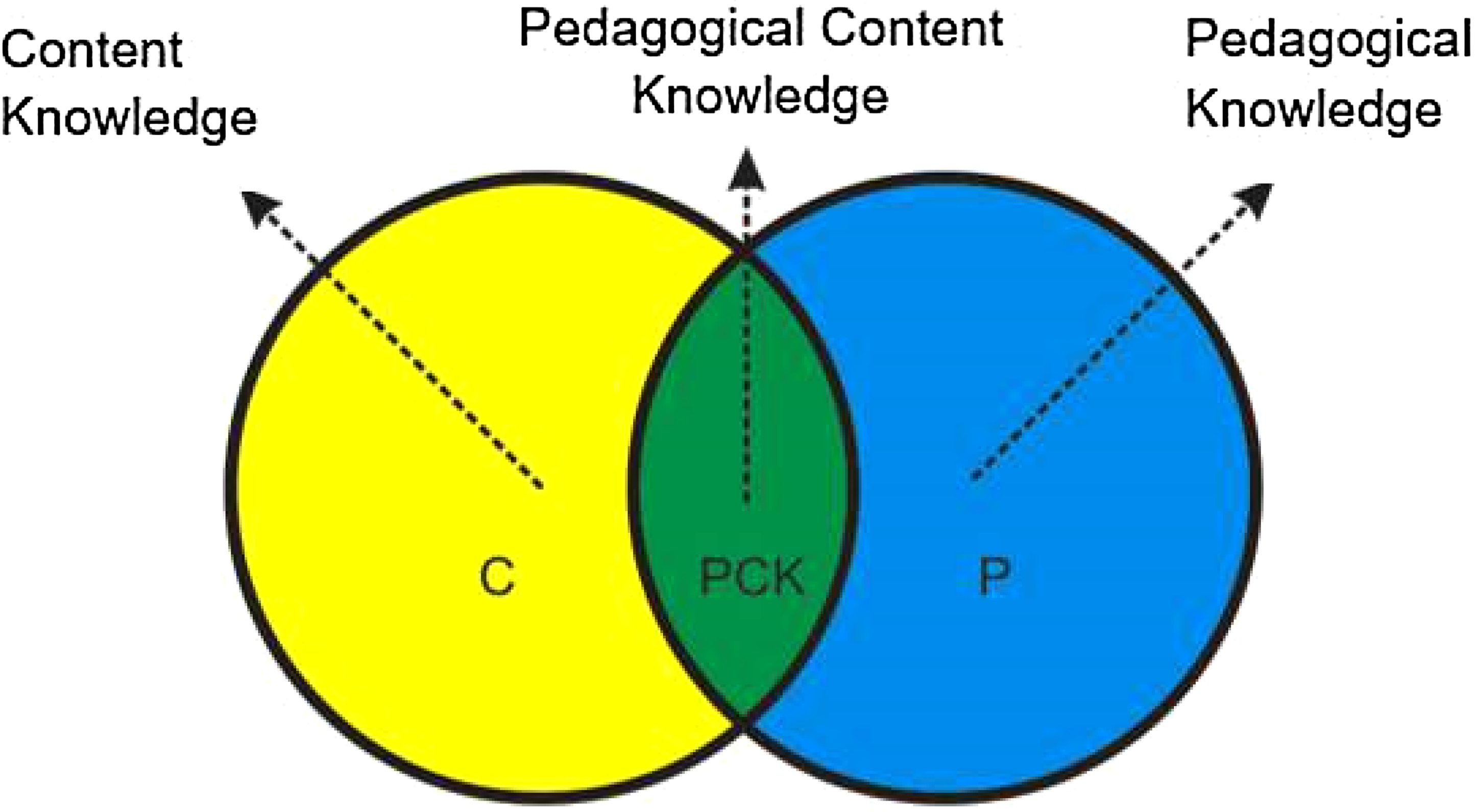
Pedagogical content knowledge (Shulman, 1986b, 1987)
Shulman (1987) identifies seven knowledge bases needed for teaching: content knowledge, general pedagogical knowledge, curricular knowledge, pedagogical content knowledge, knowledge of students, knowledge of educational contexts and knowledge of educational ends, purposes and values. This represents a refinement of the concept of PCK and places it as a knowledge base of equal status with the others (Unwin, 2007).
A key notion implied by PCK is ‘representation’. There are two sets of ideas about this notion. The first set is proposed by Shulman (1986b). Representation is defined as the ways of communicating concepts and processes of a subject discipline. For Shulman, representation is part of transformation: the all-important process of turning subject knowledge into knowledge for teaching. The second set of ideas comes from Bruner (1970). He argues that there are three characteristic ways of representing the word: enactive, iconic and symbolic representations. Enactive representation is understanding by activity, by doing something actively. Iconic representation is understanding through pictures, maps, and diagrams. Symbolic representation is understanding through the use of symbol systems such as spoken and written language, mathematical symbols or musical notation. Bruner maintains that students first come to understand and represent the world enactively, then iconically and then through symbol systems. He claims that adults use all three forms of representation and move back and forth through them as occasion demands. Turner-Bisset (1997, 2001) argues that teachers may use all three forms of representations when thinking about what kinds of representations to use for particular age ranges to teach a particular idea or concept.
Shulman (1987) also contends that to represent the content, teachers need to ‘prepare’, ‘select’, ‘adapt’ and ‘tailor’ the representations to students’ needs. ‘Preparation’ is done by examining and critically interpreting the teaching materials based on the teacher's understanding of the subject matter (ibid). ‘Selections’ occur when the teacher draws upon a repertoire of approaches or strategies of teaching to represent the content knowledge. Such a repertoire can be rich and varied. ‘Adaptation’ involves the process of delivering the represented material according to the needs of the learners. When teachers ‘tailor’ their teaching, it involves delivering appropriate representations to particular students or groups of students (Turner-Bisset, 2001). Shulman (1987) maintains that teacher knowledge representations involve all the four processes discussed above: preparation, selections, adaptation and tailoring for students’ needs. He claims that such representations help teachers communicate their understanding of the subject knowledge (ibid).
PCK, as proposed by Shulman, is criticised for being static in that it does not perceive teachers as developing their PCK as they mature in the teaching profession (Banks et al., 1999, 2005; Cochran et al., 1993; Kind and Chan, 2019). Such a static model may imply a teacher-centred pedagogy rather than a learner-centred one (Banks et al., 1999, 2005; Kind and Chan, 2019) and that teacher education needs to ensure that student teachers learn a prescriptive set of teaching techniques so that they gradually develop fixed professional knowledge from these (Kind and Chan, 2019). Research also indicates that teachers are likely to experience difficulty in attempting to articulate the links between practice and knowledge (Hashweh, 2005; Kind and Chan, 2019; Meyer and Timmermans, 2016). In the first place, they may not be motivated to do so, considering the numerous competing demands of their teaching duties (Kind and Chan, 2019). They may also be unaware of the tacit nature of PCK and the elusiveness involved in articulating it, “hindered by perceptions of both an apparently non-existent language to express it and a conceptual structure within which to organise it” (Meyer and Timmermans, 2016: 31).
Since its introduction, PCK has become a widely applicable academic construct (Ayers, 2015, 2016, 2017, 2018; Ball, 1993; Ball et al., 2008; Davies and Brant, 2006; Deng, 2018, 2020; Hashweh, 2005; Joshi and Marri, 2006; Kind and Chan, 2019; Mishra and Koehler, 2006; Neumann et al., 2019; Unwin, 2007). For example, Ball (1993) and Ball et al. (2008) refine PCK to include the following four domains: horizon content knowledge, specialised content knowledge, knowledge of content and teaching, and knowledge of content and students. I discuss these dimensions in the next section regarding economics education.
PCK in economics education
The research literature on how PCK is developed in economics education is limited. Journal articles researching the use of PCK pertain to how this is developed in secondary social studies preservice and inservice teachers teaching economics as a content area within social studies in the K-12 classroom (Ayers, 2015, 2016, 2017, 2018; Joshi and Marri, 2006). Another study by Swan and Hofer (2011) uses technological pedagogical content knowledge, an extension of the PCK framework, to explore teaching integrating podcasting technology in economics education.
Ayers (2016) argues that Joshi and Marri (2006) start the discussion about the teacher knowledge that social studies teachers require to be well-equipped to teach economics as an integral part of the social studies curriculum and about the challenges of an economic methods course. Joshi and Marri (2006) follow the approach of attempting to model teaching economics lessons as part of a methods course for secondary social studies preservice teachers. After reflecting on the courses taught, discussing with students, and reading course evaluations, they provide insights. First, students tended to equate economics with neoclassical economics: “Students often wished to merely understand ‘how the economy worked’ and did not recognise the ideological underpinnings in this objective” (Joshi and Marri, 2006: 200).
The second insight is that the development of PCK in social studies teachers may require more subject matter exposure than previously thought. The authors suggest that “one line of future research is the following up of teachers into the classrooms to see how they are making sense of economics concepts in either stand-alone or history courses” (ibid.: 201). They contend that active methods are the best approach toward teaching economics and that further research needs to explore how to support preservice teachers in creating such active classroom methods.
Ayers (2015, 2016, 2017, 2018) continues the dialogue about the various domains of teacher knowledge and skills that secondary social studies preservice and inservice teachers require to teach economics as part of the social studies curriculum. Arguing that economics education has historically been predominantly characterised by a lack of teacher preparation, low student achievement and quantitative research findings, she explored how the personal orientations toward economics of three award-winning teachers influenced their instruction (Ayers, 2015) and how these teachers demonstrated their PCK during the teaching and learning process (Ayers, 2015, 2018). She investigated, in particular, how the teachers demonstrated horizon content knowledge, specialised content knowledge, knowledge of content and teaching, and knowledge of content and students. Underpinned by a PCK theoretical framework, the qualitative data analysis suggested that the most influential personal orientation factors included the teachers’ life and professional experiences, disciplinary background, political leanings, economics course beliefs, and economic instructional goals (Ayers, 2015).
The teachers demonstrated their PCK by connecting economics knowledge to other grades, subjects, economics concepts, and skills. This ‘curriculum connection’ represents horizon content knowledge. It is the knowledge that assists teachers in integrating “multidisciplinary (mathematics and English), interdisciplinary (other social studies subjects), and intradisciplinary (strategic force-shadowing) instruction, promote cross-curricular, higher-order thinking, require multiple perspectives on complex issues, and create and activate prior knowledge” (Ayers, 2018: 77). The teachers believed this “was an important and even unavoidable economic instructional practice, based on the advantages of activating students’ prior knowledge when teaching new economic content” (ibid: 73). In a self-study on an economics course for educators, Ayers (2016) found that “most teacher candidates initially struggled to make interdisciplinary connections between economics and other social studies subjects” (Ayers, 2017: 126). By the end of the course, participants had experimented with a wide range of multidisciplinary linkages due to the economics curriculum's flexibility and real-world relevance.
Specialised content knowledge was manifested through “critically-minded, reflective citizenship preparation” and the “frequent and practical applications of economic reasoning tools” (Ayers, 2018: 77). Economics content was regularly used to educate students about citizenship, including assisting them in understanding current events and casting more informed votes. Emphasis was placed on applying economic reasoning skills, including real-world applications of the economic way of thinking, such as through the ‘Analysis of Economic Events’ process (Ayers, 2016). However, authentic discussions about controversial issues were mostly lacking. Ayers (2018) contends that “this is an unfortunate reality for students enrolled in economic courses ... because the high school classroom may be the only constructive public space they experience that affords them a deeper understanding of economic policies from peers who have dissimilar worldviews” (p. 75).
Knowledge of content and teaching exhibited itself through active learning and instructional approaches. Teachers limited the amount of lecturing and other passive instructional practices and used student-centred instructional practices that included simulations, role-playing, games, and technology-related activities. Simulated experiences were explicitly connected to economic content and real-world contexts, and assessments were aligned to active learning and skills-based learning objectives.
Teachers manifested aspects of the domain of knowledge of content and students by emphasising student relevance and scaffolding (Ayers, 2018). They employed culturally relevant instructional practices, used real-world examples and analogies related to students’ everyday lives, scaffolded economic content, started their explanations with familiar language and less complex concepts, and addressed difficult economic notions and misconceptions.
Methodology
Part of a more extensive study, this research employed a qualitative approach to explore teaching and learning in the school economics class (Mizzi, 2022). Qualitative research allows for in-depth analysis, exploring sensitive issues, and thoroughly evaluating the subject matter, providing valuable insights (Charmaz, 2014; Cohen et al., 2011, 2018; Grbich, 2013; Punch, 2014). Through interviews and lesson observations, the researcher engaged in face-to-face interactions with the participants, facilitating the collection of in-depth data and nuanced perspectives.
The research is underpinned by the belief that an objective reality exists, but it can be subjectively perceived and interpreted by individuals, influenced by their beliefs, values and experiences. Guided by the conceptual framework of critical realism, the study acknowledges the existence of a real world that can be experienced and understood differently by different observers (Bhaskar, 1979, 2017; Fletcher, 2017). To gain insights into the teaching and learning of school economics in Malta, the researcher explored the perspectives of teachers and students through semi-structured interviews and observing actual lessons. Combining these methods, the study explored diverse insights and viewpoints to understand economics education better. For instance, observations might shed light on the meaning that interviews might not fully capture, and vice versa (Phoenix and Brannen, 2013). Semi-structured interviews were chosen as they enabled the researcher to flexibly address the research aim of exploring school economics education and probe deeper, thus allowing the participants to express their understanding of their perceived reality of economics education.
The educational system in Malta has three main educational providers: the State, the Catholic Church and the Independent sector. Economics is taught to students aged 13 to 16, specifically from Year 9 to Year 11. However, there is a disparity in its inclusion in the curriculum among the different providers. While the subject is part of the curriculum in Church and Independent schools, it is not offered in State schools. Since the population of the economics school teachers was relatively small, consisting of twenty-four teachers, the researcher aimed to recruit as many of these teachers as possible; each teacher would bring into the research an understanding of the economics teaching and learning process. Fourteen teachers consented to be interviewed: eleven teachers from Church schools and three from Independent schools. Teachers were asked permission to observe one of their lessons; ten teachers consented. The researcher observed two experienced participants twice and two student teachers in the final year of their teacher education course. In total, 14 lessons were observed. To explore students’ viewpoints and perceptions regarding the teaching and learning process in economics education, Year 11 students were interviewed. These were approximately 16 years of age, were in the final stages of their secondary school journey, and had been studying economics for the last three years. A total of twenty students were involved in the interviews.
The data from the interviews was transcribed, and lesson observations were written. In due process, all names were anonymised. The resulting data was analysed using Nvivo software for the qualitative and thematic analysis. The use of thematic analysis is advocated as a flexible method of data analysis capable of dealing with complex qualitative data, which can provide a rich account of the data concerned (Braun and Clarke, 2006, 2013). Initially, each text was read repeatedly. Textual passages were then categorised into themes relating to economics education. ‘Teachers’ development of PCK’ emerged as a theme. The length of the passages varied from a few words to a whole paragraph. The codes relating to the theme ‘Teachers’ development of PCK’ included ‘Thinking creatively to develop PCK representations’, ‘Infusing variety during lessons’, and ‘Connecting economics to real-life scenarios.’ During the initial phase of the analysis, I kept the code ‘The implicit acceptance of neoclassical theory’ separate. I later decided to include it under the ‘Teachers’ development of PCK’ theme as I judged that being steeped in the neoclassical school of economic thought influenced a teacher's pedagogical approaches. Finally, the results were written from the information.
Efforts were made to ensure the accuracy and fidelity of the data and its subsequent analysis, aiming to represent what was happening within these classes faithfully. Using more than one data collection method helped to capture the teaching and learning process in these classes rigorously and validly (Cohen et al., 2011, 2018; Robson and McCartan, 2016). By piloting the interview questions and observation guidelines and being open to feedback from an unbiased individual, an attempt was made to avoid bias during the questioning and the writing up of the observation notes. Furthermore, notes were taken of all data, including deviant cases (negative case analysis). This search for negative cases was an important means of countering researcher bias (Silverman, 2014).
Findings
Teachers exhibited PCK that attempted to connect content to pedagogy. They thought creatively about developing various PCK representations, infusing variety during lessons, and connecting economics to real life. The study uncovers an implicit acceptance of neoclassical economic theory among teachers.
Thinking creatively to develop PCK representations
Teachers tended to employ their specialist knowledge to develop a variety of PCK representations that facilitated a meaningful encounter and engagement between their students and the economics knowledge prescribed by the syllabus. Representation is the means of conveying concepts and processes within a subject discipline (Shulman, 1986b). Teachers tried to make the economics content accessible to their students, enacting it in such a manner as to make the subject relevant, alive, and worth studying. Teacher Robert, for example, recounted how representations came to mind during informal times, such as when driving: “I immediately take note of these ideas.” He discussed about “thinking creatively”:
I try to read between the lines in the news. There are many things that I can use to make the content appealing. It's a matter of being creative: finding ways to get extracts from things that students engage with daily and apply them to economics. The primary challenge is finding something and thinking, ‘What can I extract from this?’
Another example that exhibits PCK comes from Caroline's class. I observed her recounting how two business partners wanted to introduce another owner and establish a limited liability company. She gave three students, representing the three owners, cheese portions from a round ‘La vache qui rit’ box wrapped in individual serving-sized foiled wedges. The students had 40%, 40% and 20% of the portions, respectively. Caroline discussed with her students that these percentages represented the shareholding in the company. From how her students answered the exercise correctly at the conclusion stage of the lesson, I noted that this representation assisted them in understanding the notion of shares, an idea that students tend to find difficult to grasp. Two interviewed students from this class mentioned how the enactment of this representation helped them to score well in a test question about shares, suggesting that the teacher had managed to transform content into a pedagogically powerful form that helped the students grasp the idea of shareholding.
Another example of a PCK representation was teacher Mary's use of ‘the metaphor of the football match’. She used it to help her students understand that it was not a one-off increase in demand that caused demand-pull inflation but an increase in demand when the economy was operating at or near full employment level: When the ground is empty, is there an effect on prices when people come to watch the game? … No. There's an increase in demand, but there's no pressure on the price. However, when the ground is nearly full, nearing full capacity, speculators start pushing ticket prices up. ... This also happens in concerts.
Infusing variety during lessons
Most teachers did not seem to perceive the curriculum as a static body of knowledge to be transmitted to students so that learning became the passive absorption of content. Instead, they attempted to adopt student-centred approaches to teaching and learning that depended mostly on student involvement in lessons.
Economics education was enriched by the adoption of various teaching strategies, which assisted the students in interacting with the economics content. These strategies involved the students in games, gathering data, engaging in discovery learning, solving problems and case studies, and applying and communicating ideas. Student Luke, for instance, remarked: “There is no chance that I fall asleep during the lessons because the teacher keeps us engaged most of the time.”
Teacher Ian discussed how he experienced the topic of financial institutions as involving too many details: “Students can read the functions of these organisations from their respective websites.” He attempted to teach the topic appealingly by “being creative. It becomes equally interesting.” For example, he used the jigsaw cooperative learning technique to involve the students in groups to teach each other. The students recounted how he used this technique whenever chunks of content needed to be learned. Student Nikolai claimed: “It is fascinating that we first learn and then teach each other.” Another student, Benjamin, recounted that they practised presentation skills by sharing with each other, which they will find handy in the future when they eventually join the workforce.
Teacher Ian discussed how he approached teaching the topic of production:
As a student, I did not like product curves, production costs and economies of scale. These are about numbers, graphs and plotting, which I did not like! At that age, I did not perceive this production topic as important. So, I put a label on it. When I was about to teach it, I was unhappy because the label stayed with me. Nevertheless, I wanted to make something different. I wanted to make this topic interesting for my students. So, I ended up changing my whole approach. For example, I started using examples from a game the students played. … They understood at once. … That was a different way of approaching things!
Teachers’ pedagogical approaches were enhanced when they employed digital technology to engage their students better with the disciplinary knowledge involved. For example, they employed videos from online applications to elucidate economic concepts and used websites such as https://learningapps.org/ and https://wordwall.net/ to assist them in organising the activities they infused in their lessons. They administered quizzes using websites such as https://quizizz.com/, https://take.quiz-maker.com/ and https://kahoot.com/ to celebrate what was learned during the session, especially at the concluding stage of the lesson.
Connecting economics knowledge to real-life scenarios
Teachers attempted to use real-world evidence to contextualise economics in the student's life experiences and the local, national, and international contexts. I discuss an example from Liberata. During her early years of teaching, Liberata experienced the production possibility curve (PPC) as challenging to explain to her students. By developing a PCK representation that related to her students’ experience of studying and relaxing after school, she was now experiencing it as enjoyable to teach: I tell them: ‘How many hours do you have available after school before you sleep?’ We calculate, for example, five hours. I ask them: ‘What do you do during those five hours?’ They come up with some responses. So basically, they enjoy hours of leisure - watching television, eating, playing, … - and they have hours of study. I plot on the whiteboard: zero hours of leisure and all study, studying three hours, enjoying two hours of leisure, and so on. We start increasing leisure time and decreasing study time, hour per hour. The opportunity cost emerges. We plot together a PPC on the whiteboard. Then I tell them: ‘What if we sleep during the time when we’re supposed to be studying?’ That's an inefficient use of resources; when I sleep, I’m doing nothing … Then I ask them: ‘You need to study for four hours, but you have two hours for leisure. So you need six hours. It's outside the curve. You cannot do it with your present time and resources.’ Then I ask them: ‘What can be done?’ ‘Eh, we can stay another hour studying. … A way of increasing our resources. The PPC shifts outwards.’ I tell them: ‘What happens if you start arriving home one hour later? The PPC shifts inwards. I write down these points on the whiteboard. I then explain that the same thing that happens in the everyday life of studying and leisure can happen to a business, a government, and a whole country. I then plot a PPC of a country with points on the curve, points inside and outside.
An implicit acceptance of neoclassical theory
The data analysis suggests that theory from the dominant neoclassical school of economics appears to have been unconsciously accepted by the participants. For example, teacher Antonia contended that she liked the ‘ceteris paribus’ condition because it ‘makes economics a science. It is like going to a doctor who eliminates one factor at a time.’ Ceteris paribus is a Latin phrase used in neoclassical economics that means ‘all other things being equal.’ It indicates the effect of one economic variable on another, provided all other variables remain constant.
By considering one factor at a time, Antonia argued that students could reason ‘scientifically.’ She brought an example from teaching the demand theory: ‘First, we deal with price vis-à-vis demand; nothing else changes. If we add something else, we will get a complicated equation. I tell my students: “Hold your horses!”’ By adopting this approach, she tended to assume that people behaved rationally. However, results could turn out to be far from what was expected. She was, in fact, aware that some students could not digest the logic as proposed by the ceteris paribus condition. For instance, if they wanted to buy a pair of jeans from a particular brand, students could be interested in factors other than the price, such as the style and the advertisements they saw. Antonia argued that since the demand model is two-dimensional following the ceteris paribus condition, some students could not ‘take this logic and argue: ‘I’m used to buying things in this manner, having three variables.’’ Antonia replied: ‘OK, but you cannot apply this logic to the simple Year 9 economics model.’ Antonia argued that some students, ‘irrespective of the brilliant teachers they might have, are simply blocked off economics.’ This example suggests that by closely following a neoclassical model, teachers can exclude aspects of reality important to understanding what is happening, rendering economics learning dull. This issue needs to be explicitly raised in teacher education and professional development programmes.
Discussion
This study contributes to the relatively limited research on developing PCK in economics education. Prior studies, such as those by Ayers (2015, 2016, 2017, 2018) and Joshi and Marri (2006), have focused on secondary social studies teachers incorporating economics into their curriculum. The current study draws upon the voices of 14 school teachers teaching the subject during Year 9, Year 10 and Year 11, 20 Year 11 students and 14 lesson observations.
The findings of this study indicate how teachers developed PCK to enhance student engagement and understanding in economics education (Figure 2). These findings call to mind Shulman's argument that transforming content knowledge into pedagogically powerful forms is vital for deep learning (Shulman, 1986a, 1986b, 1987).
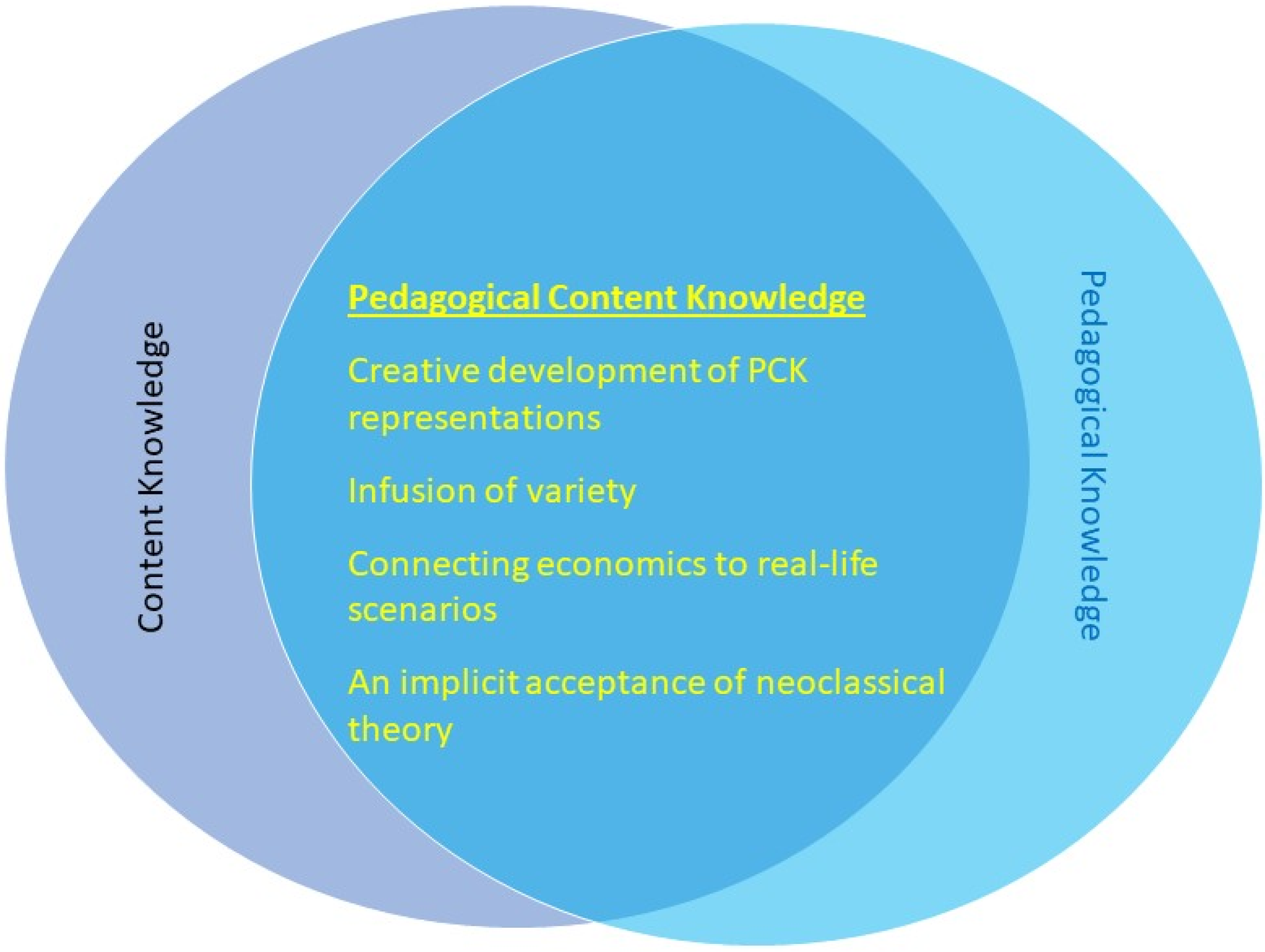
Teachers’ PCK in school economics
Creative development of PCK representations
Teachers drew upon their specialist knowledge to develop PCK representations that assisted their students in engaging with the disciplinary knowledge involved. I contend that the amalgam of content and pedagogy refutes the dichotomisation that the curriculum (‘what to teach’) can be separated from the pedagogy (‘how to teach’) (Young, 2008, 2013); the questions regarding ‘what to teach’ and ‘how to teach’ are interrelated. In economics, integrating ‘what to teach’ with ‘how to teach’ is essential for supporting students in grasping ideas which they may perceive as abstract, particularly when theoretical models appear to them disconnected from real-world applications (Mizzi, 2023b, 2024; Ayers, 2015).
These teachers’ generation of PCK reflects Shulman's emphasis on the value of representation in the classroom (Shulman, 1986b). For example, Mary's football match metaphor for demand-pull inflation, Caroline's use of cheese portions to explain shareholding, and Robert's use of everyday objects, such as a paper bag, to explain international trade are examples of how teachers may employ their subject-matter expertise to generate engaging learning opportunities. These approaches align with Joshi and Marri's (2006) and Ayers’ (2018) suggestion that practical approaches facilitate deep learning in economics. Shulman's preparation, selection, adaptation, and tailoring procedures are applied in these cases to engage the students in learning (Shulman, 1987).
The effectiveness of the PCK representations generated, as evidenced in student test performance and engagement, supports Shulman's view that PCK is a critical component of expert teaching. These representations bring to mind Darling-Hammond's (1997) claim that teachers need to be able to perceive how ideas connect across fields and to everyday life to select and apply relevant examples, problems, and applications for PCK. This study highlights that a teacher may be inspired by a particular PCK during ‘informal’ times, such as when practising a hobby. These valuable moments need to be cherished as they represent an ‘aha’ moment in developing a PCK representation. This aspect has not been emphasised in the literature discussing PCK in economics education (e.g., Ayers, 2015, 2016, 2017, 2018; Joshi and Marri, 2006).
Experienced teachers found it easier to develop PCK representations. In contrast, teachers with limited teaching experience struggled to devise representations. For example, in her first year of teaching, Debbie was finding it difficult to explain the idea of a country's balance of payments: “The topic seems so detached from the students’ experience that I cannot think of relevant ways to explain the notion. In the first place, I need myself to strive to be confident about the content itself.” This example aligns with the research literature contending that a grasp of the substantive knowledge involved was a prerequisite to adopting a pedagogy that supported the students’ encounter with disciplinary knowledge in economics (Mizzi, 2023b; Ayers, 2016; Joshi and Marri, 2006). Otherwise, there exists the tendency for inexperienced teachers who are weak in substantive knowledge to be overreliant on textbooks, notes, and mechanistic approaches that promote a transmission pedagogy.
While developing PCK representations, teachers demonstrated aspects of the domain of knowledge of content and teaching, where they ‘did’ economics by utilising student-centred instructional practices (Ayers, 2018). They also exhibited aspects of horizon content knowledge when connecting economics concepts to broader real-world scenarios and other disciplines. This domain refers to curriculum connections across subjects, courses, themes and issues (Ayers, 2018). For instance, when Robert used a paper bag from Brussels to teach international trade, he explained the immediate topic and also made connections to the wider context of global economics and cultural and business exchanges. This approach assists students in appreciating the interconnected nature of economic systems and understanding how economic principles apply in various contexts. I did observe, however, the same issue as that reported by Ayers (2016) in that “the participants needed to be more thoughtful in making the interdisciplinary content connections more explicit during instruction” (p. 83). This issue can be addressed in teacher education programmes and professional development.
Infusing variety in lessons
Teachers encouraged their students to engage with the knowledge to be grasped using various active learning strategies such as games, discovery learning, digital technology, and problem-solving activities. This aligns with the research literature claiming that active learning strategies are the best approach to teaching economics to keep students engaged (Mizzi, 2024; Ayers, 2015, 2016, 2017, 2018). For example, Ian used the jigsaw cooperative learning technique and the ‘numbers game’ to explain financial institutions, production, and efficiency. This approach resonates with Bruner's (1970) idea of enactive, iconic, and symbolic representations, in which teachers employ various modes of representation to support students’ learning. The positive student feedback on these techniques indicates that varied strategies do enhance learning outcomes.
The varied teaching methods employed by the teachers demonstrate aspects of the domain of knowledge of content and teaching. This is an understanding of how best to teach specific content. It concurs with the findings of Ayers (2018) that by limiting “economic lecturing and other passive instructional practices” and ‘doing’ economics by utilising student-centred “active learning instructional practices”, teachers can modify their teaching to make the content more accessible and interesting for their students (p. 77).
By being innovative in their varied pedagogical approaches, teachers tended to promote independent thinking, involved their students in discussing the economic knowledge presented, and positioned them better to challenge and be critical of the substantive knowledge involved. These are commendable aspects, representing aspects of the expressions of powerful knowledge in school economics (Mizzi, 2023b).
Connecting economics knowledge to real-life scenarios
Most teachers’ confidence in their subject and pedagogic approach facilitated the relationship between economics knowledge and real-world experiences. They were wise to draw upon examples and evidence from their lives, their students’ experiences, and the world around them. Liberata's use of the PPC related to students’ after-school activities exemplifies how contextualising economics concepts in familiar contexts and students’ everyday experiences can make learning more relevant, highlighting that everyday knowledge is a valuable resource for students and teachers (Mizzi, 2021, 2022, 2023a, 2023b, 2024; Roberts, 2014).
Teachers prioritised getting to know their students to facilitate the effort of connecting the economics content to life experiences so that students could perceive the economics around them. However, the difficulty of relating particular topics, such as national income and monetary policy, to students’ experiences suggests a need to explore further how to make these topics relevant and accessible.
By presenting knowledge from economics in the context of real-world scenarios and student experiences, most teachers demonstrated aspects of the PCK domain of knowledge of content and students, emphasising ‘student relevance’ by “incorporating real-world examples and analogies that relate to students’ everyday lives as the focal point of lessons” (Ayers, 2018: 77). This approach complements and expands upon the literature by highlighting the importance of teachers bridging the gap between knowledge that may appear theoretical and students’ daily lives. Understanding students’ backgrounds and learning needs allows teachers to “scaffold or ‘chunk’ economic content, starting with familiar language” (Ayers, 2018: 77). This knowledge helps teachers anticipate potential misconceptions and modify their teaching to address them. Another benefit of this approach is that students are educated to use economic reasoning skills instead of memorising content. This is an important educational goal in economics education (Ayers, 2016; Mizzi, 2024).
An implicit acceptance of neoclassical theory
The data analysis indicates the need for teachers to reflect on their potential unintentional immersion in the dominant neoclassical school of economics and the expectation that their students take this economics knowledge as given (Mizzi, 2022, 2024). This finding is not reported in Ayer's research (2016, 2018), but Joshi and Marri (2006) remark that preservice teachers “tended to equate economics with neoclassical economics” (p. 200).
Closely following the neoclassical approach can exclude important aspects of economic behaviour and reality, potentially rendering the subject less engaging for young people (Mizzi, 2024). This highlights the need for teacher education programmes to address the risk of strictly adhering to neoclassical models. While considering other schools of economic thought (Mizzi, 2023b, 2024), teachers can broaden their horizon content knowledge, enriching their students’ understanding and cultivating a critical stance towards the curriculum. It is also beneficial for teachers to consider infusing values into economics education to enhance the subject's ethical dimension (Mizzi, 2023a).
Despite the lack of awareness of the dominance of the neoclassical economics orthodoxy, school economics tended to facilitate the students’ participation in discussions over various perspectives on the economy, assisting them to recognise the political and economic nature of issues (Mizzi, 2022). These aspects can be considered powerful because they provide epistemic access to knowledge (Mizzi 2023b).
Conclusion
This study contributes to knowledge by enriching the understanding of how economics teachers develop and utilise PCK to assist their students’ engagement with disciplinary knowledge in economics, supporting Shulman's (1987) assertion that PCK is a unique and essential component of teachers’ professional knowledge. Teachers attempted to creatively transform content knowledge into PCK representations that facilitated student learning, infused variety during lessons, and connected content to real-life scenarios. The teaching practices that emerged from this research offer insights for improving teacher knowledge and skills in teacher education and professional development in economics education, particularly considering that most of them are backed by research on economics education. The implicit acceptance of neoclassical theory suggests a need for more critical approaches in teacher education to ensure that economics teachers consider other schools of economic thought to enhance their students’ learning experiences.
Further studies can research the practice of individual economics teachers over an extended period of time to gain deeper insights into their PCK. This longitudinal approach can inform how teachers refine their PCK over time. Understanding the nuances of how teachers acquire, interpret, and transmit economic knowledge can contribute to enhancing teaching practices and curriculum development in economics education. Further studies can explore how innovative PCK techniques affect students’ achievement and interest in economics over the long run.
By emphasising the importance of amalgamating subject matter expertise with teaching strategies, the construct of PCK offers the opportunity for professional development that focusses on pedagogical approaches that work best for each content domain in economics. This professional development assists student teachers and teachers in supporting each other to foster the articulation, exchange, and flourishing of PCK insights and best practices. Opportunities can be created to share and celebrate successful teaching approaches, resources, and innovative ideas, making explicit the tacit nature of PCK. This collaborative environment assists in cultivating reflective teaching practices where teachers can critically evaluate their pedagogical approaches and adapt them according to student needs and outcomes.
Understanding PCK assists teachers in developing inclusive strategies that accommodate students’ diverse needs and abilities. During professional development, teachers can enjoy sharing strategies and resources that support inclusive classrooms, cater to individual learning styles, and support students with varying levels of prior knowledge. This collaborative spirit enhances the collective expertise of teaching staff and promotes a culture of continuous learning and improvement.
PCK acknowledges the role of technology in the teaching and learning process (e.g., Swan and Hofer, 2011). Research and professional development can focus on technology integration programmes that offer insights into infusing technology into teaching practices to support student learning and engagement. Teachers can learn about the latest educational technologies, digital resources, and innovative teaching tools that use artificial intelligence to align with subject knowledge and pedagogical goals.
I experience teaching as a continuous journey where one expands one's discipline knowledge, refines one's pedagogical approaches, and stays updated on the latest research and best practices in education. The idea of PCK provides student teachers, teachers, and lecturers with the opportunity to think creatively about how to enact teaching and learning in a manner that makes economics relevant and worth studying for young people.
Footnotes
Declaration of Conflicting Interests
The author declared no potential conflicts of interest with respect to the research, authorship, and/or publication of this article.
Funding
The author received financial support from the University of Malta for the research, authorship, and/or publication of this article.
