




Abstract
Objectives:
Quantitative review and categorization of available endocrinology related mobile apps for the iOS platform (Apple®) and outline of search strategies to identify appropriate mobile apps for this field.
Methods:
A total of 80 endocrinology related search terms were collected and grouped into 8 main categories covering different areas of endocrinology. These terms were then used to perform comprehensive searches in three categories of Apple’s app store, namely ‘Medicine’, ‘Health and Fitness’, and ‘Reference’.
Results:
Altogether, matches were found for only 33 of the 80 collected endocrinology related search terms; the majority of matches were found in the medical category, followed by matches for the health and fitness (27/33), and reference (16/33) categories. Restricting the search to these categories significantly helped in discriminating between health related apps and those having another purpose. The distribution of apps per category roughly matches what one can expect considering available data for incidence and prevalence of corresponding endocrinological conditions. Apps matching terms belonging to the spectrum of glucose homeostasis disorders are the most common. For conditions where patients do not have to constantly monitor their condition, apps tend to have a reference or educational character, while for conditions that require a high level of involvement from patients, there are proportionally more apps for self-management. With a single exception, the identified apps had not undergone regulation, and information about the data sources, professional backgrounds, and reliability of the content and integrated information sources was rare.
Conclusions:
While applying a good search strategy is important for finding apps for endocrinology related problems, users also need to consider whether the app they have found respects all necessary criteria regarding reliability, privacy and data protection before they place their trust in it.
Keywords
Introduction
For many adults and adolescents, mobile phones and the apps running on them have become an important part of their daily life. According to numbers published for 2013, about 91% [Rainie, 2013] of US adults and 78% of adolescents (those aged between 12 and 17) own a cellphone. Ownership numbers for smartphones, i.e. devices able to download and run mobile apps are lower but still impressive (adults: 56%, adolescents: 37%). Numbers for other developed countries are in similar ranges or even higher [Statista, 2014; Wikipedia, 2014b].
Usage is not limited to private use or simple office tasks. Health related applications are continually gaining popularity. Target audiences range from healthy users who are simply interested in health related aspects or fitness to patients suffering from a chronic condition as well as healthcare professionals. Currently (April 2014), around almost 25,000 apps are available for iOS in the ‘Medical’ category [148Apps.biz, 2014]. Compared with previous times, where the number of available medical apps was considerably lower, Android is rapidly gaining ground: as of April 2014 about 16,000 medical apps were available for the Android ecosystem [AppBrain Stats, 2014].
Nowadays, these app stores even cover specific medical specialties and endocrinology is no exception. In various evaluations by other groups, such as the one by Eng and Lee, only certain aspects of apps relating to endocrinology were scrutinized [Eng and Lee, 2013]. We wanted to take a different approach in that we did not want to evaluate specific apps for ‘popular’ or ‘common’ endocrinological conditions such as diabetes. Rather, we wanted to determine how well the overall field of endocrinology is covered by available apps. Especially for rarer conditions, apps have the potential to put users, both patients as well as medical professionals, in touch with each other or to allow them to manage the condition, but also to simplify recruitment for scientific studies or to provide valuable information that might otherwise be hard to come by.
Cursory searches on various app stores as well as searches in the literature showed that, while some areas of endocrinology were thoroughly covered, other areas seemingly fell behind. To paint a more thorough picture of the current situation, we therefore performed searches using a comprehensive list of endocrinology related search terms. The results of our search were evaluated with respect to the areas of endocrinology they covered.
Methods
Identifying an encompassing set of mobile health applications for specific purposes is not an easy task when using the official, often web-based search methods that mobile application stores provide for their customers. Unfortunately, not all popular app stores offer simple means for performing conclusive, script-based searches in specific categories. For example, while Apple offers an official search API (application programming interface) for web-based searches that can be fine-tuned for specific countries, categories and search terms [Apple, 2014a], the same does not hold true for Google’s Play Store. For searches in this store, users are limited to the official, web-based search form offered by Google without being able to direct their search at a specific country’s store or a category unless they make use tools provided by third parties.
In our evaluation, we focused on Apple’s app store. This was done for a number of reasons. First of all, the limited search possibilities offered by competing stores did not facilitate the type of search we had planned. Our aim was to simply gain an overview of the general situation of endocrinology related apps and to determine how such apps are categorized. Also, Apple’s app is currently still the store with the largest number of medical and health related apps [iMedicalApps, 2013] and as a recent study has shown, albeit for cardiology [Edlin and Deshpande, 2013], iOS based apps tend to have a higher level of involvement by medical professionals or professional societies than those published for the Android platform.
Results returned using the aforementioned search API can easily be parsed and evaluated. Using this API, searches in the iTunes store can be performed in a relatively simple manner, e.g. as https://itunes.apple.com/search?key1=value1&…; thus a simple search for ‘diabetes’ in the US store, limited to software, would be performed as http://itunes.apple.com/search?term=diabetes&limit=200&country=US&media=software. Results are returned in JSON format and can easily be parsed and evaluated. Fields made available in the results include information about assigned categories, pricing, available languages, etc. and can be used for filtering. Available apps are usually assigned to one or more categories and thus, the search results can be filtered for the desired category, e.g. ‘Medicine’, ‘Health & Fitness’ or ‘Reference’.
To obtain an encompassing list of endocrinology related search terms, surpassing the list mentioned by Eng and Lee [Eng and Lee, 2013], we resorted to endocrine diseases listed in Wikipedia [Wikipedia, 2014a] and derived our search terms from this list (Table 1). To round off the list, five additional, more general search terms not found in Table 1 were also included and assigned to category ‘Others / General’: ‘endocrinology’, ‘endocrine’, ‘endo’, ‘multiple endocrine neoplasias’ and ‘hormone’.
List of endocrinology related categories and corresponding search terms derived from them [Wikipedia, 2014a].
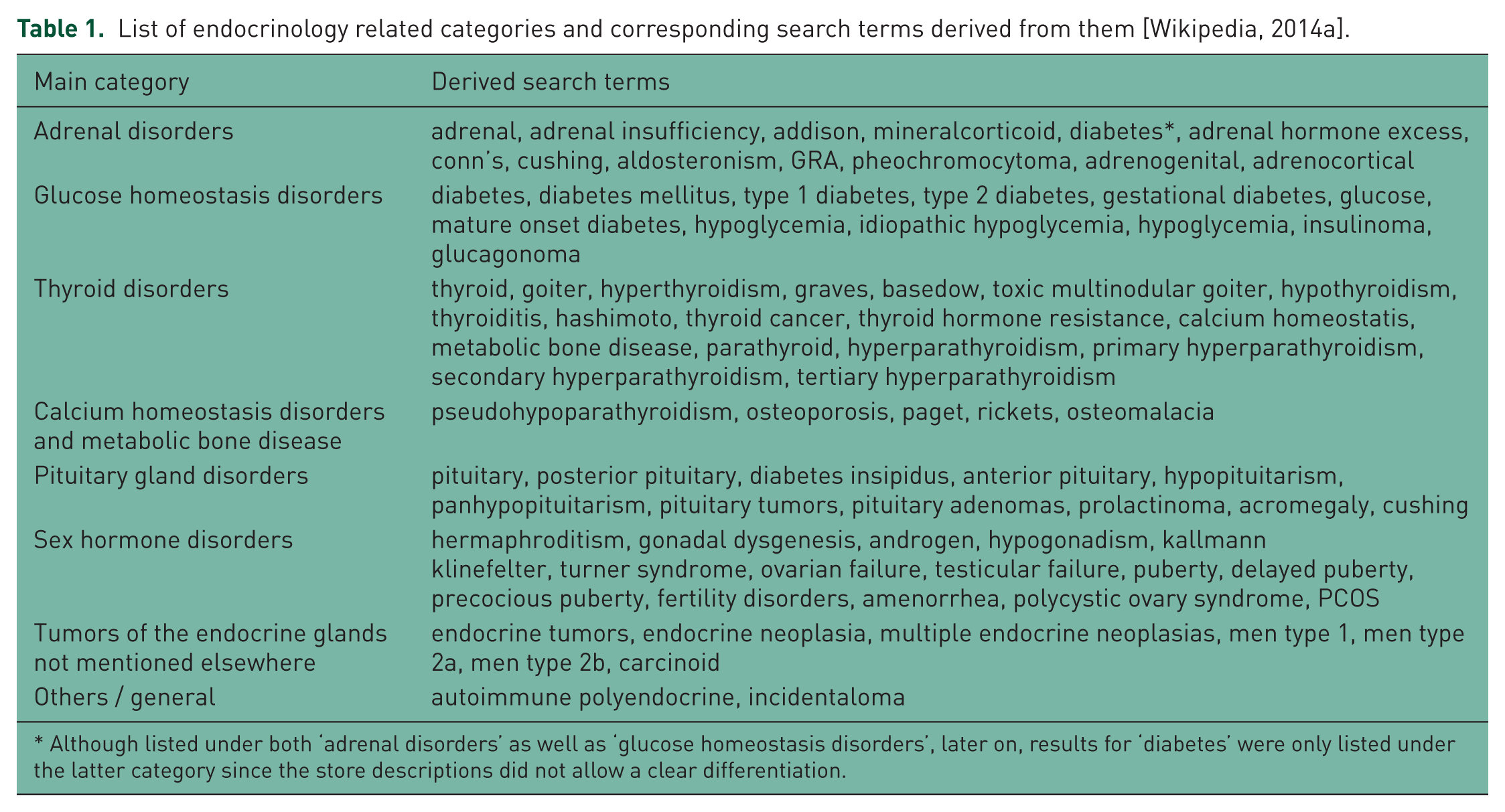
Although listed under both ‘adrenal disorders’ as well as ‘glucose homeostasis disorders’, later on, results for ‘diabetes’ were only listed under the latter category since the store descriptions did not allow a clear differentiation.
Within Apple’s app store, there are separate stores per country and languages differ as well; apps available in one country’s store might not be available in another. Therefore, in order to obtain results for a large market, the collected search terms were then used to perform searches in the US part of Apple’s app store. These searches were done separately for three store categories ‘Medicine’, ‘Health & Fitness’ as well as ‘Reference’ (searches were performed on 14 April 2014) since we expected these categories to have the highest yield. As befits their designation, apps belonging to category ‘Medicine’ are often perceived as targeted at medical professionals, while ‘Health & Fitness’ apps often include those designed for laypersons. While ‘Medicine’ and ‘Health & Fitness’ seem to be the most logical choices for locating medical or health related apps, during exemplary searches performed before our evaluation, we noticed that a number of apps providing endocrinology related content were listed as ‘Reference’ apps and would not have been found based on the other two categories (e.g. ‘Biology 30 Unit 2: The Endocrine System’, or ‘Endo 2013’, an app for last year’s meeting of the ‘Endocrine Society’), although they may nevertheless provide valuable content for certain users.
Search results found using the described strategy were disregarded and not included in the statistics if either
the description was not given in English, or
they did not appear to be a basic match for what one would expect from a serious medical or health related app (e.g., an app that aimed alleviating growth related conditions with ‘meditation’), or
they were not related to endocrinology (e.g. ‘endo’ matching endoscopic procedures of other medical disciplines).
Results
Table 2 lists the results of the searches performed following the above mentioned strategy, stratified for ‘adrenal disorders’, ‘calcium homeostasis disorders and metabolic bone disease’, ‘glucose homeostasis disorders’, ‘general terms/other’, ‘pituitary gland disorders’, ‘sex hormone disorders’ and ‘thyroid disorders’.
Descriptive statistics for the search terms defined above (sorted alphabetically) and three categories ‘Medical’, ‘Health & Fitness’, and ‘Reference’ (Apple’s iTunes Store, US).

Terms where results were lacking are not listed.
Altogether, matches were found for only 33 of the 80 search terms listed in Table 1. The majority of these (30/33) matched apps in the medical category, followed by matches for categories health and fitness (27/33) and reference (16/33). Only 9 search terms lead to matches in only a single category (medicine: 6; health and fitness: 3), and 8 matched two categories (again, only medicine and health and fitness). All search terms with matches in the reference category also produced matches in the other two categories.
The distribution of apps per category roughly matches what one can expect considering available data for incidence and prevalence [Golden et al. 2009, National Center for Health Statistics, 2014a, 2014b] of corresponding endocrinological conditions (Table 3). As expected, apps matching terms belonging to the spectrum of glucose homeostasis disorders are the most common. According to various sources [Golden et al. 2009; National Center for Health Statistics, 2014b], about 10% of adults aged 18+ in the US have diabetes. Many of these patients suffer from obesity as well, explaining the relatively large number of fitness and weight control related apps mentioning diabetes and related search terms in their app store descriptions. A high proportion of these apps were found in the ‘health & fitness’ category and appeared to be targeted at patients, i.e. diabetics managing their disease. In comparison to what Eng and Lee had found in 2013, the percentage of apps aimed at self-management (as stated in the store descriptions) had further increased from 33% to 40% (76/189).
Number of available apps, main category per search term and percentage of paid applications.

Results for the number of available apps do not necessarily represent the sum of the results for the three separate store categories since some of the apps were listed in two or all three store categories.
This trend is also mirrored by the growing number of recent publications dealing with such apps [Arnhold et al. 2014; Årsand et al. 2012; García-Gómez et al. 2014; Goyal and Cafazzo, 2013; Holtz and Lauckner, 2012; Klonoff, 2013; Markowitz et al. 2013; Ribu et al. 2013]. Another large proportion of the apps indicated an educational or reference purpose (37% or 69/189). Many apps targeting nonprofessional users that matched the keyword diabetes were meant for providing nutritional information, recipes and carbohydrate counting (34%, 65/189). Often, these were found in the store category ‘Health and Fitness’. Only a small percentage (8%, 15/189) of the apps targeting diabetes is aimed at professionals and these are almost exclusively reference and educational apps (14/15) or apps provided by professional organizations. Surprisingly, some of these are not listed in either the ‘Medical’ or ‘Health and Fitness’ category but rather categorized as ‘Reference’.
Independent of whether they target medical professionals or patients, app descriptions rarely give information about the information sources they are based on or about available evidence, a problem previously noted by Eyler [Eyler, 2013]. Corresponding to their lower incidence and/or prevalence compared with diabetes [Golden et al. 2009], the number of apps is lower for other conditions where patients are required to manage and monitor their situation. Still, proportions of management apps versus those with a pure reference or educational purpose remain similar.
In contrast, for conditions where patients do not have to constantly monitor their condition, apps tend to have a reference or educational character. This may very well make sense for chronic conditions that, while they may not be acute, can still have debilitating consequences for patients and may seriously impact their quality of life. For example, in the US, about 1.7% of adults aged 50–64 and 10% of adults 65+ have osteoporosis [Golden et al. 2009; National Center for Health Statistics, 2014a]. Although members of the latter age group may not represent typical ‘smartphone users’, apps covering this area and providing appropriate information may very well make sense for younger users. For example, according to Golden and colleagues, a large percentage (depending on the ethnicity and gender, 23–48% of those aged 45+) may suffer from osteopenia, a condition that is often considered as a precursor to osteoporosis [Golden et al. 2009]. Of the 24 apps that were found when searching for the term ‘osteoporosis’, 17 targeted patients. Most of these provided information for reference, ranging from nutritional information (with prevention of osteoporosis in mind) to information about the disease itself or giving guidelines about its risks; seven of the apps were aimed at professionals, with three of them providing background information about a scientific congress. There was also one app providing algorithms for calculating an individual’s 10-year probability of suffering an osteoporosis fracture, while the others were aimed at reference. Similar to the situation described for the diabetes related apps, when looking at what is stated in the app store descriptions, information about scientific evidence and sources integrated into the apps is rare.
Discussion
Limitations
A limitation of our investigation was certainly its focus on a single app store, namely Apple’s iTunes store. This store was chosen due to the fact that the search possibilities offered by this store surpass those offered by other stores, thus facilitating the evaluation. Also, it is still the one with the largest number of medical and health related apps [iMedicalApps, 2013], closely followed by Google’s Play Store; app stores for other platforms currently offer only a small fraction of the apps available but are also not as widely used.
General aspects of the evaluation
Numbers for available medical apps and health apps vary depending on the classification one applies and any misclassifications can also have an influence on whether a matching app for a specific area of interest such as endocrinology can easily be identified or not.
Of course, this also holds true for finding apps for other medical disciplines. Although the app stores provide specific categories for health related content that can be assigned to the apps they distribute, this does not necessarily mean that all apps assigned to these categories conform to what one would expect. This can be due to varying reasons. Available categories are often not clearly defined, which became clear early on in our evaluation when some apps we would have expected to be listed in either the ‘Medical’ or ‘Health and Fitness’ category were not included in the search results for these categories. There are no clear specifications of what it takes to be allowed to place an app within a specific store category; criteria for inclusion or exclusion are unavailable. For example, apps matching under the store category ‘Reference’ encompassed many different types, ranging from apps for meetings of professional societies to those providing information about laboratory values or educational material for patients. Also, the store categories are often rather haphazardly extended to include additional classes of apps. Neither users nor developers have an influence on the way store owners construct their categories or on the requirements (or lack thereof) for assigning such a category to an app.
Medical apps – a ‘categorial’ problem?
Although app stores often give developers the opportunity to assign more than one category to their apps, there are no specific guidelines for the categories to use, and apps with health-related content are often also found in other categories, e.g. ‘Reference’, ‘Health and Fitness’, ‘Education’, or ‘Books’. Depending on the search strategy users apply when trying to identify an app that meets their needs, this may complicate the search process. For common diseases such as diabetes, even general searches performed without specifying a category such as ‘Medicine’ will return a large number of good matches. For less common conditions with a small target audience, search results are often still promising at first glance, but will often lead to matches for other subjects as well and users will have to sift through the results in order to find an app matching their needs. For endocrinology, this is for example the case with Graves’ disease, where general searches point to cemetery reference apps or games. If permitted by the respective app store, users should therefore carefully select the category in which they want to search. Unfortunately, as mentioned before, not all stores allow a search by category. In fact, Android users often have to wade through a large number of results to find a medical app matching their needs. App store providers could considerably help their customers if they would generally allow searches that are restricted to specific store categories or target audiences.
Store categories – current situation
Criteria or clearer definitions of how an app can be categorized or how appropriate information about it can be presented to customers are only hesitantly added. For example, this occurred recently, when, in an email to developers enrolled in iTunes Connect, Apple specified that an additional content description had been added for ‘Medical/Treatment Information’ [Apple, 2014b]. Since store providers usually remain closemouthed about the underlying processes that an app has to undergo before being admitted to the respective store, it remains an open question whether they really evaluate if manufacturers have selected the most appropriate category or provided fitting content descriptions for their products. One can suspect that such an evaluation does not always take place. This is understandable considering the sheer number of apps being submitted as this would certainly require extensive administrative effort. If an app were to be rejected based on such grounds, some developers might also see this as undue interference and as a potential deterrent for publishing their app for the respective platform. In fact, by providing developers with a sales platform that does not put up too many obstacles, chances for successful sales (and profit) can be expected rise for both parties. Developers can assign one or more categories and provide more or less fitting keywords and app descriptions for informing potential users, but it is entirely up to them what information they provide.
Unfortunately, the lack of information that users often have to deal with is not a trivial problem since, to identify an app that meets their needs without too much effort on their part (and possibly giving up before their search has been successful), users have to rely on certain keywords as well as a correct classification. Another important aspect is the name of the app, which can also serve as a search criterion.
Which criteria can be used for a systematic search depends on the chosen app store. Usually, online searches in an app store only allow entering simple search terms without being able to use logical operations, i.e. by linking search terms with ‘and’, ‘or’, or ‘not’; official search APIs such as the one provided by Apple [Apple, 2014a] are also a rarity and, even in this case, there are limits such as the maximum number of 200 matches that can be obtained using this search API.
Conclusion
Which measures should developers and distributors implement to aid potential customers?
If apps are to be perceived as serious and reliable offers for providing aid for medical and health related questions, it will be necessary to professionalize both the development of such apps as well as the way they are distributed. This should concern all stakeholders alike and includes ensuring trustworthiness as well as reliability on the development side, but also easy discovery of apps in the stores for both professional users as well as laypersons on the store side by providing potential users with comprehensive information about the apps in a transparent manner. As far as possible, this transparency should mirror what has been established for other health related products.
Altogether, the following aspects should be considered when distributing (professional) medical and health related apps and this is something where developers/manufacturers and app store providers need to collaborate:
There should be a clear definition of appropriate categories (possibly including subcategories) for the distribution platforms (app stores); clear inclusion and exclusion criteria for placing an app in a specific category need to be defined. These categories and criteria for inclusion and exclusion could for example be based on whether specific MeSH terms are matched or not. There should also be a rigorous review of whether appropriate categories have been assigned in order to prevent classifications that are either chosen out of ignorance or with the aim of increasing sales.
Aside from observing regulatory aspects (that also depend on the requirements of the involved jurisdictions), as previously mentioned by Albrecht and colleagues [Albrecht, 2013a; Albrecht et al. 2014], there should be a clearer differentiation between apps with a strictly medical purpose and those that aim at health and fitness. The differentiation can for example be based on the definition of health by the World Health Organization (WHO), i.e. ‘Health is a state of complete physical, mental and social well-being and not merely the absence of disease or infirmity’ [WHO, 1948] and this is a good match for the purpose of basic health and fitness related apps. In contrast, medicine aims at providing a clear diagnosis and an appropriate therapy, and the purpose of medical apps should be to support this process. A good differentiation between both types of apps can also server to heighten transparency since it makes it more obvious what an app can (and may) do.
In addition to ‘simple’ search methods offered today, enhancing the search experience by offering additional possibilities (e.g. logical operators) would be desirable; likewise, if appropriate search APIs were provided – independent of the mobile platform – this could further simplify the search process and possibly open up the evaluation process to (independent) third parties. In this context, in order to determine whether there is a potential bias during searches, another important aspect would be to provide information about the underlying search algorithms that the stores apply for returning results matching a user’s request.
Developers are called upon (and the store owners should encourage this) to provide users with extensive and transparent information about their app that lets them more easily judge whether an app matches their needs. This could for example be done based on a standardized reporting tool, e.g. the app synopsis proposed by Albrecht [Albrecht, 2013b].
Applying these criteria is in the best interest of all stakeholders. Even high quality apps for common diseases must first be found by users and deemed trustable in order to obtain good ratings, which in turn will further raise their visibility and possibly generate higher revenue; for less common conditions (as they are also found in endocrinology), due to their smaller user base, observing the aforementioned points is even more important.
What do users need to consider when searching for specific apps?
While applying a good search strategy is already half the job for identifying apps fitting the desired purpose, users should remain aware of many additional aspects before they place their trust in an app that may very well have a negative influence on their health (in the case of patients) or on their work and thus their patients (for professional users). Although many of the apps we came across during our evaluation (especially those performing some sort of calculation for diagnosis or therapy) could be perceived as medical products – depending on the jurisdiction they are used in – and would thus have to undergo regulatory processes if their manufacturers had assigned them an official medical purpose, such a designation is rarely done: This would necessitate at least a basic conformity evaluation before such apps could be put on the market. Nevertheless, there was only one diabetes management app where this was mentioned. In fact, even for other medical specialties or medical apps in general, there are only very few medical apps for which compliance to regulation has been shown such as following the US Food and Drug Administration’s rules [US FDA, 2013] for the US market or by obtaining a CE label [European Union, 2007] as required for the European market. Since there is no overseeing authority, private certification initiatives for medical apps are also not always reliable; a prime example for this was when Happtique suspended its health app certification program after an independent evaluation had found serious flaws in apps they had certified [Misra, 2014].
To find the right app and determine for themselves whether they can place their trust in an app they have found, ideally before they install it, users should refer to several key questions that can be used similar to a checklist to obtain a better overview:
What is the stated purpose of the app, what is its target audience and does the app’s purpose match the user’s needs?
Is a thorough and comprehensible description of the app’s functionalities available?
Are there any inherent limitations and potential risks and are corresponding concerns adequately addressed by the manufacturer? These may include medical aspects (by endangering the user’s own health or the health of other persons, e.g. patients being treated by professionals who make use of the app), or may also concern data entrusted to the app (e.g. intentional or unintentional leaks concerning data protection and privacy).
Is there any information about the information sources used to build the app, about who is responsible for the content (authors) and development (developers), and about their qualifications?
What measures are taken to address data protection and privacy concerns? If the app records any data: do users remain in control of their data, are they asked for permission before anything is transmitted (if at all) and are they informed about their due rights? Are appropriate measures taken to ensure secure storage and transmission (encryption)?
If questions arise, is there a possibility to easily contact the manufacturers/developers of the app, e.g. via information provided in an imprint?
Final remarks
Despite the benefits mobile apps may offer for medical professionals and patients alike, many questions still remain open, e.g. regarding quality of the content, data security and privacy. In this context, endocrinology related apps are no exception. Still, in a field, where patients’ health as well as professional ethics may very well be at risk if such technology is used without good sense, it is in the best interest of all parties involved to ensure that the aforementioned points are taken care of.
Unfortunately, clear criteria for medical and health apps are lacking for all stakeholders, although there are many projects or initiatives that have this objective [Albrecht, 2013a]. For apps where regulation applies, some of the risks may be mitigated but, as we noted in our attempt to determine how well the field of endocrinology is represented app-wise, regulation is currently rarely observed. Of all endocrinology related apps found in our evaluation, compliance with regulation was only stated for one app.
We therefore advise that, until standardized mechanisms have been firmly integrated, for example, by better adapting the distribution process to the needs of the field, apps should be used with caution by medical professionals as well as patients. We hope that the points mentioned above may be a building block in the process of professionalizing the distribution and use of medical apps.
Footnotes
Conflict of interest statement
The authors declare no conflict of interest in preparing this article.
Funding
This research received no specific grant from any funding agency in the public, commercial, or not-for-profit sectors.