



Abstract
Background
Natural dyes are gaining popularity due to their environmental and health benefits over synthetic products, which are facing regulations due to hazardous effects, promoting the use of plants as eco-friendly alternatives.
Objective
This study was aimed at exploring binary colorant from berry (Zizyphus jujube) and henna (Lawsonia inermis) leaves extracts for colorfast artificial intelligence optimized dyeing of microwave (MW) treated unmordanted and mordanted cotton fabrics.
Methods
The binary plant extract and cotton fabrics were exposed to microwave (MW) treatment for 1–9 min using the dyeing and radiation conditions. The colorfast dyeing was assisted via central composite design, pre-, and post-mordanting techniques
Results
Sustainable chemical- and bio-mordant (0.5-2.5 g/100 mL) incorporated new shades with excellent fastness properties onto the dyed cotton fabrics. It has been concluded that 7 min MW-rays treated cotton fabric using acidic binary dye extract of pH 5.5 having 1.5 g/100 mL salt at 50 °C gave colorant yield of 85.42% higher than that of untreated dyed cotton fabric counterpart. The shades made before and after mordanting developed new colorfast garments.
Conclusion
The study revealed microwave treatment as an environmentally friendly surface treatment method with excellent potential for textile modification and surface response methodology as an artificial intelligence technique for optimizing dyeing process.
Intoduction
Synthetic dyes are organic or inorganic substances used for coloring different substrates, because they are obtainable at low cost.1,2 These colorants are water polluting, soil degrading, non-biodegradable and capable of causing in fertility. 3 Mostly these dyes are hard to treat, causing respiratory illnesses, destroying global beauty and capable of initiating dermatological problems.4,5 Hence, textile industry is one of the major dye consumers that discharge used dyes into the environment, polluting ecosystem by causing global heat and behavioral change of life style., 6 Recently, the globe is moving toward sustainable green chemistry and eco-friendly products to curtain these troubles. 7 Among such green products, natural dyes are sustainable, non-toxic, organic and eco-friendly. 8 Other benefits that promote their awareness include antioxidant, antiviral, anti-inflammatory, and antimicrobial properties. Additionally, they are non-carcinogenic, less hazardous, and beneficial to the environment.9,10 Green purchasing (natural dyes among others), which accounts for about 40% of environmental materials, offers an alternative to harmful purchases and protects the environment from naive degradation.11,12 Due to such benefits their marketing has also been enhanced up to 40% annually worldwide.
The specific problems with natural colorants include, poor colorfastness, labor intensive, low yield and low hue uniformity. 13 The conventional methods of natural dyes extraction from their sources has failed to overcome these problems.14,15 The alternative methods currently needed for improving extraction should be affordable, environmentally friendly, energy-efficient, sustainable, and lead to rapid increase in color yield. These techniques are also needed for surface-tuning textiles to enhance their dyeing behavior uptake. 16 These modern methods include radiation processes such as plasma, gamma, microwave, ultrasonic and UV radiation. 17
Microwave treatment is the promising and an innovative approach among the modern extraction techniques because of its time, labor, solvent effective nature that helps to increase colorant extraction efficiency.18,19 During extraction, these microwave rays can enter the plant cell wall structure uniformly, and by rupturing cell walls to allow solvent molecules to combine with natural plant colorant. This effective powder-solvent interaction adds value in colorant yield. 6 The surface changes in the MW treated fabric materials may result from local heating effect of MW radiation, which can be seen through the scanned image in electron microscopy without any major effect on chemical composition.20,21 Poor colorfastness of natural dyes is alleviated through utilization of mordants before, during or after natural dyeing of textiles. Mordants often used for enhancing the color strength and fastness of naturally dyed substrates can be chemical (metal salt) or natural (herb). 22 However, some metal salts are found toxic, now encouraged to be replaced with organic bio molecules. 23
Henna is the shrub or tiny tree, grown all around the globe. The leaves extract has biomedical properties.. 24 It provides many shades onto fabrics due to addition of many chemicals. 25 Lawsone (Figure 1) is the primary biochemical in henna leaves that has potential to import color onto fabrics and yarns. 26 The leaves of Berry (Zizyphus jujuba) plant is rich in anthocyanin and flavonoids (Figure 1). 27 It is the potential plant for curing of many diseases.28–30

Chemical structure of lawsone from henna leaf and anthocyanin from berry leaf.
The involvement of several variable parameters (such as pH, contact time, initial dye concentration, liquor ratio, agitating speed and temperature) makes textile dyeing process a little bit cumbersome. Utilization of artificial intelligence like surface response methodology (SRM), and/or artificial neural networks (ANN) have been reported to make the dyeing process seamless. 31 Eyupoglu et al32,33 optimized protein fibers coloring process with natural dye using ANN intelligence, while Amin et al 34 used SRM in optimizing textile dyeing with agro crop wastes. Abdelileh et al 35 compared and contrast between utilization of ANN and SRM artificial intelligence model in optimizing dyeing process of acrylic fiber using indigo carmine dye. The study recommended SRM as a better dyeing parameters optimizing model.
Insufficient information on the use of SRM, a form of central composite design as an artificial intelligence model for predicting optimal dyeing conditions for obtaining colorfast adorable shades from binary dyed mordanted cotton fabrics vindicated this study as a novel one. The present study was aimed at investigating the ability of berry-henna binary dye for green coloring of mordanted cotton fabrics.
Materials and Methods
Materials
Berry leaves (Zizyphus jujuba
Methods
MW irradiation of plant materials and cotton fabrics, dye and bio-mordants extraction, mordanting, and dyeing of cotton fabrics were carried out at Color Chemistry Laboratory, Applied Chemistry Department, Government College University Faisalabad, Pakistan between year 2023 and 2024.
Radiation and Dyeing Process
The extraction process was done as described by Fersi et al 19 with slight modification. Binary dye mixture was obtained by boiling 2 g of berry leaves and 2 g of henna leaves powder separately for 45 min in 100 mL of different extracting medium (aqueous, alkaline and acidic medium). The plant extracts, and cotton fabrics were microwave irradiated for 1–9 min at high power using the commercially available orient oven of 50 Hz with the power of 700 W. MW-irradiated and un-irradiated extracts were used to dye MW-treated cotton, and un-treated cotton samples at 50 °C for 35 min at material-liquid ratio 1:30. The flow sheet representation of plant extraction and dyeing of cotton fabrics is shown in Figure 2.
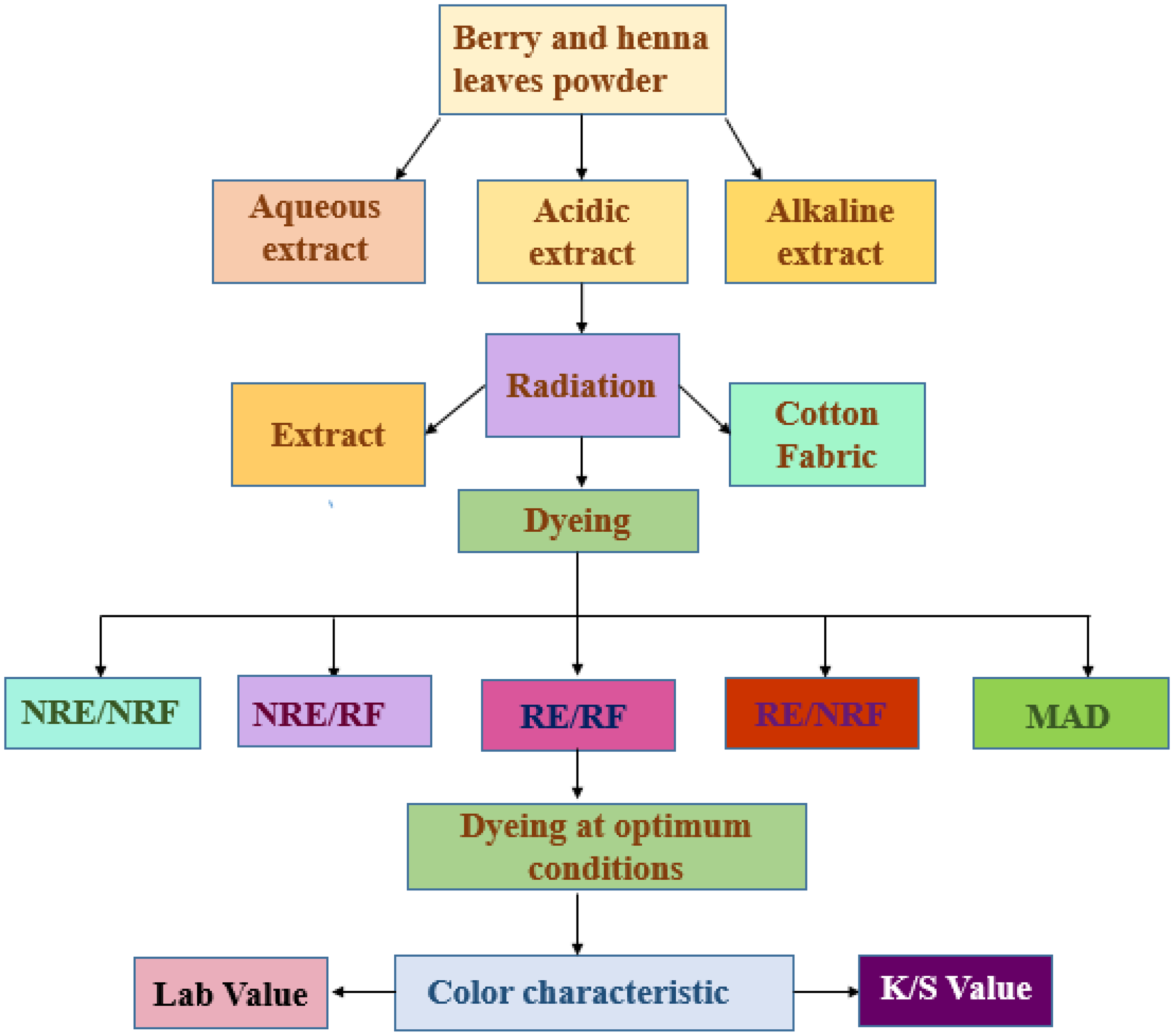
Flow sheet of the extraction and application of colorant from a binary mixture of berry and henna leaves for dyeing cotton fabric.
Mordanting Conditions
For increasing the color intensity, sustainable and colorfastness of the dyed fabric, chemical mordants and bio-mordants were employed at concentrations 0.5, 1, 1.5, 2, and 2.5 g/ 100 mL, temperature 30–70 °C, mordant-fabric ratio of 25:1 (4% wof), for 45 min for pre- and post-mordanting process. 28 The flow sheet representation of mordanting is shown in Figure 3.

Flow sheet of mordants used in fixing colorant from a binary mixture of berry and henna leaves onto the cotton fabrics.
Evaluation and Characterization of Dyed and Undyed Fabrics
Scanning electron microscopy (SEM), UV-vis, and Fourier transform infrared spectroscopy (FTIR) analyses were used to examine the morphological and chemical changes after treating cotton fabrics with microwave radiation.27,36 For the evaluation of color strength (K/S), all the dyed fabrics were subjected to the CIE Lab system in Spectraflash SF-600. The dyed fabrics were subjected to ISO standards for rating the colorfastness properties in observing the role of bio-mordants and their comparison with chemical mordants. The color fastness properties were analyzed for washing (ISO105 CO3), light (ISO105 BO2), and rubbing (ISO105 X-12), as per ISO standards, and ratings were taken by comparing shade changes at a grey scale. The studied color fastness properties were analyzed using fadometer. Colorfastness properties were analyzed by washing dyed fabric sandwiches between undyed cotton using neutral soap solution at standard conditions. The dyed fabric's colorfastness to rubbing was assessed using a crock meter, which was turned ten times for dry and wet rubbing.
Results
Dye Extraction from Binary Mixture of Berry and Henna Leaves
The selected dye extraction conditions, such as microwave irradiation time, and extraction medium (Figure 4), others like extraction temperature, pH, solvent volume, time, and salt concentration (Table 1) were used for optimizing the dye yield.

Dyeing of cotton fabrics with binary dye extract from (a) aqueous, (b) acidic and (c) alkaline medium.
Levels for Optimization of dye Extraction from Berry and Henna Leaves.

Figure 4 shows the influence of extracting media, and irradiation time on color strength of the dye extract.
Range of shades developed onto the dyed cotton fabrics after mordanting with their corresponding color coordinates are presented in Table 2.
Relation Between Sample Formulations, Obtained Color Strength, and Shade of Dyes Obtained from MW Treated and Untreated Berry and Henna Leaves Extracts.

Dyeing of Cotton Fabric
The dyeing parameters optimized via central composite design for maximizing color strength are presented in Table 3.
Central Composite Design (CCD) Analyses for Optimizing Dyeing Parameters Using Irradiated Binary Mixture of Berry and Henna Leaves Extract.

The color strength (K/S) of treated dyed fabric increased with the increase in dye volume from 20 to 30 mL, temperature from 30 to 70 oC, salt concentration from 0.5 to 1.5 g/100 mL and pH from 3.5 to 5.5, then declined by further increase in the varied parameters.
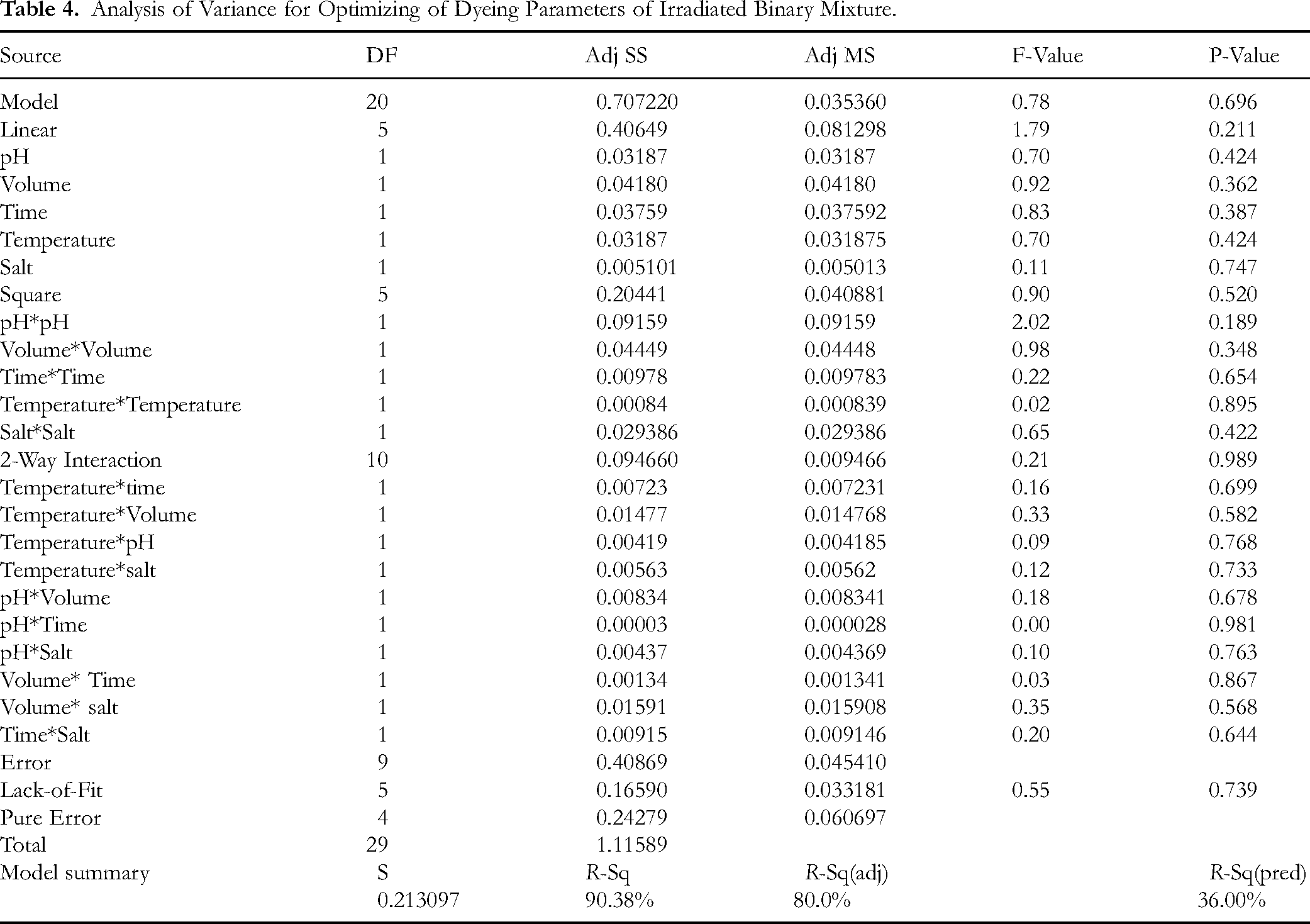
The analysis of variance (ANOVA) of the selected parameters (pH, volume, salt, temperature, and time) has meaningful impacts on the color strength (K/S) of the dyed fabrics (Table 4).
Analysis of Variance for Optimizing of Dyeing Parameters of Irradiated Binary Mixture.
Results on color strength (K/S), CEL*a*b* values and different shades developed before and after mordanting of dyed cotton fabrics are presented in Figure S1 and Table 5, respectively.
Effect of pre and post-Chemical and bio-Mordents on Microwave-Irradiated Cotton Fabric.

Mordanting of Dyed Cotton Fabric
Figure 5 shows the proposed mechanisms for the interaction of mordant with dye molecules and cotton matrix. In the figure, metal mordant fixed dye molecules onto the cotton fabric by covalent bond, while herbal mordant does the same by extra H-bond.

Suggested interaction between binary dye, mordant, and cotton fabric
Colorfastness
Colorfastness attributes of unmordanted and mordanted binary dyed cotton fabrics are shown in Table S1. The table displays scale rating 1–5 for washing and rubbing fastness, where 1 stands for poor, fair for 2, and 3 indicates good, 4 and 5 indicate very good and excellent, respectively. For light fastness, the scale rating is from 1 to 8, where 1-2 indicates poor, 3-4 is fair and 5 means good, 6-7 is very good and 8 stands for excellent.
Characterization of Binary Mixture of Berry and Henna Leaf Extract, Unmordanted and Mordanted Dyed Cotton Fabrics
SEM Analysis
Surface appearance of cotton fabric before and after MW treatment was analyzed using scanning electron microscope (SEM). SEM images of untreated and MW treated cotton fabric are presented in Figure S2. Figure S2a shows smooth image of untreated fabric, while minor scratches appear at the SEM surface image of MW treated cotton fabric (Figure S2b).
Spectrometry Analyses
The wavelength of maximum absorption (
Discussion
Dye Extraction from Binary Mixture of Berry and Henna Leaves
At the selected levels (Table 1), the MW rays ruptured the cell wall of the plant materials whereby resulting into maximum extraction for obtaining optimum dye yield.36,37 The color coordinates (CIEL*a*b*c*) for the shades revealed that the selected conditions have produced highest shade of reddish yellow hue having good saturation (ho) and chromaticity (c*) values (Table 2, Table 5). Figure 4 shows that extract from acidic medium, irradiated for 7 min yielded maximum color strength (K/S = 2.4483). This observation agreed with the findings reported by Amin et al 33
Dyeing of Cotton Fabric
The dyeing parameters, such as dyeing volume, temperature, time, salt and pH also played the noteworthy role in the dyeing of textile fabrics with plant extracts. According to Liu et al 38 the aggregation of colorant at higher varied parameters of dyeing created hindrance for dye molecules to enter into the fabric pores that made them to mainly remain at the surface. On washing, these unfixed dye molecules were wiped off and actual dye strength observed became less. By systematically varying each of the parameters within its designated range, it was observed that the fitted model followed a linear trend (Table 3). Hence, the maximum color strength was achieved by the result of binary mixture of berry and henna dyed fabrics using optimal parameters such as dye volume (30 mL), temperature (50 °C), time (35 min), and 1.5 g/100 mL of salt solution.
Analysis of variance (ANOVA) explores the significance of each of the parameters used for the optimization based on the response. 39 The significance is determined by two values, as p-value and F-value. According to Saliya, 40 the parameter is considered to have a significant influence if the p-value ≥ 0.5 and significant effect increases with a higher F-value. 40 From Table 4, since model p-value is 0.001, this indicates that second order polynomial model fit is good. A statistical analysis of the experimental data showed that the roles of pH (p-value = 0.000), Volume (p-value = 0.001), time (p-value = 0.012) and salt (p-value = 0.007) are highly important ie, all linear effects of the dyeing parameters are found to be significant. Quadratic effects of pH, temperature and salt are significant too. Interaction effects of pH*volume, temperature*time, pH*salt and volume*salt are also significant since p-values are small for them. Overall, goodness of fit is very high and low value of standard deviation (0.08638) validated the reliability of whole experimental data.
Mordanting of Dyed Cotton Fabric
While using natural dyes, mordants are needed to fix the color, particularly for textiles using plant extract. Chemical mordants add value in either shade brightening or darkening by the formation of a metal dye complex between dye molecules and cotton fabric. 41 Some metal salts like Cu, Co, Ni and Cr are considered carcinogenic, and their presence in effluents causes many health hazards 38 So, eco-friendly mordants such as electrolytes of Al, and Fe have been used before and after dyeing to develop new colorfast shades.22,28 Al lacks d orbital, so it only formed brighter shade, whereas Fe, being one of the members of transition metals, utilized d-orbital and produced dark shade 42 through formation covalent bond between fabric and dye molecules as presented in proposed mechanism in Figure 5a. For comparative analysis, plant-based bio-mordants, such as turmeric, pomegranate, and walnut bark have been tested. The potent molecules from these plants produce a wide range of colors based on their mode of application and the fabric used. 9 Their functional groups such as -OH, -C = O and-NH interact with cotton fabric and colorant via additional H-bonds to give colorfast shade through formation of special interaction (Figure 5b). These sustainable molecules show environment-friendly behavior and provide acceptable dyeing properties that confirmed them as alternative to hazardous metallic mordants. According to the results in Table S1, 2.5% of iron salt (Fe) and 1.5% of aluminum salt (Al) have yielded good results with acceptable fabric shade. After dyeing, it is clear that 2.5% of aluminum salt (Al) and 1% of iron salt (Fe) have produced high color yields. Turmeric, Pomegranate, and Walnut bark furnished darker shades. Color variation given in Table 5 revealed that shades are bright yellow with variation in reddish-green tone obtained with pre-dyeing proportions of 2.5% walnut bark, 1.0% pomegranate, and 2.5% turmeric, and post-dyeing concentrations of 0.5% pomegranate, 0.5% turmeric, and 1.5% walnut bark.
Overall, pomegranate as bio-mordant and iron salt as chemical mordant are effective in producing good quality tints onto cotton fabric (Figure S1). These observations agreed with the findings made by Pranta and Rahman. 43
Colorfastness
Colorfast shades are essential for every dyed textile material because they are the most important requirement for natural dyes. The mordanted dyed cotton fabrics were tested for color fastness using the ISO standards. The rating results in Table S1 for unmordanted dyed cotton fabric has shown good results in terms of washing, and rubbing and fair result for light. These results were improved to good for light and very good or excellent for washing and rubbing after mordanting with less toxic metal salts and eco-friendly bio-mordants. These good results are due to the formation of the stable complex between the fabric and colorant by chemical mordants and additional H-bonding by bio-mordant extracts. 44 Therefore, using microwave treatment under specific conditions, the recommended amount of mordants is suggested to achieve desired colorfast shades before and after coloring cotton fabrics with natural berry-henna binary dye.
Characterization of Binary Mixture of Berry and Henna Leaf Extract, Unmordanted and Mordanted Dyed Cotton Fabrics
SEM Analysis
Figure S2a shows smooth image of untreated cotton fabric, while minor scratches appear at the SEM surface image of MW treated cotton fabric (Figure S2b). According to Jabar et al, 17 the minor scratches made on the treated cotton fabric's surface by microwave rays revealed that the sorption uptake would be enhanced. This treatment has facilitated the good color strength and attractive shade when compared with the one observed for unmordanted dyed cotton fabric. This observation is in line with literature reports by Jabar et al; 17 Fersi et al 19
Spectrometry Analyses
The wavelength of maximum absorption obtained for the berry and henna leaves extracts fall within the ones reported in the literature for similar studies.24,45 The FTIR spectrum of untreated berry and henna leaves extract (Figure S3) present distinctive peaks of the -OH, C-H, C = O carbonyl, C = C/and C-C conjugate carbon of the aromatic ring, and C-O functional groups at 3291.2, 2920.4, 1736.8, 1541.3, and 1023.2 cm−1 predicting presence of the moieties of lawsone and anthocyanin in the extract. According to Jabar, 45 an insignificant shift in vibration peaks (3291.6, 2917.06, 1541.9 and 1024.33 cm−1 for -OH, C-H, C = O, C = C/ C-C and C-O functional groups) after MW treatment on berry/ henna leaves extract confirmed that MW-rays did not change the chemical composition of the extract. The FTIR spectra of untreated, microwave (MW)-treated cotton fabric, and untreated, MW-treated dyed cotton fabric are presented in Figure S4. Similarity in the –OH functional group of a typical cellulosic fiber at 3328.5, 3329.6, 3332.2, and 3340.40 cm−1 in Figure S4a, b, c, and d, respectively, affirmed that action of MW-rays on the cotton fabric did not alter its chemical constituents. According to the previous study 46 a clear shift in the C-O vibration peak at 1028.4 and 1028.6 cm−1 of untreated, and microwave (MW)-treated cotton fabrics (Figure S4a and b) to1053.0, and 1053.5 cm−1 after dyeing with berry-henna leaves binary dye (Figure S4c and d) confirmed the adsorption of the dye molecules onto the cotton matrix. Hence, MW treatment did not cause any significant/major changes in the functional peaks of either cotton fabric or dye molecules.
Limitations of the Study
Assessment of wellbeing functional properties, such as antioxidant, antibiotic, and UV-protection properties would have presented the dyed cotton fabrics as smart textiles for aged, infants, nursing mothers, and health care officers, especially as medical gown or protective wears.
Conclusions
Colorant with attractive shade has been successfully extracted from mixture of henna and berry leaf powder and applied for dyeing cotton fabric. MW treatment, a green, pollution-free heating source, has improved the color strength of the dyed cotton fabric without altering the chemical composition of either cotton fabric or plant extract. It was observed that chemical- and bio-mordants have developed varieties of adorable hues with the good colorfastness properties on the dyed cotton fabrics. Using natural plant extracts for coloring textiles can serve as alternatives to toxic synthetic dyes for environmental protection. It is referred for future studies that new statistical design can be employed to evaluate the significance of dyeing properties using binary extracts from dye yielding plant.
Supplemental Material
sj-docx-1-npx-10.1177_1934578X251412197 - Supplemental material for Ecofriendly Utilization of Binary Agrowaste Based Natural Colorant for textile Dyeing
Supplemental material, sj-docx-1-npx-10.1177_1934578X251412197 for Ecofriendly Utilization of Binary Agrowaste Based Natural Colorant for textile Dyeing by Muhammad Yameen, Fatima Batool, Rizwana Abbas, Shahid Adeel, Noman Habib, Muhammad Aftab, Muhammad Imran and Jamiu Mosebolatan Jabar in Natural Product Communications
Footnotes
Acknowledgements
The authors express their appreciation to the Deanship of Scientific Research at King Khalid University, Saudi Arabia, for this work through a research group program under grant number RGP-2/695/46.

Ethical Approval
Ethical approval is not applicable for this article, sincere neither animal nor human subject was used.
Statement of Informed Consent
Statement of informed consent is not applicable for this article, sincere neither animal nor human subject was used.
Authors’ Contributions
Muhammad Yameen: Formal Analysis, Writing- Original Draft Preparation, Visualization; Fatima Batool: Writing- Original Draft; Rizwana Abbas: Formal Analysis, Writing- Original Draft Preparation, Visualization; Shahid Adeel: Conceptualization, Resources, Methodology, Writing- Review and Editing; Noman Habib: Resources; Methodology; Muhammad Aftab: Software; Muhammad Imran: Methodology, Writing- Review and Editing; Jamiu Mosebolatan Jabar: Methodology, Validation, Writing- Review and Editing.
Funding
The authors disclosed receipt of the following financial support for the research, authorship, and/or publication of this article: This work was supported by the Deanship of Scientific Research at King Khalid University, Saudi Arabia, (grant number RGP-2/695/46).
Declaration of Conflicting Interests
The authors declared no potential conflicts of interest with respect to the research, authorship, and/or publication of this article.
Data Availability
All associated data are within the manuscript
Statement of Human and Animal Right
Statement of human and animal right is not applicable for this article, sincere neither animal nor human subject was used.
Supplemental Material
Supplemental material for this article is available online.
References
Supplementary Material
Please find the following supplemental material available below.
For Open Access articles published under a Creative Commons License, all supplemental material carries the same license as the article it is associated with.
For non-Open Access articles published, all supplemental material carries a non-exclusive license, and permission requests for re-use of supplemental material or any part of supplemental material shall be sent directly to the copyright owner as specified in the copyright notice associated with the article.
