



Abstract
Background and Objectives
Syzygium (the family Myrtaceae) is a well-known genus in the field of food chemistry and medicinal purposes. The current study aims to provide a chemical analysis of essential oils from the fresh leaves of two Vietnamese Syzygium species Syzygium oblatum (Roxb.) Wall. ex Steudel and S. abortivum (Gagnep.) Merr. & L.M.Perry.
Methods
Chemical compounds in essential oils were identified using GC-FID/MS (gas chromatography-flame ionization detection/mass spectrometry) analysis. The broth microdilution method was used for the antimicrobial assay. Docking stimulation aided experimental results.
Results
(E)-Caryophyllene (27.89%), α-selinene (18.34%), β-selinene (17.48%), and α-pinene (5.20%) were identified to be the main compounds in S. oblatum leaf essential oil, whereas the leaf essential oil of S. abortivum was dominated by (E)-caryophyllene (19.56%), δ-cadinene (11.03%), germacrene D (10.34%), and γ-muurolene (5.50%). It noted that both studied oil samples with the MIC/IC50 values of 8-32 µg/mL/4.56-10.37 µg/mL were comparable to the standard drugs in antimicrobial experiments against the Gram-positive bacteria Bacillus cereus and Enterococcus faecalis, and yeast Candida albicans. Molecular docking results showed that the main compound (E)-caryophyllene primarily formed hydrophobic interactions with the microbial proteins C. albicans N-myristoyl transferase B. cereus patB1, and E. faecalis carbamate kinase with the binding affinities of −6.969, −6.342, and −5.530 kcal/mol, respectively
Conclusion
It is advised to isolate the main chemicals and conduct in vivo antibacterial experiments for both essential oils and their main compounds.
Introduction
People have been searching for natural remedies to treat their illnesses since ancient times. The use of therapeutic plants was instinctive in the beginning. Everything was based on experience because, at the time, neither the causes of the ailments nor the types of plants and how they may be used as a therapy were sufficiently understood. Over time, the rationale for the use of particular medicinal plants to cure particular illnesses was uncovered.1-4 As a result, the use of medicinal plants progressively departed from the empirical framework and was based on explanatory facts. Nowadays, aromatic and medicinal plants have been used for therapeutic, religious, cosmetic, nutritional, and beautification purposes since ancient times, and humanity of all civilizations and cultures are familiar with their usage.1-4
The genus Syzygium belongs to the family Myrtaceae, which contains about 500 species. The plants of this genus are mainly distributed in tropical Asia. 5 Many are used as traditional remedies to cure conditions like fever, eczema, diarrhea, diabetes, and dysentery. 6 Syzygium species are edible and grown as ornamentals throughout the tropics, and some have even infiltrated some island settings. 5 Chromatographic studies exhibited the presence of the major chemical classes acylphloroglucinols, terpenoids, and phenolic compounds. 6 Research of biological activities delivered supportive evidence for the therapeutic effects of this genus, in which crude extracts and isolated compounds were reported to exert antioxidative, anti-inflammatory, antibacterial, anticancer, antidiarrheal, and hepatoprotective activities. 7
Syzygium plants are also rich in essential oils. Especially, the clove (S. aromaticum) oil with more than 50% eugenol received much interest because of its wide uses in perfume, cosmetics, health care, medicine, flavoring, and food chemistry. 8 The leaf essential oil of S. cunini enriching in α-pinene (22.2%), cis-β-ocimene (10.2%), and (E)-caryophyllene (9.45%) is appropriate for treating inflammatory syndromes with the underlying mechanism of eosinophil migrated inhibition. 9 The isolated oil from S. polyanthum leaves was associated with the abundance of cis-4-decanal (43.489%), 1-decyl aldehyde (19.752%), and capryl aldehyde (14.092%), and strongly controlled the bacterium B. subtilis with the MIC value of 31.25 µg/mL. 10 The main constituents of S. szemaoense leaf essential oil cis-β-elemene (68.0%), as well as this essential oil suppressed the bacteria E. faecalis and S. aureus (MIC 128.0 µg/mL), and C. albicans (MIC 64.0 µg/mL). 11 Similarly, the leaf essential oils of S. coriaceum and S. samarangense showed anti-fungal activity against C. albicans with the same MIC value of 8.0 mg/mL. 12 So far, they exhibited anti-aging activity by inhibiting elastase and collagenase ezymes. 12
Syzygium oblatum (Roxb.) Wall. ex Steudel and Syzygium abortivum (Gagnep.) Merr. & L.M.Perry can be found in tropical Asia regions. 13 A literature survey revealed that there have been reports of the isolation of acylphloroglucinols with ATP citrate lyase inhibitory effects from S. oblatum. 6 Phytochemical analysis for essential oils of these two species was not yet studied, to date. Therefore, the current research deals with chemical identification based on the GC-MS analysis. The obtained essential oils have been further subjected to antimicrobial examination. In silico approach has been also used to highlight the crucial interactions among the major compounds and bacterial proteins.
Materials and Methods
Plant Materials
The fresh leaves of two studied plants were collected from Binhchuan, Pu Huong Natural Reserve, Nghean, Vietnam (S. oblatum: 19o14′41''N and 104055′51''E; S. abortivum: 19o18′8''N and 104054′9''E) in December 2022. Botanical identification was confirmed by co-author Do Ngoc Dai. Two voucher specimens SOL-2022 (S. oblatum) and SAL-2022 (S. abortivum) have been deposited in Nghe An College of Economics.
Hydro-Distillation of Essential Oils
Essential oils were obtained by hydro-distilled procedures. In brief, 2.0 kg of the fresh leaves of each plant were chopped and subjected to hydro-distillation using a Clevenger-type apparatus for 3.0 h. For further analyses, essential oils have been made dry by Na2SO4 and kept in sealed glass vials at 3 oC. The obtained oils were yellow and pungent, in which the yields of 0.15 and 0.17%, w/v were assigned to S. oblatum and S. abortivum, respectively.
The GC-FID/MS Analyses
The GC-FID analysis was carried out using a Shimadzu GC2010 with the FID detector. 14 The HP5-MS column (30 × 0.25 mm, 0.25 m film thickness) was used. Operating conditions included: column temperature rises from 50 to 250 °C at 4 °C/min, and then held at 250 °C for 4 min; the helium (99.999%) was used as a carrier gas with a 1.0 mL/min flow rate; injection volume, 0.1 µL (split ratio of 1:20); and the injector and detector temperatures = 250 and 270 °C, respectively. The relative percentage of each component in essential oil was obtained by the normalized peak area (%).
The GC-MS analysis was carried out by a Shimadzu GC2010. The column was an HP5-MS fused silica capillary one (30 m × 0.25 mm i.d.×0.25 µm film thickness). The EI (electron ionization) mode happened at 70 eV. Helium was employed as a carrier gas at a flow rate of 1.0 mL/min. The injection volume was 0.1 µL (split ratio of 1:20). Injector and ion-source temperatures were established at 250 and 270 °C, respectively. The oven temperature program was the same as the one used for the GC. Mass spectra were taken at a scan interval of 0.5 s, in a mass range from 50 to 550 Da. Identifying constituents in essential oils was based on their RI (retention indices) on an HP-5MS capillary column, under the same operating conditions as those used in the GC-FID analysis, involving a homologous series of n-alkanes (C7-C30). Chemical structural identification was matched with the W09N08 library, Adams book, 15 and NIST Chemistry WebBook. 16
Antimicrobial Assay
Microbial strains used in this study consist of three Gram-positive bacteria Bacillus cereus ATCC11778, Staphylococcus aureus ATCC29213, and Enterococcus faecalis ATCC51299, three Gram-negative bacteria Escherichia coli ATCC8739, Pseudomonas aeruginosa ATCC9027, and Salmonella enterica ATCC10708, and one yeast Candida albicans ATCC 60193. They were obtained from the Institute of Marine Biochemistry, VAST, Hanoi, Vietnam. The Mueller-Hinton broth and Sabouraud dextrose broth were used as the mediums for bacteria and fungi, respectively. The experimental methods were identical to our previous publication (Supplemental material).17,18
Statistical Analysis
Data are processed using Microsoft Excel and represented as Mean ± SD (Standard Deviation). The difference was statistically meaningful with P < .05.
Molecular Docking
Based on the promising in vitro antimicrobial activity of S. oblatum and S. abortivum essential oils, it is hypothesized that the main compound, (E)-caryophyllene, plays a significant role in this activity. Molecular docking analysis was conducted to describe the antimicrobial mode of action through related biological targets. Three proteins C. albicans N-myristoyl transferase, E. faecalis carbamate kinase, and B. cereus patB1 were used as targets, and cyclohexamide and streptomycin were used as reference controls.19-21 The crystal structures of these three proteins were obtained from the Protein Data Bank (https://www.rcsb.org/) with PDB IDs 1IYL, 2WE5, and 5V8E, respectively.19-21 The structures of these proteins were then prepared by removing unnecessary molecules for docking and adding missing hydrogen atoms using AutoDockTools software. (E)-caryophyllene was drawn using Marvin JS software. The grid box of each protein target was determined based on previous literature reports and set up using the AutoDockTools software. AutoDock Vina 1.2.3 software was used to dock the ligands into the binding sites of the target proteins running on the Ubuntu operating system. 22 The docking procedure was validated by re-docking the co-crystallized ligands into the binding sites, and the RMSD values were calculated. The 2D and 3D visualizations of the ligand-protein interactions were generated using PyMOL and Discovery Studio Visualizer.
Results
Chemical Profile of Essential Oils
Hydro-distillation of S. oblatum fresh leaves resulted in a yellow essential oil with a yield of 0.15 w/v. A total of 43 compounds were identified, which accounted for 96.12% (Table 1 and Figure 1). The obtained essential oil was predominated by sesquiterpene hydrocarbons (81.24%). Meanwhile, monoterpene hydrocarbons, oxygenated sesquiterpenes, and oxygenated diterpene occurred with 7.37, 7.22, and 0.29%, respectively. (E)-Caryophyllene (27.89%), α-selinene (18.34%), β-selinene (17.48%), and α-pinene (5.20%) were the primary compounds. In addition, some compounds were recorded greater than 1.00%, consisting of conocephalenol (2.38%), α-humulene (2.23%), (Z)-β-farnesene (2.13%), α-copaene (2.00%), δ-cadinene (1.99%), 7-epi-α-selinene (1.95%), cedrol (1.30%), and β-bisabolene (1.05%).
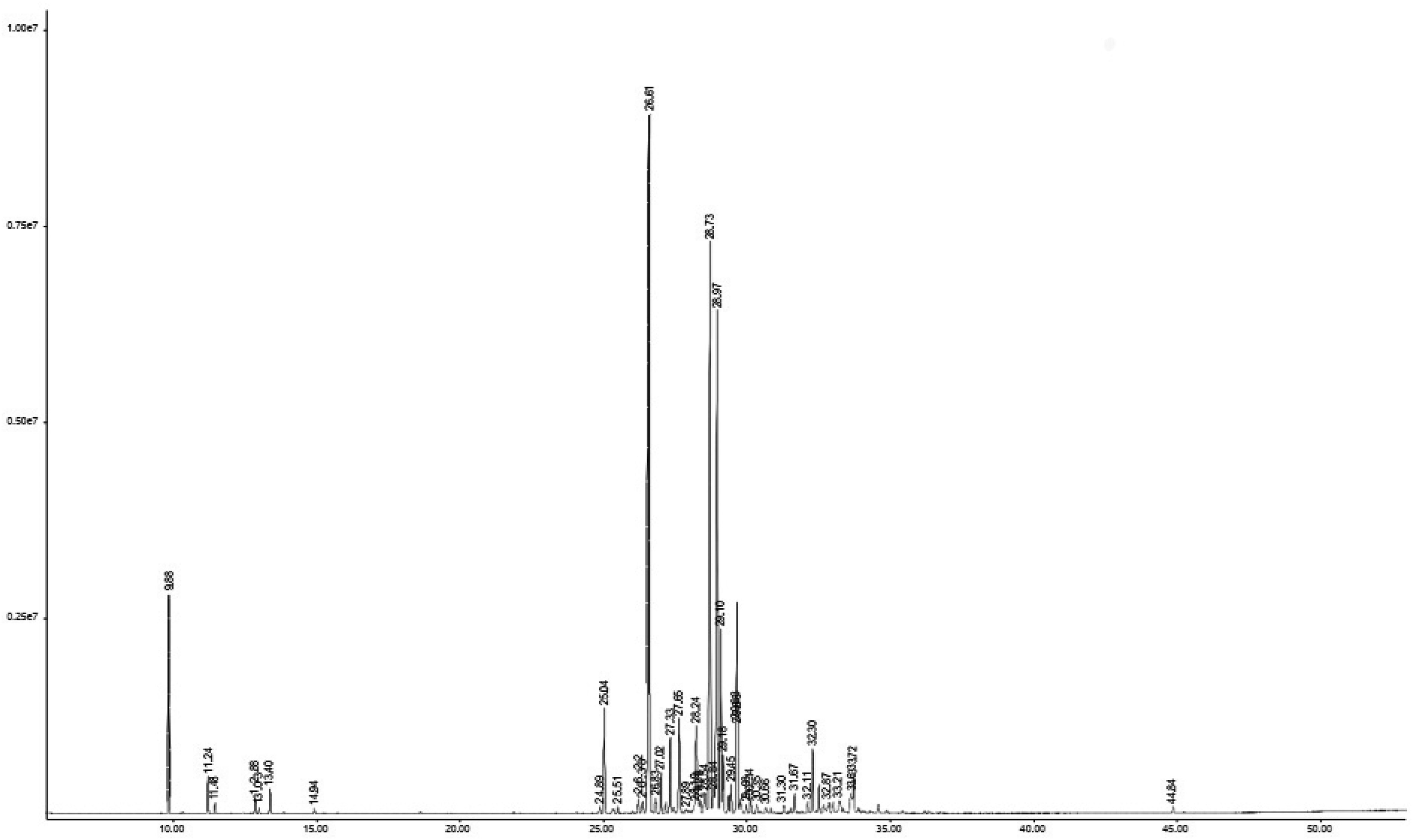
The GC chromatogram of essential oil of Syzygium oblatum leaves.
The Identified Compounds (%) in the Leaf Essential oOls of Two Myrtaceae Plants.
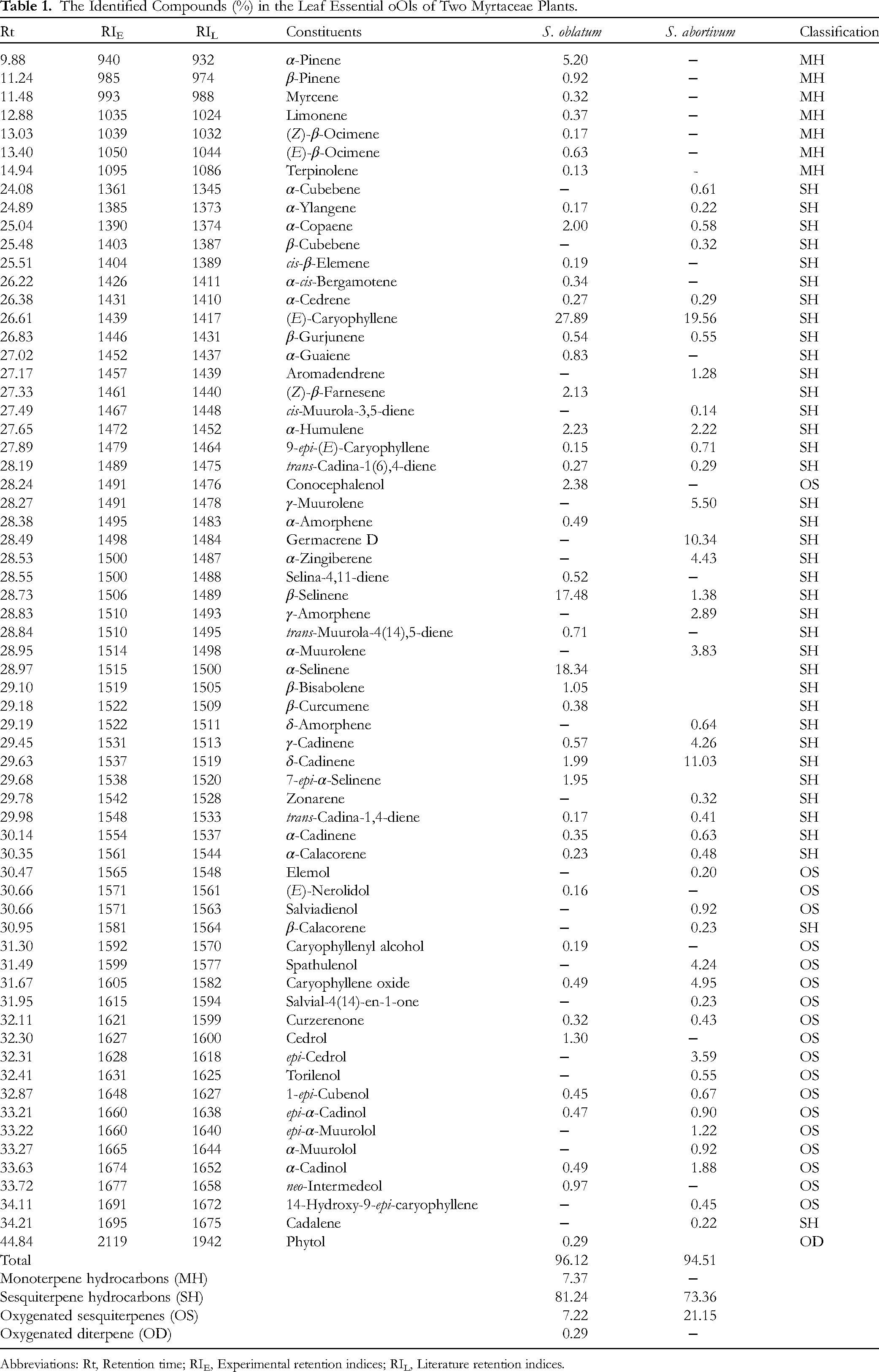
Abbreviations: Rt, Retention time; RIE, Experimental retention indices; RIL, Literature retention indices.
The yellow essential oil of S. abortivum leaves was obtained with a yield of 0.17%, w/v. A list of 41 identified compounds was tabulated in Table 1 and Figure 2, which represented 94.51%. Sesquiterpene hydrocarbons (73.36%) and their oxygenated derivatives (21.15%) were the two main chemical classes, whereas monoterpene hydrocarbons and oxygenated diterpenes were completely absent. The major compounds in this essential oil sample included (E)-caryophyllene (19.56%), δ-cadinene (11.03%), germacrene D (10.34%), and γ-muurolene (5.50%). Some other compounds were found to reach exceeding 1.00%, such as caryophyllene oxide (4.95%), α-zingiberene (4.43%), γ-cadinene (4.26%), spathulenol (4.24%), epi-cedrol (3.59%), γ-amorphene (2.89%), α-humulene (2.22%), and α-cadinol (1.88%).

The GC chromatogram of essential oil of Syzygium abortivum leaves.
As can be seen, the percentage of (E)-caryophyllene in S. oblatum leaf essential oil is more than that of S. abortivum leaf essential oil by 10.55%. The remaining major compounds of S. oblatum leaf essential oil were insignificant or absent in S. abortivum leaf essential oil. In the same manner, δ-cadinene, germacrene D, and γ-muurolene were significant in S. abortivum essential oil, but they were much less or absent in the first oil sample. Various compounds have been only found in one species. For example, a series of monoterpene hydrocarbons α-pinene β-pinene, myrcene, limonene, (Z)-β-ocimene, and (E)-β-ocimene were unique in S. oblatum leaf essential oil, or various compounds, such as germacrene D, γ-muurolene, and α-zingiberene are significant compounds in S. abortivum essential oil, but they disappeared in the leaf essential oil of S. oblatum leaf essential oil.
Antimicrobial Activity
The studied essential oils have been further subjected to antimicrobial experiments. For Table 2, both two samples were comparable to the standard streptomycin (MIC/IC50 = 32 µg/mL/20.45-50.34 µg/mL in antimicrobial assay against three Gram-positive bacteria B. cereus, S. aureus, and E. faecalis. Regarding the Gram-negative bacteria, two essential oil samples inhibited the growth of the bacterium P. aeruginosa with the MIC/IC50 value of 64-128 µg/mL/21.44-44.92 µg/mL, but they did not show activity against two bacteria E. coli and S. enterica. In the last case, essential oils showed anti-candidal activity against the yeast C. albicans with the same MIC value of 8 µg/mL and the IC50 values of 4.56-4.84 µg/mL, as compared with those of the standard cyclohexamide (MIC/IC50 = 32 µg/mL/10.46 µg/mL).
Antimicrobial Activity of the Studied Essential Oils.
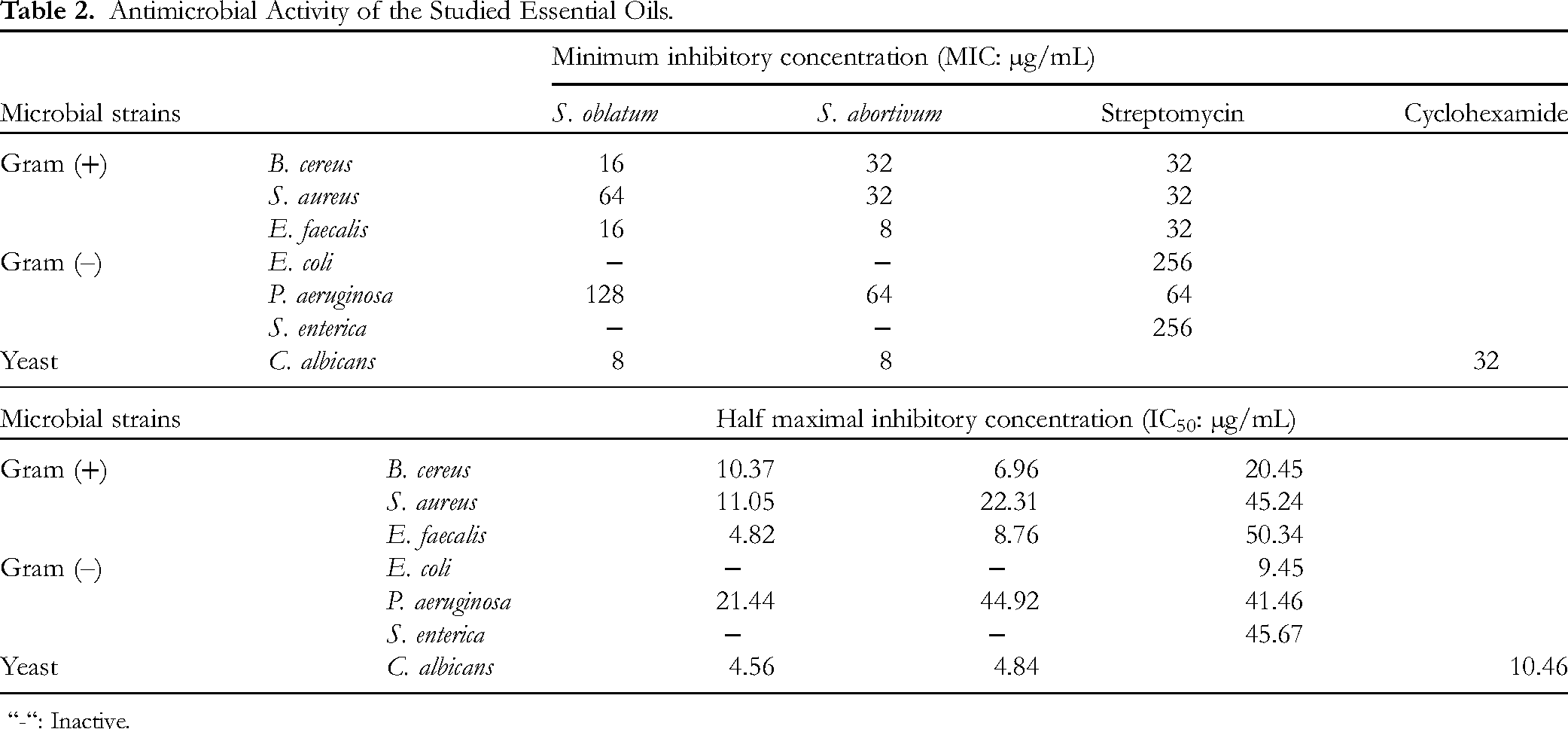
“-“: Inactive.
Molecular Docking Study
To validate the protocol before conducting the docking simulations, a re-docking approach was performed to determine its reliability by comparing it with the known binding positions of the co-crystallized ligand structures in the protein-ligand complexes. The results, as shown in Figure 3, with the calculated RMSD value of 1.041 Å (< 2 Å), indicated that the protocol was highly reliable.14,23 Subsequently, the results of the docking simulation of (E)-caryophyllene with the selected target proteins are presented in Figure 4 and Table 3. It was found that (E)-caryophyllene interacted with C. albicans N-myristoyl transferase with the ΔG (binding energy) value of −6.969 kcal/mol, followed by interactions with E. faecalis carbamate kinase (ΔG = –5.53 kcal/mol) and B. cereus patB1 (ΔG = –6.342 kcal/mol). The comparison with the two control compounds is analyzed. The interaction analysis of (E)-caryophyllene with the studied proteins showed that the compound primarily formed hydrophobic interactions with the amino acid residues in the selected proteins due to its hydrocarbon nature (Figure 4). Specifically, (E)-caryophyllene formed pi-alkyl interactions with Phe117, Tyr354, Phe339, His227, and Phe240, and pi-sigma interactions with residue Tyr225. In contrast, this molecule only formed alkyl interactions with two proteins E. faecalis carbamate kinase and B. cereus patB1. (E)-Caryophyllene interacted with E. faecalis carbamate kinase at amino acid residues Lys209 and Val206, and with B. cereus patB1 at residues Met195, Leu210, and Ala233.

The outcome of re-docking the R64 representative ligand and superimposing their binding positions at the 1IYL protein's active pocket.

Molecular interactions among target proteins and (E)-caryophyllene.
Binding Energies and Hydrophobic Interactions of the major (E)-Caryophyllene in Essential Oils and Target Proteins.

Discussion
(E)-Caryophyllene is one of the major compounds found in the genus Syzygium. As an example, it was found to reach 18.21, 16.0, and 12.72%, respectively, in the leaf essential oil of Indian S. caryophyllatum, Brazilian S. cumini, and German S. aqueum.5,24,25 It is also recognized that (E)-caryophyllene is a naturally occurring bicyclic sesquiterpene that is widely present in essential oils derived from a variety of fruits, species, and medicinal plants. It is classified as a phytocannabinoid and is accepted for use as a food additive, flavoring agent, and taste enhancer by the US Food and Drug Administration and European agencies. 26 Thereby, the appropriate methods to isolate and enrich this sesquiterpene hydrocarbon from the current studied species are expected.
It noted that Syzygium essential oils exhibited higher activity against the Gram-positive bacteria than the Gram-negative bacteria. This is deduced from the great role of the membrane of bacteria, in which the Gram-positive bacteria are known as monoderms because they have a single, thick peptidoglycan cell wall enclosing them. 27 The Gram-negative bacteria are called diderms because they have an outside membrane containing lipopolysaccharides enclosing the cell while having a much weaker peptidoglycan cell wall. 27 It matches well with previous records, Syzygium essential oils are excellent agents for treating microbial strains.
Various records indicated the appropriate uses of Syzygium essential oils for antimicrobial treatments. For instance, the leaf essential oils from four Vietnamese species S. formosum, S. syzygioides, S. megacarpum, and S. chantaranothaianum with MIC values of 16-128 µg/mL were comparable to the standard streptomycin against the Gram-positive bacteria S. aureus and B. cereus, and Gram-negative bacterium P. aeruginosa. 28 The clove oil showed both antibacterial and antibiofilm against B. substilis due to its effects on the protein structures of older biofilms. 29
(E)-Caryophyllene is a well-known natural product that exhibits various pharmacological activities, such as anticancer, and antiinflammation, especially antimicrobial activities. For instance, this metabolite inhibited S. mutans with a MIC value of 0.32% by penetrating the biofilm, which constituted a protective barrier against external substances, acting as an ion exchange resin. 30 In another report, (E)-caryophyllene was comparable to the standard compound kanamycin to inhibit the proliferation of the bacteria S. aureus, E. coli, P. aeruginosa, A. niger, and Rhizopus oryzae. 31 In this study, the molecular docking method has been implemented to get good fits in the interactions and binding energies between the main compound (E)-caryophyllene, and the target proteins C. albicans N-myristoyl transferase, E. faecalis carbamate kinase, and B. cereus patB1.
Conclusions
The current research first describes the chemical analysis of essential oils from the leaves of two Vietnamese Myrtaceae plants S. oblatum and S. abortivum. Generally, sesquiterpene hydrocarbons and their oxygenated derivatives were the main chemical classes. (E)-Caryophyllene was found to reach the highest percentage in both two species. The studied essential oils have shown good antimicrobial activity, especially strongly inhibiting the growth of the Gram-positive bacteria B. cereus and E. faecalis, and yeast C. albicans. The in silico studies were also conducted to investigate the inhibitory potential of (E)-caryophyllene against the microbial targets C. albicans N-myristoyl transferase, E. faecalis carbamate kinase, and B. cereus patB1. Hydrophobic interactions such as alkyl, pi-alkyl, and pi-sigma primarily contributed to their binding affinities.
Supplemental Material
sj-docx-1-npx-10.1177_1934578X241309736 - Supplemental material for The Leaf Essential Oils of Syzygium oblatum and Syzygium abortivum: Chemical Composition, Antimicrobial Activity, and Molecular Docking Study
Supplemental material, sj-docx-1-npx-10.1177_1934578X241309736 for The Leaf Essential Oils of Syzygium oblatum and Syzygium abortivum: Chemical Composition, Antimicrobial Activity, and Molecular Docking Study by Do Ngoc Dai, Le Thi Huong, Pham Thi Nhu Quynh, Nguyen Thi Le Quyen, Nguyen Ngoc Linh, Phi Thi Tuyet Nhung, Nguyen Xuan Ha and Ninh The Son in Natural Product Communications
Footnotes
Acknowledgements
The authors are grateful to the director board of Pu Huong Natural Reserve for sample collections
Declaration of Conflicting Interests
The authors declared no potential conflicts of interest with respect to the research, authorship, and/or publication of this article.
Funding
The authors received no financial support for the research, authorship, and/or publication of this article.

Supplemental Material
Supplemental material for this article is available online.
References
Supplementary Material
Please find the following supplemental material available below.
For Open Access articles published under a Creative Commons License, all supplemental material carries the same license as the article it is associated with.
For non-Open Access articles published, all supplemental material carries a non-exclusive license, and permission requests for re-use of supplemental material or any part of supplemental material shall be sent directly to the copyright owner as specified in the copyright notice associated with the article.
