



Abstract
Introduction
The genus Paramignya Wight, a member of the Rutaceae family, encompasses 28 species that are mostly found in India, Bangladesh, and Southeast Asia. 1 Many Paramignya plants have been used in traditional medicine for centuries. For example, P trimera roots have traditionally been used to treat diabetes in Vietnam. 2 Stems of P griffithii are herbal remedy used for the treatment of nose infections in Thailand. 3 Research has demonstrated that essential oils (EOs) obtained from Paramignya species exhibit multiple bioactivities of importance to human health. For instance, EO extracted from P trimera leaves strongly inhibited the growth of Staphylococcus aureus, Candida parapsilosis, and Trichomonas vaginalis. 4 The EO of P lobata leaves showed moderate antioxidant activity evaluated by DPPH radical scavenging assay. 5 Previous studies have revealed that EOs of several Paramignya species contain a variety of major constituents, including β-caryophyllene, caryophyllene oxide, (E)-nerolidol, 7-epi-α-eudesmol.5,6 Notably, β-caryophyllene and caryophyllene oxide account for 24.8 and 20.5% of the EO of P lobata, respectively, which are considerably higher than those of P trimera.
Paramignya scandens, locally known as “Xáo leo” in Vietnam, is a scandent shrub commonly found in the North-central and Southeast regions of Vietnam. Limited data about phytochemicals in this plant species have been published to date. Few compounds were isolated and characterized from the stems and leaves of P scandens, including tirucallane derivatives (paramignyols and paramignyosides).7,8 To our knowledge, no information about the chemical composition of the EOs from this plant species is available in the literature. From this point, the present study was carried out to investigate volatile constituents of EOs extracted from trunks and leaves of the plant.
Development of enzyme inhibitors from natural resources is significant for the food, cosmetics, and pharmaceutical industries, as well as for disease prevention and treatment, mainly because of their minimal side effects and remarkable effectiveness.9–11 For instance, natural tyrosinase inhibitors are well-suited for inclusion in depigmentation agents, making them a strong candidate. Effective diabetes management is largely dependent on α-amylase inhibitors. Therefore, in vitro α-amylase and tyrosinase inhibitory activities of the EOs were assessed in the present study. To gain further insights into the interactions between the bioactive constituents of P scandens EOs and the target enzymes (ie, α-amylase and tyrosinase), we used in silico molecular docking studies. This computational approach allowed us to explore the binding affinities and binding modes of these compounds, providing a rational basis for their bioactivity. The results of this study will hopefully contribute to our understanding of the pharmacological potential of P scandens EOs and open avenues for their applications in nutraceutical industry, medicine, and cosmetology.
Results and Discussion
EO Composition
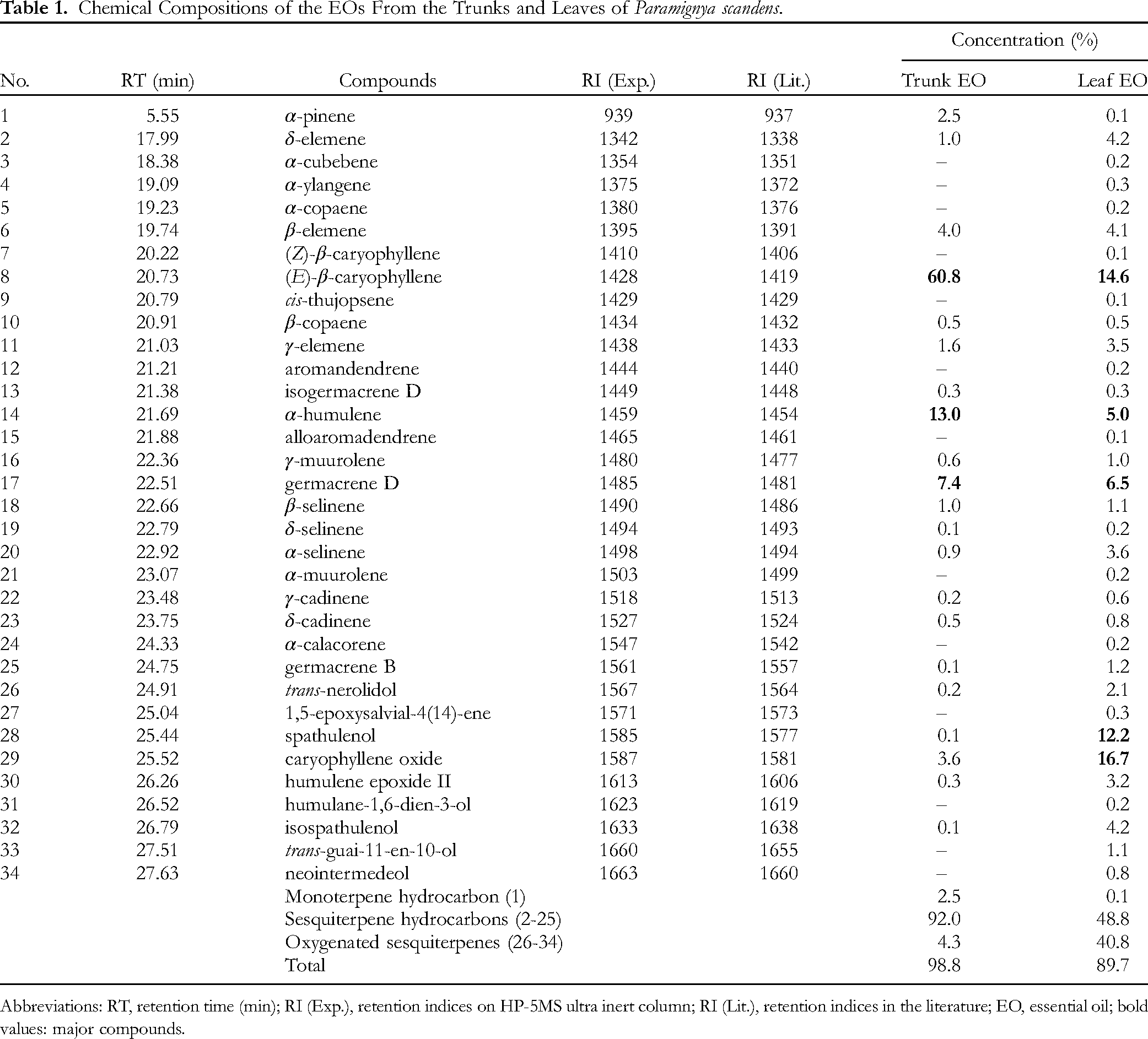
The hydrodistillation of the fresh trunks of P scandens produced light yellow-coloured EO, while the fresh leaves of P scandens produced light green-coloured EO. The yields of two EO samples were 0.25% (w/w, trunk) and 0.21% (v/w, leaf), calculated on a fresh weight basis. The chemical compositions of both EOs were determined by using gas chromatography-mass spectrometry (GC-MS) analysis (Figures S1 and S2, Supplemental Material), the results of which are presented in Table 1.
Chemical Compositions of the EOs From the Trunks and Leaves of Paramignya scandens.
Abbreviations: RT, retention time (min); RI (Exp.), retention indices on HP-5MS ultra inert column; RI (Lit.), retention indices in the literature; EO, essential oil; bold values: major compounds.
The analytical results indicated that a total of 21 compounds were identified in the trunk EO of P scandens (representing 98.8% of the total EO), while 34 compounds were identified in the EO of the fresh leaves (representing 89.7% of the total EO). The trunk EO of P scandens was mainly dominated by sesquiterpene hydrocarbons, which accounted for 92.0% of the EO content. Among these, the major compounds were (E)-β-caryophyllene (60.8%), followed by α-humulene (13.0%) and germacrene D (7.4%). In addition, several minor terpenes such as β-elemene (4.0%), caryophyllene oxide (3.6%), and α-pinene (2.5%) were detected in significant percentages. Meanwhile, the leaf EO of P scandens was rich in sesquiterpene hydrocarbons and oxygenated sesquiterpenes, accounting for 48.8% and 40.8% of the EO content, respectively. The most abundant components presented in the leaf EO were caryophyllene oxide (16.7%), (E)-β-caryophyllene (14.6%), spathulenol (12.2%), germacrene D (6.5%), and α-humulene (5.0%). It is noted that caryophyllene oxide and spathulenol were 2 major sesquiterpenes in the leaf EO while these components were found in low percentages (0.1% and 3.6%, respectively). To the best of our knowledge, this study is the first report on the chemical composition of the EOs of P scandens trunks and leaves.
The chemical compositions of EOs from several other Paramignya species were identified in the previous studies. For example, the major components of the leaf EO of P lobata from Pahang, Malaysia were β-caryophyllene (24.8%), caryophyllene oxide (20.5%), (E)-nerolidol (10.4%), α-humulene (5.8%), and humulene epoxide II (5.4%). 5 The peel EO of P trimera from Khanh Hoa, Vietnam contained 3 main components including β-caryophyllene (19.1%), α-humulene (24.8%), and trans-muurola-4(14),5-diene (24.8%), 12 while the leaf EO of P trimera from Hue, Vietnam consisted mainly of β-caryophyllene (10.5%), β-caryophyllene oxide (9.9%), 7-epi-α-eudesmol (7.6%), and γ-muurolene (6.8%). 6
A comparison of the present results with other studies of the genus Paramignya in the literature showed that there are some similarities in the chemical constituents of the EOs. Some components, such as β-caryophyllene, α-humulene, and caryophyllene oxide, were found to be the major compounds in most EOs from the genus Paramignya. Perhaps, these compounds are the chemotaxonomic markers of Paramignya EOs.
α-Amylase and Tyrosinase Inhibition
The inhibitory ability of the EOs from P scandens trunks and leaves against α-amylase and tyrosinase was determined in the current study. These results are presented in Table 2.
α-Amylase and Tyrosinase Inhibition of the EOs From the Trunks and Leaves of Paramignya scandens.

Abbreviation: EO, essential oil.
Different letters (a, b, c) indicate significant differences among the test samples (p < 0.05).
The results indicated the inhibition of leaf EO against α-amylase and tyrosinase enzymes with IC50 values of 2.039 ± 0.050 and 1.086 ± 0.040 mg/mL, respectively. Also, the trunk EO had an inhibitory effect on tyrosinase enzyme with an IC50 value of 0.583 ± 0.020 mg/mL, while the inhibitory ability of trunk EO for α-amylase enzyme was weak with an IC50 value > 4.000 mg/mL. The above IC50 values implied that P scandens leaf and trunk EOs exhibited different inhibitory effects on α-amylase and tyrosinase enzymes. Additionally, the positive control (acarbose, IC50 = 0.091 ± 0.002 mg/mL) exhibited anti-α-amylase activity, which was approximately 20 and 40 times stronger than the leaf and trunk EOs, respectively. Similarly, leaf and trunk EOs exhibited approximately 16-fold and 8-fold weaker antityrosinase activity compared with the positive control (kojic acid, IC50 = 0.068 ± 0.001 mg/mL), respectively.
EOs, often referred to as aromatic volatile oils or ethereal oils, are derived from various plant parts and include a variety of chemical components, mostly terpenes, and terpenoids. 4 EOs have been reported to have various pharmacological effects such as powerful antibacterial, antifungal, anti-trichomonas, antioxidant, antiviral, anti-inflammatory, cytotoxic, and anticancer activities.4–6,12,13 Recently, some scientists have reported that EOs from different plant parts inhibit enzymes related to diabetes and melasma skin such as α-amylase (eg, Eruca vesicaria subsp. longirostris, Mentha longifolia var. calliantha, Salvia tomentosa, Prangos gaubae, etc) and tyrosinase (eg, M longifolia var. calliantha, S tomentosa, etc).14–17 However, to the best of our knowledge, no studies have been documented on the α-amylase and tyrosinase inhibitory effects of Paramignya species EOs, including P scandens EOs. In previous reports, the EOs from Piper nigrum (containing mainly β-caryophyllene, limonene, β-phellandrene, β-pinene, etc) 18 and Piper lolot (containing mainly β-caryophyllene, β-bisabolene, β-selinene, β-elemene, (E)-β-ocimene, etc) 19 displayed good inhibition against α-amylase enzyme. In another study conducted by Yur et al, 20 it was claimed that Tanacetum haussknechtii EO contained α-pinene, β-pinene, santolinatriene, and borneol as the main compounds and showed significant anti-α-amylase and anti-tyrosinase activities. There are also studies in the literature that suggest that caryophyllene, the main component of the EOs, inhibits melanogenesis, thereby inhibiting tyrosinase activity as well as amylase inhibitory effects associated with diabetes.16,17,20 The above results show that the main chemical composition of EOs extracted from plants is quite diverse. The major chemical constituents in these EOs may be important contributors to their inhibitory effects on the enzymes α-amylase and tyrosinase. This argument is consistent with the results of our study. The EOs of P scandens trunks and leaves, which demonstrated moderate activity against α-amylase and tyrosinase enzymes in vitro, also contain caryophyllene oxide, germacrene D, humulene, spathulenol, and β-caryophyllene, as reported by the current study. This is the first record of the anti-α-amylase and anti-tyrosinase activities of the leaf and trunk EOs of P scandens. The results of the present study confirm that P scandens is a potential source of antidiabetic as well as skin-care products. However, to obtain further evidence on the effect of P scandens EOs on α-amylase and tyrosinase inhibition, in silico molecular docking simulations were conducted on the main components of the EOs such as caryophyllene oxide, germacrene D, humulene, spathulenol, and β-caryophyllene. The experiment could be the next step in confirming the α-amylase and tyrosinase enzymes inhibition of these EOs.
Molecular Docking Simulation
First, the redocking of crystallized ligands into the binding region of the protein receptor is employed for the purpose of validating the docking process. The docked pose is superimposed onto the original crystallized ligand to compute the RMSD value. The computed RMSD values for the native co-crystallized ligands mini-montbretin A (in PDB ID: 5E0F) and kojic acid (in PDB ID: 5M8M) are recorded as 1.87325 and 0.6199 Å, respectively (Figure S3, Supplemental Material). The employed docking methodologies have undergone verification, and their application in molecular assembly has been affirmed within an acceptable range, specifically with RMSD values ≤ 2.0 Å. 21 In this research, molecular docking simulations of the principal constituents, namely caryophyllene oxide, germacrene D, humulene, spathulenol, and (E)-β-caryophyllene, have been carried out to elucidate the interactions and binding affinities within the active sites of the α-amylase (PDB ID: 5E0F) and tyrosinase (PDB ID: 5M8M) receptors.
The detailed binding affinities are visually represented in Figures 1 and 2. Meanwhile, Figure S4 and S5 (Supplemental Material) provide insights into the binding interactions between the target proteins, α-amylase and tyrosinase, and the main compounds within the EOs of P scandens. Results indicate that the binding affinities of the primary compounds found within the EOs range from −7.034 to −7.657 kcal/mol for the α-amylase enzyme and from −5.205 to −5.888 kcal/mol for the tyrosinase enzyme. (E)-β-caryophyllene exhibits the highest binding affinity of −7.657 kcal/mol when docked into the active site of the α-amylase enzyme, as demonstrated in Figure 1. This compound establishes 4 pi-alkyl and alkyl interactions at amino acid residue positions Trp59, Leu165, Leu162, and Tyr62. Caryophyllene oxide similarly demonstrates interactions analogous to (E)-β-caryophyllene, although no interactions are observed with residue Tyr62. Germacrene D and humulene predominantly engage in pi-sigma, pi-alkyl, and alkyl interactions. Specifically, germacrene D interacts with His305, Trp59, Trp58, His299, Leu165, and Leu162, whereas humulene exhibits similar interactions but does not interact with residue His305. Particularly, the active site of the α-amylase enzyme, spathulenol forms 2 hydrogen bonds with residues Asp300 and His305, while hydrogen bonding is also observed with the control compound mini-montbretin A (Figure S4, Supplemental Material). These hydrogen bonds and hydrophobic contacts with amino acid residues of α-amylase enzyme and major compounds at observed important positions including Trp58, Trp59, Tyr62, Leu162, Leu165, His299, Asp300, and His305, were previously reported.22,23 Clearly, the formation of interactions at these key positions can demonstrate the effectiveness of the major compounds in inhibiting α-amylase enzymes. In the case of the tyrosinase enzyme, as inferred from the results presented in Figure 2, most of the key compounds in the EOs exhibit stronger binding affinities than the positive control compound kojic acid (−5.34 kcal/mol), except for germacrene D (−5.205 kcal/mol) and caryophyllene oxide (−5.319 kcal/mol). As depicted in Figure S5 (Supplemental Material), interactions primarily involve pi-alkyl and alkyl interactions with amino acid residues within the active site of the tyrosinase enzyme. (E)-β-caryophyllene and caryophyllene oxide formed similar interactions with residues Tyr362, His215, His377, and Leu382. Germacrene D and α-humulene also demonstrated analogous interactions with residues Leu382 and His377 while additionally interacting with His381. Notably, spathulenol engages in pi-alkyl and alkyl interactions with residues His381 and His215. Furthermore, the amino acid residue at His381 is regarded as a crucial amino acid. Compounds germacrene D, spathulenol, and α-humulene interact with this residue within the active site of the tyrosinase enzyme. 24 This suggests that these compounds are potential candidates as tyrosinase enzyme inhibitors with pigmentation-inhibiting properties.
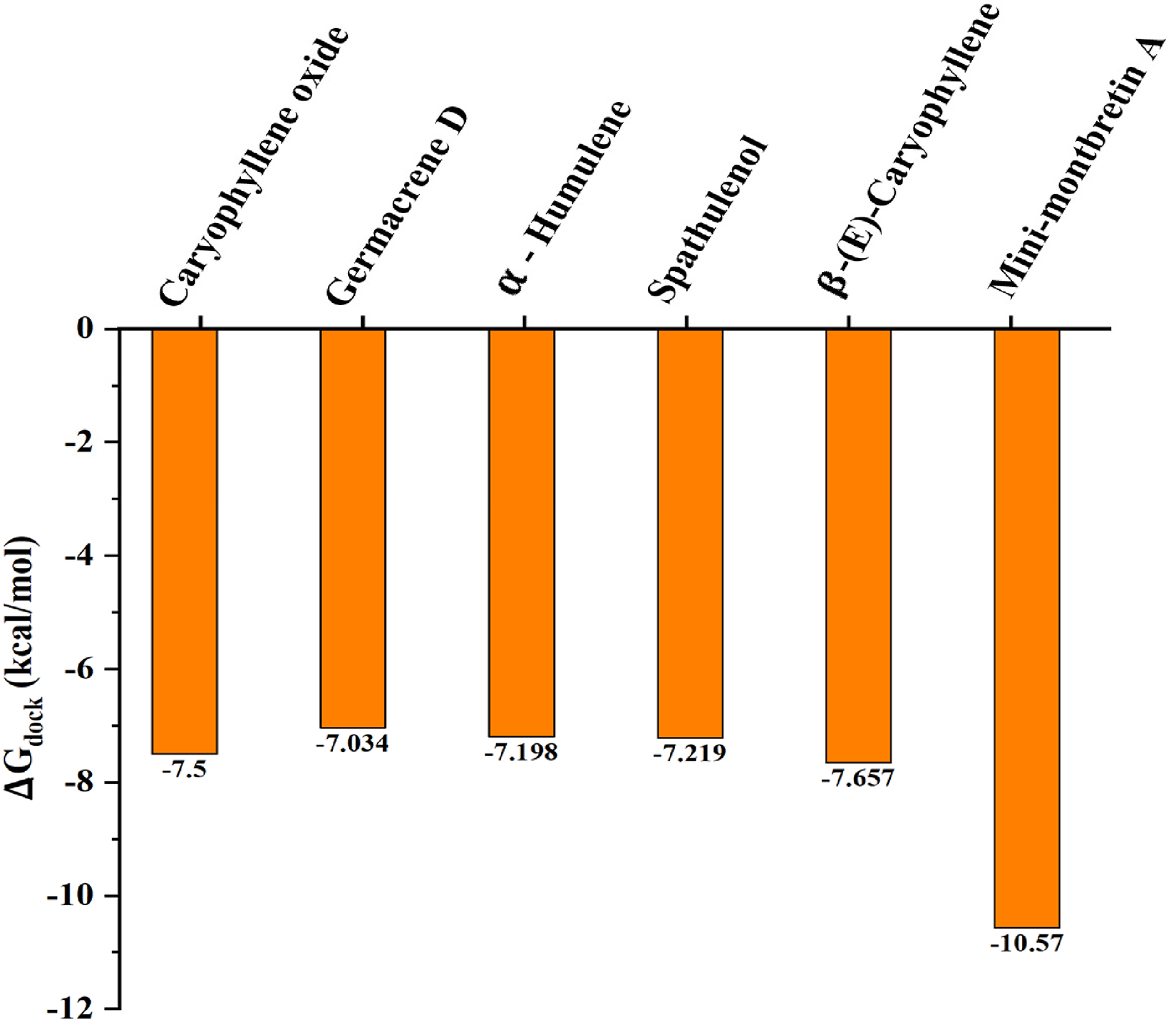
Binding affinities of the major components and control compounds in the active site of α-amylase enzyme calculated using the AutoDock Vina v1.2.3 program.

Binding affinities of the major components and control compounds in the active site of tyrosinase enzyme calculated using the AutoDock Vina v1.2.3 program.
Conclusions
In conclusion, the phytochemical composition, in vitro α-amylase and tyrosinase inhibitory activities, and in silico molecular docking study of trunk and leaf EOs of P scandens were reported for the first time. This work also revealed that trunk and leaf EOs of P scandens exhibited moderate anti-α-amylase and anti-tyrosinase activities and could be applied in nutraceuticals, medicine, and cosmetics although further studies are needed.
Materials and Methods
Plant Materials
Fresh trunks and leaves of P scandens were harvested in June 2022 from Ba Den Mountain (11°22′36.9″N; 106°10′44.2″E), Tay Ninh Province, Vietnam. The scientific plant name was authenticated by Assoc Prof Dr Nguyen Hoang Tuan. Its voucher specimen (No. HC. 025XL) was maintained in the Herbarium of the Department of Chemistry, Vinh University, Vinh City, Nghean, Vietnam.
Isolation of the EOs
The EOs were obtained by hydrodistillation (300 g each time) using a Clevenger-type apparatus, according to the method established in previous studies.25,26 This experiment was performed at 100 °C until no more EO sample was collected (approximately 3 h). EOs were collected in the graduated tube and dried over anhydrous sodium sulfate (Na2SO4, Merck) and stored in a sealed tube at 4 °C prior to further analysis. The experiments were conducted in triplicate. The trunk EO has a light-yellow color with a yield of 0.25% (w/w), while the leaf EO has a light-green color with a yield of 0.21% (w/w), calculated on fresh weight.
Chemical Characterization of the EOs
In the current study, the EOs of the fresh trunks and leaves of P scandens were performed by GC-MS system using an Agilent 7890B GC System equipped with a 5977B MSD model. The GC-MS parameters were set according to our previous study. 27 Identification of the EOs components was carried out by comparing their mass spectra and retention indices (RIs) with those contained in the literature (NIST 17 and Adams). 28 The formula for determination of the RIs was employed as previously described. 29 Finally, quantification of each component was performed using the relative area of the total ion chromatogram peaks. 30
α-Amylase Inhibitory Activity
Refer to Supplemental Material.
Tyrosinase Inhibitory Activity
Refer to Supplemental Material.
Molecular Docking
Refer to Supplemental Material.
Statistical Analysis
The experiments on anti-α-amylase and anti-tyrosinase activities were carried out in triplicate, and the results were shown as mean ± standard deviation. One-way analysis of variance with Tukey's HSD test was used to evaluate the differences between the bioactivities of the test samples. Minitab 19 software was used to perform the analysis.
Supplemental Material
sj-docx-1-npx-10.1177_1934578X231222383 - Supplemental material for Essential Oils From the Trunks and Leaves of Paramignya scandens (Griff.) Craib From Vietnam: Phytochemical Composition, In Vitro α-Amylase and Tyrosinase Inhibitory Activities and In Silico Molecular Docking Studies
Supplemental material, sj-docx-1-npx-10.1177_1934578X231222383 for Essential Oils From the Trunks and Leaves of Paramignya scandens (Griff.) Craib From Vietnam: Phytochemical Composition, In Vitro α-Amylase and Tyrosinase Inhibitory Activities and In Silico Molecular Docking Studies by Hieu Tran-Trung, Tran Dinh Thang, Trang H.D. Nguyen, Danh C. Vu, Nguyen Hoang Tuan, Nguyen Xuan Ha, Tran Van Chen, Ha Thuy Oanh, Ngu Thi Tra Giang and Phan Thi Thuy in Natural Product Communications
Footnotes
Declaration of Conflicting Interests
The author(s) declared no potential conflicts of interest with respect to the research, authorship, and/or publication of this article.
Funding
The author(s) received no financial support for the research, authorship, and/or publication of this article.

Supplemental Material
Supplemental material for this article is available online.
References
Supplementary Material
Please find the following supplemental material available below.
For Open Access articles published under a Creative Commons License, all supplemental material carries the same license as the article it is associated with.
For non-Open Access articles published, all supplemental material carries a non-exclusive license, and permission requests for re-use of supplemental material or any part of supplemental material shall be sent directly to the copyright owner as specified in the copyright notice associated with the article.
