



Abstract
Postmenopausal osteoporosis (PMOP) is an important part of primary osteoporosis, and the current clinical treatment program for PMOP is easily limited by side effects and adverse reactions, so it is particularly important to seek more efficient, safe, and economical drug treatment for PMOP. In recent years, with the change of disease treatment mode and the gradual deepening of Traditional Chinese medicine (TCM) research on PMOP, a review of the literature reveals that there is a huge number of studies on the use of TCM in the treatment of PMOP, but there are no relevant systematic studies on the rules of its formulas and the specific mechanisms by which the core drugs exert their therapeutic effects. Therefore, in this study, we collected a total of 141 formulas used by TCM clinicians to treat PMOP, statistically analyzed their high-frequency medications, Four Qi, Five Flavors, meridians, and efficacies, and analyzed the core medications based on the association rules, which were Rehmanniae Radix Praeparata, Epimedium, Eucommia ulmoides, Rhizoma Drynariae, Angelica sinensis, Achyranthes, Astragalus propinquus, Psoralen, Cornus officinalis and licorice. A total of 87 drug pairs were obtained from the correlation analysis, and a total of 8 groups of potential core combination drugs and 4 potential new prescriptions were derived based on the cluster analysis. Subsequently, a network pharmacological analysis of the core drugs was conducted to obtain 173 active ingredients in the core drugs, including kaempferol, β-sitosterol, quercetin, etc. 298 targets of action, including MAPK3, STAT1, HSP90AA1, etc. 170 signaling pathways including AGE-RAGE, PI3 K/Akt, TNF, HIF-1 and others. The molecular docking results showed that 11 key active ingredients in the core drugs had stable binding to the target targets. This study showed that TCM treatment of PMOP is mainly based on “reinforcing liver and kidney, warmly invigorating spleen and stomach, activating blood and resolving stasis.” Core drugs therapy for PMOP is a comprehensive intervention through multi-component, multi-target, and multi-pathway approaches. The minimum binding energies between the 11 key active ingredients and the 11 key targets were calculated in a comprehensive analysis, which shows that the core drugs have good binding activities to their therapeutic targets, proving that the predictions of this study are reliable. In the future, it will provide certain medication basis and data support for TCM treatment of PMOP.
Keywords
Introduction
Osteoporosis (OP) is a systemic metabolic bone disease characterized by decreased bone mass, damage to the microstructure of bone tissue, resulting in increased bone fragility and susceptibility to fracture, which leads to fractures and other complications that dramatically increase mortality rates and health care costs, seriously affecting patients’ quality of life and longevity. 1 It has a serious impact on patients’ quality of life and life expectancy. Middle-aged and elderly people are at high risk of developing OP, which is becoming increasingly common in women over 55 years of age and men over 65 years of age, and its incidence is increasing with the aging of the population. 2 Clinical symptoms of OP include low back pain, lower limb spasms, and numbness of the limbs, and its onset is related to many factors such as age, diet, and lifestyle. 3 Modern medicine classifies OP into two categories: primary and secondary, and PMOP is an important part of primary OP. PMOP is a common disease in older women after menopause. Modern medicine believes that the disease is caused by a significant decline in estrogen in the body due to the decline of the ovaries after menopause, which leads to disturbances in bone metabolism, resulting in a decrease in bone mass and a decrease in the value of bone mineral density, and ultimately triggering a metabolic disease. 4 It has now become a global public health problem, and epidemiologic findings have shown that there is a large base of people at risk for PMOP, with approximately 200 million women suffering from PMOP globally, and in addition, the incidence of bone fractures in women is almost twice as high as in men.5, 6 Currently, the clinical treatment of PMOP is based on calcium and vitamin D supplementation with anti-osteoporosis drugs to promote bone formation, inhibit bone resorption, or bi-directional treatment of PMOP, but almost all of them require long-term treatment, and the efficacy of short-term improvement of the clinical symptoms of patients is not yet significant, and the side-effects and adverse reactions of the drug therapy have also limited its long-term use. 7 In addition, PMOP is a disease that requires long-term or even lifelong treatment, so it is particularly important to seek more efficient, safe, and cost-effective drugs to treat PMOP.
There is no name for OP in Chinese medicine, but according to its clinical symptoms and pathogenesis, it can be categorized as “bone paralysis”, “bone impotence”, “bone withering”, etc In Chinese medicine, it is believed that the kidney are related to the bones, bone produces marrow, deficiency of kidney essence is the main cause of OP, and it is difficult to nourish the bones due to the deficiency of kidney essence after menopause, so PMOP is easy to occur after women's menopause. In recent years, with the change of the treatment mode of the disease and the gradual deepening of the study of PMOP in Chinese medicine, many Chinese medicine clinicians in the past generations have used the Chinese herbal medicine to treat PMOP and achieved good efficacy.8–10 After reviewing the literature, we found that there is a huge amount of research literature on the treatment of PMOP with TCM, but there is no systematic research on the rules of its composition and the specific mechanism of the therapeutic effect of the core drugs. In the face of a large number of PMOP patients, it is particularly important to systematically analyze the clinical drugs used in previous TCM treatments. Based on this, the present study used data mining methods to collect relevant literature on PMOP treatment by TCM physicians from major databases, performed statistical analysis, and summarized the compounding rules of TCM treatment of PMOP; and then carried out network pharmacological studies on the core drugs to obtain the main targets and related pathways of the core drugs in treating PMOP, and deduced the specific mechanisms by which the core drugs exerted their therapeutic effects. In the future, we hope to provide a certain prescription and data support for the treatment of PMOP with TCM, to develop a more reasonable treatment plan, to adopt more targeted interventions to alleviate the clinical symptoms of patients, and to improve the therapeutic effect.
Materials and Methods
Data Sources and Literature Search Strategy
China National Knowledge Infrastructure (CNKI), China Science and Technology Journal Database (VIP), Wanfang Database (Wanfang Data), China biomedical literature service system (Sinomed) and PubMed were the databases used to search the literature. To avoid the inconsistency caused by the frequent database updates, we completed the search work of all databases within one day on 30 December 2023. According to the advanced searching method of each database, “formula” or “soup” or “pill” or “powder” or “drink” or “dan” or “experience” and “postmenopausal osteoporosis” were used as search terms. To ensure data accuracy and authenticity, we used two researchers to screen and review the literature. After searching the literature, judgments were made by reading the full text based on inclusion and exclusion criteria. Methods of resolving disagreements were arrived at through discussion.
Inclusion Criteria
① The diagnostic or therapeutic evaluation criteria used were in accordance with internationally or domestically recognized common standards; ② We collected five types of literature. They were randomized controlled clinical trials (RCTs), non-randomized clinical controlled trials (CCTs), case series (CS), case reports (CRs) and expert experience (EE); ③ The included literature must have a clear composition of the formulas and the drug dosage; ④ For the duplicated literature, the one with the most comprehensive and detailed data record was taken; ⑤ Statistical evaluation used the p-hacking.
Exclusion Criteria
① Chinese medicine theory discussion, literature review, Meta-analysis, molecular, cellular, animal experimental research, dietary therapy literature; ② there is no clear composition of the drug, drug dosage; ③ only a single Chinese medicine or proprietary Chinese medicine treatment of the literature is not counted; ④ TCM with surgery, physical therapy or acupuncture treatment of PMOP literature; ⑤ for the conventional treatment of the Western medicine produced by the adverse reaction, the switch to TCM intervention in the treatment of the literature.
Description of Prescription Entry and Drug Name
Referring to the Pharmacopoeia of the People's Republic of China (National Pharmacopoeia Committee, 2020) and Chinese Medicine (National Higher Education of Traditional Chinese Medicine Industry “14th Five-Year Plan” Teaching Material, 2021), the medicines with the same substance but different names involved in the 141 literature were unified under the same name, such as the unification of Chuanxuduan, Xuduan as Xuduan. squid bone and cuttlebone unified and standardized as cuttlebone, and turtle shell glue and turtle shell unified and standardized as turtle shell. Normalization of drug names and dosages using a two-person checking method to ensure data accuracy.
Database Creation and Analysis
The traditional Chinese medicine inheritance support system (TCMISS) played an important auxiliary role in inheriting the experience of TCM clinicians. The standardized data were imported into TCMISS V2.5, entry is handled and reviewed by two people to ensure the accuracy of data mining. Utilizing the “data analysis” feature within the software, 141 prescriptions were retrieved from the system based on the disease name “PMOP” and subsequently subjected to detailed statistical analysis. Including medication frequency, dosage, Four qi, Five flavors, attribution, efficacy, core drugs, potential core combinations, and potential new prescriptions. Based on the default optimal value of the system, drug association rule analysis, networked display of association rules, and extraction of core drugs were carried out.
Cyberpharmacology Research
Screening of Main Active Ingredients and Targets of Core Drugs
The core drugs for the treatment of PMOP obtained from association rule-based analysis in data mining were selected, and the TCMSP (http://lsp.nwu.edu.cn/tcmsp.php) database was searched. Pharmacokinetic parameter oral bioavailability, (OB) ≥ 30% and drug-likeness (DL) ≥ 0.18 were set as the threshold criteria for screening, which is the necessary criteria for the pharmacokinetic characterization of the TCMs in the human body. The active ingredients and targets of action of each TCM were screened and collected, and the names of the targets were standardized through the UniPort online database (limited to the species “Homo sapiens”) to obtain the targets of action of the core drugs. The ChEMBL (Https://www.ebi.ac.uk/chembl), BATMAN-TCM (http://bionet.ncpsb.org/batman-tcm/) and Herb (http://herb.ac.cn/) databases were supplemented to combine and de-duplicate the active ingredients and targets.
PMOP Target Screening
Construction of association networks based on “core targets of PMOP therapy—active constituents—drugs” with “postmenopausal osteoporosis” as keyword. Screening the Gene Cards (https://www.genecards.org), OMIM (https://omim.org/), PharmGKB (https://www.pharmgkb.org/), TTD (http://db.idrblab.net/ttd/), pharmGKB (Https://www.pharmgkb.org) and DisGeNet (Https://www.disgenet.org) databases yielded PMOP-related targets which were then pooled to yield clear PMOP targets.
Prediction of Potential Targets for Core Drugs Therapy of PMOP and Protein-Protein Interaction (PPI) Network Construction
Core drug targets and PMOP-related targets were imported into the jvenn online website (http://bioinfogp.cnb.csic.es/tools/venny), and Venn diagrams were plotted to derive common targets for core drugs and diseases, in order to clarify the interaction between the core drugs and PMOP. The resulting intersecting targets, drug names and active ingredients were uploaded to the STRING 11.0 platform (https://string-db.org). Limit the species to “Homo sapiens”. The minimum linkage score between targets was set to 0.4 to construct the PPI network of the core drugs and PMOP, download the tsv format file and import it into Cytoscape 3.8.2 software to visualize and analyze the PPI network. The topological parameters of the relevant targets were analyzed using the cytoNCA plug-in, and the importance of the nodes was evaluated in terms of node degree value and meso-centrality. Thus, the key targets are filtered out. The node degree value represents the number of edges connected to the node, and the node size is proportional to the degree value. Median centrality refers to the ratio of the number of shortest paths in the network passing through this node to the total number of paths, which gives an idea of the role and influence of this node in the whole network. The larger the value of the above two parameters corresponding to a node, the more important the role it plays in the network.
GO Functional Enrichment Analysis and KEGG Enrichment Analysis
Importing genes that intersect core drugs with PMOP into R language (https://www.r-project.org/). Selected Biological Processes (BP), Cellular Components (CC) and Molecular Functions (MF) for GO enrichment of intersecting targets to analyze potential biomolecular mechanisms. Pathway enrichment analysis of target genes based on KEGG database was performed for identifying biological functions and candidate targets. Setting a p < 0.05 was considered a statistically significant difference, and the results were sorted in ascending order of P value, screening for significantly different biological processes and reliable target pathways. The final visualization was carried out using the Microbiometrics software (http://www.bioinformatics.com.cn/), output results as bar and bubble charts.
Molecular Docking Verification
The key active ingredient of core drugs was selected for molecular docking verification with the PMOP key target. Using thePubChem database (https://pubchem.ncbi.nlm.nih.gov/) to download the key active ingredient of the 2-dimensional (2D) structure, ChemOffce software was used to draw the 3-dimensional (3D) structure. The 3D structure of the key target was downloaded from the PDB database (http://www.rcsb.org), and the protein was optimized using PyMOL. Auto Dock was then used to convert the obtained fles into pdbqt format and search for active pockets. Finally, AutoDock Vina was used to implement the docking protocol. According to literature reports, binding energy ≤ -5.0 kcal·mol-1 was selected as the reference basis to evaluate the affnity between the “key active ingredient and key target” to validate this experiment's predicted results.
Results
As a result, we found 968 related articles. Preliminary screening was achieved through the automatic duplication check function of NoteExpress V3.1. The documents that did not meet the inclusion criteria were excluded by reading abstracts and other information. The rest were judged strictly by reading the full text according to the inclusion and exclusion criteria. This finally included 141 studies, including 104 RCTs, 21 CSs, 10 CCTs, 4 EEs and 2 CRs, as shown in Figure 1.

Flow chart for literature searching and screening. CNKI, China National Knowledge Infrastructure; Wanfang data, Wanfang Database; VIP, Technology Journal Database; Sinomed, China biomedical literature service system; RCT, randomized controlled clinical trial; CS, case series; CCT, clinical controlled trial; EE, expert experience; CR, case reports; PMOP, postmenopausal osteoporosis.
Data Mining
High Frequency Medication and Dosage Analysis
Using the function of “frequency statistics” in the “prescription analysis” of TCMISS, 152 medicines were included in the prescriptions, with a total frequency of 1673 times, and an average frequency of 11 times (1673/125≈11), and the medicines with a frequency of ≥11 times were regarded as high-frequency medicines (as shown in Table 1, showing only the first ten medicines).
Statistics of the use Frequency of Single Chinese Medicine in PMOP Prescription (Frequency ≥11).

Frequency/total, where total = 1673.
Statistical Analysis of the Frequency of Four Qi Medication
According to the function of “Four Qi Statistics” in “Basic Information Statistics” of the TCMISS, the frequency of use of warm medicines was counted as 998 times, flat medicines 432 times, cold medicines 204 times, hot medicines 27 times and cool medicines 12 times, as shown in Figure 2(a).

Four Qi、five flavors、meridian tropism、efficacy. (a) Statistical analysis of the frequency of the Four Qi used in PMOP prevention and treatment prescriptions. (b) Statistical analysis of the frequency of Five Flavors used in the prescription for PMOP control. (c) Statistical analysis of the frequency of meridian tropism in the prescription for PMOP prevention and treatment. (d) Statistical analysis of the frequency of medication efficacy in PMOP prevention and treatment prescriptions.
Statistical Analysis of the Frequency of Five Flavors Medication
Using the function of “Five Flavors statistics” in the “basic information statistics” of TCMISS, the frequency of using sweet medicine was 1061 times, bitter medicine 641 times, pungent medicine 540 times, acidic medicine 158 times, salty medicine 114 times and astringent medicine 75 times, as shown in Figure 2(b).
Frequency Statistical Analysis of Meridian Tropism
Using TCMISS “basic information statistics” in the “meridian statistics” function, the frequency of liver meridian drugs was 1166 times, kidney meridian drugs 1041 times, spleen meridian drugs 559 times, heart meridian drugs 388 times, lung meridian drugs 257 times, stomach meridian drugs 173 times, gallbladder meridian drugs 73 times, bladder meridian drugs 58 times, pericardium meridian drugs 50 times, large intestine meridian drugs 50 times, triple jiao meridian drugs 6 times, and small intestine meridian drugs 1 time, as shown in Figure 2(c).
Statistical Analysis of the Frequency of Medication Efficacy
Based on the 141 oral herbal prescriptions for PMOP prevention and treatment, the efficacy of the herbal medicines involved could be categorized into 32 categories. The five efficacy categories with the highest frequency of use were Yin tonic 269 times, Qi tonic 255 times, Blood tonic 204 times, Strengthening the muscles and bones 186 times, and Activating the blood and regulating menstruation 162 times, with the total frequency of the top 10 efficacies of use accounting for 85.42% of the total frequency of use, as shown in Figure 2(d).
Analysis of Prescription Composition Rules Based on Association Rules
Based on the association rules, set the “support degree” to 28 (Refers to the frequency at which the drug combination occurs in the selected prescription. This parameter defaults to 20% of the “number of prescriptions”, that is, support = 20%, number of support = number of prescriptions × support.) and the “confidence degree” to 0.6 (System default optimum), clicked the “medication pattern”, and sorted the combinations of medicines according to the frequency of their appearances. The drug combinations that appeared 28 times or more in all the formulas were ranked according to their frequency of appearance, and there were 58 groups containing 16 flavors of traditional Chinese medicines, and the top three drug combinations in the frequency of use were Rehmanniae Radix Praeparata-Eucommia ulmoides(59), Rehmanniae Radix Praeparata-Epimedium (58), Rehmanniae Radix Praeparata-Rhizoma Drynariaev (57), as shown in Table 2.
Drug Combinations with Frequency ≥ 28 Times in PMOP Prevention and Treatment Formulas.

On the basis of the above, “Confidence level” increased to 0.7, we clicked “Rule Analysis” to analyze the association rules, and obtained 63 groups of drugs with association rules (“association rule” refers to the probability of drugs on the right side appearing when there is a drug on the left side of “≥”), as shown in Table 3.
Association Rules with Confidence Levels >0.7 in PMOP Prevention Formulas.

Based on the analysis of high-frequency drug use and formula composition, it found that the combination of Rehmanniae Radix Praeparata, Epimedium, Eucommia ulmoides, Rhizoma Drynariae was the most frequent. Based on the further analysis of drug association rules, it found that in addition to the above four drugs, Angelica sinensis, Achyranthes, Astragalus propinquus, Psoralen, Cornus officinalis, licorice, and other high-frequency drugs were closely related to it. Therefore, Rehmanniae Radix Praeparata, Epimedium, Eucommia ulmoides, Rhizoma Drynariae, Angelica sinensis, Achyranthes, Astragalus propinquus, Psoralen, Cornus officinalis, licorice were used as the core drugs for the cyber-pharmacological study, the core drugs main components were screened by searching the TCMSP, ChEMBL, BATMAN-TCM, and Herb database and a total of 173 active ingredients were obtained (OB ≥ 30%、DL ≥ 0.18), as shown in Table 4.
Core Drugs and Main Components Established Based on Drug Association Rules.

Inter-Drug Correlation Analysis Based on Improved Mutual Information Approach
Based on this collection of the number of therapeutic PMOP formulas, combined with clinical experience and different parameters extracted from the pre-reading of the data. The “correlation” and “penalization” are set to 5 and 2 respectively to obtain the association between two drugs in a formula for treating PMOP. (The results of the system test show that “correlation” and “penalization” set to 5 and 2, respectively, are more desirable data, and the results obtained are more satisfactory.) A total of 87 drug pairs had an association coefficient of 0.018 or more, and only 12 drug pairs with an association coefficient of 0.025 or more were displayed, as shown in Table 5.
Inter-Drug Correlation Analysis Based on Improved Mutual Information Approach.

Potential Core Drug Portfolio Analysis Based on Entropy Clustering of complex Systems
Based on the analysis results of the improved mutual trust method, the “correlation” and “penalization” are set to 8 and 2 respectively. (The results of the system test show that “correlation” and “penalization” set to 5 and 2, respectively, are more desirable data, and the results obtained are more satisfactory.) By clicking “Cluster - Extract Combination”, 8 potential core drug combinations of 3–5 flavors were evolved by unsupervised entropy hierarchical clustering algorithm, as shown in Table 6.
Potential Core Drug Combinations for Treating PMOP Based on Entropy Clustering of Complex Systems.

Potential new Party Analysis Based on Unsupervised Entropy Hierarchical Clustering
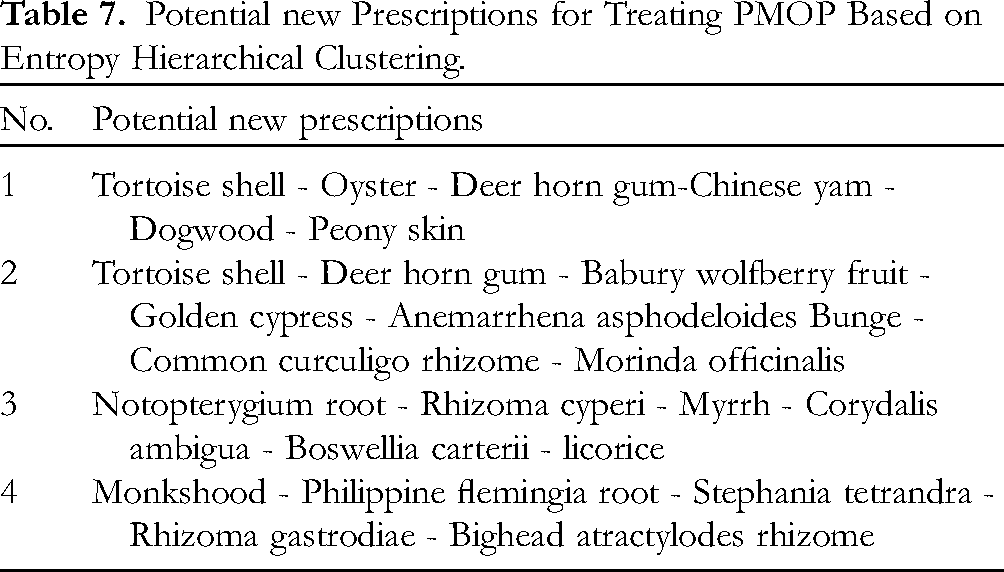
Based on the clustering at the entropy level, the core combination was further combined to evolve four potential new prescriptions for the treatment of PMOP, as shown in Table 7.
Potential new Prescriptions for Treating PMOP Based on Entropy Hierarchical Clustering.
Cyberpharmacology to Explore the Mechanism of Action of Core Drugs
Main Active Ingredients, Targets and Disease Targets of Core Drugs
Through screening, there are 173 active ingredients in the core drugs, including kaempferol, beta-sitosterol, quercetin and others; there are also 253 drug-related targets, including MAPK3, STAT1, HSP90AA1 and others. The PMOP had 1852 disease-related targets, and the intersecting targets of the core drug and PMOP totaled 115. The results of the intersection targets of core drugs and diseases were visualized in the form of Venn diagram, as shown in Figure 3(a).

(a) Venn diagram of core drug and PMOP intersection targets. (b) Core drug-active ingredient-intersection target-PMOP network construction diagram. (c) Cluster analysis and core targets of the intersection of core drugs and PMOP. (d) Bar graph of information on biological function annotation of key target genes. (e) KEGG pathway enrichment analysis of key targets. (f) Visual visualization of molecular docking.
Core Drugs - Active Ingredients - Intersecting Targets - PMOP Network Construction
The PPI analysis showed a total of 115 genes and 463 linkages, with an average node degree of 8.05, an average local clustering coefficient: 0.471, and a PPI-enriched P-value of <0.01. The regulatory networks between active ingredients and cross-cutting genes were imported into Cytoscape software to construct an “active ingredient-target” network for the treatment of PMOP with core drugs, as shown in Figure 3(b).
PPI Network Construction
In order to further investigate the mechanism of action of potential targets of core drugs for PMOP treatment, the intersection genes were imported into the STRING database. The species were defined as “Homo Sapiens”, and the linkage score was set to > 0.9 to obtain the PPI relationship. The results were imported into Cytoscape software and visualized using Network Analyzer to construct the PPI network. The specific degree value of a node in the PPI network represents the number of connections between the node and other nodes in the network, and is the most intuitive index to judge its “force”. The more connections and degrees a node possesses, the more influential it becomes, commonly referred to as a central node. Therefore, CytoHubba of Cytoscape software will be utilized to select key targets for core drugs treatment PMOP based on degree values, as shown in Figure 3(c). The initial graph contains 115 nodes and 2464 edges, where nodes represent protein genes and edges represent their interactions, with an average of 42.9 edges per point. The greater the degree value, the larger the nodes and the darker the color. The closer the protein genes are related, the thicker the edge. MAPK3, STAT1, HSP90AA1, MYC, MAPK14, AKT1, ESR1, NR3C1, MAPK1, FOS and STAT3 were the top 11 protein genes regarding degree value. These protein genes with high degree values play a key role in the overall network and in the core drugs treatment of PMOP, which may be the primary target of core drugs treatment of PMOP. The basic information is shown in Table 8.
Information Table of Key Targets of Core Drugs Formula in the Treatment of PMOP.

GO Functional Enrichment and KEGG Pathway Enrichment Analysis
To further understand the role of core drug targets in the treatment of PMOP within organisms, the GO enrichment analysis of 115 targets of core drugs acting on PMOP was carried out by using R language. The items with the highest enrichment results and p < 0.05 were analyzed according to the P value. The results showed that: a total of 2617 go items were obtained, including 2398 BP items, 85 CC items and 134 MF items. The top 10 items of each category were selected for visual analysis, as shown in Figure 3 (d). The results showed that in the biological process, the targets of core drugs therapy for PMOP were mainly concentrated in response to nutrient levels, response to oxidative stress, response to xenobiotic stimulus, response to radiation, cellular response to chemical stress, cellular response to oxidative stress, response to oxidative levels, response to increased oxidative levels, response to reactive oxygen species, response to hypoxia, etc The cell components mainly include membrane raft, membrane microdomain, vesicle lumen, secret granule lumen, cytoplasmic vesicle lumen, endoplasmic reticulum lumen, RNA polymerase ll transcription regulator complex, caveola, plasma membrane raft, serine type peptidase complex, etc In terms of molecular function, it involves DNA binding transcription factor binding, RNA polymerase II specific DNA binding transcription factor binding, phosphorase binding, transcription regulator binding, nuclear receptor activity, ligand activated transcription factor activity, theme binding, tetrapyrrole binding, sterid binding, nuclear sterid receptor activity, etc.
The KEGG pathway enrichment analysis of 115 targets was performed by R language, and the 115 intersection target genes were significantly enriched in 170 pathways based on p < 0.05. The top 30 representative pathways were selected as important pathways and analyzed visually according to P and count, as shown in Figure 3 (e). The results showed that the effective mechanism of core drugs in the treatment of PMOP involved Lipid and atherosclerosis, AGE-RAGE signaling pathway in diabetic complications, Fluid shear stress and atherosclerosis, Chemical carcinogenesis -receptor activation, P13K-Akt signaling pathway, Kaposi sarcoma-associated herpesvirus infection, Proteoglycans in cancer, Human cytomegalovirus infection, Prostate cancer, Hepatitis C, Chemical carcinogenesis - reactive oxygen species, Endocrine resistance, Hepatitis B, IL-17 signaling pathway, HIF-1 signaling pathway, Breast cancer, Hepatocellular carcinoma, Cellular senescence, Bladder cancer, Th17 cell differentiation, TNF signaling pathway, Estrogen signaling pathway, Pancreatic cancer, Colorectal cancer, Chagas disease, Endometrial cancer, Non-small cell lung cancer, Leishmaniasis, EGFR tyrosine kinase inhibitor resistance, Thyroid cancer, etc.
Molecular Docking
The 11 key components with the strongest associations were extracted as large protein receptors for molecular docking based on class clustering analysis, namely AKT1, ESR1, FOS, HSP90AA1, MAPK1, MAPK3, MAPK14, MYC, NR3C1, STAT1 and STAT3. The active ingredients corresponding to the 11 key components in the “compound-target” network were ranked by degree value, and the active ingredient with the highest degree value was selected as the ligand for molecular docking, namely Naringenin、quercetin、Odoratin、quercetin、Aureusidin、luteolin、isobavachin、Cyclopamine、Naringenin、baicalein and licochalcone A. The docking results showed that the ligands were able to enter the active center of the target proteins, and the ligands that consumed the least amount of energy for docking with each protein were selected and plotted for demonstration, namely luteolin-AKT1、isobavachin-ESR1、baicalein-FOS、Odoratin-HSP90AA1、Naringenin-MAPK1、Naringenin-MAPK3、Aureusidin-MAPK14、quercetin-MYC、Cyclopamine-NR3C1、quercetin-STAT1 and licochalcone A-STAT3. As shown in Figure 3(f). The results showed that baicalein-FOS and Aureusidin-MAPK14 docking activity was the best. The rest of the ligand-receptor binding energies are also negative and less than −5kcal·mol-1. According to the literature, 11 better binding activity is indicated when the binding energy is < -5.0 kcal·mol-1. The molecular docking results indicate that the above core drugs are capable of exerting anti-osteoporosis effects by acting on PMOP targets, as shown in Table 9.
Molecular Docking Results of the Core Target Proteins and the Active Compounds.

Discussion
PMOP occurs 5 to 10 years after menopause, and its etiology and pathogenesis can be summarized as kidney essence deficiency, spleen and stomach weakness, blood deficiency, liver depression and blood stasis in traditional Chinese medicine, and its clinical patterns are often classified into liver and kidney yin deficiency, spleen and kidney yang deficiency, and kidney deficiency and blood stasis. With the advantages of intelligent and multidisciplinary algorithms, the TCMISS is able to visualize the medication laws in the literature related to PMOP and provide data support and direction for clinical treatment of PMOP. Network pharmacology can construct the network relationship between diseases and traditional Chinese medicines, and reveal the treatment law in the form of gene pathway, which is conducive to providing scientific basis for clinical drug research. Molecular docking is a theoretical simulation method that focuses on the study of intermolecular (like ligand and receptor) interactions and the prediction of their binding modes and affinities. In recent years, molecular docking methods have become an important technology in the field of computer-assisted drug research.
Exploring the Patterns of TCM Treatment of PMOP Based on Data Mining
Analysis of High-Frequency Medication, Four Qi, Five Flavors, Meridian Tropism, and Efficacy Patterns of TCM for PMOP Treatment
This study found through frequency analysis of TCM for the treatment of PMOP that a total of 33 high-frequency drugs were used with a frequency of ≥ 11 times. The top ten drugs were Rehmanniae Radix Praeparata, Epimedium, Eucommia ulmoides, Rhizoma Drynariae, Angelica sinensis, Achyranthes, Astragalus propinquus, Psoralen, Cornus officinalis and licorice. Most of the high-frequency drugs mentioned above can tonify deficiency and weakness, and have the effects of nourishing yin, assisting yang, nourishing qi, and nourishing blood. The most commonly used dosage of high-frequency drugs is 10 or 15 g, while the dosage of Astragalus propinquus is relatively large, usually 20 or 30 g. Due to the fact that PMOP is caused by dietary disorders, old age, weakness, and long-term illness, according to the theory of Yin Yang mutual root: “Qi is Yang, blood is Yin” and “Qi is the leader of blood, and blood is the mother of Qi”. Therefore, it is necessary to use a larger dosage of Qi tonifying drugs to provide sufficient power for the biochemical transformation of the middle energizer.
Through the statistical analysis of Four Qi, it was found that warm drugs and flat drugs were the most used drugs to treat PMOP. The four qi refer to the four different medicinal properties of drugs: cold, hot, warm and cool, also known as the four natures. The drugs that can treat cold and cold diseases are warm and suitable for kidney Yang deficiency syndrome and spleen Yang deficiency syndrome PMOP. However, in the division of the Four Qi, Li Shizhen proposed the five qi classification, that “five qi, cold, hot, warm, cool, neutral”, the effect of the neutral medicine is not cold or warm medicine more significant, because it has a mild effect, generally speaking, whether it is cold or hot disease, can be combined with the application, so the use of more frequently.
Through the statistical analysis of Five Flavors, it was found that sweet drugs were used most frequently, and sweet drugs had the effect of warming the middle and tonifying deficiency and nourishing qi and blood, which was also suitable for the concept of tonifying deficiency in PMOP treatment. In addition to sour, bitter, sweet, pungent, salty, there are tasteless and astringent taste. Tasteless medicine has the effect of relieving urine and dampness, and astringency is similar to the effect of sour medicine, and it also has the effect of securing and astringing. Since PMOP is mainly deficiency syndrome, most of the TCM that usually have a tonic effect belong to or are biased to warm and flat, so the treatment should be based on warm drugs and supplemented by flat drugs.
Through the statistical analysis of meridian tropism, it was found that the main drugs were liver channel, kidney channel and spleen channel, and the drug normalization reflected some special effects of TCM on the zangfu meridians. Mastering the drug normalization could improve the correctness of drug application, and taking the drugs of liver channel, kidney channel and spleen channel as the main drugs to exert the efficacy on the main disease sites of PMOP, such as Achyranthes, Rehmanniae Radix Praeparata, and Epimedium, etc. These drugs can exert the drug force or guide the drug force of other drugs to reach a certain meridian and the lesion site, acting as a “guide”.
Through the statistical analysis of efficacy, it was found that the most frequently used drugs were deficiency tonifying drugs (yin tonifying medicinal, qi tonifying medicinal, blood tonifying medicinal), which were supplemented with strengthening drugs for muscles and bones, promoting blood circulation and regulating menstrual flow drugs, reinforcing essence and shrinking urine to stop band drugs, promoting blood circulation painkillers, dampness-draining diuretic medicinal, wind-damp-dispelling medicinal, hemostatic medicinal, etc. The main symptoms of PMOP are treated as well as other symptoms.
Based on the above research results, according to the pathological characteristics of PMOP with multiple asthenia and multiple blood stasis, this study proposed that the treatment of PMOP should be based on the syndrome differentiation of liver, kidney and spleen asthenia, and the treatment should focus on tonifying liver and kidney, strengthening spleen and qi, as well as promoting blood circulation and removing blood stasis, strengthening muscles and bones, clearing collagalates and relieving pain.
Analysis of Medication Pattern of TCM in Treatment of PMOP
The analysis of drug combinations for the treatment of PMOP found that the combination of Rehmanniae Radix Praeparata, Eucommia ulmoides, Epimedium and Rhizoma Drynariae was the most frequent. Based on the further analysis of drug association rules, it can be confirmed that the four herbs are most closely related to each other and other Chinese medicines. Therefore, according to the drug combination frequency and association rule analysis, the treatment of PMOP was mainly based on Rehmanniae Radix Praeparata, Eucommia ulmoides, Epimedium and Rhizoma Drynariae.
Earlier studies have found that Rehmanniae Radix Praeparata prevents bone loss by modulating bone metabolism, preventing bone loss in a PMOP model of ovariectomized rats and does not affect hormone secretion levels. 11 Recently, it was found that catalpol, an active ingredient in Rehmanniae Radix Praeparata, had a beneficial effect on the proliferation of osteoblasts in ovariectomized rats, the increase of ALP activity, the formation of bone mineralization nodules and the expression of key proteins of bone formation, and can inhibit the formation and differentiation of osteoclasts (OCs), the activity of TRAP and the expression of key proteins of bone resorption in order to play a role in regulating the metabolism of bone, which are all indicative of the development of catalpol as a therapeutic agent for PMOP. 12
In recent years, the research on the mechanism of action of Eucommia ulmoides and the active ingredients in Eucommia ulmoides on the prevention and treatment of PMOP has become more and more in-depth. Flavonoids in Eucommia ulmoides reduce bone loss in ovariectomized rats by targeting VEGF, IL-17 and NF-κB signaling pathways, which may contribute to the prevention of PMOP, and the good safety profile of flavonoids in Eucommia ulmoides suggests that they can be used as food additives in daily life to improve bone health. 13 In another study, the active ingredient in Eucommia ulmoidese, Eucommia ulmoidese Total Glycosides, was used in a rat model of ovariectomized rats, and it was found that Eucommia ulmoidese Total Glycosides could regulate the Notch signaling pathway to promote osteogenic differentiation of adipose mesenchymal stem cells and bone formation, and play an important role in the fight against PMOP. 14 As a commonly used clinical drug, Eucommia ulmoides is both edible and medicinal, and the above studies have confirmed that a variety of active ingredients in Eucommia ulmoides can play a role in PMOP prevention and treatment through multiple signaling pathways.
Epimedium is a classic drug for anti-osteoporosis, and its mechanism of regulating bone metabolism is constantly being studied. In vitro studies have found that icariin inhibits OC formation and bone resorption by down-regulating transcription factors to activate T cell cytoplasmic 1 and c-fos, thus further down-regulating OC generation specific genes, to improve RANKL-mediated OC generation and osteoporosis induced by ovariectomy. 15 Icariin can also play a role in bone protection through estrogen receptors. Animal experiments have confirmed that icariin (300 mg / kg / day) exerts a sufficient estrogen effect through the cross-talk of estrogen receptors in osteoblasts, and can restore the bone status of osteoblasts in estrogen-deficient mouse models. 16 Moreover, icariin-1 has been shown to have great potential in treating PMOP by targeting the gut-bone signaling axis.17, 18
Rhizoma Drynariae is widely known in TCM for its ability to increase bone mineral density. A study evaluated the effect of total flavonoids from Rhizoma Drynariae in combination with calcium carbonate in a rat model of bilateral ovariectomy and found that it significantly improved antioxidant capacity, increased bone mineral density, reduced bone mineral loss, and was effective in the prevention and treatment of PMOP.17, 18 Another study explored the potential effects of total flavonoids in Rhizoma Drynariae on bone loss in ovariectomized rats, and found that total flavonoids in Rhizoma Drynariae could prevent bone mineral loss and improve some related biochemical indicators: such as ALP, TRAP and E2, and found that the total flavonoids in bone claviculin through the WNT signaling pathway and BMP-2 signaling pathway to play an anti-osteoporosis effect on ovariectogenic rats. 19
Analysis of Potential Core Drugs and Potential new Formula Combinations for PMOP Treatment with TCM
Based on an unsupervised entropy hierarchical clustering algorithm, eight groups of potential core drug combinations were mined, based on which four potential new prescriptions were further evolved. By analyzing the drug efficacy of the new prescriptions, they conformed to the basic treatment rules of PMOP. The new prescription 1 combines turtle shell with oysters, deer antler gum, cornus officinalis, yam, and peony bark to nourish the liver and kidneys, nourish essence and blood, and is suitable for PMOP with liver and kidney yin deficiency. The new prescription 2 combines deer antler gum, Fructus Lycii, anemarrhena asphodeloides, phellodendron amurense, Rhizoma Curculiginis, and Radix Morindae Officinalis to enhance both yin and yang, strengthen tendons and bones, and is suitable for PMOP with kidney yin and yang deficiency. In the new prescription 3, Rhizoma et Radix Notopterygii is combined with Olibanum, Myrrh, Rhizoma Cyperi, Rhizoma Corydalis, and Radix Glycyrrhizae to strengthen the joints, activate blood circulation and remove blood stasis, which is suitable for PMOP with kidney deficiency and blood stasis. In the new prescription 4, Radix Aconiti Lateralis Preparata is combined with Rhizoma Atractylodis Macrocephalae, Radix Flemingiae, Radix Stephaniae Tetrandrae and Rhizoma Gastrodiae to warm yang, strengthen spleen and strengthen tendons and bones, which is suitable for PMOP of spleen kidney yang deficiency type.
According to Chinese medicine, different prescription choices should be made according to the specific symptoms of the disease, and the treatments and prescriptions should be adjusted according to the changes of the condition in the clinic. The “Clinical Practice Guidelines for Postmenopausal Osteoporosis in Chinese Medicine (2021 Edition)” categorizes PMOP into 4 common types of evidence: Yin deficiency of liver and kidney, Yang deficiency of spleen and kidney, Blood stasis in kidney deficiency, and Yin and Yang deficiency of kidney, which corresponds to the 4 potential new formulas obtained in this study, which further corroborates that the results obtained in this study are of research significance.
Exploring the Mechanism of Action of Core Drugs for PMOP Based on Network Pharmacology
Active Ingredient Analysis of Core Drugs
In this study, the pharmacokinetic parameters such as OB and DL were screened by network pharmacology and other methods, and combined with the database targets, it was concluded that kaempferol is one of the effective active ingredients of Eucommia ulmoides, Rhizoma Drynariae and Epimedium, which plays an important role in this study. Kaempferol is a flavonoid that can inhibit OC activity in vitro, and has the function of improving a variety of human diseases. Kaempferol has a wide range of pharmacological effects, including antioxidant, anti-inflammatory, antibacterial, anti-OP, estrogen supplement and other effects. 20 Studies have shown that kaempferol has a beneficial effect on the bone structure disorder caused by estrogen deficiency in rats. Experiments have confirmed that kaempferol can promote the osteogenic differentiation of Rhizoma Drynariae mesenchymal stem cells (BMSCs) by increasing the expression of RUNX2, Osterix and CXCL12, and reducing the expression of miR-10a-3p. Improve the bone mineral density of ovariectomized osteoporosis rats. 21 Another study found that osteoblast differentiation was induced in ovariectomized rat models of osteoporosis at a peak plasma concentration of 483 ng/ml (2μM) without hepatotoxic effects. 22 Epidemiologic studies have shown a positive correlation between the consumption of foods or medications containing kaempferol and a reduced risk of a number of diseases, including PMOP, cancer and cardiovascular disease. 23 The above cellular and molecular experiments confirmed that kaempferol can promote osteogenic differentiation in estrogen-deficient rats in vivo, and the safety of kaempferol at moderate doses was guaranteed. Therefore, further studies on the specific mechanism of action of kaempferol in the prevention and treatment of PMOP are important for future clinical applications.
β-sitosterol is the common active ingredient of Eucommia ulmoides, Psoralen, Rhizoma Drynariae, which belongs to phytol estrogen, and it can play the biological functions of antioxidant, anti-inflammation, anti-apoptosis and neuroprotection through multi-targets and multi-pathways. β-sitosterol directly promotes osteogenesis by promoting the secretion of estradiol from ovarian granulosa cells and increasing the ratio of OB osteoprotegerin to OC differentiation factors, and it effectively inhibits the growth of osteoclasts, thus achieving the effect of regulating bone homeostasis, 24 as well as effectively inhibiting OC differentiation through the MAPK, TNF-α, NF-κb, and Toll-like receptor pathways. 25 As an important functional cell for ovarian growth and development, the proliferation and apoptosis of granulosa cells affect estrogen production, and estrogen deficiency is one of the main factors inducing PMOP. Studies have shown that 20 μmol-L-1 of β-sitosterol can promote the proliferation of granulosa cells by increasing the expression of P-AKT and P-PIK3CA proteins, which is beneficial to improve the situation of estrogen and progesterone insufficiency in vivo, and reduce the expression of Caspase-3 protein, which inhibits apoptosis of granulosa cells, and thus slows down the progression of PMOP. 26
Quercetin belongs to a variety of flavonoids common ingredients, with estrogen antagonist active ingredient, can regulate the level of osteocalcin, to achieve the purpose of antagonizing the low estrogen level in the body, is conducive to improving the postmenopausal women's ovarian insufficiency, estrogen secretion reduction triggered by the symptoms of PMOP. 27 The current study suggests that quercetin promotes proliferation and osteogenic differentiation of BMSCs through the miR-206 / Cx43 pathway. 28 Another study found that quercetin also inhibited RANKL-mediated OC generation, OB apoptosis, oxidative stress, and inflammatory responses through the regulation of Wnt, NF-κB, Nrf2, SMAD, and intrinsic and extrinsic apoptotic pathways, while promoting osteogenesis, angiogenesis, antioxidant expression, and adipocyte apoptosis. 29 Considering the important role of quercetin in regulating bone homeostasis, it can be considered as an economic and promising drug to improve bone health in patients with PMOP.
Target of Action Analysis of Core Drugs
After comprehensive analysis of the collected data, MAPK3, STAT1, HSP90AA1 and other related factors were considered as the key targets of the core drugs for PMOP treatment, and the key targets are discussed and analyzed.
MAPK3, the first mitogen-activated protein kinase discovered in mammals, also known as extracellular regulated protein kinase, it's a key component of signaling from the cell surface transducer to the interior of the nucleus and is importantly associated with physiological processes such as cell proliferation, stress, inflammation, differentiation, functional synchronization, transformation, and apoptosis. MAPK3 inhibits the transcription and expression of NFATc1, the major transcription factor of OC, by inhibiting the phosphorylation of MAPK3 stimulated by RANKL, thereby reducing OC production, 30 Or MiR-27a-3p-mediated increase in the phosphorylation level of MAPK3 with concomitant decrease in CRY2 expression induced calcified nodules, increased alkaline phosphatase content and significant reversal of osteogenesis-related protein expression, thereby promoting OB differentiation. 31 Both of them work together to correct the state of PMOP patients’ bone resorption over bone production, and regulate the level of bone metabolism in the body. In addition to its direct effect on osteoclastogenesis and resorption, recent studies have shown that MAPK3 can also participate in the regulation of intestinal flora and play an anti PMOP role. 32
STAT1 is a unique protein that binds to DNA and usually responds to a variety of extracellular cytokine and growth factor signals, when STAT is phosphorylated, it undergoes polymerization and becomes an activated transcriptional activation factor, which enters the nucleus and binds to target genes to promote their transcription, and plays a key role in signal transduction and transcriptional activation. 33 Up-regulation of STAT1 phosphorylation in OB significantly leads to increased secretion of chemokine ligand 9 (Cxcl9) to promote OB proliferation and differentiation and inhibit bone angiogenesis, which reveals the mechanism by which OB affects bone metabolism by regulating bone angiogenesis. 34 IL-35 slowed osteoporosis progression by inhibiting TNF-α-induced OC production through inhibition of NF-κB and MAPK and downregulation of NFATc1, c-fos, and TRAP, during which JAK1 / STAT1 was activated. 34 In addition, STAT1 can play a regulatory role in the process of inflammatory response-induced osteoporosis, but the specific mechanism remains to be explored. 35
HSP90 is one of the most abundant proteins in the human body and has been associated with numerous human diseases; its synthesis and release facilitate the maintenance of cellular homeostasis and mediate a variety of programmed cell deaths, including apoptosis, autophagy, and iron-death. 36 Recent studies have revealed that the chaperone protein HSP90AA1 can assist the transcription factor TFEB to enter the nucleus and thus regulate autophagy, providing a new target for the delay of aging and the treatment of aging-associated diseases, which may be one of the important pathways for PMOP induction. 37 Although there is no study that directly confirms the relevance of HSP90AA1 to the pathogenesis of PMOP, but HSP90AA1 as a marker of autophagy, has been validated in animal experiments in human knee tissues or surgically-induced OA, and a recent study has found that the down-regulated expression of HSP90AA1 in the blood and cartilage of patients with osteoarthritis is associated with the risk of osteoarthritis, and that knockdown of the HSP90AA1 gene has been associated with cellular autophagy, inflammatory responses, oxidative stress, aging, and apoptosis. 38 Based on the above recent studies, we believe that chaperone protein HSP90AA1-mediated cellular autophagy may play an important role in the pathogenesis of PMOP, which is of great exploratory value and research significance.
Signaling Pathway Analysis of Core Drugs
The results of GO enrichment analysis showed that the core drugs could improve the metabolism and endocrine level of the body through enhancing the nutritional level, regulating oxidative stress and other biological processes, and realize the therapeutic purpose of PMOP. KEGG enrichment results showed that the core drugs exerted their anti-PMOP effects mainly through 170 signaling pathways, including AGE-RAGE, PI3 K/Akt, TNF, and HIF-1.PMOP results in an imbalance of bone metabolism due to an altered estrogenic status and insufficient intake of specific nutrients, and after menopause in females, the increased The effectiveness of bone minerals depends largely on the adequacy of pharmacologic or dietary calcium supply. 39 And the core drug can improve the nutritional level of PMOP patients by providing abundant nutrients, which is beneficial to regulate the level of bone metabolism. Oxidative stress refers to the imbalance between the generation and elimination of reactive oxygen species, excessive reactive oxygen species lead to cell damage and apoptosis, affecting cell function, and is a common pathological condition secondary to estrogen deficiency and aging. It has been found that oxidative stress is closely associated with the AGE-RAGE pathway, and AGEs are associated with decreased bone tissue mass, whereas oxidative stress promotes the formation of AGEs, which in turn promotes unbalanced bone remodeling through RAGE-mediated signaling, increases bone resorption and inhibits bone formation. 40 In addition, it can inhibit oxidative stress-induced mitochondrial dysfunction and reduce apoptosis of OBs by activating the PI3 K/AKT signaling pathway. 41 And another study found that TNF-α increased reactive oxygen species activity in cells of different tissues, suggesting that TNF-α and oxidative stress play a synergistic role in PMOP. 42 When bone tissue in PMOP is exposed to a hypoxic microenvironment, cellular HIF-1α senses hypoxia and is activated, increasing ROS production and promoting the generation of OCs. 43 In summary, there is a close connection between the biological processes and signaling pathways involved in this study, which have been increasingly studied over time, reflecting to some extent that the specific processes involved in the treatment of PMOP with core medications are extremely important and complex, and remain to be further explored.
Conclusion
In this study, data mining was carried out by using the software of TCMISS, and through the multi-angle analysis and exploration of the medication pattern of the Chinese medicine compound formula for PMOP, it was initially clarified that the core medication pattern of the treatment of PMOP was Rehmanniae Radix Praeparata, Epimedium, Eucommia ulmoides and Rhizoma Drynariae, and that the medications used for the treatment of PMOP were mostly those that tonified the deficiency, strengthened the muscles and bones, and invigorated blood circulation to regulate the menstruation, with sweetness being the dominant flavor, and the pathogenesis and the attribution of the major medications used for the treatment of PMOP was closely related to the organs of the liver, kidneys, and spleen, so that the clinical treatment is usually based on the nourishment of the liver and kidneys and strengthening of the spleen to promote the qi, and the activation of blood circulation and elimination of blood stasis, strengthening of the muscles and bones, and opening of collaterals for the alleviation of the symptoms of PMOP. Using network pharmacology methods, we predicted the potential targets and mechanism pathways of the core drugs for the treatment of PMOP, which mainly improve the metabolism and endocrine level of the body by enhancing the nutritional level, regulating oxidative stress and other biological processes, and realize the signaling pathways such as AGE-RAGE, PI3 K/Akt, TNF, HIF-1, and so on. The therapeutic purpose of PMOP. To a certain extent, we have clarified the mechanism of the core drug's onset of action, which in turn provides a therapeutic idea for the clinical treatment of PMOP. Using molecular docking technology, the three-dimensional spatial structure and binding activity between the key active ingredients and targets were better predicted and revealed, which provides data support for further basic research and clinical use of TCM in the treatment of PMOP. In addition, this study has some limitations: the limited number and uneven quality of the included literature may lead to biased results. Although the existing literature reports have confirmed the results of some network pharmacology and molecular docking predictions, further experiments are needed to verify the results of other predictions in this study.
Footnotes
Acknowledgments
We are grateful to Dr Xiaoyun Zhang from the Ruikang Hospital Affiliated with Guangxi University of Chinese Medicine for his help in all stages of this study.
Author Contributions
HZ, KH, YC and XZ contributed to the study design, data collection and processing, and paper writing and modification. HL, YL and ZL were mainly responsible for the data analysis. XZ joined the discussion. All the authors read the final manuscript and agreed to publish it.
Declaration of Conflicting Interests
The authors declared no potential conflicts of interest with respect to the research, authorship, and/or publication of this article.
Ethical Approval
Ethical Approval is not applicable for this article.
Funding
The authors disclosed receipt of the following financial support for the research, authorship, and/or publication of this article: This work was supported by the Natural Science Foundation of Guangxi Zhuang Autonomous Region, Innovation Project of Guangxi Graduate Education, Guangxi Traditional Chinese Medicine Appropriate Technology Development and Promotion Project, National Natural Science Foundation of China funded project, (grant number No.2023GXNSFAA026075, YCSY2023038, GZSY22-36, No.82360937).

Statement of Human and Animal Rights
This article does not contain any studies with human or animal subjects.
Statement of Informed Consent
There are no human subjects in this article and informed consent is not applicable.