



Abstract
Keywords
Introduction
Alzheimer's disease (AD) is a central nervous system degenerative disease that is manifested by impaired cognitive function and impaired quality of life. 1 This irreversible and fatal disease tends to occur in older people and has a slow course, which brings a heavy burden on the family and society. 2 The pathogenesis of AD is largely unknown. Even though some therapeutic drugs can improve symptoms to some extent, they cannot delay or stop disease progression. Major depressive disorder (MDD) is an emotional disorder with complex morbidity, diverse forms, and high recurrence rates. In clinical terms, depression is mostly characterized by significant and lasting low mood, lack of interest, impaired thought, and so forth. 3 Recent evidence suggests a strong relationship between MDD and AD. The systematic meta-analysis by Ownby et al shows that the interval between MDD and AD diagnoses is positively connected to an increased risk of developing AD. 4 It is suggested that MDD could be a risk factor for AD rather than a prodrome. Furthermore, the pathogenesis of AD is influenced by the same molecular mechanisms and pathways that contribute to the pathogenesis of major depression. 5 In particular, a specific impairment of the signaling of some neurotrophins, such as brain-derived neurotrophic factor (BDNF) and transforming-growth-factor beta 1 (TGF-beta 1), has been observed both in MDD and AD.6, 7
Based on the similar neurophysiological basis of AD and MDD, the collaborative clinical treatment of the 2 diseases has received great attention. First, some antidepressants are substrates of P-GP, which can promote the clearance of Aβ after p-GP functional repair, 8 while the core problem of the pathological mechanism of AD is the massive deposition of Aβ. 9 Therefore, these depression drugs could potentially be used to treat AD. In addition, some drugs exert antidepressant effects by activating the cholinergic anti-inflammatory pathway mediated by α7 nAChR. 10 Activation of α7 nAChR promotes the release of the neurotransmitter acetylcholine and plays a neuroprotective role in AD by reducing Aβ deposition. Therefore, drugs targeting α7 nAChR are also expected to be developed as a promising treatment for AD and MDD. 11 However, although many drugs have the potential to treat both AD and MDD in different ways, no specific evidence has been found.
Traditional Chinese medicine (TCM) has the characteristics of multichannel and multilevel synergistic integration. 12 At present, relevant studies have shown that TCM exerts a positive effect on the treatment of AD and MDD. 13 However, while many TCM therapies have achieved promising results, the therapeutic mechanisms of TCM in AD and MDD are not known. In recent years, the development of network pharmacology has shifted the methodological approach from a “one target, one drug” model to a “network target, multi-component” model, boosting TCM research modernization. Molecular docking involves placing the ligand molecule in the active site of the receptor macromolecule in order to forecast the conformation and action energy of the small molecule to the receptor, thus revealing the mechanism of action between the drug and the target of the body. 14 Therefore, the present study adopted the network pharmacology and molecular docking approach to screen MDD prescriptions for TCM and multitarget ingredients with potential impact on the simultaneous treatment of MDD and AD.
Material and Methods
Selection of TCM Prescriptions for MDD
A comprehensive search for relevant studies was conducted in the China National Knowledge Infrastructure (CNKI), Weipu Database, Wanfang Database, and PubMed up to March 2022, with no language or publication status restrictions. The main keywords were “traditional Chinese medicine,” “Chinese patent medicine,” “traditional Chinese medicine prescription,” “Major Depressive Disorder” and “Depression”. The literature was excluded related to complications, review articles, duplicate publications, cell experiments, and animal experiments. The full text of the studies was analyzed to extract information about TCM prescriptions for MDD treatment. After sorting out the TCM prescriptions, a database of summary information was developed. In addition, the frequency of single herbs was calculated, and common herbs were screened.
Screening Target-Related Ingredients
The active compounds of Chinese herbs were obtained through the Traditional Chinese Medicine Systems Pharmacology Database and Analysis Platform (TCMSP, https://old.tcmsp-e.com/tcmsp.php) database. From this database, the absorption, distribution, metabolism, and excretion (ADME) parameters of the herbal ingredients were obtained, including drug-likeness (DL) and oral bioavailability (OB). 15 The compounds meeting the DL≥0.18 and OB≥30% filter conditions were defined as active ingredients with therapeutic properties. 16
Potential Target Prediction for Active Compounds
To predict the probable targets of the active compounds, a docking procedure was performed using the PharmaMapper website (http://www.lilab-ecust.cn/pharmmapper/), which provides a pharmacophore matching service to discover prospective targets. 17 The predicted target species was set to “Homo sapiens,” and the rest of the parameters were left at their default values. Based on the “fit score” of each compound, the top 10 targets were chosen for further research. Subsequently, the UniProt database (https://www.uniprot.org/) was used to convert the target into a gene name.
Identification of Disease-Related Targets
Using “Alzheimer's disease” and “Major Depressive Disorder” as the search terms, GeneCards (http://www.genecards.org), DrugBank database (https://www.drugbank.ca/), OMIM (https://omim.org/), DisGeNET (https://www.disgenet.org/) database, and Therapeutic Target Database (TTD, http://db.idrblab.net/ttd/) were employed to identify MDD-related targets and AD-related targets in January 2022.
Searching for Common Targets
The Venn diagram (http://bioinfogp.cnb.csic.es/tools/venny/) displays the intersecting targets for active substances, MDD, and AD. The common targets were the predicted therapeutic targets of the active ingredients for MDD and AD.
Establishment of Networks and Analysis
We constructed, visualized, and analyzed the herb-active ingredient-common target network and target-pathway network using Cytoscape 3.8.2 software to understand the relationships between herbs, active ingredients, targets, and pathways for disease treatment. Furthermore, the common targets were incorporated into the Search Tool for Retrieval of Interacting Genes (STRING) database (https://string-db.org) to establish protein–protein interaction (PPI) networks.
18
The degree of centrality of a node within the network is an important statistic representing its local relevance. In general, nodes with a high degree of centralization are likely to be important network nodes. The targets with a degree of centrality exceeding the median value in the PPI network were chose
Furthermore, Kyoto Encyclopedia of Genes and Genomes (KEGG) and Gene Ontology (GO) enrichment analyses were performed based on the Metascape database (http://metascape.org/gp/index.html) and the common targets mentioned above. 19 All the terms with a P-value <.05 were saved and grouped, and the species of the targets was set to “Homo sapiens.” Therefore, the pathways and biological functions with the greatest statistical significance were identified.
Molecular Docking Between Target and Compound
Molecular docking was performed with ALB, AKT1, ESR1, CASP3, and NOS3 in order to discover natural ingredients with potential effects on MDD and AD. The protein's conformation was first obtained from the Protein Data Bank database. Then, Autotools was used for optimization, removing water molecules, adding hydrogen atoms, and adjusting force fields. In addition, all small molecules were processed for energy minimization. In cocrystal structures, the binding sites were defined as the positions of ligands. AutoDockTool 1.5.6 and AutoDock Vina software was used to perform docking simulations of macromolecular protein receptors and their corresponding compounds. 20 To evaluate binding interactions between compounds and their targets, binding energies were calculated. A binding energy of less than “5” indicated a good interaction. 21
Results
Literature Search Results
A total of 8872 relevant articles was retrieved following the literature search strategy and data collection method. By checking the title and abstract, 3604 duplicates and 3311 irrelevant studies were eliminated. After reviewing the full texts of the remaining records, 1238 studies were further eliminated. Finally, 719 studies were included in the statistical analysis (Figure 1).
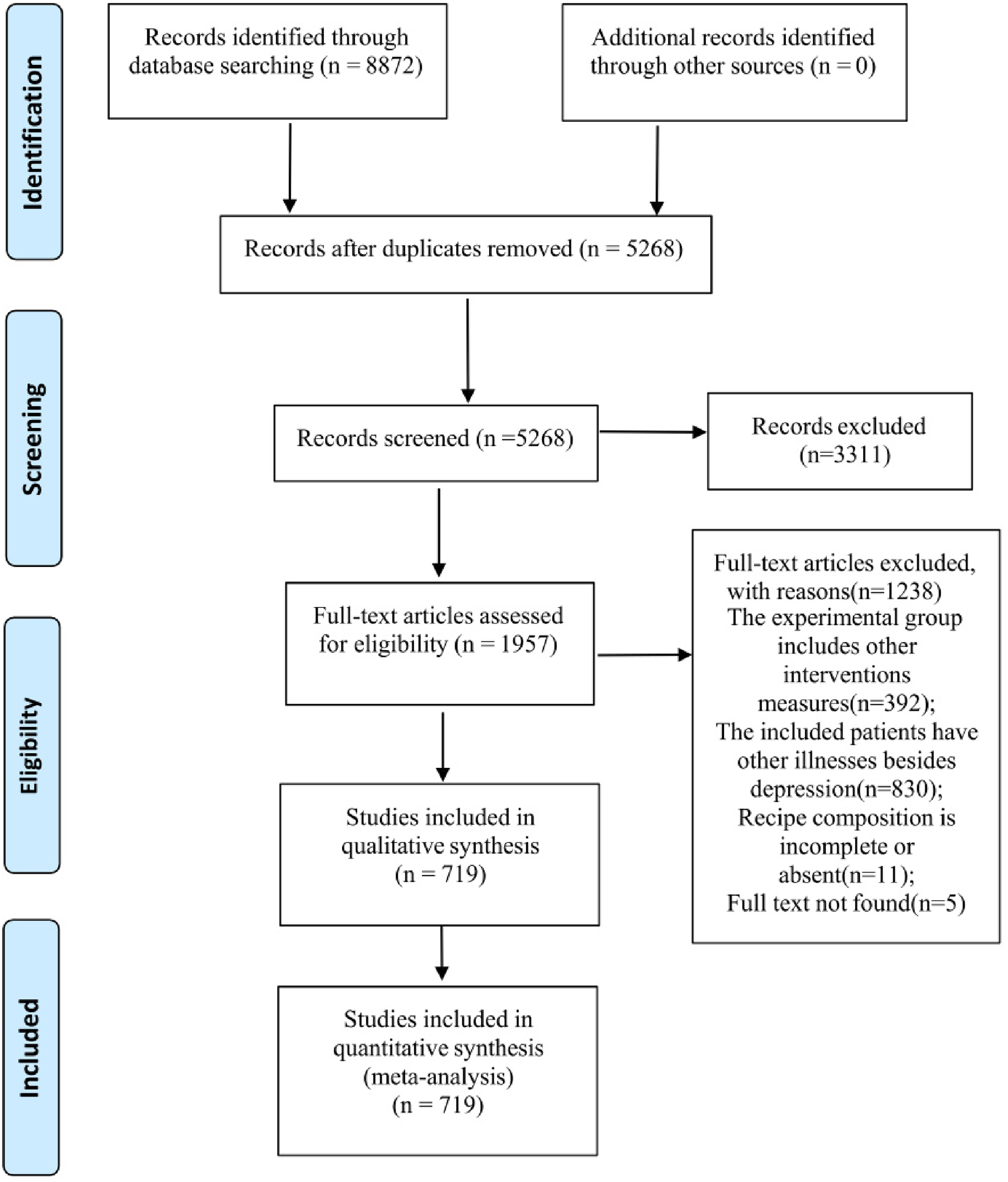
Flow diagram of study selection.
MDD-Related TCM Prescriptions and Common Herbs
The frequency of single herbs across the 234 TCM prescriptions for MDD was calculated. The 10 most commonly used herbs in TCM prescriptions for clinical therapy of MDD were Chaihu (Radix Bupleuri), Gancao (licorice), Fuling (Poria cocos (Schw.) Wolf.), Baishao (Paeoniae Radix Alba), Yujin (Curcumae Radix), Danggui (Angelicae sinensis Radix), Shichangpu (Acoritataninowii Rhizoma), Suanzaoren (Ziziphi Spinosae Semen), Xiangfu (Cyperi Rhizoma), and Banxia (Arum ternatum Thunb), as displayed in Table 1.
Frequencies of Single Herbs in TCM Prescriptions for Treating MDD.

Active Ingredients of Chinese Herbs
By eliminating the repetitive compounds from the TCMSP database, 198 active ingredients of herbs were retrieved for screening. These active compounds primarily originated from Chaihu (17), Gancao (92), Fuling (15), Baishao (13), Yujin (15), Danggui (2), Shichangpu (4), Suanzaoren (9), Xiangfu (18), and Banxia (13).
Potential Targets of Active Compounds
The PharmaMapper server was used to estimate the active chemical targets of the 10 most commonly used herbs. After deleting the repetitive targets, 144 viable ones were identified out of the 198 active components.
Related Targets of MDD and AD
After removing the repetitive targets, the 5 datasets yielded 1095 MDD-related targets and 1684 AD-related targets. In an analysis of the 2 disease-related targets, 377 overlapping targets between MDD and AD were identified as closely related to the occurrence and development of these 2 diseases.
Common Targets of Active Ingredients and Diseases
The disease-related targets modulated by active components were identified using a Venn diagram (Figure 2). The confluence of active substances, MDD and AD, revealed 30 similar targets, including ALB, AKT1, ESR1, CASP3, NOS3, PPARG, MAPK1, MAPK8, and AR. These common targets were considered relevant ones of the herbal ingredients in the treatment of MDD and AD.
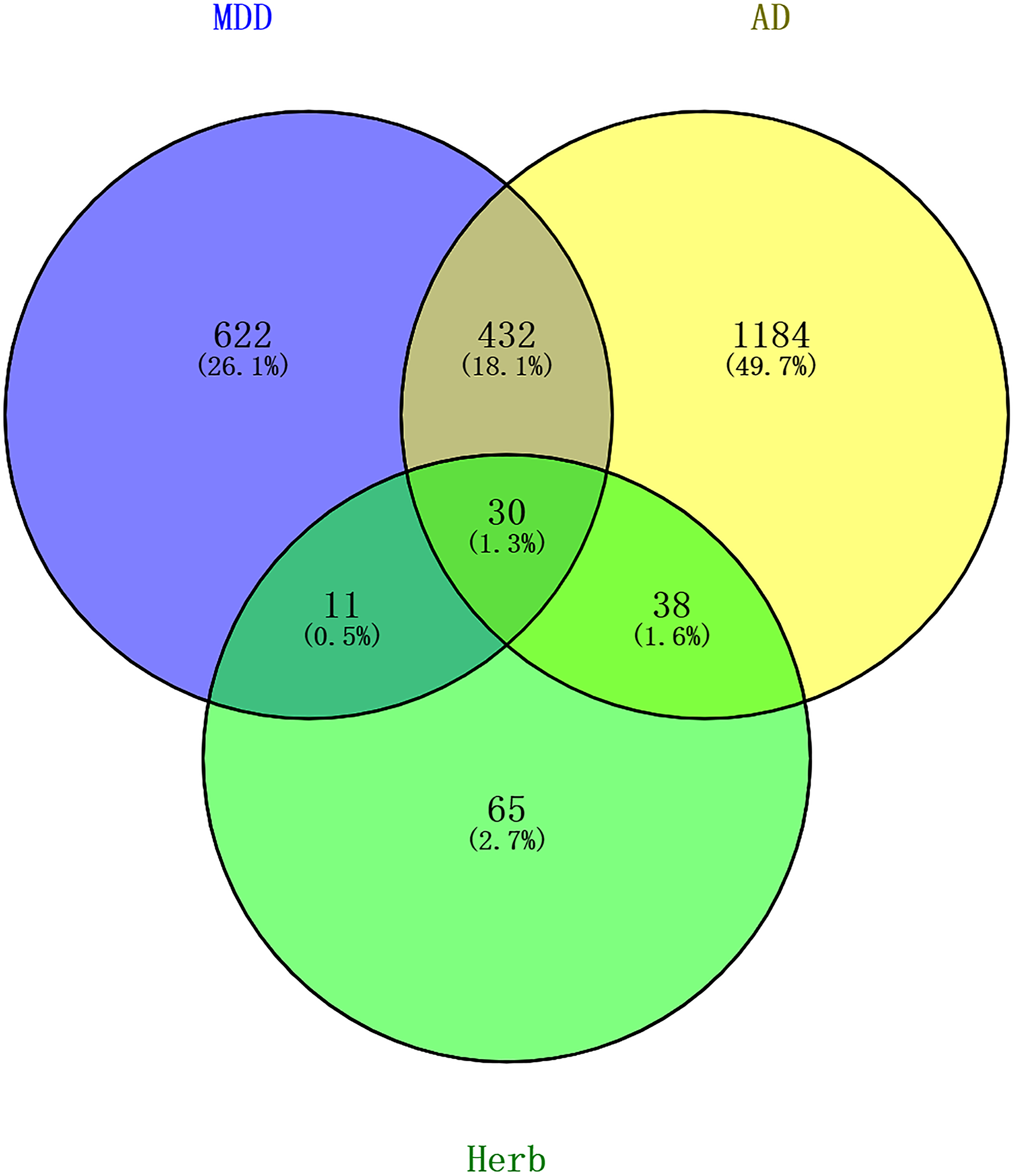
Venn diagram.
Network of Herb-Active Ingredient-Common Target
As shown in Figure 3, an herb-active ingredient network of 10 herbs and 265 active ingredients was constructed to further investigate their relationship. This network represented ingredients such as quercetin (degree = 456), kaempferol (degree = 320), β-sitosterol (degree = 195), stigmasterol (degree = 128), isorhamnetin (degree = 114), naringenin (degree = 76), and 8-isopentenyl-kaempferol (degree = 60) as high-degree components. The high-degree ingredients may potentially be used in treating MDD and AD. Notably, network analysis revealed that the representative ingredients were mainly from Xiangfu, Gancao, and Chaihu.

Herb-active ingredient network.
Furthermore, a network of herb-common targets (Figure 4) illustrated the relationship between herbs and disease-related targets in greater detail. The 30 green ovals connected by INT on the right side of the figure represent the common targets contained in the selected herb, and on the left side are the 249 key targets of the 2 diseases. These obtained common targets of herbs and diseases served as an important basis for subsequent PPI network and enrichment analysis.

Herb-common target network.
PPI Network
A PPI network composed of 30 common targets was constructed based on the STRING database, then visualized by Cytoscape to illustrate the PPIs. These 30 targets were situated in the PPI network's core and could be useful targets for bioactive substances against MDD and AD. The threshold value was higher than 10, and the 9 important targets, ALB, AKT1, ESR1, CASP3, NOS3, PPARG, MAPK1, MAPK8, and AR, were further screened (Table 2) (Figure 5).

The PPI network for the identification of key targets (the larger the node, and the deeper the color, represent the greater the degree of the node).
The Information of 9 key Targets, Their Corresponding Uniprot ID, Gene Symbols, and Degrees of Correlation With Proteins.

GO and KEGG Pathway Enrichment Analysis
Through the analysis of the Metascape website, signaling pathways were uncovered for the targets associated with herbs for MDD and AD, and the Cytoscape 3.7.1 software and Microbiology platform was used to visualize the results. The targets’ most significant biological functions included hormonal response, response to lipopolysaccharide, reproductive structure development, response to nutrient levels, regulation of hormone levels, and cellular response to organic cyclic compounds (Figure 6). A network map was created from a selection of enriched terms to investigate further their relationships. As shown in Figure 7a, the nodes representing enriched terms were colored by cluster ID. Meanwhile, the P-value was represented by the color of the enriched terms (Figure 7b), with a darker hue representing a lower P-value.

Go terms enrichment analysis of the 20 most notable biological functions of common targets.

Enriched terms network map (A: clusters of enriched terms with similarity > 0.3 are colored by cluster-ID; B: nodes indicate enriched terms colored by P-value. The lesser the P-value, the deeper the color).
Based on the KEGG enrichment study, the active ingredients of the 10 herbs may have therapeutic potential for MDD and AD via numerous signaling pathways. The most notable biological pathways were those involved in cancer, lipid and atherosclerosis, diabetic cardiomyopathy, coronavirus disease-COVID-19, serotonergic synapse, chemical carcinogenesis-DNA adducts, thyroid hormones synthesis, adherence junction, and TGF-beta signaling pathway (Figure 8).

The top 9 KEGG terms enrichment analysis pathways (ordered by − log10 (value) and gene number in order of importance).
Molecular Docking Results
Molecular docking was used to validate the connections between bioactive molecules and their targets. In general, the ligand and receptors can bind more efficiently if their binding energy is less than 5.0. 22 The higher the binding affinity, the lower the binding energy. According to key targets, pathways analysis, and study of MDD medications to treat AD, ALB, AKT1, ESR1, CASP3, and NOS3 were chosen for molecular docking with 7 representative components. The docking results showed that AKT1 with β-sitosterol, ESR1 with β-sitosterol, ESR1 with stigmasterol, and NOS3 with naringenin, displayed a better binding affinity (Table 3).
Key Compounds and Core Target Docking Energy Scale (kJ·mol−1).
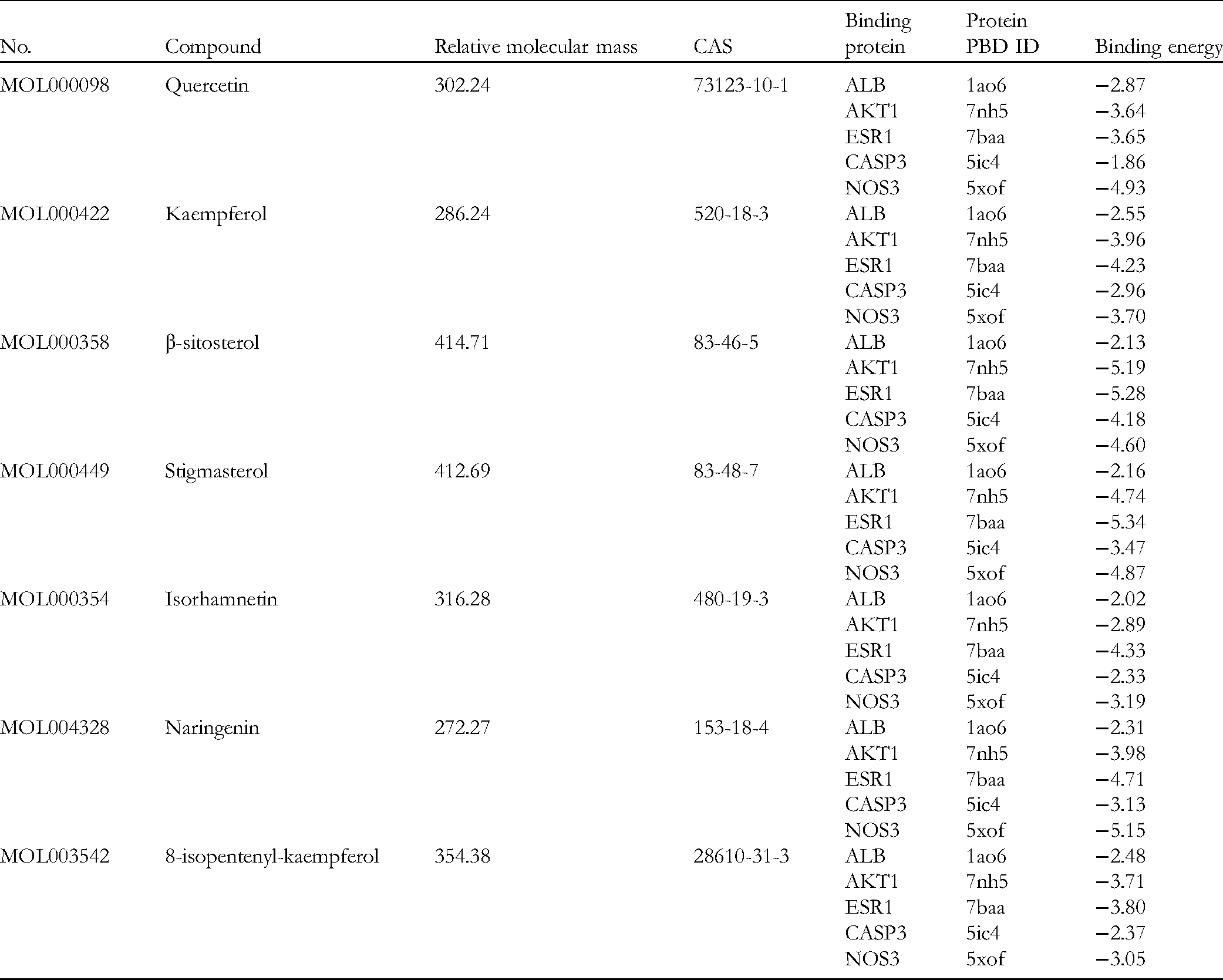
Figure 9 contains comprehensive interaction information for the active compounds and their relevant target proteins. As shown in Figure 9c, stigmasterol with ESR1 had the strongest binding energy (binding energy = −5.34). The active site formed 2 hydrogen bond interactions with a distance of 1.7 and 1.9 Å, which may be the main force securing its binding to the active site.

Molecular docking modes of β-sitosterol to AKT1 (A) and ESR1 (B), stigmasterol to ESR1 (C), and naringenin to NOS3 (D).
Discussion
As 2 common diseases worldwide, medication screening for the co-treatment of AD and MDD has received a lot of attention. In this study, we acquired 234 MDD-related TCM prescriptions and examined the 10 most commonly utilized single herbs. In addition, 30 common targets sharing similar active ingredient targets for MDD and AD were discovered, and 7 compounds with significant relevance to these targets were designated as representative ingredients with therapeutic benefits. The network analysis revealed that the 7 important compounds were mainly found in Xiangfu, Gancao, and Chaihu. In TCM, AD and MDD are similar in terms of disease development and symptoms, and the basic pathogenesis is related to poor ventilation. The onset of MDD is caused by an abnormal rise and fall of the qi machines caused by introverted sensitivity and excessive thinking, and qi stagnation caused by the unsmooth operation of the qi machines, as well as blood stasis and accumulation of dampness into the phlegm, aggravating the condition. 23 The formation of AD is also related to the abnormal qi mechanism of zang-fu organs. The operation of qi, blood, and body fluid of zang-fu organs in the whole body is affected by the qi mechanism. Stagnation and disorder breed phlegm, drink, blood stasis, and poison, and then lead to cognitive dysfunction. 24 The application of Xiangfu, Gancao, and Chaihu can relieve the stagnation of qi, which reflects the hypothesis of treating the 2 diseases by regulating the visceral qi mechanism.
Pathway enrichment analysis revealed that these common targets were enriched in a variety of biological pathways associated with MDD and AD, such as the serotonergic synapse and the TGF-beta signaling pathway. Increased clearance of 5 hydroxytryptamine from the synaptic cleft is likely to be one of the molecular causes of severe depressive disorder, according to previous studies. 25 Similarly, among target genes enriched onto serotonergic synaptic pathways, several serotonergic receptors have been reported to be associated with AD. 26 5-HT6 antagonists, for example, can boost cognitive function by stimulating glutamate, acetylcholine, and catecholamine release in the brain. 27 Moreover, TGF-β is a multifunctional peptide cytokine involved in cell proliferation, growth, differentiation, and apoptosis, as well as extracellular matrix synthesis, immune regulation, and tissue repair. 28 TGF-1, as an anti-inflammatory cytokine, has been shown to protect against amyloid (A)-induced neurodegeneration. 29 As a result, the lack of TGF-1 signaling has been linked to inflammation and cognitive deterioration in both AD and depression. 5
According to the topological analysis of PPI, 30 key targets were identified from common targets for subsequent study. Based on these major targets, pathways analysis and relevant studies of MDD medicines against AD, the 5 possible therapeutic targets ALB, AKT1, ESR1, CASP3, and NOS3 were chosen for virtual screening. These gene-related proteins have been confirmed to be associated with AD and MDD. ALB encodes albumin, which is essential for maintaining oncotic plasma pressure in systemic circulation and cerebrospinal fluid when the blood–brain barrier degenerates due to aging and dementia. According to certain research findings, the ALB gene is genetically linked to the occurrence of late-onset AD. 30 Besides, ALB is also an endogenous non-enzymatic antioxidant. Excessive oxidative stress can reduce the total bilirubin and albumin levels in patients with depression. 31 Further research has found that oxidative alteration of AKT1 causes synaptic dysfunction in AD, manifested as a lack of activity-dependent protein translation, which is required for synaptic plasticity and maintenance. 32 Meanwhile, a change in 5HT1A-coupled G-protein function, as well as the downstream AKT cascade, has been demonstrated in depressed suicide victims. 33 Another important finding was that MDD patients with the rs2494746-G allele or rs2494746-G/G genotype in the AKT1 gene had significantly higher anxiety scores. 34 The estrogen principal receptor ESR1 is known to regulate gene expression and estrogen response in areas of the brain related to MDD. 35 It appears likely that the common ESR1 variants indicate a significant association with more severe depressive symptoms, anxiety, and MDD. 36 Additionally, estrogen has been shown to protect and nourish nerves by increasing the non-amyloidogenic processing of amyloid precursor protein (APP) and upregulating apolipoprotein E (ApoE) expression. 37 Owing to such a role, the estrogen receptor gene is considered a potential candidate gene for regulating AD development. A preliminary association between 2 polymorphisms of the ESR1 gene (PvuII and XbaI) and AD has been reported. 38 CASP3 is involved in neuronal death throughout the nervous system development, as well as in some pathological circumstances. 39 Meanwhile, CASP3 overexpression in the hippocampus is a key stage in the development of depression. 40 Researchers also discovered that suppressing CASP3 expression decreased LPS-induced inflammation in astrocytes associated with neurotic plaques in AD. 41 Furthermore, NOS3 is a nitric oxide synthase (NOS), and studies have shown that the concentration of NOS is higher in patients with depression. 42 Inhibition of NOS3 in the dorsolateral periaqueductal gray matter can play a role in relieving anxiety. 43 Furthermore, NOS subtypes found in endothelial cells regulate vascular tone and blood pressure and participate in learning and memory by releasing nitric oxide (NO) as a retrograde messenger during long-term enhancement. 44 Possession of a common 894 G/T polymorphism of the G/G genotype of the NOS3 gene has been reported to be associated with an increased risk of AD. 45
Additionally, to verify further the pharmacodynamic substance basis of drug treatment for AD and MDD, molecular docking was conducted. According to our results, the core compounds demonstrated a good binding activity with many core target proteins of diseases, and all of them could bind stably through hydrogen bonding and hydrophobic interactions. A binding energy of −5.34 kcal/mol was observed for stigmasterol with ESR1, which was the strongest binding activity of all binding sites. Reportedly, stigmasterol could be the only plant sterol to significantly decrease Aβ levels. It inhibits amyloidogenic processing and could therefore be a beneficial compound in AD. 46 In in-vivo studies, stigmasterol has shown significant anxiolytic and anticonvulsant effects. It can improve depressive symptoms by increasing the expression levels of ERK and CREB in the hippocampus. 47 Therefore, the molecules chosen for this study have a good medicinal reference value, and the molecular docking results provide additional references for future development of medicines that can be used for simultaneous AD-MDD treatment. Certainly, the study's limitations must undoubtedly be acknowledged. Only 5 targets were chosen for the screening models, and some viable targets might have been overlooked. Moreover, the inhibition of multitarget compounds was assessed using virtual screening and was found to be worthy of further experimental research.
Conclusions
In conclusion, the present study adopted a unique approach to exploring Chinese herbal medicines and multitarget therapeutic components against MDD and AD by combining network pharmacology and molecular docking technology. Eventually, some natural substances, such as β-sitosterol, stigmasterol, naringenin, and others, were identified as possible therapeutic candidates against MDD and AD. At the same time, the pathways of MDD and AD binding to Chinese herbs include serotonergic synapses and TGF-β signaling pathways. Importantly, representative constituents with strong relevance to MDD and AD overlapping targets, as well as natural compounds with high binding affinity to the 5 therapeutic targets, were primarily derived from Xiangfu, Gancao, and Chaihu. As a result, the current study suggests that Xiangfu-Gancao-Chaihu could be a viable TCM combination for the co-treatment of MDD and AD. The promising results warrant further research.
Supplemental Material
sj-rar-1-npx-10.1177_1934578X221120525 - Supplemental material for Screening Traditional Chinese Medicine Combination for Co-Treatment of Alzheimer's Disease and Major Depressive Disorder by Network Pharmacology
Supplemental material, sj-rar-1-npx-10.1177_1934578X221120525 for Screening Traditional Chinese Medicine Combination for Co-Treatment of Alzheimer's Disease and Major Depressive Disorder by Network Pharmacology by Zhao-han Huang, Yuan Fang, Xiao-lu Wang, Qi Wang and Tong Wang in Natural Product Communications
Footnotes
Acknowledgements
Thanks to the Beijing University of Traditional Chinese Medicine and the State Administration of Traditional Chinese Medicine for their financial assistance and Mr Ni Shenglou for his help in professional writing.
Authors’ Contributions
Zhaohan Huang, Yuan Fang, and Xiaolu Wang have contributed equally to this work. Zhaohan Huang and Yuan Fang conducted the network construction. Zhaohan Huang and Xiaolu Wang contributed to molecular docking. Yuan Fang and Xiaolu Wang performed data curation and analysis. Qi Wang searched and screened the literature. Tong Wang revised the manuscript and approved the submission of this manuscript. All authors have read and agreed to the final submission of the manuscript.
Declaration of Conflicting Interests
The author(s) declared no potential conflicts of interest with respect to the research, authorship, and/or publication of this article.
Funding
This research was funded by The State Administration of Traditional Chinese Medicine's Key Discipline Project (Grant No. 20170709) and Beijing University of Traditional Chinese Medicine Zhenwu Decoction Literature Research Cooperation Project (Grant No. BUCM-2022-JS-FW-042).
Ethical Approval
Not applicable.
Consent to publish
All authors of this article have given their consent to publish.
Availability of Data and Materials
All data created or analyzed during this work are included in this published article and its supplementary information files.

Supplemental Material
Supplemental material for this article is available online.
References
Supplementary Material
Please find the following supplemental material available below.
For Open Access articles published under a Creative Commons License, all supplemental material carries the same license as the article it is associated with.
For non-Open Access articles published, all supplemental material carries a non-exclusive license, and permission requests for re-use of supplemental material or any part of supplemental material shall be sent directly to the copyright owner as specified in the copyright notice associated with the article.
