



Abstract
This study was aimed at evaluating the efficacy of traditional Chinese medicine (TCM) in the adjuvant treatment of Helicobacter pylori-associated gastritis (HPAG) and exploring the molecular mechanism underlying the action of the basic TCM compounds against HPAG. Eight representative Chinese and British databases were combed for pertinent literature. In light of the basic principle of evidence-based medicine, this work rigorously stuck to the inclusion and exclusion of criteria so as to plump for qualified articles. Also, the data mining method was adopted to help determine the basic TCM compound for HPAG treatment. Furthermore, a network pharmacology-based strategy was used to uncover the underlying mechanisms of the basic TCM compound against HPAG. Ultimately, molecular docking was used for preliminary verification. TCM combined with triple or quadruple therapy against HPAG possessed more advantages in improving the total effective rate and H. pylori eradication rate than triple or quadruple therapy alone. The basic TCM plant materials against HPAG consisted of Citrus reticulata Blanco, Glycyrrhiza uralensis Fisch, Pinellia ternata (Thunb.) Breit, Coptis chinensis Franch, and Poria cocos (Schw.) Wolf. Quercetin, kaempferol, naringenin, baicalein, nobiletin, and hederagenin were determined as the key active ingredients of the basic TCM preparation against HPAG. Moreover, these ingredients played a therapeutic role by acting on AKT1, TP53, interleukin (IL)-6, VEGFA, CASP3, MAPK3, JUN, TNF, and MAPK8 via Pathways in cancer, PI3K-Akt signaling pathway, TNF signaling pathway, and MAPK signaling pathway. The results of molecular docking indicated that the key ingredients could bind stably with the core targets. The efficacy of the TCM in the adjuvant treatment of HPAG is worthy of affirmation. Compatible use of the key ingredients of the basic TCM compound is a novel idea of drug research with profound clinical significance and research value in the development of anti-H. pylori drugs.
Introduction
Helicobacter pylori (H. pylori), a spiral-shaped pathogenic bacterium found on the human gastric mucosa, was first isolated by Warren and Marshall in 1983. 1 Researchers later confirmed its link with gastritis, peptic ulcer, gastric cancer and other digestive diseases. 2 More than 50% of the world's population is infected with H. pylori, with a higher prevalence rate in developing countries as compared to developed countries.3,4 Previous studies have shown that most of the H. pylori-infected individuals have no symptoms and complications, but almost all H. pylori-infected patients suffer from chronic active gastritis, that is, Helicobacter pylori-associated gastritis (HPAG).5,6 HPAG has a gastric mucosal inflammatory reaction, and gastrointestinal hormone and gastric acid secretion changes, which affect the sensitivity and movement of the stomach-duodenum and cause indigestion.7,8 After being infected with H. pylori, it rarely clears spontaneously, and the inflammation will persist for a long time. The majority of infected individuals develop chronic multifocal atrophic gastritis, which, without appropriate and timely treatment, could possibly develop into gastric cancer. Bismuth-containing quadruple therapy or 14-day triple therapy has been recommended by international guidelines as a first-line treatment for H. pylori eradication. 9 However, antimicrobial resistance, patient's poor compliance with the antibiotic regimen, and drug-related side effects are widely acknowledged to be the major problems with the eradication of H. pylori. Therefore, one that will achieve a higher eradication rate is urgently needed. In recent years, traditional Chinese medicine (TCM) has gradually become an important supplement to H. pylori eradication therapy. More importantly, with the advances in science and medical equipment, the medicinal ingredients in TCM have gradually surfaced and become an important means to inhibit H. pylori infection. At present, the relevant research on TCM against HPAG mainly focuses on the summary of experience and lacks in-depth studies of the regularity and mechanism of prescription medication. Therefore, it is urgent to explore the basic TCM formula for HPAG and analyze its mechanism, so as to provide the basis for optimizing medication and screening new compounds. A study conducted in 2019–2020 confirmed that TCM combined with triple therapy had significant advantages in improving discomfort symptoms, total effective rate and H. pylori eradication rate of HPAG patients. 10 Longdan Xiegan Decoction, a famous prescription from the Qing Dynasty, combined with triple therapy can significantly regulate the expression of serum pepsinogen (PG) and IL-8 in patients with HPAG, and improve the state of the gastric mucosa. 11 Furthermore, TCM also has a stable effect on elderly HPAG patients. In a study involving 140 HPAG patients aged ≥ 60 years, the control group was treated with triple therapy, and the observation group was treated with triple therapy and TCM. The results showed that TCM combined with triple therapy could significantly reduce the inflammatory response and improve gastric motility and H. pylori eradication rate in elderly patients. 12 TCM is a promising effective therapy against HPAG, and the combination of TCM and triple or quadruple therapy has gradually become a research hotspot. This study was aimed at evaluating the efficacy of TCM in the adjuvant treatment of HPAG and screening the active ingredients and targets of the basic TCM formula against HPAG via evidence-based medicine, data mining, and network pharmacology in order to illustrate the intrinsic related molecular mechanism and signaling pathways, which in turn promote the discovery of new anti-H. pylori drugs. We combined the holistic concept of TCM with the idea of “integration” of systems biology, which provided new ideas and a scientific basis for treating HPAG with TCM as a whole.
Materials and Methods
Retrieval Strategy
The following electronic databases were searched from inception until April 23rd, 2021: China National Knowledge Infrastructure (CNKI) (www.cnki.net/), Wan Fang database (www.wanfangdata.com.cn/index.html), Chinese Scientific Journals Full-Text Database (VIP) (qikan.cqvip.com/), Chinese Biomedical Literature Database (CBM) (www.sinomed.ac.cn/zh/), PubMed (pubmed.ncbi.nlm.nih.gov/), Embase (www.embase.com/landing?status=grey), ScienceDirect (www.sciencedirect.com/), Web of Science (www.webofscience.com/wos/alldb/basic-search), and Cochrane Library (www.cochranelibrary.com/). Only the randomized controlled trials comparing TCM plus conventional Western medicine with conventional Western medicine were considered eligible for inclusion in the analysis. For a comprehensive search, we adopted a search strategy that combines MeSH words and free words. Search terms included Helicobacter pylori, H. pylori AND gastritis AND Chinese medicine OR herbal medicine OR prescription OR decoction of herbal medicine OR Chinese patent medicine OR AND Randomized controlled trial. Literature retrieval was limited to English and Chinese.
Selection Criteria
The following inclusion criteria were applied: (i) Research type was a published randomized controlled trial. (ii) H. pylori infection was determined by the rapid urease test or urea breath test or H. pylori stool antigen test or histopathological examination or H. pylori serum antibody examination, and gastritis was diagnosed by endoscopy and pathology. H. pylori eradication in participants was confirmed by one of the above detection methods at least 1 month after the end of eradication therapy.2,13,14 (iii) Treatment methods included triple or quadruple therapy in the control group; triple or quadruple therapy plus TCM (including TCM decoction, TCM granule preparation, and Chinese patent medicine) in the treatment group, regardless of the influence of drug dose and course of treatment. (iv) Composition of the prescription was complete. (v) Main outcome index was the H. pylori eradication rate. (vi) For the repeatedly published literature, only one with the most complete data was selected. (vii) Language was limited to English and Chinese, regardless of gender and age. (viii) English title and abstract should be included in the Chinese literature.
The exclusion criteria were as follows: (i) Patients with chronic gastritis complicated with peptic ulcer or other serious complications. (ii) The diagnostic criteria or outcome indicators were unclear. (iii) Studies with TCM as the control group. (iv) Treatment group that selected the monomer extracts of TCM for clinical research. (v) Treatment group was combined with acupuncture therapy, catgut embedding at acupoints, ear points, or other TCM measures. (vi) Review, meta-analysis, literature research, tissue and cell molecular research, animal research or basic research. (vii) Studies with insufficient and incomplete data, or the original literature could not be found. (viii) Studies with Jadad score < 2. 15
Meta-Analysis
The Endnote X9 document management software (www.endnote.com/) was used for duplicate checking and preliminary screening. According to the inclusion and exclusion criteria mentioned above, we read the title, abstract, or full text to exclude the studies that did not meet the inclusion criteria, and screened the studies that finally met the requirements for statistical analysis. In addition, the following data were extracted: the first author, publication time, country, number of cases, age, treatment course, intervention measures, main outcome index, and Jadad score. Data extraction and quality assessment were performed independently by two reviewers. Any discrepancies were resolved by consensus or in consultation with a third reviewer. RevMan 5.3 software (training.cochrane.org/online-learning/core-software/revman/revman-5-download) was used for meta-analysis. The odds ratio (OR) and 95% confidence interval (CI) were used for statistical analysis, with p < .01 as statistical significance. The difference level of literature heterogeneity analysis was set as p = .1 and I2 was used to quantitatively analyze heterogeneity. In the absence of significant heterogeneity (p≥.1 and I2≤50%), we pooled data using a fixed-effect model; otherwise (p < .1 and I2 >50%), a random-effects model was used and then subgroup analysis and sensitivity analysis were performed to investigate the sources of heterogeneity. 16 Publication bias of the included articles was assessed by funnel plot.
Identification of the Basic TCM Compound
Microsoft Excel 2010 was used to make statistical comparisons of the composition of the included TCM formula and simple frequency analysis was performed. A database of TCM was established, in which the horizontal column listed the names of non-duplicate herbal medicines that appeared in each TCM formula, and the vertical column listed the number of included TCM components. “Y” indicated that the herb existed, “N” indicated that the herb did not exist. Prepared data were imported into IBM SPSS Statistics 18.0 (www.ibm.com/products/spss-statistics/details) and an Apriori algorithm was employed to find association rules related to the TCM formula. The interestingness of the association rules was expressed as support, confidence, and lift.
Identification of the Active Ingredients and Targets of Basic TCM Formula
The active ingredients of the basic TCM formula were obtained from the Traditional Chinese Medicine Systems Pharmacology (TCMSP) database (tcmspw.com/tcmsp.php). 17 We set drug-likeness (DL) ≥ 0.18 and oral bioavailability (OB) ≥ 30% as the threshold for bioactive ingredients. 18 Furthermore, the targets corresponding to the active ingredients were retrieved from the TCMSP database. Because of the nonstandard naming, we inputted the protein names with the species limited to “Homo sapiens” and we received their official symbol through UniProtKB (www.uniprot.org/). 19
Identification of HPAG-Related Targets
HPAG
Construction of PPI Network
Protein-protein interaction (PPI) revealed the correlation between ingredients-related targets and disease-related targets from the perspectives of biochemistry, signal transduction, and genetic networks. The acquired drug-disease consensus targets were imported into the search tool for recurring instances of neighboring genes (STRING) database (string-db.org/) to obtain the PPI network. Subsequently, the PPI network was visualized using Cytoscape 3.8.0 (cytoscape.org/download.html).
GO and KEGG Pathway Enrichment Analysis
The Database for Annotation, Visualization and Integrated Discovery (DAVID) is a high-throughput tool for functional analysis and mining of biological data that aims to systematically and comprehensively provide biological function annotation information for the large-scale gene or protein lists and then mine biological significance. 23 Gene Ontology (GO) analysis and Kyoto Encyclopedia of Genes and Genomes (KEGG) pathway enrichment analysis were carried out using the DAVID 6.8 database (david.ncifcrf.gov/). Functional categories with a p-value <.05 were considered significant. Top-ranked gene functions and pathways were screened, and the results were visualized by using a bioinformatics online website (www.bioinformatics.com.cn/). The Uniprot IDs corresponding to the potential targets of the basic TCM formula against HPAG were imported into the KEGG mapper tool (www.kegg.jp/) with the species limited to humans.
Molecular Docking Analysis
The three-dimensional structure of key targets was downloaded from the PDB database (www.rcsb.org/), and the MOL2 file of ingredients was downloaded from the TCMSP platform. The two-dimensional structures of Western medicine with high application frequency were extracted from the Pubchem database (pubchem.ncbi.nlm.nih.gov/) in Structure Data File format that was then converted to a MOL2 format file using Open Babel GUI 2.3.1 (openbabel.org/docs/2.3.1/GUI/GUI.html). AutoDockTools1.5.6 software (autodock.scripps.edu/) was used to perform molecular docking. Finally, the docking results with better affinity were converted into PDB format with the help of Open Babel GUI 2.3.1 and then imported into PyMOL 2.5 (pymol.org/2/) for result analysis and visualization. A heatmap was generated using the R package heatmap.
Results
Literature Search and Screening Process
A total of 4474 papers were retrieved from eight databases. Finally, 21 articles were included in this study according to the inclusion and exclusion criteria. The screening process was performed according to a PRISMA flow diagram (see Figure 1 for details).

Workflow of the systems pharmacology approach. (A) Research framework; (B) flow chart of literature searching and screening.
Characteristics and Baseline Information of Included Articles
Twenty-one randomized controlled trials were included in this meta-analysis, including 1091 patients in the experimental group and 1040 patients in the control group. Sixteen studies compared the total effective rate and 21 studies evaluated the H. pylori eradication rate. The basic characteristics of the included studies are summarized in Table 1 and Supplementary Table S1.
General Characteristics of Included Studies.

Note. NM represents not mentioned;
Risk of Bias and Quality Assessment of Literature
According to the calculation in Table 1, the average total effective rate of TCM combined with either triple therapy or quadruple therapy against HPAG is 93.02%, and the average H. pylori eradication rate is 86.24%, while the triple therapy or quadruple therapy alone is 75.41% and71.95%, respectively. The quality of 21 studies was evaluated by the Modified Jadad scale. All included studies mentioned a random allocation method. Only 12 studies described the random allocation method in detail. A blind method was reported in 3 studies. Five studies recorded the number of patients who dropped out or were lost to follow-up. According to the modified Jadad scale, there were 7 high-quality articles (Jadad ≥4) and 14 low-quality articles (Jadad <4). The Jadad scores of the studies included are listed in Supplementary Table S2.
The Cochrane tool for risk of bias assessment was used to measure the quality of the included studies and the results are shown in Supplementary Figure S1.
Meta-Analysis Results
Total Effective Rate
Sixteen studies discussed the total effective rate. There was no heterogeneity in the included studies (p = .53, I2 = 0%). According to a fixed-effect model, the total OR was 4.48 (95% CI: 3.24, 6.18), and the difference was statistically significant (p<.00001) (see Figure 2A for details).

Meta-analysis of TCM against HPAG. (A) Forest plot of total effective rate comparison; (B) forest plot of Helicobacter pylori eradication rate comparison.
In the funnel plot analysis, the shape of the funnel plot seemed symmetrical (see Supplementary Figure S2A for details), indicating that there was no obvious publication bias and the analysis results were relatively stable and authentic.
H. pylori Eradication Rate
All included studies reported the H. pylori eradication rate. There was no heterogeneity between these studies (p = .61, I2 = 0%), so the fixed effect model was used for data analysis. The combined effect of the interventions on the H. pylori eradication rate was statistically significant (OR = 2.60; 95% CI, 2.07,3.25, p < .00001), indicating that the H. pylori eradication rate of TCM combined with either triple or quadruple therapy was higher than that of triple or quadruple therapy alone. The forest plot of the H. pylori eradication rate is shown in Figure 2B.
In the funnel plot analysis, the shape of the plot seemed symmetrical (see Supplementary Figure S2B for details), indicating that there was no obvious publication bias and the analysis results were relatively stable and reliable.
Mining of Basic TCM Compound
Data mining provides a way to explore empirical knowledge and promotes the development of TCM from individualized empirical knowledge to large-scale evidence-based medicine. In this study, the Apriori algorithm of SPSS Modeler 18.0 software was used to analyze the association rules of the widely used Chinese herbal medicines (frequency ≥7, see Supplementary Table S3 for details). Finally, 51 strong combinations were successfully obtained by observing three preconditions, that is, setting the minimum conditional support degree to 30% (the support degree meant the probability of two medicines being used at the same time); the minimum rule confidence degree to 80% (the confidence degree represented the probability that drug A was used, and drug B was used as well), and the maximum number of anterior items was 5. The frequency limit was to avoid the contingency of certain herbal medicine and prevent the phenomenon of great lift due to a very small frequency of occurrence, while a confidence level greater than 80% is to avoid the excessive frequency of occurrence of herbal medicine without specificity. A higher degree of lift indicated a stronger correlation between the anterior and posterior items. The network diagram between herbal medicines is shown in Figure 3A. Duplicate herbal medicine pairs between anterior and posterior items were deleted, and the final correlation results are shown in Supplementary Table S4. Analysis revealed that the most representative herbal medicines were Citrus reticulata Blanco, Glycyrrhiza uralensis Fisch, Pinellia ternata (Thunb.) Breit, Coptis chinensis Franch, and P. cocos (Schw.) Wolf, with high support, confidence and lift. The core drug combination embodies the efficacy of clearing heat and eliminating phlegm, which accords with the TCM therapeutic principle of HPAG. Therefore, in this study, the combination of C. reticulata Blanco, G. uralensis Fisch, P. ternata (Thunb.) Breit, C. chinensis Franch, and Poria cocos (Schw.). Wolf was used as the basic TCM formula for the treatment of HPAG.
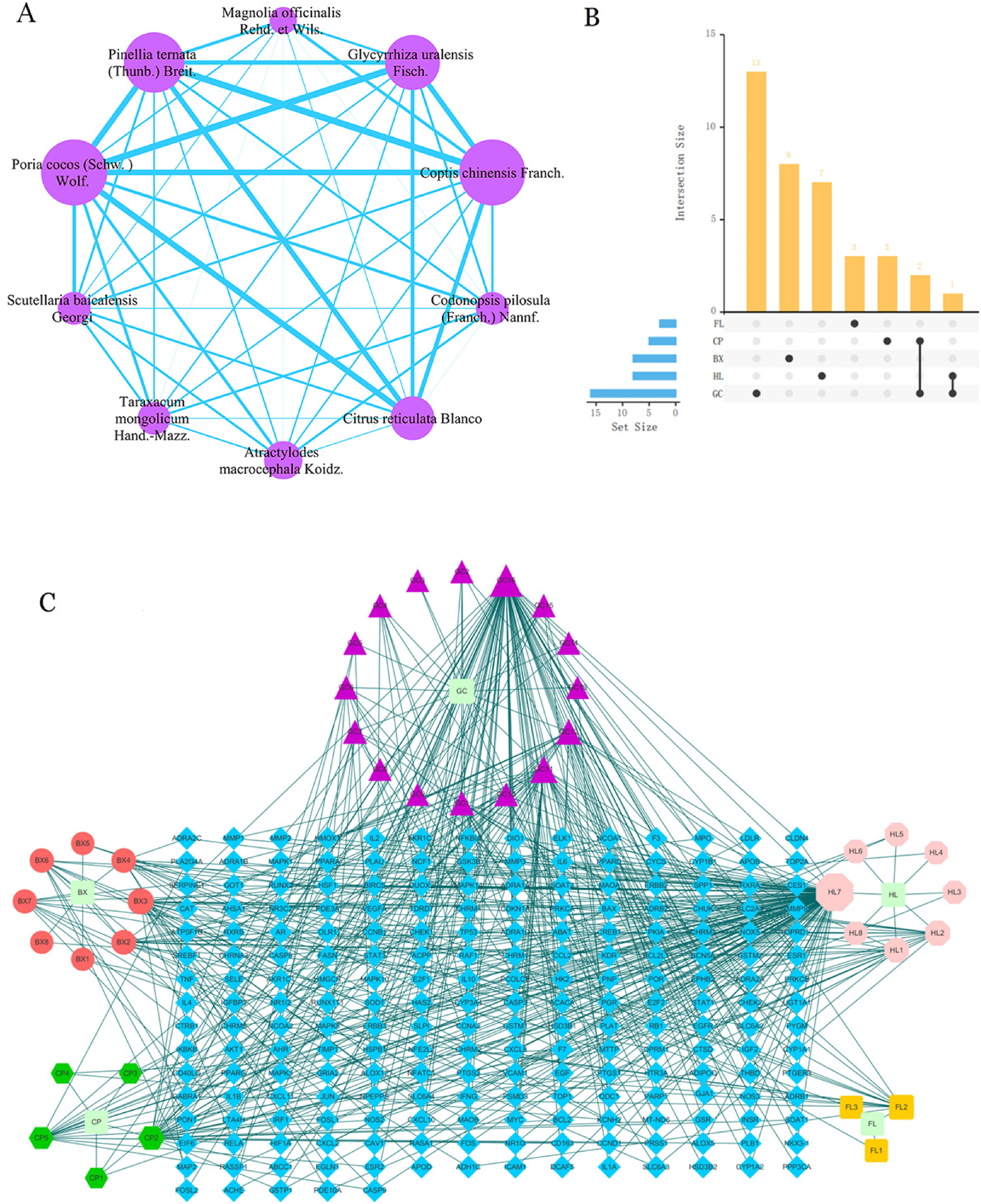
Network of high-frequency herbal medicine and the basic TCM compound. (A) High-frequency herbal medicine combination network for treating HPAG with TCM and circle size represents proportion to herbal medicine frequency; thickness of line is proportional to the strength of link between herbs. (B) Upset plot of active ingredients; (C) Ingredients-targets network; BX represents Pinellia ternata (Thunb.) Breit; CP represents Citrus reticulata Blanco; FL represents Poria cocos (Schw.) Wolf; HL represents Coptis chinensis Franch; and GC represents Glycyrrhiza uralensis Fisch.
Effective Active Ingredients of Basic TCM Compound
Based on the criteria of OB ≥ 30% and DL ≥ 0.18, 40 bioactive ingredients of the basic TCM compound were obtained from the TCMSP database (see Supplementary Table S5 for details). After excluding duplicates, 215 corresponding potential targets of these 40 bioactive ingredients were chosen for further analysis. The compound-target network was constructed using Cytoscape 3.8.0. As shown in Figure 3C, 260 nodes (containing 5 herbal medicines, 215 targets, and 40 active ingredients) and 527 edges were mapped in the network.
HPAG-Related Targets
HPAG-related targets were obtained from 3 databases, including 857 targets from Genecards, 395 from OMIM, and 0 from TTD. A total of 1241 targets were obtained after removing duplicates. Of these, 91 were common targets shared between potential targets of the basic TCM compound and HPAG-related targets. These 91 common candidate targets may be the key to HPAG treatment by the basic TCM compound.
PPI Network Construction of 91 Candidate Targets
These 91 common candidate targets were imported into the STRING database to understand the therapeutic mechanism of the basic TCM compound in HPAG. The TSV format file, which was downloaded from the STRING database, was imported into Cytoscape3.8.0 for analysis. As shown in Figure 4A, the PPI network consisted of 90 nodes and 1845 edges. The closer the node color is to red, the higher the node degree is. It is common to assume that nodes of higher degrees are more important and form the core of the network. Only the targets with the top 10 degree values were identified as the core targets in this study. Finally, AKT1, TP53, IL6, VEGFA, CASP3, MAPK3, JUN, PTGS2, TNF, and MAPK8 were selected as core candidate targets of the basic TCM compound for HPAG, which was consistent with the hub genes selected by the plug-in Cytohubba in Cytoscape 3.8.0. Detailed information about core candidate targets is provided in Supplementary Table S6.

Related network diagram of the basic TCM compound in treating HPAG. (A) PPI network diagram of the basic TCM compound and HPAG. (B (i)) Histogram of GO enrichment analysis of the basic TCM compound in the treatment of HPAG, BP: biological processes; CC: cellular component; MF: molecular functions; (B (ii)) bubble diagram of KEGG pathway enrichment analysis of the basic TCM compound in the treatment of HPAG; (B (iii)) target-pathway network diagram of the basic TCM compound in treating HPAG.
GO Enrichment Analysis and KEGG Pathway Analysis of Targets
The 91 candidate targets of the basic TCM compound against HPAG were further used to perform GO annotation and KEGG pathway enrichment. The top-ranked entries were visualized using the bioinformatics online website (www.bioinformatics.com.cn/). GO analysis was classified into the biological process (BP), cellular component (CC), and molecular function (MF). GO analysis revealed that target genes were mainly related to the BP of positive regulation of transcription from RNA polymerase II promoter, negative regulation of the apoptotic process, and response to drug. CC overrepresented terms were mostly related to cytosol, nucleus, and cytoplasm. MF was mainly concentrated in protein binding, identical protein binding, and enzyme binding. The top 10 terms are shown in Figure 4B (i).
The color of bubbles changing from green to red indicates a drop in the p-value. The y-axis label represents the pathway and the x-axis label the gene ratio. KEGG pathway enrichment analysis displayed that these candidate targets were markedly enriched in Pathways in cancer, TNF signaling pathway, PI3K-Akt signaling pathway, and MAPK signaling pathway, after a wide range of pathways were excluded. The top 20 terms are shown in Figure 4B (ii) and Figure 4B (iii). The KEGG database was used to draw core pathway maps, and the key targets involved are flagged in red, as shown in Supplementary Figure S3.
Molecular Docking
In order to study further the binding activity of the key ingredients of the basic TCM compound with the core targets, the top 8 ingredients from the ingredients-targets network and top 3 antibiotics or proton pump inhibitors from the control group in

Visualization diagram of molecular docking. (A) Molecular docking heat map of binding energy (kcal· mol−1); (B) molecular docking diagram of top four docking scores; MAPK3 (PDB ID: 4QTB), TP53 (PDB ID: 6SHZ), TNF (PDB ID: 2E7A).
Discussion
Meta-Analysis of TCM in the Adjuvant Treatment of HPAG
H. pylori is a microaerophilic negative bacillus that has a strong colonization ability in human gastric epithelial cells, causing epithelial cell inflammation, such as gastritis. Persistent H. pylori infection induces chronic inflammation in the gastric mucosa, which in susceptible individuals may progress to gastric cancer. In addition, the higher the H. pylori load, the worse the associated gastritis. 46 International consensus holds that HPAG is an infectious disease irrespective of symptoms and complications, and aggressive eradication therapy is advocated. 47 At present, Western medicine’s comprehensive therapy only acts on H. pylori itself, which is unable to intrinsically change the host environment. In this case, the recurrence rate is extremely high and has an increasing trend. Moreover, antibiotics are prone to irritate the gastrointestinal tract, and such abuse will disrupt gastrointestinal bacterial homeostasis, and even cause serious antibiotic resistance and reinfection.48, 49 It is precisely because of the above reasons that many researchers at home and abroad are actively broadening their thinking about eradicating H. pylori.
A total of 21 studies fulfilling the inclusion and exclusion criteria were included in the study and the meta-analysis results demonstrated that TCM combined with triple or quadruple therapy has more advantages in the treatment of HPAG. The total effective rate and H. pylori eradication rate were increased compared with either triple or quadruple therapy alone. HPAG is classified into the categories of “swallowing acid”, “hiccup”, “Piman”, and “stomachache” in TCM, according to the main disease manifestations. H. pylori is attributed to the category of “Xieqi,” which is opposite to “Zhengqi,” which refers to normal functions of the body and the resistance against diseases, and, specifically, it can be considered as a “damp-heat Xieqi.” 50 TCM has broad prospects in the treatment of HPAG. A study has demonstrated that neither TCM nor its components will cause an imbalance of gastric and intestinal flora when they play an anti-H.pylori role. 51 Different from antibiotics, the anti-H.pylori effect of some herbal medicine is not affected by the pH value of the gastrointestinal tract, 52 and some herbal medicine and their active ingredients also have obvious inhibitory and killing effects on antibiotic-resistant H. pylori. 53 The mechanism of TCM against HPAG involves multiple physiological and pathological links to H. pylori. Modern pharmacological studies have proved that TCM mainly treats HPAG by inhibiting the expression of H. pylori functional protein and mRNA, destroying the integrity of cell structure, inhibiting the synthesis of biofilm, inhibiting the release of H. pylori virulence factor, urease and related inflammatory factors, reducing the adhesion of H. pylori, and regulating the related immune response. 54 The improvement of pharmacological research provides a reliable basis for TCM against HPAG, which makes TCM treatment more valued. Actively carrying out research on TCM against HPAG based on the basic theory of TCM and clinical experience will help to develop TCM compound preparations with definite curative effects, stability and not easy to develop drug resistance. TCM preparations can also increase sensitivity and reduce toxicity to triple or quadruple schemes.
Pharmacodynamic Basis of the Basic TCM Compound Against HPAG
The basic TCM compound composed of C. reticulata, G. uralensis, P. ternata, C. chinensis, and P. cocos reflects that TCM treats HPAG from the basic principles of “eliminating dampness-phlegm, regulating qi and strengthening spleen” from multiple angles, dimensions, and levels. By consulting the ancient TCM books, the basic TCM compound is precisely the classic prescription Huanglian Erchen Decoction, which comes from the Yizong Jinjian from the Qing Dynasty, a famous medical TCM book. From the perspective of TCM compatibility, Rhizoma Pinelliae-Rhizoma Coptidis is the core compatible drug pair of Banxia Xiexin Decoction, a famous classic prescription from the Han Dynasty. On the one hand, the compatibility of Pericarpium Citri Reticulatae-P. cocos can comb the movement of qi to eliminate the phlegm-dampness that has been formed and invigorate the spleen to eliminate the source of phlegm. Moreover, it, combined with R. Pinelliae-Radix Glycyrrhizae, has become “Erchen decoction,” a formula from the Song Dynasty. Therefore, the basic TCM compound is supported by basic TCM theory and the analysis of association rules, with a rigorous cube and exquisite compatibility, which is not separated from the classical famous prescriptions Huanglian Erchen Decoction, Banxia Xiexin Decoction, and Erchen Decoction, which deserve further investigation.
R. Pinelliae (Ban Xia in Chinese) is the dried tuber of P. ternata, family Araceae, that was first published in Shennong Emperor's Classic of Materia Medica (Shen-nong Ben-cao Jing), the earliest existing pharmaceutical monograph in China. 55 It is warm and dry in nature, bitter and pungent in taste, slightly toxic, and has the effects of downgrading adverse qi and harmonizing the stomach, dissipating stagnation and eliminating swelling. Modern studies have confirmed that R. Pinelliae indeed significantly reduces nitric oxide (NO), tumor necrosis factor (TNF)-α, IL-8, and intercellular cell adhesion molecule (ICAM)-1, and inhibits the expression of IL-8 and ICAM-1 mRNA to slow down the chemotaxis of neutrophils, which is conducive to the recovery from inflammation. 56 R. Pinelliae can increase the levels of antioxidant enzymes such as serum superoxide dismutase and glutathione peroxidase, enhance the body's ability to scavenge excessive free radicals, 57 and restore the immune function of tumor-associated dendritic cells by regulating the immune effect and improving the immune microenvironment. All these aforementioned mechanisms of R. Pinelliae produce a tumor inhibitory effect. 58
Rhizoma coptidis is prepared from the rhizomes of C. chinensis, also known as Huang Lian in Chinese. The use of this herb was first recorded in Shennong Emperor's Classic of Materia Medica about 2000 years ago in China. R. coptidis can significantly reduce the expression of cyclooxygenase-2 (COX-2)/PGE2 and block tumor development. The mechanism underlying these effects may be associated with the inhibition of tumor angiogenesis and tumor metastasis. 59 Berberine, one of the main components of R. coptidis, was able to increase significantly the contents of NO and nitric oxide synthase (NOS) in gastric tissue of mice, and, at the same time, the content of endothelin was significantly reduced, thus promoting the healing of gastric ulcer mucosa. 60 Another study found that berberine restored the balance between proinflammatory cytokines (PICs) and anti-inflammatory cytokines by reducing PICs (TNF-α, IL-1β, and IL-6) and increasing the release of cytokines (IL-10) in an HPAG model. 61
Pericarpium Citri Reticulatae (Chen Pi in Chinese), a commonly used medicinal and edible Chinese herbal medicine, originated from the mature pericarp of C. reticulata, a small tree, family Rutaceae and its cultivated varieties. Pericarpium Citri Reticulatae, pungent and bitter in taste, warm in nature, is characterized by regulating qi and invigorating spleen, and removing dampness and phlegm. Modern pharmacological studies have shown that it has obvious anti-tumor, antioxidant, and antibacterial effects. 62
P. cocos (Fu Ling in Chinese) is the dried sclerotia of P. cocos and its traditional efficacy is eliminating dampness and diuresis, invigorating spleen and calming the heart. P. cocos counteracts different acute and chronic inflammation by inhibiting the expression of nitric oxide lyase and cyclooxygenase, and the production of inflammatory mediators such as TNF-α, IL-1, PGE2, NO, and IL-6. 63 Mizushina et al 64 found that pachymaric acid, a new topoisomerase inhibitor, has an efficient effect on inhibiting the proliferation of gastric cancer cells, which can make cell replication stay in the G1 phase and inhibit the activity of DNA polymerase.
R. Glycyrrhizae (Gan Cao in Chinese), the dried root and rhizome of G. uralensis, is sweet in taste and warm in nature, which can replenish qi, clear away heat and toxic substances, and reconcile medicinal properties. The effective components in R. Glycyrrhizae could act as a broad-spectrum tumor suppressor to inhibit the proliferation and migration of tumor cells and promote autophagy. 65 Wei et al. 66 found that liquiritin, the main component of R. Glycyrrhizae, promoted the expression of p53 and p21 genes and inhibited the proliferation and migration of gastric cancer cells by downregulating cyclin D1, cyclin A, and cyclin-dependent kinase 4, thus inducing apoptosis and autophagy.
Network Pharmacological Analysis of the Basic TCM Compound Against HPAG
Network pharmacology is a powerful way of defining a variety of components and studying the mechanisms of Chinese herbal medicine. In this study, we found that there are 40 effective active ingredients and 215 targets in the basic TCM compound. Among these, 91 predicted targets were shared between the basic TCM compound and HPAG. Quercetin, kaempferol, naringenin, baicalein, nobiletin, and hederagenin are core ingredients of the basic TCM compound. AKT1, TP53, IL6, VEGFA, CASP3, MAPK3, JUN, TNF, and MAPK8 occupy an important position in the whole PPI network. KEGG pathway enrichment analysis displayed that 91 predicted targets were markedly enriched in Pathways in cancer, TNF signaling pathway, PI3K-Akt signaling pathway, and MAPK signaling pathway.
Quercetin is a flavonoid that can reduce the level of inflammatory factors in mice infected with H. pylori and regulate the balance of gastric cell proliferation/apoptosis. 67 Quercetin exerted its anti-inflammatory property by reducing the expressions of PICs, such as IL-1β and IL-6, and increase IL-4, IL-10, and transforming growth factor-β1. 68 At the same time, quercetin is also a powerful free radical scavenger, which can protect gastric epithelial GES-1 cells from H2O2-induced oxidative damage. Under oxidative stress, quercetin upregulates the expression of peroxisome proliferator-activated receptor-γ coactivator to significantly reduce downstream cell apoptosis. 69 The anti-H. pylori mechanism of kaempferol is related to the inhibition of the translocation of cytotoxin-associated gene A (Cag A) and vacuolating cytotoxin A proteins and leads to downregulation of PICs (TNF-α, IL-1β, and IL-8).70,71 Naringenin plays an anti-inflammatory role by regulating immune cells, inhibiting chemokines, COX-2, cytokines and proinflammatory transcription factors, suppressing PI3K/Akt, and IκB kinase/c-Jun N-terminal kinase (IKK/JNK), 72 and has a good inhibitory effect on various tumor cells such as breast cancer MDA-MB-231 73 and lung cancer H23. 74 Baicalin and baicalein both inhibited H. pylori VacA gene expression and interfered with the adhesion and invasion ability of H. pylori to human gastric epithelial cells contributing to decreasing H. pylori expression. Compared with baicalin, baicalein showed stronger anti-H. pylori activity and cytotoxicity to human gastric cancer epithelial AGS cells. 75 Nobiletin is an important dietary polymethoxylated flavonoid in citrus fruits. Nobiletin can reduce ROS, lipid peroxide, and glutathione levels in human gastric epithelial GES-1 cells infected with H. pylori, and strongly impedes TNF-α, IL-6, AKT, and mitogen-activated protein kinase (MAPK) molecules. 76 Hederagenin is a monomeric compound that has been found to reduce the release of inflammatory factors such as IL-6, IFN-γ, TNF-α, and NO by inhibiting the release of iNOS and increasing the content of eNOS and suppressing the IKKβ/NF-κB signaling pathway.77,78 These key ingredients against HPAG reflect the innovative use of Chinese herbs.
AKT1 is a known oncogene that is able to mediate the activation of the NF-κB inflammatory signaling pathway, 79 while the activation of the NF-κB inflammatory signaling pathway can lead to the occurrence and progression of chronic atrophic gastritis. 80 TP53 is an important tumor suppressor gene, which can regulate the cell cycle, cell growth, and apoptosis, participate in DNA damage and repair, and maintain the stability of various gene expressions. 81 The study by Ha et al. found that the synergistic effect between H. pylori infection and TP53 may play an important role in the pathogenesis of gastric cancer in the Vietnamese population. 82 IL-6, as a PIC, plays an important role in the process of inflammatory reaction. The expression of IL-6 and its receptor was significantly increased in patients infected with H. pylori, especially in those with gastric cancer. 83 As a cytokine that can be synthesized and secreted by normal cells and tumor cells, VEGF is expressed at low levels in normal tissue cells at a relatively constant expression level, but its expression is upregulated in many tumor cells and is the most important regulator to promote tumor cell neogenesis. VEGFA, a member of the VEGF family that is closely related to angiogenesis, can activate VEGFR2, a receptor on endothelial cells, and promote the formation of new blood vessels and tumor cell migration. 84 Caspase-3 (the corresponding protein of CASP3) participates in the activation cascade of Caspase and is responsible for the execution of apoptosis, which is the key protease leading to apoptosis. It was found that activated Caspase-3 could promote abnormal apoptosis of gastric mucosal epithelial cells induced by H. pylori. 85 Both MAPK3 and MAPK8 are members of the MAPK family, which are involved in various physiological and pathological processes such as adaptation to external environmental stress and inflammatory response, and are common pathways of a variety of anti-inflammatory drugs. 86 MAPK8, also known as JNK1, is able to induce apoptosis and promote the activation of inflammatory factors TNF-α and IL-1β, aggravating the inflammatory injury of chronic superficial gastritis. 87 Lipopolysaccharide from H. pylori can bind to Toll-like receptor 4 in the gastric mucosa, and promote the proliferation of gastric epithelial cells by activating extracellular signal-regulated kinase (ERK)1/2 (MAPK3/MAPK1 corresponding protein). 88 Transcription factor AP-1 (corresponding protein of JUN) is an important regulatory protein of the immune response. Studies have shown that H. pylori can stimulate macrophages to produce pro-inflammatory transmitters through AP-1. 89 TNF is an important member of inflammatory cytokines, which is mainly produced by activated macrophages, NK cells, and T-lymphocytes. After H. pylori infection, gastric epithelial cells can be directly stimulated and immune cells can be recruited through a variety of components, which upregulate the PICs, such as TNF-α, IL-6, IL-1β, and IL-8. 90 In conclusion, the core targets are closely related to inflammation, cancer, neovascularization, and immunity.
H. pylori infection induces a strong inflammatory response contributing, eventually, to activating Pathways in cancer. 83 Increased TNF-α in gastric cancer cells can bind with TNF receptor-1 on vascular endothelial cells, increase vascular permeability, allow other types of cells in the blood to overflow through the cell membrane, and lose a large number of red blood cells in the blood vessels, resulting in bleeding and necrosis of tumor tissue. 91 TNF activates downstream NF-κB and MAPK signaling pathways after binding to receptors, which have been proved to play an important role in H. pylori infection-related diseases. The PI3K/Akt signaling pathway is composed of PI3K with lipid kinase activity of phosphorylating phosphatidylinositol-3-hydroxyl and downstream Akt. Cag A, a virulence factor of H. pylori, can activate the PI3K/AKT1 signaling pathway and induce AKT1 phosphorylation, which is involved in gastric cancer processing. 92 When extracellular stimuli act on cells, ERK, JNK, and p38 MAPK subunits activate MAPK through a multistage kinase cascade, and activated MAPK then promotes the production of TNF-α, IL-1β, monocyte chemoattractant protein-1, and other related inflammatory cytokines by regulating the activity expression of various downstream enzymes and transcription factors, prompting local tissues to undergo acute inflammation, apoptosis, and other pathological changes. 93 A study found that the use of a specific MAPK inhibitor and JNK inhibitor could downregulate the expression of related proteins such as p-ERK1/2, ERK1/2, p-JNK, and JNK, thus inhibiting the proliferation of gastric cancer cells. 94
Molecular docking result revealed that the binding energy of the active ingredients to the core protein was less than −4.0 kcal·mol−1, which indicates that the potential key ingredients have good binding activity with key targets and confirms the targeting effect of the basic TCM compound against HPAG. Our hope is that the above results can be used to provide guidance for lab experiments when designing anti-H. pylori-related gastritis drugs.
Research Prospect of New Drugs from TCM against HPAG
TCM has been widely used for the treatment of HPAG in China for thousands of years, with high efficiency, definite curative effects, few adverse reactions, and good patient compliance. Characterized by “multiple-effects, multiple-targets, and multiple-compounds”, TCM was widely accepted in eastern countries. For the treatment of HPAG, the compatibility of drugs used by a majority of TCM physicians can be scientifically explained and justified through the preliminary analysis of the potential mechanisms of the core TCM formula. Nonetheless, research on chemical drugs against H. pylori infection is faced with the dilemma that, nowadays, the investment is increasing, whereas the output rate of new drugs is declining. This is directly related to the previous reductionist drug research and development model of “one-drug, one-target, one-disease,” which is inadequate to tackle complex diseases involving multiple malfunctioned genes.
To inherit and develop TCM is certain to generate substantial medical benefits for China and even the world. The fact is that TCM carries a lot of weight, and merits more attention. One case is that the compatibility of the ingredients from herbal medicine is based on the theory of TCM. Furthermore, TCM, which adopts a systematic and holistic view to prevent and treat diseases, plays a guiding role for the research of chemical drugs. In 2015, Professor Youyou Tu, a Chinese pharmacist, was awarded the Nobel Prize in Physiology and Medicine for her major contribution towards discovering the antimalarial effect of artemisinin, which has stimulated interest in TCM globally, and demonstrated that TCM is a vast treasure trove to be fully excavated. Fully excavating TCM is conducive to inheriting and developing TCM, and TCM makes significant contributions to China and even the world.
As is known, the study of the material basis of TCM is a premise for elucidating the scientific connotation of TCM in the treatment of diseases and realizing the modernization of TCM. Also, it is an effective way to create new chemical entity drugs originating from the active ingredients of TCM. There are abundant bioactive molecules in the pharmacodynamic material basis of TCM, so the study on monomer active ingredients in TCM is obviously a shortcut for the research and development of a new class of drugs. Modern studies have confirmed that flavonoids, such as quercetin, kaempferol, and baicalein, have antibacterial activity, which may become an important source for developing new drugs against H. pylori in the future. What's more, TCM compounds exert their curative effects not only by a single or a few active ingredients, but often by a variety of ingredients through different ways to achieve synergistic effects, which is the synergistic effect of multiple ingredients and multiple targets, so the development of new drugs with active ingredient compatibility combinations has the theoretical basis and characteristics of TCM. In light of this, for the development of new drugs against H. pylori infection, it is worth considering the compatibility and combination of the main effective substances of the basic TCM compound for the treatment of HPAG, namely, quercetin, kaempferol, naringenin, baicalein, and nobiletin.
Based on the above considerations, researchers can develop new drugs for treating HPAG by organically combining the effective ingredients of the basic TCM compound. The most appropriate reference example is Diao Xinxuekang, which has been successfully marketed in the European Union. Also, the structure and biological activity of these effective ingredients should be explored extensively to search for ingredients with medicinal value and develop chemical entity drugs originating from the active ingredients of TCM.
Conclusion
In conclusion, the curative effect of TCM combined with triple or quadruple therapy in the treatment of HPAG is better than that of triple or quadruple therapy alone and the composition of the basic TCM compound against HPAG consists of C. reticulata, G. uralensis, P. ternata, C. chinensis, and P. cocos. It may possibly be quercetin, kaempferol, naringenin, baicalein, nobiletin, and hederagenin that constitute the key ingredients of the basic TCM compound in the treatment of HPAG. Moreover, these components play a therapeutic role by acting on the core targets AKT1, TP53, IL6, VEGFA, CASP3, MAPK3, JUN, TNF, and MAPK8, mainly by regulating Pathways in cancer, TNF signaling pathway, PI3K-Akt signaling pathway, and MAPK signaling pathway.
Supplemental Material
sj-docx-1-npx-10.1177_1934578X221113968 - Supplemental material for Basic Traditional Chinese Medicinal Compound for Adjuvant Treatment of Helicobacter pylori-Related Gastritis: Implication for Anti-H. pylori-Related Gastritis Drug Discovery
Supplemental material, sj-docx-1-npx-10.1177_1934578X221113968 for Basic Traditional Chinese Medicinal Compound for Adjuvant Treatment of Helicobacter pylori-Related Gastritis: Implication for Anti-H. pylori-Related Gastritis Drug Discovery by Yuli Li, Xiaoya Li and Zhoujin Tan in Natural Product Communications
Footnotes
Author Contributions
ZT: conception and design, final approval of the version to be published; YL and XL: analysis and interpretation of the data; YL: drafting of the paper; XL: conception and design, revising it critically for intellectual content. All data were generated in-house, and no paper mill was used. All authors agree to be accountable for all aspects of work to ensure integrity and accuracy.
Data Availability Statement
The datasets used and analyzed during the current study were available from the corresponding author on reasonable request.
Declaration of Conflicting Interests
The author(s) declared no potential conflicts of interest with respect to the research, authorship, and/or publication of this article.
Funding
The author(s) disclosed receipt of the following financial support for the research, authorship, and/or publication of this article. This work was supported by the Natural Science Foundation of Hunan Province (grant no. 2020JJ4468).

Supplemental Material
Supplemental material for this article is available online.
References
Supplementary Material
Please find the following supplemental material available below.
For Open Access articles published under a Creative Commons License, all supplemental material carries the same license as the article it is associated with.
For non-Open Access articles published, all supplemental material carries a non-exclusive license, and permission requests for re-use of supplemental material or any part of supplemental material shall be sent directly to the copyright owner as specified in the copyright notice associated with the article.
