



Abstract
Objective/Background
Taxodium distichum (L.) Rich., a plant of the Cupressaceae family, is known for its leaves and cones rich in essential oils, which are traditionally used in folk medicine. This study employed hydrodistillation to extract essential oils from three parts of T. distichum, namely its leaves, twigs, and cones, and evaluated the yield and composition of these oils as well as their anti-mildew property on paper.
Methods
The chemical compositions of the essential oils from the three parts were analyzed using gas chromatography with flame ionization detection (GC-FID) and gas chromatography mass spectrometry (GC-MS). The anti-mildew properties were assessed on paper against seven mold fungi, namely Aspergillus clavatus, A. niger, Chaetomium globosum, Cladosporium cladosporioides, Myrothecium verrucaria, Penicillium citrinum, and Trichoderma viride, following standards such as TAPPI T487 cm-93 and CNS 2690. Furthermore, the essential oil demonstrating the strongest anti-mildew properties was selected from the oils extracted from three different parts, underwent column chromatography for isolation, and the main active compounds were identified.
Results
Among the three parts, cones had the highest essential oil yield (0.53 ± 0.03 mL/100 g), followed by leaves (0.46 ± 0.02 mL/100 g) and twigs (0.06 ± 0.01 mL/100 g). The main components were limonene (39.8%) and α-pinene (37.1%) in leaves; limonene (16.8%), α-pinene (15.8%), and ferruginol (11.0%) in twigs; and ferruginol (43.2%) and caryophyllene oxide (12.5%) in cones. The cone oils exhibited the most effective anti-mildew properties on paper. Furthermore, the cone oils were fractionated into six fractions (CO1–CO6), with the CO4 fraction exhibiting the best activity. CO4's main components were ferruginol, caryophyllene oxide, and β-caryophyllene. Ferruginol showed the best anti-mildew performance, with 100% inhibition at 200 μg/cm² for all strains.
Conclusion
The study results indicated that essential oils from the cones of T. distichum and ferruginol exhibit promising anti-mildew effects on paper. Therefore, further research and development are highly warranted for their application in inhibiting fungal growth on paper.
Introduction
Books are a rich source of historical information, and preserving book paper is therefore essential. Many factors affect the lifespan of book paper, including human factors, physical factors, chemical factors, and biological factors. Among these factors, biological factors are the most destructive and the most difficult to control. In particular, mold fungi are the main threats to library materials.1,2 These fungi are widely present in nature, and air contains a large number of mold spores. Once these spores land on the surface of book pages, they can grow and reproduce under suitable conditions, corroding paper and causing it to decay and deteriorate.3–5 To prevent the deterioration of paper products, strategies such as temperature and humidity control, physical methods, and chemical methods can be employed. However, chemical agents are often toxic to humans. Therefore, the application of natural plant extracts in mold prevention and inhibition has gradually gained attention.
Taxodium distichum (L.) Rich., which belongs to the Cupressaceae family under the Taxodium genus, is an ancient relic plant native to the southeastern United States, southern Africa, Europe, and eastern Asia. This species has the advantages of a straight and aesthetically pleasing trunk, rapid growth, excellent wood quality, resistance to pests and diseases, water resistance, resistance to corrosion, and strong adaptability. 6
Its leaves and cones are particularly rich in essential oils, which have traditionally been used in folk medicine to treat inflammation, infections, and various skin, gastrointestinal, and respiratory diseases. 7 Several studies have investigated the composition of the essential oils from the leaves and cones of T. distichum, with the main components of these oils varying by region, climate, environment, growth conditions, and analytical methods.7–18 In addition, only one study investigated the composition of the essential oils of the twigs of T. distichum. 15 Research has indicated that the essential oils of T. distichum have different biological activities, including antimicrobial,9,15,19 cytotoxic, 14 and antitermite 20 activities.
This study selected T. distichum as the research subject primarily because of its unique antibacterial and antifungal properties, which have potential applications in preventing the growth and spread of mold on paper. Although previous studies have demonstrated that the essential oils of T. distichum exhibit various biological activities, to the best of our knowledge, no study has investigated the compositions and biological activities of essential oils from various parts of T. distichum found in Taiwan. Therefore, this study explored the compositions of essential oils from the leaves, twigs, and cones of T. distichum samples from Taiwan and compared the results with those in the literature. In addition, this study evaluated the active compounds of these essential oils and their anti-mildew property on paper. Thus, the results of this study not only provide a new natural solution for paper preservation and mold prevention, extending the lifespan of paper products and reducing the use of chemical preservatives, benefiting both the paper industry and cultural heritage conservation, but also promote diversified applications of T. distichum essential oils.
Results and Discussion
Yields of Essential Oils of T. distichum
The hydrodistillation of T. distichum resulted in yellow-colored oils being obtained at rates of 0.46 ± 0.02, 0.06 ± 0.01, and 0.53 ± 0.03 mL/100 g (dry weight) from its leaves, twigs, and cones, respectively.
Components of the Essential Oils
Qualitative and quantitative analyses of the essential oils extracted from the leaves, twigs, and cones of T. distichum were conducted using gas chromatography with flame ionization detection (GC-FID) and gas chromatography mass spectrometry (GC-MS). The analytical results (Table 1) presented comprise the identified compounds, their identification methods, their concentrations, and their linear retention index (LRI) values. The compounds in Table 1 are listed according to their elution order on the DB-5 capillary column. The GC-MS chromatogram of the essential oils from the three parts of T. distichum are shown in Figure 1.

The GC-MS chromatogram of the essential oils from the (a) Leaf, (b) Twig, and (c) Cone parts of T. distichum. Note: The numbers in the figure correspond to the peak numbers in Table 1.
Chemical Compositions of the Essential Oils Extracted from the Leaves, Twigs, and Cones of T. distichum.

Classification: MH = Monoterpene hydrocarbons; OM = Oxygenated monoterpenes; SH = Sesquiterpene hydrocarbons; OS = Oxygenated sesquiterpenes; DI = Diterpenes; OT = Others
LRILit = LRI values from a previous study. 21
LRIExp = computed LRI values obtained for a mixture of a continuous series of n-alkane hydrocarbons (C8 to C30) in a DB-5 capillary column
Identification through MS = comparison of the NIST and Wiley mass spectral libraries; LRI = linear retention index (LRI) same as the previous findings21–23; and CO-ST = co-injection/comparison with the LRI and MS standards.
- = not detected
Composition of the Essential Oils Extracted from Leaves
A total of 30 compounds were identified from the leaf oil of T. distichum, including limonene (39.8%), α-pinene (37.1%), caryophyllene oxide (9.2%), allohimachalol (2.0%), camphene (1.4%), humulene epoxide II (1.3%), and myrcene (1.2%). These 30 compounds were categorized into six groups: monoterpene hydrocarbons, oxygenated monoterpenes, sesquiterpene hydrocarbons, oxygenated sesquiterpenes, diterpenes, and other compounds. These compound categories were ranked as follows in terms of their proportions: monoterpene hydrocarbons (80.2%) > oxygenated sesquiterpenes (14.8%) > oxygenated monoterpenes (2.1%) > sesquiterpene hydrocarbons (1.0%) > diterpenes (0.7%). No compounds falling under the category of “others” were identified. The main monoterpene hydrocarbons in the essential oils extracted from the leaves were limonene (39.8%) and α-pinene (37.1%), and the main oxygenated sesquiterpenes in these oils were caryophyllene oxide (9.2%) and allohimachalol (2.0%).
The aforementioned results differ from those in the literature (Table 2). In a previous study, D-limonene (23.78%), m-mentha-1,8-diene (15.76%), caryophyllene oxide (12.65%), and iso-aromadendrene epoxide (10.75%) were among the major compounds identified in essential oils extracted from the leaves of T. distichum in China. 9 Padalia et al 7 identified α-pinene as the predominant constituent (81.9%–94.3%) of essential oils extracted from the leaves of T. distichum in India during different seasons, including rainy days. In addition, essential oils extracted from the leaves of T. distichum in Egypt primarily comprised α-pinene (83.08%), 12 wheras those extracted from the leaves of T. distichum in Nigeria mainly comprised thujopsene (27.7%), pimara-8(14),15-diene (13.1%), widdrol (12.8%), and β-caryophyllene (11.4%). 14 α-Pinene (79.7%) was the major constituent of essential oils extracted from the leaves of T. distichum in Italy, 15 whereas caryophyllene oxide (55.56%) and bornyl acetate (11.36%) were the major constituents in Serbia. 16 Adams 17 collected T. distichum leaves from two locations in Texas, namely the Guadalupe River and Mobile (Texas), and found substantial differences in the major constituents of their essential oils. The essential oils extracted from the Guadalupe River leaves predominantly contained β-phellandrene (61.5%), caryophyllene oxide (7.3%), and α-pinene (5.3%), whereas those extracted from the Mobile (Texas) leaves contained α-pinene (72.8%), limonene (6.0%), and β-phellandrene (5.0%). Therefore, the essential oil components extracted from the leaves of T. distichum in our study differ from those reported in previous literature, making this the first time these findings have been published.
Comparison of the Major Components of Essential Oils Extracted from the Leaves, Twigs, and Cones of T. distichum from Different Countries.

- = not mentioned.
Composition of the Essential Oils Extracted from Twigs
From the twig essential oil of T. distichum, we identified 68 compounds, including limonene (16.8%), α-pinene (15.8%), ferruginol (11.0%), abietatriene (8.6%), α-eudesmol (7.6%), bornyl acetate (5.8%), eremoligenol (5.7%), caryophyllene oxide (3.6%), trans-pinocarveol (2.2%), α-terpineol (2.0%), myrtenyl acetate (1.4%), 14-hydroxy-9-epi-E-caryophyllene (1.4%), sandaracopimarinol (1.4%), pinocarvone (1.3%), borneol (1.2%), camphene (1.1%), α-campholenal (1.1%), sandaracopimarinal (1.0%), and larixol (1.0%). These compounds were categorized into six groups: monoterpene hydrocarbons (33.7%), diterpenes (23.5%), oxygenated sesquiterpenes (20.8%), oxygenated monoterpenes (17.6%), others (1.6%), and sesquiterpene hydrocarbons (1.3%). The main monoterpene hydrocarbons in the aforementioned essential oils were limonene (16.8%) and α-pinene (15.8%), the main diterpenes in the aforementioned essential oils were ferruginol (11.0%) and abietatriene (8.6%), and the main oxygenated sesquiterpene was α-eudesmol (7.6%).
Only one previous study investigated the composition of essential oils extracted from the twigs of T. distichum. The aforementioned study was conducted in Italy and reported α-pinene (content: 57.3%) to be the major compound of these oils. 15 This result considerably differs from our experimental findings.
Composition of the Essential Oils Extracted from Cones
In total, 32 compounds were identified from the cone essential oil of T. distichum, including ferruginol (43.2%), caryophyllene oxide (12.5%), limonene (7.8%), bornyl acetate (6.8%), khusilol (3.5%), 6-keto-ferruginol (2.8%), sandaracopimarinal (2.4%), sandaracopimarinol (2.3%), allohimachalol (2.0%), abietadiene (1.9%), humulene epoxide II (1.8%), α-pinene (1.7%), β-caryophyllene (1.5%), abietatriene (1.4%), and caryophylla-4(12),8(13)-dien-5α-ol (1.1%). These compounds were categorized into five groups: diterpenes (55.4%), oxygenated sesquiterpenes (21.6%), oxygenated monoterpenes (9.9%), monoterpene hydrocarbons (9.8%), sesquiterpene hydrocarbons (2.1%); no compounds belonging to the “others” category were found. The main diterpenes, oxygenated sesquiterpene, oxygenated monoterpene, and monoterpene hydrocarbons in the aforementioned oils were ferruginol (43.2%), caryophyllene oxide (12.5%), bornyl acetate (6.8%), and limonene (7.8%), respectively.
The main constituents of the essential oils extracted from the cones of T. distichum in other studies are described in the following text (Table 2). In China, there are significant differences in the major constituents identified in two studies. Zhou et al 8 identified caryophyllene oxide (41.7%), bornyl acetate (6.2%), perilla ketone (5.5%), and α-asarone (5.5%) as the primary components, while Xiang et al 9 identified D-limonene (38.02%), 5-ethyl-1-methyl-cycloheptene (11.95%), ferruginol (10.46%), and other compounds as the main constituents. For the essential oil components of T. distichum cones in Iran, Kamkar and Bagher 10 reported that α-pinene (14.8%-61.8%), 1-terpineol (24.0%-32.5%), and caryophyllene oxide (1.2%-24.6%) were the major components. However, Hosseinihashemi et al 11 reported that the main components were D-limonene (56.51%) and α-pinene (31.71%), indicating a significant difference in composition. In addition, El Tantawy et al 13 identified α-pinene (87.3%) as the main compound in Egypt. α-Pinene (60.5%) and thujopsene (17.6%) were found to be the major constituents in Nigeria. 14 Furthermore, α-pinene (87.3%) and limonene (18.7%) were identified as major constituents in Italy. 15 Finally, Odell 18 identified D-pinene (85.0%), D-limonene (5.0%), carvone (3.0%), and other compounds as major constituents in America.
Overall, the compositions of the essential oils extracted from the leaves, twigs, and cones of T. distichum collected in Taiwan differ from those reported in Table 2. According to studies by Ogunwande et al 14 and Piccaglia et al, 24 the quantitative composition and relative proportions of essential oil components are not only influenced by geographical variations but also by a wide range of factors, including genotype, developmental stage, and environmental and growth conditions. These factors may influence the biosynthetic pathways of essential oil components.25,26 Therefore, these variations might explain the differences between the results of this study and the compositions reported in Table 2.
Anti-Mildew Property
Previous studies conducted by our team have demonstrated the high inhibitory activity of the essential oils and their components against bacteria and wood decay fungi.27–30 However, paper is highly susceptible to microbial damage, especially from mold fungi. 31 Therefore, to confer paper with an anti-mildew property for protecting paper artifacts and crucial paper archives, we evaluated the anti-mildew effect of T. distichum essential oils against seven mold fungi, namely Aspergillus clavatus, A. niger, Chaetomium globosum, Cladosporium cladosporioides, Myrothecium verrucaria, Penicillium citrinum, and Trichoderma viride, according to standards such as TAPPI T487 cm-93 and CNS 2690.
Figure 2 illustrates the inhibitory effects of the essential oils of T. distichum leaves, twigs, and cones on mildew activity on paper at an oil concentration of 250 μg/cm2. The results indicate that the essential oils extracted from cones completely inhibited (inhibition rate of 100%) the growth of all mold fungi except for Ch. globosum and M. verrucaria (inhibition rates of 85% and 93%, respectively). Table 3 presents the minimum inhibitory concentration (MIC) and half-maximal inhibitory concentration (IC50) values of the essential oils extracted from leaves, twigs, and cones against the seven fungal strains. Among these essential oils, those extracted from cones exhibited the best antifungal performance. The MICs of the essential oils extracted from cones ranged from 125 to 225 μg/cm2 for all strains except for Ch. globosum and M. verrucaria (>250 μg/cm2). In addition, the IC50 values of these oils ranged from 83.9 to 152.8 μg/cm2 for the seven fungal strains. Therefore, the essential oils extracted from cones of T. distichum exhibited inhibitory effects against mold fungi on paper, which warranted further investigation into their anti-mildew effect.

Comparison of the inhibitory effects of essential oils extracted from T. distichum Leaves, Twigs, and Cones on Mildew Activity on Paper at an Oil Concentration of 250 μg/cm2. Note:1. A. c.: Aspergillus clavatus; A. n.: A. niger; Ch. g.: Chaetomium globosum; Cl. c.: Cladosporium cladosporioides; M. v.: Myrothecium verrucaria; P. c.: Penicillium citrinum; T. v.: Trichoderma viride. 2. The positive control was Nystatin.
MIC and IC50 Values (μg/cm2) of Essential Oils Extracted from T. distichum Leaves, Twigs, and Cones Against Mildew Fungi on Paper.
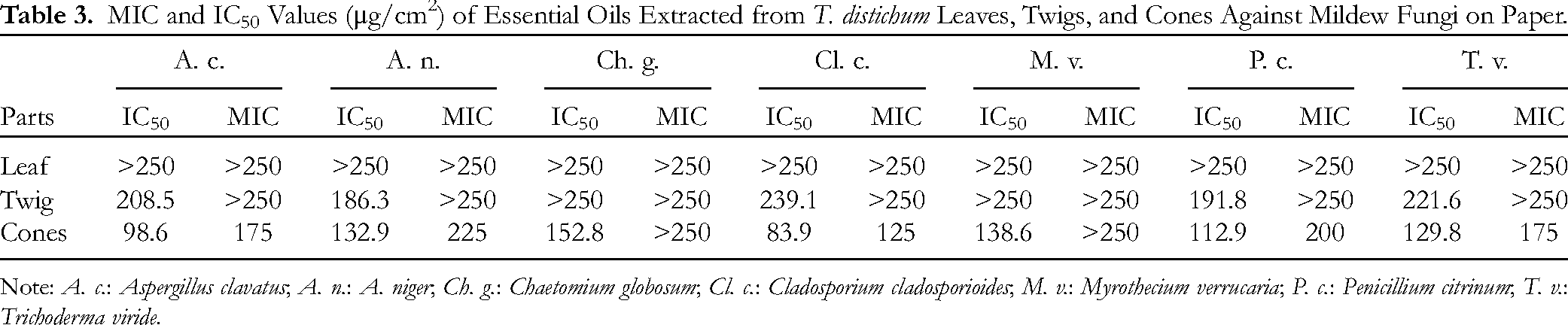
Note: A. c.: Aspergillus clavatus; A. n.: A. niger; Ch. g.: Chaetomium globosum; Cl. c.: Cladosporium cladosporioides; M. v.: Myrothecium verrucaria; P. c.: Penicillium citrinum; T. v.: Trichoderma viride.
Anti-Mildew Effects of Different Fractions of Essential Oils Extracted from Cones
The essential oils extracted from cones of T. distichum were fractionated through column chromatography into six fractions (CO1–CO6), and each fraction's anti-mildew effect against mold on paper was investigated (Figure 3). As shown in Figure 3, among all fractions, CO4 exhibited the best anti-mildew effect at an oil concentration of 250 μg/cm2. It completely inhibited the growth of all fungal strains except for Ch. Globosum (inhibition rate of 93.2%).

Inhibitory effects of six fractions of essential oils extracted from T. distichum Cones (CO1–CO6) on Mildew Activity on Paper at a Concentration of 250 μg/cm2. Note: 1. The experiments were repeated five times, and the results were averaged (n = 5); 2. A. c.: Aspergillus clavatus; A. n.: A. niger; Ch. g.: Chaetomium globosum; Cl. c.: Cladosporium cladosporioides; M. v.: Myrothecium verrucaria; P. c.: Penicillium citrinum; T. v.: Trichoderma viride. 2. The positive control was Nystatin.
Furthermore, the composition of the CO4 fraction was determined through GC-FID and GC-MS, with the results presented in Table 4. Nine compounds were identified in this fraction, with ferruginol (52.3%), caryophyllene oxide (25.8%), and β-caryophyllene (12.5%) being the major constituents.
Composition and Concentration of the CO4 Fraction.

LRILit = LRI values from a previous study. 21
LRIExp = computed LRI values obtained for a mixture of a continuous series of n-alkane hydrocarbons (C8 to C30) in a DB-5 capillary column
We obtained caryophyllene oxide and β-caryophyllene from Sigma-Aldrich (St. Louis, MO, USA), and ferruginol was isolated in our laboratory in a previous study. 32 Subsequently, we evaluated the anti-mildew effects of these three compounds against the seven mold fungi considered in this study. The MIC and IC50 values of these compounds are presented in Table 5. These results indicate that ferruginol is the active compound responsible for the anti-mildew effect of essential oils extracted from the cones of T. distichum. Studies have indicated that this compound has a strong antimicrobial effect, thus inhibiting microbial growth.33–35
MIC and IC50 Values (μg/cm2) of Three Compounds Against Mildew Fungi on Paper.

Note: A. c.: Aspergillus clavatus; A. n.: A. niger; Ch. g.: Chaetomium globosum; Cl. c.: Cladosporium cladosporioides; M. v.: Myrothecium verrucaria; P. c.: Penicillium citrinum; T. v.: Trichoderma viride.
The mechanism of essential oils against fungi includes disrupting the structure and function of fungal cell membranes or organelles, as well as inhibiting nucleic acid or protein synthesis, leading to fungal inactivation. 36 Essential oils are primarily composed of terpenoid compounds that dissolve in lipids. They inhibit chitin synthesis in fungal cell walls, affecting wall maturation, septum formation, and bud formation, thereby impairing cell division and growth. 37 Additionally, essential oils can disrupt mitochondrial function by inhibiting mitochondrial dehydrogenases involved in ATP biosynthesis (such as lactate dehydrogenase, malate dehydrogenase, and succinate dehydrogenase), leading to mitochondrial dysfunction. Furthermore, they interfere with proton transport, affecting ADP phosphorylation. 38 Therefore, within terpenoid compounds, the hydrophobicity, hydrophilicity, and functional groups in their chemical structures influence their antifungal properties. Generally, compounds with phenolic functional groups exhibit the strongest antifungal activity because they can disrupt fungal cell membranes and interfere with fungal enzyme activities, thereby inhibiting fungal growth.36,39 Therefore, ferruginol belongs to the class of phenolic compounds, hence demonstrating excellent antifungal activity.
Limitations of the Study
The findings of this study have significant practical implications for paper preservation and mold prevention. By demonstrating the inhibitory effects of essential oils extracted from T. distichum cones and the ferruginol on mold, this research provides a new, natural anti-mildew solution for the paper industry and cultural heritage preservation. This not only helps to extend the lifespan of paper products but also reduces reliance on chemical antifungal agents, thereby minimizing environmental impact. However, this study has certain limitations. For instance, the range of mold species tested was limited, which may not cover all molds affecting paper, and how to extend the anti-mildew effect of the essential oils. Therefore, future research will focus on investigating the effects of T. distichum essential oil on a broader range of mold species and exploring the use of essential oil microcapsules to extend the anti-mildew effects on paper, and book. Additionally, the application of this solution on different types of paper will be explored to further verify and expand the applicability and effectiveness of this anti-mildew solution.
Conclusion
This study conducted hydrodistillation to extract essential oils from three parts of T. distichum, namely its leaves, twigs, and cones. The main components of the essential oils extracted from the leaves were limonene and α-pinene; the main components of the essential oils extracted from the twigs were limonene, α-pinene, and ferruginol; and the main components of the essential oils extracted from the cones were ferruginol and caryophyllene oxide. Experimental results indicated that the essential oils extracted from the cones had strong anti-mildew effects on paper. Among the constituents of these essential oils, ferruginol had a excellence anti-mildew effect on paper. The findings have practical implications for paper preservation and mold prevention, offering a new, natural solution that can extend the lifespan of paper products and reduce the use of chemical preservatives, thus benefiting both the paper industry and cultural heritage conservation. Future research should focus on preparing essential oil microcapsules from T. distichum essential oil to extend its anti-mildew effect, exploring its application on different types of paper and books, and investigating its effects on a wider range of mold species. Additionally, developing suitable formulations to enhance the effective concentration of these essential oils on paper and books will be crucial for preventing mold growth more effectively.
Materials and Methods
Plant Materials
Leaves, twigs, and cones of T. distichum were freshly harvested in July 2023 from Taichung City, Taiwan (latitude: N 24°195'07”, longitude: E 120°680'19”, and elevation: 50 m), with 10 kg collected from each part for subsequent experiments. Dr Chun-Kai Hsu from the Taiwan Forestry Research Institute, Taipei City, authenticated the plant specimens, and a voucher specimen (CLH-108) was stored at the Department of Forest Products Utilization, Taiwan Forestry Research Institute.
Extraction of Essential Oils from the Leaves, Twigs, and Cones
Essential oils were extracted from fresh leaves, twigs, and cones of T. distichum by using a Clevenger-type apparatus for 3 h (500 g of each sample in 2500 ml of distilled water). 40 Following extraction, the oils were dehydrated with anhydrous sodium sulfate and then stored in sealed vials at 4 °C until further use. Essential oil yields and other experimental data were determined on the basis of triplicate analyses, and these data are presented as means with standard deviations.
Essential Oil Analysis
The qualitative and quantitative analyses of the extracted essential oils were conducted through GC with flame ionization detection (GC-FID) and GC-MS, respectively.
GC with flame ionization detection
GC-FID analysis was performed using a Hewlett-Packard 6890 gas chromatograph equipped with a flame ionization detector fitted with a DB5 capillary column (30 M × 250 μm × 0.30 μm). The oven temperature was initially set at 40 °C for 2 min and then increased to 250 °C at a rate of 3 °C/min. The injection port temperature was maintained at 270 °C, and the flame ionization detection temperature was set at 250 °C.
The carrier gas used in this study was hydrogen (H2) at a flow rate of 1.0 mL/min and a splitting ratio of 1:10. A total of 1 μL of sample (at a volume/volume concentration of 1/100, with an ethyl acetate solution) was injected in each case. All the compounds’ LRI in the essential oils were calculated with reference to the homologous series of n-alkanes from C8 to C30.
17
The relative ratios of the constituents of essential oil were standardized internally by using GC-FID peak areas without applying corrections for response factors. Table 1 presents the composition of essential oils extracted from the leaves, twigs, and cones of T. distichum. These compounds are listed in the order of their elution in the DB-5 capillary column.
GC mass spectrometry
Qualitative analyses of essential oils extracted from the leaves, twigs, and cones of T. distichum were conducted using a Hewlett-Packard 6890N gas chromatograph coupled with a 5973N MSD mass spectrometer. The adopted separation column was a DB5 capillary column (30 M × 250 μm × 0.30 μm), and helium (He) with a flow rate of 1.0 mL/min and a splitting ratio of 1:10 was used as the carrier gas. The injection port temperature was set at 250 °C. The mass spectrometer was operated in the full-scan mode with a scan time of 0.3 s, and the electrospray ionization mode was used at an ionization voltage of 70 eV. The covered mass range (m/z) was 30–500, and the analysis conditions were consistent with those described for the GC-FID analysis.
Compound Identification
Compound identification was conducted by comparing the derived LRI with those of known compounds reported in the literature21–23 or standard pure compounds. In addition, the obtained mass spectra were matched with those available in the NIST 17 and Wiley 11 databases, and co-injection with certain standard pure compounds was conducted.
Antimildew Assays
Mildew Strains
The mildew strains used in this study were selected in accordance with the CNS 2690 method (method for testing the anti-mold and physical properties of textiles in Taiwan), 41 TAPPI T487 cm-93 method (method for testing the fungal resistance of paper and paperboards), 42 and AATCC Test Method 30 (method for testing the anti-fungal activity of textile materials). 43 The seven strains used in this study were A. clavatus (ATCC 1007), A. niger (ATCC 6275), Ch. globosum (ATCC 6205), Cl. cladosporioides (ATCC 13276), M. verrucaria (ATCC 9095), P. citrinum (ATCC 9849), and T. viride (ATCC 8678). These mildew strains were obtained from the Culture Collection and Research Center of the Food Industry Research and Development Institute in Hsinchu, Taiwan.
Mold Resistance Test on Paper
A mold resistance test was conducted on paper according to the specifications outlined in CNS 2690 and TAPPI T487cm-93. Initially, the test mold strains were individually inoculated onto potato dextrose agar solid culture medium and placed in an incubator at 28 °C for 14 days. Subsequently, seven mold pieces were collected using a sterile loop, shaken in 10 mL of sterile water, and filtered through a piece of sterilized gauze to obtain a single-spore suspension. Next, 15 mL of sterilized solid culture medium was added into culture dishes. The extracted essential oils were diluted with ethanol to different concentrations (25-250 μg/cm2) and then coated onto 5 × 5 cm2 No. 1 filter paper. After solvent evaporation, the filter papers were placed in the center of the solidified culture medium. The spore suspension was evenly spread on the filter papers, followed which incubation was conducted at 28 °C ± 2 °C for 14 days. The growth of mold and the area of mycelial growth were observed. Finally, the mold growth inhibition area, IC50 values, and MICs were assessed to evaluate the mold resistance of the essential oils. The positive control was Nystatin. The aforementioned test was repeated five times.
Isolation of the Components of the Essential Oils Extracted from Cones
The essential oils extracted from T. distichum cones (20 g) were mixed with silica gel 60 (60 g, 200-300 mesh, Fluka) and then chromatographed on a silica-gel column (600 g) through gradient elution with n-hexane and ethyl acetate (the proportion of these solvents was changed from 100:0 to 0:100). The collected fractions were monitored through thin-layer chromatography (TLC), and fractions with similar profile were combined to obtain six final fractions (CO1–CO6). The yields of CO1–CO6 were 8.9%, 13.2%, 19.8%, 38.9%, 10.9%, and 8.3%, respectively. According to an antimildew assay, the CO4 fraction exhibited the best antifungal effect among the aforementioned fractions. Furthermore, the components of CO4 were analyzed through GC-FID and GC-MS to identify its composition. The main components of CO4 were determined to be ferruginol, caryophyllene oxide, and β-caryophyllene. Finally, the antimildew effects of these three compounds on paper were tested, with ferruginol exhibiting the strongest antimildew effect.
Statistical Analysis
All the experiments were repeated five times. The results were represented as mean ± SD and analyzed by two-way ANOVA at the 95% confidence level. Calculation of the IC50 values involved a Prism dose-response curve constructed from the inhibition percentage (%) versus the EO sample concentration.
Footnotes
Acknowledgment
The authors would like to thank the Taiwan Forestry Research Institute.
Declaration of Conflicting Interests
The authors declared no potential conflicts of interest with respect to the research, authorship, and/or publication of this article.
Ethical Approval
Ethical approval is not applicable for this article.
Funding
The authors received no financial support for the research, authorship, and/or publication of this article.

Statement of Human and Animal Rights
This article does not contain any studies with human or animal subjects.
Statement of Informed Consent
There are no human subjects in this article and informed consent is not applicable.