



Abstract
Natural products include inorganic as well as organic compounds. Living organisms face constant challenges in acquiring essential metal ions and getting rid of non-essential ones with toxic actions. They employ an extracellular biochemistry in these tasks and use it to engage in a chemical warfare against invaders and competitors by either increasing or decreasing the availability of metal ions for maintaining their welfare in aquatic or terrestrial ecological niches. To control mutualistic, cambialistic or parasitic symbiosis with other organisms they use a remarkably rich suite of secreted bioactive molecules with ligand donor atoms for metal binding. This overview discusses the interactions of these extracellular natural products with a multitude of metal ions in the periodic system of the elements. It focuses mainly on metallophores and metal ionophores secreted from bacteria, fungi, and plants, but metal-carrying cofactors and other chelating agents will also be mentioned in the context of related functions and with an intent to categorize. The intracellular fate of the metal ions and the controlled pathways for the biosynthesis, secretion, uptake, biodegradation or recycling of the secreted natural products that interact with metal ions will not be covered. Metallophores make extracellular metal ions available via delivery to specific transporters and unavailable to competing organisms, especially pathogens, though some invaders have developed ways to compete efficiently for metal ions. The classic concept of siderophores, carriers of iron(III) ions, is extended here to specific and broad-band metallophores for metal ions such as copper (chalkophores), zinc (zincophores), and yet others. Metal ionophores, in contrast, transport metal ions through biological membranes. There is a wide variety of chemical structures for either metallophores or metal ionophores. Together with physicochemical investigations of metal complexation und conditions mimicking the natural environment, “omics” mining and mapping the diversity of chemotypes is an on-going effort with analytic, genetic, and bioinformatic tools and comes together in defining the metallometabolome, which combines the metabolome and the metallome. Investigations are highly multidisciplinary, include an important, but academically infrequently crossed bridge between the biosciences (biochemistry) and the earth sciences (geochemistry), define significant applications in the pharmaceutical/medical sciences regarding immune modulation and the control of virulence at the host-pathogen interface, and have implications for the nutritional/toxicological and environmental/ecological sciences.
Introduction
Inorganic Biochemicals as Natural Products
Natural products are made by living organisms and therefore are usually considered organic compounds. An apparent ambiguity in this definition concerns inorganic compounds such as metal ions and chemical elements and requires elaboration and resolution. Supposedly, one would not readily consider chemical elements to be natural products, though the term natural elements is employed for those chemical elements that occur in Nature vis-á-vis the ones that can be produced only in the laboratory. Chemical elements are indeed natural products as they can be formed in the metabolism of living organisms. For example, hydrogenases in some microorganisms make hydrogen and photosynthetic plants, algae, and cyanobacteria make oxygen. Nitrogen is made in the bacterial process of denitrification that transforms ammonia to dinitrogen in anaerobic ammonium oxidation (anammox) or in a series of reactions that reduce nitrate. 1 Elemental sulfur is made from hydrogen sulfide in photosynthetic green sulfur bacteria and some chemolithotrophs that use inorganic substrates such as iron compounds in chemosynthetic processes.2,3 Even amorphous carbon can be made from methane in mixtures of either methanotrophic archaea or sulfate-reducing bacteria and selected methanogens, though the underlying enzymology is not fully understood. 4 Thus, living organisms do not only assimilate and utilize but also form most of the major non-metal elements of life, the so-called SPONCH elements (Sulfur, Phosphorus, Oxygen, Nitrogen, Carbon, Hydrogen), also known under the mnemonic acronym CHNOPS (Table 1). The exception is elemental phosphorus, for which a biogenic origin has not been demonstrated albeit anaerobic bacteria produce phosphine from phosphate, which involves a reduction beyond the oxidation state zero of elemental phosphorus. In the biosynthetic redox processes forming chemical elements, metalloenzymes with iron, manganese, copper, nickel, molybdenum, and vanadium feature prominently.
Biogenic Formation of Chemical Elements as Natural Products.
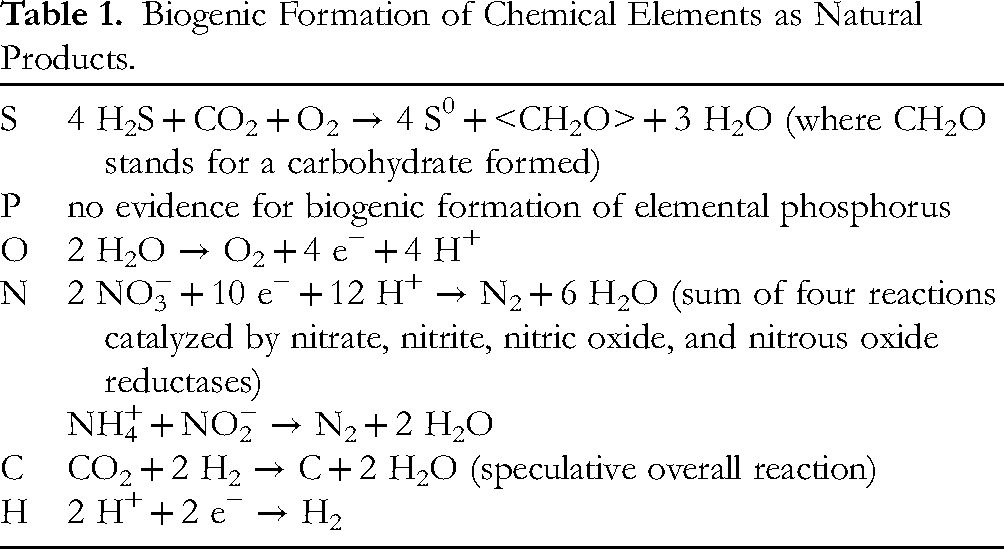
Incidentally, many life scientists use the name of the chemical element when they mean to refer to the role of a metal ion or a non-metal ion in biology, eg, zinc for the zinc(II) ion or phosphorus as an umbrella for phosphates. One would perhaps assume that living organisms cannot form elemental metals. However, biogenic formation of elemental metals is indeed possible. As part of a detoxification mechanism, microorganisms alkylate mercury and the organic mercury compounds are then transformed into elemental mercury again. 5 Recently, elemental iron and copper have been found in the brain of Alzheimer's disease patients, though the biogenic origin is not clear. 6 In addition to producing chemical elements, living organisms use chemical elements such as hydrogen, oxygen, and nitrogen in their elemental form, thus completing elemental cycles in the biosphere. Biogeochemical cycles are a critical aspect of the interaction between the biosphere and the geosphere. In this interaction, we recognize the molecular footprints that life leaves outside the actual organisms. The utilization of many chemical elements and organic ligands for metal ions is an important aspect of chemical ecology, the way living organisms interact and communicate with molecules synthesized for various purposes. For example, in quorum sensing, quenching, and signaling, specific molecules are employed to determine the demography of species. And some of these natural products contain metal ions.
Extracellular Inorganic Biochemistry
This article explores the interactions of extracellular metal ions with secreted organic ligands. Inside cells, the total metal concentrations and the protein-bound metal concentrations are tightly controlled. Membrane metal ion transporters, cytoplasmic binding proteins, and sensor proteins regulate transcriptional responses for the synthesis of proteins involved in the storage of metal ions and in the control of metal homeostasis. 7 In the cell, high molecular weight metal complexes in the form of metalloproteins are immensely important. Metalloproteins are prime examples for the selectivity and affinity that evolved in Nature to adopt metal ions for biological functions. The physical conditions in the extracellular environment differ from the intracellular environment, however. Therefore, the biological chemistry for handling extracellular metal ions is different.
The major focus here is on biological functions of secreted low molecular weight organic ligands with relatively high selectivity and affinity for metal ions. To achieve this affinity and selectivity, the ligands serve as chelating agents, chelators for short (from chele in Greek for the claws of a crab). The number of metal-coordinating donor atoms determines the denticity of the chelator. The main donor atoms are oxygen, nitrogen, and in some cases sulfur. The types of donor atoms, their arrangement in space to accommodate preferred coordination geometries and favourable energetics such as ligand field stabilization energy for transition metal ions contribute to selectivity. Coordination with neighbouring donor atoms generates a chelate effect that increases stability by lowering entropy. Yet another factor that lowers the entropy and thus contributes to the exceptional stabilities is the preformed conformation of some chelators. While many chelators are chiral molecules themselves, the metal complexes formed can be chiral as well, which is a factor for their specific recognition by proteins. 8 Chemical diversity in terms of affinity for metal ions and ligand exchange kinetics reflect the conditions in the various environments of living organisms and their requirements. It can mean that the chelators are not always optimized for highest affinity and selectivity. If the chelator is a peptide, only a few amino acids have side chains with appropriate donor atoms to serve as ligands. Among those, the side chains of histidine, aspartate, glutamate and cysteine also have the ability to serve as bridging ligands between two metal ions. Oxygen and nitrogen atoms in the peptide bond can participate in coordination and additional compounds with donor atoms in their functional groups are either recruited to or synthesized in the same natural product. The Irving-Williams series determines the stability of complexes of divalent metal ions in the d-series in the periodic system of the elements. 9 The chemical stability increases in the order: Mn(II) < Fe(II) < Co(II) < Ni(II) < Cu(II) > Zn(II). To increase the biological stability, ie, the biological half-life, and to avoid enzymatic degradation, D-amino acids, non-proteinogenic amino acids, cyclization, or modification of the N- and/or C-termini of the peptides are used. Yet, intracellular enzymes such as reductases and hydrolases make metal ions available from the chelators.
The extracellular organic ligands to be discussed have evolved in bacteria, fungi, and plants for specific biological functions and interactions with their hosts. Many of them are ribosomally synthesized and posttranslationally modified peptides (RiPPs). Non-ribosomally synthesized peptides and polyethers require non-ribosomal peptide synthetases (NRPSs) or polyketide synthases (PKSs), respectively. Appellations such as metallophores and ionophores are used to describe the ligands discussed here. Unfortunately, the words are occasionally used interchangeably. Because the ligands have many types of chemical structures, ie, a large ligandosphere, 10 only operational definitions exist. They are based on arbitrary approximate sizes and functions that are the subject of discussion throughout this article (Table 2). The word “phore” has its root in Greek, meaning “bearing, carrying”, and is used in many composite words, as for example in electrophoresis, where the electric current carries charged molecules. With a play of words, one could say that the process of extracellular metallophoresis/ionophoresis is the subject matter of this article. Per definition, metallophores carry metals ions and, therefore, they could be seen as ionophores, but the term ionophore is reserved for ligands that carry ions, not exclusively metal ions, through biological membranes by either remaining bound to their cargo or by forming a channel in the membrane for the cargo to traverse the membrane. To achieve this, ionophores have a lipophilic exterior for interacting with the lipid bilayer of biological membranes and a hydrophilic interior for interacting with the metal ion. The largely uncontrolled influx of metal ions with the aid of an ionophore is a way of poisoning or killing cells or activating specific cellular programmes. Metallophores can also starve and thus kill cells by depriving them of an essential nutrient. Their primary purpose, however, is to carry essential metal ions and make them available to the host for its benefit in growth while also chelating non-essential metal ions extracellularly and thus serve a role in detoxification. 11 Noteworthy, in both groups of compounds, killing occurs with nutritionally essential metal ions, demonstrating their dual nature and the need for controlling them tightly. Chelators bind non-essential metal ions as well, and, if these metal ions have mainly toxic actions such as lead or mercury, toxicity can be either exacerbated for the invader or mitigated for the host.
Operational Definitions of “Phores” in Extracellular Metal Biochemistry.

(footnote to table) Since the terms metallophore or ionophore generally refer to the compounds with or without metals, prefixes “apo” and “holo” are used when it is necessary to distinguish the metal-free from the metal-bound form.
After having defined the metal ligands to be discussed, the last aspect to be addressed in this introduction concerns the metal ions themselves. To understand the wealth of existing ligands and their selectivity, one needs to have an appreciation of which chemical elements are present and used by living organisms. At least twenty chemical elements are essential for humans and among those ten are metals. 15 Additional chemical elements are essential for other forms of life, eg, boron and silicon for plants, and nickel, vanadium, tungsten, and cadmium for some microorganisms. Perhaps it comes as a surprise to the reader that this knowledge of the essential elements of life, most likely, is incomplete, as it had to be amended regularly. Only ten years ago, lanthanides were found to be essential for some bacteria. 16 Another reason for the statement that our knowledge is incomplete is that the most advanced analytical instrumentation can detect the presence of almost all the chemical elements in biological material. 17 Once present, non-essential elements are bioelements and their presence is not insignificant functionally as they have beneficial, pharmacologic, or toxic actions. 18 Non-essential metal ions interact with the ligands for essential metal ions. Some of them bind with higher affinity and thus compete with the binding of the essential ones. Thus, the concept of inorganic compounds bound to ligands as natural products, in principle, applies to all the metals in the periodic system of the elements, and calls for a wider teaching of elemental biology in addition to molecular biology. 19
The major motivation for writing this article was to provide an overview of the types of secreted ligands involved in handling metal ions as an important aspect of the ecophysiology of bacteria, fungi and plants, to emphasize the concept of an extracellular biochemistry, and to allude to the far-reaching implications of metal-ligand interactions for several branches of science that are often disconnected. The order of presentation for the ligands and their metal cargo is: metallophores, metal ionophores, other natural products as chelating agents, followed by conclusions. The structure of the chapter on metallophores is guided by the number of publications for each element, while the structure of the chapter on metal ionophores, for historical reasons, follows the positions of the metal ions in the periodic system of the elements, namely s-group elements followed by d-group elements. The chapter on natural organic ligands discusses additional extracellular biological chelating agents that either contribute to buffering metal ions extracellularly and thus have a role in controlling metal ion availability or have additional functions beyond those of classical metallophores or metal ionophores.
Metallophores
Iron (Fe) – Siderophores
The field of metallophores began with siderophores (sideros in Greek for iron), carriers of iron. Siderophores will not be reviewed here in terms of their remarkable structural variety but rather discussed as a paradigm for the essential features of other metallophores. The vanishingly small concentration of available iron(III) in soil and water underscores the necessity for some living organisms to employ the chelating capacity and the delivery mechanism of secreted ligands to acquire the nutritionally essential iron. The solubility product of Fe(OH)3 is 10−39, meaning that not a single free Fe3+ ion is present from this chemical form of iron in a litre of fluid. Siderophores were the first metallophores characterized over 70 years ago as growth and virulence factors of bacteria, fungi, and plants (phytosiderophores), solubilizing Fe(III), transporting it, and making it available for cellular functions. In landmark discoveries, John Brian Neilands described that microorganisms form iron-binding compounds, particularly under conditions of iron limitation or deficiency. 20 In the older literature, one finds the term siderochrome for siderophores with the subdivision of sideroamines as growth factors and sideromycins as antibiotics, ie, growth inhibitors. In 2010, the count of different siderophores was 500 as listed and discussed in an authoritative review. 13 The operational definition of siderophores includes that they are low molecular mass compounds (500-1500 Da) with high affinity for iron (logK >10) and that iron levels regulate their biosynthesis. 13 As a way of delivering their precious cargo, siderophores bind to specific membrane receptors on cells. Therefore, they also must have the chemical information for this interaction. To compete for iron, the stability constants of siderophores need to be commensurate with the solubility product of Fe(OH)3 and accordingly are very high. The logK value of enterobactin is 49, the thermodynamically most stable siderophore/iron complex. But the stability constants can be up to 25 orders of magnitude less. The logK value for rhizoferrin, for example, is as low as 25.3 but still compares favourably with that of the most common synthetic chelating agent ethylenediaminetetraacetic acid (EDTA), which has a logK value of 25.1 for iron(III) with the same denticity of six donor atoms as enterobactin and rhizoferrin.13,21 However, the metal-ligand equilibria are often complex due to multiple protonation constants of the ligand and the dependency on ligand concentrations, making a comparison based on formation constants not always suitable. Therefore the pM, in the case of iron(III) the pFe(III) value, the negative logarithm of the free metal ion concentration, at a given pH value, usually at pH 7.4, is a better measure. 8 Stability is achieved by hexadentate complexes in many but not all siderophores with mostly, but also not exclusively, vicinal oxygen and nitrogen donors from aliphatic or aromatic/heterocyclic compounds. The donors can be assigned to four groups: carboxylate (amino- and hydroxycarboxylate), catecholate, phenolate and hydroxamate ligands. Heterocycles such hydroxyimidazole or hydroxyphenyloxazolone, aryloxazoline and arylthiazoline can also serve as ligands. 22 Yet another donor, N-nitrosohydroxylamine (diazeniumdiolate), was identified in gramibactin, a lipodepsipeptide siderophore of a rhizosphere bacterium (Paraburkholdia graminis). 23 Most complexes are mononuclear, but binuclear complexes and complexes with higher nuclearity also exist. Remarkably, sulfur donors (thiazole, thiazoline, and thiazolidine) are also used in a few siderophores, conferring some selectivity for other metal ions such as zinc and copper, which are more thiophilic (sulfur-loving). 24
Siderophores have pathways for their biosynthesis, employ surface receptors and transporters for translocation through two membranes in the case of Gram-negative bacteria, which also requires chaperone proteins in the periplasmic space to recognize them, have mechanisms for releasing iron by enzymatic processes or reduction of Fe(III) to Fe(II), which binds many orders of magnitude less tightly, and finally, they are recycled in some instances. Siderophores from marine bacteria with α-hydroxy acid groups are photo(re)active. Upon irradiation they decarboxylate with concomitant reduction of Fe(III) to Fe(II), which is yet another mechanism of releasing iron. 25
The control of extracellular iron is an aspect of quorum sensing/signaling, namely controlling population densities by regulating gene expression of siderophores and proteins involved in iron homeostasis. In this sense, siderophores can qualify as either semiochemicals, ie, chemicals that signal from one organism to another to affect its physiology, or allelochemicals, ie, chemicals used in the interactions between plants in the rhizosphere, for example, with ecological functions such as controlling abiotic or biotic stress. These functions most likely are not restricted to siderophores but apply to other metallophores that control the availability of nutritionally essential metal ions and the extracellular sequestration of metal ions with toxic actions. 11
Siderophores are functionally diverse and many non-classical functions beyond the acquisition of nutritionally essential iron have been documented. 26 Organisms interact with each other in symbiosis. The interaction in this host-guest biology can be mutualistic when both organisms benefit, commensalistic when one organism benefits and the other is not harmed, or parasitic when one organism benefits but the other is harmed (Figure 1).

Extracellular metallobiochemistry in the battlefield for metal ions. A host organism is shown with three invaders, one being a kin of the invader and another one being a cheater. The interactions can be mutualistic (the host and a guest benefit), commensalistic (a guest benefits and the host is not harmed) and parasitic (a guest benefits and the host is harmed). Metallophores and metal ionophores are secreted extracellular natural products with multiple roles in controlling the flow of nutritionally essential and non-essential metal ions, metalloids, and in some cases organic ions. Metal ion availability from organic or inorganic matter is determined by many factors in the ecological niche, such as the prevailing pH value and the binding of metal ions to ligands and chelating agents of both biotic and abiotic origin (not shown). Both host and guests can restrict the metal ion availability, but they can also use metal ions such as highly reactive copper ions to intoxicate invaders. In addition, secreted proteins, antimicrobial peptides and extracellular vesicles (EVs) participate in this circuitous metal ion traffic controlling the destinations of metal ions for cellular roles. Complex systems of homeostatic control with membrane and cytoplasmic transporters proteins, chaperone proteins, storage proteins, and sensor and buffering proteins determine the intracellular and subcellular roles of each nutritionally essential metal ion.
The figure illustrates how organisms control extracellular metal ions in a process that is crucial at the host-pathogen interface, where changes in metal composition and availability affect the virulence of pathogens in bacterial, fungal, and viral infections. Siderophores, and by inference metallophores, are used for chemical warfare, withholding metal ions from other organisms by a tug-of-war between host and invader, thus expressing antibacterial or antifungal activity. Yet, opposite to competition, they can also be cooperative and cambialistic, namely allowing “kin selection” by sparing related organisms the energy to synthesize their own siderophore. 27 It does not preclude, however, that “cheaters”, microbes that do not cooperate, also rely on the siderophore from another organism, ie, use a xenosiderophore. 27 Pathogenic bacteria can produce metallophores to counteract the host's response and thus acquire the metal ions they need, or the host counteracts the metallophore strategy by binding the siderophore with the lipocalin-2 receptor and internalizing it. Stealth siderophores, such as salmochelins that are formed by glycosylation and linearization of enterobactin, derive the attribute “stealth” from the fact that they evade the immune surveillance of the host by not binding to either lipocalin-2 (siderocalin) or albumin, which normally are part of the host's immunological defence, namely intercepting siderophores and thus preventing iron acquisition by pathogenic bacteria. 28 In addition to killing pathogenic microorganisms with a surplus of metal ions, eg, with an ionophore (see below) or by intoxication with copper ions, the opposite strategy of the host is to restrict the availability of other nutritionally essential metal ions such as iron, manganese, or zinc. These processes are part of nutritional immunity and the acute phase reaction in inflammation where zinc and iron decrease and copper increases in the blood and acute phase proteins are secreted from the liver. 29 Thus the copper protein ceruloplasmin is thought to intoxicate the invader with copper ions that produce highly reactive hydroxyl radicals and/or to starve the invader with calprotectin that binds zinc, manganese, iron, and copper. 30 As part of the innate immune system, macrophages secrete exctracellular vesicles (EVs) that have transferrin receptors and CD91 and CD163 heme protein-binding receptors on their surface. The secretion induces hypoferraemia, ie, lowering the iron availability for an invading pathogenic bacterium.31,32 The struggle for heme iron also involves strategies of both the bacterium in terms of secreting hemophores and the host in terms of using receptors for heme-binding proteins. Moreover, a cyanobacterium has been shown to secrete EVs that contain a copper metallochaperone to rid itself of excess copper under copper stress. 33 In host-guest interactions, the effect of pH should not be ignored as it is a major factor for metal ion availability. For example, plants can modulate pH values in the rhizosphere. Regarding the significance of these interactions for the human microbiome, plausible arguments based on appropriate biophysical and bioinorganic considerations have been made to suggest that our gut as a host employs several metal ions to control all three scenarios, feeding, starving, or poisoning microbes to maintain the proper microbial ecology. 34
Starving or depriving a pathogen from iron or any other essential metal ion is a basis for therapeutic interventions. Another pharmaceutical application is a Trojan horse strategy, namely employing the siderophore uptake pathway of a microorganism to deliver an antibiotic, a toxic metal instead of iron, or any other drug. This feat is accomplished in sideromycins, where antibiotics are attached to a siderophore. 35
Furthermore, there are secondary siderophores, additional siderophores produced by the same organism, and xenosiderophores or exosiderophores, siderophores used but produced from another organism. Multiple siderophores are not a case of functional redundancy. Rather, they allow pathogens like Pseudomonas aeruginosa to switch iron uptake pathways during different types of infections. 36 P. aeruginosa can also use catecholamine neurotransmitters and catechols from plants as “siderophores.” 37 In soils, Pseudomonas sp. FEN uses a novel rhizobactin derivative to extract iron from dissolved organic matter (DOM) in peatlands, further supporting the switching of siderophores for acquisition of iron and other metal ions in special ecologic niches. 38 The large number of siderophores and the breadth of the field serve as a template for the many questions that need to be addressed for metallophores of other metal ions. There are at least two theories why so many different siderophores exist, and both are probably correct. One is that it reflects the chemical and physical complexity of the ecological niches in which the organisms reside. 39 The other is that there is moonlighting, namely using siderophores for other metal ions under yet to be defined specific conditions in the same or another organism, or promiscuity, namely that a siderophore has developed in terms of both its biological regulation and selectivity in such a way that it is a more general, broad-spectrum metallophore optimized for the acquisition of a set of metal ions in addition to iron while sequestering metal ions with toxic actions extracellularly.40,41 In vitro investigations mimicking conditions of the natural habitat support this variation on the theme, because the selectivity of siderophores for iron ions is not absolute and in some cases the selectivity for other metal ions such as molybdate surpasses that for iron, suggesting a role of siderophores in the acquisition of other metal ions. In many circumstances, some siderophores have now been identified as general metallophores for bivalent metal ions as discussed further below for the individual metal ions. Answering the question of whether bona fide siderophores are used as metallophores for other metal ions is challenging while at the same time providing huge opportunities. An answer would require (i) systematic studies of their affinities for various metal ions as a function of pH in relation to the physicochemical conditions under which the organism grows in its ecosystem, (ii) information about the metal ion composition and metal buffering capacity of the aquatic, terrestrial, or biological environment, which differ and underlie dynamic changes, (iii) understanding the variations of metallomes in different organisms and their organs and the dynamic changes as, eg, occurring in different growth phases, and (iv) relating the metal acquisition of metallophores to changes in cellular metallomes. Metal usage differs between even closely related organisms and can include the acquisition of metal ions by some but not other organisms. Siderophores may even serve in the transport of metalloids such as boron and silicon. 26 Their functional potential also includes the sequestration of toxic metal ions, protection against oxidative stress caused by redox-active metal ions, and chemical or biological properties of the ligand itself. For example, siderophores from Klebsiella pneumoniae stabilize the transcription factor HIF-1α, increasing the inflammation and spreading the human infection. 42 Moreover, other biological ligands may serve as siderophores for either iron uptake or for uptake of the ligand by using iron and its uptake system(s). Thus, the uptake of the morphogen (-)-thallusin (Figure 2) of the seaweed Ulva is mediated through a ferric ion complex and a siderophore transport system. 43

Chemical structure of (-)-thallusin.
The concept of siderophores is being extended here to include other metal ions. A PubMedR search (11/01/2024) returned the following number of entries (in brackets) for metallophore (118), siderophore (16,074), chalkophore (37), zincophore (25), molybdophore (2), lanthanophore (2), nickelophore (2), vanadophore (1) and manganeseophore (1). In this article, the order of presenting metallophores follows the results of this research, thus reflecting the historic development of scientific interest in the subject matter. Since PubMedR is a database covering the biomedical sciences, additional searches were undertaken to include a wider range of scientific disciplines such as the geochemical sciences. The general term metallophore has also been used in the context of other functions, eg, for periplasmatic metal-transporting proteins that are akin to metallochaperones. Therefore, the term can become a bit “fuzzy” when it includes additional functions and high molecular weight ligands like proteins.
Copper (Cu) – Chalkophores
Chalkophores derive their name from khalkos in Greek for copper. The word should not be confused with chalcogens, which means “ore forming” and denotes the elements in group 16 in the periodic system of the elements such as oxygen and sulfur, which form anions that can interact with cations of metals such as copper.
Phylogenetic analyses define two types of chalkophores. One type (groups I and II) belongs to methanotrophic bacteria while the other (groups III to V) is expected to have roles in non-methanotrophic bacteria. Methanobactins are chalkophores employed by methanotrophs, methane-oxidizing bacteria that need copper as a cofactor for methane monooxygenase.24,44 They are genetically encoded, hence ribosomally synthesized and posttranslationally modified peptides (RiPPs). A key feature of their copper coordination is two nitrogen and two sulfur donor atoms from a heterocycle (pyrazinedione/oxazolone) and a neighbouring thioamide group (Figure 3A). Copper is a thiophilic metal. The chemical properties of a thiol/thione(thioketone) as a reducing agent towards Cu(II) engender coordination of Cu(I). The major extracellular form of copper is Cu(II), however, and some metallophores interact with this valence state of copper without reduction. Methanobactins have affinities of 6–7 × 10²⁰ M−1 (pH ≥ 8) for Cu(I). 45 A disulfide (cystine) features in some methanobactins and contributes to the conformation of the peptides and their affinity for Cu(I).

The chalkophores Cu(I)methanobactin from Methylosinus trichosporium OB3B 44 (A) and frankobactin A1 (B).
A number of methanobactins have been structurally characterized, but the full diversity is yet unknown. 46 Remarkably, methanobactin SB2 has been employed therapeutically with very high efficacy to remove copper from the liver in rodent models of Wilson's disease, a human genetic copper overload condition. 47
Like siderophores, chalkophores such as methanobactins have secondary functions as signaling factors, protection against metal toxicity, superoxidase activity, and antibiotic activity. 24 Non-classical roles beyond metal acquisition such as controlling copper toxicity may actually be the primary role of some of them. Frankobactins, hydroxamate siderophores containing proteinogenic and non-proteinogenic amino acids, have been isolated from species CH37 and 52065 of Frankia, nitrogen-fixing bacteria living in actinorhizal symbiosis with plants, and shown not to be involved in iron acquisition but instead sequestering Cu(II), thus preventing the uptake of this potentially toxic metal ion (Figure 3B). 40
Coproporphyrin III, yersiniabactin and SF2768, a di-isonitrile peptide (see below) and yet other siderophores, are thought to be chalkophores of bacteria that do not rely on methanobactin. In uropathogenic E. coli strains, yersiniabactin participates in copper import. 48 In this case, it is believed to be a Cu(II) complex of yersiniabactin. The process of using yersiniabactin is described as a case of biological passivation, namely a compromise between decreasing the toxicity of Cu(II) and making the essential metal ion available for the host. The fine balance of modulating copper toxicity is evident from investigations of the siderophore enterobactin. 49 Expression of higher amounts of enterobactin increases the toxicity of copper, demonstrating that the metallophore for one metal ion, ie, iron, influences the extracellular effect of another metal ion.
Additional evidence for roles of chalkophores has emerged in the last three years. Thus, chalkophomycin from Streptomyces sp CB00271 coordinates copper(II) with three oxygens and one nitrogen donor atoms and contains a diazeniumdiolate for binding the metal ion. 50 Also, the BGC for the broad spectrum antibiotic xanthocillin and other isocyanides (isonitriles) has been detected in filamentous fungi such as Aspergillus fumigatus, suggesting a role of this natural product in controlling extracellular copper in eukaryotic organisms. 51 Further investigations of the mode of action of xanthocillin demonstrated that Acinetobacter baumannii binds directly with its isonitrile functional group to heme, thus perturbing heme biosynthesis and killing the host.52,53 Likewise, the BGC for an isonitrile chalkophore, hazimycin, was characterized in the actinobacterium Kitasatospora purpeofusca HV058. 54 Mycobacterium tuberculosis also synthesizes diisonitrile lipopeptide chalkophores that maintain iron and copper-dependent respiration of the pathogen and thus its virulence under conditions of copper restriction induced by the host. 55 Anthrochelin from the human pathoadapted pathogen Luteibacter anthropi is a non-ribosomally synthesized salicylate-oxazole metallophore with a C-terminal homocysteine. Among the metal ions investigated in virulence promotion, the affinity for Cu2+ was highest. 56
Zinc (Zn) – Zincophores
A transliteration from the Greek word for zinc is not used to name the “phore”. The reason is that the Greek word for zinc means pseudosilver and pseudoargyrophore certainly would not be a good choice. Thus, they are called zincophores. The issue of metal specificity of the natural products is exacerbated here as many zincophores bind other metal ions as well. One would need to know where or when zinc is limiting in the environment to assign a primary role in acquiring nutritionally essential zinc(II) ions. This consideration is important for the interpretation of in vitro experiments, too, as one needs to know the metal ion concentrations in the growth media used and whether a specific metal ion is limiting. The terminology for zincophores is more diffuse as the name has been adopted for proteins, including so-called substrate- or solute-binding proteins (SBPs), which participate in the extracytoplasmic handling of metal ions either in the periplasmic space of Gram-negative bacteria or in the interaction with the peptidoglycan cell wall of Gram-positive bacteria.57–59 In the strictest sense of the word, these proteins are “phores”, metal-carrying proteins, supplying metal ions to a transporter protein in the membrane, but this can be said for metallochaperone proteins as well, which remains the preferred and more widely used term. The name zincophore also has been given to secreted specific fungal proteins (see below). 60
Staphylococcus aureus produces the metallophore staphylopine, which promotes the growth under zinc-restricted conditions and competes with the host for zinc despite the host's restriction of zinc availability with the protein calprotectin, which has subpicomolar affinity for zinc.61,62 Thus, particular attention has been drawn to the metallophores staphylopine (Staphylococcus aureus), pseudopaline (Pseudomonas aeruginosa) and yersinopine (Yersinia pestis) as zincophores. These opine metallophores are synthesized by non-ribosomal peptide synthetases, ie, nicotinianamine synthase using L- or D-His and S-adenosyl methionine (SAM) and opine dehydrogenase using the nicotianamine synthase product and either pyruvate or α-ketoglutarate. 63 Thus, yersinopine and staphylopine differ only by having L-His and D-His, respectively (with pyruvate added in the opine dehydrogenase reaction) while pseudopaline and bacillopaline (Paenibacillus mucilaginosus) also differ only having only L-His and D-His, respectively (with α-ketoglutarate added in the opine dehydrogenase reaction). To gain further insights into which bacteria produce these opine-like zincophores and into how structures vary among zincophores, bioinformatics of BGCs was used to map the zincophore “landscape”. 64 It identified already characterized zincophores in about 250 bacterial species in a wide range of ecological niches. In addition, it provided information about putative new zincophores. This group of compounds has been referred to as broad-spectrum (multi-metal) metallophores as staphylopine is also involved in the uptake of other divalent metal ions such as iron, copper, nickel and cobalt.56,65 Pseudopaline is involved in the uptake of zinc and nickel depending on the chelating properties of the growth media used. 65
The struggle between invading bacteria and the host is even more complex for these broad-spectrum metallophores as multiple metal ions are involved. Thus, while S. aureus can overcome zinc starvation using staphylopine as a zincophore, the response of the host can leverage this advantage of the pathogen with copper stress. Since staphylopine can also serve as a chalkophore, the intoxication with copper becomes a liability for the pathogen. 66
Nicotianamine (Figure 4A) is synthesized from three molecules of SAM in all plants and some fungi and involved in the control of the homeostasis of several metal ions, including zinc. 67 It transports zinc intercellularly from roots to shoots but it is also a precursor of phytozincophores secreted from the roots in metal hyperaccumulator plants (see below).68,69 The stability constant for zinc ion binding to nicotianamine is logK = 14.7. 70 The coordination involves three nitrogen and three oxygen donor atoms. Instead of using three molecules of SAM to make nicotianamine, two molecules of SAM are conjugated with glutamic acid in archaebacteria (M. thermoautrophicus) to form thermonicotianamine, in addition to the above pathway using only one SAM molecule in the four bacterial opine metallophores. 67 Additional biosynthetic pathways lead from nicotianamine to avenic acid by cleavage of the azetidine ring or to mugineic acid by hydroxylation. Both have been described as phytosiderophores. 13

Chemical structures of two metallophores, nicotianamine (A), and a kupyaphore with C12 fatty acids and showing the isonitrile groups in the protonated form (B), and two metal ionophores, calcimycin (C), and griseochelin (zincophorin) (D).
Yersiniabactin, a siderophore from Yersinia pestis, mentioned above in the context of serving as a chalkophore, is a zincophore, too. 71 Yersinia enterocolitica yersiniabactin also overcomes the host's zinc sequestration by calprotectin and thus allows both commensal and pathogenic bacteria to colonize the inflamed gut. It demonstrates the promiscuity of siderophores in terms of serving as zincophores in zinc acquisition under some conditions. Importantly, the affinity profile changes as a function of pH with the relative affinity for zinc versus iron increasing at increasing pH. 72 The observation that the uropathogenic E. coli prioritizes Fe(III) uptake in high copper environments exemplifies the subtleties in the metallophore-mediated metal ion acquisition, because Cu(II) yersiniabactin is not a competitor of Fe(III) yersiniabactin. 73 It demonstrates the complex interplay among extracellular metal ion concentrations, the selectivity of the metallophore, its uptake, and the metal control of its biosynthesis.
Another set of zincophores dubbed kupyaphores has been characterized as secreted products from Mycobacterium tuberculosis. 74 Kupya in Sanskrit refers to bare metals. Kupyaphores are diacyl-diisonitrile lipopeptides with a dipeptide core of ornithine and phenylalaninol and the amino groups acylated with isonitrile-containing fatty acyl chains (Figure 4B). Zinc release supposedly occurs via an isonitrile hydratase. If confirmed, it would be another remarkable mechanism of how the precious cargo of a metallophore can be harvested. SF2768 is such a kupyaphore, which also has been investigated as a chalkophore (see above). In their thiophilic nature, lack of ligand field stabilization energy and thus flexibility of coordination, there is little difference in activity between Zn(II) and Cu(I) ions. Therefore, such an overlapping activity of metallophores for these two ions may not surprise. However, while copper(I,II) ions are redox-active, zinc(II) ions are biologically redox-inert and can participate in intracellular redox metabolism only indirectly. 75
Coelibactin from Streptomyces coelicolor has been suggested to be a zincophore on the basis that zinc induces this antibiotic with the involvement of the zinc-responsive regulator Zur in expressing its gene cluster.76,77
Two furofurandiones were isolated from the root-invading endophyte Pezicula ericae of the zinc-accumulating plant Aucuba japonica and named isoavenaciol and 7-hydroxy-isoavenaciol. 78
Ethylene-N,N′-diaminedisuccinic acid ([S,S]-EDDS) is a bacterial zincophore. 79 It has a Kd of 2.3 × 10⁻¹¹ M and a coordination with two nitrogen and four oxygen donors. 80 EDDS is biodegradable and therefore a coveted alternative to its synthetic isomer EDTA. Technically, the molecular mass of 292 Da for EDDS is below the arbitrary cut-off of 500 Da set for siderophores (Table 2).
With historical interest, a mold (Aspergillus niger) was the first organism, in which the essentiality of zinc for growth was demonstrated by Jules Raulin, a student of Louis Pasteur, in the nineteenth century. Candida albicans and other fungi secrete zincophores.60,81 Pra1 (pH-regulated antigen 1) from Candida albicans and Aspf2 from Aspergillus fumigatus have 299 and 310 amino acids, respectively, and therefore are proteins, thus extending the original concept of metallophores/siderophores from peptides to proteins, at least in this case of fungi. The proteins are induced by low zinc and high pH, a condition that decreases the solubility of zinc(II) ions. Pra1 is upregulated in C. albicans in vaginal candidiasis and correlates with the production of pro-inflammatory cytokines. 82 High zinc instead down-regulates the expression of the PRA1 gene with concomitant decrease of inflammation. The important implication is that topical zinc treatment of women with recurrent vulvovaginal candidiasis is a preventative modality. Structures of the metal coordination sites of these fungal proteins are not known but have been approached by investigating the coordination in synthetic peptides. For Pra1, investigations employing a C-terminal peptide demonstrated coordination of Zn2+ with four imidazole nitrogens from histidines with a pKD value of 7.89 at pH 7.4. 83 A peptide of 14 amino acids from the C-terminus of Aspf2 binds Zn2+ with two sulfurs from cysteines and two imidazole nitrogens from histidines with a pKD value of 8.83 at pH 7.4. 84 Aspf2 and other zincophore proteins are immune evasion proteins that interact with many human plasma proteins. Their protein nature endows them with additional roles in fungal infections. 85 Vice versa, the host produces antimicrobial peptides (AMPs). For example, histatin-5 is such an AMP that is secreted with saliva. It has strong copper-binding ability and poisons Candida albicans with copper in the oral cavity. 86
Putative Metallophores for Other Metal Ions
Only one or two references exist in PubMedR for named metallophores of other metal ions. However, the lack of specific names is not a measure of the additional activities in the field, because many investigations are made with siderophores and metal ions other than iron as already discussed for zinc and copper. It appears that organisms re-purpose siderophores under specific conditions, but it is not clear whether they employ additional, specific natural products for handling other essential metal ions. Extensive datasets for total metal concentrations in water and soil exist. However, what matters for biology is the availability of the metal ions, which is highly pH-dependent and may be restricted for some or too high for others to protect an organism against metal ion toxicity, or the organism may need the plasticity to be rather independent of metal ion speciation or variation of metal ion concentrations. Regardless of whether the organism makes its own metallophores or relies on those of other organisms in the ecological niche, the metallophores need to compete with ligands (organic matter and inorganic ligands) that buffer the metal ions. The organism then “bar codes” the metal ion for decisions how much it needs to acquire. These decisions depend on the regulation of the biosynthesis of metallophores and their receptors. All these issues make it important to discuss the present state of the art of metallophores for other nutritionally essential metal ions.
Molybdenum and Tungsten (Mo,W) – Molybdophores and “Tungstophores”
The pterin cofactor is involved in the intracellular binding of molybdenum and tungsten, forming molybdo- and tungstopterin, respectively. Ascertaining acquisition of molybdenum, vanadium and iron is immensely important for organisms that carry out nitrogen fixation (diazotrophs), the process of bringing nitrogen in the ecosystem, as these elements are used in the different types of nitrogenases. Molybdenum is also used in enzymes of sulfate- and nitrate-reducing bacteria. Vanadium is also used in bromoperoxidases. In addition to the many molybdenum species formed abiotically under oxic and euxinic, ie, anoxic and sulfidic conditions, as possible substrates for uptake, biotically formed molybdophores have been implicated in cellular uptake of molybdate.11,87
The soil bacterium Azotobacter vinelandii produces different catechol siderophores, the monocatechol 2,3-dihydrobenzoic acid, the biscatechol azotochelin and the triscatechol protochelin. 88 Azotochelin binds the oxoanions molybdate, vanadate, and tungstate with logK values of 7.3, 8.8, and 9.0 at pH 6.6, respectively. 89 Another monocatechol, aminochelin, N-(4-aminobutyl)-2,3-dihydroxybenzamide, has lower affinities, and its secretion from soil bacteria has been implicated in making molybdenum available from silicates. 90 While these siderophores are promiscuous in also binding the divalent metal ions of copper, zinc, cobalt, or manganese in vitro, specific metal-buffering systems were developed and employed to investigate metal uptake under conditions that mimic the natural environment in soils. 91 It was found that A. vinelandii producing the siderophore protochelin serves as a bona fide molybdophore. The organism can acquire molybdenum while another diazotroph, Frankia sp. CH37, cannot. Remarkably, when 14 different Frankia species were investigated regarding their acquisition of iron, copper, zinc and molybdenum, a total of 17 metallophores and 83 secreted organic ligands were detected. 10 None of the ligands bound molybdenum. Characterization of the structure and stability of the protochelin complex with molybdate showed binding over a wide environmental pH range with a decrease of affinity below pH 5, indicating that molybdenum will be unavailable and remains bound at mineral surfaces at lower pH. 92 The binding of molybdenum to organic matter such as tannins on the leaves of plants reduces its leaching. 93
Protochelin discriminates between molybdenum and tungsten, affording preferential uptake of the required molybdenum over tungsten, which is toxic for A. vinelandii. 94 However, some archaebacteria employ tungsten instead of molybdenum.95,96 Given that the amount of tungsten in the entire human body is only about 20 µg, one wonders which specific mechanisms archaebacteria residing in the human gut have developed to acquire the necessary tungsten for detoxifying aldehydes. 97 An archaebacterium, Wolframraptor gerlachensis, requires only < 20 nM tungsten for growth, concentrations that are below those typically found to be inhibitory for other microorganisms. 98
Vanadium (V) – Vanadophores
The term vanadophore has been introduced originally in a different context with a meaning unrelated to the one employed for vanadium-carrying molecules. It designates the vacuoles of tunicates that contain V(III) in 1.8 N sulfuric acid. 99 Tunicates also have several tunichrome pigments, which are dipeptides modified with multiple ortho-polyphenol groups and thus are metal-binding. Tunichromes are functionally poorly defined but have been implicated in the defence against microbes. 100
Another natural vanadium compound is amavadin from the mushroom genus Amanita, a toadstool. It has an eight-coordinated V(V) or V(VI) with two 2,2′-(oxyimino)dipropionate ligands, establishing a coordination with two nitrogen and six oxygen donor atoms. Its biological function also remains unknown. Its function as a catalyst, in particular the peroxidase and catalase activity, suggests that the mushroom uses it in its defence. 101
Much as catecholate siderophores serve as molybdophores, they can also be vanadophores. The strain CA11.70 of A. vinelandii, which expresses only the vanadium-dependent nitrogenase, can fine-tune the secretion of catechol siderophores in such a way that it precisely controls acquisition of vanadate in the appropriate range between limiting and toxic concentrations. 102 The experimental work on this diazotroph thus showed the remarkable complexity and flexibility in adaptations. A. vinelandii can thrive under varying environmental conditions by storing molybdenum, which is poorly available due to binding to dissolved organic matter and mineral surfaces, and by switching among the three types of nitrogenases. It uses metallophores as siderophores, molybdophores and vanadophores under conditions where the metal ion concentrations are limited in soils and where other oxoanions such as phosphate and tungstate compete, all occurring with the objective to satisfy the need for all three elements (iron, molybdenum, vanadium) in the respective molybdenum/iron, vanadium/iron and iron only nitrogenases. 103
Lanthanides – “Lanthanophores”
The 15 lanthanide elements occur in their 3 + oxidation state, in which their compounds are mostly insoluble in water at neutral pH. They are part of rare earth elements (REEs) that also include yttrium and scandium. However, some elements like lanthanum, neodynium and cerium, are not rare at all and occur at concentrations similar to those of copper and nickel in the earth's crust. 104
Recent discoveries of a requirement for lanthanides in at least five types of methanol dehydrogenases in several species of methylotrophic bacteria and demonstration of an effect of lanthanides on the expression of the genes for these proteins further support the notion that our appreciation of the roles of metal ions in biology is incomplete. The lanthanide-using bacteria were originally discovered in rather acidic volcanic mud pots.16,105 Over the last ten years lanthanide biology has become an active field with the goal of defining the lanthanome.106,107 In lanthanide enzymes, the lanthanides are part of the pyrroloquinoline quinone redox cofactor (PQQ). For quite some time, PQQ was known to be a cofactor of some redox enzymes (quinoproteins), eg, alcohol dehydrogenases, including methanol dehydrogenase. Originally, PPQ was discussed as a possible vitamin, but the claim was not substantiated as it does not appear to be essential for humans or animals. However, PPQ promotes long-term health. 108 Could it then be that some lanthanides have unexplored roles for us? Other proteins involved in lanthanum metabolism were discovered. The lanmodulin protein has 112 amino acids and binds lanthanides in three EF-hand type of loops like the ones used as calcium-binding sites in proteins. 109 A periplasmic 19 kDa protein, lanpepsy, also binds lanthanides, but its function is not known. 110 Ongoing work focuses on defining the selectivity of proteins for certain REE. Encouraging results have already demonstrated the feasibility of using these proteins for the separation of lanthanides/REE and even actinides, and for REEs mining and recycling. 111
The existence of lanthanophores has been postulated based on detecting BGCs of siderophores and LCCs (lanthanide chelating clusters). Indeed, a metallophore for REE was identified in Methylobacterium extorquens AM1, structurally characterized, found to have a unique 4-hydroxybenzoate moiety, and named methylolanthanin. 112 In a biomining investigation of drainage from a coal mine, metallophores with the capacity to bind REEs were found in the genus Pseudomonas. 113 In investigations of the microbiome of the plant phyllosphere, a staphylopherinB-like siderophore presumably involved in chelation of lanthanides in methylotrophic bacteria was characterized. 114 Also, Methylorubrum extorquens AM1 is a methylotrophic gadolinium hyperaccumulator. 115 The bacterium stores gadolinium in an acidocalcisome-like compartment, a “lanthasome”. Evidence for a lanthanophore was advanced from a BGC analysis. In addition to this putative lanthanophore, PQQ was suggested to serve as an extracellular chelating agent for lanthanides. 115 While the condition of acidic mud pots may be sufficient to provide lanthanides in a soluble form, the surfaces of plants are likely not to be sufficiently acidic to warrant solubility and a lanthanophore indeed may be required.
Cobalt and Nickel (Co,Ni) – Nickelophores and “Cobaltophores”
The intracellular biochemistry of cobalt is linked to the corrin cofactor (Vitamin B12, cobalamin), which contains Co(I). Cobalamin is widely discussed as a vitamin but much less seen as a vehicle to utilize cobalt. An important aspect is that eukaryotes cannot synthesize cobalamin and therefore depend on it from the diet. Its origin is microbial. The term cobaltophore has not been used, though. like Fe3+ complexes, Co3+ (and Cr3+) complexes are kinetically quite inert and have rather similar coordination requirements in terms of ligand donor atoms and octahedral (coordination number six) coordination environments. Therefore, adventitious uptake of these metal ions through siderophores is quite likely. The opine metallophore staphylopine binds divalent cobalt and nickel (see above), and yersiniabactin, discussed as a chalkophore and zincophore (see above) is used for nickel uptake in uropathogenic bacteria. 116
While nickel apparently is not essential for humans, nickel is required for urease and hydrogenase, including its use in human pathogenic bacteria such as Heliobacter pylori and Campylobacter jejuni. 117 Additional nickel-resistant bacteria have been found in the human gut. 118 Nickel, as Ni(I), is part of the hydrocorphin cofactor F430 of methyl coenzyme M reductase in methanogenic and anaerobic methanotrophic archaea. The lactate racemase from Lactobacillus plantarum uses a PQQ-type nickel pincer nucleotide (NPN) as cofactor, pyridinium-3,5-bisthiocarboxylic acid mononucleotide (P2TMN). 119 Other enzymes, such as urease utilize just Ni2+ as cofactor, but have specific pathways for the nickel ion to be delivered to the active site. Bacterial uptake of nickel (Ni2+) involves a complex of five proteins (NikA-E). Initial investigations suggested that butane-1,2,4-tricarboxylate is a metallophore to deliver nickel to NikA. 120 However, subsequent investigations identified Ni-(L-His)2 as the substrate of the multi-protein complex, characterized the binding mode crystallographically, and confirmed the selectivity of the Escherichia coli solute-binding protein NikA for the bis-histidine complex compared to complexes with other amino acids as ligands.121–123 The nickel complex interacts with His 416 of NikA. 122 A fungal metallophore, aspergillomarasmine, binds Zn2+, Ni2+, and Co2+ with relatively high specificity. 124 Its metal complexes bind to NikA, compete with the bis-histidine complex and inhibit the uptake of nickel, suggesting its therapeutic use for suppressing the virulence of pathogens that require nickel. Staphylococcus aureus, however, a second system exists, namely CntA-F, which does not utilize the nickel bis-histidine complex but a thiazolidine-type of nickelophore instead. 125
Manganese (Mn) – “Manganeseophores”
Rhizoferrin, desferrioxamines and pyoverdines have higher affinity for manganese(III) than iron(III).24,126 Despite the preeminent importance of manganese in the oxygen-evolving complex (OEC) in photosynthesis, there is no information on specific metallophores for manganese. Two articles deal with acquisition of manganese, but they are discussing proteins.127,128
Metal Ionophores
A PubMed search (11/01/2024) retrieved 47,666 entries for the term ionophore. Ionophores shuttle ions through membranes. They were discovered in microorganisms about sixty years ago and defined as compounds of 200–2000 Da molecular mass (Table 2) with an amphiphilic nature, being lipid-soluble and yet forming complexes with monovalent and bivalent cations such as the alkali metal ions Na+ and K+ and the alkaline earth metal ions Mg2+ and Ca2+. 14 This focus on s-block metals seemingly sets them apart from siderophores and metallophores employing mostly d-block metals. An overall consideration is that in their ionic form s-block metal ions are more readily available in solution than most d-block metal ions, the divalent metal ions of which form ligand complexes with increasing strength governed by the Irving-Williams series. Thus, a metallophore competes with other complexing agents for the poorly available metal ion while a metal ionophore relies largely on the readily available ionized form of the metal ion. Accordingly, a major factor in metallophores is the stability of the metal complex whereas metal ionophores select metal ions with steric restrictions, in particular in the cavity of cyclic molecules. Another difference is that, while metallophores require a receptor or transporter protein, ionophores interact with membranes directly when transporting metal ions across a biological membrane. The activity of the ionophore also depends on the lipid composition of the membrane. Structurally and functionally, there is some overlap between metallophores and metal ionophores, too. Both occur in bacteria, fungi, and plants and use metal ions in the biochemical warfare between organisms. Also, both comprise peptides and polyethers with similar operational definitions (Table 2). Ionophores were categorized into neutral, carboxylic and channel-forming quasi-ionophores. 14 An important functional difference thus divides them into two classes. In one class (carrier ionophores), the ionophore traverses the membrane lipid bilayer with its bound metal ion while in the other (channel ionophores) the ionophore inserts itself into the lipid bilayer and forms a channel to let metal ions pass through. In eukarya, ionophores carry ions not only into the cell but also into specific cellular compartments.
Some ionophores form complexes with other cations, eg, protons (protonophores), the ammonium ion (eg enniatin), and organic cations. The remarkable selectivity in the case of valinomycin for potassium (see below) caught the interest of chemists and stimulated development of the field of host-guest chemistry, in particular the synthesis of cryptands and crown ethers that bind a variety of cations, a field for which Jean-Marie Lehn, together with Donald Cram and Charles Pederson, received the Nobel Prize in chemistry 1987. As with metallophores, some are broad-spectrum metal ionophores and carry different monovalent and divalent metal ions, including not only essential but also non-essential ones in the s-block of the periodic system of the elements, eg, lithium and rubidium in group 1 and strontium and barium in group 2, d-block metal ions, eg, monovalent Ag+ and divalent Zn2+, and even p-block metal ions such as Tl+ and Pb2+.
Most natural ionophores are toxins in the warfare between organisms and no antidotes exist for the toxicosis they induce. Organisms must avoid poisoning themselves, though. Due to their antiprotozoal activity, metal ionophores are used in animal husbandry as anticoccidial agents, and more recently in antiviral therapy. There are significant additional applications in employing these natural products pharmacologically as antibiotics (antibacterial, antifungal), especially in circumstances of antimicrobial resistance (AMR) and in multi-drug resistance (MDR). 129 Their functions in vivo depend on metal availability in the ecological niches. If an organism colonizes multiple ecological niches that differ in metal availability, there should be an ability to adapt, and maybe it is the reason for the less stringent selectivity of many ionophores that transport different metal ions. Thus, for understanding their functions in vivo, we need to know the metal composition and metal speciation of the ecological niche. In vitro, the situation is quite different as the chosen experimental conditions determine metal composition and metal speciation. Accordingly, metal ionophores can have many different biological activities in vitro. Remarkably, however, it is rather the rule than the exception that investigators do not attempt to relate these activities directly to the transport of a specific metal ion. The ability of metal ionophores to transport different metal ions can be exploited in therapy by manipulating the metal composition, for example by choosing metal ions with specific biological activities in cellular pathways. And, last but not least, ionophores are essential tools in cell biology and electrophysiology to study biological membranes, and they are employed in the manufacture of ion-selective probes and electrodes. These important applications engendered major efforts in chemistry to make new synthetic ionophores.
For Nature's selection of ionophores, we need to recall the overarching features of the concentrations of s-group (Na, K, Mg, Ca) and d-group (Mn, Fe, Co, Ni, Cu, Zn) metal ions in cell biology. The potassium gradient is opposite to the sodium gradient. Potassium concentrations inside cells are 30-fold higher than outside cells, while sodium concentrations are 10-fold lower inside than outside. Therefore, perturbation of the sodium/potassium ratio is a major factor for interfering with cell function including the tightly controlled potentials across the plasma membrane and the inner mitochondrial membrane. Calcium and magnesium interact more strongly with ligands, in particular proteins that buffer their concentrations. Therefore, the concentrations of the free ions are usually considered for their gradients. The magnesium ion gradient through the plasma membrane is very small, 130 while the free calcium ion concentrations are hugely different, namely almost 10,000-fold lower inside than outside cells. This calcium gradient is necessary to make the intracellular functions of Ca2+ as a signaling ion possible. For the ionophores, it means that bringing Ca2+ into the cell is a major perturbation that affects many processes whereas one would expect barely any effect of Mg2+ unless its extracellular concentration is increased experimentally.
Increasingly, the d-group metal ions are coming into the purview of the functions of metal ionophores. Their gradients across the cell membrane are discussed below. One question is whether there is specific uptake of a d-metal ion instead of, or in addition to, using a metallophore, which generally would bind the d-metal ion much more strongly. One reason for the increasing attention to d-group metal ions for the action of ionophores is the discovery of metal-specific pathways of cell death and therefore the use of ionophores and d-group metal ions for killing cancer cells specifically through ferroptosis for iron, 131 cuproptosis for copper, 132 and recently discussed zincoptosis for zinc. 18
Polyether ionophores are a large class. In 2012, a count of 120 compounds has been given. 133 Nigericin and lasalocid were isolated in 1951 from Streptomyces species. Polyether ionophores are linear molecules and contain one carboxyl group, multiple carbonyl and hydroxyl groups, tetrahydropyran and/or tetrahydrofuran rings, the hallmarks of a polyether ionophore, and other homo- or heterocyclic rings. They are antibiotics that are used extensively in veterinary medicine, though some are also used in human medicine against Gram-positive bacteria. Aside from monensin, the other major carboxylic polyether ionophores with antibiotic activity are laidlomycin, lasalocid, maduramicin, narasin, and salinomycin. Ionophores also generated significant interest as anticancer drugs and in other medical applications when their toxicity in inducing cell death in cancer stem-like cells (CSCs) was observed. 134 They are mostly considered in the context of interrupting sodium/potassium gradients, but perturbation of other cations is discussed as well. 133 Many biological activities and cellular targets are reported and consequently significant efforts are underway in molecular editing, namely making synthetic compounds by modifying the natural products with or without adding pharmacophores. 135 The selectivity, if any, of ionophores for cations is more challenging to investigate than for metallophores as one needs to know which metal ions are readily available. Ionophores have antitumour, antimicrobial, anti-inflammatory, antioxidant and neuroprotective activities. Which cations are brought into cells and at which targets they then act remains unresolved in most cases although the activities often can be linked to redox metabolism being affected by the redox-active or redox-inert metal ions that the ionophore carries. In a review on marine polyether ionophores of photosynthetic algae, 141 cyclic and non-cyclic compounds are listed as phytoplankton-produced phycotoxins involved in algal blooms. 136 The identification of new BGCs through genome sequencing of bacteria draws attention to a wealth of compounds and raises the spectre of the number of the produced bioactive molecules being underestimated significantly.
The following discussion is not a systematic or comprehensive review of metal ionophores. It provides examples and trends to illustrate the underlying questions that need to be addressed in future work regarding the interaction of metal ionophores with metallophores and other organic and inorganic ligands in the extracellular metal ion biochemistry. The examples also provide the reader with applications of metal ionophores in research and in the pharmaceutical sciences. Only a few examples of structures are presented here as the chemical landscape of ionophores is diverse and compounds are listed in major articles.129,137,138
s-Group Elements
Alkali Metal Ions (Monovalent)
Potassium (K)
Valinomycin was discovered in 1955 in Streptomyces. 139 It is a cyclic peptide with 12 acids (D- and L-valine – hence its name -, D-α-hydroxyisovaleric acid, and L-lactic acid), linked in peptide and ester bonds, ie, a depsipeptide (Figure 5A). Six out of the 12 carbonyl oxygen donors bind a K+ ion. There is a 10,000-fold selectivity for potassium over sodium as a result of the size of the cavity being tuned to match the ionic radius of potassium. Thus, valinomycin is a carrier ionophore for potassium with the main activity of uncoupling mitochondria.

The chemical structures of valinomycin (A) and monensin A (B).
While valinomycin is specific for a monovalent metal ion, ie, potassium, such specificity is rare or even unique as many ionophores transport multiple monovalent and/or divalent ions.
Sodium (Na)
Monensin A, a noncyclic polyether (Figure 5B), was also isolated from a Streptomyces species (cinnamonensis) as an antibiotic as early as in 1967. It has some specificity for sodium, but other monovalent ions including Ag+ and Tl+ bind as well. 140
Alkaline Earth Metal Ions (Divalent)
Magnesium (Mg)
For bacteria, a marked gradient for magnesium between the outside and inside also does not exist, perhaps a reason why specific biological magnesium ionophores have not been found. However, ionophores with specificity of Mg2+ and other s-group metal ions have been synthesized as tools in cell biology and as optical sensors, eg, selectophoresTM.
Calcium (Ca)
Bacteria weaponized with calcium ionophores for the battlefield kill their victims by targeting and perturbing their intricate cellular calcium biology. Calcium ionophores are employed experimentally to activate oocytes and in many other cellular processes that involve Ca2+ signaling.
Calcium-binding natural products include two classes as antibiotics, calcimycin and ionomycin in one class and members of the acidic lipopeptide family in the other.
Ionomycin from Streptomyces conglobatus has a preference for calcium and forms a 1:1 complex.141,142 Calcimycin (Figure 4C) from Streptomyces chartreusensis is also known as A23187. 143 For this ionophore alone, there are 17,578 references in Pubmed (16/12/2023), demonstrating how frequently it is employed in research. Both calcimycin and ionomycin transport other bivalent metal ions, and trivalent lanthanides as well. The transport rates are Zn2+>Mn2+>Ca2+>Co2+>Ni2+>Sr2+.144,145 In a metallomics investigation addressing the role of different extracellular metal ions on the antibacterial efficacy of calcium ionophores, Bacillus subtilis was treated with calcimycin and ionomycin and metal ions analysed in the bacterium. 146 Bacteria lost significant amounts of the micronutrients manganese and iron while their intracellular calcium increased. Such changes in metal ion concentrations induce transcriptional responses and oxidative stress. Furthermore, the bacteria were more sensitive to both metal ionophores when either manganese or iron was low or calcium was high in the medium. These experiments demonstrate that the ecology of extracellular metal ion concentrations is a critical factor for the effectiveness of ionophores and the intricate interactions among bacteria and between bacteria and their hosts.
Daptomycin belongs to the acidic lipopeptide family of antibiotics. It has 13 amino acids with an EF hand motif (DXDG), which is typical for calcium-binding in some proteins. Though its mechanism of action is not completely resolved, it seems to be an atypical/non-canonical metal ionophore in the sense that it is not secreted for supplying calcium to the organism. In a 1:1 stoichiometry with calcium, it forms micelles composed of 14–16 molecules. The bacterial membrane is thought to bind the calcium, dissociating the daptomycin micelle, and effecting daptomycin insertion into the membrane. 147
Two calcium-binding antibiotics called thiapyricins, were isolated from a metal-tolerant extremophile microbe. 148 They contain a thiazolylpyridine unit. The calcium is bound to four nitrogen and two oxygen donor atoms. The authors call these compounds calciphores, which they are in the wider meaning of the word, as they bind and carry Ca2+.
d-Group Elements
Many of the broad-spectrum metal ionophores transport the divalent cations of the essential metal ions of Mn, Fe, Co, Ni, Cu, and Zn. However, specific uptake with an ionophore is likely not a physiological mechanism to acquire any of these metal ions under any circumstances as they need to be very tightly controlled in the cell. As with s-group elements, their gradients are quite different. Total zinc concentrations are much higher inside than outside eukaryotic cells and copper concentrations are much higher outside than inside. In human liver cells, iron is 1000-fold higher than in blood. 149 Broad-spectrum metal ionophores are employed for bringing d-metal ions into cells, either therapeutically when taking advantage of the cytotoxicity of specific metal ions or experimentally for investigating metal metabolism, control, and functions. Commensurate with the myriad of biological functions of d-group metal ions, the ionophores have a huge number of biological activities. Although some information on their selectivity is available, very little is known about their functions regarding a particular d-group metal ion, because the cellular effects depend on which metal ions are available in the ecological niches. When the ionophores are used experimentally at unphysiologically high metal ion concentrations, many additional targets become available and specificity for these targets needs to be determined. Among the d-metal ions, zinc and copper have received most attention for activities of ionophores. Most of the ionophores investigated in this regard are not oligomeric with high molecular weights but rather have low molecular weights. I will not discuss synthetic compounds but focus on natural products only.
Zinc (Zn)
Griseochelin (Figure 4D), which also has the trivial name zincophorin because of its preference for divalent cations in the order Zn2+>Mg2+>Ca2+, was originally isolated as a secondary metabolite from Streptomyces griseus as a polyketide antibiotic.150,151 The coordination of zinc is octahedral with three oxygen donor atoms from each molecule in the 2:1 complex. It is a zinc ionophore antibiotic, not a zincophore as the name could imply. The word “phorin” is also used for calciphorin, a protein with a MW of about 3000 and selectivity for Ca2+ over Mg2+, isolated from the inner mitochondrial membrane of bovine hearts. 152 However, the molecular identity of this carrier has not been established. 153
Copper (Cu)
Copper ionophores are classified into dithiocarbamates, thiosemicarbazones, 8-hydroxyquinolines, and hydroxyflavones.154,155 Curcumin and 3-hydroxyflavone, for example, are natural products (see below). Their application has received increased attention recently in terms of their significance for nutrition and in pharmacology, also when modified chemically to generate pro-ionophores. The reasons for this attention are the high reactivity of copper ions in producing reactive oxygen species, the possibility of inducing copper-dependent cell death (cuproptosis), and the roles of copper in proliferation, in particular in stimulating angiogenesis, a mode of action, which in opposition to cuproptosis, has been referred to as cuproplasia. 156
Iron (Fe)
Apparently, there are no specific biological iron ionophores of higher molecular weight, perhaps because killing cells with metal ions that are readily available is much more efficient than using a metal ion such as Fe(III) that is energetically expensive to acquire with a siderophore. As with copper intoxication outside cells, the discovery of cell death at high cellular iron (ferroptosis) suggests pharmaceutical approaches for intoxication inside cells, specifically for CSCs.
Salinomycin is a polyether ionophore for K+ and Ca2+ Multiple biological targets have been identified independent of the cargo of the s-group elements carried through the plasma membrane. 157 Salinomycin and a synthetic derivative called ironomycin deplete cytosolic iron and accumulate with iron in lysosomes of CSCs. 158 The depletion of iron in the cytosol, in turn, leads to ferritin degradation in lysosomes, further iron accumulation and the production of ROS, permeabilization of lysosomal membranes, and finally ferroptosis. Another biological activity of salinomycin is its binding to nucleolin. 159
Other Natural Products as Chelating Agents
Numerous primary metabolites such as sugars, amino acids and fatty acids, and substances in our diet like phytonutrients and phytates as antinutrients, and many secondary metabolites bind metal ions. A discussion, therefore, would be incomplete without mentioning other secreted primary and secondary metabolites (<1000 Da molecular mass) that bind metal ions because they participate in extracellular traffic of metal ions. This account, however, will be even less comprehensive due to the enormous variety of additional ligands. Some of them are metallophores and metal ionophores while others compete with the functions of metallophores and metal ionophores for metal ions. Their functions may be even unrelated to metal ion transport and simply include complexation of metal ions in the extracellular environment or yet other activities. Many natural products in the chemosphere are organic ligands that can provide metal buffering in the extracellular environment and thus contribute to metal ion acquisition through formation of complexes that become substrates of membrane transporters or compete with metal ion uptake. 160 Bioactive peptides as hydrolysis products of proteins also have a role as chelating agents. Many of the metal-binding metabolites are monomers vis-à-vis the oligomeric compounds such as the peptides and polyethers discussed above. Clearly, it is energetically cheaper for an organism to synthesize or utilize small compounds already available in metabolism rather than making elaborate siderophores/metallophores. Another reason for including additional natural products is that there are important interactions between metal ions such as iron and non-metal ions such as phosphate. Thus, not only the mining of metal ions themselves, but also the role of metal ions in mining non-metals is an important extracellular biological process. For example, phosphate can become a limiting nutrient when it is bound to iron hydroxides in the soil. Therefore, plants employ a strategy to secrete malate into the rhizosphere. 161 Malate is then chelating iron from iron hydroxide, thereby releasing the bound phosphate. It is also a way of protecting the meristem of phosphate-deficient plants from iron accumulated in the soil. Bacteria use another primary metabolite of the citric acid cycle, namely citrate for iron uptake with transporters in the outer and inner membrane. Yet another pathway for iron acquisition includes heme/hemin and secreted proteins that carry the heme, so-called hemophores, heme importers, and Fe(II) transporters.13,31,162–166
Cofactors related to the porphyrin structure binding iron (heme) are also the basis of prosthetic groups in the biology of magnesium (chlorophyll), nickel (F430, sirohydrochlorin), and cobalt (corrin). Furthermore, zinc-coproporphyrin III, also mentioned above in the chapter on chalkophores, has been isolated from the broth of cultures of Streptomyces sp. AC8007 and called zincphyrin. 167 Vitamin B12 is an example why this view on metal acquisition is broadened here, namely that humans do not have a biosynthetic pathway for making this vitamin and thus need this chelating agent to acquire cobalt from an external source. Only some archaebacteria and bacteria synthesize vitamin B12.
For many natural products binding metal ions, specificity or affinity has not been investigated thoroughly, though this property may be important for their biological activity, eg, in phytonutrients, compounds such as allelochemicals that affect the ecological niches of plants, products formed biotically or abiotically as the results of the decomposition of organic matter from deceased organisms, or in other bioactive compounds that are considered and explored as pharmaceutical agents. Accordingly, we know very little about the role of these additional natural chelating agents in metal metabolism.
Many phenolic plant compounds including flavonoids, phenolic acids, coumarins, lignans, curcuminoids, and stilbenes have the capability to bind essential and non-essential metals ions and some can serves as ionophores in the therapy of a range of metabolic diseases where metal metabolism or signaling is perturbed. 138 For flavonoids alone, the largest group, at least 8000 different compounds have been identified. Tropolones (an estimated 200 natural products) and some alkaloids (an estimated 5000 natural products) have metal-binding capacity. Hinokitiol, for example, is a tropolone derivative found as a natural product in the wood of conifer trees. It is a monoterpenoid also known as the β-isomer of the three thujaplicins, and an ionophore for several divalent d-group metal ions such as those of iron, zinc and copper. Like pyrithione (see below), it is a broad-spectrum ionophore. Its antiviral activity has been linked to zinc. 168
In an approach termed metallophenolomics, a systematic account of plant phenolic compounds, “phenolics”, as metal ligands has been attempted. 169 It demonstrates a vast number of ligands and their confirmed interaction with virtually all the metals and metalloids in the periodic system of the elements. In addition to their numerous biological activities, the functional implications of the roles of metals in these activities and in metal metabolism are enormous and have yet to be charted for either plants, eg, photoreception and -protection, plant-pollinator interactions, redox mechanisms, metal detoxification, vacuolar sequestration, or for the animals that ingest these phytonutrients. Phenolics such as humic substances and tannins form complexes with many metal ions. Other natural products such as the polyphenols epigallocatechin-3-gallate, quercetin, and resveratrol have been described as zinc ionophores.170,171 Phytonutrients modulate zinc uptake in mammals, either enhancing it or competing with zinc uptake by virtue of their chelating properties, eg, phytate, a major competitor of zinc uptake. Serving as a chelating agent imparts additional bioactivity to some nutrients such as being bactericidal and fungicidal in our gut.
Among the zinc ionophores reviewed, 172 pyrithione, 2-mercaptopyridine-N-oxide, forms a 2:1 zinc complex (bis(2-pyridylthio)zinc 1,1′-dioxide). 173 It is indeed a natural product produced by the Persian shallot (drumstick onion, allium stipitatum) for unknown purposes. Zinc pyrithione is fungi- and bacteriostatic.
While the chelating agent pyridine-2,6-dicarboxylic acid (PDC or dipicolinic acid, DPA) sequesters calcium in bacterial endospores,174,175 a sulfur derivative, pyridine-2,6-dithiocarboxylic acid (PDTC), is a multi-metal metallophore, which in addition to iron binds copper or zinc. 24 Remarkably, the copper complex can dechlorinate carbon tetrachloride, again supporting the idea of properties not linked to metal transport, and, in this case, a catalytic activity as part of the function of a natural chelating agent. 176
Further evidence for sulfur as a ligand donor in the extracellular environment comes from investigations of fluopsin C, a small copper(II)-binding molecule, which like many antibiotics was described already 50 years ago as YC23.177,178 The ligand fluopsin is N-methyl-N-thioformylhydroxylamine (thioformine), a thiohydroxamate, and it forms a 2:1 complex with Cu(II), but several other metal ions form complexes, too. 179 It is produced by Pseudomonas and Streptomyces species and has antibacterial and antifungal activities against human, animal, and plant pathogens and also antitumour activities. The cytoplasmic membrane is its target in both Gram-positive and Gram-negative bacteria. 180 It is yet another example of a metal-chelating compound produced by bacteria and interacting with other microbes and eukaryotic hosts.
8-Hydroxyquinoline from an invasive plant (diffuse knapweed) is a root allelopathic chemical, but controversy surrounds this finding as two other groups could not detect the compound. 181 8-Hydroxyquinoline-2-carboxylic acid (8-HQA) has been found in the gut of noctuid larvae and was suggested to be a siderophore. 182 In addition, its binding of molybdate was characterized in vitro, which could make it a candidate molybdophore. 183
Conclusions
One major message is that our knowledge of the extracellular inorganic biochemistry of metals and metalloids and the ligands binding the ions is incomplete, in particular regarding the roles of metallophores with metal ions other than iron ions, metal ionophores with metal ions other than those from the s-group, and other natural products that serve as chelating agents. Ahead of us lies a treasure trove to be explored in the metallophorome and the metal ionophorome. We can marvel at the “lavishness and inventiveness” of biology, and in the eye of the beholder, the chemist, the “freakish, unexpected and bizarre” chemical structures. 184
To fill the knowledge gap, omics approaches are providing unprecedented new tools for generating understanding at the system level. The ability to sequence entire genomes of organisms made it possible to map BGCs for natural products. 185 From the results of such genome mining strategies, it became apparent that the secondary metabolome of secreted natural products is expansive and dynamic to give organisms the possibility to react to environmental cues and pressures. Once the natural product is secreted it becomes common good and organisms other than the producer can benefit from it, eg, in processes of social cheating, kin selection, or even the supply of a needed vitamin such as B12. Regarding the metal ions, metallomics is the field to be considered. Here, too, it has been noted that the metallome of bacteria is charted incompletely. 186 Further exploration is fundamentally important as we are trying to understand how to keep plants, animals, our microbiome, which includes bacteria (bacteriome), archaea, protists, and fungi (mycobiome), and consequently us healthy. And last but not least, we live with a microvirome with viral proteins that depend on metal ions, too.
Significant challenges exist as multi- and interdisciplinary efforts in poorly connected science disciplines are needed for progress in this field of extracellular biochemistry, for example bioinorganic chemistry and metallomics for the metal ions and bioorganic chemistry and metabolomics for the ligands. Thus, special training and education are required to investigate the metallometabolome and its additional dimension in the metallometabonome when changes over time take place, 187 and the metalloproteome. Many new analytical, genetic and computational tools also come to bear on such endeavours. Metallometabolomics applies both molecular and elemental mass spectrometries with high resolution and application of stable metal isotopes (MICP, metal-isotope-coded profiling) in hyphenated techniques that include so-called split-flow liquid chromatography approaches as leading techniques for defining metallophore landscapes.188–194 Workflows also include computational methods, metallomics, and ionomics, unbiased and non-targeted approaches to examine the binding of different metal ions to natural products, and genome mining strategies.
Once a natural product involved in metal binding has been identified, investigations to determine its affinity for different metal ions are called for. It requires experience in inorganic and physical chemistry. Even for scientists conversant in these disciplines, measuring stability constants requires special knowledge. 195 To put these affinities into the context of biology, chemists need to be aware of the conditions under which the organism grows. For example, the variations of pH values and redox potentials outside cells are potentially much larger than those inside cells. A necessary connectivity, therefore, concerns ecologists and geochemists/geologist who can provide information about the environmental conditions and the chemical species of the metal ions available – a field referred to as speciomics in biology. 196 Biochemists with their knowledge about the requirements and the roles of essential and non-essential metal ions in living organisms will then assist in relating the chemical specificity to biological specificity and function with bioassays, uptake experiments, and metabolic investigations.
There are numerous applications of chelating agents. One major area is therapeutics. The biological activities of the natural compounds involved in metal metabolism include both growth inhibition and growth promotion. The compounds are either employed directly as antibiotics or synthetic chemists modify the compounds to decrease the frequently encountered high toxicity, couple them to other pharmacologically active compounds in the Trojan horse approach, make pro-chelating agents or pro-ionophores for the purpose of either decreasing and increasing intracellular metal concentrations, or develop methods for encapsulation to deliver the drug to specific cells or subcellular structures. 197 Anticancer activities of metal ionophores are widely pursued and include strategies that make use of the metal selectivity of a metallophore such as a siderophore and then employing synthetic chemical modification to make it more hydrophobic so that it gains the properties of a transition metal ionophore.198,199 The metal-chelating compounds have many other biological activities. However, as mentioned earlier in this article, most of these biological activities have not been related to the metal ions involved. Another application of chelating agents is in bio- and phytoremediation of metalliferous environments. Hyperaccumulation of metal ions has been described for plants and some animals.200,201 There are obligate and facultative metallophytes. The reason for metal ion tolerance and hyperaccumulation is not entirely clear. In some cases, the concentrations of the accumulated metal ions are so high that they are no longer trace elements. Histidine, citrate, nicotianamine and other phytosiderophores are involved in the uptake of the metal ions.202–204
If there ever were a chance to write a biochemical story about war and peace or crime and punishment, here would be an opportunity with the vocabulary that has been used to describe the extracellular biochemistry of organisms interacting with secreted ligands and a host of cellular factors in the battle for and with metal ions: stealing, smuggling, intoxicating, arming, weaponizing, deceiving, highjacking, tug-of-war, weapons, stealth, arms race, social cheaters, hackers, invaders, rogues, poison, warheads, piracy, sabotage, or metal theft. In promiscuity, it does not matter which type of weapon kills. All of it provides rich food for thought what roles metal ions have in controlling the ecology of microbes, viruses and hosts such as plants, animals, and humans, and ultimately what determines health, disease, and death. We are just at the beginning of unravelling the complex chemical ecology that underlies the order of Nature as we perceive it macroscopically. Understanding these relationships and interactions is a major aspect of connecting molecular life sciences and the way we see the world.
Environmental changes have occurred through history. However, in the present geological epoch, which some have called the anthropocene, there are yet unexplored consequences of how the enormous industrial waste generates a different metal landscape that influences the interactions in our ecosystems. The stability of ecosystems depends on a complex extracellular biochemistry, a term that hitherto was employed primarily for the biochemistry in the extracellular matrix but clearly has much wider ramifications. Metal ion availability controlled by natural products such as metallophores, metal ionophores and other chelating agents is critical for the health of entire ecosystems and the biogeochemical roles of metal ions in global elemental cycles such as those of the non-metals carbon and nitrogen. 41 Even minor shifts in metal ion availability can have huge effects. Changes of geochemical and biochemical metal landscapes brought about by pollution of air, soil and water affect the stability of ecosystems on a global scale. These influences alone and the intricate interactions that are lost with a loss of biodiversity should be an incentive with sufficiently high priority for further investigations.
Footnotes
Abbreviations
Acknowledgment
I thank my long-term colleague Prof. Robert Hider for numerous discussions regarding metals in biology and Hui Liu for her assistance with drawing the chemical structures. This article is dedicated to the 88th birthday of Prof. Hans-Jörg Schneider, who taught me reaction mechanisms and nuclear magnetic resonance spectroscopy in organic chemistry during my undergraduate and postgraduate studies at the Universität des Saarlandes, Saarbrücken, Germany. It is also in memory of his wife, Dr Helga Schneider-Bernlöhr, with whom I share my first couple of publications.
Declaration of Conflicting Interests
The author declared no potential conflicts of interest with respect to the research, authorship, and/or publication of this article.
Funding
The author received no financial support for the research, authorship, and/or publication of this article.
