



Abstract
In recent years, entomophagy has attracted increased attention, as it was recommended as a potential source of food by the Food and Agriculture Organization of the United Nations. In Japan,Oxya yezoensisis one of the most widely eaten insect species, but studies of its functionality as a food are limited. In this study, we reported the optimal characterization of the total phenolic compounds in methanolic extract (OME) and different fractions of OME. Additionally, the antioxidant and antiallergic activities of the OME fractions were evaluated. The results showed that the ethyl acetate-soluble fraction of OME has potential antioxidant activity, whereas the n-hexane-soluble fraction showed the strongest inhibition of β-hexosaminidase, which is one of the key factors in allergic reactions. It was concluded that phenolic compounds might contribute to the antioxidant activity while unsaturated fatty acids contribute to the antiallergy activity.
Insects include the largest number of species, and they play an important role in the land ecosystem. 1 Recently, insects have been considered a useful natural resource as food because of their high feed conversion efficiency and their abundant nutritional value, especially proteins and fatty acids. 2
Entomophagy has been recommended by the Food and Agriculture Organization of the United Nations and has attracted the world’s attention as an alternative source of nutrients. 3 In fact, more than 2100 insect species are eaten throughout the world as of 2017. 4 In Japan, grasshopper and bee larvae have been eaten as tsukudani which is apreservable food that is boiled down in soy sauce. In addition, some studies have shown that insects not only have high protein content, but also have various pharmacological functions, such as anti-inflammatory and anticancer activities. 5 Although entomophagy has many benefits, it may be avoided in developed countries because of the textures and grotesque appearance of insects, which are different from those of other “normal” foods.
To promote entomophagy, it is necessary to change the form with holding ingredients derived from insects and use the active ingredients effectively. Cheseto et al. reported that cookies baked with oil from two insect species (Schistocerca gregaria, Ruspolia differens) that contain highly polyunsaturated fatty acids would attract the interest of consumers less than cookies baked with olive or sesame oil. 6 Zielinska et al. reported that the antioxidant and anti-inflammatory activities of edible insects (Gllyodes sigillatus, Teneblio molitor, S. gregaria) were affected positively by heat treatments such as baking and boiling. 7 Therefore, it is important to understand more about the benefits of entomophagy and chemical components of insect species which havethe potential to change.
Recently, a kind of grasshopper (Oxya chinensis) that exists in China was found to show bioactivities such as antioxidant and anti-inflammatory in its ethanol and water extracts. 8,9 A related species (O. yezoensis), which is one of the most widely eaten species in Japan, is known to have arelatively high protein content (68.1% of dry weight) and low fatty acid content (4% of dry weight). 10 Furthermore, it was used as remedy for treatment of tetanus and diarrhea. 11 O. yezoensis has been studied for a long time, but most ofthe studies were ecological, and there are few studies on its nutrient content and few chemical analyses of this insect.
In this study, the methanolic extract of O. yezoensis (OME) was successively partitioned into five fractions using liquid-liquid partition. The antioxidant and antiallergic activities of these fractions were then evaluated. In Particular, there are few studies on the antiallergic activity of insect extracts, although Jung et al. reported the activity of silkworm dropping extract. 12 Therefore, the study of antiallergic capacity of edible insect was valuable for promoting entomophagy.
The antioxidant activity was determined using a super oxide dismutase (SOD) assay and a 2,2-diphenyl-1-picrylhydradyl (DPPH) radical scavenging assay, whereas the antiallergic activity was determined based on β-hexosaminidase inhibitory activity.
The total phenolic contents (TPC) were measured by Folin-Ciocalteu colorimetric test, and the OME profile was measured by high performance liquid chromatography (HPLC) to estimate the active ingredients in O. yezoensis.
Results and Discussion
OME-Hexane Contains High Fatty Acids
HPLC was used to separate the different compounds in the sample, and each fraction showed a different profile, as shown in Figure 1. The results clearly showed that sample fractionation using liquid-liquid partitioning was an acceptable way to separate compounds in our sample. Fatty acids were identified as the main compounds in OME-Hexane (A: α-linolenic acid (ALA), B: linoleic acid (LA), C: palmitic acid, D: oleic acid (OA), and E: stearic acid) by comparing their retention times with standards. The contents of unsaturated fatty acids (USFAs) ALA, LA, and OA in dried sample were 16.1 mg/g, 5.18 mg/g, and 8.06 mg/g, respectively.
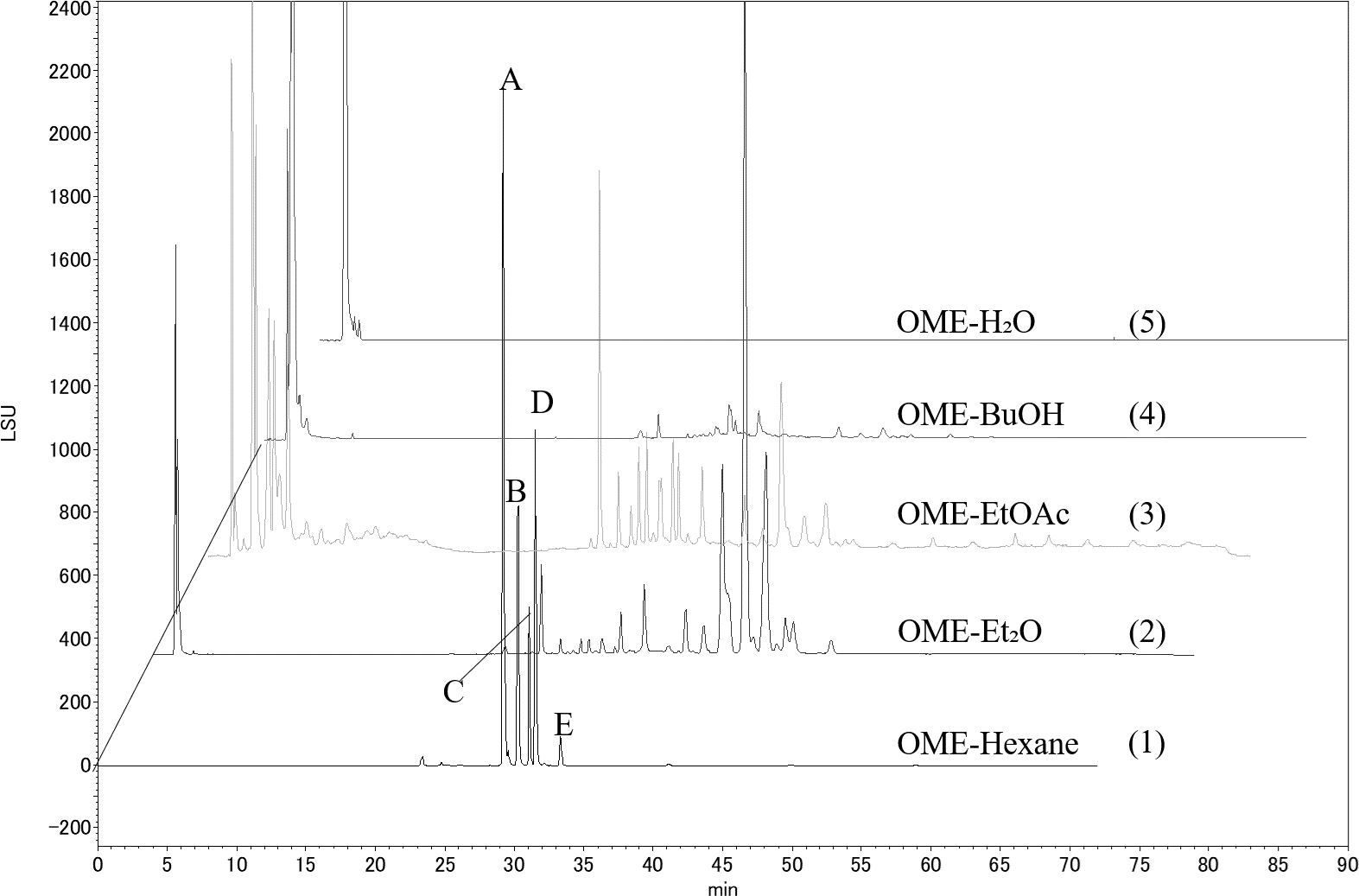
HPLC chromatograms of each fraction of OME (1; OME-Hexane, 2; OME-Et2O, 3; OME-EtOAc, 4; OME-BuOH,5; OME-H2O contained A; α-linolenic acid, B; linoleic acid, C; palmitic acid, D; oleic acid, E; stearic acid. All chromatograms were detected with ELSD).
Although Mitsuhashi reported O. yezoensis contains some fatty acids, there are no previous data on the type of fatty acids in the insect; we measured them and identified 5 different fatty acids. In particular, ALA and LA are essential fatty acids that the human body cannot synthesize, and they are important as precursors for signaling compounds such as eicosanoids. 13 Moreover, Zou et al. reported that high USFAs contents in silkworm pupae improved the lipid profile and oxidative stress parameters in high-cholesterol diet-fed rats. 14 Therefore, O. yezoensis, which contains USFAs, is beneficial as a daily life food.
Despite the results obtained in this study and the potential use of insects as a future food, the HPLC analysis of OME-BuOH and OME-H₂O suggested that they had a high content of sugars and amino acids. Hence, detailed isolation and characterization of these components shall be considered in the future.
OME-EtOAc Showed the Highest Antioxidant Activity
As shown in Table 1, OME-EtOAc showed the highest SOD activity among all of the OME fractions (IC50 = 4.9 µg/mL). In addition, OME-Et2O, OME-BuOH, and OME-H2O also exhibited activity with IC50 values of 20.3 µg/mL, 121.7 µg/mL, and 154.3 µg/mL, respectively. OME-Hexanewas inactive.
IC50 Value of OME Against Each Test of Bioactivity (Each Assay Was Measured in Triplicate. the Values Are mean ± SD).
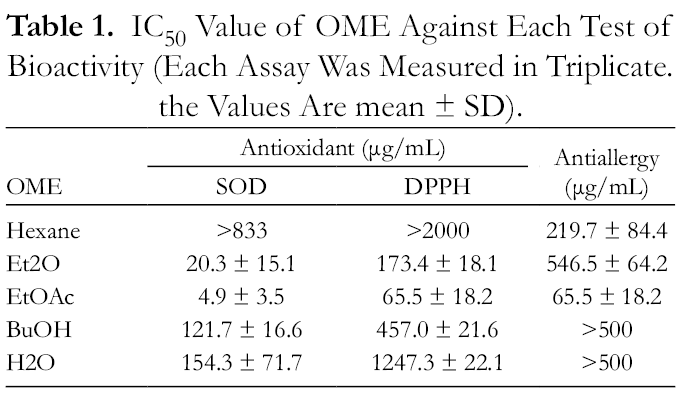
In the DPPH radical scavenging activity examination of OME, OME-EtOAc had the highest activity (IC50 = 65.5 µg/mL) compared with the other OME-fractions. In addition, OME-Et2O (IC50 = 173.4 µg/mL), OME-BuOH (IC50 = 457.0 µg/mL), and OME-H2O (IC50 = 1247.3 µg/mL) also showed DPPH radical scavenging activity, but OME-Hexane was inactive.
Antioxidant activity is a function of the metabolism to remove reactive oxygen species (ROS) produced by metabolism processes. ROS might be a trigger that can cause Alzheimer’s disease, heart disease, and neurologic disease by changing the DNA, cell lipids and through denaturation of proteins. 15 Therefore, it is important to evaluate and characterize the antioxidant activity of different kinds of foods. In this study, OME-EtOAc exhibited the highest activity among all OME-fractions in both antioxidant experiments. This means that this fraction contains some strong active compounds for removing ROS.
In our study, TPC was estimatedbyobservation ofthe reducing capacity, and OME-EtOAc showed the highest concentration of phenols (mean values of 40.4 ± 0.91 mg/g) (Figure 2). In addition, OME-Et2O, OME-BuOH, and OME-H2O, which showed antioxidant activity, also had relatively high amounts of phenolic compounds (mean values of 27.9 ± 0.23 mg/g, 35.6 ± 1.7 mg/g and 28.0 ± 1.8 mg/g). On the other hand, OME-Hexane, with no antioxidant activity, showed the lowest concentration of TPC (mean value of 11.5 ± 0.5 mg/g). In total, the amount of phenolic compounds in the dried sample was 3.41 mg/g. These results indicated that there is a correlation between antioxidant activity and phenolic compounds. In fact, a negative correlation was found between theIC50values of the SOD assay and TPC (r Pearson = −0.323), and between the IC50 values of the DPPH radical scavenging activity and TPC (r Pearson = −0.495). They are in a good agreement with published reports that phenolic compounds from cricket (Acheta domesticus) and mealworm (T. molitor) are the most important factors in antioxidant activity compared with other compounds. 16

The contents of total phenolic compounds in Each fraction of OME (Each sample was measured in duplicate. The values are mean ± SD. Tukey’s test was used after one-way ANOVA (P < 0.05). Different letters indicate statistically significant difference between groups (P < 0.05)).
As previously mentioned, the current study suggested that phenolic compounds in our sample might contribute to antioxidant activity. The OME-fraction that showed the most significant antioxidant activity was OME-EtOAc, and the active compounds in this fraction might be phenolic compounds. Although the current results showed the potential importance of the antioxidant capability of phenolic compounds in O. yezoensis, detailed research is still needed to isolate and identify the exact contributing compounds.
OME-Hexane Showed the Highest Antiallergic Activity
The β-hexosaminidase inhibitory activity of each OME-fraction was examined, and OME-Hexane showed the highest activity, with an IC50 value 219.7 µg/mL (Table 1). In addition, OME-Et2O (IC50 = 546.5 µg/mL) and OME-EtOAc (IC50 = 726.8 µg/mL) also showed β-hexosaminidase inhibition activity. OME-Hexane did not show toxicity against RBL-2H3 cells, while OME-Et2O (10, 1250 µg/mL), OME-EtOAc (10, 50 µg/mL), OME-BuOH (500 µg/mL), and OME-H2O (4, 20 µg/mL) showed toxicity (Figure 3).

The effect of different fractions from OME on cell viability in RBL-2H3 cells (Each sample was measured in triplicate. The values are mean ± SD. Dunnett’s test was used after one-way ANOVA(P < 0.05). Asterisks (*) indicate statistically significant difference at P < 0.05).
Allergic reactions are excessive immunoreactions that causes hay fever, asthma, and atopy. When an antigen is recognized by immunoglobulin E (IgE), degranulation from a mast cell occurs, and an allergic reaction is caused with the release of active mediators. 17 The mediators released by degranulation include histamines, tumor necrosis factor, interleukin and β-hexosaminidase. In this study, we measured β-hexosaminidase to estimate the antiallergic activity of OME fractions.
Because only a few studies have been performed onβ-hexosaminidase inhibition tests using insects, it is especially significant that O. yezoensis showed potential for antiallergic activity in the present study. In contrast with the results for antioxidant activity, OME-Hexane was the fraction with the strongest β-hexosaminidase inhibitory activity, followed by OME-Et2O. HPLC showed that OME-Hexane contains high amounts of fatty acids, particularly USFAs such as ALA, LA, and OA (Figure 1). Kunisawa et al. reported that α-linolenic acid rich food protected against allergic symptoms in vivo. 18
USFAs identified in OME were evaluated for their antiallergic activity by measuring their β-hexosaminidase inhibition activity. It was found that ALA, LA, and OA, which were contained in high amounts in OME-Hexane, have antiallergic activity, as shown in Figure 4. Moreover, LA (0.8, 4, 20, 100 µg/mL)and ALA (4, 20, 100 µg/mL) did not showed toxicity against RBL-2H3 cells (Figure 5). Therefore, we clearly confirmed the contribution of USFAs to the antiallergic activity of OME.
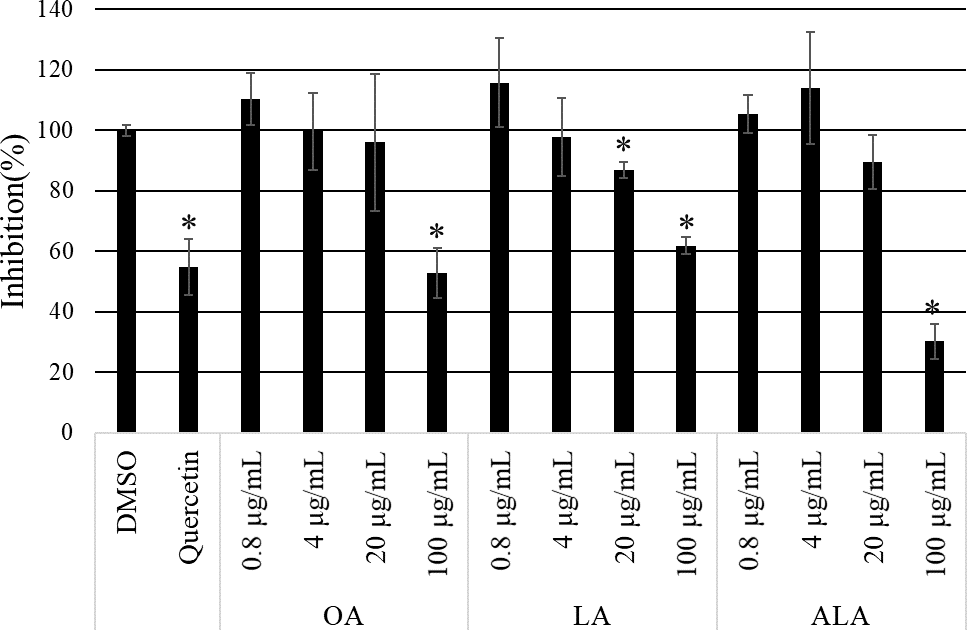
β-Hexosaminidase inhibitory activity of USFAs in OME-Hexane (Each sample was measured in triplicate. Quercetin was used as a positive control. The values are mean ± SD. Dunnett’s test was used after one-way ANOVA (P < 0.05). Asterisks (*) indicate statistically significant difference at P < 0.05).
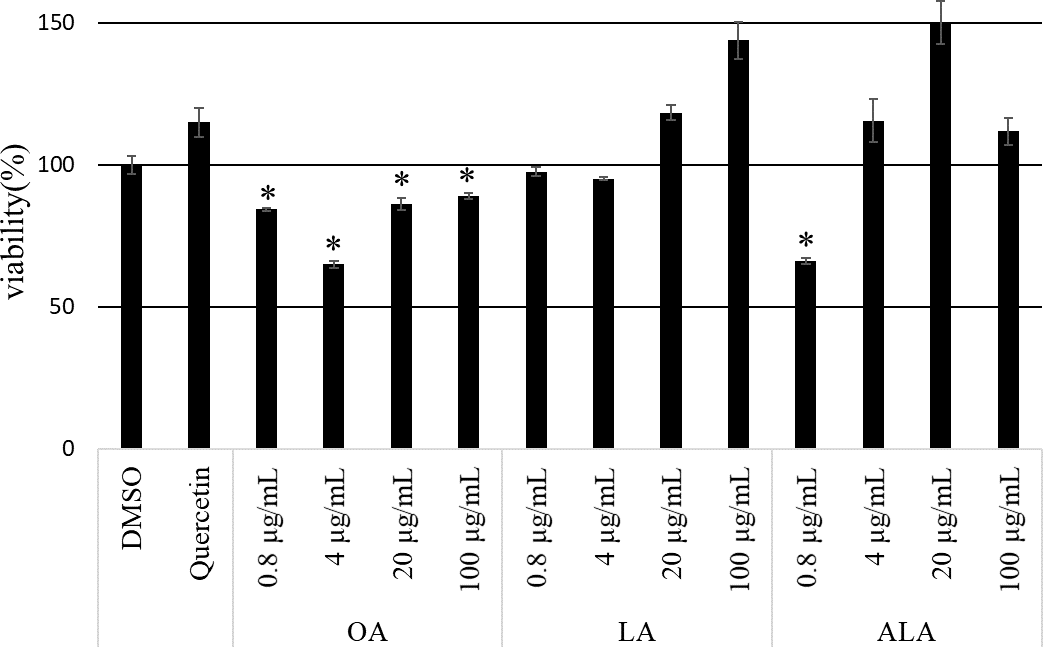
The effect of USFAs in OME-Hexane on cell viability in RBL-2H3 cells (Each sample were measured in triplicate. The values are mean ± SD. Dunnett’s test was used after one-way ANOVA (P < 0.05). Asterisks (*) indicate statistically significant difference at P < 0.05).
In addition, OME-Et2O and OME-EtOAc showed β-hexosaminidase inhibition activity, even though the amount of USFAs was not very high. Moreover, there was no correlation between the activity and TPC. From this point of view, the antiallergic active compounds in OME are not only fatty acids, but also other classes of compounds that are not phenolic. Thus, further detailed study is needed to identify the compounds, other than USFAs, that contribute to the β-hexosaminidase inhibition activity.
Conclusions
In conclusion, the methanol extract of Oxyayezoensis was partitioned into five fractions by liquid-liquid fractionation. The obtained fractions were evaluated for their capacities for antioxidant and β-hexosaminidase inhibitory activity. The ethyl acetate-soluble fraction of OME, which contained high amounts of total phenolic compounds, was observed to have the highest antioxidant activity, and the n-hexane-soluble fraction of OME, which contained high amounts of fatty acids, showed the highest β-hexosaminidase inhibitory activity. In particular, the contributions of linolenic acid, linoleic acid and oleic acid to β-hexosaminidase inhibitory activity were confirmed.
The current study provides insights into the utilization of insects as functional foods and as promising potential natural food sources with novel bioactivities such as antioxidant and antiallergy activities. In the future, a detailed chemical investigation is to be considered to isolate and characterize the compounds that contribute to the bioactivities studied.
Materials and Methods
Sample Materials
Oxya yezoensis was purchased from Tsukahara Shinshu Chinmi Company (Nagano, Japan). The sample was kept in refrigerator at −20 ℃.
Chemicals
DPPH was purchased from Tokyo Chemical Industry Co., Ltd.(Toyko, Japan), α-linolenic acid, linoleic acid, and oleic acid from Wako (Osaka, Japan), palmitic acid, and stearic acid from Kishida (Osaka, Japan), Folin-Ciocalteu’s phenol reagent from Merck (Darmstadt, Germany).
Sample Extraction and Fractionation
O. yezoensis was freeze-dried and milled, then 5.14 g of sample was extracted with 30 ml of methanol by sonication for 30 minutes repeated 10 times. After concentration of the combined extracts, the crude extracts (OME, 549 mg) were suspended in 30% aqueous methanol and sequentially partitioned with n-hexane, diethyl ether, ethyl acetate, and n-butanol to yield corresponding fractions, namely an n-hexane-soluble fraction (OME-Hexane, 27 mg), diethyl ether-soluble fraction (OME-Et2O, 68 mg), ethyl acetate-soluble fraction (OME-EtOAc, 77 mg), n-butanol-soluble fraction (OME-BuOH, 281 mg), and aqueous fraction (OME-H₂O, 81 mg). The obtained fractions were subjected to HPLC analysis and biological investigation.
Measurement of Antioxidant Activity
Each OME fraction was measured with 2 different antioxidant tests (Super oxide anion radical (O₂-) and DPPH radical) to evaluate the radical scavenging activity.
A SOD assay was performed using the SOD assay kit-WST which was purchased from Dojindo-Laboratory (Kumamoto, Japan). The sample preparation and method were performed according to the manufacturer’s protocol. Twenty μL of sample suspension in dilution buffer, 200 µL of WST working solution, and 20 µL of enzyme working solution were mixed in 96-well plates and incubated at 37℃ for 10 minutes. The absorbance of the final solution was measured at 450 nm. The IC50 value in this study was determined as the 50% inhibition level of generation of super oxide anion radicals.
A DPPH radical scavenging activity assay was conducted as described in the literature 19 with some modifications. Sample solution (15 µL) dissolved in methanol, 150 µL of DPPH methanol solution (0.2 mM), and 2-morphlinoethanesulfonic acid water solution (0.2 mM) were mixed in a 96 well plate. This was kept at room temperature for 20 minutes in the dark. The absorbance of the final solution was measured at 515 nm. The 50% inhibition level of DPPH radicals was calculated as the IC50 value. Trolox was used as a positive control.
Measurement of Antiallergic Activity
The measurement of β-hexosaminidase inhibitory activity was conducted as previously described byBarbosa et al. 20 with some modifications. RBL-2H3 cells (concentration: 2.5 × 10⁴ cells/well) in 96-well plates were cultured in Eagle’s minimum essential medium (E-MEM) containing 10% fetal bovine serum (FBS) and 1% penicillin-streptomycin solution (sp) and maintained at 37 ℃ in a humidified atmosphere with 5% CO2 for 24 hours. Before stimulation with calcium ionophore A23187, the cells were pre-treated with serial dilutions of the sample solution. OME-Hexane, OME-Et2O and OME-EtOAc (final concentration; 2 ~ 1250 µg/mL) were dissolved in DMSO, and OME-BuOH and OME-H₂O in milliQ (final concentration; 4 ~ 500 µg/mL). Three UFSAs; ALA, LA and OA (final concentration; 0.8 ~ 100 µg/mL) were dissolved in DMSO. 4-Nitrophenyl-N-acetyl-β-glucosaminide was added to the supernatant of the cells and the absorbance of the final solution was measured at 405 nm. The IC50 value in this study was set at the level of 50% inhibition of β-hexosaminidase activity. Quercetin was applied as a positive control.
MTT Reduction Assay
RBL-2H3 cell viability was assessed by the 3-(4,5-dimethylthiazol-2-yl)−2,5-diphenyltetrazolium bromide (MTT) assay described in the literature, 21 with some modifications. After treatment with sample solution, the cells were incubated with 20 µL of MTT solution (5 mg/mL in PBS) and 100 µL of E-MEM containing 1% sp. The formazan crystals were eluted by 100 µL of HCl (40 mM) in isopropanol and the final solution was measured at 570 nm.
Measurement of Total Phenolic Content
The total phenolic content (TPC) was determined by the Folin-Ciocalteu colorimetric test, as previously described. 22 All of the samples were dissolved in ethanol. Gallic acid was used as the standard. The absorbance of the final solution was measured at 765 nm.
HPLC Analysis
HPLC analysis of the O. yezoensis extracts was performed using an Agilent Technologies 1220 Infinity LC (Agilent Technologies, Japan) equipped with a 1290 Infinity Ⅱ ELSD (Agilent Technologies, Japan). The separation of analytes was efficiently performed on a YMC triart C18 column (150 mm × 4.6 mm i.d.; 5 µm particle size) (YMC CO., Japan), and 5 µL of sample (10 mg/mL) was injected. The column temperature was set at 40 ℃. The mobile phases were 0.1% (v/v) formic acid aqueous solution (phase A) and 0.1%(v/v) formic acid methanol (phase B) at a flow rate of 1.0 mL/min. The solvent gradient program was as follows: 50% B for 5 minutes, increased to 95% B for 30 minutes, increased to 97% B for 6 minutes, maintained for 2 minutes, increased to 98% B for 5 minutes, maintained for 2 minutes, increased to 99% B for 5 minutes, maintained for 2 minutes, increased to B for 3 minutes, maintained for 15 minutes, decreased to 50% B for 1 minutes, and maintained for 4 minutes. The photodiode array detection wavelength was 190‐400 nm. The ELSD evaporator temperature and nebulizer temperature were both 30℃. The gas flow ratio was 1.6 mL/min.
Statistical Analysis
All statistical analysis was made using Microsoft Excel 2016. Tukey’s test was used after analysis of variance (ANOVA) against measurement of TPC to assess statistical differences between fractions. Student’s t-test was used after ANOVA to assess statistical differences between the assay results of samples and negative controls. Dunnett’s test was used as a modification of P value. A value of P < 0.05 was considered significant (*).
Footnotes
Acknowledgments
We gratefully acknowledge Prof. Atsushi Kume, Kyushu University, for his kindly support and to Hiroto Tanaka, Inaka-Denshosha in Wakayama prefecture, for his interesting advice to us.
Declaration of Conflicting Interests
The author(s) declared no potential conflicts of interest with respect to the research, authorship, and/or publication of this article.
Funding
The author(s) received no financial support for the research, authorship, and/or publication of this article.
