1H and 13C nuclear magnetic resonance (NMR) data and specific rotations of eremophilane sesquiterpenoids are cumulated as a series of review articles. This fourth chapter focuses on furanoeremophilanes bearing 10H with C-3 oxygen functionality, and 175 10H-furanoeremophilanes with 3-O functionality are listed in 38 tables. Those with 15,6-lactones and 6,15-ethers are included in this chapter. Dihydrofurans, lactols, dimers, nor- and seco-compounds, and other related compounds, are not included in this chapter. These data may help chemists working in the area of natural products chemistry and synthetic scientists as well as computational chemists.
Isolation of numerous eremophilane-type sesquiterpenoids has been reported, and the number of compounds continues to increase. As a part of an ongoing series of reviews,1-3 data of 175 furanoeremophilane sesquiterpenoids are listed in Tables 1–38. This chapter focuses on furanoeremophilanes bearing 10H with C-3 oxygen functionality. The eremophilane skeleton, esters attached to compounds, and their numberings are shown in Figure 1.1 The compounds mentioned in this chapter are shown in Figures 2–14. Dihydrofurans, lactols, dimers, nor- and seco-compounds, and other related compounds will be discussed in separate chapters in the future. In the case of compounds having more than 2 acyloxy groups, the one substituted in the lower numbered position is numbered with a prime, the next with a double prime, and so on. The coupling constants are sorted from the largest to the smallest; the order of the type of splitting pattern, d, t, or q, must correspond to the value of the coupling constant. In the case of apparent situation, original data were fixed to the proper order, or the problem with the data pointed out in the footnotes. The data that were not assigned in the original papers were tentatively included in the tables without any supporting evidence. The solvents used for nuclear magnetic resonance (NMR) and [α]D were indicated with abbreviations (A: acetone or acetone-d6; B: benzene or benzene-d6; C: chloroform or chloroform-d; D: dimethyl sulfoxide or dimethyl sulfoxide-d6; E: ethanol; F: dichloromethane; H: hexane; M: methanol or methanol-d4; P: pyridine or pyridine-d5; and T: carbon tetrachloride). Solvents were selected by original chemists depending on the solubility and the stability of compounds, or the easiness of analyses. Source of compounds were also abbreviated (Ca: Cacalia [current Parasenecio, however original description has been remained]; Cr: Cremanthodium; E: Eremophila; F: Farfugium; L: Ligularia; P: Petasites; S: Senecio; V: Valeriana). These data may help chemists working in the area of natural products chemistry and synthetic scientists as well as computational chemists.4,5
The eremophilane skeleton, esters, and their numberings.
Data in ref. 8, [α]D +53 (CHCl3), +78 (MeOH) prepared from furanoligularenone.
Probably CDCl3 by analogy.
Discussion
The data of 10βH-furanoeremophilan-3α-ol (1),6 10αH-furanoeremophilan-3β-ol (2),7-9 10βH-furanoeremophilan-3β-ol (3),7,9 and 10αH-furanoeremophilan-3-one (4)8,10,11 (Figure 2) are listed in Table 1. Both 10αH- and 10βH-furanoeremophilan-3β-ols have been reported.7-9 Compounds 1 and 3 are C-3 epimers. The data are relatively old and full assignment has not been reported for compounds 1-4. Furanoligularanol (2) is found in nature and also synthesized by hydrogenation of furanoligularenone.7-9 The specific rotation of natural compound 2 is reported to be [α]D +53 (CDCl3) in reference 8, and the one prepared from furanoligularenone +78 (MeOH).8
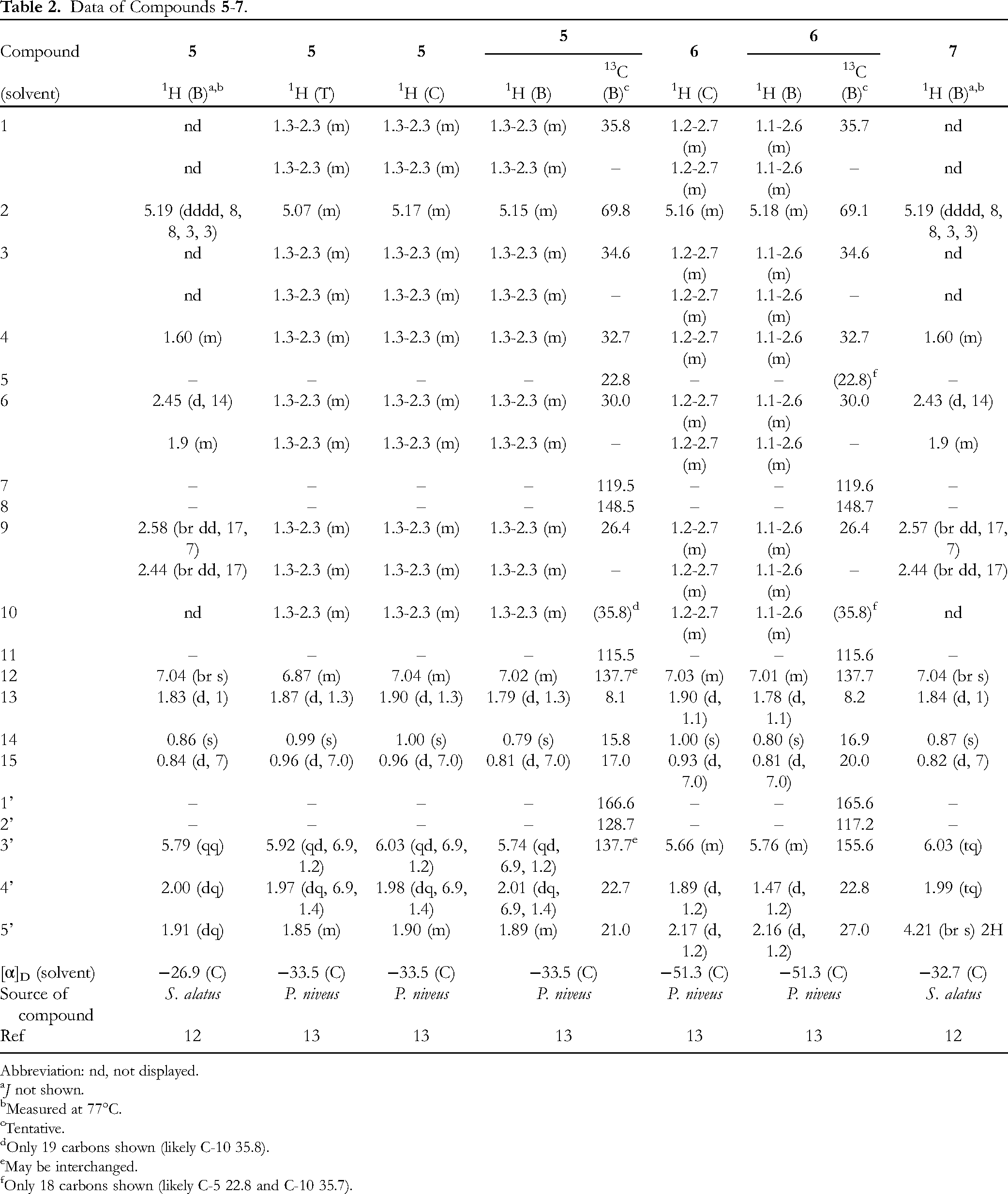
Table 2 shows the data of 10βH-2β-angeloyloxyfuranoeremophilane (5),12,13 10βH-2β-senecioyloxyfuranoeremophilane (6),13 and 10βH-2β-(5'-hydroxyangeloyloxy)furanoeremophilane (7)12 (Figure 2). Compounds 5 and 7 were measured at 77 °C in C6D6, probably due to broadening of some peaks. The 13C NMR data of compound 5 in reference 13 showed only 19 carbons; presumably the resonance at δ 35.8 corresponds to 2 carbons for C-1 and C-10. Only 18 carbons were listed for compound 6 in reference 13; it can be considered that the resonances of 2 carbons C-5 and C-10 are likely overlapped at δ 22.8 (C-5 and 4') and 35.7 (C-1 and 10), respectively.
Only 18 carbons shown (likely C-5 22.8 and C-10 35.7).
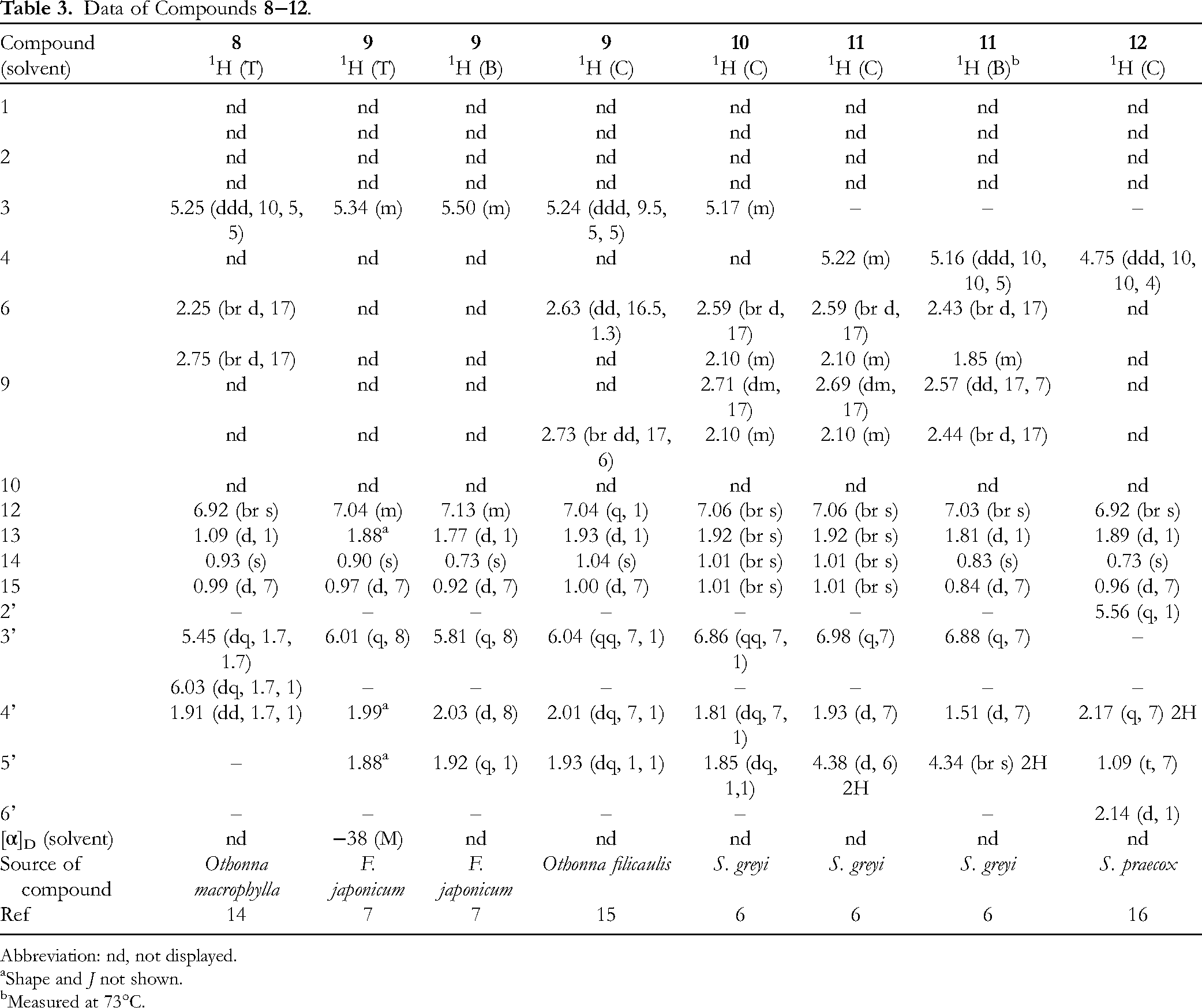
Table 3 compiles the data of five 3-acyloxyfuranoeremophilanes, 8-12 (Figure 2).6,7,14-16 Compounds 8-11 have 10βH, while 12 10αH. Unfortunately, the data of H-10 have not been reported for these compounds. The acyl groups of these compounds are different from each other. There are 2 hydrogen atoms at C-6 and C-9, but only 1 proton is shown for compound 9,15 unfortunately. Compound 11 was measured in C6D6 at 73 °C.6
The data of two 2,3-dihydroxyfuranoeremophilanes, 13 and 14,15 and three 3,6-dihydroxyfuranoeremophilanes, 15-17,17-21 (Figure 3) are presented in Table 4. The configurations at C-3 and C-10 of compounds 13 and 14 are different. Compounds 15 and furanofukinol (16) are C-3 epimers, while furanofukinol (16) and 17 C-6 epimers. The configuration at C-3 of furanofukinol (16) was previously assigned 3α-OH,19 but later revised to 3β-OH as depicted in structure 16.17,20
Compounds 13-19.
Data of Compounds 13-17.
Compound
13
14
15
16
16
16
17
(solvent)
1H (T)
1H (C)
1H (D)
1H (D)
1H (D)
1H (C)
13C (P)
1H (D)
1
nd
nd
nd
nd
nd
nd
27.0
nd
nd
nd
nd
nd
nd
nd
–
nd
2
3.65 (m)
4.03 (m)
nd
nd
nd
nd
28.2
nd
–
–
nd
nd
nd
nd
–
nd
3
3.65 (m)
4.03 (m)
nd
nd
nd
4.21 (ddd, 10, 5, 5)
68.1
nd
4
nd
nd
nd
–
–
–
39.3
nd
5
–
–
–
–
–
–
43.0
–
6
nd
nd
nd
nd
nd
4.90 (br s)
66.8
4.70 (d, 7)
7
–
–
–
–
–
–
121.4
–
8
–
–
–
–
–
–
149.5
–
9
nd
nd
nd
–
–
–
30.4
–
10
nd
nd
nd
nd
nd
nd
37.0
–
11
–
–
–
–
–
–
119.5
–
12
7.00 (br s)
7.05 (br s)
7.14 (m)
nd
nd
nd
138.4
–
13
1.85 (d, 1)
1.89 (d, 1)
1.98 (d, 1)
7.14 (m)
7.16 (br s)
7.06 (q, 1.3)
7.7
1.94 (d, 1)
–
–
–
1.98 (d, 1)
2.00 (br s)
2.07 (d, 1.3)
–
–
14
0.99 (s)
1.00 (s)
0.77 (s)
0.77 (s)
0.76 (s)
0.95 (s)
9.1
0.73 (s)
15
0.89 (d, 6.5)
1.11 (d, 6.5)
0.84 (d, 7)
0.84 (d, 7)
0.84 (d, 7)
0.97 (d, 7.3)
20.1
0.91 (d, 7)
OH
–
–
–
–
–
–
–
4.09 (d, 5) 3-OH
OH
–
–
–
–
–
–
–
4.87 (d, 7) 6-OH
[α]D (solvent)
nd
nd
nd
nd
nd
−18 (dioxane)
nd
Source of compound
Synthetic
Synthetic
Synthetic
Synthetic
Synthetic
P. japonicus
Synthetic
Ref
15
15
17
17
18
19, 20
21
Abbreviation: nd, not displayed.
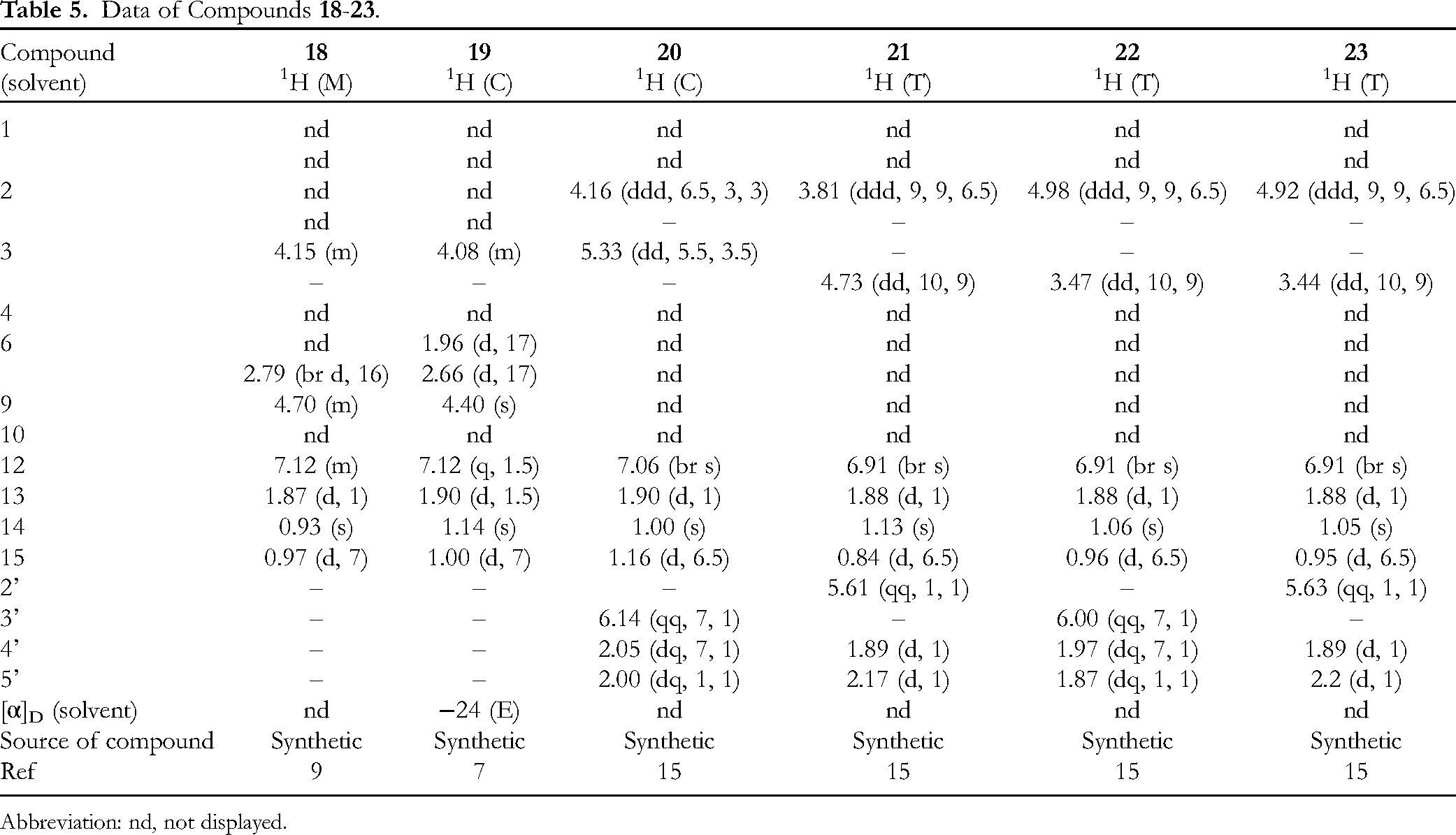
The data of two 3,9-diols, 18 and 197,9 (Figure 3), and four 2,3-diol monoacyloxy derivatives, 20-2315 (Figure 4) are provided in Table 5. Compounds 18 and 19 are C-9 epimers.7,9 The 1H NMR spectrum of compound 18 was measured in CD3OD, while 19 in CDCl3, and the shape of H-9 of 18 was multiplet, while that of 19 singlet. The specific rotation of 18 was not reported, because this was the racemic synthetic product. Compound 20 has 2β,3β-configurations, but compounds 21-23 2β,3α-configurations. Compounds 20 and 22 have angeloyloxy groups, and 21 and 23 senecioyloxy groups. It is interesting to note that H-3 of compound 20 resonates at δ 5.33, rather lower field than other data.
Compounds 20-34.
Data of Compounds 18-23.
Compound
18
19
20
21
22
23
(solvent)
1H (M)
1H (C)
1H (C)
1H (T)
1H (T)
1H (T)
1
nd
nd
nd
nd
nd
nd
nd
nd
nd
nd
nd
nd
2
nd
nd
4.16 (ddd, 6.5, 3, 3)
3.81 (ddd, 9, 9, 6.5)
4.98 (ddd, 9, 9, 6.5)
4.92 (ddd, 9, 9, 6.5)
nd
nd
–
–
–
–
3
4.15 (m)
4.08 (m)
5.33 (dd, 5.5, 3.5)
–
–
–
–
–
–
4.73 (dd, 10, 9)
3.47 (dd, 10, 9)
3.44 (dd, 10, 9)
4
nd
nd
nd
nd
nd
nd
6
nd
1.96 (d, 17)
nd
nd
nd
nd
2.79 (br d, 16)
2.66 (d, 17)
nd
nd
nd
nd
9
4.70 (m)
4.40 (s)
nd
nd
nd
nd
10
nd
nd
nd
nd
nd
nd
12
7.12 (m)
7.12 (q, 1.5)
7.06 (br s)
6.91 (br s)
6.91 (br s)
6.91 (br s)
13
1.87 (d, 1)
1.90 (d, 1.5)
1.90 (d, 1)
1.88 (d, 1)
1.88 (d, 1)
1.88 (d, 1)
14
0.93 (s)
1.14 (s)
1.00 (s)
1.13 (s)
1.06 (s)
1.05 (s)
15
0.97 (d, 7)
1.00 (d, 7)
1.16 (d, 6.5)
0.84 (d, 6.5)
0.96 (d, 6.5)
0.95 (d, 6.5)
2'
–
–
–
5.61 (qq, 1, 1)
–
5.63 (qq, 1, 1)
3'
–
–
6.14 (qq, 7, 1)
–
6.00 (qq, 7, 1)
–
4'
–
–
2.05 (dq, 7, 1)
1.89 (d, 1)
1.97 (dq, 7, 1)
1.89 (d, 1)
5'
–
–
2.00 (dq, 1, 1)
2.17 (d, 1)
1.87 (dq, 1, 1)
2.2 (d, 1)
[α]D (solvent)
nd
−24 (E)
nd
nd
nd
nd
Source of compound
Synthetic
Synthetic
Synthetic
Synthetic
Synthetic
Synthetic
Ref
9
7
15
15
15
15
Abbreviation: nd, not displayed.
Table 6 tabulates the data of 6β-ethoxyfuranoeremophilan-3β-ol, 24,13 6β-acetoxyfuranoeremophilan-3α-ol 25,22 and three 6β-acyloxy-3-ols, 26-28 (Figure 4).20,22-25 Unfortunately, only H-6 and acetyl protons were reported for compound 25.22 Coupling constants for a 2-methylbutanoyl group of compound 26 were not described.23
Table 7 gives the data of two 6β-acyloxy-3β-ols, 29 and 30,13,14 three 3-acyloxy-6β-ols, 31-33,15,17,26 and 3β-angeloyloxyfuranoeremophilan-9β-ol 34 (Figure 4).7 Compounds 29 has a tigloyloxy group at C-6, while 30 a senecioyloxy group. Compounds 32 and 33 are C-3 epimers. Because H-3 of compounds 29-31 and 33 have at least one large coupling, these molecules seem to adopt non-steroid-like conformations (vide infra).
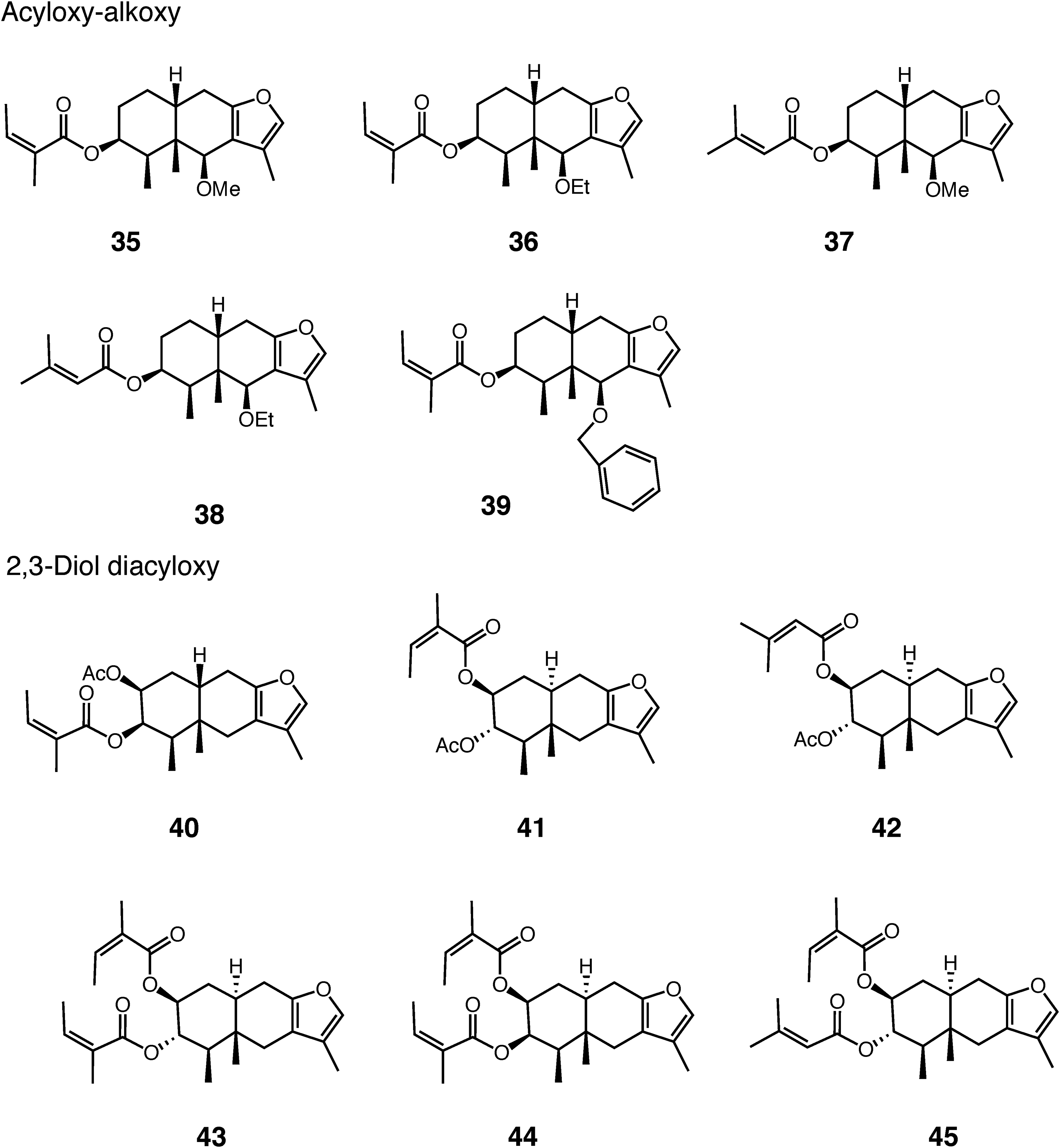
The data of five 3β-acyloxy-6β-alkoxyfuranoeremophilanes, 35-39 (Figure 5)13 are found in Table 8. Compounds 35 and 36 are isomers of 6β-alkoxy groups. Compounds 35 and 37, and 36 and 38 are isomers of 3β-acyloxy groups. Compound 39 have a benzyl group at C-6. Five aromatic protons of compound 39 appeared at δ 7.34 (m) in CDCl3 and δ 7.15 (m) in C6D6.13 The 13C NMR data of compound 38 in C6D6 have been tentatively assigned.
Table 9 lists the data of six 2,3-diacyloxyfuranoeremophilanes, 40-4515 (Figure 5) and 3β,6β-diacetoxyfuranoeremophilane (46)20,21 (Figure 6). Compounds 40-42 are monoacetates, and 46 is diacetate. Compounds 40 and 41 have angeloyloxy groups, and 43 and 44 bis(angeloyloxy) groups. Compound 45 has an angeloyloxy group at C-2 and a senecioyloxy group at C-3. The data of an acetyl group of compound 40 is not described.15
Compounds 46-62.
Data of Compounds 40-46.
Compound
40
41
42
43
44
45
46
46
(solvent)
1H (C)
1H (T)
1H (T)
1H (T)
1H (C)
1H (T)
1H (C)
1H (C)
1
nd
nd
nd
nd
nd
nd
nd
nd
nd
nd
nd
nd
nd
nd
nd
nd
2
5.38 (m)
5.08 (m)
5.05 (m)
5.20 (m)
5.40 (m)
5.15 (m)
nd
nd
–
–
–
–
–
–
nd
nd
3
5.38 (m)
5.08 (m)
5.05 (m)
5.20 (m)
5.40 (m)
5.15 (m)
5.32 (m)
5.28 (ddd, 10, 5.5, 5.5)
4
nd
nd
nd
nd
nd
nd
nd
nd
6
nd
nd
nd
nd
nd
nd
6.37 (br s)
6.28 (s)
9
nd
nd
nd
nd
nd
nd
nd
nd
nd
nd
nd
nd
nd
nd
nd
nd
10
nd
nd
nd
nd
nd
nd
nd
nd
12
7.04 (br s)
6.92 (br s)
6.92 (br s)
6.93 (br s)
7.04 (br s)
6.92 (br s)
7.06 (m)
6.98 (q, 1.1)
13
1.90 (d, 1)
1.88 (d, 1)
1.88 (d, 1)
1.88 (d, 1)
1.90 (d, 1)
1.89 (d, 1)
1.88 (d, 1)
1.82 (d, 1.1)
14
1.02 (s)
1.17 (s)
1.16 (s)
1.18 (s)
1.00 (s)
1.17 (s)
1.01 (s)
0.98 (s)
15
1.15 (d, 6.5)
0.82 (d, 6.5)
0.82 (d, 6.5)
0.83 (d, 6.5)
1.14 (d, 6.5)
0.82 (d, 6.5)
0.97 (d, 7)
0.93 (d, 6.0)
2'
nd
–
5.56 (qq, 1, 1)
–
–
–
2.03 (s) 3-OAc
2.00 (s) OAc
3'
–
5.98 (qq, 7, 1)
–
5.94 (m)
6.08 (qq, 7, 1)
5.94 (qq, 7, 1)
–
–
4'
–
1.96 (dq, 7, 1)
1.89 (d, 1)
1.94 (dq, 7, 1)
2.00 (dq, 7, 1)
1.8-2.0 (m)
–
–
5'
–
1.82 (dq, 1, 1)
2.14 (d, 1)
1.8-1.9 (m)
1.89 (br s)
1.8-2.0 (m)
–
–
2''
–
1.92 (s) OAc
1.91 (s) OAc
–
–
5.55 (qq, 1, 1)
2.13 (s) 6-OAc
2.11 (s) OAc
3''
6.09 (qq, 7, 1)
–
–
5.94 (m)
6.08 (qq, 7, 1)
–
–
–
4''
2.01 (dq, 7, 1)
–
–
1.8-1.9 (m)
2.00 (dq, 7, 1)
1.8-2.0 (m)
–
–
5''
1.89 (dq, 1, 1)
–
–
1.94 (dq, 7, 1)
1.89 (br s)
2.12 (d, 1)
–
–
[α]D (solvent)
nd
nd
−15.3 (C)
nd
nd
nd
nd
−53.7 (C)
Source of compound
Othonna bulbosa
Othonna bulbosa
Othonna bulbosa
Othonna bulbosa
Othonna bulbosa
Othonna bulbosa
Synthetic
Synthetic
Ref
15
15
15
15
15
15
21
20, 21
Abbreviation: nd, not displayed.
Table 10 compiles the data of nine 3,6-diacyloxy compounds, 47-55 (Figure 6).15,23-25,27 Compounds 47-50 have 3β-acetoxy groups, while 51-55 6β-acetoxy groups. Compounds 52 and 53 are C-3 epimers. The data of an acetyl group of compounds 51-55 are not described. Only a part of 1H NMR data were reported for compound 51.27 The H-3 of compounds 52, 54, and 55 appear as (ddd, 10, 10, 5) indicating that these molecules adopt steroid-like conformations (vide infra).
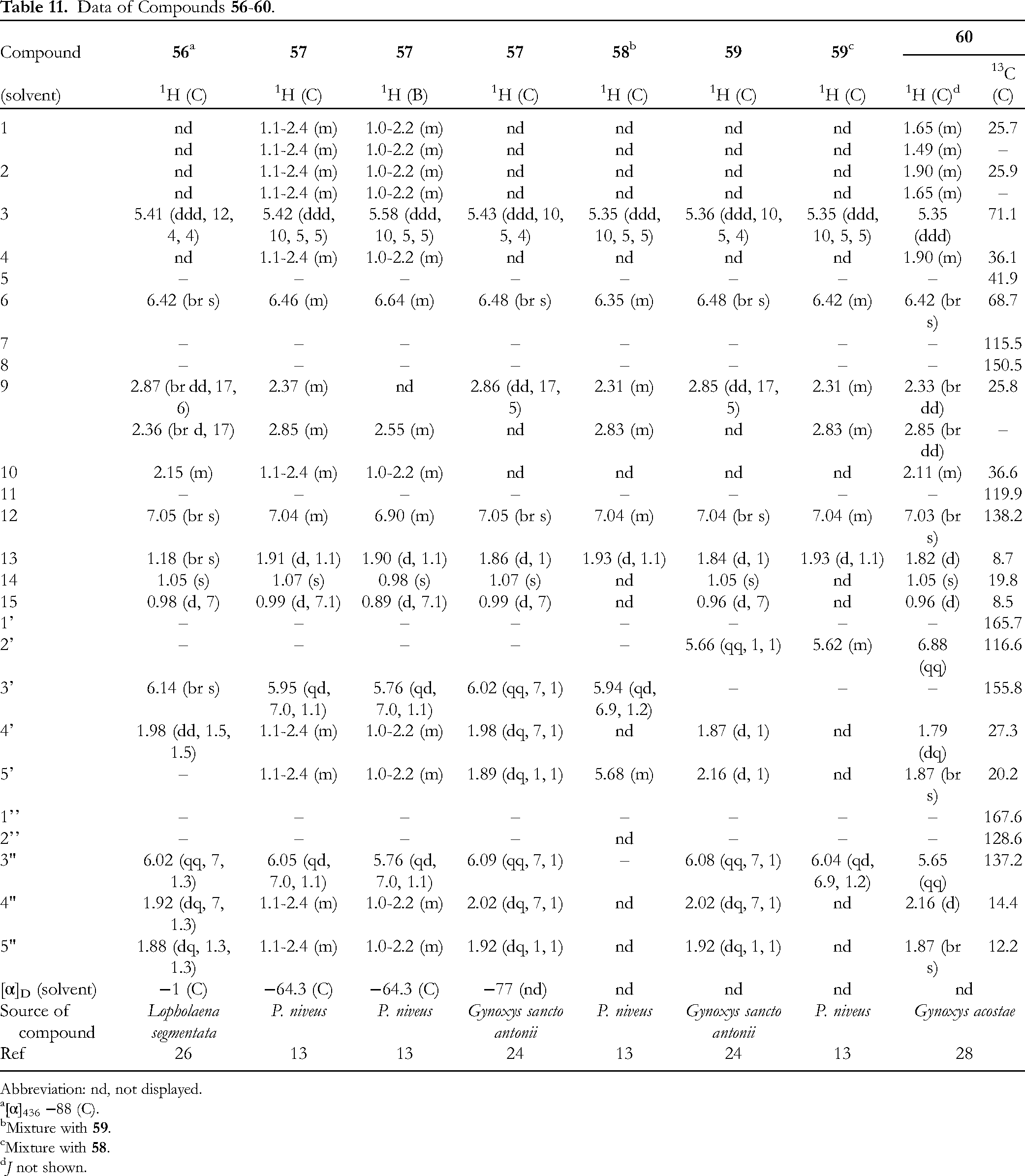
The data of five 3,6-diacyloxyfuranoeremophilanes, 56-60 (Figure 6)13,24,26,28 are presented in Table 11. Compounds 56, 57, and 59 are 6β-angeloyloxy compounds, while 60 a 6β-tigloyloxy derivative. Compounds 57 and 58 have 3β-angeloyloxy groups, while 59 and 60 senecioyloxy groups. The specific rotation of compound 56 was quite small (−1 in CHCl3), therefore, it was measured at 436 nm to show [α]436 −88 (CHCl3).26 Compound 58 is a mixture with compound 59. The H-3 of all compounds (couplings not clear in compound 60; nevertheless similar values expected) show one large coupling, indicating that these compounds adopt non-steroid-like conformations (vide infra).
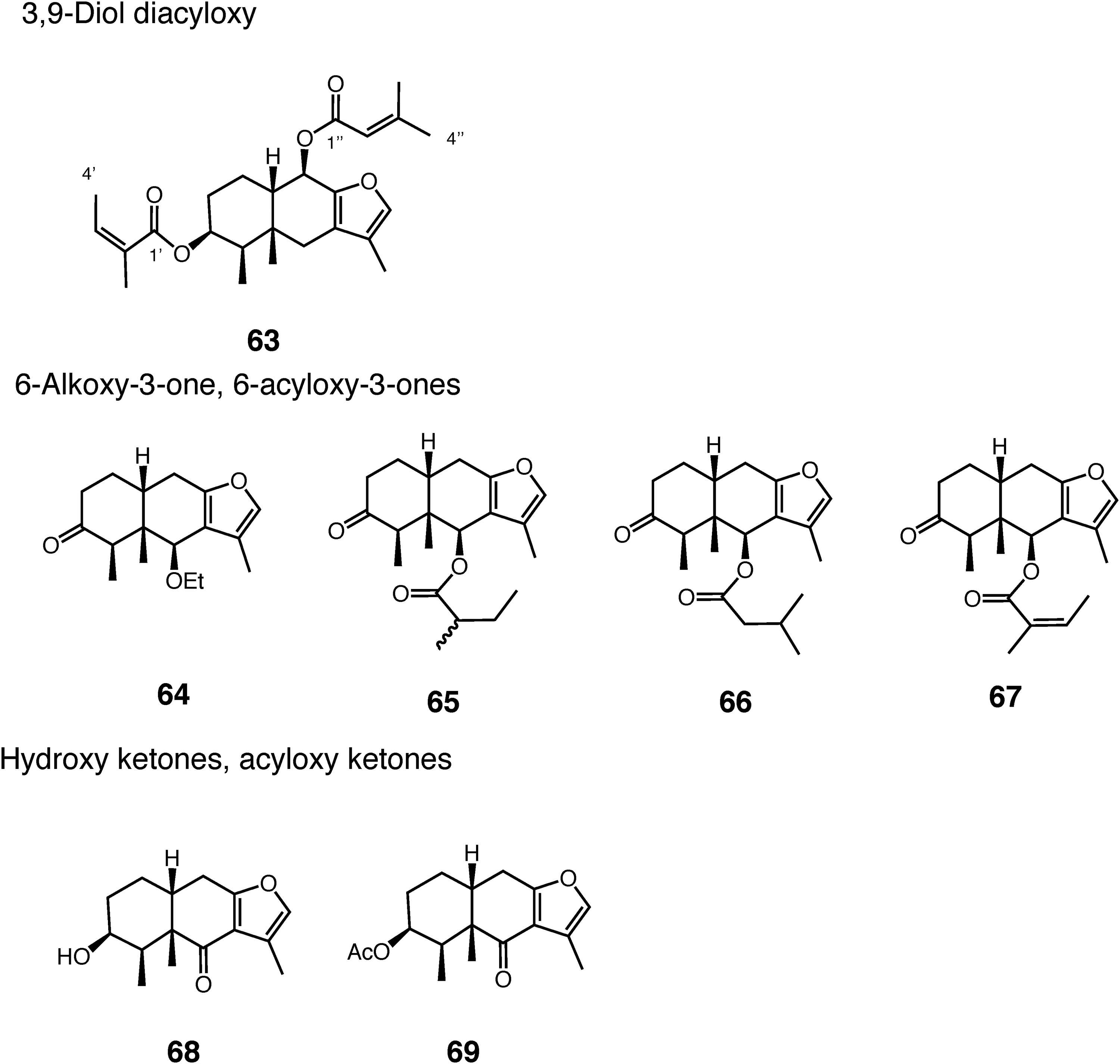
Table 12 provides the data of two 3,6-diacyloxyfuranoeremophilanes, 6113,14 and 62,20,22 (Figure 6) and 3,9-diacyloxyfuranoeremophilane 63 (Figures 7).7 Compound 61 has 2 senecioyloxy groups, while 63 a senecioyloxy and an angeloyloxy group. S-furanopetasitin (62) has an angeloyloxy group at C-6β and a (3'-methylthio)propenoyloxy group at C-3α. Compound 61 from Orthonna intermedia is a mixture with other compounds.14 Data of compound 61 described in references 13 and 14 are not necessarily the same. More detailed studies are expected in the future.
Table 13 tabulates the data of 6β-ethoxyfuranoeremophilan-3-one (64)29 and three 6β-acyloxyfuranoeremophilan-3-ones, 65-67 (Figure 7).29,30 All the compounds having 3-oxo groups have been isolated from Ligularia stenoglossa, the data being reported in the meeting, but the data not published in the literature.
Data of Compounds 64-67.
Compound
64
65
65
66
67
(solvent)
1H (B)
1H (C)
13C (C)
1H (B)
13C (B)
1H (B)
13C (B)
1H (B)
13C (B)
1
1.15 (ddt, 14.3, 7.2, 3.6)
1.81-1.90 (m)
25.9
1.11 (m)
25.8
1.11 (m)
25.8
1.12 (m)
25.8
1.61 (m)
2.11-2.23 (m)
–
1.63 (m)
–
1.63 (m)
–
1.61 (m)
–
2
1.90 (ddd, 15.1, 11.5, 7.4)
2.38-2.59 (m)
36.3
1.84 (m)
36.2
1.84 (m)
36.2
1.84 (m)
36.2
2.08 (ddd, 15.1, 6.0, 3.6)
2.29-2.41 (m)
–
2.05 (m)
–
2.05 (m)
–
2.05 (m)
–
3
–
–
211.7
–
209.0
–
209.0
–
209.1
4
1.96 (m)
2.29-2.41 (m)
46.4
1.84 (q, 6.4)
46.2
1.84 (q, 6.4)
46.2
1.86 (q, 6.7)
46.3
5
–
–
43.8
–
43.8
–
43.8
–
43.9
6
3.81 (s)
5.89 (s)
68.4
6.05 (s)
68.6
6.05 (s)
68.7
6.14 (s)
68.7
7
–
–
111.6
–
116.6
–
116.6
–
116.6
8
–
–
152.3
–
152.9
–
152.9
–
152.8
9
2.34 (dd, 17.3, 9.0)
2.83 (dd, 17.4, 6.9)
24.8
2.36 (m)
24.9
2.36 (m)
24.9
2.37 (d, 8.6)
25.0
2.43 (dd, 17.3, 7.4)
2.91 (dd, 17.4, 10.6)
–
2.36 (m)
–
2.36 (m)
–
2.37 (d, 8.6)
–
10
2.27 (m)
2.45-2.53 (m)
34.2
2.13 (m)
34.4
2.13 (m)
34.4
2.13 (m)
34.8
11
–
–
119.4
–
119.8
–
119.8
–
119.8
12
6.97 (s)
7.09 (s)
138.4
6.91 (s)
138.7
6.91 (s)
138.7
6.89 (s)
138.7
13
1.82 (s)
1.93 (s)
8.1
2.00 (s)
8.4
2.00 (s)
8.4
1.99 (s)
8.4
14
0.96 (s)
0.91 (s)
18.1
0.80 (s)
18.2
0.80 (s)
18.2
0.81 (s)
18.3
15
0.86 (d, 6.8)
0.98 (d, 6.6)
7.9
0.96 (d, 6.4)
8.1
0.96 (d, 6.4)
8.1
0.97 (d, 6.7)
8.3
1'
3.27 (dq, 8.4, 6.9)
–
176.1
–
171.9
–
171.9
–
167.1
3.48 (dq, 8.4, 6.9)
–
–
–
–
–
–
–
–
2'
1.07 (t, 6.9)
2.29-2.41 (m)
41.3
2.20 (sext, 6.8)
41.5
1.98 (m) 2H
43.5
–
128.0
3'
–
1.37-1.49 (m)
26.6
1.62 (m)
27.1
2.07 (m)
25.7
5.66 (qq, 7.3, 1.5)
138.0
–
1.60-1.71 (m)
–
1,.29 (dquint, 14.6, 6.8)
–
–
–
–
–
4'
–
0.86 (t, 7.5)
11.6
0.77 (t, 6.8)
11.8
0.80 (d, 6.5)
22.3
1.93 (dq, 7.3, 1.5)
15.8
5'
–
1.14 (d, 7.0)
16.8
1.03 (d, 6.8)
17.0
0.81 (d, 6.5)
22.4
1.77 (quint, 1.5)
20.8
[α]D (solvent)
−50.4 (E)
−108 (M)
nd
−125.0 (E)
−129.5 (E)
Source of compound
L. stenoglossa
L. oligonema
L. stenoglossa
L. stenoglossa
L. stenoglossa
Ref
29
30
29
29
29
Abbreviation: nd, not displayed.
The data of 3β-hydroxyfuranoeremophilan-6-one (68),19 3β-acetoxyfuranoeremophilan-6-one (69)19 (Figure 7), and euryopsonol (70)7,31-34 (Figure 8) are found in Table 14. Compound 69 is an acetyl derivative of compound 68. Compound 70 has a trans decalin system with 3α-hydroxy group. The structure of compound 70 was revised from 10βH to 10αH.31,32 Unfortunately, 1H NMR data of compound 70 described in the references 7 and 31-33 are not reasonably the same. The H2-6 of compound 70 in references 31 and 32, were shown to be δ 2.63 (q, 16.0). However, 2 protons do not appear as a quartet with the same chemical shift value; this must be an AB quartet and should be described as 2.90 (d, 16.0) and 2.36 (d, 16.0) (obtained by calculation), respectively.
H-6 may be ABq; better be revised to 2.90 (d, 16.0) and 2.36 (d, 16.0).
J not shown.
The data of two 3-hydroxyfuranoeremophilan-9-ones, 71 and 72 (Figure 8)7,9,31-34 are given in Table 15. These 2 compounds are isomeric at C-3 and C-10; the former being trans- and the latter cis-fused compound. Epieuryopsonol isolated from Euryops floribundus was previously assigned to have 10βH, but later revised to 10αH depicted as structure 71.31,32 The H-6 of compound 71 described as 2.57 (d, 16.0) should likely be changed to 2.90 (d, 16.0) and 2.36 (d, 16.0).31
H-6 may be ABq; better be revised to 2.90 (d, 16.0) and 2.36 (d, 16.0).
J not shown.
Table 16 includes the data of 3β-hydroxyfuranoeremophilan-9-one (73),7,9,33 and three 3-acetoxyfuranoeremophilan-9-ones, 74-76 (Figure 8).34-36 Compounds 74-76 are acetates of euryopsonol (70), 71, and 73, respectively. Compound 75 and 76 are C-10 epimers. Unfortunately, no 1H NMR data was found for compounds 74 and 75.34Cis-fused compound 73 can be isomerized to the corresponding trans-fused derivative under basic conditions. The ORD spectrum of compound 73 was measured.7
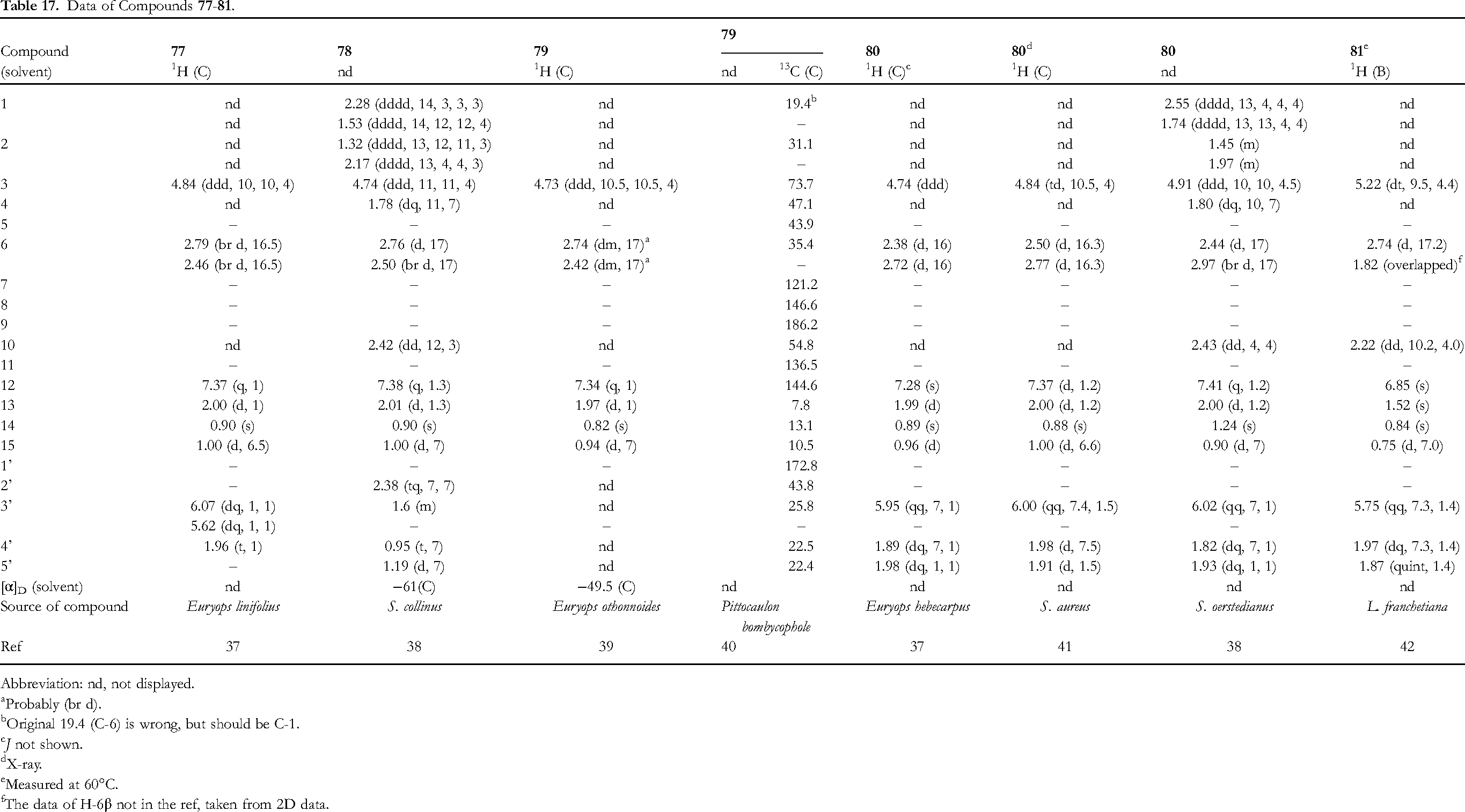
The data of four 3α-acyloxyfuranoeremophilan-9-ones, 77-80,37-41 and franchetianone B (81)42 (Figure 8) are listed in Table 17. Compounds 77-80, have 10αH, while 81 10βH. Because the 3β-H signals of compounds 77-80 have 2 large coupling constants, they should be in the axial position. The shape 'dm' of H-6 of compound 79 in reference 39 better change to br d. The 13C NMR data of 19.4 assigned to C-6 of 79 should be corrected to C-1.40 The structure of compound 80 was determined by X-ray.41 The 1H NMR data of compound 81 was measured at 60 °C.42 One of the H-6 protons of compound 81 was not shown in the original reference 42, therefore, it was found from the 2D data of our own experiments.29 The structure of compound being compared with franchetianone B (81) in the original paper (compound 4 in reference 42) was wrong; it should be the 3α-angeloyloxy derivative.37
The data of H-6β not in the ref, taken from 2D data.
Table 18 compiles the data of four 3-acyloxyfuranoeremophilan-9-ones, 82-8539,40,43,44 and 2 compounds bearing long-chain acyloxy groups, 86 and 87 (Figure 8).45 All compounds have 10αH. Compounds 83-87 have 3α-acyloxy groups, while 82 a 3β-acyloxy group. The structure of compound 83 was solved by X-ray to show C-3' (S).40 The original 13C NMR data of C-7 and 8 of compound 83 should be interchanged as shown in Table 18.40
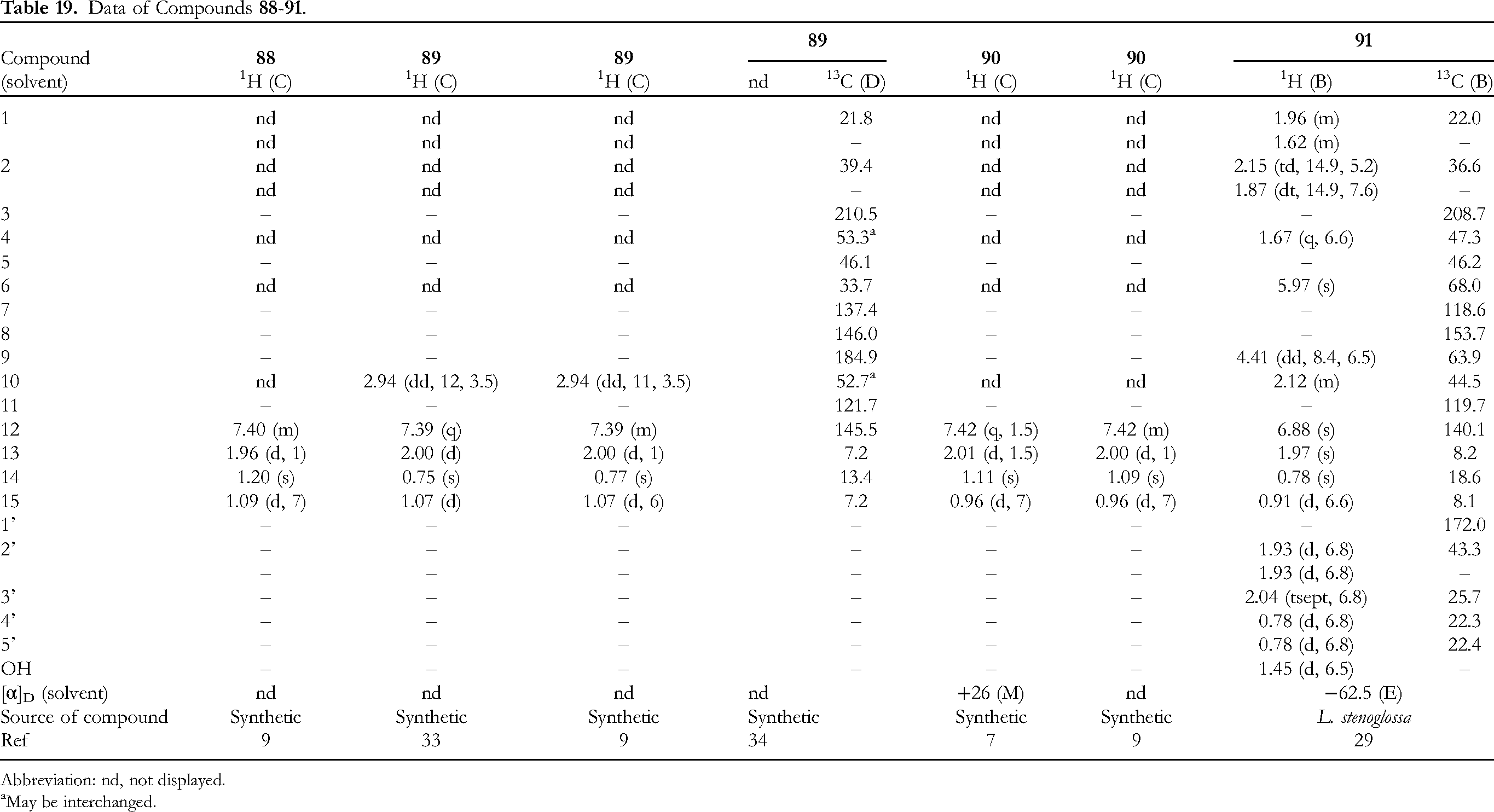
Table 19 presents the data of 3 furanoeremophilane-3,9-diones, 88-90,7,9,33,34 and 6β-acyloxy-9-hydroxyfuranoeremophilan-3-one, 91 (Figure 9).29 Dehydroeuryopsonol (89) has 10αH, while compounds 88, 90, and 91 10βH. Compound 88 has a C-4α substituted methyl group, and compounds 88 and 90 are C-4 epimers. Unfortunately, no H-4 was recorded for compounds 88-90. Compound 91, which adopts a non-steroid-like conformation (vide infra), have been isolated from Ligularia stenoglossa, the data being reported in the meeting, but the data not published in the literature.29
The data of three dihydroxyfuranoeremophilan-6-one monoacetates, 92-94,33 dihydroxyfuranoeremophilan-9-one monomethylether, 95,14,27 and three dihydroxyfuranoeremophilan-9-one monoacetates, 96-9831 (Figure 9) are provided in Table 20. Compounds 92, 93, 95, and 96 have 10αH, while 94, 97, and 98 10βH. Compounds 92 and 93 have C-4α methyl group, and compounds 92 and 93 are C-3 epimers. Compounds 96 and 97 are C-10 epimers, and 97 and 98 C-3 epimers. Detailed J values were not shown in reference 33.
The data of two 6β-acyloxy-3β-hydroxy-9-ones, 99 and 100,23,46 and three 3-acyloxy-1α-hydroxyfuranoeremophilan-9-ones, 101-103 (Figure 9)43 are tabulated in Table 21. Compounds 99 and 100 have 10βH, while 101-103 10αH. Compounds 101-103 have C-1α hydroxy groups. The 1H NMR data of compounds 9946 and 10023 were measured at 70 and 75 °C, respectively. The specific rotations of compounds 102 and 103 were measured at 365 nm, because those at D-lines were too small.
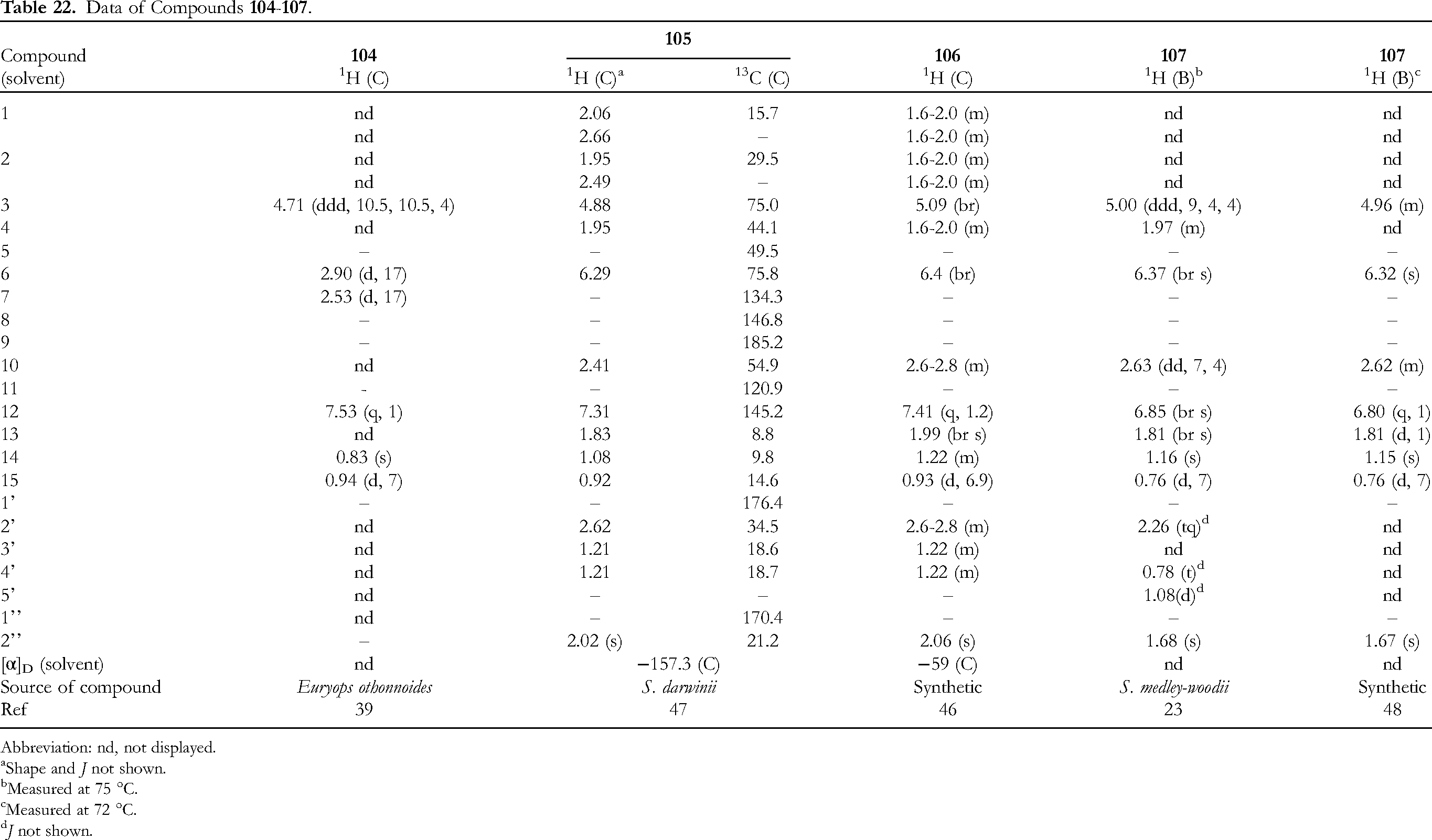
Table 22 gives the data of 3α-acyloxy-13-hydroxyfuranoeremophilan-9-one, 104 (Figure 9),39 and three 3β-acetoxy-6β-acyloxyfuranoeremophilan-9-ones, 105-107 (Figure 10).23,46-48 The 1H NMR of compound 107 was measured at 75 °C and 72 °C in references 23 and 48, respectively. Sendarwin I (105) and 104 have 10αH, while 106 and 107 10βH. Sendarwin I (105) and 106 are C-10 epimers.
The data of four 3,6-diacyloxyfuranoeremophilan-9-ones, 108-111,46,49-51 and methyl ester 112 (Figure 10)14 are found in Table 23. Compounds 108, 111, and 112 have 10αH, while 109 and 119 10βH. Compounds 108 and 109 are C-10 epimers. Compounds 109 and 110 have an angeloyloxy and a tigloyloxy group, respectively. The acyl group of compound 111 is 2,3-epoxy-2-methylbutanoyl, but the configurations have not been determined. The 1H NMR of compound 109 was measured at 60 °C.49
Table 24 lists the data of two 3,6-diacyloxyfuranoeremophilan-9-ones, 113 and 114,40,52 and two 3β-senecioyloxy-6-methoxyfuranoeremophilan-9-ones, 115 and 116,14,27 (Figure 10). Compounds 115 and 116 are C-6 epimers. Compound 113 has 10βH, while 114-116 10αH. The data of compound 115 is due to a mixture with a 3-angeloyloxy derivative.27
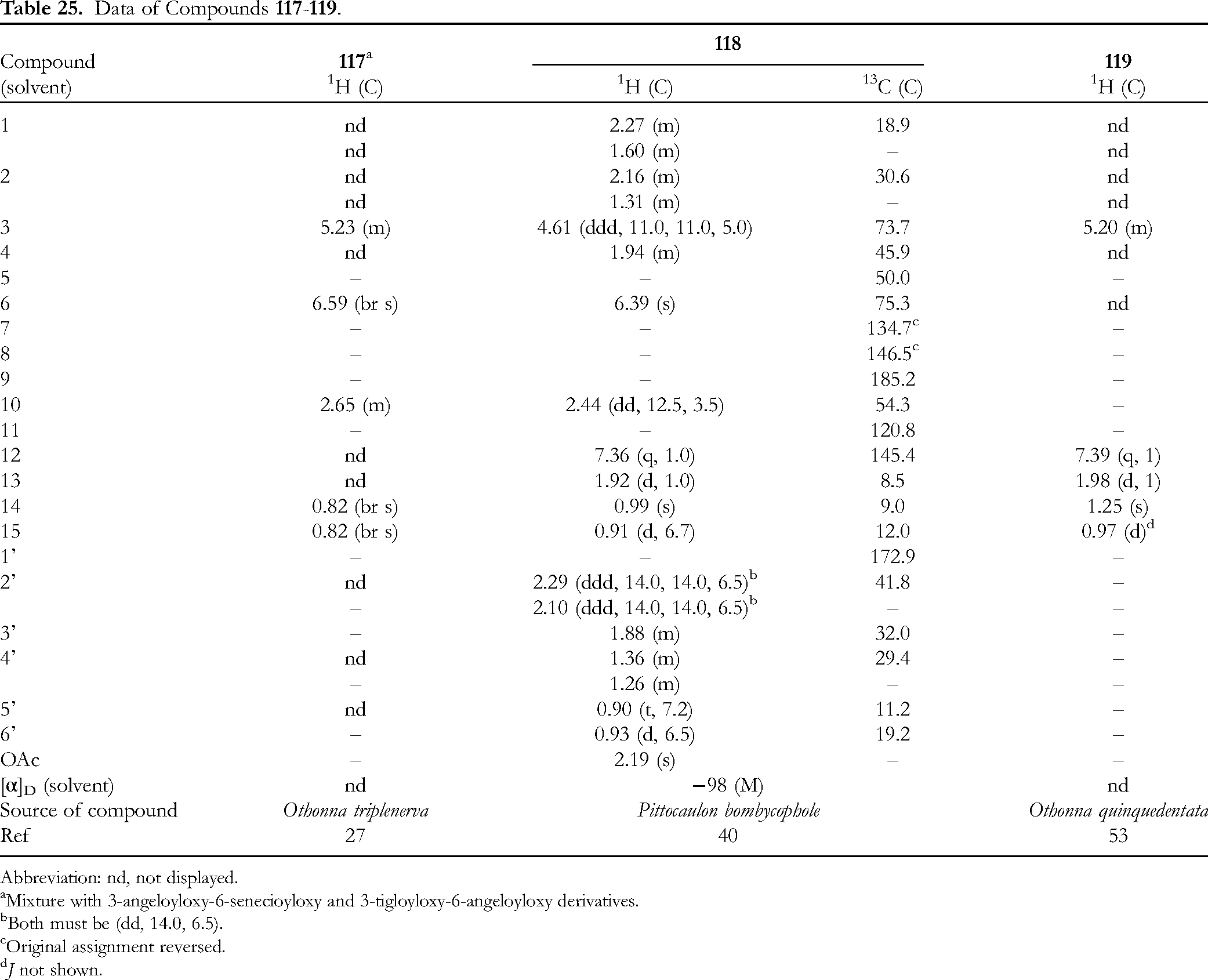
Table 25 compiles the data of two 3,6-diacyloxyfuranoeremophilan-9-ones, 117 and 118,27,40 and 3,10-diacyloxyfuranoeremophilan-9-one, 119 (Figure 10).53 The absolute configurations of C-3' of compound 118, and C-10 of compound 119 were not determined. Compound 117 is a mixture with 2 similar compounds; 3-angeloyloxy-6-senecioyloxy- and 3-tigloyloxy-6-angeloyloxyfuranoeremophilan-9-one.27 The H-2' data of compound 118 must be (dd, 14.0, 6.5) for both protons.40 The original 13C NMR data of C-7 and 8 of compound 118 should be interchanged as shown in Table 27.25 In the case of compounds having an oxo group at C-9, chemical shifts of C-7 appear at δ 135-140. This is a marked difference from those without C-9 oxo groups, chemical shifts of which are about δ 115-120.
Mixture with 3-angeloyloxy-6-senecioyloxy and 3-tigloyloxy-6-angeloyloxy derivatives.
Both must be (dd, 14.0, 6.5).
Original assignment reversed.
J not shown.
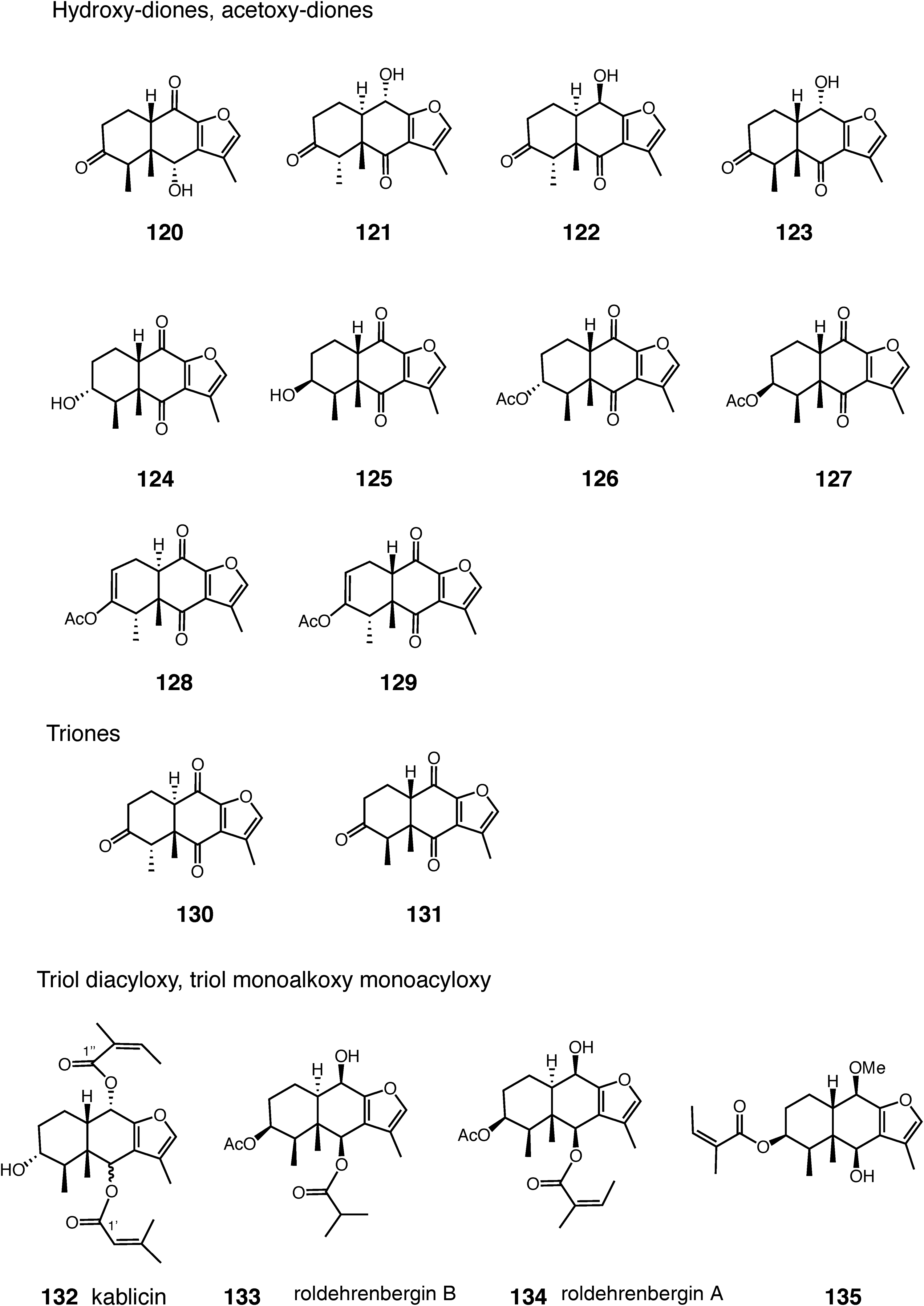
Table 26 presents the data of 6α-hydroxyfuranoeremophilane-3,9-dione, 120,9 three 9-hydroxyfuranoeremophilane-3,6-diones, 121-123,9,33 and two 3-hydroxyfuranoeremophilane-6,9-diones, 124 and 125 (Figure 11).33 Compounds 120-123 are 3-ones. Compounds 121 and 122 have 10αH, while compound 120 and 123-125 10βH. Unfortunately, no J values were shown for some data.
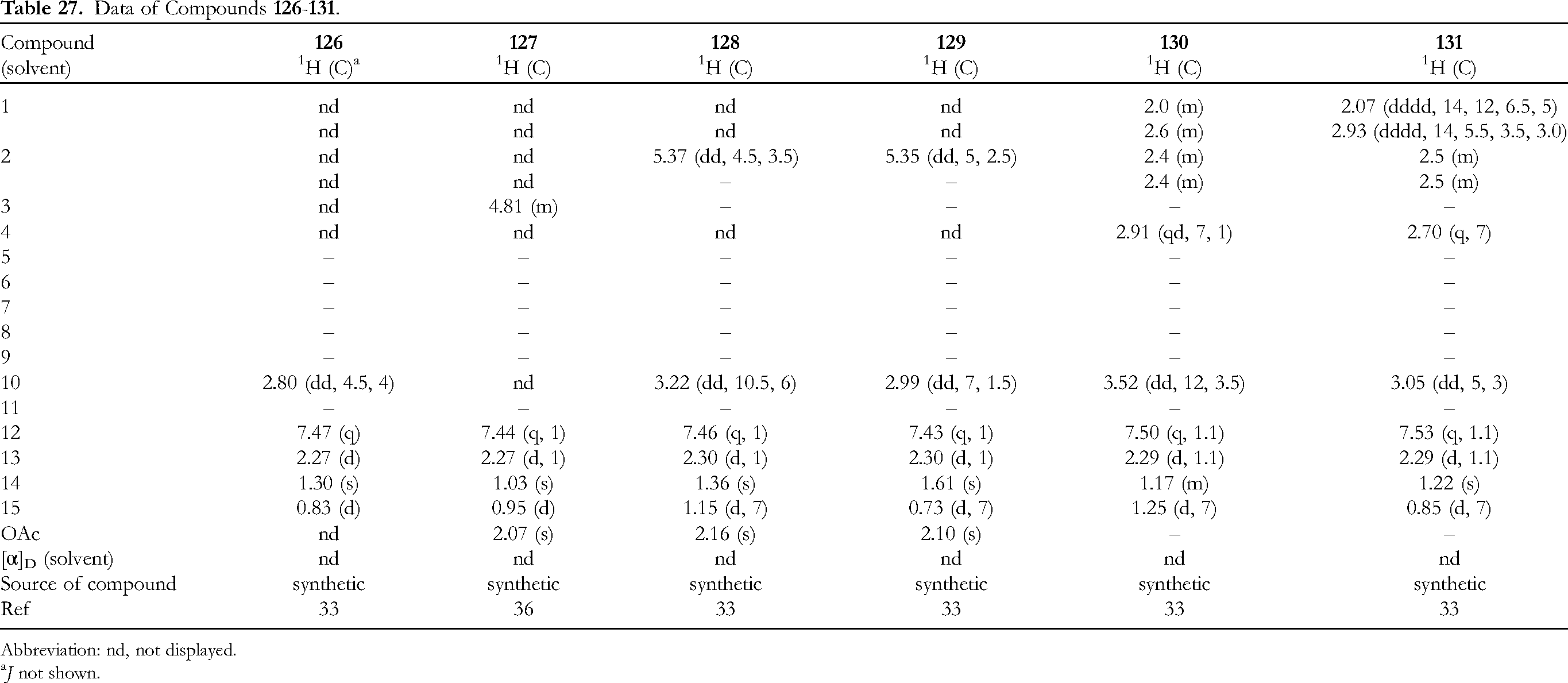
The data of four 3-acetoxyfuranoeremophilane-6,9-diones, 126-129,33,36 and two furanoeremophilane-36,9-triones, 130 and 131 (Figure 11),33 are provided in Table 27. Compounds 126 and 127 are C-3 epimers. Compounds 128 and 129 are enol-acetates, and are C-10 epimers. Compounds 130 and 131 are both triones having different configurations at C-4 and 10. The chemical shift values of H-10 of compounds 130 and 131 are quite different; in compound 130 appearing in the slightly lower field than that of 131. This phenomenon was also seen for compounds 128 and 129.
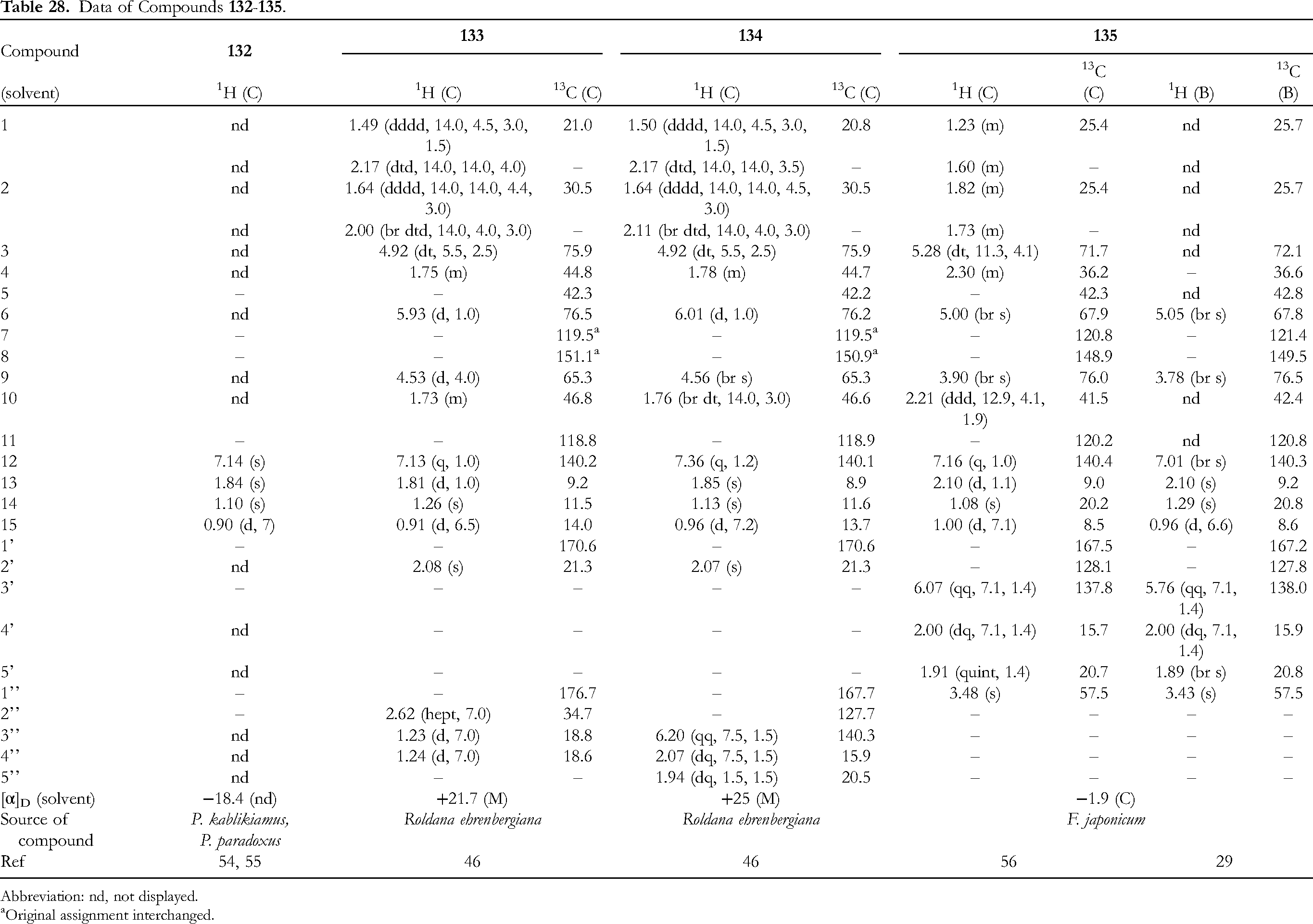
Table 28 tabulates the data of three diacyloxyeremophilanols, 132-134,46,54,55 and 3β-angeloyloxy-9β-methoxyfuranoeremophilan-6β-ol, 135 (Figure 11).56 The configuration of C-6 of kablicin (132) was not determined. Roldehrenbergins A and B, 134 and 133, have 10α-H, while kablicin (132) and 135 10β-H. Roldehrenbergin A (134) has an angeloyloxy group at C-6β, while roldehrenbergin B (133) a 2-methylpropanoyloxy group. Only a part of data were reported for kablicin (132)54,55 The original data of 13C NMR chemical shifts of C-7 and 8 of both compounds 133 and 134 were interchanged, as discussed before.
The data of 2 diols, 136 and 137,15,57 diacyloxy compound 138,15 and 3,6-diacyloxy-15-hydroxyfuranoeremophilan-9-one (139)54 (Figure 12) are found in Table 29. All have C-15 oxygen functions. Compound 139 is a mixture with a 6-(2-methylbutanoyloxy) derivative.
Table 30 gives the data of 3β,6β,15-triol, 14015,57 and its triacetate, 141 (Figure 12).57 Compound 140 prepared by Takahashi's group was sent to Bohlmann's group and its NMR spectrum was measured for comparison.57 The fact that the structure was revised from 140 to 170 will be described in Table 38. The data of 140 shown in Table 30 are slightly different, presumably due to the difference in the size of the magnet of the NMR machine used. The reference 14 cited in reference 57, is the error, and should be corrected to reference 16 (in reference 57).
Table 31 lists the data of 2 diacyloxy-hydroxy ketones, 142 and 143,27,57 a triacyloxy ketone 144,53 and 2 diacyloxy aldehydes, 145 and 146 (Figure 12).57 Three compounds 142-144 are 9-ones, and 145 and 146 15-als. Compound 142 was measured at 75 °C. Compound 143 is a mixture of 3-angeloyloxy-6-senecioyloxy and 3-tigloyloxy-6-angeloyloxy derivatives. The configuration of C-10 of compound 144 is not shown,53 and the solvent for NMR is not shown; probably CDCl3. Compounds 145 and 146 are a mixture, and the data for a sesquiterpene part are almost the same.57
Mixture of 3-angeloyloxy-6-senecioyloxy and 3-tigloyloxy-6-angeloyloxy derivatives.
The configuration of C-10 not determined; solvent not shown, probably C.
Mixture of 145 and 146.
Table 32 compiles the data of four 15-oic acids, 148, 150, and 151,15,58 and two methyl esters, 147 and 149 (Figure 13).15 The C-15 positions are oxidized to acids or esters. Compounds 147-149 are monoacyloxy, and 150 and 151 diacyloxy compounds. Compounds 147, 150, and 151 have 3β-(2-methylpropenoyloxy) moieties, while 148 and 149 3β-angeloyloxy. Two 13C NMR signals of C-4 and 15 of compound 150 are broad, presumably due to slow movement in the solvent.
Table 33 presents the data of three diacyloxy 15-oic acids, 152, 153, and 155,15,57,59 and methyl ester 154 (Figure 13).57 Compound 154 is the methyl ester of 153. All have 3β-angeloyloxy groups, and among them 155 has one more angeloyloxy group at C-6β. Compound 152 is a mixture with 161,59153 with 155 and 159,57154 with 157 and 160,57 and 155 with 154 and 158.57 The 13C NMR signals of C-1, 9, and 2' of compound 152 were broad.59
Table 34 provides the data of 4 methyl esters, 156-158, and 160,15,27,57 and 15-oic acid 159 (Figure 13).57 All have 3β-angeloyloxy groups. Compounds 156 and 157 have 6β-angeloyloxy groups, 158 6β-senecioyloxy, and 159 and 160 3-methylpentanoyloxy groups. Compound 157 is the methyl ester of the corresponding carboxylic acid of the natural product.15 The configuration of C-3 of compound 156 is 3α-acyloxy (R), others 3β (S). The configurations at C-3' of compound 159 and 160 were not determined.57
Table 35 tabulates the data of 2 diacyloxy acids, 161 and 162,59,60 a methyl ester 163,61 and an acid 16462 (Figure 13). All have 10βH and 3β,6β-substituents. Compound 161 is a mixture with 151, and the 13C NMR peaks of C-1, 9, and 2' were broad.59 Compound 163 was derived from the natural product, the corresponding acid.61 Both 1H and 13C NMR signals are tentatively assigned for compound 164.62 The signals at δ 2.24 (H-10) and 1.04 (H-3'') for compound 164 recorded in reference 62 should be corrected to 2.44 (qd, 6.6, 5.2) and 1.99 (m), respectively.62
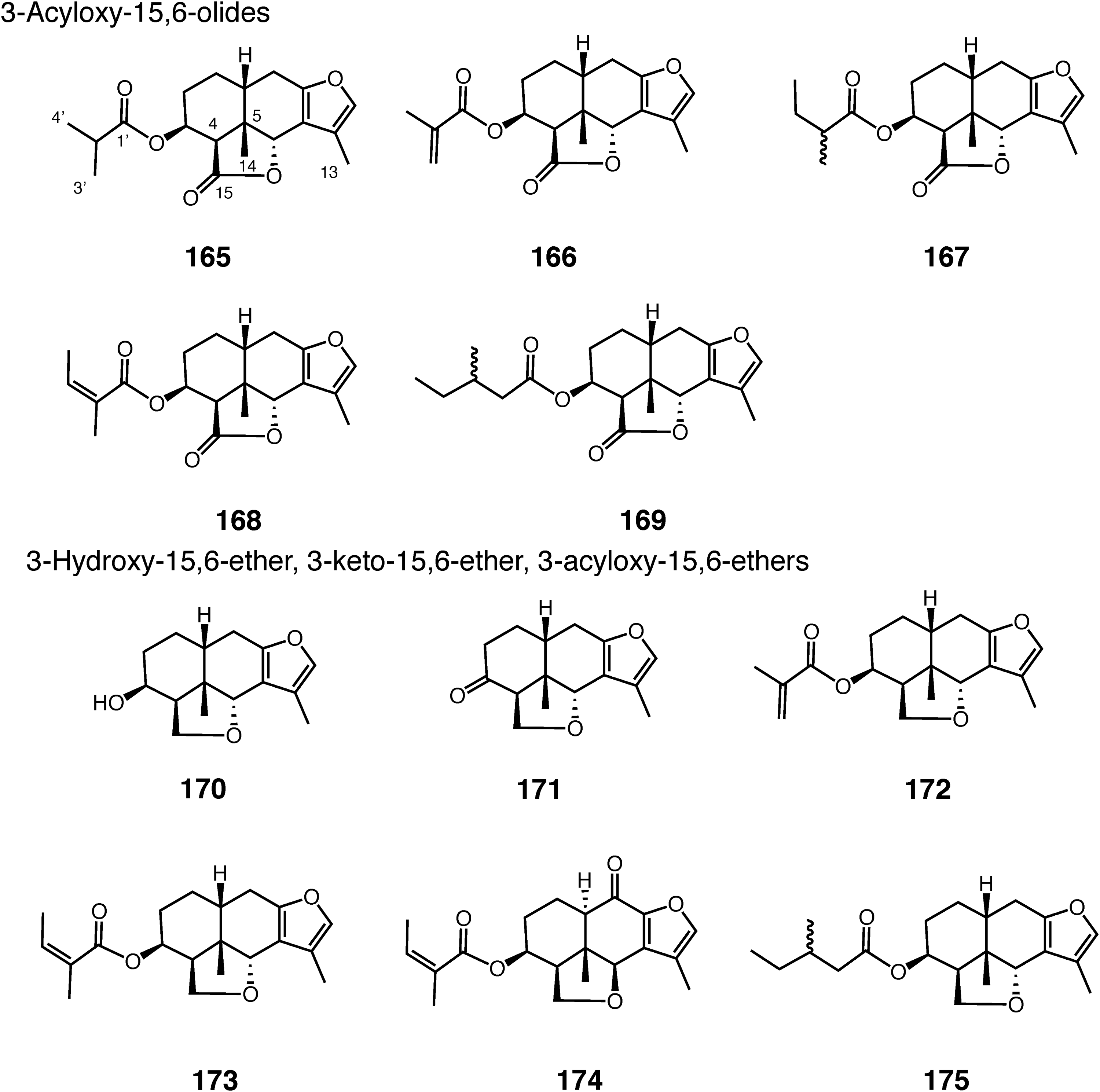
Table 36 gives the data of three 3β-acyloxy-15,6-olides, 165-167 (Figure 14).60 They can be categorized to furan and/or lactone, but they are included in this chapter. Compound 165 has 2-methylpropanoyloxy group, 166 2-methylpropenoyloxy, and 167 2-methylbutanoyloxy group. These three were isolated from Ligularia hookeri.
Table 37 shows the data of 3β-angeloyloxyfuranoeremophilan-15,6α-olide (168)27,57,60,63 and 3β-(3-methylpentanoyloxy)furanoeremophilan-15,6-olide (169)62 (Figure 14). Compound 168 in reference 27 is a mixture with 166. The 13C NMR data for compound 168 in reference 63 were revised by comparing with those of similar compounds.
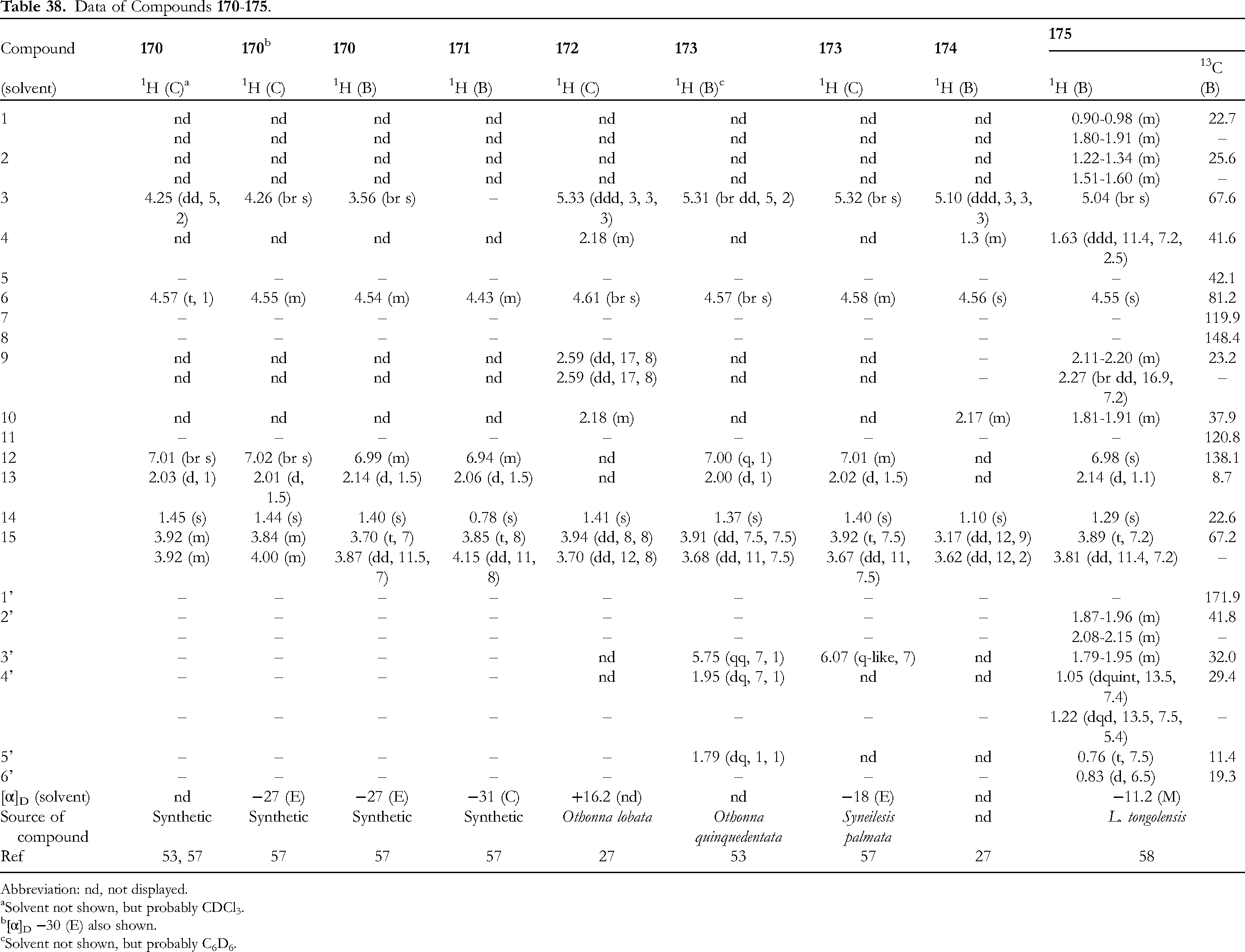
The data of 6α,15-epoxyfuranoeremophilan-3β-ol (170),53,57 6α,15-epoxyfuranoeremophilan-3-one (171),57 and four 3β-acyloxy-6α,15-epoxyfuranoeremophilane, 172-175 (Figure 14).27,53,57,58 are listen in Table 38. All have epoxide structure between C-6 and C-15. Compound 170 was originally proposed as triol 140 by Bohlmann,53 but later revised to have 6α,15-epoxide structure,57 and it was found to be easily prepared from 140 through acid treatment. Compound 174 has 10αH and 9-oxo group with 6αH, which can be derived from compound 142 through hydrolysis, cyclization, and isomerization.27 The configuration at C-3' of compound 175 was not determined.58
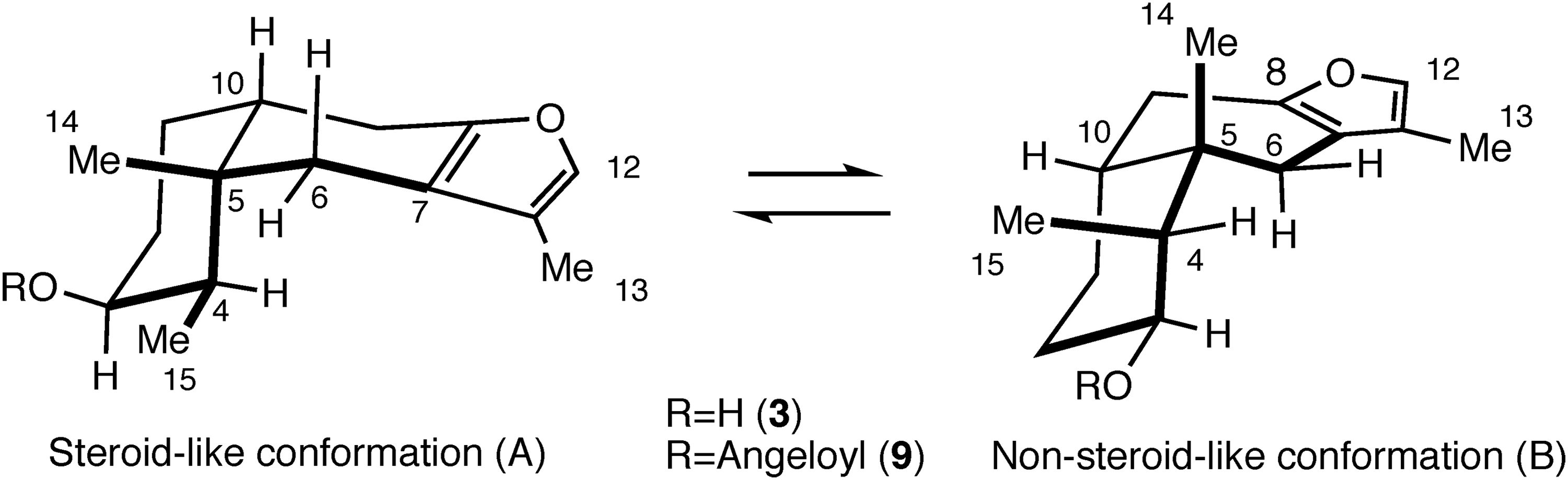
Finally, 2 conformations of 10β-H furanoeremophilanes are quickly introduced here for better understanding (Figure 15). In the previous review,3 2 conformations, namely, “steroid-like” and “non-steroid-like” conformations were displayed using ligularol and 6-epi-ligularol. In steroid-like conformation, 3β-O function adopts axial position, but in non-steroid-like conformation, equatorial position. The conformation for compounds having more functionalities is easily determined by the coupling constants and/or nuclear overhauser effect (NOE) measurements. However, those of less substituted compounds, such as ligularol and its 6-epimer, are not easy, in case the temperature dependent NMR measurement is necessary to see the 2 conformers, in some cases at lower temperature (preferably in CDCl3), and in the other cases at higher temperature (sometimes in C6D6 solution).
Two conformations of 10βH-furanoeremophilanes.
Footnotes
Acknowledgements
The author thanks laboratory staff members engaged in these projects acquiring NMR data. Special thanks are due to Dr Yasuko Okamoto and Prof. Masakazu Sono, Tokushima Bunri University, Prof. Yoshinosuke Usuki, Osaka Metropolitan University, and Emeritus Prof. Chiaki Kuroda, Rikkyo University, for their help to check the references appeared in this review.
Declaration of Conflicting Interests
The author declared no potential conflicts of interest with respect to the research, authorship, and/or publication of this article.
Funding
The author received no financial support for the research, authorship, and/or publication of this article.
ORCID iD
Motoo Tori
References
1.
ToriM. Cumulative data of 1H and 13C NMR signals and specific rotations of eremophilane sesquiterpenoids. 1. bicyclic eremophilanes (1). Nat Prod Commun. 2022;17(8):1-67. doi: https://doi.org/10.1177/1934578X221109527
2.
ToriM. Cumulative data of 1H and 13C NMR signals and specific rotations of eremophilane sesquiterpenoids. 2. bicyclic eremophilanes (2). Nat Prod Commun. 2022;17(12):1-39. doi: https://doi.org/10.1177/1934578X221141172
3.
ToriM. Cumulative data of 1H and 13C NMR signals and specific rotations of eremophilane sesquiterpenoids. 3. 10H-furanoeremophilanes without 3-O functionality. Nat Prod Commun. 2023;18(6):1934578X231180710.
4.
PesekMJuvanAJakošJKošmrljJMaroltMGazvodaM. Database independent automated structure elucidation of organic molecules based on IR, 1H NMR, 13C NMR, and MS data. J Chem Inf Model. 2021;61:756-763.
5.
HuangZChenMSWorochCPMarklandTEKananMW. A framework for automated structure elucidation from routine NMR spectra. Chem Sci. 2021;12:15329-15338.
6.
BohlmannFEhlerDZderoC. Einige neue Furanoeremophilane aus Senecio-Arten. Phytochemistry. 1978;17(3):467-470.
7.
NaganoHTanahashiYMoriyamaYTakahashiT. New furanoeremophilane derivatives from Farfugium japonicum Kitamura. Bull Chem Soc Jpn. 1973;46(9):2840-2845.
YamakawaKSatohT. Studies on terpenoids and related alicyclic compounds. XVI. Total synthesis of furanosesquiterpenes; (±)-furanoeremophilane, (±)-furanoligularane, (±)-9,10-dehydrofuranoeremophilane, (±)-3ß-hydroxyfuranoeremophilane, and (±)-3ß-furanoligularanol. Chem Pharm Bull. 1978;26(12):3704-3714.
10.
BrooksCJWDraffanGH. Sesquiterpenoids of Warburgia species-I Warburgin and warburgiadione. Tetrahedron. 1969;25(14):2865-2885.
11.
YamakawaKKobayashiMHinataSSatohT. Studies on the terpenoids and related alicyclic compounds. XXIII. Total synthesis of (±)-phomenone, (±)-3-epiphomenone, (±)-ligularenolide, and (±)-furanoligularanone. Chem Pharm Bull. 1980;28(11):3265-3274.
12.
BohlmannFZiescheJ. Eremophilane derivatives from Senecio species. Phytochemistry. 1980;19(12):2681-2684.
13.
GuerrieroAPietraF. Furanoeremophilanes from Petasites niveus: high solvolytic reactivity at the C-6β position bearing an α,β-unsaturated ester group. Phytochemistry. 1982;21(12):2887-2891. doi:https://doi.org/10.1016/0031-9422(80)85061-8
14.
BohlmannFSuwitaA. Weitere Furanoeremophilane aus Othonna-Arten. Chem Ber. 1976;109(4):1230-1238.
15.
BohlmannFZderoCGrenzM. Neue Sesquiterpene der Gattung Othonna. Chem Ber. 1974;107(12):3928-3945.
NaganoHTakahashiT. 6β-Acetoxyfuranoeremophilan-3α-yl Angelate and 6β-hydroxyfuranoeremophilan-3α-yl angelate. New furanoeremophilane derivatives from Farfugium hiberniflorum Kitamura. Bull Chem Soc Jpn. 1972;45(6):1935-1936.
18.
ItoKIidaTFunataniT. Study on the ingredients of gigantic type of Farfugium japonicum (L.) Kitam. Isolation of 8-epi-eremophilenolides. Yakugaku Zasshi. 1979;99(4):349-353.
19.
NayaKMakiyamaYMatsuuraTIiNNaganoHTakahashiT. The revised structure of furanofukinol, a constituent from Petasites japonicus Maxim. rhisomes. Chem Lett.1978;7(3):301-304.
20.
NayaKShimizuMNishioHTakedaMOkaSHirotaK. The photosensitized oxygenation of furanoeremophilanes. III. The transformation to the skeletally isomeric lactones from furanofukinol. Bull Chem Soc Jpn. 1991;64(4):1071-1080.
21.
YamakawaKSatoT. Studies on terpenoids and related alicyclic compounds. XVIII. Stereoselective synthesis of (±)-furanofukinol. Chem Pharm Bull. 1979;27(8):1747-1752.
22.
NayaKNakagawaMHayashiMTsujiKNaitoM. The substituents of Petasites japonicus Maxim. rhisomes. Tetrahedron Lett. 1971;12(31):2961-2964.
23.
BohlmannFZderoC. New furanoeremophilanes from South African Senecio species. Phytochemistry. 1978;17(7):1161-1164.
24.
BohlmannFGrenzMSuwitaA. Inhaltsstoffe aus Gynoxys- und Pseudogynoxys-Arten. Phytochemistry. 1977;16(6):774-776.
25.
BohlmannFZderoCBergerDSuwitaAMahantaPJeffreyC. Neue Furanoeremophilane und weitere Inhaltsstoffe aus sudafrikanischen Senecio-Arten. Phytochemistry. 1979;18(1):79-93.
26.
BohlmannFWallmeyerM. Furanoeremophilanes from Lopholaena species. Phytochemistry. 1982;21(8):2126-2127.
27.
BohlmannFKnollKH. Weitere Furanoeremophilane aus Othonna-Arten. Phytochemistry. 1978;17(3):461-465.
28.
JakupovicJZderoCKingRM. Furanoeremophilanes from Gynoxys species. Phytochemistry. 1995;40(6):1677-1679.
29.
ToriM. Unpublished results.
30.
KurodaCInagakiKOkamotoY,et al.Chemical diversity in Ligularia oligonema. Nat Prod Commun. 2017;12(8):1161-1164.
31.
RivettDEAWoolardGR. The structure of euryopsonol. Tetrahedron. 1967;23(5):2431-2436.
32.
WoolardGRPretoriusJAColemanPC. Crystal structure of euryopsonol. J Chem Soc, Perkin II. 1979:930-932.
33.
BohlmannFFörsterHJFischerCH. Synthese von Furanoeremophilanen. Liebigs Ann Chem. 1976;1976(7-8):1487-1513.
34.
VhalmersAAColemanPCRivettDEAWoolardGR. Carbon-13 nuclear magnetic resonance spectroscopy of euryopsonol and euryopsol. South African J Chem. 1980;33(1):1-3.
35.
NaganoHTakahashiT. 3β-Angeloyloxy-10β-hydroxy-9β-senecioyloxyfuranoeremophilane and 3β-angeloyloxy-10β-hydroxyfuranoeremophilane. New furanoeremophilane derivatives from Farfugium japonicum Kitamura. Bull Chem Soc Jpn. 1978;51(11):3335-3340.
36.
YamakawaKSatohTOhbaNSakaguchiRTakitaSTamuraN. Studies on the terpenoids and related alicyclic compounds-XXII. Stereochemical study on the angular hydroxylation of polycylic ketones using benzeneseleninic anhydride. Tetrahedron. 1981;37(3):473-479.
37.
BohlmannFZderoCGrenzM. Über die Inhaltsstoffe der Gattung Euryops. Chem Ber. 1974;107(8):2730-2759.
38.
BohlmannFCastroVZderoCKingRMRobinsonH. New furanoeremophilanes from Senecio species. Rev Latinoamer Quim. 1984;14(3):101-103.
39.
BohlmannFZderoCRaoN. Neue Furanoeremophilane aus Euryops-Arten. Chem Ber. 1972;105(11):3523-3531.
40.
MaldonadoJIRArciniegasAPérez-CastorenaALVillaseñorJLde VivarAR. Furanoeremophilanes and other constituents of Pittocaulon bombycophole. Heterocycles. 2008;75(12):3035-3042. doi:https://doi.org/10.3987/COM-08-11479
ToriMTanioYOkamotoY,et al.Chemical constituents of Ligularia franchetiana collected in Yunnann province of China. Heterocycles. 2008;75(8):2029-2034.
43.
BohlmannFZderoCKingRRobinsonH. Furanoeremophilanes from Senecio smithii. Phytochemistry. 1981;20(10):2389-2391.
44.
SaitoYIchiharaMTakiguchiK, et al.Chemical and genetic diversity of Cremanthodium lineare. Phytochemistry. 2013;96:184-190.
45.
BohlmannFSuwitaAZderoC. Neuartige Ester von Eremophien-Derivaten aus Sudafrikanischen Snecio-Arten. Phytochemistry. 1978;17(10):1763-1767. doi:https://doi.org/10.1016/S0031-9422(00)88690-2
46.
Pérez-CastorenaALArciniegasAHernandezMLde la RosaIContrerasJLde VivarAR. Furanoeremophilanes from Roldana ehrenbergiana. Z Naturforsch. 2005;60b(10):1088-1092. doi:https://doi.org/10.1515/znb-2005-1012
47.
GarridoVMSepulveda-BozaSHartmannRBreitmaierE. Furanosequiterpene aus südamerikanischen Senecio-Arten. Chemiker Zeitung. 1989;113(6):201-205.
48.
YamakawaKSatohT. Studies on the terpenoids and related alicyclic compounds. XXVI. Total synthesis of highly oxygenated furanoeremophilanes: (±)-6β-Hydroxy-1,10-dehydrofuranoeremophilan-9-one, (±)-decompostin, (±)-dihydrodecompostin, (±)-adenostylone, (±)-3β,6β-dipropionyloxyeuryopsin-9-one, (±)-3β,6β-dihydro-10βH-furanoeremophilan-9-one, and (±)-3β,6β-dihydroxy-10αH-furanoeremophilan-9-one. Chem Pharm Bull. 1981;29(12):3474-3485.
49.
BohlmannFZderoC. Ein Neues Furanoeremophilon-derivat aus Gynoxys psilophylla. Phytochemistry. 1979;18(2):339.
50.
BohlmannFZderoCBergerDSuwitaAMahantaPJeffreyC. Neue Furanoeremophilane und weitere Inhaltsstoffe aus südafrikanischen Senecio-Arten. Phytochemistry. 1979;18(1):79-93.
51.
BohlmannFZderoC. Neue Furanoeremophilane und andere Sesquiterpene aus vertretern der Gattung Euryops. Phytochemistry. 1978;17(7):1135-1153.
52.
JakupovicJBohlmannFGrenzM. Furanoeremophilanes from Hertia pallens. Phytochemistry. 1989;28(11):3231-3232.
53.
BohlmannFRaoN. Neue Furanoeremophilane aus Othonna quinquedentata Thunb. (1). Tetrahedron Lett. 1973;14(8):613-616.
54.
NovotnýLSamekZHeroutVŠormF. The structure of kablicin, the main component of the light petroleum extract of Petasites kablikianus Tausch. ex Bercht. and of Petasites paradoxus (retz) Baumg. rhizomes. Tetrahedron Lett. 1968;9(11):1401-1404.
55.
NovotnýLTomanJHeroutV. Terpenoids of the Petasites paradoxus and Petasites kablikianus in relation to their phylogeny. Phytochemistry. 1968;7(8):1349-1353.
56.
ToriMOtoseKFukuyamaH, et al.New eremophilanes from Farfugium japonicum. Tetrahedron. 2010;66(27-28):5235-5243.
57.
KurodaCMuraeTTadaMNaganoHTsuyukiTTakahashiT. 3β,6β-Bis(acyloxy)furanoeremophilan-14-als and -14-oic acids from Syneilesis palmata (Thunb.) Maxim. Bull Chem Soc Jpn. 1982;55(4):1228-1233.
58.
ShimizuAHanaiROkamotoY,et al.Chemical constituents in hybrids of Ligularia tongolensis and L. cymbulifera: chemical introgression in L. tongolensis. Chem Biodiv. 2016;13(7):837-844.
59.
OkamotoYNakadozonoYShiojiriK, et al.Diversity of furanoeremophilane composition in Ligularia tongolensis. Nat Prod Commun. 2019;14(10). doi: https://doi.org/10.1177/1934578X19878937
60.
SaitoYShiosakiYFujiwaraM, et al.Eremophilanes from Ligularia hookeri collected in China and structural revision of 3β-acyloxyfuranoeremophilan-15,6-olide. Chem Pharm Bull. 2018;66:668-673.
61.
BohlmannFKnollKH. Ein neues Norsesquiterpen und andere Inhaltsstoffe aus Ligularia-Arten. Phytochemistry. 1979;18(5):877-878.
62.
HanaiRGongXToriM, et al.Chemical and genetic study of Ligularia tongolensis, Ligularia cymbulifera, and Ligularia atroviolacea in the Hengduan mountains of China. Bull Chem Soc Jpn. 2005;78(7):1302-1308.
63.
LiYSWangZTZhangMZhouHChenJJLuoSD. New eremophilane-type sesquiterpenes from Ligularia lapathifolia. Planta Med. 2004;70(3):239-243.