1H and 13C Nuclear Magnetic Resonance (NMR) signals and specific rotations of eremophilane sesquiterpenoids are cumulated as a series of review articles. In the first chapter of this review, 332 bicyclic eremophilanes, namely with no furan or lactone rings (except for epoxides), without 3-OR functionality (except for hydroxy, acetoxy, and carbonyl) are listed in tables. These data may help chemists working in the area of natural products chemistry as well as synthetic scientists.
Many compounds have been isolated from not only plant sources, but also animals, fungi, and many other living organisms including fossils. Nowadays search for the data of such compounds is available through a good database, for example, SciFinder. The dictionary published in 1991 by Connolly and Hill is a nice dictionary in this area.1 Reviews on natural products were recently published.2–16 It is quite obvious that spectroscopic data are very important to identify the compound; otherwise, we further need to measure 2D nuclear magnetic resonance (NMR), specific rotations, and other physiological data. Therefore, the data for known compounds are very important, but it is not always possible to find such data, because sometimes they are quite old and not enough data are presented. This review article collected 1H and 13C NMR data concerning eremophilane sesquiterpenoids published by now as much as possible. It is regretted that not all the data can be collected due to the difficulties in checking all the references. The old data have been measured using 60 MHz NMR machines and so on; hence, it was not possible to assign all the signals. Therefore, in this review both old and recent data are collected. Some compounds have been reported repeatedly, whose data are also included for comparison. Glycosides are not collected. This review is divided into chapters: in the first chapter of this review, 332 bicyclic eremophilanes, namely with no furan or lactone rings (except for epoxides), without 3-OR functionality (except for hydroxy, acetoxy, and carbonyl) are listed in Tables 1 to 37.
Bicyclic eremophilanes (1) without 3-OR (R ≠ H, Ac) and 3-oxo
Bicyclic eremophilanes (2) with 3-OR (R ≠ H, Ac)
10-H-furanoeremophilanes
10-O-furanoeremophilanes
3-O-furanoeremophilanes
3-oxo-furanoeremophilanes
Furanoeremophil-1(10)-enes
2-O-furanoeremophil-1(10)-enes
1,10-epoxyfuranoeremophilanes
Furanoeremophilan-15,6-olides
Eremophila-(15,6),(12,8)-diolides
8α-H-eremophilan-12,8-olides
8α-O-eremophilan-12,8-olides
8β-H-eremophilan-12,8-olides
8β-O-eremophilan-12,8-olides
Eremophil-1(10)-en-12,8-olides
2-O-eremophil-1(10)-en-12,8-olides
1,10-epoxyeremophilan-12,8-olides
3-oxo-eremophilan-12,8-olides
7α,8α-epoxyeremophilan-12,8-olides
7β,8β-epoxyeremophilan-12,8-olides
Eremophil-7-en-12,8-olides
Eremophila-7(11),8-dien-12,8-olides
Lactols
Cacalols
Dimers
Nor compounds
Seco compounds
Other eremophilanes
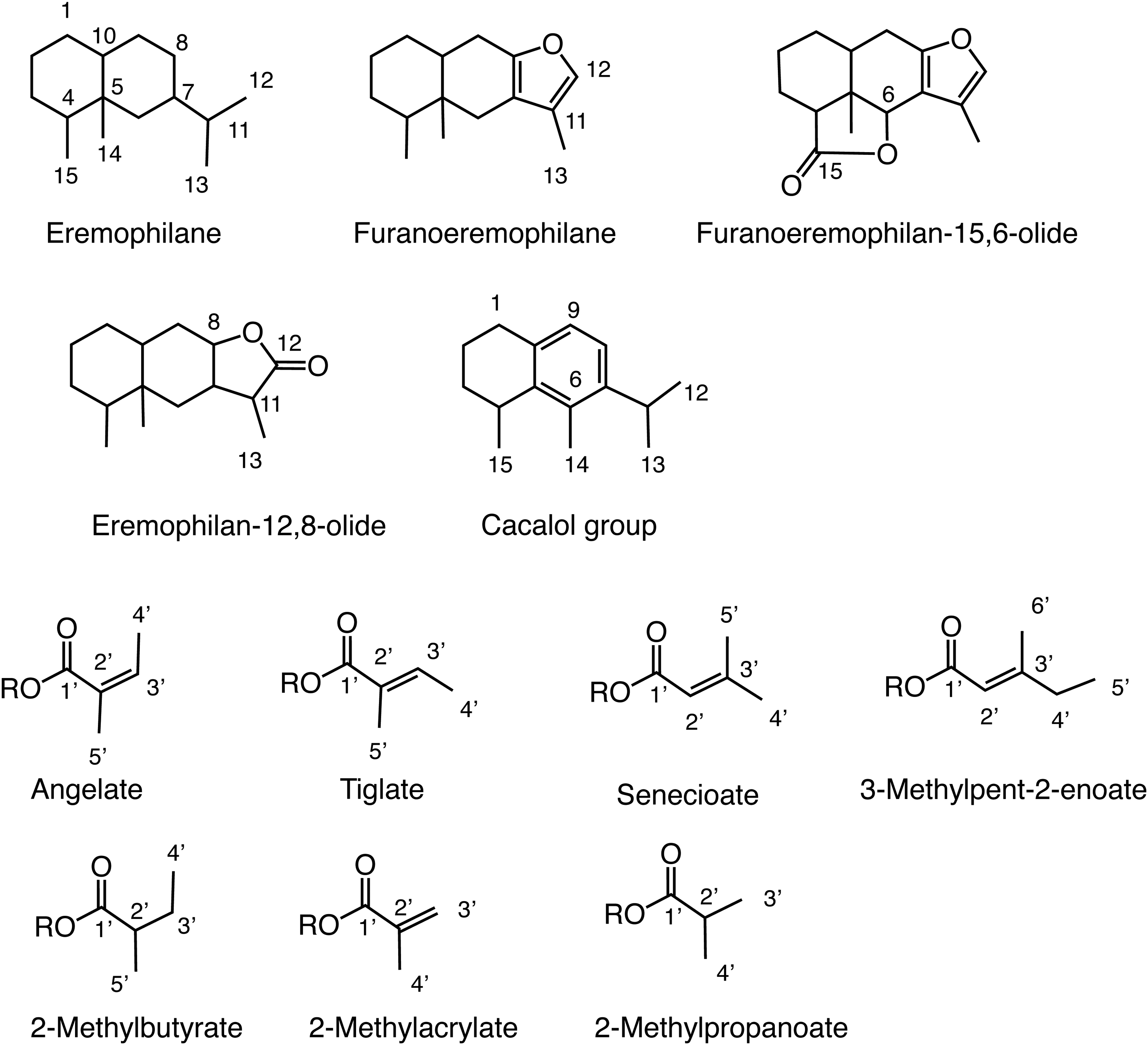
The names of skeletons and the numbering system are shown in Figure 1. Compounds bearing the α absolute configurations of both C-14 and 15 are sometimes called valencene, which are included in eremophilane group. The controversial numbering of C-14 and 15 followed the dictionary published by Connolly and Hill.1 This frequently becomes big confusion. The numbering at C-11, 12, and 13 is also a troublesome work. In the case of isopropenyl, the double bond obviously is called C-11, 12 and the methyl group C-13 position. However, in the case that the methyl group is substituted with a hydroxy group, this hydroxymethyl group is called C-12 and the double bond C-11, 13. Please note the abbreviation below used in this review.
Solvent
A: Acetone or acetone-d6
B: Benzene or benzene-d6
C: Chloroform or chloroform-d
D: Dimethyl sulfoxide or dimethyl sulfoxide-d6
E: Ethanol
F: Dichloromethane
H: Hexane
M: Methanol or methanol-d4
P: Pyridine or pyridine-d5
T: Carbon tetrachloride
Source of compound
Ca: Cacalia (current Parasenecio, however original description has been remained)
Cr: Cremanthodium
E: Eremophila
F: Farfugium
L: Ligularia
P: Petasites
S: Senecio
V: Valeriana
Apparent errors in the original papers were corrected, and unassigned data were tried to assign with the note “tentative assignment” (of course this does not mean the correct assignment). However, most of the original data were listed unchanged. Particularly, in case that the pattern of the coupling and the J values do not match, apparent errors are revised; but in most cases they were listed unchanged due to the lack of the precise information. The coupling patterns were always written from the largest to the smallest. The mismatch in the size of the J values was left as they are.
Skeletons, esters, and their numberings appeared in this review.
Discussion
Table 1 includes seven hydrocarbons, 1–7 (Figure 2). Not very many hydrocarbons are reported, presumably due to the difficulty of the isolation procedure. Many are claimed in the GC-MS profiles. Note that compounds 1–3 are eremophila-1(10),11-dienes,17,18 while compounds 4–6 are eremophila-9,11-dienes.17,19,20 Unfortunately signals of other than methyl groups are not studied in detail. Separation of hydrocarbons is not easy and thus not very many spectroscopic data of them have been reported so far. Eremophila-1(10),8,11-triene (7) was isolated from the liverwort.20
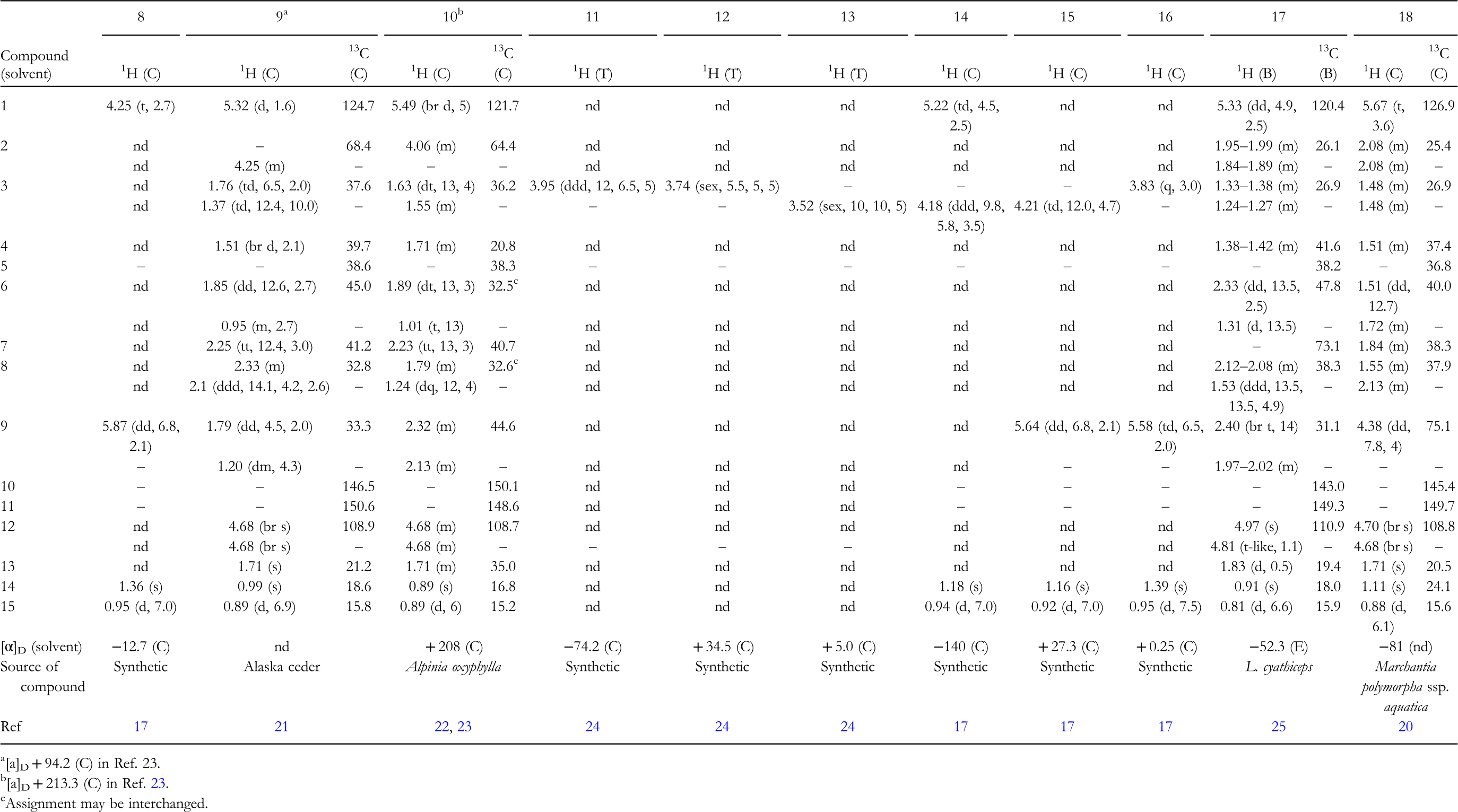
Tables 2 includes the data of 11 mono alcohols 8–18 (Figure 2); some have the 1(10)-ene or 9-ene moiety and the others have no double bond. Ref. 23 described the specific rotations of compounds 9 and nootkatol (10)22 prepared from nootkatone (27).23 The detailed NMR data of compounds 11–16 have not been described.17,24 Compound 17 was isolated from Ligularia25 and compound 18 from the liverwort,20 both being analyzed in detail.
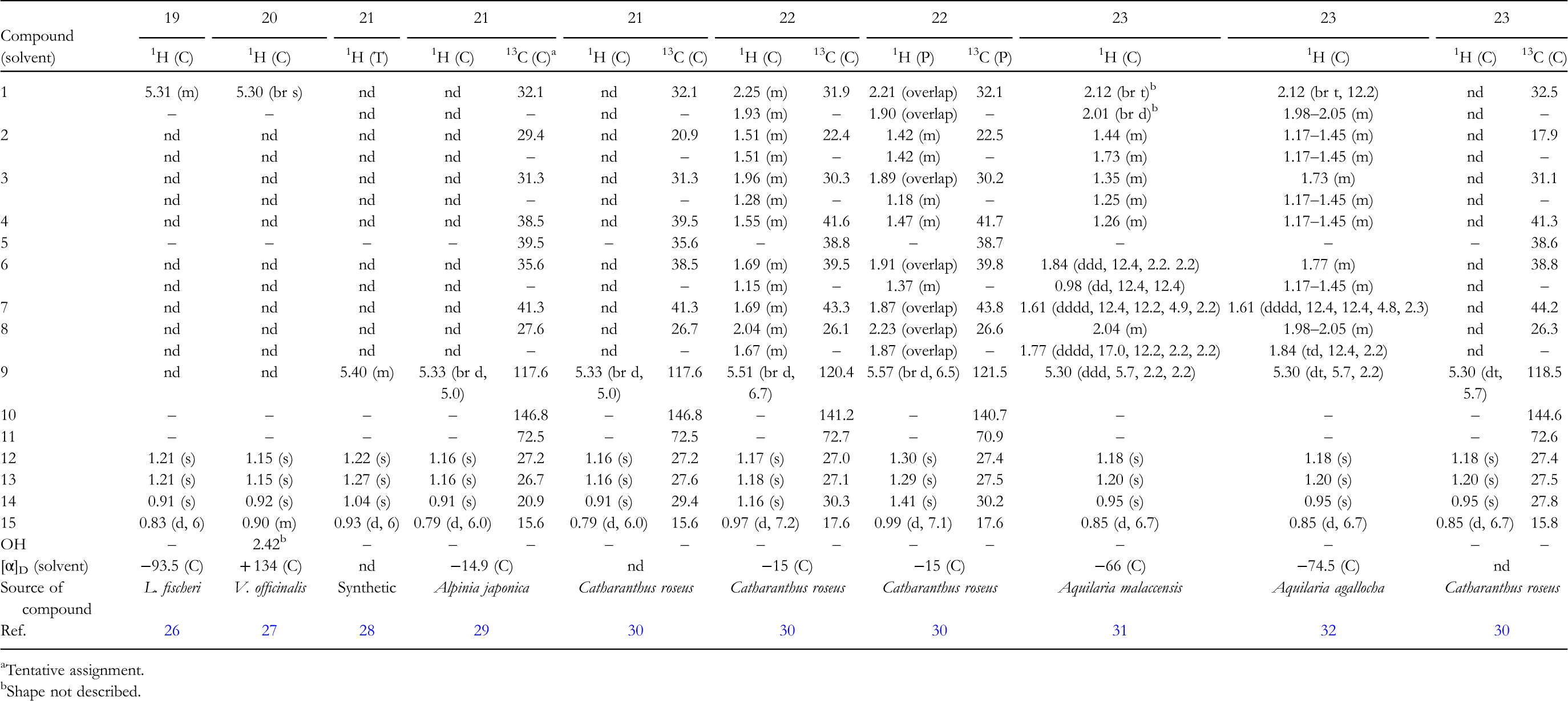
Table 3 includes the data of five mono alcohols 19–23 (Figure 2). Eremoligenol (19)26 and valerianol (kusunol) (20)27 are diastereoisomers concerning two vic-methyl groups. Valerianol (kusunol) (20) and jinkoheremol (23) possess the α-configurations of C-14 and 15 (sometimes called valencene). Compound 22 is 5-epi-jinkoheremol. Both the data of 22 and 23 were recorded in detail.30–32
Table 4 lists the data of two alcohols 2433 and 25,21 one acetate 26,34 and three ketones 27–29 (Figures 2 and 3). Signals of H2-12 in compound 26 were shown as ABq, but probably two signals should be divided into each doublet. The methyl group at C-4 (H3-15) is shown to be δ 0.88 (d, 17) in the original paper, but this must be the mistake of writing J = 17 Hz instead of J = 7 Hz.34
In Ref. 34, J was shown to be 17 Hz, but probably J = 7 Hz.
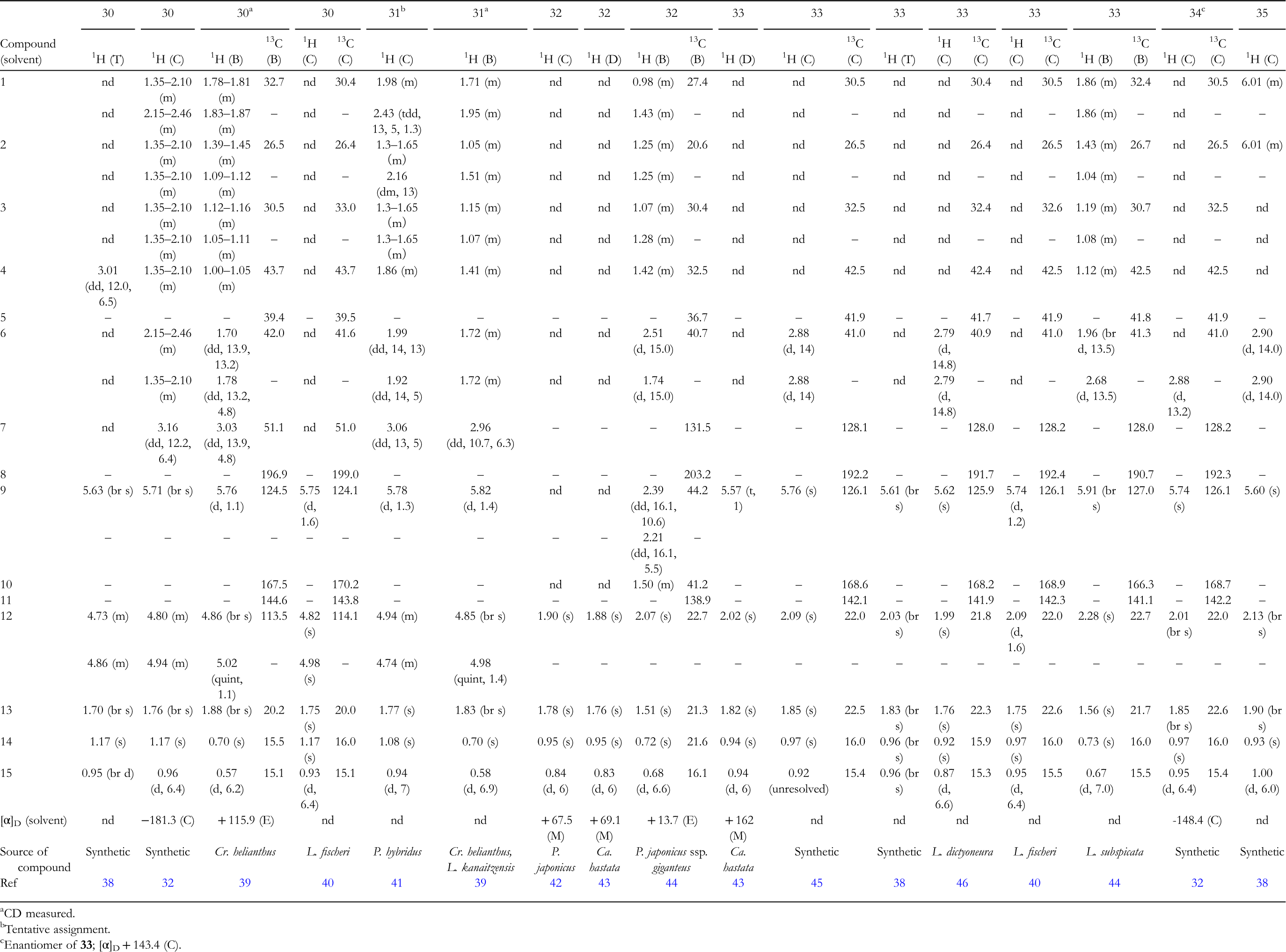
The data of six ketones, 30–35 (Figure 3), are listed in Table 5. Compound 30 and neopetasane (31) are isomeric at C-7, and H-7 of 31 resonates in the slightly higher region than that of 30. Please note that signals tend to shift to higher field when measured in benzene-d6. Unfortunately 13C data of neopetasane (31) has not been reported. CD spectra are most reliable data showing the apparent difference between compounds 30 and 31.39 The data of fukinone (32) measured in benzene-d6 are our own results, which are unpublished. Synthetic compound 34 is an enantiomer of natural dehydrofukinone (33)32; the NMR data should of course be the same as each other except for the specific rotation. Ref. 32 reported that 33 ( = enantiomer of 34) was also synthesized ([α]D + 143.4 (C)). Fukinone (32) is the dihydro derivative of 33 with H-10β. Karanone (35), known as a fragrance, has one more double bond at C-1/C-2 than dehydrofukinone (33). Isofukinone (29) (Table 4) and neopetasane (31) are the double-bond isomers.
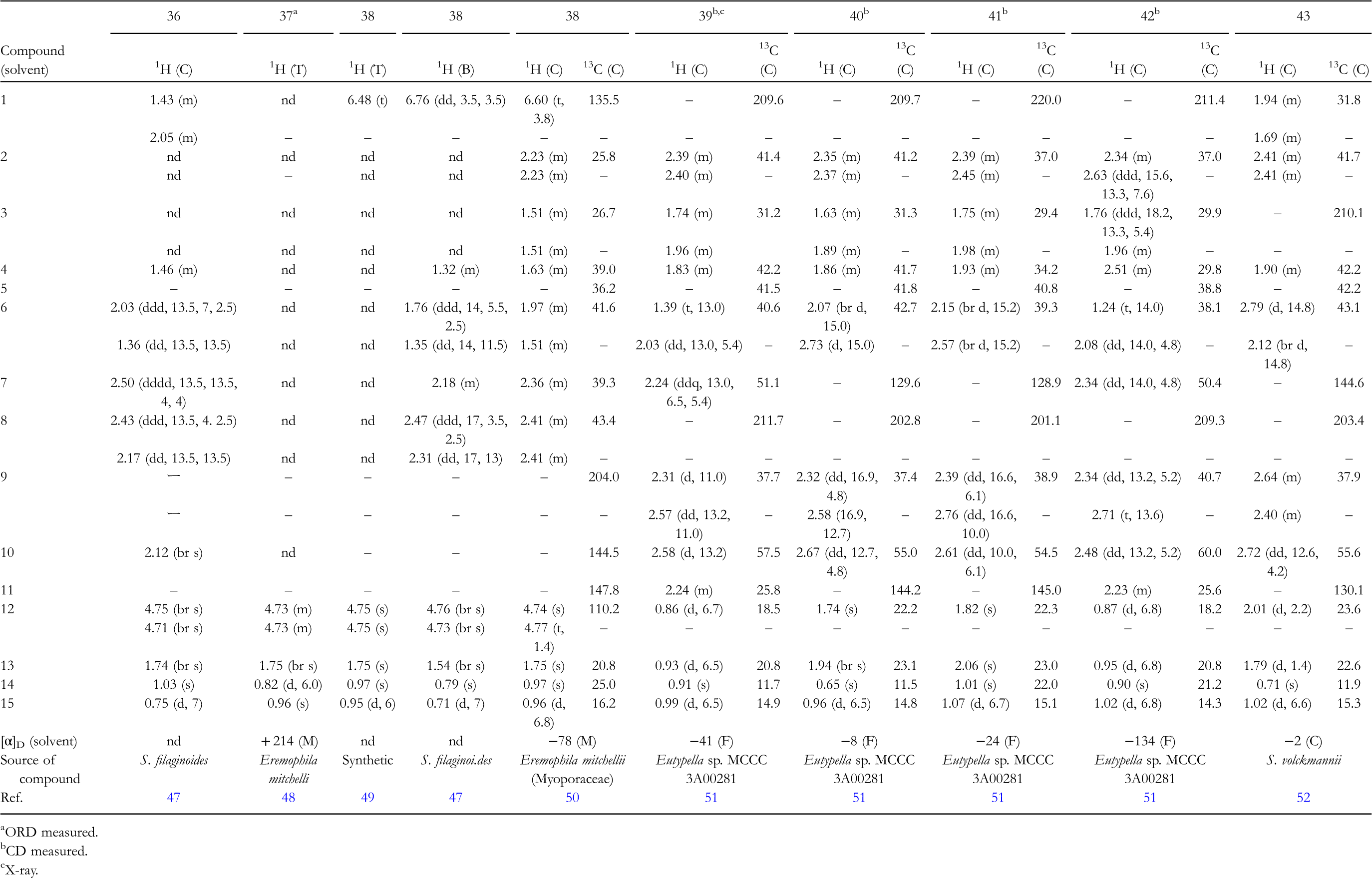
Table 6 includes the data of three monoketones, 36–38, and five diketones, 39–43 (Figure 3). The configuration at C-7 of compound 36 is unknown. Compound 37 is a C-1/C-2 dehydro derivative of 36, but the chemical shift of H-7 of 37 is not shown. Therefore, it is difficult to compare 36 with 37, whose H-7 is α-orientation. Eremophilone (38) is 1(10)-ene isomer of 37. Compounds 39–43 are 10-H diketones; 39 and 40 are trans- and 41–43cis-fused decalin derivatives. The structure of eutyperemophilane C (39) was established by X-ray analysis.51 The CD and ORD spectra of 39–4251 and 3748 were measured, respectively.
The data of six diols, 44–49 (Figures 3 and 4) were listed in Table 7. Compounds 44, 45, and 47 have a 9-ene system, while 46, 48, and 49 have no double bond in a decalin ring. Compounds 46, 48, and 49 possess the α absolute configurations of C-14 and 15, and 44 and 45 C-15α absolute configuration. The structure of capsidiol (45) was established by X-ray analysis.18 Compound 48 and its diastereoisomers 49 were also analyzed by X-ray.57
The data of eight diols, 50, 52–55, and 57–59, and two mono acetates, 51 and 56, were listed in Table 8 and Figure 4. Compounds 50–57 have a 1(10)- or 9-ene system, while 58 and 59 have no double bond in the decalin ring. Dihydropetasol (53) and 52 are C-8 epimers, and the chemical shifts are more or less similar each other except for C-8 and neighbors. Compound 56 is 12-acetate of 55. The CD spectrum of acremeremophilane K (51) was recorded, and the numbering system used in the original paper was changed to the present system.58
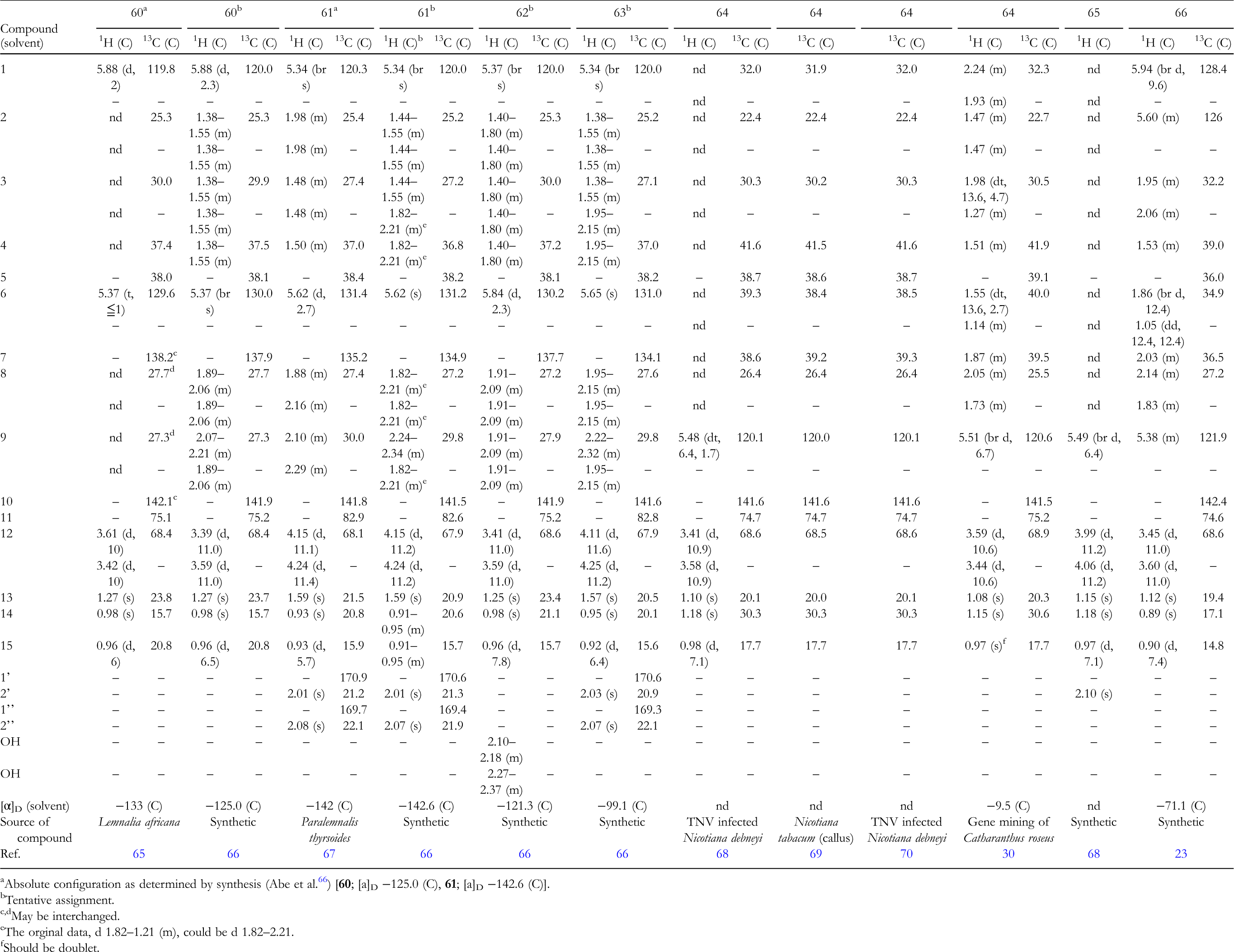
Seven 11,12-diols and their acetates were included in Table 9 and Figure 4. Compounds 60–63 have a 1(10),6-diene system, and 64 and 65 9-ene. Compound 66 has a 1,9-diene system. The absolute configurations of compounds 60 and paralemnolin C (61) were determined by synthesis. Paralemnolin C (61) and compound 63 are diacetate derivatives of 60 and 62, respectively. Compounds 62 and 63 are C-11 epimers of 60 and 61, respectively. The configuration of C-11 of compounds 60–65 were determined; however, that of 66 was not determined.23 The chemical shift δ 1.82–1.21 (m) for 61 in Ref. 66 could be 1.82–2.21 (m) (Table 9). The shape of H3-15 of debneyol (64) should be doublet.30
Absolute configuration as determined by synthesis (Abe et al.66) [60; [a]D −125.0 (C), 61; [a]D −142.6 (C)].
Tentative assignment.
May be interchanged.
The orginal data, d 1.82–1.21 (m), could be d 1.82–2.21.
Should be doublet.
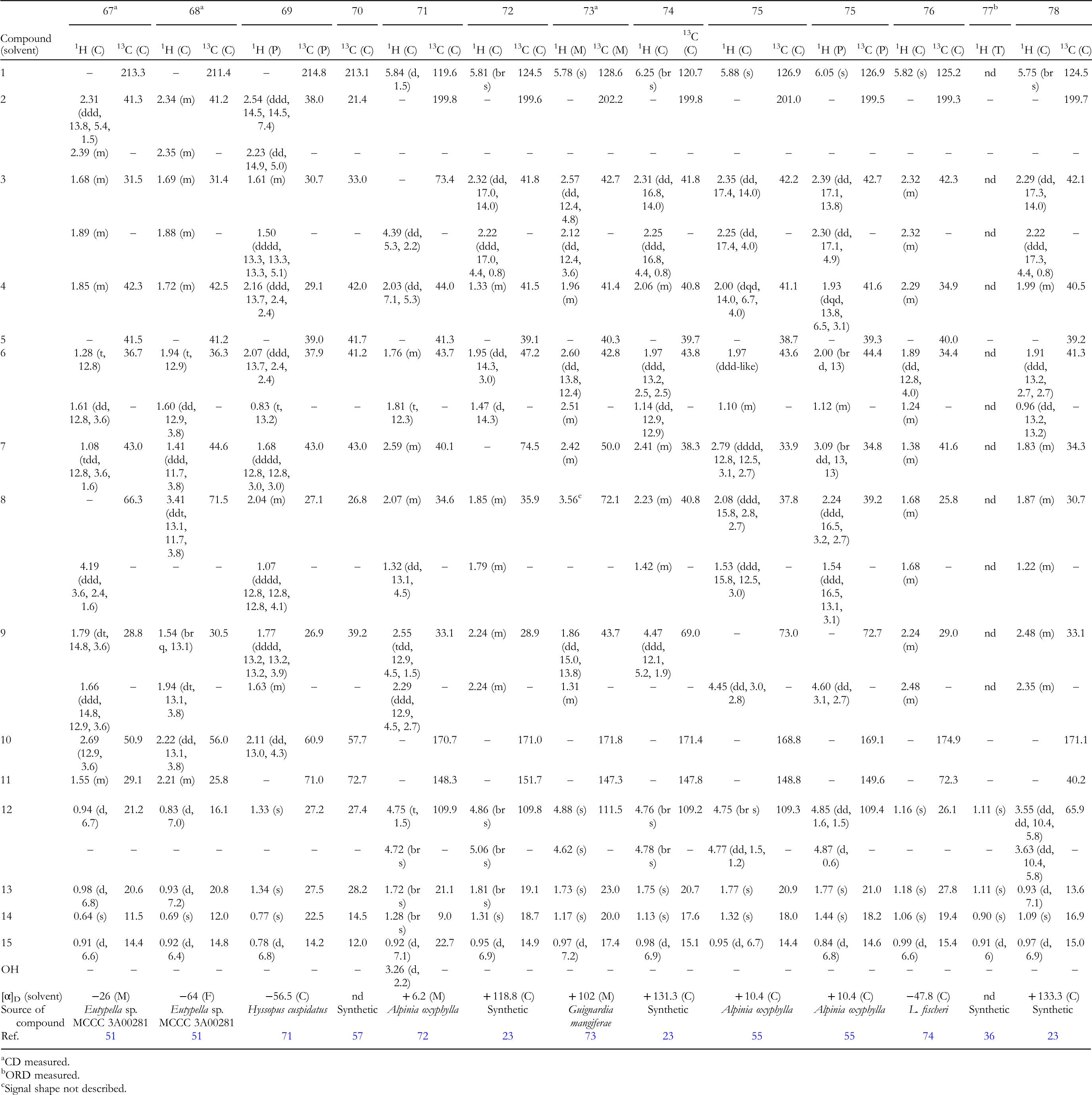
Table 10 includes data of 12 hydroxyketones, 67–78 (Figures 4 and 5). Compounds 67–70 are 1-ones, and the rest are 2-one derivatives. Compounds 70–72, 74, 75, 77, and 78 possess the α absolute configurations of C-14 and 15. The CD spectra of 67, 68, and 73 were measured.51,73 In the case of compound 77, ORD spectrum was measured.36 The C-11 configuration of 78 was not determined.23 It is interesting to note that compounds 76 and 77 are diastereoisomers concerning both C-4 and 5, but it can be also said that compounds 76 and 77 are C-7 epimers, if compound 77 is shown as its enantiomer. The data of 77 are not enough and cannot be compared with other similar compounds in detail.
The data of eight hydroxyketones, 79–86, and one acyloxyketone 87 are listed in Table 11 and Figure 5. All have a 1-hydroxy-8-one system. Compounds 79–82 have 7β-H, while 83 7α-H; the rest 84–87 the 7(11)-ene moiety. Eutyperemophilane V (79) and eutyperemophilane W (83) are C-7 epimers. Compounds 81 and 82 are C-1 epimers, the H-1 and H-9 chemical shifts of which are different and characteristic.39 Eutyperemophilane Q (84) and eutyperemophilane R (85) are C-10 isomers, namely the former is trans-decalin and the latter cis-decalin. Remarkable differences are detected in both 1H and 13C NMR spectra for compounds 84 and 85 or 84 and 86 (Table 11). Compound 87 has an angeloyloxy group at C-1β position. The CD spectra of 79, 80, and 83–86 were measured.51 It is not possible to compare the chemical shifts of H-7 of 82 and 83, because they were measured in different solvents.
The data of four hydroxyketones, 88, 89, 91, and 92, and two keto acetates, 90 and 93, are listed in Table 12 and Figure 5. Compounds 88–90 are 7(11),9-dien-8-ones and 91–93 are 9,11-dien-8-ones. Compounds 88 and 89 are C-1 epimers, and 90 is acetate of 88. Compounds 91 and acremeremophilane G (92) are C-2 epimers, and 93 is an acetate of 92. The data of 88 and 89 in Ref. 77 were measured using the mixture of 88:89 = 2:1. The CD spectra of acremeremophilane G (92) and acremeremophilane H (93) were measured.58 The numbering system used for compounds 92 and 9358 has been changed to the present system.
Table 13 includes the data of five 8-one compounds, 94–98 (Figure 5). Petasol (94) is frequently isolated from plant sources; unfortunately complete data of 1H NMR cannot be found so far in the literature. Compound 96 is a 3-epimer of petasol (94), and 95 is 6,7-dehydro compound of petasol (94). The chemical shift of H-3 of 3-epi-petasol (96) resonated at δ 3.95,59 while petasol (94) at δ 3.65.81 Compound 98 is acetate of hoaensieremone (97). Interestingly, the chemical shifts of H-1 and 2 of hoaensieremone (97) are the same (δ 6.15), while those of its acetate 98 different (δ 6.20 and 6.01)83 (Table 13).
The data of hydroxyketones, 99–105 (Figures 5 and 6) are listed in Table 14. Compounds 99–101 have a 7(11),9-dien-8-one system, and 102 1,7(11),9-trien-8-one system. Ligudicin D (103) and 104 are 9,11-dien-8-ones bearing 7-hydroxy group in α- and β-orientation, respectively. Compound 105 is trans-decalin bearing a hydroxy and a carbonyl group at C-9 and 8, respectively. Compound 100 is acetate of isopetasol (99). Compounds 100 and 101 are C-3 isomers.
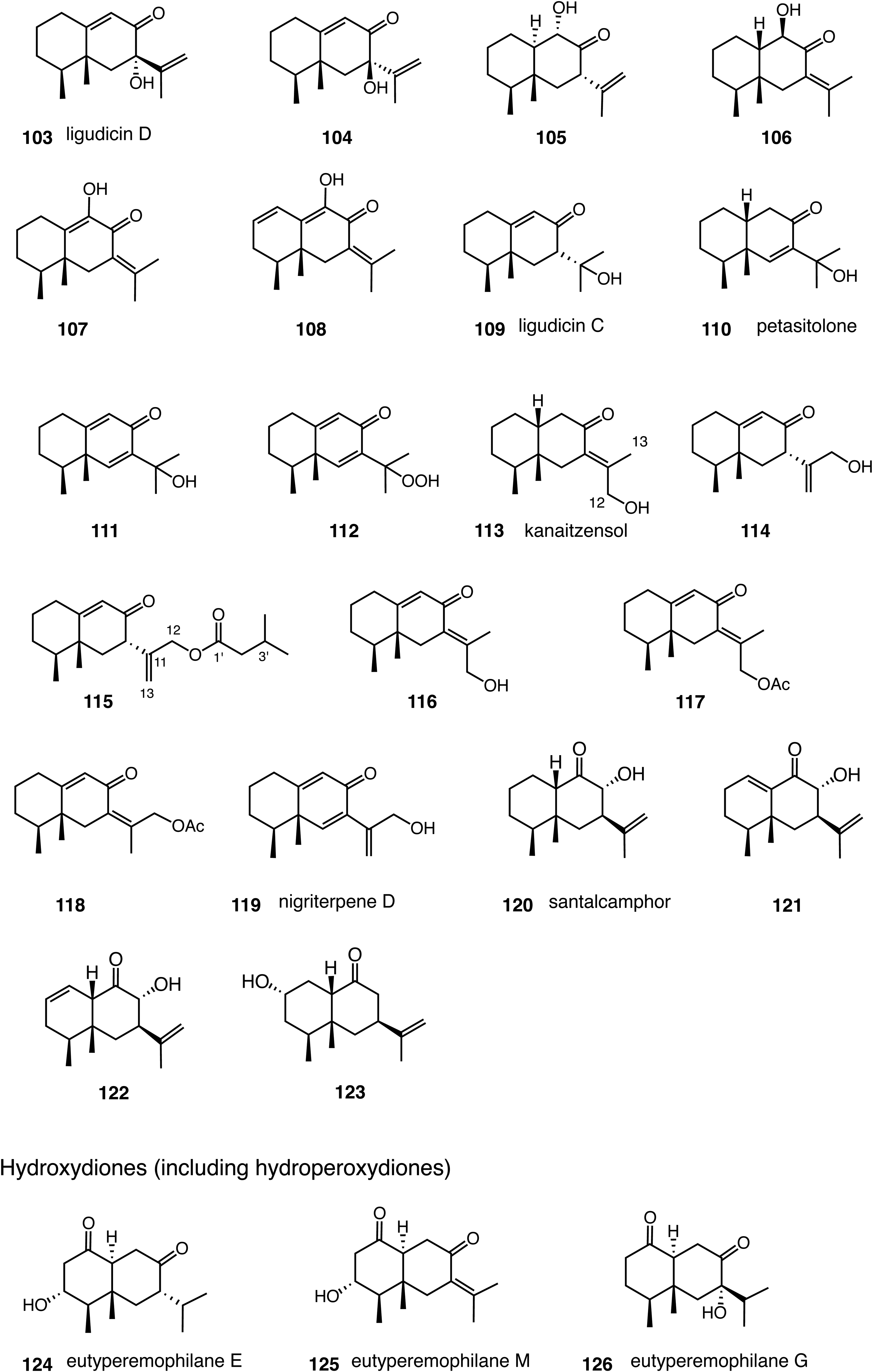
Table 15 includes the data of six hydroxyketones, 106–111, and hydroperoxyketone 112 (Figure 6). Compound 112 is a hydroperoxy derivative of alcohol 111. The presence of a hydroperoxy proton at δ 8.59 (s) is an important evidence of the hydroperoxy moiety.63 The evidence also due to 13C chemical shift at C-11 (δ 83.8)91 compared with that of compound 111 (δ 71.8). Compounds 107 and 108 are enol form of diketone.50 Compounds 106 and petasitolone (110) are cis-decalin derivatives.
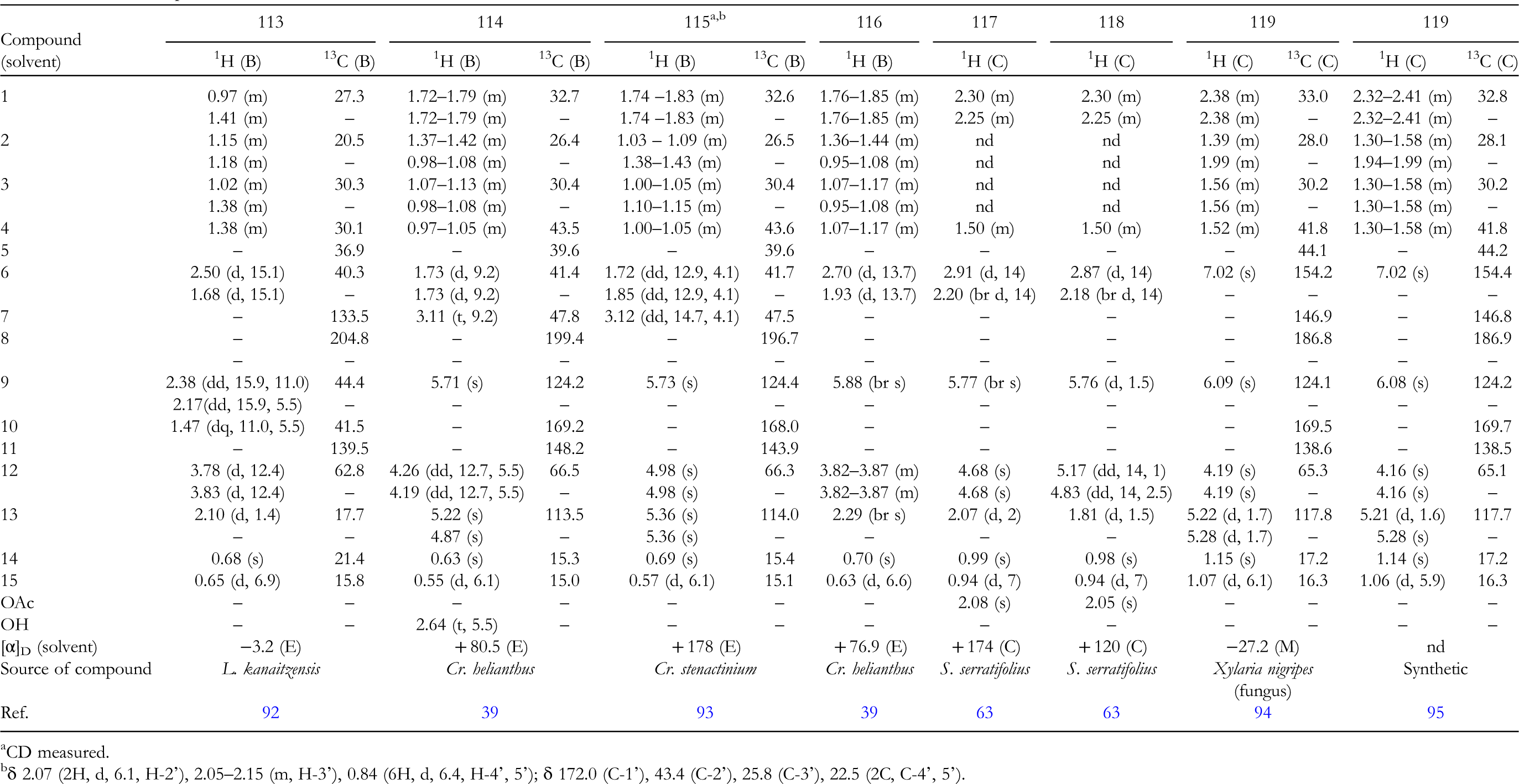
Table 16 includes the data of four hydroxyketones, 113, 114, 116, and 119, two ketoacetates, 117 and 118, and acyloxyketone 115 (Figure 6). Kanaitzensol (113) is a 12-hydroxy derivative of fukinone (32).92 Compounds 114 and 116 are double-bond isomers, and 115 is a 3-methylbutanoyloxy derivative of 114. Compound 117 is an acetate of 116, and 118 is a geometric isomer of 117. Nigriterpene D (119) is a 6,7-dehydro derivative of 114. The CD spectrum of compound 115 was measured.93
Table 17 includes the data of four hydroxyketones, 120–123, and four hydroxydiketones, 124–127, the former being 9-ones and the latter 1,8-diones (Figures 6 and 7). Compounds 120–122 are 8α-hydroxy-9-ones, and 123 2α-hydroxy-9-one. Santalcamphor (120), 122, and 123 are cis-decalins, while 124–127trans-decalins. The CD spectra of 123–127 were measured.51,96 Eutyperemophilane G (126) and eutyperemophilane H (127) are C-7 epimers; the differences of the NMR data of these two isomers were expectedly detected both in 1H and 13C NMR spectra.51 The NOE experiments of 126 assigned the C-7 configuration, which was confirmed by X-ray analysis.51 The absolute configuration was also established using Flack parameters.
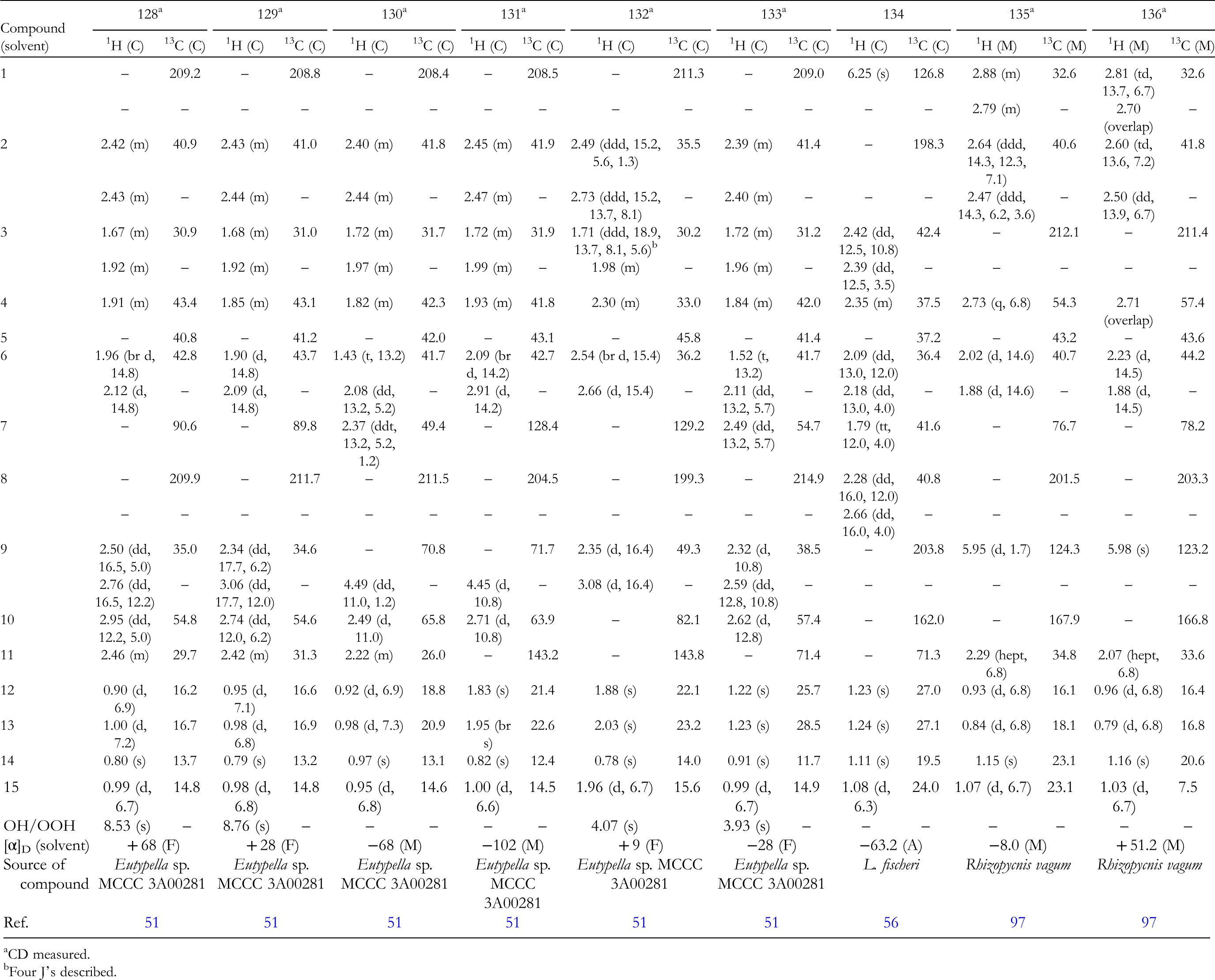
Table 18 includes the data of two hydroperoxydiketone, 128 and 129, and seven hydroxydiketones, 130–136 (Figure 7). Eutyperemophilane I (128) and eutyperemophilane J (129) are hydroperoxy derivatives of eutyperemophilane G (126) and eutyperemophilane H (127), respectively, and thus, 128 and 129 are C-7 epimers. The presence of singlet peaks at δ 8.53 and 8.76 in these compounds, respectively, indicates the hydroperoxy group. The 13C chemical shift of C-7 of 128 (δ 90.6) is slightly in the lower field than that of 129 (δ 89.8); the same tendency is detected for compounds 126 and 127. The C-7 chemical shift of compound bearing α-hydroxy or hydroperoxy group appears in the lower field than that bearing β. The CD spectra of all the compounds, except for 134, were measured.
Table 19 includes the data of seven dihydroxyketones, 137–140, and 143–145, and two chlorides 141 and 142 (Figure 7). Compound 137 is 1-one, 138–142 2-ones, 143 3-one, and 144 and 145 8-ones. Compounds 137 and 139–143 possess the α absolute configurations of C-14 and 15. Compound 139, isolated in pure, and 140, isolated as a mixture with 139, are C-11 epimers. Compounds 141 and 142 are 12-chloro derivatives of 139 and 140, respectively. Both guignarderemophilane B (144) and rhizoperemophilane B (145) have 1β,2β-dihydroxy groups. The CD spectra of acreremophilane I (138), 141, 142, and 145 were measured.58,97,98 The NMR data of 139 and 140 are almost the same and only small changes around C-11 are detected.
Table 20 includes the data of ten dihydroxyketones, 146–155 (Figures 7 and 8). Rhizoperemophilane A (147) and 148, and eutyperemophilane X (149) and rhizoperemophilane E (150) are C-1 epimers, respectively. Compounds 152–154 are 6,9-dien-8-ones. The CD spectra of rhizoperemophilane A (147),97 rhizoperemophilane E (150),97 and paraconiothin G (154)60 were measured. The configuration at C-11 of compound 153 was not determined. The absolute configuration of eutyperemophilane X (149) was determined by the MTPA method.51 The X-ray analysis of compound 151 appeared100 but the other spectroscopic data cannot be found so far.
Table 21 includes the data of nine dihydroxyketones, 156–164, all bearing an 8-oxo group, and 3α,8α-dihydroxy-9-one, 164a (Figure 8). Petasitol (160) and 3-epi-petasitol (161) are C-3 epimers. Rhizoperemophilane D (156) and 164 have a 1,9-dien-8-one system. The 14-position of JBIR-27 (163) is oxidized, which is quite rare as a natural product.107 The CD spectra of rhizoperemophilane D (156),97157,103 and dendryphiellin H (164)108 were measured, and in the case of petasitol (160), ORD was measured.104
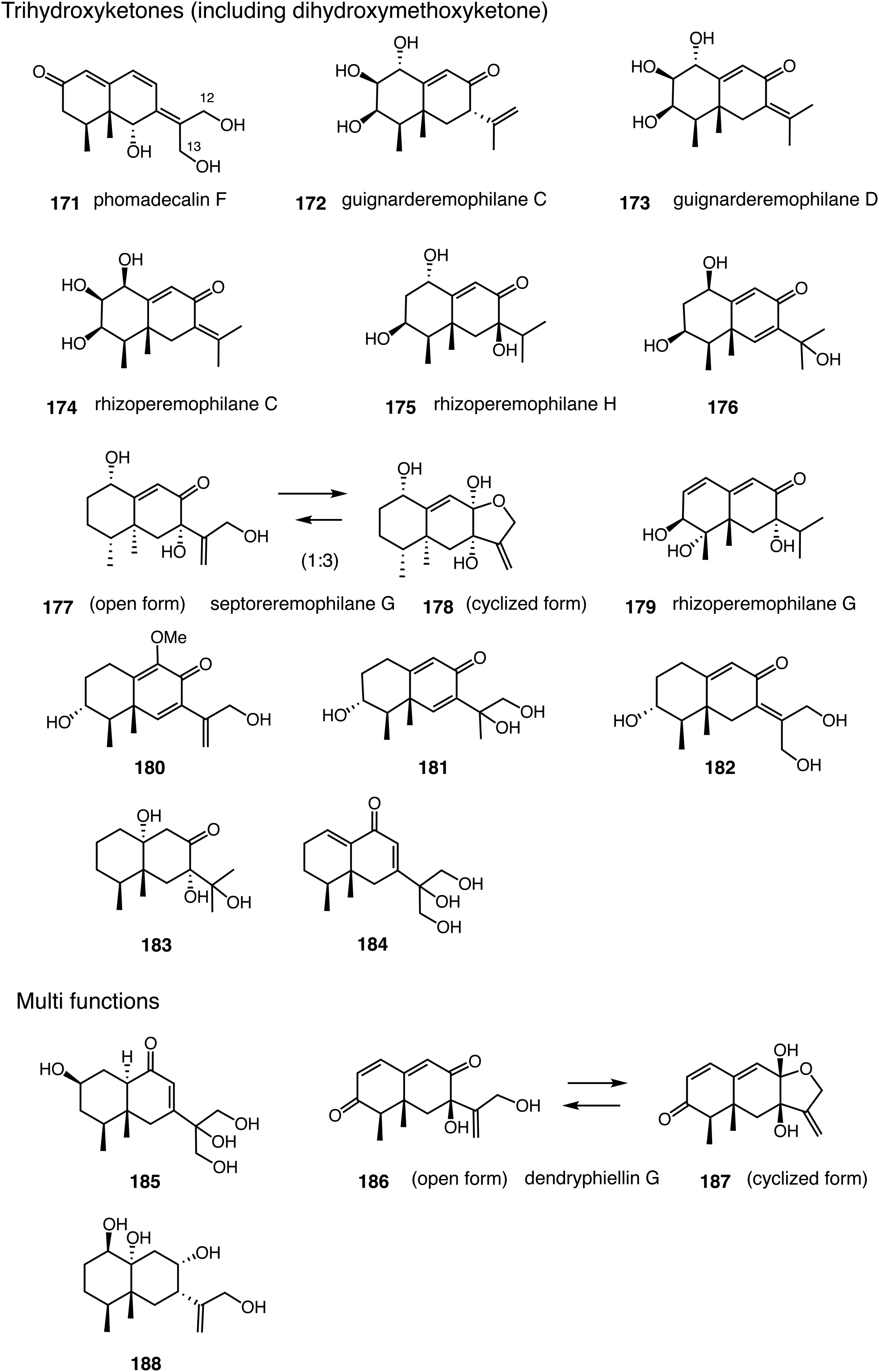
The data of six triols, 165–170, and four trihydroxyketones, 171–174, are listed in Table 22 (Figures 8 and 9). Paraconiothin D (167) and acremeremophilane J (168) are isomers concerning the double bond position and C-8. The configuration at C-11 of 169 was not determined. Guignarderemophilane D (173) and rhizoperemophilane C (174) are C-1 isomers. Guignarderemophilane C (172) is a double-bond isomer of guignarderemophilane D (173). The CD spectra of guignarderemophilane D (173)73 and rhizoperemophilane C (174)97 were measured. The numbering used in acremeremophilane J (168)58 was changed to the present system. The absolute configuration of 170 was determined by the MTPA method.109
Table 23 includes the data of eight trihydroxyketones, 175–177, 179, and 181–184, dihydroxymethoxyketone 180, and tetrahydroxyketone 185 (Figure 9). Septoreremophilane G has C-14α and C-15α absolute configurations and exists as a mixture of open form 177 and cyclized form 178 in a ratio of 1:1.3 in methanol.62 The H2-12 of the open form 177 resonating at δ 4.06 (q, J = 14.4 Hz) seems an AB quartet. Cyclized form of septoreremophilane G (178) is a tricyclic eremophilane and should be listed in the later chapter; however, this is one of the equilibrium isomers and, therefore, shown in Table 23. Compounds 176, 180, and 181 have a 6,9-dien-8-one system. Both compounds 184 and 185 have the 11,12,13-triol moiety. The CD spectra of rhizoperemophilane H (175),97176,99 rhizoperemophilane G (179),97184,112 and 185112 were measured.
Mixture of open form (177) and cyclized form (178) in 1:1.3 (in M).
Seems AB quartet.
J not shown.
May be interchanged.
Table 24 includes the data of three polyfunctional compounds, 186, 187, 188, and seven epoxides, 189–195 (Figures 9 and 10). Dendryphiellin G exists as a mixture of an open form 186 and a cyclized form 187 in a ratio of 1:6 (at 20 ˚C) in methanol.113 The ratio changed to 1:3 at 55 ˚C in methanol.113 Compounds 189–192 have 1,10-epoxide, while 193–195 9,10-epoxide. The chemical shifts of methine protons at C-1 of 189–192 resonate at δ 2.90–2.97, while those of 193–195 δ 3.23–3.44, slightly in the lower field. However, the chemical shifts of 13C NMR of the epoxide carbons appear at δ 59.3–69.0 for all epoxides. The ORD spectrum of dendrryphiellin G (186, 187)113 and the CD of 193119 were measured.
Table 25 includes the data of 10 epoxides, 196–205 (Figure 10). Compounds 196–200 are 9,10-epoxides, while 201–205 6,7-epoxides. Compounds 197 and 198 are C-8 epimers, and 199 is a p-bromobenzoate derivative of 198. Dihydrosporogen AO-1 (201) and 202 are C-8 epimers. The CD spectrum of artefreynic acid (200)120 was measured. Unfortunately, the 13C chemical shift of C-11 of peribysin A (203) was missing.121 The configuration of epoxide rings is one of the difficult problems. There are many cases that expected NOE’s can also be explained if the configuration of the epoxide ring is reversed. Therefore, we have to be much more careful about the details.
The data of nine 6,7-epoxides, 206–214, are listed in Table 26 (Figures 10 and 11). Compounds 207–214 have a 9-en-8-one system, while 206 has two hydroxy and an acetoxy groups with 9-ene. Xylarenone B (211) is acetate of xylarenone A (210). The structure of phomenone (213) was determined by X-ray analysis,131 and the CD spectrum was measured.130 JBIR-28 (214), a 6,7-epoxy derivative of JBIR-27 (163), has two hydroxy groups at C-3 and 14. Oxidation at C-14 position is rather rare in natural products.
The data of further twelve 6,7-epoxides, 215–226, are listed in Table 27 (Figure 11). Compounds 219–226 have a 1,9-diene system. Penicilleremophilane A (218) is a 3-chloro-4-hydroxyphenylacetyl derivative of sporogen AO-1 (208). Phomadecalin I (220), the CD spectrum of which was measured,134 is a desoxy derivative of compound 222. Compound 224 is C-3 epimer of phomadecalin D (223). The C-8 configuration of phomadecalin C (221) was revised from 8β-OH to 8α-OH.122,134
Table 28 includes the data of ten 7,11-epoxides, 227–236 (Figure 11). Compounds 227–233 bear an 8-oxo group, while 234–236 an 8-hydroxy group. Compounds 227 and 228 are epoxide isomers, and 229 and 230 are their 6β-acetoxy derivatives, respectively.87 The configuration of the epoxide of 227 and 228 was determined by comparing the data with those of synthetically made compounds and X-ray analyses of their derivatives.137 Thus, the structure of natural product 227 was unambiguously established as depicted in Figure 11.136 The structure of 229 was established by X-ray analysis.87 Ligudicin A (231) and 232 are 9-ene derivatives of 227 and 228, respectively. The CD spectra of 227–230 were measured.87,136,137 It is interesting to note that compound 227 shows the positive Cotton effect at 310 nm (EtOH), while 229 the negative Cotton effect at 299 nm (EtOH), although both have 7α,11-epoxide. This phenomenon is presumably due to the presence of an acetyl group at C-6β position, and the consequent conformation change. As far as 13C chemical shifts of C-7 and 11 of compounds 227–232 are concerned, those of α-epoxides, 227, 229, 231, resonate in the higher field than those of β-epoxides, 228, 230, 232.
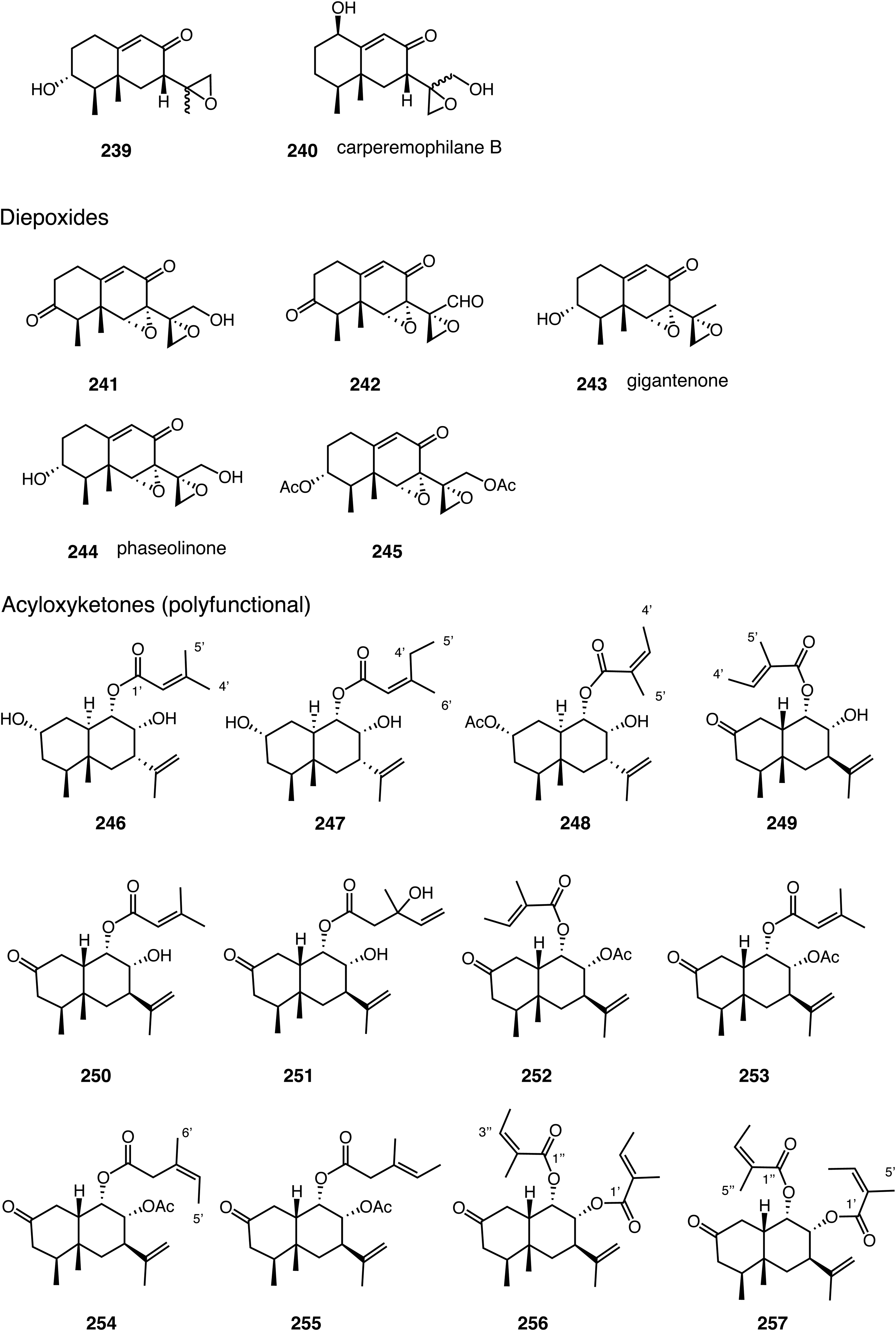
Table 29 includes the data of four mono epoxides, 237–240, and five diepoxides, 241–245 (Figures 11 and 12). Compound 237 and 238 are C-7 epimers; however, the configuration at C-11 is undetermined. The configurations at C-11 of both 239 and 240 were not determined. Compound 242 is a formyl derivative of 241. Compound 245 is diacetate of phaseolinone (244). The structure of gigantenone (243) was determined by X-ray analysis.82 The CD spectrum of phaseolinone (244) was measured.132,133
The data of 17 compounds bearing one or two acyloxy groups, 246–262,141,142 are listed in Table 30 (Figures 12 and 13). All the compounds are cis- or trans-decalins. Alkoxy groups are angelate, tiglate, senecioate, E- and Z-3-methylpent-3-enoate, E-3-methylpent-2-enoate, 3-hydroxy-3-methylpent-4-enoate, 2-methylbutanoate, and their combination. Signals due to two esters attached to C-8 and 9 positions of compound 258 were not assigned. Unfortunately, 13C NMR data were not displayed.
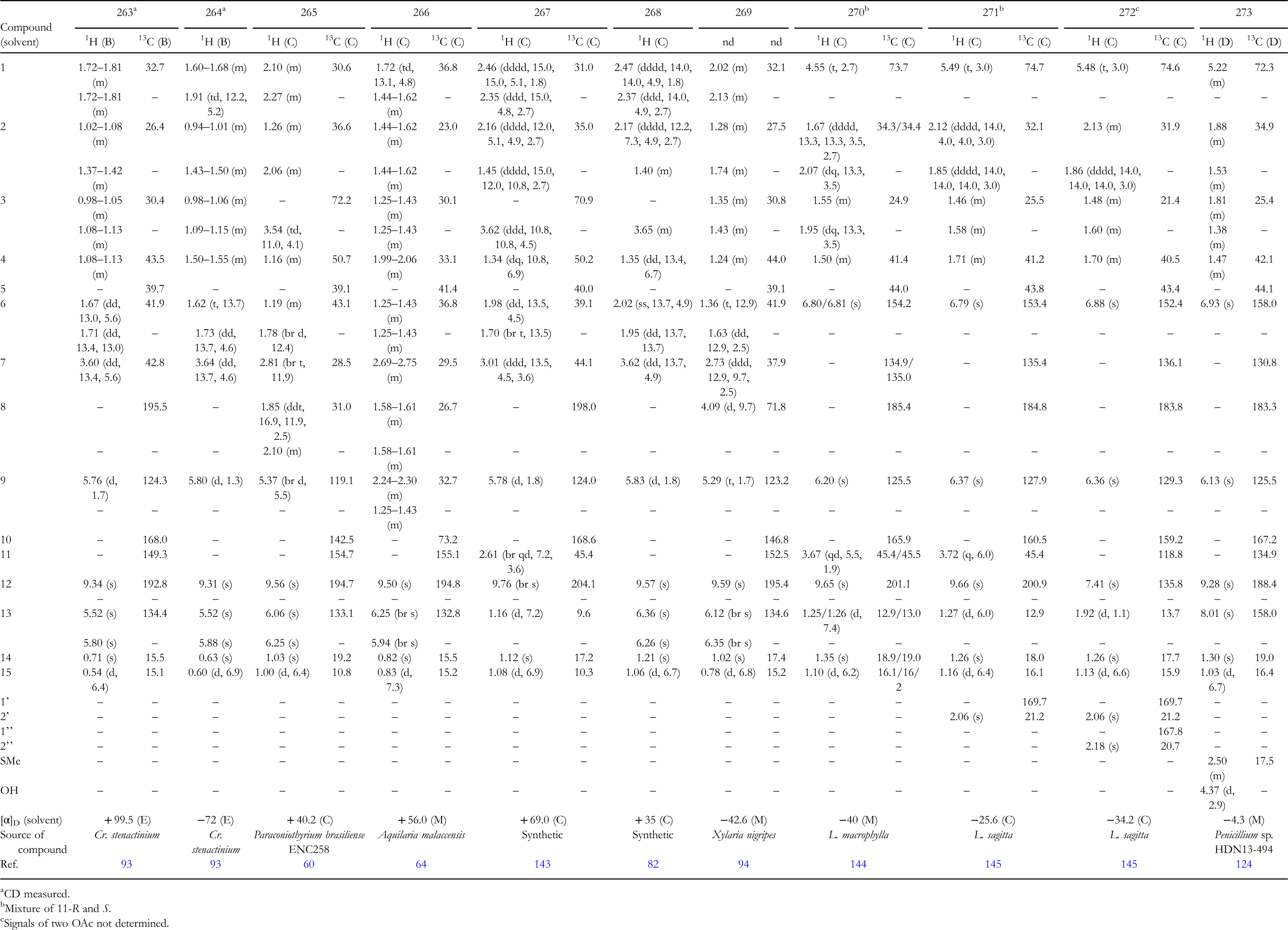
Table 31 includes the data of 11 aldehydes, 263–273 (Figure 13). Nigriterpene F (263) and 264 are C-7 epimers. Compound 266 has no double bond in a decalin ring. The configuration at C-11 of 267 was not determined. Compounds 270 and 271 are a mixture of C-11R and S isomers. Compound 272 is an enol acetate of 271. Signals due to two acetyl groups of 272 were not distinguished.145 Phomenone A (273) has a methylthio group at C-13. The CD spectra of nigriterpene F (263) and 264 were measured.93
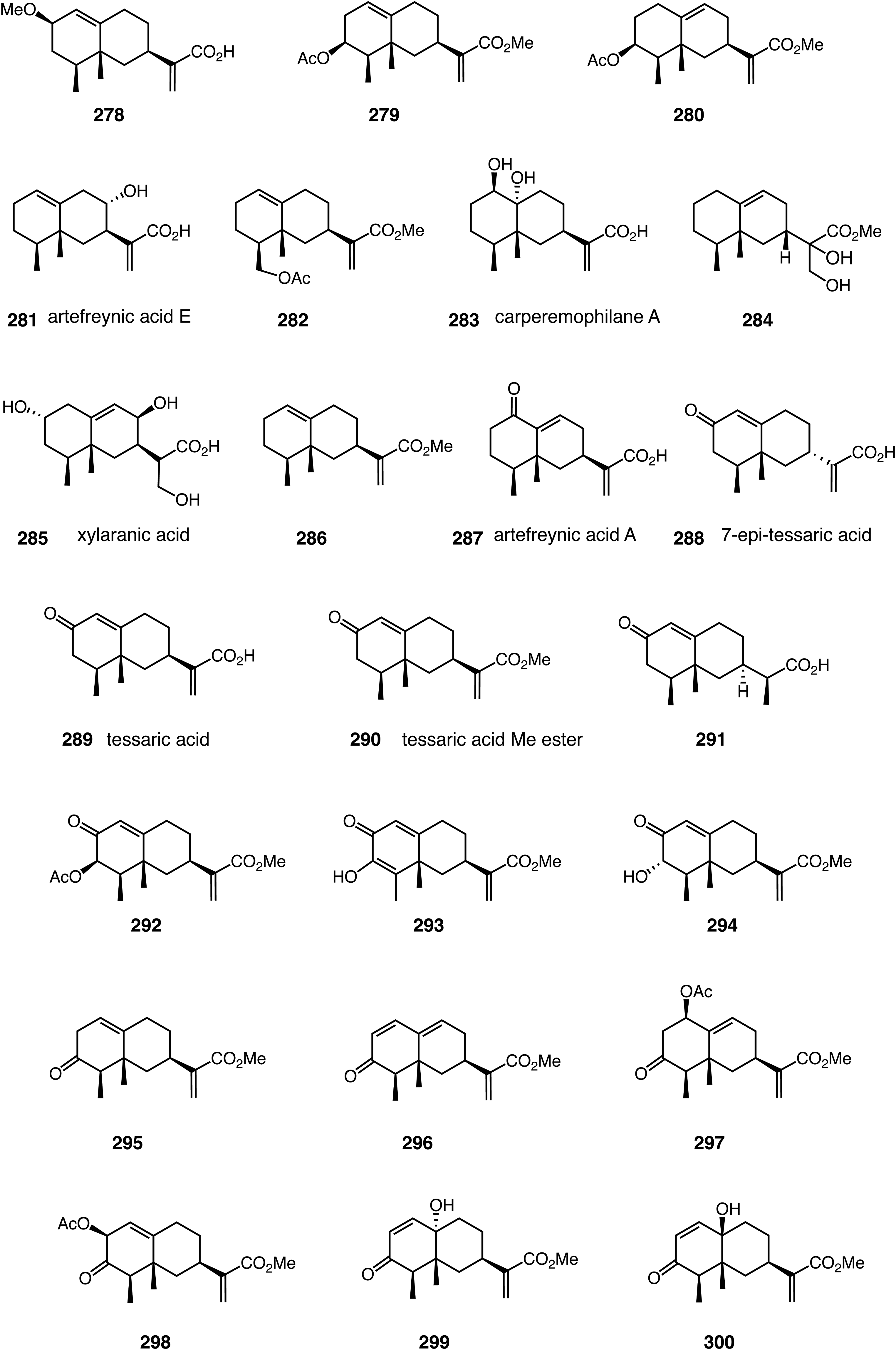
Table 32 includes the data of five carboxylic acids, 274, 276, 278, 281, and 283, and five methyl esters, 275, 277, 279, 280, and 282 (Figures 13 and 14). Compounds 274, 275, and 280 are 9-enes, while 276–279, 281, and 282 are 1(10)-enes. Compounds 276 and 277 are C-7 epimers. The C-15 position of compound 282 is oxidized, which is rather rare as the natural product.119 The 13C chemical shift of 96.1 of 277 cannot be assigned.147 The CD spectra of compounds 274, 276, and 281 were measured.120,146 Although methyl esters are recorded for 275, 279, 280, and 282, their original natural products are the corresponding carboxylic acids. The structure of carperemophilane A (283) was determined by X-ray analysis.149
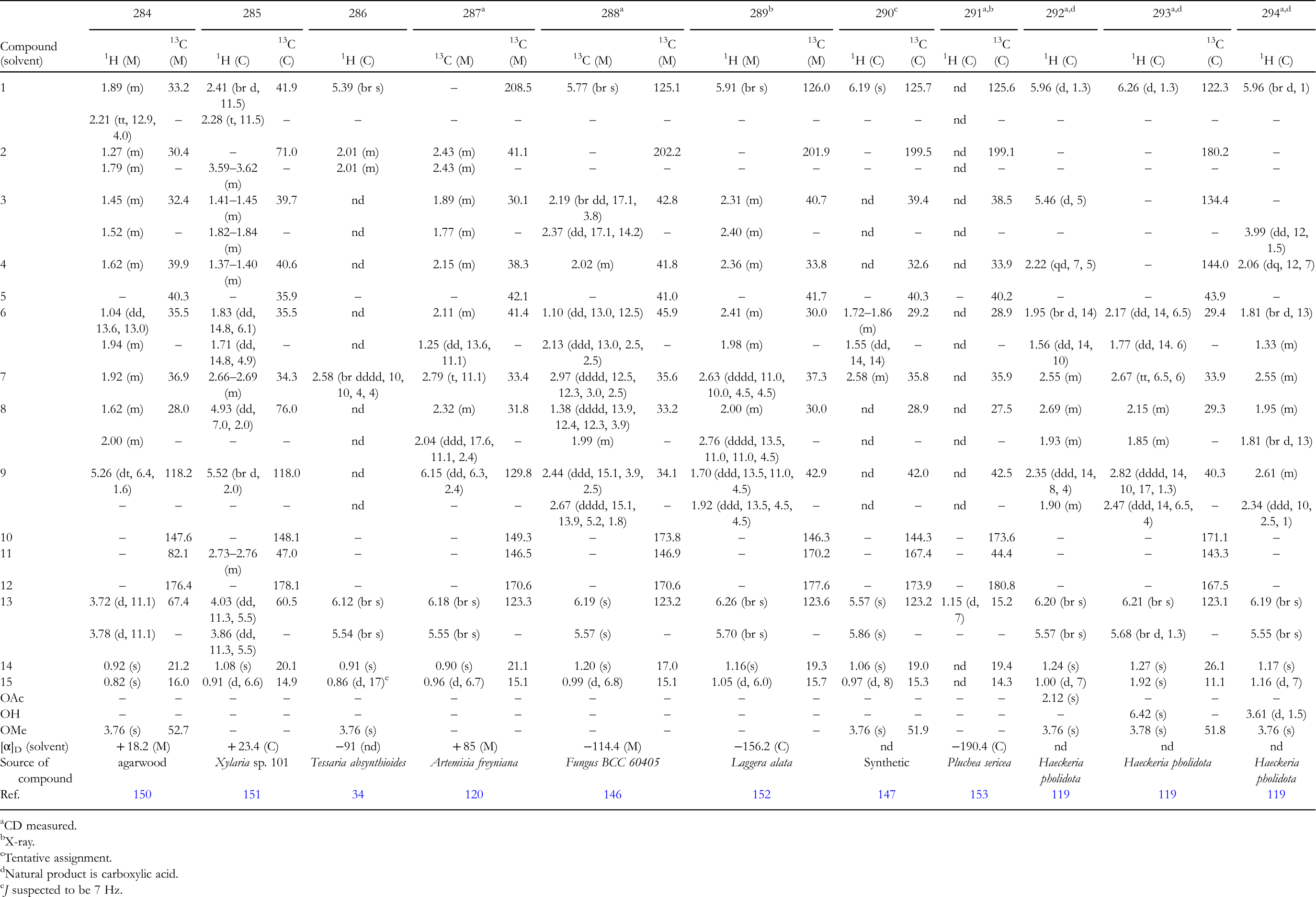
Table 33 includes the data of five carboxylic acids, 285, 287–289, and 291, and six methyl esters, 284, 286, 290, and 292–294 (Figure 14). Compound 286 is methoxycarbonyl derivative of aldehyde 264. Tessaric acid (289) and 7-epi-tessaric acid (288) are C-7 epimers. Compound 290 is methyl ester of tessaric acid (289), and compound 291 is dihydro derivative of tessaric acid (289). Compound 293 is an enol form of 2,3-diketone. The CD spectra of 287, 288, and 291–294 were measured.119,120,146,153 The structure of tessaric acid (289) and 291 was determined by X-ray analysis.152,153 Although methyl esters are recorded for 292–294, the natural products are their carboxylic acids.
The data of 10 methyl esters (natural products are their carboxylic acids), 295–304, all bearing 3-ketones, are listed in Table 34 (Figures 14 and 15). Two compounds, 301 and 303 are hydroperoxides, whose hydroperoxy protons are detected at δ 7.48 and 7.59, respectively.119 Compounds 299 and 300 are C-10 epimers. Compound 301 is the corresponding hydroperoxide of 300. Compounds 302 and 303 are enol acetates. The CD spectra of 296 and 298 were measured.119
Table 35 includes the data of five carboxylic acids, 305–307 312, and 314, three methyl esters, 308, 313, and 315, and three ethyl esters, 309–311 (Figure 15). The absolute configuration at C-11 of 306 was determined by X-ray analysis of its p-bromophenacyl ester.92 The H-11 of 306 (11-R) resonated at δ 3.70 (in benzene-d6), while that of 307 (11-S) at δ 3.59; hereafter these two compounds can be distinguished by comparing the chemical shift of H-11. Thus, in the case of ethyl ester, the one having H-11 appearing at lower field (δ 3.89) can be assigned 11-R (δ 3.80 for 11-S).157 The configurations at C-11 of 305, 308, and 314 are undetermined. Compound 314 has tigloyloxy group at 1α-position. The CD spectra of compounds 305–307 and setoreremophilane H (315) were measured.62,92,155
Table 36 includes the data of seven carboxylic acids, 316–322, and methyl ester 323 (Figure 15). Compound 323 is the corresponding methyl ester of 322. Compounds 316 and 317 have a 1,9-dien-8-one system and 319–323 a 7,9-dien-8-one system. The configurations at C-11 of compounds 319, and 321–323 are not determined. The CD spectra of acemeremophilane A (317),58 phomadecalin H (318),135 and phomadecalin G (320)135 were measured. The numbering system used in acemeremophilane A (317) was changed to the present system.
Table 37 includes the data of three carboxylic acids, 324, 325, and 327, two methyl esters 326 and 328, two dicarboxylic acids, 330, and 331, and dimethyl ester 329 (Figure 16). Compounds 324–328 have a 7,9-dien-8-one system, and 328 has an angeloyloxy group at C-1β. Compound 329 is a 1:1 mixture of 11-R and S, and compounds 330 and 331 were isolated as a mixture of 2:3.171 The configurations of C-11 of 324–328 were not determined.
Compounds 2, 3, and 4 in Table 6 of Ref. 162 should be compounds 7, 8, and 9.
Mixture of 11-R and S.
330:331 = 2:3 mixture.
Compounds 1–26.
Compounds 27–47.
Compounds 48–74.
Compounds 75–102.
Compounds 103–126.
Compounds 127–147.
Compounds 148–170.
Compounds 171–188.
Compounds 189–211.
Compounds 239–257.
Compounds 258–277.
Compounds 278–300.
Compounds 301–323.
Compounds 324–331.
Footnotes
Acknowledgments
The author thanks laboratory staff members engaged in these projects acquiring NMR data. Special thanks are due to Dr Yasuko Okamoto and Prof. Masakazu Sono, Tokushima Bunri University, Prof. Yoshinosuke Usuki, Osaka Metropolitan University, and Emeritus Prof. Chiaki Kuroda, Rikkyo University, for their help to check the references appeared in this review.
Declaration of Conflicting Interests
The author declared no potential conflicts of interest with respect to the research, authorship, and/or publication of this article.
Ethical Approval
Not applicable, because this article does not contain any studies with human or animal subjects.
Funding
The author received no financial support for the research, authorship, and/or publication of this article.
Informed Consent
Not applicable, because this article does not contain any studies with human or animal subjects.
ORCID iD
Motoo Tori
Trial Registration
Not applicable, because this article does not contain any clinical trials.
References
1.
ConnollyJDHillRA. Dictionary of terpenoids. London: Chapman and Hall, 1991.
2.
WehrliFWNishidaT. The use of carbon-13 nuclear magnetic resonance spectroscopy in natural products chemistry. In: HerzWGrisebachHKirbyGW (eds.) Progress in the chemistry of organic natural products. Wien: Springer, 1979:1-229.
3.
SeamanFC. Sesquiterpene lactones as taxonomic characters in the Asteraceae. The Botanical Review. 1982;48:121-595.
4.
LiuJQWangYJWangAL, et al. Radiation and diversification within the Ligularia-Cremanthodium-Parasenecio complex (Asteraceae) triggered by uplift of the Qinghai-Tibetan plateau. Mol Phylogen Evolution. 2006;38:31-49.
5.
YangJLWangRShiYP. Phytochemicals and biological activities of Ligularia species. Nat Prod Bioprospect. 2011;1:1-24.
6.
KurodaCHanaiRNaganoH, et al. Diversity of furanoeremophilanes in major Ligularia species in the hengduan mountains. Nat Prod Commun. 2012;7:539-548.
7.
YaoitaY. New sesquiterpenoids from the rhizomes of Petasites japonicus Maxim. And the roots of Ligularia dentata hara. Yakugaku Zasshi. 2012;132:887-893.
HouCKulkaMZhangJ, et al. Occurrence and biological activities of eremophilane-type sesquiterpenes. Mini-Rev Med Chem. 2014;14:664-677.
10.
KurodaCHanaiRToriM, et al.Diversity in furanoeremophilane composition produced by Ligularia species (Asteraceae) in the Hengduan mountains area of China. J Synth Org Chem Jpn. 2014;72:717-725.
11.
YuJJKurodaCGongX. Natural hybridization and introgression between Ligularia cymbulifera and L. tongolensis (Asteraceae, Senecionae) in four different locations. Plos One. 2014;9:e115167.
12.
WuLLiaoZLiuC, et al. Eremophilane sesquiterpenes from the genus Ligularia.Chem Biodivers. 2016;13:645-671.
13.
ToriM. Terpenoid composition and base sequences of Ligularia virgaurea (Asteraceae) grown in the Hengduan mountain area in China and a comment on drawing structures. Chem Pharm Bull. 2016;64:193-206.
14.
ToriM. Diversity of plants belonging to the genus Ligularia (Asteraceae) based on terpenoids and synthetic studies on some terpenoids. Yakugaku Zasshi. 2016;136:309-327.
15.
LiuSJTangZSLiaoZX, et al.The chemistry and pharmacology of Ligularia przewalskii: a review. J Ethnopharmacology. 2018;219:32-49.
16.
ToriMKurodaC. Chemical constituents of Ligularia Species (asteraceae) and their diversity in east Asia. In: KinghornADFalkHGibbonsS, et al. (eds.) Progress in the chemistry of organic natural products. Switzerland: Springer Nature Switzerland AG, 2020, pp.1-247.
17.
ZhaoYSchenkDJTakahashiS, et al. Eremophilane sesquiterpenes from capsidiol. J Org Chem. 2004;69:7428-7435.
18.
BirnbaumGIStoesslAGroverSH, et al. The complete stereostructure of capsidiol. x-ray analysis and 13C nuclear magnetic resonance of eremophilane derivatives having trans-vicinal mehtyl groups. Can J Chem.1974;52:993-1005.
19.
WhiteheadIMEwingDFThrelfallDR, et al. Synthesis of (+)-5-epi-aristlochene and (+)-1-deoxycapsidiol from capsidiol. Phytochemistry. 1990;29:479-482.
20.
RieckABulowNFrickeC, et al. (-)-1(10),11-eremophiladien-9(-ol from the liverwort Marchantia polymorpha ssp. aquatica. Phytochemistry. 1997;45:195-197.
21.
KhasawnehMAXiongYPeralta-CruzJ, et al. Biologically important eremophilane sesquiterpenes from Alaska cedar heartwood essential oil and their semi-synthetic derivatives. Molecules. 2011;16:4775-4785.
22.
ShojiNUmeyamaAAsakawaY, et al. Structure determination of nootkatol, a new sesquiterpene isolated from Alpinia oxyphylla miquel possessing calcium-antagonistic activity. J Pharm Sci. 1984;73:843-844.
23.
FurusawaMHashimotoTNomaY, et al. Biotransformation of citrus aromatics nootkatone and valencene by microorganisms. Chem Pharm Bull. 2005;53:1423-1429.
24.
NayaKMakiyamaYMatsuuraT, et al. The revised structure of furanofukinol, a constituent from Petasites japonicus maxim. Rhisomes. Chem Lett. 1978: 301-304.
25.
NaganoHTorihataAMatsushimaM, et al.Chemical and genetic study of Ligularia cyathiceps in yunnan province of China. Helv Chim Acta. 2009;92:2071-2081.
26.
IshiiHTozyoTMinatoH. Studies on sesquiterpenoids. Part XIII. Components of the root of Ligularia fischeri Turcz. J Chem Soc. 1966: 1545-1548.
27.
JommiGKrepinskyJHeroutV, et al. The structure of valerianol, a sesquiterpenic alcohol of eremophilane type from Valeriana oil. Tetrahedon Lett. 1967;8:677-681.
28.
ZalkowLHChettyGL. Interconversion of eremophilone and isoeremophilone and related reactions. J Org Chem. 1975;40:1833-1834.
29.
ItokawaHMoritaHWatanebeK, et al. Agarofuran-, eudesmane-type sesquiterpenoids from Alpinia japonica (Thunb.) Miq. Chem Pharm Bull. 1985;33:1148-1153.
30.
LiangJAnTZhuJX, et al.Mining of the Catharanthus roseus genome leads to identification of a biosynthetic gene cluster for fungicidal sesquiterpenes. J Nat Prod. 2021;84:2709-2716.
31.
NakanishiTYamagataEYonedaK, et al. Jinkoh-eremol and jinkohol II, two new sesquiterpene alcohols from agarwood. J Chem Soc, Perkin Trans. 1983;1:601-604.
32.
IshiharaMTsuneyaTUneyamaK. Fragrant sesquiterpenes from agarwood. Phytochemistry. 1993;33:1147-1155.
33.
WangC-FZhaoYLiuY-Z, et al. Two new eremophilane-type sesquiterpenoids from the rhizomes of Ligularia veitchiana (Hemsl.) Greenm. Helv Chim Acta. 2008;91:1712-1716.
34.
BohlmannFZderoCSilvaM. Two further eremophilane derivatives from Tessaria absynthioides.Phytochemistry. 1977;16:1302-1303.
35.
HandoreKLSeetharamsinghBReddyDS. Ready access to functionally embellished cis-hydrindanes and cis-decalins: protecting group-free total synthesis of (±)-nootkatone and (±)-noreremophilane. J Org Chem. 2013;78:8149-8154.
36.
HikinoHSuzukiNTakemotoT. Structure and absolute configuration of kusunol. Chem Pharm Bull. 1968;16:832-838.
37.
BohlmannFFritzU. Isofukinone, an eremophilane from Ligularia speciosa.Phytochemistry. 1980;19:2471-2472.
38.
HagiwaraHUdaHKodamaT. Synthetic study on several eremophilane sesquiterpenes using a common intermediate. J Chem Soc Perkin I. 1980: 963-977.
39.
SaitoYIchiharaMOkamotoY, et al. Four new eremophilane-type alcohols from Cremanthodium helianthus collected in China. Nat Prod Commun. 2012;7:423-426.
40.
WangCLiJYangR,et al.Petasins from the rhizomes of Ligularia fischeri and its derivatives. Rec Nat Prod. 2014;8:156-164.
41.
NeuenschwanderMNeuenschwanderASteineggerE. Struktur der sesquiterpene von Petasites hybridus (L.) G. M. et SCH.: neopetasol-abkömmilinge. Helv Chim Acta. 1979;62:627-634.
42.
NayaKTakagiIKawaguchiY, et al. The structure of fukinone, a constituent of Petasites japonicus Maxim. Tetrahedron. 1968;24:5871-5879.
43.
HayashiKNakamuraHMitsuhashiH. Sesquiterpenes from Cacalia hastata.Phytochemistry. 1973;12:931-2933.
44.
ToriiSInokuchiTYamafujiT. Functionalization of trans-decalin. III. A stereospecific preparation of vicinal cis two methyl groups of eremophilane skeleton, leading to dl-dehydrofukinone. Bull Chem Soc Jpn. 1979;52:2640-2645.
45.
TanAWangZHongX, et al. Study on the chemical constituents of Ligularia dictyoneura.J China Pharmac Univ. 2002;33:104-106.
46.
ToriM. unpublished results (data measured in our laboratory).
47.
BohlmannFJakupovicJWarnigU, et al.Sesquiterpenes with new carbon skeletons, furoeremophilanes, seco-eremophilanes and other constituents from Argentinian Senecio species. Bull Soc Chim Belges. 1986;95:707-736.
48.
ChettyGLZalkowLH. 7a(H)-Eremophila-1,11-dien-9-one. A new sesquiterpene of the eremophilane type. Tetrahedron Lett. 1969;10:307-309.
49.
McMurryJEMusserJHAhmadMS, et al. Total synthesis of eremophilone. J Org Chem. 1975;40:1829-1832.
50.
BeattieKDWatermanPGForsterPI, et al. Chemical composition and cytotoxicity of oils and eremophilane derived from various parts of Eremophila mitchellii Benth (Myoporaceae). Phytochemistry. 2011;72:400-408.
51.
NiuSLiuDShaoZ, et al. Eremophilane-type sesquiterpenoids in a deep-sea fungus Eutypella sp. Activated by chemical epigenetic manipulation. Tetrahedron. 2018;74:7310-7325.
52.
CastroSJGarciaMEPadronJM, et al. Phytochemical study of Senecio volckmannii assisted by CASE-3D with residual dipolar couplings and isotopic 1H/13C NMR chemical shifts. J Nat Prod. 2018;81:2329-2337.
53.
GordonMStoesslAStothersJB. Post-infectional inhibitors from plants. IV. The structure of capsidiol, and antifungal sesquiterpene from sweet peppers. Can J Chem. 1973;51:748-752.
54.
StillmanMJStothersJB. Capsidiol and 1-epicapsidiol: absolute configuration, nmr, and optical spectra of the dibenzoates. Can J Chem. 1981;59:2303-2305.
55.
MorikawaTMatsudaHToguchidaI, et al. Absolute stereostructures of three new sesquiterpenes from the fruit of Alpinia oxyphylla with inhibitory effects on nitric oxide production and degranulation in RBL-2H3 cells. J Nat Prod. 2002;65:1468-1474.
56.
WangW-SZhuQ-XGaoK, et al. Sesquiterpenes from Ligularia fischeri.J Chin Chem Soc. 2000;47:1291-1293.
57.
ColladoIGDeligeorgopoulouAHansonJR, et al. The inhibition of the fungus Botrytis cinerea by an eremophilane phytoalexin analogue. J Chem Res. 2004: 527-529.
58.
ChengZZhaoJLiuD, et al. Eremophilane-type sesquiterpenoids from an Acremonium sp. Fungus isolated from deep-sea sediments. J Nat Prod. 2016;79:1035-1047.
59.
LeDHTakenakaYHamadaN, et al. Eremophilane-type sesquiterpenes from cultured lichen mycobionts. Phytochemistry. 2013;91:242-248.
60.
NakashimaKTomidaJHiraiT, et al. Paraconiothins A-J: sesquiterpenoids from the endophytic fungus Paraconiothyrium brasiliense ECN258. J Nat Prod. 2019;82:3347-3356.
61.
GaoJJJiaZJCodinaC. An eremophilane sesquiterpenoid from Pedicularis striata pall ssp. arachnoidea. Phytochemistry. 1996;43:1411-1412.
62.
Li-BinLXiaoJZhangQ, et al. Eremophilane sesquiterpenoids with antibacterial and anti-inflammatory activities from the endophyric fungus Septoria rudbeckiae.J Agric Food Chem.2021;69:11878-11889.
63.
DupreSGrenzMJakupovicGJ, et al. Eremophilane, germacrane and shikimic acid derivatives from Chilean Senecio species. Phytochemistry. 1991;30:1211-1220.
64.
WuBLeeJGLimCJ,et al.Sesquiterpenoids and 2-(2-phenylethyl)-4H-chromen-4-one (=2-(2-phenylethyl)-4H-1-benzopyran-4-one) derivatives from Aquilaria malaccensis agarwood. Helv Chim Acta. 2012;95:636-642.
65.
IzacRRFenicalW. Neolemnane and eremophilane sesquiterpenoids from the pacific soft coral Lemnalia africana.Tetrahedron. 1981;37:2569-2573.
66.
AbeHFujimakiMGotoE, et al.Total synthesis and determination of the absolute configuration of paralemnolin C and biological studies of eremophilane derivatives. Tetrahedron Lett. 2019;60:1604-1606.
67.
HuangHCChaoCHLiaoJH, et al. A novel chlorinated norsesquiterpenoid and two related new metabolites from the soft coral Paralemnalia thyrsoides.Tetrahedron Lett. 2005;46:7711-7714.
68.
BurdenRSRowellPMBaileyJA, et al. Debneyol, a fungicidal sesquiterpene from TNV infected Nicotiana debneyi.Phytochemistry. 1985;24:2191-2194.
69.
WatsonDGRycroftDSFreerIM, et al. Sesquiterpenoid phytoalexins from suspended callus cultured of Nicotiana tabacum.Phytochemistry. 1985;24:2195-2200.
70.
BurdenRSLoefflerRSTRowellPM, et al. Cyclodebneyol, a fungitoxic sesquiterpene from TNV infected Nicotiana debneyi.Phytochemistry. 1986;25:1607-1608.
71.
LiuDYinQZhangQ, et al.New NO production inhibitors from Hyssopus cuspidatus in LPS-induced RAW264.7 cells. Phytochemistry Lett. 2019;34:91-95.
72.
ThapaPLeeYJNguyenTT, et al. Eudesmane and eremophilane sesquiterpenes from the fruits of Alpinia oxyphylla with protective effects against oxidative stress in adipose-derived mesenchymal stem cells. Molecules. 2021;26:1762.
73.
LiuYLLiYQuJ,et al.Eremophilane sesquiterpenes and polyketones produced by an endophytic Guignardia fungus from toxic plant Gelsemium elegans.J Nat Prod. 2015;78:2149-2154.
74.
LiuXLiJLuoJ, et al. A new sesquiterpene from Ligularia fischeri.Chem Nat Comp.2016;52:642-646.
75.
HanaiROkamotoYHashidaT,et al.Chemical and genetic diversity of Ligularia kanaitzensis in the hengduan mountains area. Chemical relationship with L. subspicata. Chem Biodiversity. 2021;18:e202000444.
76.
BohlmannFKnollKH. Zwei neue eremophilan-derivate aus Senecio suaveolens.Liebigs Ann Chem. 1979;1979:470-472.
77.
SorensenDRaditsisATrimbleLA, et al. Isolation and structure elucidation by LC-MS-SPE/NMR: PR toxin- and cuspidatol-related eremophilane sesquiterpenes from Penicillium roqueforti.J Nat Prod.2007;70:121-123.
78.
Ruiz-VasquezLOlmedaASZunigaG, et al. Insect antifeedant and ixodicidal compounds from Senecio adenotrichius.Chem Biodivers. 2017;14:e201600155.
79.
DaengrotCRukachaisirikulVTansakulC, et al.Eremophilane sesquiterpenes and diphenyl thioethers from the soil fungus Penicillium copticola PSU-RSPG138. J Nat Prod. 2015;78:615-622.
80.
SugamaKHayashiKNakagawaT, et al. Sesquiterpenoids from Petasites fragrans.Phytochemistry. 1983;22:1619-1622.
81.
LiuXWuQ-XShiY-P. Terpenoids from the flower of Cacalia tangutica.J Chin Chem Soc.2005;52:369-374.
82.
SugawaraFHallockYFBunkersGD, et al. Phytoactive eremophilanes produced by the weed pathogen Drechslera gigantea.Biosci Biotech Biochem. 1993;57:236-239.
83.
WittayalaiSMahidolCPrachyawarakornV, et al. Terpenoids from the roots of Drypetes hoaensis and their cytotoxic activities. Phytochemistry. 2014;99:121-126.
84.
BrooksCJWDraffanGH. Sesquiterpenoids of Warburgia species-I Warburgin and warburgiadione. Tetrahedron. 1969;25:2865-2885.
85.
ToriiSInokuchiTKawaiK. Functionalization of trans-decalin. II. A synthesis of dl-isopetasol from trans-5-oxodecalin-8a,2-carbolactone. Bull Chem Soc Jpn.1979;52:861-866.
86.
BohlmannFKnollKHZderoC, et al.Terpen-Derivate aus Senecio-arten. Phytochemistry. 1977;16:965-985.
87.
SaitoYHattoriMIwamotoY, et al.Overlapping chemical and genetic diversity in Ligularia lamarum and Ligularia subspicata. Isolation of ten new eremophilanes and a new seco-bakkane compound. Tetrahedron. 2011;67:2220-2231.
88.
TanAHeHYangH, et al. Chemical constituents of Ligularia dictyoneura.Acta Pharm Sinica.2003;38:924-926.
89.
NayaKYoshimuraFTakagiI. The structure of petasitolone, a new constituent of Petasites japonicus Maxim. Bull Chem Soc Jpn. 1971;44:3165-3167.
90.
AhmedAA. Eremophilanes from Senecio desfontainei.J Nat Prod. 1991;54:271-272.
91.
LiYSWangZTZhangMA, et al. Study on the terpene compounds from Ligularia kanaitzensis.J Chin Pharm Sci.2002;11:115-117.
92.
ToriMWatanabeAMatsuoS, et al.Diversity of Ligularia kanaitzensis in sesquiterpenoid composition and neutral DNA sequences. Tetrahedron. 2008;64:4486-4495.
93.
SaitoYIchiharaMOkamotoY, et al. Four Eremophil-9-en-8-one derivatives from Cremanthodium stenactinium samples collected in China. Molecules. 2011;16:10645-10652.
94.
ChangJCHsiaoGLinRK, et al. Bioactive constituents from the termite nest-derived medicinal fungus Xylaria nigripes.J Nat Prod.2017;80:38-44.
95.
MengZLiuB. Total synthesis of five natural eremophilane-type sesquiterpenoids. Org Biomol Chem. 2018;16:957-962.
96.
SaitoYTaniguchiMKomiyamaT, et al.Four new compounds from Ligularia virgaurea: isolation of eremophilane and noreremophilane sesquiterpenoids and the absolute configuration of 2(-hydroxyeremophil-11-en-9-one by CD spectrum and DFT calculation. Tetrahedron. 2013;69:8505-8510.
97.
WangAYinRZhouZ, et al.Eremophilane-type sesquiterpenoids from the endophytic fungus Rhizopycnis vagum and their antibacterial, cytotoxic, and phytotoxic activities. Front Chem.2020;8:596889.
98.
ChenPQuLTiamL, et al. Two halogenated sesquiterpenoids from the fruits of Alpinia oxyphylla.Helv Chim Acta. 2013;96:1163-1167.
99.
ArciniegasAPerez-CastorenaALReyesS, et al. New oplopane and eremophilane derivatives from Robinsonecio gerberifolius.J Nat Prod.2003;66:225-229.
100.
MoralesGParedesABritoI, et al. Crystal structure of 1(,11-dihydroxyeremophil-9-en-8-one, C15H24O3. Z Krist New Cryst Struct. 2017;232:379-381.
101.
LiPLJiaZJ. A new triterpene and new sesquiterpenes from the roots of Ligularia sagitta.Helv Chim Acta. 2008;91:1717-1727.
102.
MatsumotoTImahoriDSaitoY, et al.Cytotoxic activities of sesquiterpenoids from the aerial parts of Petasites japonicus against cancer stem cells. J Nat Medicines. 2020;74:689-701.
103.
Del VallePFigueroaMMataR. Phytotoxic eremophilane sesquiterpenes from the coprophilous fungus Penicillium sp. Gq-a14. J Nat Prod. 2015;78:339-342.
104.
NayaKTakagiI. The structure of petasitin. A new sesquiterpene from Petasites japonicum Maxim. Tetrahedron Lett. 1968;9:629-632.
105.
TakagiITazukeYNayaK. The components of Petasites japonicus Maxim. IV. The structure of petasin. Bull Chem Soc Jpn. 1977;50:3320-3323.
106.
YamakawaKIzutaIOkaH, et al. Studies of terpenoids and related alicyclic compounds. XVII. Total synthesis of sesquiterpenoids; (±)-isopetasol, (±)-3-epiisopetasol, (±)-warburgiadione, and (±)-petasitol. Chem Pharm Bull. 1979;27:331-340.
107.
MotohashiKHashimotoJInabaS, et al.New sesquiterpenes, JBIR-27 and −28, isolated from a tunicate-derived fungus, Penicillium sp. SS080624SCf1. J Antibiot. 2009;62:247-250.
108.
FangWWangJWangJ, et al.Cytotoxic and antibacterial eremophilane sesquiterpenes from the marine-derived fungus Cochliobolus lunatus SCSIO41401. J Nat Prod. 2018;81:1405-1410.
109.
IsakaMSrisanohUSappanM, et al. Eremophilane and eudesmane sesquiterpenoids and a pimarane diterpenoid from the wood-decay fungus Xylaria sp. BCC 5484. Phytochemistry Lett. 2012;5:78-82.
110.
ShionoYKoyamaHMurayamaT, et al. New sesquiterpenes from the endophyte Microdiplodia sp. TT-12 and their antimicrobial activity. Phytochemistry Lett. 2015;14:143-147.
111.
DevysMFerezouJPGaudemerA, et al. Sur l'addition du methanol a phomenone, phytotoxine du champignon Phoma exigua var. inoxydabilis: structure de la methoxydesoxyphomenone. Comtes Rendu Acad Sc. 1976;283:45-47.
112.
LiuYLGaoYGKanYX, et al. Two new eremophilane-type sesquiterpenes from the fresh roots of Rehmannia glutinosa.Phytochemistry Lett. 2021;42:125-128.
113.
GuerrieroAD'AmbrosioMCuomoV, et al. Novel trinor-eremophilanes (dendryphiellin B, C, and D), eremophilanes (dendryphiellin E, F, and G), and branched C9-carboxylic acids (dendryphiellic acid A and B) from the marine deuteromycete Dendryphiella salina (Sutherland) Pugh et Nicot. Helv Chim Acta.1989;72:438-446.
114.
IsakaMSrisanohUVeeranondhaS, et al. Cytotoxic eremophilane sesquiterpenoids from the saprobic fungus Berkleasmium nigroapicale BCC 8220. Tetrahedron. 2009;65:8808-8815.
115.
Perez-CastorenaALArciniegasAGuzmanSL, et al. Eremophilanes from Senecio mairetianus and some reaction products. J Nat Prod. 2006;69:1471-1475.
116.
YangLPengHRJiaZJ. New sesquiterpene from Ligularia sagitta.Chin Chem Lett. 1995;6:875-876.
117.
PengHRShiYPJiaZJ. New sesquiterpenes from two Ligularia species. Planta Med. 1997;63:335-338.
118.
AmaralLSRodrigues-FilhoE. Two novel eremophilane sesquiterpenes from an endophytic Xylariaceous fungus isolated from leaves of Cupressus lusitanica.J Braz Chem Soc. 2010;21:1446-1450.
119.
ZderoCBohlmannFAnderbergA, et al. Eremophilane derivatives and other constituents from Haeckeria species and further Australian Inuleae. Phytochemistry. 1991;30:2643-2650.
120.
ZhangCWenRMaXL, et al. Nitric oxide inhibitory sesquiterpenoids and its dimers from Artemisia freyniana.J Nat Prod.2018;81:866-878.
121.
YamadaTIritaniMMinouraK, et al. Peribysins A-D, potent cell-adhesion inhibitors from a sea hare-derived culture of Periconia species. Org Biomol Chem. 2004;2:2131-2135.
122.
HatakeyamaTKosekiTMaruyamaT, et al. Eremophilane sesquiterpenes from the endophyte Microdiplodia sp. KS 75-1 and revision of the stereochemistries of phomadecalins C and D. Phytochemistry Lett. 2010;3:148-151.
123.
WuQChangYCheQ, et al. Citreobenzofuran D-F and phomenone A-B: five novel sesquiterpenoids from the mangrove-derived fungus Penicillium sp. HDN13-494. Mar Drugs.2022;20:137.
124.
TirillyYKloostermanJSipmaG, et al. A fungitoxic sesquiterpene from Hansfordia pulvinata.Phytochemistry. 1983;22:2082-2083.
125.
TanakaSWadaKMarumoS, et al. Structure of sporogen-AO1, a sporogenic substance of Aspergillus oryzae.Tetrahedron Lett. 1984;25:5907-5910.
126.
TanakaSWadaKKatayamaM, et al. Isolation of sporogen-AO1, a sporogenic substance, from Aspergillus oryzae.Agric Biol Chem.1984;48:3189-3191.
127.
VoVGLeHDTranTN, et al.A new eremophilane-sesquiterpene from the cultured lichen mycobiont of Graphis sp. Nat Prod Res. 2020;36:319-325.
128.
HuZYLiYYHuangYJ, et al. Three new sesquiterpenoids from Xylaria sp. NCY2. Helv Chim Acta. 2008;91:46-52.
129.
GaoSSShangZLiXM, et al. Secondary metabolites produced by solid fermentation of the marine-derived fungus Penicillium commune QSD-17. Biosci Biotech Biochem. 2012;76:358-360.
130.
RicheCPascard-BillyCDevysM, et al. Structure cristalline et moleculaire de la phomenone. Phytotoxine produite par le champignon Phoma exigua var. non oxydabilis. Tetrahedron Lett. 1974;74:2765-2766.
131.
RicheCPascard-BillyC. The crystal and molecular structure of phomenone. Acta Crystallogr.1975;B31:1476-1477.
132.
KitaharaTKiyotaHKurataH, et al. Synthesis of oxygenated eremophilanes, gigantenone, phomenone and phaseolinone, phytotoxins from pathogenic fungi. Tetrahedron. 1991;47:1649-1654.
133.
DharTKSiddiquiKAIAliE. Structure of phaseolinone, a novel phytotoxin from Macrophomina phaseolina.Tetrahedron Lett. 1982;23:5459-5462.
134.
CheYGloerJBWicklowDT. Phomadecalins A-D and phomapentenone A: new bioactive metabolites from Phoma sp. NRRL 25697, a fungal colonist of Hypoxylon stromata. J Nat Prod. 2002;65:399-402.
135.
KhanBZhaoSWangZ, et al. Eremophilane sesquiterpenes and benzene derivatives from the endophyte Microdiplodia sp. WGHS5. Chem Biodivers. 2021;18:2000949.
136.
PonomarenkoLPKalinovskyAIBerdyshevDV, et al.Chemical constituents of Ligularia alticola Worosch. Leaves and their biological activities. Phytochemistry Lett. 2016;15:46-52.
137.
SaitoYToriM. Structures of fukinone epoxides. Configuration, conformation, and CD spectra. Heterocycles. 2011;82:1719-1726.
138.
YangDLWangHGuoZK, et al. Fragrant agarofuran and eremophilane sesquiterpenes in agarwood ‘Qi-Nan’ from Aquilaria sinensis.Phytochemistry Lett. 2014;8:121-125.
139.
LinTTChenG. A new sesquiterpene and known alkaloids from Toddalia asiatica and their inhibitions against phosphodiesterase-4. Rec Nat Prod. 2020;14:207-212.
140.
IsakaMJaturapatAKladwangW, et al.Antiplasmodial compounds from the wood-decayed fungus Xylaria sp. BCC 1067. Planta Med. 2000;66:473-475.
141.
BohlmannFZderoCGrenzM. Über die Inhaltsstoffe der Gattung Euryops. Chem Ber. 1974;107:2730-2759.
142.
GonserPJakupovicJMungaiGM. Eremophilanes and furoeremophilanes from Euryops jacksonii and E. algoensis.Phytochemistry. 1991;30:899-904.
143.
ArciniegasAMaldonadoJIPerez-CastorenaAL, et al. Conversion of two eremophilane glucosides from Pittocaulon praecox into eremophilanolides. Heterocycles. 2012;85:2735-2744.
144.
WangQMuQShibanoM, et al. Eremophilane sesquiterpenes from Ligularia macrophylla.J Nat Prod.2007;70:1259-1262.
145.
ZhaoYPengHRJiaZJ. Six new eremophilane derivatives from two Ligularia species. J Nat Prod. 1994;57:1626-1630.
146.
YoiprommaratSUnagulPSuvannakadR, et al. Eremophilane sesquiterpenes from the mangrove fungus BCC 60405. Phytochemistry Lett. 2019;34:84-90.
147.
LeonLGDonadelOJTonnCE, et al. Tessaric acid derivatives induce G2/M cell cycle arrest in human solid cell lines. Bioorgan Med Chem. 2009;17:6251-6256.
148.
ZhangZJHeJLiY, et al. Three new sesquiterpenes from Laggera pterodonta.Helv Chim Acta.2013;96:732-737.
149.
WangLJinGJEbrahimW, et al.New eremophilane-type sesquiterpenes and maleimide-bearing compounds from Carpesium abrotanoides L. Fitoterapia. 2019;138:104294.
150.
LiWYangYLYangL, et al.New sesquiterpenoids bearing 11-methyl ester group of agarwood. Fitoterapia. 2020;143:104557.
151.
LiYYHuZYLuCH, et al. Four new terpenoids from Xylaria sp. 101. Helv Chim Acta. 2010;93:796-802.
152.
ZhengQXXuZJSunXF, et al. Eudesmane derivatives and other sesquiterpenes from Laggera alata.J Nat Prod.2003;66:1078-1081.
153.
VivarARReyesBDelgadoG, et al. Constituents of Pluchea sericea. Structure and configuration of (11S)-11,13-dihydrotessaric acid. Chem Lett. 1982: 957-960.
154.
CeccherelliPCuriniMMarcotulioMC, et al. Biogenetic-type transformation of 3-keto-4,5-epoxy-eudesmanes: synthesis of cyperanes, eremophilanes and spirovetivanes. Tetrahedron. 1989;45:3809-3818.
155.
ToriMKumeMNakashimaK, et al. Eremopetasitenin A3 and 8-oxoeremophil-6-en-12-oic acid from Petasites japonicus ssp. giganteus. Heterocycles. 2005;65:887-891.
156.
SrinivasPReddyDSKumarKS, et al. A new route to eremophilanes: synthesis of (±)-eremophilenolide, (±)-eremophiledinone, and (±)-deoxyeremopetasidione. Tetrahedron Lett. 2008;49:6084-6086.
157.
SaitoYIchiharaMOkamotoY, et al. Twelve new compounds from Ligularia melanothyrsa; isolation of melanothrsins A-E, normelanothyrsin A, and other eremophilane sesquiterpenoids. Tetrahedron. 2014;70:2621-2628.
158.
TaniguchiMNakashimaKOkamotoY, et al. Constituents of Ligularia brassicoides collected in China: a new Diels-Alder adduct of eremophilan-10(-ol and methacrylic acid. Nat Prod Commun. 2015;10:827-830.
159.
HassanWAl-GendyAAl-yousselH, et al. Chemical constituents and biological activities of Senecio aegyptius var. discoideus Boiss. Z Naturforsch. 2012;67c:144-150.
160.
Ruiz-VasquezLReinaMLopez-RodriguezM, et al.Sesquiterpenes, flavonoids, shikimic acid derivatives and pyrrolizidine alkaloids from Senecio kingii Hook. Phytochemistry. 2015;117:245-253.
161.
ZhangDGeHJhZ, et al. Periconianone A, a new 6/6/6 carboxylic sesquiterpenoid from endophytic fungus Periconia sp. with neural anti-inflammatory activity. Org Lett. 2014;16:1410-1413.
162.
ZhangSZhaoGLiR, et al. Eremophilane sesquiterpenes from Cacalia roborowskii.Phytochemistry. 1998;48:519-524.
163.
LiYShiYP. Sesquiterpenoids and lignans from Ligularia virgaurea spp. oligocephala.Helv Chim Acta. 2006;89:870-875.
164.
ZhaoYJiaZYangL. Novel sesquiterpenes from Ligularia veitchiana. Planta Med. 1994;60:91-92.
165.
FuBZhuQXYangXP, et al. New sesquiterpenes from Ligularia macrophylla.Pharmazie. 2002;57:275-278.
166.
ZhangCFZhangMQuR, et al. Studies on sesquiterpenes constituents of Ligularia pleurocaulis.Chinese J Natural Medicines. 2004;2:341-343.
167.
LiWXLeiMFeiDQ, et al. Eremophilane-type sesquiterpene derivatives from Ligularia hodgsonii. Planta Med. 2009;75:635-640.
168.
XuJQHuLH. Five new eremophilane sesquiterpenes from Ligularia przewalskii.Helv Chim Acta.2008;91:951-957.
169.
LiuJXWeiXNShiYP. Eremophilane sesquiterpenes from Ligularia myriocephala. Planta Med. 2006;72:175-179.
170.
ZhaoYJiaZJPengHR. Eight new eremophilane derivatives from the roots of Ligularia przewalskii. J Nat Prod. 1995;58:1358-1364.
171.
WangXYSunLLHuangKX, et al.Phytochemical investigation and cytotoxic evaluation of the components of the medicinal plant Ligularia atroviolacea. Chem Biodivers. 2009;6:1053-1065.