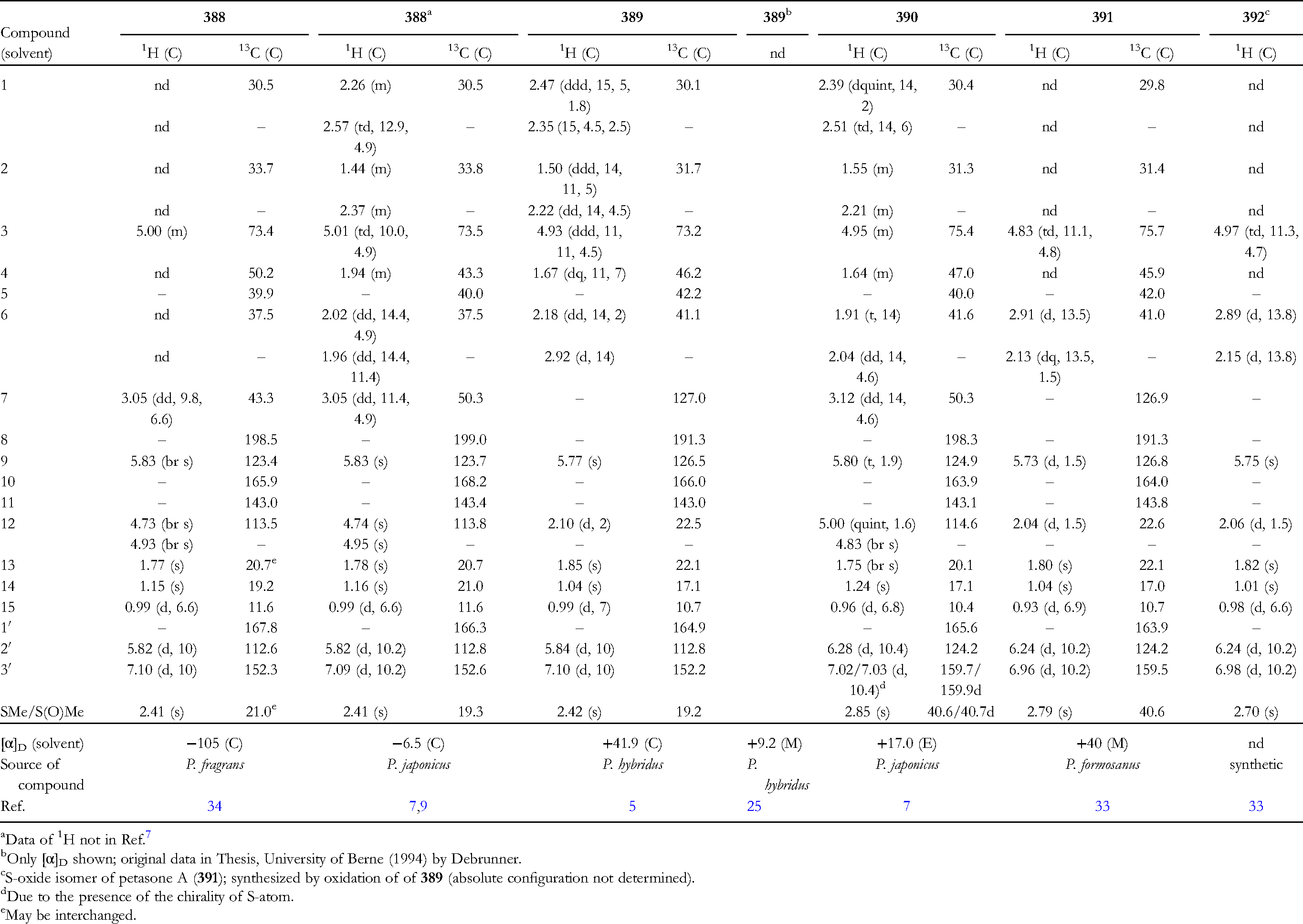
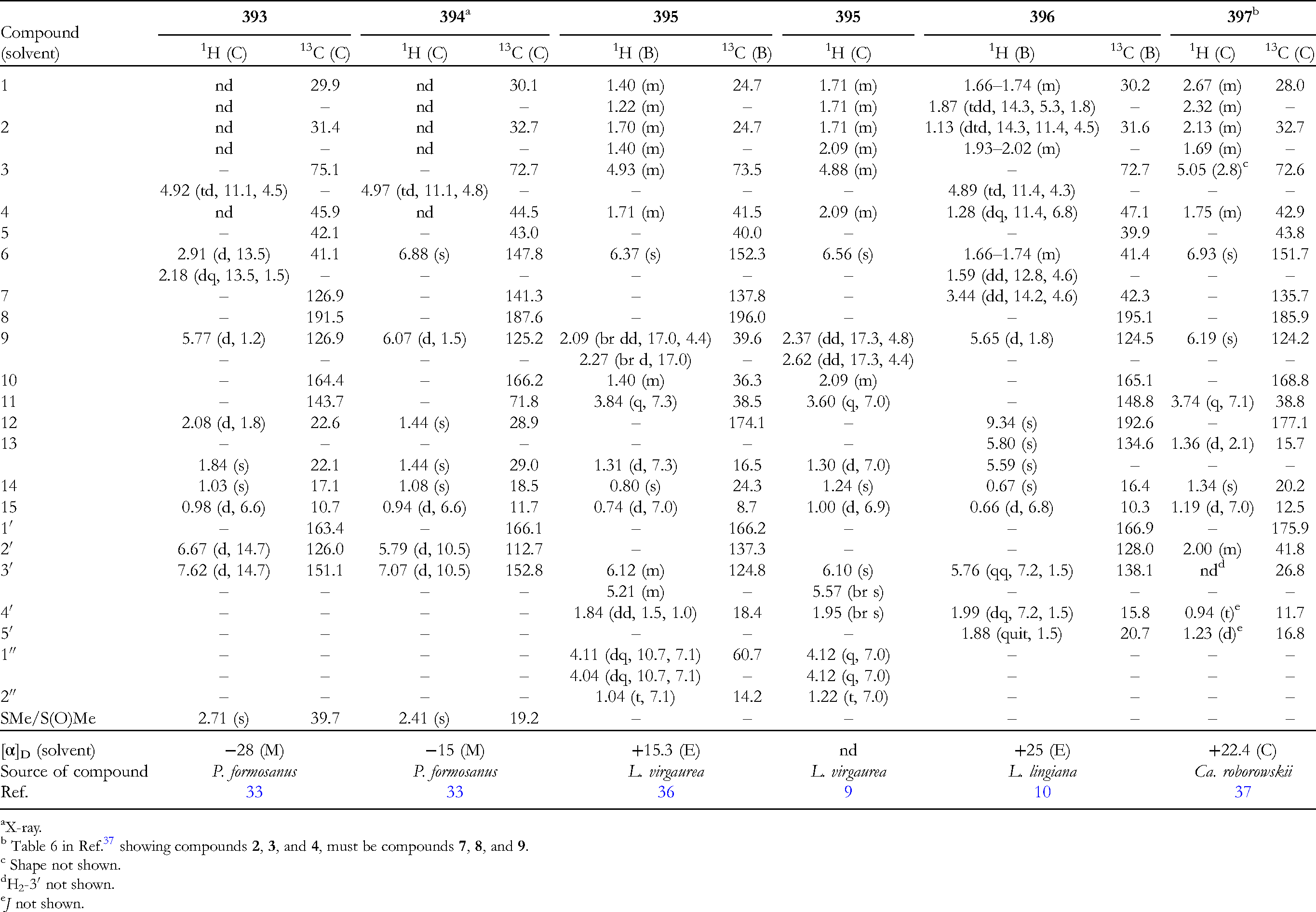
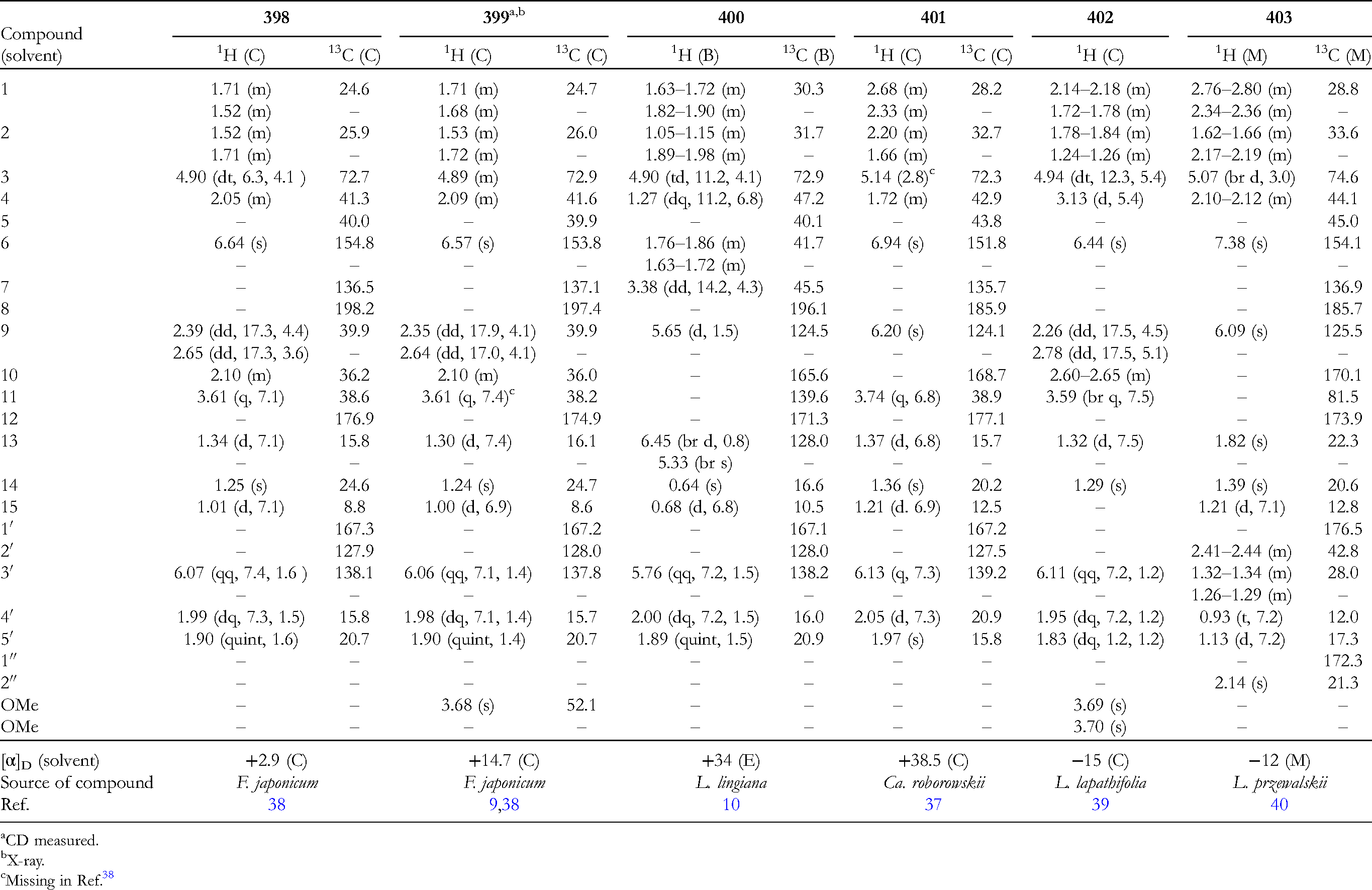
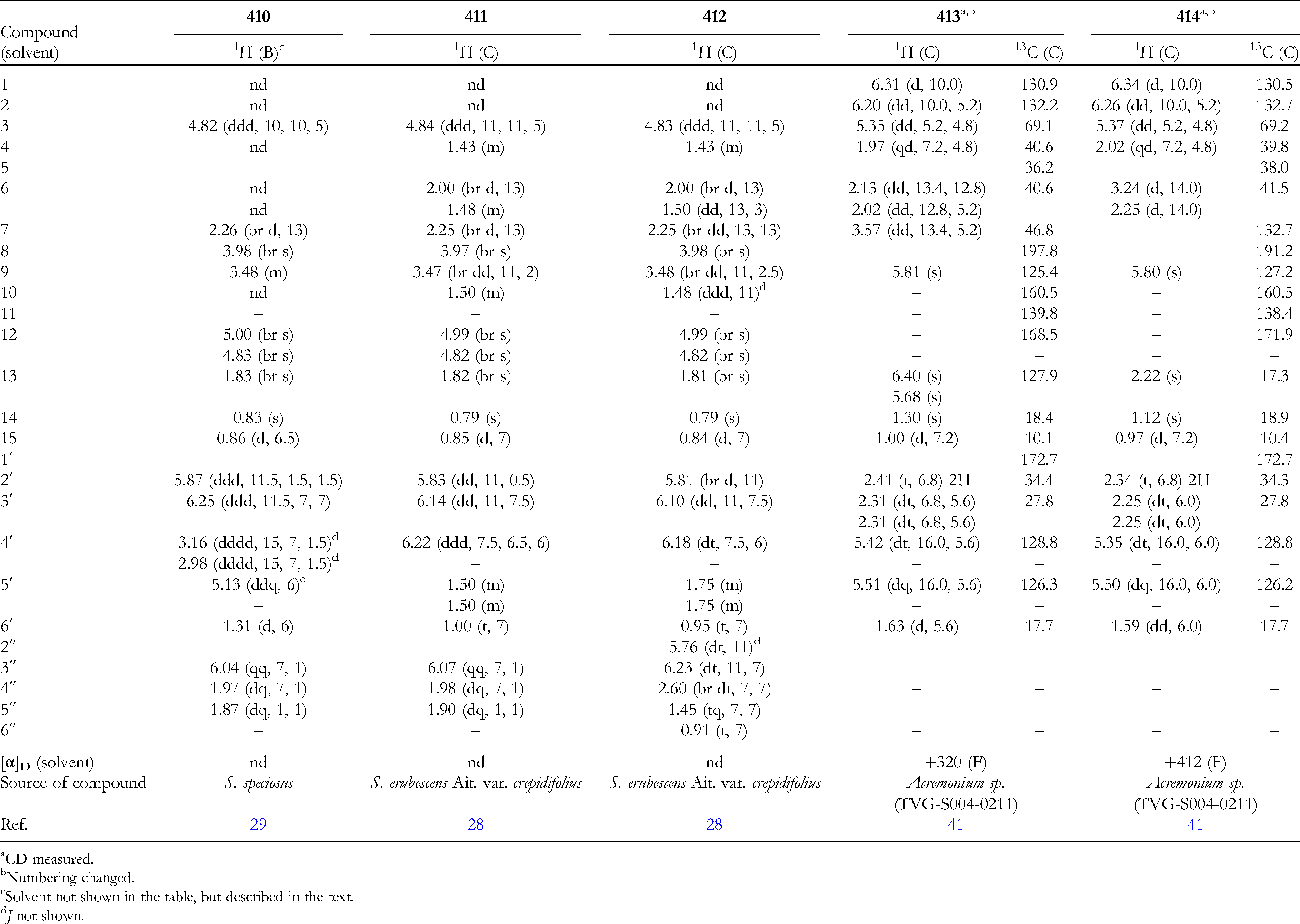
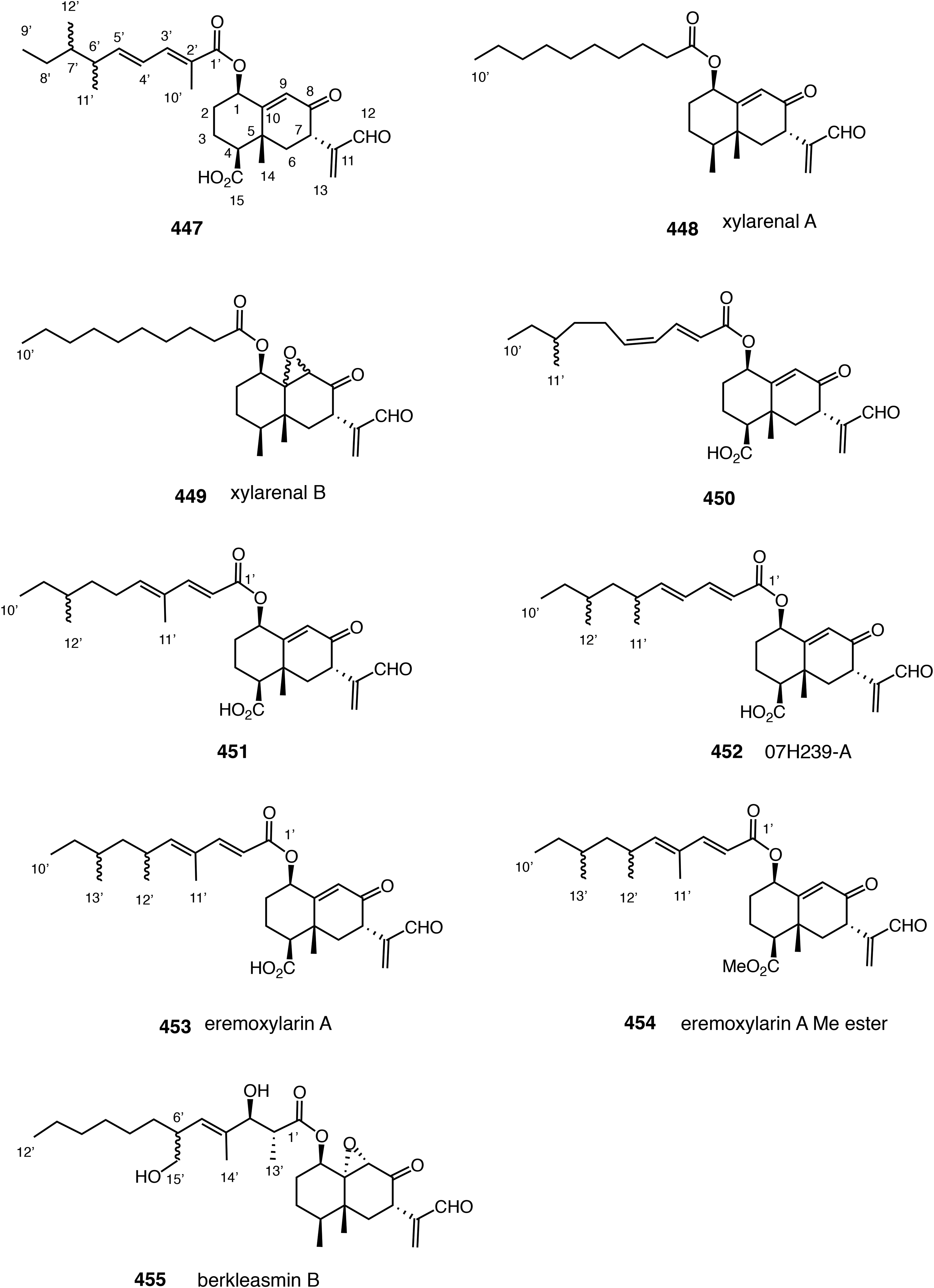
1H and 13C NMR signals and specific rotations of eremophilane sesquiterpenoids are cumulated as a series of review articles. In the second chapter of this review, 124 bicyclic eremophilanes without furan or lactone rings (except for epoxides) and with 3-OR functionality (some have OH) are listed in 25 tables. Those bearing long chain acyloxy groups without 3-oxygen functions and some bi- or tri-cyclic compounds are also included in this chapter. These data may help chemists working in the area of natural products chemistry as well as synthetic scientists.
As a continuation of a series of reviews, data of 124 eremophilane sesquiterpenoids of bicyclic eremophilanes with 3-OR (R ≠ H, Ac) are listed in Tables 1–25. There are some exceptions in this chapter. Those bearing long chain acyloxy groups without 3-oxygen functions and some bi- or tri-cyclic compounds are also included in this chapter. Compounds listed in this chapter are shown in Figures 1–10. Compound numbers are a continuation from the previous paper.1 The names of skeletons, the numbering system, and abbreviations used in this review, should refer to the ones used in the previous paper.1 The coupling constants are sorted from the largest to the smallest; the order of the shapes, d, t, or q, must correspond to the value of the coupling constant. In the case of apparent situation, they were fixed to the proper order.
Table 1 includes the data of six enones, 332–337 (Figure 1). Compounds 333 and 335 are the C-7 epimers. Compounds 336 and 337 have an isopropylidene moiety at C-7. Three compounds, 333, 335, and 336, have a 2-methylpropanoyloxy moiety at C-3α, while compounds 334 and 337 a 2-methylpropenoyloxy moiety at C-3α. Unfortunately, the data of compounds 334 and 337 are due to the mixture with 344 and 346, respectively. However 344 and 346, listed in Tables 4 and 5, respectively, are reported as pure compounds. The C-8 carbon signal (δ 126.9) of compound 335 (in Ref.2) may be mistyped (most probably δ 196.9).2 The CD spectra of compounds 332 and 333 were measured.3,4
Compounds 332–351.
The data of petasin (338) and neopetasin (339), both having an angeloyloxy group at C-3α, are shown in Table 2 (Figure 1). Petasin (338) and neopetasin (339) are the C-7 epimers. The data of petasin (338) have been reported many times.5–11 Their data are almost the same, except for those of the methyl groups. Sometimes the doublet methyl group is described as a singlet, which is presumably due to the lower frequency machine used for accumulation. Therefore, the precise data is still needed using high frequency machines. The 13C NMR data of C-15 of petasin (338) at δ 29.7 described in Ref.6 must be wrong. There is some confusion in assignment of C-14 and C-15, not due to the numbering system; C-14 should resonate in the lower field. The assignment of C-1 and C-2 is sometimes questionable. In Ref. 15, compound 339 is shown to have 7α-H, but its name is described as petasin (7β-H) in the text. The 13C NMR data in Ref. 15 are almost the same as those of Ref.6, except for the C-15, mentioned above; the data are not similar to those of Refs., 2,7 instead resembles to those of petasin (338). The X-ray analysis of petasin (338) was carried out.11 The maxima of the CD spectrum of petasin (338) are recorded at +9000 (253 nm) and −7900 (323 nm).9
The data of isopetasin (340) and a 3α-tigloyloxy-9,11-dien-8-one, 341, are listed in Table 3 (Figure 1). Isopetasin (340) is the double bond isomer of petasin (338). Compound 341 is the E/Z isomer of the acyloxy group of petasin (338). Isopetasin (340) has also been isolated from many sources, but their complete 1H NMR data have not been reported, presumably because they have been measured using 60 or 100 MHz NMR machines. Unfortunately, the patterns of H3-14 and H3-15 of isopetasin (340) were not described in Ref.8, although they can be assigned as singlet and doublet (J not shown). The H-3 of 340 in Ref.43 is shown as 4.92 (dt, 11.2, 4.3), but this should be (td, 11.2, 4.3). In Ref.45, only the data of specific rotation was reported. The CD spectrum of compound 341 was measured.3
Table 4 includes the data of two 3α-tigloyloxy-9-en-8-ones, 342 and 343, and two 3α-senecioyloxy-9-en-8-ones, 344 and 345 (Figure 1). Compounds 342 and 345 have 7α-H, while 344 7β-H. Compound 343 has an isopropylidene moiety at C-7. The chemical shift difference of H3-4′ of compound 342 (δ 1.80 and 1.43) are due to the difference of the solvent measured (in CDCl3 and C6D6).9,12 The data of compound 343 are assigned tentatively. The solvent for NMR measurement of 344 and 345 was not described in Ref.14; however presumably CDCl3 is used for similarity to other compounds. Coupling constants for protons of the tigloyl group in Ref.12 were not shown. The CD spectrum of compound 344 was measured.9
The data of four 3α-acyloxy-7α-isopropenyl-9-en-8-ones, rumicifoline K (347), rumicifoline L (348), 349, and senescaposon (350) are shown in Table 5 (Figure 1). Rumicifoline L (348)13 is one carbon elongated derivative of rumicifoline K (347).13 Compounds 346 and isosenescaposon (351) have an isopropylidene group at C-7. Compounds 348-351 have acyl groups composed of 6 carbons; among them senescaposon (350) and isosenescaposon (351) have 5-acetoxy-4-methylpent-2-enoyloxy groups. The solvent for NMR measurement of 349–351 were not described in Ref.14 but most probably CDCl3 for similarity to other compounds. The coupling constants for H-7 of 349, and H2-6 of 351 are not shown.1 The coupling pattern of H-4′ of 350 and 351 must be ddqd.
Table 6 shows data of seven 3-angeloyloxy-8-ones, 352–358, all having one more hydroxy or acyloxy group (Figure 2). Rumicifoline J (352) and 1-epi-rumicifoline J (353) are the C-1 epimers. Compounds 354 and 355 have 3β-angeloyloxy groups, while the others 3α. Compounds 354, 355, 357, and 358 have an isopropylidene group at C-7. Compound 358 is an enol form of 8,9-diketone. The data of 1β-angeloyl group of 355 are shown in the footnote of Table 6.
Compounds 352–369.
The data of four 3α-acyloxy-9-hydroxy-8-ones, 359–362, two 3α-angeloyloxy-7,9-dien-8-ones, 363 and 364, and a 3α-angeloyloxy-9,11(13)-dien-8-one, 365, are listed in Table 7 (Figure 2). Petasitin (363) and 364 are positional isomers of the hydroxy group. Compounds 360 and 361 are the C-9 epimers. The configuration at C-11 of compound 364 was not determined.15 The H3-12 of 361 resonates at the lower field than H3-13.16 Coupling constants for protons of the tigloyl group of compound 359, 361, and 362 are not described.17,25 The H2-12 protons of 364 appeared at δ 4.13 (dd, 14.3, 6.8) had better be assigned as AB quartet.1
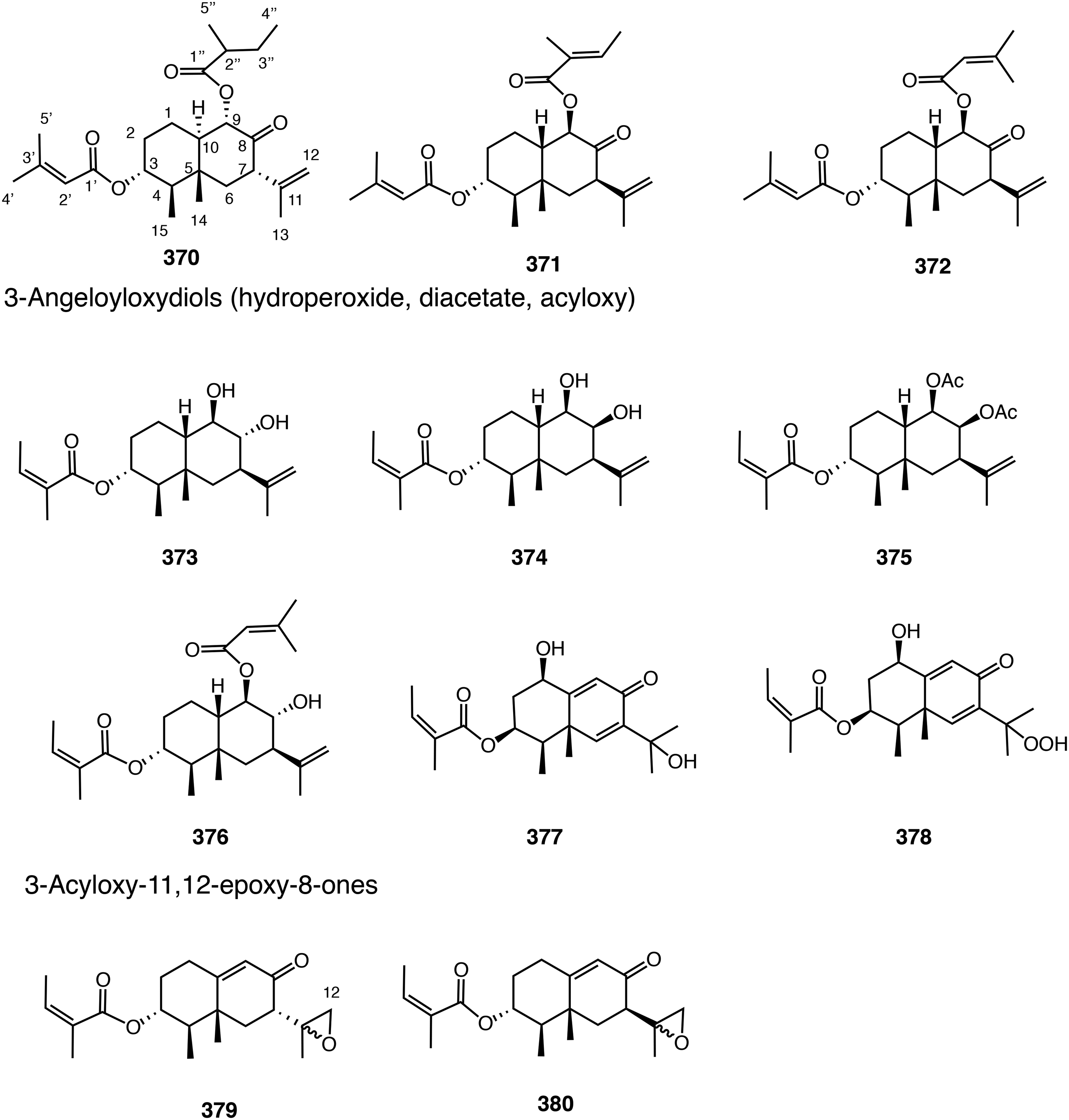
The data of a 3α-angeloyloxy-12-hydroxy-7(11),9-dien-8-one, 366, and six diacyloxy compounds, 367–372, all having 3α-acyloxy groups, are tabulated in Table 8 (Figures 2 and 3). Compounds 366–368 have 3α-angeloyloxy group, 369 tigloyloxy, and 370–372 senecioyloxy group. Compounds, 367–369, 371, and 372 have 7α-H, while 370 7β-H. The data of 9β-tigloyloxy group of 371 were not described.29 The coupling constants for protons of acyl groups of compounds 367–372 were not described.18,28,29
Compounds 370–380.
The data of six 3α-angeloyloxy compounds, 373–378, were compiled in Table 9 (Figure 3). Compounds 373 and 374 are the C-8 epimers. Compound 375 is the corresponding 8,9-diacetate of 374, and compound 376 9-senecioate of 373. Compound 378 is a hydroperoxy derivative of compound 377.22 The hydroperoxy proton of 378 appeared at δ 10.0 (s), and the 13C signal of C-11 of 377 at 71.4 changed to 82.5 for 378. These are the good evidence of the presence of a hydroperoxy group (as well as the MS data). Two acetyl groups of compound 375 were not distinguished.1 The coupling constants for protons of acyl groups in compounds 373–376 were not described.17,18,29 The structure of compound 378 was analyzed by X-ray.22
Table 10 lists the data of two 11,12-epoxy-9-en-8-ones, 379 and 380, and three 2β-acyloxy (including S-atom) substituted compounds, 381–383 (Figures 3 and 4). Compounds 379 and 380 are the C-7 epimers, and the absolute configurations of C-11 are not determined. S-Japonin (381), petasitesterpene I (382), and petasitesterpene II (383) have isopropylidene groups at C-7. Although these three compounds are 2-acyloxy compounds, they are included in this section. The chemical shift of H-7 of 379 is slightly in the lower field than that of 380.30 The methylsulfanyl group of 381 resonates at δ 2.38 (s), while the methylsulfinyl group of 382 and 383 at δ 2.82 (s) and 2.84 (s), respectively.4647 The CD spectra of compounds 382 and 383 were measured.22
Compounds 381–394.
The data of four S-atom including 3α-acyloxy substituted compounds, 384–387, are found in Table 11 (Figure 4). Compounds 384, petasinol B (385), and petasinol A (386) are 9,11-dien-8β-ols, and S-petasin (387) is 9-en-8-one. Compounds 384 and 387 have methylsulfanyl groups, while 385 and 386 methylsulfinyl groups. All four compounds have 7β-H. The acyl group attached at C-3α of petasinol B (385) has E-configuration, while others Z-configuration. The E and Z configurations can easily be differentiated by the coupling constants. The coupling constant of the double bond for E-isomer is J = 14.7 Hz,33 The methylsulfanyl group of 381 resonates while that of Z-isomer 10.0–10.9 Hz (Table 11).2,7,33,34 The 1H NMR chemical shift of a methyl group of a methylsulfanyl group is δ 2.36–2.42, while that of a methylsulfinyl group δ 2.69. The 13C NMR chemical shift of a methylsulfinyl group is about 20 ppm lower than that of a methylsulfanyl group (Table 11).2,7,33,34 The structure of S-petasin (387) was analyzed by X-ray crystallography.2 The CD spectrum of 387 was measured.7 The 13C NMR data of C-12 of 387 at δ 144.3 is most probably mistyped of 114.3.24
The data of five 3α-acyloxy-9-en-8-ones, 388–392, are presented in Table 12 (Figure 4). Neo-S-petasin (388) and iso-S-petasin (389) have methylsulfanyl groups, while eremopetasinsulfoxide (390), petasone A (391), and petasone A S-isomer (392) methylsulfinyl groups. Iso-S-petasin (389) was oxidized with mCPBA to give petasone A (391) and its diastereoisomer due to the S-atom (392), but the absolute configuration was not determined.23 Only the specific rotation of 389 was described in Ref.51, and the detailed NMR data should be in the Thesis of University of Berne by Debrunner, but it was difficult to check directly.35 Eremopetasinsulfoxide (390) exists as the mixture of S-isomers, therefore, two signals for H-3′ and C-3′, and S(O)Me are detected.7
Table 13 contains the data of two S-atom substituted 3α-acyloxy compounds, petasone B (393) and S-petasitin (394), an ethyl ester 395, an aldehyde 396, and a carboxylic acid 397 (Figures 4 and 5). Compound 396 is the corresponding aldehyde of compound 400 (Table 14).10 The structure of S-petasitin (394) was analyzed by X-ray.33 A comment to the Ref.37 should be added here; Table 6 in Ref.37 showing compounds 2, 3, and 4, must be compounds 7, 8, and 9
Compounds 395–403.
The data of four carboxylic acids, 398, 400, 401, and 403, and two methyl esters, 399 and 402, are listed in Table 14 (Figure 5). Compound 399 is the corresponding methyl ester of 398. Compounds 401 and 403 are cross-conjugated dienones. 2-Methylbutanoyloxy group is attached to C-11 of 403. The absolute configurations of C-11 of 401–403 were not determined. The CD spectrum of 399 was measured,38 and the configuration at C-11 was determined by X-ray.38 The 1H NMR signal for H-11 of 399, δ 3.61 (q, 7.4), is missing in Ref.38.
Table 15 shows the data of five 3-acyloxy-9-hydroxy-8-ones, 404–408, and a diacyloxy compound 409 (Figure 6). An angeloyloxy group is attached to the 2-hexenoyl group of 404, 407, and 408. The 2-hexenoyloxy group is attached to the C-4′ of the 2-hexenoyl group of 405 and 406. Compounds 405 and 406 are the double bond isomers. Unfortunately, in all cases, H2-1 and H2-2 are not assigned. The geminal coupling constants for H-6 of 404 and 407 are not shown. The necessary J values are lacking for H-2″ of 405 and 406, H-10, H-12, and H-13 of 406, and H-4′ and H-5′ of 407 and 408. The solvent (C6D6) for NMR measurement of compounds 404, 407, and 408 is not shown in the table, but described in the text.
Compounds 404–417.
The data of five hexenoyloxy substituted compounds, 410–414 are found in Table 16 (Figure 6). The 2-hexenoyl group is attached to compounds 410–412, while 4-hexenoyl group to 413 and 414. Compounds 410–412 are 8,9-diols, and compounds acemeremophilane B (413) and acemeremophilane C (414) are 8-oxo-1,9-dien-12-oic acid. An angeloyloxy group is attached to the 2-hexenoyl group of 410 and 411. The numbering used for 413 and 414 was changed to our system.41 CD spectra of 413 and 414 were measured.41 The J values of H2-4′ and H-5′ of 410,29 H-10 and H-2″ of 412 are not fully described.28
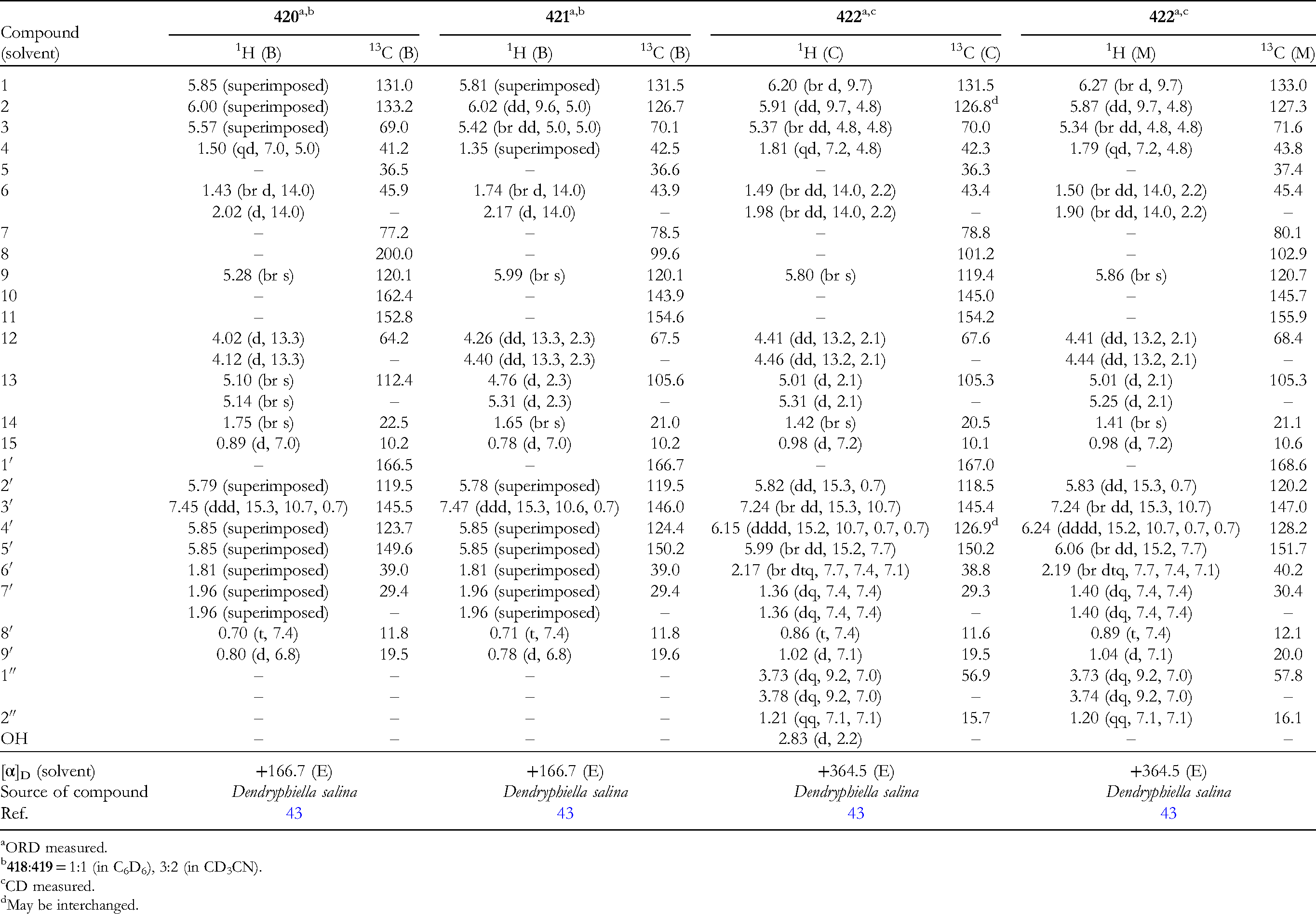
The data of three 3β-(4-hexenoyloxy) substituted compounds, 415–417, and two 3β-(6-methylocta-2,4-dienoyloxy) compounds, 418 and 419, are given in Table 17 (Figures 6 and 7). All compounds have a 1,9-dien-8-one system. Acremeremophilane D (417) is a methyl enol ether of the corresponding dialdehyde. Acremeremophilane F (416) is the 13-hydroxylated compouond of acremeremophilane E (415). Dendryphiellin E1 (418) and dendryphiellin E2 (419) are double bond isomers. The numbering for compounds 415–417 is changed to our system. Acremeremophilane E (415) and acemeremophilane C (414) (Table 16) are Z/E isomers of 7,11-double bond. The H3-13 of acemeremophilane E (415) appeared at δ 2.11, while that of 414 at δ 2.22. The CD spectra of compounds 415–417 were measured.41
Compounds 418–431.
The data of three 3β-(6-methylocta-2,4-dienoyloxy) substituted compounds, 420–422, are listed in Table 18 (Figure 7). Compounds 421 and 422 are not bicyclic, but 421 exists as an equilibrium mixture with 420 (420:421 = 1:1 in C6D6; 3:2 in CD3CN). Therefore, it is easy to understand to be included in this section. Dendryphiellin F (422) is an ethyl ether of dendryphiellin E (421), hence included in this section. The relative configuration of sesquiterpene part of 420 was determined by NOE. The absolute configuration of 422 was determined by application of the exciton chirality rule.43 The absolute configuration of the side chain was established by chiral synthesis. These results revealed the absolute configuration of both 421 and 422. The ORD spectra of compounds 420–422 were also measured.43
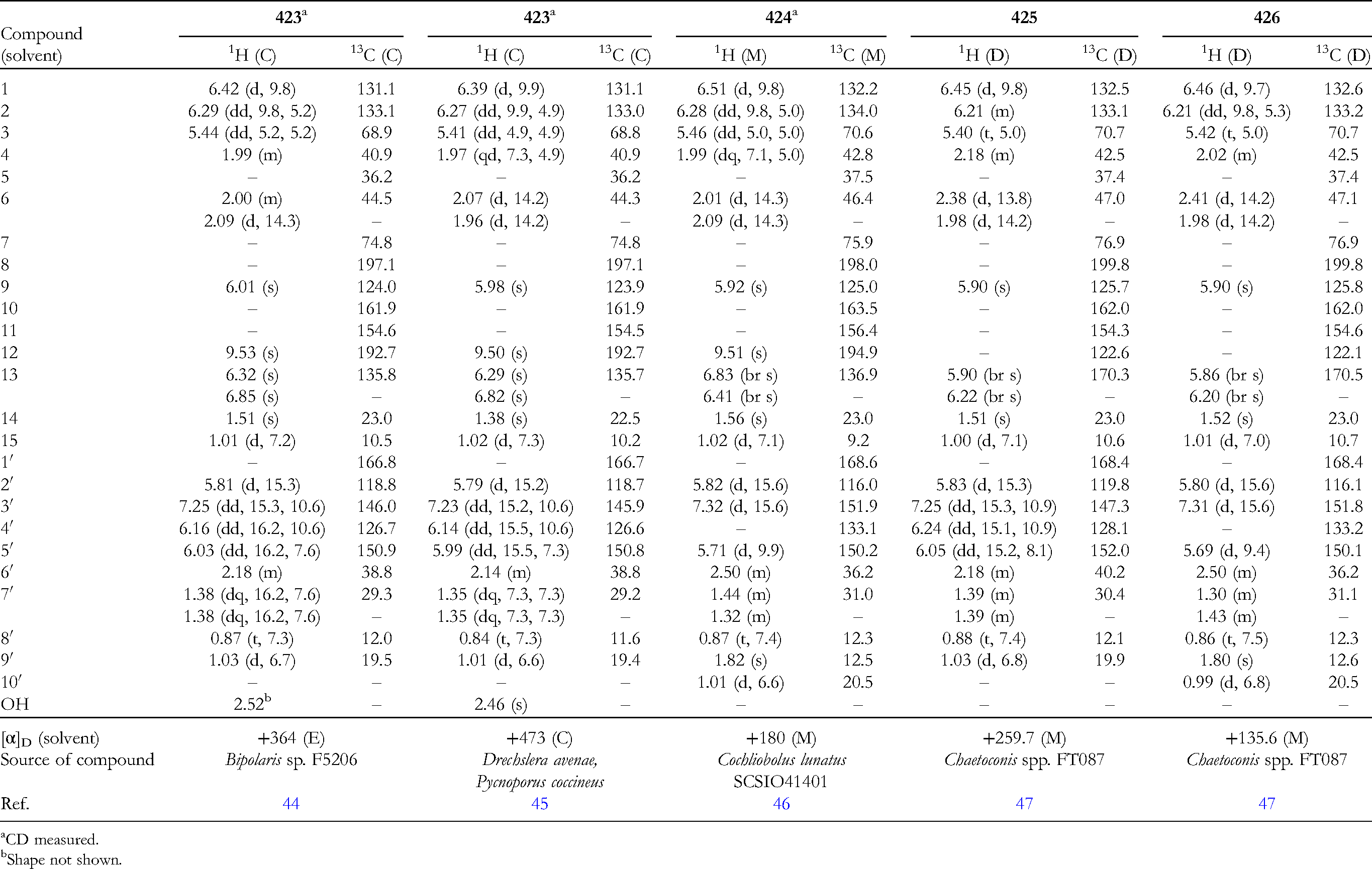
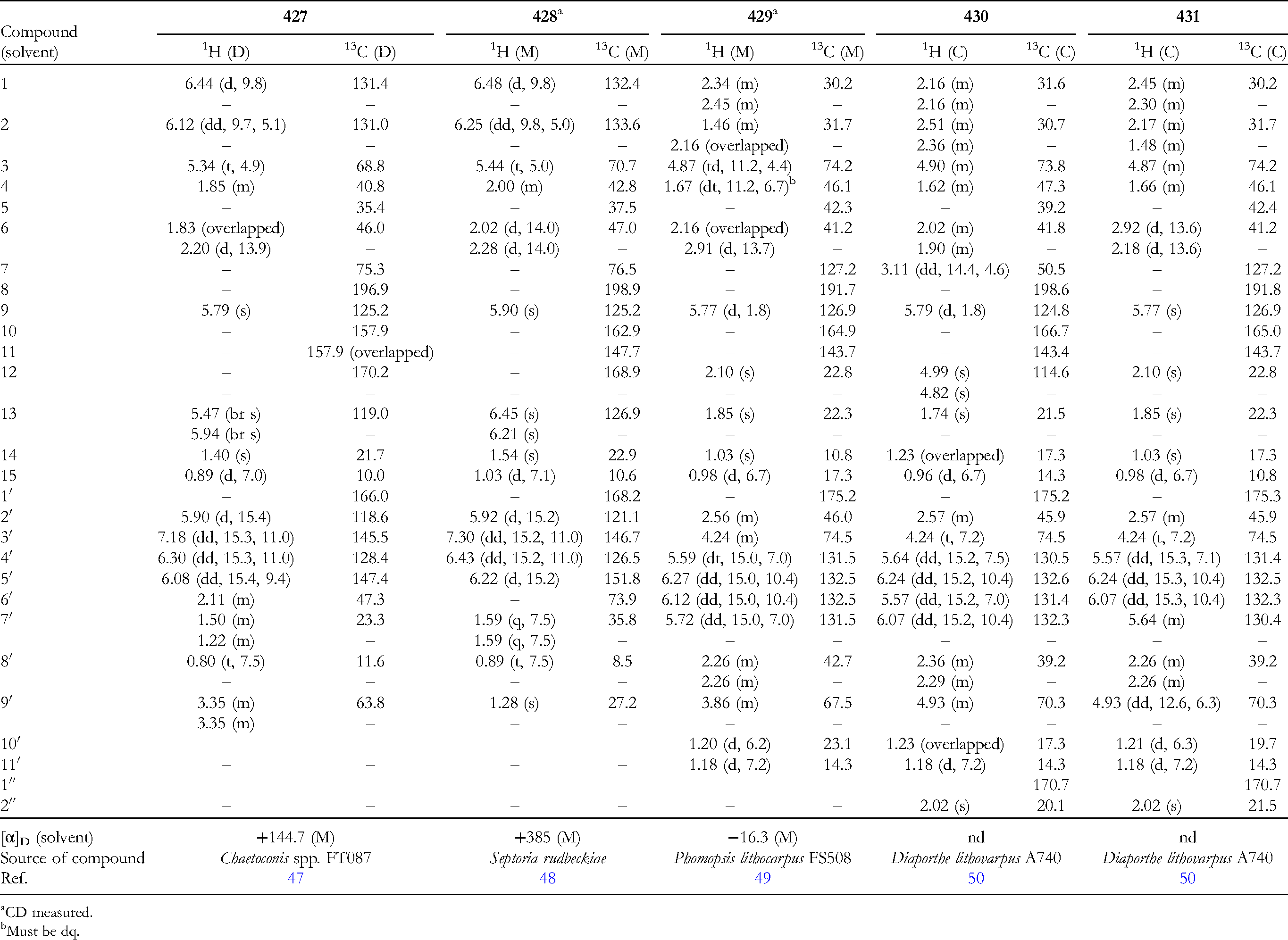
Table 19 includes the data of two aldehydes, 423 and 424, and two carboxylic acids, 425 and 426 (Figure 7). Dendryphiellin I (424) has one more methyl group at C-4′ position of 423. Bipolal (423) is an aldehyde, isolated in 1995, and the configuration of C-7 was determined by NOE.44 The same compound was isolated again in 1998 from a different source (named KM-01), and a detailed work was published.45 The side chain ester was synthesized to establish the absolute configuration of C-6′ to be S, which was the same as that of compounds 420–422.43 The configurations at C-6′ of chaetopenoid A (425) and chaetopenoid B (426) are not determined.47 The CD spectra of 423 and 424 were measured.44–46 The data of two 3β-(octa-2,4-dienoyloxy) substituted carboxylic acids, 427 and 428, and three 3α-(deca-4,6-dienoyloxy)-9-en-8-ones, 429–431 are accumulated in Table 20 (Figure 7). Chaetopenoid C (427) and chaetopenoid G (428) are C-9′ and C-6′ hydroxylated compounds of chaetopenoid A (425), respectively. The configuration of C-6′ of 427, C-2′,3′,9′ of compounds 429–431 are not determined. The H-4 of 429 appeared at δ 1.67 (dt, 11.2, 6.7), but the shape must be dq.49 Ref.50 described that tenellone H was isolated as compound 5 in the text, but this must be wrong; instead lithocarin A (compound 429 in this review). The CD spectra of chaetopenoid G (428) and lithocarin A (429) were measured.48,49
The data of five 3α-(5′-methylundeca-2′,4′,6′-trienoyloxy) substituted ketones, 432–436, and three 1β-(4′,6′-dimethyl-2′-hydroxy-2′-hydroxymethyloctanoyloxy)-12-hydroxy-8-ones, 437–439 are shown in Table 21 (Figures 8 and 9). Five compounds 432–436 have the same acyl group and compounds 432, 433, and 435 are 8-ones. However, compound 434 and 436 are 9-ones. Xylarenones D (439), F (437), and G (438) have the same acyl group, and the configurations of three asymmetric centers, C-2′, C-4′, and C-6′, are not determined.51 Xylarenones F (437) and xylarenone G (438) are the C-11 epimers. The chemical shift differences of these two compounds are not very large; for example H-11, δ1.51 (m) for 437, and 1.52 (m) for 438, and H3-13, δ 1.07 (d, 7.0) for 437 and 1.07 (d, 6.5) for 438. The situation is the same as in the 13C NMR data; C-11, δ 41.0 for 437, and 41.3 for 438, C-13, δ 16.1 for 437 and 16.3 for 438. Unfortunately, chemical shifts of H2-1 and H2-2 of compounds 432–436 are not assigned. The two acetyl groups in compounds 435 and 436 are assigned separately.
Compounds 432–436.
Compounds 437–446.
The data of two 1β-acyloxy-6,7-epoxy-12-hydroxy-9,11(13)-dien-8-ones, 440 and 441, and two 1β-acyloxy carboxylic acids, 442 and 443 are listed in Table 22 (Figure 9). The acyl group of xylarenone C (440) is 24,6-trimethyloctanoyl and the configurations at C-2′,4′,6′ positions are not determined. Xylarenone E (441) has four hydroxy groups at C-12,2′,7′,9′ positions. Both the C-12 and C-15 positions of integric acid (442) are oxydized to aldehyde and carboxy groups, respectively.36,37 Integric acid (442) and eremoxylarin C (443) are positional isomers of the methyl group in the acyl group. The absolute configuration of 442 was determined using modified Mosher method.36 The missing data of H-12, δ 9.54 (s), of 442 in the Table of Ref.53 was picked up from the text. Both C-4′ (S) and C-4′ (R) integric acid (442) were synthesized, and the absolute configuration of natural 442 was determined to have C-4′ (S). The compound of C-4′ (R) showed [α]D − 3.6 (MeOH).54
The data of three 1β-(octa-2-enoyloxy) substituted compounds, 444–446, a 1β-(nona-2,4-dienoyloxy) substituted compound, 447, and two 1β-decanoyl substituted compounds, 448 and 449, are compiled in Table 23 (Figures 9 and 10). Compounds 444-446 have acyloxy groups consisting of C8 (without substituents) chains, 447 a C9 chain, and xylarenal A (448) and xylarenal B (449) C10 chains. Xylarenal A (448) and xylarenal B (449) have saturated alkyl chain in their acyl groups. Compound 445 is the corresponding methyl ester of eremoxylarin B (444), which is 2′-methyl derivative of eremoxylarin C (443). Compound 446 is a dimethyl acetal of integric acid (442). The signal at δ 4.82 (s) of 446 corresponds to the methine proton bearing two oxygen functions. The configuration of the epoxide in xylarenal B (449) was not determined.38
Compounds 447–455.
Table 24 shows the data of three aldehydes, 450–452 (Figure 10). All have deca-2,4-dienoyloxy groups, but only compound 450 has a cis ble bond at C-4′/5′. The absolute configurations of C-8′ of 450 and 451, and C-6′ and 8′ of 07H239-A (452) are not determined. The NMR signals for 452 were not assigned in Ref.61, therefore they were tentatively listed in Table 24 with reference to those of Ref. 40.
The data of three aldehydes, 453–455, are compiled in Table 25 (Figure 10). Eremoxylarin A (453) is 4′-methyl derivative of 07H239-A (452).56,60 The configuration of C-6′ and 8′ of eremoxylarin A (453) and eremoxylarin A methyl ester (454), are not determined.56 Berkleasmin B (455) is 9α,10α-epoxide, and the absolute configurations of C-2′ and 3′ positions are established, but C-6′ undetermined.62 The configuration of the epoxide was established by application of modified Mosher method to the analogous compound berkleasmin A.62
Footnotes
Acknowledgements
The author thanks laboratory staff members engaged in these projects acquiring NMR data. Special thanks are due to Dr Yasuko Okamoto and Prof. Masakazu Sono, Tokushima Bunri University, Prof. Yoshinosuke Usuki, Osaka Metropolitan University, and Emeritus Prof. Chiaki Kuroda, Rikkyo University, for their help to check the references appeared in this review.
Declaration of Conflicting Interests
The author(s) declared no potential conflicts of interest with respect to the research, authorship, and/or publication of this article.
Funding
The author(s) received no financial support for the research, authorship, and/or publication of this article.
ORCID iD
Motoo Tori
References
1.
ToriM. Cumulative data of 1H and 13C NMR signals and specific rotations of eremophilane sesquiterpenoids. 1. Bicyclic eremophilanes (1). Nat Prod Commun. 2022;17. https://doi.org/10.1177/1934578X221109527.
2.
NeuenschwanderMNeuenschwanderASteineggerE. Struktur der sesquiterpene von Petasites hybridus (L.) G. M. et SCH.: neopetasol-Abkömmilinge. Helv Chim Acta. 1979;62:627‐634.
3.
ToriMWatanabeAMatsuoS, et al.Diversity of Ligularia kanaitzensis in sesquiterpenoid composition and neutral DNA sequences. Tetrahedron. 2008;64:4486‐4495.
4.
OkamotoYTaniguchiMTeradaK,et al.Diversity in chemical constituents of Ligularia longihastata collected in China. Nat Prod Commun. 2016;11:145‐148.
5.
NeuenschwanderMNeuenschwanderASteineggerEEngelP. Struktur der Sesquiterpene von Petasites hybridus (L.) G. M. et SCH.: petasol- und Isopetasol-Abkömmilinge. Helv Chim Acta. 1979;62:609‐626.
6.
ZhaoYPengHRJiaZJ. Six new eremophilane derivatives from two Ligularia species. J Nat Prod. 1994;57:1626‐1630.
7.
ToriMKawaharaMSonoM. Eremophilane-type sesquiterpenes from fresh rhizomes of Petasites japonicus. Phytochemistry. 1998;47:401‐409.
8.
XueHQMaXMWeiXNWuSXWangHQ. Study on chemical constituents from Ligularia intermedia of Shanxi. China J Chin Materia Med. 2007;32:1044‐1047.
9.
ToriM. unpublished results.
10.
SaitoYSasakiYKomiyamaT,et al.Structure and cytotoxic evaluation of five 12-oxygenated eremophilanes from Ligularia lingiana. Tetrahedron. 2014;70:5878‐5883.
11.
WangCLiJYangR,et al.Petasins from the rhizomes of Ligularia fischeri and its derivatives. Rec Nat Prod. 2014;8:156‐164.
12.
LiuZLTianX. Components of Cacalia tangutica. Bull Korean Chem Soc. 2004;25:1078‐1080.
13.
NayaKTakagiIKawaguchiYAsadaYHiroseYShinodaN. The structure of fukinone, a constituent of Petasites japonicus Maxim. Tetrahedron. 1968;24:5871‐5879.
14.
YaoitaYNagataKSuzukiNKikuchiM. Structures of eremophilenolides from the rhizomes of Petasites japonicus Maxim. Chem Pharm Bull. 1992;40:3277‐3279.
15.
TanAHeHYangHZhangMWangZHaoX. Chemical constituents of Ligularia dictyoneura. Acta Pharm Sinica. 2003;38:924‐926.
16.
BrooksCJWDraffanGH. Sesquiterpenoids of Warburgia species-I Warburgin and warburgiadione. Tetrahedron. 1969;25:2865‐2885.
17.
BohlmannFKnollKHZderoC, et al.Terpen-Derivate aus Senecio-Arten. Phytochemistry. 1977;16:965‐985.
18.
BohlmannFZderoC. Eremophilane aus Südamerikanischen Senecio Arten. Phytochemistry. 1978;17:1337‐1341.
19.
BohlmannFEhlerDZderoC. Einige neue Furanoeremophilane aus Senecio-Arten. Phytochemistry. 1978;17:467‐470.
20.
ToriiSInokuchiTKawaiK. Functionalization of trans-decalin. II. A synthesis of dl-isopetasol from trans-5-oxodecalin-8α,2-carbolactone. Bull Chem Soc Jpn. 1979;52:861‐866.
21.
YeYDawaDLiuGH,et al.Antiproliferative sesquiterpenoids from Ligularia rumicifolia with diverse skeletons. J Nat Prod. 2018;81:1992‐2003.
22.
ArciniegasAPerez-CastorenaALReyesSContrerasJLRomo de VivarA. New oplopane and eremophilane derivatives from Robinsonecio gerberifolius. J Nat Prod. 2003;66:225‐229.
23.
Ruiz-VasquezLMesiaLRReina-ArtilesM, et al.Benzofurans, bezoic acid derivatives, diterpenes and pyrrolizidine alkaloids from Peruvian Snecio. Phytochem Lett. 2018;28:47‐54.
24.
Perez-CastorenaALArciniegasAVillasenorJLde Vivar AR. Eremophilanes and pyrrolizine alkaloids of Senecioneae species. J Mex Chem Soc. 2014;58:202‐204.
25.
BohlmannFAtes (Goren)NKingRMRobinsonH. Two sesquiterpenes from Senecio species. Phytochemistry. 1983;22:1675‐1677.
26.
NayaKTakagiI. The structure of petasitin. A new sesquiterpene from Petasites japonicum Maxim. Tetrahedron Lett. 1968:629‐632.
27.
TakagiITazukeYNayaK. The components of Petasites japonicus Maxim. IV. The structure of petasin. Bull Chem Soc Jpn. 1977;50:3320‐3323.
28.
BohlmannFZderoCJakupovicJ, et al.Eremophilane derivatives and other constotients from Senecio species. Phytochemistry. 1985;24:1249‐1261.
29.
BohlmannFSuwitaAZderoC. Neuartige Ester von Eremophien-Derivaten aus Sudafrikanischen Senecio-Arten. Phytochemistry. 1978;17:1763‐1767.
30.
LiuXWuQ-XShiY-P. Terpenoids from the flower of Cacalia tangutica. J Chin Chem Soc. 2005;52:369‐374.
31.
NayaKKawaiMNaitoMKasaiT. The structure of eremofukinone, 9-acetoxyfukinanolide and S-japonin from Petasites japonicus maxim. Chem Lett. 1972:242‐244.
32.
MatsumotoTImahoriDSaitoY, et al.Cytotoxic activities of sesquiterpenoids from the aerial parts of Petasites japonicus against cancer stem cells. J Nat Med. 2020;74:689‐701.
33.
LinYLMeiCHHuangSLKuoYH. Four new sesquiterpenes from Petasites formosanus. J Nat Prod. 1998;61:887‐890.
34.
SugamaKHayashiKNakagawaTMitsuhashiHYoshidaN. Sesquiterpenoids from Petasites fragrans. Phytochemistry. 1983;22:1619‐1622.
35.
BodensieckAKunertOHaslingerEBauerR. New eremophilane sesquiterpenes from a rhizome extract of Petasites hybridus. Helv Chim Acta. 2007;90:183‐194.
36.
NakashimaKHoshiyamaKHayamiC,et al.Eremophilane sesquiterpenoids and nor- and dinorsesquiterpenoids from Ligularia virgaurea collected in China. Nat Prod Commun. 2018;13:795‐798.
37.
ZhangSZhaoGLiRLinG. Eremophilane sesquiterpenes from Cacalia roborowskii. Phytochemistry. 1998;48:519‐524.
38.
ToriMOtoseKFukuyamaH, et al.New eremophilanes from Farfugium japonicum. Tetrahedron. 2010;66:5235‐5243.
39.
FeiDQLiSGLiuCMWuGGaoK. Eremophilane-type sesquiterpene derivatives from the roots of Ligularia lapathifolia. J Nat Prod. 2007;70:241‐245.
40.
XuJQHuLH. Five new eremophilane sesquiterpenes from Ligularia przewalskii. Helv Chim Acta. 2008;91:951‐957.
41.
ChengZZhaoJLiuDProkschPZhaoZLinW. Eremophilane-type sesquiterpenoids from an Acremonium sp. fungus isolated from deep-sea sediments. J Nat Prod. 2016;79:1035‐1047.
42.
GuerrieroACuomoVVanzanellaFPietraF. A novel glyceryl ester (glyceryl dendryphiellate A), a trinor-eremophilane (dendryphiellin A1), and eremophilanes (dendryphiellin E1 and E2) from the marine deuteromycete Dendryphiella salina (Sutherland) Pugh et Nicot. Helv Chim Acta. 1990;73:2090‐2096.
43.
GuerrieroAD’AmbrosioMCuomoVVanzanellaFPietraF. Novel trinor-eremophilanes (dendryphiellin B, C, and D), eremophilanes (dendryphiellin E, F, and G), and branched C9–carboxylic acids (dendryphiellic acid A and B) from the marine deuteromycete Dendryphiella salina (Sutherland) Pugh et Nicot. Helv Chim Acta. 1989;72:438‐446.
44.
WatanabeNFujitaABanN,et al.Bipolal: anti-microalgal compound isolated as a candidate for marine antifouling produced by Bipolaris sp. F5206. J Nat Prod. 1995;58:463‐466.
45.
KimSKHatoriMOjikaMSakagamiYMarumoS. KM-01, A brassinolide inhibitor, its production, isolation and structure from two fungi Drechslera avenae and Pycnoporus coccineus. Bioorg Med Chem. 1998;6:1975‐1982.
46.
FangWWangJWangJ,et al.Cytotoxic and antibacterial eremophilane sesquiterpenes from the marine-derived fungus Cochliobolus lunatus SCSIO41401. J Nat Prod. 2018;81:1405‐1410.
LinLBXiaoJGaoYQ,et al.Trinor- and tetranor-eremophilane sesquiterpeniods with anti-neuroinflammatory activity from cultures of the fungus Septoria rudbeckiae. Phytochemictry. 2021;183:112642.
49.
XuJLLiuHXChenYC, et al.Highly substituted benzophenone aldehydes and eremophilane derivatives from the deep-sea derived fungus Phomopsis lithocarpus FS508. Marine Drug. 2018;16:329.
50.
LiuHChenYLiH,et al.Four new metabolites from the endophytic fungus Diaporthe lithocarpus A740. Fitoterapia. 2019;137:104260.
51.
GubianiJRZeraikMLPliveiraCM, et al.Biologically active eremophilane-type sesquiterpenes from Camarops sp., an endophytic fungus isolated from Albertia macrophylla. J Nat Prod. 2014;77:668‐672.
52.
De OliveiraCMSilvaGHRegasiniLO, et al.Xylarenones C-E from an endophytic fungus isolated from Alibertia macrophylla. J Nat Prod. 2011;74:1353‐1357.
53.
SinghSBZinkDPolishookJ, et al.Structure and absolute stereochemistry of HIV-1 integraceinhibitor integric acid. A novel eremophilane sesquiterpenoid produced by a Xylaria sp. Tetrahedron Lett. 1999;40:8775‐8779.
54.
WaalboerDCJvan KalkerenHASchaapmanMCvan DelftFLRutjesFPJ. Total synthesis and absolute stereochemistry of integric acid. J Org Chem. 2009;74:8878‐8881.
55.
IsakaMYangchumASupothinaSChanthaketRSrikitikulchaiP. Isopimaranes and eremophilanes from the wood-decay fungus Xylaria allamtoidea BCC 23163. Phytochem Lett. 2014;8:59‐64.
56.
ShionoYMurayamaT. New eremophilane-type sesquiterpenoids, eremoxylarins A and B from Xylariaceous endophytic fungus YUA-026. Z Naturforsch. 2005(60b):885‐890.
57.
TchoukouaASuzukiTArieftaR,et al.A new eremophilane sesquiterpene from the fungus Xylaria sp. V-27 and inhibition activity against degranulation in RBL-2H3 cells. J Antibiot. 2017;70:1129‐1132.
58.
SongYWangJHuangH,et al.Four eremophilane sesquiterpenes from the mangrove endophytic fungus Xylaria sp. BL321. Mar Drugs. 2012;10:340‐348.
59.
SmithCJMorinNRBillsGF,et al.Novel sesquiterpenoids from the fermentation of Xylaria persicaria are selective ligands for the NPY Y5 receptor. J Org Chem. 2002;67:5001‐5004.
60.
McDonaldLABarbieriLRBernanVSJansoJLassotaPCarterGT. 07H239-A, a new cytotoxic eremophilane sesquiterpene from the marine-derived Xylariaceous fungus LL-07H239. J Nat Prod. 2004;67:1565‐1567.
61.
SongYXChengBZhuX,et al.Synthesis and cytotoxic evaluation of eremophilane sesquiterpene 07H239-A derivatives. Chem Pharm Bull. 2011;59:1186‐1189.
62.
IsakaMSrisanohUVeeranondhaSChoowongWLumyongS. Cytotoxic eremophilane sesquiterpenoids from the saprobic fungus Berkleasmium nigroapicale BCC 8220. Tetrahedron. 2009;65:8808‐8815.