



Abstract
Phytochemical study on the methanolic extract of the aerial parts of this plant led to the isolation of 7 phenolic compounds (
Introduction
Piper longum L. (family Piperaceae) is native to Asia and widely distributed in Vietnam. Its seeds have long been used as a spice and Vietnamese traditional folk medicine for treating inflammatory diseases, diabetes, coughs, bronchitis, snakebites, and colds.1,2 Previous studies have revealed alkaloids and phenolics from this plant.3–6 Its fruit has antiparasitic, antimicrobial, mosquito-larvicidal, anti-inflammatory, anthelminthic, analgesic, anticancer, antioxidant, neuro-pharmacological, antihyperglycemic, hepato-protective, antihyperlipidemic, immunomodulatory, antiangiogenic, antiulcer, and anti-arthritic effects. 7 During our search for anti-inflammatory substances, we found that the methanol extract of the aerial parts of P. longum showed good nitric oxide (NO) inhibitory activity (IC50 = 68.9 µg/mL). Therefore, it was selected for further study. This article reports the isolation and structure elucidation of 3 new and 4 known phenolic compounds isolated from the methanol extract of this plant and their inhibition of NO production in LPS-stimulated RAW 264.7 cells.
Results and Discussion
A phytochemical study of the water layer of the methanolic extract of the aerial parts of P. longum, which showed strong NO production inhibition activity, led to the isolation of 7 phenolic compounds (

Chemical structures of
Compound
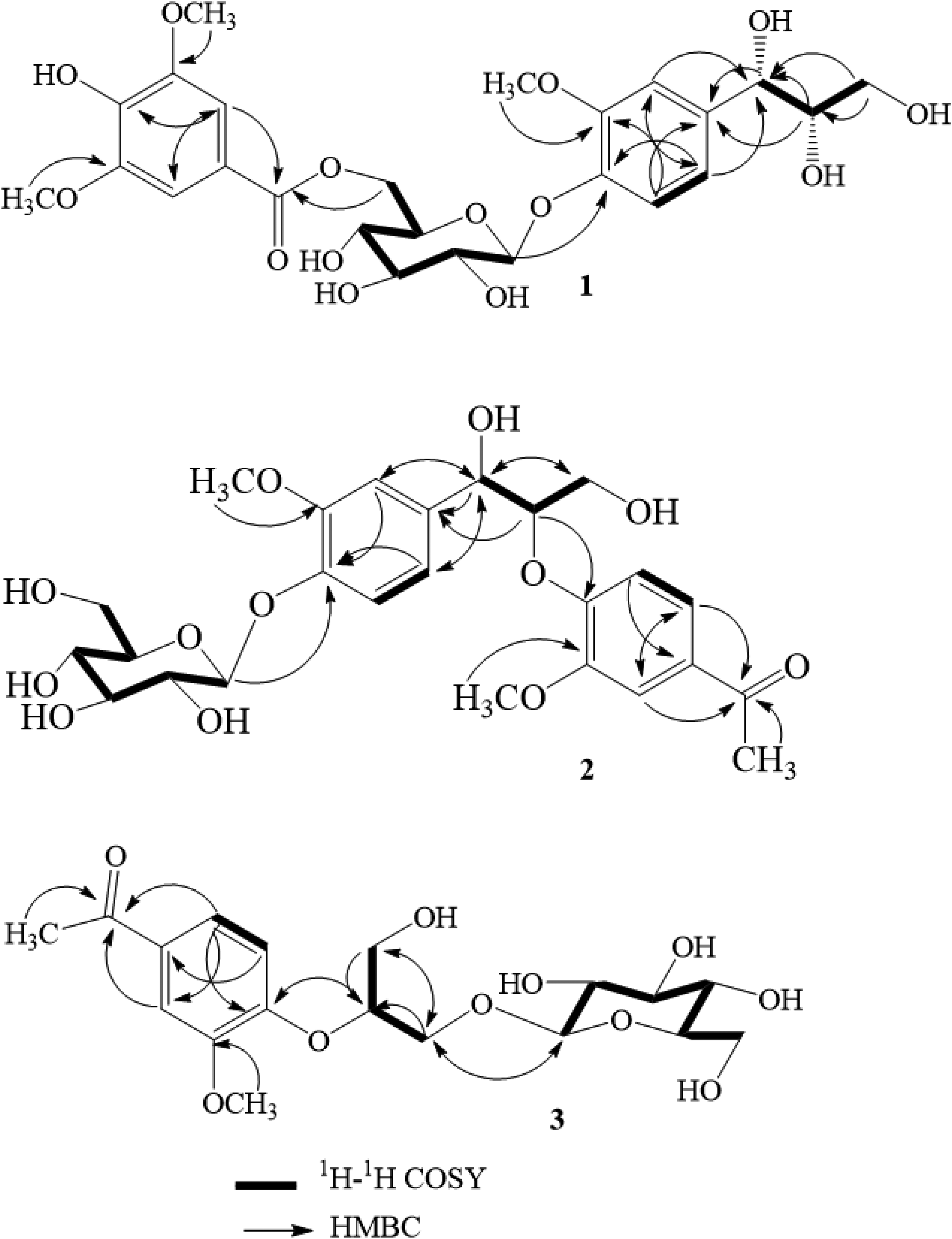
Key 1H-1H COSY and HMBC correlations of
The HR-ESI-MS of compound
Compound
1H NMR and 13C NMR Spectroscopic Data for

Abbreviation: NMR, nuclear magnetic resonance spectroscopy.
aMeasured in CD3OD.
b150 MHz.
c600 MHz.
*Overlapped signals.
The HR-ESI-MS and NMR spectra of compounds
To identify NO inhibitors, compounds
Materials and Methods
General Experimental Procedures
The used characterization equipment is the same as that described in our previous work. 16 Refer to Supplemental Material.
Plant Materials
The aerial parts of Piper longum L. were collected from Me Linh Biodiversity Station, Vinh Phuc, Vietnam, and identified by Dr Nguyen The Cuong, Institute of Ecology and Biological Resources, VAST. The voucher specimen (NCCT-P136) has been deposited at IMBC, VAST.
Extraction and Isolation
Refer to Supplemental Material.
Piperlongoside A (1 )
Colorless solid,
Piperlongoside B (2 )
Colorless solid,
Piperlongoside C (3 )
Colorless solid,
Acid Hydrolysis and Confirmation of Monosaccharide
Refer to Supplemental Material.
Nitric Oxide Assay
The nitric oxide assay is the same as that described in our previous work. 17 Refer to Supplemental Material.
Conclusions
Bio-guided fractionation and isolation of the active component from the aerial parts of P. longum led to the isolation of 3 new phenolic compounds, piperlongosides A-C (
Supplemental Material
sj-docx-1-npx-10.1177_1934578X221150367 - Supplemental material for Piperlongosides A–C, Three New Phenolic Constituents From Piper longum L.
Supplemental material, sj-docx-1-npx-10.1177_1934578X221150367 for Piperlongosides A–C, Three New Phenolic Constituents From Piper longum L. by Le Thi Huyen, Nguyen Thi Thu Hau and Phan Van Kiem in Natural Product Communications
Footnotes
Abbreviations
Acknowledgments
The authors would like to thank Dr Nguyen for The Cuong at the Institute of Ecology and Biological Resources, VAST for the plant identification.
Author Contribution
Research idea, LT Huyen, PV Kiem; Isolation, NNT Hau, LT Huyen; Structure elucidation and writing, LT Huyen, PV Kiem.
Declaration of Conflicting Interests
The author(s) declared no potential conflicts of interest with respect to the research, authorship, and/or publication of this article.
Funding
The author(s) disclosed receipt of the following financial support for the research, authorship, and/or publication of this article: This work was supported by the Vietnam National University, Hanoi, Vietnam (grant no. QG.22.05).
Ethical Approval
Our institution does not require ethical approval for reporting individual cases or case series.
Statement of Human and Animal Rights
This article does not contain any studies with human or animal subjects.
Statement of Informed Consent
There are no human subjects in this article and informed consent is not applicable.

Supplemental Material
Supplemental material for this article is available online.
References
Supplementary Material
Please find the following supplemental material available below.
For Open Access articles published under a Creative Commons License, all supplemental material carries the same license as the article it is associated with.
For non-Open Access articles published, all supplemental material carries a non-exclusive license, and permission requests for re-use of supplemental material or any part of supplemental material shall be sent directly to the copyright owner as specified in the copyright notice associated with the article.
