



Abstract
Phytochemical investigation from the leaves and stem extracts of Piper maingayi Hk.F. resulted in the isolation of a new amide, N-isobutyl-15-(3″,4″-methylenedioxyphenyl)-2E,4E,12Z-pentadecatrienamide (
Keywords
Piper is the largest genus in the Piperaceae family. This pantropical genus is estimated to contain 2000 species dispersed widely in American and Asian tropic including Indian, Indonesian, and Malaysian tropical rainforest. 1 Most species of Piper appeared to be restricted to altitudes ranging from 0 to 2500 m, and very few occurred above 3000 m which grow in wet and shaded places. 1,2 This genus is usually erect or scandent herbs, shrubs, or infrequently trees. 3,4 The structure is rather uniform morphologically, with simple alternate leaves and joined stems with enlarged nodes and possessed aromatic or pungent smell. Many produce pearl bodies on the leaves or stems, but the most distinctive morphological feature is the production of inflorescences of tiny seeds packed into upright or pendant spikes. 5 It has provided many past and present civilizations with a source of medicines and food spices. The well-known species as stated previously, Piper betle, Piper nigrum, and Piper sarmentosum, had been brought up to the highest level of usage in perfumery and herbal products. Chemical studies carried out on Piperaceae species have revealed the presence of several compounds including alkaloids/amides, propenylphenols, lignans, neolignanas, terpenes, steroids, kawapyrones, piperolides, chalcones, dihydrochalcones, flavones, flavanones, and miscellaneous compounds. 3 Amide derivatives are frequently isolated from Piper species, and many of them exhibit diverse biological activities, such as antimicrobial, antitubercular, antitumor, and cytotoxicity. 6 -9
A study on the essential oil of Piper maingayi leaf has been reported by Sirat et al. 10 Our first study on the fruits and stem essential oils obtained from P. maingayi has resulted in the identification of 34 and 18 components accounting for 83.6% and 78.7% of the total amount, respectively. The main constituents of stems essential oil were β-caryophyllene (26.2%), while the fruits essential oil was dominated by δ-cadinene (22.6%) and β-caryophyllene (18.8%). The stem and fruit oils were found to be effective scavengers of the 2,2′-azino-bis(3-ethylbenzothiazoline-6-sulfonic acid) radical with an IC50 values at 12.6 and 13.9 µg/mL and 2,2-diphenyl-1-picrylhydrazyl assay with IC50 14.9 and 20.8 µg/mL, respectively. The tyrosinase inhibition activity (1 mg/mL) was found to be significant for stem oil (65.5 ± 0.2%), but lower than the positive control, kojic acid (91.3 ± 0.1%). 11 With regard to the phytochemicals investigation, only one short communication on the phytochemicals of P. maingayi has been published by Ahmad et al. 12 Thus far, in the aspect of biological activity, none has been reported on P. maingayi. The paucity of the studies on the biological active metabolites of P. maingayi justify our exploration of the phytochemical constituents from this species in an attempt to enhance the acceptability of herbal medicines for the development of pharmaceutical and herbal formulation documentations.
Compound (
The assignments of the olefinic protons were further substantiated by the COSY spectrum. Thus, signals for olefinic protons of H-3 (δ 7.21) were coupled with its neighboring proton of H-4 (δ 6.12) which then coupled with H-2 (δ 5.77). Meanwhile, H-1′ was also observed to couple with proton of amide system (N-H, δ 5.53) and H-2′ at δ 1.82. The cis-olefinic protons which were assigned to H-12 and H-13 were observed to couple with H-14 (δ 2.28). Thus, the coupling pattern of this isobutylamide was consistent with the proton and carbon assignation position. The HMQC spectrum showed direct correlation of the assigned H-2 (δ 5.77) with C-2 (δ 121.8), H-3 (δ 7.21) with C-3 (δ 143.1), H-4 (δ 6.12) with C-4 (δ 128.2), and H-5 (δ 6.07) with C-5 (δ 141.3). Meanwhile, the cis-olefinic H-12 and H-13 were also observed to have direct correlation with individual carbon signal at δ 129.3 (C-12) and 131.1 (C-13), respectively. The HMBC spectrum reconfirmed the position of cis-olefinic protons H-12 and H-13 because C-12 was observed to possess a strong correlation with H-14 and H-11. Meanwhile, H-15 was also observed to have a long distance correlation with quaternary C-3″ (δ 147.4) and C-12 (δ 129.3), while H-6 (δ 2.16) was found to correlate with C-4 (δ 128.2) and C-5 (δ 141.3). The methyl group at H-3′ and H-4′ were observed to correlate with C-2′ (δ 28.6) and C-1′ (δ 46.9). Meanwhile, H-1′ (δ 3.16) was correlated with J 3 distance with C=O unsaturated carbonyl carbon (δ 166.4). The mass spectrum showed a peak corresponding to the molecular formula C26H37NO3, based on the [M]+ ion signal at m/z 411.2789 (calc. 411.2785). 13
The NMR data (Table 1) of compound (

Chemical structure of compound (1).
NMR Data for Compound (1).
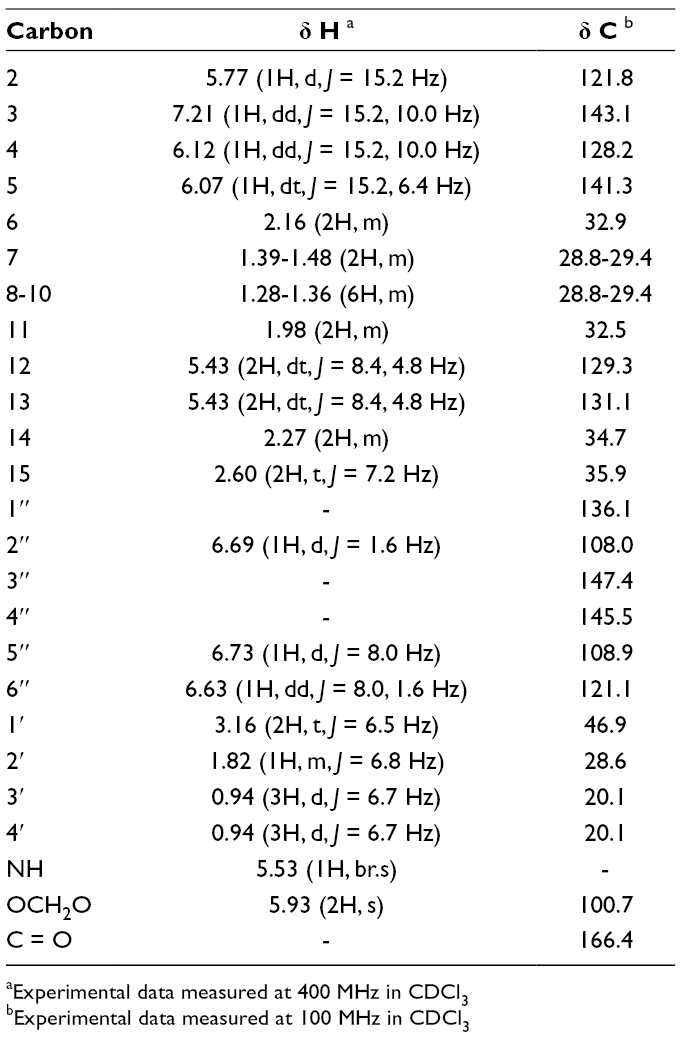
aExperimental data measured at 400 MHz in CDCl3
bExperimental data measured at 100 MHz in CDCl3
Experimental
Plant Materials
Piper maingayi was collected from Hutan Simpan Fraser, Fraser Hill, Perak, in January 2014, and identified by Shamsul Khamis from Institute of Biosience (IBS), Universiti Putra Malaysia (UPM). The voucher specimens (SK2329/14) were deposited at the Herbarium of IBS, UPM.
Extraction and Isolation
The dried leaves (697 g) and stems (539 g) were sequentially subjected to cold extraction with n-hexane (5.0 L), EtOAc (5.0 L), and MeOH (5.0 L) successively. The n-hexane extract (PMLH) (9.34 g), EtOAc extract (PMLE) (17.43 g), and MeOH extract (PMLM) (6.95 g) of leaves were fractionated using vacuum liquid chromatography (VLC) (70.0 g silica, column size 6.0 cm × 4.0 cm). PMLH and PMLE were fractionated and eluted with n-hexane, CHCl3, EtOAc, and MeOH by increasing polarity to give 28 and 17 fractions. Fractionation of PMLH gave 3 combined fractions, F 2-12, F 8-23, and F 24-28, whereas PMLE were pooled into 5 fractions, F 1-3, F 5-9, F 10-11, F 12-13, and F 14-17. The fractions were combined based on TLC profiles. Fraction F 2-12 was subjected to column chromatography (CC) afforded oleic acid (
Antibacterial—MIC
Minimum inhibition concentration was verified by using micro broth dilution technique. 14,15 This test was conducted in a sterile 96-well round bottom microplate. The compound was diluted in dimethylsulfoxide (DMSO) to obtain a sample stock solution with a concentration of 1 mg/mL. The bacteria (50 µL) was added to the sample solution (50 µL) with concentration ranging from 1000 to 7.81 µg/mL obtained from 2-fold serial dilution with nutrient broth (NB). The microplates were then incubated for 24 hours at 37°C for Staphylococcus aureus, Escherichia coli, and P. aeruginosa and 30°C for B. subtilis. Streptomycin sulfate (0.1 mg/mL) was employed as a positive control in this assay and was treated similar to the sample. Inoculum viability wells that contain bacteria (50 µL) and NB (50 µL) supplemented with Tween 80 (0.02% v/v) and sterility control wells that contain only the sample (50 µL) in 2-fold dilution were reserved in each microplate. 2-(4-Iodophenyl)-3-(4-nitrophenyl)-5-phenyl-2H-tetrazolium (INT) staining method was chosen to evaluate the growth of bacteria in the wells. INT solution (0.2 mg/mL) was prepared freshly and should be kept away from light. After 24 hours of incubation, INT solution (25 µL) was added to all wells followed by incubation for at least 30 minutes. Bacteria growth in the well was indicated by the formation of reddish-pink color, while clear well indicated the inhibition of bacterial growth by the sample.
Lipoxygenase (15-LOX) Inhibitory Activity
The reagents were prepared according to the standard protocol (Lipoxygenase inhibitor screening assay kit, item no. 760 700 Cayman Chemicals Co., Ann Arbor, MI). 16 Stock solutions of sample were prepared to obtain the concentrations of 1000 to 62.5 μg/mL in the respective wells. The prepared solutions were then introduced onto 96-well plates where the cells were distributed as blank 1A-2A-1D (triplicate), positive control 1B-2B (duplicate), and 100% initial activity wells 1C-2C-2D (triplicate). The remaining wells were designated for inhibitor (compound) solutions in duplicate. The addition of the reagents was done according to the standard protocol in which 100 µL assay buffer was added to the blank wells, whereas 90 µL lipoxygenase (15-LOX) enzyme and 10 µL assay buffer were added to the positive control wells. About 90 µL lipoxygenase enzyme and 10 µL solvent (DMSO) were added to wells with 100% initial activity. The inhibitor (compound) wells were charged with 90 µL lipoxygenase enzyme and 10 µL respective stock (compound) solutions. The reaction was initiated by adding 10 µL of the substrate (AA) to all wells. The plate was then shaken for 5 minutes on an orbital shaker. Ultimately, 100 µL of chromogen solution (prepared according to the standard protocol) was added to each well to stop enzyme catalysis. The plate was incubated for 30 minutes and was read at 500 nm. The percentage inhibition (I%) of the compound was calculated using the following equation:
where A initial is the absorbance of 100% initial activity wells without sample and A inhibitor is the absorbance of compound/reference. Analyses were expressed as mean±SD of triplicates.
Statistical Analysis
Data obtained from biological activities are expressed as mean values. Statistical analyses were carried out by employing one-way ANOVA (P > 0.05). A statistical package (SPSS version 11.0) was used for the data analysis.
N-Isobutyl-15-(3″,4″-methylenedioxyphenyl)-2E,4E,12Z-pentadecatrienamide (1)
White amorphous.
Rf: 0.35 (n-Hexane: CHCl3; 3:2).
IR (KBr): 3298, 1654, 1628, 1610 cm−1.
1H (400 MHz, CDCl3) and 13C NMR (100 MHz, CDCl3): Table 1. HR-EI-MS: m/z 411.2789 [M]+ ; calcd for C26H37NO3, 411.2785. Spectroscopic data was available in Supplementary Material.
Supplemental Material
Supplementary data - Supplemental material for A New Amide From Piper maingayi Hk.F. (Piperaceae)
Supplemental material, Supplementary data, for A New Amide From Piper maingayi Hk.F. (Piperaceae) by Nur Athirah Hashim, Farediah Ahmad, Wan Mohd Nuzul Hakimi Wan Salleh, and Shamsul Khamis in Natural Product Communications
Footnotes
Acknowledgments
The authors would like to thank the Department of Chemistry, Faculty of Science, Universiti Teknologi Malaysia (UTM) for research facilities.
Declaration of Conflicting Interests
The author(s) declared no potential conflicts of interest with respect to the research, authorship, and/or publication of this article.
Funding
The author(s) disclosed receipt of the following financial support for the research, authorship, and/or publication of this article: The authors thank the Ministry of Science, Technology and Innovation Malaysia (QJ130000.2526.03H93) for financial support.
References
Supplementary Material
Please find the following supplemental material available below.
For Open Access articles published under a Creative Commons License, all supplemental material carries the same license as the article it is associated with.
For non-Open Access articles published, all supplemental material carries a non-exclusive license, and permission requests for re-use of supplemental material or any part of supplemental material shall be sent directly to the copyright owner as specified in the copyright notice associated with the article.
