



Abstract
Introduction
Ischemic stroke (IS), caused by cerebral blood circulation disorder, is associated with a high disability rate, high morbidity and mortality, and numerous complications. A series of clinical neurological deficit syndromes are caused by oxygen and even further necrosis. 1 Traditional Chinese medicine (TCM) can be used to prevent and treat IS. These medicines not only improve the condition of patients with stroke but also adjust the general state of the body, relieve accompanying or secondary symptoms, and improve the quality of life of patients. 2 The TCM compound Wenyang Huayu formula (WYHYF), which is useful for treating IS, is composed of Aconitum carmichaeli Debx, the dry root of Aconitum chinense Paxton (Araceae); the dry root of Acorus tatarinowii Schott, a grass-like perennial herb; the dried twigs of Cinnamomum cassia Presl, a Lauraceae plant; the dry rhizome of Atractylodes macrocephala Koidz, a Compositae plant; the dry leaf of Epimedium brevicornu Maxim, a Berberidaceae plant; the dry root of Panax notoginseng, a ginseng plant of Acanthopanaceae; the dry root of Rheum palmatum, a type of rhubarb and perennial plant in Polygonaceae; and the dried roots of Glycyrrhiza uralensis Fisch, a bean plant.
In this study, we examined whether WYHYF can be used to treat IS. Our results showed that WYHYF improved the condition of patients with IS in the acute stage, showing stronger effects than those of conventional western medicine in terms of improving neurological function, enhancing daily living ability, and safety. The mechanism may be related to reducing the plasma D-dimer and low-density lipoprotein-cholesterol levels of patients with stroke. WYHYF improves nerve function and increases the carotid middle thickness of patients with IS. 3 This study aimed to explore the mechanism of WYHYF in treating IS and provide a theoretical basis for the clinical treatment of IS.
Network pharmacology can predict the mechanisms of drugs at the molecular level, explain the complex relationships between drugs and organisms, and reveal the synergistic effects of multiple drugs. Molecular docking, an important method applied in the field of drug design, is useful for the virtual prediction of molecular ligands and targets.4,5 To predict the mechanism of the effect of WYHYF on IS, network pharmacology analysis was performed to predict the active ingredients, therapeutic targets, and signaling pathways of WYHYF. The results were confirmed using molecular docking and rat experiments. This research provides a reference for subsequent clinical applications and basic studies of WYHYF.
Results
TCM Targets and Disease Targets
According to the database, 147 active ingredients in TCMs were identified, including aconite (6), calamus (4), cassia twig (6), atractylodes (5), notoginseng (7), epimedium (23), rhubarb (10), and licorice (86). A total of 2846 TCM targets was obtained by standardizing the targets, giving 277 TCM targets after removing duplicate targets using the STRING platform. We collected 3777 IS disease targets from the disease database. Considering the intersection of the TCM targets and disease targets, 212 intersecting targets were obtained (Figure 1).

Venn diagram of common targets of Wenyang Huayu Formula compounds against cerebral ischemia-reperfusion.
Drug-Ingredient-Target-Disease Network Graph Analysis
The drug-ingredient-target-disease network of WYHYF was constructed using Cytoscape 3.7.2 software (Figure 2). The network contained 2667 edges and 421 nodes, including 8 TCMs, 52 active ingredients, 277 potential targets, and 1 disease. The triangle represents the name of WYHYF; the diamond, hexagon, ellipse, and V-shaped nodes represent the name of the TCM, ingredient, potential target, and disease, respectively, and the edge represents the interaction relationship between nodes. WYHYF may be useful for treating IS as a multicomponent, multitarget, and multichannel intervention. PTGS2, ESR1, CALM2, HSP90AA1, and AR may be important targets. Quercetin, kaempferol, luteolin, wogonin, 7-methoxy-2-methylisoflavone, beta-sitosterol, formononetin, C-homoerythrin, 1,6-didehydro-3,15,16-trimethoxy-, (3.beta)-, isorhamnetin, and naringenin may be important active ingredients.

Network diagram of Wenyang Huayu Formula for anti-cerebral ischemia and reperfusion “drug-ingredient-target-disease.”
Protein–Protein Interaction Network Graph Analysis
Using the STRING platform, intersecting targets were evaluated in protein-protein interaction (PPI) analysis, and network topology analysis was performed on the obtained data using Cytoscape software. We observed 212 nodes and 4537 edges in the network, with an average degree value of 42.8 (Figure 3). Analysis of the interaction information using Cytoscape 3.7.1 software showed that the median degree value was 43 and 88 targets with indicators greater than the median were screened as core targets. A larger construction degree value was shown as a darker color; a larger graph was considered to have a closer interaction with other proteins. The top ten targets were AKT1, TP53, IL6, CASP3, VEGFA, JUN, IL1β, EGFR, MAPK3, and STAT3, which may be important for treating IS using WYHYF. The 36 core targets showing the largest degree values are listed in Figure 3.

Protein–protein interaction network graph: top 36 core targets with the largest degree values.
Gene Ontology Functional Enrichment Analysis and Kyoto Encyclopedia of Genes and Genomes Pathway Enrichment Analysis of Potential Target Genes of WYHYF for IS
Using the Metascape database, gene ontology (GO) enrichment analysis revealed 4475 biological process entries, 367 cell component entries, and 502 molecular function entries. For the biological process category, the target functions were mostly related to the response to inorganic substances, cytokine, and positive regulation of cell migration; for the cell composition category, targets mainly involved transcription regulator complex, membrane raft, vehicle lumen, cyclin-dependent, protein kinase holoenzyme complex, endoplasmic reticulum lumen, and perinuclear region of cytoplasm; in the molecular function category, the targets mainly involved kinase binding, RNA polymerase II-specific DNA-binding transcription factor binding, and NF-κB binding (Figure 4). Kyoto Encyclopedia of Genes and Genomes (KEGG) pathway analysis showed that these key targets were involved in signaling pathways, mainly cellular senescence, FoxO signaling pathway, tumor necrosis factor-alpha (TNF) signaling pathway, Toll-like receptor signaling pathway, nonalcoholic fatty liver disease, Th1 and Th2 cell differentiation, pathways of neurodegeneration – multiple diseases, and epithelial cell signaling in Helicobacter pylori infection. The top 20 pathways are shown in Figure 5.

Gene Ontology functional enrichment of Wenyang Huayu formula targets related to ischemic stroke.

Top 20 results of Kyoto Encyclopedia of Genes and Genomes enrichment analysis of the components of Wenyang Huayu formula against cerebral ischemia and reperfusion.
Molecular Docking Results
The key targets selected from WYHYF for treating IS were molecularly docked with the main active ingredients. The results showed that 88% of targets had a docking score <−5 kcal/mol, demonstrating that most of the core targets combined with the ingredients. A heat map of the docking scores is shown in Figure 6, and a schematic diagram of some of the docking interactions with the active ingredient molecule is shown in Figure 7. A smaller docking binding force indicated more stable binding between the ligand and receptor and that their interaction was more likely. The lowest binding force between stigmasterol and IL-1β was −9.6 kcal/mol (1 kcal ≈ 4.186 kJ).

Molecular docking results between the active ingredients of the Wenyang Huayu formula and core target.
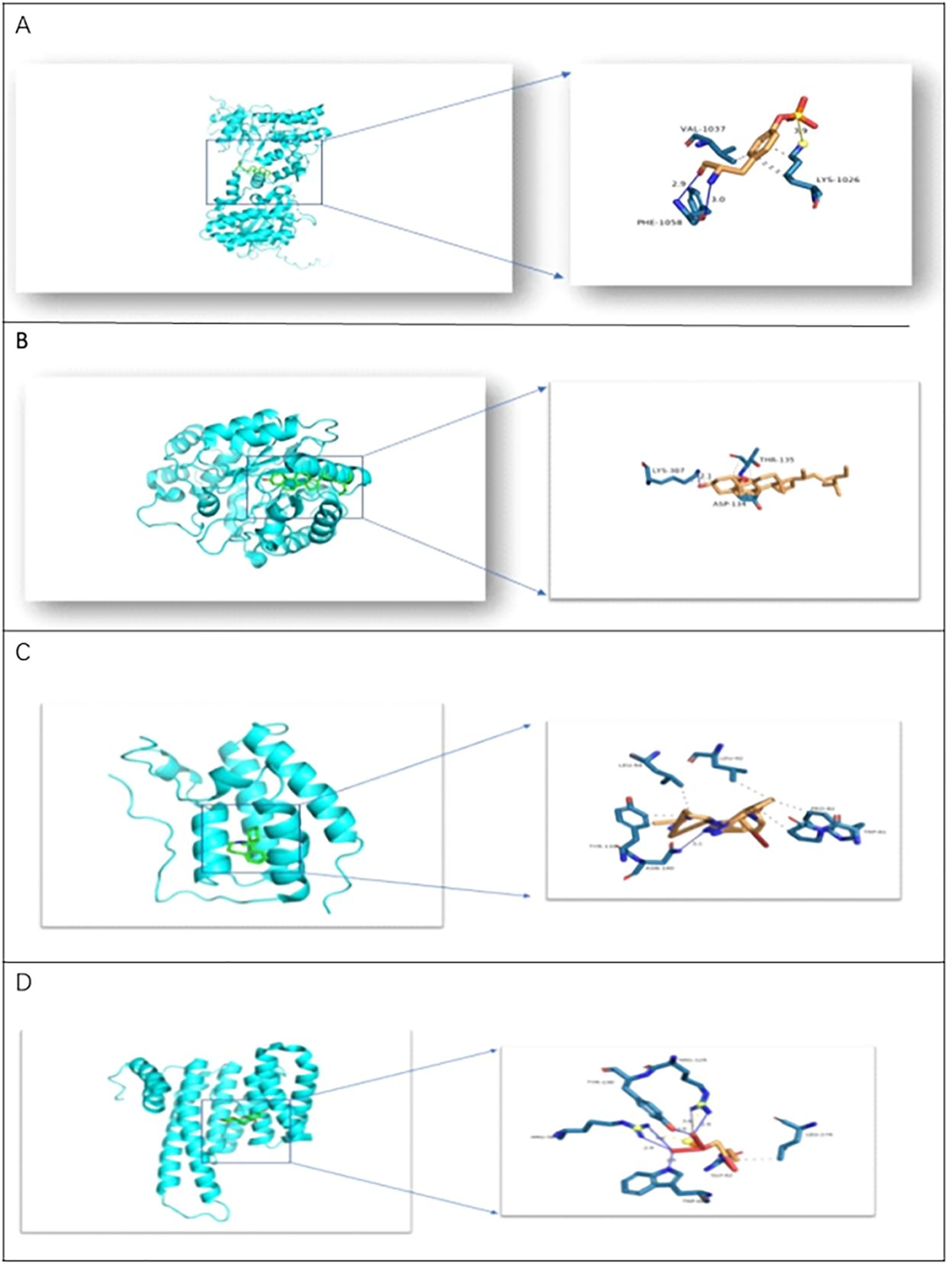
Molecular docking diagram: (A) Stigmasterol binds to IL-6; (B) stigmasterol binds to IL-1β (C) TNF binds to C-homoerythrin (D) NF-κB binds to luteolin. The blue solid lines represent hydrogen bonds, and the gray dashed lines represent hydrophobic interactions. The yellow line shows the salt bridge. Abbreviations: TNF: tumor necrosis factor; IL: interleukins.
Animal Experimental Verification
Effect of WYHYF on Neurological Function Following IS
Damage to neurological function was more severe in the model control group than in the sham group based on the significantly higher Zea Longa score in the model control group (P < .01). The symptoms of neurological damage were improved in the nimodipine and WYHYF groups compared to that in the model control group, with the Zea Longa score showing a significant decrease (P < .05). The results are shown in Figure 8.

Neurological function score. The Wenyang Huayu formula group compared with the other 3 groups: *P < .05, **P < .01.
Protein Expression of Toll-like receptor 4, NF-κB p65, and Caspase-3
The relative expression levels of Toll-like receptor 4 (TLR4), NF-κB p65, and caspase-3 were compared with the expression level of β-actin. Compared to that in the sham group, the protein expression levels of TLR4, NF-κB p65, and caspase-3 in the rat brain tissue were significantly upregulated in the model group (P < .01). Compared to that in the model group, the expression levels of TLR4, caspase-3, and NF-κB p65 were significantly decreased in the nimodipine and WYHYF groups (P < .05) (Figure 9).

Expression of TLR4, NF-κB p65, and caspase-3 protein detected using western blotting. WYHYF group compared with the other 3 groups: *P<.05, **P < .01. Abbrevitions: TLR4, Toll-like receptor 4; WYHYF: Wenyang Huayu formula.
Effects of WYHYF on serum TNF-α, IL-6, and IL-1β in Mice with IS
The levels of TNF-α, IL-6, and IL-1β in the sham group were significantly lower than those in the model group. The nimodipine and WYHYF groups showed significantly reduced serum levels of TNF-α, IL-6, and IL-1β in rats. Compared to that in the nimodipine group, WYHYF significantly reduced the serum levels of TNF-α, IL-6, and IL-1β in rats (Figure 10).

Concentrations of IL-1β, IL-6, and TNF-α in brain tissue and serum of rats in the 4 groups. WYHYF group compared with the other 3 groups: *P < .05, **P < .01. Abbreviations: TNF-α, tumor necrosis factor-α; WYHYF: Wenyang Huayu formula.
TUNEL Staining
The apoptosis rate in the model group was significantly higher than that in the sham group, indicating that acute brain injury was successfully induced in the model group, which would lead to brain cell apoptosis. The apoptosis rate was significantly lower in the nimodipine group than in the model group (P < .01). The apoptosis rate was significantly lower in the WYHYF group than in the nimodipine group (P < .01). The results are shown in Figure 11.
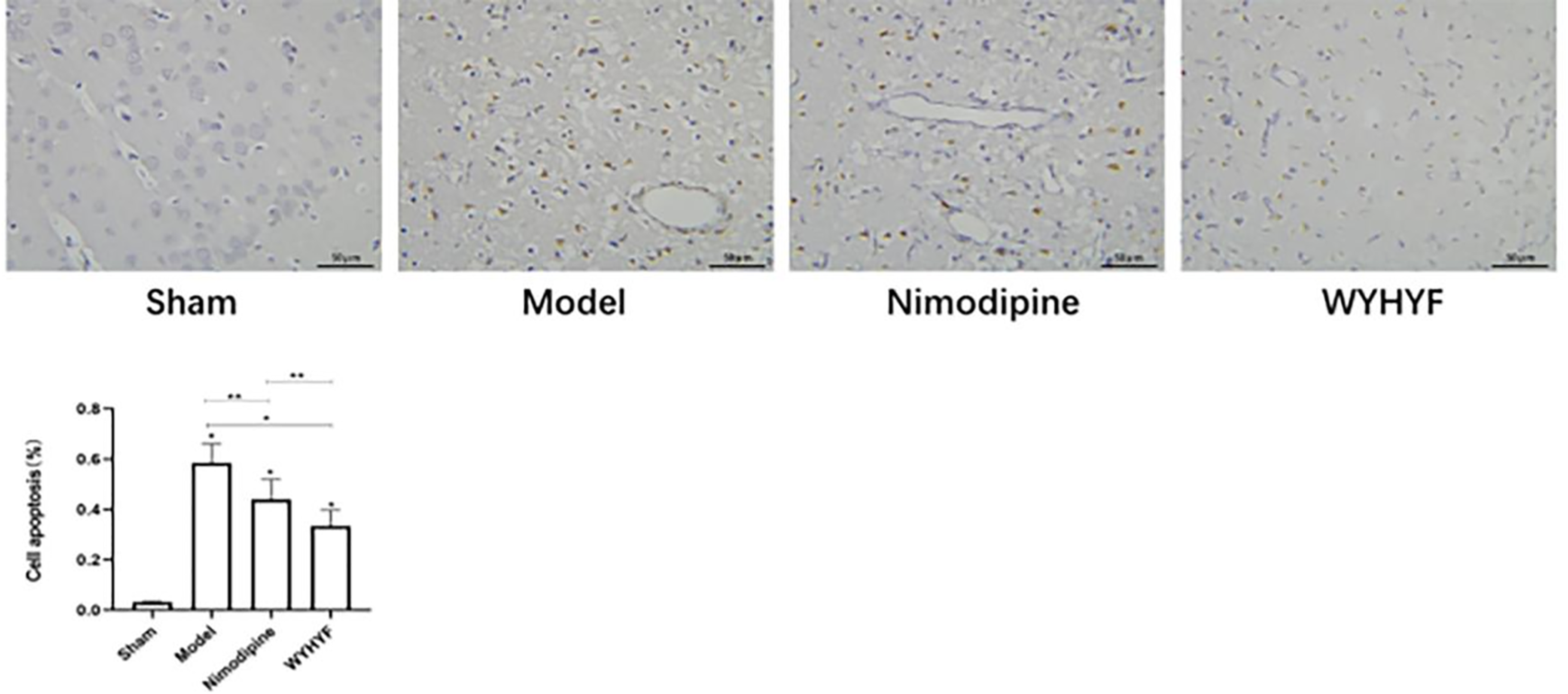
TUNEL staining results of rat brain tissue showing that Wenyang Huayu formula (WYHYF) inhibits apoptosis in the brain tissue of rats; WYHYF group compared with the other 3 groups: *P < .05, **P < .01.
Transmission Electron Microscopy
In the sham group, the blood–brain barrier structure was acceptable, perivascular glial cell pedicle structure was acceptable, glial filaments were abundant, coupling was good, endothelial cell morphology was acceptable, the vascular lumen was not atrophied, and vascular basement membrane was intact. The model group showed the most serious damage to the blood–brain barrier, mainly in the peripheral blood vessels, with extensive edema and dissolution, slight compression of the blood vessels, mild edema of endothelial cells, and a blurred basement membrane structure. Damage to the blood-brain barrier was less severe in the nimodipine group than in the model group. Images of the WYHYF group revealed mild damage to the blood–brain barrier; the endothelial cell structure was fair or exhibited slight edema, mainly with mild edema of the extravascular matrix, an intact astrocyte foot plate membrane, and local matrix dissolution (Figure 12).

Structure of the sham group was acceptable; the model group showed moderate to severe damage; the nimodipine group showed moderate damage; and the Wenyang Huayu formula (WYHYF) group showed mild damage.
Discussion
The etiology, pathological process, and mechanisms of IS are complex and diverse. In addition to intravenous thrombolysis and mechanical thrombectomy, IS is mainly treated conservatively, and evidence-based effective treatment measures for IS are lacking. 6 TCM contains multiple components and has numerous targets, and the treatment of IS is not limited by the time window. We used previously reported information to explore the mechanism of TCM in the treatment of stroke.7,8
Network pharmacology analysis was based on 277 compounds with potential biological activity, 2846 corresponding protein targets, and 3777 disease targets in WYHYF to construct a “drug-ingredient-target-disease” network. Pathway enrichment analysis suggested that inflammation is closely related to cerebral ischemia-reperfusion, and the inflammatory signaling pathway may play an important role in treating cerebral ischemia-reperfusion using WYHYF. We identified 150 pathways in enrichment analysis, with the Toll-like receptor signaling pathway showing the largest number of enriched genes; among them, the TLR4has been widely studied. 9 Activated TLR4 may promote neurogenesis and angiogenesis10,11 and initiate MyD88- and TRIF-dependent signaling pathways. MyD88-dependent signaling cascades activate NF-κB light chain enhancer or mitogen-activated protein kinase signaling pathways in activated B cells.12,13 By mediating activation of the nuclear transcription factor NF-κB, it promoted the expression of downstream inflammatory factors, such as IL-6, IL-1β, and TNF-α, thereby amplifying the inflammatory signal. Following IS, microglia exert their pro-inflammatory effects by activating NF-κB. Because of the neurotoxic effect of activated microglia, TNF-α may mediate neuronal necrosis through an apoptotic mechanism, which in turn aggravates brain damage.14,15 In molecular docking, the key components of WYHYF showed relatively stable binding activity to IL-6, IL-1β, and TNF-α. Therefore, the TLR4 pathway, closely related to the pathogenesis of IS, was examined in animal experiments, and the expression levels of IL-6, IL-1β, and TNF-α were verified.
The results of network pharmacology and animal experiments confirmed that WYHYF improved neurological function and reduced cerebral ischemia-reperfusion injury after 6 days of administration. WYHYF significantly reduced the proliferation and migration of endothelial cells, increased vascular permeability, and promoted the formation of new blood vessels. Our results also suggested that WYHYF plays a protective role in cerebral ischemia injury by reducing the apoptosis of neurons in and around the injured area. After cerebral ischemia-reperfusion, the levels of IL-1β, IL-6, and TNF-α in the brain are increased, indicating brain tissue damage. IL-1β is highly expressed in the brain and functions by regulating neurotropism and ion channel expression and activity. 16 After IS, the levels of TNF-α and IL-1β increase dramatically because of the activation of microglia and macrophages. 17 We found that WYHYF significantly reduced the levels of the inflammatory factors IL-1β, IL-6, and TNF-α in the brain of rats with cerebral ischemia-reperfusion injury, indicating that WYHYF reduced cerebral ischemia-reperfusion injury and the related inflammatory response. WYHYF downregulated the expression of inflammation-related proteins TLR4, NF-κB p65, and caspase-3 and reduced the levels of IL-6, IL-1β, and TNF-α in the brain tissue.
Conclusion
We analyzed the mechanism of action of WYHYF for IS treatment based on initially screened targets. The results showed that WYHYF may act on IL-6, IL-1β, and TNF-α through the TLR4/NF-κB signaling pathway to exert neuroprotection effects; reduce reperfusion injury; exert anti-inflammatory effects; and inhibit apoptosis. The synergistic therapeutic effects of multiple components and targets of TCM were revealed, which may be useful for identifying the key active components in WYHYF and developing new drugs. 18 We only verified some core targets and individual pathways. Whether the above-mentioned core targets and pathways are involved in the actual treatment process must be verified in further animal and cell experiments. Studies of continuous supplementation are needed to clarify the specific mechanism of WYHYF in the treatment of IS and to provide a theoretical basis for the clinical treatment of IS.
Materials and Methods
TCM and Disease Targets
Using a TCM systems pharmacology database and analysis platform, components with oral bioavailability ≥ 30% and drug-like properties ≥ 0.18 were screened as active ingredients. 19 The Encyclopedia of Traditional Chinese Medicine, Traditional Chinese Medicine Integrative Database, China National Knowledge Infrastructure, and PubMed databases were used to search for the active ingredients and corresponding targets of Aconite, Shichangpu, Guizhijian, Atractylodes, Epimedium, P. notoginseng, rhubarb, Zhigancao, and Bawei. Target name conversion was performed using the STRING database. Disease targets were identified using the GeneCards and Online Mendelian Inheritance in Man databases with “ischemic stroke, cerebral infarction” as the search terms. 20 Based on the results of previous work, a Venn diagram of the TCM targets and disease targets was drawn to identify the intersecting targets.
Drug-Component-Target-Disease Network Diagram of WYHYF
Cytoscape 3.8.2 software was used to draw the drug-component-target-disease network diagram of the collected data. The Network Analyzer tool was used to draw the network diagram, and core components were screened according to the degree value.
Protein–Protein Interaction
A PPI network diagram was drawn using the STRING platform, and PPI calculation was performed for the intersection targets. The results were imported into Cytoscape software for network topology analysis.
GO and Kyoto Encyclopedia of Genes and Genomesenrichment Analysis
Using the Metascape database, GO enrichment and KEGG pathway analyses were performed on the intersection targets. R language was used to visualize the data in bubble charts and histograms.
Molecular Docking
The core components were selected for molecular docking with the core protein. The compound structure was downloaded from the PubChem database, and the core protein was downloaded from the Protein Data Bank. 21 PyMOL software was used to remove water molecules, separate proteins, and visualize the data. Molecular docking was performed using Autodock Vina with corresponding computational results. 22
Animal Experimental Verification
Drug
WYHYF (20 g A. carmichaeli Debx extracted and concentrated from 120 g crude drug, batch number A200029810; 20 g A tatarinowii Schott extracted and concentrated from 120 g crude drug, batch number A210003710; 15 g C cassia Presl extracted and concentrated from 180 g crude drug, batch number A210084810; 15 g A macrocephala Koidz extracted and concentrated from 50 g crude drug, batch number A210006210; 15 g E brevicornu Maxim extracted and concentrated from 300 g crude drug, batch number A200162510; 15 g P notoginseng extracted and concentrated from 15 g crude drug, batch number A210087101; 6 g R palmatum extracted and concentrated from 18 g crude drug, batch number A210075410; 6 g G. uralensis Fisch extracted and concentrated from 18 g crude drug, batch number A210165010) was produced by Jiangyin Tianjiang Pharmaceutical Co., Ltd ().
Animals
Male Sprague-Dawley rats (n = 24), with a body weight of 200 ± 20 g (animal certificate number: 430727211101291332; experimental animal license number: SCXK (Xiang) 2019-0004, provided by Hunan Slike Jingda Laboratory Animal Co., Ltd), were reared in the specific pathogen-free animal room at Guangxi University of Traditional Chinese Medicine at 18–26 °C with a humidity of 40%–70%. The animals were fed adaptively for 1 week before the experiment. All experimental procedures were approved by the Ethics Committee of Guangxi University of Traditional Chinese Medicine (DW20200415-53). The rats were anesthetized by intraperitoneal injection of 1% pentobarbital sodium (30 mg/kg body weight, SHBD9164V). When anesthesia was completed, the rats were sacrificed by cervical dislocation. The rats were monitored every day, and the humane end points of the experimenters were as follows: the rats’ food or water intake was reduced, and breathing was difficult. The rats could not stand and respond to external stimuli. During the experiment, there were no abnormal signs indicating the end point of the experiment, and death was confirmed as cardiac arrest and chills.
Animal Experiment
The rats were anesthetized with 1% pentobarbital sodium (intraperitoneal; 30 mg/kg) and fixed with their heads on a stereotactic frame to keep the back and front fontanels at the same level. A cerebral ischemia-reperfusion rat model was prepared as described by Li et al. 23 After modeling, the wounds were sutured layer by layer. After 2 h of cerebral ischemia and reperfusion, rats with a neurological deficit score > 0 were randomly divided into the model, nimodipine tablet 30 mg/kg control, and WYHYF granules treatment groups. The sham group was subjected to the same operation as cerebral ischemia-reperfusion modeling without vascular treatment. The nimodipine group was administered nimodipine 30 g/kg/d, and the WYHYF group was administered 30 g/kg/d WYHYF, equal to 220 g crude oil drug. The sham and model control groups were given the same volume of normal saline twice per day by gavage for 6 consecutive days.
Observation Indicators
Neurological Function Score
The neurological function test was performed on day 6 after administration using the 5-point scoring method of Zea Longa for scoring. The specific scoring criteria were as follows: grade 1 (0 points), no signs of neurological deficits, and the rats behaved normally; grade 2 (1 point), the rats were unable to fully flex the contralateral forepaw; grade 3 (2 points), the rats turned to the side of the paralysis; grade 4 (3 points), the rats were dumping to the paralyzed side; and grade 5 (4 points), the rats were unable to walk spontaneously and lost consciousness. A higher score indicated a more severe cerebral ischemia-reperfusion injury.
Expression of Proteins Detected Using Western Blotting
The rat brain was extracted. A bicinchoninic acid assay was performed to determine the protein concentration. The proteins were separated using sodium dodecyl sulfate-polyacrylamide gel electrophoresis and transferred onto membranes. After antigen blocking, primary antibodies were incubated with the membrane (anti-caspase-3 antibody [ab184787, Abcam], anti-NF-kB p65 antibody [ab239882, Abcam], anti-TLR4 antibody [ab217274, Abcam]), followed by incubation with the secondary antibody (with peroxidase-conjugated goat anti-rabbit IgG [HL] 1:10,000). Images of the membranes were acquired.
Enzyme-Linked Immunosorbent Assay Detection
After the last administration, rats were intraperitoneally injected with 1% sodium pentobarbital (30 mg/kg); 5 mL of blood was collected from the abdominal aorta and centrifuged at 3000 r/min for 10 min (centrifugation radius 8.58 cm). The serum was collected and stored at −80 °C. The rats were euthanized after blood collection. According to the instructions of the enzyme-linked immunosorbent assay (ELISA) kits (rat TNF-α ELISA kit [RA20035, Bioswamp], rat interleukin 6 [IL-6] ELISA Kit [RA20607, Bioswamp], rat IL-1β ELISA kit [RA20020, Bioswamp]), the concentrations of TNF-α, IL-6, and IL-1β were determined.
TUNEL Staining
After the last administration, the rats were intraperitoneally injected with 1% sodium pentobarbital at a dosage of 30 mg/kg and sacrificed by decapitation. The brain was removed, fixed in formaldehyde, embedded in paraffin, and sectioned. The tissue sections were processed as follows: hydrogen peroxide, streptavidin HP solution, DAB chromogenic solution, hematoxylin counterstaining, dehydrated with alcohol, and cleared with xylene. The slides were mounted and observed under a microscope.
Transmission Electron Microscope Observation
After 6 days of treatment, the rats were intraperitoneally injected with 1% sodium pentobarbital at 30 mg/kg and sacrificed by decapitation. The brain tissue was collected at a volume of 1 × 1 × 1 mm, quickly placed in an electron microscope fixative solution at 4 °C for 2–4 h, and rinsed 3 times with 0.1 M phosphate buffer (pH 7.4) for 15 min each time. Next, 1% osmic acid in 0.1 M phosphate buffer (pH 7.4) was used to postfix the brain for 2 h at room temperature (20 °C), followed by rinsing 3 times with 0.1 M phosphate buffer (pH 7.4) for 15 min each time. The postfixed brain was treated as follows: dehydration, infiltration, embedding, and ultra-thin sectioning. The sections were double-stained with uranium and lead and then dried overnight at room temperature for observation under a transmission electron microscope and image collection.
Statistical Analysis
SPSS 20.0 software (SPSS Inc.) was used to analyze the data, and GraphPad Prism 9.0 was used to draw charts. Measured data are expressed as the mean ± standard deviation. Data from multiple groups were compared using one-way analysis of variance, and then a posttest (Bonferroni) test was performed; Statistical significance was set at P < .05.
Footnotes
Author Contributions
WM, YY, TX, and XL contributed equally to this work. XM and XL designed the research; WM analyzed the network pharmacology data, conducted experiments, and wrote the manuscript; YY prepared the herbal prescriptions; TX contributed to data analysis and interpretation of the results; XM and XL reviewed the manuscript. All authors have read and approved the manuscript.
Declaration of Conflicting Interests
The author(s) declared no potential conflicts of interest with respect to the research, authorship, and/or publication of this article.
Funding
The author(s) disclosed receipt of the following financial support for the research, authorship, and/or publication of this article: This work was supported by the National Natural Science Foundation of China (81874453) and Natural Science Foundation of Guangxi Province, China (2020GXNSFAA297270).
Ethical Approval
All experimental procedures were approved by the Ethics Committee of Guangxi University of Traditional Chinese Medicine (DW20200415-53).
Statement of Animal Rights
All experimental procedures were approved by the Ethics Committee of Guangxi University of Traditional Chinese Medicine (DW20200415-53).

Abbreviations

| Full name | Abbreviation |
|---|---|
| Wenyang Huayu formula | WYHYF |
| Ischemic stroke | IS |
| Traditional Chinese medicine | TCM |
| Protein–protein interaction | PPI |
| Gene ontology | GO |
| Kyoto Encyclopedia of Genes and Genomes | KEGG |
| Toll-like receptor 4 | TLR4 |
| Nuclear factor-κB light chain enhancer | NF-κB |