



Abstract
Objective
The objective of this study is to investigate the pharmacological mechanism of rhubarb, a widely used Chinese medicine for the treatment of cerebral ischemic stroke (CIS), which remains poorly understood. Based on network pharmacology and molecular docking techniques, we further to investigate the protective effcts of rhubarb on CIS rats.
Methods
To evaluate the oral bioavailability and drug similarity, rhubarb compounds were obtained from the Traditional Chinese Medicine Systems Pharmacology (TCMSP) database and subjected to assessment based on absorption, distribution, metabolism, and excretion criteria. A total of 12 compounds were identified through the utilization of network analysis, and their identification was further confirmed by means of mass spectrometry. Additionally, the SwissTargetPrediction tool successfully predicted 296 potential targets associated with rhubarb, while the databases NCBI, GeneCards, Drug Bank, and Online Mendelian Inheritance in Man collectively identified 3027 targets related to CIS. Among these targets, 195 were found to be potentially associated with rhubarb. To analyze the functional annotation of Gene Ontology (GO) pathway enrichment and Kyoto Encyclopedia of Genes and Genomes (KEGG) pathway, a protein-protein interaction network was constructed using Cytoscape 3.7.2. Next, we established the middle cerebral artery occlusion (MCAO) to evalute the protective effect of rhubarb on CIS rats. First, we using neurological function score to observe the neurologic impairment symptoms. TTC staining was used to measure the cerebral infarction volume. We determined the contents of MDA, SOD, and LDH using Biochemical reagent kits and the levels of TNF-α and IL-1β using ELISA kits. Finally, Western blot were employed to examine the protein expressions of PI3K/Akt signaling pathway.
Results
A comprehensive identification of 20 genes associated with various pathways, including the PI3K/Akt signaling pathway. Additionally, through docking experiments, it was determined that the hub compounds (Eupatin, sitosterol, rhein, and (-)-catechin) may potentially impact the top 5 targets (AKT1, TNF, VEGFA, TP53, and IL1B). After the intervening with rhubarb, rhubarb signalificantly decreased the neurological function score and cerebral infarction volume; It also lowered the MDA and LDH contents and increased SOD content; Similarly, it decreased TNF-α and IL-1β levels; It increased the expreassion of p-PI3K and p-Akt1.
Conclusion
Our study demonstrated rhubarb exerts a protective effect via regulating PI3K/Akt signal pathway. These findings serve as a valuable reference for the advancement of drug discovery and development in this field.
This is a graphical representation of the abstract.
Keywords
Introduction
As is well documented, the disability and mortality rate of stroke is high. Stroke is a disorder caused by impairments in cerebral blood circulation and is one of the most prevalent and severe diseases worldwide.1,2 Approximately 87% of stroke patients suffer from an cerebral ischemic stroke (CIS) as opposed to a hemorrhagic stroke (HS).3,4 Ischemia, hypoxia, and nerve necrosis constitute the primary pathological process underlying CIS.5,6 CIS may disrupt the blood–brain barrier, thereby damaging neurons and disrupting the blood supply to the brain. This condition may be caused by energy depletion, oxidative stress, excitotoxicity, inflammation, or other pathological factors.7,8 To date, treatment options for CIS remain limited.9,10 Therefore, there is an urgent need to develop novel drugs for the treatment of CIS.
For millennia, traditional Chinese medicines (TCM) have demonstrated favorable clinical efficacy for the prevention of cardiovascular diseases.11-14 Rhubarb is a TCM drug that has been historically used to treat blood stasis syndrome, including diabetes, 15 atherosclerosis, 16 ischemia, 17 and inflammation. 18 Furthermore, it has been reported to possess anti-inflammatory and antioxidative properties that may facilitate the treatment of cerebral ischemia,19,20 but its specific mechanism in the treatment of CIS remains elusive.
Thus, this study aimed to provide new insights into the effectiveness of rhubarb. A network pharmacology approach was used to predict the effects of rhubarb on CIS. To determine the mechanism by which rhubarb affects CIS model rats, molecular docking analysis and western blot assays were performed. Targets related to rhubarb were predicted using the TCMSP database and SwissTargetPrediction databases. Additionally, the NCBI, GeneCards, Drug bank, and Online Mendelian Inheritance in Man (OMIM) databases were queried to screen for co-expressed targets, then the biological functions and signaling pathways of rhubarb were investigated, and a rhubarb-CIS-related protein-protein interaction (PPI) network was established. Cytoscape 3.7.2 was used to extract hub genes, and AutoDock 4.2.6 was used for molecular docking. In summary, we conducted molecular docking analysis and Western blotting to authenticate the CIS-related targets.
Materials and Methods
Active Ingredients and Disease Targets of Rhubarb
The active ingredients of rhubarb were acquired from the TCMSP database (http://tcmspw.com/tcmsp.php). More specifically, in order to screen the potential components of rhubarb, its pharmacological and molecular properties were searched in TCMSP, with oral bioavailability (OB) value ≥ 30% and drug-like (DL mass) value ≥ 0.18 as screening criteria. The PubChem database (https://Pubchem.ncbi.nlm.nih.gov/) was employed to convert the two-dimensional structure of components to the SDF format. SwissTargetPrediction (http://www.swisstargetprediction.ch/) 21 was used to predict targets. Relevant targets belonging to “Homo sapiens” were also standardized from UniProt (https://uniprot.org/).
Prediction of CIS-Related Targets
To screen CIS-related targets, NCBI Gene databases, 22 GeneCards, 23 DrugBank, 24 and OMIM 25 were selected.
Protein–Protein Interaction Network
Disease-common targets were introduced in STRING 11.5 26 to construct the PPI network, while Cytoscape 3.7.2 27 was used to display the PPI network. The magnitude of the nodes corresponds to their degree of correlation. The higher the degree, the higher the correlation between the protein and its therapeutic action. 28
Gene Function and Pathway Enrichment Analysis
GO and KEGG analyses were conducted to identify selected hub targets using the “clusterProfiler” package in R software, and P < 0.05 was considered statistically significant.
Molecular Docking
Molecule docking is a technique for designing drugs using computers. 29 The structure of the top 5 hub genes was downloaded from the RCSB Protein Data Bank, 30 while the three-dimensional structure of eupatin, betasitosterol, rhein, and (-)-catechin were retrieved from PubChem. 31 The receptors underwent processing using PyMOL 2.5.4 (https://pymol.org/2/) and AutoDock 4.2.6 (http://autodock.scripps.edu/) to eliminate water molecules and heteroatoms, as well as to incorporate charges and hydrogen atoms. The conformations of ligand-receptor binding were predicted by molecular docking using AutoDockTools. Finally, the conformation with the optimal binding energy was selected.
Animal
Sprague-Dawley rats weighing 260 to 300 g were purchased from Sippr BK Laboratory Animal Co., Ltd. They were treated according to the “3R” (reduction, refinement, and replacement) rules and provided with food and water ad libitum. This study was approved by the Zhejiang Chinese Medicine University's Laboratory Animal Research Center.
Materials
Rhubarb was acquired from Zhejiang Chinese Medical University. The kits (LDH, SOD, and MDA) were procured from Jiancheng Bioengineering Institute. TNF-α and IL-1β kits were obtained from Shanghai Enzyme-linked Biotechnology Co., Ltd. Triphenyltetrazolium chloride (TTC) (BCBX0337) dye was purchased from Merck. Rabbit primary antibodies against PI3K (54f8512), p-PI3K (p85, 28o6408), p-Akt1 (Thr308, 22o0843), and β-actin (12w2944) were bought from Affinity Biosciences. Akt1 rabbit antibody (HO1213) was purchased from HUABIO. Goat IgG HRP (Anti-Rabbit, 56j9958) labeled antibodies were acquired from Affinity Biosciences.
Medicine Preparation
Dried rhubarb (200 g) was extracted twice with 95% ethanol at 80 °C in a flask. It was then filtered through a 2-layer filter screen and concentrated using a rotary evaporator to obtain the final extract (20 g). Based on previous research and clinical administration doses, rhubarb extract was administered in the rhubarb group at a dose of 157.5 mg·kg−1·d−1.
UPLC/Q-TOF-MS Analysis
The active ingredients present in rhubarb were analyzed using a UPLC/Q-TOF-MS system (Waters MS Technologies). Chromatographic separation was accomplished using a CORTECS C18 column (100 × 2.1 mm, 1.6 μm) maintained at a temperature of 35 °C. The mobile phase comprised 0.1% formic acid (A) and acetonitrile (B). The gradient elution flow rate was set at 0.3 ml/min, and the injection volume was 2 μL. The gradient elution protocol consisted of the following steps: From 0 to 2 min, the elution was performed using a mixture of 95% A and 5% B; from 2 to 32 min, the elution was carried out using a gradient of 95%-0% A and 5%-100% B; at 32-33 min, the elution was performed using 100% B; at 33.5 min, the elution was switched back to 95% A and 5% B; and from 33.5 to 35 min, the elution was maintained at 95% A and 5% B. The mass parameters were optimized as follows: Electrospray ionization was used, with positive and negative scan modes; the scan range was set from 50 to 1200 m/z; the spray voltage was set at 3 Kv for positive mode and 2.5 Kv for negative mode; MSE continues full scan mode was employed, with a scanning time of 0.2 s and a scanning range of 50 to 1200. In MSE, collision energy is employed, wherein a low collision energy of 6 V and a high collision energy ranging from 15 to 45 V is utilized. Sodium formate is employed for the purpose of calibrating the mass spectrometer, while leucine enkephalin (with a positive ion mode m/z of 556.2771 and a negative ion mode m/z of 554.2615) is employed for real-time quality calibration.
Establishment of Animal Model
The Longa method was employed to establish the MCAO model. 28 After weighing rats, they were injected with pentobarbital sodium (35 mg/kg, i.p.). Following skin incision, separate the common carotid artery (CCA), external carotid artery (ECA), and internal carotid artery (ICA) through a median incision in the neck, an incision was made in the CCA. Next, a nylon monofilament was inserted through the incision in the CCA and pushed into the ICA. After 1 h of MCAO, the nylon monofilament was removed, and the incision was sutured. Rats were randomly divided into three groups: Sham group, Model group, and Rhubarb group. Three rats were used for the TTC staining experiment, three were used for Western blot, and the remaining six rats were used for other experiments. 157.5 mg/kg of rhubarb was gavaged to rats in the rhubarb group for 7 days. In contrast, rats in both the sham and model groups received an equal amount of sodium carboxymethyl cellulose (0.1%).
Score of Neurological Deficit and TTC Staining
Longa's score was calculated for rats of each group after 1, 3, and 7 days of reperfusion 32 (no neurologic deficit: 0 point; failure to extend left forepaw: 1 point; circling to the left: 2 points; falling to the left: 3 points; no spontaneously walking with a depressed level of consciousness: 4 points). Next, the rats were euthanized with an intraperitoneal injection of 35 mg/kg pentobarbital. After 15 min, brain tissues were frozen at–20 °C and then sliced into 6 pieces with a thickness of roughly 2 mm above the sulci and placed in 2% TTC at 37 °C for 30 min. Lastly, the ischemic area on each brain slice was determined, and the cerebral infarction volume ratio was calculated using Image J (https://imagej.nih.gov/ij/).
Determination of Antioxidant Index and Inflammatory Factor
Brain tissues of rats were homogenized in an ice bath (m/v = 1:9) at 4 °C, followed by centrifugation at 12000 r/min for 15 min. Afterward, the level of LDH, MDA, SOD, TNF-α, and IL-1β were determined following the instructions of the kits.
Western Blot
The selection of the PI3K/Akt signaling pathway for Western blot validation was based on an analysis of KEGG results. Ischemic brain tissues from rats were lysed on ice with a buffer containing protease and phosphatase inhibitors. Following this, 10% tissue homogenate was centrifuged for 15 min at 12000 r/min using a BCA Protein Determination Kit. Then, the denatured proteins were separated by SDS-PAGE using 10% gels and thereupon transferred to 0.45 mm-thick nitrocellulose membranes. After blocking with 5% skimmed milk for 1 h, the membranes were incubated with the primary antibodies overnight at 4 °C. The membranes were then incubated with the corresponding secondary antibody for 1 h at 37 °C. Grayscale values of the protein bands were quantified using Image J (https://imagej.nih.gov/ij/) software after developing the membranes with an ECL reagent.
Statistical Analysis
The statistical analyses were conducted using SPSS 25.0 software. The data were expressed as mean ± SEM. Multiple groups of data were compared by ANOVA followed by the Tukey post hoc test. P < 0.05 was considered statistically significant.
Results
Pharmacokinetic Information of Rhubarb
TCMSP was used to determine the pharmacological and molecular properties of rhubarb (Table 1). A total of 92 compounds were evaluated by absorption, distribution, metabolism, and excretion. Among these, 16 compounds met the recommended drug screening criteria. Indeed, they exhibited a high degree of drug similarity (see Table 2).
Pharmacological Properties and Molecular Structure of Rhubarb.

Compounds of Rhubarb.

Note: The DH is Chinese herbal medicine Dahuang.
Candidate Targets
In total, 296 potential rhubarb-related targets were predicted using TCMSP and SwissTargetPrediction, and 3027 CIS-related targets were identified using the NCBI, GeneCards, Drugbank, and OMIM databases. As illustrated in Figure 1A, 195 targets overlapping genes were co-expressed.

Cross target of rhubarb and CIS (A). Protein-protein interaction (PPI) network (nodes represent proteins and edges represent interactions) (B).
Construction of the PPI Network
STRING 11.5 was used to construct the PPI network. The data of 195 genes was imported into Cytoscape 3.7.2 to obtain 2179 edges, where nodes represent proteins and degrees represent the number of lines connected to a node. A line represents an interaction between proteins. The more the number of lines, the higher the correlation. In total, 47 target proteins exceeded the average degree value, and the average value for node degree was 30. As displayed in Figure 2, AKT1, TNF, VEGFA, TP53, IL1B, MYC, CASP3, EGFR, CTNNB1, SRC, and other targets had high degree values in the PPI network.

Rhubarb-CIS-related hub targets.

Results of gene ontology (GO) enrichment analysis. Each bar denotes the number of genes in a specific category. BP is biological process, CC is cellular component, and MF is molecular function.
GO and KEGG Pathway Enrichment Analysis
GO enrichment analysis was conducted using the clusterProfiler package in R based on the gene ID of 47 targets (Table 3). The top ten GeneRatios were then selected for analysis. The results revealed that they were enriched in response to oxidative stress, membrane rafts, protein phosphatase binding, etc (Figure 3).
Gene ID and its Entrez ID.

Figure 4 depicts the top 20 KEGG pathways, with the majority of genes enriched in proteoglycans in cancer, MAPK signaling pathway, PI3K-Akt pathway, etc.
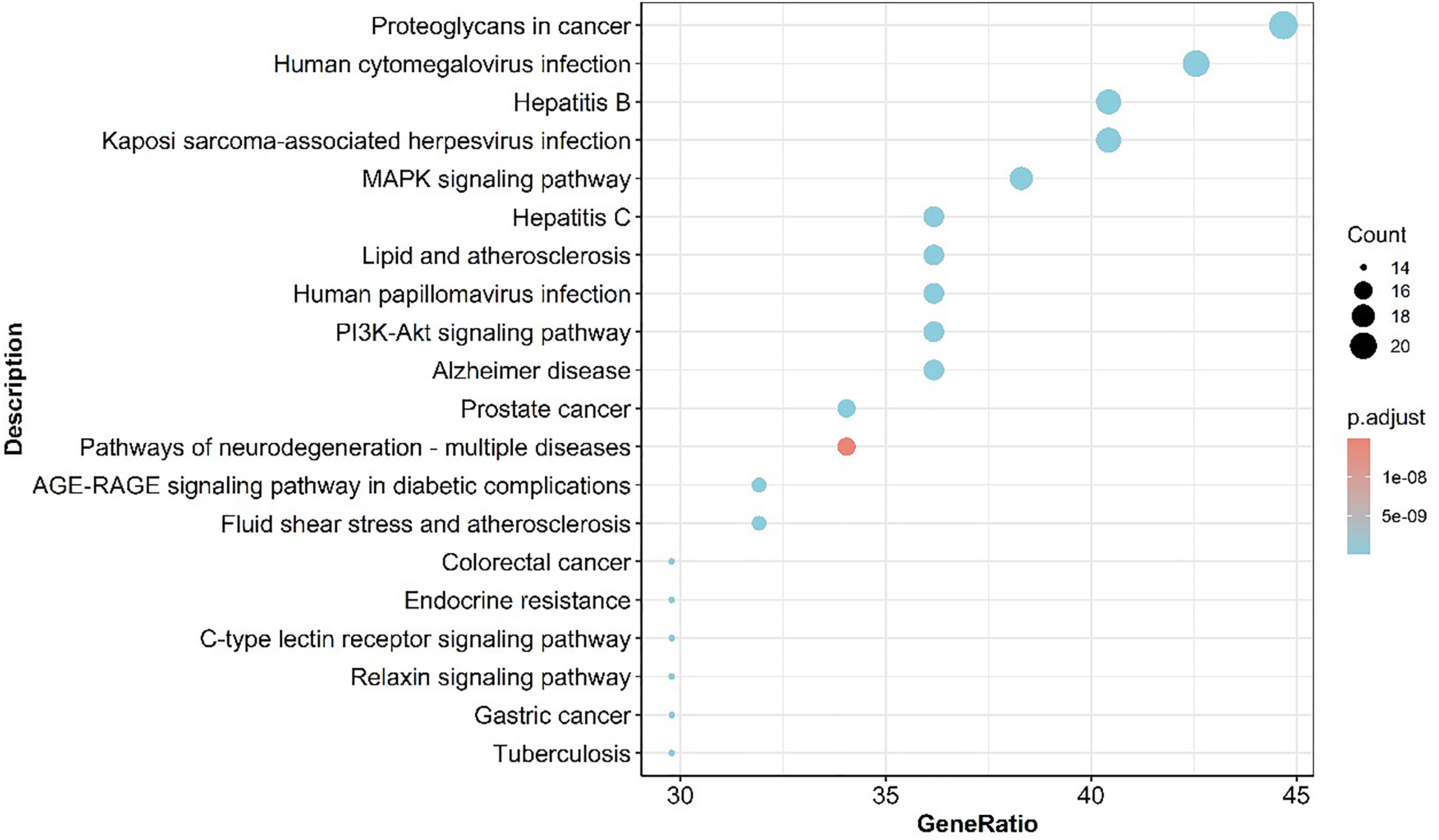
Results of the top 20 Kyoto Encyclopedia of Genes and Genomes (KEGG) pathways.
Rhubarb-Disease-Target-Pathway Network
The rhubarb-target-pathway network consisted of 229 nodes (Figure 5). The nodes represent the different drugs, active compounds, targets, diseases, pathways, and targets. More specifically, 1 drug (yellow V shape), 12 compounds, 195 targets (blue square), 1 gray square, and 20 KEGG pathways (green diamond) were identified. The relationship between nodes indicates their importance.

Potential disease-target-pathway network of rhubarb. (The yellow V shape, red circles, blue square, gray square, and green diamond denote the drug, compounds, targets, diseases, and KEGG pathways, respectively.).
Results of Molecular Docking
Table 4 details hub genes that were docked with eupatin, β-sitosterol, rhein, and (-)-catechin using AutoDockTools 1.5.7. In order to further screen bioactive components of rhubarb that affect CIS, the affinity of the top 5 core target proteins, namely AKT1 (1UNQ), TNF (2AZ5), VEGFA (1MMK), TP53 (1YC5), and IL-1B (5R85), with 4 potential bioactive components were investigated.
Optimal Docking of Potential Bioactive Components with the top 5 Hub Targets.

As delineated in Figure 6, all 4 potential bioactive components were stably bound to the first 5 targets and strongly bound to AKT1. Hence, the binding energy between eupatin, β-sitosterol, rhein, and (-)-catechin with AKT1 were examined. Eupatin was bound to the TYR-26, LYS-39, and GLU-40 binding sites of AKT1. At the same time, β-sitosterol was bound to the TYR-26, LYS-39, GLU-40, and ARG-48 binding sites of AKT1. Rhein was bound to the GLU-98, GLU-95, GLU-91, and LYS-8 binding sites of AKT1. Finally, (-)-catechin was bound to the GLU-40, LYS-39, TRY-26, and LYS-30 binding sites of AKT1.

Schematic representation of the binding site of eupatin (A), β-sitosterol (B), rhein (C), and (-)-catechin (D), with the core target protein AKT1. The yellow sticks represent small molecules.
Identification of the Constitents in Rhubarb by UPLC/Q-TOF-MS
Figure 7 exhibits the total ion chromatogram derived from the analysis of rhubarb extract using UPLC/Q-TOF-MS. A total of 10 compounds, namely (-)-catechin (peak 2), rhein (peak 7), and aloe-emodin (peak 8), were successfully identified and are listed in Table 1.

Chromatogram: The total ion chromatogram obtained in the negative modes. Note: (1) gallic acid-3-O-(6ʹ-O-galloyl)-glucoside; (2) (-)-catechin; (3) torachrysone-8-O-beta-D-(6ʹ-oxayl)-glucoside; (4) procyanidin B-5,3ʹ-O-gallate; (5) emodin-1-O-beta-D-glucopyranoside; (6) toralactone; (7) rhein; (8) physciondiglucoside; (9) aloe-emodin; (10) palmidin A.
Assessment of the CIS Model
The neurological function scores in the model group were significantly elevated compared with the sham group on days 3 and 7 (P <0 .01). However, rhubarb treatment significantly lowered the neurological function scores when compared to the model group (P <0 .05, P <0 .01) (Figure 8A).
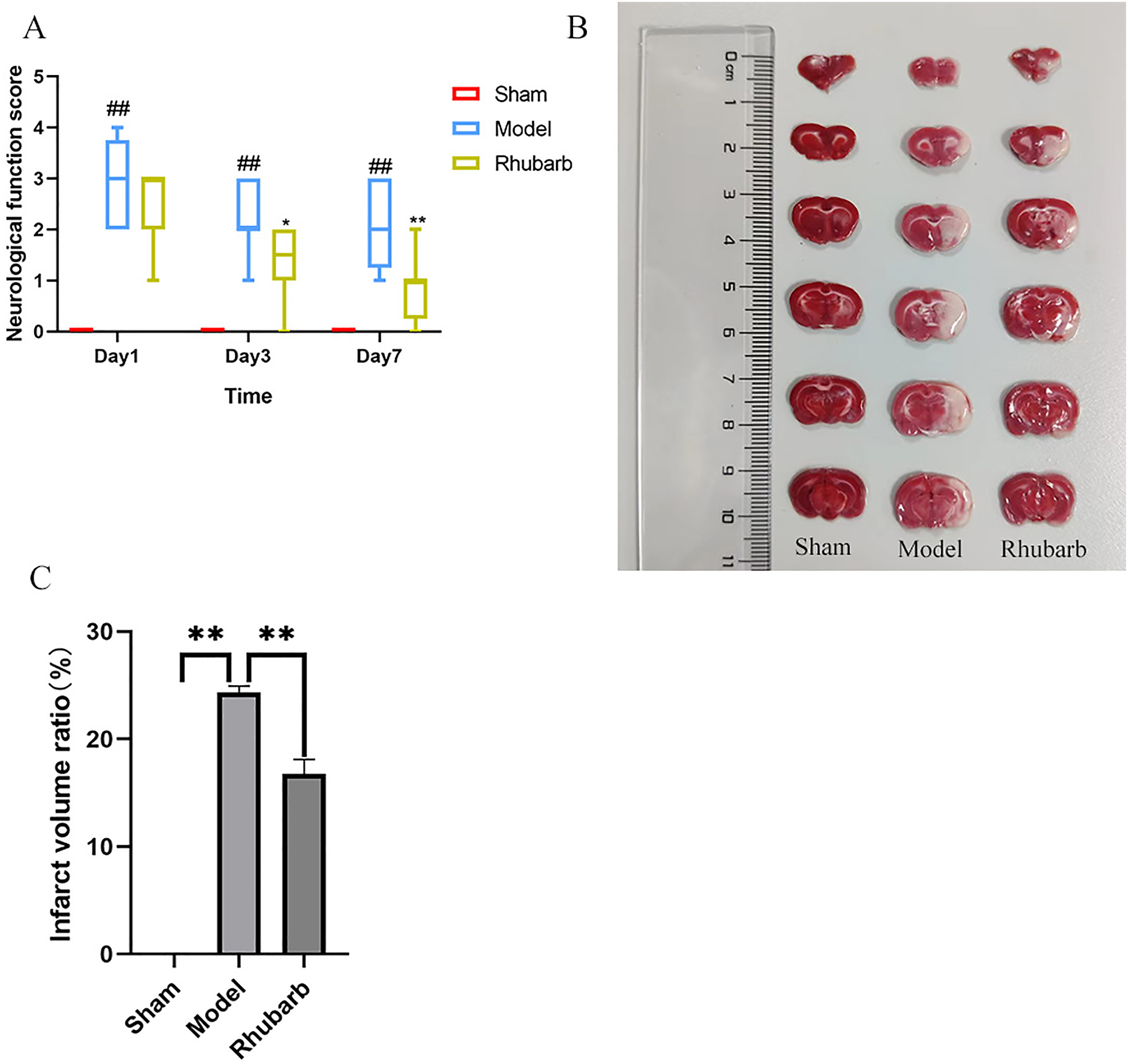
The neurological deficit scores in each group on 1, 3, and 7 days (A) (n = 12). TTC staining (B) and infarct volume ratio (C) (n = 3). Values are expressed as means ± SEM. *P < 0.05, **P < 0.01.
As shown in Figure 8B, the red color following TTC staining represents healthy brain tissue, whereas the white color indicates infarcted areas. As anticipated, the infarct volume in the model group was significantly increased than that in the sham group (P < 0.01). In addition, the infarct volume in the rhubarb group was significantly lower than that in the model group (P < 0.01) (Figure 8C).
Effects of Antioxidant Index and Inflammatory Factor
As shown in Figure 9, the levels of MDA, LDH, TNF-α, and IL-1β in the model group were significantly higher than that in the sham group; These indexes in the rhubarb group were significantly lower than that in the model group (P < 0.01). Conversely, the SOD level in the model group was significantly decreased compared to the sham group; Similarly, the SOD level in the rhubarb group was significantly increased compared to the model group (P < 0.01).

MDA content (A), SOD and LDH activity (B, C), TNF-α and IL-1β levels (D, E). Values are expressed as means ± SEM. *P < 0.05, **P < 0.01 (n = 6).
Expression of Pathway Proteins
The expression levels of the PI3K and Akt1 proteins were comparable in the 3 groups (Figures 10A-C, E). Furthermore, the expression levels of p-PI3K and p-Akt1 (Figure 10A, B, D, F) in the model group were significantly downregulated in the model group, whereas they were significantly upregulated in the rhubarb group (P < 0.01). Besides, the levels of phosphorylation of PI3K and Akt1 in the sham group were significantly higher compared to the model group (Figure 10G, H). Similarly, PI3K and Akt1 phosphorylation levels in the rhubarb group were significantly higher than in the model group (P < 0.01).
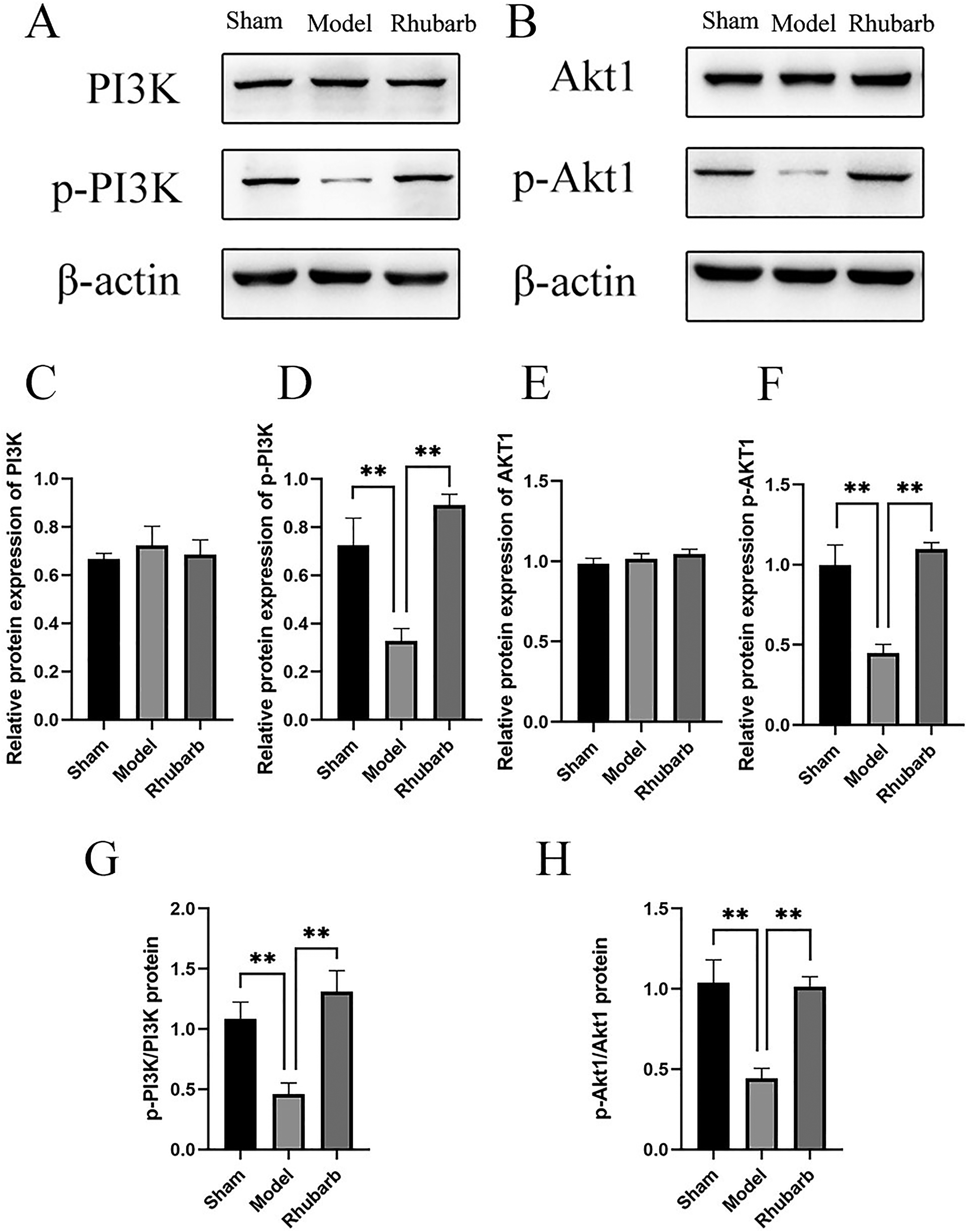
Representative western blot images of proteins (A, B) and levels of PI3K (C), p-PI3K (D), Akt1 (E) and p-Akt1 (F). PI3K (G) and Akt1 (H) phosphorylation level. Values are expressed as means ± SEM. *P < 0.05, **P < 0.01 (n = 3).
Discussion
Herein, OB and DL were used to identify 12 potential compounds. The results exposed that rhubarb regulates 195 targets linked to CIS, including AKT1, TNF, VEGFA, TP53, IL1B, etc These targets were enriched in proteoglycans, in addition to cancer, the MAPK pathway, the PI3K/Akt pathway, and Alzheimer's disease. Moreover, these pathways were mainly involved in antioxidative stress, antiapoptotic, anti-inflammatory,33-35 and pathological processes. In addition, some physiological processes were related to the pathological process of CIS. 8 Concerning molecular docking, 5 hub genes were selected based on their availability value. The results implied that eupatin, β-sitosterol, rhein, and (-)-catechin may effectively interact with the 5 targets (AKT1, TNF, VEGFA, TP53, and IL1B). Then, the results of the KEGG analysis were compared with those of molecular docking, and the PI3K-Akt signaling pathway was selected for further experiments.
Recent studies insinuated that the PI3K-Akt signaling pathway may be closely connected to cerebral ischemia-reperfusion injury and rehabilitation. Moreover, earlier studies have demonstrated that the PI3K/Akt pathway plays an instrumental role in cell survival and proliferation. PI3K/Akt is upregulated in the central nervous system, which contributes to nerve cell safety and alleviates cell death.36,37 After cerebral ischemia-reperfusion injury, activated Akt plays a vital role in neuronal survival. In MCAO model rats, overexpression of Akt1 reduced infarct size by 35% after cerebral ischemia, according to Ohba et al. 38 Likewise, another study claimed that overexpression of Akt1 can reduce the volume of infarcted brain tissue by up to 50%. 39
Mitochondria play a decisive role as a key mediator of neuronal apoptosis. 40 Cell death results from PI3K/Akt phosphorylation, which increases mitochondrial transcription factors and cytochrome c oxidase. 41
A study published by Xian 19 inferred that aloe-emodin and rhubarb inhibit cerebral ischemia-reperfusion injury through the PI3K/AKT/mTOR and NF-KB signaling pathways.
After a stroke, inflammatory cytokines play a key role in the inflammatory cascade and neuronal injury. 42 What's more, LDH may penetrate mammalian mitochondria. 43 As an essential antioxidant enzyme against oxidative stress, mitochondrial SOD influences the mitochondrial respiratory chain.44,45 Additionally, LDH, SOD, and MDA are associated with cell damage, and SOD and MDA are also biomarkers of oxidative stress. 46 In the current study, mice in the model group had significantly higher levels of LDH and MDA than those in the sham group. After the administration of rhubarb, the levels of LDH and MDA were significantly decreased. Interestingly, SOD activity was decreased in the model group compared with the sham group but increased after rhubarb administration, signifying that rhubarb administration can protect against mitochondrial damage in proliferating cells.
Conclusion
Our study explored the mechanism of action of rhubarb in the treatment of CIS in a systematic and comprehensive manner. In total, 47 hub genes and related biological functions of rhubarb, as well as twenty major KEGG pathways, were investigated via network pharmacology. Furthermore, 20 potential targets of rhubarb were identified via molecular docking analysis. Rhubarb was found to significantly decrease cerebral infarction volume, MDA content, and LDH activity and enhance neural function and SOD activity. Western blot demonstrated that 4 rhubarb-related proteins (PI3K, p-PI3K, Akt1, and p-Akt1) participated in the PI3K/Akt signaling pathway. In addition to providing a reference for anti-CIS drugs, these results provide new insights into the molecular mechanism of rhubarb. One potential constraint of this study lies in its exclusive focus on the analysis of the PI3K/Akt signaling pathway. To obtain a comprehensive understanding of the potential of rhubarb in enhancing CIS, it is imperative to undertake further investigations that explore multiple signaling pathways associated with network pharmacology in predicting CIS.
Supplemental Material
sj-docx-1-npx-10.1177_1934578X231215247 - Supplemental material for Investigating the Protective Effects of Rhubarb on Cerebral Ischemic Stroke Rats Using Network Pharmacology and Molecular Docking
Supplemental material, sj-docx-1-npx-10.1177_1934578X231215247 for Investigating the Protective Effects of Rhubarb on Cerebral Ischemic Stroke Rats Using Network Pharmacology and Molecular Docking by Yuhua Liang, Mingjiang Mao, Xingqin Cao and Ying Guo in Natural Product Communications
Footnotes
Author Contributions
YH and YG contributed to the project design. YH and MJ performed the experiments. YH and XQ contributed to the literature review and data analysis. YY and YG contributed to the article writing. All authors read and approved the final manuscript.
Declaration of Conflicting Interests
The author(s) declared no potential conflicts of interest with respect to the research, authorship, and/or publication of this article.
Ethics Statement
The animal study was reviewed and approved by the Institutional Animal Care and Use Committee of the Laboratory Animal Research Center of Zhejiang Chinese Medical University.
Ethical Approval
This study was approved by the Administrator Committee of Experiment Animals, Zhejiang Province, China.
Funding
The author(s) disclosed receipt of the following financial support for the research, authorship, and/or publication of this article: This work was supported by the Zhejiang Provincial Traditional Chinese Medicine Science Research Fund Project, Scientific research cultivation project of College of Life Sciences of Zhejiang Chinese Medical University, Zhejiang Provincial Natural Science Foundation of China, (grant numbers 2020ZB064, 2022BJ002, LY16H280007).
Statement of Human and Animal Rights
All of the experimental procedures involving animals were conducted in accordance with the Instututional Animal Care guidelines of Zhejiang Chinese Medical University, China and approved by the Administrator Committee of Experiment Animals, Zhejiang Province, China.
Statement of Informed Consent
There are no human subjects in this article and informed consent is not applicable.

Supplemental Material
Supplemental material for this article is available online.
References
Supplementary Material
Please find the following supplemental material available below.
For Open Access articles published under a Creative Commons License, all supplemental material carries the same license as the article it is associated with.
For non-Open Access articles published, all supplemental material carries a non-exclusive license, and permission requests for re-use of supplemental material or any part of supplemental material shall be sent directly to the copyright owner as specified in the copyright notice associated with the article.
