



Abstract
Keywords
Introduction
Chronic glomerulonephritis (CGN) is a common progressive chronic kidney disease with various etiologies, mostly related to immune inflammation. Its clinical manifestations are diverse, mainly proteinuria, hematuria, and edema, accompanied by varying degrees of renal fibrosis damage. 1 CGN progresses slowly, and some patients eventually develop end-stage renal disease, involving multiple system functions of the body. 2
Angiotensin transferase inhibitors and other medications are mostly used in clinical settings by western medicine to address patients’ early symptoms and avoid problems. According to Traditional Chinese Medicine (TCM), CGN belongs to edema disease, in which deficiency of both spleen and kidney is the key factor. There are many researches on the treatment of edema by TCM prescription. Clearing heat and reducing turbidity, benefiting Qi for activating blood circulation, warming spleen and tonifying kidney are effective methods in the treatment of CGN. In their investigation, Lu 3 et al found that the medication law of TCM compound in the treatment of CGN is mainly to strengthen the spleen and kidney, warm Yang and remove Qi (Yang and Qi are TCM terms), and mainly to promote blood circulation for removing obstruction in collaterals.
Taohong Siwu Decoction (THSWD) is well known for promoting blood circulation for removing blood stasis. It is mainly composed of 6 TCMs, such as ripe rehmannia glutinosa, white paeony root, angelica sinensis, ligusticum chuanxiong, peach kernel, and safflower. It is widely used in clinic, mostly for gynecological diseases such as primary dysmenorrhea, which has the function of dilating blood vessels, anti-inflammatory, regulating immune function and so on. According to Zhang et al, 4 the anti-inflammatory and immunomodulatory effects of THSWD could reduce renal inflammation, decrease glomerular capillary permeability, and dilate blood vessels, thus improving glomerular blood flow and alleviating renal burden. THSWD in TCM clinical treatment of CGN well curative effects,5–7 but its mechanism of action in the treatment of CGN is not clear. Therefore, this article constructs a network based on citing network pharmacology to explore the mechanism of action of THSWD in the treatment of CGN, with a view to finding the effective components of clinical prevention and treatment of CGN through research, and providing new research methods and therapeutic ideas for the treatment of CGN.
Materials and Methods
The Workflow of This Research
In this work, in order to reveal the potential mechanism of THSWD in treating CGN, we collected active ingredient targets in THSWD and targets of CGN from various databases, and used network pharmacology, molecular docking technology. The workflow of this research is shown in Figure 1.

The workflow of this study.
Screening of Active Components and Related Targets in THSWD
According to the 6 TCM names of THSWD, we downloaded the active ingredients and related targets of each TCM ingredient in THSWD from the Traditional Chinese Medicine Database and Analysis Platform (TCMSP, https://tcmspw.com/tcmsp.php). 8 In order to obtain the active ingredients of TCM and their protein targets, the absorption, distribution, metabolism, excretion (ADME) properties of the 2 drugs were as follows: For oral availability (OB) ≥ 30% and druglikeness (DL) ≥ 0.18, preliminary screening of drug components was performed. Subsequently, common targets of unpredicted active ingredients were supplemented through literature search. After obtaining the targets, we loaded the targets into a protein database called UniProt (https://www.uniprot.org) to normalize the expression of the protein targets.
Construction of Drug-Component-Target Network Diagram of THSWD
The drug-component-target network diagram of THSWD was constructed with Cytoscape version 3.8.2 software, and the network parameters for active ingredients and targets were obtained using Cytoscape version 3.8.2 software. Through degree value, closenesss value, and betweenness value, the article analyzes the core target of THSWD and which active ingredients play the efficacy from multiple dimensions such as connectedness, compactness, and mediality.
Screening of Disease-Related Targets for CGN
The keywords of CGN were identified as “chronic glomerulonephritis”, “chronic glomeruli nephritis”, “chronic nephritic syndrome”, and “chronic glomerular nephritis” using the English-Chinese medical classification dictionary and various literature resources. We took advantage of GeneCards database (https://www.genecards.org) to find the potential targets of CGN and reapplied DRUGBANK database (https://www.drugbank.ca) to mine for clinical commonly used drug targets for treatment of CGN complement. 9 The score value in the GeneCards database reflects the relationship between disease and target genes, and higher the score value, closer the relationship.
Protein–Protein Interaction (PPI) Network Construction of Drug Components-Disease Targets
In order to understand the interaction between the drug target of THSWD and the targets of CGN, we first de-weight the data in each database and then combined them with the drug target to draw a Venn diagram using the Venn software package in R language. Then, the combined targets of THSWD and CGN were imported into STRING version 11.5 database (https://string-db.org) to construct a PPI network model, 10 in which we changed the species to “Homo sapiens”, the minimum interaction threshold to > 0.9, and other settings are default settings to obtain the PPI network. The PPI network is thoroughly examined using Cytoscape version 3.8.2's built-in plug-in MCODE to identify probable protein functional modules. It is easy to find the biological process (BP) in which each module participates so that its function can be determined. 11
KEGG Pathway and GO Function Enrichment Analyses
Enrichment analysis is a method used to analyze the expression information of gene targets. 12 Enrichment refers to the classification of gene targets according to prior knowledge, such as genome annotation information. After the classification of gene targets, it is not difficult to judge whether the gene targets we find have a certain commonality. We applied R3.6.3 to call clusterProfiler R package to perform enrichment analysis of the kyoto encyclopedia of genes and genomes (KEGG) pathway and gene ontology (GO) function of THSWD in treating CGN.
Results
Extraction of Active Components and Related Targets of Various TCMs from THSWD
The main active ingredients of 6 Chinese herbs extracted from the TCMSP database were selected by ADME and target corresponding screening, and a total of 51 active ingredients were obtained, including 15 active ingredients of safflower, 19 active ingredients of peach kernel, 2 active ingredients of ripe rehmannia glutinosa, 6 active ingredients of ligusticum chuanxiong, 8 active ingredients of paeonia lactiflora, and 1 active ingredient of angelica sinensis, including stigmasterol, kaempferol, sitosterol, baicalin, lignan, hydroxykaempferol, etc. As shown in Table 1. There were 193 targets of safflower, 43 targets of peach kernel, 27 targets of rehmannia glutinosa, 25 targets of Ligusticum chuanxiong, 82 targets of radix paeoniae alba, and 33 targets of Angelica sinensis. A total of 205 targets were obtained by deleting the repeated values after merging.
The Ingredients of Taohong Siwu Decoction (THSWD).

Construction of Drug-Component-Target Network Diagram of THSWD
Cytoacape version 3.8.2 software was used to construct a drug-component-target network diagram for THSWD, as shown in Figure 2. Using the built-in Network Analyzer of Cytoscape version 3.8.2 software to draw a relational network diagram, we can see that there are 256 nodes and 566 edges in Figure 2. Squares represent drugs. Circles represent the composition of the drug. Regular hexagon represent the common components of drugs, where larger the letter, more corresponding targets of the components. Diamond represent the target, the darker the color, the more important the drug target. Analysis of the topological parameters of the drug component target network of THSWD then showed that the core component was A(β-sitosterol), B(stigmatosterol), C(kaempferol), and D(sitosterol) and relatively important targets are PTGS2, NCOA2,, PTGS1 GABRA1, PGR, PIK3CG, NR3C2, etc.
Acquisition of Disease-Related Targets in CGN
A total of 1736 targets related to CGN were obtained from GeneCards database. GeneCards is a nonprofit organization that has created a comprehensive bioinformatics database providing manually annotated, predictable details of all genes and automatically integrating data from approximately 150 genetic centers, including genomics, transcriptomics, and proteomics, genetic clinical, and functional information. 13
Construction of Drug Component-Disease Target PPI Network
The intersection of the active ingredient targets of THSWD and the disease targets of CGN was selected. The intersection targets were imported into the R language to draw Venn diagram to obtain 104 common targets for THSWD and CGN, as shown in Figure 3A. The PPI network of the THSWD targets is then obtained once the targets are submitted to the STRING version 11.0 platform, as illustrated in Figure 3B. This is a network composed consisting of subsets of proteins in which proteins physically interact physically with one or more proteins. 14 Figure 3 shows a total of 104 targets and 827 protein interaction edges. The color of the associated target is darker and the circle is larger with a higher degree value. For instance, the circle of tumor necrosis factor (TNF) target genes is the biggest and its color is the deepest. From the figure, we can see that the main targets of THSWD in the treatment of CGN are TNF, JUN, IL6, AKT1, MAPK14, etc.

Drug-component-target network diagram of Taohong Siwu Decoction (THSWD).

Venn diagram and protein–protein interaction (PPI) network diagram of intersection target gene. (A) Venn diagram and (B) PPI network diagram.
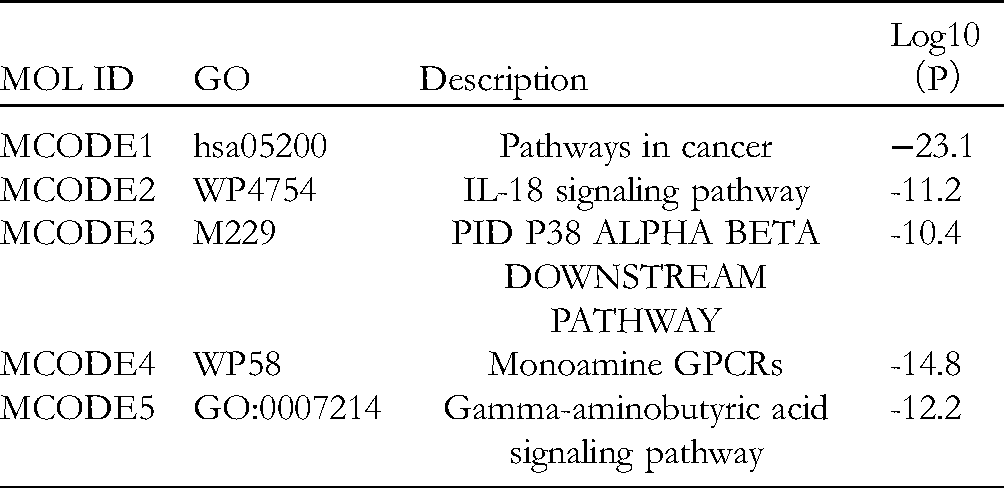
Module is some areas with high density in PPI network and the network in Module is the potential sub-network of the PPI complex network. Despite having few connected areas, these networks have a high connection density. Due to their high density, all modules are considered to be biologically significant collections. Such assemblies have two meanings: protein complexes, where multiple proteins form a complex and then exert a biological effect and one is functional modules, which, are like proteins in a pathway that interact more closely with each other. 15 Therefore, in order to more accurately analyze the mechanism of THSWD in the treatment of CGN, it is particularly necessary to have a comprehensive understanding of this Module after drawing the PPI network of THSWD. The built-in molecular complex detection technique was invoked after the PPI network was constructed with the aid of the MCODE plug-in in Cytoscape version 3.8.2 software, in order to identify the complex network and analyze the protein interaction and obtain module. There are 5 modules in Figure 4. In order to describe the function of BP, we retained the best scoring items in the modules based on their P value, as shown in Table 2. Excluding the pathways in cancer in MCODE 1, we can obtain that THSWD in the treatment of CGN which mainly acts on IL-18 signaling pathway, PID P38 Alpha Beta Downstream pathway, monoamine GA -protein-coupled receptors (GPCRs), and gamma-aminobutyric acid signaling pathway.

Module in protein–protein interaction (PPI) network of target.
Protein–Protein Interaction (PPI) Network Function Description of the Target.
Enrichment Analysis of Gene Target Function and Pathway
Enrichment Analysis of KEGG Pathway
A Total of 25 signal pathways were found after using the R language to analyze the function of 104 genes related to the possible targets of THSWD in the treatment of CGN. Following the exclusion of cancer-related pathways, it mainly involves IL-17 signaling pathway, TNF signaling pathway, AGE-RAGE signaling pathway in diabetic complications pathway, fluid shear stress and atherosclerosis, Hepatitis B, lipid and atherosclerosis, and so on, as shown in Figure 5.

Bubble map of KEGG pathway analysis for potential targets.
Enrichment Analysis of GO Pathway
Enrichment analysis refers to a statistical number or limited acyclic graph at the functional level of a particular protein or gene, including 3branches: Biological Process (BP), molecular function (MF), and cellular component (CC). 16 In this experiment, R3.6.3, the clusterProfiler R package was used to investigate the role of 104 potential targets in gene function of THSWD in the treatment of CGN. Among them, the 10 items with the highest enrichment degree related to BP, as shown in Figure 6A, are mainly related to the response to lipopolysaccharide, in response to molecule of bacterial drigin, cellular response to drug, response to steroid, and so on. The 10 items with the highest enrichment degree related to MF, as shown in Figure 6C, mainly involved peptide binding, amide binding, neurotransmitter receptor activity, oxidoreductase activity, and acting on paired donors, with incorporation or reduction of molecular oxygen, G protein-coupled amine receptor activity, etc. The 10 items with the highest concentration related to CC, as shown in Figure 6B, mainly involved membrane raft, membrane microdomain, membrane region, intrinsic component of postsynaptic membrane, etc. Figure 6 shows more thorough pathways.

GO enrichment analysis bubble plots of potential targets: (A) BP, (B) CC, and (C) MF.
Molecular Docking Validation of Active Ingredients and Core Target
We verified the molecular docking between the core components of THSWD and the key proteins with a degree value > 40 in the PPI network of the drug disease targets through AutoDock Vina software and visually displayed the optimal configuration of the key components and the interaction between the core targets. The docking results are shown in Table 3. The lowest binding energy between drug component macromolecular protein and disease target protein is < 0, which indicates that both ligand and receptor can spontaneously bind without external force.
Docking of Main Compounds With Main Targets.

If the binding energy of molecular docking is < − 5 kcal/mol, the binding is likely to be reasonably stable. The docking binding energies of TNF protein and kaempferol β-sitosterol, and sitosterol are < − 5 kcal/mol, − 6.58, − 5.57, and − 5.1kcal/mol, respectively. The docking binding energies of AKT1 protein and kaempferol, β-sitosterol, and quercetin are < − 5 kcal/mol, − 6.93, − 5.92, and − 9.03 kcal/mol, respectively. The docking binding energies of MAPK14 protein and kaempferol, β-sitosterol, and quercetin are < − 5 kcal/mol, − 7.25, − 11.24, and − 8.4 kcal/mol, respectively. The binding energy between IL-6 protein and kaempferol is − 5.52 kcal/mol. The binding between the main active ingredients and the core target is consistent with the prediction of network pharmacology. As shown in Figure 7A, kaempferol is hydrogen bonded to ILE-136 residue of TNF. As shown in Figure 7D, kaempferol is hydrogen bonded to ARG-30 residue, LYS-27 residue, and ASP residue of IL-6. As shown in Figure 7K, sitosterol is hydrogen bonded to VAL-349 residue of MAPK14. Other docking details are shown in Figures 7B, C and E to J. The major active components of THSWD have a high affinity for the central target of CGN, which raises the possibility that THSWD may regulate these associated targets therapeutically.

Docking of main compounds with main targets. (A)TNF and kaempferol,(B) TNF and sitosterol,(C) TNF and quercetin,(D) IL6 and kaempferol,(E) IL6 and quercetin,(F) AKT1 and kaempferol,(G) AKT1 and sitosterol,(H) AKT1 and quercetin,(I) MAPK14 and kaempferol,(J) MAPK14 and beta-sitosterol,(K) MAPK14 and sitosterol,and (L) MAPK14 and quercetin.
Discussion
Chinese medicine compounding is characterised by multicomponent, multi-target and multichannel pharmacological effects, which makes it suitable for network pharmacology analysis. Network pharmacology is an analytical approach based on database retrieval data analysis and virtual computing. It uses mathematical models to display on a computer the relationship between active ingredients and target-related pathways and diseases. Prediction results are usually validated by the literature or animal studies. Compared to traditional pharmacological research methods, network pharmacology has the advantages of being efficient, high-throughput, and resource-saving.17,18
In the present study, we constructed a drug-component-target network diagram of THSWD, which showed that THSWD had 51 active ingredients and 104 genes that were associated with CGN. Its primary components, which are frequently used in the quality testing of THSWD, 19 are β-sitosterol, kaempferol, sitosterol, quercetin, etc. According to Liao 20 et al, β-sitosterol has anti-inflammatory properties because it prevents NLRP3 from becoming activated in macrophages and epidermal cells, which lowers the production of IL6 and IL8. Basic research21–24 has demonstrated that kaempferol has biological functions such as antioxidant, anti-tumor, anti-infection, and others. Kaempferol is one of the main bioactive components of safflower and paeonia lactiflora, and has a variety of physiological activities. The anti-inflammatory effect of kaempferol is mainly through inhibiting the expression of inflammatory factors. 25 Kaempferol can repair mesangial cells and improve renal injury and fibrosis.26,27 Studies28–30 have also shown that quercetin can resist inflammation and oxidative stress by inhibiting TNF, IL6, and MAPK14, thereby reducing kidney damage.
We retrieved THSWD and CGN targets gene from multiple databases and combined them to obtain 104 THSWD targets gene for CGN. Then, we constructed a PPI network and screening module, which can determine that the genes encoding TNF, IL6, AKT1, and MAPK14 are the key targets. CGN is a primary glomerular disease caused by diffuse inflammation or limited glomerular fibrosis. Glomerulonephritis is usually classified as idiopathic or secondary to systemic lupus erythematosus, toxins, other infections or malignant tumors. 31 Patients with CGN had greater levels of TNF and IL6 than those in the normal group. One important immune system regulator, TNF, has been linked in some research to the development of autoantibodies, lupus-like illness, and globular nephritis in some people. TNF is a cytokine that mediates inflammatory kidney diseases, such as immune complex glomerulonephritis produced by macrophages and renal mesangial and tubular epithelial cells. 32 Müller et al 33 found that TNF is an important factor in causing nephropathic changes, which is characterized by increased renal cell death and loss of glomerular endothelial cells. Meanwhile, TNF-α can induce tubular epithelial cell transformation and aggravate renal interstitial fibrosis in glomerulonephritis. A cytokine called IL-6 plays a role in controlling inflammatory and immunological reactions. Batal et al 34 explored and found that the high levels of IL-6 secreted by peripheral blood monocytes in patients with glomerular disease accelerated the progression of glomerulonephritis. Numerous investigations have shown that AKT1, a protein kinase involved in cell death, has a function in CGN. According to Lin 35 et al, AKT1 is involved in tubular apoptosis and inflammatory response during renal ischemia-reperfusion injury, and tubular mitochondrial AKT1 is activated during ischemia-reperfusion injury and plays a key role in susceptibility to chronic kidney disease. In CGN, the MAPK cascade is crucial for controlling a variety of cell activities. 36 Both acute and long-term inflammatory responses are thought to be primarily regulated by MAPK.37, 38
In addition, we screened the modules in the PPI network and described their functions. Our results show that the functions of these modules are related to the binding of GPCRs to cell surface receptors and signaling pathways associated with immune response. Previous studies have suggested that the IL-18 signaling pathway plays a role in chronic inflammatory and autoimmune diseases, while chronic globular adrenal disease is an inflammatory disease based on the activation of immune cells, and the kidney is more affected by the manifestations of autoimmune processes.
We carried out enrichment analysis with 104 intersecting genes, among which KEGG results showed that the top 10 pathways were mostly related to immune function, and the pathways related to autoimmunity infection and inflammatory response were age-rage signaling pathway, TNF signaling pathway and IL-17 signaling pathway. Meanwhile, KEGG results showed that THSWD was also enriched in the pathways related to cancer and cardiovascular and cerebrovascular diseases, suggesting that THSWD may also have potential therapeutic roles in other related diseases. From the perspective of cell components, effects on the targets are mainly related to the membrane, and closely linked to the biological structure of the glomerulus, mainly focusing on the presynaptic membrane, postsynaptic membrane and plasma membrane. In terms of MF, the target enrichment pathways are peptide binding, amide binding, neurotransmitter receptor activity, oxidoreductase activity, acting on paired donors, with incorporation or reduction of molecular oxygen, G protein-coupled amine receptor activity, etc. PCR is a membrane-bound receptor involved in signal transmission, which is closely related to the immune system. Chemokine receptors such as interleukin receptor and histamine receptor also belong to the GPCR family. Interleukin, especially IL-6, is one of the key targets of THSWD in the treatment of CGN.
Finally, we used molecular docking to verify the docking of disease target proteins and small molecules of drug active ingredients. From the docking results, it is not difficult to see that the minimum binding energy between small molecules of drug components and disease target proteins is <0, which indicates that both ligands and receptors can spontaneously bind without external force. Among them, the docking binding energy of 10 pairs is < − 5 kcal/mol, the binding was relatively stable, with the drug components connected to the disease target genes by hydrogen bonding. In addition, the binding energy of AKT1 and quercetin, MAPK14 and kaempferol, MAPK14 and β-sitosterol, and MAPK14 and quercetin are > − 7 kcal/mol, which are considered to be very stable.
Conclusion
According to network pharmacology, the molecular mechanism of THSWD in the treatment of CGN is that β-sitosterol, kaempferol, quercetin, and key targets like TNF, IL-6, AKT1 protein kinase, and MAPK14 protein kinase play a cooperative role in the pathway related to autoimmune infection and inflammatory response. The molecular mechanism of THSWD is to regulate different targets and thus interfere with different signaling pathways and BPs. Network pharmacology, on the other hand, is based on bioinformatics and massive amounts of data calculation. The basis of the TCM compound is not a simple add and chemical composition, rather, the messy process of TCM compound formula and processing determines the particularity of compound Chinese medicine. This calls for additional testing and animal studies to determine the primary targets of THSWD in treating CGN.
Footnotes
Acknowledgements
This study was supported by National Key Clinical Specialty Construction Project (Clinical Pharmacy) and High-Level Clinical Key Specialty (Clinical Pharmacy) in Guangdong Province. The results of this study are based on the data from TCMSP (https://tcmsp-e.com/) and GeneCards ( ). We thank the authors who provided the data for this study.
Author’s Contribution
All authors contributed to study conception and design, analysis of data, and visualization of results. The manuscript was written by GX Du, XH Qu, J Hu, YZ Zhang. YM Cai is responsible for revising the manuscript. All authors read and approved the final manuscript.
Availability of Data and Materials
Declaration of Conflicting Interests
The author(s) declared no potential conflicts of interest with respect to the research, authorship, and/or publication of this article.
Funding
The author(s) disclosed receipt of the following financial support for the research, authorship, and/or publication of this article: The project is sponsored by SRF for ROCS, SEM, and supported by the Project of Chinese Ministry of Education (grant number 2017A11001), Research on Prediction Trend of Population Infected with COVID-19 Based on Big Data (grant number 2020KZDZX1126), and Natural Science Foundation of Guangdong Province (grant number 2020A1515010783).