



Abstract
Juechuang, a traditional Chinese herbal medicine, is originated from Rostellularia procumbens (L.) Nees. Many studies have shown that the ethyl acetate extract from Juechaung may inhibit platelet aggregation. However, the antiplatelet aggregation mechanism of Juechuang requires more systematic research. In this article, network pharmacology was used to explore the antiplatelet aggregation components and its antiplatelet aggregation mechanism. Different components were evaluated and screened by pharmacokinetic characteristics. The potential targets of active ingredients were predicted by a reverse pharmacophore matching method, and the targets were screened according to targets related to antiplatelet aggregation in the GeneCards database. Thus, an interaction network of component-target-pathway of Juechuang was generated using Cytoscape 3.2.1. software. Furthermore, the binding energy of relevant active components with key targets was calculated using a Lamarck genetic algorithm in the molecular docking calculations. Finally, the study identified 28 potentially active ingredients in Juechuang, providing further evidence that the active ingredients act on 277 targets, and 38 protein targets related to antiplatelet aggregation were screened. Through the Kyoto encyclopedia of genes and genome pathway enrichment analysis, we found that the mechanism of antiplatelet aggregation may be related to the Ras signaling pathway, platelet activation signaling pathway, mitogen-activated protein kinase (MAPK) signaling pathway, etc. Via molecular docking of 2 targets, non-receptor tyrosine kinases(SRC) and MAPK were selected for molecular docking. By comparing the molecular docking results of Chinensinaphthol, Taiwanin E, Tuberculatin, Cycloeucalenol, and Justicidin B to the control drug, we found that those test molecules combined with targets and lead to high binding activity. These molecular docking results were also consistent with the literature values, and they helped identify the active ingredients and assured the reliability of the network analysis. This study may further provide a reference for the systematic study of the pharmacodynamic effect and the antiplatelet aggregation mechanism of Juechuang.
Juechuang stems from Rostellularia procumbens (L.) Nees has been included in the 1977 edition of the pharmacopeia of the People’s Republic of China. It is widely distributed in China’s southwest provinces, Taiwan, and Southeast Asia. Domestic and foreign research groups have systematically studied the chemical composition of Juechuang. In recent years various compounds, such as lignans, triterpenoids, and other compounds, have been isolated. 1 -3
Many research groups have indicated that Juechuang possesses antifungal, cytotoxic, anti-inflammatory, antipyretic, hepatoprotective, immunomodulatory, antiplatelet aggregation, and antiviral activities. 4 In 1996, Chen et al, 1 conducted antiplatelet aggregation experiments and identified 4 lignan compounds in Juechuang. The 4 lignan compounds significantly inhibited platelet aggregation compared with aspirin. This study also indicated that Juechuang could serve as an excellent antiplatelet aggregation drug. Meanwhile, Yan-Fang Yang 5 found that the ethyl acetate extract of Juechuang could inhibit platelet aggregation. Moreover, a Western blot test showed that justicidin B, isolated from the ethyl acetate extract, could inhibit the expression of αIIbβ3 integrin protein. Various lignan types were still retained as main components of Juechuang; however, its antiplatelet aggregation effect is still unclear. So, advanced studies on the antiplatelet aggregation mechanism of Juechuang still require a more systematic research approach.
The term “platelet” describes an organelle without a nucleus, circulating in the blood. The platelets mainly participate in hemostasis and thrombosis. Generally, a nonactivated form of platelet circulates in the body, until they come into direct contact with endothelial defects or undergo a coagulation cascade. At this point, platelets adhere to the defect site of the endothelial cells, deform, release granular contents, and adhere to each other to form aggregates, thus further promoting platelet activation. However, excessive platelet activation can lead to acute blockages, such as acute myocardial infarction. Modern research shows that platelet aggregation and thrombosis are the main pathogenic factors of cardiovascular and cerebrovascular diseases. 6 Therefore, antiplatelet therapy has become an indispensable treatment for cardiovascular and cerebrovascular diseases. Therefore, we should develop new, safe, and effective antiplatelet aggregation drugs for the prevention and treatment of cardiovascular and cerebrovascular diseases.
Network pharmacology describes a network analysis method to study the interrelationship between drugs, diseases, and targets. It combines multidisciplinary techniques, such as systems biology, pharmacology, and computer technology, and it is based on the disease-gene-target-drug interaction network. Network pharmacology also uses professional network analysis software to systematically explore potentially active components and target traditional Chinese medicine for realizing comprehensive network analysis of drug effects. The systematic and holistic characteristics of network pharmacology are consistent with the multicomponent, multitarget, and multipathway action characteristics of traditional Chinese medicine. Various researchers have focused on revealing the mechanism of action of traditional Chinese medicine and providing a new strategy and direction for the research and modernization of traditional Chinese medicine. 7 -9
Based on a systematic review of relevant national and international literature, the study has generated an active ingredient database of Juechuang and used the network pharmacology method to predict and screen the potential active ingredients and the target of platelet aggregation. Our study investigated the mechanism of multicomponent, multitarget, and multipathway antiplatelet aggregation of Juechuang. The key targets and chemical components, obtained from network analysis and pathway analysis, were verified by a molecular docking method. Moreover, this study aimed at identifying the active chemical constituents, predicting the mechanism of antiplatelet aggregation of Juechuang, and substantiating a theoretical foundation for further research and development.
Materials and Methods
Active Component Screening
The main chemical composition of Juechuang was searched from relevant national and international literature sources, and the compound names were retrieved from the PubChem database (https://pubchem.ncbi.nlm.nih.gov/, last accessed on 2019-5-7). The standard formula and CID structures of these compounds were downloaded from the PubChem database. The structures of the chemical components were stored in sdf format. Finally, a database of all compounds of Juechuang was established.
Screening of Targets
A pharmacokinetic study is an important approach in drug design and drug screening. 10 Computer-aided prediction can be used to screen the ADMET properties of drugs according to physical and chemical properties and a virtual screening model can be established using various software packages. ADMET of candidate drugs can be evaluated in vitro in advance, thereby effectively reducing the drug development costs, drug toxicity, and side effects. This may significantly improve the success rate of innovative drug discovery in the future.
An in vitro ADMET screening model of drugs mainly involves intestinal absorption, blood-brain barrier permeability, in vitro metabolism, drug interaction, and various in vitro toxicity models. Commonly used key parameters include human intestinal absorption (HIA), cell permeability (Caco2), and plasma protein binding (PPB). 11 Throughout this study, the collected components were imported into PreADMET. Caco2, HIA, and PPB parameters were selected, and the compounds were further examined and screened to identify the active ingredients of Juechuag.
Reverse Molecular Docking
The target protein, screened for the active ingredient, was uploaded into the database, and the protein was converted into the Official Symbol format. The keyword “Platelet Aggregation” was searched in the GeneCards database to obtain the corresponding targets related to platelet aggregation. By comparing the names of these targets with the potential target genes of the active ingredients, the potential target genes for the antiplatelet aggregation effect of Juechuang were obtained.
Screening of Potential Targets
The target protein screened for the active ingredient was entered into the database (http://uniprot.org/, last accessed on 2019-5-12), and the target protein was converted into the corresponding gene. The Official Symbol format name of the corresponding gene was then obtained and saved as the potential target gene of the active ingredient. The GeneCards database (http://www.genecards.org/, last accessed on 2019-5-19) was searched using a keyword “platelet aggregation” to obtain the gene names associated with the platelets; then we download the result in a CSV format. After ranking the genes by relevant score, we selected 10 as the threshold to screen about 10% of all the genes (sf. Table S1). These gene names were compared with the potential target genes of the active ingredients, and the potential target genes of the antiplatelet aggregation effect were obtained.
Target Pathway Annotation Analysis
Potential target genes were entered into the functional annotation tool of the Database for Annotation, Visualization, and Integrated Discovery (DAVID), Kyoto encyclopedia of genes, and genome (KEGG) pathway annotation. Furthermore, gene ontology (GO) enrichment was conducted. Three modules, namely, biological process, molecular function, and cellular component, were selected for GO enrichment analysis. KEGG was selected for the pathway analysis, and P ≤ 0.05 was set to determine the key target enrichment pathway. As an identifier, OFFICIAL_GENE_SYMBOL was selected, and Homo sapiens were identified as the species. By analyzing the annotation results of the gene enrichment pathway of active components obtained by KEGG, we concluded that this pathway represents an important regulatory pathway for the antiplatelet aggregation effect.
Construct Component-Target-Pathway Network
Based on the potential target prediction and enrichment analysis results of Juechuang, a component-target-path network model of Juechuang was constructed using the Merge function of the Cytoscape 3.2.1 software. Thus, 3 networks were obtained, namely, component-target network, disease target interaction network, and disease component target interaction network. In this network, nodes of different colors represented the pharmacodynamic components, potential core targets, and action pathways. Edge was used to connect a certain pharmacodynamic component with its potential target and the relevant pathways of the target and its annotation. Thus, we constructed a network and explored the potential targets and pathways for the components in Juechuang.
Molecular Docking Verification
According to the results of protein-protein interaction (PPI) and KEGG, the target protein with a higher degree value is considered to be associated with more of the remaining targets, so it easily becomes a central target when Juechuang is functioning. Therefore, we will use them as key target proteins for subsequent research. Simultaneously, genes suitable for target analysis were obtained from the literature database. Corresponding proteins were searched in the Protein Data Bank (PDB) database, and protein structures with high resolution could be selected and downloaded. The obtained protein structures and active components were modified by AutoDockTools 1.5.6 and the molecular docking experiment was carried out thereafter. Among the molecular docking results, a cluster with the largest binding energy absolute value was selected. Drugs with clear effects on target proteins were screened from the literature and Drugbank; molecular docking experiments were performed under the same conditions. The corresponding binding energy of the drug and target was used as the screening threshold to obtain the active ingredient with a strong binding ability to the target protein. Finally, Pymol software was used to visualize the compound and protein complex with the largest binding energy.
Results
Screening Results of Medicinal Ingredients
A screening parameter HIA greater than 20, Caco2 greater than 4, and PPB greater than 70 were selected as candidate pharmacodynamic components. A total of 28 potential medicinal ingredients were obtained through screening, including 18 lignin compounds, 4 flavonoids, 5 triterpenoids, and 1 organic acid compound. The corresponding parameter details are shown in Table 1.
The Potential Ingredients, Screened by ADMET.

Abbreviations: ADMET, pharmacokinetic characteristics; Caco2, Caco2 cell permeability;HIA, human intestinal absorption; PPB, plasma protein binding.
Target Prediction Results
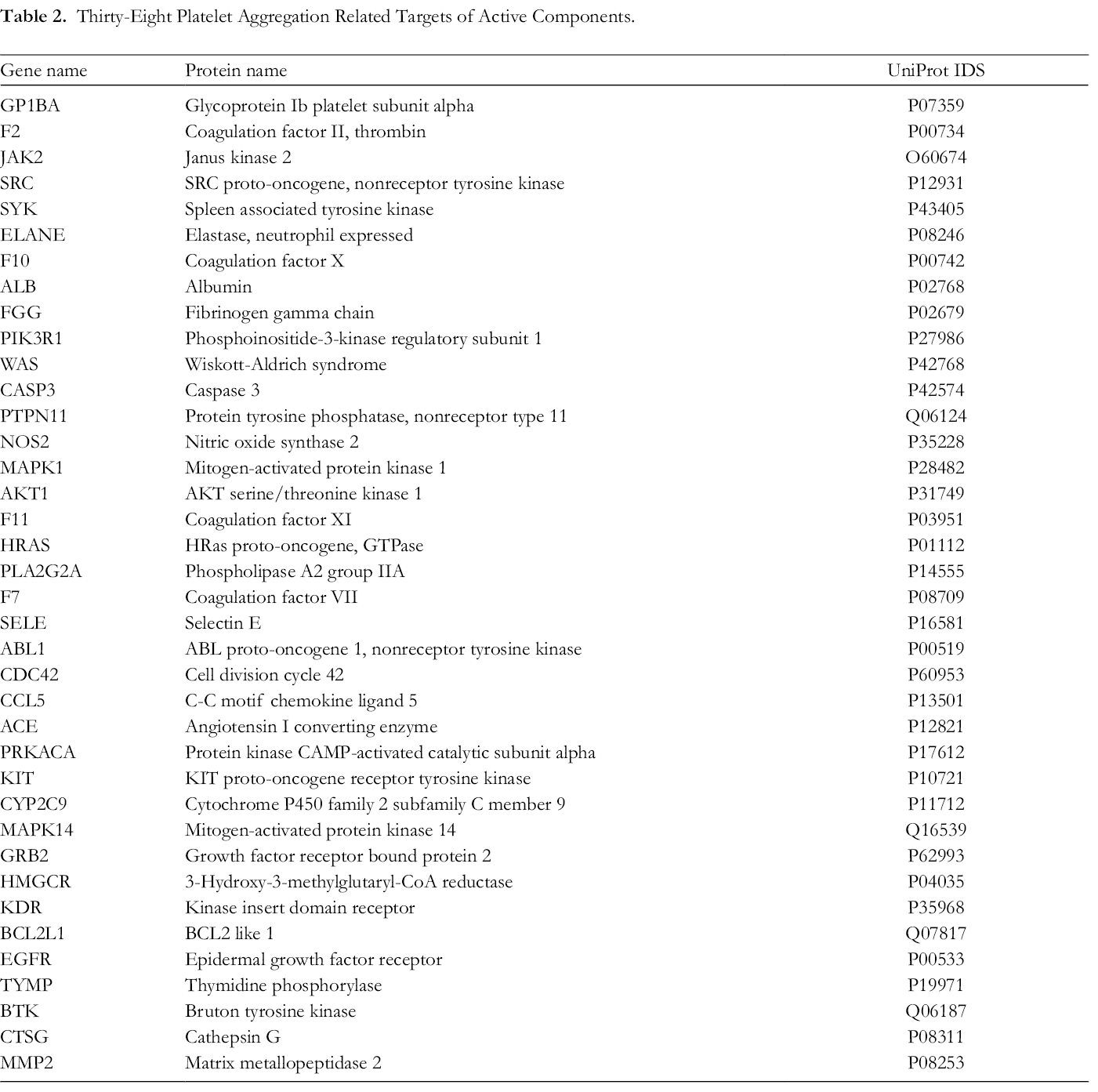
Through Gene Cards database search, the pharmacodynamics model cluster targets were ranked according to a Fit score size. Proteins with a Fit score greater than 3 were selected as candidate target proteins. Therefore, 277 genes related to platelet aggregation were obtained. By comparing those genes with target genes of potentially active components, potential target genes of platelet aggregation were obtained for each active component. A total of 38 target genes of potential platelet aggregation were obtained for Juechuang (Table 2).
Thirty-Eight Platelet Aggregation Related Targets of Active Components.
Pathway Enrichment Results
All summarized potential targets were uploaded into the DAVID database for KEGG pathway annotation and GO enrichment analysis. The pathways or gene functions, related to the largest number of targets, were analyzed, and the P-value threshold was set at P ≤ 0.05. Graphpad Prism 6 was used to plot the first 10 terms of the KEGG pathway and 5 terms of GO enrichment (cf. Figures 1 and 2).
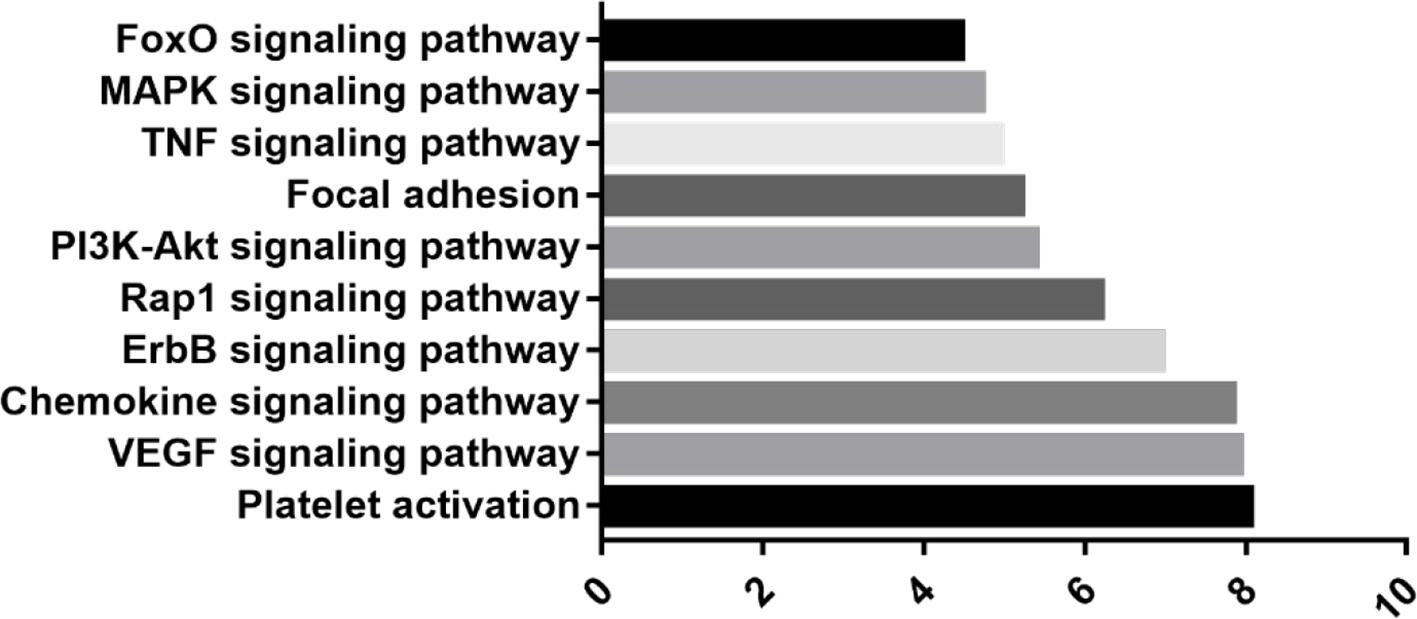
First 10 terms of Kyoto encyclopedia of genes, and genome pathway analysis. MAPK, mitogen activated protein kinase; PI3K, phosphatidylinositol 3-protein kinase; TNF, tumor necrosis factor; VEGF, vascular endothelial growth factor.

First5 terms of gene ontology enrichment analysis.
The KEGG pathway annotation results showed that 88 signaling pathways were involved in 38 potential targets. Among these targets, 37 targets were determined to correspond to P ≤ 0.05. Further comparative analysis of the ten KEGG pathways with the strongest correlation (ie, highest −logp value) showed that platelet activation was directly related to platelet aggregation in KEGG. Moreover, vascular endothelial growth factor (VEGF), ErbB, and chemokine signaling pathways were directly related to thrombosis and platelet regeneration. Meanwhile, phosphatidylinositol 3-protein kinase (PI3k)-Akt, MAPK, FoxO, and other pathways play an important role in various biological processes, including platelet aggregation.
Construction of a Component-Target-Pathway Network
Using the merge function, the first ten pathways, involved in the maximum number of targets (38 potential targets and 28 active components), were combined to construct a network diagram of the active component-target-enrichment pathway (cf. Figure 3). The network diagram showed that various components of Juechuang may act on multiple targets and exert an integral anti-platelet aggregation effect through multiple pathways. Moreover, the Degree value of active components was analyzed. Here, components with a higher Degree value referred to more targets, which indicated that they may play a more important role in the anti-platelet aggregation of Juechuang.

Network diagram of the active component-target-enrichment pathway.
The target genes were imported into the STRING database to obtain the PPI network. Furthermore, the network was imported into the Cytoscape 3.6.1 software. The target genes were represented as the nodes, and the interactions between proteins were represented by edges to obtain a protein interaction network diagram (cf. Figure 4). The Network analysis function was used for analysis. High-degree gene targets in the protein interaction network were analyzed. Potentially, these target proteins exert an important anti-platelet aggregation effect in the central association of Juechuang. Among them, MAPK describes the targets of degree.

Protein-protein interaction network constructed by Cytoscape.
Active Component/Target Protein Docking
In the component-target-pathway network, components with a high degree value were selected as important active components. Palmitic acid possesses thrombolytic activity; however, it is still considered as a false-positive component. After an extensive literature search, cycloeucalenol (degree = 21), tuberculatin (degree = 12), Taiwanin E (degree = 12), chinensinaphthol (degree = 12), and justicidin B (degree = 5) were selected as ligands for molecular docking verification experiment. Considering the component-target-pathway network and protein interaction network and analyzing its importance in the KEGG pathway, ALB, SRC, and MAPK were selected as the molecular docking targets.
6E6E (SRC) and 5NHO (MAPK1) were selected from the PDB database as protein structures for docking. Pymol was used to remove ligands and solvents from the protein structures, and the structures were then stored in PDB format after hydrogenation. The screened active components were compared with the positive control chemical components of the target. A minimized energy function was used in ChemBio3D Ultra to obtain the lowest energy conformation before storage in PDF format. The treated target protein and active component structures were imported into AutoDockTools 1.5.6 for molecular docking experiments. The grid box and molecular docking parameters are shown in Table 3.
Molecular Docking Parameters.

Abbreviations: MAPK1, mitogen-activated protein kinase 1; Src, non-receptor tyrosine kinases.
After 10 docking tests, the cluster with the most suitable conformation and the largest binding energy value was selected for further analysis. The value with the largest absolute value was the binding energy of the compound and the target protein. The largest absolute binding energy was the binding energy between the compound and the target protein. Using advanced literature search and analysis, (4-methylpiperazin-1-yl)anilino]-4-[2-(propanoylamino)anilino]-pyrimidine-5-carboxamide and ulixertinib were selected as positive control drugs for SRC and MAPK1 protein targets, respectively. Under the same conditions, the binding energy of the control drug was used as the threshold to screen the compounds. The corresponding molecular docking results are shown in Table 4.
The Binding Energy of 5 Active Components and Positive Control Drugs.

Abbreviation: MAPK1, mitogen-activated protein kinase 1.
Finally, we selected the SRC-cycloeucalenol complex and MAPK1-Taiwanin E complex as the representative complexes and visualized them with Pymol. The parameters were set according to the Protein-Ligand Interaction Profiler website (https://projects.biotec.tu-dresden.de/plip-web/plip/ index). The picture of the corresponding docking pattern is shown in Figure 5.

Docking pattern visualized by Pymol. (A) SRC-cycloeucalenol complex. (B) Mitogen-activated protein kinase 1-Taiwanin E complex.
Discussion
As a new discipline in pharmacology, network pharmacology features the characteristics of integrity and dynamics; it can accelerate the modernization of traditional Chinese medicine and further bridge the gap between traditional and modern medicine. Therefore, in the process of modernization of traditional medicine, drug-target-disease networks at the biomolecular were explored. 12 Network pharmacology may identify the effective components of traditional medicine and explain their mechanism of action. Furthermore, network pharmacology may be used for research and development of traditional medicine. Also, this method may improve the success rate and reduce the risk and cost of drug research and development and provide future directions for the modernization of traditional Chinese medicine. 13
ADMET is an important parameter for screening candidate drugs for further development, and it may greatly improve the success rate of drugs in clinical practice. Presently, ideal models include several processes in ADMET, such as a drug intestinal absorption model, and metabolic stability model. Here, key parameters include cell permeability (Caco2) and PPB. 14,15 Final screening results show that lignin represents the most active ingredient, followed by triterpenoids and flavonoids. Through a further literature search, we found that most of the previously conducted pharmacological studies on the chemical constituents of Juechuang focused on total constituents or lignan constituents, but only a few of them focused on flavonoids. Previous literature reports show that Taiwanin E, chinensinaphthol methyl ether, and justicidin B exhibit antiplatelet aggregation functions. 1 The 3 components were successfully screened by the ADMET screening method.
Traditional Chinese medicine has the characteristics of multiple components, multiple pathways, and multiple targets, which renders the research on the mechanism of action of traditional Chinese medicine even more complex. The chemical components of traditional Chinese medicine were used as probes in reverse molecular docking. Various databases were searched to identify biological target macromolecules for those probes. These compounds may recognize each other and form complexes through spatial and energy matching. Thus, potential drug targets can be screened. This method also improves the screening efficiency of potential active drugs and may help save monetary expenses and time. 16,17
Cardiovascular and cerebrovascular diseases, especially coronary heart disease and stroke, have become a major threat to overall human health. During the manifestation of cardiovascular and cerebrovascular diseases, platelet aggregation is an important pathological event. Platelets play an important role in the formation of clots. The screening of active lead compounds against platelet aggregation has become an important research direction for studying cardiovascular and cerebrovascular diseases.
In this study, we thoroughly investigated the antiplatelet aggregation effect of Juechuang. Four parts of the total extract from Juechuang for anti-adenosine diphosphate-induced platelet aggregation activity were screened in vitro, where Juechuang exhibited a significant antiplatelet aggregation effect, and the ethyl acetate moiety was determined to be the most active part of Juechuang.
Through KEGG pathway enrichment analysis, 38 signaling pathways, including the MAPK signaling pathway, PI3k-Akt signaling pathway, VEGF signaling pathway, and platelet activation signaling pathway, were identified.
Platelet activation signals play a significant role in platelet-induced thrombogenesis. Compared with the traditional concept of platelet activation, some new and more complex platelet signaling activation and amplification networks, such as the PI3K pathway and adhesion receptor-mediated platelet activation pathway, have attracted more and more attention. 18,19 Integrin αIIbβ3 (GPIIb/IIIa), an important integrin receptor, is on the surface of platelet membranes. Corresponding studies have shown that integrin αIIbβ3 is closely related to the pathogenesis of thrombotic diseases. Yan-Fang Yang 5 found that justicidin B, isolated from the ethyl acetate extract of the Juechuang, could inhibit the expression of integrin αIIbβ3. In recent years, the role of the PI3k-Akt signaling pathway in platelet aggregation and thrombus stabilization has received increasing attention. PI3K, an intracellular phosphatidylinositol kinase, plays an important role in platelet functional response and thrombosis. 20 Akt is a downstream signaling molecule of PI3K, and the activation of PI3K leads to the phosphorylation of Akt. The latter is a widely accepted marker for the activation of the PI3K/Akt signaling pathway, and it plays an important role in mediating platelet particle release, platelet aggregation, and thrombogenesis. 21,22 In the early stage, the overall platelet activation signaling pathway mainly involves the platelet membrane surface pathway. Other signaling pathways have rarely been studied. The results of KEGG pathway enrichment analysis provide new insights into other signaling pathways.
Two targets were selected for molecular docking, namely, SRC and MAPK. In the case of vascular injury, Src family kinases (SFKs) play an important role in mediating a rapid platelet response. They transmit activation signals from various platelet surface receptors, including the integrin αIibβ3, the collagen receptor complex gpvi-fcrg chain, and the von Willebrand factor receptor complex GPIb-IX-V. These receptors are mediated by ligands (downstream tyrosine phosphorylase, adapters, and cytoskeletal proteins), which can increase the SFK activity. Together, these species transmit signals and coordinate platelet activation. 23 Li-ming Lien has found that licochalcone prevents the platelet activation and thrombosis by inhibiting PLCγ-2-pkc, Akt, and MAPK pathways, without affecting normal hemostasis. 24 Molecular docking results showed that compared with the positive control drug, cycloeucalenol, and justicidin B combined with the corresponding targets led to higher binding ability. These molecular docking results were consistent with values found in the literature, and justicidin B exhibited suitable antiplatelet aggregation. Furthermore, the above results further highlight the reliability of ADME screening and network analysis. Cycloeucalenol exhibited a mild cardiotonic effect; it could slightly enhance the contractile force of the right atrium. 25 The effect of cycloeucalenol on antiplatelet aggregation has not been studied thoroughly, but it may provide useful research clues for the further development of antiplatelet drugs.
In this study, a total of 28 potentially active components were obtained, 277 of which were predicted to act on targets, and 38 protein targets related to platelet aggregation were screened. Through KEGG pathway enrichment analysis, we found that the mechanism of platelet aggregation might be related to the Ras signaling pathway and platelet activation signaling pathway. The effect of Juechuang on platelet aggregation may be due to the Ras signaling pathway and platelet activation signal. This study may provide a reference for the systematic study of the pharmacodynamic effect of Juechuang and its mechanism.
Supplemental Material
Table S1 - Supplemental material for Study of Components and Mechanism of Juechuang Against Platelet Aggregation Based on Network Pharmacology
Supplemental material, Table S1, for Study of Components and Mechanism of Juechuang Against Platelet Aggregation Based on Network Pharmacology by Zhou-Tao Xie, Bo Liu, Yi-yi Xiong, Yan-Fang Yang and He-Zhen Wu in Natural Product Communications
Footnotes
Declaration of Conflicting Interests
The author(s) declared no potential conflicts of interest with respect to the research, authorship, and/or publication of this article.
Funding
The author(s) disclosed receipt of the following financial support for the research, authorship, and/or publication of this article: This study was supported by the National Natural Science Foundation of China. (Grant No. 31570343)

Supplemental Material
Supplemental material for this article is available online.