



Abstract
Yanhusuo (Corydalis Rhizoma) extracts are widely used for the treatment of pain and inflammation. The effects of Yanhusuo in pain assays were assessed in a few studies. However, there are few studies on its analgesic mechanism. In this paper, network pharmacology was used to explore the analgesic components of Yanhusuo and its analgesic mechanism. The active components of Yanhusuo were screened by TCMSP database, combined with literature data. PharmMapper and GeneCards databases were used for screening the analgesic targets of the components. The protein interaction network diagram was drawn by String database and Cytoscape software, the gene ontology and KEGG pathway analyses of the target were performed by DAVID database, and the component–target–pathway interaction network diagram was further drawn by Cytoscape3.6.1 software. System Dock Web Site verified the molecular docking among components and targets. Finally, an interaction network of the component–target–pathway of Yanhusuo was constructed, and the functions and pathways were analyzed for preliminarily investigating the mechanism of Yanhusuo in analgesia. The results showed that the active components of analgesic in Yanhusuo were Corynoline, 13-methylpalmatrubine, dehydrocorydaline, saulatine, 2,3,9,10-tetramethoxy-13-methyl-5,6-dihydroisoquinolino[2,1-b]isoquinolin-8-on-e, and Capaurine. The mechanisms were involved in metabolic pathways, PI3k-Akt signaling pathway, pathways in cancer, and so on. The top 3 targets were NOS3, glucose-6-phosphate dehydrogenase, and glucose-6-phosphate isomerase in components-target-pathways network, and they were all enriched in metabolic pathways. Meanwhile the molecular docking showed that there was a high binding activity between the 6 components and the important target proteins, as a further certification for the subsequent network analysis. This study reveals the relationship of the components, targets, and pathways of active components in Yanhusuo, and provides new ideas and methods for further research on the analgesic mechanism of Yanhusuo.
Yanhusuo comes from the rhizoma of Corydalis Yanhusuo W.T. Wang. It has been used for the treatment of pain in China for more than 2000 years. 1 The sensation of pain is often felt in the response of a physical injury. Approximately, many people worldwide are suffering from chronic pain. Analgesics mainly act on the central or peripheral nervous systems by selectively inhibiting and relieving from various kinds of pain. 2
The chemical constituents of Yanhusuo are complex, and include alkaloids, polysaccharides, resins, volatile oils, and inorganic trace elements. The main components in Yanhusuo include protoberberine alkaloid tetrahydroprotoberberine alkaloids, protopine alkaloids, and aporphine alkaloids. 3,4 It has been demonstrated that its biological properties are mainly associated with Yanhusuo alkaloids. In previous study, dehydrocorybulbine, an alkaloid isolated in Yanhusuo, as well as its crude extract exhibit antagonistic activities at dopamine receptors. 1,5 Lehao Wu et al 6 identified 8 alkaloids from Yanhusuo with D1 receptor antagonistic activities.The dopamine-receptor-antagonistic effects of 4 compounds, including 13-methyldehydrocorydalmine, dehydrocorydaline, columbamine, and corydaline, were reported for the first time. However, the analgesics mechanism of Yanhusuo has not been systematically elucidated, and the active compounds and targets have not fully been identified. The identified components have been verified by pharmacokinetic study, 7,8 and the signal pathway studies are lacking. So this study explores the analgesic components of Yanhusuo and its analgesic mechanism by network pharmacology.
Network pharmacology was introduced by Hopkins in 2008 using a visualization network software and a variety of algorithms combined with integrated analysis of existing related databases. 9 Network pharmacology is a new discipline, which establishes a multilevel network of disease–gene–drug; the network predicts drug targets in the drug discovery process. 10,11
In the present study, network pharmacology was used to explore the analgesic components of Yanhusuo and its analgesic mechanism. The active components of Yanhusuo were screened by TCMSP database, combined with literature data. PharmMapper and GeneCards databases were used for screening the analgesic targets of the compounds. The protein interaction network diagram was drawn by String database and Cytoscape software, the gene ontology (GO) and KEGG pathway analyses of the target were performed by DAVID database, and the component–target–pathway interaction network diagram was further drawn by Cytoscape3.6.1 software. System Dock Web Site verified the molecular docking among components and targets. Finally, an interaction network of the component–target–pathway of Yanhusuo was constructed, and the functions and pathways were analyzed for preliminarily investigating the mechanism of Yanhusuo in analgesia.
Materials and Methods
Construction of the Chemical Library
The main chemical composition of Yanhusuo was searched by pharmacology of traditional Chinese medicines (TCM) (TCMSP, http://lsp.nwu.edu.cn/tcmsp.php) and literature analysis in different platform databases, and the active compounds were screened by ADME screening (screening oral bioavailability [OB] value greater than or equal to 30%, drug likeliness (DL) value greater than or equal to 0.18). The standard formula of these compounds was obtained in PubChem (https://www.chemeurope.com/en/encyclopedia/PubChem.html), the structures were confirmed, and *.SDF and PubChem CID structures were downloaded. Finally, the database of all compounds in Yanhusuo was established.
Screening the Targets
Drug molecules exert their effects by binding to specific molecular targets and regulating their biological activity or transcription level. For elucidating the mechanism of a drug’s action, the drug-targets interactions should be studied. The molecular structures in SDF formats, which were filtered out (as described in the section “Construction of the Chemical Library”), were uploaded on PharmMapper database (http://lilab-ecust.cn/pharmmapper/submitfile.html).
Target name, gene name, Uniprot ID, fit score, and other data of the compound were obtained. The predicted targets of the compound were screened and searched in the UniProt database (https://www.uniprot.org/). The “species” was selected as "Homo sapiens," and the “repeated,” “non-human” and “non-standard” targets were eliminated. The gene targets of the active components of Yanhusuo were finally obtained through retrieval and transformation. The reported targets of Yanhusuo were searched for screening and supplementation.
Collection of the Analgesic Targets
Pain-related targets were searched in the GeneCards (http://www.malacards.org/) database, repeated target genes were screened and eliminated, and the intersection comparison with the targets obtained in the section "Screening the Targets." Ultimately, analgesia-related chemically potential targets of Yanhusuo were obtained.
Construction and Analysis of the Protein–Protein Interaction Network
To illustrate the role of the target protein in the system, information regarding potential analgesia-related targets of Yanhusuo, derived from "Collection of the Analgesic Targets," were uploaded to String10.5 online software (http://string-db.org), designated the “species” as “humans,” and the PPI network map was obtained. Protein-protein interactions including direct and indirect interactions between proteins were predicted by String database stores, and points to each protein interaction information were evaluated and assigned. Higher the score, higher is the confidence degree of protein interaction. The node 1, node 2, and Combined score were exported from the String database, the results were imported to Cytoscape 3.6.1 software for visual analysis, and the network analysis was obtained. The node size was set. Color, degree value, size, and edge thickness reflected combined score, the PPI network graph was obtained.
Network Target Characteristics Analysis
Network analyzer in Cytoscape 3.6.1 software was utilized for computing the topological parameters of the network. If a regulatory relationship is present between the nodes in the network, they were connected by the edges. In this study, the nodes were evaluated on the basis of the average shortest path, intermediate centrality, center proximity, clustering coefficient, degree value, and other parameters.
Correlation Pathway and Annotation Analysis
The analgesic targets of Yanhusuo specified in the section “Collection of the Analgesic Targets” were imported into David 6.8 database (https://David.ncifcrf.gov) in the format of Gene Symbol. The identifier was set as OFFICIAL Gene Symbol, and List Type was set as Gene List to limit the study within human species. GO and KEGG pathway analyses were performed on the analgesic targets of Yanhusuo, and the results were saved. Differences between the pathways were considered as significant at P < 0.05, the data were sorted according to the size of P-value, and the pathways were ranked from high to low. GraphPad Prism 5.0 software was used for plotting.
Component-Target-Pathway Network Graph Construction
According to the above target prediction results of Yanhusuo chemical components for analgesia, the model of Yanhusuo component-target-pathway network was constructed by using the “merge” function of Cytoscape software. Nodes in the network represent compounds, targets, and pathways. A potential target of a compound was connected by edges. The principle of connection between the nodes is that when the target of active ingredient action is the same as the target of the action pathway, the active ingredients will be correlated with the action pathway by edges. The effect of chemical compositions–targets–pathways on Yanhusuo was studied by constructing a network.
Molecular Docking
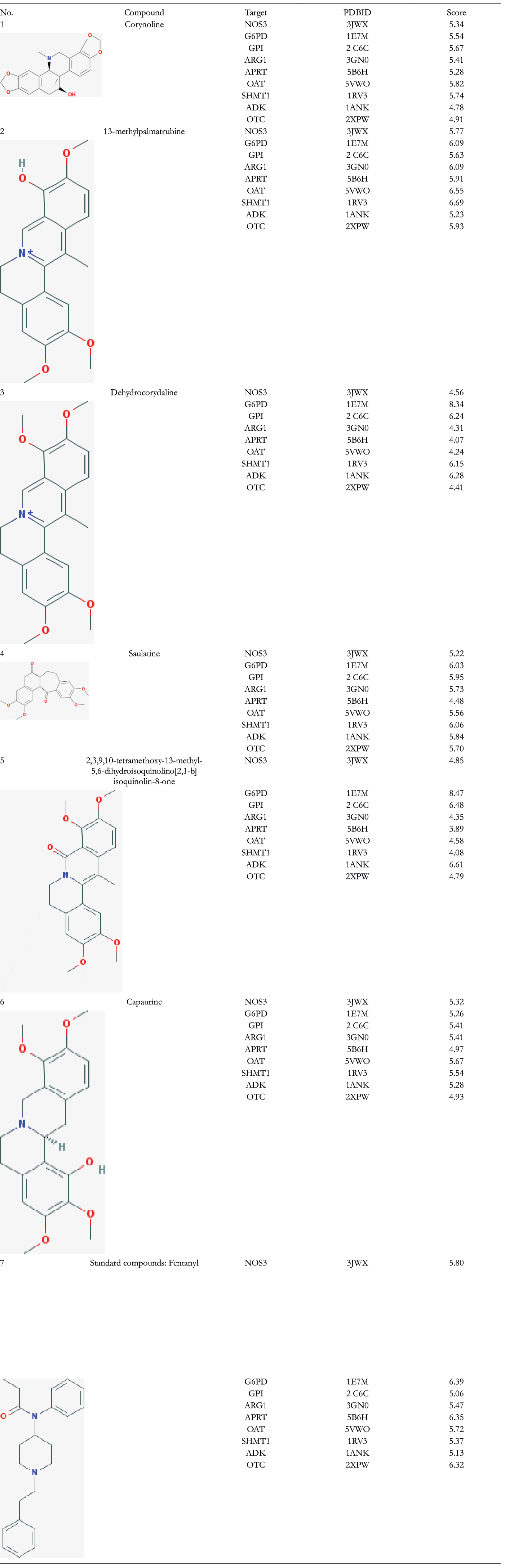
Degree in the (section “Component–Target–Pathway Network Graph Construction”) network refers to the number of interacting proteins with a certain protein. Generally, in a network, only a few nodes have high degrees and occupy an important position in the whole network. In other words, the highest-ranked target protein of degree plays an important role in analgesia of Yanhusuo. However, proteins with a higher degree must also be present in the relevant pathways screened out in the section “Correlation Pathway and Annotation Analysis”. The proteins in the section “Component–Target–Pathway Network Graph Construction” network were ranked according to the degree from large to small. To obtain the top 9 proteins, the proteins were compared with the proteins, which were in the metabolic pathways in the section “Correlation Pathway and Annotation Analysis.” The PDB numbers of these proteins were found in the PDB database. In “Component–Target–Pathway Network Graph Construction” network, the top 6-degree ranking compounds were selected. The PDB number of proteins and the Sdf structure of the compounds were entered into Systems Dock Web Site (http://systemsdock.unit.oist.jp/iddp/home/index) for docking. The docking results are shown in Table 1. The results of molecular docking showed that the binding activities of 6 important components and important targets in Yanhusuo were good.
Docking Scores of 6 Active Ingredients With 9 Important Targets (The PDB Number of Proteins and the Sdf Structure of the Compounds Were Entered Into Systems Dock Web Site [http://systemsdock.unit.oist.jp/iddp/home/index] for Docking).
Results
Screening of Chemical Constituents of Yanhusuo
According to existing literature, the main components of Yanhusuo are alkaloid , which are also the main active components. Based on literature and databases, OB ≥30% and DL ≥0.18 were selected as the screening parameters. A total of 33 compounds were selected as active compounds. The basic information of the compounds is shown in Table 2.
Compound Information Screened From Yanhusuo (The Compounds in Yanhusuo Screened by TCMSP, http://lsp.nwu.edu.cn/tcmsp.php).

Construction of the Interaction Network of Analgesic Target Proteins of Yanhusuo (PPI)
Relevant targets of Yanhusuo components were selected from PharmMapper database and GeneCards database. Ninety-nine targets were obtained, including F2, NOS3, MET, and IL2. The interaction of analgesic targets of Yanhusuo is shown in Figure 1. Details of nodes in the relational network are shown in Table 3 (only the top 30 targets with the highest target degree are listed).

Interaction diagram of analgesic target proteins of Yanhusuo (the interaction of 99 analgesic targets of Yanhusuo).
The First 30 Targets of the 99 Analgesic Targets of Yanhusuo.

Bioinformatics of Analgesic Targets of Yanhusuo
GO and KEGG analyses were conducted on the corresponding targets of active components of Yanhusuo using the DAVID database, and a threshold value of P <.05 was set. The top biological processes (BP) or pathways were screened, and GraphPad Prism was used for plotting. GO enrichment analysis refers to a directed acyclic diagram that counts the numbers of proteins or genes at a certain functional level in 3 branches, including BP, cellular component (CC), and molecular function (MF). Among them, the peptidyl-tyrosine autophosphorylation, transmembrane receptor protein tyrosine kinase signaling pathway, regulation of cell proliferation, and innate immune response ranked first in Figure 2 (BP). Extracellular exosome, cytoplasm, and mitochondrion ranked first in Figure 3 (CC). ATP binding, serine-type endopeptidase activity, and receptor binding are the top ones in Figure 4 (MF). Figure 5 (KEGG) shows that the main pathways for analgesic are metabolic pathways, PI3k-AKT signaling pathway, and pathways in cancer.
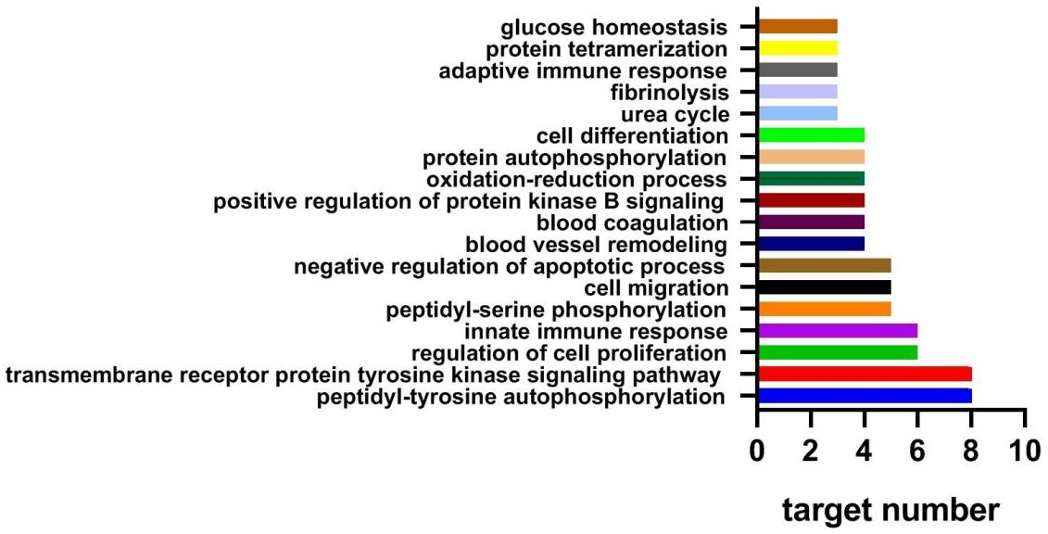
Enriched gene ontology terms for biological processes of potential analgesic targets of the main active ingredients of Yanhusuo.
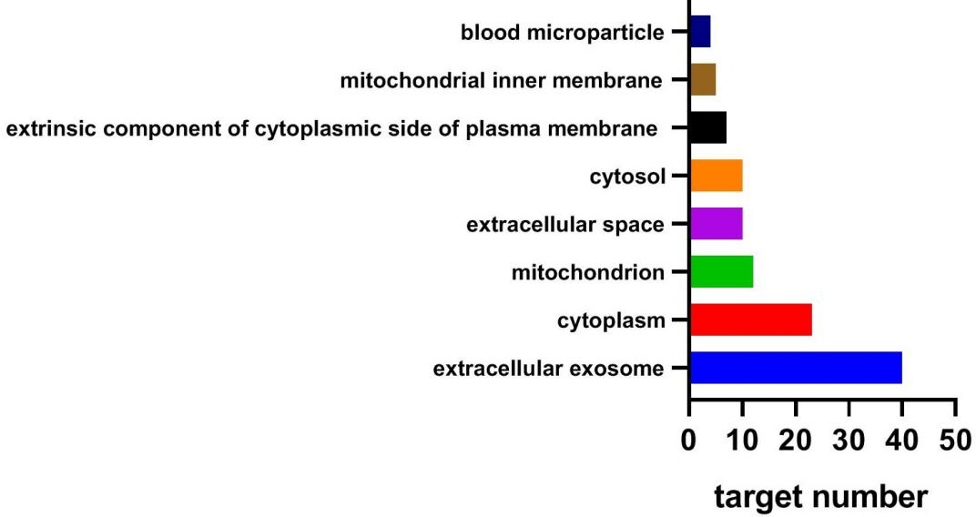
Enriched gene ontology terms for cellular components of potential analgesic targets of the main active ingredients of Yanhusuo.
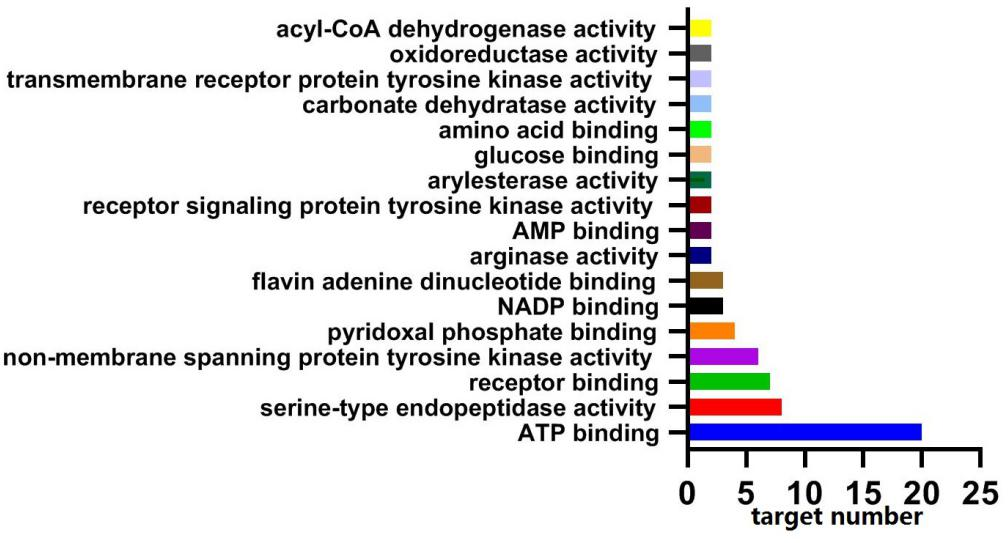
Enriched gene ontology terms for molecular function of the potential analgesic targets of the main active ingredients of Yanhusuo.
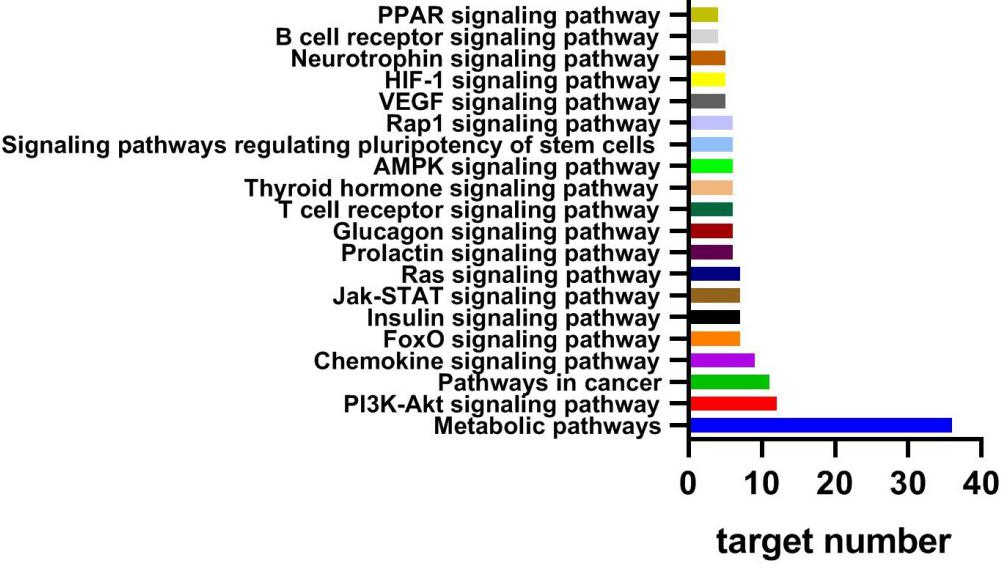
Enriched KEGG pathways of potential analgesic targets of the main active ingredients of Yanhusuo.
Component-Target-Pathway Network Diagram Construction
The “Merge” function of Cytoscape software was used for constructing the active componenttarget–pathway network for studying the analgesia targets of Yanhusuo. As shown in Figure 6, the main active analgesic components of Yanhusuo were distributed in different pathways and coordinated with each other to regulate the analgesic mechanism of Yanhusuo. The main analgesic mechanism of Yanhusuo is related to the metabolic pathway.

Component–target–pathway network (component–target–pathway network was constructed by using the “merge” function of cytoscape software).
Molecular Docking
The 9 proteins high-ranked in degree (section “Component–Target–Pathway Network Diagram Construction”) were selected, and their PDB numbers were obtained from the PDB database. Six compounds high-ranked in degree (section “Component–Target–Pathway Network Diagram Construction”) were identified. Fentanyl was selected as the standard compound, and the system Dock Web Site software was employed for performing molecular docking according to default parameters for computing the docking score. Generally, a score above 4.25 indicates average binding activity, a score above 5.0 indicates good binding activity, while a score above 7.0 indicates strong binding activity between the molecule and the target. Results in Table 1 suggest that the binding activity of 6 active compounds in Yanhusuo with 9 proteins is relatively high, and the docking score was close to that of the standard compound.
Discussion
The contribution of natural products to drug development has been extensively documented. The structural diversity and biological activity of natural products make them the most valuable sources of drugs and drug leads. 12 However, single-component drugs are less sufficient to treat complex conditions, and multicomponent drugs such as natural products are becoming more important in the treatment of complex diseases as they have multiple targets and multiple pathways. 13 Natural products comprise a vast and diverse source of bioactive compounds, some of which are supported by thousands of years of traditional medicine, and they possess unique characteristics that distinguish them from traditional small-molecule drug candidates, requiring new methods and approaches for assessing their therapeutic potential. 14 Network pharmacology is more effective for establishing a “compound-protein/gene-disease” network and revealing the regulation principles of small molecules in a high-throughput manner. This approach makes it very powerful for the analysis of drug combinations, especially TCM preparations. 15
TCM Yanhusuo is a commonly used analgesic; its analgesic effect is stronger than the general antipyretic-analgesics, side effects are less, and the herb causes no addiction. 1 The purpose of this study was to find the chemical constituents, targets, and molecular biological mechanisms of analgesia of Yanhusuo by using network pharmacology.
In this study, the results showed that the active components of analgesic in Yanhusuo were Corynoline, 13-methylpalmatrubine, dehydrocorydaline, saulatine, 2,3,9,10-tetramethoxy-13-methyl-5,6-dihydroisoquinolino[2,1-b]isoquinolin-8-one, and Capaurine. However, there is little research literature on the content of these 6 alkaloids. More attention will be paid on the content of alkaloids in Yanhusuo in the subsequent experiments. In the previous study, the main components in Yanhusuo included protoberberine alkaloid, tetrahydroprotoberberine alkaloids, protopine alkaloids, and aporphine alkaloids. 3,4 Eight alkaloids from Yanhusuo with D1 receptor antagonistic activities were identified. The dopamine-receptor-antagonistic effects of 4 compounds, including 13-methyldehydrocorydalmine, dehydrocorydaline, columbamine, and corydaline, were reported for the first time. 6
KEGG pathway analysis found that the analgesic targets of Yanhusuo were enriched in metabolic pathways, PI3k-AKT signaling pathway, pathways in cancer, and so ontc. Chronic pain is a major symptom that develops in cancer patients. Cancer cells undergo numerous metabolic changes that include increased glutamine catabolism and overexpression of enzymes involved in glutaminolysis, including glutaminase. Increased levels of extracellular glutamate have been associated with the progression of cancer-induced pain. 16 Headache is a common episodic or chronic neurologic disorder. Wu-Zhu-Yu decoction, a TCM formula containing 4 TCM herbs, is commonly used in the treatment of headache in China. A total of 17 potential biomarkers were characterized and related metabolic pathways were identified by liquid-chromatography--high-resolution mass spectrometry-based metabolomics approach. 17 Modification of the PI3K pathway is strongly implicated in cancer pathogenesis. 18
The top 3 targets were NOS3, glucose-6-phosphate dehydrogenase (G6PD), and glucose-6-phosphate isomerase (GPI) in component–target–pathway network, and they were all enriched in metabolic pathways. According to the previous study, NOS3 plays an important role in oxaliplatin resistance and CBD overcomes NOS-induced oxaliplatin resistance by inducing autophagy. This enhanced autophagy is triggered by mitochondrial dysfunction through a reduction in SOD2 expression. 19 G6PD is a rate-limiting enzyme of the pentose phosphate pathway. Multiple studies have previously revealed that elevated G6PD levels promote cancer progression in numerous tumor types; however, the underlying mechanism remains unclear. It was demonstrated that high G6PD expression is a poor prognostic factor in bladder cancer, and the levels of G6PD expression increase with increasing tumor stage. 20 GPI is a housekeeping cytosolic enzyme that plays a key role in glycolytic and gluconeogenic pathways, catalyzing the interconversion between G6P and fructose-6-phosphate. Its expression is induced by c-Myc 21 and HIF-1 22,23 and is increased in many cancers. 24 Meanwhile the molecular docking showed that there was a high binding activity between the 6 components and the important target proteins, as a further certification for the subsequent network analysis. The mechanism of analgesic activity of Yanhusuo is characterized by multiple components, multiple targets, and multiple pathways. The results of network pharmacology can provide certain scientific basis for subsequent experimental research.
Footnotes
Declaration of Conflicting Interests
The author(s) declared no potential conflicts of interest with respect to the research, authorship, and/or publication of this article.
Funding
The author(s) disclosed receipt of the following financial support for the research, authorship, and/or publication of this article: This work was financially supported by the National Natural Science Foundation of China (Grant No. 31570343).