



Abstract
Liver cancer, otherwise known as hepatocellular carcinoma, is a chronic disease condition with an excessive deposition and growth of malignant cells in the body. The high incidence and prevalence rates of liver cancer continue to be problems, as well as its poor prognosis and therapeutic limitations involving severe drug adverse reactions linked to the use of synthetic chemotherapeutic compounds. Continuous experimental studies, as well as utilization of pure herbal-based compounds, are essential towards finding more potent cures for liver cancer. Natural bioactive compounds, particularly alkaloids (eg, berberine), have been shown to be highly beneficial in the treatment of various diseases. Berberine (BBR), an isoquinoline alkaloid, is obtained from stem, bark, roots, rhizomes, and leaves of several medicinal plants, including Berberis species. It is commonly synthesized from the benzyltetrahydroisoquinoline system with the incorporation of an additional carbon atom as a bridge. The multiple attributes of BBR involving effective inhibitory and cytotoxic actions against the proliferation of cancer cells have been demonstrated. The use of BBR in experimental studies (in vivo and in vitro) for over a decade for liver cancer treatment has proven to be highly effective, safe, and potent. Until now, the poor solubility of BBR remains one of the contributing factors leading to its minimal clinical bioavailability. Therefore, BBR could serve as a prospective drug candidate in the future towards drug formulation for liver cancer treatment. The relevant information regarding this review was obtained electronically through the use of databases such as PubMed, Google Scholar, Springer, Hindawi, Embase, Web of Science, and China National Knowledge Infrastructure. All the aforementioned databases were searched from 1981 to 2020. This literature represents an update of previous review papers discussing the various positive pharmacological and mechanistic effects (oxidative stress regulation, inflammation reduction, apoptosis activation, overcoming drug resistance, and metastasis inhibition) of BBR for liver cancer treatment, which would be of great significance to drug development and clinical research.
Introduction
Liver cancer is termed a chronic disease with an excessive or uncontrolled deposition and proliferation of malignant cells in the body.1,2 It is normally accompanied by a manifestation of symptoms like swelling of the abdomen, weakness, weight loss, yellowish skin, and easy bruising and pains in the right side below the rib cage. The occurrence of liver cancer is associated with certain causative agents such as iron overload, obesity, hepatitis-B virus, diabetes, smoking, alcohol-related cirrhosis, liver flukes, hepatitis-C virus, nonalcoholic fatty liver disease (NAFLD), aflatoxin exposure, immunosuppression, and lupus (systemic lupus erythematosus).3–5 The prevalence of liver cancer is still rapidly on the rise worldwide, with a minimal survival rate.6,7 This, combined with poor prognosis and therapeutic shortcomings or limitations involving chronic drug adverse reactions to the synthetic chemotherapeutic components applied in drug formulation are causes of concern. The treatments often delay, but can potentiate the degree of disease progression. More experimental studies, as well as utilization of pure herbal-based compounds, are essential towards finding more potent curative agents to treat liver cancer. 8
Natural bioactive compounds, particularly alkaloids (eg, Berberine; BBR), have been shown to be highly beneficial in the treatment of various diseases.9–14 BBR is commonly synthesized from the benzyltetrahydroisoquinoline system with the incorporation of an additional carbon atom as a bridge. Current evidence indicates the multiple attributes of BBR involving effective inhibitory and cytotoxic actions (oxidative stress regulation, inflammation reduction, apoptosis, and autophagy activation) against the proliferation of cancer cells.15–21 The use of BBR in experimental studies (in vivo and in vitro) for over a decade against liver cancer has proven to be highly effective, safe, and potent. However, until now, the poor solubility of BBR remains one of the contributing factors leading to its minimal clinical bioavailability. Therefore, BBR could serve as a prospective drug candidate for drug formulation against liver cancer. This work represents an update of previous review papers discussing the various positive pharmacological and mechanistic effects (oxidative stress regulation, inflammation reduction, apoptosis activation, overcoming drug resistance, and metastasis inhibition) of BBR for liver cancer treatment.
Methodology
The information shown in this review was obtained electronically through the use of databases such as PubMed, Google Scholar, Springer, Hindawi, Embase, Web of Science, and China National Knowledge Infrastructure by using keywords such as “Berberine,” “Berberine and Cancer,” “Berberine and Tumor,” “Berberine and Carcinoma,” “Berberine against liver cancer,” “Berberine against hepatocellular carcinoma,” Hepatocellular carcinoma,” Liver cancer,” and “Berberine effects on liver cancer.’’ All the aforementioned databases were searched from 1981 to 2020.
Botanical Sources, Pharmacological Activities, and Metabolism of BBR
The isoquinoline alkaloid, BBR (Figure 1) or 5,6-dihydro-9,10-dimethoxybenzo[g]-1-3-benzodioxolo[5,6-a] quinolizinium derivative, is a constituent of many different medicinal plants such as Berberis species (B. aquifolium, B. vulgaris, B. heterophylla, B. darwinii, B. petiolaris, B. beaniana, and B. aristata), and others (eg, Hydratis canadensis, Phellodendron chinense, Coptidis sp., Argemone mexicana, Camellia japonica, Tinospora cordifolia, Coscinium fenestratum, Xanthorhiza simplicissima, Callosobruchus chinensis, and Phellodendron amurense).22–27 Table 1 lists the BBR containing species (family, botanical names) and their applications. Owing to their yellowish color, Berberis species are commonly utilized in dyeing leather, wood, and wool. BBR also has a wide-ranging history in Asia, being known for its low or poor lipid solubility alongside its remarkable biochemical and pharmacological activities.50–53 Traditionally, BBR, particularly BBR sulfate and hydrochloride, is extensively applied in traditional Chinese and Ayurvedic medicine.54,55

Chemical structure of berberine.
Berberine Containing Species and Their Applications.

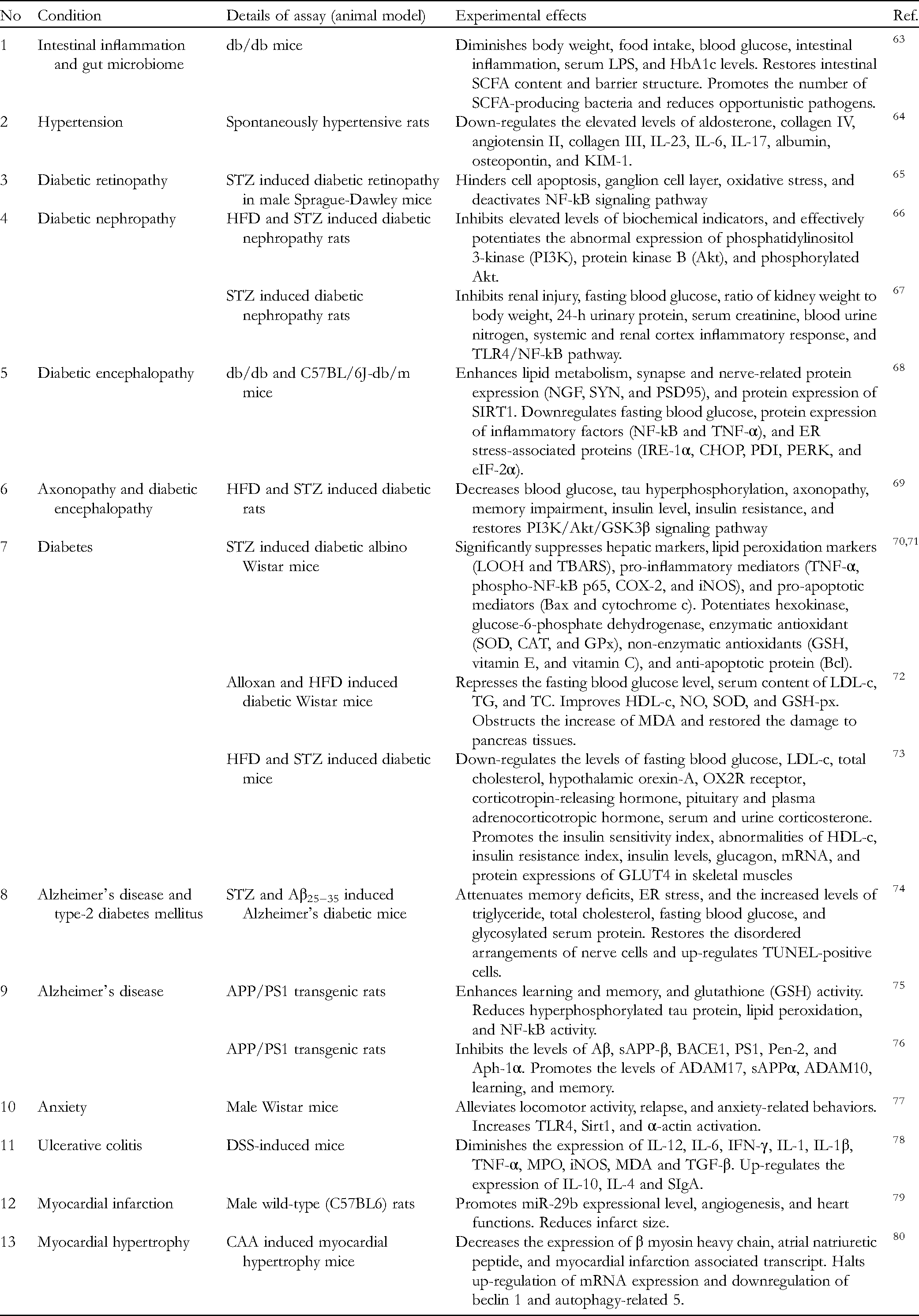
Recent analytical studies have shown that BBR could serve varying purposes, such as anti-obesity, anti-microbial, spatial memory enhancement, anti-diabetic, anti-cancer, anti-atherosclerotic, anti-hypertensive, anti-hyperlipidemic, anti-protozoal, anti-inflammatory, neuroprotective, hepatoprotective, and anti-oxidative agents,56–62 as well as being utilized clinically for the treatment of disease conditions involving polycystic ovary syndrome, NAFLD, CAD, and metabolic syndrome. Table 2 summarizes the numerous beneficial activities of BBR in animal models. The metabolism of BBR is considered mostly to take place in the liver via demethylation (phase I) and glucuronidation processes (phase II), and excreted in the bile. 81 Excessive consumption or administration of BBR in large doses (4-6 weeks) results in liver overload. Also, its usage in pregnancy may lead to miscarriage and contraction of the uterus, as well as neonatal jaundice. Other possible toxicological effects or adverse reactions include gastric troubles, headache, digestive problems, stomach upset, constipation, diarrhea, and flatulence.
In Vivo Beneficial Activities Associated With Berberine.
Potential Utilization of BBR for the Treatment of Liver Cancer
Over the past decade, diverse studies carried out by researchers regarding the medicinal effects of BBR in the treatment of liver cancer cells portrayed or indicated certain clinical outcomes through suppression of cellular proliferation, activation of apoptosis, halting the process of angiogenesis, and slowing down the onset of metastases. In this respect, we outline the prospective in vivo and in vitro actions of BBR in liver cancer (Table 3).
Mechanistic Actions of Berberine on Liver Cancer.

BBR and Liver Cancer
Liver cancer, otherwise known as primary hepatic cancer or hepatocellular carcinoma (HCC), is considered one of the most prevalent and deadliest types of cancer universally, causing deaths with a significant percentage of humans annually.6,99,100 In 2018, according to World Health Organization (WHO), liver cancer reportedly claimed about 782 000 human lives worldwide. It has greater predominance in males than in females, as well as high regional (Western and Middle Africa, Southeast and East Asia), and low regional (Eastern and Northern Europe, Western and South-Central Asia) incidence rates. 101 Nowadays, lung transplantation, surgery, and radiation therapies provide possible treatments for individuals with early detection.102–108 Regardless of the therapeutic advancement, the treatment of liver cancer still remains burdensome due to the tendency of recurrence, even after curative treatment. Varied experimental studies have shown that BBR demonstrates enormous anti-cancer actions.109,110
Effects of BBR on Overcoming Drug Resistance in Liver Cancer Treatment
BBR has demonstrated significant characteristics for overcome multidrug resistance, thus exhibiting its capacity in tumor chemotherapy. BBR regulates the neutrophil phenotype to maintain the sensitivity of cancer cells to doxorubicin, 111 synergistically sensitizes human liver cancer cells to sorafenib, 82 and promotes the radio-sensitivity of hepatoma cells by inhibiting the Nrf2 pathway. 83 Also, BBR and the Janus nanocarrier-based co-delivery of doxorubicin impairs chemotherapy-exacerbated HCC recurrence via inhibition of caspase-3-iPLA2-COX-2 signaling pathways. 112 BBR combined with irradiation promotes anti-cancer actions through activation of the p38 MAPK pathway and ROS generation in human hepatoma cells.84,113 Additionally, the combination of BBR and vincristine significantly impaired the growth and apoptotic induction in hepatoma cells. 114
Effects of BBR on Liver Cancer Metastasis Inhibition
BBR has been proven to possess positive attributes in the inhibition of tumor metastasis.115,116 Matrix metalloproteinases (MMPs) break down the matrix tissue, thereby enabling the malignant cells to advance to the barrier of normal tissues and occupy the surrounding normal tissues and distant organs.
BBR suppresses Id-1 expression and inhibits the growth and development of lung metastases in HCC. 85 BBR exerts a strong suppression on the invasion and migration of HCC cells through promoting PAI-1 and decreasing urokinase-type plasminogen activator (uPA). 86
Mechanistic Effects of BBR on Liver Cancer
Oxidative Stress Regulation
Oxidative stress is a harmful process that can be an essential mediator of either impairment or destruction of cell structures and thus activates different disease conditions, namely cancer, diabetes, and neurological and cardiovascular diseases. Shukia et al demonstrated that BBR regulates oxidative stress through the promotion of reactive oxygen species (ROSs), and lipid peroxidation alongside the down-regulation of the actions of glutathione (GSH), catalase (CAT), and superoxide dismutase (SOD) expressions via the JUK signaling pathway. 87 A traditional herbal medicine, Lagerstroemia speciosa (L.) Pers., containing of BBR, Gallic acid, and Corosolic acid, induces oxidative stress-mediated apoptosis associated with HepG2 cells through intrinsic and mitochondrial mechanisms. 117
Inflammation Reduction
Inflammation represents a common cause of different chronic diseases. BBR reduces the proliferation of liver cancer through an anti-inflammatory pathway. BBR reduces the protein expression levels of cytosolic phospholipase A2 (cPLA2) and cyclooxygenase (COX)-2, and up-regulates the content ratio of arachidonic acid to prostaglandin E2 in the human hepatocarcinoma (HepG2) cells. 88 BBR suppresses the phosphorylation of Akt, mTOR, and ERK, indicating inhibition of cell growth through the PI3K/Akt/mTOR and ERK/MAPK signal pathways. 89 BBR induces G1-phase arrest accompanied by a decrease in cyclin D1, cyclin E, and cdc2 expressions. It inhibits cell growth through cell cycle arrest. In addition, BBR mediates proliferation and migration in HCC via the Wnt/β-catenin signaling pathway, 118 represses progression or growth of liver cancer cells via inhibiting glutamine uptake, 90 and β-catechin translation involving 4E-binding protein. 91 BBR also exerts anti-proliferative effects against mitochondrial dysfunction-mediated apoptosis in HepG2 cells through down-modulation of the PI3K/Akt/mTOR mechanism, 87 and impairs cell proliferation and migration in HCC via regulation of the Wnt signaling pathway. 89 A traditional herbal remedy, known as DaHuangWan, constituted of BBR and costunolide, suppresses the proliferation of hepatoma cells through modulating the epithelial growth factor (EGF) mechanism. 119 Moreover, BBR can hamper cell proliferation of HepG2, Hep3B, and SNU-182 via promoting protein expression of tumor suppressor genes, like activating transcription factor 3 (ATF3). 92
Apoptosis Activation
BBR potentiates the mitochondria-dependent pathway to activate apoptosis in human hepatocarcinoma (HepG2) cells. BBR restores the activation of caspase-3 and caspase-8 and releases mitochondrial membrane potential, cytochrome c, and cleavage of poly ADP-ribose polymerase (PARP), resulting in a decrease in the expression level of Bid and anti-apoptosis factor Bcl-XL. 93 BBR remarkably activates the mRNA level or expression of FoxO1 and FoxO3 and inhibits their breakdown. Hence, BBR promotes the transcriptional effect of FoxO that is related to the anti-proliferation of tumors. Elevating FoxO transcriptional factors vigorously activates the level of the BH3-only protein Bim and induces the pro-apoptotic protein Bax and caspases, leading to mitochondria-mediated apoptosis. In addition, BBR activates apoptosis in liver cancer cells via inhibition of the AMPK-mediated mitochondrial/caspase pathway,93–95 Akt-ASK1-P38MAPKs linked cascade, 96 NF-kB p65 pathway, 97 and the iPLA2/LOX-5/LTB4 signaling pathway. 120 The combined use of BBR and evodiamine also improves the apoptosis of human HCC SMMC-7721 cells.121,122 Furthermore, the use of Berberis lycium Royle in the apoptotic treatment of HepG2 cells, revealed a decrease in Bcl-2, independent of p53 Mrna, and an increase in CDK1 while suppressing CDK5, CDK9, and CDK10 mRNA expressions. 98
Autophagy
Autophagy is described as a natural, conserved catabolic pathway, through which eukaryotic cells degrade or recycle internal components via a membrane trafficking mechanism. It also serves as a source of sustainable energy and biomolecules to the cells for proper maintenance of intracellular homeostasis during stressful conditions like a tumor microenvironment.
BBR activates autophagic cell death in HepG2 and MHCC97-L cells through suppression of the mTOR mechanism and Beclin-1 activation by increasing P38 MAPK and decreasing the activities of Akt signaling. 123 BBR also induces the glucose-regulated protein 78 (GRP78) level via down-regulation of proteasomal and ubiquitination degradation, and activation of ATF6 cleavage, thereby resulting in cancer cell death and autophagy. 124 BBR, obtained from Coptidis Rhizoma, triggered autophagic cell death via suppression of the PI3K/Akt/mTOR mechanism and elevation of ROS-mediated mitochondrial dysfunction in HCC Hep3B cells. 125 In addition, BBR sensitized human HCC to ionizing radiation by obstructing cell cycle arrest and autophagy, resulting in senescence, 126 triggered autophagic and apoptotic death in HepG2 cells through the activation of AMPK mechanism, 127 and activated cell death in human hepatoma carcinoma cell line HepG2 through inhibiting the expression of CD147. 128 Finally, BBR suppressed the viability, migration, and invasion capacity of HepG2 cells via the activation of pyroptosis (caspase-1 dependent programmed cell death) both in vitro and in vivo, which was impaired by caspase-1 inhibitor Ac-YVAD-CMK. 28
In summary, BBR prevents cellular growth, proliferation, migration, autophagy, apoptosis, and cell cycle arrest processes in HCC cells via the inhibition of AMPK-mediated mitochondrial/caspase, arachidonic acid metabolic, NF-kB p65, iPLA2/LOX-5/LTB4, PI3K/Akt/mTOR, and Wnt signaling pathways. Figure 2 indicates the schematic illustration of BBR effects and mechanisms on liver cancer.

Schematic illustration of berberine effects or mechanism in liver cancer.
The Enhancement of BBR Effects Through New Drug Formulation
Table 4 shows several formulation techniques particularly designed for tackling the limitations (poor intestinal absorption, poor pharmacokinetic, or poor bioavailability) associated with BBR administration, thereby promoting its anti-cancer efficacy.29–45 These involve nanocarriers or nanoparticles of different surface charges and size with few targeting subcellular organelles like mitochondria. For instance, the experimental studies carried out by Khan et al, demonstrated a 14-fold elevation in the half-life of BBR in a mice model through poly (lactic-co-glycolic acid) (PLGA) nanoparticle BBR carriers, while the charged vitamin E-based amphiphilic mixed micellar vehicles provided a 30-fold enhancement in BBR pharmacokinetics. 29 Also, the advancement in BBR cytotoxicity via preparation of liposomes has been discovered in vitro as well. 46 This type of ongoing study show significant potential towards improving the efficacy of the most active BBR derivatives.
Formulation Techniques Designed to Promote the Bioavailability and Effectiveness of Berberine as an Anti-Cancer Agent.

Conclusion and Future Perspectives
In this review, we aimed to collect all information with regards to the various positive pharmacological and mechanistic effects of BBR for liver cancer treatment. The highlighted in vivo and in vitro experimental studies carried out for over a decade with the use of BBR for liver cancer treatment has proven the compound to be highly effective, safe, and a potent natural product, which could serve as a prospective choice as an herbal remedy in treating liver cancer. It also known to possess a wide spectrum of clinical usage against various diseases, such as polycystic ovary syndrome, NAFLD, CAD, and metabolic syndrome. However, a significant drawback is its hydrophilicity, known to be associated with the use of BBR in malignant or tumor treatment, thereby leading to poor bioavailability and low effective concentration. However, it has been proven that complexes of iron-oxide nanoparticles and the hypoxic cell sensitizer sanazole, in conjugation with BBR, represent a highly efficient improvement in the therapeutic specificity and bioavailability of BBR. However, more studies are required regarding the activities of BBR in preventing cellular growth, proliferation, migration, autophagy, apoptosis, and cell cycle arrest processes in HCC cells via different signaling pathways or mechanisms, so as to provide extensive analytical data to aid the conduction of clinical research in the future.
Footnotes
Acknowledgements
This study was financially supported by the National Natural Science Foundation of China (no. 81803739).
Declaration of Conflicting Interests
The authors declared no potential conflicts of interest with respect to the research, authorship, and/or publication of this article.
Funding
The authors disclosed receipt of the following financial support for the research, authorship, and/or publication of this article: This work was supported by the National Natural Science Foundation of China (grant no. 81803739).
