



Abstract
Objective:
To explore the potential mechanism of Sini jia Renshen Decoction (SJRD) in the treatment of COVID-19 based on network pharmacology and molecular docking.
Methods:
The active compounds and potential therapeutic targets of SJRD were collected through the Traditional Chinese Medicine Systems Pharmacology Database (TCMSP). Then a string database was used to build a protein–protein interactions (PPI) network between proteins, and use the David database to perform gene ontology (GO) function enrichment analysis and Kyoto Encyclopedia of Genes and Genomes (KEGG) pathway enrichment analysis on core targets. Then we used Cytoscape software to construct an active ingredients-core target-signaling pathway network, and finally the active ingredients of SJRD were molecularly docked with the core targets to predict the mechanism of SJRD in the treatment of COVID-19.
Results:
A total of 136 active compounds, 51 core targets and 93 signaling pathways were selected. Molecular docking results revealed that quercetin, 3,22-dihydroxy-11-oxo-delta(12)-oleanene-27-alpha-methoxycarbonyl-29-oic acid, 18α-hydroxyglycyrrhetic acid, gomisin B and ignavine had considerable binding ability with ADRB2, PRKACA, DPP4, PIK3CG and IL6.
Conclusions:
This study preliminarily explored the mechanism of multiple components,multiple targets,and multiple pathways of SJRD in the treatment of COVID-19 by network pharmacology.
Introduction
In December 2019, coronavirus disease 2019 (COVID-19) caused by the SARS-CoV-2 virus broke out in Wuhan, China, and then quickly spread all over the world. SARS-CoV-2 is highly contagious and infectious and belongs to the β genus of coronaviruses 1 , infecting all age groups, but particularly the elderly. The clinical symptoms are mainly fever, dry cough, fatigue, and dyspnea. Severe cases exhibit complications manifested as acute respiratory distress syndrome due to cytokine storm 2 . At present, there is no specific medicine for this disease, but, in China, we use traditional Chinese medicine to treat COVID-19. Chinese medicine accounted for 91.5% of the total treatment, and its total effective rate reached over 90%. Traditional Chinese Medicine (TCM) has shown its unique advantages in being able to participate in the prevention, treatment, and rehabilitation of COVID-19 patients 3 .
Sini jia Renshen Decoction (SJRD) comes from “Treatise on Febrile Diseases”, which is composed of Radix Aconiti Lateralis Praeparata (Fuzi), Radix Ginseng (Renshen), Rhizoma Zingiberis (Ganjiang), and Radix Glycyrrhizae (Gancao). Among them, Radix Aconiti Lateralis Praeparata is the principal drug, being pungent and sweet in flavor and very hot and toxic in nature, being good at supporting the congenital true fire of Ming Men, promoting the circulation of Qi and blood throughout the twelve regular channels, used raw to act on the whole body rapidly to warm up Yang-Qi and dispel cold. Radix Ginseng is powerfully reinforcing original qi, tonifying zang-organ qi, promoting the generation of body fluid to alleviate thirst. Rhizoma Zingiberis warming the Yang-Qi of the middle-Jiao to remove cold in the interior, assisting Radix Aconiti Lateralis Praeparata in promoting the generation of Yang-Qi, and Radix Glycyrrhizae detoxicating and relieving the drastic and pungent nature of Rhizoma Zingiberis and Radix Aconiti Lateralis Praeparata. The combination of all medicines has the effect of regaining yang and saving yin, promoting body fluid and nourishing qi, warming the kidney and dispelling cold. Therefore, it has been recommended by many provincial programs and used in the treatment of severe COVID-19 patients and achieved good results 4 .
With the in-depth study of modern pharmacology, many effective ingredients of Chinese medicine have been discovered. Radix Aconiti Lateralis Praeparata contains a large number of monoester alkaloids, which have anti-inflammatory, analgesic, cardiac, anti-shock, and anti-anoxia effects, and have good effects in cardiovascular diseases. Rhizoma Zingiberis has the effects of strengthening the heart, lowering lipids, is anti-inflammatory, analgesic, and antioxidant, containing various chemical components, among which the volatile oil has good curative effects in cerebral ischemia, coagulation, and thrombosis. Radix Glycyrrhizae has obvious adrenal cortex hormone-like effects, can lower blood pressure, is anti-inflammatory, and can enhance immunity; the drug contains triterpene saponins. Radix Ginseng can increase the excitability of the nervous system, increase the brain's oxygen intake, increase myocardial contractility, protect myocardial function, adjust the state of arrhythmia, and expand blood vessels; the plant material contains ginsenosides and a small amount of volatile oil. Radix Ginseng has a good effect in cardiovascular diseases. A combination of various drugs can invigorate qi and blood, warm the spleen and stomach, nourish the heart and calm the nerves, restore yang and yin, and effectively improve the symptoms of heart rate disorders, chest tightness and shortness of breath. However, its current mechanism of action in the treatment of COVID-19 is not very clear. The motivation of this study was to use network pharmacology to analyze the ingredients and mechanism of action of SJRD, which has been clinically proved to have a therapeutic effect on COVID-19, and to confirm the relevant results by molecular docking. This not only provides a further theoretical basis for the SJRD treatment of COVID-19, but also contributes to the development of new drugs.
Network pharmacology includes the technology and content of multiple disciplines such as systems biology, multi-directional pharmacology and computational biology. It can explore the connection between drugs and diseases from the overall perspective 5 . The holistic, systematic and comprehensive nature of network pharmacology fits well with the characteristics of multiple components, multiple targets, and multiple pathways of traditional Chinese medicine. Therefore, network pharmacology is used to study the mechanism of action of traditional Chinese medicinal compounds 6 . This study uses network pharmacology and molecular docking technology to understand the molecular mechanism of SJRD in treating convalescent COVID-19, to explore the core targets, pathways and active ingredients of SJRD in the treatment of COVID-19, and provide new ideas for the prevention and treatment of COVID-19 by TCM. The specific process is shown in Figure 1.
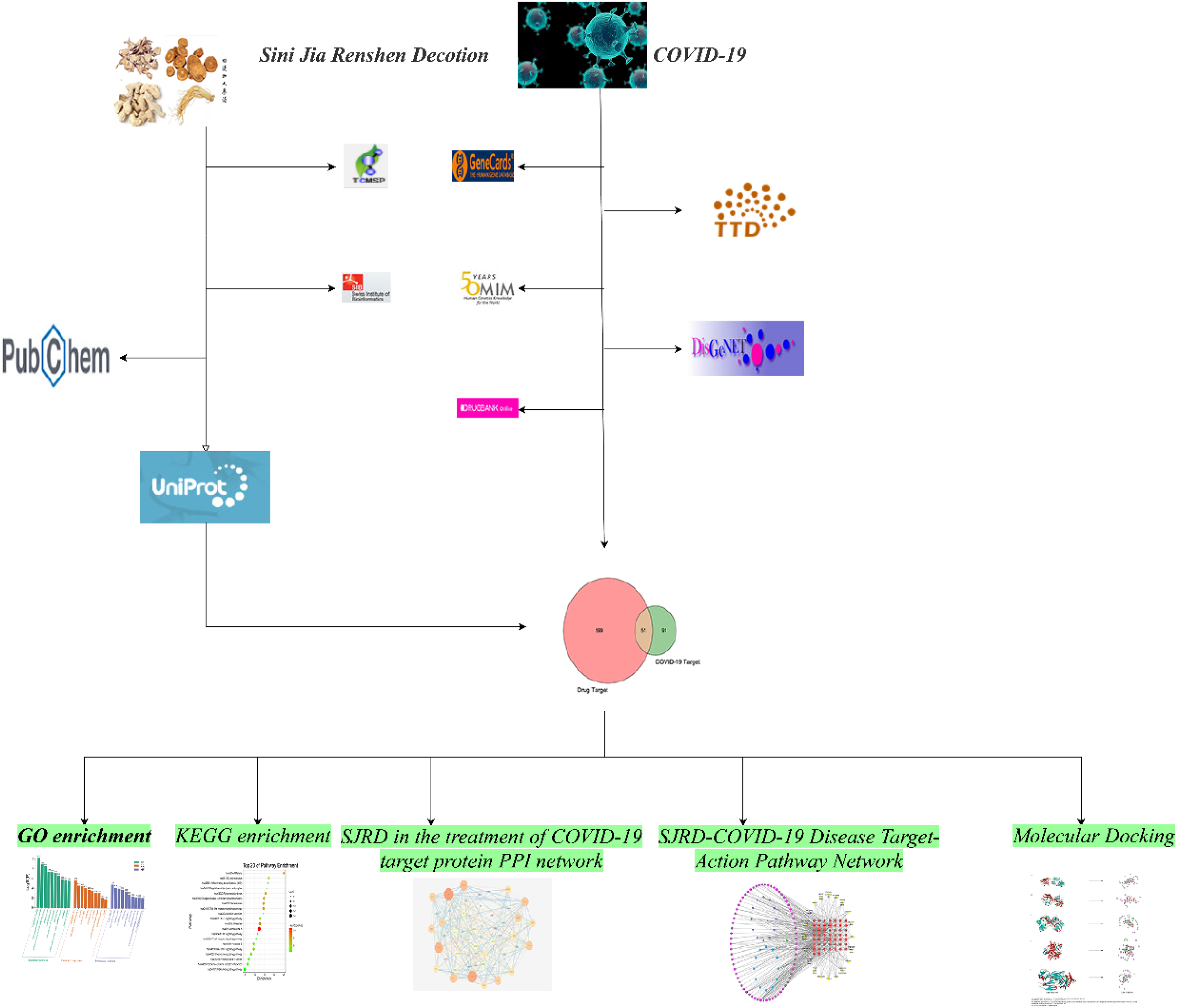
Flow chart.
Screening for Drug Targets of SJRD
We used the TCMSP database (http://tcmspw.com/tcmsp.php) to retrieve the chemical constituents of Radix Ginseng, Radix Aconiti Lateralis Praeparata, Rhizoma Zingiberis, and Radix Glycyrrhizae in SJRD 7 . Then these active ingredients were screened by the two ADME attribute values: oral bioavailability (OB) ≥ 30%, and drug-likeness (DL) ≥ 0.188,9. The next step was to summarize the protein targets of these active ingredients. For some active ingredients whose target is not recorded in TCMSP, we used Swiss Target Prediction (http://www.swisstargetprediction.ch/) to predict their protein targets 10 . The obtained protein targets were normalized in the Uniprot database (https://www.uniprot.org). Finally, we summarized and deduplicated the drug targets of SJRD 11 .
Acquired Targets for COVID-19
With COVID-19 as the key word, and using DisGeNET (https://www.disgenet.org/), TTD (http://db.idrblab.net/ttd/), OMIM (http://www.omim.org), Genecards (https://www.genecards.org/), and DRUGBANK (https://www.drugbank.ca/) databases, we respectively queried the targets of COVID-1912-16. In the Genecards database, the higher the target score, the more closely the target is linked to COVID-19. Therefore, we selected the target with a score greater than or equal to 10 as a potential target for the treatment of COVID-19. Finally, all disease targets were summarized and deduplicated.
Establishment of a PPI Network of SJRD-COVID-19 Target Proteins
In order to screen out the core targets of SJRD for the treatment of COVID-19, we intersected the drug targets and the disease targets by R language, and drew the Venn diagram. Next, the core targets were submitted to the STRING database (https://string-db.org/). We selected multiple protein analyses and set the organism to Homo sapiens. By setting the minimum required interaction score to medium confidence (0.400), a PPI network was established about SJRD and COVID-19 target proteins. We then imported it into Cytoscape 3.8.0 for visualization.
Gene Ontology and KEGG Pathway Enrichment Analysis
Through the DAVID database (https://david.ncifcrf.gov/), the core targets acquired in the previous step underwent GO function enrichment analysis and KEGG pathway enrichment analysis17,18. We used Omicshare tool (http://www.omicshare.com) to draw the bubble chart of the KEGG pathway and GO enrichment analysis bar chart.
Construction of Active Ingredients-Disease Target- KEGG Pathway Network
In order to clarify the relationship between the active ingredients of SJRD, the targets of COVID-19, and the pathway of action, Cytoscape 3.8.0 was used to establish a network of active ingredients of SJRD-targets of COVID-19-action pathways. In this network diagram, the point (Node) represents the components, targets and pathways, and the edge (Edge) represents the connection between them. Then we analyzed the network topology parameters of the active ingredients and disease targets. Using Degree, Betweenness and Closeness as referenced indicators, we chose these parameters to determine the core targets and the main active ingredients that play a role 19 .
Molecular Docking Verification
The RSCB PBD database (http://www.rcsb.org/) was used to find the PDB structure of the core targets 20 , and TCMSP was used to search for the MOL2 structure of the active ingredients. We used the DISCOVERY STUDIO platform for online molecular docking. The binding strength between the core targets of COVID-19 and the active ingredients of SJRD were judged by the Dockscore 21 .
Results
Active Ingredients of SJRD and Their Corresponding Targets
After screening by the two restrictive conditions of oral bioavailability (OB) and drug-likeness (DL), Radix Aconiti Lateralis Praeparata had 21 active ingredients, Rhizoma Zingiberis 5, Radix Ginseng 22, and Radix Glycyrrhizae 92. We summed up the active ingredients of the four medicines in which 136 active ingredients were obtained after removing the duplication. At the same time, we acquired 650 drug targets after removing the duplication. Detailed information of some of the active compounds are shown in Table 1.
Active Ingredients of SJRD.

Active Ingredients of SJRD.
In the Genecards database, the highest score for a target was 54, and the lowest was 1. Therefore, a score of ≥10 was set as the disease target of COVID-19. Next, the disease targets collected in the four databases were summarized and deduplicated. Finally, we obtained 142 disease targets.
Construction of PPI Network of Target Proteins of SJRD for the Treatment of COVID-19
We took the intersection between the targets of the active ingredients and the targets of COVID-19, and used the R language to draw the Venn diagram (Figure 2). We obtained 51 core targets. When these were visually analyzed by Cytoscape 3.8.0, the calculation rules of this software were used to analyze the degrees of nodes. The degree is the most direct measure of node centrality in network analysis. The greater the degree of a node, the higher its degree of centrality, and the more important the node is in the network. The results are shown in Figure 3.

The intersection of the drug targets of SJRD and the targets of COVID-19.

SJRD in the treatment of COVID-19 target protein PPI network.
Through GO function enrichment analysis, 289 GO entries were obtained with the threshold of P<.05. Among them, there were 235 biological process (BP) entries, 19 cellular component (CC) entries, and 35 molecular function (MF) entries. The first 10 of these were drawn into a bar graph, as shown in Figure 4. The larger the bubble in the figure, the greater the number of genes enriched in this pathway. The higher the ranking, the more likely it is being the main biological function and mechanism of SJRD in the treatment of COVID-19. BP mainly includes inflammatory response, cellular response to lipopolysaccharide, positive regulation of the nitric oxide biosynthetic process and immune response. CC mainly includes extracellular space, the external side of the plasma membrane, lysosome, and extracellular region. MF mainly includes cytokine activity, norepinephrine binding, receptor binding and epinephrine binding.

GO enrichment analysis of SJRD in the treatment of COVID-19.
KEGG pathway analysis showed that there were 93 pathways (P < .05), including those in measles, Chagas disease (American trypanosomiasis), amoebiasis, Toll-like receptor signaling pathway, malaria, chemokine signaling pathway, HIF-1 signaling pathway, Jak-STAT signaling pathway, cytokine-cytokine receptor interaction, and others. It was not difficult to find that they were mainly involved in such important pathological processes as virus infection, immune cell differentiation, and signal transduction pathways. The importance of these processes in COVID-19 is self-evident, and many studies have confirmed the correlation between these pathways and the corresponding symptoms of COVID-19. A bubble plot of the 20 most significant KEGG pathways are shown in Figure 5. Among them, the color depth in the bubble chart represents the P value, the darker and smaller, the more important.

KEGG pathway enrichment analysis of SJRD in the treatment of COVID-19.
Using Cytoscape 3.8.0, 40 potential components, 51 candidate targets, and the top 20 KEGG pathways were collected to construct a “C-T-P” network. As shown in Figure 6, purple nodes represent KEGG pathways, red nodes represent candidate, and purplish red nodes represent target components. The first 10 components with higher Degrees, Betweenness and Closeness were selected as the important ligands in the subsequent analysis. The top 10 components were quercetin, celabenzine, 3,22-dihydroxy-11-oxo-delta(12)-oleanene-27-alpha-methoxycarbonyl-29-oic acid, gomisin B, ignavine, 18α-hydroxyglycyrrhetic acid, ginsenoside Rg5_qt, (R)-norcoclaurine, kaempferol, and frutinone A. It is generally believed that the importance of the role of a target between components and pathways are positively associated with its degree. Therefore, according to the ranking of the targets’ degrees, the top 10 targets were selected. These were ADRB2, PRKACA, DPP4, F2, PIK3CG, TNF, PIK3CD, IL6, TLR4 and IFNG. Their specific network topology parameters are shown in Table 2 and Table 3.
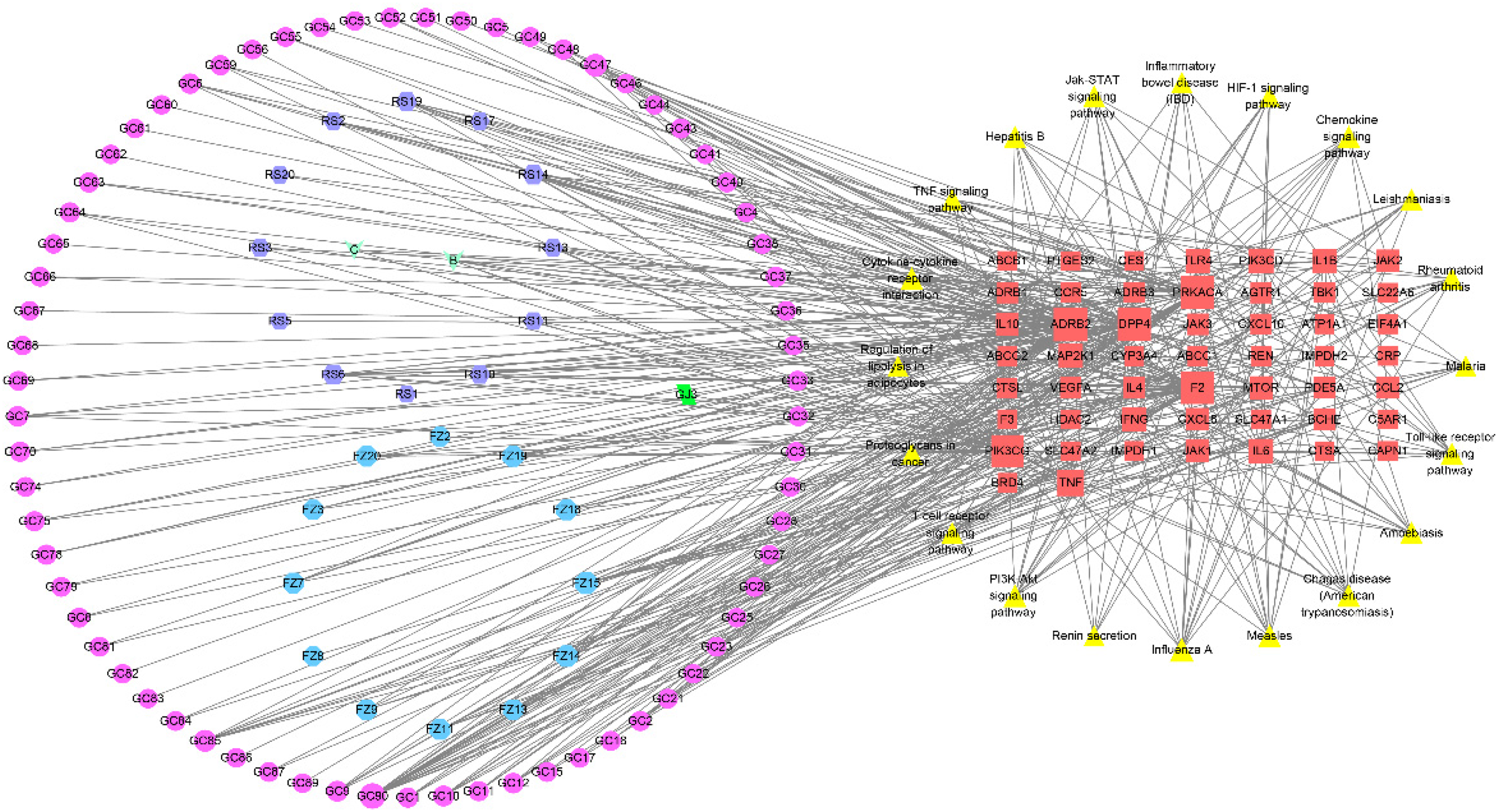
SJRD-COVID-19 disease target-action pathway.
The Main Active Ingredients of SJRD in the Treatment of COVID-19.

The Core Targets of SJRD in the Treatment of COVID-19.

The core targets were molecularly docked with the main active ingredients. The
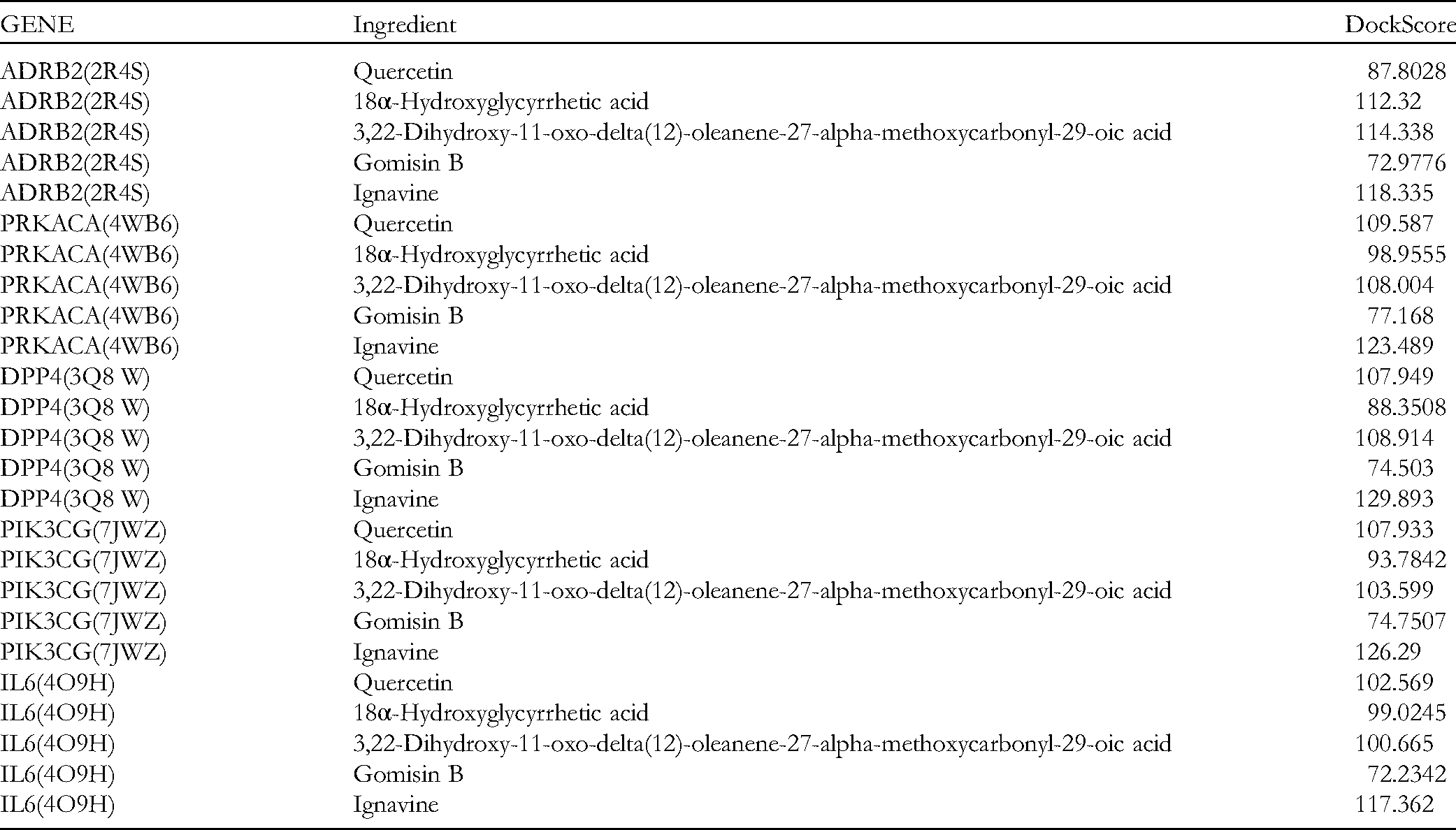
likelihood of the ligand interacting with the receptor is determined by the DockScore between them. The results of molecular docking are shown in Table 4, and the details in Figure 7. The bigger the DockScore, the more stable is the binding between the ligand and the receptor, and the greater the possibility of interaction. Quercetin, gomisin B, 18α-hydroxyglycyrrhetic acid, ignavine and 3,22-dihydroxy-11-oxo-delta(12)-oleanene-27-alpha-methoxycarbonyl-29-oic acid all had stable binding abilities with IL6, DPP4, PIK3CG, PRKACA and ADRB2.

Detailed view of molecular docking.
The Docking Results of the Main Active in Ingredients and the Main Core Target Molecules.
COVID-19 belongs to the category of “epidemic” in traditional Chinese medicine. It is highly infectious, and easy to spread. SARS-CoV-2 is the pathogen that causes COVID-1922-24. It is an enveloped, single-stranded RNA virus 25 , which can enter cells through at least two different ways, one of which is induced by TMPRSS2 on the cell surface, and the other which is mediated by the ACE2 receptor pathway 26 . Symptoms vary greatly after the host is infected, ranging from asymptomatic to multiple organ failure27,28. A variety of studies have shown that29,30 SARS-COV-2 can make the virus actively replicate after entering the cell, triggering a storm of cellular inflammatory factors, such as IL-6, TNF, IL-2, IL-7 and other inflammations. The factors work together to destroy alveolar type II epithelial cells, damage lung tissue and destroy the blood barrier, eventually leading to respiratory failure and damage to multiple organs. Traditional Chinese medicine has the unique advantages of holistic treatment and multi-target intervention.
In treatment, great attention should be paid to the connection between the lungs and other organs. Studies have shown that SJRD has a better effect on respiratory diseases with impaired lung function.
This study used the “component-target-pathway” network to explore the potential active components, targets and anti-COVID −19 mechanisms of SJRD; 9 active ingredients were significantly related to COVID-19. Quercetin has anti-inflammatory, antioxidant, antiviral, and protective effects on liver, kidney, and heart, and some studies have shown that it may regulate multiple signaling pathways by inhibiting the activity of recombinant human angiotensin-converting enzyme 2 (ACE2), and then play a therapeutic effect on COVID-1931-33. Some studies demonstrated that quercetin can interfere with various stages of the coronavirus entry and replication cycle such as PLpro, 3CLpro and NTPase/helicase 34 . It can also down-regulate the Jak -STAT signal pathway to improve the gas exchange function of the lungs, reduce the release of inflammatory mediators, and reduce lung injury. This is consistent with the results of the enrichment analysis of the KEGG pathway in our study 35 . At the same time, quercetin has a high affinity for 3-chymotrypsin-like protease (3CLpro), which is the receptor protein of SARS-CoV-2 like ACE2 36 . Ginsenoside Rg5 ameliorates lung inflammation in mice by inhibiting the binding of LPS to toll-like receptor-4 on macrophages 37 . Kaempferol is a flavonoid that has various pharmacological effects such as anti-cancer, anti-oxidation, anti-virus, anti-inflammatory, anti-bacterial, and immune enhancement 38 . The anti-inflammatory activity of kaempferol may be mediated by several mechanisms of action. The activation of nuclear factor kappa B (NF-kB) increases the expression of pro-inflammatory cytokines, chemokines and enzymes (e. g. TNF-α, IL-1, IL-6, IL8, COX-2, iNOS) 39 . Gomisin B has a variety of pharmacological effects, such as anti-asthma, anti-infection, protection of liver and heart, and can also reduce the inflammatory response of lung injury 40 . The above evidence suggests that various components in SJRD may play anti-inflammatory and anti-virus roles by inhibiting the binding of SARS-CoV-2 to receptor proteins.
Through PPI network analysis, we found that IL4, IL6, IL10, IL-1β, and TNF were the main targets of SJRD in the treatment of COVID-19. IL4, IL6, IL10 and IL-1β belong to the interleukin (IL) family. Interleukin −4 (IL-4), a pro-inflammatory cytokine, has been found to use the receptor IL-4R and is seen to activate quite common pathways in signaling. The use of Janus kinase (JAKs) by IL-4 has also been seen. A variety of other different signaling molecules were found to be activated, which play an essential role in regulating the proliferation induced by IL-4 41 . IL-6 is an emerging biomarker for COVID-19. In the study by Chen et al, 52% (51/99) of patients had elevated IL-6 levels at admission 42 . Increased IL-6 levels have been associated with increased risk of death 43 , and a gradual increase during hospitalization has been reported in non-survivors 44 . The national version of the diagnosis and treatment plan (eighth edition) also mentioned that the early warning indicators of severely/critically ill patients’ condition were deteriorated and progressively lower peripheral blood lymphocyte counts, or gradually increasing levels of peripheral blood inflammatory markers such as interleukin (IL)-6, C reactive protein (CRP), and ferritin. It is recommended to use cytokine monitoring equipment to monitor the treatment of patients to improve the cure rate and reduce the mortality rate 45 . A reduction in IL-1β activity would reduce IL-6 production 46 . IL-10 might constitute a potential target to reduce COVID-19 mortality by attempting to block its pathological proinflammatory function 47 . TNF is the main cytokine that mediates inflammation and innate immunity. Overexpression causes cytokine storm, dysfunction of cytokines, and disrupts the immune balance 48 .
GO analysis shows that the targets of SJRD in the treatment of COVID −19 are mainly involved in inflammatory response, cellular response to lipopolysaccharide, positive regulation of the nitric oxide biosynthetic process, immune response, neutrophil chemotaxis, response to drug, and other immune-related biological processes. KEGG analysis results show that these targets are mainly enriched in cytokine-cytokine receptor interaction, JAK-STAT signaling pathway, chemokine signaling pathway, influenza A, measles, malaria, Toll-like receptor signaling pathway, TNF signaling pathway and HIF-1 signaling pathway. Cytokines are a class of small molecular proteins with a wide range of biological activities synthesized and secreted by a variety of tissue cells. They usually bind to corresponding receptors to regulate cell-cell interactions, thereby regulating the host of innate or adaptive immune responses, defense procedures and biological processes, such as cell growth and differentiation49-51. JAK-STAT is a signal transduction pathway stimulated by cytokines, which mainly plays an important role in cell proliferation, differentiation, apoptosis and immune regulation. Luo 52 explored the potential and mechanism of action of targeting the JAK-STAT signaling pathway in COVID-19, and believed that JAK inhibitors have considerable theoretical advantages for the treatment of CRS in COVID-19. The main function of chemokines is to recruit white blood cells to the site of infection, trigger an inflammatory immune response, and resist the infection of the body by microorganisms 53 . The chemokine signaling pathway mainly regulates the body's immune response by activating downstream JAK-STAT, PI3-Akt and other signaling pathways 54 .
For molecular docking, corresponding protein structures were obtained from the PDB database. Then, the 3-dimensional (3D) structure of the target proteins and the components were subjected to molecular docking using the Discovery Studio 2016 client. From the protein structure file, the water molecules, hydrogen bonds, and proto-ligands were omitted. Specific details, including the docking fraction, are presented in Table 4. Two dimensional and 3D views of the protein and the docking component are shown in Figure 7. To assess the quality of docking between the component and protein, a Dock Score of >70 was considered as effective binding. Among these,ADRB2 and ignavine exhibited the strongest binding, having a Dock Score of 118.335. Overall, the corresponding docking scores suggest effective binding between the active components and key targets. They also suggest that the prediction results of network pharmacology are reliable and accurate.
Traditional Chinese medicine plays an important role in COVID-19 treatment. However, because of too many ingredients in TCM and the low content of some effective medicinal substances, the short-term efficacy of TCM is limited, which also limits its global acceptance. With the current research on TCM, it is difficult to determine a manner in which TCM can be adapted for local conditions, find TCM prescriptions for symptomatic treatment, and to discover the specific active substances to form a reasonable combination of multicomponents. At present, the best solution for this stubborn epidemic is early protection, early diagnosis, early isolation, and early treatment. Rational use of TCM, and COVID-19 treatment with a combination of TCM and Western medicine may be the most effective measure, and may also become an effective method to control the epidemic quickly.
In this study, we evaluated the chemical constituents, action targets, and the binding ability of the core compounds of SJRD to COVID-19 3CL hydrolase in SJRD via network pharmacology and molecular docking. From the research results, it can be seen that SJRD can exert its curative effect through the synergistic effect of multicomponents, multitargets, and multi-pathways in the treatment of diseases. However, network pharmacology is still in the early stages of development and has many problems. First, appropriate computing software has not been developed for network pharmacology. Further, screening, integration, and processing of data is another problem. The data on various drugs, genes, proteins, and others, are not comprehensive. The databases on Chinese herbal medicines, proprietary Chinese medicines, and TCM are incomplete, and their accuracy and integrity have not been verified. Network pharmacology uses computer network screening to achieve target selection, and many results do not have enough experimental data support. The known compound targets do not completely correspond to the complex mechanism of TCM formulae. Because of the limitations of network pharmacology and molecular docking, experimental studies can be performed with regard to material basis, pharmacodynamics, and pathway verification at later stages to provide the theoretical and experimental basis for the use of SJRD in the treatment of COVID-19. In addition, future studies can be conducted with regard to drug development and the use of SJRD as a reference for dealing with invasions of other stubborn viruses.
Conclusion
COVID-19 seriously threatens people's health and reduces the quality of life. This study used the “component-target-pathway” network to analyze the active ingredients of SJRD against COVID-19 and to understand its pharmacological mechanism. SJRD may be able to treat the new type of coronavirus pneumonia by acting on the above pathways and targets, but it needs to be further confirmed by animal experiments. The results of this study provide a strong theoretical basis for further systematic experimental research on the anti-COVID-19 effect of SJRD, and provide theoretical guidance for its clinical application.
Footnotes
Conflict of Interests
The authors declare that they have no competing interests.
Availability of Data and Materials
The datasets used and/or analyzed during the current study are available from the corresponding author on reasonable request.
Ethical Approval
Ethical Approval is not applicable for this article.
Statement of Human and Animal Rights
This article does not contain any studies with human or animal subjects.
Statement of Informed Consent
There are no human subjects in this article and informed consent is not applicable.
Declaration of Conflicting Interests
The author(s) declared no potential conflicts of interest with respect to the research, authorship, and/or publication of this article.
Funding
The author(s) disclosed receipt of the following financial support for the research, authorship, and/or publication of this article: This work was supported by the Health Commission of Hubei Province (grant number ZY2019Z011).

Trial Registration
Not applicable, because this article does not contain any clinical trials.