



Abstract
Introduction
Since the end of 2019, the acute respiratory infectious disease caused by severe acute respiratory syndrome coronavirus 2 (SARS-CoV-2) has spread globally. The WHO named it COVID-19. This has caused a serious negative impact on the health and economic development of all human beings, as well as social order. At present, there is no specific drug for treatment of this disease. We mainly promote the recovery of patients through supportive management. 1 Traditional Chinese medicine (TCM) is crucial in the COVID-19 outbreak, and plays an integral role in all three processes: the prevention and treatment of COVID-19, and the recovery of patients. 2 In the preliminary treatment, TCM can significantly inhibit the deterioration of the disease, reduce the patient's symptoms and promote the negative conversion of viral nucleic acid. At the same time, TCM can promote the conversion of severe cases into mild cases. 3 This shows that TCM has a positive effect on patients with COVID-19 at different periods.
SBS is composed of ten Chinese medicines: Dolichos lablab L. (Baibiandou), Atractylodes macrocephala Koidz. (Baizhu), Poria cocos(Schw.)Wolf. (Fuling), Glycyrrhiza uralensis Fisch. (Gancao), Platycodon grandiforum(Jacq)A. DC. (Jiegeng), Nelumbo nucifera Gaertn (Lianzi), Panax ginseng C. A. Mey. (Renshen), Amomun villosum Lour. (Sharen), Dioscorea opposita Thunb. (Shanyao), and Coix lacryma-jobi L. var. mayuen. (Roman.) Stapf (Yiyiren). SBS is recorded in the earliest existing Chinese official pharmacopoeia “Tai Ping Hui Min He Ji Ju Fang”. 4 SBS has the effects of replenishing the spleen, stomach and lungs. It fits the main pathogenesis of COVID-19 “damp, poison, and epidemic”. 5 Therefore, SBS was used to recover COVID - 19 patients and achieved good results. However, its current mechanism of action is not particularly clear. The motivation of this study was to use network pharmacology to analyze the active ingredients and mechanism of action of SBS, which has been clinically proved to have a therapeutic effect on COVID-19, and to confirm the relevant results by molecular docking. This can not only provide a further theoretical basis for SBS treatment of COVID-19, but also contribute to the development of new drugs.
Network pharmacology includes the technology and content of multiple disciplines such as systems biology, multi-directional pharmacology and computational biology. It can explore the connection between drugs and diseases from the overall perspective. 6 The holistic, systematic and comprehensive nature of network pharmacology fits well with the characteristics of multiple components, multiple targets, and multiple pathways of traditional Chinese medicine. Therefore, network pharmacology is used to study the mechanism of action of traditional Chinese medicines. 7 To understand the molecular mechanism of SBS in treating convalescent COVID-19 patients, this study used network pharmacology and molecular docking technology to explore the core targets, pathways and active ingredients of SBS in the treatment of COVID-19, in order to provide new ideas for the prevention and treatment of the disease by TCM. The specific process is shown in Figure 1.

Flow chart.
Materials and Methods
Screening of Drug Targets of SBS
We used the TCMSP database (http://tcmspw.com/tcmsp.php) to retrieve the chemical constituents of Baibiandou, Baizhu, Fuling, Gancao, Jiegeng, Renshen, Sharen, Shanyao, and Yiyiren. 8 We used the ETCM database (http://www.tcmip.cn/ETCM/index.php/Home/) to retrieve the chemical constituents of Lianzi. 9 Then the active ingredients of SBS were screened by the two ADME attribute values: oral bioavailability (OB) ≥ 30%, and drug-likeness (DL) ≥ 0.18.10,11 The next step was to summarize the protein targets of these active ingredients. For some active ingredients whose target is not recorded in TCMSP, we used SwissTargetPrediction (http://www.swisstargetprediction.ch/) to predict their protein targets. 12 The obtained protein targets were normalized in the Uniprot database (https://www.uniprot.org). Finally, we summarized and deduplicated drug targets of SBS. 13
Targets for COVID-19
With COVID-19 as the key word, and using the DisGeNET (https://www.disgenet.org/), TTD (http://db.idrblab.net/ttd/), OMIM (http://www.omim.org), Genecards (https://www.genecards.org/) and DRUGBANK databases (https://www.drugbank.ca/), we respectively queried the targets of COVID-19.14-18 In the Genecards database, the higher the target score, the more closely the target is linked to COVID-19. Therefore, we selected the target with a score greater than or equal to the median as a potential target for the treatment of COVID-19. Finally, all disease targets were summarized and deduplicated.
Establishment of a PPI Network of SBS-COVID-19 Target Proteins
In order to screen out the core targets of SBS for the treatment of COVID-19, we intersected the drug targets and the disease targets by R language, and drew the Venn diagram. Next, the core targets were submitted to the STRING database (https://string-db.org/). We selected multiple proteins for analysis and set the organism to Homo sapiens. 19 By setting the minimum required interaction score to medium confidence (0.400), a PPI network about the SBS and COVID-19 target proteins was established; this was then imported into Cytoscape 3.8.0 for visualization.
Gene Ontology and KEGG Pathway Enrichment Analysis
Through the DAVID database (https://david.ncifcrf.gov/), for the core targets which had been acquired in the previous step, GO function enrichment analysis and KEGG pathway enrichment analysis were performed.20,21 We used Omicshare tool (http://www.omicshare.com) to draw the bubble chart of the KEGG pathway and GO enrichment analysis for the bar chart.
Construction of the Active Ingredients-Disease Target- KEGG Pathway Network
In order to clarify the relationship between the active ingredients of SBS, the targets of COVID-19, and the pathway of action, Cytoscape 3.8.0 was used to establish a network of active ingredients of SBS-targets of COVID-19-action pathways. In this network diagram, the point (Node) represents the components, targets and pathways, and the edge (Edge) represents the connection between them. Then we analyzed the network topology parameters of the active ingredients and disease targets. Using Degree, Betweenness and Closeness as reference indicators, we chose these parameters to determine the core targets and the main active ingredients that play a role. 22
Molecular Docking Verification
RSCB PBD database (http://www.rcsb.org/) was used to find the PDB structure of the core targets, 23 and TCMSP was used to search for the MOL2 structure of the active ingredients. We used the SwissDock platform (http://www.swissdock.ch/) for online molecular docking.24,25 The binding strength between the core targets of COVID-19 and the active ingredients of SBS were judged by the binding energy.26,27 The smaller the binding energy, the more stable was the binding between the ligand and the receptor, and the greater the possibility of interaction. 28
Results
The Active Ingredients of SBS and Their Corresponding Targets
After screening by considering the two restrictive conditions of oral bioavailability (OB) and drug-likeness (DL), Baibiandou in SBS has 1 active ingredient, Baizhu has 7 active ingredients, Fuling has 15 active ingredients, Gancao has 92 active ingredients, Jiegeng has 7 active ingredients, Lianzi have 5 active ingredients, Renshen has 22 active ingredients, Sharen has 10 active ingredients, Shanyao has 16 active ingredients, and Yiyiren has 9 active ingredients. By summing up the active ingredients of the ten medicines, 177 were obtained after removing duplication. At the same time, we acquired 681 drug targets after removing duplication. Detailed information of some of the active compounds is shown in Table 1.
Active Ingredients of SBS.

Targets of COVID-19
In the Genecards database, the highest score with a target was 21.78, the lowest was 0.31, and the median was 11.045. Therefore, the score with a target ≥11.045 was set as the disease target of COVID-19. Next, the disease targets collected in the five databases were summarized and deduplicated. Finally, we obtained 164 disease targets.
Construction of the PPI Network of the Target Protein of SBS for the Treatment of COVID-19
We took the intersection between the targets of active ingredients and the targets of COVID-19, and used R language to draw the Venn diagram (Figure 2); 43 core targets were obtained. These were then submitted to the STRING database, and the PPI network, which is about the targets of SBS for the treatment of COVID-19, was built. It was optimized by Cytoscape 3.8.0 (Figure 3).

The intersection of the drug targets of SBS and the targets of COVID-19.

SBS in the treatment of COVID-19 target protein PPI network.
GO Function Enrichment Analysis and KEGG Pathway Enrichment Analysis
In the GO analysis, there were 256 items related to biological process (BP), mainly including inflammatory response, positive regulation of nitric oxide biosynthetic process, positive regulation of transcription from RNA and response to lipopolysaccharide. There were 45 items on molecular function (MF), mainly including Ras guanyl-nucleotide exchange factor activity, receptor binding, drug binding, cytokine activity and steroid hormone receptor activity. There were 25 items related to cellular component (CC), mainly including membrane raft, cell surface and lysosome. According to the P value, we selected the top 10 items about BP, CC, and MF to draw a bar graph. The result is shown in Figure 4. From the enrichment analysis of the KEGG pathway, it can be seen that SBS has 58 pathways in the treatment of COVID-19, mainly including leishmaniasis, tuberculosis, malaria, HIF-1 signaling pathway, Jak-STAT signaling pathway, influenza A, and PI3K-Akt signaling pathway. According to the P value, we selected the top 20 pathway enrichments to draw a bubble chart (Figure 5). From the results of enrichment analysis, it can be seen that SBS treatment of COVID-19 is the result of multiple targets and multiple pathways.

Go enrichment analysis of SBS in the treatment of COVID-19.

KEGG pathway enrichment analysis of SBS in the treatment of COVID-19.
Active Ingredients of SBS-Targets of COVID-19-KEGG Pathway Network Diagram
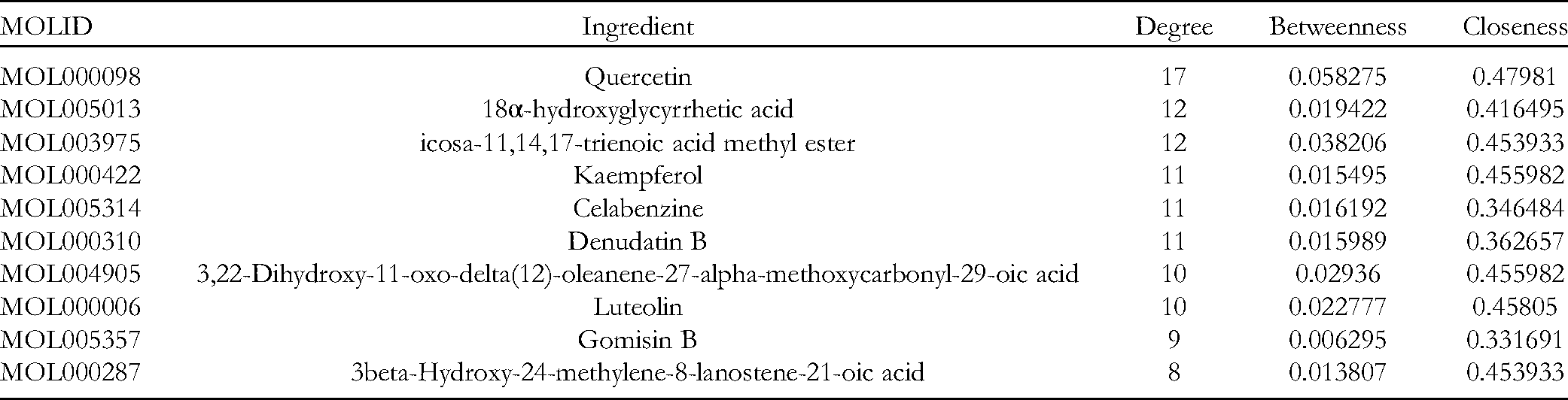
In order to clarify the main active ingredients and core targets of SBS in the treatment of COVID-19, a network diagram which is about the active ingredients of SBS - disease targets - KEGG pathway network was constructed by Cytoscape 3.8.0. Analyzing this network with NetworkAnalyzer, we obtained the main active ingredients and core targets of SBS for the treatment of COVID-19; the network diagram is shown in Figure 6. The results showed that quercetin, 18α-hydroxyglycyrrhetic acid, icosa-11,14,17-trienoic acid methyl ester, kaempferol, 3,22-dihydroxy-11-oxo-olean-12-ene-27α-methoxycarbonyl-29-oic acid, luteolin, gomisin B, 3β-hydroxy-24-methylene-lanost-8-ene-21-oic acid, celabenzine, and denudatin B were the main active ingredients of SBS for the treatment of COVID-19, and that PTGS2, NOS2, PPARG, PTGS1, DPP4, F2, TNF, IFNG, IL6, and NR3C1 were their core targets; their specific network topology parameters are shown in Tables 2 and 3.

SBS-COVID-19 disease target-action pathway network.
The Main Active Ingredients of SBS in the Treatment of COVID-19.
The Core Targets of SBS in the Treatment of COVID-19.

Results of Molecular Docking Between Active Ingredients and Core Targets
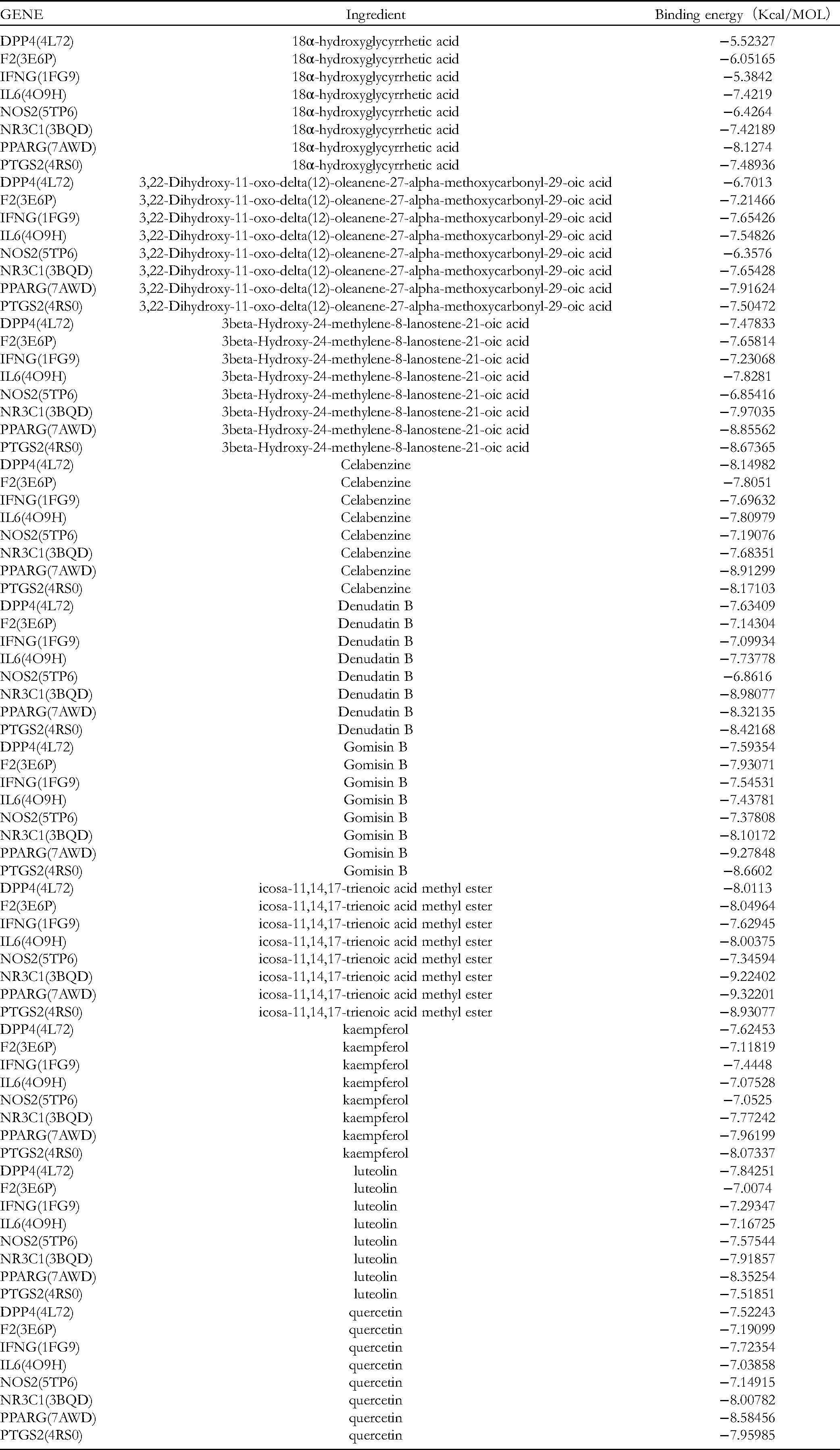
The core targets were molecularly docked with the main active ingredients. The likelihood of the ligand interacting with the receptor is determined by the binding energy between them. The results of molecular docking are shown in Table 4, and the details of molecular docking in Figure 7.

Detailed view of molecular docking.
The Docking Results of the Main Active Ingredients and the Main Core Target Molecules.
Discussion
Since the outbreak of COVID-19 at the end of 2019, it has caused great harm to human health all over the world. At present, there is no specific drug for COVID-19 in clinic. Therefore, it is of great significance to screen traditional Chinese medicines, and to know their active components, core targets and active pathways that have a therapeutic effect on COVID-19.
We obtained some core active ingredients of SBS for the treatment of COVID-19, including quercetin, kaempferol, luteolin and gomisin B. Quercetin has anti-inflammatory, antioxidant, antiviral, and protective effects on liver, kidney, and heart, and some studies have shown that it may regulate multiple signaling pathways by inhibiting the activity of recombinant human angiotensin-converting enzyme 2 (ACE2), and then play a therapeutic effect on COVID-19.29-31 Quercetin can down-regulate the Jak -STAT signal pathway to improve the gas exchange function of the lungs, reduce the release of inflammatory mediators, and reduce lung injury, which is consistent with the results of the enrichment analysis of the KEGG pathway in our study. 32 At the same time, quercetin has a high affinity for 3-chymotrypsin-like protease (3CLpro), which is the receptor protein of SARS-CoV-2 like ACE2.33,34 Both kaempferol and luteolin are flavonols, which have various biological functions such as antiviral, anti-inflammatory and immune regulation.35,36 Some scholars have found that kaempferol and luteolin can effectively fight SARS-CoV-2 infection through molecular dynamics simulation research and MM-PBSA combined free energy calculation technology, which coincides with our research. 37 Gomisin B has a variety of pharmacological effects such as anti-asthma, anti-infection, protection of liver and heart, and can also reduce the inflammatory response of lung injury. 38 The above evidence suggests that various components in SBS may play anti-inflammatory and anti-virus roles by inhibiting the binding of SARS-CoV-2 to receptor proteins.
In addition to targeting ACE2 and 3CLpro, SBS has also been shown to regulate IL6 to relieve the symptoms of COVID-19. Among the core targets of SBS for the treatment of COVID-19, PTGS2 and PTGS1 are important targets of the arachidonic acid metabolism pathway. They can directly promote the production of IL-6 by activating PGE2. The level of IL6 is associated with acute respiratory distress syndrome. 39 The progressive increase in IL6 is a clinical warning indicator for the deterioration of the disease in the “Chinese Novel Coronavirus Diagnosis and Treatment Program”. Studies have shown that serum TNF-α cytokines in patients with COVID-19 were significantly increased. 40 The continuous production of pro-inflammatory cytokines such as TNF-α and IL6 can lead to immune disorders and lead to respiratory failure. 41 Some studies have also shown that dipeptidyl peptidase-4 (DPP4) can be another possible receptor for the virus. The existence and severity of COVID-19 are related to the reduction of DPP4, which may be a possibility for disease monitoring in the course of the disease. 42 A study proved that SARS-CoV-2 also uses DPP4 as a co-receptor when entering cells; the suppression of DPP4 was not only for halting the progression to the hyper-inflammatory state, but also for reducing viral infection to target cells in COVID-19 patients. 43 Network pharmacology and molecular docking analysis show that SBS may play a role in an anti-cytokine storm and have an antioxidant effect by regulating IL-6, TNF, DPP4 and other targets after virus infection of host cells, thereby playing a role in the treatment of COVID-19.
In this pharmacological network-based study, we studied the potential mechanism of SBS in the treatment of COVID-19. The results showed that SBS could reduce the inflammatory response, apoptosis and immune defense of SARS-CoV-2 infection. In addition, we provide several potential targets for the treatment of COVID-19, which may help to develop new treatment options. However, our study has several limitations. First, our results need to be further verified by subsequent pharmacodynamic and pharmacokinetic experiments. Secondly, a more comprehensive database of traditional Chinese medicine is needed to make the results of network pharmacological analysis more reliable. Third, even if we combine the results of network pharmacology and molecular docking, we still could not fully understand the accurate treatment mechanism of SBS.
Conclusion
In China's struggle with COVID-19, SBS, a traditional Chinese medicine formula, has been proven to be effective in treating patients with COVID-19. In summary, we obtained the active ingredients of SBS and explored the complex pharmacological mechanism of SBS for the treatment of COVID-19 through network pharmacology. The comprehensive analysis of the active ingredients and core targets of SBS by network pharmacology showed that the effect of SBS is the result of multi-component, multi-target and multi-channel interaction in the treatment of COVID-19.
Footnotes
Declaration of Conflicting Interests
The author(s) declared no potential conflicts of interest with respect to the research, authorship, and/or publication of this article.
Funding
The author(s) disclosed receipt of the following financial support for the research, authorship, and/or publication of this article: This work was supported by the Health Commission of Hubwi Province (grant number ZY2019Z011).
Availability of Data and Materials
The datasets used and/or analyzed during the current study are available from the corresponding author on reasonable request.
Ethical Approval
Ethical Approval is not applicable for this article.

Statement of Human and Animal Rights
This article does not contain any studies with human or animal subjects.
Statement of Informed Consent
There are no human subjects in this article and informed consent is not applicable.
Trial Registration
Not applicable, because this article does not contain any clinical trials.