



Abstract
The novel coronavirus, 2019-nCoV, has led to a major pandemic in 2020 and is responsible for more than 2.9 million officially recorded deaths worldwide. As well as synthetic anti-viral drugs, there is also a need to explore natural herbal remedies. The Traditional Chinese Medicines (TCMs) system has been used for thousands of years for the prevention, diagnosis, and treatment of several chronic diseases. In this paper, we performed an in silico molecular docking and interaction analysis of TCMs against SARS-CoV-2 receptor RNA-dependent RNA polymerase (RdRp). We obtained the 5 most effective plant compounds which had a better binding affinity towards the target receptor protein. These compounds areforsythoside A, rutin, ginkgolide C, icariside II, and nolinospiroside E. The top-ranked compound, based on docking score, was nolinospiroside, a glycoside found in Ophiopogon japonicas that has antioxidant properties. Protein-ligand interaction analysis discerned that nolinospiroside formed a strong bond between ARG 349 of the protein receptor and the carboxylate group of the ligand, forming a stable complex. Hence, nolinospiroside could be deployed as a lead compound against SARS-CoV-2 infection that can be further investigated for its potential benefits in curbing the viral infection.
Keywords
The Coronavirus disease 2019 (COVID-19), caused by Severe Acute Respiratory Syndrome Coronavirus 2 (SARS-CoV-2), started in the city of Wuhan in China in December 2019. The virus belongs to a notorious family of coronaviruses that caused Severe Acute Respiratory Syndrome (SARS) in 2003 and Middle East Respiratory Syndrome (MERS) in 2012. 1 Published studies have reported that this virus belongs to the beta-BAT-SARS-CoV-2 group, which has some essential amino acids necessary for viral replication. 1 The common symptoms of SARS-CoV-2 infected people are fever along with cough, shortness of breath, and gradual difficulty in breathing. In severe cases, people develop pneumonia, SARS, and eventually death. The COVID-19 outbreak has spread over 200 countries and has been declared as a global health threat to life, leading to serious financial instability all around the world. Currently, there is no specific medication available to fight against COVID-19 and, therefore, several attempts are being made to treat the clinical conditions fostered by COVID-19 positive patients. Meanwhile, the research community is striving hard to find virus-specific treatments and medicaments which could effectively treat the infected patients, as well as prevent the further spread of the virus. The available antiviral medicaments and therapies in clinical use hold a very narrow spectrum of activity and therapeutic usefulness, and their toxicity varies from drug to drug. 2 The possible treatments against SARS-CoV-2 may normalize respiratory symptoms or inhibit viral replication. There are several promising antiviral agents, immunotherapies, and vaccines that have been discovered and are being developed to potentially combat the virus, but due to lack of sufficient effective clinical results, they cannot be used as confirmed medication. 3,4
Medicinal plants have long been used for the treatment of diseases including Indian Ayurveda, African herbs, and Traditional Chinese Medicines (TCMs). These plants contain several Pharmaceutical Active Ingredients (PAIs) that can be utilized to formulate modern drugs. 5 TCM, evolved over thousands of years, uses various mind and body practices (such as acupuncture and tai chi)and herbal compounds to treat various diseases. As far as compounds from the TCM is concerned, these have been studied for several diseases, including heart diseases, 6,7 stroke, 8 -10 mental disorders, 11 -14 respiratory diseases, 15 -17 liver diseases, 18,19 and SARS-CoV-2 infections. 12,20 TCMs observed to have good efficacy for the SARS outbreak in 2003 are also reported to be effective for combating COVID-19. A recent review of the effectiveness of TCM to combat COVID-19 can be found in Chen & Chen. 20
There are around 30 TCM herbs reported to be effective for COVID-19 treatment. 21 -23 However, among them, which has the best binding affinity with the SARS-CoV-2 receptors is unknown. Hence, here we performed molecular docking studies of 30 selected TCM compounds with the SARS-CoV-2 receptor protein and ranked the herbs based on docking score and free energy. Our analysis could be useful for selecting the best inhibitor for COVID-19 infections.
Materials and Methods
Drug Library Preparation
We retrieved the approved herbal extracts of Traditional Chinese Medicines (TCMs) for novel coronavirus that are being tested against the SARS-CoV-2 infection in patients. 24 PubChem 25 was used to retrieve their structures in .mol/.sdf file formats.
Protein Target Preparation
The optimization of RdRp was performed using Schrodinger maestro 26 to alleviate any steric clashes present before the protein preparation step.
Molecular Docking Analysis
AutoDockVina software 27 was employed for the docking experiments with the optimized RdRp model as the docking target. Notably, the docking space was not kept restricted to explore the complete protein receptor surface. A grid box of 110 Å × 110 Å × 118 Å was generated for the SARS-CoV-2 RdRp. The ligand was treated as flexible and only torsional degrees of freedom were explored, holding bond angles and bond lengths constant.
Protein-Ligand Interaction Analysis
The complexes obtained after docking were inspected using the Protein-Ligand Interaction Profiler 28 to understand the type of interaction that governs this binding.
Results and Discussion
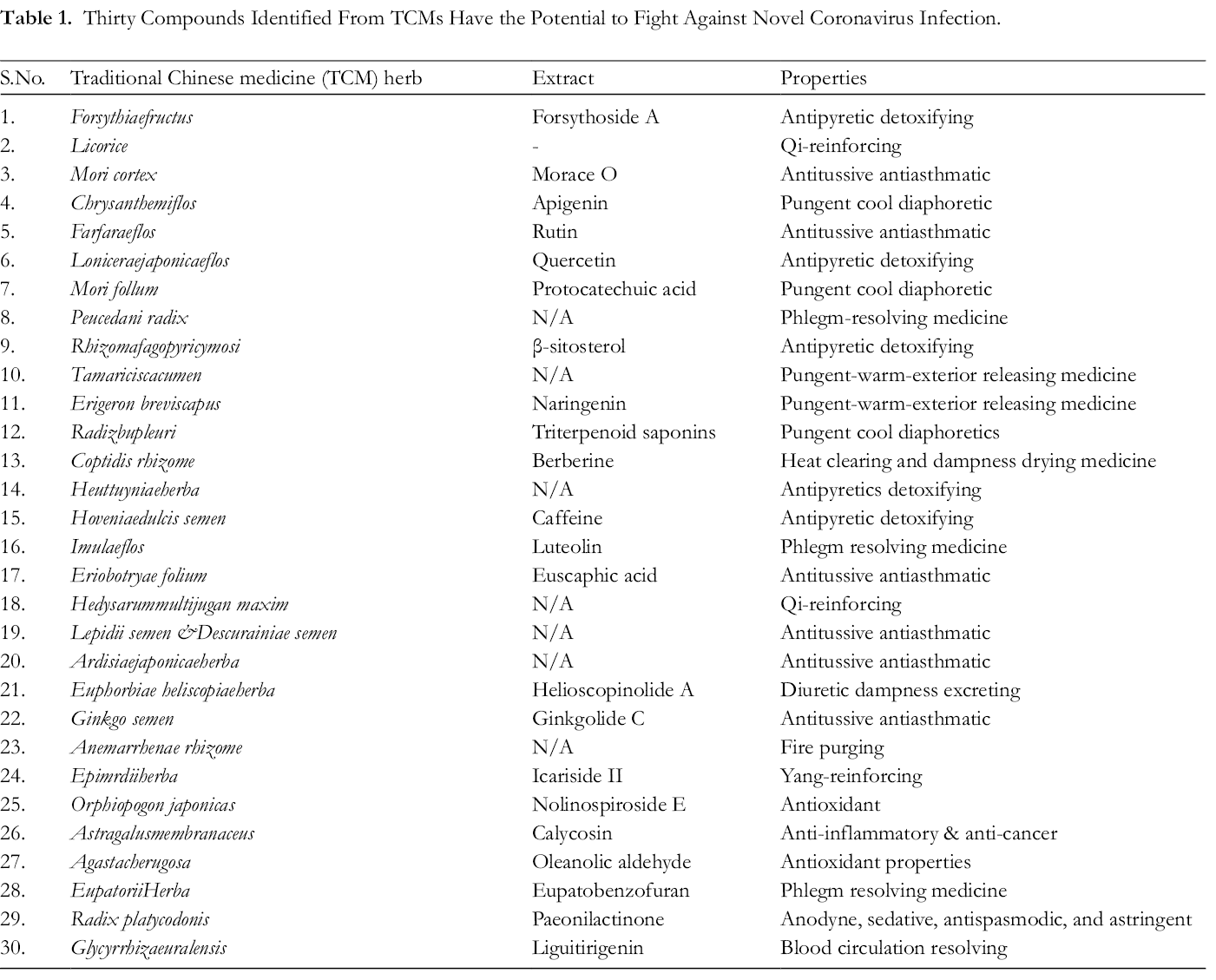
In the current work, our objective was to examine the existing drugs from traditional Chinese medicines (TCM) that could potentially and effectively interact with the SARS-CoV-2 RdRp protein and, therefore, potentially be used for antiviral treatments. We retrieved the 30 best drug extracts from the TCM which are currently being tested for efficacy against COVID-19 infected patients. Table 1 lists the 30 best drug candidates identified which can be used to fight the COVID-19 infection. 24
Thirty Compounds Identified From TCMs Have the Potential to Fight Against Novel Coronavirus Infection.
Out of these 30 compounds, the comparative binding energy of the top 25 drug compounds is depicted in Figure 1. We identified the 5 most effective drug compounds which had a better binding affinity towards the target receptor protein, namely forsythoside A, rutin, ginkgolide C, icariside II, and nolinospiroside E; their details are presented in Table 2. With these results in hand, we discerned that the TCM compounds exhibited binding energies for RdRp between –5 and –9 kcal/mol. Two of the compounds displayed the lowest binding energy as compared to the others, namely, nolinospiroside and rutin, and these might prove to be potential drugs employed against COVID-19 infection.

Comparative binding energy of drug compounds.
Top 5 Herbal Compounds Retrieved After Molecular Docking.
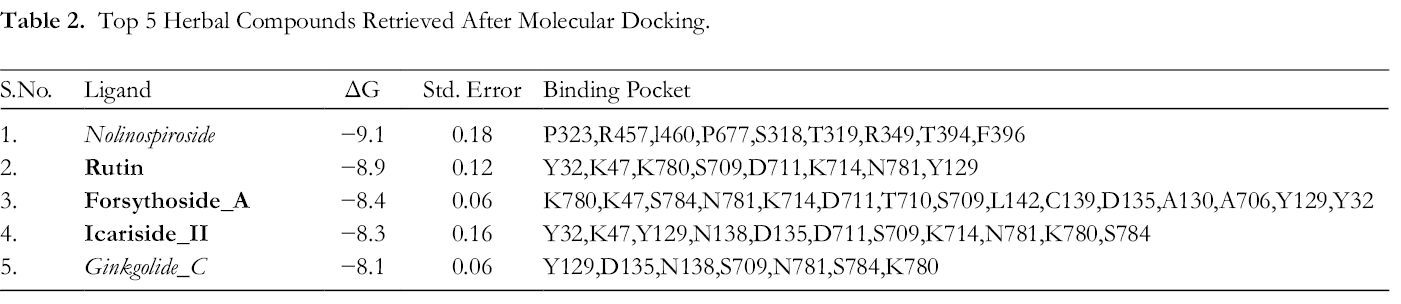
The top-ranked compound based on docking score was nolinospiroside, a glycoside found in Ophiopogonjaponicas that has antioxidant properties and showed binding energy of −9.1 kcal/mol with a 0.18 standard error. It was observed from the docking results that hydrogen bonds and hydrophobic interactions rule the binding. Furthermore, salt-bridge formation and pi-stacking were also observed.
After retrieving the best-docked complexes, we subjected them to a protein-ligand interaction analysis using PLIP and found that nolinospiroside formed 5 hoursydrogen bonds and 5 hoursydrophobic interactions, along with one salt bridge formed between ARG 349 of the protein receptor and the carboxylate group of the ligand. The hydrogen bonds formed between ligand and protein were almost over a distance of 2.5 Å. Therefore, the stronger the hydrogen bond, the greater is the stability of the binding. Table 3 showcases the interactions formed between the protein receptor and the best 5 drug candidates.
Interactions Formed Between the Best 5 Drug Candidates With the Target RdRp Receptor Protein.

Conclusion
The coronavirus disease (COVID-19) pandemic is an ongoing global issue whose epicenter is the city of Wuhan in China. This pandemic has caused researchers to shift to its impact on human health. In this paper, we performed a molecular docking and interaction analysis. The results suggest that out of the commonly employed Traditional Chinese Medicines (TCMs), nolinospiroside could be deployed as a lead compound against SARS-CoV-2 infection. The compound forms 5 hoursydrogen bonds and 5 hoursydrophobic interactions, along with one salt bridge formed between ARG 349 of the protein receptor and the carboxylate group of the ligand. The hydrogen bonds formed between ligand and protein were almost over a distance of 2.5 Å. However, this result requires a competitive binding assay experiment for validation. Further, optimization of this compound may provide better insights into its use for the treatment of the newly emerged viral infection.
Footnotes
Declaration of Conflicting Interests
The author(s) declared no potential conflicts of interest with respect to the research, authorship, and/or publication of this article.
Funding
The author(s) received no financial support for the research, authorship, and/or publication of this article.
