



Abstract
Increasing data support that herbal medicines are beneficial in the treatment of cervical cancer; however, their mechanisms of action remain to be elucidated. In the current study, we used a systems pharmacology approach to explore the pharmacological mechanisms of FDY003, an anticancer herbal formula comprising Lonicera japonica Thunberg, Artemisia capillaris Thunberg, and Cordyceps militaris (Linn.) Link, in the treatment of cervical cancer. Through the pharmacokinetic assessment of absorption-distribution-metabolism-excretion characteristics, we found 18 active compounds that might interact with 106 cervical cancer-related targets responsible for the pharmacological effects. FDY003 targets were significantly associated with gene ontology terms related to the regulation of cellular behaviors, including cell proliferation, cell cycle processes, cell migration, cell apoptosis, cell death, and angiogenesis. The therapeutic targets of the herbal drug were further enriched in various oncogenic pathways that are implicated in the tumorigenesis and progression of cervical cancer, including the phosphatidylinositol 3-kinase, mitogen-activated protein kinase, focal adhesion, human papillomavirus infection, and tumor necrosis factor signaling pathways. Our study provides a systematic approach to explore the anticancer properties of herbal medicines against cervical cancer.
Keywords
Introduction
Cervical cancer is one of the most common malignancies and causes of cancer-related death in women worldwide. 1 Abnormalities in the regulation of key oncogenes and tumor-suppressor genes and their relevant oncogenic signaling pathways, which include the mitogen-activated protein kinase (MAPK), phosphatidylinositol 3-kinase (PI3K)-Akt, focal adhesion, human papillomavirus (HPV) infection, tumor necrosis factor (TNF), and forkhead box O (FoxO) pathways, are implicated in the tumorigenesis and progression of cervical cancer. 2,3 Chemotherapy and molecular targeted therapy are major pharmacological strategies for the treatment of this cancer. 4 However, chemotherapeutic drugs can negatively impact the quality of life (QOL) of cancer patients due to undesirable side effects, such as digestive and gastrointestinal symptoms, fatigue, immunosuppression and myelosuppression, and cardiotoxicity. 5 Moreover, most selective targeted agents have limited pharmacological activity in a variety of dysregulated cancer signaling pathways. 6 These concerns highlight the requirement for safe and effective anticancer therapies that target diverse oncogenic signaling pathways simultaneously. Herbal medicines, which have a multicompound, multitarget, and multipathway mode of action, have gained increasing attention because they exhibit potent anticancer effects by targeting multiple genes/proteins and pathways involved in tumorigenesis and cancer development while having fewer side effects than chemotherapeutic or targeted drugs. 7,8 Clinical studies have reported the safety of herbal medicines and their efficacy in improving the survival rate as well as the QOL of cancer patients. 9,10
FDY003 is a herbal formula comprising 3 herbal medicines (ie, Lonicera japonica Thunberg [LjT], Artemisia capillaris Thunberg [AcT], and Cordyceps militaris (Linn.) Link [Cm]) that possess anticancer properties. 11 -20 FDY003 inhibits cancer cell proliferation and survival and induces apoptosis in cancer cells in vitro and in vivo. 21 FDY003 exerts therapeutic effects by modulating the activities of key regulators in the apoptotic signaling pathway, such as Bcl-2-associated X protein (Bax) and caspase-3, in colorectal cancer cells. 21 However, the anticancer activities of FDY003 in cervical cancer and the underlying system-level therapeutic mechanisms have not been fully understood.
Systems pharmacology is a research field that integrates various scientific areas such as medicine, pharmacology, and computational systems biology to elucidate the complex mechanisms of various diseases and develop effective therapeutic strategies for disease treatments at the systems level. 8,22 -25 This integrative approach has proven useful for investigating the pharmacological mechanism of action of herbal medicines. 8,22 -25 Systems pharmacology has been widely utilized to explore the therapeutic properties of herbal medicines by identifying the active compounds and their targets and to unravel system-level mechanisms coordinated by the complex interactions between them. 8,22 -25 This study aimed to explore the anticancer mechanisms of FDY003 based on a systems pharmacology approach.
Materials and Methods
Cell Culture
HeLa human cervical cancer cells were obtained from the Korean Cell Line Bank (Seoul, Korea). The cells were cultured in Dulbecco’s modified Eagle’s medium (WELGENE, Daegu, Korea) supplemented with 10% fetal bovine serum, and 100 U/mL penicillin, and 100 µg/mL of streptomycin (Thermo Fisher Scientific, Waltham, MA, USA) in a humidified atmosphere containing 5% carbon dioxide (CO2) at 37 °C.
FDY003 Preparation
All raw herbal constituents of FDY003, approved by the Korea Ministry of Food and Drug Safety (Seoul, Korea), were obtained from Green Myeong-poom Pharm. (Namyangju, Korea). Dried plant materials of LjT (4.16 g), AcT (6.25 g), and Cm (6.25 g) were ground, mixed, and then reflux-extracted with 70% ethanol (500 mL) at 80 °C for 3 hours. After filtration through a 1-μm pore filter (Hyundai Micro, Seoul, Korea), the herbal extract was purified using 80% and 90% ethanol and freeze-dried at –80 °C. The freeze-dried samples were stored at –20 °C and dissolved in distilled water before use.
Cell Viability Assay
Cell viability was determined using the 3-(4,5-dimethyl-2-thiazolyl)-2,5-diphenyltetrazolium bromide (MTT) assay, as described previously. 21 In brief, HeLa cells were seeded into 48-well plates (5.0 × 10⁴ cells/well) and treated with varying doses of FDY003 at 37 °C in the presence of 5% CO2 for 48 hours. Then, 200 µL of MTT (Sigma-Aldrich, St. Louis, MO, USA) was added to each well, and the cells were incubated for 2 hours. The purple, soluble formazan crystals were dissolved using dimethyl sulfoxide. The absorbance at 550 nm was measured using an Epoch 2 microplate reader (BioTek, Winooski, VT, USA).
Investigation of the Active Compounds in FDY003
We surveyed the phytochemical compounds in the herbal constituents of FDY003 (ie, LjT, AcT, and Cm) using information extracted from databases containing comprehensive pharmacological information relevant to herbal medicines such as the Traditional Chinese Medicine Systems Pharmacology (TCMSP) and CancerHSP databases. 26,27 To identify the active compounds of FDY003, we evaluated absorption, distribution, metabolism, and excretion (ADME) properties, including oral bioavailability (OB), Caco-2 permeability, and drug-likeness (DL), 26 for individual phytochemical constituents in the 3 herbal medicines in FDY003. OB is the fraction of an administered dose of a substance that reaches the systemic circulation and becomes available at the site of therapeutic action. 26,28 Caco-2 permeability is the rate of flux of a compound across polarized monolayers of Caco-2 human colon epithelial cancer cells and is widely used to assess and predict the intestinal drug absorption capacity and extent of drug molecules. 26,29 -31 A compound is considered permeable and to be absorbed in the intestinal epithelium if its Caco-2 permeability is equal to or greater than –0.4. 32,33 DL is a parameter considered for drug design and development to evaluate the drug potential of prospective chemical compounds based on their pharmacokinetic and pharmaceutical features. 26,34 Compounds with OB ≥30%, Caco-2 permeability ≥–0.4, and DL ≥0.18 were regarded as active compounds, as described previously. 26,35,36
Exploration of the Targets of Active Compounds in FDY003
Target genes/proteins of the active compounds in FDY003 were explored from Search Tool for Interactions of Chemicals (STITCH) 5, 37 SwissTargetPrediction, 38,39 PharmMapper, 40 and Similarity Ensemble Approach (SEA). 41 In silico models such as the weighted ensemble similarity (WES) algorithm 42 and systematic drug targeting tool (SysDt) 43 were also applied for the target investigation, as described previously. 44 -50 Biological information for the targets was verified and standardized using Uniprot. 51 Cervical cancer-related human genes/proteins were retrieved from various relevant databases, including DisGeNET, 52 DrugBank, 53 GeneCards, 54 Human Genome Epidemiology Navigator, 55 Online Mendelian Inheritance in Man, 56 Pharmacogenomics Knowledge for Personalized Medicine, 57 Therapeutic Target Database, 58 and the Comparative Toxicogenomics Database, 59 using the search term “cervical cancer”, while setting the species to Homo sapiens.
Network Construction
Herb-compound (H-C) and compound-target (C-T) networks were generated by connecting the herbal medicines and their active compounds, and the active compounds and their potential targets, respectively. A target-pathway (T-P) network was constructed by connecting the targets and the signaling pathways they are involved in. A protein-protein interaction (PPI) network was built using the highest-confidence human protein interaction pairs (confidence score ≥0.9) among the targets obtained from the STRING database (version 11.0). 60 Cytoscape software 61 was used for network visualization. In the networks, nodes refer to the herbal medicines, bioactive compounds, targets, or pathways, and edges (or links) indicate their interactions. 62 The degree of a node is defined as the number of its edges in a network. 62
Survival Analysis
The Kaplan-Meier Plotter was used to analyze the correlation between the expression levels of key targets of FDY003 and the survival rates of cervical cancer patients. 63
Contribution Index Analysis
To investigate the contribution of individual active phytochemicals to the anticancer properties of FDY003, a contribution index (CI) was obtained on the basis of the network-based efficacy, using the following equations, as described previously 36 :


where di is the degree of protein i targeted by compound j; n is the number of targets of compound j; m is the number of compounds, and ci is the number of previous studies regarding both cervical cancer and compound i. The term “cervical cancer” and the common names of individual compounds were used as search terms to survey the literature related to cervical cancer and the active compounds. The papers in PubMed (http://www.ncbi.nlm.nih.gov/pubmed) that contained the search terms in the title or abstract were counted. If the sum of CIs of the top N chemical components was larger than 85%, those N components were determined as the main contributors for the pharmacological activity of FDY003, as described previously. 36
Functional Enrichment Analysis
Functional enrichment analysis of the FDY003 targets was performed using the g:Profiler 64 and Kyoto Encyclopedia of Genes and Genomes (KEGG) database. 65
Molecular Docking Analysis
To verify the binding between the key targets and bioactive compounds of FDY003, we performed molecular docking analysis. For this purpose, the molecular structures of chemical compounds were acquired from the PubChem database, 66 and the protein structures of the targets were obtained from the RCSB Protein Data Bank database. 67 Then, docking scores for the binding interactions between the compounds and targets were calculated using Autodock Vina. 68 In general, a docking score of less than –5.0 indicates that a compound may have good binding activity with a certain target, and a lower score suggests a stronger and more stable binding interaction. 69,70
Results
We conducted a systems pharmacology-based exploration of the therapeutic mechanism of FDY003 (Figure 1). First, we extensively surveyed multiple TCM-associated databases for information on the chemical compounds of the 3 herbal medicines constituting FDY003 (Figure 1). Next, we evaluated the ADME parameters of the phytochemicals of FDY003 to identify potentially active compounds that may play major roles in the anticancer effects of this medicine (Figure 1). Then, target genes/proteins of the active compounds were explored through in silico analysis of compound-protein interactions (Figure 1). Finally, the comprehensive information on FDY003 was merged into H-C, C-T, and T-P networks, and the pharmacological mechanisms of the herbal formula were explored at the systems level (Figure 1).

A schematic illustration for the workflow of the systems pharmacology-based exploration of the therapeutic mechanisms of FDY003 in the treatment of cervical cancer.
Anticancer Effects of FDY003 on Cervical Cancer Cells
To assess the pharmacological effects of FDY003 on cervical cancer, HeLa human cervical cancer cells were treated with FDY003 for 48 hours, after which their viability was evaluated. FDY003 treatment significantly decreased HeLa cell viability (Supplemental Figure S1), suggesting that the herbal formula exhibits anticancer activity against cervical cancer cells.
Chemical Compounds in FDY003
The chemical compounds of the 3 herbal medicines (ie, LjT, AcT, and Cm) constituting FDY003 were retrieved from TCM-associated databases such as TCMSP and CancerHSP. 26,27 In total, 324 FDY003 compounds were obtained (237, 56, and 40 compounds for LjT, AcT, and Cm, respectively) after duplicate removal (Supplemental Table S1).
Active Compounds in FDY003
In silico modeling of ADME properties has proven useful in the exploration of active compounds primarily responsible for the therapeutic effects of a given drug. 26,34 To screen for potentially bioactive compounds in FDY003, ADME parameters of the chemical compounds in FDY003 were evaluated. Potential active compounds were identified based on the following criteria: OB ≥30%, Caco-2 permeability ≥–0.4, and DL ≥0.18, as described previously. 35,36 Some compounds that did not satisfy the criteria but were abundantly present in the 3 herbal constituents of FDY003 and reportedly have potent pharmacological properties were also considered as bioactive compounds. In total, 20 potentially active compounds were identified (Supplemental Table S2).
Targets of the Active Compounds in FDY003
To investigate the pharmacological targets of FDY003, we used various in silico tools to predict chemical-protein interactions, including STITCH 5, 37 SEA, 41 SwissTargetPrediction, 38,39 and PharmMapper. 40 In addition, we employed the SysDt 43 and WES algorithms 42 for target investigation, as previously described. 44 -50 In total, 196 targets were identified for 18 active compounds in FDY003 (Supplemental Table S3). For 2 compounds, loniceracetalides B_qt and demethoxycapillarisin, no potential targets were obtained.
Systems-Level Pharmacological Mechanisms of FDY003
To analyze the systems-level mechanisms of FDY003 based on a systems pharmacology approach, an herb-compound-target (H-C-T) network was built by connecting the herbal medicines with their active compounds and these in turn with their targets (Figure 2). The H-C-T network for FDY003 consisted of 217 nodes (3 herbal medicines, 18 bioactive compounds, and 196 targets) and 353 edges (Figure 2). Then, for a network-level exploration of the pharmacological characteristics of FDY003, a C-T network (124 nodes and 195 links) was built by connecting the active compounds and their cervical cancer-associated targets (Figure 3, Supplemental Table S3). The active compounds quercetin (degree = 117), luteolin (degree = 48), cordycepin (degree = 39), kaempferol (degree = 37), eriodyctiol (flavanone) (degree = 23), β-sitosterol (degree = 19), and isorhamnetin (degree = 18) had the largest numbers of cervical cancer-related targets (Figure 3), which suggests that they may be the major active compounds responsible for the therapeutic actions of FDY003. Furthermore, 36 cervical cancer-associated genes/proteins were targeted by 2 or more active compounds (Figure 3), supporting the multicompound, multitarget polypharmacological features of FDY003.
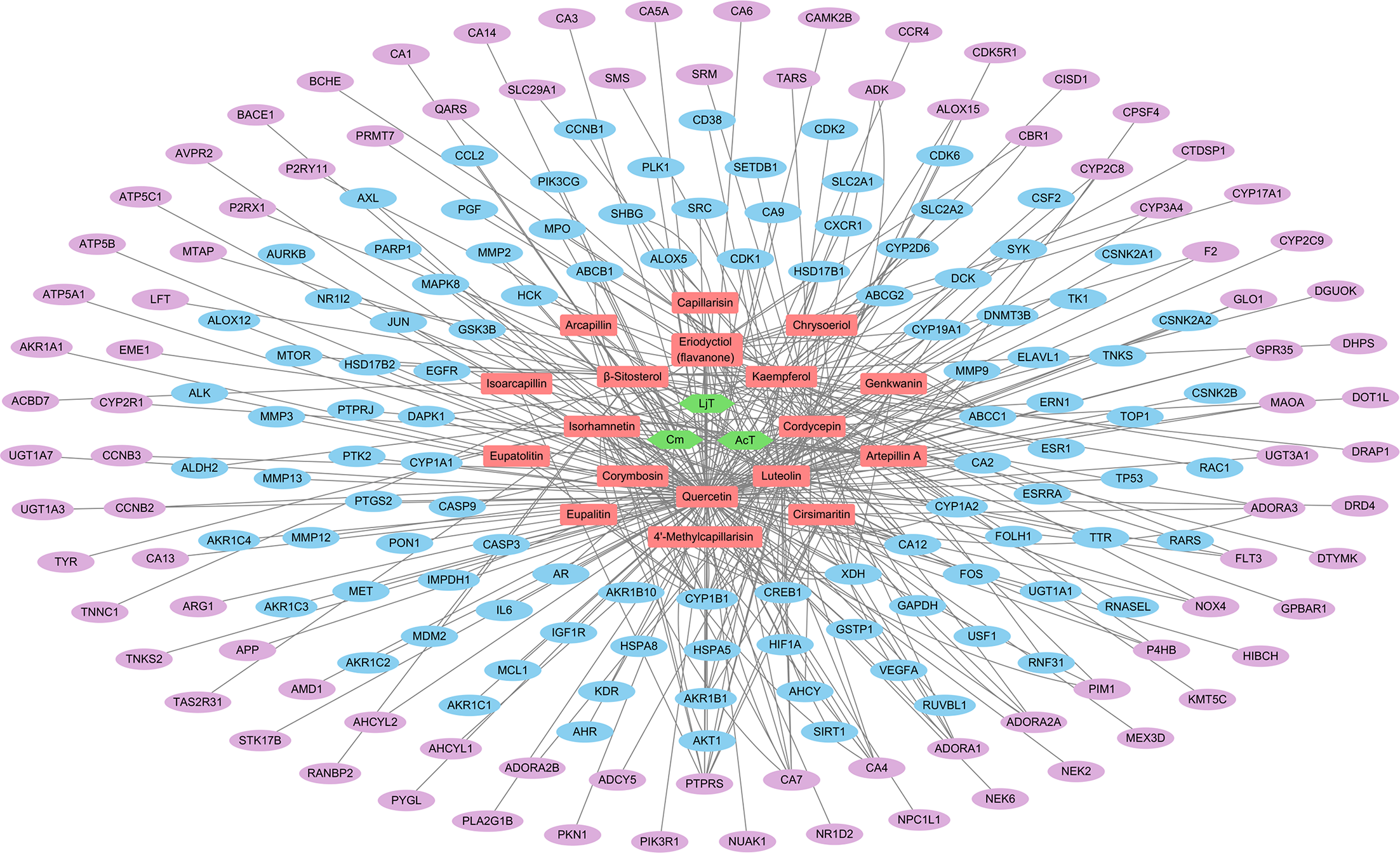
The herb-compound-target network of FDY003. Green and red nodes refer to the 3 herbal constituents of FDY003 and their 18 active compounds, respectively. Ovals refer to the 196 targets of the active compounds; those closely related to the tumorigenesis and progression of cervical cancer are colored in blue.

The compound-target network of FDY003. Red and blue nodes represent the 18 active compounds in FDY003 and their 106 cervical cancer-associated targets, respectively.
To explore the biological characteristics of the targets at the network level, we generated a PPI network (92 nodes and 226 edges) composed of the paired interactions between the cervical cancer-associated targets of FDY003 (Figure 4). Then, we investigated the hub nodes, high-degree nodes that are shown to play key roles in diverse cellular functions, 71,72 in the PPI network. In this study, a node was defined as a hub if its degree was equal to or higher than twice the average degree of all nodes in a network. 73,74 Among the cervical cancer-associated FDY003 targets, TP53 (degree = 29), SRC (degree = 21), AKT1 (degree = 18), VEGFA (degree = 18), JUN (degree = 15), EGFR (degree = 14), MAPK8 (degree = 12), ESR1 (degree = 12), and AKR1C3 (degree = 11) were hubs, suggesting that they may be important targets involved in the pharmacological effects of FDY003 on cervical cancer cells (Figure 4). Functional loss of the tumor suppressor p53 (encoded by TP53), a crucial regulator of cell proliferation, apoptosis, metabolism, and cell cycling, may facilitate the tumorigenesis and progression of cervical cancer, and its restoration or (re)-activation has been suggested as a promising oncological therapy. 75 -77 Src (encoded by SRC) is a nonreceptor tyrosine kinase that is dysregulated in many types of cancer, including cervical cancer, and it plays an important role in cancer progression by promoting proliferation, migration, and invasion of cervical cancer cells. 78 -82 AKT (encoded by AKT1), epidermal growth factor receptor (EGFR; encoded by EGFR), and c-Jun (encoded by JUN) exhibit diverse tumorigenic activities, and their targeting may enhance therapeutic sensitivity to chemotherapy and radiotherapy in cervical cancer cells. 83 -96 Vascular endothelial growth factor A (VEGF-A; encoded by VEGFA) functions as a key modulator of cervical cancer cell growth, angiogenesis, and metastatic behavior. 97 -101 Activation of estrogen receptor α (encoded by ESR1) is required for the onset and malignant progression of cervical cancer. 102 -105 c‐Jun N‐terminal kinase 1 (JNK1; encoded by MAPK8) is an important mediator of apoptosis of cervical cancer cells in response to anticancer drug treatment. 106 -110 Aldo-keto reductase family 1 member C3 (AKR1C3; encoded by AKR1C3) is involved in the regulation of migratory and invasive capabilities of cervical cancer cells and is associated with higher recurrence rates and poorer survival outcomes in cervical cancer patients. 111,112 Among the hub targets of FDY003, survival analysis further showed that high expression of TP53, ESR1, and AKR1C3 and low expression of AKT1, VEGFA, JUN, and EGFR were associated with a higher survival rate of cervical cancer patients (Figure 5), suggesting their potential clinical significance.
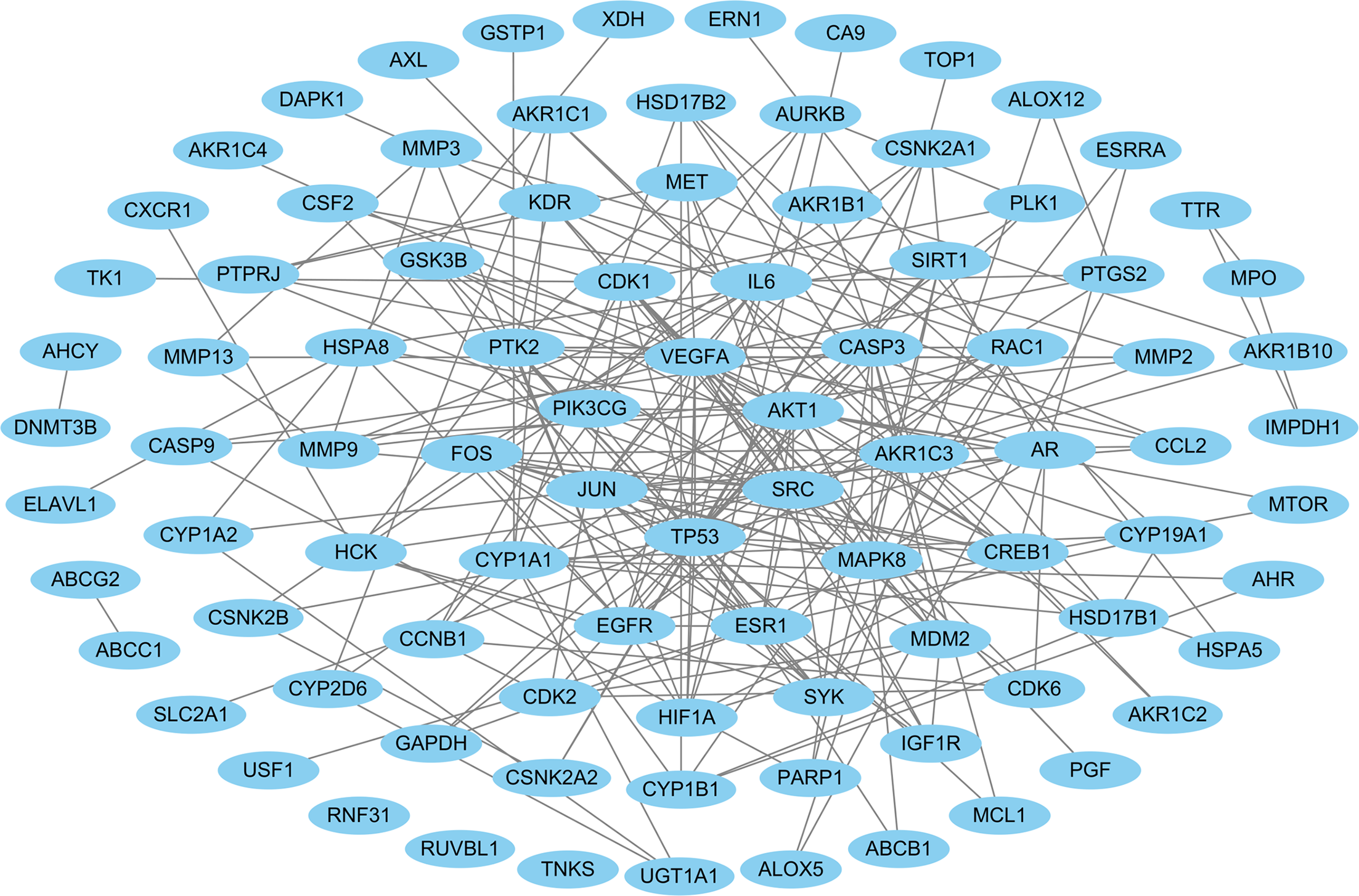
The protein-protein interaction network for cervical cancer-related targets of FDY003. Nodes indicate the cervical cancer-related targets of the active compounds in FDY003.

Survival analysis of the cervical cancer-associated hub targets of FDY003. Kaplan-Meier curves for overall survival of cervical cancer patients according to the expression of indicated targets.
To investigate the contribution of each of the active compounds to the anticancer properties of FDY003, CIs for individual active compounds were calculated as described previously. 36,113 Two compounds, quercetin and luteolin, had high CIs, with a sum of 94.04% (Supplemental Figure S2), suggesting that these compounds might be the main contributors to the therapeutic activities of FDY003 in cervical cancer treatment.
Collectively, the results suggested that FDY003 has a complex network-level action mechanism.
Functional Enrichment Analysis of the FDY003 Network
To understand the functional properties of the cervical cancer-associated targets of FDY003, they were subjected to gene ontology (GO) enrichment analysis. The targets are significantly involved in the regulation of cellular behaviors, including cell proliferation, the cell cycle process, cell migration, cell apoptosis, cell death, and angiogenesis (Supplemental Figure S3), which provides insights into the anticancer mechanisms of FDY003.
The dysregulation of various oncogenic pathways is involved in the tumorigenesis and progression of diverse cancer types. 114 To explore the signaling mechanisms of FDY003, KEGG pathway enrichment analysis was conducted for the cervical cancer-related targets of the herbal formula (Figure 6, Supplemental Figures S3 and S4). The targets were found to be involved in various pathways associated with the pathogenesis of cervical cancer, including “pathways in cancer,” “PI3K-Akt signaling pathway,” “MAPK signaling pathway,” “focal adhesion,” “human papillomavirus infection,” “TNF signaling pathway,” “steroid hormone biosynthesis,” “viral carcinogenesis,” “apoptosis,” “cellular senescence,” “estrogen signaling pathway,” “FoxO signaling pathway,” “PD-L1 expression and PD-1 checkpoint pathway in cancer,” “HIF-1 signaling pathway,” “Wnt signaling pathway,” “cell cycle,” “ErbB signaling pathway,” “p53 signaling pathway,” “VEGF signaling pathway,” and “prolactin signaling pathway.” Previous studies have shown the central roles of these pathways in the tumorigenesis and progression of cervical cancer. Dysfunction of the PI3K-Akt, MAPK, focal adhesion, erythroblastic leukemia viral oncogene homolog (ErbB), and hypoxia-inducible factor 1 (HIF-1) pathways has been strongly implicated in tumor initiation and development in cervical cancer. 3,115 -120 Infection with oncogenic viruses such as HPV is reported to be an important contributor to the carcinogenic process of cervical cancer. 121,122 Dysregulated cellular processes, including senescence, apoptosis, and cell cycle regulation, are key pathological mechanisms in cervical cancer. 123 High endogenous levels of estradiol, an important estrogen steroid hormone, are associated with an elevated risk of cervical cancer, and activation of its downstream estrogen signaling pathway contributes to the malignant development of cervical cancer. 102 -105,124,125 The upregulation of programmed death-ligand 1 (PD-L1) expression is negatively correlated with survival outcomes in cervical cancer patients, and anti-PD-L1 therapies have been suggested as potentially effective therapeutic strategies for cervical cancer treatment. 126,127 The prolactin pathway has an antiapoptotic role, and its overactivity is closely associated with enhanced cancer cell survival in cervical cancer. 128 -130 The p53 and FoxO pathways are implicated in the modulation of cell proliferation, migration, and invasion capacities induced in cervical cancer cells by anticancer agents. 92,131 -135 The TNF signaling pathway acts as a major regulator of inflammation and is associated with HPV-related cervical cancer progression. 136 -140 The Wnt signaling pathway is crucially involved in the regulation of cell differentiation, proliferation, and stem cell-like properties in cervical cancer cells. 141,142 Aberrant regulation of the VEGF signaling pathway contributes to cervical cancer progression by promoting angiogenesis and tumor metastasis. 143 -145

The herb-compound-target-pathway network of FDY003. Green and red nodes indicate the 3 herbal medicines comprising FDY003 and their 18 active compounds, respectively. Blue and orange nodes indicate the cervical cancer-associated targets of the active compounds and the signaling pathways enriched with the corresponding targets, respectively.
Pathway mapping analysis of the FDY003 targets suggested that FDY003 may exert its pharmacological activities by synergistically acting on multiple genes/proteins involved in various signaling pathways associated with the tumorigenesis and progression of cervical cancer (Supplemental Figure S5), which supports the multicomponent, multitarget, multipathway pharmacological properties of the herbal formula.
Functional association analysis of the cervical cancer-related FDY003 targets was further performed using GeneMANIA. 146 The analysis revealed that 32.7% and 37.5% of the targets may be co-expressed and engaged in physical interactions, respectively (Supplemental Figure S6), implying that they may have similar cellular functions and characteristics.
Taken together, these results suggested that FDY003 may exhibit pharmacological activities by regulating multiple cervical cancer-related pathways and relevant biological processes.
Molecular Docking Analysis
To validate the binding activity of key compounds of FDY003 to the therapeutic targets, we conducted molecular docking analysis for the bioactive compounds of the herbal drug and their hub targets (see Materials and Methods section). We found that 96.9% (157 out of 162) of interaction pairs between the compounds and the targets had docking scores of less than –5.0, suggesting their potential pharmacological binding abilities (Supplemental Figures S7 and S8).
Discussion
Cervical cancer remains among the most widely prevalent malignancies in women globally. 1 Herbal medicines have gained increased interest for cancer treatment owing to their potent anticancer properties together with relatively low toxicity and few side effects. 7,8 By employing a systems pharmacology approach, we investigated the therapeutic mechanisms underlying the pharmacologic effects of FDY003 in cervical cancer treatment. The following are our major findings: (1) 18 potential bioactive compounds in FDY003 may exert their pharmacological action by targeting 106 cervical cancer-related targets; (2) FDY003 targets were significantly associated with GO terms related to the regulation of cellular behaviors, including cell proliferation, cell cycle progression, cell migration, cell apoptosis, cell death, and angiogenesis; and (3) the therapeutic targets of the herbal medicine are involved in diverse oncogenic signaling cascades, including the PI3K-Akt, MAPK, focal adhesion, HPV infection, and TNF signaling pathways, which are involved in tumorigenesis and progression in cervical cancer.
The herbal and chemical components of FDY003 have been previously shown to possess anticancer properties. LjT, AcT, Cm, genkwanin, and carpillarisin have shown antiproliferative and apoptotic effects in cervical cancer cells. 147 -152 Kaempferol, luteolin, and β-sitosterol can induce apoptosis while inhibiting proliferation and invasiveness of cervical cancer cells by targeting various oncogenic kinases and signaling pathways. 153 -161 Quercetin exerts anticancer effects in cervical cancer cells by regulating their dysregulated behaviors in proliferation, cell cycle progression, survival, apoptosis, migration, and invasion. 135,161 -174 Isorhamnetin suppresses the proliferation of cervical cancer cells by inducing cell cycle arrest in the G2/M phase. 175 Cordycepin stimulates apoptotic cell death and interferes with the cell cycle through the generation of reactive oxygen species and the repression of cell cycle regulators in cervical cancer cells, 176,177 and sensitizes cervical cancer cells to radiotherapy. 178 Collectively, these previous findings may provide a basis for the anticancer effects and the underlying pharmacological mechanisms of the herbal and chemical constituents of FDY003.
The pharmacological activities of FDY003 in cancer treatment have been investigated previously. 21 In human colorectal cancer cells in vitro, FDY003 exerted pharmacological effects by modulating the activities of important apoptosis regulators, including Bax, caspase-3, p21, and p53, thereby suppressing cell proliferation, while inducing apoptosis. 21 The therapeutic effects of the herbal formula in vivo were confirmed in a xenograft model: mice engrafted with human colorectal cancer cells showed significant tumor regression upon FDY003 treatment. 21 It is noteworthy that unlike irinotecan, a chemotherapeutic anticancer drug widely used in the clinic, 179 FDY003 did not cause body weight loss in experimental animals during the treatment period, 21 suggesting that the herbal medicine is tolerable. Further experimental investigation of the action mechanisms of FDY003 would advance the design of safe and effective herbal medicine-based anticancer therapeutic strategies.
In summary, we investigated the pharmacological mechanism of FDY003 at the systems level. Based on a systems pharmacology analysis, we identified 18 potentially active compounds in FDY003 that may interact with 106 cervical cancer-related targets. Functional enrichment analysis showed that the FDY003 targets were implicated with GO terms related to the regulation of cellular behaviors, including cell proliferation, cell cycle progression, cell migration, cell apoptosis, cell death, and angiogenesis and that they are involved in diverse pathways related to cervical cancer tumorigenesis and progression, including PI3K-Akt, MAPK, focal adhesion, HPV infection, and TNF signaling. Taken together, the results provide novel insights into the systems-level pharmacological mechanisms of FDY003 for cervical cancer treatment.
Supplemental Material
Supplementary Material 1 - Supplemental material for Systems Pharmacology Study of the Anticervical Cancer Mechanisms of FDY003
Supplemental material, Supplementary Material 1, for Systems Pharmacology Study of the Anticervical Cancer Mechanisms of FDY003 by Ho-Sung Lee, In-Hee Lee, Kyungrae Kang, Sang-In Park, Tae-Wook Kwon, Seung-Joon Moon, Chol Hee Lee and Dae-Yeon Lee in Natural Product Communications
Footnotes
Declaration of Conflicting Interests
The author(s) declared no potential conflicts of interest with respect to the research, authorship, and/or publication of this article.
Funding
The author(s) received no financial support for the research, authorship, and/or publication of this article.

Supplemental Material
Supplemental material for this article is available online.
References
Supplementary Material
Please find the following supplemental material available below.
For Open Access articles published under a Creative Commons License, all supplemental material carries the same license as the article it is associated with.
For non-Open Access articles published, all supplemental material carries a non-exclusive license, and permission requests for re-use of supplemental material or any part of supplemental material shall be sent directly to the copyright owner as specified in the copyright notice associated with the article.
