



Abstract
Introduction
Angong Niuhuang Pills (AGNH), a Chinese patent medicine recommended in the “Diagnosis and Treatment Plan for COVID-19 (8th Edition),” may be clinically effective in treating COVID-19. The active components and signal pathways of AGNH through network pharmacology have been examined, and its potential mechanisms determined.
Methods
We screened the components in the Traditional Chinese Medicine Systems Pharmacology (TCMSP) via Drug-like properties (DL) and Oral bioavailability (OB); PharmMapper and GeneCards databases were used to collect components and COVID-19 related targets; KEGG pathway annotation and GO bioinformatics analysis were based on KOBAS3.0 database; “herb-components-targets-pathways” (H-C-T-P) network and protein-protein interaction network (PPI) were constructed by Cytoscape 3.6.1 software and STRING 10.5 database; we utilized virtual molecular docking to predict the binding ability of the active components and key proteins.
Results
A total of 87 components and 40 targets were screened in AGNH. The molecular docking results showed that the docking scores of the top 3 active components and the targets were all greater than 90.
Conclusion
Through network pharmacology research, we found that moslosooflavone, oroxylin A, and salvigenin in AGNH can combine with ACE2 and 3CL, and then are involved in the MAPK and JAK-STAT signaling pathways. Finally, it is suggested that AGNH may have a role in the treatment of COVID-19.
1. Introduction
Novel coronavirus pneumonia is caused by the new coronavirus infection that broke out by the end of 2019. On February 11, 2020, the Director-General of the World Health Organization, Tedros Adhanom Ghebreyesus, announced that the latest type of coronavirus-infected pneumonia was named “COVID-19”. 1 The symptoms of patients with COVID-19 mainly include fever, fatigue, cough, and shortness of breath/respiratory distress, accompanied by reduced white blood cell counts and lymphopenia; severely infected patients even can experience multiple organ failure or death. 2,3 According to statistics, as of September 21, 2020, there were 90,885 confirmed cases in China, 4,744 deaths, 4,517,714 confirmed cases worldwide and 216,411 deaths, and World public health security faced great challenges. 4 The World Health Organization believed that the current new crown pneumonia epidemic (COVID-19) was a global pandemic.
In recent years, extensive and in-depth research has been carried out on Chinese medicine components worldwide. According to the characteristics of the disease, Traditional Chinese Medicine, guided by the overall concept and syndrome differentiation and treatment, uses different routes of administration, and flexibly add or subtract medications with the symptoms, which has obvious characteristics and advantages for the treatment of COVID-19. An-Gong-Niu-Huang Pills (AGNH) is an well-known Traditional Chinese Medicine. It is composed of Bovis Calculus, Pulvis Cornus Bubali Concentratus, Moschus, Pearl, Cinnabaris, Realgar, Coptidis Rhizoma, Scutellariae Radix, Gardeniae Fructus, Curcumae Longae Rhizoma, and Borneolum Syntheticum. AGNH has a unique effect on high heat and coma resulted from stroke, cerebral hemorrhage, cerebral ischemic injury and other encephalopathies. The medicinal application of AGNH has a long history and its curative effect is definite. COVID-19 has clinical symptoms such as dyspnea, dizziness, irritability, sweating, and cold limbs. AGNH, which is a representative prescription for cooling resuscitation, is a heat-clearing and resuscitation agent. It can clear heat, detoxification, sedate, and resuscitate, and thus is used for fever, pericardium problems, and high fever convulsions. 5 Therefore, AGNH may be effective in treating COVID-19. However, the study of the mechanism of Chinese medicine has always been a problem, and there is no clear conclusion about the effective components and potential mechanism of AGNH in the treatment of COVID-19.
Network pharmacology is based on the theory of systems biology, using visualization software and a variety of algorithms to establish a “herb-components-target-pathway” (H-C-T-P) network to explore deeply the relationship between drugs and potential targets. 6 In this study, the network pharmacology method was used to study the effective components of AGNH, to analyze their related pathways and biological processes, and to establish the relationship among the components, targets and pathways. The virtual molecular docking was used to predict the affinity of the active components of AGNH and the key targets, and the potential mechanism of AGNH in the treatment of COVID-19 is preliminarily discussed. The flow chart of this research is shown in Figure 1.
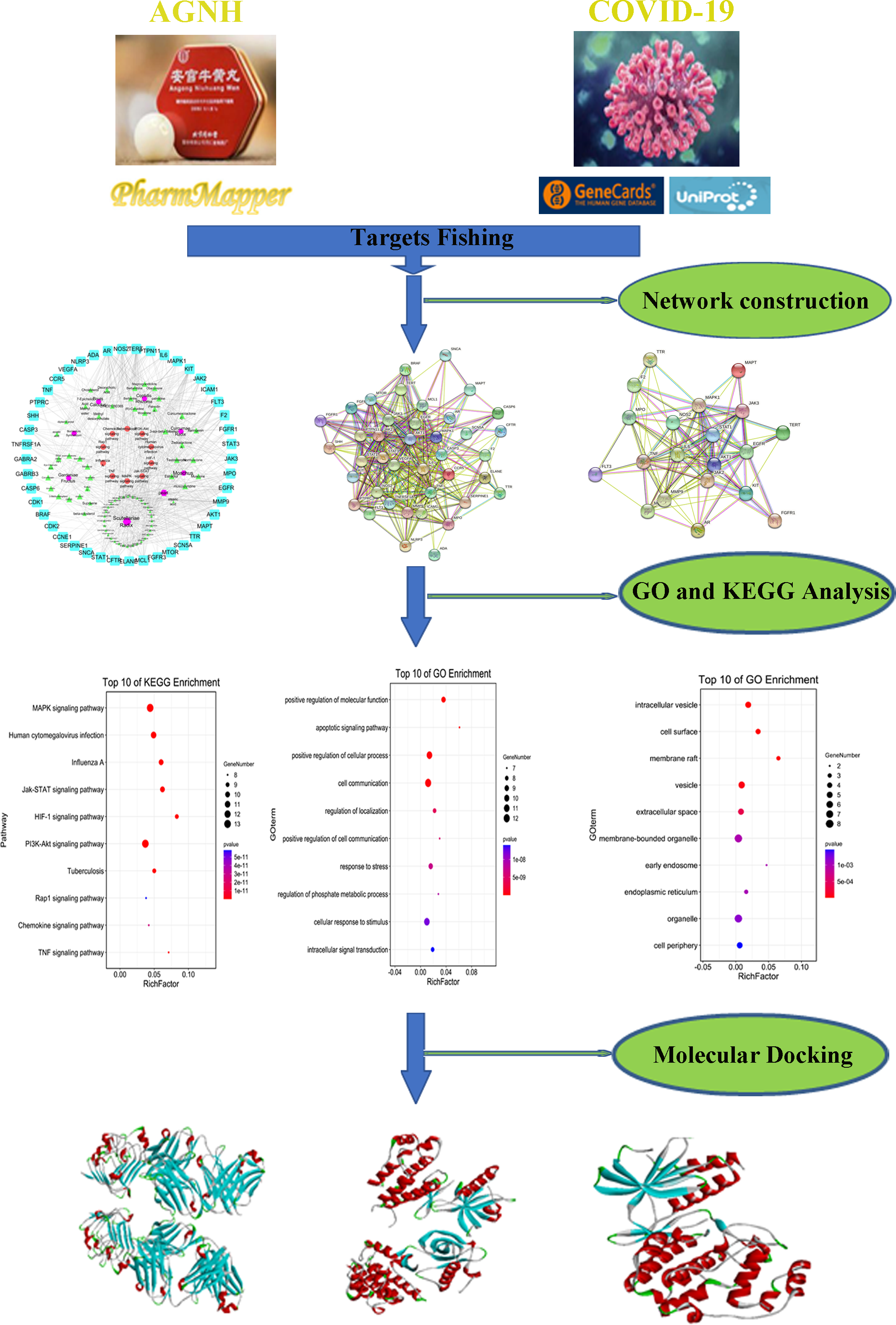
Flow chart of network pharmacology analysis.
Materials and Methods
Collection of Components
TCMSP (http://lsp.nwu.edu.cn/tcmsp.php) is constructed based on the framework of Traditional Chinese Medicine System Pharmacology. TCMSP also provides drug targets and relevant diseases for each active component, automatically generating components-target-disease networks. 7 Oral bioavailability (OB) refers to the relative amount of the drugs absorbed by the body into the systemic blood circulation and rate after oral administration, and drug likeness (DL) refers to the likeness index of the components and the known marketed drugs. 8,9 Therefore, we considered OB ≥30% and DL ≥0.18 to be suitable conditions for screening. We then screened the chemical components of Bovis Calculus, Pulvis Cornus Bubali Concentratus, Moschus, Pearl, Cinnabaris, Realgar, Coptidis Rhizoma, Scutellariae Radix, Gardeniae Fructus, Curcumae Longae Rhizoma, and Borneolum Syntheticum. We then downloaded the structures of the chemical components from the PubChem database and summarized them.
Components and Disease Related Targets Screening
The PharmMapper database (http://lilab-ecust.cn/pharmmapper/) was used for targets matching. The PharmMapper online tool is a web server that matches the queried components with the internal pharmacophore model database to identify potential drug targets. After comparison, the targets corresponding to the structure of the components is obtained; in the GeneCards database (https://www.Genecards.org/), we used “COVID-19” as a keyword in order to obtain the COVID-19 targets. The targets of the components were deduplicated and the intersection was obtained. The common targets of the 2 were the targets of AGNH in the treatment of COVID-19. The potential targets of COVID-19 were summarized, and the results are depicted in Table 1.
Components of AGNH.

Construction of a “H-C-T-P” Network
We used Cytoscape 3.6.1 software to construct “H-C-T-P” networks. Nodes were used to represent key components, targets, and pathways, and edges were used to represent the relationship between the 2 nodes. We analyzed the degree of association between one node and another according to Degree value.
Protein-Protein Interaction Network (PPI) Construction
The protein interaction network is composed of individual proteins through their interactions with each other to participate in all aspects of life processes such as biological signal transmission, gene expression regulation, energy, material metabolism, and cell cycle regulation. Analysis of the PPI network helps the study of the molecular mechanism of the disease from a systematic perspective and to discover new drug targets. 10 The STRING database is commonly used to analyze PPI networks (https://string-db.org/), which can discover the interaction among key targets.
GO/KEGG Function Enrichment Analysis
KEGG Pathway (Kyoto Encyclopedia of Genes and Genomes) analysis shows the importance of different signal pathways in the protein interaction network. It is often used in the analysis of the mechanism of drug action in network pharmacology. GO analysis, namely Gene Ontology, is a systematic description of biological processes. The KOBAS3.0 database (http://kobas.cbi.pku.edu.cn/ann-o_iden.php) was used for GO and KEGG pathway annotations. We analyzed the annotation results of the KEGG pathway and sorted the results according to the ascending order of P value. Finally, we filtered the top-ranked pathways that can be considered as key signaling pathways for AGNH in the treatment of COVID-19.
Molecular Docking
The top 3 components in AGNH were verified by molecular docking with key receptor proteins, and the 3 dimensional structures of the targets were obtained through the PDB database (https://www.rcsb.org). We used Discovery Studio software (Discovery Studio 2016; BIOVIA; San Diego, USA) for molecular docking. A Libdockscore score either greater than or equal to 90 indicates that the small molecule ligand has a strong affinity with the receptor and is easier to bind.
Result
Components Screening Results
The components of Bovis Calculus, Moschus, Pearl, Coptidis Rhizoma, Scutellariae Radix, Gardeniae Fructus, Curcumae Longae Rhizoma, and Borneolum Syntheticum were searched in the TCMSP database according to the setting value. Pulvis Cornus Bubali Concentratus is an animal medicine, whose main components are various amino acids; Cinnabaris is a mineral medicine, the main component of which is HgS; Realgar is a mineral medicine, the main component being As4S4. Thus, all 3 of the above were not included in the screening scope of this study. In conclusion, a total of 87 chemical components were obtained. Compared with the other Chinese herbs, Gardeniae Fructus and Coptidis Rhizoma have more components, with 34 and 15, respectively. The general information on these components is shown in Table 1.
Potential Gene Target Screening
A total of 788 targets were obtained after removing duplicates from 87 components. We used Venn diagrams to analyze and compare targets from components and diseases, as shown in Figure 2, and then integrated the targets to obtain the intersection. Finally, the potential targets of AGNH for the treatment of COVID-19 were obtained, as shown in Table 2.
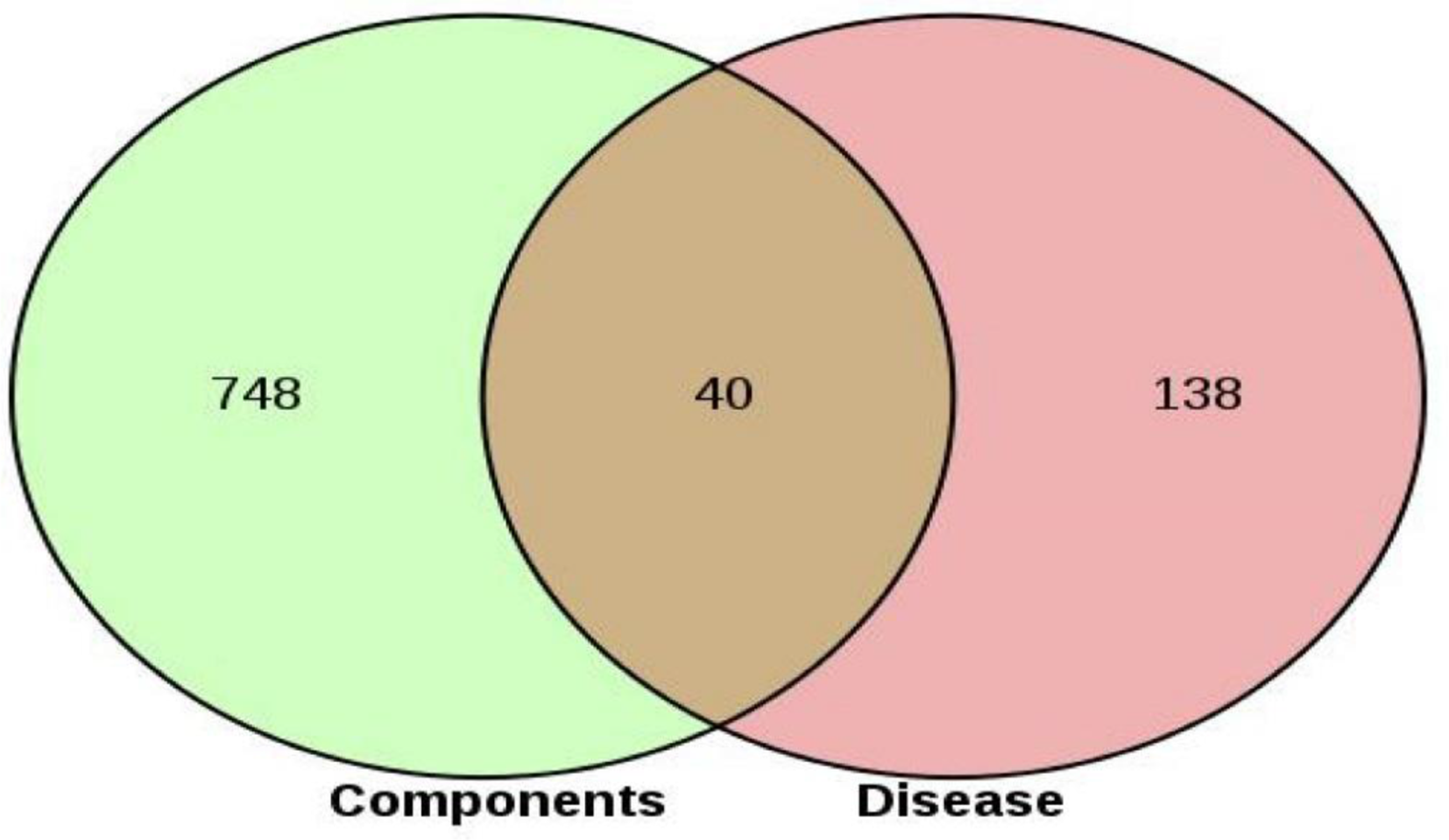
Venn diagram of coincidence target.
Potential Targets.

“H-C-T-P” Network Analysis
The 87 components, 40 target genes, and signal pathways analyzed by the KEGG pathway were integrated. As shown in Figure 3, we used Cytoscape 3.6.1 software to construct a H-C-T-P network diagram. The red nodes in the innermost circle represent the signal pathway; the purple nodes represent herbs, the contained components of which are represented by the green nodes that surround the purple ones; the blue nodes in the outermost circle represent the targets. A total of 135 nodes are included, in which 8 represent single herbs, 40 targets, 10 signal pathways, and 77 chemical components. A total of 638 edges represent the interaction relationship between nodes. The higher the degree of node association, the more connected the edges are, and a higher degree value is obtained. We found that each component in AGNH correlated with multiple targets. In addition, different components also interacted with the same targets, which reflects the mechanism of interaction between multiple components of traditional Chinese herbs and multiple targets. We list the top 10 components in Table 3 according to degree value between the components and the targets. Then we screened the first 15 targets as key targets, namely AR, TERT, NOS2, KIT, FLT3, EGFR, MMP9, AKT1, MPO, TTR, MCL1, JAK2, F2, JAK3, and IL6.

H-C-T-P network.
the Top 10 Potentially Effective Components in the Prescription.

Targets Function and Pathway Analysis
GO bioinformatics enrichment and KEGG pathway enrichment were performed in the KOBAS3.0 database; the threshold was set as P < 0.05, and count >8. KEGG pathway annotation is depicted in Figure 4, and GO enrichment in Figure 5. KEGG pathway enrichment obtained 143 pathways, in which 55 were screened according to the set value (P < 0.05). Figure 3 shows the top 10 pathways of AGNH in the treatment of COVID-19. Among them, the MAPK signaling pathway involves 13 genes, such as CASP3, EGFR, AKT1, and TNF. Human cytomegalovirus infection involves 11 genes, such as STAT3, EGFR, IL6, and TNF. JAK/STAT signaling pathway involves 10 genes, such as STAT3, STAT1, EGFR, IL6, and AKT1. Influenza A involves 10 genes, such as CASP3, STAT1, IL6, AKT1, and TNF. HIF-1 signaling pathway involves 9 genes, such as EGFR, IL6, and AKT1. Therefore, it was suggested that AGNH may act on key targets such as EGFR, IL6, AKT1, TNF, and STAT1, for which it plays a therapeutic role. GO enrichment analysis produced 1409 GO entries, which were screened according to the set value (P < 0.05) and sorted according to the P value in ascending order. The top 10 BP, CC, and MF entries were summarized respectively, as shown in Figure 5(A–C), respectively.

Bubble chart of the result of KEGG pathway enrichment.

Bubble chart of the result of GO functional enrichment; (A) The top 10 significantly enriched terms in cellular components (CC);C: The top 10 significantly enriched terms in molecular function (MF).
PPI Network Construction
As shown in Figure 6(A) we used the STRING database to integrate the targets and make the interaction network diagram; after that we used Cytoscape 3.6.1 software for analysis. It can be found that in the PPI network, the degree values of IL6, AKT1, VEGFA, TNF, and MAPK1 were higher than those of the other proteins. We also analyzed the top 20 targets in the H-C-T-P network diagram (Figure 6(B)). We found that EGFR and IL6 occupied the core status in the H-C-T-P network diagram and PPI network. Therefore, we predicted that the mechanism of action of AGNH may be related to the regulation of key targets EGFR and IL6, and it affect several pathways such as the Jak-STAT and MAPK signaling pathways.
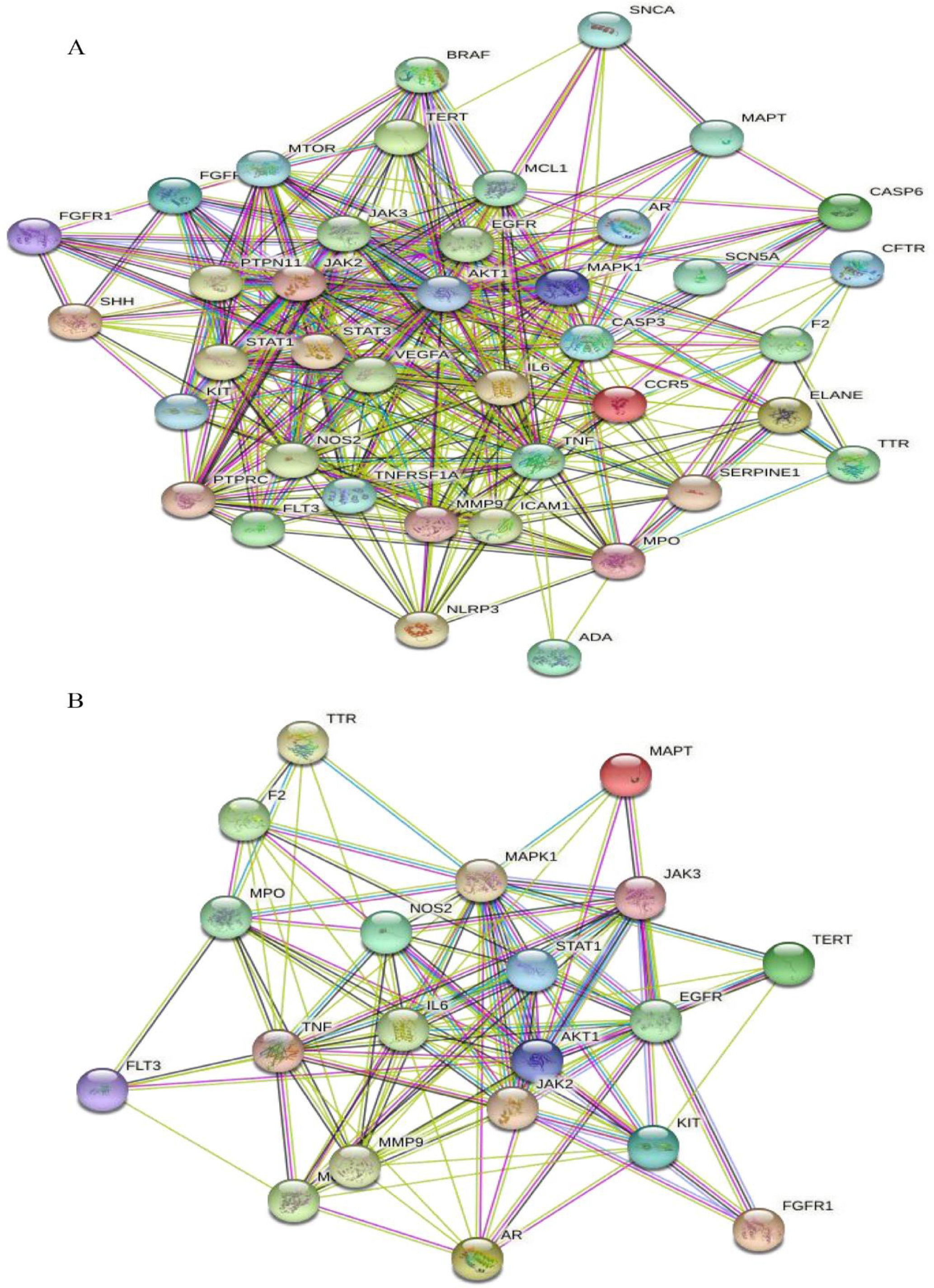
PPI interaction network; A: Components and disease related targets PPI; B: Interaction of top 20 targets in the H-C-T-P network.
Molecular Docking Verification
Generally, the lower the energy is of the complex formed by the binding of ligands and receptors, the more stable the binding is. With that, we can get higher LibDockscores and a greater possibility of interaction. According to the network analysis of this study, we selected key targets such as EGFR, IL-6, 3 Cl(COVID-19 targets), and ACE2(COVID-19 targets) for molecular docking. The docking results were analyzed using a LibDockscore ≥90 as the criterion; these are shown in Table 4. The docking scores of the top 3 components with the key targets we selected were greater than the threshold of 90, which showed high binding activity. Among them, the oroxylin A docking score was greater than 100, indicating that the oroxylin A in Scutellaria baicalensis may play a key role in the treatment of COVID-19. The docking conformation of oroxylin A and the key targets is shown in Figure 7.
Molecular Docking.


The docking conformation of oroxylin a and key target. (A) The docking conformation of oroxylin a and ACE2(1R42); (B) The docking conformation of oroxylin a and IL-6(4NI7); (C) The docking conformation of oroxylin a and EGFR(6D19); (D) The docking conformation of oroxylin a and 3 Cl(6IU7).
Discussion
COVID-19 has been a terrible infectious disease worldwide since 2019, and there are no current specific medicines for its targeted treatment in clinical practice. Therefore, it is of great significance to screen out Traditional Chinese medicines and their active components that are effective against COVID-19. In our research, we have screened the active components of AGNH to treat COVID-19. It was found that the top active components mostly originated from Scutellaria baicalensis. These can clear away heat and dampness, as well as purify fire and detoxify. The drug has a wide range of pharmacological effects. Modern pharmacological research has shown that the active components of S. baicalensis have broad-spectrum antibacterial and antiviral effects. Even though Staphylococcus aureus has developed resistance to penicillin, S. baicalensis is still effective. 11 At the same time, it has a good anti-inflammatory effect, which is mainly caused by inhibiting the formation of lipid peroxides and affecting the release of inflammatory mediators. 12 At the same time, some studies have found that S. baicalensis extract has effective anti-SARS-CoV-2 activity. Salvigenin, oroxylin A and moslosooflavone are 3 active components found in this study. Wohn-Jenn Leu 13 et al. found that salvigenin inhibits the release of IL-6 induced by lipopolysaccharide, and may inhibit the activation of NLRP3 inflammasome. Oroxylin A, mainly derived from S. baicalensis, is an important flavonoid component. It has a wide range of pharmacological activities, such as anti-inflammatory, blood vessel protection, and antiviral effects. Some studies have shown that oroxylin A can rescue lipopolysaccharide-induced acute lung injury by regulating the nuclear factor NF-κB signaling pathway. 14 At the same time, oroxylin A is one of the top 3 active components in this study, and its docking scores with key targets were greater than 120 points, indicating that it is likely to be a component that has a therapeutic effect on COVID-19. Liu Rui 15 found that moslosooflavone scavenges free radicals, inhibits the release of inflammatory factors, and reduces oxidative stress and inflammatory reactions. Moslosooflavone has also been shown to combat influenza virus pneumonia through a variety of signaling pathways, such as the VIP/PKA/AQP5 and JAK-STAT signaling pathways. These may be the potential mechanisms of moslosooflavone to treat COVID-19.
Through GO bioinformatics analysis of this study, we found that the biological processes involved in the relevant targets mainly include the positive regulation of molecular functions, apoptosis signal pathways, cell response to stimuli, and intracellular signal transduction. Through enrichment analysis of the KEGG pathway, it was found that the molecular mechanism of the therapeutic effect of AGNH on COVID-19 mainly focuses on key signaling pathways, such as the MAPK, JAK-STAT, and PI3K-Akt signaling pathways, and human cytomegalovirus infection. The MAPK signaling pathway can regulate cell growth, differentiation, stress adaptation to the environment, inflammatory response, and many other important cellular physiological and pathological processes. Studies have shown that the MAPK signaling pathway is involved in the progression of acute respiratory distress syndrome. 16,17 found that the MAPK pathway affects the release of the pro-inflammatory cytokine IL-6, and is related to acute lung injury and myocardial dysfunction. A large number of studies have shown that JAK-STAT as a key inflammation signaling pathway is closely related to COVID-19. 18,19 The cytokine storm of excessive inflammation may be an important effect of COVID-19. Cytokines IL-6 and TNF-α can cause excessive inflammation. As the key target of this study, inhibiting IL-6 will hinder the normal signal transduction of the JAK/STAT pathway, which reduces the inflammatory response in the lungs. 20 At the same time, the human cytomegalovirus infection pathway is also affected by the JAK/STAT pathway. The activation of JAK/STAT releases inflammatory factors, which in turn induces human cytomegalovirus infection. Thus it may cause viral infection of lung tissue. 21 The PI3K-Akt signaling pathway is also involved in the regulation of inflammatory response. The key targets of this study, such as EGFR, IL-6, and TNF, will activate PI3K and then activate this pathway. COVID-19 can cause pulmonary interstitial fibrosis and chronic inflammatory changes, prompting inflammatory factors to repeatedly and continuously stimulate and attack alveolar epithelial cells. COVID-19 plays the dual role of promoting inflammation and carcinogenicity by activating the PI3K/Akt signaling pathway. 22 The analysis above further revealed the possible molecular mechanism of AGNH in the treatment of COVID-19.
The study of Traditional Chinese Medicine in network pharmacology has gradually shifted drug research and development from a “single target, single drug” model to a “network target, multi-component therapy” model. The application of systems biology methods to study the pharmacological effects, mechanism, and safety of Traditional Chinese Medicine is of great significance to modern research and development of Traditional Chinese Medicine. There are still some imperfections in network pharmacology technology, such as incomplete Chinese Medicine database, insufficient total information for Chinese medicine analysis, and many other problems, which require further innovation and improvement.
Conclusion
In this study, the mechanism of action of AGNH in the treatment of COVID-19 was preliminarily explored by the method of network pharmacology. The active components of AGNH in the treatment of COVID-19 were collected, some key targets were predicted, and a complex “H-C-T-P” network was constructed. The molecular docking method was used to predict the binding ability of the active components and key targets. All of the above provide a reference for more in-depth research on AGNH in the treatment of COVID-19.
Footnotes
Acknowledgments
We sincerely thank all colleagues from Key Laboratory of Traditional Chinese Medicine Resources and Chemistry of Hubei Province, Wuhan, China, who advised on the process of writing the paper.
Declaration of Conflicting Interests
The author(s) declared no potential conflicts of interest with respect to the research, authorship, and/or publication of this article.
Funding
The author(s) disclosed receipt of the following financial support for the research, authorship, and/or publication of this article: This work was supported by the National Natural Science Foundation of China (No. 31570343).
