



Abstract
The t:slim X2 insulin pump with Control-IQ technology (Tandem Diabetes Care) is interoperable with G6 and, more recently, G7 sensors (Dexcom). CGM-derived metrics from customers who transitioned from using Control-IQ technology with G6 and then G7 sensors were compared. Median times in various glucose concentration ranges for the final 30 days of G6 use and the initial 30 days of G7 use changed by <1% and remained within consensus target recommendations for TIR (70-180 mg/dL) >70% and TBR (<70 mg/dL) <4%. Differences in sensor use, time in closed loop, and median glucose levels were clinically insignificant. Control-IQ-based pump users experienced similar outcomes and achieved excellent glycemic control with G6 or G7 sensors.
Introduction
Automated insulin delivery (AID) systems improve outcomes and are recommended for people with type 1 diabetes (T1D). 1 AID system components include a continuous glucose monitor (CGM), an insulin pump, and a control algorithm. The Food and Drug Administration recognizes the potential interoperability of these components, and has created regulatory processes to allow for different configurations of interoperable algorithms, insulin pumps, and sensors, as long as they meet rigorous special controls and standards of accuracy and precision. 2 Successful implementation of AID systems requires a good understanding of each of these components, but the availability of multiple options for each component may be confusing for patients and clinicians who are tasked with using them.
Control-IQ technology is a predictive advanced hybrid closed loop algorithm that mitigates hyperglycemia and hypoglycemia with insulin automation that is based on near-term (30 minutes) predicted CGM values. Clinical trials 3 have shown that use of the algorithm improves A1C, time in range (TIR) 70 to 180 mg/dL, and time below range (TBR) <70 mg/dL in people with T1D ages 2 to 72. Real-world evidence from users who switched from Basal-IQ technology (a predictive low glucose suspend algorithm) to Control-IQ technology shows that transitioning leads to rapid and dramatic improvements in TIR and mean glucose levels for people with either T1D 4 (where TIR on average improved from 58.4% to 70.5%) or type 2 diabetes (T2D) (where TIR on average improved from 63.2% to 72.6%). 5 Control-IQ technology is available with two insulin pumps from Tandem Diabetes, including the t:slim X2, a rechargeable touch screen insulin pump available since 2020, and the new Tandem Mobi, a smaller insulin pump that is fully controlled from a smartphone, that became available in 2024. The system offers multiple wear options and very short tubing length, which, in combination with an on-body sleeve, allows users to adhere the pump to their body, similar to a patch pump. 6
The G6 and G7 CGM systems (Dexcom) are interoperable with both the Tandem t:slim X2 and Tandem Mobi insulin pumps with Control-IQ technology.. Compared with G6, the G7 system offers a simplified insertion process, a smaller wearable that integrates the sensor and transmitter, and a longer working life (10.5 days). 7 A distinguishing feature of the G7 CGM is that it has a 30-minute warm-up period (compared with 2 hours with the G6), which allows for more continuous access to glucose values.
Because CGM sensor performance is an integral part of AID usefulness, it is important to assess whether there are meaningful differences when new CGM sensors are introduced to the AID ecosystem. With the recent availability of G7 sensors that are interoperable with Control-IQ technology, we conducted a retrospective analysis of adults with T1D who transitioned from using the G6 to the G7 sensor.
Methods and Results
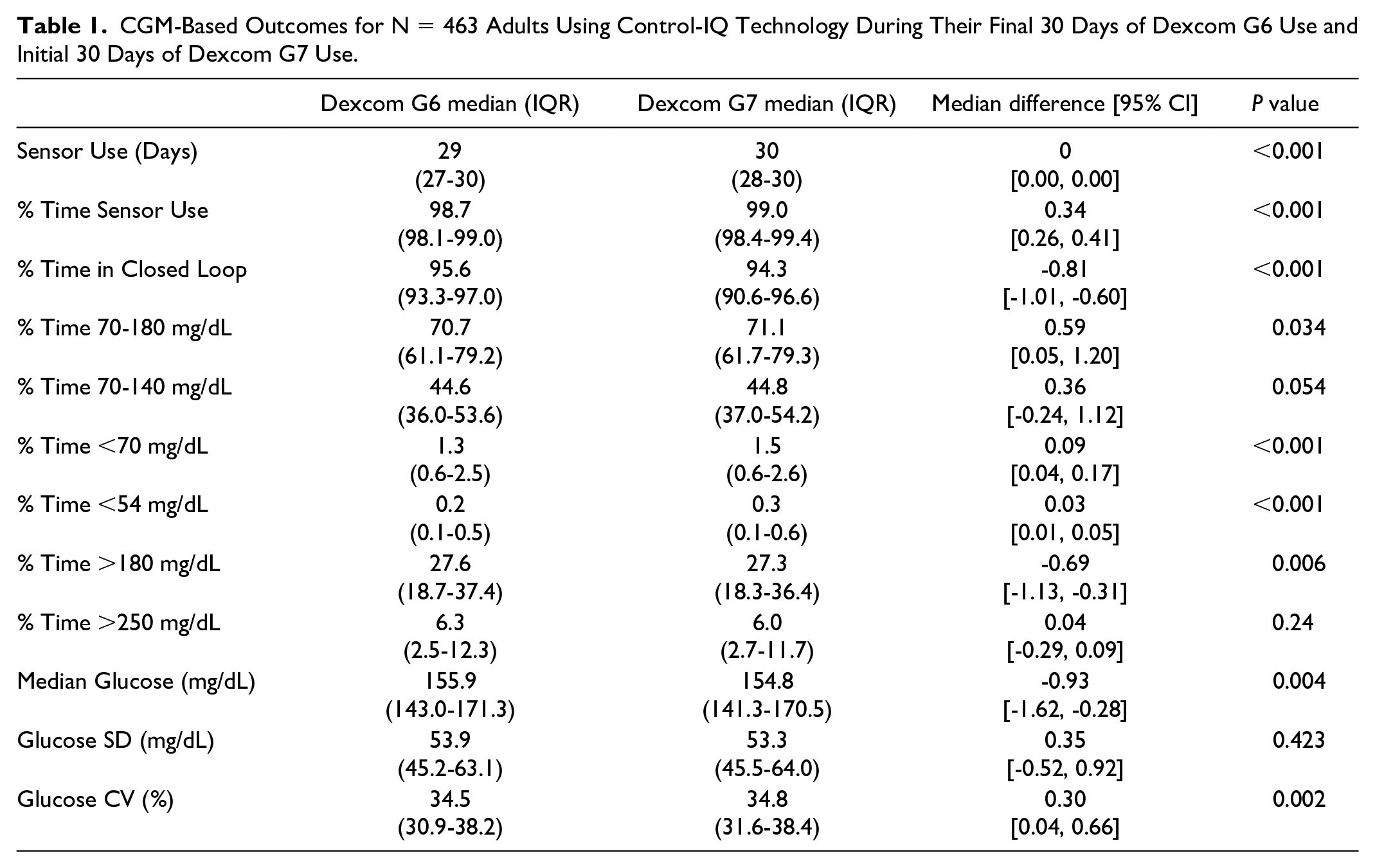
This is a retrospective single-center study involving 463 adults using the t:slim X2 insulin pump with Control-IQ technology who transitioned from the G6 to the G7 sensor between November 2023 and June 2024, and uploaded ≥30 days of data from each system. There were no exclusion criteria. As this was a retrospective analysis of routinely-collected data, the IRB granted this research exempt status. Wilcoxon signed-rank tests were used for paired comparisons. Participants’ mean ± SD age was 36 ± 15 years, Control-IQ average use was 4 ± 2 years, 59% were female, and 99.6% had T1D. As shown in the Table 1, median time of sensor use and median time in closed loop were very high with each system. The observed differences, while statistically significant for some attributes, are of unlikely clinical significance. Median TIR was 70.7% during G6 use and 71.1% during G7 use, showing that most of the individuals met the consensus goal 8 of >70% TIR. Most individuals also met consensus goals for time <70 mg/dL and time <54 mg/dL.
CGM-Based Outcomes for N = 463 Adults Using Control-IQ Technology During Their Final 30 Days of Dexcom G6 Use and Initial 30 Days of Dexcom G7 Use.
Conclusion
This analysis provides reassurance to people using Control-IQ technology with G6 sensors that the transition to G7 sensors can be accomplished without clinically meaningful changes to important CGM-based metrics of glycemic control. This highlights the benefit of having interoperable CGM technologies that allow for technological improvements to existing systems without disrupting glycemic control. Because Tandem Mobi was approved for use with G7 sensors in May 2024 and our observation window closed in June 2024, we are unable to provide meaningful comparisons specific to the Mobi pump. This represents a limitation of the current study. Our study has additional limitations in that it did not include subjects transitioning from G7 to G6 sensors, nor did it include subjects transitioning to or from non-Dexcom CGM systems. All subjects were seen at a single academic medical center which may also limit the generalizability of our results; however, demographic and glycemic characteristics of our population (N = 463) are in line with those of a separately-reported population (N = 19 354) of individuals with T1D who used Control-IQ technology for three months. 4
We anticipate that future real-world observational studies will allow comparisons between AID systems with interoperable sensors from Dexcom and other manufacturers, and we recognize a need for standardization of CGM performance metrics as the field moves toward true CGM interoperability. 9 Randomized clinical trials with device-independent outcomes such as A1C may be necessary to establish relative efficacy and effectiveness of AID system configurations. 10 Finally, Control-IQ users who transitioned from G6 to G7 sensors maintained excellent glycemic control.
Footnotes
Abbreviations
AID, automated insulin delivery; CGM, continuous glucose monitoring; TAR, time above range; TBR, time below range; TIR, time in range.
Declaration of Conflicting Interests
The author(s) declared the following potential conflicts of interest with respect to the research, authorship, and/or publication of this article: HKA has received research support and consultation fees from Tandem Diabetes Care, Medtronic, and Dexcom. AKJ and LHM are full-time employees and shareholders of Tandem Diabetes Care. JBW is a full-time employee and shareholder of Dexcom.
Funding
The author(s) received no financial support for the research, authorship, and/or publication of this article.
