



Abstract
The 2023 elections witnessed the highest number of women in national parliament in Thailand's history. What explains this sharp rise in women's political leadership in Thailand? Based on in-depth interviews with 18 women candidates and party executives across six political parties, this paper finds that party leadership and individual political entrepreneurship account for increased success rates of women candidates. Parties that adopt voluntary gender quota and champion diversity policies tend to have greater incentive to support women candidates to win. Yet, significant structural and institutional barriers remain, mostly notably the entrenched patronage system. Even in cases where there is strong party support for gender equity, male party leaders continue to dominate resources, networks and decisions regarding candidate selection. While the success of female MPs in the 2023 election provides promising evidence that the country is moving in the right direction toward greater female representation in parliament, major significant challenges remain.
Introduction
Rukchanok “Ice” Srinork became known during her campaign trail as the cyclist campaigner—she regularly biked in sweltering Bangkok heat to meet voters in her constituency. 1 Despite having gone viral with her campaigning videos on TikTok, no one expected Ice to win. A young, female political rookie from a brand-new Move Forward Party (MFP), Ice was running against a well-known incumbent, Wan Ubumrung, the son of a wealthy and well-connected long-time politician from popular Pheu Thai Party (PTP). Ice was only known for her social media following as she put herself through university selling products online. Ice surprisingly beat Wan by more than 21,000 votes in a shocking electoral race. Ice's victory was also surprising because she appeared to have lacked the key ingredients for political success: funding, connections, networks, and familiarity with the constituency. Yet her triumph was not an outlier in this election: more women and political rookies won in 2023 than at any other time in recent history.
The 2023 national elections marked a watershed moment for women in politics in Thailand. Not only were the most women elected to the country's parliament in the country's 90-year electoral history but the proportion of elected women was also higher than those contesting in the election. While the number of women candidates remained stable in the past five elections, the 2023 election witnessed the highest success rate for female candidates. What might explain the sharp rise in the success of women's political leadership in recent elections in Thailand? Thailand is a particularly fascinating case to study the success and failure of women candidates to get elected to parliament because there does not seem to be a clear pattern or linear progression in the number of women elected to parliament.
Existing theories on women's political leadership cannot fully explain the rise and fall of the number of women elected to parliament in Thailand. First, levels of democracy did not equate to more women elected to parliament in Thailand (Shalaby, 2016). The pre-2006 coup years, which include the 1995, 1996, 2001, and 2005 elections, had the same or fewer women elected to parliament when compared to more autocratic periods such as the 2007, 2011, and 2019 elections. Women candidates have also done better at getting elected in the single-member district system than in the proportional representation (PR) one, which contradicts existing research that strongly advocates for the PR system being better for women representation (Delgado-Márquez et al., 2014). Furthermore, dynastic ties did not explain the rise in the number of elected MPs in the 2019 and 2023 elections, given the large number of female MPs not having any close familial ties to existing or former politicians, contradicting prevailing studies on gender and dynastic bias (Folke et al., 2021). Thailand also has one of the highest public supports for women in political leadership in Southeast Asia—a level of public support that has been continuously increasing in the last two decades. 2 Yet, a rise in supportive political culture for women in political leadership is not well matched with the number of women MPs in recent elections. The oscillation in the trend of women's political leadership in Thailand requires closer inspection to fully understand factors that can help women candidates break through barriers to political leadership.
This article examines what specific conditions have enabled a substantial increase in women's parliamentary representation in Thailand's 2023 election. In particular, it investigates how party-level gender equity commitments and individual entrepreneurial strategies, such as social media engagement, have facilitated women's electoral success. It also critically examines the persistent barriers that continue to restrict women's political participation, focusing particularly on Thailand's deeply entrenched patronage systems. The article grounds the 2023 Thai elections in the broader context of recent development in the success of women political leadership both in Thailand and Southeast Asia. It addresses key structural, institutional, cultural, and individual factors that are generally associated with women leaders in politics.
The paper argues that party support and individual political entrepreneurship of candidates contributed to higher success rates of women candidates in the 2023 elections. Parties that adopt gender quota policies and champion women policy platforms tend to be more open to place women higher in their party-list rankings. At the agency level, women candidates who amass greater political capital are more likely to succeed at the ballot. Such political capital goes beyond networks and finances: it includes online popularity and campaign marketing. Nonetheless, the entrenched patronage systems remain important challenges to advancing more women in political leadership. Male patrons continue to have an outsize role as gatekeepers for women aspiring to become political leaders in Thailand and prioritizing male-dominated networks in candidate selection.
The paper has five sections. It first provides an overview of the literature on women political leadership globally and regionally within Southeast Asia. The second section discusses data and methodology, noting them in relation to the overall pattern of women political leadership in Thailand. The third section describes the outcomes of the 2023 election and how women candidates have fared in this election compared to the past and within the broader context of the Southeast Asian region. The fourth section outlines key factors that contributed to the rise in women in politics as well as discusses important barriers that remain. The final section provides conclusion and discussion of the implications of the Thai case and its relevance to other Southeast Asian countries and competitive authoritarian regimes.
Barriers to Women in Politics
Existing literature on gender and political leadership highlights four key factors that explain the electoral success of women: regime type, electoral system, dynastic bias, and political culture (Maguire, 2018). Earlier comparative studies frequently argued that democratic regimes inherently facilitated greater representation of women, linking features such as political openness, competitive elections, robust civil society, and transparency to improved gender equity outcomes (Inglehart and Norris, 2003; Tremblay, 2007). These studies emphasized pathways that democracies, by nature, offer institutionalized pathways and accountability mechanisms such as electoral competition, independent media, and vibrant civil society that collectively foster environments more conducive to women's political participation and leadership. Democracies also tend to be more decentralized and inclusive in candidate selection procedures, thereby reducing the opportunities for men to control who gets to run for office (Lee and Park, 2018; Ruud and Nielsen, 2018). The value of political equality is central to the principle of democratic politics, thus, in theory democracies should therefore produce more women political leaders (Shair-Rosenfield, 2012). Furthermore, democracies tend to have greater degrees of freedom of speech, association, and press that are more conducive to supporting women-focused activism, gender equality measures, and providing resources and training for women candidates (Bjarnegård, 2013). Because democratic systems tend to operate under greater scrutiny and accountability through free and fair elections, parties are more incentivized to make inclusive appeals to the electorate (Tripp, 2008). Democracies have also been found to be more likely to implement gender-sensitive institutional reforms that make it easier for women to enter and sustain political careers (Krook, 2010).
Recent scholarships, however, have increasingly critiqued these assumptions that democracies are inherently “better” for women's political leadership, arguing it oversimplifies the multifaceted dynamics between regime type and gender representation by overlooking the persistence of patriarchal norms and exclusionary practices even within democratic contexts (Paxton et al., 2020). Valdini (2019), for instance, demonstrates that democracies employing majoritarian electoral system have been found to lag behind systems with PR when it comes to gender parity. Bush and Zetterberg (2021) also find that democratic regimes are not uniformly inclusive and cultural and social norms about gender roles significantly condition the political arena, influencing the attitudes of voters, party elites, and candidates themselves. The depth and consolidation of democratic institutions also matter greatly: in newer and more fragile democracies, women's representation can suffer as political parties may default to male-dominated leadership structures to maintain stability and legitimacy (Krook and O’Brien, 2012). There are also cases where authoritarian regimes strategically adopt gender-quotas to improve their domestic and international legitimacy without fundamentally addressing gender inequalities (Bush and Zetterberg, 2024; Donno and Kreft, 2019). In Southeast Asia, Vietnam and Singapore stand out as countries with the highest rates of women's political leadership in parliaments—both representing authoritarian regimes. Collectively these insights underscore the importance of considering specific democratic features when assessing how democracy influences women's political participation, rather than presuming a universally positive relationship.
Electoral systems and gender quotas has been the most notable barriers to women in politics. While PR is generally more acceptable to women's political representation than first-past-the-post systems as PR systems tend to allow for more diverse pool of candidates, closed-list PR is more effective for women representation (Kittilson, 2016). In closed-list PR systems, parties have control over the ranking of candidates on their voting lists, as such, if parties are committed to advancing women representation, they are more likely to rank women candidates higher on their lists which then increases their chances of winning. The “zipper system”—alternating women in party lists or across constituencies—have been effectively used in countries such as Belgium, France, Costa Rica, and Chile (Ridley-Castle, 2024). Unlike open-list PR systems where candidates from the same parties compete with one another, closed-list PR reduces direct competition and help women candidates to benefit from the party's overall vote share, thereby reflecting broader support for the party rather than individual candidate (Verge and De la Fuente, 2014).
The most important institutional invention that has increased the number of women political leaders globally is the gender quota. Gender quota is a form of affirmative action that is designed to lift the number of women running for political office. It follows the idea that it is important to create a critical mass of women in positions of power to engender change. Today many countries around the world adopt some form of gender quotas, be they voluntary or legislated, and they generally produce higher numbers of women candidates and representation at the national level as well as creating other positive outcomes such as increasing female voters and reducing gendered practices in political parties (Allen and Cutts, 2018). In Southeast Asia, as Figure 1 notes, the implementation of electoral quotas for women demonstrates success in increasing the amount of women representation at the national level as shares of parliamentary seats occupied by women increased between 5% and 13% when comparing the pre- and post-quota period (Sinpeng and Savirani, 2022).
Political families are a dominant and entrenched feature of politics in Southeast Asia especially in Indonesia, Philippines, Singapore, and Thailand but they do not always guarantee electoral success (Nishizaki, 2022). Women from political families are more likely to enter politics because of their dynastic advantages that serve to overcome barriers that would otherwise prevent them from entering the political arena (Folke et al., 2020). Dynastic ties provide resources, networks, social capital, and legitimacy that drastically reduce the costs of getting into politics and winning on the ballot (Derichs, 2013). Voters tend to be more familiar with women from political families, who may also benefit from an established voter base, vote mobilization networks, and campaign resources otherwise unavailable to women candidates from nonpolitical families. Institutional engineering measures, such as term limits, created to ensure greater chance of political change has in fact led to a large increase in female relatives of term-limited incumbents entering local politics (Labonne et al., 2021). Dynasties flourish in political systems that have weak institutions or rampant factionalism as dynasties serve to provide a source of political stability (Thompson, 2012).
Cultural norms and beliefs against women's political leadership have shown to be the hardest to change and difficult to tackle. In Southeast Asia, while public perception toward certain dimensions of gender equality such as equal education access and job access is no longer an issue, public acceptance of women political leaders remains one of the most problematic. When examining only the issue of gender and political leadership, most Southeast Asian countries have a strong preference for male leadership. Figure 4 draws on results from three waves of the World Value Survey spanning 2005–2022 in Indonesia, Malaysia, Philippines, Singapore, Thailand, and Vietnam to the question: “Are men better as political leaders than women.” Singapore is the only country where public support for female political leaders improved over time, with the biggest increase occurring in the last five years. Four countries—Indonesia, Malaysia, Philippines, and Vietnam—still see more than 50% of respondents preferring men as political leaders than women. In Indonesia, there is a sharp rise in the preference for male political leaders, having increased 14% between 2006 and 2018. Malaysia and Thailand also witnessed a decline in support for women political leaders between 2006 and 2012, before the situation improved in 2018. These findings show clearly that with the exception of Singapore, public acceptance of women political leaders remains weak.
These structural and institutional factors have been, however, unable to fully explain the patterns of women representation in Thailand's elections. First, the degree of democratic quality and the number of women MPs elected did not always rise concurrently in the case of Thailand. While military coups in 2006 and 2014 plunged the numbers of women MPs, as shown in Figure 3, democratic gains did not raise the number of female politicians. The more democratic period pre-2006 coup had nearly 200% fewer women elected to parliament than the post-2006 coup autocratic period, particularly following the 2011 election. The Thai case does, however, support some of the later scholarship which suggests the importance of examining the fragility and establishment of democratic institutions to better understand how likely they would support women's political empowerment and leadership.
Second, the closed party-list system has helped to reduce competition among women candidates from the same party but with important limitations. The voluntary nature of the gender quota means that it has been selectively adopted by only few parties and without any mechanisms of accountability. At the cultural level, Thais have been unevenly supportive of women in politics, with youths leading the way while their older and more conservative counterparts have remained ambivalent (Sinpeng and Savirani, 2022). Support for women in politics in Thailand also ebbed and flowed in the past two decades—defying expectations that social acceptance of women in power should rise as wealth increases (Inglehart and Norris, 2003). Finally, patronage systems continue to persist despite increases in the proportion of women elected to parliament in recent elections, signifying the deeply entrenched dynastic biases in the Thai political systems (Thananithichot, 2015).
Data and Methodology
This research adopts a mixed-method approach that combines qualitative and quantitative analysis or primary and secondary data on barriers to women's political leadership and participation in Thailand and Southeast Asia more broadly. The data collection and analysis are divided into four parts: (1) desk research of existing literature, (2) statistical and descriptive analysis of quantitative data, (3) interviews with women political leaders, and (4) social media analysis. This research focuses on identifying factors that enable and obstruct women from actualizing their political leadership. Recognizing existing structural, institutional, cultural, and economic barriers to women's political advancement, the paper seeks to profile women who have broken through these barriers or have forged and democratized pathways to political power.
A total of 18 women candidates and party policy strategists from five different political parties were part of this study. Fifteen were interviewed prior to the 2023 election between October and December of 2022 (all were candidates for the 2023 election), while the other three were policy strategies from MFP, PTP, and Palang Pracharath Party who were interviewed postelection in June 2023. While many MP candidates were sought for interview, the sample was slightly skewed toward candidates from opposition parties prior to the 2023 election, which presents a limitation to the study. Additional statistical analysis on Southeast Asia–level data of gender and political participation indicators was performed that drew on a variety of global, regional, and country-specific databases on gender statistics. Content analysis on social media profiles of MP candidates was also conducted prior to the election to identify narratives on social media that target women politicians in Thailand to better understand what kind of issues and contexts give rise to such harassment.
This study adopts a psychological discursive approach to understand written, spoken, and unspoken talk and text that centers on participant's perspectives (Wetherell et al., 1987). It combines discourse analysis, which analyses various forms of communication, including computer-mediated conversations, and psychology to infer meaning on talks and texts both explicitly and implicitly. This approach is particularly useful when examining women victims of violence as it helps to understand how language can be used to justify, conceal, and work to produce dominance of men in contexts of unequal gendered power relations (Ford, 2018). The interviews and social media discursive analysis are designed to pay special attention to metaphor and ambiguity that may be presented in interviews and on social media content.
Women Political Leaders and the 2023 Election in Thailand
Women political leaders have come a long way in Thailand. Two decades ago, only 6% of members of parliaments were women. This number has now increased to 19% in 2024. But Thailand's progress toward achieving better women representation in formal politics has been marred by sharp fluctuations. During the military dictatorship between 2014 and 2019, the number of women politicians in parliament dropped from 16% to 5% only to go back up to 16% once elections returned in 2019 and subsequently increased to 19% in the 2023 election. The same pattern could be observed following the 2006 coup. Unlike other closed autocracies in the region such as Vietnam and Laos, when dictatorship takes over in Thailand, women do not get into political leadership roles (Figure 3). The reasons for this are unclear but it seems likely that fewer women seek political leadership positions during military governments. Military dominance in Thai politics institutionalized the state’s use of force against political opposition.
Thailand's general elections on May 14, dubbed “the end game,” took place following an eight-year military-dominated rule by former junta leader General Prayuth Chan-ocha. Framed as contestation between progressive democrats versus conservative autocrats, nearly 40 million Thais—or 75% turnout, casted their ballots against the backdrop of ongoing youth-led protests that began in 2020. Move Forward Party, a new party full of political rookies, shocked the nation by winning 14 million votes, defeating even the country's most popular party, PTP. The MFP, which campaigned on reforming the monarchy and the military, was unable to govern as it could not secure support from the junta-appointed senate and pro-military conservative parties to form a coalition. Despite not being able to govern, the millions of votes for change the MFP and other former opposition parties—the PTP included—received was a strong indication that many Thais wanted a departure from the old political system dominated by conservative, pro-military and royalist forces (Sawasdee, 2023). The MFP, a progressive left-wing party, also championed a vision of a more equal Thai on issues of gender equality, same-sex marriage, and LGBTQI+ rights.
Women and nonbinary candidates were the big and unsuspecting winners of the 2023 Thai elections. Of the 500 lower house seats, 96 went to women (84 constituency and 12 party-list seats), representing 19% of the total seats at the time of the official results announcement by the Election Commission of Thailand in May (Figure 2). Additionally, there were four publicly declared nonbinary candidates elected to the lower house—all from the MFP—bringing the total of women and gender diverse candidates elected to parliament to 100, or 20% of the lower house. The 2023 elections were record-breaking in terms of women's political representation in the highest office in history with more proportion of women candidates elected than ever before (Figure 2). Among the nearly 5,000 constituency candidates running for election, 18% identified as women. Similarly, about 19% of party-list candidates were women. Approximately 68% of the women candidates used the title Miss (นางสาว) while the other 32% used the title Mrs (นาง)—noting the majority of elected women candidates as being single or legally unmarried. Provinces with the highest number of women candidates were not the major metropolitan cities—Sa Kaew, Kalasin, Nakhon Phanom, and Saraburi. Most women candidates (58%) were between the age of 41 and 60 and generally younger than most male candidates. More than 40% of women candidates were self-employed, with 76% having obtained a bachelor's degree or higher. The women candidates’ profile was similar in most respect to their male counterparts, except that they were generally younger.
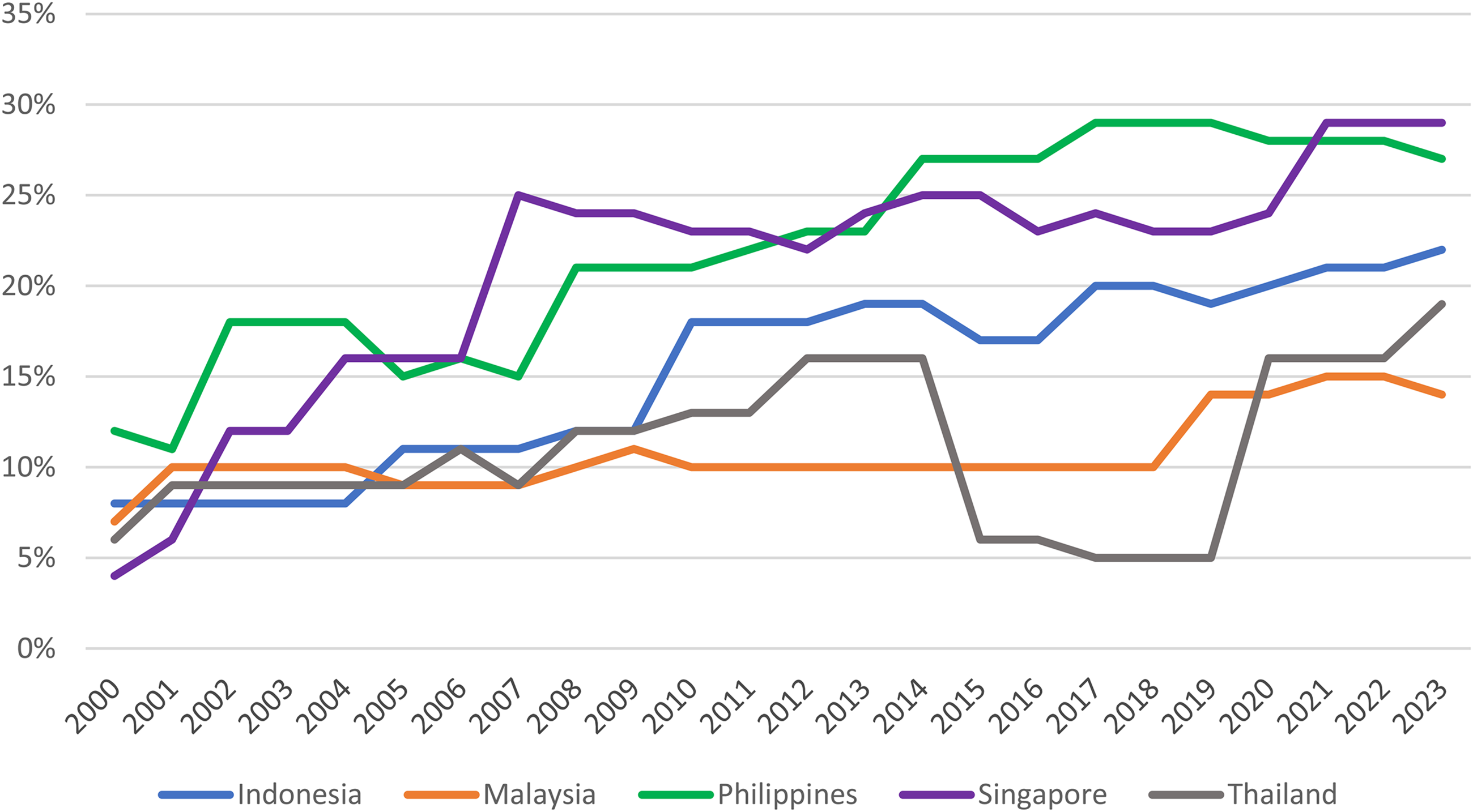
Percentages of Women MPs in National Parliament (Indonesia, Malaysia, Philippines, Singapore, Thailand), 2000–2023.
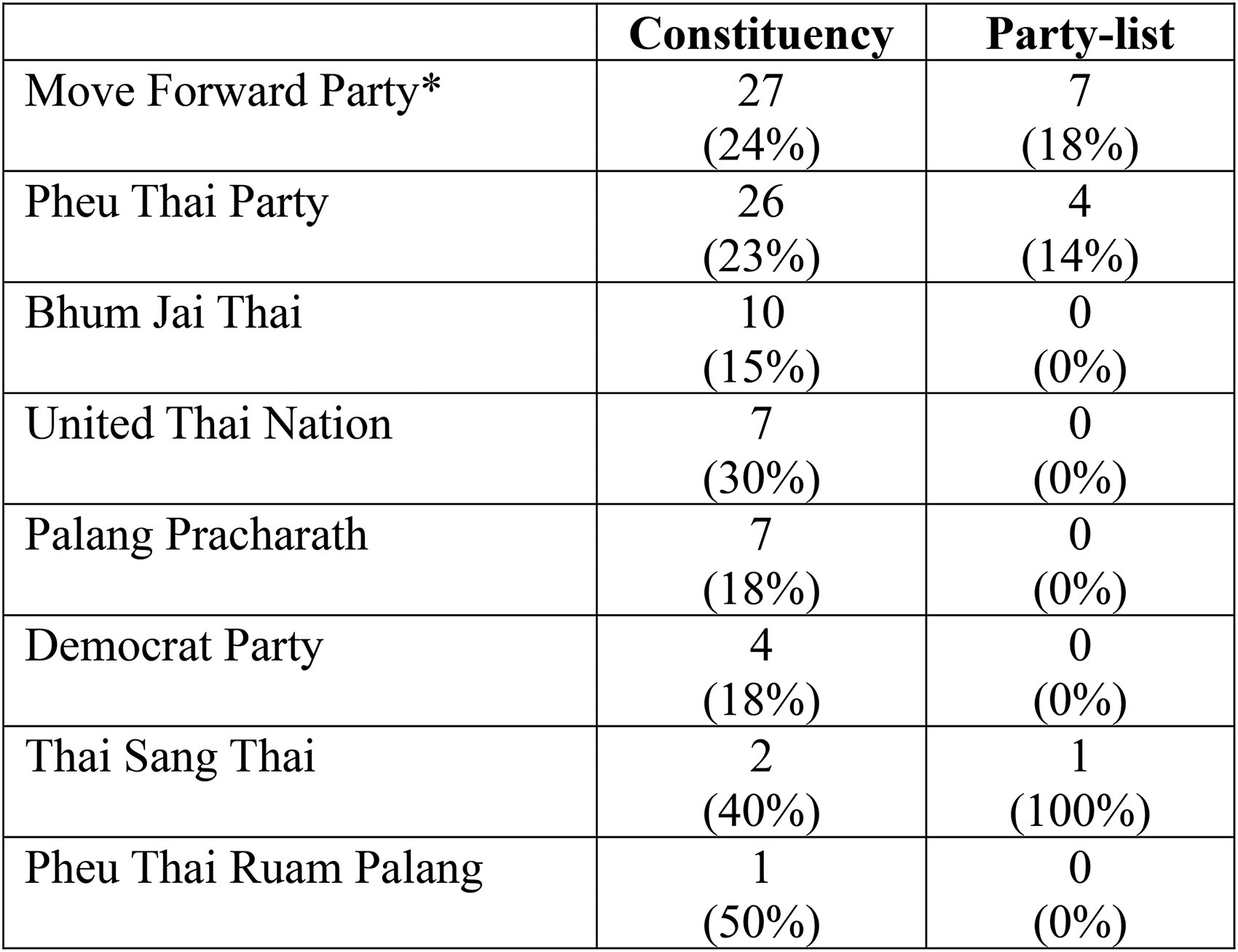
Numbers and Percentages of Elected Women Candidates by Party and Type in Thailand's 2023 National Elections.
The success of women candidates in the 2023 elections was also remarkable as it was the first time in nearly two decades that more women got elected than the proportions that contested in the election. As Figure 3 shows, the proportions of women running for office in 2007 and thereafter ranged between 16% and 18%. However, there has been a continuous rise in the number of female candidates getting elected at the constituency level (through changes in the electoral systems, notwithstanding), from 9% to 19% in the last election. The 2023 election win for women candidates was even more remarkable when examining the pattern of women's political leadership in historical perspective. Women's political representation in parliament has been highly uneven in Thailand, where figures ebbed and flowed over time rather than demonstrating a progressive increase (or even stagnation). The dictatorship years under the military junta following the 2014 coup were the worst on record for women political representation in recent times, as women MPs dropped from 16% to 6%—a situation that did not improve until the 2019 election. It remains unclear whether the 2023 results—being the best on record in terms of women political leadership—could have been part of a continuous trend of increased women representations if it were not because of the 2006 and the 2014 coups.
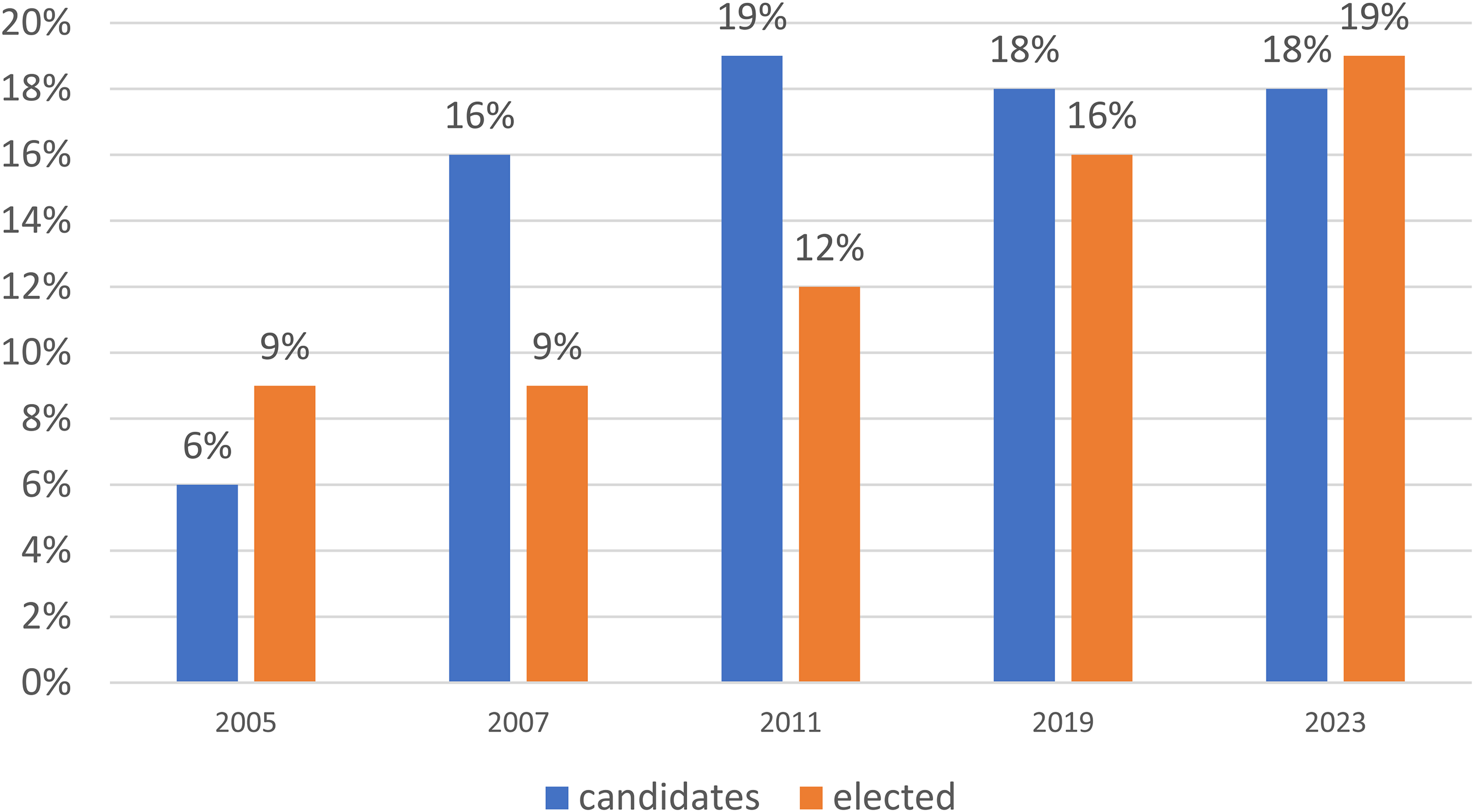
Percentage of Women Constituency Candidates Versus Elected Women Candidates by Election Year (2005–2023).
Only eight political parties, out of the 17 elected to parliament fielded winning female candidates—MFP, Pheu Thai, Democrat Party, Palang Pracharath, Bhum Jai Thai, Thai Sang Thai, United Thai Nation, and Pheu Thai Ruam. Parties that adopt voluntary gender quotas and champion diversity policies, most notably Move Forward and Pheu Thai, account for the higher number of women MPs elected: 27 and 26, respectively. This is especially important when examining the success rate of women candidates at the party-list levels: only MFP, Pheu Thai, and Thai Sang Thai managed to secure electoral victories for their female candidates, while none of the other 14 out of the 17 parties represented in parliament has female MPs form the party list. Among the larger parties, United Thai Nations—the pro-military party headed by the incumber, General Prayuth Chan o-cha, was most successful in getting women candidates elected at the constituency level at 30%, while their rivals had a success rate of 24% (MFP) and 23% (Pheu Thai). Far fewer women were elected as party-list MPs, however, despite higher proportion of female candidacy. Only 12% of female party-list candidates were elected. Interestingly, many major and medium-sized parties who were successful at the constituency level had no elected party-list female candidates—United Thai Nation, Bhum Jai Thai, Democrat Party, for instance. MFP had 18% and Pheu Thai had 14% of women party-list MPs.
Persisting Patronage and Political Entrepreneurship
Based on the interview data and policy document analysis, there are three distinct pathways for women gaining entry into Thai politics: (1) familial connection, (2) patronage, and (3) individual entrepreneurship. The familial connection pathway leverages family name and existing familial political capital, offering women the most direct, least costly, and most straightforward route into political leadership. Women from well-known political families typically face minimal resistance, as their family networks provide immediate credibility, resources, and access to established voter bases. Political parties actively approach and recruit women from these political dynasties, recognizing the electoral advantages of established family reputations.
The second pathway, patronage, is based primarily on the support of powerful patrons—individuals, almost exclusively men, who possess substantial political capital and influence within existing party structures. In this pathway, patrons function as critical gatekeepers who facilitate or restrict women's political access by endorsing and advocating for candidates within parties. Women who successfully build relationships with influential party leaders or powerful local figures gain critical advantages, including improved chances of being nominated in competitive constituencies or achieving higher rankings on party lists. This pathway, however, remains contingent on women's ability to secure and maintain these supportive patron–client relationships.
The third pathway, individual entrepreneurship represents the most indirect and potentially most costly pathway. Women following this route lack substantial familial political legacies and influential patrons. Consequently, they must independently build their own political capital, predominantly through strategic use of social media and grassroots engagement, to gain public visibility, credibility, and support. While social media can significantly lower entry barriers by enabling direct voter communication and personal branding, women pursuing this route still rely on the openness and progressive stances of certain political parties, such as the MFP, or supportive individual patrons willing to embrace politically independent or “outsider” candidates. Despite its promise, the entrepreneurial pathway involves considerable uncertainty, greater investment of personal resources, and higher risks compared to familial and patronage-based paths.
As Figure 4 demonstrates, women from political families were mainly approached from parties to run for office, especially if the family name is well known locally. Their entry into politics is thus the most direct and least costly for the candidates. If candidates are not from political families but they have personal connections to party leaders or influential members inside established parties, their entry to politics become less onerous as they have someone inside to vouch for their credibility. They are more likely than candidates without any connection inside the party to be selected to run for election as their perceived risks of failures decrease. The most challenging path to entering politics for women candidates without any connection is via direct entry—getting in touch with the party directly that they are interested in joining the party and running as candidates. Political parties that have open recruitment both in policy and in practice and prioritize gender equity are the most approachable for women without connections.
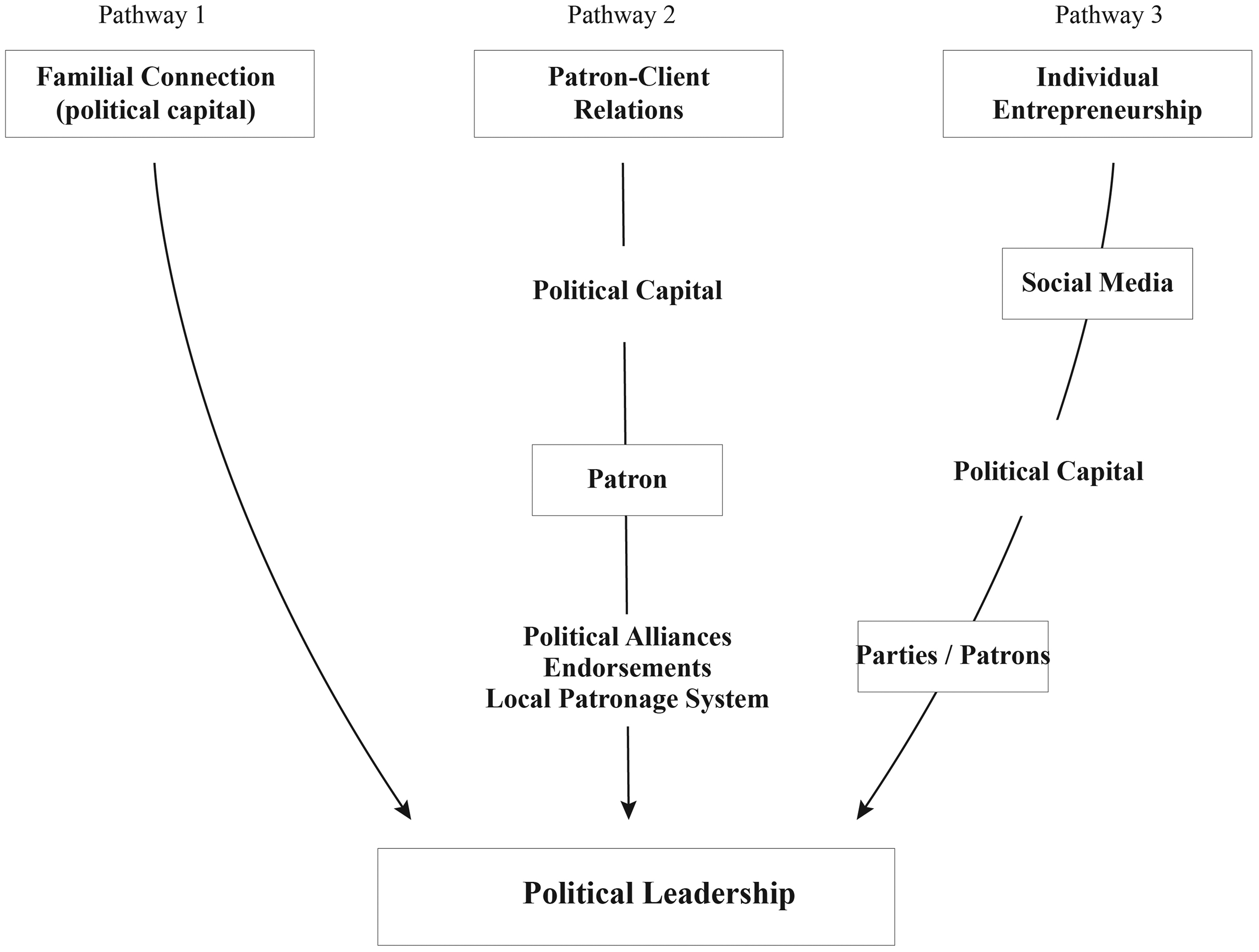
Women's Pathways to Political Leadership.
Based on the analysis of familial connections, the majority of women MPs in the 2023 elections were from political families especially at the constituency level. Out of the 96 elected women MPs, 53 came from political families while 43 were not, representing 55% and 45%, respectively. Familial connections were measured based on direct familial relationships with either current or former politicians at local or national levels of politics. For instance, a niece of a current MP or daughter of a former local politician all count as having come from political families. 3 Women political leaders from nonpolitical families do not have direct ties to current or past politicians within the family. The data also reveals that women MPs at the constituency level account for 94% of all women MPs from political families, while party-list women MPs only constitute 6%. The high proportion of politically connected women who ran and won at the constituency level in comparison to the party-list ballot is consistent with existing literature. Elections at the constituency level rely heavily on name recognition, local vote canvassers, and patronage networks especially (Aspinall et al., 2022). On the other hand, parties have greater control over who appears on the party list and can strategically place candidates who may not have a family background but aligns with party values or demographics they want to appeal to (Dal Bó et al., 2009).
The easiest pathway to entering politics for women was through family connections. For women from political families, their entry to political leadership was the most direct and least challenging. All women drawn from political families in our interview data reported no barriers to their becoming candidates and running for election. In most cases, political parties approached them first or they already belong to existing parties due to their family ties. As one of the interviewees, a niece of a long-time politician from northern Thailand: “I began helping my uncle [politician] as a student with campaigning and then he asked me to run for the local election before moving on to national election…I faced no barriers to entering politics as my uncle took care of everything. It [the election] went really smoothly”
4
The interviewee further noted that there was another candidate interested in running in the same constituency as her, but the party put that candidate on the party-list ballot instead to remove any competition for her. 5 Dynastic candidates are of significant values to political parties because their legacies are known and their chances of getting elected are high. Some of the women candidates from political families interviewed reported being “repeatedly begged” to run as candidates as they were unsure if political leadership was the right thing for them. 6 For women candidates with familial connections, their key challenge is often not getting elected per se, but the high costs of maintaining influence and networks. Often the entire family is involved in financing a family member's political career due to the high cost of maintaining their political primacy. In party systems known for party switching, their loyalty to specific political parties is tenuous, thus, political parties work hard to keep the loyalty of these political families.
For candidates with personal connections with existing parties, their main access to political parties is through someone they know from the inside—either personally or professionally. While the candidates themselves do not possess the family connections or even financial resources to run for elections themselves, their relationship with existing party members particularly with influential ones or party leaders are crucial to breaking entry barriers. If they know someone who are influential party members or party leaders, their chance of being selected to run as candidates rises significantly, as they are viewed as less risky than completely unknown candidates. An interviewee, who lacked family connections, gained entry to politics as an intern for an established party with a stronghold in southern Thailand. She was then asked by a long-time and influential male politician to “come help” with the newly founded party. Initially, she thought she would help with the back office, but the new party wanted to pursue a policy of gender equality and instead placed her as the second candidate on the party list. She said: “There was a lot of female involvement in the party and it didn’t sit well with a lot of the male candidates who felt it was deeply unfair as they were career politicians…I felt that I received a lot of support from [male] party executives because I traveled a lot with them.”
7
For candidates from nonpolitical families with no connection with existing political parties, their main way into politics was through direct entry. This means candidates approached the parties themselves either via direct application or contact with party members. Few women interviewed gained their candidacy and subsequent election this way as it was the most difficult path to political leadership. Interviewees noted the openness of the process of application for candidacy for parties like MFP to be attractive to “no-name candidates.” As one of the interviewees stated: “As you can see, I have nobody in my family who's involved in politics. My family doesn’t even support my decision to join politics. But I was interested in it, and I saw that the party was open to people like me who are not from political families or have no background in politics. The party gave me the opportunity to join politics.”
9
Party openness to women candidates significantly influenced the success of female political leaders, with notable efforts from the MFP and Pheu Thai. Very few political parties adopt an electoral quota to field as many women candidates as men. As the quota is not mandatory, parties lack incentives to implement them as they are seen as raising the cost of doing politics. Among the large- and medium-sized parties in Thailand, only two parties, MFP and Pheu Thai, explicitly tried to adopt voluntary gender quota when recruiting and running constituency candidates. Both parties stand out for their gender equity policies, which emphasize diversity and social inclusivity as key components of their platforms.
10
These policies are not just statements of intent; they are operationalized through the active recruitment and high ranking of women candidates in constituencies and party lists. MFP and its predecessor Future Forward Party were the first parties that successfully ran openly LGBTQI+ candidates in the country's history. The party's advocacy for gender equity signals to voters that they value women's leadership and capability, which in turn fosters greater acceptance among the electorate within party ranks. As a female elected MP from MFP noted: “I was placed high in the party list because…the party wanted to make sure a labour leader was represented.”
11
Women who are not from political families or have connections with political parties have increasingly relied on individual entrepreneurship and social capital to gain political traction. Social media platforms such as Facebook, Twitter, and TikTok became critical instruments for women candidates during Thailand's 2023 elections, providing unprecedented pathway to political visibility and engagement. As Nethipo et al. (2023) note in the surprising victory of MFP in the 2019 election, social media enabled candidates to establish visibility with voters outside of entrenched networks. The 2023 was noted to be the first election where social media played a decisive role in vote choice, which meant that candidates could leveraged their entry to politics, negotiated to be on the ballot, and ran successful campaigns if they had effective social media marketing (Sinpeng, 2024). Digital tools provided autonomy to candidates in shaping their political identity and messaging, helping them to overcome visibility deficits imposed by traditional networks. Women candidates could communicate their ideas directly, by passing male-dominated gatekeepers who traditionally determined candidate viability and access to resources.
Social media's democratizing effect is particularly evident among younger and urban voters who engage actively with online political content and are drawn to candidates perceived as authentic and relatable (Chowprasith and Thirasirikul, 2024). Women candidates could effectively leverage platforms, utilizing short engaging videos to communicate policy positions, discuss social issues, and provide voters with personal insights into their backgrounds and motivations. One candidate noted: “I would use the fact I’m from a new generation and that voters should give someone new a chance. I would also draw upon my quality as being idealistic and advocating human rights.” 12
Some of these candidates, especially if they wanted to appeal to antiestablishment parties like the MFP, emphasized their independence from political connections, a factor that appeals to voters who seek change from entrenched elite dominance (Pansawat et al., 2024). But many of the successful candidates have some established influence, as past celebrities, well-known individuals, or online influencers—key factors that were valuable in attracting voters. This was Ice Rukchanok's path to power: she campaigned on her bicycle and on foot with an antiestablishment message—a core value of the MFP. Her path to power was similar to many of her MFP female peers: while she did not come from political families and lack personal connection with existing members, she was drawn to the party's identity and brought with her individual entrepreneurship. Parties like the MFP responded to such candidates as they saw their lack of political experience and connection as well as their social capital as assets to the party. 13 Their barriers really begin inside the party: whether they get to become candidates and run for election depends on factors such as support among senior party members and the level of competition with existing members (especially when running in constituency). They almost always have a party influencer—mostly male—championing their cause, which suggests the continued importance of the patronage system inside political parties.
While social media disrupts certain patronage-based barriers, structural limitations persist, particularly at the constituency level. Patronage, characterized by the exchange of resources and political support shapes power dynamics across the region as it influences how politicians gain and maintain power, particularly negatively impacting women's potential to both enter and succeed in politics (Hicken and Kuhonta, 2015). As Aspinall et al. (2022) argue patronage networks in Southeast Asia have historically been predominantly male-dominated, with control over resources, political influence, and connections concentrated in the hands of male elites. Women who lack connections to these female-dominated networks find it challenging to build the support base necessary to run successful campaigns or maintain political positions (Derichs, 2013). Political parties, often with predominantly male leaders, act as gatekeepers by allocating resources, support, and access to their loyal followers, often channeled through men (Bjarnegård, 2013). Family-based patronage systems are prevalent in Southeast Asia as women from political families have access to established networks; gain legitimacy through family names and thus increase their electoral appeal (Aspinall et al., 2019).
In Thailand, patronage systems shape political dynamics in ways that both reinforce traditional hierarchies and create barriers for outsiders, such as women, who are not part of established networks. Patronage-based candidate selection continues to be prioritized over meritocratic or inclusive considerations (Wannasopha et al., 2024). Paetongtarn Shinawatra's rise reflects the continued influenced of her father, Thaksin Shinawatra, as she was the highest-ranked woman from Pheu Thai on the party list despite not having any experience in politics prior to the 2023 election. Many voters saw her as the natural successor to her father's political legacy, perceiving her leadership as a continuation of his policies particularly following the ousting of her aunt, Yingluck Shinawatra in 2014 (Thairath, 2024). The Shinawatra's family resources and long-standing connections in Thai politics help to ensure loyalty among key figures within PTP, who had supported and carried on the party despite Thaksin's 17 years in self-exile. Paetongtarn's success demonstrates how the Shinawatra family's resources, legacy, and loyal networks continue to influence Thai politics, providing her with advantages that reinforce traditional power structures.
While patronage-based political systems pose significant barriers to entry for all political outsiders, these challenges manifest distinctly for women candidates due to the inherently gendered nature of patron–client relationships. The male-dominated patronage networks in Thailand systematically exclude women, thereby limiting their access to crucial political resources such as campaign funding, party endorsements, and local constituency networks (Bjarnegård, 2013; Sinpeng and Savirani, 2022). Women attempting to navigate these patronage systems encounter explicit gender bias, a lack of trust, or outright dismissal unless they possess significant personal connections to established political figures. As one of the interviewees noted in her journey to politics: “I am now the secretary of a political party all because of uncle Pravit [longtime politician, male]. He took me under his wings as he saw in me that I really wanted to change Thailand and be part of politics. He was a friend of my father and I respect him like my real uncle. Without him I could never enter politics, let alone be in the position of power within the party.”
14
Conclusion and Policy Recommendation
The 2023 Thai elections marked significant progress in the representation of women in politics, primarily driven by the support of progressive and inclusive parties such as Move Forward (MFP) and Pheu Thai, as well as by the individual entrepreneurial efforts of women candidates. The policies of these parties, which actively promote gender equity and provide high-ranking party-list placements for women, have opened new pathways for women in a political landscape that has traditionally been male-dominated. MFP and Pheu Thai's commitment to placing women candidates in competitive constituencies and prominent list positions has enabled women to overcome some of the systemic barriers that often limit their political opportunities. This support from political parties has been instrumental in helping women candidates secure visibility and legitimacy, making a clear case for the critical role that party policies play in advancing gender equality in politics.
However, despite these advancements, the underlying patronage-based system in Thai politics remains a formidable barrier to achieving full gender parity. The 2023 election results highlight the persistent influence of patronage, where family connections and powerful male patrons continue to shape political opportunities and candidate selection. Women from political families benefit from existing networks, while those without such connections must rely heavily on individual entrepreneurship—such as leveraging social media to build personal political capital—to stand out and appeal to voters independently. Although these efforts represent an important shift, the entrenched nature of patronage and the influence of male-dominated networks demonstrate that there is still a long road ahead to achieve meaningful and sustainable gender equality in Thai politics. Addressing these challenges will require not only supportive party policies but also structural reforms to reduce the influence of patronage networks and create a more inclusive political environment for women from all backgrounds.
The findings from Thailand's 2023 election offer valuable insights into breaking down barriers for women in politics across Southeast Asia, particularly within authoritarian contexts where challenges are more severe. Progressive party policies, such as gender equity commitments and the strategic placement of women on party lists, underscore the importance of institutional support in promoting women's political participation. In authoritarian states, however, state violence and the suppression of dissent remain critical concerns that complicate efforts to increase women's representation. Women who enter politics in these regimes often face harassment, intimidation, and threats from state actors, which not only discourages female participation but also reinforces societal norms that view women as unsuitable for political roles. By adopting institutional measures that both protect and promote women candidates, Southeast Asian states could mitigate these risks and foster a more inclusive political climate, even within restricted political systems.
More broadly, the Thai case highlights the effectiveness of individual entrepreneurship as a tool for women to build social capital and counterbalance the influence of entrenched patronage networks. In environments where formal pathways to power are limited or controlled by elite families, individual strategies such as social media campaigns and community engagement provide women with alternative ways to connect with voters and establish political credibility. This approach is particularly relevant for aspiring female politicians in authoritarian regimes who may lack access to traditional patronage channels. The lessons from Thailand illustrate that while institutional support is critical, empowering women to leverage digital platforms and create their own networks of influence can help circumvent traditional barriers. For Southeast Asia's authoritarian contexts, the combination of protective policies, party openness, and independent social capital-building offers a framework for advancing gender equality in politics, even under challenging conditions.
It is also critical to acknowledge the broader context of political unpredictability that characterizes Thailand's political landscape, particularly given its significant implications for women's political representation. Thai politics has long been marked by volatility, including frequent military coups, constitutional changes, shifting electoral rules, and unpredictable party alliances. These factors collectively create an environment of uncertainty that disproportionately affects marginalized groups, including women who seek political office. Such unpredictability heightens political risks, complicates candidate recruitment processes, and voter uncertainty—all of which pose additional challenges for women candidates attempting to build sustainable political careers and undermine efforts toward gender equity.
There are several concrete policy recommendations for improving women's pathways to political leadership. Firstly, political parties should move toward implementing mandatory gender quotas, rather than relying solely on voluntary measures. The current voluntary approach, as illustrated by the practices of parties like Move Forward and Pheu Thai, has increased women's representation but lacks the structural guarantees necessary for sustained and widespread change. Mandatory quotas, by contrast, would ensure consistent representation of women across election cycles, compelling all political parties to systematically recruit and support women candidates at both constituency and party-list levels. Such measures have been effective internationally in transforming political cultures and institutional practices toward greater inclusivity and gender balance.
Secondly, targeted investments in comprehensive political training and capacity-building programs for women candidates are crucial. These training initiatives should focus explicitly on equipping women—especially those without traditional patronage connections—with skills and strategies to succeed politically. Special emphasis should be placed on digital literacy, online campaigning, and the strategic use of social media, given the transformative role these platforms played in the 2023 elections. Programs could include workshops on digital branding, voter engagement techniques, and managing online harassment, as well as networking opportunities to facilitate mentorship and peer support among aspiring and established female politicians.
Thirdly, legal and institutional frameworks addressing violence against women in politics must be significantly strengthened and enforced to safeguard women candidates from threats, harassment, and intimidation. As documented in this study, women in Thai politics routinely face gendered forms of political violence, both online and offline, which serve as substantial deterrents to sustained political participation. Legislative reforms should clearly define gender-based political violence, create accessible reporting mechanisms, and ensure robust enforcement of protective measures. Moreover, civil society organizations and electoral bodies must collaborate to develop awareness campaigns and resources that educate both candidates and the electorate about the unacceptable nature and consequences of gendered harassment and violence.
Lastly, sustained advocacy and public awareness initiatives should accompany these policy reforms to shift societal attitudes toward greater acceptance of women's political leadership. Public education campaigns could be specifically designed to challenge patriarchal stereotypes about leadership, promoting broader societal recognition of the value of women's participation in political decision-making. Additionally, advocacy initiatives led by civil society, women's organizations, and progressive political actors should continually push for accountability and transparency from political parties, ensuring they meaningfully implement policies designed to support women candidates. Implementing these concrete policy recommendations is essential for achieving durable progress toward gender equality in political representation. Such measures will help dismantle persistent structural and cultural barriers, ultimately fostering a more inclusive and democratic political environment in Thailand.
Footnotes
Declaration of Conflicting Interests
The author declared no potential conflicts of interest with respect to the research, authorship, and/or publication of this article.
Funding
The author disclosed receipt of the following financial support for the research, authorship, and/or publication of this article: This work was supported by the Australian Research Council.
