



Abstract
Research in Western Democracies suggests voting has substantive impacts on how one feels about democracy and state institutions. Voting for winners leads to positive feelings while voting for losers has the opposite effect. How, though, do voters interpret electoral results in a system prone to authoritarian intervention? Thailand's 2023 election offers a unique opportunity to examine how voting in a hybrid regime can impact voter opinion. Using a pre- and postelection survey, we demonstrate that, like elections in democracies, an election in a hybrid regime can have a significant impact on voter opinions. When pro-democracy voters win an election in a hybrid regime, the win does boost some support for state institutions. On the other hand, the losing pro-authoritarian voters turned against democracy and expressed reduced support for some state institutions. By contrast, we see an absence of the winner–loser gap regarding some state institutions designed to support authoritarian rule.
In democracies, there is clear evidence that voting for a winning party in an election has a strong impact on an individual's opinions, ranging from support for democracy and the political system to improving subjective well-being (Anderson et al., 2005; Blais et al., 2017; Toshkov and Mazepus, 2023). Being on the winning side of an election can have long-term effects, boosting one's perceptions of the government for as long as five years (Loveless, 2021). On the other hand, voting for losers might push some voters to lose faith in the political system or even oppose democracy, though this may in part be due to underlying policy preferences (Gartner et al., 2020). The psychological effect of a loss is also pronounced, with those who vote for losing parties reporting lower levels of happiness and life satisfaction than those who vote for winning parties (Toshkov and Mazepus, 2023). In short, voting for the winning team feels good, voting for the losing team feels bad.
The findings cited above, though, largely draw from relatively established democracies. Voters in such systems may be more responsive toward electoral results through long experience with policy-making and electoral feedback mechanisms (Gartner et al., 2020). In much of the world, though, consolidated democracies are not the norm. Over the past two decades, hybrid regimes have been on the rise, including moves toward sophisticated application of democratic institutions designed to prolong authoritarian rule (Levitsky and Way, 2002; Matovski, 2021; Morgenbesser, 2020). How do voters interpret electoral results in a system prone to authoritarian interventions?
In this essay, we draw on Thailand's 14 May 2023 election to investigate this question. This was the second election in the country since a coup in 2014 placed General Prayuth Chan-ocha as the head of the government. Prayuth ruled directly under a military junta from the coup until an election in 2019, which was held under a constitution which had been designed to ensure continued authoritarian rule (McCargo and Alexander, 2019; Ricks, 2019). Notwithstanding a second-place finish in those polls, Prayuth was able to utilize institutional advantages to secure the premiership and serve as prime minister until 2023. Many voters treated the subsequent 2023 election as a referendum on Prayuth and the military's time in power. Despite possessing numerous tools to shape the electoral outcome, the result was a devasting loss for the Prayuth and his coup supporters (Kongkirati, 2023; Hicken and Jatusripitak, 2023). Two opposition parties, Move Forward and Pheu Thai, together captured 292 of the 500 seats in the house of representatives and combined 67.7 per cent of the party-list votes across the country, while the three largest conservative parties (Palang Pracharath, United Thai Nation [UTN], and Democrat) managed to win less than 16 per cent of the party list votes combined and 20 per cent of parliamentary seats.
Using a two-wave online survey of Thai voters conducted both the week before and the week after the election, we gauge the impact of electoral outcomes on voter opinion. Based on the results of the surveys, we show that Thai voter attitudes do respond to election results, demonstrating that even semidemocratic elections can significantly impact voter attitudes. On one level this reflects the winner–loser gap identified in the elections and democracy literature. But our results also show that attitudes did not shift in relation to some authoritarian-enabling institutions and that some pro-authoritarian losers became more supportive of some institutions after the election. Our findings contribute to a growing literature on the importance of elections in hybrid regimes and demonstrate that the psychological impact of voting is not limited to mature democracies.
Of course, we must acknowledge that at the point of the second wave of the survey, respondents only knew the electoral results. The ensuing negotiations over government formation took three months and resulted in the barring of the opposition Move Forward Party, the recipient of the largest number of parliamentary seats and most votes, from taking the seat of Prime Minister (see McCargo, 2024). As such, the psychological effect of winning the election highlighted here could possibly be ephemeral, and in fact, might eventually be replaced by democratic disillusionment due to the postelection coalitional maneuvering.
Our argument proceeds as follows. In the next section, we lay out our theoretical expectations as well as provide context for the Thai election. We then describe the survey before presenting the results. After this, we discuss our findings and conclude with a few implications for researching semidemocratic elections.
The Effect of Winning an Election
Winners and Losers
Elections, by their very nature, create winners and losers (Nadeau and Blais, 1993). Research in developed democracies has repeatedly demonstrated the existence of a winner–loser gap among voters, wherein those who vote for winners express a variety of positive attitudes, including higher levels of support for democracy and democratic institutions (Anderson and Guillory, 1997). These positive feelings include increased support for democracy, greater trust in the government and political system, and higher levels of happiness, optimism, and even better health (Anderson et al., 2005; Blais et al., 2017; Loveless, 2021; Toshkov and Mazepus, 2023).
On the other hand, voting for an electoral loser can be gut-wrenching, with one study estimating that it can be more emotionally impactful than a terrorist attack (Pierce et al., 2016). It can also significantly reduce satisfaction with democracy (Anderson et al., 2005). Other work suggests that losing voters react differently to different institutions, such as expressing additional support for independent institutions like courts that provide checks on majoritarianism (Mazepus and Toshkov, 2022). Repeatedly losing elections has significant long-term effects, though, perhaps even turning losers against democracy (Hansen et al., 2019).
In short, the winner–loser gap observed in Western Democracies shows that whether one's party wins an election can have a strong impact on whether one is satisfied with democracy and government institutions.
When we move beyond well-established democracies, though, we face a potentially more complicated relationship between winning, losing, and attitudes toward democracy and the political system in general. In electoral autocracies, electoral outcomes can result in boosts of support for authoritarians or provide justification for modifications to the political system which further entrench the incumbent and undermine democracy (Singer, 2018). In some cases, electoral victories by opposition parties or candidates may not translate into government formation, which hollows out any benefit of winning. In other cases, losing may inspire rejection of the electoral results, and even elections in general, as the losers turn to more extreme methods, such as protests, coups, or violence, to try securing their seat in power (Piazza, 2022).
The benefits to authoritarian and semi-authoritarian incumbents of holding elections are well documented (e.g., Morgenbesser, 2016). But these elections have the additional effect of turning voters into either winners or losers, even where the ultimate outcomes of the election are subject to manipulation. In many cases, opposition voters enter the ballot booth already knowing that the odds are stacked against them or their chosen candidate. They may even face incentives to support candidates that they find distasteful to express their opposition to the status quo (Gandhi and Ong, 2019). This potentially changes the impact of an election on their level of satisfaction with the system.
In particular, we are interested in the ways that electoral results in a hybrid regime might impact voters’ feelings toward democracy and state institutions. Do losers lose faith in democracy? How do winners interpret their victory? Do results change the way they see state institutions, such as electoral commissions, especially if those institutions are designed to encourage authoritarian outcomes? Anderson et al. (2005, 29–31) argued that electoral losers should have a more negative outlook toward both the “processes of government and the outcomes it produces” than their counterparts. We interpret this as including both attitudes toward democracy as well as support for state institutions (ibid, chapter 3; Singer, 2018).
We hypothesize that the emotional boost of being on the winning side of an election is universal, even if the ultimate outcome is not fully democratic. This increase in satisfaction should impact both voters’ approval of democracy as well as state institutions, much as it does in well-established democratic systems. If an opposition party wins, oppositional voters will be buoyed by the feeling and belief that their distaste toward the regime is reflected in the broader population. They might even have hope that the results will be respected and that the autocrat will step down. If the autocrat wins, his supporters receive the comfort of knowing that their leader enjoys broad popular support and will remain in power.
The experience of losers may be a bit more complex. For opposition supporters, there may be a baked-in expectation of loss, which could negate any change in opinion regarding the regime and the country. Opposition-supporting voters may already have low levels of satisfaction with the system and low expectations for the election. Thus, the impact of a loss might have less impact on their opinions. For authoritarian supporters, though, losing an election may result in disappointment and anger targeted toward opposition voters. It may also eviscerate their belief in democracy, and, if they behave like losers in democracies, also undermine their support for government institutions. However, given the nondemocratic context, another possibility. Facing an electoral defeat, it is possible that losing authoritarian supporters may express greater support of state institutions that can help keep the opposition from taking power, such as an electoral commission or appointed oversight body.
It is important to note that as we prepared for data collection, we did not have foreknowledge of the outcome of the election, meaning we could not create specific hypotheses until the electoral context was established. Prior to the election, our hypotheses were broad. Only after electoral results were known could we be more concrete in our expectations. We now explain conditions surrounding the 2023 Thai election that allow us to provide more specific hypotheses to test.
The Thai Context
Thailand has a long history of authoritarian interventions. Since the fall of the absolute monarchy in 1932, a military official or former military official has headed the government more than 67 per cent of the time. In the last two decades, two coups, one in 2006 and another in 2014 have dominated the political scene (Chambers, 2024). Beyond the military, conservative courts have displaced prime ministers, dissolved political parties, and facilitated less-than-democratic outcomes (McCargo, 2020; Merieau, 2016). This interference stands in stark contrast to the six general elections held between 2001 and 2014. In each of those elections, a party affiliated with Thaksin Shinawatra had won, and sometimes formed a government, before being displaced by coup, court decision, or election nullification. Understandably, such events could make Thai voters somewhat skeptical of the power of elections. Most recently, Generals Prayuth Chan-ocha, Prawit Wongsuwan, and Anupong Paochinda led a coup on 22 May 2014, ousting the elected Pheu Thai government, before initiating five years of direct authoritarian rule under Prayuth.
The coup group oversaw the writing of a new constitution, which they promised would return democracy to the country. The 2017 Constitution, though, included multiple mechanisms that ensured the coup group would be able to extend their influence in politics. Elections were announced for 2019, overseen by the junta-appointed Electoral Commission. Prayuth, while not joining a political party, became the prime ministerial candidate for the Palang Pracharath Party (PPRP), which was created primarily to support Prayuth's continued role as government leader.
When the 2019 was finally held, it was far from free and fair. Opposition parties and candidates were subject to intense harassment by security forces while the resources of government, including budgets and prosecutorial powers were brought to bear in an unprecedented way to boost support for PPRP and discourage support for opposition politicians. Despite these efforts by the junta, the PPRP was only able to secure second place behind the Pheu Thai party in terms of parliamentary seats. Nevertheless, thanks to electoral engineering, decisions by the junta-appointed Electoral Commission, and constitutional provisions granting power to the junta-appointed Senate over government formation, Prayuth claimed victory and became prime minister (see Hicken, 2020; McCargo and Alexander, 2019; Ricks, 2019). The election was not a return to democracy; rather it was an extension of authoritarianism by another means.
The constitution required another election after four years, and as 2023 drew near, preparations began for the polls. This time, though, splits appeared between Prayuth and his coup-collaborator, Prawit (Kongkirati, 2023). They ultimately parted ways, with Prawit becoming head of PPRP and its prime ministerial candidate, and Prayuth joining a new party, UTN, espousing a stringent nationalism reminiscent of Cold War-era military leadership. The split between the coup leaders weakened their electoral position, but it did not negate the built-in institutional advantages they enjoyed, especially the power of the junta-appointed Senate to help select the next Prime Minister. The Senate provision left them assured that at least one of them would be able to find their way into top office. In the days leading up to the polls, the two uncles, as they were called, exuded confidence that their parties would capture a significant proportion of votes setting up their return to power.
From the opposition, the Pheu Thai (PT) party had campaigned heavily on the promise of a “landslide” victory, which would allow it to move from the opposition into government. Many observers and PT voters expected PT to again capture the largest number of seats in parliament, as it, or its predecessor parties, had done in every election over the past two decades (Selway, 2023).
As the votes were counted, however, it became clear that an upset was in the making. The progressive Move Forward Party, successor to the disbanded Future Forward Party that had placed third in the 2019 election, performed much better than expected, capturing 151 parliamentary seats, the largest share of any party in the election. Pheu Thai, which had won the 2019 poll and was predicted to win the 2023 election, came in second with 141 seats. Palang Pracharath Party and UTN captured only 40 and 36 seats, respectively. Combined, the two generals captured barely half the number of seats of Move Forward (for more details see Hicken and Jatusripitak, 2023; Jatusripitak and Ricks, 2024). Also notable was the shattering loss experienced by the Democrat party, the oldest surviving political party in Thailand. The Democrat Party had long been seen as an ally of conservative forces in Thai politics, and one of its most prominent voices, Abhisit Vejjajjiva (2009–2011), had held the prime minister's seat thanks, in part, to the party's perceived closeness to the military. In 2019, though, much of the party's support had been cannibalized by PPRP (Ricks, 2019); 2023 furthered this process. After capturing only 2.5 per cent of the party list vote, the party teetered on brink of complete collapse. 1
This shock result prompted a quick declaration of victory for the progressive movement, with MFP leader Pita Limjaroenrat immediately declaring himself Prime Minister-elect. In the days following the election, cautious optimism spread among the party's supporters at the same time as they held their collective breath to see whether MFP would be allowed to head the government. Their concern was well-founded. The 2019 election had seen significant postelection actions by the Election Commission, which ultimately reduced the seat allocation for winning parties in favor of small parties that supported Prayuth. The Senate, which continued to wield significant power over appointing the prime minister, was also full of pro-Prayuth and pro-Prawit loyalists. Voters also knew that Move Forward was perceived to be the enemy of the conservative political and military elite of the country, due to the party's calls for systemic reform, including reforms of the lese-majeste law and repealing military conscription. In short, voters knew that Move Forward's win was a direct reproach of the last nine years of military/conservative rule—which also meant that it was highly unlikely the victory would be allowed to stand. 2 On the other hand, those who voted for the two uncles enjoyed a reasonable degree of certainty that voting for losing parties didn’t mean that they would necessarily be shut out of power despite the painful results at the ballot box. In contrast, there was little solace for the Democrat Party voters, who were forced to recognize that the party had experienced a second devastating loss. Finally, what of Pheu Thai supporters? After expecting a convincing victory (a so-called “landslide”) they were no doubt disappointed in their second-place finish. However, they could also be certain that they would be included in whatever governing coalition was formed.
Given these conditions, how did the results affect voter attitudes in the immediate aftermath of the election? Did they have the same psychological impact as in full democracies?
Based on our theoretical expectations, we propose the following hypotheses: H1: Move Forward voters (the opposition winners) should exhibit a boost in their support for democracy and feelings toward government institutions. H2: UTN and PPRP voters (the pro-authoritarian losers) should exhibit a reduction in their support for democracy and feelings toward government institutions. H2A: UTN and PPRP voters (the pro-authoritarian losers) might continue to express support for government institutions in a position to hinder the democratic winners. H3: Democrat Party voters (the biggest losers) should exhibit the largest reduction in their support for democracy and feelings toward government institutions. H4: Pheu Thai voters (the opposition second-place winners) should exhibit similar results to Move Forward voters (H1), but we might expect these results to be somewhat muted, as Pheu Thai voters were disappointed in a second-place finish.
These hypotheses are built upon the logic that the winners of the election (Move Forward voters), despite favorable results, faced a situation in which their victory was likely hollow. Even so, in the immediate aftermath of the election, we predict that they would be buoyed by the temporary emotional boost of an electoral win and hope that the win might translate into their forming a government. The losers (UTN and PPRP), reeling from their devastating electoral loss, should express less support for democracy. Predicting their attitudes toward state institutions is less straightforward, and we test competing hypotheses. On the one hand, their loss, and the prospect of losing control of government institutions, could translate into less support for those institutions (H2). On the other hand, given the nondemocratic nature of some of those institutions to begin with, pro-authoritarian losers might continue to place faith in those institutions as the means to keep the winners from power and ensure that losing the election doesn’t mean they are entirely excluded from power (H2A). By contrast, the poor showing of the Democrat party allows us to consider the feelings of those who unquestionably suffered a setback in their fortunes. Finally, the upset of Pheu Thai allows us to check for the impact of unexpected results on voter attitudes.
Methods and Variables
The Survey
To evaluate the impact of the election on voter opinions, we carried out a two-wave online survey. The first wave of the survey, which included 1,366 respondents, occurred one week before the election, with data collected from 4 to 8 May 2023. The second wave occurred one week after the election, from 23 to 31 May 2023, and targeted the original respondents. 858 respondents took part in both waves of the survey. This is the pool of respondents that we will use to test our hypotheses.
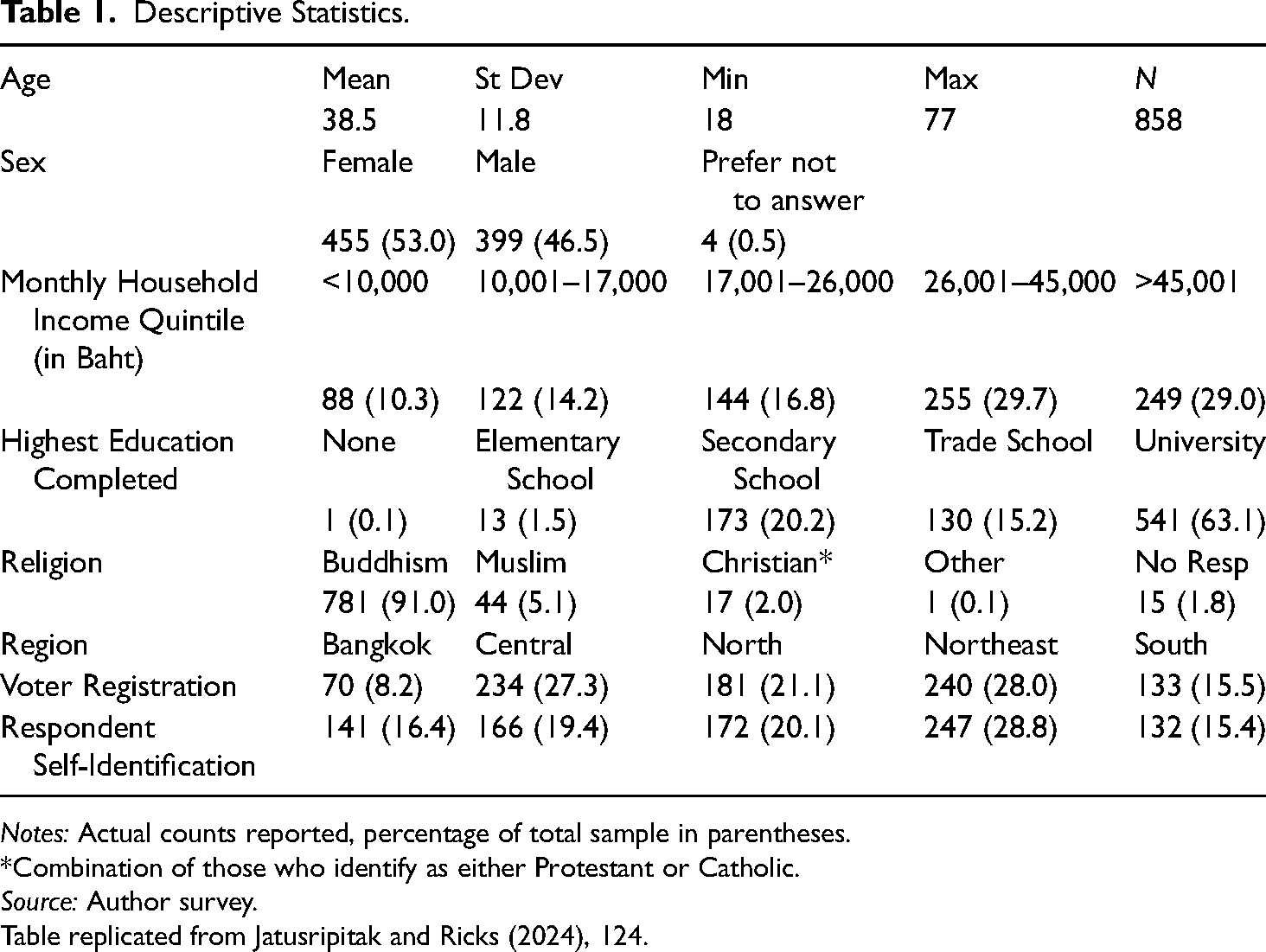
The survey was carried out through Qualtrics online panels and utilized targeted sampling to obtain approximate gender parity and representative regional distribution of respondents. 3 The survey was self-administered, mostly via smartphone. As participants self-selected into the online survey panel, it was unsurprising that the sample was generally younger, wealthier, and more highly educated than the general Thai population, as shown in Table 1. 4 Because of this, we recommend exercising some caution in drawing broad conclusions about the whole Thai population based on our results. Nevertheless, as we have measures of the same questions from both shortly before and shortly after the election, we have reasonable confidence that the observed changes in opinion occurred due to the election results (see Blais et al., 2017).
Descriptive Statistics.
Notes: Actual counts reported, percentage of total sample in parentheses.
*Combination of those who identify as either Protestant or Catholic.
Source: Author survey.
Table replicated from Jatusripitak and Ricks (2024), 124.
Independent Variable
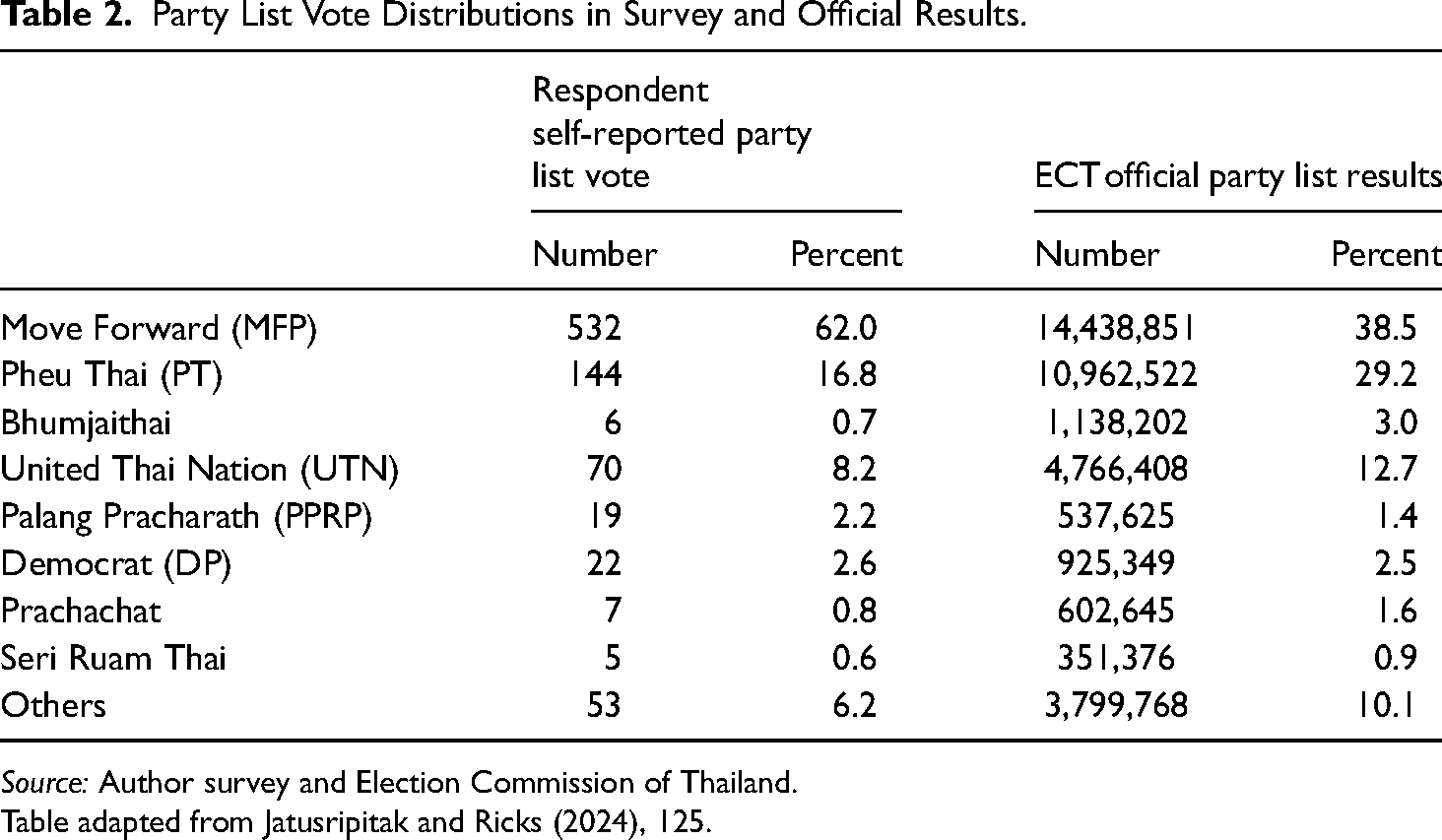
We are interested in the impact of voting for electoral winners or losers, with the main measure of being whether a voter's party list choice won or lost the election. In the election, voters chose both a constituency-level candidate and a national-level party list vote. We focus here on the party list vote. Constituency votes in Thailand are often influenced by local personalities and patronage-style politics. The party list vote, though, is seen as a more direct reflection of voter opinions regarding party affiliation. During the second wave of the survey, we asked respondents to directly identify their party list vote, with descriptive statistics reported in Table 2.
Party List Vote Distributions in Survey and Official Results.
Source: Author survey and Election Commission of Thailand.
Table adapted from Jatusripitak and Ricks (2024), 125.
As the Move Forward Party targeted voters who were generally younger and more online savvy, the bias of our sample toward that demographic gives us additional leverage to test for the impact of voting for the electoral winners. Table 2 shows that most of our respondents (62 per cent) did vote for Move Forward. A smaller percentage (16.8 per cent) voted for Pheu Thai, which most observers expected to capture the most seats in parliament, as the party, or its predecessors, had done for the past two decades. On the other hand, 10.4 per cent of our respondents indicated voting for either UTN or PPRP, the two parties of the generals. And a relatively small group of Democrat voters (2.6 per cent) aligns roughly with that party's official results.
Before moving on to our tests, we emphasize that our respondent numbers for the PPRP and Democrat Party voters are very small, which means that we cannot draw many meaningful conclusions from analyzing them independently. As such, it might make more sense to combine them with our UTN respondents to create a block of conservative voters. We decided, however, to present them separately, as the voters for PPRP, Democrat, and UTN parties were sufficiently distinct in their preferences that we believe there is value in presenting their preferences separately. That said, we again emphasize caution in drawing inferences based on the PPRP and Democrat results presented here.
Dependent Variables
Our dependent variables of interest were the changes in respondent opinions between preelection and postelection survey waves regarding support for democracy as well as state institutions. We measured this in three ways.
First, we presented respondents a series of questions designed to gauge their feelings about democracy in the first wave of the survey prior to the election. Then, one week after the election, respondents were presented with these same questions again.
5
Survey questions regarding democracy were based on Likert scales running from 1 to 5, scaled such that 5 signified more support for democracy. After conducting an exploratory factor analysis of the statements, we confirmed that we had a series of five statements that jointly measured an underlying variable of support for democratic values.
6
We then created a factor variable using the following items:
What are the most important components of having a democratic system of government? To have equal treatment of all people. What are the most important components of having a democratic system of government? Majority rule. What are the most important components of having a democratic system of government? To have political freedoms, like the right to protest and speak freely. Democracy requires that all people have equal voice in elections. Democracy requires that multiple political parties are free to compete in elections.
This single democracy variable serves as our dependent variable to measure respondent support for democracy.
Second, to gauge their support for state institutions, we asked respondents to evaluate their level of trust in a series of 11 state institutions based on a five-point Likert scale ranging from No Trust at All to A Great Deal of Trust. Specifically, we asked about the following:
7
Prime Minister The PM's party The main opposition party Parliament (House of Representatives) One's own constituency member of parliament The police The education system The court system The military The Electoral Commission The Senate
Important here is a recognition that we consider these 11 institutions as potentially representing three different categories of institutions. First, three of these measures were essentially a reflection of partisanship (the Prime Minister, the PM's party, and the main opposition party). Support for these institutions should clearly follow the winner–loser gap logic. Second, we had four institutions which might be considered more neutral in that these institutions, although potentially political, are not necessarily seen as directly supporting either democratic or authoritarian outcomes (the police, the education system, parliament, and one's own constituency member of parliament). 8 We expected that voters would consider these institutions all falling under control of the winning electoral party, and thus, should follow the winner–loser gap logic, although perhaps not as directly as the first three measures. Finally, we had a set of four institutions that could be considered authoritarian enabling, as these institutions had all been involved in displacing democratically elected results in favor of authoritarian outcomes (the courts, the military, the Electoral Commission, and the Senate). Thailand's courts have repeatedly dissolved political parties and set aside prime ministers; the military has staged multiple coups; the Electoral Commission was appointed by the Prayuth junta and had made judgments in 2019 that allowed Prayuth to retain power; and the Senate was an appointed body full of pro-Prayuth loyalists who would have a strong say in government formation (Chambers, 2024; McCargo, 2020; Ricks, 2019). While we roughly expect that voters would respond to these institutions based on winner–loser gap logic, we also suspected that pro-authoritarian voters would be more supportive of the authoritarian-enabling institutions (H2A). That said, we expected that the winner–loser gap would be found broadly across the institutions.
As a third measure, we asked respondents their evaluations of the effectiveness level of these same institutions. These were evaluated, again, on a five-point Likert scale ranging from Not Effective at All to Very Effective. The point of having a second measure covering the same institutions was to provide a secondary check and try to capture perceptions that might not be completely tied up in institutional trust.
The two waves of the survey, then, allowed us to measure the difference in respondent's feelings of support for democracy and state institutions in the wake of the electoral results.
Results
Before presenting the tests of our hypotheses, we first describe some of the top-line results that help reassure us that we are accurately capturing voter attitudes. First, we asked voters after the election to what extent they were satisfied with the results of the election. Figure 1 displays the results for respondents who reported voting for MFP, PT, PPRP, UTN, and Democrat parties. A score of 1 equals “Very Dissatisfied” while a score of 5 equals “Very Satisfied.” As expected, MFP voters are the most satisfied with the election results—the median MFP voter reported a score of 5, or very satisfied, and the average score for all MFP voters was 4.39. Pheu Thai voters, many of whom expected to win the election, but nonetheless also expected to be part of the ruling coalition, were somewhat less happy, though the median PT voter was still satisfied (score = 4) with an average score of 3.99. As expected, UTN and Democrat Party voters were the least satisfied in our survey, with an average score of 2.80 and 3.23, respectively. Somewhat surprisingly, though, PPRP voters were not as upset with the election results, with an average score of 3.74. One might have expected most conservative voters to be very dissatisfied with the election results, but while they are significantly less satisfied than opposition supporters, we don’t see evidence of extreme polarization. 9
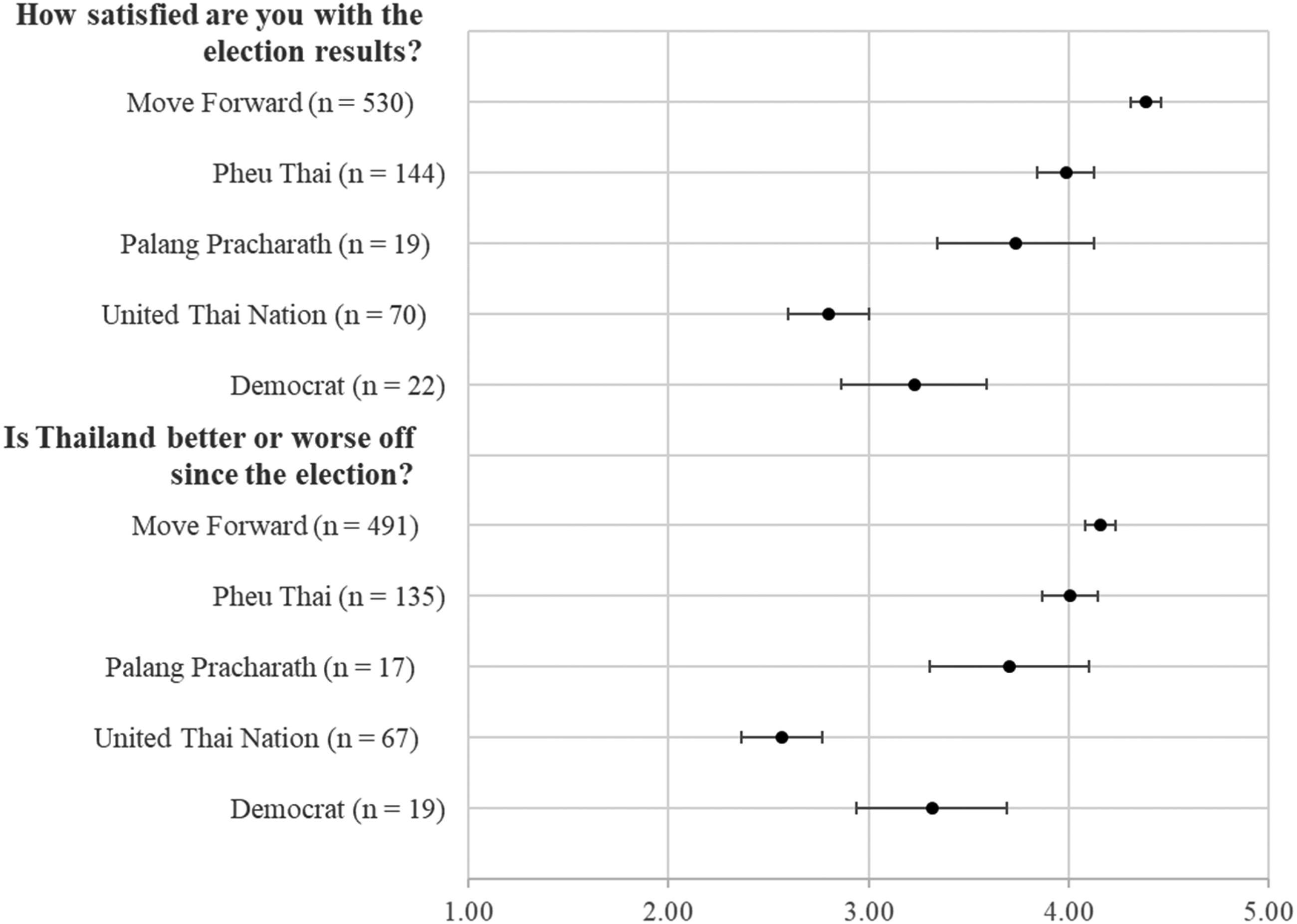
Mean Scores of Voters by Party for Selected Survey Questions.
We also asked the question “Is Thailand better or worse off since the election?” Possible responses range from 5 (improved a lot) to 1 (a lot worse). Once again, the basic pattern remained the same, with MFP and PT voters suggesting that they had seen improvement while UTN voters felt as though things had gotten worse.
The survey results for both questions are presented in Figure 1. Note the difference in attitudes between the questions for MFP voters. While they are happy with the election results, they appear to be slightly less optimistic about what results mean for Thailand more broadly. This is consistent with our claim that MFP supporters recognized the election results were no guarantee that the party would be able to help the government and implement its reform agenda.
We now turn to the pre- and postelection analysis. This analysis approaches the election results as a treatment and compares the heterogenous effects of this treatment across voters from different parties (i.e., winners and losers). For each analysis, we are comparing a voter's attitudes a week prior to the 2023 election to their attitudes one week after the election once the election results were known. Specifically, we look at attitudes toward the following items: (1) Democracy, (2) Trust in institutions, and (3) Belief in the effectiveness of institutions.
Democracy
Figure 2 shows attitudes toward democracy before and after the election, broken down by party. It is clear that MFP voters espouse democratic values at a much higher rate than voters for the conservative parties, a pattern that is true both before and after the election. In contrast, PT voters, despite the party's portrayal as pro-democratic, exhibited similar democratic values to conservative voters. This suggests that there was a potential value cleavage between MFP voters and PT voters in the 2023 election (Jatusripitak and Ricks, 2024; Jatusripitak and Lohatepanont, 2025).
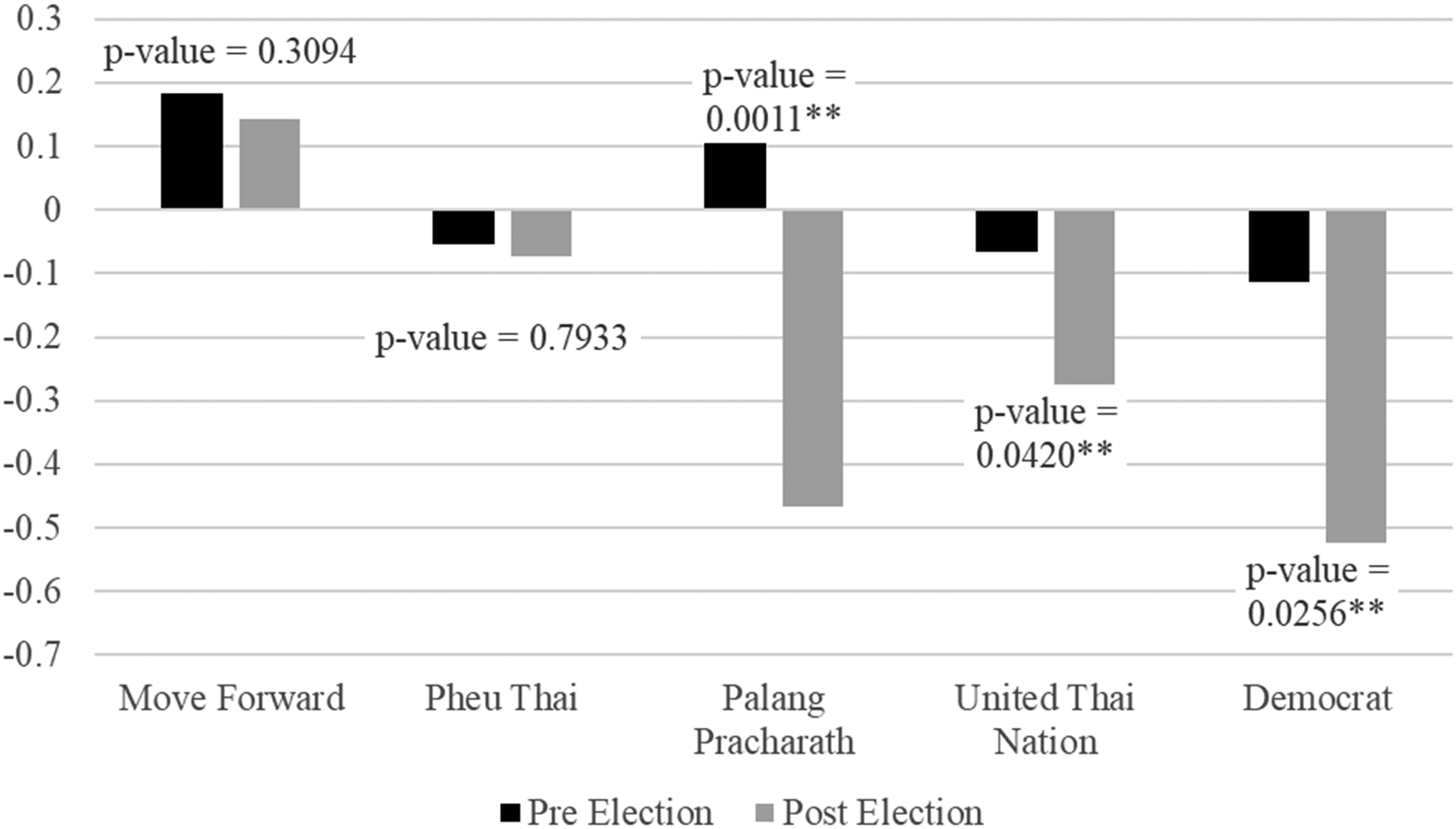
Democracy Variable: Change in Means between Preelection and Postelection Surveys by Party.
The election had a strong impact on opinions, with the shift in attitudes toward democracy clearest among the losing parties. Consistent with our hypotheses, the losers of the election, supporters of conservative parties, report a statistically significant decline in their support for democracy. All three party groups, PPRP, UTN, and Democrat, saw significant drops in their democracy variable scores after the election. By contrast, the support for democracy among MFP voters changes only slightly after the election, but the shift is far from statistically significant. Similarly, there is no clear change in democratic attitudes among Pheu Thai voters. So we have partial support for our hypotheses. As expected, the electoral losers become less supportive of democracy, but we see less evidence that the supporters of winning parties become more bullish on democracy in the Thai case. This is in line with the literature showing that electoral losses have more impact on voter opinions than electoral victories (Pierce et al., 2016).
Why doesn’t winning an election boost supporters’ attitudes toward democracy? It is possible that we are observing ceiling effect wherein MFP voters were already so positive toward democracy prior to the election that there was not much room in the survey responses to show additional support for democracy. However, the lack of change may also reflect reservations about the ultimate outcome of the elections, and recognition that nominally democratic institutions in Thailand have been bent to the advantage of Thailand's conservative forces or overridden and ignored altogether. In other words, in the Thai political context, opposition winners had abundant reasons to be pessimistic about whether the electoral results would translate into political control.
More concerning is the contingent support for democracy on display by the supporters of losing parties. Democracy advocates have long argued that one of the pillars of stable democracy is losers’ consent—the losers agree to support democracy, and by extension, tacitly accept governance by the winning party (Anderson et al., 2005). In other words, support for democracy should not be contingent on whether one is on the winning or losing side. That we see such sharp declines in support for democracy among losing party supporters is consistent with the notion that many in Thailand are, at best, contingent democrats. These voters, already demonstrating relatively low support for democracy, have become significantly less supportive of democratic values after suffering an electoral loss. This is indicative of a major weakness of Thai democracy over the last quarter century as electoral losers have, time and time again, proven willing to abandon democracy in order try and win power via other means. These results suggest that, despite the strong showing for opposition parties in the most recent election, a sizeable number of voters remain sympathetic to, if not supportive of, nondemocratic paths to power, including supporters of PT, something that authoritarian entrepreneurs could try to exploit in the future as they have in the past.
Trust in Institutions
We then examined whether the election results affected the level of trust respondents placed in individual state institutions. First, if our measures are valid, we would expect to see major changes in the levels of trust in the Prime Minister (or Prime Minister-elect), the PM's party, and the main opposition party in the wake of an election that saw incumbent conservative parties lose. This is precisely what we observe. Figure 3 demonstrates that among supporters of MFP and PT the trust in the presumptive PM (Pita Limjaroenrat) and the PM's party (MFP) soars in the wake of the election, while trust in the presumptive opposition party (UTN) declines. We see the opposite pattern for UTN supporters, which, postelection, view the incoming PM and his Party with distrust, while holding more favorable views toward the main opposition party. We see no significant change in the attitudes of either PPRP or DP voters, consistent with the idea that among conservative voters UTN voters were the most ideologically extreme. In other words, it appears that partisan identities strongly impact these responses, and, as a rough gauge of the validity of our measures, we are seeing responses in line with predictions.
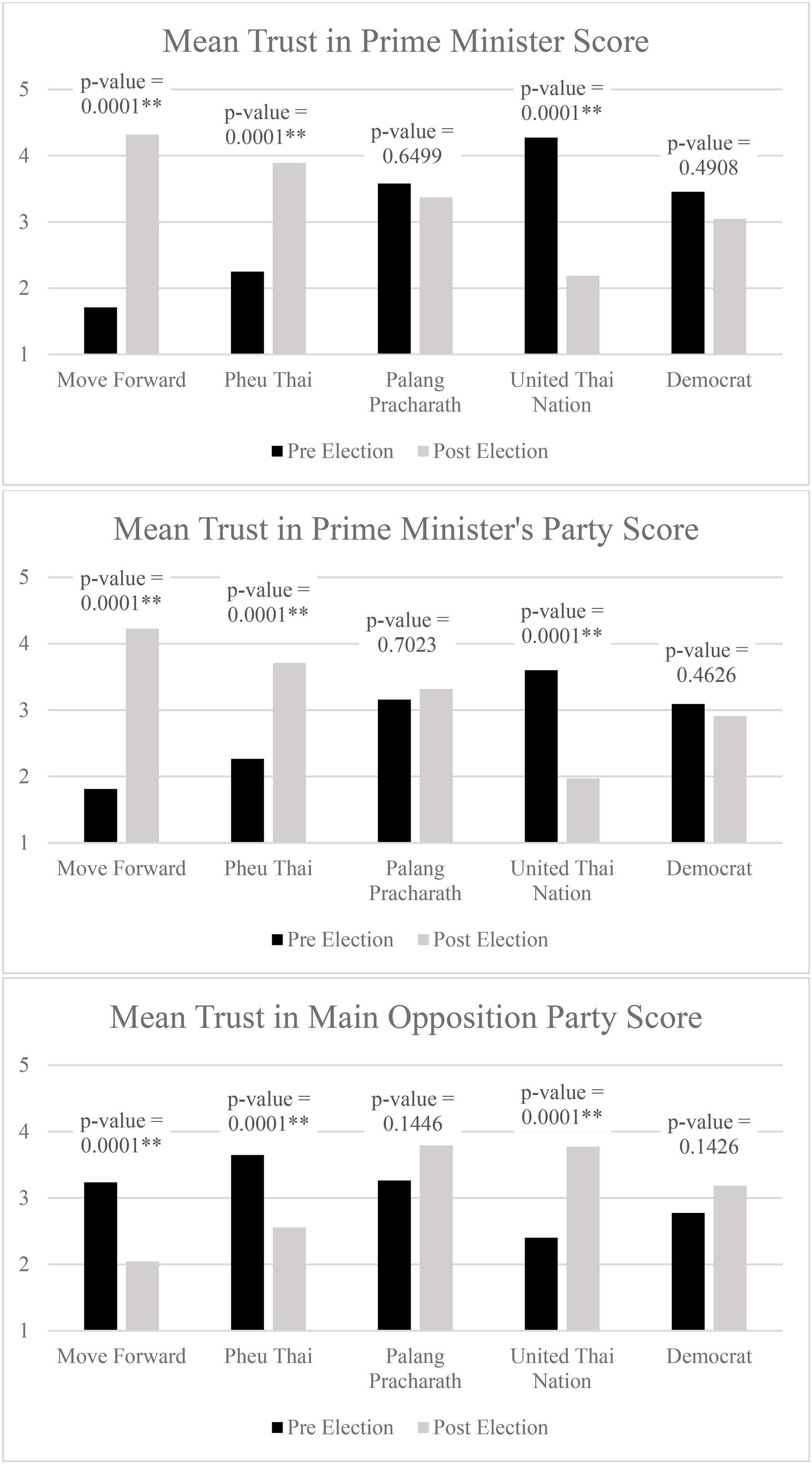
Trust in Institutions: Change in Means between Preelection and Postelection Surveys by Party.
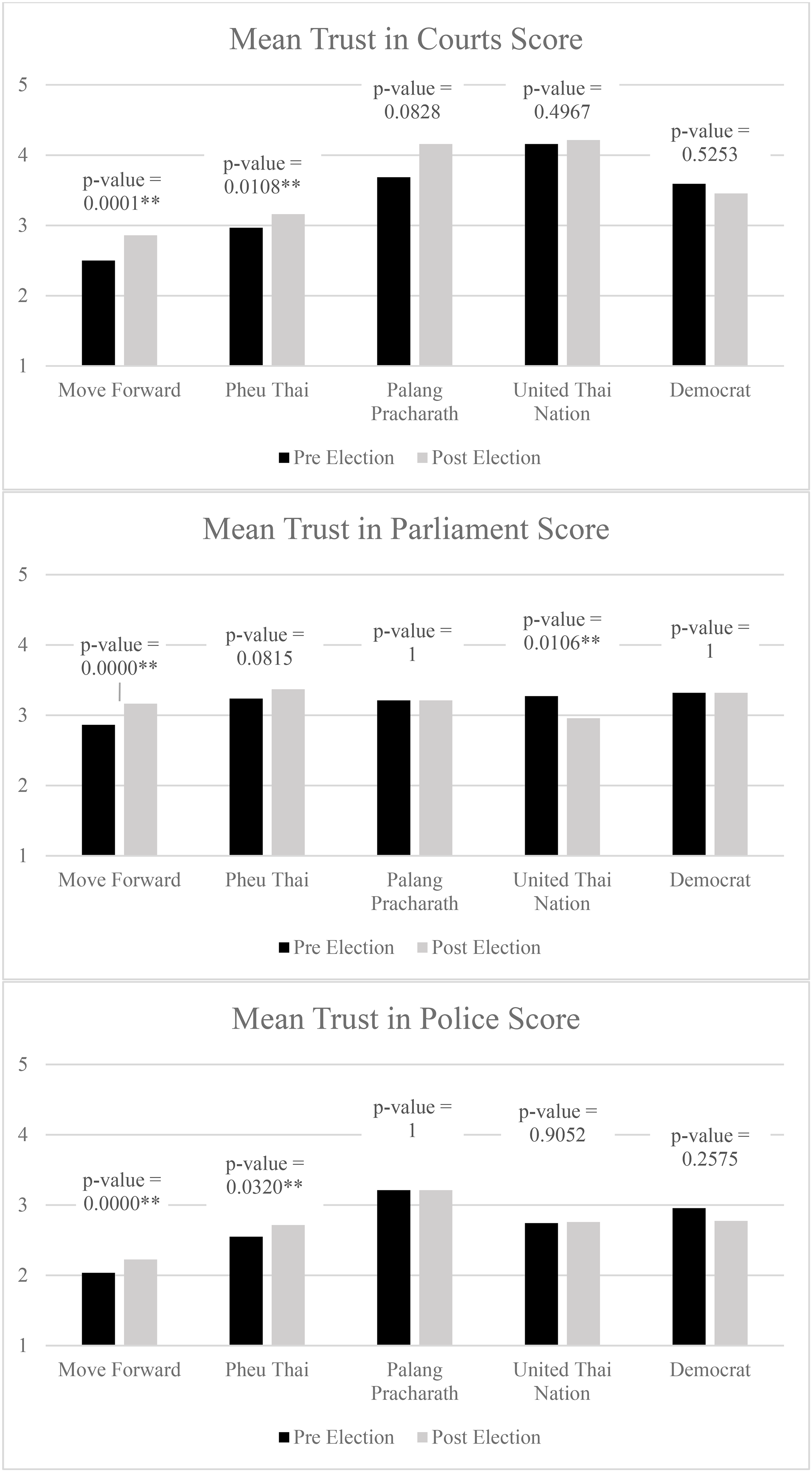
Trust in Institutions: Change in Means between Preelection and Postelection Surveys by Party.
Turning to other institutions, we see evidence that winning elections causes the supporters of winning parties to view certain institutions more positively. Regarding trust in institutions, MFP voters saw statistically significant (p < 0.01) positive changes in their average level of trust toward four institutions: parliament, their member of parliament, the police, and the courts. Pheu Thai voters saw statistically significant (p < 0.1) positive changes in their average level of trust toward three institutions: The parliament, the police, and the courts. Some of these results are presented in Figure 4.
While MFP and Pheu Thai voters’ increase in trust for the police and MFP voters’ trust in parliament is consistent with our predictions, as we consider these as more neutral institutions, we are more interested by the change in support for the courts. Thai courts have been seen as immensely political in recent years, as the constitutional court has intervened to disqualify Prime Ministers, politicians, and political parties. The institution is perceived by many as authoritarian enabling (see McCargo, 2020; Merieau, 2016). As seen in Figure 4, MFP and Pheu Thai voters both already had low levels of trust in the courts, but after the election, their level of trust in the courts did increase by a statistically significant amount. These results were consistent with findings regarding the effectiveness of the courts, as discussed below. We take this as a signal of the power of an electoral win on attitudes toward state institutions, even those that might seem authoritarian enabling. Truly an electoral victory can have a powerful effect on winners’ opinions about state institutions.
Alternatively, we see an important contrast in UTN voters. Their behavior is not consistent with H2—we only see a decrease in trust toward two out of the eight state institutions voters were asked about: the education system and parliament. Their trust in all other state institutions remained relatively constant with their preelection opinions, despite suffering a debilitating loss. If they were to exhibit the winner–loser gap as seen among losers in democracies, we should have seen more changes that we did. We take this to suggest that, even though they lost the election, they trusted that state institutions remained favorable to their side and would protect their interests, consistent with H2A.
Across all parties, the election results don’t bring any major changes in terms of the trust in the military, the Electoral Commission, or Senate for the supporters of any of the parties, with one exception. 10 Finding themselves in a surprising second-place finish, PT voters become slightly less trustful of the Senate (A decrease from 2.87 to 2.67, p < 0.05). We see this as potential recognition that the Senate had been an authoritarian-enabling institution in 2019 and blocked Pheu Thai from government. Perhaps PT voters were anticipating that the junta-appointed body would block them again from power. 11
Effectiveness of Institutions
We also asked voters how they would rate these same institutions in terms of their effectiveness, with responses ranging from not effective at all to very effective. Among the three prominent partisan institutions, the patterns are the same as in the institutional trust analysis. MFP and PT voters view the Prime Minister and the PM's party as more effective after the election and the main opposition party as less effective. Supporters of UTN express the opposite view. These results mirror those reported for trust.
For the other eight institutions, the winning MFP voters, as our hypotheses predict, were much more positive toward state institutions after the election. They judged six of the eight institutions as more effective (p < 0.05) in the immediate aftermath of the election: The parliament, their member of parliament, the courts, the police, the education system, and the military. The only two institutions that did not see a positive change were the authoritarian-enabling bodies of the Senate and the Electoral Commission. Pheu Thai voters also saw statistically significant increases in their rankings of effectiveness (p < 0.05) for five of the same institutions, with the exception being the education system. These results suggest that the electoral win resulted in much more positive feelings about state institutions almost across the board showing the strong impact of winning an election on voter perceptions of the state. Voters for both MFP and PT, though, made exceptions for the Electoral Commission and the Senate, where we observed no change in opinion between the pre- and postelection results, suggesting that these voters perceived both institutions as less effective and perhaps likely to block a democratic outcome, as they had done in 2019.
However, the effectiveness results do depart from the trust results in a couple of ways. First, while no partisans reported a change in their level of trust in the military, voters from MFP, PT, and PPRP all report feeling the military is more effective after the election (Figure 5). By contrast, voters from the losing UTN party view the military as slightly less effective after the election. (The results for both PPRP and UTN are each significant at the .10 level.) We also see a difference between the winning and losing parties in terms of their views of the education system: MFP voters view the education system as more effective after the election, while UTN voters feel the opposite (Figure 5). In terms of the Senate, consistent with H2A, UTN supporters, perhaps in anticipation of the Senate's role in blocking MFP's bid for the premiership, view the Senate as more effective after the election (significant at the .10 level) (Figure 5). There are no differences in terms of voters’ views of the Electoral Commission.
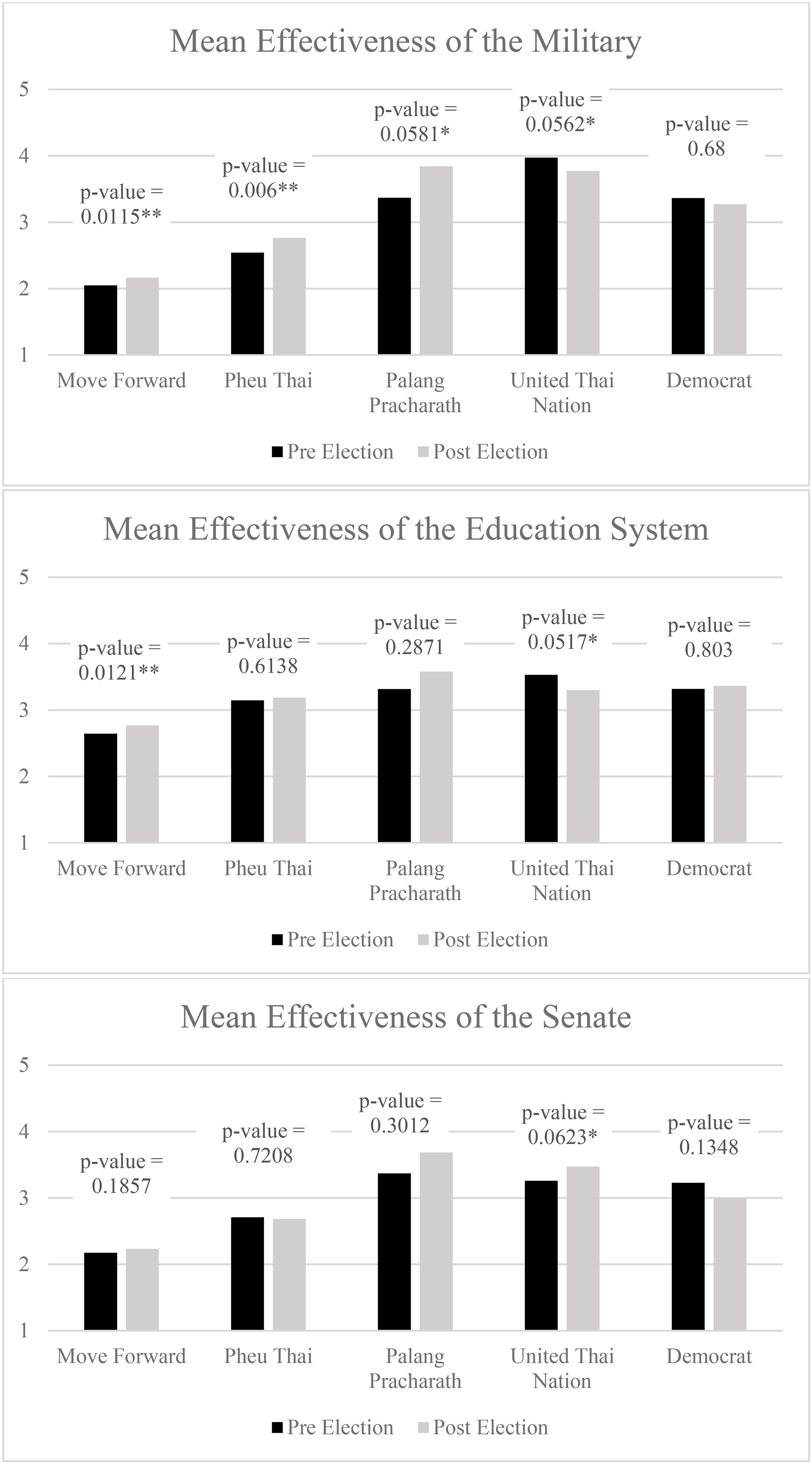
Effectiveness of Institutions: Change in Means Between Preelection and Postelection Surveys by Party.
We suspect that UTN voters’ increased belief in the effectiveness of the Senate was partly a reaction to their loss. The junta-appointed Senate played an important role in the parliamentary vote for prime minister after an election, holding 250 votes against the 500 votes held by the elected parliamentarians. Senators, many of whom were personally loyal to Prayuth, were firm in their opposition to MFP and could be expected to vote against the MFP's candidate for prime minister (as was the case). Thus, UTN voters were likely supportive of the Senate's position as a potential way for their preferred party to retain access to power (again, consistent with H2A). In some ways, this might parallel findings in democracies that losers may support institutions that protect their rights (Mazepus and Toshkov, 2022), but importantly here, the Senate had the power to upend the electoral outcome and prevent MFP from forming a government.
The results regarding education do provide some support for our theoretical expectations regarding how winners and losers react to election results. MFP voters, after experiencing the win, likely felt that the education system had imbued fellow voters with sufficient wisdom to turn against the pro-authoritarian parties. On the other hand, UTN voters felt that the education system had failed to teach fellow voters the proper appreciation for Prayuth and his regime. Especially since youth voters turned to MFP in droves.
We do find it interesting that voters from MFP and PT both saw an increase in their attitudes regarding the effectiveness of the military, while UTN saw the opposite. This contrasted with their perceptions about other authoritarian-enabling institutions of the Senate and the Electoral Commission. We had expected the PPRP voter results, suggesting that the party's voters felt warmly toward the military, as the party was aligned with General Prawit who had been a central actor in the coup group. Our suspicion regarding MFP and PT voters is that, at the time of the survey (one week after the election), they believed the military would not directly overthrow the election, and/or were pleased that the military hadn’t interfered with the election, as it did in 2019. In contrast, UTN voters were potentially disappointed that the military had not overtly expressed its support for Prayuth after the election. Indeed, the military had made no movement toward tamping down celebrations over MFP's victory. Also, General Narongpan Jittkaewtae, the army chief, had issued a statement on 12 May that the military would not engage in a coup and would allow the results of the election to stand (Bangkok Post, 2023). Of course, Prayuth had also made such promises a decade earlier before launching a coup, but the sentiment in the postelection period was that the military would sit on the sidelines. We suspect that most MFP and PT voters were cautiously optimistic regarding the behavior of the military, while UTN voters were frustrated that support for their chosen party was not forthcoming. Again, this provides evidence of the strong impact of electoral outcomes on voter opinions.
Finally, like the trust measures, UTN voters did not report reduced belief in the effectiveness of the court system and Electoral Commission. Thus, the pro-authoritarian losers didn’t act like we expected losers would if H2 holds. This again aligns with our alternative hypothesis about how pro-authoritarian losers in a hybrid regime would respond.
Discussion and Conclusion
The results of our analysis provide some support for our hypotheses. As expected, voting for an electoral winner is associated with significant increases in feelings of trust in some state institutions and belief in the effectiveness of those institutions. This held for most of the state institutions we posed to respondents. We did not see, though, the expected increase in support for democracy among winners. In contrast, we do find that supporters of losing conservative parties report less support of democracy and exhibit less trust in some state institutions and more skepticism about those institutions’ effectiveness, again, as expected. Just as in the literature on developed democracies, losing seems to have a stronger impact on voter opinions than winning does.
In short, even in hybrid systems that are less than fully democratic, electoral outcomes need not be epiphenomenal—they can have a psychological effect on voters, shaping their attitudes in measurable ways. We also find, not surprisingly, that voters trust institutions more, and believe those institutions to be more effective when they expect their chosen parties to administer those institutions.
However, the results are not all so clear-cut. We find evidence consistent with the notion that authoritarian institutions might moderate voter responses to winning or losing. The oppositional winners did not feel more positively about some institutions that were widely perceived to be authoritarian-enabling (the Senate and the Electoral Commission). And the pro-authoritarian losers did express some increased support for one authoritarian-enabling institution (the Senate) and did not express a loss of support for other authoritarian-enabling institutions (the courts and the Electoral Commission). We suspect this is due in part to the fact they are aware that these institutions are arranged such that these arms of the state will ultimately protect their parties and interests. Elections in hybrid regimes, then, could have substantively different impacts on voter opinion than elections in democratic regimes based upon the ways state institutions are structured.
Overall, then, the data presented here contribute to both the research on the impact of voting for winners or losers in elections and the literature on Thai politics. We push forward our understanding of how voting in hybrid regimes can impact public opinions toward their country, democracy, and their government. To our knowledge, this is the first paper conducting such a before-and-after electoral survey in a hybrid regime (see Blais et al., 2017).
Beyond this, the results here give us insight into the way that Thai voters interpreted the 2023 election. Our survey suggests that there are clear and significant differences in the way that MFP voters and UTN voters view democracy and the state. We also show that the losers of the election, UTN, PPRP, and Democrat voters, became less supportive of democracy. This points to a growing ideological divide in Thai society that will impact politics in the coming years (see Jatusripitak and Ricks, 2024).
This paper also suggests several avenues for future research. First, how stable are these attitudes? A natural extension to this study would be a follow-up survey of voters, to see if attitudes have shifted again in the wake of the postelection political machinations. Second, to what extent do shifts in attitudes predict changes in political behavior? Finally, with a larger sample of conservative voters we could probe potentially interesting differences within that group—for example, differences between ultra and mainline conservatives, militarists v. royalists, or anti-Thaksinists v. antiprogressives.
Footnotes
Acknowledgments
The authors express thanks for comments on the paper from Aim Sinpeng, Greg Raymond, and the other participants of this special issue. Professor Ricks is grateful for feedback during a presentation at Khon Kaen University's College of Local Administration. Professor Hicken would like to thank Pat Chimtanoo for research assistance and the Amnuay-Samornsri Viravan Endowment for Thai Studies for research support. The authors are also grateful for helpful suggestions from the reviewers of this paper.
Declaration of Conflicting Interests
The author(s) declared no potential conflicts of interest with respect to the research, authorship, and/or publication of this article.
Funding
The author(s) disclosed receipt of the following financial support for the research, authorship, and/or publication of this article: Research for this project was supported through a Lee Kong Chian Fellowship at Singapore Management University. Data collection for this project was approved by SMU's Institutional Review Board (approval: IRB-23-052-A042(423)) on 20 April 2023.
