



Abstract
This paper explores voting reasons in Thailand's 2023 election in the Northeast. For a long time, this region has been considered a bastion of pro-democracy movements in the streets and parliament. While the recent election results still suggest so to a greater degree, the region has also witnessed big victories for parties positioning themselves to be staunch guardians of Thai conservatism. This is not to mention electoral surprises including dark horses whose victory has upset long-serving incumbent constituency members of parliament. Based on a textual analysis of questionnaire responses from voters of a wide range of demographic backgrounds, the paper explains the election outcomes in terms of voters’ political ideologies, needs, challenges, and strategies.
Introduction
Observers of Thai politics are probably familiar with how certain regions of the country have been political hotspots: the Deep South and the Northeast. Such words as chon tai (Southern thugs) and khon Isan ngo (Stupid Isan people) have been recurring themes in political conversations with condescending views towards armed dissidents in the Deep South and voters in the Northeast, who throughout the years have been shaping electoral politics in ways not approved by many middle-class Thais. In the case of the Northeast, or known among Thais as Isan, its residents account for a third of the Thai population. During the Cold War, its border provinces were a stronghold of the Communist Party of Thailand. In post-Cold War electoral politics, political parties faring well in this region often had a good chance of forming a government. The New Aspiration Party came first with a total of 125 MP seats in the 1996 election, 78 of which were in the Northeast (Hewison and Maisrikrod, 1997). It later formed a coalition government with former military general Chawalit Yongchaiyudh as prime minister. In 2001, northeasterners voted in 71 newly formed Thai Rak Thai Party MPs out of the 138 seats in the region. The party ended up winning 200 out of 400 constituency seats nationwide. Thai Rak Thai's victory made its founding leader, businessman-turned-politician Thaksin Shinawatra, become prime minister, leading a two-party government. Thai Rak Thai went on to win again in the 2005 election. This time, its landslide victory allowed it to form the first single-party government since the Cold War era (Siripan, 2019: 103). Since then the region has been a stronghold for Thaksin-associated parties from the start of his political troubles in 2005 until losing its winning title to the up-and-coming, progressive-leaning Move Forward Party in the 2023 election. It should be noted that after the Constitutional Court's dissolution of Move Forward in late 2024, the successor party is now known as the People's Party (Head, 2024). Thus, to have a better understanding of Thai politics, it is necessary to pay close attention to political developments in this region both on the street and parliamentary fronts.
Since the latest round of political conflicts, triggered by the 2014 military coup, Thailand has seen an unprecedented amount of tension and confrontation between different groups of stakeholders. If the 2010 Redshirt protests put poorer, ordinary people from Isan provinces in the spotlight and in the crosshairs of the guns held by “mysterious” sniping mass murderers, the 2020 youth-led protests against the elite-backed government saw many Isan protesters back to the streets in Bangkok and elsewhere joining young activists in their struggles for what they saw as the better Thailand (Saowanee, 2021). To many, the ensuing consequences were more enraging than pacifying, as protesters and dissidents, most of whom were young, were later charged with serious crimes including lese majeste. The struggles evolved in their aims, going from calling for a dissolution of parliament in 2010 to calls for the country's structural reforms (Anusorn, 2022). The conflicts reveal more and more dimensions of a general rift (Somkiat, 2022). In the electoral arena, the 2019 and 2023 election results were largely in favor of pro-democracy allies, the victories of Pheu Thai, a long-time favorite party in Isan, which is associated with former prime ministers Thaksin and Yingluck Shinawatra, and the up-and-coming Move Forward (formerly Future Forward), which is extremely popular among younger generations and progressive supporters. Pheu Thai came first place in the 2019 elections, while Move Forward led in the 2023 elections. However, their parliamentary seat results were not enough to bring drastic power shifts; each party alone failed to reach the majority threshold to guarantee the formation of a single-party government. In the 2023 elections, a constitutional change from a one-ballot system to a two-ballot system (one for a constituency race and the other for a party-list race) was partly responsible for even more diversified results (see Kritdikorn, 2023 for an analysis of the waning support for Pheu Thai). This was coupled with the legal hurdles created by the elite-backed 2017 constitution and political machinations (Alderman, 2023, Viengrat et al., 2023). What happened to Pheu Thai in 2019 happened this time to Move Forward in 2023. But on this occasion, Pheu Thai, who came second in the elections, broke off from the original “pro-democracy” coalition led by Move Forward and joined hands with parties associated with the junta leaders. They managed to form a government after Move Forward failed to garner enough support from the Thai Senate to install their leader as Prime Minister. This infuriated many voters who saw Pheu Thai as a “traitor” and “liar,” causing a new political rupture and marking the great divide between Pheu Thai and Move Forward not just as political rivals but enemies. In her comparative analysis of anti-democratic movements, Sinpeng (2020) shows that animosity between political parties is just one manifestation of a deep political cleavage. The Democrat Party politicians became joint-leaders of the People's Alliance for Democracy movement, also known as the Yellow Shirts. This pro-establishment movement staged protests across the country that finally led to the military coup in the same year that overthrew Thaksin Shinawatra. In 2011, the movement reincarnated as a new movement called People's Democratic Reform Committee, PDRC, with a mission to topple Pheu Thai Prime Minister Yingluck Shinawatra's government using street protests. The Democrat Party once again supported this pressure group. In another example, the 2009–2010 protests organized by the Red Shirt movement were supported by Pheu Thai while the fatal crackdown, resulting in nearly 100 deaths, took place under Prime Minister Abhisit Vejjajiva from the Democrat Party. Some of those killed were ordinary voters from Isan who became political activists because they wanted to pressure Abhisit to dissolve parliament and call a new election (Saowanee and McCargo, 2019). These examples show that Thailand has witnessed more than once deep-rooted political conflicts that manifest themselves in parliaments and in street protests involving voter-turned protesters and politician-turned movement leaders, and protest leader-turned members of parliament. The interrelatedness between street, electoral, and parliamentary politics serves as a reminder that Thai politics is complex, and that animosity between political parties can go beyond a ballot box. Even though the post-election conflict between Pheu Thai and Move Forward was intense, currently there is no evidence that it will translate into anything other than an ever-increasing electoral and parliamentary competition sparked by the 2023 election.
In the region of Isan where competition between both parties was intense, Pheu Thai won 73 constituency seats, while Move Forward, 8. The number of Pheu Thai's constituency seats dropped from 84 in the 2019 elections, despite fielding candidates in more constituencies. Move Forward, on the other hand, jumped from having only one seat in 2019 (Saowanee, 2021). When actual votes are taken into account, a clear picture emerges, revealing another serious contender. Consider the following Table 1 comparing constituency and party-list counts for the region's top three winners.
Comparison of Votes for Pheu Thai, Move Forward, and Bhumjaithai by Province.
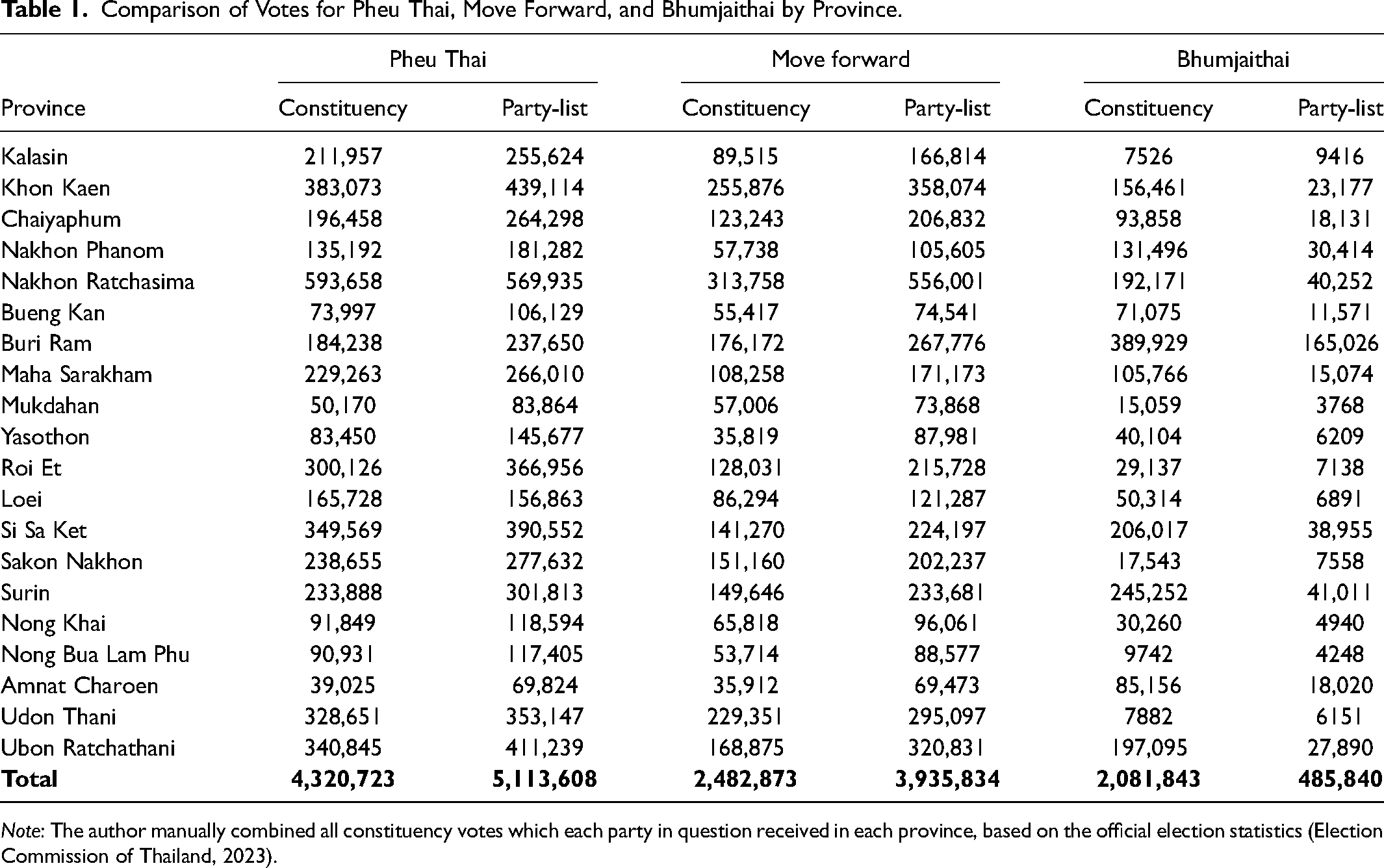
Note: The author manually combined all constituency votes which each party in question received in each province, based on the official election statistics (Election Commission of Thailand, 2023).
The table shows that Pheu Thai and Move Forward garnered far more votes in party-list voting than in constituency voting. This is true for Move Forward in all 20 provinces, while Pheu Thai showed a reversed trend in two provinces—Loei and Nakhon Ratchasima. In fact, Move Forward seemed to have benefited greatly from the two-ballot system. While its constituency candidates together garnered only around 2.4 million votes, the party gained an additional 1.4 million votes on the party-list ballot. Bhumjaithai, on the other hand, collected a much smaller number of votes for its party-list than for its constituency runs in all 20 Isan provinces. The table suggests that while Isan voters were more diverse in their constituency choices, they preferred Pheu Thai and Move Forward in party-list voting. Consider, for example, the results from Buriram and Amnat Charoen provinces, where Bhumjaithai had a landslide victory, winning all contested seats. However, in these very same provinces, its party-list votes were nowhere near the totals of its constituency votes. In Amnat Charoen, in particular, the number of its party-list votes was five times smaller than that of its constituency votes. By and large, Isan people split their votes in the election's new two-ballot system.
Given their post-election fallout, Move Forward supporters started to identify themselves as “Orange,” and Pheu Thai supporters as “Red”; they are essentially continuing the two-decade-long color-coded war. The only major difference is that this time it is Orange vs. Red, not Yellow vs. Red. What is more, the two parties were not the only ones that did well in Isan. Bhumjaithai, a mid-sized royalist party associated with the former government and seen by many pro-democracy supporters as politically opportunistic, doubled its constituency seats to 35 in Isan (out of its total 68 constituency wins nationwide) (ThaiPBS, 2023). It should be noted that it went from winning 19 Isan constituency seats and thus a total of 51 MP seats in the 2019 elections. This conservative leaning party was fast growing in size in this region, which has become its electoral strongest support base of all the regions. Right from the election aftermath, Bhumjaithai took a hostile stance against Move Forward on the issue of Move Forward's policy to amend the lese majeste law (Article 112), completely shutting down any possibility of both parties joining forces to form a government, even though Bhumjaithai's 71 MPs (including 3 party-list MPs) would have fostered Move Forward's chances of success. In essence, Isan now has more players. While the self-proclaimed pro-democracy parties like Pheu Thai and Move Forward compete to show who has the better way forward and who is democratic or not, their competitor, Bhumjaithai, earned the electorate's support and established itself as a serious rival in electoral politics. The 2023 election results outlined above thus have brought a poignant moment of reflections on this region, based on the reality of what happened on the ground. It may sound simplistic to call the phenomenon “the hand-in-hand growth of democratic and not-so-democratic values,” but it would be safe to say that, despite democratic hide tides, conservative undercurrents remain strong. According to Suthikarn (2023: 395), Isan in the 2023 elections “…is shifting towards a new, more diverse political landscape, with a multitude of parties, diverse voices, and competitive narratives.” Given this trend, more needs to be done in order to make sense of the elections. To this end, the question, “What were the reasons behind Isan people's voting decisions in the 2023 elections?'’ served as a guide for this study.
Research Method
This research employed a single method—an online questionnaire. This method was deliberately chosen, not with the intention of making strong claims about the findings, but for the following reasons. First, the goal was to explore voting reasons obtained through a data-collection method that was least threatening. Interviewing or using other face-to-face elicitation methods would be less likely to elicit data because voting choice is a sensitive topic, especially in the Thai context. The second reason was that the research aimed to conduct a textual analysis of various voting reasons and examine potential relationships between them, serving as a springboard for further studies. Given this qualitative and exploratory nature, conducting a questionnaire-based online survey was believed to be effective for collecting linguistic data that would serve the purpose. Thus, the questionnaire was created and launched at the end of June 2023. To make it accessible to a wide variety of individuals, contacts from different demographic backgrounds were asked to pass along the link to those who might be interested. It is important to note that there was no prior knowledge of the contacts’ voting choices.
The questionnaire remained open for responses until the end of October 2023. This time frame was crucial because important political events occurred, including the suspension of Move Forward's prime ministerial candidate, Pita Limjaroenrat, from his MP duties, the subsequent failure of Move Forward to form a coalition government, and Pheu Thai's success in forming a government. These two events sufficed to not only hammer the divide between ardent supporters of each party but also trigger a change of heart for Pheu Thai voters who wanted the party to stay in the original coalition.
The questionnaire collected the respondents’ basic demographic information with no information linking to their actual identity, voting decisions, and reasons. Questions thus sought answers that were “facts,” “opinions,” and “political desires.” It returned 175 valid responses. As mentioned before, this relatively small corpus posed no problem regarding generalization, as it was intended to serve the exploratory analysis. The responses were analyzed for general patterns found. A textual analysis was also conducted on voting reasons that the respondents were asked to write in response to three questions. The first two questions focused on the 2023 elections. They were: “What are your reasons for voting for a constituency candidate?” and “What are your reasons for voting for a party in the party-list voting?” Any party name was deliberately avoided in order to keep the focus on the paper's main topic and prevent distracting respondents from describing their political reasons or values.
Responses containing reasons for constituency and party-list votes were divided into two smaller corpora. On each of the corpus, a semantic analysis of content words was then conducted (nouns, adjectives, verbs, and adverbs) to determine whether the voters were driven by positivity-driven or negativity-driven reasons. For instance, na mai, mi khwam ru khwam samat (A new face with knowledge and ability) was coded as a positivity-driven reason, while yak chop yuk banyai nai kan lueak nai phuenthi khong tua-eng laeo (I want to end the “big family” era in my area) was coded as a negativity-driven reason. The term “big family” is a nickname for a powerful provincial political family associated with old-style politics, which dominates the selection of candidates, usually from a single-extended family in a particular constituency. Many regard the banyai politics as problematic in Thai politics (Nishizaki, 2022). In the context of this study, negativity-driven reasons are not equated with “bad” reasons. They simply refer to undesirable people, actions, events, or states of affairs as a source motivating a decision. Common negatively driven reasons take the forms of making complaints and mentioning specific problems or issues. One entry from a respondent could contain both positivity- and negativity-driven reasons, and it was coded accordingly. In addition to this, a linguistic analysis of the reasons was conducted, as language serves as a direct source of evidence for expressed beliefs (in addition to action, which is not a concern of this study). A careful linguistic analysis can also uncover subtle beliefs and ideological nuances hidden behind word choice, grammatical structure, language style, and so forth. Language cannot be taken for granted if one wishes to understand human thought. This is why a linguistic turn on political discourse analysis is crucial (Wilson, 2015). In particular, a highly discourse-oriented language like Thai fully deserves to be examined thoroughly, as it allows hints and clues to be embedded in discourse.
First, a corpus search for high-frequency words was conducted as linguistic evidence for common reasons. A linguistic analysis of collocations (words or phrases occurring together) was further conducted to identify specific meanings and contexts of some words as necessary. This helped to obtain a finer analysis of voters’ reasons. Therefore, despite using only one data-gathering method, different analytic tools, primarily linguistic in nature, were employed to best understand the voters’ decisions.
Respondents’ Demographic Profiles
Of the 175 responses, 105 were identified as female, 56 as male, 12 as LGBTQ+, and 2 were unspecified in terms of gender. The majority of respondents (62.3%) were from Ubon Ratchathani, followed by those from Amnat Charoen (9.7%), and Si Sa Ket (4%). The rest of the voters came from the remaining 17 Isan provinces, although their representation in the corpus was not strong. In terms of age, there were 174 valid responses, as one person declined to state her age. Of these, 38.5 per cent were under 30, 18.4 per cent were between 30 and 39, 8.6 per cent were between 40 and 49, 26.4 per cent were between 50 and 59, and 8 per cent were 60 and over. In terms of education, 84 respondents (48%) reported having an undergraduate education, 35 of whom were students, while 45 (25.7%) had a high school education. The third-largest group consisted of 16 respondents (9.1%) with graduate education. When asked about their occupational status, 80 per cent of the respondents reported having an occupation. Government officials, farmers, and students were the three largest groups, respectively. The questionnaire did not collect any financial information, but the respondents’ occupations were grouped into three categories: salary-based (i.e. government officials and office workers), non-salary-based (i.e. farmers, freelancers, small-scale vendors, business owners), and unidentifiable income (i.e. students and those who marked “other”). Those in the unidentifiable income and non-salary-based income groups, which tend to have unsteady monthly incomes and thus less financial security, together outnumbered the group with a steady monthly income. The corpus thus reflects the views of a mix of individuals with different backgrounds, although those in the youngest and older age ranges formed nearly half of the sample group. In summary, demographically, the sample was dominated by women with at least a college education who lived in Southern Isan provinces, especially Ubon Ratchathani. This point will be revisited later.
Voting Patterns for Constituency and Party-List Voting
Of the 175 respondents, 117 (66.3%) stated that they voted for the same party in both the constituency and party-list ballots, while 58 (33.1%) reported splitting their votes. This means that most of them showed strong support for one party to win decisively. This is not quite consistent with the region's general voting pattern–split voting, as mentioned earlier.
The voters were broken down into age groups. As mentioned before, one voter declined to state her age, so there were 174 valid responses. Voters under 30 were broken down into two ranges: 18–25 and 26–29. This was done to determine if there were any observable differences between those primarily in school (university-level) and those of working age (Table 2).
Numbers of Straight-Ticket and Split-Ticket Voters by Age Range (N = 175).
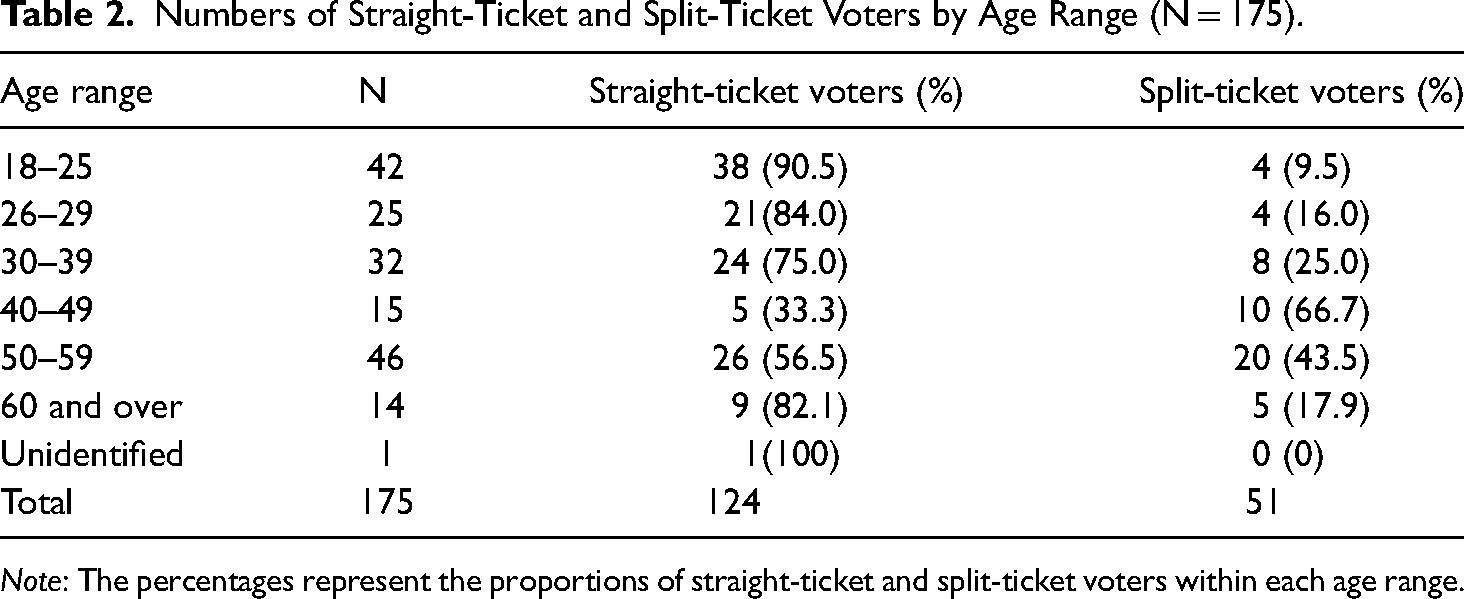
Note: The percentages represent the proportions of straight-ticket and split-ticket voters within each age range.
Age seems to be strongly associated with the voting patterns. Recall that a large majority of the respondents opted to vote for a single party on both ballots. The table further shows that the main force behind this group was younger and older voters. Voters under 30 and over 60 accounted for half of the straight voters (68 out of 124). However, as the table shows, the percentages of straight voters decrease in older age ranges until they rise again in those in the 50s and older. Despite a small sample size, the finding that younger and older voters formed the largest group of straight voters suggests that perhaps these voters came to the polling stations with a strong determination; they chose one party to support on both tickets, although we do not know exactly which party they voted for. Middle-aged voters in their 40s and 50s show a more compromising move, while the voters in their 50s here are nearly split equally into the two groups, those in their 40s showed a strong preference for split voting. A further analysis shows that this age group was dominated by those identifying as farmers, but the 14-person sample is too small to make any strong observations. Recall that middle-aged voters in this study are well into the middle of their lives and are probably shouldered with work and family responsibilities, so they could have a lot to consider when they went to the polls at a time when the country was deeply divided politically and suffering serious economic problems. Younger and older voters are generally less burdened than middle-aged voters. In the context of this study, many young voters were students, while other voters were either retired or carried fewer expectations than their middle-aged counterparts. They thus were probably relatively more free to make an electoral choice.
Asked if they would make the same voting choice should a new election occur in 1 month, 76.0 per cent of 175 respondents stated they would, while 24.0 per cent stated they would not. This suggests that post-election political developments did not alter most participants’ commitment to their prior voting choice. Interestingly, a large majority (79.7%) of those determined not to change their minds were straight-ticket voters. These findings suggest that straight-ticket voters tended to maintain their strong commitment to one party in the post-election period.
Reasons for Voting
Recall that the respondents were asked to write an answer to the question of why they voted for their candidate or party of choice. As expected in many questionnaire-based surveys, most respondents wrote a few words or phrases—just enough to give a general impression of what they thought, or what they would like a reader to think they thought. These, nonetheless, were the “political identities and thoughts” with which the respondents wanted to be associated. Some responses were more expressive and specific about their reasons. These responses were longer and more elaborate. Despite the fact that the phrase phro het dai (why) was used in the questionnaire, it turns out that many of the reasons given were not something that existed before the act of voting that caused the respondents to vote in a certain way, but instead they were something that the voter would like to achieve as a result of their voting. They thus appeared to be more like a purpose or desired outcome of voting. But they nonetheless motivated the voting, so reasons and motivations are interchangeably used here to accommodate the Thai respondents’ understandings. The following are key observations about the respondents’ reasons, based on the linguistic corpus analysis outlined earlier.
First, a crude coding of the reasons for constituency and party-list voting combined yields a total of 305 positive, 51 negative, and 14 indecipherable or irrelevant motivations. Some responses contained only positive, only negative, or mixed motivations. The number of motivations does not correspond to the number of responses. Positive motivations featured constructive attributes, including praising a candidate or party, alluding to perceived democratic values, or expressing desired election outcomes. Negative motivations drew on negativities including complaining about an unpreferred candidate, party, action, or values perceived as undemocratic or undesirable, which can be seen in overt linguistic choices. Given the numbers above, these voters were generally positive and constructive in their rhetoric, as positive motivations were six times as frequent as negative ones. Positive motivations appeared more often than negative ones in both constituency voting (167 vs. 18) and party-list voting (163 vs. 9). Positive reasons also frequently occurred alone in the corpus.
Constituency Voting
Reasons for constituency voting choices were predominantly party-related, which will be discussed later. However, among responses mentioning candidates, the respondents attributed their choice to the candidate's character, background, personal relationships, and political track record. Some interesting examples of positive motivations for constituency voting are: “I chose a person who I want to work in the area,” “the candidate's vision,” “I like the candidate's performance,” “we are acquainted,” “the candidate is someone you can count on,” and “the candidate has regularly visited the constituency and done a good job.” As the examples show, the respondents described positive attributes of the candidate they have voted for. Taken together, these responses suggest the importance of a constituency MP as someone who has a physical presence there, in addition to other qualities.
Negative and mixed motivations in constituency voting are discussed together, as they rarely stand as sole reasons; they were found together. A 20-year-old female voter from Si Sa Ket wrote a response showing mixed motivations: “I wanted to help a farmer's child become an MP. So far, only the rice mill owners’ child has become an MP, who was not able to fix the problems of dropping rice prices. After four years in the position, only roads were built, because the family owns a business related to cement products.” The negative motivation relates to the voter's complaint about an incompetent MP—a child from a rich family. Likewise, another respondent from Ubon Ratchathani wrote: I want a new person to do the job. I think the old one has done nothing for improvement. Plus, the old one doesn’t have any appealing policy.
In addition to the positive/negative dichotomy, which was taken at face value as sincere voting, responses containing strategic voting were also found. A 25-year-old student voter from Ubon Ratchathani gave her reasons as follows: The candidate had a better chance at winning than the one I really wanted to vote for. I think voting for the one I really support would cause the candidates’ votes to be shared to the point the one with the opposite ideology would have won.
The voter essentially said she cast a tactical vote. There is a lot lying behind her response here. First, she did not want the candidate on the opposite side of the political spectrum to win; her vote was to prevent that candidate from winning. She also did not want the parties on the same side to share votes that did not result in any of them winning the seat due to votes being wasted. This voter, therefore, calculated the maximum impact of her vote and decided to cast it strategically for the less preferred candidate, who had a better chance of winning. Another strategic voter was also from Ubon Ratchathani. A 37-year-old female voter wrote, “The candidate had a better chance than others to beat candidates from the Uncle's or other conservative parties.” The voter had quite a few assumptions before giving this reason. She assumed that the candidate was a favorite in the race, that the Uncle's (former junta leader and PM Prayuth Chan-ocha's) and other conservative parties were not good choices, and that defeating them was her voting goal. Even though we do not know what party or parties she voted for, such strategic voting suggests that she prioritized her ideological stance and hoped to use the elections to free the country of the establishment's influence to the point that the candidates’ qualifications did not play a significant role in her constituency choice.
Second, the top three high-frequency content words for constituency voting were as follows: phak (party) with 55 tokens, chop (like) with 35 tokens, and nayobai (policy) with 33 tokens. These same words also topped the high-frequency list for party-list voting, but in a slightly different order: phak (65 tokens) came first, followed by nayobai (55 tokens), and chop (47 tokens). The strong presence of “party” and “policy” in the reasons for both voting categories highlights that party identity, as portrayed by policy-based branding, was a major appeal to the voters surveyed. The positive semantics of these two words were so salient that even when they were the only words written in the response, they sufficed to clearly indicate the respondents’ positive view towards them. In other words, if one says he or she casts a vote because of a policy, that policy must be good, not bad, in the eye of the voter. What is interesting about this finding is that the reasons for constituency voting were largely based on the appeal to the parties rather than to the candidates themselves. Coupled with the finding earlier that the majority of voters in this study were straight-ticket voters, it appears that they put “party” first, and the party they preferred had attributes so appealing that they were willing to give the party both of their votes.
With context, a link between the word “party” as well as its associated attributes and constituency voting became a bit clearer. A 22-year-old female voter from Amnat Charoen stated, “because I wanted the number of MPs for the party I aimed to vote for to be big enough to win the prime minister voting.” To her it was about having a prime minister from the party she supported. It was not about local, constituency-based issues. Likewise, a 36-year-old male voter from Yasothon wrote, “The party of new generations, new ideas,” as a reason for voting for a local candidate. Again, not only did the voter ignore the party's constituency candidate, but he also linked his vote to the party because of its desirable attributes. The use of khon run mai (new generations) sounded synonymous with a campaign slogan by Move Forward. Note, however, that “new generations” and “new ideas” are quite abstract. The word “new” seems to be the key positive attribute here, suggesting the assumption that newness is a desirable value, even though it has nothing to do with the party's policy or performance. Without it, the words “generations” and “ideas” would not be appealing on their own. In contrast, a 22-year-old female voter from Nakhon Phanom claimed to have voted for a constituency candidate because of “the party's policy and past job performance.” In this response, the word “party” is now linked to another high-frequency word, “policy,” indicating that it is the party's policy, not other attributes, that motivated her voting decision. However, by also mentioning kan tham ngan thi phan ma (the past job performance), this respondent essentially stated that her voting decision was based on both policy and past performance. It should be noted that positive words or expressions co-occurring with the word “party” tend to be vague or general, such as di (good) and those discussed above. Taken together, these examples show that although the high-frequency words by themselves carry positive attributes, their context reveals other associated attributes, including image, policy, and performance.
Another high-frequency word, chop (like), was a bit trickier to analyze, as it is a verb and requires context to derive what the respondents meant. A further collocation analysis showed that for the constituency voting, chop describes the respondents’ liking for a candidate's party, his or her commitments and performance, and his or her other, non-work-related characteristics. The verb itself is an expression of affect. A 58-year-old female voter from Ubon Ratchathani wrote, “I like (this person) for being someone from this area.” On the surface, this reason may not sound reasonable because being someone local has nothing to do with whether the person has any abilities to do the job as an MP. However, being someone local in the Thai sociocultural context implies that the person has roots in the community and would be likely to respond to the community's needs. Therefore, this affect-based reason is not without rational thinking on the part of the voter.
The word “like” sometimes appeared alone in the response, and in that case it simply indicated the respondents’ likeness for their “constituency choice,” with no reference to the party or the candidate as the reason. A male voter from Si Sa Ket wrote a single word “like,” not clarifying whether he liked the candidate or the party, even though the most reasonable guess would be the candidate because the question was about constituency voting. On the contrary, a male voter from Maha Sarakham clearly stated, “I voted for the constituency candidate because I like the party.” As one of the most frequent reasons for voting, “likeness”—as an expression of affect—seems to be a readily available reason when voters want to be brief. But likeness is not an instant affective reaction to something. A liking for policies, political parties, or politicians is based on experiences that eventually develop into political intimacy, which plays a crucial role in political affiliation (see Marcus, 2000). Jakkrit Sangkhamanee (2023) has demonstrated through his fieldwork observations in Ubon Ratchathani province that political campaign trail activities and associated paraphernalia allowed for interactions between candidates and prospective voters in a physical space of the speech rally site, essentially allowing for political intimacy to be developed and maintain over time.
In addition to these three high-frequency words, other words that recurred in the responses included phatthana (development), khon run mai (new generation), phon ngan (accomplishment), and okat (opportunity). The occurrence of the word “development” was not surprising, as it has been one of the main themes in Thai political discourse for a long time (see McCargo, 2002, for example). So far we have seen that the main themes in the responses were tied to high-frequency words. The voters had high hopes for the party of choice that they believed to possess certain characteristics and trusted that it would deliver the electoral promises and expectations. But overall, the responses were not clear about exactly what those characteristics, promises, and expectations were, even though the expressions have more semantic content than the simple “like” discussed earlier.
Second, content analysis classified the responses into two main categories: simple and elaborate reasons. There were 174 valid responses for constituency voting, 171 for party-list voting. Simple reasons tended to be shorter and were in the form of words, phrases, or simple sentences. Each of them contained one reason or motivation for voting with no elaboration or details. Elaborate reasons were usually marked by linguistic connectors such as “and” (though not always) or content semantically salient enough to indicate different reasons or layers of reasons even without overt linguistic marking. They were longer and more elaborate than the simple counterparts.
For constituency voting, simple-reason responses accounted for a large majority (148 responses: 85.1%). Examples are as follows: the ubiquitous “policy,” “like the party,” “I want a new leader,” “I want help with low prices of agricultural products,” and “progressiveness.” Elaborate reasons were found in 26 responses (14.9%). A voter in Roi Et wrote, “…is with the party that I like for its policies and election campaigns.” The response is considered an elaborate reason, as it shows that, although the primary motivation is preference for the party, the two characteristics of the party clarify what specifically about it appealed to this voter. With more details, a response of this type is certainly different from the one containing just short phrases “like the party” or “like the policy.”
Party-List Voting
There were 171 valid responses for party-list voting motivations because four respondents opted not to give any reasons. Like constituency voting, 138 simple-reason responses (77.8%) markedly outnumbered their 38 elaborate-reason counterparts (22.2%) and mostly contained positive but vague characteristics mentioned earlier. Take a simple-reason response given by a female farmer in her late 40s as an example. She wrote, “…has a tangible work performance” as a sole reason for her voting choice, suggesting that she based her decision on the party's past performance. Therefore, it was about what the party has done that earned her confidence, but we do not know what constituted the “tangible work performance.” However, despite being much less common, elaborate responses were quite interesting because of their explicitness. In contrast, some respondents looked forward to the future and based their reasons on the hopes and expectations projected onto the party they had voted for. Take the following response as an example. A retired government official in his 70s wrote a multiple-reason response, The party holds democratic ideologies. It's determined to seek power in order to eliminate injustice, bribery, ‘elephant tickets’ (the controversial, unethical practice of professional appointments among the police), and exploitations of the people by the ruling class, capitalists, warlords and the aristocratic backers. This would give the people opportunities, hopes, rights, freedom, and dignity. I was looking forward to a new form of politics where the people have the right to thoroughly monitor the work of the government and the implementation of marriage equality law given in the party's policy platform.
In summary, the key findings show that voters from different demographic backgrounds voted differently, that they favored parties over individual candidates, that voting reasons—whether simple or elaborate—could be traced back to their relevance in Thai political discourse, and that both sincere and strategic voting reflect a shared goal of eliminating the establishment's influence in politics. As mentioned earlier, the observation about age and other demographic characteristics may not be significant, as the corpus is small. It does call for the need for future studies on political ideologies and participation of individuals of different demographic backgrounds amid the country's political crisis. On the other hand, voting reasons’ relevance in Thai political discourse and the voters’ shared attempt to fight against traditional powers is worth discussing. Recall that most of the voters in this study were partisan voters who cast single-ticket votes. They expressly hoped their votes would bring about change. They commonly mentioned both party policies and ideologies, with party leadership mentioned to a lesser degree. These reasons likely show sincere voting, as they support their favorite party to win (Bol and Verthe, 2021). Strong party-based support is not a surprise, as the 2019 election not only failed to remove former junta leader Prayuth Chan-ocha from politics, but it also endorsed him as a prime minister through election even though his party did not win (Kas, 2019). Prayuth-led government's poor performance towards the end of his second premiership, coupled with the rising popularity of Pheu Thai and Move Forward in 2022, Thai people seemed to be ready to use the polls to change the country back to the path towards democratic development (see Selway, 2023). Also, many young voters have shown before in the 2019 election that they looked forward to democratic change for the country by supporting Future Forward (McCargo and Saowanee, 2019). This is not to mention the impact of the youth-led protests in 2020, that shook the country's traditional establishment and the legal backlash against pro-democracy protesters and leaders (Kanokrat, 2024). It is not surprising, then, that voters, old or young, would generally want a decisive win for their favorite party, which is consistent with the single-ticket voting pattern here. Strategic voting reasons were largely to boost the chances of winning or to stop pro-establishment parties from winning. Based on the reasons given, these voters share the same goal as their sincere voting counterparts above—to win. The main difference lies in the choice of which they wanted to win—the party they strongly supported or the party they supported to a lesser degree, which had a good chance to win. However, split voting was less common in this study, despite being the main characteristic of the 2023 election in Isan, but again the sample was too small to make any strong claims about it in this regard. Taken together, the voting patterns and reasons for voting suggest that the voters who responded to this questionnaire were driven by a strong desire to win, with the belief that winning would bring about change in Thai politics. Change, as the analysis of reasons above suggests, appears to be associated with trust in a political party based on its policies, commitments, past performance, as well as ideologies associated with democracy. Voting decisions in this study appear to be straightforward, but behind frequently used words such as di (good/right) or chop (like) may lie something far more complex, shaped by contradictory forces—just like the region's election outcomes under close examination.
Conclusions
At the height of Thailand's post-election rift among winning parties, voters in the Northeast were asked why they voted and whether they would vote for the same party or parties in the near future. The questions elicited the respondents’ immediate reactions to political events in the aftermath of the 2023 general elections. The findings show voters’ preference for straight-ticket voting on both ballots. The main reasons or motivations lie with the party, not its candidates’ qualifications. Although the corpus is biased toward a certain part of the region and dominated by certain demographic groups of voters, the findings serve as the first step toward our understanding of voters’ sentiments in Thailand's outwardly post-coup period, in which the once extremely popular Pheu Thai, the up-and-coming Move Forward (both claiming to be pro-democracy), and the politically savvy Bhumjaithai have become major contenders in the region once dominated by Pheu Thai. As the recent 2024 Senate elections have shown, candidates with ties to Bhumjaithai gained a large number of the 200 Senate seats (Aekarach and Mongkol, 2024). The first local re-election for Provincial Administrative Organization President has also just taken place, and the winner was a Pheu Thai candidate (Pongpat, 2024). Move Forward has also announced its commitment to fielding candidates for the PAO elections in several provinces. At the time of this writing, in the most recent nationwide PAO presidential elections, Pheu Thai and Bhumjaithai ranked first and second in winning numbers while the People's Party (Move Forward's successor party) did not fare well, winning only one seat out of 17 provincial candidates it had fielded. The results in Isan not only mirrored the national picture but also highlighted the fact that Bhumjaithai has become more powerful. It won four provinces while Pheu Thai, the once most favorite party, won five. Future elections, be they local or parliamentary, would thus be an arena of great contestation in this region, as winning elections here is very likely to strengthen political parties at the national level. For as long as the region stands, with its many voters and how diagnostic it is of the entire country, the question is not whether it has any electoral influence in Thai politics, it is how exactly. A nuanced understanding of the decisions made by these voters—whether young or old, rich or poor, formally educated or not—rather than a simplistic dismissal of their political relevance, will only enhance our understanding of Thai politics in general.
Footnotes
Declaration of Conflicting Interests
The author declared no potential conflicts of interest with respect to the research, authorship, and/or publication of this article.
Funding
The author received no financial support for the research, authorship, and/or publication of this article.
