



Abstract
The 2023 Thai general election was fought on the question of what it meant to be Thai: the progressives arguably won the argument, but the conservatives seized power anyway. The progressive Move Forward Party became the largest single party in the new parliament but was barred from forming a government. At the final election rally of his conservative United Thai Nation (UTN) Party on 12 May 2023, incumbent prime minister and former 2014 coup leader General Prayut Chan-ocha paused his speech to show a video ad critiquing a slogan popularized by Move Forward, which had pledged to ensure that Thailand would “not be the same as before.” The UTN ad parodied the slogan, depicting a Thai family in which young adults were at cross-purposes with their parents and grandparents, reflecting a collapse in traditions and standards of behaviour. UTN's negative campaigning epitomised a shift among Thai voters along the lines of two major cleavages: age (younger voters versus older ones) and ideology (progressive voters versus those supporting conservative values). This article uses the UTN video to explore how these cleavages were central to the 2023 Thai election campaign. The video was a seminal text for this election, offering an extraordinary insight into the mentality and moral posturing of the conservative side.
The 2023 Thai election was effectively a referendum on the controversial 2014 military coup, which sought to suppress democratic participation and promote a conservative ideology centred on the monarchy and the military. In May 2023, coup leader and former army commander General Prayut Chan-ocha remained prime minister, after nine long years. Yet everything Prayut represented had come under attack from the insurgent Move Forward Party, which articulated a progressive ideological position and was led by 42-year-old Pita Limjaroenrat, a former businessman, Harvard graduate and social media celebrity. Taking its cue from the arguments of Napon Jatusripitak and Jacob Ricks (Napon and Ricks 2024), this article explores how an important campaign video from that election demonstrated the recent emergence of two new and powerful voting cleavages in Thailand: age and ideology. Whereas past Thai elections had often been viewed in terms of socio-economic or regional contestation – low-income farmers versus middle-class professionals, or Northerners and Northeasterners versus Bangkokians and Southerners – the crucial variables in 2023 concerned generational identification and ideological orientation.
Not the Same as Before: Move Forward
When I first saw the Move Forward slogan “Not the same as before” on election posters around Thailand in April 2023, I began asking both party candidates and campaign workers what the slogan meant. 1 None of their answers really satisfied me. Why frame a key election message as a negative, an absence, or a lack of continuity – rather than calling directly for change, as Barack Obama did in 2008, or Rodrigo Duterte in 2016? I found the slogan vague and confusing and assumed it would not be effective as a rallying cry for younger votes.
I was completely wrong.
What did Move Forward represent in 2023? McCargo and Anyarat argued that the core project of the Future Forward Party – the previous incarnation of the Move Forward Party – was not one of political reform or incremental changes of the kind advanced through manifestos, policy platforms or legislative changes. Rather, Future Forward was all about narrative disruption, aiming “to provoke a crisis of faith in Thailand's power structures, and to inspire a younger generation to dismantle them – even if the process took decades to work through” (McCargo and Anyarat, 2020: 165).
The 2020 student-led protest movement that emerged following the dissolution of Future Forward took disruption to new heights, including calling openly for a wholesale overhaul of the monarchy. The new disruption agenda was explicitly articulated through ten demands for monarchy reform, read out at a Thammasat University Rangsit campus rally on 10 August 2020 (Akanit, 2023; McCargo, 2021; Saowanee, 2021; Wichuta 2023). Many had assumed that Move Forward leader Pita Limjaroenrat was a rather more conservative figure than Future Forward's leader Thanathorn Juangroongruangkit; and observers expected Move Forward to play it safe during the 2023 election campaign, in order not to alienate mainstream voters who could be alarmed by challenges to the country's traditional institutions. Yet the opposite proved to be the case. Future Forward had held back on hot-button issues such as the monarchy, but Move Forward went all out to highlight these questions, tapping the radicalism of Gen Z, who were overwhelmingly indifferent to the new reign, and contemptuous of the conservative values associated with the 2014 military coup and the subsequent Prayut administrations. Move Forward leader Pita later confirmed that recruiting prominent figures from the 2020 protest movement to run as parliamentary candidates was a deliberate electoral strategy. 2
Move Forward went into the 2023 elections with a remarkable raft of three hundred policies. While some of the policies were useful for addressing particular constituencies of voters – such as policy 144 on fertiliser promotion, for example – the main value of the policies lay in their oppositional positionality, and indeed their sheer number. Party spokesman Parit Vejjajiva argued that “Even if you disagree with what we are offering, you at least acknowledge that it's something new and different.” 3 Collectively, Move Forward's three hundred policies to change Thailand amounted to a formidable assault on the status quo, a statement of intent and a proclamation of seriousness. Indeed, the policy omnibus amounted to a virtual declaration of war on the Thai establishment, and could be reduced to a single tagline: “Not the same as before.” 4 Parit explained, “If any other party were to use the phrase ‘Not the same as before’ it would not be convincing, so in that sense, it's well suited to us, it's a brand.”
A second de facto tagline for the party was “112”: Move Forward's calls for revision of the lèse-majesté law, Article 112 of the Criminal Code, carried a significance that went far beyond the law itself. Talking about 112 was a means of disrupting longstanding narratives and norms, by asserting that an issue related to the monarchy could form a legitimate part of an election campaign. “112” was not really just about Article 112: it was a cue for more critical public discourse and a call for wholesale narrative disruption. 5 Ultimately, manifesto calls to reform the lèse-majesté law provided the pretext for Move Forward's contentious dissolution by the Constitutional Court on 7 August 2024.
Based on a post-election survey of almost 2000 Thai voters, Siripan Nogsuan Sawasdee found that the majority of Move Forward voters cited a desire to see change as one of their two main reasons for supporting the party's candidates: 62.2 per cent for constituency seats and 59.5 for party-list selections (Siripan 2023). 6 By contrast, 61.3 per cent of those who cast their party list votes for Palang Pracharat did so largely because of the party's royalist stance. Napon Jatusripitak and Jacob Ricks also conducted two online surveys, one pre-election and another immediately post-election, which looked at how factors such as age and ideology influenced voter behaviour (Napon and Ricks, 2024). These surveys showed that voting for Move Forward strongly correlated with age: younger voters were far more likely to vote for the party than older ones. Move Forward voters also held different ideological positions from voters for other parties, including those of Pheu Thai. These voters were much more likely to oppose military interventions in politics and were much less likely to regard the protection of nation, religion and the monarchy as an important priority. By contrast, UTN supporters – along with Palang Pracharat and Democrat Party voters – were much more inclined to place emphasis on protecting nation, religion and monarchy, and scored lower in their support for democratic values. The evidence for a deeply divided electorate, polarized by both age and ideology, is clear from these survey-based analyses.
During the final days of the 2023 Thai election campaign, a short video entitled Not the Same as Before went viral on social media (for an overview of the election, see Napon and Hicken, 2023). By issuing a video ad that appropriated the campaign slogan of a major rival, United Thai Nation acknowledged that the forthcoming 2023 election would be essentially a clash of generations, a clash informed and fuelled by deep ideological divides. This article argues that the UTN video was a seminal text for the 2023 Thai elections, offering an extraordinary insight into the mentality of the conservative side, and illustrating their intellectual and moral limitations. Younger voters, especially those under thirty, were deeply alienated from conservative values that emphasised the perpetuation of an uncritical Bhumibol-era kneejerk royalism. They were terribly unhappy about the paternalistic attitudes and rhetoric of older people, ranging from self-serving retired generals to hypocritical elderly monks, and from bullying school principals to washed-out machine politicians. At the same time, many older people were mortified by the behaviour of the young, especially their lack of deference and their willingness to challenge hierarchies and longstanding social norms in bold and even aggressive ways. Some were determined to push back against this rising tide of disrespect and saw current prime minister General Prayut as the best hope for resisting these changes. Yet the fact that UTN chose to use an anti-Move Forward attack ad as a centrepiece communication strategy was surprising: overall, there was very little online negative campaigning by Thai parties during the 2023 election (Surachanee and Akkaranai, 2025).
The ensuing 2023 election campaign was a highly charged affair, featuring a number of key players, including the Pheu Thai Party, a vote-mobilising juggernaut representing the Shinawatra family, a political dynasty that had topped every Thai election since 2001; the upstart Move Forward Party, deploying a progressive message of change with a strong appeal to younger voters; and the two military-aligned “uncle” parties, United Thai Nation and Palang Pracharat, which embodied the conservative agendas behind the 2014 military coup and the subsequent nine years of the Prayut Chan-ocha premiership. During the early weeks of the campaign, Pheu Thai's bold claims that it would win by a landslide dominated the airwaves. After the 13–15 April Songkran holiday, however, Move Forward assumed an ever-stronger position, scoring success after success with their TV debate performances and slick social media campaigns. The conservative parties proved largely unable to communicate their messages effectively, except in some heartland areas such as the Upper South.
UTN's Not the Same as Before ad attacked the Move Forward agenda and framed Thailand as a nation under attack by the younger generation. The original YouTube post on the UTN website attracted nearly 11,000 comments and inspired various spoofs and media debates. Social media loomed extremely large in the 2023 election (Aim 2024), but this ad was not just posted online: it was incorporated into the UTN's election campaigning, most notably at the party's final rally at the Queen Sirikit Convention Centre on the evening of Friday 12 May, two days before the election (Figure 1). 7
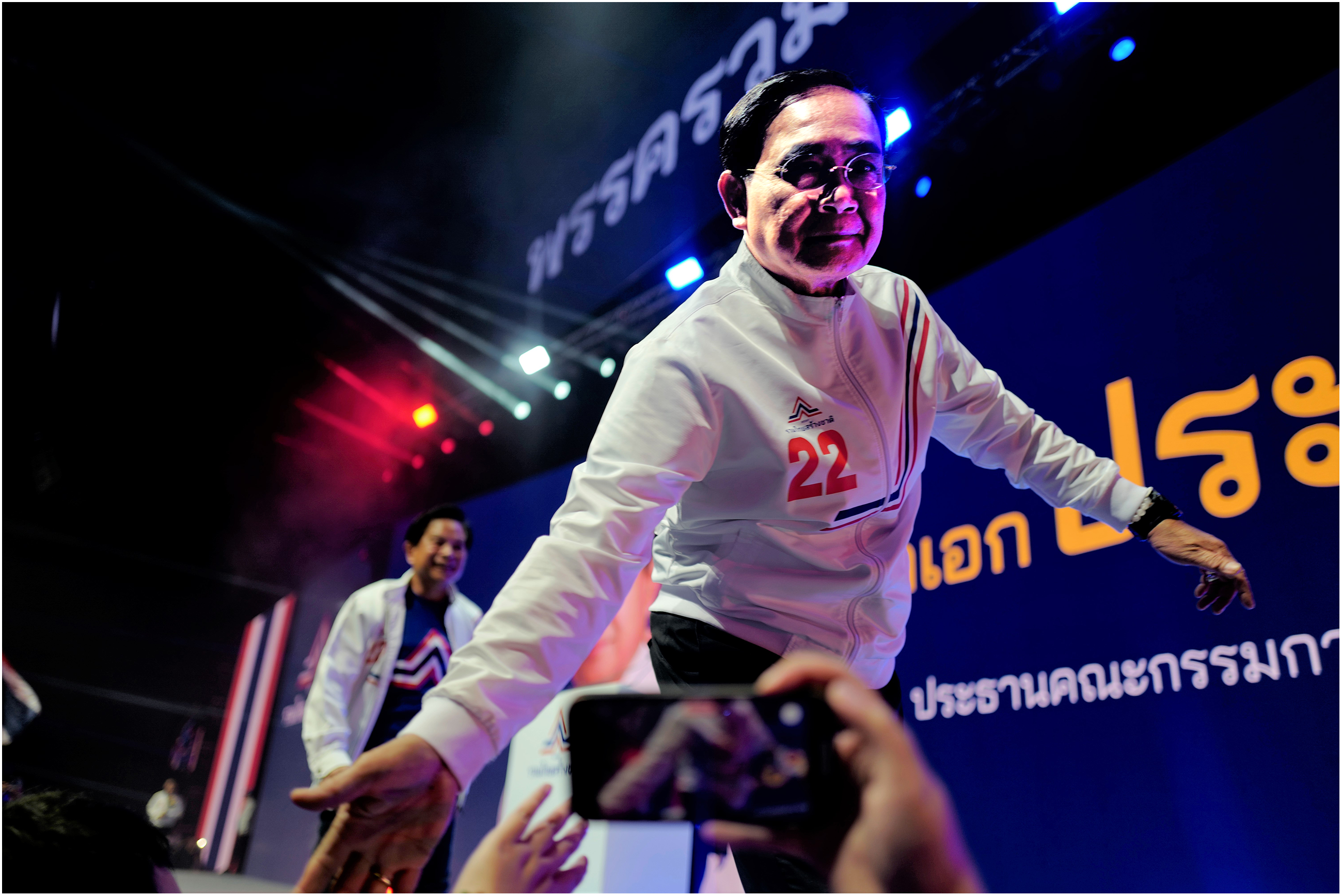
Then prime minister General Prayuth Chan-ocha on stage at the final rally of the United Thai Nation Party, 12 May 2023. Duncan McCargo.
Prayut Chan-ocha's speech at the final rally came after three and a quarter hours of warm-up acts. Most of the audience were ardent admirers of the army-commander-turned-prime-minister and were hanging on his every word. But after speaking for just four and a half minutes, Prayut asked the audience to watch the screen behind him, turned his back to the crowd, and stood there while the UTN Not the Same as Before video was played to the packed convention hall (Figure 2). 8
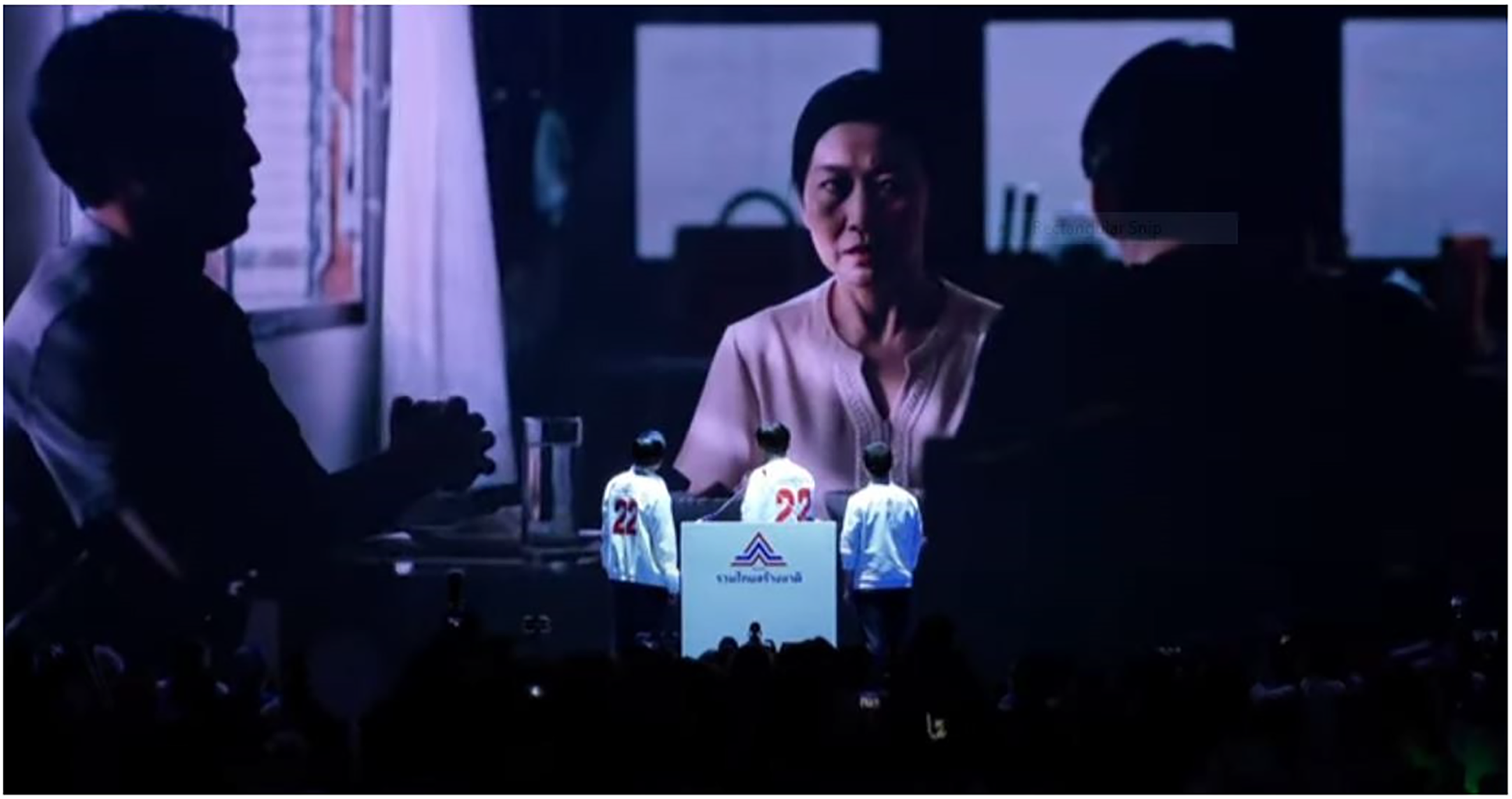
Prayut and UTN leaders watch the Not the Same as Before video, Queen Sirikit Centre, 12 May 2023.
Continuing his speech after the video screening, Prayut talked about the importance of parents: what would Thais do without their father and mother? People who did not love their father and mother were not fit to be considered Thai. It was clear that for the serving prime minister of Thailand, the disrespect towards the elders of the family shown in the video was a direct analogy for the disrespect shown by some members of society – and implicitly by the Move Forward Party – towards the nation's father and mother: in other words, towards the monarchy itself.
What did the UTN ad reveal about the larger discourses of the election campaign? On one level, this was no ordinary Thai election, but an election fought for the soul of Thailand, in which the nation's core values and identity were at stake. Prayut's beliefs about Thai values were clearly articulated in the aftermath of the 2014 military coup when his junta had proclaimed 12 values to be taught in schools and to be widely disseminated (Figure 3):
Love the nation, religion, and the King. Be honest, willing to sacrifice, patient, and uphold principles of the common good. Be grateful to your parents, guardians, and teachers. Seek knowledge and be diligent in studying directly and indirectly. Preserve beautiful Thai culture and traditions. Be moral, truthful, and wish well to others, be generous and share with others. Learn to understand the true meaning of democracy with the King as head of state. Be disciplined, respect the law, and inferiors should know how to respect their superiors. Be self-aware, think, and act in accordance with HM the King's words. Learn to uphold the sufficiency philosophy of HM the King, learn to save money for rainy days, have enough to live on, and if you have something left give it to others and expand your business when you are ready and have immunity. Be strong in body and mind, do not succumb to evil powers or desires, be ashamed and fearful of sin according to religious principles. Consider the common good and good towards the nation more than your personal gains (Alderman 2023: 56).
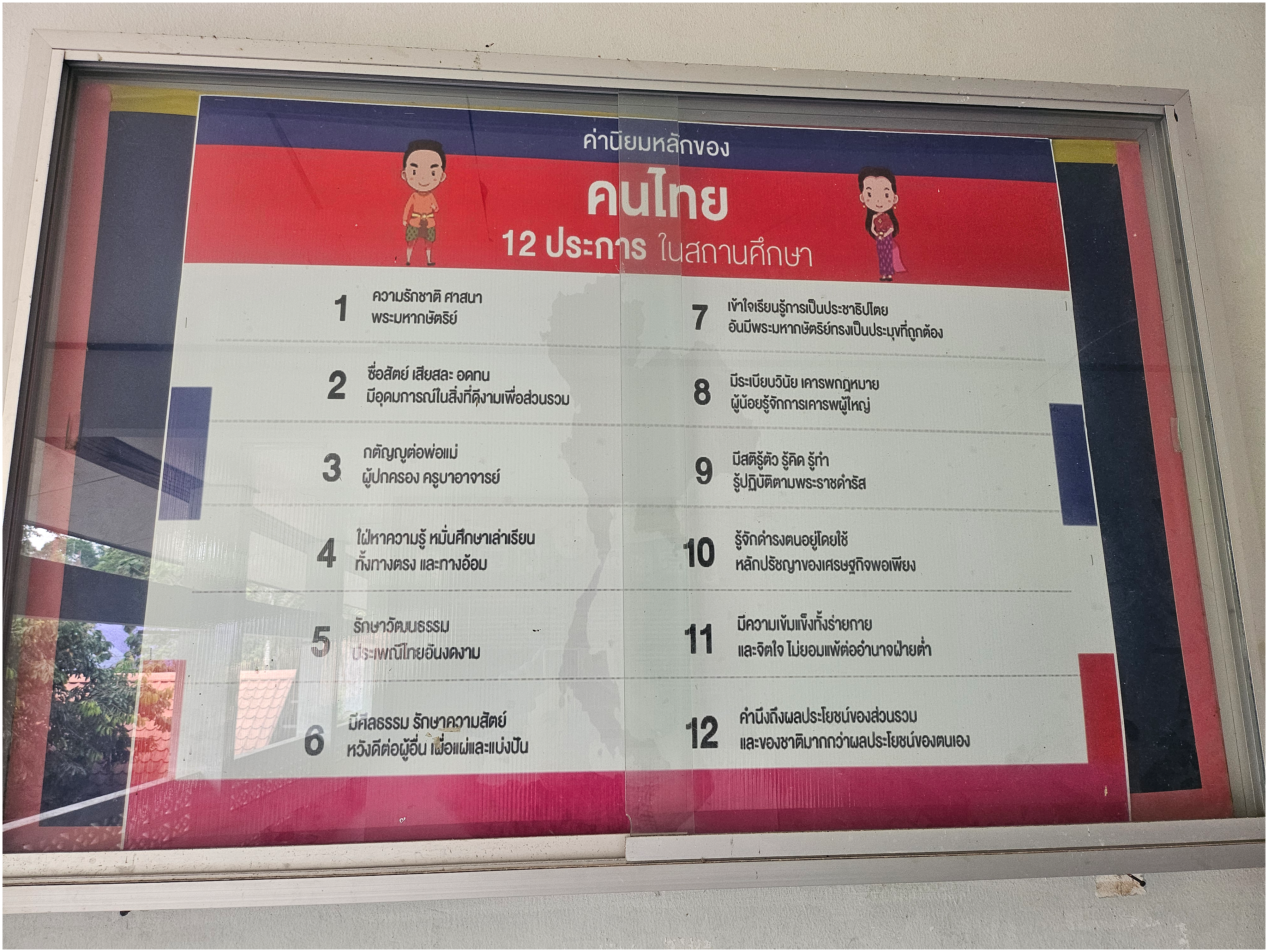
The 12 values on display at a high school in Trat province, January 2025.
As Petra Alderman notes, the twelve values were “a peculiar mix of nationalism, political conservativism, and religious moralism (2023: 56).” Four of them explicitly referenced the King, while others alluded to Buddhist and Confucian notions of morality and virtue. None mentioned concepts such as human rights, equality or citizenship: the true meaning of democracy was instead closely linked to the monarchy. Collectively, the values amounted to a call for stasis, for preserving what already existed rather than embracing the new. As a party explicitly launched in late 2022 as a vehicle to support Prayut's hopes of continuing as prime minister (Wassana, 2022), the politics of UTN were very closely aligned with the conservative ideological stance captured in his twelve Thai values. The very name of the party (in Thai, literally “Thais come together to build the nation”) evoked nostalgia for an earlier era of nation-building, in which the military had played a major role in defending Thailand from communism during the heyday of the Cold War.
Prayut's values represented a rather garbled distillation of a far more serious tradition of Thai conservative political thought (see Connors and Ukrist, 2021: 18–39). Although the absolute monarchy was overthrown in 1932, subsequent decades saw Thailand set world records for the numbers of both military coups and new constitutions, as competing elements of the elite struggled for political dominance. While the monarchy was gradually rehabilitated and restored to prominence during the long reign of King Bhumibol (Rama 9, r. 1946–2016), the palace became very dependent on the politically interventionist military for support. Demands for greater democracy waxed and waned, often manifested in massive street protests that were sometimes violently suppressed. Periods of parliamentary governance alternated with episodes of authoritarian rule. The 2023 election was just the latest iteration of a longstanding struggle between progressive and conservative forces in Thailand.
Many UTN supporters at the final rally had previously rallied with the People's Democratic Reform Committee, an anti-Thaksin, anti-Yingluck movement that staged a series of mass protests in 2013–14 in order to “Shutdown Bangkok,” and so helped create the conditions for the 2014 military coup. The PDRC was particularly notable for sabotaging the February 2014 election, which was boycotted by the opposition Democrat Party and then annulled by the Constitutional Court. Despite deploying the language of democracy, the PDRC was opposed to free elections (Aim Sinpeng 2021). The 2023 elections saw the conservative wing of the longstanding Democrat Party vote base largely decamp to UTN, especially in the Upper South.
UTN's website highlights six strategies that formed the basis of the party's 2023 election manifesto: 9 many of these policies were relatively progressive. Indeed, during the campaign, UTN foregrounded livelihood issues that differed little from the “populist” messages of Pheu Thai, Bhumjai Thai and Palang Pracharat, including an allowance of 1000 baht per month for the elderly. 10
Ultimately, United Thai Nation's appeal lay less in any manifesto pledges, but in embodying the track record and hardline conservative image of General Prayut himself. While the two military-aligned parties ended up with similar numbers of MPs – 36 for UTN, 40 for Palang Pracharat – they gained these numbers by different routes. After the departure of General Prayut for UTN at the beginning of 2023, the rival Palang Pracharat Party led by General Prawit Wongsuwan branded itself as more pragmatic, less attached to hardcore conservative ideologies, and more willing to broker compromises between rival parties, leaders and factions (Prajak, 2023). Palang Pracharat, like the ultra-pragmatic Bhumjai Thai (which gained 70 seats overall), was a machine party with no genuine popular base and was able to win seats only through patronage and vote-buying at the constituency level. Party popularity in Thailand can best be measured through party-list votes, which are not tied to constituency concerns: Palang Pracharat secured only 1 party list seat, and Bhumjai Thai just 3 party list seats. By contrast, UTN won 13 per cent of the party list vote (coming third behind Move Forward and Pheu Thai) and so secured 13 party list seats. In other words, UTN had a genuine voter base, and was arguably the only party to have mounted a serious ideological challenge from the right of Thai politics; this status made UTN's Not the Same as Before commercial all the more interesting. According to an interview, the team behind the UTN's very slick 2023 election campaign materials – including this commercial – worked closely with then Deputy Prime Minister and Minister of Energy Suppattanapong Punmeechaow, who served as one of Prayut's right-hand men for three years from August 2020. 11
Not the Same as Before: The UTN Video
Disrespect for Bureaucrats
The 2023 UTN election campaign video lasts just 2 minutes and 45 seconds, but packs a series of images, assertions and vignettes into this short space of time. It opens with a black screen and the words (both projected and voiced over) “Thailand is not the same as before,” before presenting the first of six illustrative vignettes. 12
The first vignette does not feature any actors or dialogue but immediately introduces the sardonic tone that characterizes the whole video. We are shown a short sequence depicting a dystopian urban setting, apparently a Bangkok road construction site, and the facetious claim that in this country retired civil servants can easily find income anywhere. We then see a faceless beggar on a pedestrian overpass, with a (suspiciously nicely printed) sign in front of a plastic container inviting passers-by to donate money to a retired civil servant. As in all the other vignettes, there is no mention of the Move Forward Party – or any other political party – and we do not see any images of politicians. Indeed, there is no reference at all to the forthcoming election. The opening vignette sets the style for what follows: the ad shows fictionalized slices of life in an imagined near future, rather than conventional campaign messaging.
This vignette refers to claims made during the campaign that Move Forward planned to cut civil service pensions, claims that circulated widely on LINE and other social media channels. These rumours were based on a misrepresentation of something Pita had said in a speech, and never formed part of Move Forward's policy platform; 13 Move Forward issued a press release on 5 April 2023 specifically denying the pension cut claims. 14 When I visited a coffee shop in Nakhon Pathom with a Move Forward candidate on 12 April, he was berated for several minutes by a retired District Officer who was spreading fake news about pension cuts via an Interior Ministry LINE group and was entirely uninterested in the fact that the rumours were not true. 15 The UTN video gave further credence to these rumours without offering any source and was designed to inspire indignation rather than to convey accurate information. The mode was set for the vignettes that followed: the video aimed to provoke viewers, rather than to make logical arguments. Indeed, since the video did nothing other than take aim at Move Forward, it was not obviously explicitly beneficial to the United Thai Nation Party. I interviewed one incumbent Bhumjai Thai constituency candidate who, entirely unprompted, sang the praises of the video without making any reference to the fact that it had been issued by the rival UTN: it was a resource that any party opposed to Move Forward could draw upon. 16 This election directly pitted Move Forward against the rest of the parties.
The first vignette was designed to appeal to civil servants, and especially to those who had already retired. It directly invoked number 8 of Prayut's Thai values, respect for the elderly. Many voters in these categories supported conservative political parties, and since 2019 had switched from backing the Democrat Party – the longstanding default party for bureaucrats – to the military-aligned parties Palang Pracharat and United Thai Nation. The opening salvo of the video was designed to appeal to the core vote (than siang) of UTN: government officials who felt disrespected by the messaging of Move Forward, with its emphasis on change and its allegedly dismissive attitude to those had worked hard on behalf of the nation for many decades past. Implicitly, the video tapped into latent nostalgia for the long reign of the late King Bhumibol (1946–2016) and the associated ‘Bhumibol consensus’, an era that had featured a greater sense of both moral certainty and social hierarchy.
Protest Fatigue
The second vignette ridicules the artistic creativity of Thai protestors, satirizing their success in attracting global media attention (Manager Online 2023). The first image shown is from 14 November 2020, during the massive wave of student-led protests against the Prayut government that called for reform of the monarchy and features the Democracy Monument covered in a white sheet daubed with coloured political slogans. The series of mainly youth-led protests across Thailand in the second half of 2020 were partly inspired by the Constitutional Court's dissolution of the Future Forward Party (the precursor of Move Forward); Move Forward fielded no less than 16 parliamentary candidates in the 2023 elections who had close links to the protest movement, so illustrating a strong overlap between the 2020 protests and the party (Thareerat and McCargo, 2024). The 14 November 2020 visual assault on the Democracy Monument epitomized the generational and ideological contestation that the video-makers wanted to highlight, casting the protestors as disruptors of peace and order hiding behind the flimsy pretext of artistic license.
The Democracy Monument scene then gives way to three images of the national headquarters of the Royal Thai Police, which are shown in quick succession. The first of these shows the sign outside the front of the Headquarters vandalized by black paint; a second shows police officers carrying riot shields, presumably defending the compound from attack; and a third and final image shows what appears to be the same sign, splashed with so many different coloured paints that it is barely recognizable. These images apparently date from student-led protests staged on 18 November 2020, though ironically they are strikingly similar to the vandalism carried out against the same sign during the conservative-aligned People's Democratic Reform Committee (PDRC) protests on 22 January 2014 – so much so that I initially assumed they had been taken during that incident. In 2014, the PDRC attacked the police headquarters because they saw the police force as allied with the elected Yingluck government, whereas the 2020 student protestors targeted the police for using water cannons to suppress them on behalf of the monarchical network. Viewed from a conservative perspective, the images show the willingness of student protestors to deface symbols of state authority, but they are also a reminder that both progressive and conservative Thais often use very similar protest tactics.
The vignette alludes to two of Prayut's 12 values: number 5 – respect for Thai tradition and culture – as well as number 8, maintaining discipline and respect for the law.
Dinner-Table Democracy
The third vignette is the first of four clips featuring a fictional family who is directly experiencing the impact of changing social and political values. Actors stage domestic scenes that illustrate the tensions created when Thailand becomes “not the same as before.” The vignette depicts good-looking middle-aged parents with a young adult son, sitting in their home dining kitchen. Our first impression is of a model, well-to-do family. The mother has prepared her husband's favourite stew as a family meal, which she brings over to the table gleefully. But the good mood around the table is abruptly shattered when their son asks why he was not consulted on the menu and complains that he has not been able to exercise his rights. “A civilized democratic society has to start right here at this table, at this moment,” he declares. The statement is delivered in an absurdly earnest, hectoring manner that parodies the pro-democratic messaging of Move Forward. Difficult conversations about who to vote for in the upcoming election took place at many Thai family meal tables – but the proposition that civilized democracy should begin with a vote about what to have for dinner is clearly beyond ridiculous. The implicitly Move Forward-supporting son is typecast as priggish, humourless and disrespectful, while his parents are an older couple who still have a warm, attractive bond. The vignette implicitly invokes the third of Prayut's Thai values, filial piety towards parents.
Conscription Abolished
The fourth vignette features two other members of the fictional family, a grandmother and her young grandson. The narrator's opening line sets the scene: “A country where nobody has to suffer because of conscription.” Grandma is at home in the living room, listening to a radio news report on an old stereo system that looks like something from the 1970s, suggesting she is living in a time-warp. The radio announcer explains that Thailand's borders have been violated by unknown forces and the population has to be urgently evacuated. “But what has happened to all the soldiers?” she asks her grandson, who is in the room playing with his phone. He tells her that conscription has already been abolished.
This is the only one of the six clips explicitly to address one of Move Forward's three hundred policies – Policy 12, the abolition of conscription – a proposal which proved extremely popular with young voters in both the 2019 and 2023 elections. 17 Conscription has long been understood as an extremely problematic system, but until the emergence of Future Forward in 2018 had never become a substantive electoral issue. Middle-class Thai men can usually avoid national service by completing basic military training as part of their school and college courses, while better-off Thai families can bribe recruiting officers so that their sons can avoid being conscripted. As a result, most conscripts come from poor and disadvantaged backgrounds. Some conscripts end up as household servants for senior military officers, or even working for businesses owned by their commanders.
Although abuses of the national service system are widespread, the military and conservative elite insist that conscription is essential to safeguard national security. The video clip, with its reference to unspecified invaders, fuels national anxieties and plays into collective narratives about serious and imminent threats to the nation – despite the fact that Thailand has no obvious enemies, either regionally or beyond. The link to Prayut's 12 values is less explicit than other vignettes, but the violation of Thailand's borders references the first value, defending the nation, religion and King.
It's My Body
The fifth vignette opens with the ironic tagline “A country that has rights and freedoms, we can do anything we like.” The daughter of the family – apparently in her twenties – is confronted by her mother when she gets home. Her mother explains that someone at work showed her an online posting, showing her daughter appearing in sexually explicit commercial videos. She passes her phone with the online page to her daughter, who responds aggressively that she has the right to do what she wants with her body. The daughter then stomps up the stairs, declaring that if she just does regular work she will never be rich.
The clip possibly alludes to Move Forward's support for legalizing sex work. 18 But the main focus of the vignette was on the daughter's disrespect towards her mother, with the implication that she was indifferent to the shame she had brought upon the family, and unwilling to understand her mother's point of view. In fact, the mother's conduct as shown in the vignette was remarkably restrained: she did not even offer any opinion about her daughter's conduct. The mother simply explained that she was aware of the videos, but this was enough to trigger a hostile reaction from her daughter, whose way of speaking was very impolite.
By implication, in a Thailand that was no longer the same as before, family bonds and existing social norms would break down. As with the other clips, the apparent moral was “Be careful what you wish for.” Throughout the vignette, the daughter's face is never seen. Ironically, she may have shown her naked body to the world, but she seemingly refuses to look her own mother in the eye. The gender politics of the clip are also very troubling: were conservative voters especially triggered by the determination of young women to exercise rights over their own bodies? The vignette depicts the violation of both filial piety (value 3) and of Thai traditions and culture (value 5).
Loss of Values
The UTN ad comes to a head in the sixth and final vignette, arguably the most powerful and compelling of them all. Grandma appears in one of the rooms of the house, but in this clip she is silent. The only words we hear come from the narrator, who says simply “A country where…” The sentence is left deliberately unfinished: a handheld camera pans the room, and we see the grandmother wai-ing [making a Thai gesture of respect by holding both hands pressed together] into the air. After a moment, the viewer realizes that Grandma is paying respects to the indoor household shrine, but the shrine contains nothing other than a couple of rather forlorn phuang malai (flower garlands). There are no Buddhas, no monk statues, no Chinese deities, no amulets, no joss-sticks, and no offerings of food or drink. Nor are there any images of past kings, let alone a photograph of the present King.
The implication is clear. If Thailand is not like before, then traditional values will disappear. In a coded way, the vignette references the calls by Move Forward for reform of the controversial Article 112, the lèse-majesté law, and implies that the party rejects the preservation of Thai-ness as previously understood. The first of Prayut's 12 values – upholding nation, religion and king – has been completely overturned.
The Finale
A short finale summarises the whole video. The camera pauses before the empty shrine, and we see a quick sequence of recap images: the begging retired civil servant, the parents with the stew, and the mother staring sadly after her daughter has gone upstairs. There is no further reference to the student protests or to the end of conscription.
The sixth vignette then unexpectedly resumes: in the concluding sequence of the video, Grandma does a 180-degree turn and walks away from the shrine. Finally, the black screen reappears and we see two questions: “Do you want a country that is not like before? Really?” This time the narrator remains silent. Only in the very last shot of the video do we see the United Thai Nation Party logo, including the party name in small letters. At last, we understand why the video has been created: as a direct conservative riposte to the electoral challenge from Move Forward.
Viewer Responses
What did viewers think of Not the Same as Before? Thanks to the YouTube comments feature, we have been able to find out a great deal about the reactions of the audience. 19 To date, the version posted on the official YouTube Channel of the United Thai Nation Party has been viewed over 483,000 times. At the time of data collection in October 2023, the video had received 10,959 comments, 8706 of which were primary comments. 20 At some point between June and August 2024, the comment feature was disabled, which means they can no longer be viewed. 21
The official posting is entitled “Asking Thai people: is this what you want? Do you really want Thailand not to be the same as before?” 22 Several other YouTube videos featured the ad, notably one from a Channel 3 TV news show hosted by prominent presenter Sorrayuth Sunthornsima on 7 May 2023, which attracted a further 82,000 views. 23 Not the Same as Before also inspired a number of commentaries, some of them highly satirical. 24 The most popular parody, by Buffalo Gags, gained over 264,000 views: the funniest line was when Grandma asked where the soldiers had gone, and her grandson explained that a lot of them were now in parliament. 25 Both the original video, the news commentaries and the satires were also widely circulated on other platforms such as LINE, so the total number of YouTube views may not correspond to the total audience for the videos concerned.
A close analysis of the comments on the party's YouTube channel is highly revealing. Of the comments posted, 93.4 per cent were critical of the Not the Same as Before video and of UTN, while just 4.9 per cent were supportive of the ad's messaging. 26 Why was the online reaction so negative? One part of the explanation could be that UTN is a far less popular party than Move Forward, and won just 4.8 million party list votes compared with Move Forward's 14.4 million. Another explanation may lie in the kind of people who supported UTN: most were older voters, less familiar with the internet, and less likely to post comments on YouTube.
Which of the vignettes provoked the most comments? (Chart 1). The overwhelming majority of the comments (7600 of them) made no reference to specific elements of Not the Same as Before: most were generic criticisms of conservative political ideas. But some vignettes attracted much more comment than others. There was very little commentary on the protest scenes and not much about the sex clip episode. By far the most “popular” vignette was the conscription scene, followed by the family dinner, and then the opening and closing vignettes about begging civil servants and the empty shrine respectively.
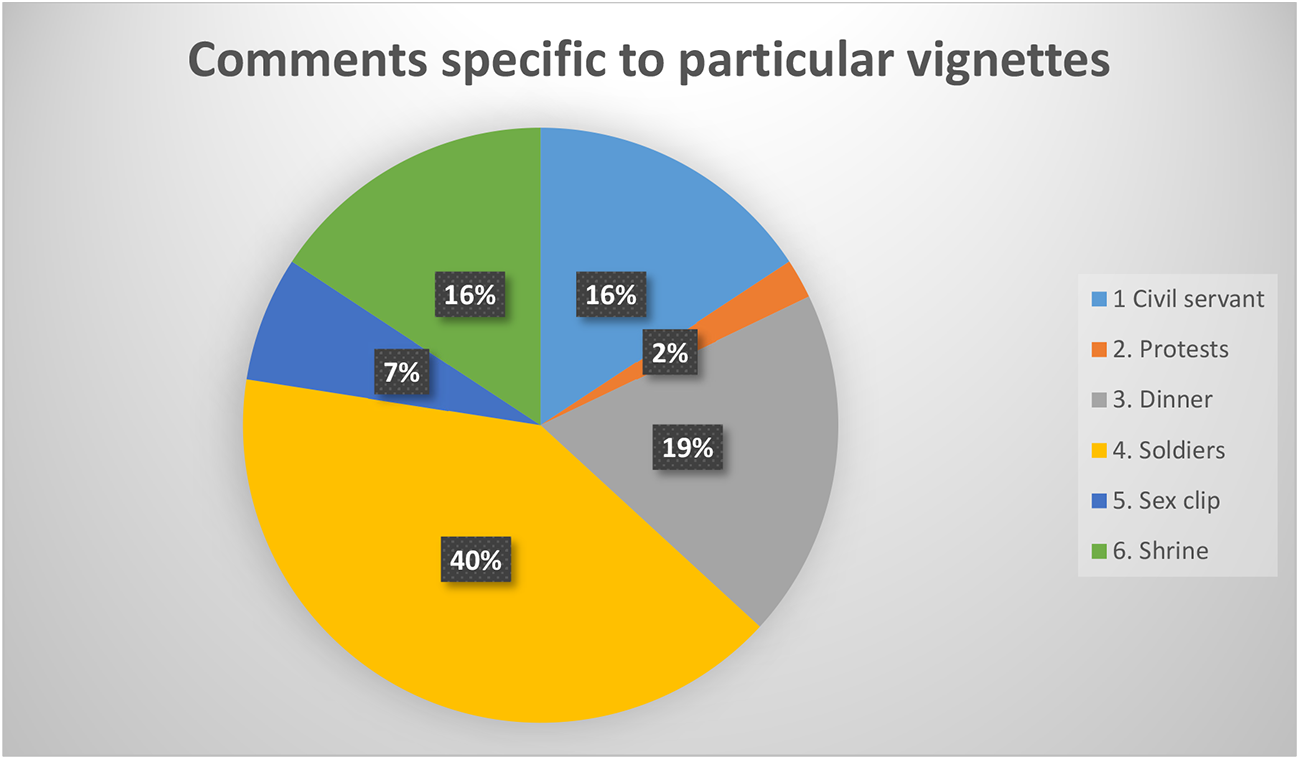
Distribution of comments by vignette.
Here are examples of some of the most illustrative of the YouTube comments, including both positive and negative views of the vignettes:
Civil Servants
Made just to push the anti-monarchists’ buttons. See how all of them are squirming with anger? Hahahaha I didn't know that Thai civil servants, who have benefits so heavenly, income so high, have to depend 100,000% on a retirement pension. Not having a pension means they need to become a beggar. This would just go to show what the previous government has done to the country to the point that even civil servants, with the most job security, would be this hopeless. What about the rest of the jobs? It's time to change this country, seriously.
The civil servant vignette elicited sharply contrasting reactions. UTN supporters took perverse delight in the complaints by Move Forward that it misrepresented their policies. For progressive-minded viewers, the clip demonstrated that UTN was completely out of touch with the sceptical views most Thais held towards what they often saw as privileged, self-important and entitled civil servants.
Protests
What you're doing here just emphasizes your failures in running the country. The video clip shows your party's outdated ideas. You ask if we really want Thailand to change. I'd say, “yes”. I don't want it to be the same. Same means bad. We have no freedoms, but in the clip you say we do. I'm confused. Thai people rallied in the streets, but you shot rubber bullets and tear gas at them. You call this “right to free expression”. Think for once. Utterly disgusting.
Dinner
I like the scene with the stewed pork. Everyone is out of their mind … claiming democracy even over little tiny issues and belittling people who disagree with them. They act more like communists. I absolutely have no idea who to vote for in the 2023 election. In reality nobody votes right at the table for what to be on the menu. These days you can't choose what to eat. Just eat what you can afford to keep your stomach filled. Under Prayut's rule over this “buffalo country” for 7–8 years, prices of foods and gas, everything, have risen, except for wages. They are freaking the same. How can you even vote for what to eat when what everybody can afford is just instant noodles and a half of a boiled egg with fish sauce that you bastards glorify.
These comments nicely exemplify the contrasting views of those who watched the vignette: for some, it illustrated how preachy and self-righteous Move Forward had become, while for those of the progressive side, the dinner scene was yet more evidence of how detached from reality the conservatives remained.
Soldiers
Shrinking the army while the “really nice” neighbours are ready for war with weapons ready in their hands. We've gone from being strong to where in the future we wouldn't be able to handle our neighbours. Today you're young, but 30–40 years from now you’ll become old elephants in the eyes of your grandchildren like we are. You demand your rights with no regard for others. It's not different from entitled children, who throw tantrums for what they want. Soon you will scold anyone at will, just like cavemen did. Whatever you do now, will be done to you by your children and grandchildren. Do you really think acting like steps in a ladder for someone to step on will make your lives better if that person can’t even get their stories straight and clear? Let me tell you with no prejudice about my experience on the day I joined up, on a conscription day. I signed up for voluntary enlistment, so I'm gonna tell the whole truth. I signed up for the navy. In the first three months, I was in a training unit. Woke up at 5:30 am, cleaned the area assigned to me, then went to have breakfast before lining up for a drill. Did more cleaning and then had lunch. Had more drills and then dinner at 7 pm. Joined a meeting for orders for what to do the next day and then took a punishment if any. Went to sleep after that. The same went on every day. Weapons and tactical training was in the week before the final one. And it lasted only a week.
It is especially telling that the conscription vignette attracted the largest number of comments: a specific Move Forward policy that touched directly on both the entrenched power of the military and on questions of inequality and was deeply alarming to the conservative support base of Prayut and UTN. The comment by a former conscript about the futility of his experience was very representative, demonstrating why abolition was such a successful campaign pledge for Move Forward. For conservative commentators, the idea of abolishing conscription illustrated both the naivety and lack of patriotism of progressive voters.
Sex Clip
These kids grew up with the media exploiting sex for money. Super-discriminatory toward the end of the video. Super-condescending towards women–the gender of our mothers. You just assume here that having freedom to do anything with their body, they would then sell it on the internet. What sort of logic is this? Are you saying millions of people in Thailand are selling their bodies? Damned you! You're insulting your own parents. Don’t remove this video. It's laughable. You want to look smart but end up looking stupid. Them slims should see how they insult you with this.
27
Curiously, this very emotive vignette attracted little by way of comments, but the critical response quoted nicely interrogated the confused, derogatory and patriarchial assumptions behind the clip.
Shrine
They will destroy even religion, allowing monks to vote and letting them fixate on politics rather than Dhamma teachings and practice. Monks would later become vote canvassers, joining street demonstrations. This would pile wrongful desires up on monks. Is the religion not tarnished enough these days? Vote for Move Forward and Thailand will not be the same. Just choose what country you want Thailand to become: Sudan or Rwanda? As you please. What's your point in the last scene? The fall of Buddhism like that of the Jedis? Are you suggesting that if this party doesn’t get to lead the country, the country will be without religion? And for older generation people, having no religion = them weirdos in the society, neither welcomed in hell or wanted in heaven. This is such an excellent promotion. Let me respond from a non-religious someone's perspective (I grew up with Buddhism and stopped practicing it). Seeing Buddhism as a national religion is not wrong because it has been casually said forever that Thailand is a Buddhist country, but what you're doing here is not constructive and will only add to the conflict. Don’t you think? You bring religion into this, but it is a delicate matter. What you’re doing is divisive, sharply dividing left and right. I can't believe you’re the party that older generation people love –“love nation, religion, and King” – so much. You can do PR, propaganda, or whatever, but presenting yourself this way only plays up the fact this position is not for the present day. It's the 21st century now. Why did you bring in religion? I don't understand you at all.
The shrine sequence was one of the most commented upon, demonstrating that it touched some raw nerves. For the conservative comment poster quoted above, Move Forward was advocating a dangerous politicization of Buddhism which could lead Thailand to become a failed state like Sudan or Rwanda. For the progressive comment poster, such accusations were dangerously divisive and illustrated the absolute desperation of the conservative side.
The nearly 11,000 comments posted about the UTN video vividly illustrated the polarization of Thailand's politics, and the strong views evident on both sides of the political spectrum. Not the Same as Before had been carefully crafted to trigger a public reaction, and it certainly worked. Nevertheless, the preponderance of highly critical YouTube comments could suggest that the video was somewhat counter-productive, galvanizing support for Move Forward rather than necessarily boosting the UTN vote.
Conclusion
The United Thai Nation Party campaign video, riffing off the Move Forward slogan Not the Same as Before, was one of the most powerful pieces of political messaging to emerge from the 2023 Thai election. Six vignettes of life in a dystopian near-future deftly parodied the policies and positions of Move Forward as exemplifying a rude and disrespectful younger generation, crassly rejecting the values and traditions of Thai society. The advertisement was very professionally done: the satires on family life clearly riled many Move Forward supporters, and at the same time fired up the conservative UTN base. Yet the video contained no positive messages: there were no references to the achievements of the Prayut government and no mention of the United Thai Nation Party's manifesto pledges.
In many ways, Not the Same as Before encapsulated the central theme of the election: a clash of values which was part generational, and part ideological. The election was not primarily fought on the policy platforms of the various parties, ranging from Move Forward's 300 policy omnibus to UTN's six strategies, the details of which were lost on most voters. The contrast between youthful Move Forward leader Pita Limjaroenrat (42) and the very senior Prayut Chan-ocha (69) was not just a question of personalities, nor a difference in policies or political styles: Pita and Prayut embodied the contrasting values of their respective generations. Neither man appeared in the UTN video, but the video epitomized what each leader represented, in the larger narrative of an election fought on the question of what it meant to be Thai in 2023. Former Future Forward Party spokesperson Pannika Wanich argued that the UTN video was “proof that we are very successful in upgrading[the] political battle in Thailand to become [a] really ideological one.” 28
The UTN video Not the Same as Before aroused strong reactions among both conservatives and progressive Thais, fueling both political polarization and a growing sense of generational contestation. Contrasting with the light, upbeat style of the messaging produced by Move Forward – and indeed several other parties – the video cast a gloomy, grey pallour over the 2023 election campaign, invoking anxieties and seeking to trigger alarm. In many ways, this extraordinary 2 minutes and 45 seconds video perfectly captured the mentality of the conservative elite, faced with unprecedented challenges not simply to their authority as holders of state power, but also to the values and beliefs that they held dear. The video was cleverly crafted, at certain moments deftly skewering the arguments of the progressive side.
However, for many viewers the video was far removed from reality, speaking volumes about how disconnected Thailand's ruling class had become. As one of the comment-posters put it: “this position is not for the present day. It's the twenty-first century now.” Those behind the video resembled the baffled grandmother in the conscription vignette, accessing incomplete information from a 1970s stereo set, then forced to ask the younger generation for clues about what was happening around them in today's Thailand. The video set out to ridicule the opponents of Prayut and his allies, only to reveal how vulnerable the conservative side itself was to ridicule. As another poster wrote “You want to look smart but end up looking stupid”.
The UTN video Not the Same as Before, which was widely shared on a range of online platforms, illustrated the powerful influence of social media on the election campaign. In under three minutes, this remarkable video encapsulated what the 2023 Thai election was all about: a clash between generations, one that was framed by a larger clash over ideological orientation.
Footnotes
Declaration of Conflicting Interests
The author declared no potential conflicts of interest with respect to the research, authorship, and/or publication of this article.
Funding
Post-election interview research in 2024 was funded by the NTU Start Up Grant Generation Thailand, under IRB 2024-311.
Notes
Author Biography
 , e-mail