



Abstract
The Belt and Road Initiative (BRI) embodies Beijing's global ambitions. Social opposition to BRI projects in host countries, however, undermines China's preferred image. Beijing, therefore, requires state-owned enterprises (SOEs) to enhance public engagement to secure local people's support. Embedded in Myanmar's political transition in the 2010s, this study interrogates variations in Chinese SOEs’ public engagement approaches to three leading BRI projects, namely the Myitsone dam, the Letpadaung copper mine and the China–Myanmar dual pipeline. Some studies attribute discrepancies in engagement approaches to fragmented and decentralised implementation of the BRI. Nonetheless, it remains puzzling that an SOE constantly adjusted its public engagement strategies in the same project over time. Building on the institutional theory, this article argues that an SOE's behaviour was jointly shaped by endogenous cognitive beliefs and exogenous constraints imposed by Myanmar society and Beijing. Intra-case analysis and cross-case comparisons in this study find that an SOE would pursue dialogue with societal actors when strong local resistance coincided with close Beijing's scrutiny over a project. Otherwise, an SOE would manage its relations with locals in a hierarchical accountability, blame-shifting or even business-as-usual approach. That said, an SOE's public engagement was not institutionalised but reactive to its dynamic external environments.
Keywords
Introduction
Belt and Road Initiative (BRI) projects are state-coordinated investments that embody Beijing's (the Chinese government) global ambitions. The pushback from impacted communities against BRI projects makes headlines and impedes China's preferred international image. Beijing, therefore, requires state-owned enterprises (SOEs) to win the hearts and minds of local people in their overseas undertakings. In response, Chinese SOEs tactically adjust their public engagement strategies to align with the state's political agenda. A transparent and participatory environmental and social impact assessment (ESIA) is essential before signing an agreement to ensure project legitimacy (Holley and Mitcham, 2016). Investors are expected to inform, consult and involve impacted communities in the course of project development through public engagement (Pellizzone et al., 2015; see also Mark et al., 2020: 396). While Chinese SOEs are increasingly accustomed to corporate social responsibility (CSR) programmes to bolster their reputation during project implementation, their public engagement practices vary.
This article interrogates SOEs’ public engagement strategies in their BRI projects in Myanmar's reform period from April 2011 to January 2021, a decade-long political liberalisation that was marked by the dissolution of the military junta in 2011 and ended with the 2021 coup. Three leading BRI projects were examined in this study: the Myitsone dam, the Letpadaung copper mine and the China-Myanmar oil and gas pipelines were invested by the China Power Investment (CPI), Wanbao Mining (Wanbao) and the China National Petroleum Corporation (CNPC), respectively. 1 Divergent public engagement approaches were observed across the three projects despite a largely similar political context. CPI and Wanbao sought local people's endorsement of their projects, whereas CNPC avoided addressing the communities’ concerns. Moreover, SOEs adjusted their outreach strategies in their respective projects from time to time. CPI initially condemned local opposition to the project following the dam suspension but subsequently invested considerable efforts to sway local people's opinion. By contrast, Wanbao scaled back its engagement efforts after signing a revised contract with Naypyidaw (the Myanmar government). Meanwhile, CNPC refused to meet with societal actors throughout the pipelines’ implementation. What explains variations in Chinese SOEs’ public engagement strategies in their BRI projects in transitional Myanmar? What accounts for changes in engagement efforts in the same BRI project implemented by the same SOE?
Drawing inspiration from the institutional theory which pinpoints that an organisation strategically reacts to its institutional environment (Child and Tsai, 2005; Scott, 2014), a Chinese SOE's engagement behaviour is conditioned by its endogenous cognitive beliefs and exogenous operational constraints. Intra-case analysis and cross-case comparisons of the three SOEs’ engagement behaviour in this study, grounded in extensive interviews in Myanmar from 2015 to 2019, find that an SOE is more likely to enter into dialogue with local stakeholders when strong local resistance to a project converges with close scrutiny from Beijing. Otherwise, it tends to turn to a hierarchical accountability, blame-shifting or even business-as-usual approach to the project's implementation. Despite the proliferation of Chinese overseas investment guidelines promulgated by the authorities, SOEs’ engagement behaviour has been reactive to their external environments rather than institutionalised.
This study contributes to the BRI scholarship on three fronts. Theoretically, it demonstrates how the interplay between local resistance and Beijing's scrutiny jointly shapes an SOE's operational environment, as well as its public engagement behaviour. Furthermore, it underscores the role of societal actors in international economic agreements, which has been under-explored. Empirically, the study accentuates the dynamic operational environments during Myanmar's political reform period. The ebb and flow of Chinese SOEs’ engagement approach sheds light on the efficacy of Chinese overseas investment guidelines (Liu, 2021; Chan and Pun, 2020, 2022).
To examine Chinese SOEs’ engagement strategies, the remainder of the article is structured as follows: The second section illustrates Beijing's global ambitions in the BRI, followed by a discussion about a top-down design versus a bottom-up implementation of the undertaking. The third section introduces an analytical framework of Chinese SOEs’ engagement strategies and data collection methods. Four engagement approaches are generated in a two-dimensional model based on the levels of local resistance and Beijing's scrutiny. The next section details the three SOEs’ engagement behaviour in their projects with intra-case and cross-case comparisons. The conclusion summarises research findings and explores changes in SOEs’ engagement approach in contexts beyond Myanmar.
The Belt and Road Initiative and Beijing's Ambitions
Since its launch in 2013, the BRI has been Beijing's flagship diplomatic tool to elevate China's international standing. Closely tied to President Xi's legacy, the transcontinental infrastructure programme embodies his vision of a Sino-centric world order. Building on Ikenberry's (2018) insights into the rising power's challenges to the existing international hierarchy, the BRI forges ahead Beijing's global aspirations through three intertwined means – asymmetric economic interdependence, the creation of new institutions and influence over the United Nations agencies.
First, the BRI exploits asymmetric economic interdependence with host countries and, therefore, advances Beijing's geo-economic, geo-political and geo-strategic interests in its peripheral regions and beyond. The connectivity projects facilitate China's exports, investments and access to natural resources from debt-laden host countries (Dreher et al., 2022). Meanwhile, the BRI constructs a China-friendly external environment, in which many host countries openly echo China's political values and foreign policy (Brazys and Dukalskis, 2017). The building of oil and gas pipelines and potentially dual-use deep sea ports enhances China's energy and maritime security (Chan, 2024: ch. 5). Second, backed up by new institutions, norms and standards, the BRI aims to reorient ‘economic, political, cultural and security relations’ towards China's orbit (Callahan, 2016). The Asia Infrastructure Investment Bank, for instance, is perceived as an alternative international financier to the World Bank (Qian et al., 2023). Moreover, Beijing incorporates the notion of a ‘community of shared future for mankind’ into BRI discourse, promoting mutual development and respect for sovereignty (Xi, 2017). Third, considering the UN as the foremost multilateral mechanism, Beijing actively seeks its endorsement of the undertaking (Haug, 2024). In 2016, it established the UN Peace and Development Trust Fund. Through forming partnerships with UN agencies, such as the UN Development Programme, the UN Department of Economic and Social Affairs, and the World Health Organisation, Beijing strives to boost the BRI's international profile (Department of Economic and Social Affairs of the United Nations, 2022). Grandiose international events have also been organised at home for the same endeavour. Furthermore, Beijing aspires to be recognised as a responsible great power (Fung, 2019), often highlighting the principles of reciprocity, sustainability, transparency and high quality in the BRI (National Development and Reform Commission of the Peoplés Republic of China, 2021: ch. 41). Such narratives are directed towards both international audiences and the SOEs.
The BRI is a state-orchestrated strategy in which the state apparatus, SOEs, private firms, policy banks, financiers, media and academics are mobilised to materialise China's strategic goals (Mertha, 2024). Unexpectedly, it has sometimes encountered resistance from host countries, including many China's Global South allies. Social resistance to the Cheay Areng dam in Cambodia, the Damak Clean Industrial Park in Nepal and the Lamu coal power plant in Kenya has derailed the BRI projects and caused embarrassment to China. Some scholars attribute the conflicts to fragmented authoritarianism amid the BRI's decentralised implementation (Jones and Zeng, 2019; Tjia, 2023). To them, SOEs prioritise short-term profit maximisation at the expense of the state's long-term interests. Furthermore, a myriad of political actors, for instance, the Ministry of Commerce (MOFCOM), the Ministry of Foreign Affairs, the Ministry of Finance, the National Development and Reform Commission, and State-owned Assets Supervision and Administration Commission (SASAC), with competing mandates makes policy coordination challenging (Jones and Zeng, 2019). These views, however, downplay the state's domination over SOEs through the nomenklatura system (the state's control over personnel), administrative measures and other policy instruments (Norris, 2016; Liao and Freeman, in press). Put differently, the state mobilisation and an SOE's autonomy co-exist.
Public Engagement Strategies Influenced by Operational Environments
This study is embedded in Myanmar's reform era that reshaped Chinese SOEs’ investment environment. The host country's location facilitates China's landlocked western region to access the Indian Ocean through the China-Myanmar Economic Corridor (CMEC). Besides the oil and gas pipelines, other infrastructure projects along the CMEC, including a deep sea port, and a high-speed railway, are deemed strategic to China. Myanmar's half-century dictatorship transited to a nominally civilian government in March 2011. With hindsight, Naypyidaw was never effectively under civilian control in the 2010s (Egreteau, 2016; Huang, 2020). Nevertheless, the relaxation of media censorship, a fast-growing civil society, tolerance of contentious politics and competitive elections indicated positive signs of reform (David and Holliday, 2018). These sociopolitical shifts created operational constraints for SOEs that previously counted on the authorities for the smooth implementation of their projects (Dossi, 2015; Chan, 2024).
Most of the corporations carry out CSR activities to some extent to build positive relations with local stakeholders. CSR broadly refers to voluntary corporate initiatives that are driven by social, environmental and/or business considerations in their operations. Some companies take CSR as their responsibility to the impacted communities (Shirodkar et al., 2018). Conversely, others may be incentivised by business interests. Regardless of their motives, top-down and paternalistic charitable projects may provoke opposition from target communities (Tan-Mullins, 2020).
Public engagement incorporates CSR activities but seeks to boost corporations’ legitimacy through on-going interactions with impacted communities, journalists and other local stakeholders (Holley and Mitcham, 2016). To obtain a social licence to operate, an investor ought to solicit free, prior and informed consent from impacted communities through an ESIA, which identifies potential environmental and social risks, as well as mitigation measures. Public communication, consultation and participation constitute the three principal dimensions in public engagement (Baba et al., 2021; Pellizzone et al., 2015).
Chinese companies do not have a good reputation for public engagement, but a robust civil society compelled Chinese SOEs to review their business environment and engagement practices in transitional Myanmar. This article applies Scott's institutional theory to examine variations in Chinese SOEs’ engagement efforts in the host country. According to Scott (2014), an entity's behaviour is governed by its cognitive, normative and regulative conditions (see Table 1). In other words, an SOE's engagement strategy (Y) – measured by public communication, consultation and participation was shaped by its internal values (X1) – driven by corporate economic interests, and constrained by a new external environment (X2) – determined by Myanmar society's social expectations (X2A), and Beijing's scrutiny (X2B), respectively (see Figure 1).
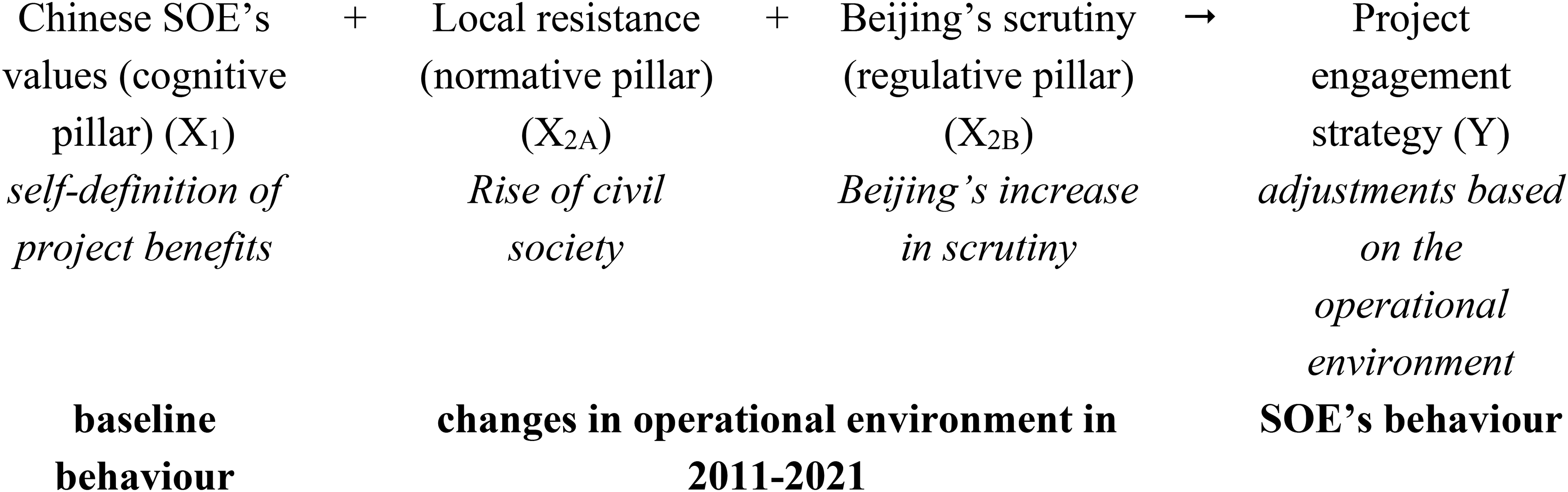
Institutional Framework of Chinese State-Owned Enterprises’ Engagement Strategy Amid Myanmar's Reform Period, April 2011 to January 2021.
Institutional Model of Chinese State-Owned Enterprises’ (SOE) Engagement Behaviour.
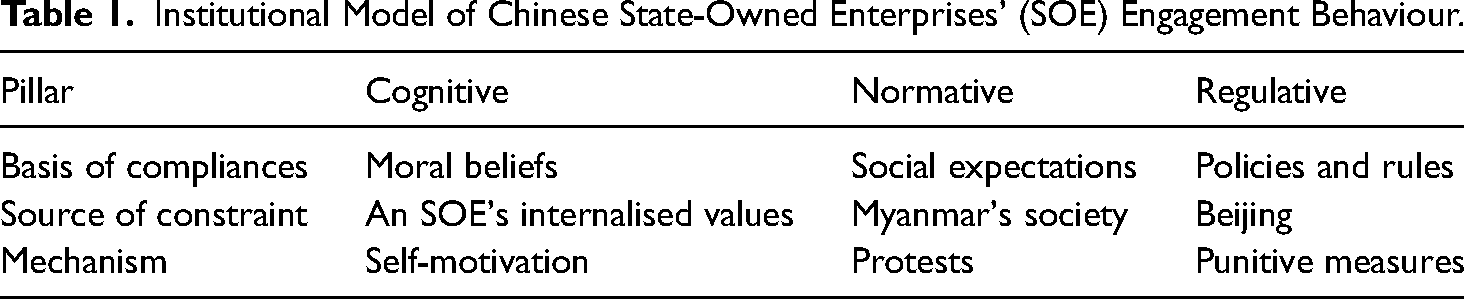
An entity's cognitive beliefs, formed by its internalised values, lay a foundation for its baseline behaviour (Scott, 2014). Chinese President Xi (2017) asserts that China's success in lifting millions of its nationals out of poverty is a remarkable human rights achievement. A Chinese diplomat also opines that industrialisation and exploration of natural resources are necessary in the course of development (Myanmar Golden Phoenix, 2012). Chinese SOEs often unreservedly embrace the state's development model and thereby adopt Beijing's state-centric approach to managing relations in a foreign country. Moreover, their experience at home makes them inclined to neglect public consultation and participation in BRI projects. Nevertheless, a majority of them still carry out CSR activities in their overseas operations (People's Daily, 2019).
On the normative front, an entity conforms to the norms and values of its surrounding environment to meet social expectations. An SOE's behaviour that deviates from social expectations will be subject to public criticism (Scott, 2014). Societal actors, comprising impacted communities, civil society organisations, opposition parties and other local stakeholders, often demand sustainable development, transparency and accountability throughout the project development. Under Myanmar's military rule, societal actors were silenced and not consulted before the signing of a contract. Amid the reform period, local stakeholders spoke out about the adverse impacts of the projects. Despite its preference over project implementation, Naypyidaw's hands were tied when anti-BRI sentiment snowballed (Dossi, 2015; Chan, 2024). The unforeseeable public pushback prompted SOEs to adjust their engagement approaches to BRI projects.
On the regulative front, an entity is prescribed to the laws and regulations; otherwise, it could be sanctioned (Scott, 2014). Regarding public engagement, Beijing's investment guidelines encourage SOEs to gain local support through project transparency, corporate social responsibility, labour rights protection and respect for local culture that complement the UN Sustainable Development Goals (Chinese Academy of International Trade and Economic Cooperation of the Ministry of Commerce et al., 2015). 2 A Chinese authority-led survey reported widespread non-compliances among Chinese firms in their overseas investments. A third of them did not conduct environmental impact assessments (EIA), while a half omitted social impact assessments (SIA) (Chinese Academy of International Trade and Economic Cooperation of the Ministry of Commerce of the People's Republic of China et al., 2017). These findings highlight deficiencies in enforcement mechanisms. Nonetheless, Beijing could penalise SOEs for damaging China's international image (Norris, 2016; Liao and Freeman, in press). Host governments’ legal enforcement is a powerful mechanism to extract investors’ social and environmental compliances, but many Chinese SOEs invest in countries where local governance is in question (Li et al., 2021; Liao and Freeman, in press). Investors are, therefore, less concerned about legal requirements. In Myanmar, the Environmental Impact Assessment procedures, which mandate a project proponent to inform and consult the public, only took effect in 2016. That said, CPI, Wanbao and CNPC, that signed the respective project agreements before 2016, were thereby not obliged to comply with the procedures. For this reason, this study excludes Naypyidaw's role in SOEs’ engagement behaviour.
Chinese SOEs’ Engagement Typology
A Chinese SOE's cognitive beliefs form a baseline of its engagement approach. This study, embedded in Myanmar's reform period, interrogates how an SOE's operational environment shapes its public engagement. To this end, this article's analytical framework accentuates the normative and regulative pillars of Scott's (2014) institutional theory model to understand how Myanmar's social opposition and Beijing's scrutiny jointly redrew operational environment of an SOE.
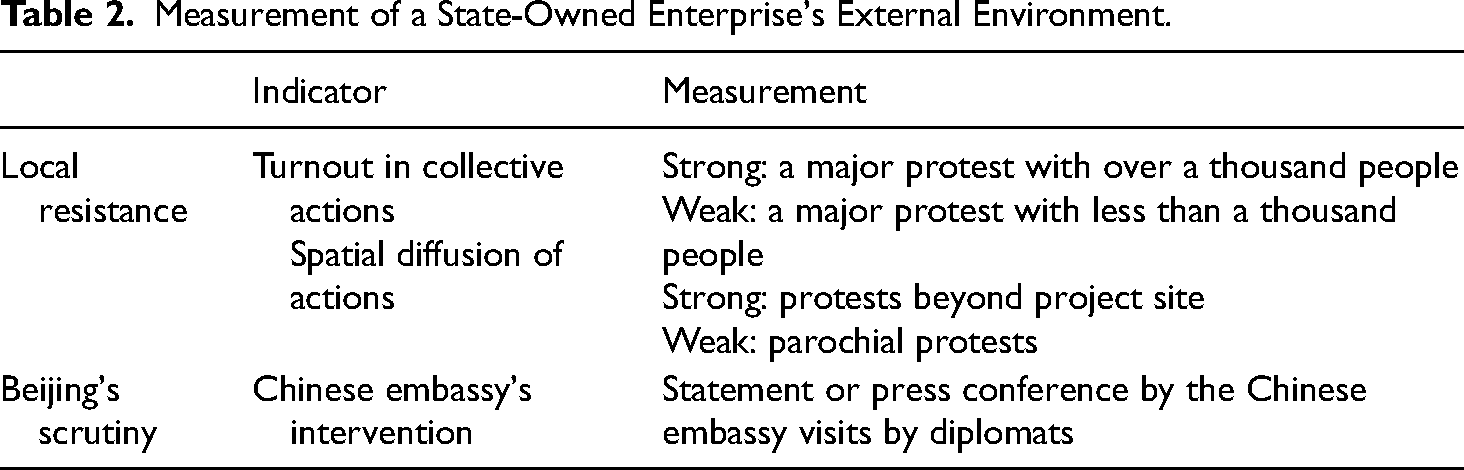
Myanmar's local resistance indicated societal actors’ normative expectations for a project. The stronger the local resistance, the more obstacles an SOE would face in a project implementation. The scale of local resistance was measured by the turnout and spatial diffusion of an anti-BRI project movement that was made up of diverse actions. This study considers social opposition to a BRI project to be strong if a major protest had a turnout of over 1000 people, and the actions spread to cities outside the project area. The reliability of information is enhanced through data triangulation, drawing upon academic publications, media reports, and first-hand interviews. Meanwhile, Beijing was willing and capable of exercising its regulatory power over an SOE that inadvertently undermined national interests owing to their social and environmental non-compliances on the ground. The mechanisms that SASAC and MOFCOM held SOEs accountable were largely opaque to the public, but the state's close scrutiny of a BRI project was observed by high-level meetings, project site visits, press conferences and statements (Table 2). The interplay of constraints from Myanmar society and Beijing generated four approaches to public engagement by the Chinese SOEs (see Table 3). This study concedes that an SOE's engagement efforts could be multi-faceted. The distinction among the following approaches is mainly determined by an SOE's endeavour to communicate with, consult and involve impacted communities in their operations.
Measurement of a State-Owned Enterprise's External Environment.
A Typology of Chinese State-Owned Enterprises’ Engagement Strategies.
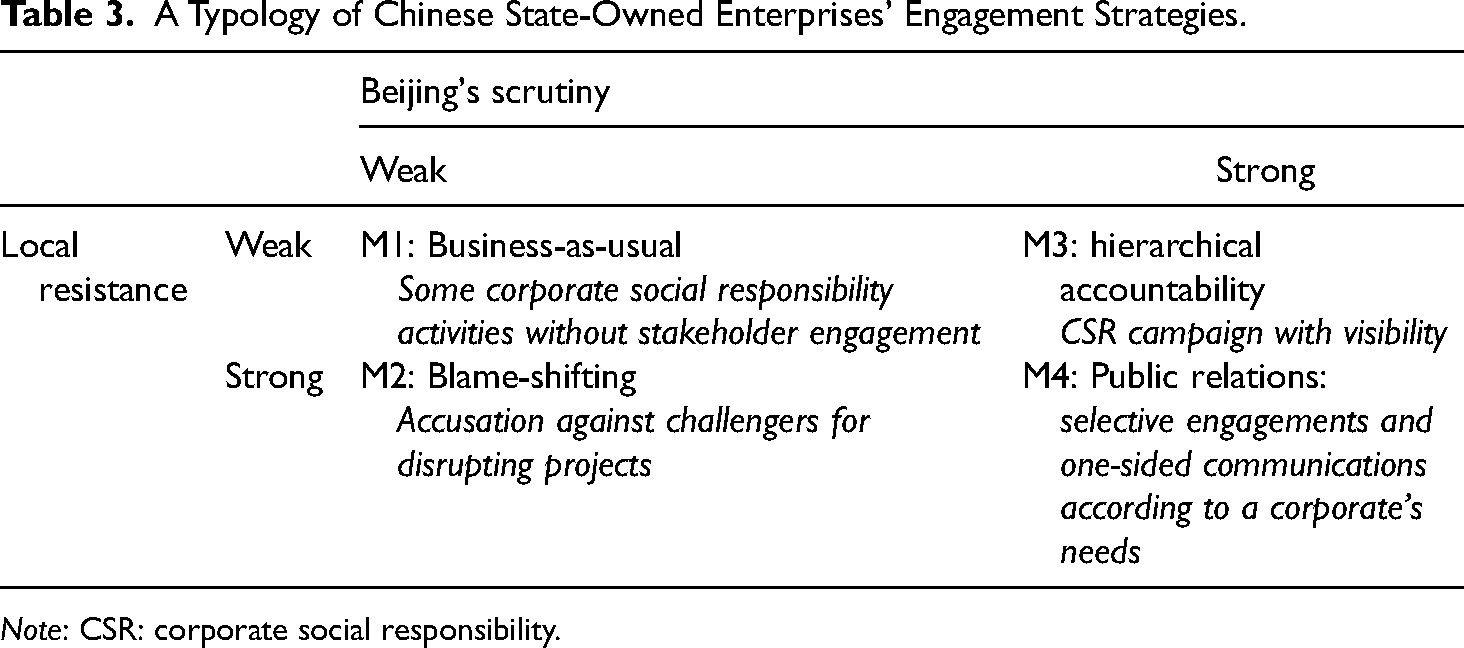
Note: CSR: corporate social responsibility.
Data of this study is drawn from 41 semi-structured interviews with stakeholders of BRI projects conducted in Myanmar from 2015 to 2019. Interviewees were recruited through snowball sampling with the informants’ referrals. All the interviewees are anonymised owing to the volatile political environment in post-coup Myanmar. Activists, Chinese SOE's staff, journalists, politicians and villagers are coded as A, C, J, P and V correspondingly (see appendix). The interview data is complemented by Chinese officials’ statements, SOEs’ publications and news articles.
Shift in Chinese SOEs’ Engagement Strategies
The nominally civilian government headed by President Thein Sein replaced the military regime in March 2011. However, Beijing failed to recognise political changes in Myanmar's transitional period and even upgraded China–Myanmar relations to a comprehensive strategic and cooperative partnership in May 2011. To its dismay, Naypyidaw unilaterally halted the Myitsone dam 4 months later. Some posit that the dam suspension signalled Naypyidaw's willingness to recalibrate its alignment strategy and tilt towards the United States (Han, 2017; Sun, 2012; cf. Passeri and Marston, 2022), while others attribute project derailment to a bottom-up anti-dam movement (Chan, 2017). Setting aside these contested explanations, Beijing realised Myanmar's political reform had profound implications for its external environment after the shelving of the dam project, and therefore stepped up its scrutiny over SOEs’ behaviour in the host country (Chan, 2024).
Myitsone Dam: From Blame-Shifting (M2) to Public Relations (M4)
The suspension of the Myitsone dam in September 2011 marked a watershed in CPI's engagement in Myanmar, as observed by its evolving public communication, consultation and participation strategies. From April 2011 to September 2011, CPI primarily employed a blame-shifting approach to its public engagement to evade responsibility. After the shelving of the project in late September, it moved towards a public relations approach to push for project resumption.
Phase 1: Before Dam Suspension (April 2011–September 2011)
Local resistance to the Myitsone dam intensified in the early phase of Myanmar's political liberalisation. Forced relocation, disproportionate distribution of benefits and cultural affection for the Ayeyarwady River galvanised nationwide opposition (interview: A01). Big and small mobilisation took place around the project site and in major cities, including Yangon and Mandalay. Beijing's misjudgment of Myanmar's political transition resulted in a weak oversight of the project's implementation. CPI immediately accused the activists of having ulterior motives in their actions (China Daily, 2011).
The Kachin Independent Organisation (KIO), which controls part of Kachin State, has categorically opposed the project since 2007 (Chan, 2017). Although the civil war in the ethnic state resumed in mid-2011, Naypyidaw did not consider suspending the project. The “Save the Ayeyarwady” campaign in central Myanmar gained momentum following the leak of the project's EIA report, which did not recommend the construction of the mega dam. The leaked findings sparked criticism from several retired civil servants in July 2011 (interview: A02). In August 2011, Aung San Suu Kyi, then opposition leader, also called for a project review which further energised the movement. Subtle anti-dam activities flourished, including art exhibitions, petitions, seminars and community talks in Yangon, Mandalay, Myitkyina and other towns along the Ayeyarwady River. An exhibition in Yangon, attracted 7000 people, displayed conspicuous social discontent (interviews: A04, A05; Chan, 2017). Government hardliners maintained an intransigent position on the project, but divisions among political elites surfaced in mid-September (Wai Moe, 2011). A senior government official revealed that Thein Sein deeply worried about the implications of anti-dam protests for Myanmar's political transition (interview: P01). The civil war in Kachin State posed security threats to the project's implementation. Nevertheless, Thein Sein cited environmental concerns and public outcry instead of the armed conflict, that prompted his decision to suspend the project for 5 years.
CPI neglected public consultation in the implementation of the Myitsone dam. Traditionally, Beijing did not consider societal actors in host countries as significant or legitimate entities in Chinese foreign relations (Foot, 2020), and, therefore, declined to engage with them until the 2010s (interview: A05). Similarly, Chinese SOEs disapproved of the representativeness of Myanmar activists and NGOs and refused to enter into dialogue with them (interviews: C01, C02). Soon after the dam suspension, CPI's President Qizhou Lu strongly criticised Western NGOs for their obstruction to Myanmar's development (China Daily, 2011). Although CPI conducted an EIA for the Myitsone dam, the project commenced in December 2009 before the completion and approval of the EIA report in March 2010 and January 2011, respectively (Upstream Ayeyawady Confluence Basin Hydropower Corporation Limited, 2013), which undermined the integrity of the process.
Phase 2: After Dam Suspension (October 2011–January 2021)
After the Myitsone dam suspension, a movement that called for project cancellation sprang across the country with a bigger turnout. In response, Beijing launched a public diplomacy campaign in order to resume the project. CPI amended its engagement strategy to allay opposition but reached out to societal actors only when necessary (Gong, 2020). Interviewees approached by CPI said that they felt patronised by the company.
A high turnout in anti-Myitsone dam activities displayed sustained disapproval of the project (interview: A05). An opening political environment fostered collaboration between activists in Kachin State and central Myanmar. Newly released political prisoners joined the cause in 2012 (interview: A06). More exhibitions, talks and protests were held on the annual World Water Day and the anniversary of the dam suspension to sustain public awareness (Chan, 2024: ch. 6; interviews: A02, A04). In Kachin State, some 1000 residents near to the project site manifested their opposition to the dam in a self-organised poll in March 2014 (interview: V01; Martov, 2014). A 10,000-strong anti-dam protest took place in the ethnic state in 2019 (Nan Lwin, 2019).
Beijing re-centralised control over SOEs that operated in Myanmar after the project derailment. Both SASAC and MOFCOM reiterated that SOEs should carry out ESIAs to win local people's support. The shelving of the Myitsone dam became Beijing's prestige problem. CPI leaders were reportedly penalised through the nomenklatura system for hampering national interests (Hall and Krolikowski, 2022). Meanwhile, Beijing unequivocally pressed its counterpart to resume the project and initiated meetings with non-state actors to gain their support. Over the years, a broad spectrum of Myanmar political and social elites has been invited to visit China, where the project was often discussed during the trips (Chan and Pun, 2020). 3 In December 2018, Chinese Ambassador Liang Hong visited Kachin elites in Myitkyina. Acknowledging KIO as a significant stakeholder, Beijing also sought its endorsement of the project (Jangma, 2019). Given Beijing's resolve to restart the project, CPI was under pressure to defuse local opposition.
CPI adjusted its stakeholder engagement strategy after the dam suspension. In 2012, it opened a public relations office in Kachin State. Complementing its CSR activities, CPI assured public safety and environmental protection in the project's implementation (Upstream Ayeyawady Confluence Basin Hydropower Corporation Limited, 2013). Additionally, it commissioned consultancy firms – Beijing Rong Zhi Cooperate Social Responsibility Institute and Bell Pottinger – to boost its image. Interviewees in Myitkyina recalled multiple visits from the SOE (interviews: A09, P03). An activist who conducted a survey with local people pointed out that CPI brought Chinese NGOs and scholars to understand local people's grievances only after the dam suspension (interview: A10). CPI reiterated the project's benefits and feasibility but failed to comprehend people's deep connection to the national river and ancestral land. Interviewees found that the company's public relations engagement approach was counterproductive (interviews: A01, A09, A10, P03).
Letpadaung Copper Mine: From Public Relations (M4) to Hierarchical Accountability (M3)
The signing of the revised contract in July 2013 marked a turning point in Wanbao's engagement strategies in the Letpadaung copper mine, a joint venture between Wanbao and the Union of Myanmar Economic Holdings (UMEHL) in Sagaing Division. A framework agreement was signed in June 2010 and the project implementation began without any ESIA. Nationwide anti-mining protests emerged during the political reform. Thein Sein temporarily halted the project and formed an investigation commission to review the project in December 2012. The project was eventually resumed in 2013 on the condition of a contract revision. Before the revised contract's signing in June 2013, Wanabo adopted a public relations approach to secure the resumption of the project. Its public engagement efforts scaled back to a hierarchical accountability mode that primarily addressed Beijing's concerns after the project resumption.
Phase 1: Before Contract Revision (March 2011–June 2013)
Land confiscation was at the heart of the controversy in the copper mine. Although villagers were deceived or coerced into giving up their land in late 2010 (Egreteau, 2024), only a few of them dare to oppose the project before the regime change (interview: A11). Strong mobilisation emerged in 2012 when urban activists supported villagers with legal knowledge, organising techniques, and media contacts (interviews: A12, J02). Wanbao's further encroachment of disputed farmland provoked more social discontent. Over 5000 people from 26 villages in the project area staged a protest in September 2012 (Aung Hla Tun, 2012). In November 2012, about 500 Buddhist monks joined the anti-mining campaign after learning that a historical monastery on Letpadaung mountain had been demolished (Lipes, 2012). Naypyidaw suppressed villagers’ mobilisation by protest application rejections and arrests of protest leaders (Cheesman, 2015), yet over 120 protests were still reported around the project area in 2012 (Letpadaung Taung Investigation Commission, 2013). Naypyidaw's brutal protest crackdown in late November 2012 injured over a hundred protesters, mostly monks. Parochial protests spread to Yangon, Mandalay, Monywa, Pakokku and other cities. Thein Sein halted the project and appointed opposition leader Aung San Suu Kyi to head an investigation commission to advise on the future of the project.
The suspension of the Myitsone dam has made Beijing more circumspect about Myanmar's political environment. The Chinese Ambassador Junhua Li organised a press meeting in October 2012, claiming that Beijing would not support a project that could not benefit the Myanmar people (Myanmar Golden Phoenix, 2012). After the halt of the project, he pledged that Wanbao would accept the investigation commission's constructive recommendations (Burma News International, 2012). It was evident that the SOE was under Beijing's watch.
Wanbao was compelled to reform its engagement strategy due to mounting external pressure. In March 2013, Naypyidaw resumed the project on the condition of contract renegotiation. An agreement was reached in July 2013, with Naypyidaw becoming a new party in the joint venture. Furthermore, 2% of the mining project's net profit would be earmarked for CSR programmes (Myanmar Wanbao Mining Copper Limited, 2016a). Wanbao, previously criticised activists for inciting anti-mining sentiment reset the tone and stressed the importance of a social licence to operate (Myanmar Wanbao Mining Copper Limited, 2014). It voluntarily conducted an ESIA and published the findings. Furthermore, it established Community Social Development (CSD) teams to disseminate information to villagers, channel their concerns, and involve them in CSR activities (Tang-Lee, 2016).
Phase 2: After Contract Revision (July 2013–January 2021)
The Letpadaung copper mine restarted in 2013. Wanbao, together with Chinese state media, boasted about its success in getting a social licence to operate the project. However, its public engagement efforts dwindled when local opposition subsided. Following the signing of a new contract in mid-2013, the scale of anti-mining protests subsided in terms of turnout and geographical diffusion. Sporadic protests were participated by a few hundred villages around the project site (Chan, 2024: ch. 4; Vandenbrink, 2013a; Vandenbrink, 2013b). Villagers who struggled to make ends meet gradually withdrew from anti-mining resistance (interview: V02). Moreover, social and political elites refrained from challenging the opposition leader's judgement over project continuation (interviews: A12, A13). Those who continued to oppose the project were criticised by Aung San Suu Kyi's supporters for allegedly failing to appreciate the investigation commission's recommendations (interview: P04).
Beijing conceded the necessity of engaging with a broader spectrum of stakeholders was vital to safeguard its economic interests and international image under Myanmar's new political context. The Chinese embassy required SOEs to progressively promote Chinese investments’ benefits to the local population (Global Times, 2013). Wanbao reverted its engagement approach to a hierarchical accountability model when social resistance to the copper mine waned. It published CSR reports and produced a promotional video, ‘Myanmar Wanbao: A New Dawn’, in 2016 to portray itself as a responsible investor (China Meets Myanmar, 2016). Many villagers were not against CSR activities, but a misalignment between the company's charitable work and villagers’ actual needs was not unusual (interviews: V03, V04) (see also Tang-Lee, 2016; Chan, 2024: ch. 4). Villagers once relied on farmland and natural resources lost their livelihoods. Following land confiscation, roughly 10% of villagers were employed by Wanbao (Myanmar Wanbao Mining Copper Limited, 2016b). The CSD teams did not address villagers’ grievances related to unemployment or underemployment (interviews: V05, V06). Journalists and union leaders also criticised the Chinese SOE for its reluctance to enter into dialogue with them (interviews: A14, A15, J03, J04). Wanbao, has selectively engaged with NGOs that were less critical of its operations (interview: A14), and has stopped publishing CSR reports since 2016. On the contrary, it was keen to collaborate with state media to publicise its CSR efforts to the Chinese audience (Sun, 2018).
China–Myanmar Pipelines: From Business-as-Usual (M1) to Hierarchical Accountability (M3)
The launch of the electricity access campaign in Rakhine State in 2012 shifted CNPC's engagement strategy from a business-as-usual approach to a hierarchical accountability model in the China–Myanmar oil and gas pipelines. The pipelines are joint ventures with six companies from four countries, in which CNPC holds a 50.9% stake in both projects. Starting in Myanmar's Rakhine State, the pipelines cross the country, and then enter China's Yunnan Province. The project is designed to enhance China's energy security and efficiency.
Phase 1: Before the Launch of the Electricity Campaign (April 2011–December 2011)
In the early phase of the project implementation, CNPC maintained a business-as-usual engagement approach due to weak constraints from impacted communities and Beijing. Pipeline construction commenced immediately after the conclusion of the framework agreement in June 2010 (China National Petroleum Corporation, 2015). Villagers who suffered from land confiscation and construction waste pollution did not dare to resist the project openly in 2010–2011. Even during the political reform, organising protests was challenging as the 800km parallel pipelines span Rakhine State, Magway Division, Mandalay Division and Shan State. Moreover, pipeline construction progressed more rapidly than activists’ mobilisation (interview: A16). Once the pipelines were laid underground, public concern diminished significantly (interview: A17). Beijing's scrutiny over CNPC's engagement strategy was not visible in 2011. CNPC did not reach out to Myanmar villagers, NGOs and local media. Its extensive experiences in overseas operations, however, made it internalise CSR activities in its projects.
Phase 2: After the Launch of the Electricity Campaign (January 2012–January 2021)
CNPC's engagement strategy was confined to hierarchical accountability from 2012 to 2021, with little pressure from local communities before and after the pipeline construction. Comprehending Beijing's quest for legitimacy in BRI projects, CNPC responded by launching high-profile CSR campaigns – such as press conferences, publications and media features – to enhance its public image (Sun, 2019). It appears that CNPC cared more about the perception of political and social elites at home than acceptance from stakeholders on the ground.
Urban activists did not resonate with the anti-pipeline campaign initiated by villagers along the pipelines. While mobilisation in Rakhine State was active, it was primarily focused on demanding that Naypyidaw provide electricity to the region. In 2012, the Rakhine Nationalities Development Party (RNDP) (later restructured as the Arakan National Party, ANP) launched an electricity access campaign in the region. Even though RNDP acknowledged local people's discontent stemmed from unfair land compensation, environmental degradation, safety concerns and uneven benefit distribution of the project (interviews: P05, P06, P07, P08), the ethnic party seized the opportunity to extract concessions from Naypyidaw in the pipeline operations rather than monitoring the social and environmental impacts. In 2012 to 2013, it successfully collected 300,000 signatures in an electricity access campaign (Vandenbrink, 2014: see also interviews: P07, P08). Meanwhile, most of the anti-pipeline protests were self-organised by villagers with a small turnout around the project areas (interviews: V07, V08). A 400-strong protest on Maday Island, the starting point of the oil pipeline in Rakhine State, in April 2013 was considered a bigger mobilisation. After the completion of the pipeline construction, only sporadic and parochial protests continued along the pipeline route (Chan, 2020).
Beijing paid special attention to the pipeline project due to its strategic value and linkage with prospective BRI projects in Rakhine State. Chinese Ambassador Li inspected the project's progress and learned about the CSR activities during the trip to Maday Island in early 2012 (Embassy of the People's Republic of China in Myanmar, 2012). His successor, Ambassador Houlan Yang, also met villagers on Maday Island in May 2013 following a local protest (Embassy of the People's Republic of China in Myanmar, 2013). Furthermore, Beijing regularly invited Rakhine political and social elites to visit China to discuss the deep sea port and special economic zone that were under planning (interviews: P07, P08).
Since 2012, CNPC has invested more resources in CSR activities in the project areas. However, its CSR efforts did not translate into meaningful stakeholder engagement. The Myanmar-China Pipeline Watch Committee (MCPWC), a national pipeline watchdog formed in October 2012, claimed that CNPC was reluctant to address its research findings. The Chinese SOE even used MCPWC's report launch in January 2016 as its media opportunity instead of resolving disputes with activists and community members (interviews: A16, A18). Likewise, a community-based organisation in Rakhine State opined that CNPC disregarded the impacted communities’ grievances (interview: V08). The absence of a grievance mechanism to address local concerns further corroborated societal actors’ criticism (see interview: C03). CNPC's engagement approach was largely oriented towards assuring Beijing of its efforts to promote a positive national image to a large extent.
Cross-Case Comparison of BRI Projects in Myanmar
Chinese SOEs invariably reiterate their operations adhere to domestic laws. As one Chinese SOE representative noted, it is common for investors to meet only the minimum legal requirements set by host countries (interview: C01). Since the 2000s, Chinese SOEs have accumulated extensive experience in overseas operations (Maurin and Yeophantong, 2013). Many of them have been socialised to enhance CSR, yet they continue to fall short of public transparency and accountability (Franceschini, 2020). A business and human rights organisation indicates that the leading Chinese SOEs are less willing to respond to requests for information compared to their counterparts in Asia (Business and Human Rights Resource Centre, 2021). The fact that CNPC is less responsive to human rights enquiries reflects its cognitive belief in public engagement (Business and Human Rights Resource Centre, 2025). Before Myanmar's political transition, SOEs usually employed a business-as-usual engagement strategy (M1). With a drastic change in Myanmar's political outlook in the 2010s, whether an SOE would adopt a blame-shifting (M2), hierarchical accountability (M3), or public relations (M4) model depended on its respective external environment (Table 4).
Chinese State-Owned Enterprises’ Engagement Strategies in Myanmar.
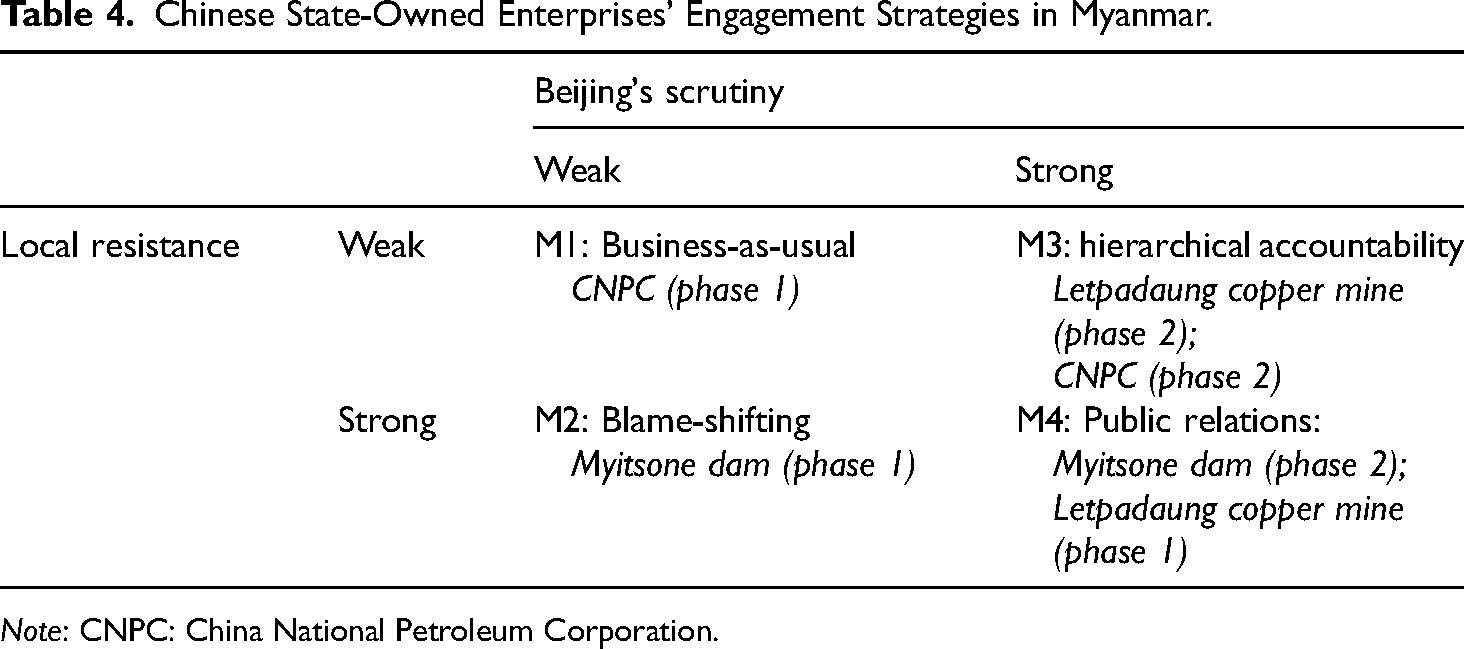
Note: CNPC: China National Petroleum Corporation.
This comparative study of three BRI projects finds that CPI and Wanbao attempted to persuade impacted communities to endorse their projects. In the Myitsone dam case, sustained pressure from both Myanmar society and Beijing led CPI to abandon its initial blame-shifting approach (M2) and reach out to local stakeholders after the project's suspension. Nonetheless, the subsequent public relations model (M4) still encountered resistance, as state-led investment had not secured community consent from the outset. In the Letpadaung copper mine case, engagement efforts eroded – with sustained pressure from Beijing but waning social opposition – after the contract revision. A public relations approach (M4) regressed to a hierarchical accountability (M3). CNPC, however, showed less concern about its engagement strategy throughout its operations. In the early stage of the pipeline operation, CNPC took up a business-as-usual stance (M1), assuming that the investment environment was the same under the military regime. Beijing's pursuit of legitimacy and strategic interests in Rakhine State prompted CNPC to perform hierarchical accountability (M3). Weak local resistance to the project could not motivate the SOE to address villagers’ grievances. Its top-down CSR strategy largely aimed at impressing Beijing.
Operational Environment in Post-Coup Myanmar
The 2021 military coup has once again changed the institutional environment for Chinese SOEs’ operations in Myanmar. Beijing has scaled back its dual-track diplomacy to state-to-state relations, and urged the junta to accelerate the CMEC development (Passeri, 2024: 115–116), notwithstanding persistent calls from opposition groups to suspend investments that finance the military regime (The Irrawaddy, 2022; Justice for Myanmar, 2023). Acknowledging intense armed resistance groups’ operations have posed tangible threats to the stability of the BRI projects, it demands the junta enhance security for existing Chinese investment projects (Tang, in press). More landmines are planted along the pipelines, which further jeopardises civilians’ safety (see Abb et al., in press). The execution of two striking workers from the Yang Tse copper mine, a Wanbao's subsidiary (The Irrawaddy, 2022) has raised serious concerns over human rights issues in Chinese SOEs’ operations in the country. These developments suggest that SOEs have reverted to a business-as-usual or blame-shifting model in their public engagement.
CITIC's Kyaukphyu deep sea port is a crown jewel in CMEC that is critical for China's access to the Indian Ocean. Weak resistance to the new BRI project in Rakhine State does not motivate SOEs to win local people's support. An ESIA was conducted in 2023 (Myanmar News Agency, 2023), but it is doubtful whether impacted communities could express their concerns without fear amid armed conflict and political repression. Residents who experienced adverse impacts of the CNPC's pipeline projects worried that the new projects could exacerbate social and environmental non-compliances (Abb et al., in press). Despite some CSR outreach and CSR activities, local people's voice is marginalised (Chu et al., 2024). A recent study has even revealed that the construction of the SEZ began in the second half of 2022, which was before the completion and approval of the ESIA (Zou, 2024: ch. 3). If the claim is correct, it once again tarnishes the Chinese SOE's reputation. Put plainly, Beijing and the Chinese SOEs pushed social resistance aside and resumed the business-as-usual engagement model in the pre-reform period.
Conclusion: Reform or Rhetoric?
Traditionally, Chinese SOEs were reluctant to engage with impacted communities in their operations in Myanmar. During a decade-long political liberalisation, SOEs realised changes in their operational environment and adjusted their engagement behaviour to varying extents. Their adaptation to operational environments raised questions about whether public engagements were institutionalised reforms or political rhetoric.
Intra-case analysis and cross-case comparisons of SOEs’ public engagement strategies in transitional Myanmar lacked institutionalised reform, but were subject to domestic actors’ pushback and Beijing's scrutiny. CPI, Wanbao and CNPC's relations with societal actors fell short of public engagement, that aims to communicate with, consult and involve societal actors in the course of project development. Bypassing prior and informed consent from impacted communities inevitably intensified contention. Strong local resistance and close Beijing's scrutiny compelled CPI and Wanbao to win over the hearts and minds of the impacted communities. They shifted engagement away from a state-centric approach and built relations with locals. Selective engagement initiated by CPI and Wanbao under a public relations model in the Myitsone dam project and Letpadaung copper mine was sub-optimal, but reflected their acknowledgement of societal actors’ influence in state-coordinated investments. Nevertheless, Wanbao's engagement efforts eroded when local opposition waned despite Beijing's pressure remained. Meanwhile, weak local resistance and strong Beijing's pressure made CNPC resort to a hierarchical accountability model to manage its relationship with local stakeholders in the pipeline project. In post-coup Myanmar, Beijing largely relies on the military to safeguard the projects. It also urges armed resistance forces to protect its investments. Against this background, Chinese SOEs are likely to adopt a business-as-usual or blame-shifting approach in their relations with societal actors. This probably fuels local people's distrust of the BRI projects.
This research contributes to the BRI literature in three ways. First, it underscores the importance of operational environments in shaping Chinese SOEs’ behaviour. Drawing inspiration from the institutional theory, it contends that endogenous cognitive beliefs guide an SOE's engagement practices. Moreover, exogenous factors – Myanmar's normative demands and Beijing's regulatory requirements – also mould its outreach strategy. Second, an examination of societal actors’ pushback complements the burgeoning scholarship of host countries’ agencies in state-coordinated investments. Additionally, it augments the discussion about a centralised strategy and fragmented implementation of the BRI. Third, SOEs’ dynamic interactions with societal actors in empirical cases illustrate a lack of institutional reform in SOEs’ public engagement.
Beijing champions the BRI as an international public good that mutually benefits China and the host countries. Nevertheless, a grievance mechanism at the project level has rarely been established (Baird and Thomas, 2020). This study suggests that the SOEs’ engagement framework can be applicable beyond Myanmar. It is observed that social opposition generally prompts Chinese SOEs to step up public engagement efforts. For instance, frequent strikes at the Las Bambas copper mine in Peru compelled China Minmetals Corporation to pursue dialogue with the union and communities (Cardenal, 2024). Following local protests and the temporary shelving of the Port City Colombo in Sri Lanka in 2017, China Communications Construction Company issued its first CSR report for the project in early 2020 to publicise the project benefits to the communities (Xinhua, 2021). China Overseas Ports Holding Company collaborated with a local university and an NGO to review CSR projects in response to mass protests and terrorist attacks on the Gwadar Port and related projects in Pakistan in 2022 (Kazmi, 2022). The transformation and evolution of SOEs’ engagement strategies in specific projects require careful review of the respective operational environments. Future research can probe the ebb and flow of SOEs’ interactions with societal actors in other host countries.
Supplemental Material
sj-docx-1-saa-10.1177_18681034251352870 - Supplemental material for Public Engagement in Belt and Road Projects in Myanmar: Reform or Rhetoric?
Supplemental material, sj-docx-1-saa-10.1177_18681034251352870 for Public Engagement in Belt and Road Projects in Myanmar: Reform or Rhetoric? by Debby Sze Wan Chan in Journal of Current Southeast Asian Affairs
Footnotes
Declaration of Conflicting Interests
The author declared no potential conflicts of interest with respect to the research, authorship, and/or publication of this article.
Funding
The author received no financial support for the research, authorship, and/or publication of this article.

Supplemental Material
Supplemental material for this article is available online.
Notes
Author Biography
Appendix: Interviewee List.
Code
Affiliation
Interview date
Interview place
Activist
A01
A Kachin peacebuilding organisation
July 2015
Yangon
A02
A Yangon-based environmentalist
December 2015
Yangon
A03
A transnational environmental organisation
December 2015
Yangon
A04
A Yangon-based environmentalist
January 2016
Yangon
A05
A gallery
December 2015
Yangon
A06
88 Generation Students
July 2015
Yangon
A07
Kachin activist
June 2015
Yangon
A08
A cross-border ethnic organisation
July 2015
Chiangmai, Thailand
A09
A church organisation in Kachin State
June 2015
Myitkyina
A10
A community-based organisation in Kachin State
June 2015
Myitkyina
A11
A Mandalay-based environmental organisation
July 2015
Yangon
A12
A Monywa-based ad-hoc network
January 2016
Monywa
A13
A national lawyer network
August 2015
*
A14
A policy advocacy organisation
May 2019
Yangon
A15
A labour union
May 2019
Letpadaung area
A16
A pipeline watchdog
July 2015
Yangon
A17
A cross-border environmental organisation
July 2015
Chiangmai
A18
A pipeline watchdog
January 2016
Sittwe
Chinese state-owned company
C01
A Chinese state-owned enterprise (SOE)
August 2016
Yangon
C02
A Chinese SOE
January 2016
Yangon
C03
A Chinese SOE
January 2016
Yangon
Journalist
J01
An English media outlet
January 2016
Yangon
J02
The Irrawaddy
July 2015
Chiangmai
J03
A local newspaper
May 2019
Monywa
J04
A local newspaper
May 2019
Monywa
Politician
P01
President's Office
January 2016
Naypyidaw
P02
National League for Democracy (NLD)
February 2017
Yangon
P03
A political party in Kachin State
June 2015
Myitkyina
P04
NLD
May 2015
Yangon
P05
Arakan National Party (ANP)
February 2017
Naypyidaw
P06
ANP
January 2016
Sittwe
P07
ANP
December 2015
Yangon
P08
ANP
January 2016
Sittwe
Villager
V01
Villager
June 2015
Myitkyina
V02
Villager
July 2015
Letpadaung area
V03
Villager
May 2019
Letpadaung area
V04
Villager
May 2019
Letpadaung area
V05
Villager
May 2019
Letpadaung area
V06
Villager
May 2019
Letpadaung area
V07
Villager
July 2015
Kyaukphyu
V08
Villager
January 2016
Maday Island
References
Supplementary Material
Please find the following supplemental material available below.
For Open Access articles published under a Creative Commons License, all supplemental material carries the same license as the article it is associated with.
For non-Open Access articles published, all supplemental material carries a non-exclusive license, and permission requests for re-use of supplemental material or any part of supplemental material shall be sent directly to the copyright owner as specified in the copyright notice associated with the article.
