



Abstract
China's Belt and Road Initiative (BRI) is nowadays a global development initiative, with which China pursues a new international identity as a “responsible major country.” The inadequate fulfilment of corporate social responsibility (CSR) in BRI partner countries however has tainted the BRI's cooperative “win–win” principle and sparked external legitimacy crises. This study explores how Chinese policymakers respond to overseas CSR challenges in the realms of environmental and societal responsibility. By integrating both constructivist and rationalist elements, we employ three key variables to facilitate cross-case comparisons. Our analysis reveals that China has favoured a parallel overseas CSR governance system that allows for tailored responses to specific contexts. China's nuanced approaches to international CSR standards reflect rational decisions influenced by issue-specific domestic–international normative fit, perceived legitimacy of the relevant international regime, and the significance of each issue to China's global status. This research offers insights into China's contextualised engagement with international CSR norms in the BRI era.
Introduction
Over the past decade, China's Belt and Road Initiative (BRI) has transformed into a global development initiative, characterised by significant capital mobilised to enhance the “hard connectivity” of infrastructures, especially in the Global South. However, it is less clear how such “hard connectivity” has been facilitated by the “soft connectivity” of rules and standards governing the full life cycle of BRI projects, including planification, tendering and bidding, procurement, development, and operation. China officially commits itself to a cooperative “win–win” approach, not only by adhering to generally accepted international rules and standards but also by actively contributing to the development of higher-standard international economic and trade regulations (China Daily, 2019). Nonetheless, this official rhetoric has been challenged by counter-narratives, partially based on the accumulated records of problematic practices by Chinese companies involved in BRI projects. Examples include adverse environmental impacts in Angola (Tan-Mullins and Mohan, 2013), community conflicts in Peru (Merino, 2022), and human rights violations in the Democratic Republic of Congo (Rapanyane, 2022). This gap between the statements of the Chinese government and the actions of some Chinese companies has led to significant external legitimacy crises, which have, to some extent, undermined China's efforts to construct a new identity as a “responsible major country” (负责任大国, fuzeren daguo). Consequently, overseas corporate social responsibility (CSR) has profound political and diplomatic implications. It is therefore intriguing to explore the extent to which the BRI and the associated legitimacy challenges influence China's perceptions and actions on overseas CSR and to examine the normative dynamics at play within the BRI concerning the governance of overseas CSR.
Current research on this specific topic is yet limited, even though there is a growing body of literature concerning China's CSR that follows two distinct trends. The first stream, which has developed within the management and international business disciplines, primarily explores endogenous factors that influence CSR perceptions and performance at the company level, both domestically and internationally (Du et al., 2022). While this stream has provided valuable insights into understanding the divergent patterns of CSR behaviour exhibited by Chinese multinational companies, it predominantly employs a corporate-centric approach based on paradigms originally developed in a Western context, considering the national regulatory framework as a given exogenous environment in which CSR practices and performance are determined by corporate governance, resources, capabilities, and strategic activities. However, in the case of China, where the development of CSR is primarily “state-led” and “legislation-centric” (Hofman et al., 2017; Hou and Li, 2014; Tan-Mullins and Hofman, 2014), corporate initiatives are argued to be subservient to governmental commitments (Lin et al., 2016; Luo and Wang, 2021; Xu and Liu, 2020). Consequently, China's approach to CSR highlights the inherently political nature of CSR (Whelan, 2012) and suggests that scholars should take a step back, shifting their focus to the decision-making processes within state agencies as a starting point. This shift is crucial for a more comprehensive understanding of the unique dynamics at play in China's CSR landscape.
Another strand of prior research on CSR development in China adopts a more generic and institutionalist approach, emphasising the pivotal role played by governmental agencies in shaping CSR concepts in China. These studies delve into the distinctiveness of China's domestic CSR norms, particularly regarding the uneven development at issue level (Bai et al., 2015) and the localised interpretation of underlying normative values that underpin prevalent international CSR standards (Coni-Zimmer, 2017; Lusteau et al., 2018). Theoretically, these studies align with the constructivist paradigm, aiming to elucidate the processes and mechanisms through which international norms permeate the domestic sphere. They provide comprehensive insights into state-driven CSR development over the years (Lin et al., 2016; Tan-Mullins and Hofman, 2014), intricate interactions among domestic stakeholders (Hofman et al., 2017; Tan-Mullins and Hofman, 2014), and the selective adoption of international CSR norms through the localisation process (Coni-Zimmer, 2017; Lin, 2010; Lusteau et al., 2018). However, they often fall short of fully capturing the nuances between China's inward-oriented CSR normative construction and its outward-looking policymaking, with few exceptions such as Maurin and Yeophantong (2013) and Lin (2023). Maurin and Yeophantong (2013), for instance, contextualise China's CSR regulatory framework within the backdrop of the “going out” strategy. They highlight that China's regulation of social and environmental impacts resulting from overseas investments is not solely influenced by an internal political impetus to construct a “harmonious society” but also by the political imperative to maintain a positive national image. In a similar vein, Lin (2023) proposes the existence of a dual-track CSR regime in the BRI era. This dual-track system suggests that China's domestic norms governing outbound practices align more closely with international CSR norms compared to those governing inbound practices. These pioneering studies serve as a reminder that China's quest for a new identity as a “responsible major country” has amplified international scrutiny and pressure. This, in turn, has created additional pressures on Chinese policymakers to be aware of external perceptions to justify their proactive foreign initiatives. Consequently, Chinese state agencies are expected to adopt subtly different political-economic rationales to govern domestic and overseas operations of Chinese companies through nuanced interactions with domestic actors and transnational entities.
Several scholars have made valuable contributions to the exploration of normative dynamics in this evolving context through case studies on specific CSR topics, such as international environmental accountability and the integration of human rights in business practices. However, the empirical evidence gathered does not yield generalised conclusions. For instance, the evidence suggests that China exhibits willingness, activeness, and cooperation in encouraging its companies to adhere to international environmental standards in their overseas operations (Coenen et al., 2021; Karakir, 2018; Yang, 2022). In contrast, China's approach to human rights issues lags behind, resulting in ad-hoc less coordinated efforts to prompt domestic enterprises to embrace global human rights norms in their international endeavours (Liang and Fu, 2022; Zhong and Qian, 2014). These nuanced variations in China's handling of different aspects of overseas CSR underscore the need for further research that can organise the myriad of variables into a manageable and meaningful framework for cross-case comparisons and theoretical advancement.
This article aims to address this gap by presenting a coherent analytical framework for the comparative analysis of measures taken by Chinese policymakers in response to overseas CSR challenges in two distinct areas: corporate environmental responsibility and corporate societal responsibility. To achieve this, we first draw upon the insights provided by Lin (2023) to formulate an eclectic theoretical framework that incorporates both constructivist and rationalist elements, which would help us understand China's overarching approach to international CSR norms. Subsequently, we apply three variables, as proposed by Foot and Walter (2013), to elucidate the varying behavioural outcomes observed at the issue level. Our analyses reveal that China intentionally establishes a loosely defined parallel overseas CSR regime, which allows for flexible and customised responses to external challenges within specific contexts. We contend that China's stance towards relevant international standards, although seemingly inconsistent, reflects fundamentally rational decisions guided by a “logic of consequences,” as articulated by Checkel (2005), consistently influenced by domestic–international normative fit, China's perceptions of procedural and substantive legitimacy, and China's evaluation of the consequences for its global power status. This study makes a valuable contribution to the existing body of literature by connecting disparate case studies and offers insights into the broader discussion concerning how China proactively engages with international norms that underpin the contemporary global order.
The rest of the article will be structured as follows. Section “China’s Stances on International CSR Norms Under the BRI” discusses the CSR and legitimacy challenges that the outward-oriented BRI has brought to traditionally inward-looking Chinese enterprises and authorities before exploring the constructivist-rationalist rationale for a dual-track CSR regulatory framework developed in China and presenting the analytical framework composed of three variables to account for the variations within the overarching policy framework. Sections “Corporate Environmental Responsibility Under the BRI" and “Corporate Societal Responsibility Under the BRI,” respectively, demonstrate how the dynamics between these three variables in the evolving contexts shape China's policies and approaches regarding its governance of overseas environmental responsibility and societal responsivity under the BRI. Section “Conclusion” concludes the article with a comprehensive assessment of China's nuanced stances and their implications on international CSR standards within the context of the BRI.
China's Stances on International CSR Norms Under the BRI
BRI, China's New Identity and CSR
The remarkable expansion of China's influence in the international arena has sparked significant interest surrounding its impact on the norms and regulations that underpin the existing international order. This inquiry is particularly pertinent due to China's shifting foreign policy, transitioning from a low-profile approach to a more proactive stance, epitomised by President Xi Jinping's hallmark foreign initiative, the BRI. The BRI was originally composed of two separate economic development initiatives, the Silk Road Economic Belt and the 21st Century Maritime Silk Road, introduced in 2013 through two pivotal speeches by Xi Jinping in Kazakhstan (FMPRC, 2013) and Indonesia (Wu, 2013). In 2015, Chinese authorities combined them and unveiled the Vision and Actions on Jointly Building Belt and Road (NDRC et al., 2015), outlining five key areas of cooperation: policy coordination, infrastructure development, trade and investment, financial cooperation, and people-to-people exchanges. Over the years, the geographical scope of the BRI has expanded dramatically. By 2023, on the tenth anniversary of the BRI, it had garnered the involvement of 152 partner countries spanning seven continents, transforming it from a regional endeavour centred on Eurasia into an ambitious global development initiative (Parkin, 2023).
At its core, the BRI revolves around economic objectives, aiming to address the infrastructure deficiencies that impede global connectivity and prosperity. This strategy places a significant emphasis on mobilising capital for infrastructure development, exemplified by the Silk Road Fund's accumulated investments of $22.04 billion in seventy-five projects, over four trillion yuan in Belt and Road loans allocated by the Export–Import Bank of China, and support for more than 1,300 Belt and Road projects from the China Development Bank (Xinhua, 2023a). This capital influx has accelerated the internationalisation of Chinese companies engaged in BRI construction, which by the end of 2022 held foreign direct investment stocks amounting to $309.9 billion and recorded contracted turnovers of $1.3 trillion between 2013 and 2022 in BRI partner countries (Renmin, 2023). As a result, Chinese companies are not only gaining global visibility through their domestic activities and trade but also through their on-ground practices and their direct outbound economic, environmental, and societal impacts on local communities, which make them emerging transnational actors that may shape the pattern of international business.
Equally visible is China's desire to not only promote “hard connectivity” of infrastructure, but also “soft connectivity” of rules and standards (FMPRC, 2021). Policy coordination, as one of the five pillars for enhancing interstate connectivity, suggests the BRI's potential as a platform for policy dialogues among like-minded developing states, offering alternative development ideas and norms that, as China repeatedly argues, could positively contribute to global governance. In this context, the BRI transcends the economic realm and should be regarded as a pivotal tool for advancing China's normative power and its aspiration for the “greater good and shared interests” (正确义利观, zhengque yiliguan), a concept coined by Xi during his 2013 visit to Africa (Wang, 2013). The BRI's decade-long development reflects China's efforts to establish a new identity as a “responsible major country.”
However, this new identity cannot be unilaterally determined; it depends on a process of intersubjective construction, during which concerned parties assess China's professed global commitment based on justifiable evidence. To be perceived as a “responsible major country” in the context of the BRI's advancement, BRI projects should be executed responsibly, and Chinese companies engaged in them should go beyond profit-making and address broader social and environmental issues. Yet, the outcomes are mixed. On the one hand, the BRI has improved infrastructure stocks, particularly in the Global South. On the other hand, a notable number of projects have encountered issues such as corruption, cost overruns, funding shortfalls, or adverse environmental impacts (Parkin, 2023). At the micro level, Chinese companies have faced criticism for neglecting environmental protection, labour rights, and human rights violations. Between 2013 and 2020, the Business and Human Rights Resource Centre recorded 679 allegations involving 1,690 human rights issues linked to Chinese overseas investments (BHRRC, 2021). This disjunction between official rhetoric and implementation outcomes undermines China's efforts to gain the respect that comes with its new identity and fuels counter-narratives framed by traditional global powers, portraying the BRI as a tool that systematically undermines Western-promoted international norms and standards.
The mixed outcomes of the BRI's decade-long development underscore the significant challenges facing both Chinese companies and authorities as they adapt to their new roles in the international arena. This adaptation necessitates a shift from a historical “inward” approach to a more demanding “outward” orientation concerning their responsibilities towards the international community. Specifically, as Chinese companies become increasingly “multinational” in terms of the geographic dispersion of their core business, they face the challenge of reconciling their understanding and interpretation of CSR, which has traditionally been defined within China, with the expectations of multiple external stakeholders. To navigate these “exported challenges” (Liang, 2018), the internalisation of international CSR norms can help companies reduce transaction costs, avoid sanctions, and enhance their external legitimacy. Nevertheless, the full embrace of international CSR norms as guiding principles for establishing globally coherent corporate CSR codes would necessitate a re-evaluation of existing internal mechanisms tailored to China's specific political and social realities, potentially challenging practices previously deemed “legitimate” within China. This dilemma engages with broader questions that Chinese authorities face regarding their stance on international CSR norms.
China historically found itself at the receiving end of norm diffusion and resisted consistently the coercive imposition of norms and standards by transnational actors (Lin and Esteban, 2023). Playing the “developing country” card, China has for a long time emphasised state sovereignty and wielded its agency primarily through the contextualisation of international norms by reinterpreting core values and concepts in line with national interests, domestic power dynamics, and ideology (Dai and Renn, 2016; Kent, 2006; Potter, 2007). In the realm of CSR, the diffusion of international norms has undergone a localisation process, through which CSR was defined territorially and conceptualised as an “internal affair,” resulting in domestic CSR norms infused with distinctive Chinese characteristics, including an uneven emphasis on different CSR issues and selective adoption of international CSR norms (Bai et al., 2015; Coni-Zimmer, 2017; Lin, 2010; Lusteau et al., 2018).
However, the localised appropriation of certain values and ideas underpinning international CSR norms, while critical for justifying the regime's internal legitimacy, falls short in gaining external legitimacy following China's assertion of being a “responsible major country.” Tailor-made Chinese norms governing domestic CSR, serving as subsidiary norms that shape the constitutive impact of international norms within the domestic sphere (Acharya, 2004, 2009), may not be suitable for application in BRI partner countries with different historical, cultural, and power dynamics among stakeholders. As a response, China has adhered to the respect of sovereignty as the underlying principle for its national companies to engage with foreign actors by complying with local legislation and social norms. But no matter how sovereignty could be justified in international politics, in practice, an overemphasis on it causes a series of dilemmas. On the one hand, it makes China eschew the responsibility to provide normative “public goods” by placing all responsibility for the outcomes of bilateral cooperation on the authorities of partner countries. On the other hand, given the divergence between countries in terms of governance capability and regulatory quality, China's extraterritorial action would be inevitably incoherent and inconsistent, subject to specific features of partner countries. In this context, there is a pressing need for China to transition from a reactive orientation to a proactive stance by redefining CSR on a global scale and re-evaluating its role in shaping shared understandings of what constitutes CSR and how to govern it under the BRI.
While upholding the cosmopolitan values enshrined in existing international CSR norms can facilitate China's engagement with transnational actors, enhance its global reputation, and garner acceptance from the international community, this shift may trigger internal legitimacy crises. This is particularly true when embracing the universality of international CSR norms requires reshaping domestic CSR norms in a manner that conflicts with the interests and core values of domestic actors. Consequently, just as Chinese emerging multinational corporations grapple with the CSR management dilemma arising from their internationalisation, Chinese authorities also find themselves in a precarious situation, oscillating between external and internal legitimacy crises as they pursue a new national identity.
China's Divergent Actions Within a Dual-Track CSR Normative Framework
From the standpoint of Chinese actors, the CSR governance dilemma and the related legitimacy quandary cannot be resolved through a simple trade-off, such as enhancing external legitimacy at the expense of internal legitimacy, or vice versa. In practice, China has charted a middle path, increasingly referring to international CSR standards as guidelines for regulating its foreign business activities while maintaining separate regulatory systems rooted in national sovereignty for its domestic operations (Lin, 2023). This dual-track CSR regime, which disentangles the governance of domestic and overseas CSR, is both constructivist and rationalist.
This policy approach is primarily constructivist, as Chinese policymakers demonstrate that they take seriously the expectations and feedback from other international actors, which influence and shape China's national identity and preferences. As early as 2007, then-President Hu Jintao, during his visit to Namibia, emphasised that Chinese companies operating in Africa should prioritise the safeguarding of fundamental national interests, take proactive steps to assume social responsibility, expand the positive impact of Chinese enterprises in African society, and win the heart of the broader African population (CCTV, 2007). The imperative of upholding China's positive image and the good corporate reputation of its national companies is not waning when China's material power augments. On the contrary, the diplomatic importance of overseas CSR reached an unprecedented level following the launch of the BRI. In April 2016, President Xi Jinping urged Chinese companies to value not only the economic returns from their foreign investment projects but also their reputation as law-abiding and responsible entities (Xinhua, 2016). In August 2018, he further called on Chinese enterprises to adhere to laws, comply with regulations, prioritise environmental protection, and fulfil their social responsibilities, emphasising their role as “image ambassadors” of the BRI (Xinhua, 2018).
Chinese central leadership approaches consistently overseas CSR through the lens of morality, contrasting it with corporate pecuniary interests. Therefore, what the government expects from a better overseas CSR performance pertains more to virtual reputational assets and ideational interests that go beyond tangible material interests defined by entrepreneurial actors. The introduction of ideational interests alongside material interests broadens the concept of “utility,” the maximisation of which serves as the driving force behind rational policymaking. Given the complexities of strategic decisions within this dual utility framework, the policy design that separates domestic and overseas CSR governance is fundamentally rationalist and, perhaps, the optimal solution to China's normative dilemma with minimal costs. This strategy enables the governance of domestic CSR to remain insulated from international norms or standards that could potentially jeopardise internal political and social stability while simultaneously facilitating their adoption to tackle overseas CSR controversies to enhance its international image and bolster the legitimacy of the BRI.
The overarching aim of upholding a positive image for China through a parallel overseas CSR regime triggers a two-way socialisation process between Chinese actors and transnational counterparts. In this process, international CSR norms would be relearned, revalued, and reshaped to justify the legitimacy of the BRI. This two-way socialisation has yielded some promising outcomes on two distinct fronts. First, Chinese authorities have, over time, promulgated specific policies and regulations, encouraging domestic companies to adhere to widely accepted rules and standards when operating overseas. This principle urges Chinese companies to go beyond sole compliance with local “hard laws” and “soft laws” for their sustainable development in foreign regions (Lin, 2023). Second, China has actively encouraged all participating companies, including Chinese enterprises, to follow general international rules and standards in BRI construction (China Daily, 2019), demonstrating its willingness to facilitate the dissemination of international CSR norms within the BRI network.
Nonetheless, while China has generally acknowledged the importance of “widely accepted rules and standards” as a complementary principle for holding its national companies accountable abroad, it is not clear what exactly these rules and standards refer to and there is a marked divergence in the following measures taken to enforce the implementation of this principle at issue level. Domestically, policies specific to Chinese overseas practices, while emphasising the environmental and ecological sustainability of Chinese overseas investments, have given relatively less attention to issues like the engagement of local communities and respect for human rights (Liang, 2018). The work of Lin (2023) also indicates a significant disparity across six CSR dimensions in terms of the congruence between Chinese norms on overseas CSR and prevailing international norms, with “high” congruence concerning corporate overseas environmental responsibility and “low/moderate” congruence regarding societal responsibility abroad.
This discrepancy at the issue level, characterised by a more proactive stance on environmental action, is also evident in China's interactions with other states and transnational actors within the BRI framework. For example, comparing the outcomes announced in the first two BRI forums, the number of outcomes related to green BRI development grew from four in 2017 to twelve in 2019, covering areas such as ecological protection, green finance, and renewable energy (CNR, 2023). In contrast, only eight out of 283 outcomes in the second BRI forum addressed various other CSR issues (Xinhua, 2019a), such as anti-corruption (three outcomes), disaster relief (two outcomes), labour issues (one outcome), children protection (one outcome), and social welfare cooperation (one outcome). This focus on environmental sustainability becomes even more pronounced in the third BRI forum held in 2023, where among eighty-nine multilateral cooperative outcomes, fourteen are related to green BRI development, four pertain to disaster relief and emergency management, and three aim to counter corruption (Xinhua, 2023b).
Understanding China's Nuanced Approaches to Different CSR Issues
China's strategic calculations and behavioural patterns can be influenced by various factors. Drawing from the research of Foot and Walter (2013), we identify three critical variables: domestic–international normative fit, perceived international norm legitimacy, and relevance to the global power hierarchy.
The first variable, domestic–international normative fit, refers to the extent to which domestic and global norms align concerning a specific CSR issue. In this context, the term “domestic” carries a dual meaning: it refers to norms established within China and primarily applied to regulate inbound practices. This definition excludes thus Chinese internal norms that are designed to guide exclusively outbound operations. Additionally, the assessment of normative fit extends beyond a mere verbatim congruence between domestic and relevant international guidelines and principles. It also takes into account the extent to which the spirit of a specific norm is internalised within China's own value system. This may involve political endorsement in governmental policies, social recognition of internationally defined justice and appropriateness of behaviour, and the incorporation of a specific international norm into the national legal system.
The domestic–international normative fit is pivotal, as it substantially influences the extent of the political dilemma that China encounters and prescribes potential courses of action. When there is a high normative fit, the so-called internal–external legitimacy dilemma becomes a one-dimensional problem. In this scenario, the primary question is whether China is willing to actively promote international norms in international forums, as a systematically proactive cooperative stance is less likely to provoke an internal legitimacy crisis. Conversely, when the normative fit is low, Chinese decision-makers must carefully weigh material and ideational interests across various scenarios. They must also closely scrutinise potential internal repercussions that may arise from adopting a particular international norm. This situation is more likely to lead to piecemeal and cautious efforts within the BRI. In both cases, China's motivation to advance its overseas CSR practices under international law is influenced by two other variables.
The second variable, perceived international norm legitimacy, pertains to China's subjective assessment of the validity of a given international norm. This perception is believed to significantly influence China's actions, as some types of international norms are more readily embraced by China than others. One common distinction among norms is the degree of explicitness and institutionalisation. Weyland (2007) categorises norms as either loose templates (“principles”) or concrete policies (“models”). Principles serve as general guidelines for overall direction, offering flexibility in their implementation, which is highly dependent on circumstances. They are also voluntary, often with promotional mechanisms to facilitate their national transposition and implementation. In contrast, models are prescriptive, providing specific courses of action, and often come with institutionalised mechanisms for enforcement. This distinction has implications for the diffusion of international norms. The diffusion and acceptance of principles typically require modest departures from what states would have done in the absence of a regulatory treaty (Downs et al., 1996) and are thus easier to embrace. In contrast, models demand a qualitative increase in a state's commitment (Donnelly, 1986).
What amplifies the relevance of this distinction is the debate surrounding legitimacy, stemming from the distribution of agency during the norm-creation process. When normative agency is concentrated in a few like-minded states, it is more likely to produce operationalisable standards with built-in regulatory institutions. Conversely, the dispersion of normative agency tends to yield more inclusive but loosely defined principles with less binding mechanisms. While one could argue that the concentration of normative agency does not necessarily make the norms less legitimate in terms of representativeness (Finnemore and Sikkink, 1998), procedural legitimacy provides China with a convenient argument to remain cautious about endorsing or disseminating certain normative references, especially those that are legally binding with third-party monitoring mechanisms or those that are partner specific.
In this context, it is expected that China would be more supportive of norms, rules, principles, and standards established under the United Nations (UN) framework, where China holds a permanent seat and can ensure the procedural legitimacy it deems just and appropriate. Additionally, if China recognises the legitimacy of existing multilateral institutions in shaping international norms on specific issues, it is also anticipated that China would leverage its agency power through a “reform from within” approach. However, this does not preclude the concurrent use of the BRI framework, where China plays a leading role, to expedite desired reforms, particularly when other powerful states raise concerns regarding the procedural or substantive legitimacy of relevant international regimes. The significance of the BRI becomes more pronounced if China itself questions the distributional obligations, procedures, and enforcement mechanisms associated with the creation or elaboration of global norms.
The third variable, relevance to the global power hierarchy, addresses the extent to which a specific issue impacts China's position in the global power system. This variable encompasses external pressures that can either enhance or moderate China's motivation to engage with prevailing international norms. Broadly, China's current position has been predominantly shaped by its ascendant economic power. However, a notable gap exists between China's relatively limited knowledge reserves and the long-term accumulation of international-level experiences related to the management of environmental and social impacts resulting from economic growth, particularly those affecting extraterritorial third parties. Consequently, China's current position remains somewhat precarious and open to challenges from other competing states on the ideational front.
In this regard, rationalist theorists contend that international norms diffuse through both competition and learning mechanisms. According to Gilardi (2013), “competition” implies that countries influence one another by vying to attract economic resources, while “learning” suggests that the experiences of other countries can provide valuable information about the likely consequences of a given policy. The competition and learning reasoning may mitigate China's systematic resistance to the “models” discussed earlier, which are determined by the specific interests and values of western democratic critical states. We thus argue that similar to the advantages gained through later development in the economic sphere, China may also enjoy analogous “later-development” advantages in the normative realm. In other words, purely from a cost–benefit calculation perspective, China can draw upon international best practices and records of potential outcomes associated with various policy choices to minimise the costs incurred in identifying the most suitable path. Consequently, the interactions between domestic and transnational actors will likely be nonlinear and evolve in accordance with the shifting international circumstances that influence how Chinese authorities perceive the strategic significance of a particular issue.
In the following sections, the analysis will focus on two significant CSR issues: environmental responsibility and societal responsibility. By comparing these cases, we argue that the domestic–international normative fit, the perceived legitimacy of the international regime, and their relevance to the global power hierarchy collectively shape the steps taken by the Chinese government to promote each of them overseas, and hence complicate the effective function of the parallel overseas CSR governance framework.
Corporate Environmental Responsibility Under the BRI
Domestic–International Normative Fit
Within the realm of CSR, the environmental dimension has emerged as a prevailing focus of academic inquiry in China (Bai et al., 2015; Moon and Shen, 2010), and China's domestic legislation concerning environmental protection is known to exceed international standards (CSR Asia, 2016). The prominence of environmental concerns in China's CSR discourse and legislative framework can be attributed to the visible degradation of the environment during the early first decade of the twenty-first century, prompting the government to prioritise pollution control and even politicise it under the leadership of President Xi Jinping (Lian and Li, 2024). Moreover, green technologies have been identified as one of the emergent pillar industries to sustain national economic development and improve China's global competitiveness. Therefore, over the past two decades, there has been a political consensus on the importance of environmental protection, energy conservation and emissions reduction for both political and economic benefits (Hilton and Kerr, 2017).
It is worth noting that, although civil society is rarely treated as an influential actor in the decision-making process in China, in recent years, there has been evidence of the proliferation of environmental Non-Governmental Organisations, which local government officials intentionally leverage to scrutinise the pollution caused by state-owned enterprises (Eaton and Kostka, 2017). Commercial media also balanced the official rhetoric calling for more government action and arousing more public action on pollution incidents (Li and Svarverud, 2017; Tang and Tang, 2016). This makes Hofman et al. (2017) claim that the CSR development in China is “state-led and society-driven.” The combined “top-down” and “bottom-up” awareness of environmental protection is able to quench the opposition of business groups, which used to portray global environment norms as conflicting with economic goals. Some international environmental certification systems, such as ISO 14001, have been introduced smoothly. As of the end of 2022, 295,501 Chinese companies had obtained ISO 14001 certification, constituting 56 per cent of the total certificates issued (ISO, 2022).
Supported by domestic environmental normative progress, China has made significant strides in climate action on the international stage in recent years (Hilton and Kerr, 2017). Despite its previous reluctance to adopt binding emissions cuts, China committed in 2009 to reducing its emissions intensity, and since then, it has continued to upgrade its targets. In 2014, China pledged to reach its peak in energy-related emissions by 2030 and aimed for a significant reduction in emissions intensity by 2030 compared to 2005 levels. More recently, China pledged to reach the peak in CO2 emissions before 2030, achieve carbon neutrality before 2060, reduce CO2 emissions per unit of Gross Domestic Product by over 65 per cent by 2030, increase the share of non-fossil fuels in primary energy consumption to around 25 per cent, increase forest stock volume, and expand installed wind and solar capacity (Min, 2021).
Mainly pushed by internal factors, China has increasingly internalised the spirits embedded in the international climate regime through the implementation of ambitious domestic environmental initiatives. This makes China less resistant to following voluntarily a prescriptive course of action. However, by doing so, China has confined its global environmental duties within its territorial boundaries, redefining implicitly an international issue as a domestic one. In other terms, as the country with the largest greenhouse gas (GHG) emissions, China has focused on the reduction of GHG emissions inside of the country as its predominant contribution to the global battle against climate change. In this regard, the higher degree of domestic–international normative fit may not necessarily transform China into a cooperative actor in the diffusion of the prevailing regulatory framework by promoting the deepening and circulation of current norms and standards in their interaction with other states and in international fora.
Perceived Legitimacy of the International Regime
China has signed and ratified all three global climate frameworks early on after their adoption and has participated in all the annual climate gatherings known as the Conference of the Parties (COP) (Hart et al., 2019). Ratification of climate treaties and continued COP attendance demonstrate its lasting interest in developing an international “just” climate regime under the UN framework, which China has leveraged to counter the proliferation of specific normative ideas advocated by Western negotiators. The European Union (EU), for example, has historically been an advocate of a supranational and legally binding regime, emphasising universalist, cosmopolitan values, scientific expertise, and supranational institutions (Von Lucke et al., 2021). Despite a common ground shared by the EU and China, such as a higher degree of voluntariness concerning GHG reductions from both sides, China has diverged from the EU position in the international fora opposing the imposition of obligatory emission reduction targets on developing countries, thus underlining its emphasis on a voluntary climate regime that respects state sovereignty (Yang, 2022).
Although China has gradually changed its perception since 2007 of what is considered fair and just concerning climate change (Stensdal and Heggelund, 2023), it continues to defend the “right to develop,” which suggests uneven responsibility for historic emissions. Siding with the group of seventy-seven countries, China has strategically shaped goals in international climate negotiations by accommodating the needs of developing countries in setting adaptable monitoring, reporting, and verification of emissions requirements. Thus, China has contributed to shaping key principles within the United Nations Framework Convention on Climate Change (UNFCCC) that encompass the principle of Common but Differentiated Responsibilities and Respective Capabilities (CBDR-RC) applicable to the Kyoto Protocol and Paris Agreement (Kopra, 2019).
Thanks to the wide representation of the interests of developing countries both in the negotiation process and the distributional outcomes, China perceives the UNFCCC and Paris Agreement as the most legitimate international environmental norms. It is therefore not surprising to observe that they are systematically incorporated in the BRI as the guiding principle. However, under the CBDR-RC principle, China is expected to play a paradoxical role in the global climate abatement because of its “strict at home, flexible abroad” attitude. On the one hand, it has increasingly begun to conceptualise itself as a responsible global power by over-complying with its commitments, and China's national climate policies are more ambitious than its Nationally Determined Contributions (Hart et al., 2019); on the other hand, it has historically refrained itself from direct interventions in climate policy of a third country, which is entitled to decide its own pathway towards tackling climate change and environmental destruction (Yang, 2022). In this context, as long as the BRI remains demand-driven with the aim to satisfy specific needs and development priorities articulated by BRI partners, the projects financed and implemented under the BRI might compromise China's substantive contribution to global environmental sustainability. Focusing on energy projects along the BRI, China has historically promoted both renewable energies and fossil fuels, arguing that they heed the energy needs and investment demands of BRI recipient countries (Hale et al., 2020). Hence, fossil fuels have received the lion's share of BRI energy finance between 2014 and 2017 (Zhou et al., 2018).
Moreover, considering the fact that the Chinese government's environmental policies governing domestic investments are more stringent than those governing overseas investments (Gallagher and Qi, 2021), the general approach to disintegrate overseas CSR from domestic CSR tends to drive Chinese companies involved in the BRI comply primarily with host countries’ local standards and regulations instead of adhering to more stringent and more demanding legislation at home when operating abroad. This approach, while aligning with the “non-interference” diplomatic principle and the respect of state sovereign, externalises the responsibility to regulate corporate overseas environmental practices to host countries, which might lack the willingness and capacity to fulfil the UNFCCC and Paris Agreement to which the BRI claimed to contribute.
In this regard, the incorporation of general principles such as the UNFCCC and Paris Agreement in the BRI alone is not enough to make the BRI greener. In order to appraise whether the BRI could serve as a constructive complementary platform to deepen global environmental governance, it requires a close look at specific initiatives and instruments, whose development within the BRI is argued to be motivated by the increasing importance of the environmental issues to elevate China's position in the global power hierarchy.
Relevance to China's Global Position
The environmental commitment has become crucial for China's aspiration to lead global governance due to several influential factors. Firstly, the Sino–US rivalry plays a significant role. The collaborative stance adopted by the US under the Obama administration in addressing the climate crisis exerted pressure on China to follow suit. This was evident in the joint announcement of emission reduction targets by China and the US in 2014, which not only facilitated other countries to declare their contributions but also expedited the entry into force of the Paris Agreement. However, China's environmental commitment is not solely synergised with the moves of the United States, but sustained by its vision to treat global climate governance as one of China's prototypical discursive frames in constructing its new international identity (Karakir, 2018; Yang, 2022). China has continued to support the Paris Agreement even after the US withdrew from it, grasping thus the opportunity to assume a more prominent role in shaping and influencing international environmental governance frameworks, particularly in the absence of US leadership. Moreover, amidst the escalating Sino–US rivalry and China's unwillingness to compromise on ideologically controversial issues that are vital to its core interests, climate change has emerged as one of the few areas where China, the US (under President Biden's administration), and the EU can cooperate.
With all this being said, China has taken advantage of its developing country identity and more actively played its leadership through the green governance of the BRI. Over the years, China has developed specific guidelines, principles, plans, initiatives, and instruments to enhance the environmental performance of Chinese corporations involved in the BRI (Coenen et al., 2021). The Vision and Actions on Jointly Building Belt and Road, released in March 2015, serves as a starting point, claiming to “support localised operation and management of Chinese companies to boost the local economy, increase local employment, improve local livelihood, assume social responsibilities, and protect local biodiversity and eco-environment” (NDRC et al., 2015). In this flagship BRI document, corporate social responsibilities are juxtaposed with corporate economic contributions and their commitment to environmental protection. By doing so, the Chinese government highlights the significance of environmental issues within the BRI and frees itself to take an active approach in proposing initiatives and cooperative schemes such as the “Green Belt and Road” and “Green Finance” without simultaneously addressing more complex societal issues under a broader conception of CSR.
Key documents released between 2015 and 2017 to foster a green BRI include “Guidance on Promoting Green Belt and Road,” the “Belt and Road Ecological and Environmental Cooperation Plan,” and the “Vision and Actions on Energy Cooperation in Jointly Building Silk Road Economic Belt and 21st Century Maritime Silk Road.” Since 2017 when the United States took a drawback in the battle of the climate crisis, a new round of Chinese co-created initiatives has been launched to further incorporate climate principles in the BRI, including a series of bilateral or regional environmental cooperative strategies and action plans signed with ASEAN, Mekong countries, member countries of Shanghai Cooperation Organization, central and east European countries, and some African countries (Yu and Wang, 2021). The institutionalisation of the green governance of the BRI also has advanced significantly in recent years, especially after Xi Jinping's declaration at the opening ceremony of the Second Belt and Road Forum for International Cooperation in 2019, which has elevated the Green BRI concept to the highest political level: We need to strengthen international development cooperation so as to create more opportunities for developing countries, help them eradicate poverty and achieve sustainable development. In this connection, China and its partners have set up the Belt and Road Sustainable Cities Alliance and the BRI International Green Development Coalition, formulated the Green Investment Principles for the Belt and Road Development, and launched the Declaration on Accelerating the Sustainable Development Goals for Children through Shared Development. We have set up the BRI Environmental Big Data Platform. We will continue to implement the Green Silk Road Envoys Program and work with relevant countries to jointly implement the Belt and Road South-South Cooperation Initiative on Climate Change. (China Daily, 2019)
Different from the previous approach of integrating green governance into the BRI through bilateral cooperation treaties, both the BRI International Green Development Coalition (BRIGC) and the Green Investment Principles (GIP) are multilateral initiatives resulting from collaborative efforts. The BRIGC comprises more than 150 partners from over forty countries, aiming at formulating the Green Development Guidance for BRI Projects with reference to best practices adopted by China, the EU, the Organisation for Economic Co-operation and Development (OECD), the International Finance Corporation, the World Bank, and other entities (BRIGC, 2020). The GIP is jointly developed by China's Green Finance Committee and the City of London Corporation's Green Finance Initiative, backed up by the global financial community. As of April 2021, thirty-seven institutions have signed up to the GIP, of which, twenty foreign financial institutions, mainly from the UK, EU, MENA region and Asian countries, and seventeen from China, including eleven financial institutions, three non-financial service providers, and three Hong Kong-based financial institutions. These co-created guidelines and initiatives share the same principle that BRI partners, including Chinese stakeholders, should construct the Green BRI according to international rules and standards and “strengthen the connection with the green standards” of BRI countries instead of just abiding by host countries’ standards and regulations.
These initiatives heading to common and consistent environmental norms among BRI partners soften the historically held normative relativism inherent in China's insistence on absolute sovereign principle and drive Chinese overseas investments to go beyond host country rules. In less than a year between 2021 and 2022, three political documents have been issued demonstrating further China's more and more proactive actions to promote the circulation of international standards among BRI partners. In July 2021, the Green Development Guidelines for Overseas Investment and Cooperation encourage the practice of environmental impact assessments and due diligence in accordance with internationally accepted standards. In January 2022, the Guidelines for Ecological and Environmental Protection of Foreign Investment Cooperation and Construction Projects asked Chinese enterprises to improve their internal environmental management systems with reference to international practices. In March 2022, Opinions on Jointly Promoting Green Development of the Belt and Road suggested “regulating” the environmental behaviour of enterprises abroad, which indicates a significant change to the previous “encouragements” to apply international standards (De Boer et al., 2022).
The promotion of best practices and internationally accepted standards throughout the whole lifecycle of the BRI project also potentially nuances the separation of domestic and overseas CSR normative framework, creating an outward reach of China's internal stricter regulatory framework. In 2020, Guiding Opinions on Promoting Investment and Financing to Address Climate Change advocated the application of Chinese standards in overseas financing. In all three documents previously mentioned, “China's stricter standards” together with “international standards” are referenced for environmental protection in host countries with weak environmental governance. Although these guidelines are soft laws without enforceability in court, they do send strong political signals to Chinese enterprises that China's decision-makers are steering to the implementation of much higher environmental standards in infrastructure projects under the BRI. In practice, some State-Owned Enterprises (SOEs) have acted in this fashion. For instance, Zijin Mining requires their foreign projects to adopt domestic standards for environmental protection when host countries use standards lower than Chinese ones (Zijin Mining, 2020). In the same vein, we may interpret Xi Jinping's announcement that China “will not build new coal-fired power projects abroad” in 2021 (FMPRC, 2021) as a departure from the pure demand-driven approach to advancing the BRI.
Since Xi's 2021 pledge, no new investments in coal power plants have been recorded under the BRI, according to the China Overseas Finance Inventory (COFI, 2022), which tracks Chinese equity and debt investments in the power-generation sector. The latest assessment of the Green Finance and Development Centre (Nedopil, 2023) also found that China's energy-related “engagement” under the BRI in the first half of 2023 was “the greenest” for any six-month period since the initiative's launch in 2013. Even though there still exist loopholes because of political ambiguity in dealing with coal power projects in the pipeline (You, 2023), the latest Opinions on Jointly Promoting Green Development of the Belt and Road emphasise the need to “facilitate the full implementation of the UNFCCC and Paris Agreement among all parties,” which means projects in the BRI should be selected and designed such that they are consistent with keeping warming of our planet well under 2°C by the end of this century. It therefore goes beyond the halt of new coal power projects, but an overall careful assessment of all high-emissions projects, including “…prudently proceed with existing (coal-fired power plants) that are under construction.” Moreover, the Opinions stipulate that “the green development of the BRI will be basically formed” by 2030. This time-bound target is interpreted by De Boer et al. (2022) as a suggestion that “red” projects identified by BRIGC would be phased out of existing portfolios and no longer receive new or extended financing by 2030.
In the end, there is a clear tendency that China is prone to set stricter rules on the supply side to balance economic and sustainability goals of BRI partners. In the meantime, the BRI also helps China to diffuse its domestic environmental standards and lead the climate financing.
Corporate Societal Responsibility Under the BRI
Domestic–International Normative Fit
CSR encompasses the systematic consideration of a company's societal impact and the affirmation of its principles and values through internal methods, processes, and interactions with various stakeholders. In addition to the environmental dimension, which focuses on the physical environment, there are three main areas of CSR, which involve different social stakeholders to whom corporations are held accountable.
According to international CSR principles that China has endorsed, Table 1 provides a classification of relevant CSR issues within three dimensions, divided into two categories: CSR outcomes and CSR methods. CSR outcomes outline the expected deliverables of responsible corporations, while CSR methods describe how these outcomes can be achieved and sustained. For example, in the labour dimension, responsible corporations should aim to eliminate forced and child labour, eradicate employment discrimination, and ensure sound employment relationships that address health and safety, wages, and skills development. These outcomes should be supported by a systematic approach that respects workers’ rights, including the right to join labour unions and engage in collective bargaining.
Classification of Main Corporate Social Responsibility (CSR) Dimensions and Issues.
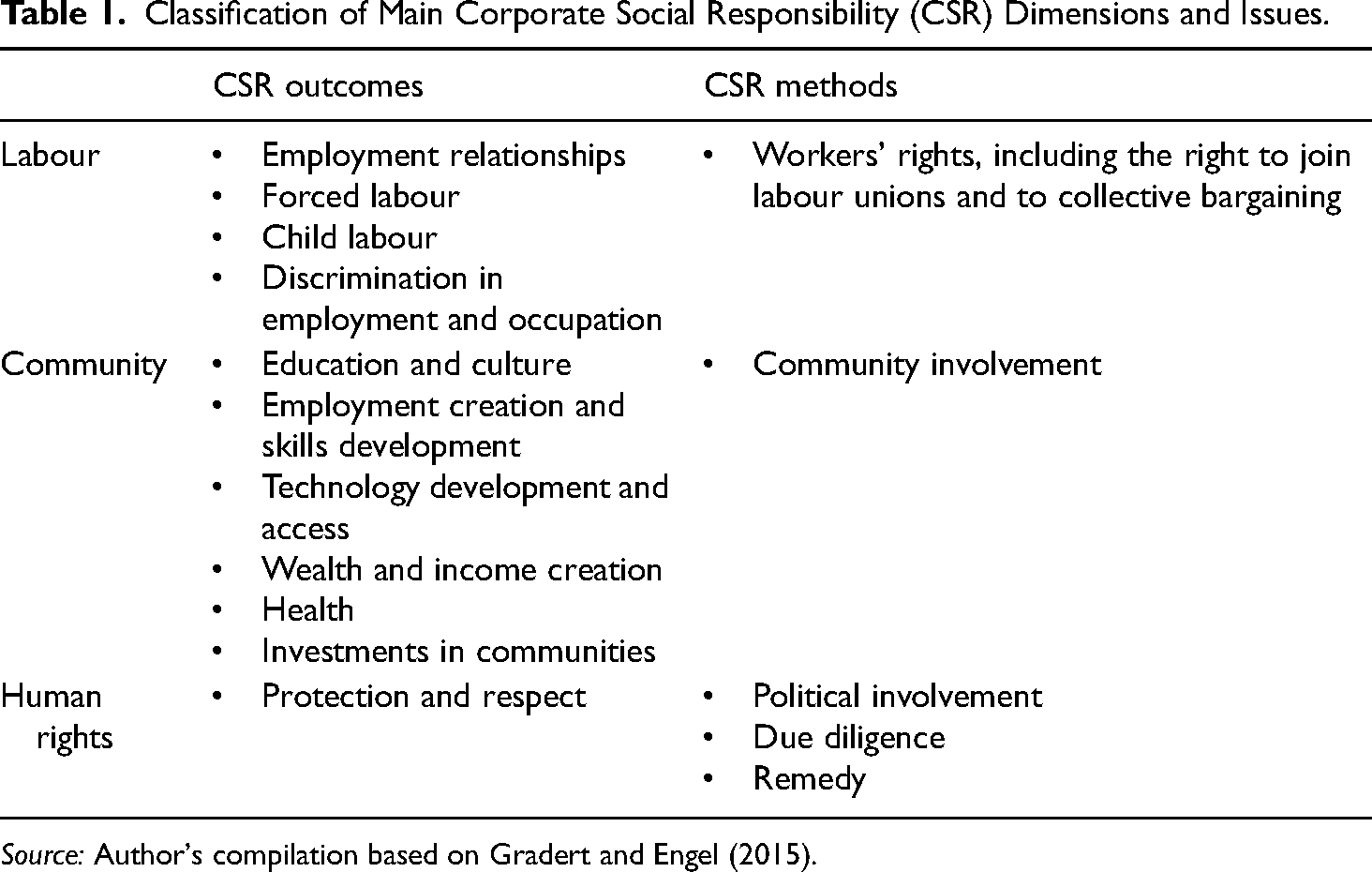
Source: Author's compilation based on Gradert and Engel (2015).
In accordance with these international CSR principles, CSR outcomes are not guaranteed by unilateral benevolent corporate decisions, but by the participation of stakeholders in the decision-making to jointly define and monitor CSR objectives. “Workers’ rights” for labour issues, “community involvement” for community development and “political involvement” for human rights, all point to the same underlying principle that is dialogue, transparency, and democracy. This marks the difference with the “old” way of reaching CSR goals as the Chilean Mining Council puts it: If in the past, companies played a very prominent role and made decisions internally for the community based on their understanding of what the community most needs or values, or based on corporate definitions of social action focuses at a national or international level, there is a transition towards associative work, more horizontal, in which companies seek to work with other actors in the territory – authorities, local organizations, other companies – in the pursuit of jointly defined objectives. […] Today, there is increasing emphasis on dialogue and the building of trust, which is characteristic of a relational approach. Transparency has become imperative for building trust. (Chilean Ministry of Energy, 2014: 62–64)
In the context of China's authoritarian regime, there is a noticeable disparity between domestic and international norms in terms of this core “democratic” principle. The Chinese government places a higher value on control rather than liberty and freedom, which contributes to a lower alignment with underlying normative values of international standards.
China has made significant progress in labour rights and labour relations in recent decades, recognising their importance for social harmony (Lin et al., 2016; Zhong and Qian, 2014). However, the scope of labour-related CSR in China is currently focused primarily on formal employee welfare, workplace safety, and employment equality. It does not encompass civil and political rights, such as freedom of association. This narrower focus reflects the limited emphasis placed on certain aspects of labour rights that are recognised as essential components of international norms.
This nuanced interpretation of labour-related CSR raises another sensitive issue concerning human rights. China does not question the whole validity of human rights, but its interpretation of human rights aligns with domestic prevailing social, political, and economic priorities. China emphasises the linkage between human rights and development, asserting a hierarchical order of human rights that prioritises economic rights over civil and political rights (Zhang and Buzan, 2020). This approach is reflected in China's national standard GB/T 36000, which is based on ISO 26000 but makes notable adjustments in the domain of “respect for human rights” (Hao, 2015). It narrows the scope of human rights discussed, primarily focusing on issues such as non-discrimination, the prohibition of child labour, and equal remuneration (Whelan and Muthuri, 2017). This limited interpretation of human rights can create confusion, as there is an apparent overlap between labour rights and human rights. Furthermore, the Chinese government's official CSR measures, such as the State-owned Assets Supervision and Administration Commission's (SASAC) Guidelines on CSR Fulfilment by Central-Level Enterprises, do not explicitly include human rights (Lin, 2010).
Regarding corporate community engagement, there is a lack of specific official guidelines at the government level. However, charitable community work by SOEs has been a significant part of the Chinese model of poverty reduction, with campaigns like “A Hundred Companies in a Thousand Villages” (百企千村, baiqi qiancun) assigning specific localities for companies to undertake charitable community work (Links et al., 2021). The engagement of SOEs in the national anti-poverty campaign reveals how CSR has been politicised to enhance the regime's internal legitimacy and how the government instead of local communities is playing the leading role in defining and guiding corporate community responsibilities.
Perceived Legitimacy of the International Regime
As a permanent member of the United Nations, China actively engages with and supports CSR norms established under the UN framework, such as the United Nations Global Compact (UNGC) and the United Nations Guiding Principles on Business and Human Rights (UNGP). In addition, whenever the development of international norms is perceived as procedurally legitimate, China demonstrates its willingness to leverage its soft power through the adept use of international discourse (Li et al., 2011).
For instance, despite initial reservations, China sent expert envoys to engage in the negotiation and drafting of the ISO 26000 standard. Collaborating with representatives from other developing countries, China successfully incorporated its core interest claims into the ISO 26000 standard. The resulting ISO 26000 is the most inclusive and flexible standard issued by the International Organization for Standardization, as it is non-mandatory and non-certifiable in nature. However, China's general endorsement of ISO 26000 in 2010 did not automatically translate into a qualitative increase in China's commitment. The dissemination and promotion of ISO 26000 within China have been minimal. There is a dearth of academic and news articles discussing the theoretical and practical value of ISO 26000, and there is a perception of its obsolescence in China (Li, 2019). Only around 10 per cent of CSR reports issued by Chinese companies in 2021 referenced ISO 26000 (GoldenBee, 2022).
The diffusion of the UNGP in China is another example. After China's endorsement of the UNGP in 2011, it published three versions of its National Human Rights Action Plan. The second version, covering the period between 2016 and 2020, introduced the concept of human rights due diligence to guide domestic and foreign investment decisions, which was seen as a significant step forward. However, there was no direct reference to the UNGP in this Plan (Liang, 2018), nor followed by any other national policy to promote and implement the UNGP. The latest China's National Human Rights Action Plan (2021–2025) for the first time advocates the encouragement of “Chinese businesses to abide by the UN Guiding Principles on Business and Human Rights in their foreign trade and investment” and to “strengthen human rights training in Chinese enterprises operating overseas” (State Council, 2021). However, government departments have not yet taken more active actions to use the UNGP to guide business practices, causing low awareness and limited adoption of the UNGP among Chinese companies. By 2021, only eight Chinese companies have made corporate human rights policy, representing around 6 per cent of 143 Chinese companies listed in Fortune Global 500, which is in stark contrast to the situation among non-Chinese companies where 70 per cent have declared the respect for international human rights norms in their human rights policies (Liang and Fu, 2022).
The diffusion of the UNGC, the earliest comprehensive international CSR norm endorsed by China, has been relatively successful. As early as 2001, the China Enterprise Confederation (CEC), sponsored by SASAC, began introducing the UNGC to its members. In 2004, the CEC established an office dedicated to promoting the UNGC (Ip, 2009). In 2009, a local network was formed, and it was restructured with a more organised management system in 2011. The UNGC China network, a group of participants who voluntarily come together to advance the Global Compact and its Principles at the local level, allows the Chinese government to enhance its cooperation with UN institutions in specific uncontroversial areas, such as the annual “Caring for Climate” summit, which focuses on practical solutions for companies related to environmental concerns. Recent collaborations include a partnership between the UNGC and the Yicai Media Group to launch two accelerator programs in China: the Climate Ambition Accelerator and the Target Gender Equality Accelerator, which are expected to build on China's progress in environmental protection and labour equality (Dou, 2022).
China's positive attitude towards the UNGC can be attributed to the pragmatic and demand-driven approach that the UNGC has adopted to engage with the Chinese government. For example, the UNGC China Strategy aims to “mobilize Chinese companies’ collective action and impact in supporting China's development priorities reflected in China's 14th Five-Year Plan (2021–2025)” (UNGC, 2022). This approach aligns with China's interests and makes it more willing to incorporate the UNGC as the overarching CSR principle in the BRI. In 2019, the Joint Communique of the Leaders’ Roundtable of the Second Belt and Road Forum for International Cooperation explicitly called upon the UNGC as the primary international reference for all market players in BRI cooperation to fulfil their CSR (FMPRC, 2019). The role of the UNGC in promoting the sustainability of the BRI was reaffirmed in 2020 during the High-Level Video Conference on Belt and Road International Cooperation (FMPRC, 2020).
However, it is important to note that the UNGC, being principle-based, does not outline specific human rights obligations. Therefore, neither the UNGC China Strategy nor the BRI flagship document emphasises or specifies human rights. Since the UNGC is a voluntary non-binding norm that promotes broad principles rather than a code of conduct against which compliance can be measured (Rasche, 2022), the mere mention of the UNGC in the BRI is not sufficient to make the BRI socially responsible or ensure the protection of human rights. Whether the BRI will substantially contribute to respecting and protecting human rights, as enshrined in the UNGC, depends on the complementary plans, initiatives, measures, and instruments that hold involved Chinese companies accountable not only to domestic but also to external social stakeholders.
Relevance to China's Global Position
The management of corporate societal commitment under the BRI is a salient case of the dilemma that China has to overcome in its pursuit of international reputation when the domestic–international normative fit is relatively low. Despite China's efforts to mitigate universal enforcement of human rights and justify its internal social control, its interference with civil and political rights has adversely affected its international image, rendering it susceptible to criticism from established democracies. Furthermore, while China may categorise its internal social control as an “internal affair,” it encounters difficulties in exporting or imposing its conception of human rights and state–society relations on all 152 BRI partners, of which sixty-seven are full democracy or democratic regimes according to Polity VI score for 2018.
This dilemma necessitates innovative solutions, including the establishment of distinct norms for domestic and international contexts. At the international level, China's position on the development of an internationally legally binding instrument concerning transnational corporations (TNCs) and other business enterprises with respect to human rights illustrates a rationalist approach. During the inaugural open-ended intergovernmental working group meeting in 2015, while the Chinese government representative supported the notion of “enhancing respect and protection of human rights by businesses in general and TNCs in particular,” they strongly objected to the European Union's proposal to expand the working group's mandate to encompass all business enterprises, even those lacking global outreach (Liang, 2018).
On the national level, the Chinese government favours a dual-track CSR normative framework, as discussed in Section “China’s Stances on International CSR Norms Under the BRI.” This framework implicitly erects a “firewall” that curbs the potential repercussions of corporate overseas social practices that are expected to adhere to higher social standards. China's approach to distinguishing overseas corporate societal responsibility from domestic one yields paradoxical outcomes. On the one hand, it results in a lack of systematic collective efforts to deepen or disseminate existing international regimes through policy coordination among BRI partners. On the other hand, it creates a unique space for policy experimentation, where more advanced measures and instruments may be employed to encourage Chinese companies to uphold higher social standards abroad, thus improving the nation's image without compromising domestic political stability.
Consequently, it is not surprising to observe that Beijing's endeavours to instil social responsibility in its BRI projects remain largely elusive at the institutional level. Main initiatives include three Memoranda of Understanding signed with the International Labour Organization in 2019 (ILO, 2019), the ratification of two additional International Labor Organisation Fundamental Conventions, covering forced labour in 2022 (ILO, 2022), and the announcement of the Beijing Initiative for the Clean Silk Road to combat corruption during the Second Belt and Road Forum in 2019 (Xinhua, 2019b).
In the meantime, industrial associations have taken additional steps to enhance corporate awareness of their overseas social responsibility in specific sectors. In 2016, the China Federation of Industrial Economics introduced the First Chinese-Invested Company Social Responsibility Roadmap for the BRI, outlining three mechanisms, five principles, and four actions to promote sustainable development in the region. Between 2012 and 2018, the China International Contractors Association and the China Chamber of Commerce for Minerals, Metals & Chemicals Importers & Exporters (CCCMC) issued industry-specific CSR guidelines, aiming to align with international standards and practices. As of early 2020, more than twenty Chinese industrial organisations had developed voluntary sustainability standards, further reflecting the leading role that quasi-governmental bodies play in guiding corporate overseas social responsibility (Zhang, 2021).
Nonetheless, the extent of political support for certain industry associations is contingent upon the exposure level of their affiliated companies to external pressures and the strategic importance of their activities. A notable example illustrating this dynamic is the formulation of Chinese Due Diligence Guidelines for Responsible Mineral Supply Chains. Since the inception of the BRI, China has witnessed an exponential surge in overseas investments in extractive industries, which accounted for 24 per cent of China's ODI stocks in Africa by 2022 (MOFCOM, 2023). This substantial international presence has transformed the management of Chinese mineral companies’ supply chains into a transnational issue, raising concerns about their potential adverse environmental and social impacts. Moreover, the dominance of Chinese companies in processing critical mineral resources carries significant geopolitical implications. Both the United States and the European Union, in the name of national security, have adopted “de-risking” measures to reduce their reliance on China for critical mineral resources. These measures include promoting sustainable mining practices that advance social, environmental, and labour standards, potentially excluding Chinese suppliers from the global supply chain if they fail to comply (Vivoda and Matthews, 2023).
In response, business and government interests align to advance specific regulations to counter critics framed in international discourses and provide Chinese mineral companies with a justifiable norm to follow. Supported by the Ministry of Commerce, the CCCMC collaborated closely with several transnational institutions, including the OECD, to absorb international standards and best practices including those not openly endorsed or ratified by the Chinese government, such as the OECD Due Diligence Guidance for Responsible Supply Chains of Minerals from Conflict-Affected and High-Risk Areas (Buhmann, 2017). The resulting 2015 Chinese Due Diligence Guidelines for Responsible Mineral Supply Chains differ from other Chinese CSR documents in several significant ways. They incorporate external intelligence from international agencies and non-governmental organisations during the consultation process, are explicitly crafted based on international standards and best practices, and provide management advice to promote implementation (Chen, 2023).
In November 2016, CCCMC took another step by initiating the Responsible Cobalt Initiative (RCI), described by Park (2023) as a prime example of the universalisation of a subsidiary norm. This initiative applies not only to Chinese companies but to all participants in the global supply chain. To gain recognition from downstream companies, the RCI expanded the “5-Step framework” of the 2015 CCCMC guidelines, introducing “community participation” as an additional clause. This expansion aligns with the underlying principle guiding corporate societal responsibility. The RCI represents a relatively low-risk and efficient approach to enhance the legitimacy of BRI-related overseas investment projects for two reasons. First, it addresses the governance of a specific import-dependent supply chain of key mineral resources for green transition of the world economy, which does not challenge or overhaul China's nuanced stance on human rights concerning overall BRI projects or domestic extractive activities. Second, given China's concentration of approximately 95 per cent of the world's announced cobalt refining capacity (IEA, 2023), the RCI empowers Chinese companies to maintain their dominant position in the global supply chain by adhering to normative standards.
However, the advancements witnessed in CCCMC's guidelines must be relativised. As emphasised by Park (2023), the global standards adopted by CCCMC to develop its guidelines primarily consist of “thin” transparency rules, lacking specific implementation and compliance regulations. Corporate social engagement abroad remains heavily dependent on the capabilities and experiences of in-place managers, leading to ad-hoc and inconsistent responses (Tan-Mullins et al., 2017). This underscores the limited effectiveness of the dual-track CSR framework in enhancing the social performance of Chinese corporations abroad, particularly when separate and “higher” standards for regulating corporate overseas social practices continue to be compromised in practice by “lower” or “narrower” domestic interpretations of human rights in a business context.
For example, Whelan and Muthuri (2017) found that transnational pressures to uphold all human rights are often outweighed by pressures that prioritise specific human rights within the national and intra-organisational environment of Chinese global SOEs. Moreover, the development of relevant social norms under the BRI, including the advanced RCI, is predominantly an elite process, lacking adequate participation from local communities and civil society. This elite interpretation of human rights often diverges from the local perspectives on the ground, consistently challenging the social legitimacy of BRI projects (Merino, 2022). In this context, rather ironically, the BRI reinforces the hegemony of the ruling elite instead of advancing the international regime towards strengthening the group postcolonial scholars refer to as the “Other” or “people who lie outside the influential inner circle of power” (Munshi, 2005).
In summary, different from the state-orchestrated environmental initiatives under the BRI, the incorporation of corporate societal responsibility within the BRI has been spearheaded by less coordinated efforts by industrial associations. This strategic move underscores the Chinese government's pragmatic and rationalist response to address both external and internal legitimacy crises when the domestic–international normative fit is low. By identifying well-defined social issues in critical sectors that directly impact China's global standing, a unique space for policy experimentation has been carved out, where specific industrial organisations enjoy the freedom to explore international CSR ideals and terminology through horizontal connections with international institutions and non-governmental organisations without jeopardising China's conventional stance on politically sensitive CSR issues in a more general sense.
Conclusion
China has emerged as a dominant player in the global economy, being the largest exporter of merchandise, the second largest investor in terms of outward foreign investment stocks and hosting the largest number of companies on the TOP 250 international contractors list. This success is attributed to the rapid internationalisation of Chinese corporations. However, this expansion comes with the challenge of navigating “institutional duality” while conducting business. As Chinese multinationals operate on a global scale, they face increased exposure to the expectations and pressures of multiple external stakeholders. In this context, CSR has become a transnational issue for these companies, influencing China's public diplomacy and impacting its international image. The way China's decision-makers, as influential stakeholders with legislative power, approach CSR regulation offers valuable insights into how they navigate challenges stemming from China's deep integration into the global economic and political landscape.
Our analysis indicates that China's approach to overseas CSR can be characterised as rational and pragmatic. Rather than fully integrating overseas CSR into the existing domestic regulatory framework, the Chinese government emphasises adherence to domestic CSR norms within China while encouraging companies to comply with local laws, respect diverse social norms, and adopt international best practices when operating abroad. We argue that this dual-track CSR normative framework represents a compromise when domestic and international normative values do not perfectly align, serving two strategic goals: maintaining domestic legitimacy and establishing international legitimacy for the regime. The parallel overseas CSR system, though outlining fundamental principles, lacks credible management measures and enforcement mechanisms. This reflects China's reform tradition, which typically begins with a general orientation at high levels without a pre-established roadmap, followed by policy experimentation at low levels to identify the most effective measures and solutions based on specific circumstances. Therefore, it is expected to observe significant policy variations across different CSR issues within the same reform space, which are shaped by issue-specific domestic–international normative fit, the perceived legitimacy of the international regime, and the relevance to the global power hierarchy.
Table 2 summarises how these three variables interact to influence specific steps that the Chinese government has taken to govern corporate overseas environmental responsibility and societal responsibility. Domestic–international normative fit is the most important variable to predict whether China has the motivation to promote the circulation of international normative values around the world. Its concern about a certain CSR issue on its position in the global power system further enhances or moderates the motivation, while China's perception of the legitimacy of the extant international regime would indicate the role of the BRI as a complementary or alternative normative framework.
Comparison of Three Variables Across Two Main CSR Issues.
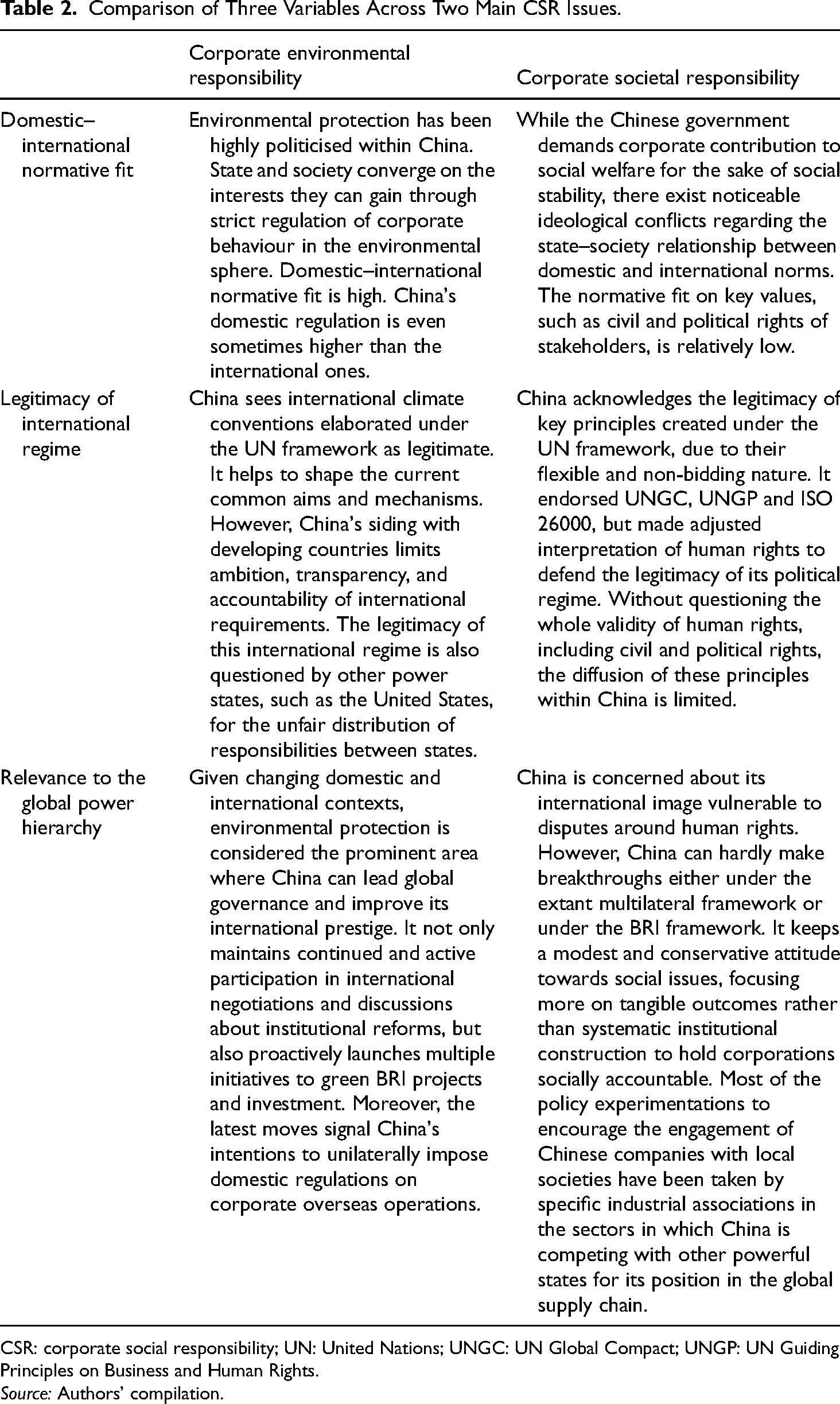
CSR: corporate social responsibility; UN: United Nations; UNGC: UN Global Compact; UNGP: UN Guiding Principles on Business and Human Rights.
Source: Authors’ compilation.
These variables collectively contribute to China's proactive approach to promoting environmental responsibility among Chinese companies both domestically and internationally. Within this context, the BRI network complements the existing international regime, which may not enjoy universal substantive legitimacy. However, when it comes to corporate societal responsibility, these variables are not mutually enhancing. As a result, China's decision-makers must carefully weigh the material and ideational benefits and costs associated with various options, giving rise to a more nuanced and compromised rationalist behaviour pattern.
In summary, the framework of a dual-track CSR normative system catalyses divergent governmental actions at the sub-level, characterised by proactive, cooperative, and systematic efforts in the environmental sector contrasted with a passive, reactive, and ad-hoc approach in the social domain. This contrast challenges the simplistic dichotomous perspective between compliance and non-compliance in assessing China's engagement with international norms. Instead, it may be more insightful to conceptualise China's interactions with these norms within a zone of ambiguity, where normative compliance is more aptly depicted along a spectrum, as articulated by Lin and Esteban (2023). This nuanced perspective underscores the necessity for international stakeholders to adopt a differentiated approach when engaging with China, recognising the varied effectiveness by imposing existing international norms on China across different issue areas. High-level governmental dialogues and cooperation may hold promise in fostering China's proactive participation in global environmental governance. Conversely, engagements at the sub-governmental level, including non-governmental and quasi-governmental exchanges, may prove more practical and efficacious in encouraging corporate societal responsibility among Chinese enterprises within the international arena.
In conducting this study, our primary focus has been on delineating the status quo and underlying motivations of China's evolving stance towards international CSR norms in the BRI era, rather than exploring the direct effectiveness of such policy shifts on corporate conduct. While understanding the Chinese government's policies and behaviours is crucial, the translation of political will into actionable corporate practices remains underexplored and warrants further investigation. Such research is essential to fully comprehend the tangible impacts of China's ascendance on global sustainable development.
Footnotes
Declaration of Conflicting Interests
The author declared no potential conflicts of interest with respect to the research, authorship, and/or publication of this article.
Funding
The author disclosed receipt of the following financial support for the research, authorship, and/or publication of this article: This research is a result of the project “China Horizons: Dealing with a Resurgent China” (DWARC) (grant no. 101061700) funded under the European Union’s Horizon Europe research and innovation programme. Views and opinions expressed are however those of the author's and do not necessarily reflect those of the European Union. Neither the European Union nor the granting authority can be held responsible for them.
