



Abstract
In this article, we explore why the Myanmar-based insurgency organisation known as the United League of Arakan (ULA) supports the Kyaukphyu Special Economic Zone (KSEZ): a controversial Belt and Road Initiative (BRI) project. We argue that the ULA's support for the KSEZ is rooted in a biopolitics that benefits the ULA by attractively showcasing its insurgent aims and by effectively boosting its local authority. The ULA's pro-KSEZ policy partially explains why the KSEZ, unlike other BRI projects in junta-led Myanmar, has enjoyed moderate success. Despite its biopolitical benefits, the ULA's pro-KSEZ policy has marginalised certain anti-KSEZ actors in the rebel organisation's sphere of control. The resulting fragmentation may both destabilise the ULA's hard-fought social order and undermine the prospects of the KSEZ. Our examination of the ULA–KSEZ relationship empirically contributes to BRI-in-Myanmar research, which has heretofore paid little attention to rebel-controlled societies’ significant influence on foreign-led domestic development projects.
Keywords
Introduction
The Kyaukphyu Special Economic Zone (KSEZ) is a Belt and Road Initiative (BRI) project initiated by China in Myanmar. In December 2009, the Myanmar military junta and the Chinese government signed a memorandum of understanding (MoU) affirming their commitment to the KSEZ. Two years later, in December 2011, the semi-civilian Thein Sein government created the KSEZ Management Committee. While conducting the KSEZ tender process, the committee claimed to be adhering to international standards. On December 30, 2015, the Myanmar government announced that the giant Chinese state-owned enterprise China International Trust and Investment Corporation (CITIC) 1 had won the international tender to develop both a deep-sea port and an industrial zone. CITIC claimed that “the port and the industrial park combined will create more than 100,000 jobs each year for local residents and create tax revenues of 15 billion dollars during the initial franchise period of 50 years” (Xinhuanet, 2020). Given that Myanmar is a developing nation, its central government regarded the KSEZ and its economic benefits as a coup.
However, the KSEZ is highly controversial. Covering 4000 acres, the KSEZ is located in Kyaukphyu Township, which itself is located in Rakhine State (formerly known as Arakan Region), Myanmar's westernmost administrative region, facing the Bay of Bengal (BRI Monitor, 2021). The original costs of the deep-sea port and the industrial zone were estimated to be US$7.3 billion and US$2.7 billion respectively, giving rise to fears that such costly infrastructure could cause Myanmar to fall into a Chinese debt trap (Calabrese and Cao, 2021). Moreover, the KSEZ has already resulted in environmental degradation and social unrest, with some local villagers calling for the project's suspension (Radio Free Asia, 2018). By contrast, from China's perspective, the KSEZ project along with two additional BRI projects—the 1000-kilometer Kyaukphyu–Kunming Railway and the 771-kilometer Kyaukphyu–Kunming gas and oil pipelines 2 —could help ensure China's energy and economic security by reducing the country's heavy reliance on the Strait of Malacca for critical imports of oil, liquefied natural gas, and sundry other goods. After taking strategically sufficient control of the deep-sea ports in Myanmar, Bangladesh, Sri Lanka, the Maldives, and Pakistan, China could achieve a “string of pearls” scenario “to secure its own trade and energy supplies along the sea lanes dominated by the US navy” (Malik, 2018: 371). This scenario would place Myanmar in a position subservient to China and would thus erode Myanmar's national sovereignty (Malik, 2018).
Central to the controversies swirling around the KSEZ is the powerful insurgency organisation known as the United League of Arakan (ULA). Based in Rakhine State, the ULA—along with its military wing, the Arakan Army (AA)—declared its support for the KSEZ (Eleven, 2019) and indeed vowed to protect the project (Radio Free Asia, 2023). Why? We argue that the ULA's support for the KSEZ is rooted in two central goals: the KSEZ can attractively showcase the ULA's insurgent cause and can effectively strengthen the ULA's authority in Kyaukphyu Township, where traditionally the rebel group has struggled to exercise control. The ULA's pro-KSEZ policy partially explains why the KSEZ, unlike other BRI projects in Myanmar, has enjoyed moderate progress since February 2021, when a destabilising coup led by the Myanmar military deposed the country's elected government. Despite its benefits, the ULA's pro-KSEZ policy has marginalised some local anti-KSEZ actors, an outcome that may both destabilise social order in the areas under ULA control and undermine the prospects of the KSEZ itself.
BRI-in-Myanmar research emerged in 2020 and, since then, has tended to focus on the Myanmar state's national and sub-national levels of social control (Calabrese and Cao, 2021; Chan and Pun, 2020; Jones and Khin Ma Ma Myo, 2021; Kobayashi and King, 2022; Mark et al., 2020; Mostafanezhad et al., 2023; Soong and Kyaw Htet Aung, 2021). Almost entirely absent from the research are discussions about non-state armed insurgent groups, which have played an essential role in Myanmar's transnational development projects (Kiik, 2016). Although some studies have touched upon rebel groups and their importance (e.g., Mark et al., 2020; Mostafanezhad et al., 2023), the studies have shed little light on the relationship between these rebel groups and the BRI. For example, the research in this field has left unanswered the important question of how the leadership of rebel groups in Myanmar have viewed and responded to BRI projects. By exploring, in the present study, the relationship between the ULA and the KSEZ, we elucidate previously unexplored aspects of the BRI in Myanmar and further our understanding of the linkage between the country's rebel-held regions and its transnational development projects.
For this study, we have drawn on David Brenner's conception of biopolitics in rebel governance (2015, 2017a, 2017b, 2018 Brenner and Tazzioli, 2022). Responding to previous research on the reciprocal interactions between rebel rulers and their grassroots supporters (Mampilli, 2011; Wickham-Crowley, 1987), Brenner took two important steps. First, he conceptualised rebel governance as “competing biopolitics” in which rebel rulers mould a “[rebel] population into imagined communities in direct opposition to the existing nation state” (Brenner and Tazzioli, 2022: 1). According to Brenner, this reformulation of a rebel population helps legitimate the rebel leaders’ authority over the population. We propose that this conceptualisation of rebel rulers’ state-making biopower helps explain why the ULA has adopted a pro-KSEZ policy. Second, in identifying the biopolitical dynamics of rebel societies in Myanmar, Brenner argued that the ways in which grassroots rebel supporters and low-ranking rebel soldiers respond to their rebel leadership, particularly with respect to economic matters, can reshape the rebel movement (2015; 2017a; 2017b; 2018). This second point led us to examine how, in villages affected by the KSEZ, local residents responded to the ULA's pro-KSEZ policy. We sought to determine what, if any, effect these responses might have on the future of the KSEZ.
For the present study, we collected primary data in three stages. First, from March 2022 to October 2023, the first and second authors conducted several online interviews: using a focus-group method, the two authors interviewed a group of three KSEZ-affected villagers (from three villages) and a group of two environmental activists; by contrast, the two authors used a semi-standardised interview method to individually interview five local civil society organisation (CSO) members, one high-ranking official in the ULA, and one local analyst specialising in the ULA. The local analyst and two local CSO members were interviewed twice. Each interview lasted approximately one to two hours. With permission from the interviewees, the two authors video-recorded and then transcribed all the interviews before promptly deleting the recordings. These interviews were conducted in English or in Burmese according to the preference of the interviewees.
In the second phase of the primary-data collection, the third author conducted fieldwork in Kyaukphyu, Pauktaw, and Sittwe Townships from October 2 to 15, 2023. Four villagers (from four villages), one CSO member, and one youth activist participated in the fieldwork's one-on-one interviews, each of which was conducted in the Arakanese language and then transcribed into English. Voice-recordings were made when interviewees consented to the practice; in all other cases, the note-taking method was used. In the third phase, a hired local research assistant conducted fieldwork interviews with seventeen KSEZ-affected villagers (from five villages) in Kyaukphyu Township between June 4 and July 28, 2023. The one-on-one interviews lasted between thirty and forty minutes each. All interviewees consented to having the interviews audio-recorded with a smartphone. The interviews were conducted in the Arakanese language. The research assistant transcribed these interviews, and then the second author translated the transcriptions into English. To protect the privacy of all interviewees, we disclose no readily identifying information about them. Hence, we use pseudonyms throughout this paper.
A set of criteria guided our selection of interviewees. In selecting CSOs and environmentalists, we prioritized those who had experience with the KSEZ in at least one of three areas: environmental protection, livelihood, and land-grabbing. A single criterion guided our selection of villagers for this study: they needed to have been significantly affected by both the KSEZ and the Kyaukphyu–Kunming gas and oil pipelines. Of the 24 villagers who agreed to participate in our study, 13 were farmers, 6 were fishermen, 3 were business persons, 1 was an NGO assistant, and 1 was a cleaner. We used our personal networks to find a high-ranking ULA official and a local analyst, both of whom agreed to participate in our interviews and both of whom were more than sufficiently familiar with the history and governance practices of the ULA.
Throughout the primary-data collection process, we (i.e., the authors and the hired research assistant) held pre-fieldwork meetings to optimise the data collection and to minimise any possible security risk to the interviewees. We also held post-fieldwork meetings to examine the credibility of the data and reduce the possibility that we might misinterpret the data.
This article, outside the introduction and conclusion, consists of four sections. In the first section, we outline the existing research on the BRI in Myanmar and we point out the important gap in the research regarding armed non-state groups in positions of power. In the second section, we discuss the topic of rebel governance and Brenner's conceptual contributions to it. In the third section, we discuss the ULA: its origins, its governance structures, and its biopower practices. In the fourth section, we analyse how, by supporting the KSEZ, the ULA has sought to strengthen itself, and we explain how, by marginalising local anti-KSEZ actors, this pro-KSEZ policy may destabilise social order in the areas under ULA control and undermine the prospects of the KSEZ itself.
The BRI-in-Myanmar Research: What is Missing?
BRI-in-Myanmar research first emerged in 2020. Since then, two themes have proven to be especially popular in this body of literature. The first theme concerns how BRI projects were handled by the National League for Democracy (NLD), which was Myanmar's democratically elected government from 2015 until 2021, when it was deposed from power in a military coup. Most of the pioneers in this vein of research have been political scientists or economists and have shown that the NLD government exercised considerable agency when dealing with China and its BRI projects. Calabrese and Cao (2021) show that the NLD government negotiated with Chinese investors to downsize some projects. For example, the NLD government not only reduced from 10 to 2 the number of berths available for the zone's Kyaukphyu sea port but also slashed from US$7.3 billion to $1.3 billion the funding for the projects (Calabrese and Cao, 2021: 7–8). In addition, Soong and Kyaw Htet Aung (2021) and Kobayashi and King (2022) argue that the NLD government adopted a hedging strategy: a plan by which a state tries to maximise its profits and minimise its costs by following “a middle way between the two poles of bandwagoning and balancing” (Kobayashi and King, 2022: 1014). The NLD government manifested its agency by diversifying its economic partners and expanding its diplomatic relations (Kobayashi and King, 2022; Soong and Kyaw Htet Aung, 2021).
The second major theme of BRI-in-Myanmar research concerns local Myanmar populations’ responses to domestic BRI projects. Most of the scholars pursuing this line of inquiry have been anthropologists, sociologists, or geographers. Mark et al. (2020) show that the BRI projects in Myanmar have greatly benefited Myanmar-based companies, which tend to be run by ethnic-Chinese Myanmar citizens who have close relations with the Chinese government as well as with Myanmar's political elites. Mark et al. (2020: 390) note a particularly interesting factor undermining the implementation of BRI projects: their decision-making processes exclude marginalised ethnic groups that have taken up arms against the Myanmar government. Chan and Pun (2020) show that the Letpadaung Copper Mine, which is located in the Sagaing Division's Salingyi Township, triggered local resistance powerful enough to compel the Myanmar government and Chinese investors to renegotiate the project. Mostafanezhad et al. (2023) explore how the Myanmar people have responded with considerable unease and even fear to the somewhat predictable nature of BRI projects: they have been fraught with opacity, have created the impression of Chinese dominance over Myanmar, and—to varying degrees—have harmed local environments and communities (2023: 136–142). Interestingly, the previously mentioned study notes that Myanmar's Bamar and Kachin ethnic groups have responded negatively to BRI projects for reasons unique to the groups’ respective histories. For example, many members of the Bamar community expressed the belief that the Chinese state had destabilised Myanmar's sovereignty by supporting the Kachin Independence Organisation (KIO), which is an ethnic armed organisation operating in parts of northern Myanmar bordering China. Similarly, members of the Kachin community stated that their political autonomy was being hindered by BRI projects and by the Chinese and Myanmar governmental actors promoting these projects (2023: 142).
Because the existing literature on the BRI in Myanmar has come from scholars with diverse disciplinary backgrounds, it has taken on a distinctly multi-disciplinary hue. Thus, the research covers various actors: the Myanmar state, local CSOs, BRI-affected villagers, ethnic groups, and business interests. Equally important is the fact that this multidisciplinary research extends across sub-national, as well as national levels.
The extant research, however, has focused overwhelmingly on the Myanmar state and its social controls. The prevalence of this analytical paradigm should not come as a surprise, as talk about debt-trap diplomacy and China's “grand strategy” spread quickly on the internet and other media beginning around 2017 (Brautigam, 2020). All of the extant BRI-in-Myanmar research has explored, in one way or another, the responses of the Myanmar government to China's strategic ambitions and economic tactics (e.g., Calabrese and Cao, 2021; Chan and Pun, 2020; Jones and Khin Ma Ma Myo, 2021; Kobayashi and King, 2022; Mark et al., 2020; Mostafanezhad et al., 2023; Soong and Kyaw Htet Aung, 2021). Consequently, the existing BRI-in-Myanmar research necessarily limits our understanding of the issue to the Myanmar state and its control of Myanmar society.
A notable Myanmar actor neglected in the research is the non-state armed rebel group. The country has experienced more than seven decades of ethnic conflict, and during that time, many ethnic armed organisations have engaged in state-making efforts by creating state-like institutions (Harrisson and Kyed, 2019; Lall and South, 2014; Lintner, 2021; South, 2008). Ashley South (2018) argues that, in Myanmar, non-state authorities, as well as state authorities, overlap each other. We also know that rebel societies have played a critical role in transnational development projects. For example, Laur Kiik (2016) shows that the Chinese state-owned enterprise China Power Investment adopted a tactic of “anti-ethno-politics,” marginalising ethno-political actors, including the KIO, local CSOs, and villagers, to create the US$3.6 billion Myitsone Dam in Kachin State. These marginalised actors re-ethno-politicised the dam and argued that it could destroy the Irrawaddy River, which has nurtured Kachin culture and personal identity. The strategy of re-ethno-politicisation gained support from both ethnic Kachin and Bamar groups, which pushed the Thein Sein government to suspend the dam in September 2011. This sequence of events proves that a rebel society can profoundly influence the progress of a transnational development project.
Mark et al. (2020) and Mostafanezhad et al. (2023) touch upon ethnic armed organisations, with the former study acknowledging the importance of rebel groups in Myanmar, and the latter study exploring Kachin rebel society's response to the BRI. Understandably, the narrow focus of these articles prevents them from casting a broad, illuminating light on the many varied roles that Myanmar's rebel groups play in domestic BRI projects. With the present study, we have set out to help fill this gap. If we want to understand why the ULA has supported the creation of the KSEZ, we must first understand how the ULA, as a rebel society, stands to benefit from the KSEZ.
Analytical Framework
We based our analytical framework on a conception of rebel society that treats rebel rulers and their grassroots supporters as stakeholders who tend to engage in reciprocal interactions (Mampilli, 2011; Wickham-Crowley, 1987). Because “power without legitimacy is unstable and ultimately impotent,” rebel rulers do not rely solely on coercion (Brenner, 2015: 346): they also rely on grassroots support. In exchange for it, rebel rulers provide their current and prospective grassroots supporters with various “public goods,” most of which are security and social services, including education, public health, and a legal system (Furlan, 2023; Harrisson and Kyed, 2019; Lall and South, 2014; Lintner, 2021). In many cases, the public goods that a non-state service-delivery regime bestows on local communities are goods usually denied by the official state (Brenner, 2015; 2017a). And, in exchange for these goods, the grassroots support that local communities offer the rebel regime can range from food, shelter, and taxes to intelligence and military conscription (Brenner, 2015; 2017a). Thoughtfully executed rebel governance can help rebel rulers cement the legitimacy of their authority and can create a stable insurgent social order (Brenner, 2015; 2017a).
Brenner has furthered our understanding of the social contracts between rebel rulers and local communities in two ways. First, with Martina Tazzioli, Brenner conceptualised rebel governance as competition in the realm of biopolitics (Brenner and Tazzioli, 2022). According to Michel Foucault's notion of governmentality, states use technologies and practices of biopower to optimise “people's physical and mental health as well as the general welfare of populations,” and the purpose of this biopower is “subjugation of bodies and control of population” (Brenner and Tazzioli, 2022: 4). Likewise, rulers of a rebel state can, in their own right, exercise biopower over their territory's population. For example, these rulers can establish schools and hospitals to improve the welfare of rebel-controlled populations. The rebel rulers “craft population bodies that stand in a conflicting relationship with the population body of the existing nation states” (Brenner and Tazzioli, 2022: 4). Rebel biopower thus shapes people's conduct and subjectivities in ways that generate social mores distinct from “the ones prescribed by the existent nation state” (Brenner and Tazzioli, 2022: 5). In short, biopolitics shifts the contractual relationship between rebel rulers and local communities away from mere transactionality and toward a rebel-aligned nationalism.
The second way in which Brenner has strengthened our understanding of these social contracts has been to examine their susceptibility to external economic incentives. For example, after the KIO and the Karen National Union (KNU) signed bilateral ceasefire agreements with Myanmar's military junta in 1994 and 2012, respectively, the two rebel groups enjoyed a number of subsequent economic benefits: the KIO participated in state-sponsored joint ventures extracting natural resources, including timber and jade (Brenner, 2015); and the KNU leadership received “gifts” from the military junta (Brenner, 2017a; 2017b). This transactionality, however, did not extend to the local populations governed by the rebel groups; that is, the ceasefire agreements brought about an armistice but did not address the political grievances and aspirations of the local populations. Not only did the economic benefits that enriched rebel rulers fail to trickle down to the governed communities, but also the transactional arrangements between the junta and the rebel leadership worsened such problems as environmental degradation, land grabbing, and general corruption. This “ceasefire capitalism” (Woods, 2011) demoralised rebel soldiers and created distrust between the rulers and their erstwhile grassroots supporters. Indeed, the distrust grew so pronounced that the previously stable insurgent social orders were now tottering on the verge of collapse. Young rebel soldiers in these two ethnic armed organisations challenged the rebel leadership's reconciliation policies, and infighting ensued, leading to reconfigurations of the leadership (Brenner, 2015; 2017a; 2017b). Much of this internal contestation, fragmentation, and reformation was traceable to the corrupting influence of external economic incentives. In short, external economic incentives intensify the dynamics of rebel society yet are an overlooked topic in scholars’ conception of rebel society as a site of reciprocal interactions.
Brenner's exploration of the social contracts between rebel rulers and local communities supports our main argument: by supporting the KSEZ, the ULA has strengthened its local authority but has also exposed itself to internal fissures. First, Brenner demonstrates that rebel rulers’ use of biopower is a state-making effort, and we see this phenomenon unfold in the ULA's support for the KSEZ. Second, Brenner demonstrates that external economic incentives can corrupt rebel leadership and destabilise its biopower-based state-making efforts. In the context of the present study, we thus examine whether or not the destructiveness of external economic incentives is a potential consequence of the ULA's pro-KSEZ policy.
The United League of Arakan
Origins
Before discussing the KSEZ in the context of ULA-governed rebel society, it is necessary to understand the ULA's origins and governance methods, including its exercise of biopower. The socio-political environment in which the AA operates is very much rooted in the Myanmar government's development of Rakhine State, which, since the country achieved independence in 1948, has resulted in neglectful treatment of the Arakan people. The KNU, a powerful ethnic armed organization based in Karen State, assisted in the creation of the Arakan Liberation Party/Army (ALP/A). However, the ALP/A has limited capacity to help the Arakan people because the ALP/A is located on the Thailand–Myanmar border and has not operated in Rakhine State for many years (Asia Times, 2017a). Against this backdrop, a group of 26 young Rakhine nationalist activists created the AA in April 2009.
The AA gained significant assistance from the KIO, which, in the late 2000s, was aware that its “arms and autonomy under the truce” were in peril and that its 1994 ceasefire agreement with the Tatmadaw (i.e., the Myanmar military) was near collapse. Thus, the KIO helped establish and arm “two proxies” in 2009: the AA and the Ta’ang National Liberation Army (TNLA) (International Crisis Group, 2019: 5). Unsurprisingly, the AA set up its headquarters not in Rakhine State but in Laiza, a remote mountainous KIO-controlled town in Kachin State. During this time, the AA, the TNLA, and the Kachin Independence Army (KIA) (the military arm of the KIO) jointly battled against the Tatmadaw (Mathieson, 2020: 4). In recent years, many soldiers in the AA have been Rakhine migrant labourers in the jade-mining industry that has sprung up in Hpakant, Kachin State (Asia Times, 2017b). As of early 2022, the AA was estimated to have about 30,000 soldiers in its ranks (BNI, 2022). Furthermore, it is affiliated with three prominent coalitions of ethnic armed organisations opposed to the Myanmar government: the Northern Alliance, the Three Brotherhood Alliance, and the Federal Political Negotiation and Consultative Committee.
According to David Scott Mathieson (2020: 9–11), the AA adopted three strategies to expand its territories. First, beginning in 2011, the AA engaged in guerrilla warfare, attacking police outposts, seizing important waterways and land routes, and entering and occupying nearby townships (Asia Times, 2019). Second, the AA directly engaged the Tatmadaw, besieging its “Tactical Operations Command based at Mee Wa in Paletwa Township” in February and March 2020 (Mathieson, 2020: 10). This and other confrontations between the two armed forces displaced more than 230,000 civilians between 2018 and 2020 (Radio Free Asia, 2020) (Figure 1 presents the routes of the AA's expansion). Third, the AA has systematically punished—by means of intimidation, detainment, and abduction—anyone suspected of disobeying the militant organisation's orders. These three strategies, since 2014, have enabled the AA to expand the territories under its control from the southern Chin State to about 70 percent of northern Rakhine State, including Maungdaw District, Sittwe District, Mrauk-U District, and Ann District (Figure 2 presents the ULA's governance of Rakhine State).
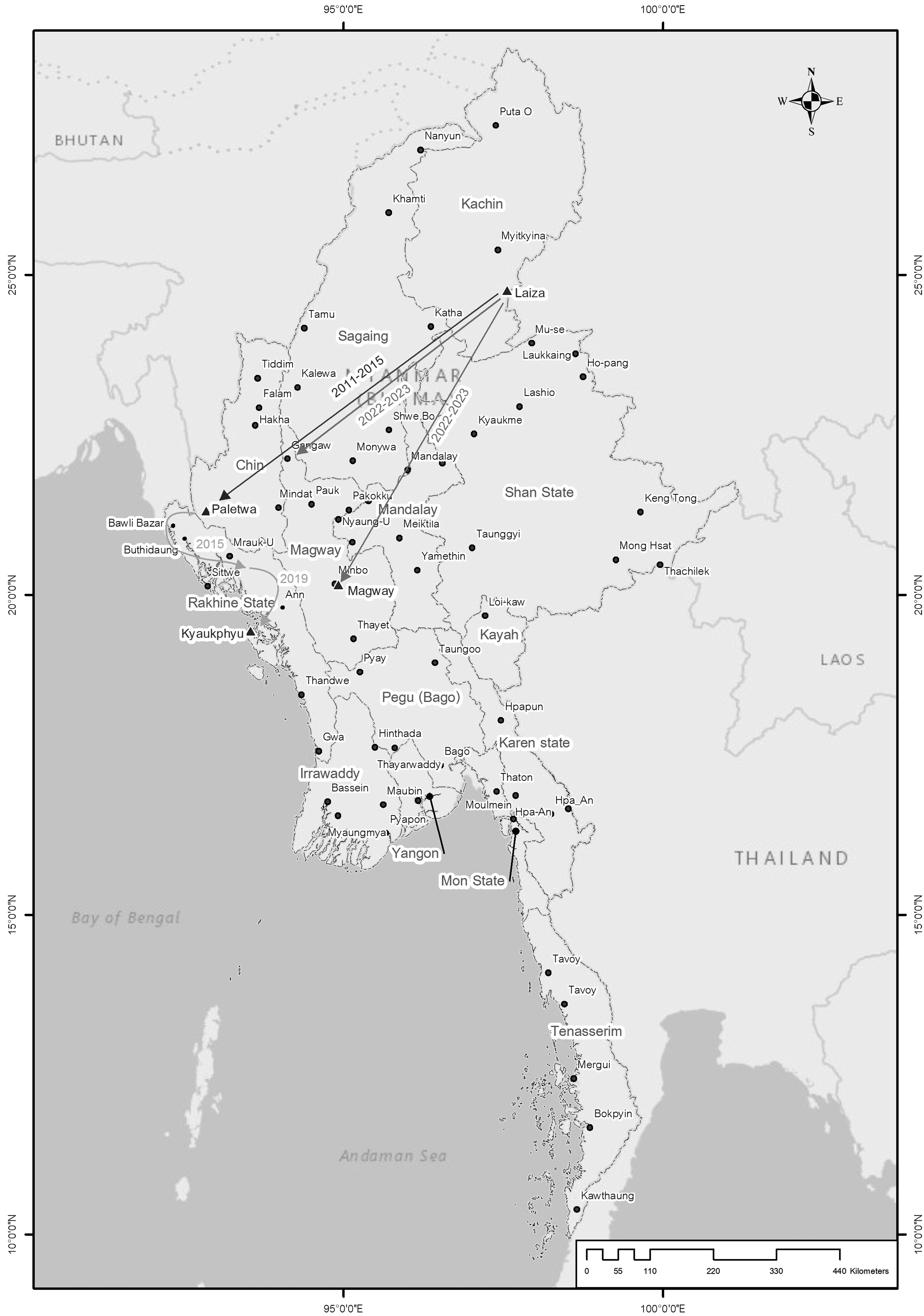
the Routes of the AA Expansion.
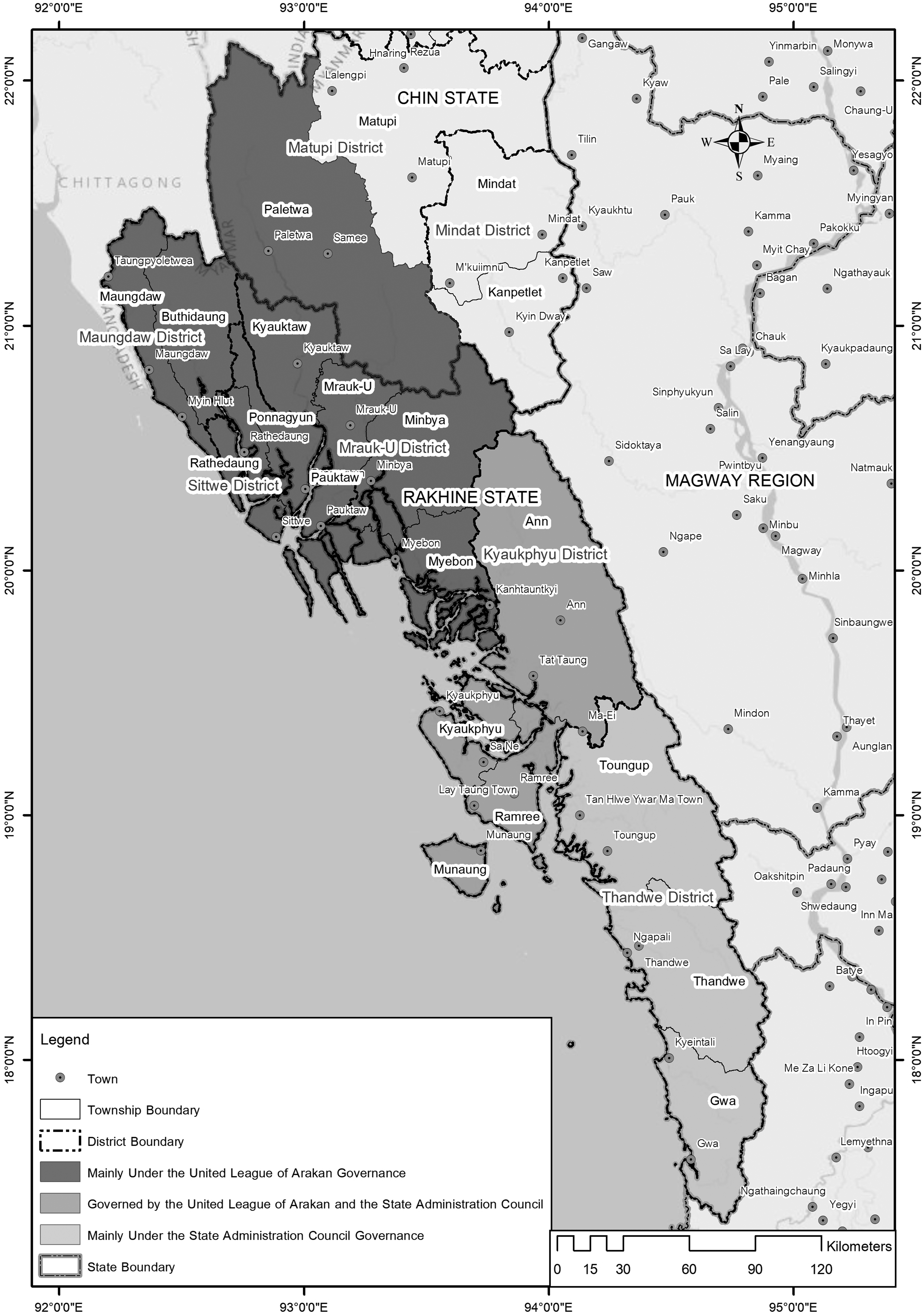
The ULA Governance of Rakhine State.
Despite its rise to prominence in northern Myanmar, the AA was absent from Myanmar's peace process that unfolded between 2011 and 2021. At the very start of the process, Myanmar's semi-civilian government was leading the country through a difficult political transition from military rule to democratic rule. Led by ex-general Thein Sein, the government initiated a multiparty peace process at the centre of which were negotiations for a nationwide ceasefire (Bünte and Dosch, 2015). In 2013, the AA tentatively joined the Nationwide Ceasefire Coordination Team, which had been created by seventeen ethnic armed organisations seeking to “negotiate with President Thein Sein's Union Peace-making Work Committee (UPWC) for the conclusion of a ceasefire agreement” (Leider, 2022: 1). However, the UPWC refused to accept the AA's bid to participate in the organisation, arguing that the militant group “was not based in the territory of its ethnic identity, Rakhine State” (Mathieson, 2020: 4). In 2015, the Thein Sein government blocked the AA and two other armed rebel groups from signing the National Ceasefire Agreement. The main reasons given for this move were that the rebel groups had consistently refused to disarm and had never signed bilateral agreements with the Myanmar government (Leider, 2022). In 2016, the recently elected NLD government held a new round of peace talks (the second Panglong Conference), and once again, the AA was excluded from the process. In 2020, the NLD government designated the AA a terrorist group for its brutal tactics and disrupted internet services throughout Rakhine State in a bid to destablise the AA (The Irrawaddy, 2019c).
Governance
In January 2016, the AA created a political apparatus, the ULA. Its structure is that of a hierarchical pyramid, at the peak of which is the Central Politburo Committee (CPC), followed by the Central Committee (CC) and then Party Committees at the regional, township, village tract, and village levels. 3 The CPC's Chairman and Vice Chairman are Twan Mrat Naing and Nyo Tun Aung. The CPC nominates candidates for CC membership, and most of these individuals are leading figures in Rakhine State's business, education, healthcare, and agricultural sectors.
The ULA's Regional Party Committees are based on military zones, each of which comprises several townships. Each Regional Party Committee consists of a regional military representative, a ULA political commissioner, administrative officers, and a chief of police. 4 The regional military representatives enjoy higher positions in the ULA than do non-military members and are charged with managing military, as well as administrative, affairs. As of 2023, Twan Mrat Naing has appointed—and been able to replace—the regional military representatives. His exercise of this authority may deter representatives from establishing corruptibly close relations with local business figures and other stakeholders. 5
As noted above, Party Committees are also present at the township, village tract, and village levels. These local committees function chiefly to gain the favour of, mobilise, and give voice to local populations. The CPC appoints the Township Party Committee members on the basis of suggestions from regional military commanders. The members in the Village Tract Committees and the Village Committees are elected. For example, heads of households in a village elect the members of their Village Committee.
In January 2018, the ULA articulated its insurgent cause in a YouTube video entitled “The Way of Rakhita.” The video starts with a short talk by Twan Mrat Naing: The Arakan Kingdom [of Mrauk-U] was very wealthy, and we are very proud about our ancestor inheritance and its history. Under the Burmese rule, we became very poor, and we lost everything that we’ve had. We have lost our rights: the rights of the indigenous people.
6
The rest of the video shows scenes of the AA engaged in military training and announces “the Arakan Dream 2020”: a resolution to protect Arakan interests and freedom and achieve political autonomy by that year. “The Way of Rakhita” is a means to “ignite an Arakan nationalist movement by drawing on sentiments associated with the historical Kingdom of Mrauk-U,” a powerful seventeenth-century kingdom that ruled present-day Rakhine State until suffering defeat at the hands of Burmese conquerors in 1785 (Broome, 2021). After the video's release, the ULA began developing its administrative system.
In December 2019, part of this system took shape: the ULA created the Arakan People's Government (APG) and tasked it with the administrative governance of ULA-controlled areas. The APG consists of six departments covering judicial matters, taxation, law enforcement, the penal system, humanitarian matters, and information. People who work for these departments must have one year of training in the ULA-established Arakan School of Public Administration and Public Policy in Rakhine State. 7 In addition, the administrative-governance levels of the APG mirror those of the ULA: regional, township, village tract, and village. Most administrative officials in the APG are members of the ULA. For example, a political commissioner at the regional level of the ULA can be an administrative official at the regional level of the APG. Thus, the boundaries between the ULA and the APG are blurred.
The period from November 2020 to November 2021 was very important for the ULA. In November 2020, the Tatmadaw and the AA reached an informal ceasefire agreement, which was followed, in March 2021, by the Myanmar government's decision to rescind its previous designation of the AA as a terrorist designation. Although fighting between the two armed forces resumed in northern Rakhine State in December 2021, the one-year truce enabled the ULA to significantly expand its administrative services, as exemplified by the ULA's establishment of the Judiciary Department in August 2021. This independent agency comprises a five-level system of courts: a chief justice, regional courts, district courts, township courts, and village-tract courts. Members of local communities, including their lawyers, can access court services at offices open to the public. 8 And litigants who are unsatisfied with a lower-level court's verdict can appeal it in a higher court. Prisons fall under the domain of the Judiciary Department and are located in areas distant from Tatmadaw forces. It is important to note that, because the APG has implemented neither civil nor criminal laws in the areas under its administrative control, the APG's judicial system rests almost squarely on the laws governing the Myanmar state. However, the APG has rejected certain laws that have remained in effect in the Myanmar state. One example is the Race and Religion Law. Enacted by the Thein Sein government in 2015, the law stipulates that “Muslim couples that wish to marry must obtain official approval” (Diplomat, 2015). The APG rejected this law on the grounds that it discriminated against the Muslim community in Myanmar. 9
Biopower
As we noted above, Brenner—following Foucault—conceives of biopolitics not merely as transactional in an instrumental sense but as transformational in a relational and identity-forming sense. We propose that, in the realm of governance, the ULA has extensively exercised its biopower, and two recent cases support our argument.
The first case concerns the third wave of COVID-19, which began in Myanmar in July 2021. The ULA issued a public statement on July 20, 2021, urging people to stay home for two weeks. According to Kyaw Hsan Hlaing, an analyst and journalist from Rakhine State, “the ULA has been punishing people for flouting the stay-at-home order, and beatings with sticks have been administered to miscreants in some of the state's northern townships” (Frontier Myanmar, 2021). On July 25, Twan Mrat Naing delivered a speech via social media to inform the public that he and his government had been attempting to acquire vaccines. Likewise, Nyo Tun Aung promised that “we will strive to provide vaccines to all people of Rakhine State regardless of race and religion” (Frontier Myanmar, 2021).
In contrast to the ULA's response to COVID-19, the Myanmar military junta manipulated the public-health crisis. Specifically, General Min Aung Hlaing and his supporters successfully staged a coup in February 2021. With the elected and civilian NLD government ousted, Min Aung Hlaing established the State Administration Council (SAC) to rule Myanmar. Democratic opposition activists were not cowed, however, and they quickly organised the Civil Disobedience Movement to resist the council. In response, the council ordered the arrest of dissenters, many of whom were medical practitioners (Time, 2021). As part of this repression, the Tatmadaw looted community-run clinics, and soldiers “posed as COVID-19 patients in order to entrap and arrest medical volunteers” (Time, 2021). The third COVID-19 wave caused thousands to die in Myanmar (Frontier Myanmar, 2022).
The second recent case supporting our assertion that the ULA has extensively exercised its biopower took place when Cyclone Mocha hit Rakhine State on May 14, 2023. One week before this disaster, the ULA's Humanitarian and Development Coordination Office issued early public warnings about preparatory steps the public should take before landfall of the cyclone. On May 9, 2023, the ULA evacuated people from Myebon, Pauktaw, and Ponnagyun Townships and distributed “cyclone awareness posters, and ‘dos and don’ts’ pamphlets” (Kyaw Hsan Hlaing, 2023: 5). After May 14, the ULA urged local CSOs, UN agencies, and international NGOs to undertake a joint humanitarian mission in the region (The Arakan Army, 2023) and created the Cyclone Mocha Emergency Response and Rescue Committee for Arakan, whose task was to open relief and rehabilitation centres in the townships hit by the cyclone.
The SAC also oversaw preparatory disaster-mitigation steps and provided financial assistance to those hardest hit by the cyclone. On May 12, the council announced that people who had not vacated the zones most vulnerable to the disaster would face prosecution under the Natural Disaster Management Law. After the cyclone hit Rakhine State, the council acted inconsistently: it provided $7 billion Myanmar Kyat to Rakhine State, yet simultaneously prevented UN agencies and other response teams from reaching areas hit by the cyclone (Kyaw Hsan Hlaing, 2023).
The ULA's governance in the midst of these two incidents was characterised by biopolitics. First, in keeping with the definition of ‘biopolitics,’ the ULA's governance regulated people's bodies and behaviours. For example, the ULA imposed curfews, physically punished violators, and distributed posters and pamphlets promoting particular ways of thinking and acting. Second, the ULA repeatedly expressed its commitment to protecting the public's health through the acquisition and provision of vaccines and the establishment of rehabilitation centres. These types of biopolitical micro-practices are designed to strengthen grassroots support for the people and institutions responsible for the practices. A Kyauktaw Township resident by the name of U Zaw Win told Frontier Myanmar, a media outlet focusing on political issues in Myanmar, that “the people in Rakhine State have been hungry for a government that properly represents their interests or a government that derives its power from the people of the state” (Kyaw Hsan Hlaing, 2021). Our interviewed villagers expressed similar perspectives. Saw Win (a male business person) said, “I hold firm in my conviction that it [the ULA] will yield positive outcomes, largely because it involves governance by our own people.” 10 Daw Myar (a female business person) said, “They [the ULA and the AA] are also good. There is a sense of unity among Rakhine people.” 11 U Zaw Win, in praising the ULA, contrasted it with the SAC. He said, “If they [the SAC] think of themselves as a government, they must act like a government, but they are acting like an autocratic elite that oppresses people” (Kyaw Hsan Hlaing, 2021). This comparison reflects the central competitive function of biopolitics: to draw grassroots support away from one ruling system and toward another. On a textual level, phrases such as “represents their interests” (U Zaw Win), “governance by our own people” (Saw Win), and “a sense of unity” (Daw Myar) indicate that the ULA's engagement in biopolitics has gradually helped shape an imagined, deeply felt community centred on Arakanese nationalism. The ULA and its progenitor organisation, the AA, have acted not merely as executors of an armed insurrection but indeed as de facto state-makers. 12
The KSEZ and the ULA
The ULA's pro-KSEZ policy is itself a form of biopolitics, which has manifested itself at the executive, judicial, and military levels of governance. At the executive level, the ULA's public statements about the KSEZ shine a spotlight on the policy's biopolitical roots. In a press conference at Panghsang in Shan State on April 17, 2019, Twan Mrat Naing explained the ULA's position vis-à-vis the KSEZ: Rakhine ethnics are living in the state, but we don’t belong to it. The [Myanmar] Union government is misusing the country. We have nothing that we own. It will be advantageous if we have some natural resources. We have no reason [to be] against the Chinese projects being implemented in our state. We are thinking how the projects are dealing with the problems faced by people. (Eleven, 2019)
On July 23, 2019, the ULA praised the KSEZ, approved the creation of the KSEZ's deep-sea port in Rakhine State's Kyaukphyu Township, and welcomed “those governments and organizations willing to invest in the Arakan state for mutual benefit and enterprise” (Radio Free Asia, 2019). The AA's spokesman Khaing Thukha reiterated the ULA's public comments, declaring, “We are ready to cooperate for all kinds of investment in the state which are not harmful to the public interest” (Radio Free Asia, 2019).
The positive views that the ULA and AA leadership expressed regarding such investment projects as the KSEZ reflect, in part, the severe and widespread problems of poverty, underdevelopment, and marginalisation in Rakhine State. According to the World Bank, 78% of the region's population lives below the poverty line, and “people in Rakhine have less access to sanitation, drinking water, and electricity than in any other state in Myanmar.” 13 What is more, the Myanmar government exploited natural resources in Rakhine State but shared few of the resulting profits with local communities. The most valuable natural resources in Rakhine State are natural gas and crude oil discovered in the Bay of Bengal (Zhao, 2011). In the 2000s, Posco DaeWoo Corporation (51%), Myanma Oil and Gas Enterprise (15%), ONGC Videsh (17%), Gail (8.5%), and Korea Gas Corporation (8.5%) created the Shwe Consortium to extract the gas and oil in the so-called Shwe Gas Project. In 2008, the Chinese state-owned enterprise China National Petroleum Corporation (CNPC) and the Myanmar military junta signed an agreement to build a US$2.3 billion oil pipeline and a US$2 billion natural gas pipeline (Zhao and Yang, 2012: 21). The CNPC agreed to purchase gas from Myanmar for 30 years, and each pipeline could bring US$900 million in national revenue annually for the Myanmar government (Shwe Gas Movement, 2013: 6). During these three decades, China would presumably wield considerable leverage over Myanmar because most Chinese-led investments are based on a government-to-government approach, which necessarily excludes non-state stakeholders (Myoe, 2015; Sun, 2012a, 2012b). Today, the gas pipelines (est. in 2013) and the oil pipelines (est. in 2017) are regarded as “pioneering” milestones with respect to the BRI (BRI Monitor, 2021). However, according to the community-based organisation the Shwe Gas Movement, local populations, while sharing in none of the two projects’ substantial profits, have suffered from the projects’ various environmental and social drawbacks (Shwe Gas Movement, 2013). Some villagers have written letters of complaint to investors and to district and township authorities. Several of the present study's interviewed villagers recounted to us in detail how the pipelines had destroyed their farmland and had thus made it difficult simply to survive. 14 Aung Naing (a male farmer) said, “In 2010, Myanmar government departments came to my farmland and cut down bushes on it without telling me” and investors “grabbed part of my farmland [0.4 acre]. Also, a bunch of waste ended up covering part of my paddy fields [0.5 acre].” 15 Striking a similar note of discontent, Nu Nu (a female farmer) confided that “I’d used my uphill lands to grow fruits and vegetables … but, in October 2011, the projects started up and destroyed my farmland … my cucumbers and pumpkins were all destroyed.” The local CSO member Win Oo Ming argued that the military junta's mismanagement of the Shwe Gas Project explained why many villagers in Kyaukphyu Township opposed the KSEZ. 16
The ULA and the AA biopoliticised their public pro-KSEZ statements in three ways. First, by emphasising the Myanmar state's misgovernance of the region's natural resources, Twan Mrat Naing challenged the Myanmar state's authority to extract oil and gas. Second, by promoting the principle of Rakhine self-governance, he invoked Arakanese nationalism not only to stoke the local populations’ imagined sense of community but also and ultimately to showcase the ULA's insurgent cause. Third, the ULA linked its embrace of foreign investments to the economic benefit that they would have for long marginalised and impoverished local populations. Indeed, according to the KSEZ's leading investor, China International Trust and Investment Corporation, the KSEZ could provide up to 100,000 job opportunities and broadly develop the local economy (Xinhuanet, 2020).
The ULA's approach to judicial governance is yet another example of biopolitics. In general, a judiciary can showcase both the government's competence and local communities’ shared sense of unity. We see evidence of these judicial functions in the ULA's handling of the KSEZ. For example, in Kyaukphyu Township, the KSEZ has had environmental and social drawbacks for local populations, some 70 percent of whom rely on farming and fishing for their livelihood (Oxfam, 2017). These drawbacks have been well documented. Pipelines and cargo ships have destroyed coral reefs and other aquatic habitats, shrunk fish populations, and damaged critical fishing tools (e.g., nets), thereby undermining the ability of local fishing communities to preserve their traditional livelihoods (Oxfam, 2017: 20). As for local farmers, many never possessed an official land title and thus were easily stripped of their informally held lands and were ineligible for compensation (The Irrawaddy, 2017). To make matters worse, after the military government's announcement that the KSEZ project would get underway, speculators started buying up vast swaths of land in Kyaukphyu Township, creating even more hardships for locals (Oxfam, 2017: 16). Almost immediately, the price of land in the area skyrocketed, and this inflationary consequence of land speculation prevented many local villagers from becoming property owners (Oxfam, 2017: 18–20).
Inserting itself into these many grievances is the ULA's biopolitically charged approach to judicial governance. According to several of our interviews, KSEZ-affected villagers have turned to the ULA's judicial system to address land disputes arising from the KSEZ. The villager Maung Maung (a male farmer) mentioned that he had filed land-dispute suits in both ULA and SAC courts. As he put it, I eventually decided to pursue my case in a ULA court because this area is under their control and because this area is of great importance to ULA officials.… I [also] chose [to pursue my case] in a State Administration Council court because it seemed to be more effective … Maybe I need to give more money to [the State Administration Council court] … but for the ULA court, it's very difficult to give them money. They just won’t accept it.
17
In the quote above, Maung Maung's multiple references to ‘money’ are actually references to bribes. In comparing the ULA and SAC courts with each other, Maung Maung made the point that only the ULA courts had refrained from accepting bribes. The comparison is telling insofar as it reveals the biopolitical benefits that accrue to a state (e.g., the ULA) when its judiciary is widely perceived as honest and competent. Tun Han Oo (a male farmer), another villager from Kyaukphyu Township, also acknowledged the competence and fairness of the ULA court system, but in a confessional way: he claimed that a ULA court had rightly sentenced him to one year in jail (from 2022 to 2023) because he had illegally extracted stones from his land and sold them for a profit. 18 These and other comments from our interviewees suggest that the ULA judiciary has regulated people's conduct, has done so in ways perceived to be fair, and has proven to be fairer than the Myanmar state's judiciary.
In addition to executive and judicial perspectives, there is the military perspective to consider. The ULA's military wing—the AA—exercises considerable influence over the ULA. After all, the former created the latter. One area in which the AA has contributed to the ULA's pro-KSEZ policy is administration. In December 2019, for example, the AA announced that it would levy taxes on infrastructure projects in the areas under its control. One such project was the India-backed Kaladan Multi-Modal Transit Transport Project, worth an estimated US$480 million (The Irrawaddy, 2019d). Even the AA's military objectives can take second seat to economic objectives, as was the case when Twan Mrat Naing promised that the AA “would not engage in clashes near the China–Myanmar Crude Oil and Gas Pipelines, or the planned Kyaukphyu Special Economic Zone and Belt and Road Initiative projects” (The Irrawaddy, 2019d). The promise, it turns out, was incentivised by Myanmar's northeastern neighbors: “Beijing,” Twan Mrat Naing noted, “acknowledged the existence of the Arakan Army” (The Irrawaddy, 2019d). This quid-pro-quo arrangement continued when, in July 2023, the AA along with its partners in the Three Brotherhood Alliance vowed to protect Chinese investments in Myanmar and to “crush perpetrators of violence” in Shan State and Rakhine State (Radio Free Asia, 2023). The actions taken by the AA suggest that it, like the ULA, has regulated people's conduct, strengthening the rebel government's standing materially and ideologically.
The coup in February 2021 created setbacks for many BRI projects in Myanmar. On one notable occasion, a station overseeing oil and gas pipelines in Mandalay Region's Natogyi Township suffered damage when anti-coup members attacked Tatmadaw forces guarding the facility (The Irrawaddy, 2022a). On another occasion, miners in the Letpadaung Copper Mine joined the anti-junta People's Defense Force (PDF) to threaten to destroy the mine (Radio Free Asia, 2022).
However, the executive, judicial, and military actions of the ULA and its AA have helped the KSEZ achieve moderate progress. In October 2022, a gas-fired 135 MW powerplant began operations in the KSEZ (The Irrawaddy, 2022b), with the generated power serving mainly the Rakhine State population (Development Media Group, 2022). Moreover, key KSEZ stakeholders outside the ULA have made efforts to resolve problems with KSEZ projects. For example, in 2022, the KSEZ investor China International Trust and Investment Corporation held two public consultation meetings—one in Kyaukphyu Township on August 25 and the other on Maday Island on August 26—aimed at discussing potential and actual environmental and social harms associated with three KSEZ projects: Maday Island Port, Ranbye Island Port, and the road-and-bridge system linking the ports and other hubs to one another.
However, some of the Kyaukphyu Township villagers and CSO representatives whom we interviewed for the present study strongly opposed the KSEZ. Kyaukphyu Rural Development Association secretary Tun Kyi insisted that “the project will not profit the Rakhine or Kyaukphyu communities. The communities will lose their rights” (ASEAN Today, 2019). His sentiments echoed those voiced by more than one thousand activists belonging to the Arakan Natural Resources and Environmental Network, an alliance of thirty local CSOs: in November 2018, these individuals protested the current mega-development projects in Rakhine State and demanded not only that the region's people ought to “decide which development projects should be pursued in the region” but also that all the current development projects in Rakhine State be suspended (Radio Free Asia, 2018). For these individuals, the biopolitics of the ULA have materially and ideologically failed to generate sufficient support for the KSEZ.
Although we undertook this study chiefly to determine various stakeholders’ views on how the ULA was shaping the KSEZ's impact on Rakhine State, several interviewees addressed the topic from a different perspective: how the ULA was shaping the KSEZ's impact on the BRI project's investors, be they the Chinese government, Chinese state-operated enterprises, or other foreign investors. Tun Han Oo (a male farmer) said that, in his opinion, the ULA “had no harmful intentions toward China.”
19
Daw Myar (a female business person) likewise postulated that the ULA “doesn’t make any unreasonable demands of investors” and “doesn’t engage in any actions that trouble these individuals.”
20
The local CSO member Win Oo Ming suggested that the ULA might have been a little too averse to ruffling investors’ feathers: After 2020, the ULA started to stake out a place for itself in the [Kyaukphyu] Township. That's why the local population began turning to the ULA for help addressing land disputes.… But the truth is that the ULA hasn’t been able to do much in this regard…. In fact, the ULA has deliberately turned a blind eye to land disputes.
21
According to further comments made by this CSO member, the ULA's hands-off approach to KSEZ-related land disputes left some land-owning villagers feeling so hopeless that they decided to sell their lands and be done with the hassle. 22
The above comments imply that, with varying degrees of success, the ULA has been attempting to perform a balancing act between disparate stakeholders, including Chinese and other foreign stakeholders. This finding is significant. As discussed earlier, the nature of rebel society is dynamic. Grassroots supporters of Myanmar-based rebel movements (e.g., the KIO, the KNU) ended up opposing and reforming the movements’ leadership, which had been corruptly profiteering from various money-making ventures and which, at the same time, had badly failed to support some of the basic aspirations of supporters, among whom were many young rank-and-file rebel soldiers.
In our current study, we have uncovered no evidence that the ULA has been systematically and corruptly profiting from KSEZ pipelines and related projects. Indeed, several of our study's interviewed villagers looked forward to sharing in the economic benefits of the KSEZ. 23 For example, Min Khan (a male farmer) said, “We could have job opportunities and could develop our local livelihood. In addition, transportation could be improved.” 24 Bu Saw (a male farmer) 25 and Nan Kyi (a male fisherman) 26 mentioned that since the Chinese investors had built the KSEZ, the nearby villages have had access to electricity. Thus, at the present moment, the limited evidence suggests that any anti-KSEZ sentiments harboured by villagers and CSOs in Kyaukphyu Township are unlikely to trigger powerful opposition to the ULA partly because villagers expect to benefit from the KSEZ.
Nevertheless, the ULA has encountered some problems that are not entirely dissimilar from those experienced by the KIO and the KNU. Owing chiefly to its pro-KSEZ policy, the ULA has exhibited a limited governance capacity with respect to resolving KSEZ-related problems. For example, the AA's vow to protect the KSEZ in July 2023 indicates that the KSEZ needs protection from threats within Rakhine Province. If true, these threats suggest that the ULA has inadvertently and perhaps negligently marginalised local stakeholders who, for various reasons, are opposed to KSEZ activities. According to Brenner, rebel leadership that develops a local reputation for unjust governance can risk the fragmentation and even the collapse of rebel society. Although collapse seems unlikely in the case of the ULA, fragmentation seems to exist already and could undermine prospects for the KSEZ. On the whole, however, the ULA's executive, judicial, and military efforts to establish pro-KSEZ policies have proven to be generally popular in Kyaukphyu Township, thanks partly to the ULA's adept application of biopolitics to rebel governance.
Many would argue that the Chinese state itself is an obvious factor that one should focus on when attempting to explain the ULA's pro-KSEZ policy. We agree that this argument appears to be reasonable. First, China is a regional power and has leverage over Myanmar. Since the BRI was initiated in 2013, the Myanmar government has had difficulty resisting China's assertive promotion of BRI projects in Myanmar (Chan, 2020; Kobayashi and King, 2022). Moreover, the KIA and the United Wa State Army (UWSA), the AA's partners in the Northern Alliance and in the Federal Political Negotiation and Consultative Committee, have close relations with China. Thus, the ULA's pro-KSEZ policy is not surprising.
Though the above argument sounds reasonable, there is little empirical evidence to confirm that China has directly interacted with the ULA. The ULA's high-ranking official whom we interviewed said as much: “This [the BRI] is a global project. We’re super tiny. It's not in our interest to oppose this project.… When we become more powerful, [and] better control all of Rakhine state, we can contact Chinese stakeholders. When you’re small, you’re unable to oppose the project.” 27 Given this backdrop, we suggest, quite tentatively of course, that the ULA's pro-KSEZ policy is nothing more than the ULA's non-oppositional response to the Chinese investments in Rakhine State.
Interestingly, according to news sources (particularly The Irrawaddy) and an insightful NGO report (i.e., Jade and conflict: Myanmar's vicious circle by Global Witness), the ULA is neither economically nor militarily reliant on China. Consider the fact that the ULA has three possible revenue streams. The first is donations made by Arakanese nationals. For example, we know that “some rich Arakanese gave money to the AA to help them buy anti-aircraft missiles” (The Irrawaddy, 2019a). Consider the further fact that both the Myanmar government and the Tatmadaw have accused the AA of being involved in drug trafficking. Part of this trade is based in the part of Bangladesh bordering Maungdaw District in Rakhine State (Global Witness, 2021: 42; Yoshihiro and Angotti, 2020). We should note that the AA has denied this accusation (The Irrawaddy, 2019a). A third piece of evidence pointing to the ULA's economic and military independence from China comes from the international NGO Global Witness (2021: 41), which observed that the ULA had imposed a tax on Rakhine State companies and individuals doing business in jade-rich Hpakant and had been “involved in brokering illicit jade sales in Mandalay.” In addition, the AA has diversified its weapons suppliers. The AA can buy weapons variously from the KIA, the UWSA, and sellers operating in the black market at the Thai–Myanmar border (Yoshihiro and Angotti, 2020). The ULA's economic and military independence from China should by no means suggest that the factor of the Chinese state is unimportant. Nevertheless, the evidence pointing to this independence should remind us that the argument pointing to this factor remains speculative in the absence of hard, empirical evidence.
Brenner's conception of biopolitical rebel societies can guide us in our search for factors that explain the ULA-governed society's support of the KSEZ. Two factors look promising in this regard: the ULA can use its support of the KSEZ (1) to showcase the viability of the ULA's insurgent aims and (2) to boost the ULA's local authority. Through these and similar lenses, we can consider and assess alternative and perhaps compelling explanations for the ULA's pro-KSEZ policy.
Conclusion
In this article, we have drawn on Brenner's conceptualisation of biopolitics in rebel societies to explore the KSEZ in the context of ULA-led rebel society. As we have shown, the ULA has eschewed a merely transactional approach to governance by creating a materially and ideologically transformational foundation for the KSEZ's progress. This progress, though imperfect, rests partly on a rebel version of biopolitics that, at executive, judicial, and military levels, has shaped a local “nationalism” in which the ULA is superior to the Myanmar junta. Of course, the findings in our present study are limited to one region (the Rakhine State) and are based on only a handful of interviewed stakeholders as well as on previous studies. Thus, we cannot claim, nor would we want to, that our main argument in this article is definitive or is applicable to other BRI projects and other rebel societies in Myanmar. After all, the ULA is observably different from other ethnic armed organisations (e.g., ULA rulers have refused to cooperate economically with the Myanmar military, and no internal faction has challenged the ULA's legitimacy). Despite our case study's limitations, we hope that it will encourage scholars to explore the BRI in Myanmar beyond the mainstream Myanmar state-centric paradigm. In this way, we can think about the BRI differently and more comprehensively.
Three research themes in particular might prove fruitful for future scholarship. The first concerns the NLD government's approval, in July 2018, of three new economic zones along Myanmar's border with China: Kanpiketi (in Kachin State), Muse (in Shan State), and Chinshwehaw (also in Shan State) (The Irrawaddy, 2019b). In line with this step, the NLD government called for further foreign investments in Myanmar. The second research theme that scholars would do well to consider exploring is the Kyaukphyu–Kunming Railway, which, when completed, will pass through northern Myanmar's main cities of Muse and Lashio. The New Democratic Army–Kachin militia, which has close relations with the Tatmadaw and which controls the Kanpiketi (The Irrawaddy, 2020), was founded by Zahkung Ting Ying, who has had various ties to the Kyaukphyu–Kunming Railway project (The Irrawaddy, 2021). Furthermore, in August 2019, members of the rebel Northern Alliance, including the AA, the Ta’ang National Liberation Army, and the National Democratic Alliance Army, undertook a clandestine military operation in which they blew up “the main route to the most important trade hubs on the northern border: Muse and Chinshwehaw” (Mark et al., 2020: 390). Analysts concluded that the Northern Alliance undertook the mission in order to send a message to the Myanmar government: if you exclude us from the Kyaukphyu–Kunming Railway project, you will pay a dear price (Mark et al., 2020: 390). Third, the situation in Kyaukphyu Township has recently experienced a significant change. In October 2023, the AA, with its partners in the Brotherhood Alliance, announced their decision to join the wider struggle against Myanmar military rule. After this announcement, the AA attacked Danyawaddy Naval Base in Kyaukphyu Township and seized many outposts in Mrak-U Township, Pauktaw Township (in Rakhine State), and Paletwa Township (in Chin State) (The Irrawaddy, 2024a, 2024b; Frontier Myanmar, 2024). In March 2024, the AA claimed to have taken full control of Ramree Township, close to the KSEZ (The Irrawaddy, 2024c). The situation in Kyaukphyu Township is likely to change from mixed-governance to ULA-dominated governance. More data and more analysis concerning the three new economic zones, the Kyaukphyu–Kunming Railway, and the new governance style in Kyaukphyu Township will surely broaden our understanding of how the BRI in Myanmar operates in the context of rebel societies.
Footnotes
Acknowledgements
The authors would like to thank all the participants in the research, three anonymous reviewers for their valuable comments on earlier drafts, and Ms. Supamas Sanguansaksanti for creating the maps.
Declaration of Conflicting Interests
The authors declared no potential conflicts of interest with respect to the research, authorship, and/or publication of this article.
Ethics Approval
This project is under approval of Chiang Mai University Research Ethics Committee
Funding
This research is funded by Program Management Unit for Human Resources & Institutional Development, Research and Innovation (PMU-B), Thailand.
