




Abstract
Although Cambodia adopted a modern democratic constitution in 1993, Prime Minister Hun Sen has consolidated an autocratic regime in which elections are the only way political competition plays out, and even that competition is limited. Freedom of expression, horizontal and vertical control mechanisms, and civil participation have been reduced to almost zero by the Royal Government of Cambodia. Irrespective of the deinstitutionalization of liberal principles, the European Commission and some EU member states still perceive Cambodia as moving toward democratization. In the case of Cambodia, the difficulty of external democracy promotion is compounded by the limited impact of formal state institutions, which are completely undermined by kinship relations, personal networks, clientelism and nepotism. However, one can observe not only non-effective efforts toward European democracy promotion, but also increasing human rights violations due to trade facilitations, namely the EU's “Everything But Arms” initiative.
Introduction
The European Union is the world's largest donor of international development assistance. Objectives like poverty reduction, sustainable development and the integration of developing countries in the world economy are also part of the EU's own interests when those aims can foster political stability and help create new markets for its products and services worldwide. However, its members define the EU not only as an organization of common interests – which are actually often diverging – but also as a community of values (Blumenwitz 2005) with a certain understanding of political rule and how a state should be organized. These values are reflected in countless official documents, first and foremost the Treaty of Lisbon in Article 2:
The Union is founded on the values of respect for human dignity, freedom, democracy, equality, the rule of law and respect for human rights, including the rights of persons belonging to minorities. These values are common to the Member States in a society in which pluralism, non-discrimination, tolerance, justice, solidarity and equality between women and men prevail (European Union 2010: 17).
During the last two decades, an analogy between the EU's internal–external relations has become obvious (Peters and Wagner 2005: 215): Its values and principles are not limited to managing the inner organization, but have become a general orientation in its international relations as well, notably in the “Copenhagen Criteria” for applicant countries. However, the EU applies its shared principles – often generalized as “Western values” – not only in its neighbourhood, but also to its global development assistance programmes. Since adopting the Paris Peace Accords in October 1991, Cambodia has become a major target country for international aid, attracting the strong presence and commitment of the European Union. From the beginning, the overall development process was closely connected to the establishment of a liberal and democratic political environment that included respect for and recognition of human rights, the rule of law and good governance principles.
After clarifying basic terms and definitions, this article 1 is divided into two different parts. First, it offers a short overview of the historical background, along with an accented analysis of Cambodia's liberal-democratic institutions and of the regime's main characteristics. This analysis constitutes the reference framework for the second part, in which the current EU policies of democracy promotion in the country are surveyed. That discussion is about both the measures of the European Union and its major stakeholders as well as their perceptions of and their real motivation for democracy promotion in Cambodia. I argue that external democracy promotion in Cambodia failed due to the lack of commitment on the part of the Royal Government of Cambodia (RGC). So far, the approaches of Western donors like the European Union have been insufficient to impede the authoritarian trend.
The author would like to thank the two anonymous reviewers for their valuable recommendations on the first draft of this article.
Democracy and Democracy Promotion
In general terms, a modern liberal democracy reflects the sovereignty of the people and not of an individual or a single party. Basically, this requires fundamental freedoms as well as political and judicial equality. To balance these integral parts, a functioning democracy has to expand free and fair elections (as an obligatory implementation of the principle of majority rule) with power-limiting mechanisms that are codified as constitutional rights and other legal rules that exist irrespective of any simple majority decision. This requires complex institutional and procedural structures – partial regimes of a democracy – to ensure mutual interaction and to safeguard liberal and democratic principles from internal and external threats. Such an
embedded, liberal democracy consists of five partial regimes: a democratic electoral regime, political rights of participation, civil rights, horizontal accountability, and the guarantee that the effective power to govern lies in the hands of democratically elected representatives (Merkel 2004: 36).
These partial regimes are not isolated from one other, but are rather in close interaction with one another and together constitute the “embedded” democracy. The implementation of its principles – displayed in the partial regimes – is not defined and there are not yet “any conclusions about the institutional design” (Croissant 2006: 329). Merkel's approach, however, has often been regarded more as a “fine-grained ascertainment” (Bünte 2010: 43, author's translation) of defective democracies than as a proper instrument to detect and analyse variations of authoritarian regimes. From this maximalist definition of democracy, Bünte further distinguishes minimalistic approaches, which are displayed, for example, in Schumpeter's (1942) procedural understanding of democracy in selecting political leaders or in the term “electoral democracy” (Freedom House 2012: 29). Although that approach seems more applicable to the analysis of (semi-)authoritarian states with very restricted political participation – mostly unfair elections – Merkel's structural segmentation facilitates an inclusive examination of all political regimes with formal democratic institutions.
In contrast, in an autocracy basic rules of the democratic game are not accepted by its leading stakeholders. They violate most or all basic principles of liberty and political equity in order to establish an undemocratic and illiberal form of government: There is no significant participation of the people in selecting political leaders and in political decision-making processes. Neither independent branches to ensure effective horizontal accountability nor human rights are institutionalized sufficiently.
Consequently, democratization is a process in which “political changes [move] in a democratic direction” (Potter 1997: 3). According to Thomas Carothers, assistance to promote and support liberal democracy is “aid specifically designed to foster a democratic opening in a non-democratic country or to further a democratic transition in a country that has experienced a democratic opening” (Carothers 1999: 6). In practice, there are two general alternatives to promoting democratization processes. On the one hand, assistance for the five partial regimes tends to direct democracy support. Instruments to that end can be, for example, financial, technical or personal support for conducting elections (and observer missions later on) as well as assistance in capacity-building or in human resources development for state institutions, political parties and civil society. In addition, diplomatic instruments and political dialogues may influence the attitudes and behaviour of the political elite. On the other hand, democracy promotion can also succeed without addressing state institutions, mainly by boosting the economy of a regime. The instruments of this are financial incentives like trade facilitations and development assistance. After all, this approach can lead to higher economic output and therefore increase the domestic legitimacy of the (democratic) regime. In addition to a very wide set of positive instruments, international politics and transnational interaction also offer negative instruments like political pressure, conditionality in development aide, sanctions and diplomatic isolation (Knodt and Jünemann 2007: 15-19). 2
It should be noted that foreign democracy promotion is, if anything, only a very minor component of neorealism or structural realism (Waltz 1979) in explaining international relations. Hence, this analytical perspective is not part of the article.
Democracy Assistance by the European Union
Since its inception, the European Union has been a regional organization that only consists of democratic states. As displayed in official documents, this distinct value-driven orientation may be the most significant factor in the EU's motivation for promoting democracy worldwide:
The European Union […] is founded on the principles of liberty, democracy, respect for human rights, fundamental freedoms and the rule of law. One of the objectives of EU external action is to develop and consolidate democracy and the rule of law, and respect for human rights and fundamental freedoms (Council of the European Union 2009: 1).
Over the last two decades, democracy promotion by the European Union has focused less on countries in Asia, Latin America and sub-Saharan Africa and more on the general neighbourhood of the EU – former communist states in Central, Eastern and Southeastern Europe, along with the Mediterranean region. For the last 20 years or so, the “promotion of human rights and democracy has become an extremely well-integrated element of EU external relations policy, with multiple references to it at various institutional levels” (Crawford 2002: 911).
However, the strategies and instruments the EU utilizes in democracy assistance are not harmonized: According to the Council of the European Union,
locally driven processes can be supported by an appropriate mix of financial and political instruments tailored to the specific situation of each country. EU democracy support should therefore aim at assisting efforts and strengthening the capacity of Governments, Parliaments and other state institutions, political actors, civil society organisations and other actors (Council of the European Union 2009: 1).
While “democracy promotion is defined as a cross-cutting issue for all policy fields” (Knodt and Jünemann 2007: 15), it is also important to keep in mind that the EU does not act as a monolithic institution. On the one hand, EU member states – while sharing common principles – often find it difficult to agree on concrete implementation of their policies. Their historical past as colonial masters can also determine their behaviour and interests to a certain extent. On the other hand, various European actors compete for influence on the supranational level. Yet there is not only a distinction between the policies of the Parliament and the Commission, but also within the latter itself: At least five directorate-generals are involved in foreign affairs, development assistance, and international trade, all of which might affect democracy assistance with the EU's partner countries. With regard to Cambodia, however, the internal division of the European Commission (EC) can hardly be observed from the outside looking in, whereas the institutional independence of the European Parliament became quite obvious at the latest in 2010.
Cambodia's Historical Burden
Politics in Cambodia have always been subject to complex conditions. The country's recent history is widely characterized by an overall instability of political and social institutions and by numerous confrontations. There have been neither resilient liberal and/or democratic structures nor traditions of a willingness to share power. Instead, a “winner-takes-all political culture based on endemic distrust” (Chandler 1998: 43) has narrowed the space for balanced policies, consensus in decision-making processes, and participation rights for political minorities. The consequence had, until the 1990s, been violence, something still part of the general political awareness. Particularly, the knowledge of nearly 30 years of genocide and war – including civil war – has shaped politicians’ behaviour in terms of their competition for power and their (un-)willingness to cooperate in nearly all public spheres of society and economics. The significance of leaders and leadership has always been pre-eminent; undoubtedly, Cambodia's domestic politics strongly depend on the experiences the various leaders have had with each other (alliances, coalitions, hostilities, warlike battles, etc.). Due to a fundamental lack of social confidence in general, very personalized forms of governance replaced formal institutions. Four major regime changes between 1970 and 1993 can be regarded as both reason for and consequence of that.
Beyond these endogenous factors, exogenous influence has intensified Cambodia's conflicts: Since the 1960s, international powers have perceived Cambodia as a place where they had to safeguard their strategic interests. Only a few years after France decolonized its Indochinese possessions (only partly by choice), Cambodia was pulled into the Vietnam War by all belligerents. In 1970, General Lon Nol toppled the Cambodian head of state, Prince Norodom Sihanouk, who had tried to sustain Cambodia's neutrality. After the United States withdrew their forces from Vietnam, Cambodia and Laos, the American-backed regime in Phnom Penh collapsed in 1975 and was replaced by the nationalist-Maoist Khmer Rouge, who gained support from the People's Republic of China. Their terror ended in 1979 when Vietnam – a close ally of the Soviet Union – succeeded in a short war against the Democratic Kampuchea regime. In the 1980s, the Cambodian civil war continued with international support on both sides: The resistance groups in western Cambodia were mainly backed by China, Thailand, and the US whereas the new regime in Phnom Penh – since the end of 1984 led by Prime Minister Hun Sen – depended on the military support of Vietnam as well as financial and technical assistance from the Soviet Union and the whole Eastern Bloc.
Not until the end of the bipolar world order did a peaceful solution for Cambodia come into reach. Following two decades in which the country was turned into a battlefield, the peacekeeping in Cambodia was supposed to be accomplished with enormous international – mainly Western – support. The euphoria at the end of the Cold War was strong: It was devoutly believed that a continuing “third wave of democratization” (Huntington 1991) in all former socialist states would cause the “end of history” (Fukuyama 1992). Cambodia was the first area in the third wave of democratization where Western support was supposed to have transformed a failed state into a liberal democracy. 3 The United Nations Transitional Authority in Cambodia (UNTAC), at that time the most expensive UN mission ever created, was charged with helping Cambodia to conduct general elections to the National Assembly, which adopted a new constitution in 1993.
This occurred in the early 1990s. However, Cambodia was not the first attempt at external democracy promotion by the West: After World War II, West Germany and Japan emerged successfully from fascist rule through the enforcement and active assistance of the United States.
Even today, Cambodia's constitution appears quite modern: It reflects the values of a liberal democracy, including human rights, the rule of law, and the separation of powers. But the reality of Cambodian politics has not changed at all: Quickly after the first elections, which the post-communist Cambodian People's Party (CPP) lost, it became obvious that power still primarily depended on the barrel of a gun. The winner of the 1993 elections, royalist party FUNCINPEC (Front Uni National pour un Cambodge Indépendant, Neutre, Pacifique, et Coopératif), was forced into a coalition government with the CPP, which still controlled the state administration and most military units. In 1997, then Second Prime Minister Hun Sen started a bloody coup d'état to destroy FUNCINPEC's power resources and to reinstate his sole leadership. More violent eruptions took place during the 1998 elections that put Hun Sen and his party in an unchallenged dominating position. Since then, democratic principles have been continuously weakened, considerably reducing the scope of action for oppositional politicians and civil society actors.
Hun Sen's Autocratic Governance
Despite Cambodia's liberal constitution and the country's dependence on Western financial assistance, Hun Sen has faced only little resistance while consolidating his power step by step. Today he appears to be the unambiguous hegemon of an autocratic regime. Since the first general elections in 1993, a continuing de-institutionalization of liberal and democratic principles has taken place. Democratization as a process has faded away, and Hun Sen has been able to centralize all relevant decision-making processes. He has created a highly personalized style of governance with informal institutions like kinship relations, personal networks, clientelism and nepotism that have nearly completely undermined the state institutions (Karbaum 2008).
Since the first attempts at Cambodian perestroika in the late 1980s, Hun Sen's clear strategy has been to create a distorted image of Cambodia for the Western world. The result is not only a “façade democracy that veils an authoritarian leadership” (Linz 2000: xxxix, author's translation), but more significantly also a façade of a formal state. By using Merkel's approach of partial regimes, one finds numerous aspects that describe the illiberal character of the regime and directly affect any promotion of democracy by international donors:
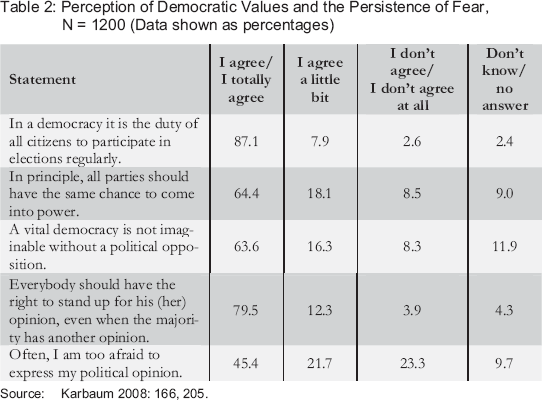
Similar to other countries, Cambodia has shown that elections do not necessarily have a significant impact on the creation of a liberal democracy. In addition, the cardinal purpose of elections (to select leaders) in Cambodia is overridden because elections there are not free and fair, which is to the advantage of one particular party. There is no real competition for power because only the ruling CPP has full access to electronic media and the state infrastructure, which minimizes equal opportunities for other political parties. Particularly in remote provinces, threats, intimidation and vote-buying are systematic methods used by the prime minister's party. It is still difficult and dangerous to campaign for other parties in rural areas. 4 People suspected of not voting for the CPP can be excluded from the electoral roll; therefore, the declining turnout (Table 1) can be regarded as politically induced (Karbaum 2007: 118). On election day, police and military units are mobilized around many polling stations to frighten undecided voters. The election administration is biased in favour of the CPP and complaints are normally not accepted. The electoral system favours the strongest party – the CPP – because the conversion of votes into seats is considerably distorted. Despite all unfair and repressive concomitants that also lead to disappointment and lower turnout, Cambodian elections can be regarded as positive in two ways: First, elections have led to visible parliamentary opposition since 1998, the most relevant group being the Sam Rainsy Party (SRP). Second, they shape the democratic awareness of the people because for the vast majority of Cambodians, there are no other opportunities to participate politically. And undoubtedly, democratic values seem to be popular among Khmer people, as a representative survey conducted by the author throughout the country in 2007 shows clearly (see Table 2). However, elections are dysfunctional and cannot stop Prime Minister Hun Sen and the CPP from continuing to monopolize political power in Cambodia – in fact, elections only reflect that tendency.
Cambodia's Parliamentary Elections, 1993–2008
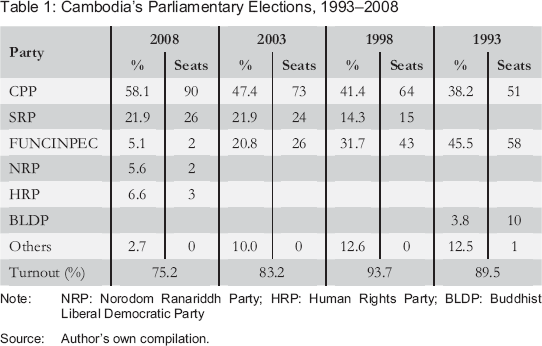
Cambodia's Parliamentary Elections, 1993–2008
Note: NRP: Norodom Ranariddh Party; HRP: Human Rights Party; BLDP: Buddhist Liberal Democratic Party
Source: Author's own compilation.
Perception of Democratic Values and the Persistence of Fear, N = 1200 (Data shown as percentages)
Source: Karbaum 2008: 166, 205.
Although violence was widespread for months around polling days (notably in 1993 and 1998), commune and parliamentary elections were comparatively peaceful in 2007 and 2008. Compared to other post-war societies, there are no grave tensions within society, and voters’ moods appear very calm and hardly polarized.
Each year, freedom of speech is declining more and more: Oppositional politicians, unionists, journalists and representatives of civil society organizations are often charged with defamation or with presenting misinformation. In the current legislative period, four opposition politicians have been stripped of their parliamentary impunity, including leading figures like Sam Rainsy and Mu Sochua. Freedom of association is also in danger: The so-called “NGO law”, which has been the subject of discussions between NGO representatives and Interior Ministry officials since December 2010, would create extensive regulations that could restrict the work of civil society organizations. Unions’ freedom of action is also restricted because the right to strike is often overruled by the government. In particular the 2004 murder of Chea Vichea, the charismatic leader of the Free Trade Union of Workers of the Kingdom of Cambodia, has widely been regarded as a successful attempt by the ruling elites to split and sideline unions economically and politically. Finally, the control of electronic media (radio and TV) is widely seen as the most effective characteristic of limited rights of participation in Cambodia. Aside from a few radio stations like Radio Beehive, all broadcast stations are controlled by state ministries, the Hun Sen family, or companies with very close ties to the ruling party. There are also on-going attempts to censor online content critical of the government. Although the written press enjoys more liberties than electronic media, its readership is limited to urban areas. Furthermore, editors of independent newspapers usually face more or less direct pressure from the government; hence, self-censorship is not unusual.
Civil Rights
In the narrower sense, there is only one fundamental reason why Hun Sen has been able to maintain his power since 1985: his employment of violence to political ends, which has undermined both political rights of participation and civil rights. Although Cambodia appears more peaceful than it did decades ago, violence is still a political means – through the credible use of threats and intimidation. But the visible use of violence has decreased, as Hun Sen has marginalized all his political opponents inside and outside of the CPP. Currently, it is sufficient to construct judicial sophistries to neutralize whoever he wants. The vast majority of Cambodian citizens do not have access to an impartial judiciary and therefore cannot sue state representatives for violations of human rights, as they are codified within the constitution. In consequence, civil rights as negative liberties hardly exist. Arbitrariness is widespread – especially among police and military units, which often use their physical resources to safeguard their own interests and the interests of the ruling elites. Most significantly, countless cases of land-grabbing, in which political and economic elites as well as the armed forces are deeply involved, illustrate the very limited impact of property rights in Cambodia. Limited access to health facilities and education (both services rank among the lowest in Cambodia among all Southeast Asian countries) hinders the progress of gaining further economic, social and cultural rights.
Separation of Powers and Horizontal Accountability
Horizontal accountability through legislative bodies and independent courts does not exist. An autoregressive power circle including the formal state institutions and main bodies of the CPP is widely controlled by Hun Sen and his close allies (see Figure 1). Most essential, the membership of parliament is bound to one's membership of a political party. Once expelled from his/her party by party leaders, a member of parliament also loses his/her seat. Members of the opposition parties have often been stripped of their parliamentary immunity. Between September 2010 and April 2011, in three different trials, opposition leader Sam Rainsy was sentenced in absentia to 14 years in jail (the Cambodian Court of Appeals later reduced the prison sentence by three years). Since January 2010, he has been living in self-imposed exile in Paris. 5 In 2007, a Cambodian NGO described the atmosphere during debates in parliament:
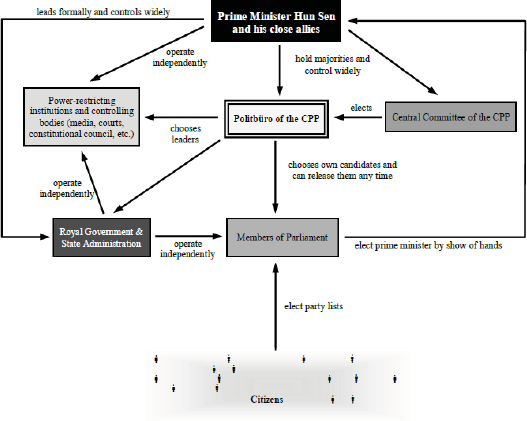
Cambodia's Autoregressive Power Circle
A similar case took place in 2005 and the president of the SRP had to leave the country for more than one year.
Due to the National Assembly's routine [of] silencing and intimidation of parliamentarians who oppose the current government's agenda, it has stifled its own internal debate and imposed a culture of fear and self-censorship (Center for Social Development 2007).
Even more intensely, Cambodian courts are totally subordinated to the administration. LICADHO (Cambodian League for the Promotion and Defense of Human Rights), a well-known human rights NGO in Cambodia, perceives three functions of the judiciary: The national courts have to “persecute political opponents and other critics of the government, perpetuate impunity for state actors and their associates, [and] protect the economic interests of the rich and powerful” (LICADHO 2007: 1). Since the 1980s, the judiciary has followed a communist logic whereby courts guarantee the assertion of the government's policies. Obviously, in all politically relevant cases the courts judge based on the guidelines they receive from the administration. Today, Cambodia's legal system is still far from “rule by law” at the very least: Whenever vital interests of those in power are affected, the course of justice is perverted, and laws – including the constitution – are completely ignored.
More than most formal state institutions, corruption is highly institutionalized in Cambodian politics and bureaucracy, and it undermines the effective power of state representatives to govern. The scope of the corruption is tremendous: Currently, the country is ranked 164th in the Corruption Perceptions Index (Transparency International 2011: 4). There is enough empirical evidence to claim that the enrichment and plundering of natural resources are national objectives. Corruption and nepotism appear in different variations: Petty corruption refers to daily situations in which citizens have to bribe officials to receive public services; grand corruption covers different forms of systematically absorbing money through holding public office; crony capitalism describes close connections between political and economic elites; and different types of illegal behaviour merge to facilitate organized crime activities, especially those conducted by the military (Global Witness 2007). On the one hand, corruption in Cambodia is best described by a pyramid scheme with very few patrons on top. On the other hand, it is necessary for the prime minister to satisfy his followers in the state bureaucracy and within the armed forces. He has created a government with more than 400 ministers, secretaries of state and undersecretaries of state. In addition, Hun Sen has more than 1,000 advisors in the aforementioned ranks. Cambodia's army also has one the highest ratios of generals to troops in the world. Hun Sen's system requires a flow of so much money that it absorbs nearly all of the yearly economic growth (Asia Development Bank 2007: 7; Karbaum 2008: 230). Institutionalized corruption not only limits the effective power to govern extremely because it shifts political priorities, but can also be regarded as the cardinal reason for the persistence of poverty in Cambodia.
To summarize, the partial regimes of the embedded democracy are vastly distorted and lack even the minimum standards to be called an “illiberal” or “electoral” democracy rather than an autocracy. Furthermore, the regime has only very limited legitimacy. Everything depends on individuals – first of all Hun Sen – and not on formal institutions. Under the prime minister's reign, the dominance of the “CPP's formidable network of power and patronage” is unlikely to unravel (McCargo 2005: 110). This guarantees stability only for the present. The government's policies goals are to maintain power and siphon money. Violent eruptions, including political murders, still occur, although the periods of peace are getting longer. As is typical for autocratic regimes, Cambodia is built on fear: This is not only a common perception of ordinary citizens, but it is also verifiable (as shown in the last row of Table 2). During elections, the impact of anxiety is particularly perceptible: People are afraid to vote for the opposition because their villages are likely to be punished if the outcome of the elections does not satisfy the CPP's higher-ups. Moreover, there is little doubt that Hun Sen would use violence if he believes his reign to be in danger, especially if he loses an election. Therefore, the greatest danger for the regime is that its policies are causing more and more social instability because most Cambodians are still disconnected from the economic development. The reason for this disconnection is first and foremost bad governance on the part of the Cambodian government, which has a complete lack of political will to improve.
Strategies of European Democracy Promotion in Cambodia
Among other donors, 6 the EU – along with its individual member states still Cambodia's second-biggest donor block, representing about 25 per cent of donor pledges – has promoted democratic and liberal principles in Cambodia for two decades. 7 According to Jean-François Cautain, the first ambassador of the EU to Cambodia, the support of the “young democratic process” is still among the EU's top priorities and should continue in 2012 and afterwards (Cambodia Herald 2012). The most visible instrument of European democracy promotion in Cambodia has been several election observer missions (EOMs) since 1998. Undoubtedly, these missions have resulted in Cambodia's four-week-long election campaigns being conducted with less violence, fewer technical irregularities, and without serious fraud on polling day. After four parliamentary and two commune elections, one can summarize that of all liberal and democratic institutions in Cambodia, elections are the best functioning, but as mentioned earlier, they have no impact on the competition for power.
UNTAC in the early 1990s was charged with initiating a democratic opening and a sustainable transition to liberal democracy. Afterwards, the support of the principles and institutions of liberal democracy was also carried out by numerous bi- and multilateral donors, i.e. the United Nations Development Programme (UNDP), the World Bank, the United States Agency for International Development (USAID), the National Democratic Institute (NDI) and the International Republican Institute (IRI).
The author cordially thanks Michelle Labeeu, head of operations of the Delegation of the European Union to the Kingdom of Cambodia, for her contribution to this chapter in July 2010.
However, 1998's EOM 8 drew heavy criticism. Notably, the United States along with Japan (but not the EU) pushed Hun Sen following his 1997 coup to allow ousted First Prime Minister Prince Norodom Ranariddh to return to Cambodia and participate as the top candidate of his FUNCINPEC party. Throughout the country, the general atmosphere before and after polling day was affected by the overall dominance of the CPP, which did not refrain from violence, threats and intimidation (Hughes 2003: 59ff). Despite grave shortcomings, the EU, among other international bodies, declared the elections sufficiently free and fair – just one day after polling day. As Peter Schier argues, the motivation for making this declaration could not have been to confirm the quality of the overall election process, but was rather an effort to legitimize the EU's aid pledges (totalling approximately 12 million USD). Furthermore, the EU needed a sense of achievement: Never before had the EU been committed in a country's general election to such an extent (Schier 1998: 70-71). In contrast, the EOMs in Cambodia in 2003 (EU Election Observation Mission to Cambodia 2003) and 2008 (EU Election Observation Mission, Cambodia 2008) did not produce such controversial conclusions.
In 1998, the European Union did not conduct its own mission, but instead had a leading position in the Joint International Observer Group (JIOG).
The European Union's commitment is also visible beyond periodic elections. Due to the overall political environment in Cambodia, the delegation of the European Commission has used indirect and direct strategies to promote democracy. The limited capacity of state institutions has led to a “governance approach”. This strategy even goes beyond the partial regimes of a liberal democracy: If policies were to be implemented in a professional manner (transparent and in accordance with the rule of law), liberal and democratic principles would also be strengthened. For this purpose, the EU implemented the EC-Cambodia Co-operation Facility for Governance and Human Rights (ECCF) in 2009, which supports decentralization and de-concentration in a process called “Sub-national Democracy Development”; local governance; the Extraordinary Chambers in the Courts of Cambodia (in which former Khmer Rouge top cadres are charged); and civil society actors. Furthermore, the ECCF provides technical assistance for legal and judicial reform.
Under the European Instrument for Democracy and Human Rights (EIDHR), 23 on-going human rights projects were implemented in Cambodia between 2003 and 2010. The key areas addressed include legal representation for the most vulnerable and disadvantaged populations, land rights, human trafficking, children's rights, and the empowerment of women. This was accomplished through a set of capacity-building and training activities, attempts to improve prison conditions, and a show of support for the Khmer Rouge Tribunal. In February 2012, the Delegation of the European Union to Cambodia announced it would fund 14 human rights and local authorities projects with an additional 3.6 million EUR (the total amount given since 2003 is 26 million EUR). These projects have very different objectives – for example, to improve the capacity of local authorities; to improve human and civil rights; to empower marginalized and vulnerable groups (especially women and children) and indigenous communities; to support poor families in danger of losing their land; to ensure sustainable land-use planning; to fight human trafficking; to promote land security; to advocate for respect for freedom of speech and expression; to improve the conditions of inmates in Cambodia's prisons (for example, promoting educational, informative and cultural activities for inmates); to support the upcoming commune and parliamentary elections in 2012 and 2013 by increasing the number of informed voters; and to improve the capacity of local authorities, through a local partnership with civil society organizations (Delegation of the European Union to Cambodia 2012). Recipients of these funds are mainly national civil society organizations and commune, municipality and provincial councils.
Furthermore, the EC delegation in Phnom Penh uses different forms of political dialogue, such as an on-going policy dialogue with national authorities and trilateral meetings with the EU troika and the Cambodian government. The Joint Committee (JC) is the highest forum and is held every 18 months. 9 A sub-group on human rights and governance as part of the JC has also been established. In addition, a human rights informal group of EU and like-minded development agencies support the government's Cambodia Human Rights Committee. Altogether, communication with Cambodian authorities seems to be excellent and there are enough forums for exchanges of views.
So far, there have been six meetings of the JC. The last one took place in Brussels on 8 October 2010. It was co-chaired by Ouch Borith, secretary of state of the Cambodian Ministry of Foreign Affairs and International Cooperation, and James Moran, director for Asia in the Commission's Directorate-General for External Relations.
According to the delegation of the European Commission itself, it works in close cooperation and mutual understanding with all EU member states present in Cambodia. To ensure a high degree of coherence, the EC delegation asserts that it is in close contact with all EU diplomatic representations. The country that holds the presidency usually invites EC representatives to a monthly meeting. Likewise, there is a monthly EU development counsellors meeting with the EC's head of operations. In 2010, the EU joint programme SPACE, comprised of the EC, Germany, Sweden and the United Kingdom, was launched. “SPACE” stands for “Strengthening Performance, Accountability and Civic Engagement” and is designed to support national and sub-national agencies in Cambodia and with them jointly develop structures, procedures and capacities that will enable those agencies to be more responsive to citizens.
Similarly to the EC itself, its member states have also been supporting democratic and liberal institutions through various projects and programmes since the 1990s. Most obviously, the Danish International Development Agency (DANIDA) ran a comprehensive human rights and good governance programme in Cambodia from 2006 to 2010. In its last two years of existence, DANIDA contributed to: improved access to and delivery of justice and legal aid; advocacy of human rights and support for rights holders’ capacities to claim and access their rights; and strengthening public institutions, reform processes and public awareness in improving mechanisms for transparency, accountability, and combating corruption. The programme was funded with two million EUR (Danish Ministry of Foreign Affairs 2009). To a lesser extent, the United Kingdom is also committed to projects whose intent is to strengthen governmental accountability and democracy in Cambodia: In June 2011, the British embassy in Phnom Penh announced its support of the Advocacy and Policy Institute (API) with more than 35,000 EUR to promote open dialogue between civil society and governmental officials in specific issue areas. In addition, a further 45,000 EUR were disbursed to the Committee for Free and Fair Elections in Cambodia (COMFREL) for use in improving the transparency of Cambodia's voter registration process (Phnom Penh Post 2011c).
As shown above, democracy promotion by the European Union in Cambodia is based upon bilateral assistance of both its member states and the EC. The assistance is broad and it follows a maximal understanding of democracy. However, this is only one part of EU democracy promotion in Cambodia. Major stakeholders’ perceptions of general political conditions and the latter's exposure to certain setbacks of liberal and democratic institutions remain important benchmarks of the analysis.
European Perceptions of the Hun Sen Regime
The success of those chosen strategies and approaches for promoting democratic and liberal principles is directly connected to the EU's perception of the political conditions. Only with this knowledge is it possible to define an appropriate starting point. This insight, however, is quite new in European assistance as the following quote from July 2009 shows:
Democracy-building is a complex, long-term process touching the very heart of a country's sovereignty. Any outside support to this process should therefore take as its starting point an in-depth analysis of a country's situation with regard to democracy (Commission of the European Communities 2009: 19).
This should lead to a “tailor-made, country-specific approach” (Commission of the European Communities 2009: 19) for further democracy-building objectives. Unfortunately, this in-depth analysis conducted by the EC and EU member states in Phnom Penh is not public. Nevertheless, one could argue that the analysis is based on an EU-specific perception of the political conditions in Cambodia. The current Cambodia-European Community Strategy Paper, for example, offers the following assessment: “Given the short period of time that has elapsed since 1993, overall progress in establishing democratic structures in Cambodia has been good” (Delegation of the European Union to the Kingdom of Cambodia 2007: 11).
In contrast, the European Parliament's views seem to act as a counterbalance to the official views of the European Commission. On 21 October 2010 the former unanimously adopted a “resolution on Cambodia, in particular the case of Sam Rainsy”. In it, the legislators summarize that
a worrying authoritarian trend has been noticeable in Cambodia over the last few years; […] this is reflected in a deterioration in the human rights situation, the stifling of fundamental freedoms, a brutal policy of land-grabbing that affects essentially the poor, the suppression of all forms of criticism and protest, the persecution of the parliamentary opposition and civil society activists, the use of the courts for political ends and a drift toward a one-party system (European Parliament 2010a).
Furthermore, the resolution condemns “all politically motivated sentences against representatives of the opposition and NGOs” and calls for Cambodian authorities – among others – to “engage in political and institutional reforms to build a democratic state governed by the rule of law and founded on respect for fundamental freedoms” (European Parliament 2010a).
Among the member states, Germany offers judgements very similar to the European Commission by pointing out that Cambodia is led by the democratic legitimized government of Hun Sen (BMZ 2011a). Over the last few years, the German federal government has defended its “amicable relationship” (BMZ 2011b, author's translation) with the Royal Government of Cambodia. Most notably, in 2009 the manager in charge of Cambodian issues within Germany's Federal Ministry for Economic Cooperation and Development (BMZ) was asked to address the topic of land-grabbing as the most widespread, systematic and serious human rights violation. She replied publicly that she is less concerned about land-grabbing than about the representatives of the Cambodian government losing face when confronted with this matter by German officials. This might be one reason why the magazine Neon claimed in January 2010 that Germany supports forced evictions in Cambodia (Neon 2010: 30). However, the head of the BMZ, Dirk Niebel, is not reluctant to use more critical words: During his visit to Phnom Penh in March 2010, Minister Niebel emphasized the meaning of values in his country's development assistance. In October of the same year, he criticized the EU for its financial support of Cambodia, among other states, saying, “It is not acceptable that governments with such a dubious reputation can access European money that easily” (quotation provided by Der Spiegel 2010: 103, author's translation). 10 However, in December 2011 the ministry announced its controversial plan to assist in the land registry despite the fact that the World Bank just had cancelled its Land Management and Administration Project (LMAP) due to the situation in the Boeung Kak Lake area of central Phnom Penh, where residents have been forcibly resettled (World Bank Inspection Panel 2010).
In September 2010, the delegation of the European Union announced that the EU would provide 31 million EUR in project aid to improve the education sector in Cambodia for the years 2011–13 after having already spent 26 million EUR on similar projects since 2006 (Xinhua News Agency 2010).
Other member states have been taking a more critical approach for a longer time, although diplomatic reasons normally prevent criticism that is too strong. For example, the Swedish International Development Cooperation Agency (SIDA) assessed in 2009 that
Cambodia's young democracy still has major deficiencies. The country has a multi-party system, but the governing party holds much of the power, putting opposition parties in a vulnerable position. Poor people's rights are strongly limited. […] Civil society's role in the democratic process is a key issue. To improve poor people's rights, the power of the governing party needs to be counterbalanced. […] The judicial system is deficient and corruption is common. Power is centralized and millions of people in rural areas still lack basic rights.
DANIDA avoids making such direct judgements, but has published some criticism about sensitive political issues on its websites. A quite radical decision regarding Cambodia was taken by the Department for International Development (DFID) of the United Kingdom, which closed its Cambodian office in 2011 and will end all its programmes by 2013. A completely different strategy is being taken by Cambodia's former colonial master, France, which has been a loyal backer of the regime in domestic policies since the 1990s (Peou 2007: 194-195). Hun Sen is also regularly invited to France by its presidents on official visits: In 2005 he met with Jacques Chirac, and in 2009 with Nicolas Sarkozy. In July 2011, French Prime Minister François Fillon met with Hun Sen during a trip to Phnom Penh.
The Limited Impact of European Democracy Promotion
Evaluating perceptions alone is insufficient for political scientists to delineate strategies of democracy promotion. To support liberal and democratic values in practice, trustful diplomatic relations are pre-eminent, and harsh criticism, if publicly voiced, would undoubtedly damage bilateral relations. However, scholars and policymakers should not ignore these perceptions completely, because there are only a few other reference points for assessing democracy promotion in general. The development of democratic and liberal conditions is a rather long and multifaceted process, as argued above. It is difficult to measure them clearly and to delimit collateral aspects and conditions in the transition to democracy.
International assistance in Cambodia follows the concept that an embedded democracy contains many dimensions and is linked to its surrounding historic, cultural and socio-economic conditions. Although this context is widely recognized, there is a danger that assistance might become diffuse and user-defined: Human rights programmes involve governance issues, and the support in land management is supposed to reduce human rights violations. Altogether, these different aspects are regarded as a sort of democracy promotion by the EU. Therefore, it is nearly impossible to define how strongly the EC or any member state is committed to democracy promotion in its basic sense: strengthening the horizontal power-limiting institutions and mechanisms as well as – to demonstrate the vertical dimension – enforcing the sovereignty of the people through political participation and the recognition of inalienable human rights.
But evaluating what the final impact of these strategies is on democratic and liberal institutions is only possible by analysing the results. Making such an evaluation does not mean figuring out how successfully development organizations have managed their programmes and projects or how they have spent their budgets, but rather how they have influenced political behaviour and how they have induced reform processes. Finally, one has to examine whether robust structures geared to liberal and democratic principles have been built up or not. In this case, one could conclude that democracy promotion by the EC and its member states exists on a minimal level, but has so far had no impact on Cambodia's formal and informal institutions and political conditions. And there is no evidence that it will have an impact in the future.
Given Cambodia's single-party dominance and its corrupt government, any democracy promotion there by outside bodies must be understood as an investment by those outsiders in Cambodia's long term. However, this is not a case of experiencing a few setbacks; there has been, in fact, a clear visible tendency to de-institutionalize democratic and liberal principles for more than 15 years. Particularly freedom of expression for oppositional politicians, other independent individuals, and ordinary citizens has been reduced step by step (LICADHO 2010: 50). Civil society actors, human rights defenders, unionists, and journalists had more room to manoeuvre from the mid-1990s through 2005 than they do now. As they have become more self-confident and better equipped, their operating range has been narrowed by laws, threats, intimidation and murder.
Altogether, there are many indicators that could lead observers to question the perception of Cambodia having a democratically legitimized government, especially when one examines the state institutions. Obviously, human rights, the rule of law, as well as independent bodies like a parliament, a non-partisan judiciary and a central audit authority are not sufficiently institutionalized in Cambodia to be able to restrict the central government's claim to power. Hence, a vertical differentiation of executive power could be a positive alternative to the current system. It seems that the European Union believes that and has chosen decentralization and de-concentration as the key strategies to counterbalance the power of the central government. However, de-concentration is still a myth in Cambodia, and decentralization is nothing more than very limited top-down devolution (Dosch 2007: 141). While local analysts perceive the accountability of commune councils and their service delivery as having improved, they also mention that the participation of local citizens and representation of other political parties, women, and other marginalized groups is still limited (Heng, Kim, and So 2011: 17-18). In addition, fiscal decentralization still faces major obstacles – in particular, both functional and revenue assignment are still rarely implemented (Pak 2011: 21). Of course, this whole process is just beginning and its impact might not be significant for 10 or 20 years. But as long as the character of the regime does not change, all these newly installed authorities, bodies, and offices are no more than new formal façades.
Sorpong Peou has already provided a detailed overview of the overall failure of democracy assistance by international donors, especially in institution-building and economic and political assistance (Peou 2007: 165ff.). Along similar lines, Sophal Ear argues that “foreign aid has not had a positive impact on governance in Cambodia” (Ear 2007: 69). In many off-the-record conversations, Western donors in Cambodia have assessed the situation very similarly, but the official policies of their organizations and governments do not seem to match these assessments. As these bodies have learned that it is nearly impossible to induce substantial changes in Cambodia, they have realigned their focus to jointly supporting the creation of more and more formal institutions with commune, district and provincial councils. However, the rules and regulations of these bodies are not implemented, as these councils are not financially independent from the central government. In addition to the EU, the World Bank and the United Nations Development Programme (UNDP) want to tackle that challenge, too, but the Cambodian authorities have not yet met the conditions the World Bank and UNDP have set out for further cooperation.
However, it is still not clear whether donors are going about decentralizing and de-concentrating based on incorrect assumptions: The slow pace of progress, resistance and other setbacks are not currently being caused – and will not in the future be caused – only by the stage of development, specificities in the development path, long-lasting decision-making processes in the political system, or an under-equipped administration, but by a combination of these and a more significant reason: a general political will not to share power with anybody. The ruling cadres still do not regard a vertical differentiation of the state as an acceptable restraint of their power. And at the moment, there is absolutely no reason to believe that the central government – to speak of a consistent administration is already inappropriate because it does not reflect the CPP's different wings and factions and its internal power struggles – and its leaders will abandon power and control capacities in the coming years.
Therefore, these councils are thoroughly comparable with Potemkin villages. Often, international actors intensify these dysfunctional creations with considerable financial incentives. It is fair to say that any development organization can buy nearly any law in Cambodia. If it has enough money, it can get any formal institution that it wants – for example, a senate, commune council elections, a Khmer Rouge Tribunal, an organic law, and after 16 years of debate even an anti-corruption law. Instead of focusing on implementing those existing norms so they have a real effect, donors prefer to build one façade after the other although the result is always the same. Today, all formal institutions (the ministries within the government; the provincial, district and commune councils; the National Assembly; the Senate; the courts; the National Audit Authority; the national bank and even the king and his royal palace) are embedded into the CPP's power structure and are subordinate to Hun Sen's leadership. Still, the European Union and its member states have failed to explain why the situation could be improved with newly created institutions.
The European EBA Initiative and the State of Human Rights in the Agriculture Sector
One detects not only the limited impact of democracy promotion and support, but also an intensification of human rights violations caused by European policies more or less directly. The starting point is the “Everything But Arms” initiative (EBA) under which all imports to the EU from Least Developed Countries are duty-free and quota-free. As mentioned above, trade facilitations are also recognized as legitimate instruments of indirect democracy promotion when they tend to stabilize the surrounding – socioeconomic – conditions of states in transformational processes. With this in mind, the European Union has designed the EBA scheme to increase trade with 49 countries to “enhance their export earnings, promote their industrialization and encourage the diversification of their economies” (Directorate-General for Trade of the European Commission 2009). Although the initiative already allowed for the export of textile products to the EU, it was first on 4 June 2010 that a Cambodian company along with its Thai partner shipped 10,000 tonnes of sugar to the United Kingdom, the first shipment of sugar it had made to the UK in 40 years (Phnom Penh Post 2011b).
In addition to its garment industry with an 85 per cent share of all exports, Cambodia also sells agricultural products overseas. For the cultivation, companies receive economic land concessions for ground that belongs to ordinary citizens who so far have farmed it for their own needs. Although Cambodia has a proper land law and has also ratified international treaties like the International Covenant on Civil and Political Rights (ICCPR), forced evictions with insufficient compensation (or none at all) are widespread throughout the country. Independent organizations estimate that 100,000 to 250,000 citizens were victims of land-grabbing between 2005 and 2010 alone (Phnom Penh Post 2010).
By March 2011, more than 12,000 people altogether in three provinces had been hit by land-grabbing due to agriculture concessions in connection with the EBA scheme. According to a report by a Cambodian magazine, those violations “include forced evictions; seizure and clearance of farmland and crops; destruction of forests; poisoning of local water resources and the shooting, arrest and harassment of human rights defenders” (Southeast Asia Globe 2011). According to David Pred, executive director of rights organization Bridges Across Borders Cambodia, the impact on local communities has been devastating: “Families have been made landless and were driven into destitution and severe food insecurity. Hundreds have been made homeless and haven't received any compensation” (quotation provided by Southeast Asia Globe 2011).
In most cases, companies owned by Ly Yong Phat 11 – a tycoon who is also a senator in the ruling CPP – are involved in these disputes. At least one case is well documented: In Omlaing Commune in Kampong Speu Province, one of the senator's companies – which sells its products to UK-based agro company Tate & Lyle PLC – has laid claim to land that belongs to farmers (altogether ca. 3,000 families) as a part of an 8,343-hectare concession. Local rights groups have already warned that the EBA scheme could be an incentive for forced evictions in Cambodia. They also called on the EU to investigate the gross human rights abuses that have been perpetrated in connection with the production of sugar that is being exported to Europe under this agreement (Reuters 2010). Although Rafael Dochao-Moreno, then chargé d'affaires for the Delegation of the European Commission to Cambodia, said EU officials take the issue seriously, he also said that no investigation had been initiated. He further stated that “questions related to forced evictions need to be dealt with by the Cambodian government” (Reuters 2010) and not by the European Union. Then in May 2011, Swedish member of the European Parliament Cecilia Wikström, who was on a private visit to Cambodia, put the debate back on the agenda when she met with affected communities in Kampong Speu and Koh Kong Provinces and called for rigorous consequences:
Phnom Penh Sugar Company, Koh Kong Sugar Industry, Kampong Speu Sugar Company.
I think we need in the European Parliament […] to look into the details and the provisions put in place in the EBA concerning human rights. In my view, they have been violated. […] The EBA should be suspended when it comes to sugar and some other agricultural products (quotation provided by the Phnom Penh Post 2011a).
By June 2011 – more than nine months after this case was made public – it was still unclear how the EU would deal with this matter. However, irrespective of possible further adjustments or revisions to the EBA scheme, this case exemplifies the capacity (though limited) of the European Commission and its local officials to act when confronted with these kinds of sensitive political issues. Whatever the reasons for this too-slow decision-making process might be (very soon the EC could be presented with a fait accompli by the sugar companies), one cannot ignore the fact that there are complex human rights violations that come about under various different circumstances – in the case of the EBA initiative even with a praiseworthy intention. However, the impact in Cambodia has been quite different than expected and again it seems that the whole EU needs stimuli from the European Parliament to meet its full responsibility in this case and in general.
The Failure of Top-down Assistance
International assistance in promoting Cambodian democracy appears to be in part tragic. Compared to the wars in the former Yugoslavia (which caused reasonable concerns for its European neighbours), Afghanistan (which was abruptly regarded as security threat to the whole Western hemisphere), and Iraq (with its giant oil resources), it is quite difficult to recognize why Cambodia should be a country of international concern and intervention. One can argue that Western donors arrived in Cambodia in relatively good faith, without strong international competitors and in times of widespread optimism. However, today it has become obvious that good intentions were not enough. In the case of the European Union, it is fairly easy to identify the moment in which the operation flatlined: “The political instability of mid-1997 [the coup of Hun Sen] led to the suspension of assistance from many donors. The EU during this time took a pragmatic approach” (Delegation of the European Union to the Kingdom of Cambodia, unknown year). The alternative to this “pragmatic approach” – which led to Cambodian politicians rebuilding their confidence and conducting elections in 1998 – would have been to abandon development assistance, which would have most likely caused instability and the destruction by the CPP of the last democratic and liberal leftovers, and maybe even led to another civil war. Therefore, the EU's behaviour at that time seemed to be justified.
In hindsight, however, this strategy can be described as the starting point of the EU ignoring and relativizing the continued de-institutionalization of democratic and liberal principles in Cambodia. Even now, the EU is still following a top-down approach, and despite all evidence, it favours a continuation over an alteration of its democracy-promoting policies: During the debate about Cambodia on 21 October 2010, EU Commissioner Máire Geoghegan-Quinn underlined that there is “no substitute for patient dialogue” although she admitted that the situation in Cambodia is “a matter of concern” (European Parliament 2010b). 12 The crucial questions, however, are still: Why has the dialogue obviously failed so far, and how should it be held in future? It is doubtful whether this dialogue can influence any heavy-hitting politicians because the objectives of Cambodia's elites are very different from the goals of those who promote democratic structures: The elites want to cement a new social order with the CPP's top cadres in leading positions for the next few decades – and this re-emerging culture of undisputed and unchallenged leadership (Bit 1991: xv) is exactly the opposite of a liberal democracy.
Similarly, in the assessment of Cambodia's overall human rights situation, the EU refrains from distinct criticism, and comments on the situation very cautiously (European Union 2011: 144-146).
Undoubtedly, any external democracy promotion runs the risk of failing dramatically in such an environment. Though – before ceasing democracy assistance in general – the EU should examine whether there are alternatives to the strategy it has hitherto applied of implementing only positive instruments. Due to Cambodia's great dependence on foreign aid, a direct link between those transfers and political performance might be a promising approach. In September 2010, 17 national NGOs, community organizations, and unions formulated the basis for a negative instrument of democracy promotion when they advised the international community to
adopt a human rights-based approach to aid policy and take a tougher line on linking financial assistance to the RGC demonstrating a real commitment to, and showing tangible improvements in, human rights (Cambodian Center for Human Rights 2010: 43).
If the 17 organizations got what they wanted, this would entail the EU demanding a much higher commitment from the Hun Sen administration to human rights issues and therefore to its political accountability, but also supporting independent actors dedicated to this field. Since the 1990s the impact of civil society on formal democratization has been very low because it has always been the authorities’ aim to keep civil society disconnected from the political system. However, those few real independent organizations – ADHOC, 13 LICADHO, CCHR, 14 CLEC, 15 CDP, 16 COMFREL and others – have been supporting social development and therefore have played a considerable role in creating a pluralistic society. Furthermore, there are countless smaller groups at the grass-roots level that aggregate and advocate the interests of their members.
Association pour les Droits de l'Homme et le Développement au Cambodge (Cambodian Human Rights and Development Organization).
Cambodian Center for Human Rights.
Community Legal Education Center.
Cambodian Defenders Project.
Conclusion
Due to countless restrictions in at least four of the five partial regimes of a liberal democracy, it is fair to say that democratization has vanished: A democratic opening was successfully introduced with the UNTAC and it experienced its highlight with general elections in 1993. Four years later, this process ceased and devolved when Hun Sen restored his hegemonic position in Cambodian politics, which had been threatened through the introduction of a liberal constitution. His ruling Cambodian People's Party has persisted as a dominant political faction, pushing an autocratic style of governance instead of using existing democratic institutions. The current Cambodian regime lacks the fundamental will for political reform, not only related to liberal principles of good governance, but rather to nearly every principle thereof – transparency, responsiveness, and rule of law.
Assessed in the light of its values and objectives, democracy promotion of the European Union appears inconsistent: Whereas the European Parliament and some EU member states tend to address existing restrictions of democratic and liberal institutions more directly, the Commission along with both of the EU's heavyweight member states, Germany and France, have tolerated the authoritarian trend. Altogether, the collaborative approach dominates the EU–Cambodia relationship. This is best illustrated by the issue of the EBA scheme, in which EU policies have had a directly negative impact on the human rights situation in Cambodia – and therefore on the embedded democracy in general: While indirect strategies of democracy promotion like trade facilitation are recognized approaches to supporting a young democracy, EBA has tended to worsen the human rights situation in Cambodia, thereby harming liberal and democratic institutions. It is not yet known whether the delicate handling of the Hun Sen regime is going to continue, but in the near future it will be interesting to see whether the EU and other Western donors want to continue to assist the Cambodian government in the latter's elimination of the last liberal leftovers. On-going nationwide land disputes and the general denial of property rights, as well as commune (2012) and parliamentary (2013) elections, will be important indicators.
As long as the EU refrains from using negative instruments of democracy promotion and as long as priority is given to the short-term political stability of the regime, any form of democracy promotion in Cambodia appears to be a “smokescreen”, having virtually no positive impact on the country. However, even the intention of promoting stability may not be promising: It is likely that the highly personalized style of governance and the degree of corruption will lead instead to more inequality and instability in general. Yet the repertoire of instruments to promote democracy is not exhausted and there is scope for the EU to make some effective adjustments.
As shown in this first part of the article, the Cambodian case provides an example of the fact that a valuable analysis of an autocratic regime can also be conducted by using an approach that makes use of a maximal understanding of democracy. It not only elucidates the numerous shortcomings of liberal institutions, but also makes it easier to understand the measures of international democracy promotion: Taking an inclusive approach allows us to subsume aspects of a liberal democracy that minimalist concepts exclude. Therefore, the advantage of this approach is not limited to regime analysis, and it also enables us to examine external democracy promotion. However, the analysis cannot consider strategic aspects like intentions and motivation of donors and their stakeholders; this remains an integral part of other fields, especially international relations and security studies. This case study may imply that a survey from the perspective of international politics could offer more insights about donors’ intentions, but I strongly believe that any analyst who takes that as a starting point will face some difficulties delivering a policy analysis of democracy promotion like the one I have attempted here.