




Abstract
By twinning the ideational and political logic approaches to populism, this article offers an original interpretation of the Redshirt movement in Thailand. The article extensively uses pro-Thaksin media sources and booklets to demonstrate how the Redshirt movement in Thailand appropriated the formerly authoritarian Thaksin as an empty signifier. This article fills a significant gap by exploring how ideational elements of the Redshirt movement fostered the emergence of a populist subject that struggled for a liberal constitutional re-foundation of Thai politics.
Thaksin Shinawatra, prime minister of Thailand from 2001 to 2006, retains a spectral presence in both the literature on populism and the politics of Thailand since he was overthrown in a coup d’état in September 2006. This article examines how Thaksin was appropriated as a democratic symbolic figure by the Redshirt movement in its struggle to restore electoral democracy. The coup of 2014 defeated that struggle, although recurrent political crises in Thailand means that Thaksin's return to national significance remains a possibility as his successor party continues to command great popularity. 1
As the study of populism has grown in tandem with the crises of democracy across the globe, scholars of populism seeking global or regional coverage often claim Thaksin, variously, as an example of a weak or strong Asian populist leader. The literature from which these characterisations are drawn tend to be leader-centric, missing the populist nature of the broader movements behind the leader — and therefore the greater import of this period of history (see Moffitt, 2016; Hellmann, 2017). In drawing on a relatively narrow secondary literature for their designation of Thaksin as a populist or not, generalists or comparativists rely on findings about the nature of Thaksin's populism that should not be treated as definitive. More than that, a consideration of the populist dynamics of the movement that appropriated him after his fall from office, which is the key focus of this piece, is needed if the period's contradictions are to be grasped (a formerly authoritarian leader becoming the symbol of democracy).
The first part of this article briefly reviews existing analyses of Thakin's populism, noting its leader-centric emphasis. The article then moves to elaborate on two distinct approaches to Redshirt populism that are combined in this article: Mudde's (2004, 2017) ideational approach which provides for mapping the ideational content of populism, and Laclau's (2005a) political logic approach which enables the delineation of a populist subject. This twinning enables an exploration of how Thaksin's authoritarian populism was transformed and disciplined by a populist movement that sought to appropriate Thaksin for the purposes of restoring a formal liberal democratic settlement. 2 Offering elements of an explanation for how this occurred is the key objective of this article, and is advanced by extensively drawing on pro-Thaksin media sources. These sources enable an evidence-based original interpretation that contributes to a critical account of populism and the dynamics of post-coup politics in Thailand.
In the conclusion, theoretical reflections are offered on how a populist movement's forcing of a political rupture may evolve to serve a liberal-democratic purpose. Undoubtedly, for those who hold populism to be illiberal, the idea of a populist politics that seeks a liberal political outcome is an oxymoron. Instead, this article offers a paradox to explain. Thus, the conclusion also addresses the seeming contradiction between the demands of liberal democracy and the populist idiom of “the general will”.
The Populist and the Continuing Legacy
Many texts refer to Thaksin as populist — weak, reluctant, defensive — in the adjectival sense, but only a few offer substantive discussion. Below, representative trends in this latter scholarship are noted so as to differentiate this article's arguments.
Most scholarship on Thaksin focuses on his purported populist economic and social policies, including debt moratoriums, poverty eradication, and universal health (e.g. Choi, 2005). The idea that Thaksin and his proxy governments (including that of Yingluck Shinawatra between 2011 and 2014) were populist in the socio-economic sense remains strong and attracts policy attention (see, e.g. Phumma and Vechsuruck, 2022). Indeed, the 2104-coup-appointed National Reform Council convened various committees to thwart the presumed threat of populist economic and political ruin (see Secretariat of the House of Representatives, 2014). The anti-populist reaction has led to a new political infrastructure to steer Thailand's political economy. As Veerayooth (2016) argues, professional classes have been co-opted into an authoritarian anti-populist project that offers tenure in the accountability agencies of the state.
Others address ideational elements. In their key study on the Thaksinisation of Thailand, McCargo and Pathamanand (2005) largely dispose of Thaksin's populist rhetoric expressed in political, economic, and stridently nationalist statements as opportunistic and inconsistent, not worth taking seriously as political conviction. Others seek to interrogate its ideational features, but there are only several extended analyses that do this. This literature (see esp. Hewison, 2017; Pasuk and Baker, 2008) mostly holds that Thaksin's populism was initially weak but intensified in the face of challenges. Hawkins and Selway's (2017) coding of several Thaksin speeches seeks to confirm this finding across two time periods (2001–2004/2005–2006).
Pasuk Phongpaichit and Chris Baker (2004, 2005, 2008), whose significant works on Thaksin's populism developed contemporaneously with its rise, see Thaksin's populism driven by responsiveness to the electoral marketplace and expressing a form of big capital control of the state through authoritarian centralised rule (for a discussion of this, see Hewison, 2017: 427–428). Their focus on Thaksin's populism explores Thaksin's personalistic machine politics and his mobilisational strategies. They also emphasise Thaksin's ideational use of three narratives that emerge in his relationship with his electoral support base: giving to the people, being of the people, and acting on their will (Pasuk and Baker, 2008: 68–70). Their empirical analysis combines ideational and political-strategic attributional approaches, offering a rich diagnosis of Thaksin's populism. Pasuk and Baker highlight the damage wrought to an emergent liberal political system by Thaksin's populism and his threat to a fragile liberal political order's checks and balances.
Hewison (2017), drawing in part on Mudde's approach, offers a different appraisal. Rather than an authoritarian populist in the making, he describes a reluctant populism (437) taking shape in the face of elite opposition to Thaksin's electoral successes and the perceived threats to the establishment. For Hewison, Thaksin's earlier reluctance to be a real populist morphs into progressive politics due to Thaksin's imminent loss of office during the challenge of 2005–2006. Thaksin finds his political survival under threat and speaks of enemies against democracy and the need for the people to struggle with him. During his self-exile and facing demonisation by his enemies, Thaksin ramps up his populist rhetoric to align with the activist social base that forms in the Redshirt movement. His absent presence magnifies the feelings of loss among the economically disenfranchised who had benefited from his distributive policies. Similarly, Mérieau (2022: 281–283) describes a “defensive populism” that emerges as Thaksin seeks to rally the rural masses after his authoritarian actions had alienated the political establishment and its supposed “deep state”.
Others view Thaksin's populist rupture as an opportunity to rethink the politics of electoral democracy. For example, rather than a pejorative account of clientelism and patronage typical of liberal critiques of populism that focus on campaign machines, emphasis is given to the “moral economy of electoralism” by exploring the different meanings that attach to the vote and the solidarities that are forged in redistributive politics between leaders and communities (Thompson, 2021). In ethnographic mode, Seo (2019) uses Laclau's approach to populism (see below) to explore “democratic populism” and an individual's negotiation of populist subjectivity, offering a promising approach to understanding the ebb and flow of “populist becoming”.
The nature of Thaksin's populism is only a starting point for this article. The leader-centric literature discussed above, which is concerned with how to characterise Thaksin's populism, has thrown up significant insights that this article draws from. It shares Pasuk and Bakers’ approach to Thaksin as an authoritarian populist during his prime ministership. 3 It also engages and expands Hewison's arguments on the progressive nature of Thaksin-associated populism in the post-coup period but extends to demonstrating the ideational appropriation of him in a populist manner (as an empty signifier) to the cause of restoring liberal democracy. Before expanding on these insights a brief discussion on the approach taken to populism in this piece is first offered.
Populism: Working Definitions
Canovan (2004: 243) has noted, “All attempts at a general characterisation of populism have been contentious, with some analysts offering definitions or lists of essential characteristics, others finding only more tenuous connections and loose family resemblances between the different candidates.” Nearly twenty years on there is still no commonly agreed characteristics of populism, leading to an ever-extending typology of different populisms. Attempting to bring order to the field, the editors of the Oxford Handbook on Populism (Kaltwasser et al., 2017: 13–14) propose what they consider the three most important approaches: the Ideational, the Political Strategic, and the Socio-Cultural.
Mudde (2017: 28) correctly notes that the Ideational Approach, where his work sits, is prevalent in the literature. Mudde's ideational definition of populism is widely used: “an ideology that considers society to be ultimately separated into two homogeneous and antagonistic groups, “the pure people” versus “the corrupt elite”, and which argues that politics should be an expression of the volonté générale (general will) of the people” (Mudde, 2004: 543). For Mudde (2017: 30), the moral division between the pure people and elites is the motivating antagonism of populism. This article explores the presence of Mudde's core features of populism in the Redshirt movement. This form of ideational analysis is what might be described as attributional in that it aligns populism with a range of attributes subject to empirical and comparative generalisations (see Panizza, 2005: 2). This is the approach that dominates in studies of Thaksin, leading to a narrow focus on the intensity of his populism and a leader-centric analysis.
This piece additionally employs the political logics approach developed by Laclau which is also subsumed under the Katlwasser et al.'s. (2017) ideational category. For Laclau, a people/elite dichotomy is not just an ideational attribute or a performative style. If it were so then populism is indeed everywhere, in varying degrees, when its features are enunciated or performed. Rather Laclau's approach is parsimonious. It steps back from second-order empirical attribution and variation — and the resulting typologies of populism — to argue for a formal identification of populism, which is none other than the first-order ontological status of populism when a collective populist subject emerges (Laclau, 2005b, 33). Thus, it focuses on the formal logical process by which a political antagonism brings into being ontological friend/enemy subjectivities and practices. In this sense, whether a leader reflects certain populist styles is beside the point. The point rather is a fundamental polarising rupture in the political system, not rapture in the leader. Laclau (2005b: 43–44) explains these political logics thus: we only have populism if there is a series of politico-discursive practices constructing a popular subject, and the precondition of the emergence of such a subject is… the building up of an internal frontier dividing the social space into two camps. But the logic of that division is dictated… by the creation of an equivalential chain between a series of social demands in which the equivalential moment prevails over the differential nature of the demands. Finally, the equivalential chain cannot be the result of a purely fortuitous coincidence, but has to be consolidated through the emergence of an element which gives coherence to the chain by signifying it as a totality. This element is what we have called “empty signifier”.
Let's unpack this quotation. First, its identification of populism is formal because it does not specify attributional content to the politico-discursive practices that construct a popular subject. Rather, it identifies a process as a political logic that breaks free from political systems that quell fundamental antagonisms through coercion or hegemony. Such systems will face a range of differential demands from citizens (who do not present as a united people) that existing institutions may seek to absorb. These demands are typically separately advanced or cumulatively aggregated as policy and may be absorbed, served, frustrated, and thwarted by an existing system: there is no ontological populist subject questioning the very foundations of political order or seeking a new order — even if populist ideational mutterings are in the air. However, when conditions are not present for the servicing of such varied demands issued from various subject positions — nor present is the capacity to quell them — a new political logic emerges. These differential demands may articulate into a unified equivalent chain that brings into a being a popular subject against that system and its representatives (a demand for democracy, for national purity, for regeneration). The question arises as to what carries the weight of the differential demands and can obscure their potential contradictions when they unite outside the existing order? For Laclau and advocates of the political logics approach, some particular element of the demands and symbols of the emerging populism can stand in for them all — can exemplify the chain of equivalence. And that thing that “stands in” assumes the status of an empty signifier. It is “empty” for two reasons. It is emptied of its particularity to now signify the mythic fullness of the populist subject excluded from the existing order. Second that mythic fullness will always be absent but will serve as an aspirational horizon that populist identity grasps towards (Laclau [1994] 2015: 66–74). To speak of an empty signifier then is not to say nothing is there — but rather a surplus of meaning, hopes, and emotions are now carried by the signifier in excess of what any one thing could meaningfully bear. It is an act of faith. Its articulating function is a counter-hegemonic unity out of differentiated elements. The concrete meaning of this process will be explored in the case of Thaksin and the Redshirts
Not surprisingly, the political logics approach applied to the Thai case points to the figurative Thaksin as an empty signifier (on leaders expressing a movement's singularity, see Laclau, 2005a, 99–100). It is worth elaborating a little more that what is being claimed here is not that the leader is central to this approach, but the process by which an empty signifier (sometimes a leader) comes to exemplify the ontological quality of the populist subject — “the people”. As Howarth (2015: 13) notes, “the construction of a people requires the production of empty signifiers — symbols that can unite heterogeneous elements into a singular identity by standing in for a community's “absent fullness”–which in populist discourses tends to be invested in the name and body of particular political leaders.” The leader as an empty signifier is not identical to a real person, the signifier has transcended individuality and volition and has a political logic of antagonism. An empty signifier by nature is socially enacted.
As will be demonstrated in the substantive section on how the pro-democracy movement appropriated Thaksin, the political logics by which he became the property of a populist moment is evidently present. Thaksin's fantastical biography becomes a fable of a people dispossessed. In the articulation of this equivalential chain, Thaksin's loss of political office in 2006 is the people's loss of democracy. A chain of equivalence is formed uniting strands of disaffection. Liberal and conservative elite attacks on his government's distributive policies as “opportunistic populism” deprive the people of basic dignity and further consolidate their insurgent identity. His supporters decry legal cases against him as double standards and recast the elites as more corrupt and identifiable as the enemy. In the political logics employed below — and foreshadowed above — the discussion is not so much about Thaksin but the political functions he comes to bear in the formation of a populist subject (notwithstanding his empirical personhood and his opportunistic interventions and motivations). Thaksin becomes the empty signifier into which the tragedies and aspirations of the populist subject are radically invested and by which an antagonistic frontier opens up between the Redshirt movement seeking the restoration of democracy and an anti-democratic elite enemy defying the general will.
This process of appropriation is remarkable given the earlier authoritarian populism that Thaksin performed when he was prime minister and the chilling emergent populist subject this performance presupposed.
Populism Evolved: The Restoration of Liberal Democracy
Exploring the pro-Thaksin movement's populist dynamics (which entails the public erasure of the malignant elements of his premiership, the elevation of mythic heroism surrounding his socio-economic populism, and popular mythic attachments to Thaksin's person) involves studying the movement's overall strategy of combatting the 2006 coup and its aftermath and the transformation of Thaksin's image into a symbol of democracy through argument, social media, protests, and debate.
The Redshirt movement took shape after the 2006 coup. It was composed of many small groups, but its central organisation became the United Front for Democracy Against Dictatorship (UDD), formed in mid-2007 out of existing anti-coup groups. The UDD's core leaders were the decision-makers in consultation with Thaksin on the movement's critical strategic directions (see Figure 1 for a pictorial representation of Thaksin's paramountcy). The UDD closely aligned with pro-Thaksin political party interests. A range of autonomous but politically identified groups linked with the UDD on national mobilisation campaigns. Before the formalisation of the Front, community groups such as Rak Thaksin [Love Thaksin] spontaneously sprouted across the North and Northeast. These became the centre of community radio and local activities that sustained the movement. At the same time, organic intellectuals of leftist calibre formed micro-groups with identifiable theoretical critiques. The UDD and the Redshirt movement, in general, became the network space by which the two met and influenced each other and were coordinated (see Naruemon, 2016; Tanet, 2016). The UDD was behind the protests of 2009 that shut down the ASEAN Summit, and the protests of 2010 that closed central Bangkok for several months and ended in mass deaths, principally by soldiers shutting down the rally. The UDD was an organisation that proclaimed its support for democracy with the king as head of state. In practice, this was a call to restore and amend the 1997 constitution. Broadly, the UDD supported liberal democracy and capitalism (see UDD, 2010).
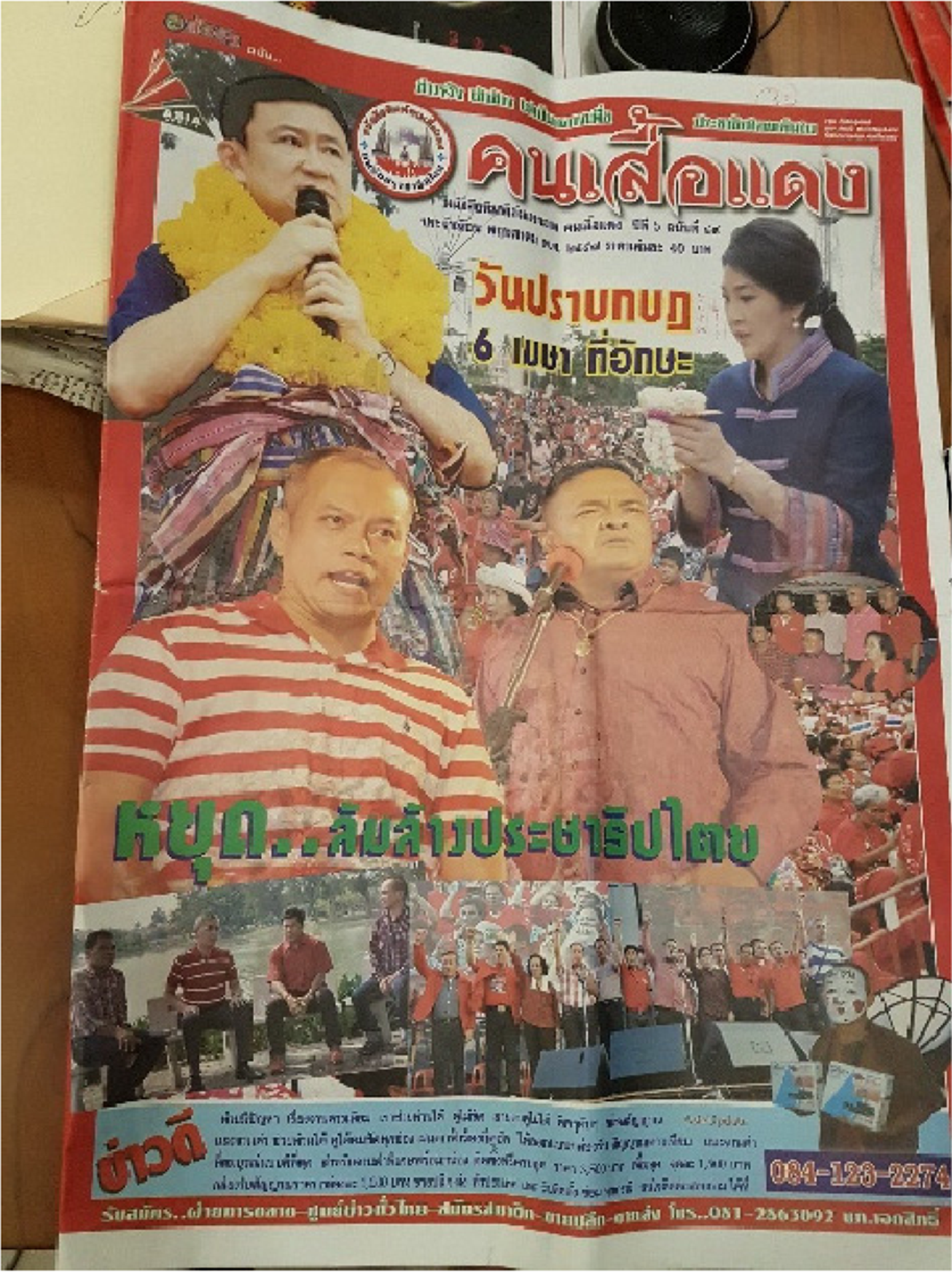
2014 representation of the chain of command from Thaksin, to Yingluck to the core leaders of the UDD and then to lower tiers of leaders of the United Front for Democracy Against Dictatorship (UDD) and then to lower tiers of leaders.
Thaksin, without the trappings of office, sought both international and domestic support to protect his interests. He rhetorically accommodated the Redshirts movement's objective to restore liberal democracy, despite his erstwhile antipathy. Given Thaksin's popularity, the movement, in turn, benefited from his ability to mobilise support. This interaction of leader and movement (explored in the next section) facilitated the emergence of a chain of equivalence among a varied support base and Thaksin's erstwhile critics. Their particularistic claims were frustrated by a military coup and its aftermath, merging into a universal demand for democracy. As Taylor (2012: 125) notes, “The shout at rallies of ‘Thaksin!’, ‘Thaksin, come back!’ was a symbolic statement to reinstitute social justice, economic opportunity, and political inclusion.” Thaksin assumed the empty signifier's role. His particularity was simultaneously suspended and collectivised to become the focal point by which all the particular demands and desires of a range of actors came to be articulated into a movement demand for democracy, signalling a populist rupture. Put differently, Thaksin sleep walked into an empty signifier. 4
All Roads to Thaksin: Leader and People Becoming
In December 2007, in the lead up to the election of that year, a pro-Thaksin newspaper Mahaprachachon (the Great People), ran a front page superimposing Thaksin on a crossroads sign with the headline “ALL ROADS TO THAKSIN” (Figure 2). The headline and image stunningly capture the unifying role of an empty signifier (the mythic Thaksin) standing in for the range of demands such that it becomes a universal claim for people's power against an elite. The subtitle reads “23rd December 2007 [election date] a coup by the people”. Thaksin's proxy party, People's Power, won that election. That and other electoral successes of pro-Thaksin forces were a reward primarily for his party's ability to deliver on its social contract to “the people” during his first term as prime minister (Hewison, 2004). Thaksin was popularly vaunted as the leader who delivered. No amount of electoral re-engineering in the 2007 and 2017 constitutions has been able to eradicate the nostalgic attachment of segments of the electorate to Thaksin and the historic gains of his policies (Taylor, 2012).
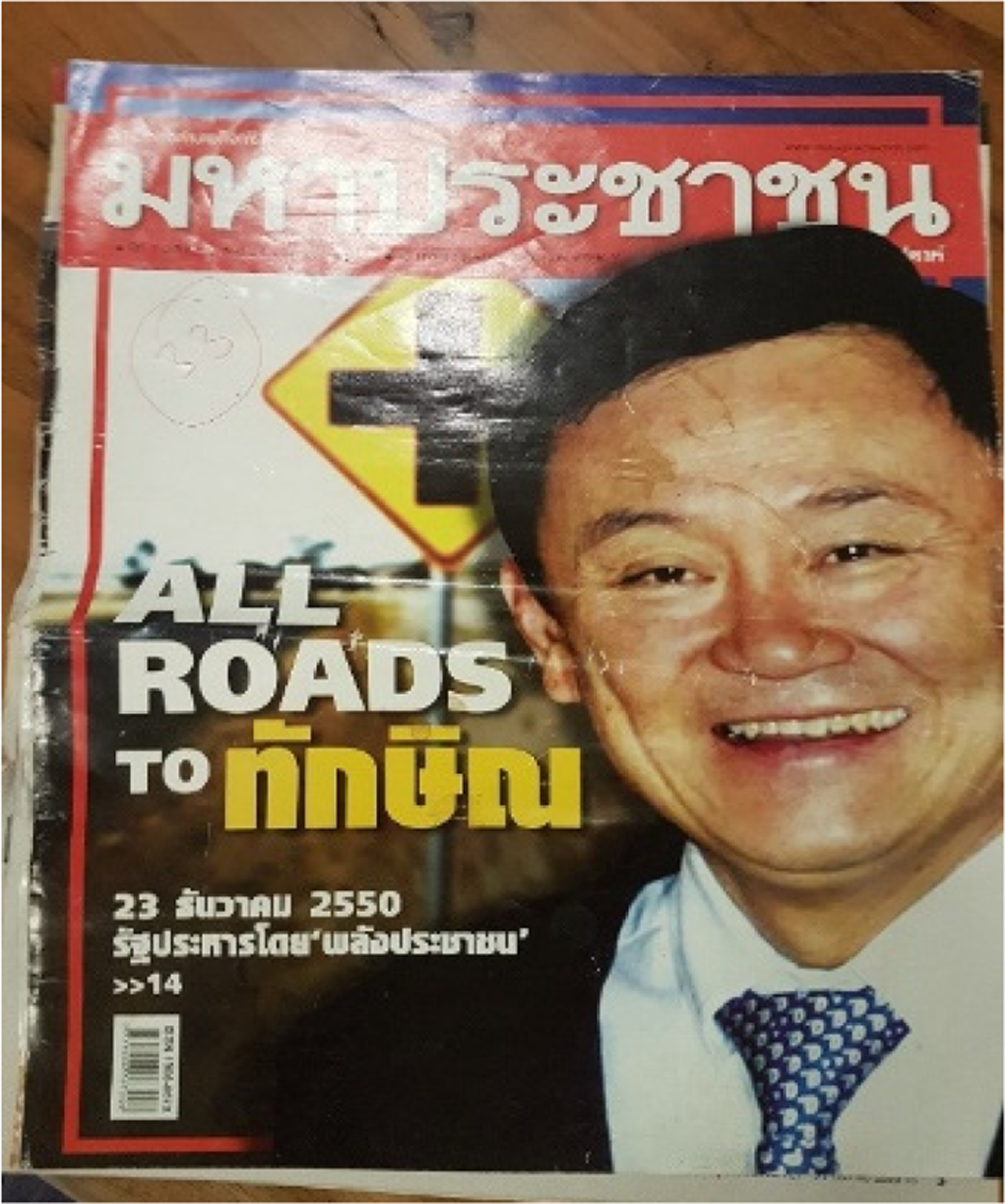
All Roads to Thaksin.
Indeed, repression of the movement and accommodation to popular material aspirations in the form of inducements only served to magnify loyalty to Thaksin, creating a revolution of expectations on his imminent return. A year after the massacre of 2010 and the state of emergency that followed, the Nationsutsapda newspaper visited the Northeast and reported the rise of Redshirt villages and vendors (Somphok, 2011). Such villages had appeared all over the Northeast with red banners flying over village arches, with some declaring “This is a 100 per cent redshirt village”. Another story in Nationsutsapda covered the post-massacre rise of Redshirt vendors despite the repressive atmosphere. A vendor of watermelons who was advertising his merchandise as Redshirt watermelons (as were many others) explained: I am a redshirt. This poster and flag, I made it myself. I didn’t get money from anyone else or from the president of the redshirts. I did it because I like the redshirts with my heart. With my ideology, I like Thaksin because he is a person (with) a good policy. He said before …that he would solve poverty in three months and he did after three months in government. There was the one-million-baht project, and there was OTOP, free education, and such things. I liked these not because of money but because you could take him at his word (cited in Kwanchai, 2011).
Thaksin had achieved much of this through centralising discretionary budgets in the prime minister's office and cutting through the formal procedures of disbursal (Suehiro, 2014). This personalistic inflection created a line of gratitude to him directly from his followers.
Jakraphop Penkair, Thaksin's former spokesperson, has noted that Thaksin played a role in bringing the people into political life. Most notably, Thaksin's healthcare policies challenged the old way of thinking that they were poor because of their karma: “The mindset is being human…Thaksin did that first”. 5 If exaggerated, it was a widely shared sentiment. Jakraphop revealingly spoke of Thaksin as an agent of modernisation addressing Thailand's historical backwardness, saying, “I believe that I have been angered by the fact that Thailand has been kept backwards as a child slave, I believe the country should be treated as an adult…Thailand should not be seen as a cute country…” 6 .
In these representations, Thaksin stands in for national progress by uplifting the people and the nation and breaking from the infantilising nature of royal nationalism and its civilisational posture towards nurturing a child-like people to maturity.
An empty signifier, analogous to a black hole, absorbs many desires and identities. That being so, it is easy to see how Thaksin challenged the notion that the king was the nation's soul. Thaksin became a surplus reference in the national discourse, even in his physical absence from the country. Redshirt media were awash with Thaksin portraits in various poses, polo cap, casual golfing wear, and formal civil service uniform — but whatever the image, they imprinted his permanent presence. For example, in a column titled “From a faraway land” (2011), a picture of a smiling Thaksin sits above a dragon statue in Singapore. The caption reads “The Prime Minister in the hearts of Thais …we will not forget.” Another striking image is that of a red-clad Thaksin set against an image of a Redshirt rally with a mask of Thaksin held aloft as if to suggest an identity between Thaksin and the crowd. Appearing on the front page is a headline regarding efforts to secure a royal pardon for Thaksin. Scrawled across Thaksin's image in his handwriting is a message “I will never forget the great generosity of my brother and sister redshirts” (Thai Red News ไทย เรดนิวส์ 21–27 August 2009: 1). The ubiquity of Thaksin's image allowed creative license, with the World Today (โลกวันนี้ July 23–31, 2009) on its front page superimposing a mask of Thaksin into a Mao cap and suit — the revolutionary leader of the people. During his exile, Thaksin sent make-up postcards that Redshirt media reproduced. Invariably, they offered gentle messages of homesickness and expressions of gratitude to the people for comforting him. Proliferating images of Thaksin played a subversive role in the formation of the we logics of populism, creating gleeful intimacy and seemingly unmediated presence.
This ongoing contiguity and instantiation of the leader/people are exemplified in a reporter's visit to Thaksin while exiled in Hongkong. The reporter ponders what gift to bear and decides to record Red shirt protest rallies for Thaksin to enjoy, thus producing reciprocity of estrangement resolved by emotional media aurally capturing a common struggle (see Figure 3 for one such media). In that Hong Kong interview, Thaksin explains his late realisation when he was prime minister that a phuu mi barami (a person with charisma, meaning either the king or a Privy Counselor) was moving against him. He notes that this view, shared by people in the provinces, brings support and a common purpose. He notes that the provincial “Rak Thaksin” [Love Thaksin] groups formed “because they saw me being bullied” (Anonymous, 2009a: 6–7). The reporter muses on Thaksin's diminished status, from the prime minister to exile and fugitive. Asking whether he lost face when he phoned into opposition rallies that at times had just several hundred people in the early days after the coup, he answers, “We are all humans, I do not think they are low we are high” (8). In his fall from office, Thaksin had become one of the people. As the reporter put it, he changed “from boss to everyone's older brother” (from jao nai to phi chai) (Anonymous, 2009a: 9).
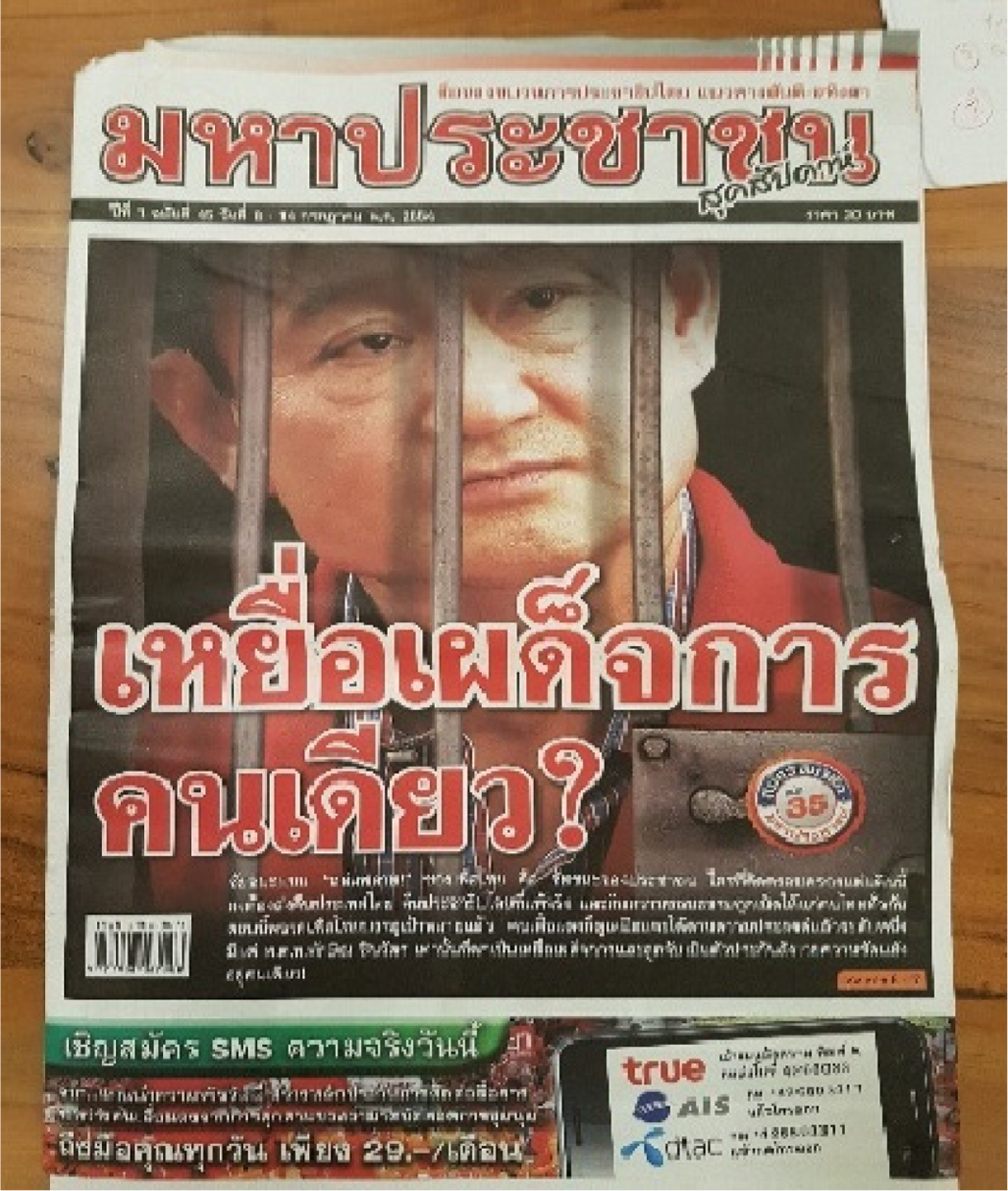
The Only Victim of Dictatorship?
Behind the Empty Signifier
Redshirt political cadre were economic and political modernisers with long histories, but bereft of an instrument until Thaksin emerged as the people's “representative”. They had to live with the contradiction of a billionaire being at the symbolic helm of a democratic movement and being the key decision-maker above the leading cadre of the UDD. Redshirt cadre was aware of the dangers of tying the democratic movement too closely to Thaksin. Indeed, Thaksin's strategy of maintaining a leader-mass relationship with his core electoral base and the movement's willingness to use this to advance its broader goals of democratic restoration put the movement in a dependent position. The Editorial Team (2009, 10) of Thai Red News proposed a cautious distance to Thaksin. Recognising that the people who love Thaksin were the movement's base, the team proffered that Thaksin had moved into the struggle against the elite after earlier vacillations. That being the case, the question of supporting Thaksin was not about Thaksin but centred on the principle of elections and democracy. Unfortunately, they admitted, “this is still a struggle for Thaksin in many eyes — and many of his supporters do not separate the struggle for Thaksin with the struggle for democracy (Editorial Team, 2009: 11). They feared that an overwhelming focus of everything being about “Thaksin” was a danger to the movement. Thaksin's paramount interest in the movement was potentially using it as a battering ram or bargaining chip to return his confiscated wealth and status. 7
As the counter-movement to Thaksin and his proxies hardened into a reactionary movement seeking an end to electoral democracy in 2008, even the left within the Redshirt movement viewed Thaksin as fundamental to their political objectives. They effectively dissolved themselves into the movement's empty signifier despite their recognition of his earlier authoritarianism. They succumbed in mid-2009 to Thaksin and his ally's control over the burgeoning Redshirt movement. Thaksin's supporters developed efficient organisational centralisation and a loyal chain of command that sidelined more independent elements. 8 Whatever the cadre's rationale for working towards Thaksin's restoration, their willingness to do so furthered Thaksin's occupation of the empty signifier. Thus, the leader, the people, and the general will form a consummate people's army confronting the enemy.
Moreover, despite such reservations about Thaksin's democratic deficit, some viewed Thaksin's government as the most democratic Thailand had experienced. Such was the view of the now exiled Jaran Ditapichai, who was formerly Chair of the Union of Civil Liberties and then served as a human rights commissioner during Thaksin's prime ministership and was highly critical of Thaksin's human rights record. Ditapichai argued that despite the 2003 War on Drugs and Tak Bai killings of over ninety unarmed protesters in the South in 2004, “Thaksin's was the most democratic government because it was the only government that made the people know what the meaning of politics is.” 9 Jakraphop Penkair and former Minister and Thaksin's communications guru, now in exile, was aware of Thaksin's authoritarian slide but viewed him as a historical instrument: “I do not see Thaksin as an angel, I see him as the right leader for this moment….” 10 . Jakraphop recognised the problematic relationship between Thaksin and the aspirational 1997 constitution, noting that Thaksin had to function and survive in a patronage system. In an interview with this author, Jakraphop linked Thaksin and the revered Pridi Panomyong, a revolutionary leader against the absolute monarchy in 1932. He said, “I have read Pridi, I subscribe to many of his ideas…I believe he was an accomplished idealist but a failed politician, so what I was looking for was a successful politician with some possibility that those aspirations would be revived. That is why Thaksin has been my choice to work for”. 11 Thus, Thaksin incarnated the thwarted spirit of the Thai people's revolution against the aristocracy.
Other activists filled Thaksin, the empty signifier, with historical objectivism. Some expressed the belief that as Thaksin was a representative of the thun mai (new capital) or globalised capitalism and Thailand was in the grip of liberal democratic revolution, Thaksin was the inevitable leader of this movement. One pseudonymous author (Chartnakrob, 2009) notes, “Right now Thailand is in the revolutionary stage for democratic liberal capitalism which flows from the revolution of 1932. This revolution aims to create prachathipatai thuniyom seri (Liberal democratic capitalism), and thus the leader must be representative of new capital, progressive globalisation, and be prepared. When this problem is analysed, we see that this leader is unavoidably Thaksin.”
The People and the General Will
One of the earliest post-coup pro-Thaksin newspapers was called The Great People (Mahaprachachon). The invocation of that people in Redshirt identity became a recurring theme across speech and textual media. Studies of music during Redshirt rallies have noted folk music's dominance on the stage of the Redshirt protests and across community radio stations (Mitchell, 2011). This élan of ordinary people is captured in newspaper social pages (Figure 4), showing a range of people involved in Redshirt activities, a kind of Redshirt riff on hi-so celebrity pages. The banners that accompanied provincial mobilisation to set up make-shift camps at the Redshirt protest sites proudly announced locality. 12
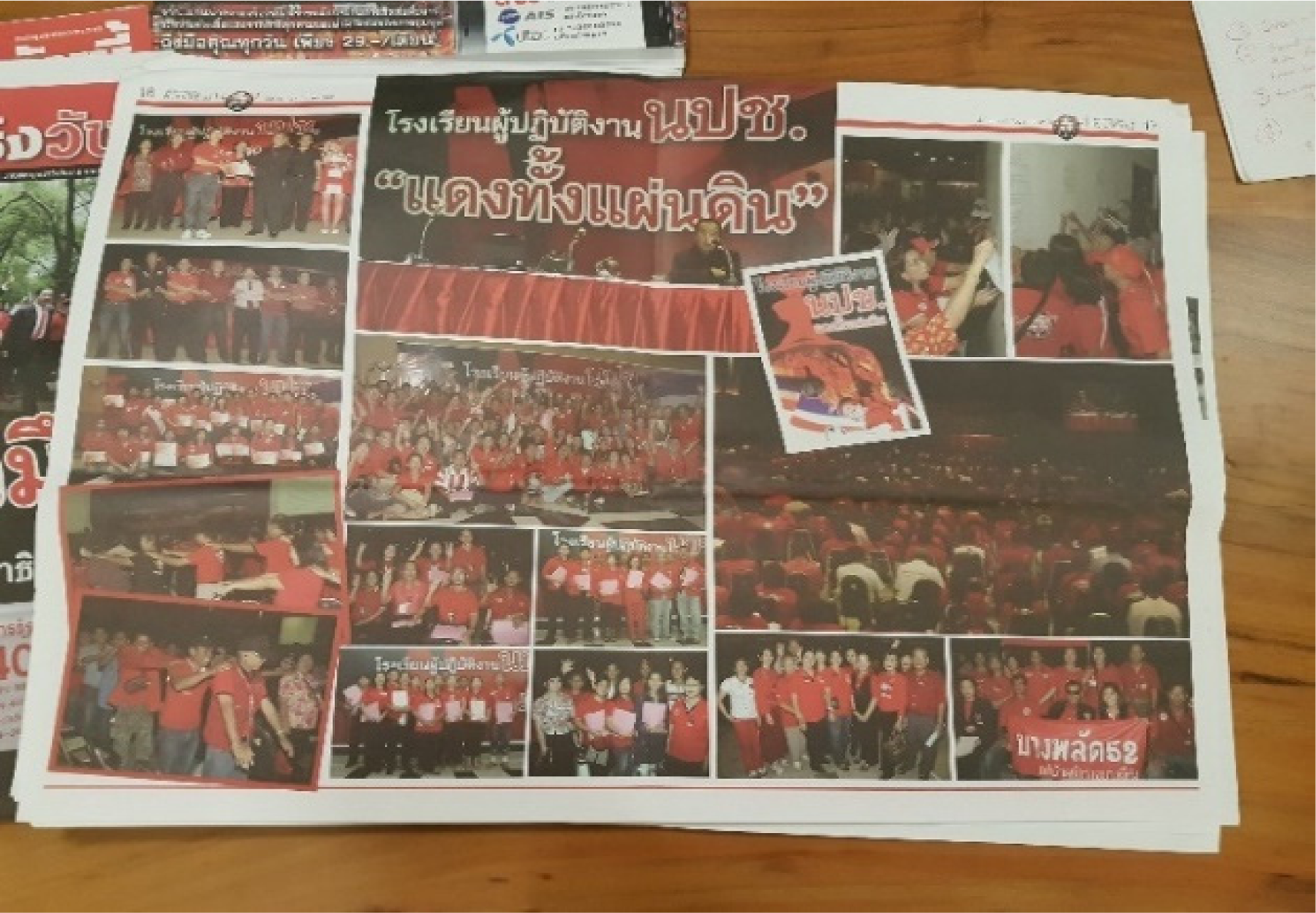
School of the United Front for Democracy Against Dictatorship (UDD): Red Throughout the Land.
An often-noted self-depiction of the Redshirt movement was its use of the words phrai (serf) and khwai (buffalo) as self-ascription and flaunting low language (see Buchanan, 2013: 66–67; Sopranzetti 2017: 191–193). The latter, much less widespread, caused some controversy when a publisher issued a protest edition of Red Buffalo News (Figure 5) at the 2014 Redshirt protests– appropriating a slur used by some commentators that the people who formed the Redshirt movement were like dumb buffaloes. 13 However, it was the former that gained prominence. Phrai was a label borne proudly on t-shirts and headbands. It marked the consciousness of second-class citizenship and forged a break between the people and elite (amaat) that stretched to the unresolved tensions of the 1932 revolution. Use of this language was an attempt to critically name the amaat political culture that functioned to exclude ordinary people. It was not a pleading but a flaunting of low status, figuratively shaking off the dust on the peasant and rubbing it into the eyes of the supposed superiors. Naming oneself phrai was an act of walking all over the historical and contemporary pieties issued by state agencies and the anti-Thaksin yellow movement about virtuous citizenship. There was speculation that the government would ban the words amaat and phrai to repress the populist rupture inhering in them (Figure 6). 14
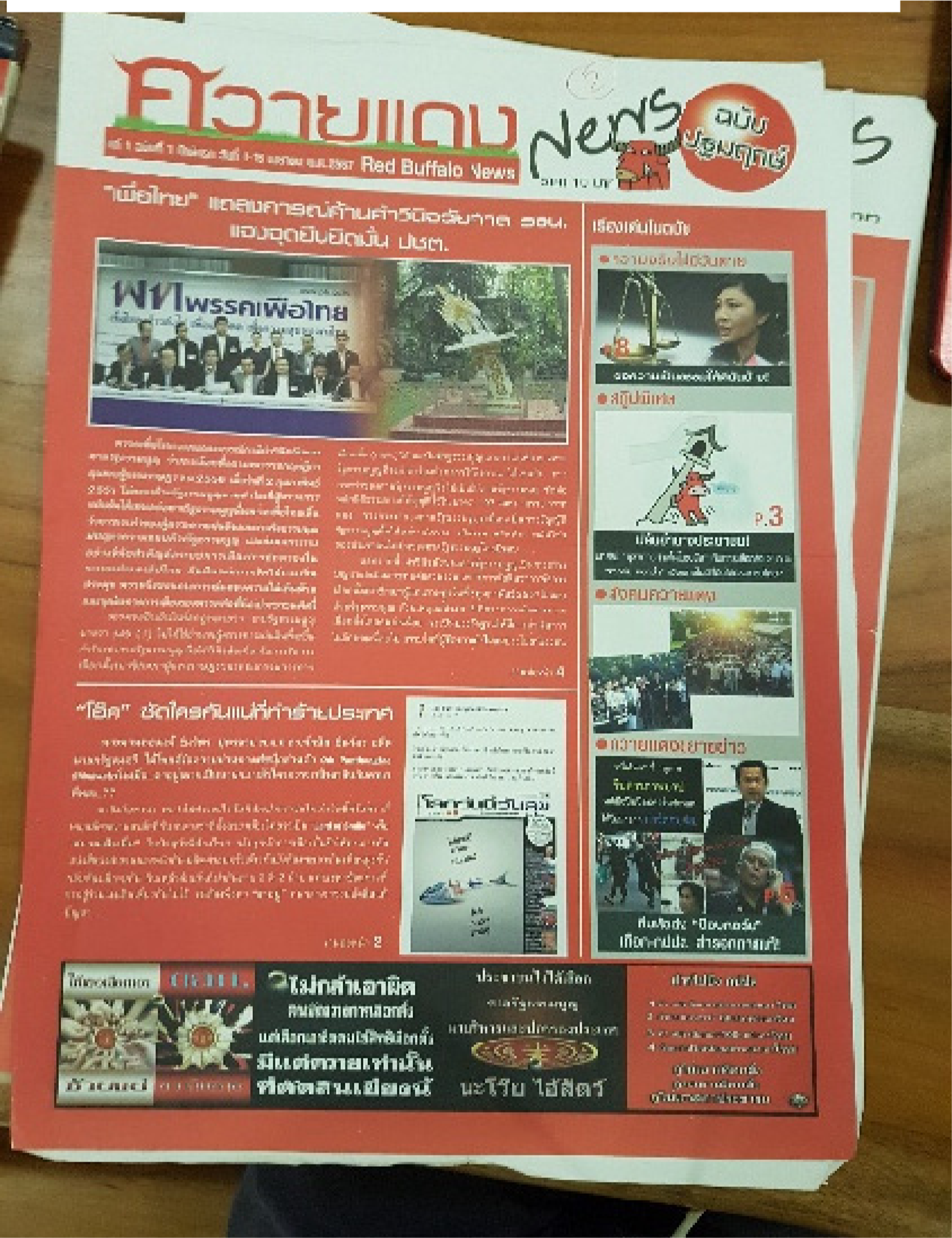
Red Buffalo News.
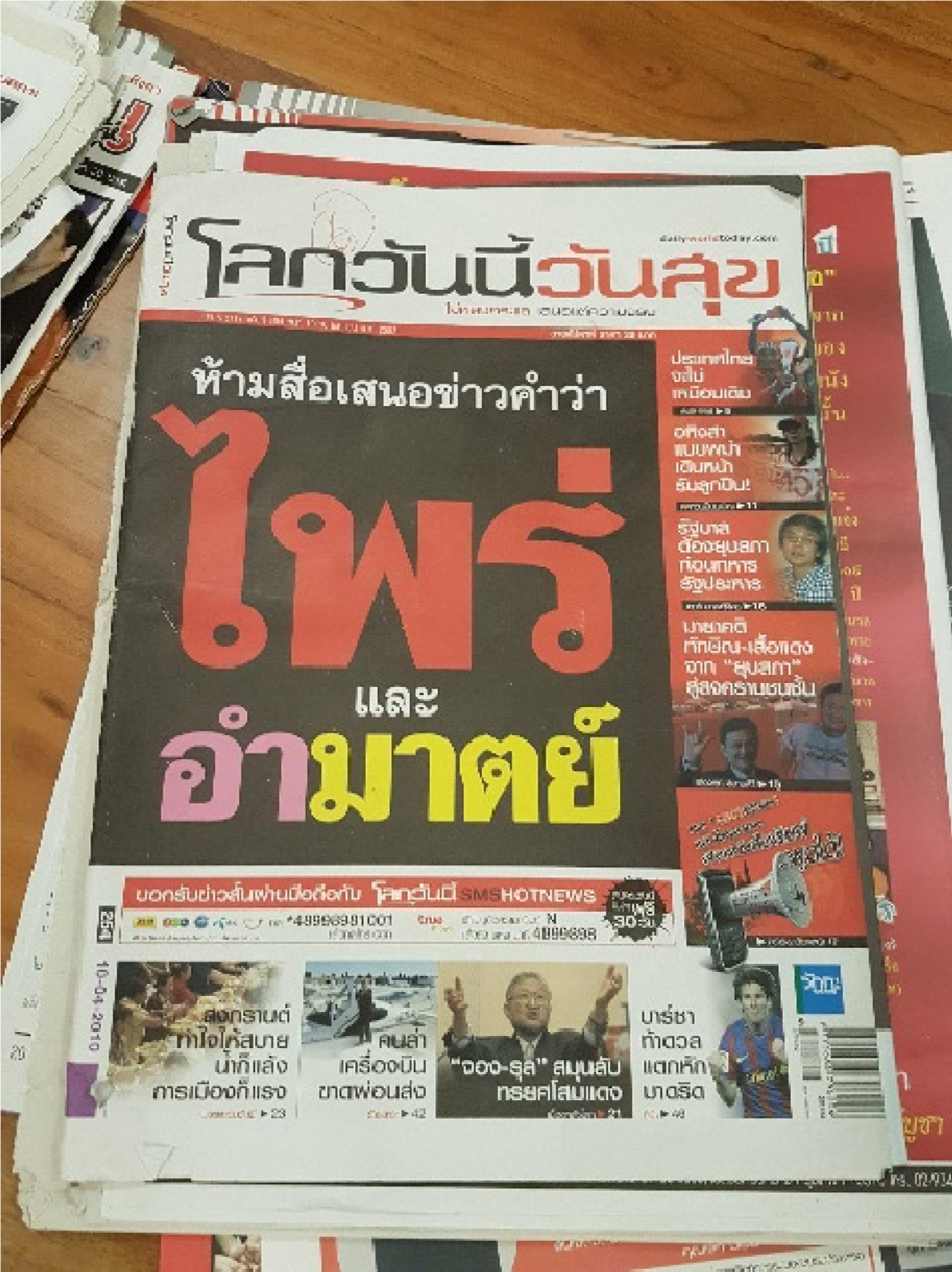
Media Prohibition on the use of Phrai and Amaat.
The signifiers had done their work. They focused on a friend/enemy formation that allowed the people's woes to be placed squarely at amaat's alleged relentless machinations to keep power and wealth since 1932. The adoption of red as the colour of the movement (initially the colour used to oppose the military-backed constitution of 2007) marked a consolidation of identity. In early protests during 2007, the precursor to the UDD, the Democratic Alliance Against Dictatorship, and other groups did not have identifiable protest attire. During the attack on Privy Councilor Prem's house in July 2007, many activists wore yellow shirts. Belated red colour identification was a marker of a consolidated identity — a symbolic manifestation of the populist rupture that pitted the phrai against the amaat.
The movement was concrete in its particularity and gleeful in its flaunting of low language and sarcasm, while theoreticians saw the people more abstractly as a constituent power. They tended to construct an abstract concept of a historical people whose general will had long been thwarted. Suphachai's (2013) study of the Redshirt movement's use of Rousseau and the idea of the general will noted the increased usage of “general will” discourse in political commentary in the post-coup period. Across Redshirt media, “constituent power” emerges in theoretical articles on the legitimacy of democracy as formed through the popular will. In one discussion, Thai Red News editor Wiboon Shamchuen (2010) deliberately uses the noun buangchon to indicate the people's abstract nature instead of being a collection of individuals (prachachon-phonlameuang). He describes the coming period as a revolutionary one in which the people's sovereignty will challenge dictatorship. Even when not invoked directly, the general will was an implicit presence in the universal demand for a people's democracy. Across op-eds and “educationals”, the problematic sovereignty question that has accompanied Thai politics since 1932 was also on display — how to articulate the people and the monarchy. Although elements of the Redshirt movement were anti-monarchy, the mainstream attempted to negotiate a new relationship with the monarchy. It claimed that it was more loyal to the monarchy in seeking constitutional rule.
One dramatic example of the sovereign people's political elevation included the appropriation of the Royal Chakri Day during the mass protests in 2010. This was announced on the front page of a Redshirt publication: “Chakri Day: we cannot be dispersed” (Figure 7). This was not merely a pushing aside of the monarchy. Instead, it was a process of strategic appropriation of the monarchy to the cause of democracy. The bottom banner of the same front cover states, “this home loves the king, treasures democracy and resists dictatorship in every form”. This recentering of the people in its relation to royal prerogative is made explicit, and perhaps ironically so, in one instance in the renaming of the Racha-prasong hi-so shopping precinct. Racha-prasong (translated as royal wish) was the central location of the largest demonstrations in 2010. The presence of the Redshirts was consciously a physical inscribing of a new will. In April 2010, Jakraphop, who had previously issued a volume of poetry [Democracy in a Cage), penned the poem Ratsadon-prasong (the people's wish). 15 Jakraphop (2010) versifies Racha-prasong as a “middle-class heaven” and calls for the making of history by appropriating it as Ratsadon-prasong. This demotic remaking of royalist markers was carried out in other ways. Jakraphop's column in Thai Red News was called “I am a servant of the people”, consciously playing with the dominant idiom of “servant of the crown (kharachakan)”.
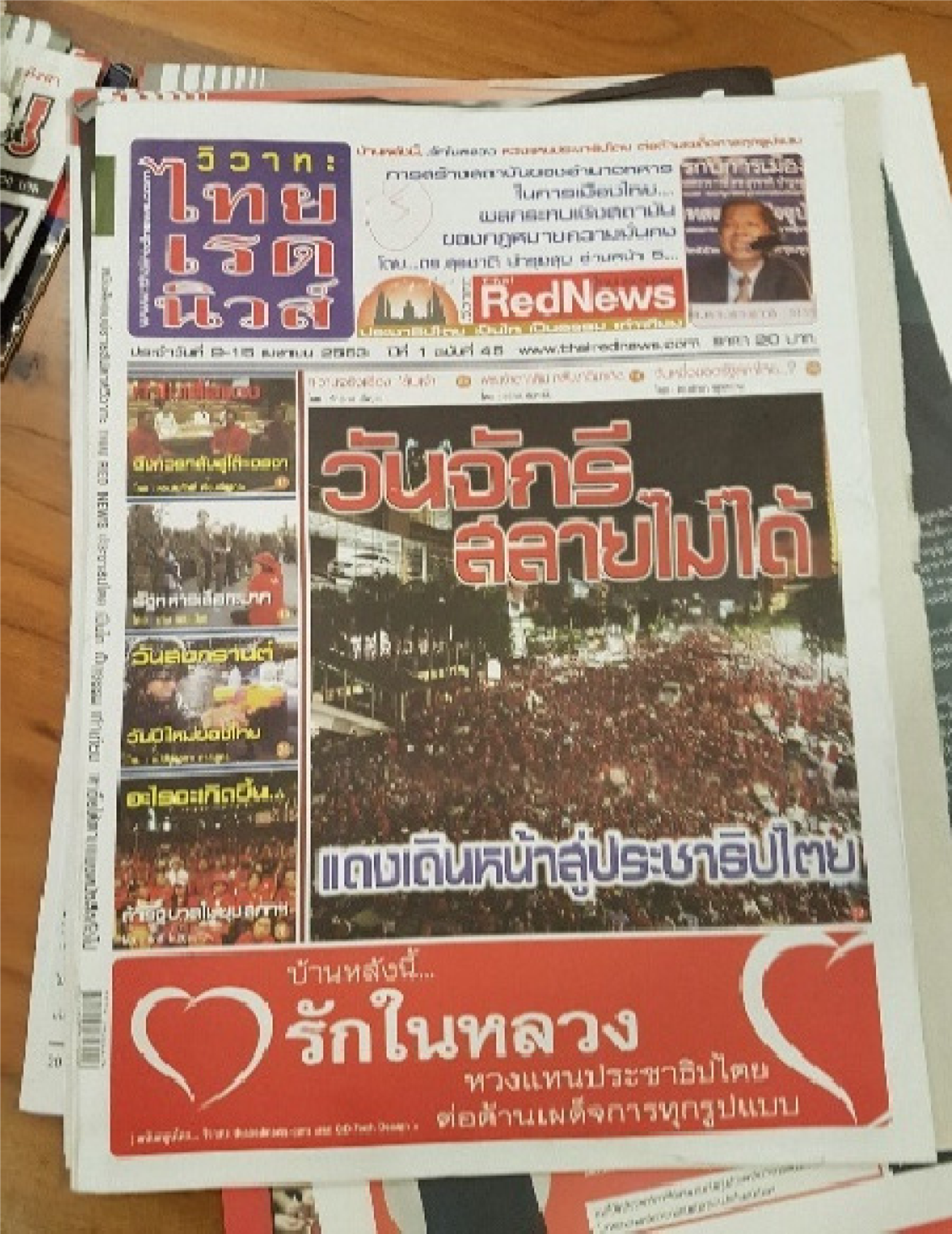
Chakri Day.
Significantly, the issue of the people's sovereignty was posited in historical terms, with the Redshirts portrayed as heirs of the 1932 revolution. Writers regularly invoked the need for revolutionary intent and the need to sacrifice to bring about a liberal democratic revolution (Editorial Team, 2010). This reaching back to the 1932 revolution and the implicit acceptance of death as martyrdom is the highest order of historically imagining a collectivity joined by the political logic described by Laclau. At the end of the tiny pamphlet Questions and Answers about the UDD (2010) distributed during the 2010 rallies, the writer suggests a slogan: “You cannot kill the population. You cannot eradicate them all.” This expression of a people's sovereign immortality is the populist purity that ties people across time.
The Enemy
“They have created a kingdom of fear by hands we cannot see, one with great barami” (Suwit, 2009).
When Thaksin declared several months before the coup d'état that there was a person with charisma acting outside the constitution to bring him down, he presaged a strategy for constructing an enemy other, however reluctant he was to reveal details (Ukrist, 2008: 128). This populist logic emerged not only through Thaksin's self-referential concerns but rather in the presses, speeches, and activism of a political cadre that would build the Redshirt movement. In early 2007, small groups such as the Sunday Group and the September 19 Network began constructing a clear attack target. A series of anonymous pamphlets with no publication details attacking the military, Prem, and the courts circulated at small protests at Sanam Luang. These were incendiary (Figures 8 and 9).
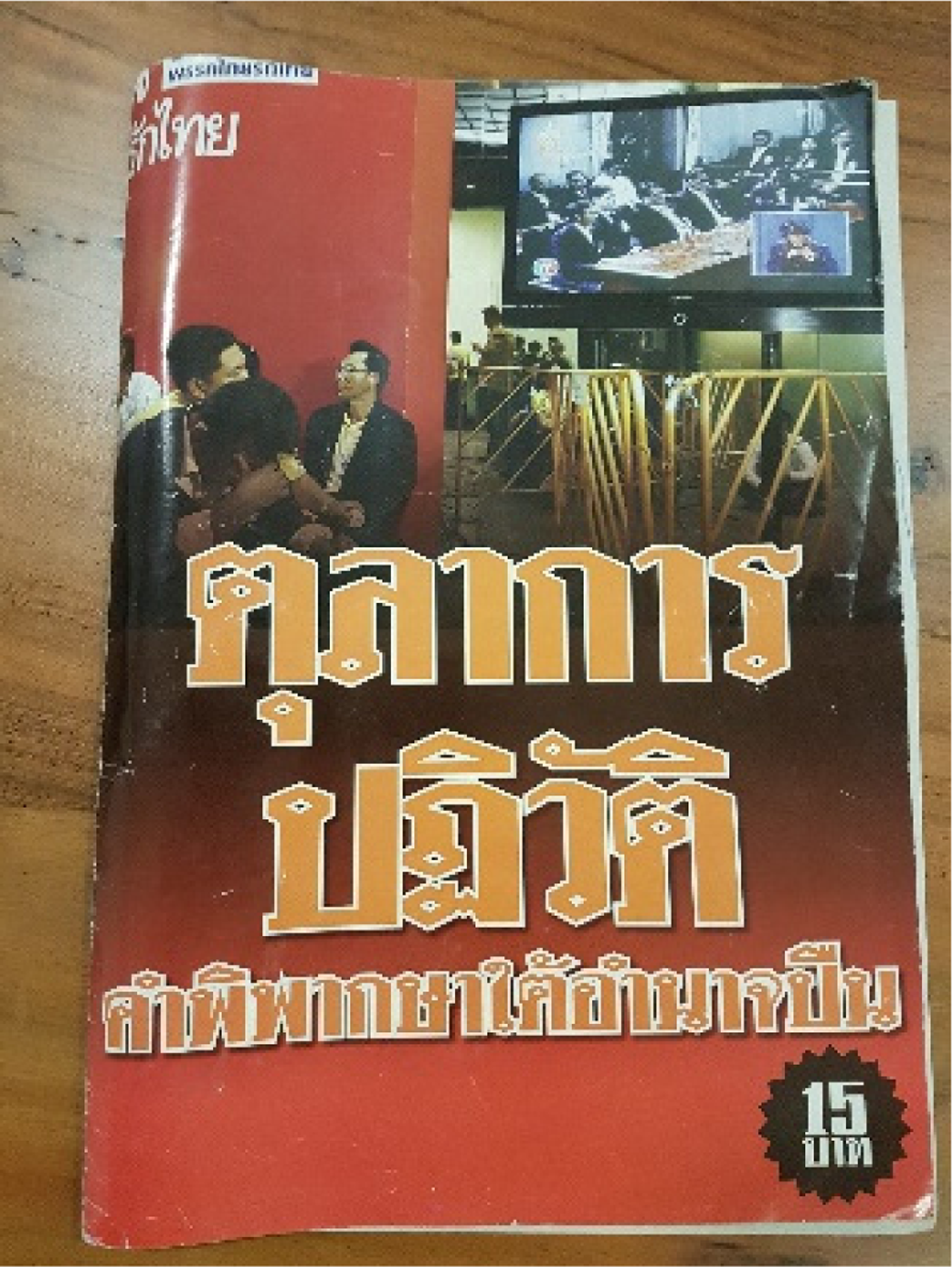
Judicial Revolution: Judgement Under the Power of a gun.
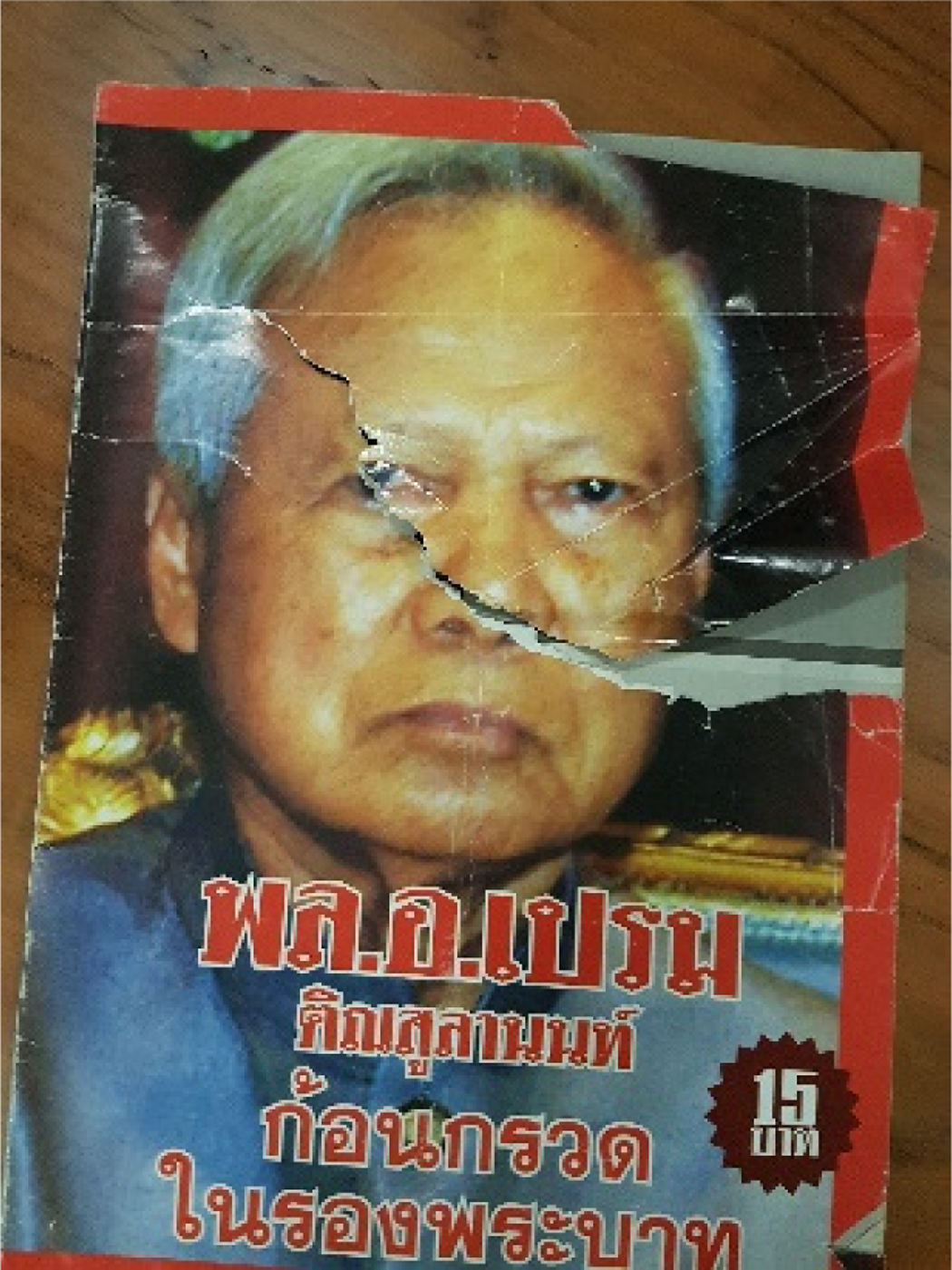
General Prem: A pebble in the king's shoe.
What was emerging in this early period was not a demand to simply return to democracy and for the military to return to the barracks. Instead, the burgeoning movement would aim to bring down a network of cross-institutional elites that had conspired to oppose popular sovereignty. As a significant thinker of the early movement, Jakraphop was aware that this was a qualitatively different approach than the 1992 movement that had successfully fought dictatorship only in the shape of the military. The embryonic movement sought to name identifiable and wide-ranging elites that were the establishment, in whatever political guise they held power. While “dictatorship” had been the historical target of democracy movements since the 1970s, the Redshirt movement supplemented this with a new and unlikely term. As phrai-amaat discourse reached a crescendo in 2009, Jakraphop (2009b) noted that “if I am asked what am I most proud of in the four years of struggle with people for democracy I will answer immediately that I am proud that the people use the word amaathiyathipadai in the status of being the main target instead of dictatorship.” Jakraphop translates the term as aristocracy, but it has also been translated as “bureaucratic polity”, or “oligarchy”. In the post-coup struggles, the amaat became the antagonistic other that opposed popular sovereignty. In using this term to identify the amaat concretely, the movement established the frontiers by which a political logic of enemy/other could return over and over, leading the movement to a permanent vigilance. Indeed Thida Thawornset (2011), one of the key UDD leaders who was also prominent in Redshirt schools, explained, “Do not forget that we use the mass line approach and one lesson of the people's struggle is it must differentiate between friend and enemy”. The mass line enabled the firming up of the populist subject by disseminating the idea that dictatorship came in many guises and a democratic movement, even during nominally democratic times would have enemies or what Jakraphop (2009a) would describe as the “amaat who formed the government within the government.” This government, which was said to include civil servants and the military who take part in the patronage system, the Internal Security Operations Command, various ministries and state enterprises, and lawyers who stood over the nominal government: “it is the real government in this kingdom”. In this manner, the Redshirt movement could fundamentally oppose the Abhisit government that came to power in 2008 and governed until 2011, rather than act as a loyal opposition. They viewed the government as an illegitimate offspring of the amaat, who acted as conspirators.
What had begun as minority political discourse of leftists in publications such as Siam Parithat edited by leftist figures such as Somyot Pruksakasemsuk (who would go on to serve seven years in goal for lese majeste) and Suthachai Yimprasert, and which involved extended ideological arguments about the ruling class, and long theorisations of Thailand political formation now grew into popular discourse. Red media and speeches from the stage of Redshirt protest sites repeatedly assailed the amaat. The process began properly in 2008 as a wide societal discourse and grew phenomenally. When the pro-Thaksin People's Power Party won office in late 2007, key stage speakers of the early protest movement were elevated onto state broadcast TV. From that position, they issued tireless attacks on the illegitimacy of the coup. They characterised the Democrat Party as the party of dictators and the state's independent agencies as mere lackeys of the elite (Connors, 2008). By extension, for Redshirts, if the establishment threatened the pro-Thaksin government of Samak (2008), then it was not hard to conclude that the cases against Thaksin which progressed through the courts were sheer unjust machinations. In the program Truth Today, remarkably broadcast on public television, the three hosts Veera, Nuttawat, and Jatuporn would develop polemical and hard-edged skills of identifying the people's enemy everywhere: in the courts, in the constitution, in the military, and the Democrat Party and the independent agencies of the state (ibid). These skills then transferred to the protest stage once the courts effectively dismissed two pro-Thaksin governments in 2008.
The moral, economic, and political corruption of the amaat became the standard response to claims of Thaksin's corruption (which cases were slowly winding through courts and committees). This was a Thai instance of the “whataboutery” logic that is now recognised as part of combative political rhetoric of populists that seek to deflect responsibility. Here, the strategy highlighted the politicised and selective nature of law — the so-called judicialisation of politics discourse — that served the amaat. Even so, the issue was never so much about law. It was about undermining the claimed moral supremacy of the amaat by a succession of attacks on its “double standards”. This happened when Redshirt protesters exposed the illegal land encroachment of the 2006 coup appointed prime minister and privy councilor General Surayut at Khao Yai and protested on site. Truth Today portrayed President of the Privy Council Prem and privy councilor Saruyut, who served as prime minister after the 2006 coup, with the headline “Amaat eat the forest” (Figure 10). The enemy was being made concrete in all its venality. To make the point stick, UDD leader Veera Musikapong in his regular Truth Today column (29–31 December 2009: 3), declared that upcoming protests at the forest reserve would show the world Thailand's legal double standards. After all, “Those with dark faces, ordinary people are already in jail for the same.” The “Eat the forest” headline achieves the closure that forges a chain of equivalence — all the life struggles of those who made up the movement are, whatever their ailments, the victims because “injustice is burning the land” (Anonymous, 2009b: 6–7).
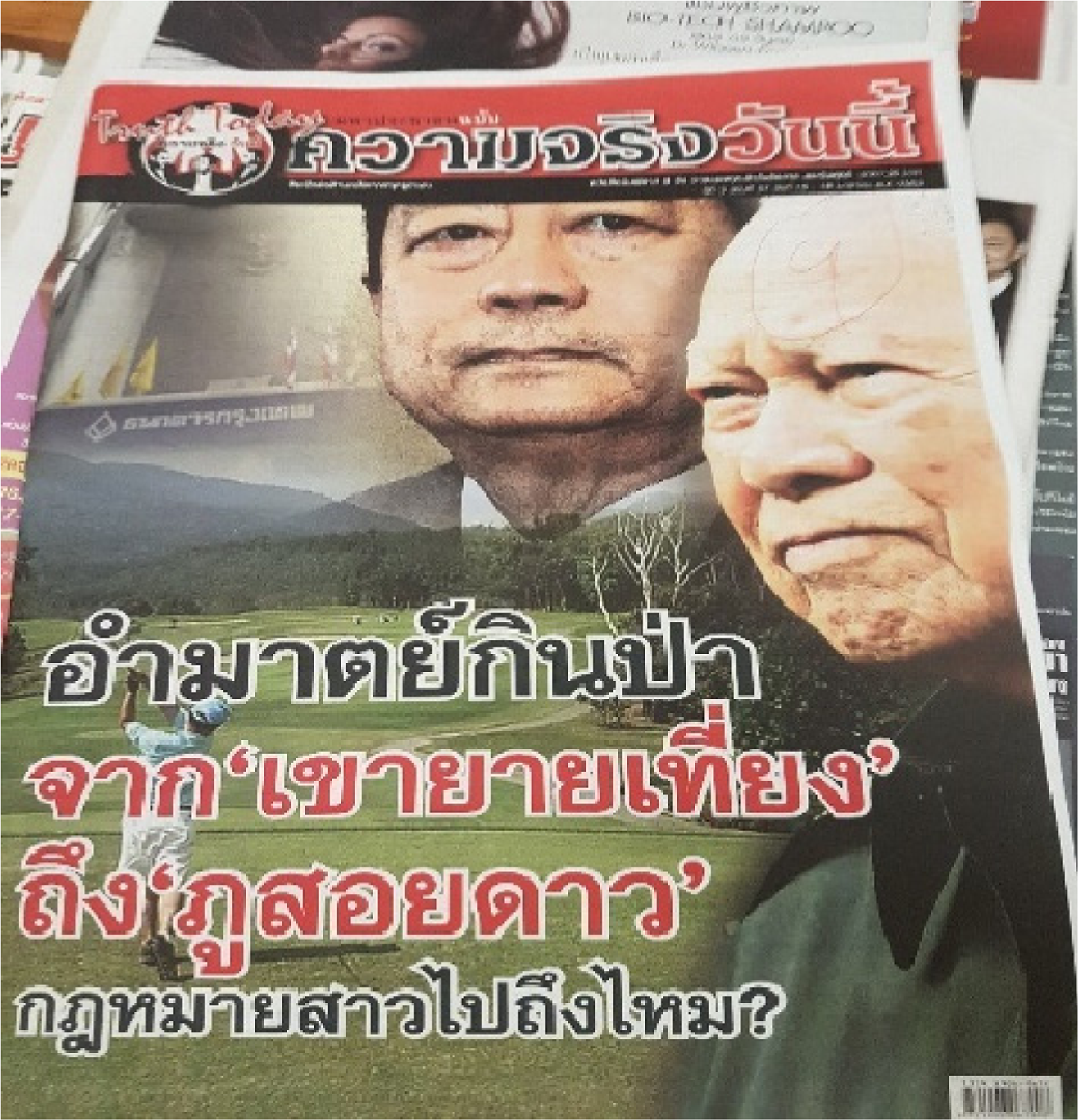
Amaat Eat the Forest.
Another construction of the enemy in populist discourse was the characterisation of the amaat as existentially threatening electoral democracy (for which evidence abounded) (Somyot, 2009). That threat enabled their demonisation (a logic that followed the anti-Thaksin movement in its animalistic characterisation of politicians, the UDD, and Thaksin). This process grew more extreme after the state killing of UDD protestors in 2010 but was present earlier. For example, in the lead up to the April–May protests in 2010, a Redshirt columnist (Nong, 2010) offered a “Red Bangkok on Tour”. It recounted yellow shirts” sins and began listing “diabolical” people dangerous to democracy, promising further revelations about their sins and karmic retribution. The amaat were called “beasts from hell” who seek power by any means, belying their khondi (good person) persona. Fake advertisements, satirising the rightwing pro-monarchist Rubbish Collection Organisation that wanted loyal Thais to act as vigilantes against lese-majeste, appeared in newspapers. They carried mugshots of eminent “virtuous people” including Prem, Anand, Prawet and others, labelling them as “rubbish of the nation” and instructing “if you see them anywhere collect them, do not let them steal democracy.” (Rubbish of the Nation, 2010). Another attribution given the political enemy was criminality, claiming that mafia elements funded the anti-Thaksin yellow shirts. The enemy frontier then is viewed as criminal, inhuman, privileged, and hypocritical. Much work went into establishing how its machinations were creating damage for the nation, the people, democracy, and the constitutional monarchy.
Conclusion
This article has offered a new interpretation of Thai populism using new sources and a combined theoretical approach that speaks to populism's empirical content and ontological status. Below, I summarise the interpretative gains offered by this approach, and which may inform future scholarship.
By exploring Redshirt media around the themes of the leader, the people, and the enemy, a picture emerges of a movement disciplining the former authoritarian populist Thaksin into a proclaimed politics of liberal democracy. The attributional elements of populism are present despite these proclaimed ends. In the Redshirt movement, the formation of the popular subject, by the articulatory practices described above, was populist in the political logics sense. Redshirt media encouraged the identity convergence of leader-people that functions to draw a line across from which sat the enemy. This is the populist rupture that Laclau speaks of and which this article has argued had as a formal objective the restoration of liberal democracy.
As discussed above, Thaksin as a symbol was crucial to the robust and catalytic construction of the antagonistic elite/people dichotomy that sits at the heart of most definitions of populism. Thus, this article's central focus is not Thaksin the man, but on how a democratic movement elevated him and appropriated his capacity to act as a representative of “the people”. Following Laclau's logic, this collective performance — of the cadre invoking the leader, the leader playing the role, and the people consuming and demanding that role — plays a part in the people's very construction represented.
To return to the supposed oxymoron of a populism that supports the formal restoration of liberal democracy discussed in the introduction, and to offer the promised, but likely provisional, resolution of the tensions existing between the two approaches employed in this article. If populism is viewed as illiberal and anti-pluralistic in Mudde's ideational approach, what to make of the claim that the Redshirt post-coup populism framed their argument, at least formally, for the restoration of liberal democracy?
Viewed from the political logics approach, a populist rupture emerges in the post-coup period: a political antagonism arises between a populist subject seeking the restoration of liberal democracy against an oligarchic elite. The attribution, as required in the ideational approach, of the people and the elite is present too. But the tension emerges in the mismatch between the ideational attribution that a populist movement conforms to homogenous anti-pluralist politics of “the general will” and the UDD's formal objectives for liberal democratic restoration. Notably, Laclau's approach sees no contradiction, as his approach is formal and has no necessary reference to a movement's content but rather focuses on an antagonistic frontier — which was indubitably present.
One response to this tension, requiring further research and reflection, may be to bring the ideational approach closer to the political logics approach by expanding its ideational content to allow for historical emergence and to move away from the static identification of populist utterances that features in leader-centric studies. This would entail a recognition that the homogenous nature of the people imagined in a populist movement (the phrai in this instance) aligns with the formation of a general will in near revolutionary times — which is to say popular liberal democratic revolutions can speak in the name of the general will. A populist moment can also be a moment of constituent power seeking to break through an antagonistic frontier and establish a new order, and which hammers an old order with its assertive monolithic identity as the people, but which may give way to pluralist politics in its post-revolutionary construction. This is a political logics interpretative correction to dogmatic attachment to ideational criteria that would discount general will politics in relation to liberal projects.
The question of whether this period of populist rupture will revive is unanswerable. Notably, however, the failure of the Redshirt movement, the resultant disaffection with Thaksin and the UDD's leaders after the 2014 coup has done nothing to thwart the popularity of Thaksin's political party apparatuses in Thailand and the collective memory of better times. Despite the emergence of a new generation of democracy activists focused on reform of the monarchy since 2020, and who have sought to move on from the Redshirt populist rupture, the mobilisation and framing resources available for a revival of the populist rupture cannot be discounted.
Footnotes
Acknowledgements
This piece was first presented, in longer form, in November 2017 at Monash University Malaysia in a workshop on “Populism in Asia” organized by Marco Buente and Andreas Ufen. I thank them and the participants for helpful feedback. This piece has indeed had a long road to publication. Mark Thompson was indispensable in providing encouragement to publish and in offering suggested improvements. Marco Buente dispensed helpful advice and a kind willingness to engage on matters of difference. The peer reviewers kindly took the time to read the piece and helped me clarify the argument. I thank them all.
Declaration of Conflicting Interests
The author declared no potential conflicts of interest with respect to the research, authorship, and/or publication of this article.
Funding
The author received no financial support for the research, authorship, and/or publication of this article.
