



Abstract
This study examines how theoretically driven indicators modify our understanding of transition dynamics in Latin America. Our indicators show that a noticeable wave of reversion to authoritarian rule in Latin America occurred during the last two decades. Moreover, unlike the past, where authoritarian regimes were established with military coups, the Democracy-Dictatorship Reprise for Latin America (DDRLA) confirms that the region's recent experience with democratic reversion has been brought about by presidents who secured office through elections and who manipulated rules to remain in office for more than two terms. For the period from 1946 to 2022, we discuss how the minimalist conception of democratic regimes can be further advanced with our reformed political regime indicator, as well as measures of initial elections and political regime transitions. We then demonstrate the utility of the DDRLA by replicating studies recently published in leading journals.
Introduction
There has been a long-standing interest in comparative politics with political regimes, yet their measurement remains a point of considerable debate (Knutsen et al., 2024; Little and Meng, 2024). Building on seminal studies of political regimes undertaken in the twentieth century, scholars have pursued wide-ranging projects to develop appropriate measurements of democratic, authoritarian, and hybrid regimes (Alvarez et al., 1996; Boix et al., 2013; Coppedge, 2002; Coppedge et al., 2008; Diamond, 2002; Geddes, 1999; Hyde and Marinov, 2012; Munck and Verkuilen, 2002; Przeworski, 2013). Many scholars use these developed empirical tools not just for theoretical exploration but also to assess the practical causes and consequences of political regime type (Acemoglu et al., 2019; Brender and Drazen, 2005; Eberhardt, 2022; Przeworski and Limongi, 1993; Rodrik and Wacziarg, 2005; Ross, 2006).
This paper sheds some light on measurement problems in measuring political regimes and democratic transitions. We concentrate on the Latin American region due to both the region's early experimentation with democracy, enduring political regime fluctuation, and recent vulnerability to democratic backsliding (Hochstetler and Edwards, 2009; Przeworski, 2009). Using our deep-region-specific knowledge, we develop reliable and valid indicators of regime type, thereby facilitating and deepening scholarship on the dynamics surrounding bi-directional political regime transitions. Our specific contribution involves introducing a dataset – Democracy-Dictatorship Dataset Reprise for Latin America, hereby known as DDRLA – for nineteen countries in Latin America.
The introduction of explicit ex-ante criteria that emphasise the importance of alternations of political power to determine whether political regimes are democratic or authoritarian remains a central contribution of the minimalist criterion introduced by Alvarez et al. (1996) and updated by Cheibub et al. (2010). In our view, however, the minimalist notion of democratic regimes has been restricted to classifying political regimes in their “steady state.” In this study, we seek to introduce a theoretical framework showing that the minimalist criterion implies a dynamic process that requires defining and measuring (a) initial elections, (b) democratic transition periods, and thereby, the distinction between “transition” years and democracy years, and (c) whether democracies revert to authoritarian rule through elections. Our integrated approach to measuring the phases of democratisation sets the DDRLA apart from a simple updating of the DD dataset for the Latin American region.
The rest of this research study proceeds as follows. First, we describe the DDRLA's theoretical logic and operationalisation, emphasising the need to identify initial elections and the distinction between “transition” and democracy years. To operationalise a measure congruent with dichotomous democratic regime country-years, we introduce a two-turnover test following Huntington (1991) to capture the enduring and uncertain nature of democratic transitions identified in the literature and empirical studies in Latin America. In contrast to alternative measures of democratic transitions, which signal immediate one-year changes, such as those proposed by Skaaning (2021), Coppedge et al. (2023), Bormann and Golder (2022), Bjørnskov and Rode (2020), Boix, Miller and Rosato (2022), Przeworski (2013), and Marshall and Gurr (2020). We empirically show why DDRLA transition measures capture the duration of democratic transition phases in Latin America more precisely.
The following section describes some of the most prominent findings from updating political regime indicators using the DDRLA. Our research shows that a critical democratic recession was underway in six of the region's nineteen countries in the 2000s: Bolivia, Ecuador, Honduras, Nicaragua, and Venezuela. Thus, there have been recent reversions from democratic to authoritarian regimes in more than one out of every four countries in Latin America. Of these reversion cases, all except Honduras were triggered by the elected incumbent's actions to extend his rule beyond the allotted two terms (Versteeg et al., 2020). The good news is that Bolivia, Ecuador, and Honduras were able to hold competitive elections after prolonged periods of autocratic rule.
We then use the DDRLA to replicate two recent studies on democratic elections and transitional democracies in Latin America. 1 We first assess whether Valdini and Lewis-Beck's (2018) finding that economic voting is contingent on political institutions in Latin America is robust to restricting the sample solely to democratic elections as conceived of by the DDRLA (e.g. excluding elections that occurred in Latin American countries recently exposed to democratic reversion). We find that conclusions about economic voting are sensitive to whether only elections under strictly democratic regimes are employed. Then, we examine Kostelka's (2017) research on turnout in democratic elections. We find stark differences suggesting that the operationalisation of political regimes, initial elections, and transitions impacts the substantive conclusions surrounding political dynamics in the region.
We conclude by emphasising that the DDRLA dataset offers new opportunities to advance studies of initial elections, the transitions between political regimes, and the significant democratic erosion underway in the region.
A Theoretical Framework for Understanding Democratic Elections in Latin America
Among the studies that have sought to measure regimes are the minimalist coding rules developed by Alvarez et al. (2000) and Cheibub et al. (2010). These rules stand out due to their explicit ex-ante criteria and emphasis on an alternation of political power for determining if a regime is democratic. However, four important problems exist in using these measures to evaluate contemporary democratisation in Latin America. This study focuses on addressing these difficulties for Latin America. First, there is an inconsistency in how initial elections are coded in the original dataset and the most recent release, Cheibub et al.'s (2010) Democracy-Dictatorship (DD) release. As a result, the first election coding in these datasets is often inconsistently coded for Latin American democracies. We propose a solution that avoids using future election outcomes to adjudicate whether these first elections were democratic retrospectively.
Second, there has been far more attention directed at using the minimalist criterion to assess whether elections are contested (e.g. popularly elected legislature, directly or indirectly elected executive, and at least two parties/candidates) than in applying the concept of alternations in power to understanding the democratic transition, thereby limiting our accurate understanding of a central preoccupation in recent scholarship – the dynamics surrounding transitions within regimes (Przeworski, 2015; Svolik, 2008). We build on the same principles that motivated the development of the minimalist criterion for democratic regimes to introduce new variables that profitably extend our understanding of democratic transitions (Avelino, 2005; Barberia, 2008; Domínguez and Lindenberg, 1997; O’Donnell et al., 1986). Instead of the extant conceptualisation of democratic transitions in the DD dataset, which characterises transitions as taking place solely over one year, the DDRLAS employs a second-turnover rule, thus helping to align minimalist criteria with Huntington's (1991) conceptualisation of democratisation as a multi-year process shaped by the alternation of political power.
Third, the original and DD datasets provide limited information on the paths that can lead to democratic breakdown. Whereas Alvarez et al. (1996) emphasised transitions to authoritarianism as occurring because of a coup d'état, Cheibub, Gandhi & Vreeland (2010:69) expanded the definition of democratic breakdowns by introducing a rule to assess if the election produced an alternation (this rule is referred to as the type II rule). As we explain below, type II violations can be used to identify the pathways by which breakdowns occur from a minimalist criterion viewpoint. Unlike previous periods of democratic recession that were often triggered by military coups, our research intimates that the region's recent experience with democratic reversion has been brought about by presidents who secured office through elections, proposed new constitutions, and later manipulated rules to remain in office for more than two terms (Versteeg et al., 2020). Indeed, the anti-democratic practices of democratically elected leaders in recent years have led some scholars to sound alarm bells that a democratic recession is underway (Bermeo, 2016; Diamond, 2015). The type II rule is thus a valuable part of the minimalist criterion approach that can permit us to track backsliding in presidential democracies.
Finally, the most recent release, Cheibub, Gandhi and Vreeland's (2010) Democracy-Dictatorship (DD) dataset, covered only from 1946 to 2008. This means that the dramatic transformations in political regimes that have transpired over the last two decades in the region are either excluded from this otherwise valuable data source or have undergone important revisions. The DDRLA updates all the variables included in the original DD dataset from 2008 until 2022 for the Latin American region.
To explain our dynamic conceptualisation of democratisation, we briefly summarise the minimalist criterion rules for classifying political regimes. As Cheibub et al. (2010) summarise, “a regime is classified as a democracy if it meets the requirements stipulated in all the following four rules:
The chief executive must be chosen by popular election or by a body that was itself popularly elected. The legislature must be popularly elected. There must be more than one party competing in the elections. An alternation in power under electoral rules identical to the ones that brought the incumbent to office must have taken place.
2
”
Two additional criteria must be met to define a regime as a democracy.
3
The ACLP and DD included an incumbent rule and a type II violation measure in the datasets. We believe both variables are important for identifying cases of backsliding in presidential democracies. The incumbency rule captures those cases in which the president rewrites rules in their favour, violating the constitution that was in effect when the leader was elected to remain in power. A type II violation excludes a regime that violates the “alternation” rule. The rule requires regimes to be corrected retrospectively when, in hindsight, they proved to revert to authoritarianism.
4
Based on the violation of any of these six criteria, the coding of democratic Latin American political regimes to authoritarian should be reverted for that entire government. Therefore, the DDRLA considers democracy to have ended if a non-democratically elected government governed for any portion of the year.
5
As we explain below, type II violations are central to contemporary cases of democratic backsliding in Latin America (e.g. Ecuador, Bolivia, Venezuela, Nicaragua, and Honduras).
6
From the outset of the development of the minimalist criteria of democracy, Przeworski, Alvarez, Cheibub and Limongi (2000) emphasised that elections were instrumental in determining whether conflicts between authoritarian rulers and democratic opposition resulted in regime change and to understanding regime type. Yet, they struggled with two important empirical regularities that complicated equating alternations as a pre-condition for a regime change to be classified as democratic. As Przeworski (2015) summarises, “While alternations are a sine qua non of democracy, transitions to democracy need not entail alternations: Most transitions occurred when authoritarian rulers were overthrown by force. Conversely, most alternations took place when previous elections were already competitive (104).”
In other words, the robust cross-country and historical evidence shows that most transitions to democracy occurred because the opposition or opposition-led factions mounted successful campaigns to depose authoritarian regimes. The fact that authoritarian regimes cede power to democratic oppositions (resulting in the holding of elections) is insufficient to classify a regime as democratic. Yet, the fact that initial competitive elections are allowed to take place increases the likelihood that transitions to democracy will successfully take root (e.g. Argentina's initial 1946 election followed by a period of democracy from 1947–1954, Brazil's initial 1985 election followed by a period of democracy from 1986 to present, etc.). 7
To capture these dynamics and how they contribute to the understanding of democratic regimes in Latin America, we introduce two additional concepts in the DDRLA. First, we introduce a measure to identify initial elections to capture the period between a democratic election and the onset of democracy. Initial elections are defined as taking place in authoritarian regime years – given that at least part of the year is governed by a non-democratically elected ruler – and are often responsible for determining the first democratic government to succeed in an authoritarian regime. As we show below, the operationalisation of this definition in the DDRLA and the onset of democracy confirms that an initial election need not initiate democratic rule in Latin America.
Secondly, we offer a solution incorporating theoretically motivated democratic regime transition indicators (Haggard, 1995; O’Donnell et al., 1986). Scholarship in political science justifies that transitions ought to be measured as multi-year, as opposed to immediate, processes. At the same time, we use measures to identify the phases of transition that follow that spirit and emphasise the alternation of political power of the minimalist criterion of democracy. For illustration, we consider Ecuador to have initiated a democratic transition in 1948 with the holding of an election and for this transition to have culminated in 1956 following both a first alternation in power from Galo Plaza Lasso of the MCDN (elected in 1948 in victory against the PC) to José María Velasco Ibarra of the FNV/ARNE. A second alternation of power (from José María Velasco Ibarra of the FNV/ARNE to Camilo Ponce Enríquez of the People's Alliance, a coalition of the Conservative Party, the Social Christian Party, and Ecuadorian Nationalist Revolutionary Action) occurred in 1956.
As this example conveys, democratic transitions are enduring processes that begin with the political demise of authoritarian regimes and/or initial elections. The first and second consecutive alternations in political power after democratic onsets are decisive for democracies. Furthermore, measuring whether these transitions occur aligns with Huntington's (1991) conceptualisation of regime transitions. In the DDRLA, the second turnover and the termination of transitory phases are marked by the year of the inauguration of an incumbent political leader's political party opponent as executive after the second.
In the following sections, we briefly describe the empirical patterns revealed by measuring initial elections and democratic transitions and then report the results for democratic regimes in the DDRLA.
Deepening Understanding of Regime Change: Initial Elections
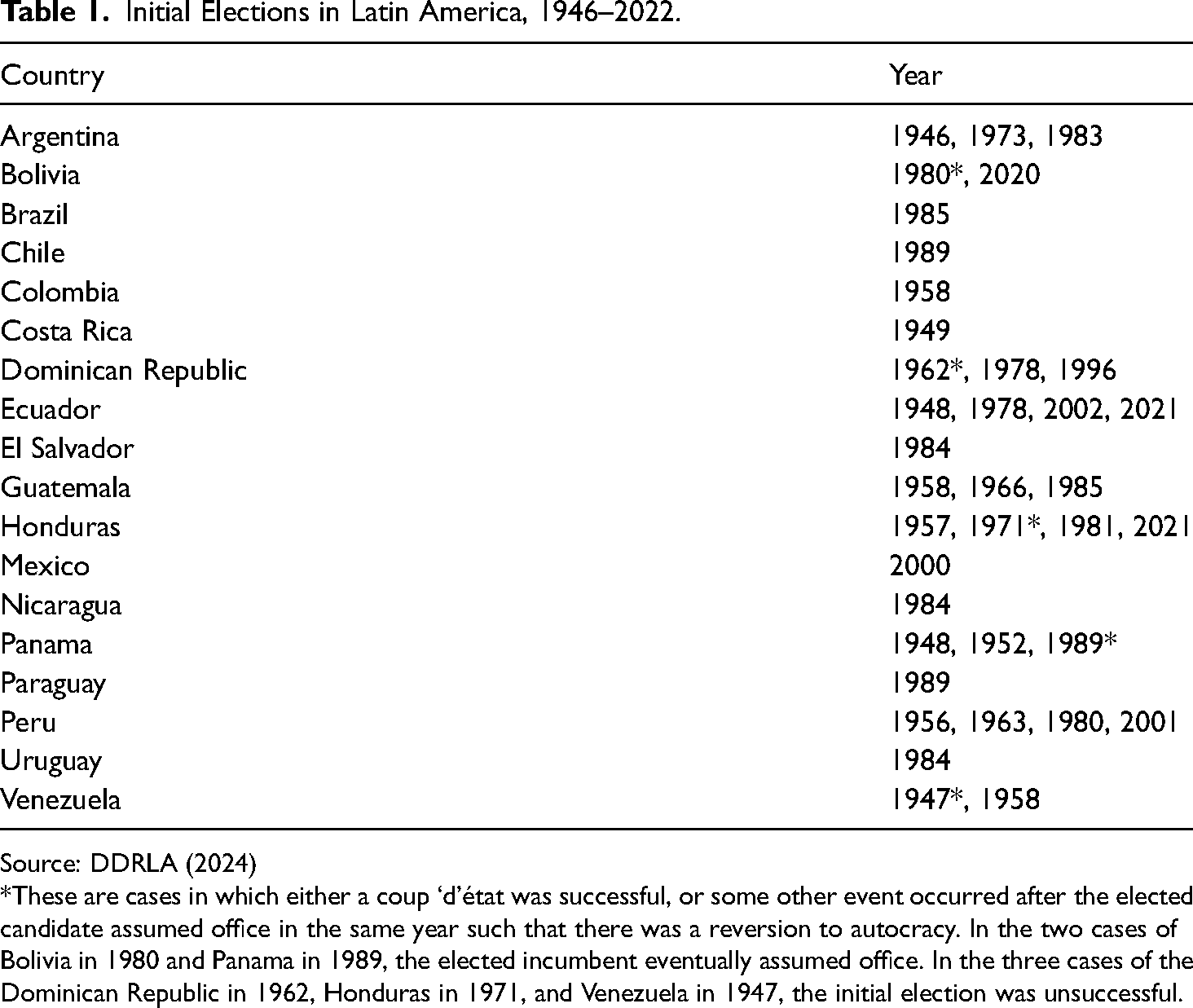
Initial elections are instrumental in measuring political regime dynamics in Latin America more precisely. By introducing an indicator to capture this stage more distinctly and when it does not occur, the DDRLA provides new insights into how democratic regimes begin in contemporary Latin America. Indeed, the DDRLA confirms that the predominant mechanism by which democracy surged in the third wave in Latin America was through elections. From 1946 to 2022, there were thirty-seven initial elections. In 86.5 per cent of cases, these elections prompted a democratic transition in which the alternation of power from an authoritarian government was transferred to a newly inaugurated president who was permitted to assume office for more than the first year. However, there were five cases where this did not occur. One such case is the Honduran election of 1971. Some democratic transitions were initiated with an interruption between the initial election and the president's inauguration (e.g. the most extended period being the Bolivian case where President Siles Zuazo was inaugurated into office two years after the 1980 election and only after the end of a prolonged period of struggle between the military and political parties). Table 1 indicates each initial election in the DDRLA by country and year.
Initial Elections in Latin America, 1946–2022.
Source: DDRLA (2024)
These are cases in which either a coup ‘d’état was successful, or some other event occurred after the elected candidate assumed office in the same year such that there was a reversion to autocracy. In the two cases of Bolivia in 1980 and Panama in 1989, the elected incumbent eventually assumed office. In the three cases of the Dominican Republic in 1962, Honduras in 1971, and Venezuela in 1947, the initial election was unsuccessful.
Significant attention has been directed at identifying the unique point in time at which authoritarian regimes become democratic regimes (Bogdanor, 1990; Reich, 2001). For us, initial elections are important to measure as they signal situations that often mark that unique point and indicate the onset of democratic transitions. Still, importantly, these elections occur in authoritarian years. For this reason, the DDRLA corrects election years, which are coded as democratic in the original DD dataset and continues to do so for elections after 2008.
The Duration of Transitions
Our democratic transition variable (two-turnover transitional democracy) complements the original transition variables found in datasets by Cheibub, Gandhi and Vreeland (2010), as well as in the works of Boix, Miller and Rosato (2013, 2022), Marshall and Gurr (2020), and Skaaning, Gerring and Bartusevičius (2015), which indicate regime transitions. In both the original DD dataset and Boix, Miller and Rosato's (2013) research, democratic transition variables are binary, marked by a value of 1 in the first year a country's regime becomes democratic after a period of authoritarian rule, thus viewing regime transitions as immediate processes.
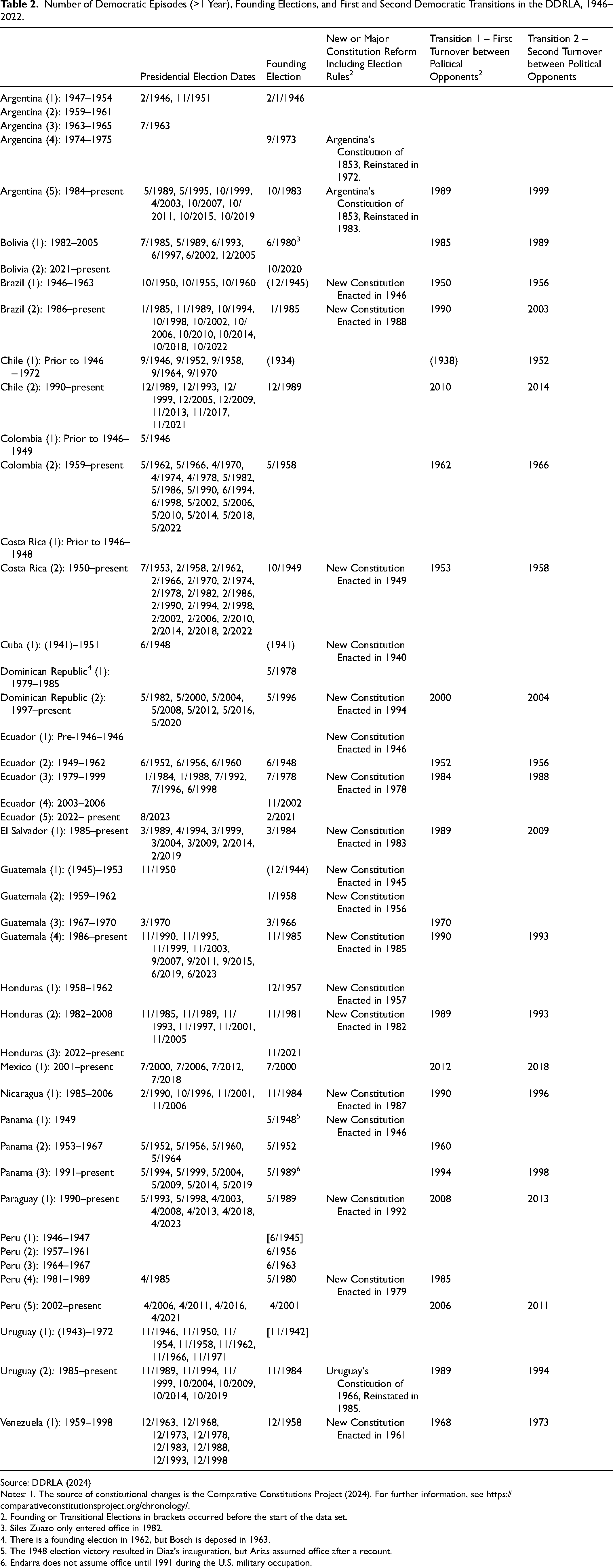
Similarly to Alvarez et al. (1996), who used an alternation in power, or turnover, to define democracies to avoid a type I error, we adopted Huntington's two-turnover rule to define the end of democratic transitions. In other words, after the second turnover, regression to authoritarian rule is unlikely, and democracy has become the “only game in town” for political elites. According to Huntington (1991), “the party or group that takes power in the initial election …loses a subsequent election and turns over power to those election winners, and if those election winners, then peacefully turn over power to the winner of a later election (267).” To assess whether this criterion is reached after the onset of a democratic episode, the DDRLA reports the year of the first (tddemoc1) and second turnovers (tddemoc2). Table 2 reports the one and two-turnovers during each Latin American transition between 1946 and 2022.
Number of Democratic Episodes (>1 Year), Founding Elections, and First and Second Democratic Transitions in the DDRLA, 1946–2022.
Source: DDRLA (2024)
Notes: 1. The source of constitutional changes is the Comparative Constitutions Project (2024). For further information, see https://comparativeconstitutionsproject.org/chronology/.
2. Founding or Transitional Elections in brackets occurred before the start of the data set.
3. Siles Zuazo only entered office in 1982.
4. There is a founding election in 1962, but Bosch is deposed in 1963.
5. The 1948 election victory resulted in Diaz's inauguration, but Arias assumed office after a recount.
6. Endarra does not assume office until 1991 during the U.S. military occupation.
The DDRLA's two-turnover rule for democratic transition is a more stringent measure than other approaches. For instance, a single turnover between political opponents occurred in only twenty-four out of forty-five democratic episodes (53.5 per cent). Nonetheless, the two-turnover test is fundamental for indicating the consolidation of democratic institutions. Interestingly, once a single turnover is achieved, the likelihood of securing a second turnover is high, occurring in twenty-one of the twenty-four one-turnover democratic transitions. In sum, the two-turnover test offers a more thorough examination of political dynamics in the region and may help explain why reversions are more likely in certain contexts and periods.
Democratisation and Reversion to Autocracy
Unlike enduring democratic transitions, democratic reversions (e.g. transitions from democratic to authoritarian regimes) may be insidious and, as such, are best captured through objective backward movement in political regime indicators. Przeworski, Alvarez, Cheibub and Limongi (2000) affirm that type II cases are those in which: “The incumbents will have or already have held office continuously by virtue of elections for more than two terms or have held office without being elected for any duration of their current tenure in office, and until today or until the time when they were overthrown they had not lost an election (29).” This is emphasised as well in the DD codebook where Cheibub et al. (2010) explain: The rationale for this variable is discussed in Przeworski et al. (2000:20-22). We expand the action that characterizes consolidation of incumbent advantage to include cases in which the incumbent was first elected in multiparty elections but, for whatever reasons, the incumbent's term was extended, and subsequent elections were postponed (e.g., Angola as of December 31, 2008).
The political dynamics in five Latin American countries that together contribute to the democratic recession observed in twenty-first-century Latin America underscore that the type II rule provides valuable insights. 8 Per the DDRLA coding, the country-years that underwent reversion to authoritarianism in recent years include Ecuador (2007–2021), Bolivia (2006–2020), Venezuela (1999–2022), Nicaragua (2003–2022), and Honduras (2009–2021). In four of these five reversion cases, the democratically-elected presidents manipulated election rules to extend their party's rule beyond two terms (Versteeg et al., 2020), violating the alternation rule (e.g. incumbent rule) and a type II case.
It is important to note that Bolivia, Ecuador, and Venezuela follow a similar pattern: an incumbent president writes a new constitution to extend the presidential term beyond two terms. We discuss each of these cases more carefully. It should also be noted that these countries’ experiences with democratic recession build on practices invoked by Joaquín Balaguer and Alberto Fujimori in the twentieth-century Dominican Republic and Peru, respectively. In both cases, the incumbent manipulated electoral rules to extend his tenure in office beyond what was permitted by institutional stipulations (Seawright, 2012).
Following the election of Evo Morales, Bolivia adopted a new constitution in 2009 that included new election rules in Article 166 (Elkins and Ginsburg, 2022). The Supreme Court agreed with President Evo Morales's claim that the first term did not count because it was under a different constitution. Thus, Morales was able to run for a third term in 2014 despite the presidential two-term limit in the country's 2009 constitution (Escobari and Hoover, 2024). Therefore, we code Bolivia as an authoritarian regime beginning with Evo Morales's inauguration in 2006 and continuing in every subsequent year of his presidential tenure.
In the case of Ecuador, Rafael Correa won the 2006 presidential election, promising to reshape the political landscape. Correa's party controlled 61 per cent of the seats in the constituent assembly that wrote the rules for the new constitution (Elkins and Ginsburg, 2022). Negretto (2022) explains that the 2008 Ecuadorian constitution increased the power of the executive in several dimensions and allowed the president to be reelected for one consecutive term. Correa was re-elected for a second term in the April 2009 general election under the 2008 constitution. He was allowed to run for re-election in 2013. Thus, Correa was reelected to his third term as president. Beginning with Correa's election in 2006, our political regime variable takes on a value of 0 in every subsequent year until 2021.
Based on the same violation of the incumbency rule, we code Venezuela as an authoritarian regime for every year since Hugo Chávez's inauguration to the presidency in 1999. A Constituent Assembly (CA) responsible for drafting a new constitution was organised by Hugo Chavez in 1999 under rules that resulted in his allies holding 94 per cent of the seats (Corrales, 2016, 2018). The new constitution abolished the Senate and permitted referendums (Elkins and Ginsburg, 2022). Following the enactment of the 2000 constitution, “mega-elections” were held for all public positions including the presidency, the National Assembly, Governors, Mayors, State Legislature, Andean & Latin Parliament. Chavez was elected for a second time in 2000 under the new Constitution. In the DDRLA, Venezuela is considered authoritarian since Chavez's first election in 1999 and for the period including his second election in 2000 (under a new constitution), his third election in 2006, and his fourth election in 2012, as well as Nicolas Maduro's election in 2018 since he is the successor to the same authoritarian regime. 9
In contrast with these cases of democratic reversion in Latin America, the reversion to authoritarian rule resulted from a military coup undertaken against Manuel Zelaya in the case of Honduras (Pérez-Liñán and Polga-Hecimovich, 2017). The 2009 intervention was, allegedly, motivated by a desire to quell then-President Manuel Zelaya's goal of manipulating political institutions to permit his reelection in 2010. Although democratic elections were subsequently reinstated (albeit with an initial banning of Zelaya's Liberal Party), we continued to code Honduras as an autocracy from 2009 to 2021 when the governing National Party ceded power to Xiomara Castro from the Freedom and Refoundation Party following the 2021 initial election.
It should be noted that presidents who manipulated electoral rules to secure power were overturned in two of the four cases. Bolivia began a new democratic transition with the 2020 initial election of Luis Arce of the Movement for Socialism (MAS) party. The election results superseded the disputed results of the October 2019 elections, which were annulled during a prolonged political crisis. Ecuador began the transition to democracy when Lenín Moreno, Correa's successor from the PAIS alliance, transferred power to Guillermo Lasso of the CREO-PSC alliance in 2021.
In sum, to understand the unique facets of political regimes and the transitions between them, it is imperative to “get the coding right.” We argue that explicit ex-ante rules emphasising the alternation of political power and measuring its distinct stages from initial elections to transitional democracy and why these regimes sometimes revert to authoritarian status go a long way in achieving this goal.
Democracy-Dictatorship Reprise for Latin America
We now turn to discuss how extending and revising the political regime coding of Latin American countries contributes to a more accurate and complete picture of political regimes in the region from 1946 to 2022. Over the 1946 to 2022 period, there are 817 democratic years and 646 authoritarian years in the nineteen Latin American countries. Furthermore, the DDRLA shows that there is a strong dominance of democratic regimes in the post-2008 period. From 2009 to 2020, there were 186 democratic (70 per cent) and 80 (30 per cent) authoritarian years in Latin America according to the DDRLA.
In the paragraphs that follow, we descriptively and empirically highlight disparities in Latin American country-year political regime classifications across DDRLA, Cheibub et al.'s (2010) original version of the DD dataset, the updated global version of the DD released by Bjornskov and Rode (BR) (2020), the Lexical Index of Democracy (LIED) (Skaaning, 2021), Polity V (2020), Boix, Miller and Rosato (BMR) (2022) and V-DEM (Coppedge et al., 2023), as well as Mainwaring and Perez-Liñan's Democracies and Dictatorships in Latin America Data (MPL) (2013), which similar to our data set was developed considering region-specific knowledge. We award particular attention to highlighting the major disagreements in the coding of specific cases and to the five recent cases of democratic recession, 10 which are poorly accounted for in other datasets.
Figure 1 plots the disparate accounts of the yearly number of Latin American democracies across the 2020–2022 period by the following regime coding rules: DDRLA, the original DD, the Bjoernskov and Rode (BR-DD), Polity V, the Mainwaring and Perez-Linan (MPL), VDEM, and Boix, Miller and Rosato (BMR) and the Lexical Index of Democracy (LIED) (Skaaning et al., 2015). To facilitate comparison with alternative regime indices that employ trichotomous, or higher order categories or continuous measures, we have converted each regime measure to be dichotomous. For example, in Polity V we consider as democracy only scores of 6 or greater; we dichotomised VDEM measures based on v2x_regime>=2.
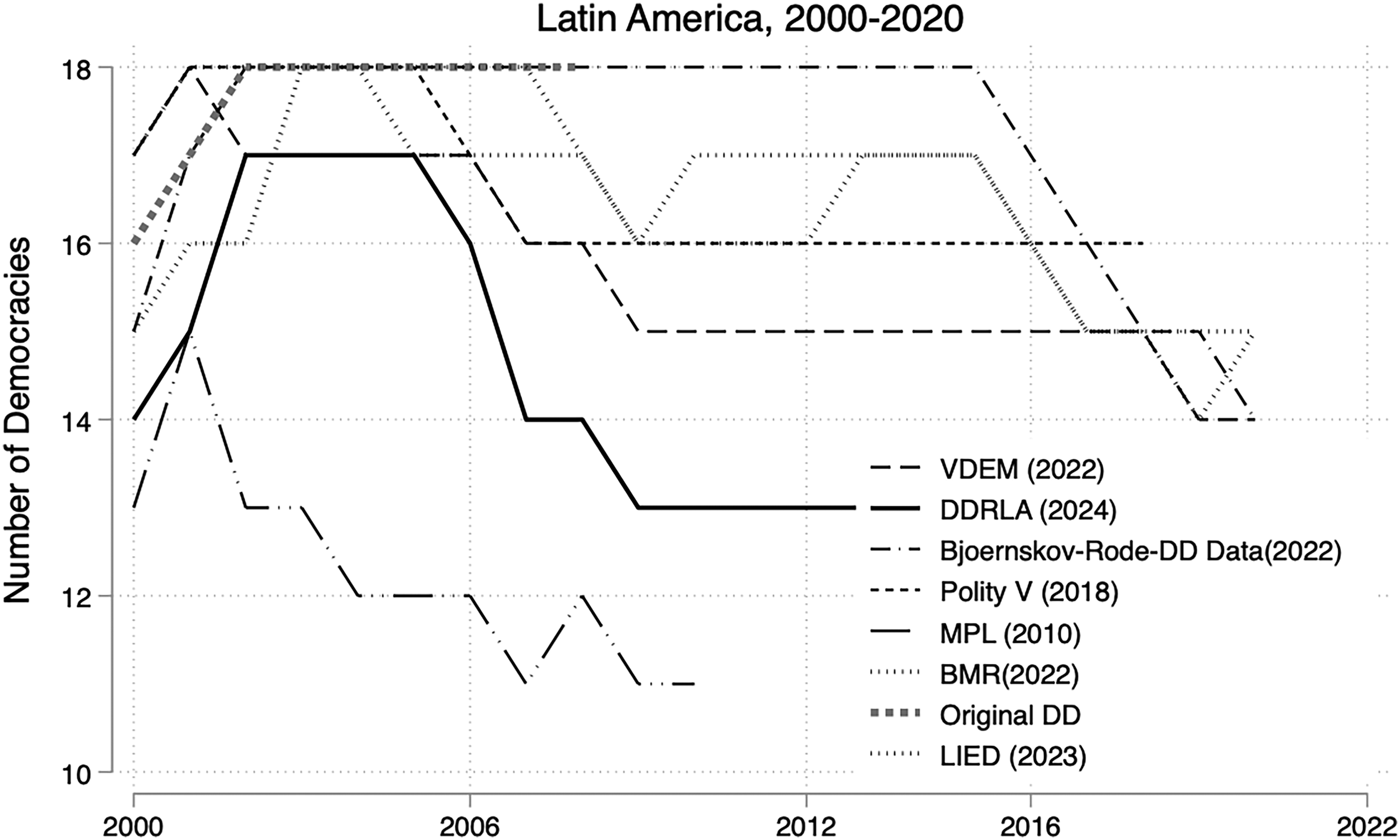
Number of Latin American Democracies per Year by Regime Coding Rule, 2000–2022
Figure 1 suggests that across all regime datasets, there are important trends indicating recessions in democracy in Latin America that occurred in the last two decades, but the starting point, magnitude and duration is a matter of controversy. However, the precise number of Latin American democracies varies as a function of the regime coding rule applied. The number of countries considered democratic by our DDRLA measure of political regimes falls behind the number of countries considered so by other popular measures of political regimes. For example, out of 361 regime-country years considered between 2000 and 2018, 316 (∼87.5 per cent) are democratic by the dichotomised Polity V and 302 (∼83.6 per cent) by the dichotomised V-DEM measure. In contrast, only 271 (∼75.1 per cent) are classified as democratic by the DDRLA coding rules. These disparities are non-negligible and significantly impact perceptions of democratic backsliding in Latin America.
The recent unfolding of political dynamics in the region also requires us to revisit the interpretation of some Latin American political regimes covered in the original DD dataset. In this dataset, there were 490 years that were authoritarian and 707 that were democratic in Latin America, our revised coding of this period reveals that 568 years are authoritarian and 629 are democratic between 1946 and 2008. In other words, the updating of the minimalist criterion to elections in Latin America suggests that a sizeable share of country-years that were classified as democratic regime years at the turn of the century no longer exhibit the fundamental features of democratic regimes. Furthermore, democratic reversions took place earlier than the initial DD dataset lets on, with twenty-first century democratic backsliding in Venezuela – classified as such due to incumbent consolidation of power – serving as an illustrative example as this country was considered a democracy for the entire period in the DD data set (1946–2008). 11
In Figure 2, we plot the disparities in political regime coding across DDRLA and other sources for the nineteen countries in the region. This comparison underscores that the DDRLA helps to identify the onset of the stark departures in democratisation in select Latin American regimes much more precisely than other regime measures. Returning to the case of Venezuela, the figure confirms that there is significant variation in the start of autocracy conditional on which coding rule is employed. In contrast, the DDRLA consistently identifies a violation of the incumbent rule and classifies the entire period of an authoritarian incumbent as autocratic based on the type II rule. Using the type II rule to measure the precise moment backsliding begins in democracies, as the DDRLA proposes, offers an advantage for scholars seeking to compare countries with consistent rules.
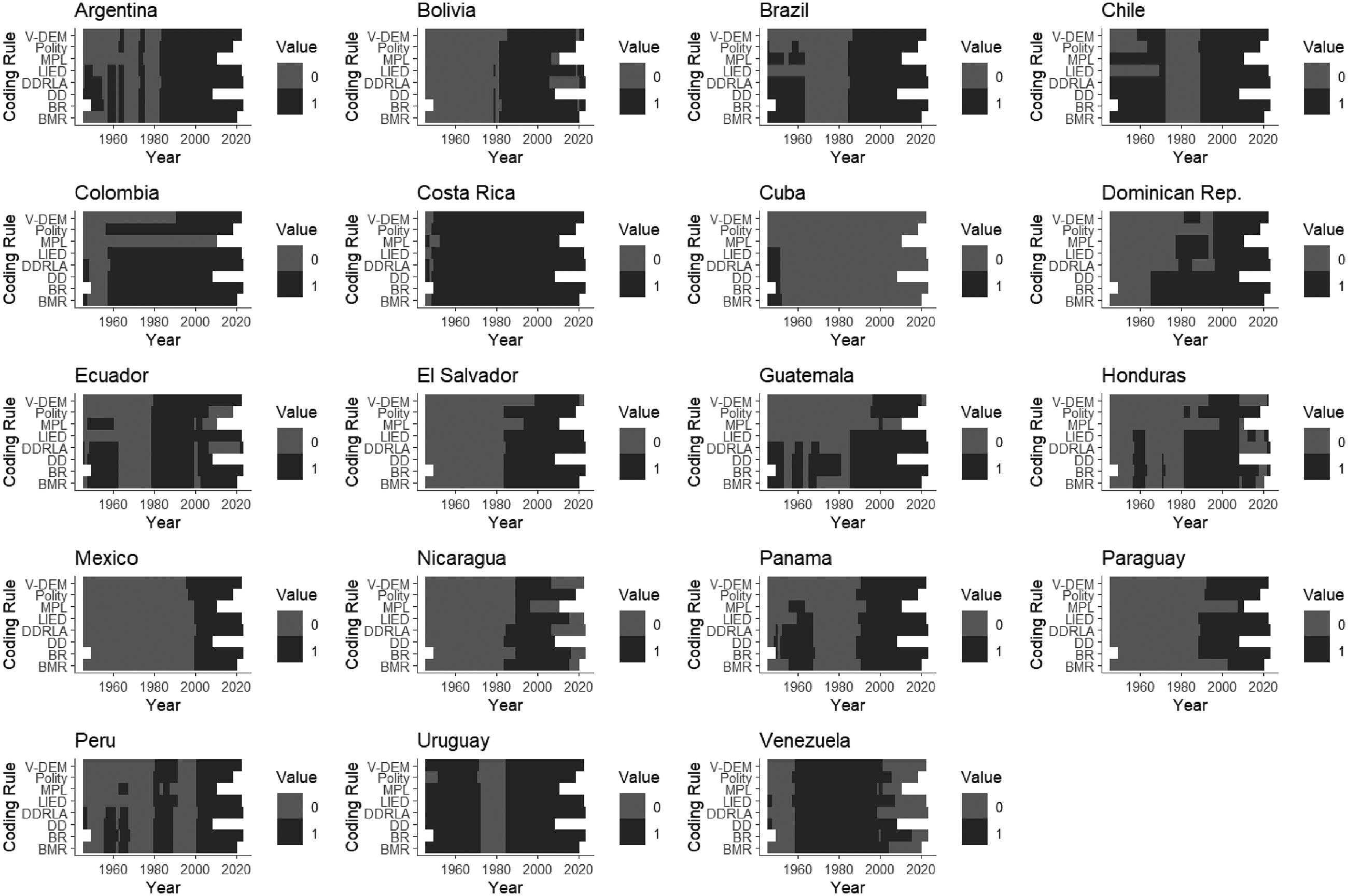
DDRLA Regime Type by Coding Rule for each Latin American Country, 1946–2022
Two Replication Exercises
In this research study, we have made ardent claims in support of the need to use more precise indicators to capture transition dynamics. In what follows, we replicate and examine two recent studies on economic voting and political participation in Latin America, including our regime, initial election, and political transition variables. The results of our replication exercises and assessments substantiate the claims we have made throughout this study. They tangibly demonstrate the importance of appropriate operationalisation of variables relating to political regimes for our understanding of related, fundamental, substantive relationships.
Replication Exercise 1: Does Democracy Matter in Assessments of Economic Voting in Latin America?
In a recent study, Valdini and Lewis-Beck (2018) assessed the influence of electoral institutions on the economic vote by analyzing ninety-three presidential elections in eighteen Latin American countries from 1983 to 2014. They argue that the economy's influence on the economic vote in the region depends on its interaction with particular institutional attributes. Specifically, Valdini and Lewis-Beck (2018) argue that six institutional rules – concurrent presidential and legislative elections, term-limited presidents, the power of regional governments, and GDP growth on the incumbent party vote share.
Despite their attentiveness to institutions, Valdini and Lewis-Beck (2018) are imprecise in explaining which political regime coding criteria they employed to restrict their analysis solely to democratic elections. This coding decision is critical as the institutional rules argued to propel economic voting in their theory work quite distinctly in democratic and in authoritarian regimes. We have specific concerns with their pooled sample.
First, Valdini and Lewis-Beck (2018) exclude twenty democratic elections in the region from their sample. For example, the authors confirm that they omit the 1990 democratic election in Colombia due to recognised electoral violence. However, not only are other similarly violent elections included in their sample (e.g. Guatemala's 1999 election in which Roberto Gonzalez of the opposition Democratic Front for the New Guatemala (FDNG) was murdered), but the violence surrounding the specific 1990 election in Colombia did not preclude its democratic stature (Hafner-Burton et al., 2018). In addition, the scholars omit elections in Bolivia (1985, 1989, 1993, 1997 and 2002), Brazil (1989), Colombia (1986 and 1990), Ecuador (1984, 1998 and 2006), El Salvador (2014), Guatemala (1990, 1995 and 2011), Honduras (1985 and 1989), Nicaragua (1990), Panama (1994), and Paraguay (1993) that conventional sources – including the DD and DDRLA – consider to have been conducted under democratic rules. These elections represent what would amount to a sizeable share of the elections in their sample, and it is difficult to identify criteria to substantiate their exclusion.
Second, Valdini and Lewis-Beck (2018) consider a number of historical and contemporary authoritarian elections. These include Mexico's 1994 election (held during the Institutional Revolutionary Party's (PRI's) hegemonic rule), elections held under Peruvian Alberto Fujimori Fujimori's authoritarian rule, and all the twenty-first century elections in Ecuador, Bolivia, Venezuela, Nicaragua, and Honduras that we interpret as having been conducted in authoritarian regimes in this study.
Does the inclusion of some authoritarian elections and the exclusion of some democratic elections, as outlined above, affect the conclusions that Valdini and Beck (2018) draw on economic voting in the region? We argue that it most certainly does.
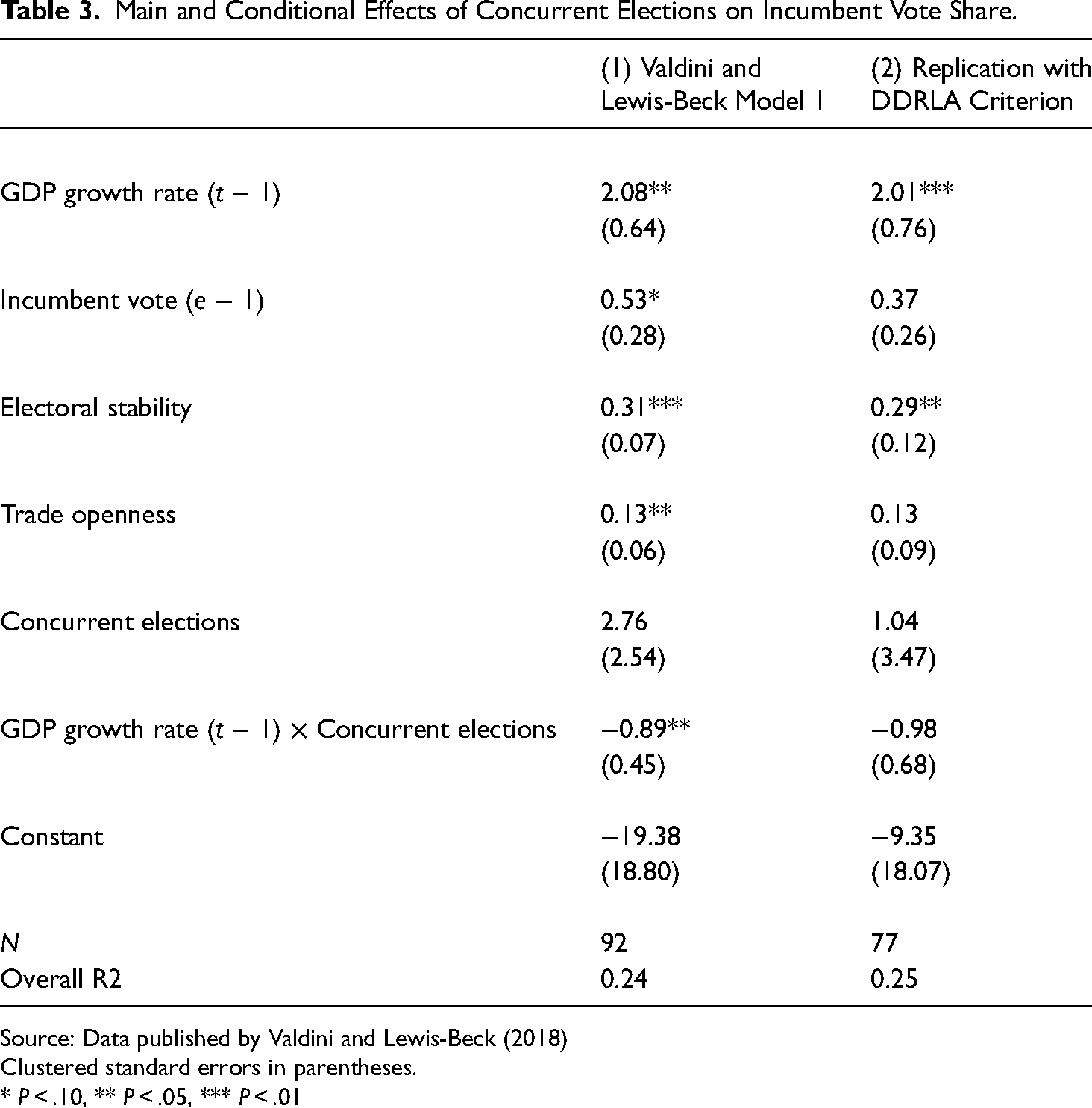
Echoing Samuels’s (2004) earlier findings, Valdini and Lewis-Beck (2018) claim that concurrent elections are “the ‘most important factor’ in determining voters’ propensities to reward or punish elected officials in presidential systems.” Specifically, they argue that the economic vote diminishes when legislative and presidential elections occur farther apart in time. They substantiate this claim with the results from Model 1 in Table 3 in their original study. As they explain, “When the two types of contests occur on the same day (concurrence = 2), economic growth has quite a strong effect on incumbent support. For a 1 percentage point increase in growth, we expect over a 5-percentage point increase in the incumbent vote (i.e. 2.08 + 5.52 − 1.78 = 5.82). However, when the country's legislative and presidential elections never occur on the same day (concurrence = 0), that economic vote effect decreases by over 3 percentage points (i.e. 2.08 + 0 − 0 = 2.08).”
To assess whether this claim is robust to the restriction of elections in the sample to democratic elections (as identified per the DDRLA criteria), we partially replicate and extend Valdini and Lewis-Beck's (2018) Model 1 in Table 4. Our replication is only partial in the sense that we only go so far as to exclude undemocratic elections from their sample; to fully test their argument, we would need also to include the twenty elections that were omitted from their sample, but this would involve collecting new data for other explanatory variables not available in their dataset. We leave this as a future exercise. Table 3 replicates Model 1 from Table 4 in Valdini and Lewis-Beck (2018). 12 The first column in Table 3 reports the coefficient estimates from Valdini and Lewis-Beck's (2018) original model analyzing the interactive effect of concurrent elections and GDP growth on incumbent vote share (Model 1). The second column reports the coefficient estimates from the same modelling specification estimated with a restricted set of elections that the DDRLA conceives as having occurred under democratic rule. As the second column in Table 3 confirms, Valdini and Lewis-Beck's (2018) central hypothesis pertaining to the interactive effect of concurrent elections and GDP growth on the incumbent vote share is not verified using more stringent and explicit criteria to determine the democratic elections comprising the sample. The coefficient associated with the interaction between concurrent elections and GDP growth is not statistically significant when the sample is restricted to only democratic elections, as determined by DDRLA criteria. For a one-percentage-point increase in growth in concurrent elections, our results suggest that the predicted increase in the incumbent vote share is not statistically significant from zero. Moreover, when countries’ legislative and presidential elections never occur on the same day (concurrence = 0), the effect is also not statistically significant from zero.
Main and Conditional Effects of Concurrent Elections on Incumbent Vote Share.
Source: Data published by Valdini and Lewis-Beck (2018)
Clustered standard errors in parentheses.
* P < .10, ** P < .05, *** P < .01
Our replication of Valdini and Lewis-Beck's (2018) study of the influence of concurrent elections on economic voting in Latin America allows us to question their conclusion that there is “unambiguous support” that concurrent elections trigger economic voting in the region. Instead, the replication of Valdini and Lewis-Beck's (2018) model with a sample restricted solely to the electoral democracies in their selected sample using DDRLA criteria suggests that there is no robust and persistent evidence that concurrent elections stimulate the economic vote in Latin American democratic elections.
Replication Exercise 2: Does the Transition to Democracy Boost Voter Turnout?
Not only is the DDRLA pertinent for fine-tuning our understanding of political regimes in the Latin American region, but it also provides the data necessary to advance our understanding of political regime transitions through its inclusion of both initial election and democratic transition variables. In what follows, we use information from DDRLA to revisit Kostelka's (2017) recent research on the relationships between political participation, founding elections, and democratic transitions. By comparing Kostelka's (2017) coding decisions with those proposed in DDRLA, we question the conclusions he draws about the electoral dynamics in transitioning democracies.
As a part of his recent scholarship, Kostelka (2017) studies the effect of different life stages of democratic regimes on voter turnout and investigates plausible causal mechanisms underpinning observed relationships. Specifically, he classifies democratic elections as being founding, being transitional, or having taken place in “established 13 ” democracies. Using these categories, Kostelka (2017) first assesses the conventional wisdom that founding elections, in comparison to elections in “established” democracies, boost turnout with generalised least squares regression analyses. His results confirm expectations that voters are more likely to turn out in founding elections succeeding authoritarian rule than in elections taking place in “established” democracies.
Because Kostelka (2017) employs ad hoc criteria to define the stages of democratic elections and uses Polity IV to assess regime type, we are wary of accepting his results on the role of founding, transitional, and “established” democratic elections in explaining voter turnout patterns. In what follows, we briefly review these concerns and highlight the ways in which our theoretically motivated coding of initial election and, chiefly, political transition variables diverge from his similar variables.
Our primary concerns lie with the author's operationalisation of democratic regimes and democratic transitions. Once again, we identify the inclusion of a significant share of nondemocratic elections in a study directed at assessing turnout during the democratisation process as a source of measurement error. For instance, he considers Mexico's 1988 election to be a founding election even though the country's hegemonic PRI party (which ruled virtually uncontested from 1929 to 2000) does not cede power to an opposition party, a fundamental tenet of democratic rule, until 2000. 14 Additionally, he considers some of Bolivia's most recent elections – elections that DDRLA considers to be authoritarian – as elections having taken place in an “established” democracy. 15 Furthermore, we are concerned that his sample does not include the entire universe of democratic elections, at least in Latin America. For example, per the minimalist criterion, Panama is considered to have transitioned to democracy in 1989, but Kostelka excludes this election from his sample and considers Panama's founding election to have taken place in 1994.
Beyond the inclusion of some authoritarian elections and the exclusion of some democratic elections, Kostelka's operationalisation of political regime transitions raises some additional issues. As aforementioned, Kostelka (2017) classifies democratic elections into three categories. To determine whether democratic elections are founding elections, transitional elections, or elections in “established” democracies, Kostelka (2017) relies on what he calls an “inclusive” operationalisation of democratic transitions. Per his operationalisation, democratic transitions take place any and every time a country experiences a shift from a negative to a positive Polity IV political regime score in consecutive years. Once a transformation in the sign of a Polity IV score takes place and initiates a democratic transition, Kostelka (2017) interprets the regime to remain in transition for a seemingly arbitrary 20 years (if “high democratic standards” endure – e.g. a Polity IV score of greater than or equal to 6). Using these democratic transition coding rules, Kostelka (2017) classifies democratic elections. 16
Kostelka's (2017) cutoff is seemingly arbitrary, as well as manufactured, and does not follow theoretically driven rules pertaining to transitions. In Figure 3, we depict differences in the number of political transition elections across Kostelka's operationalisation of political regime transitions and the DDRLA coding of elections under transitional democracies, classified using the two-turnover coding rule for Latin American democracies. Kostelka analyzes eighty-six legislative elections in Latin America from 1946 to 2015. Of these, eighteen are classified as “founding” elections. However, many of these are not initial elections as they either occurred during autocracy or after the democratic transition had occurred (see Table S1). As a result, only nine of the thirty-four DDRLA initial elections in the DDRLA were considered by Kostelka.
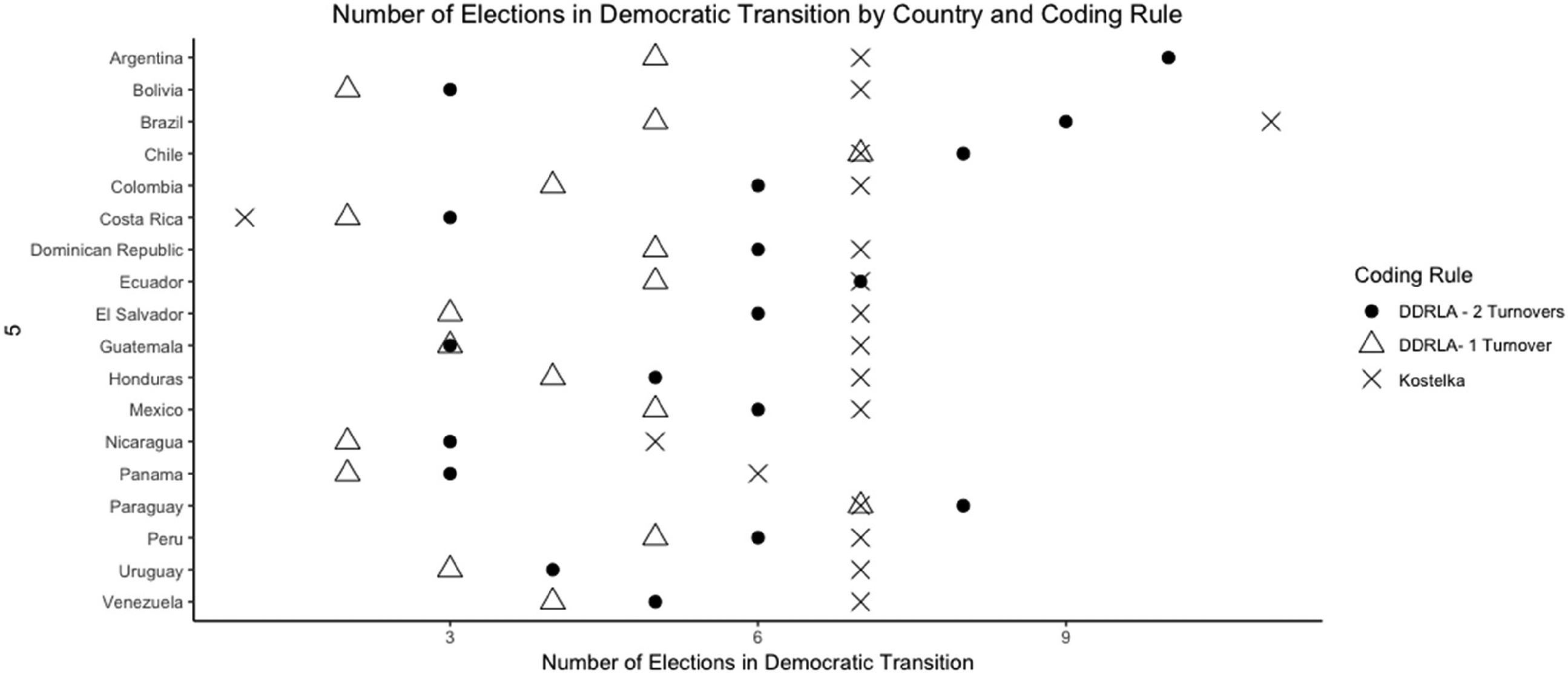
Number of Elections in Democratic Transition by Country and Coding Rule in Latin America, 1946–2015
Figure 3 suggests pronounced differences in the number of elections in democratic transitions per Kostelka's coding and the DDRLA. In large part, the number of elections in democratic transitions, as conceived by Kostelka's (2017) operationalisation, is constant across countries. For us, this uniformity is simplistic. It ignores the party alternation in power that is so critical to both the minimalist understanding of democratic regimes and our theoretically motivated operationalisation of political transitions. This discrepancy is especially evident in the case of Brazil: Per Kostelka's rule, Brazil only ended its transitional democracy in 2010. However, by the two-turnover rule, the DDRLA suggests that Brazil's democratic transition culminated much earlier, resulting in fewer transitional elections.
Figure 4 demonstrates the distribution of turnout across Kostelka's election types for each region in his sample and election types as classified using the DDRLA (resulting in an additional column for Latin America). Voter turnout differs by a larger amount across election types in Kostelka's (2017) sample than the turnout distribution across election types determined by the DDRLA coding. Because Latin America is arguably the region whose experience best exemplifies conventional wisdom about turnout patterns across election types, there are compelling reasons to believe that using more appropriate measures for initial, transitional, and “established” elections in the region could noticeably alter Kostelka's conclusions.
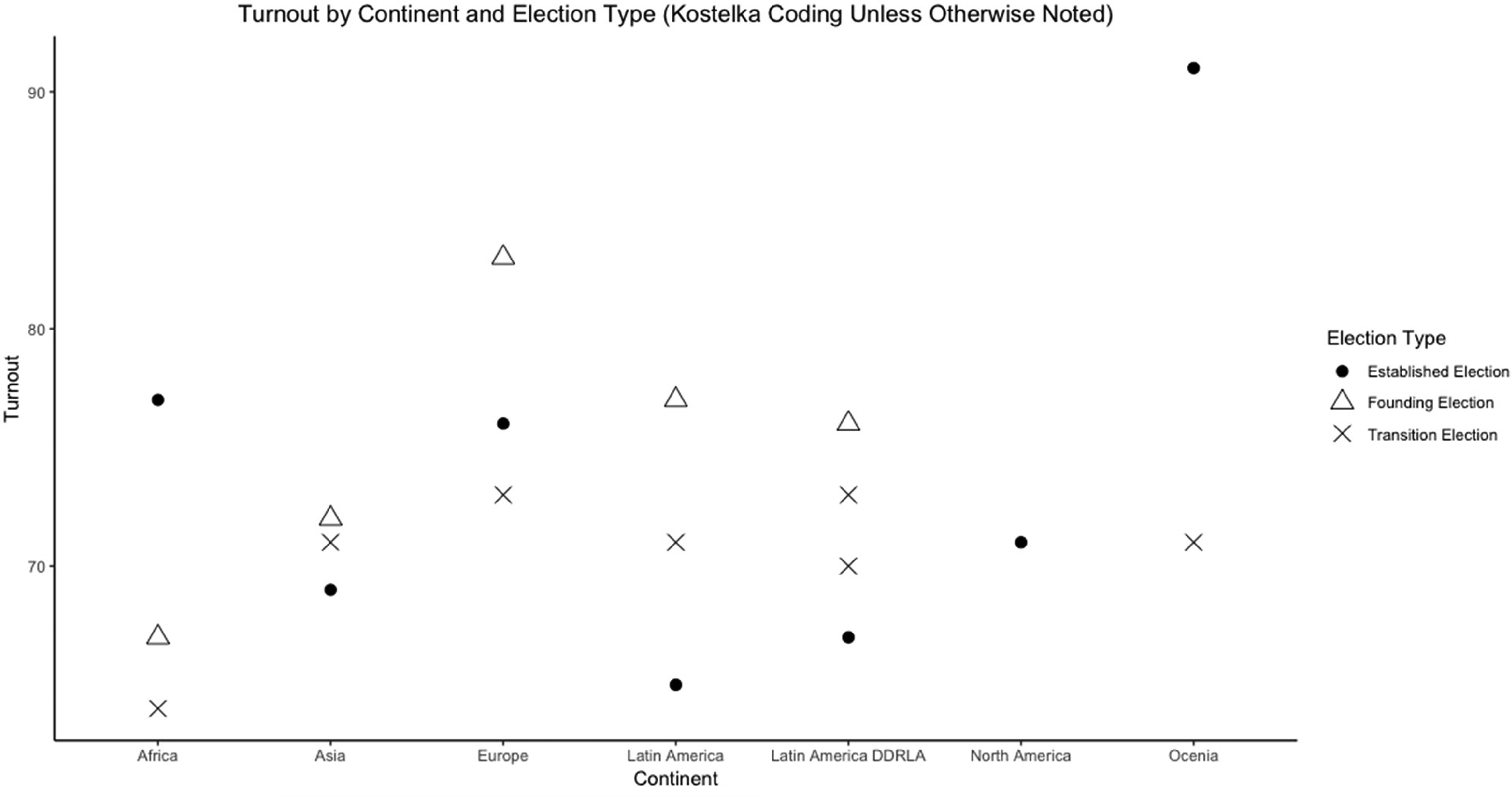
Turnout by Continent and Election Type (Kostelka Coding and DDRLA for Latin America Only).
In sum, while we recognise that Kostelka (2017) advances some important theories about why turnout might differ by election type, we are less convinced by his supporting evidence. Although we cannot wholly replicate Kostelka's (2017) findings without updated data for the worldwide sample considered in his work – an enterprise that is far beyond the objective of this study – we have sought to present a robust example that measurement of regime matters for understanding turnout dynamics. Furthermore, the type of variable operationalisation used in DDRLA applied to the universe of cases considered in Kostelka's (2017) research may yield more robust empirical findings.
Conclusion
Political regimes and the transitions between them are among the most popular topics in studies of comparative politics. Nonetheless, our understanding of contemporary political dynamics is underdeveloped due to antiquated datasets and incomplete distillations of democratisation processes. This study was developed to mitigate these shortcomings for the Latin American region and refine our understanding of political regimes and their transitions. We have contributed with indicators that more precisely capture the role of initial elections, when countries enter and exit democracy, and when within democracy, there are marked transitions – all these conceived from a minimalist point of view with objective rules.
In doing so, we have followed Przeworski et al. (2000) and Cheibub, Gandhi and Vreeland (2010)'s minimalist criteria for operationalising democracy. Like them, our indicators emphasise the importance of competitive elections and, chiefly, alternations of political power. However, rather than simply updating Cheibub, Gandhi and Vreeland's (2010) indicators of political regimes to reflect current political dynamics in Latin American countries, we have sought to make a new theoretical contribution by introducing indicators that capture initial elections and regime transitions, as well more careful measurement of the type II rule to identify when there is a reversion from a democracy to an autocracy. Thus, while our regime indicators correlate with existing regime classifications, we have also contributed to the study of democracy by calling attention to features that have not been as well understood but are central to studying democratic regimes. Through two replication and analysis exercises, we demonstrated the utility of our dataset and its prospects for enhancing our understanding of political dynamics in the Latin American region. The results of our new data set lead us to urge scholars to use theoretically devised criteria in sample selection and election coding in their studies of Latin American democracies.
The DDRLA provides a foundation upon which scholars can tackle important questions about democratic political transitions and, more prominent as of late, democratic reversions. Our current research, for example, explores whether there are disparate social spending patterns across elections depending on the stage of a country's democratisation process in Latin America. We also are examining how voter turnout patterns differ during first and transitional democracy elections especially considering the significant reversion to authoritarianism in the region. We encourage scholars to make use of our dataset to address important, yet ill-understood, facets of political regimes and, more pointedly, the transitions between them. As we have stressed with two replication exercises, there are also many important insights that can emerge re-examination of recent empirical research. Indeed, measurement error, especially for the most recent two decades in Latin America, may be leading scholars to incorrect inferences for the region, as well as in larger cross-country research. Given the importance of understanding initial elections and transitions based on a minimalist conception of democracy, we hope that the DDRLA inspires similar endeavours for other regions of the world such that these topics can be addressed on a broader global scale.
Supplemental Material
sj-docx-1-pla-10.1177_1866802X241306119 - Supplemental material for The Cycle Continues: An Assessment of Democratic Transitions in Latin America with New Data and Indicators
Supplemental material, sj-docx-1-pla-10.1177_1866802X241306119 for The Cycle Continues: An Assessment of Democratic Transitions in Latin America with New Data and Indicators by Lorena G Barberia, Kelly Senters Piazza and George Avelino Filho in Journal of Politics in Latin America
Footnotes
Acknowledgment
The authors acknowledge two anonymous reviewers and the editor for comments which helped to improve the manuscript. The authors also thank Natália de Paula Moreira, Gustavo Fernandes de Paula, Victor Shin, Maíra Meyer, Maria Letícia Claro and Davi Veronese for research assistance.
Funding
The authors disclosed receipt of the following financial support for the research, authorship, and/or publication of this article: This work was supported by the Fundação de Amparo à Pesquisa do Estado de São Paulo (grant number 2019/27645-8, 2021/08772-9).

Supplemental Material
Supplemental material for this article is available online.
Notes
Author Biographies
References
Supplementary Material
Please find the following supplemental material available below.
For Open Access articles published under a Creative Commons License, all supplemental material carries the same license as the article it is associated with.
For non-Open Access articles published, all supplemental material carries a non-exclusive license, and permission requests for re-use of supplemental material or any part of supplemental material shall be sent directly to the copyright owner as specified in the copyright notice associated with the article.
