




Abstract
The paper is narrowly addressed to a single puzzle: How did it happen that countries that attempted to install democracy earlier enjoyed it less frequently? Regime dynamics are driven by two mechanisms: (1) Democracies become more durable as per capita income increases, and (2) Past experiences with democracy destabilize both democracies and autocracies. As a result, countries that experiment with democracy at lower income levels experience more regime instability. Moreover, until they reach some income threshold, at any time such countries are less likely to be democratic than countries that first enter democracy when they have higher incomes. Hence, paradoxically, the resistance of European monarchies against democracy resulted in democracies that were more stable than those following post-independence attempts in Latin America.
Introduction
The paper 1 is narrowly addressed to a single puzzle: How did it happen that countries that attempted to install democracy earlier enjoyed it less frequently?
Revised paper presented at the symposium on “New Frontiers on Institutional Research in Latin America,” GIGA Institute of Latin American Studies, Hamburg, May 5-6, 2008. I appreciate numerous comments by the participants as well as by José Antonio Cheibub and Carolina Curvale. This work was supported by a grant from the National Science Foundation.
The motivation of the paper goes back to Lipset (1960: Table II), whose analysis contains two curious quirks. 2 The first is that the threshold needed to support democracy is lower for Latin America than for Europe and its Anglo-Saxon offshoots. European democracies, Lipset shows, existed in the range of per capita incomes between 420 USD and 1,453 USD, while Latin American ones had incomes of 112 USD to 346 USD. The income range of Latin American democracies is even lower than that of European dictatorships, 128 USD to 482 USD. The second quirk is that the categories he used for Europe were “stable democracies” and “unstable dictatorships,” while those for Latin America were “unstable democracies” and “stable dictatorships.” Lipset never commented on these patterns, but he caught something real and systematic.
Fernando Limongi first brought it to my attention.
Now, the claim that Latin American countries tried democracy earlier and, most importantly, at lower levels of economic development than Europe and North America is not original, 3 even if it often evokes surprise among ethnocentric North American and Europeans. The first part of the paper provides some anecdotal and some systematic evidence in support of this claim. The second part analyzes the dynamics of political regimes. The last part provides some explanations and poses some unanswered questions.
Annino (1996: 10) observed that “el caso latinoamericano presenta una extraordinaria precocidad en el contexto internacional… Si miramos al espacio euroatlántico en su conjunto es evidente que América Latina se encuentra en una situación de vanguardia.” For a discussion of early constitutions in Latin America, see Gargarella (2005).
My concern is mainly with the “mechanics,” rather than with the underlying causes, which receive only a cursory treatment below. To put it differently, the question is “What must be true for political regimes to exhibit the dynamic we observe?” rather than “Why it is true?” Moreover, while general mechanisms explain a good part of the observed pattern of regime instability, not everything is mechanical. Hence, the paper poses as many questions as it answers: it should be viewed as an attempt to focus the agenda of further research rather than as a definitive explanation.
By and large, democratic attempts occurred in Latin America earlier and at lower levels of economic development than in Europe. To some extent, this timing is due to the fact that several parts of Latin America participated in the 1809 election to the Cortes of Cádiz, thus launching the idea of representative institutions at the time when many European countries were involved in the Napoleonic wars and elections were still rare. 4 But a more general reason was that Latin American wars of independence were at the same time directed against monarchical rule, 5 while most European countries experienced a gradual devolution of power from monarchs to parliaments.
Palacios and Moraga (2003: 147) emphasize the impact of the elections to Cádiz: “Limitadas como fueron, las elecciones de 1809 para elegir representantes americanos a la Junta Central constituyeron un momento central en el nacimiento de sistemas políticos modernos en Iberoamérica.”
While in several countries first declarations of independence pledged loyalty to Ferdinand VII, none did after monarchical rule had been re-established in Spain. According to Bahamonde and Martínez (1998: 15-16), (1) “el Estado transoceánico tenia much más connotaciones señorales que coloniales” and (2) “El liberalismo sirvió, por lo tanto, de arma revolucionaria para contrarrestar los vacios de poder a ambos lados del Atlántico.”
The Spanish colonial administration was direct and centralized, leaving little space for self-government. The only institution that entailed some modicum of self-government in Spanish America – the cabildo – was an estate body, with offices that could be purchased and kept in perpetuity (after 1556) and only few elective posts, subject to the confirmation by the Crown and elected under highly restricted suffrage. The fiscal powers of the cabildo were minimal. These institutions functioned so badly that in 1789 intendentes appointed by the Crown took over most of their functions. Summarizing its evolution, Haring (1947: 165) concluded that “the cabildo had virtually disappeared at the end of the colonial era.” Hence, when the Spanish colonial administration disintegrated – and it collapsed not because of any pressure for independence in the Americas but because of events in Europe – the ensuing conflicts could not be resolved within a pre-existing institutional framework.
Latin Americans had to constitute their institutions anew. And they were traversing a terra incognita. Monarchies, republics with predominantly hereditary collective governing bodies, and one republic with an elected legislature and an indirectly elected president were the choices known when first Haiti in 1804 and then Venezuela in 1811 proclaimed independence. In several new countries the first form of the government was a collective body that exercised both the legislative and the executive function. Triumvirates governed Argentina from 1811 to 1814 and Venezuela in 1811-12. But the French collective executive was by then extinct and the French experience did not serve as a reference to Latin American founders. Philadelphia was prominent in their minds: the intermediary was General Francisco Miranda who participated in the United States war of independence, and who became the central figure in proclaiming the Constitution of the United Provinces of Venezuela in 1811. Also prominent was the Spanish liberal Constitution of Cádiz, adopted in 1812, which preserved monarchy but severely limited its powers.
Sentiments for a monarchical solution intermittently sprung up in most Latin American countries. In the National Assembly of Tucumán, Argentina (1816), General Belgrano put forward una monarquia temperada, a monarchical project having a king native to the Americas – a monarch of Inca descent rather than that of European lineage. General San Martín also favored a monarchical solution (López-Alves 2000: 179). Sentiments for monarchy under an Italian or British prince were present in Uruguay. Yet in the end only Brazil adopted this solution until it became a republic in 1889. In Mexico the first emperor, Agustín de Iturbide lasted two years, with a brief return of monarchy between 1862 and 1867. The reasons monarchical projects failed, according to Rippy (1965: 89) were that
“the royalties of Europe and the monarchists of America had difficulty in reaching an agreement, the United States was opposed to American kings, the princes were difficult to find, and the people were not disposed to tolerate them.”
In the end institutions based on the United States pattern prevailed – in time all Latin American political systems would have elected legislatures while placing executive function in the hands of presidents 6 – but this alternative became complicated from the onset by Bolívar's itch to keep the position for life. While El Libertador did not dare claiming royalty, he let it be known that his ideal was the English constitutional monarchy and that he was eager to become a monarch for life even under the title of the president (Discurso de Angostura 1819, in Bolívar 1969). 7 Bolívar's monarchical ambition installed into Latin Americans a fear which would subside only at the end of the twentieth century and which became institutionalized in term limits, the “Gordian knot” of Latin American politics (De Luca, 1998: 155). Only one constitution, authored by Bolívar himself, which lasted two years from 1826 in Bolivia and even less in Peru, granted life term to the president.
The very term does have weak roots in the Spanish colonial tradition. “La Presidencia” was an administrative unit below the Vice-Royalty and it was headed by a President, who as a member of the Audiencia had jurisdictional faculties.
This is a fascinating text. Having observed that only democracy is compatible with liberty, Bolívar asks which government best succeeded in combining power, prosperity, and stability. His answer is “England.” While admiring the achievements of the United States, he argues that its experience cannot be replicated elsewhere. In turn, the model to imitate is Britain, which is a de facto republic. (This is after he argued against following the US example by invoking Montesquieu to the effect that institutions should reflect local conditions.) Then he is ready to make his move: You will get hereditary Senate, to be elected by the present Congress from among you, to whom the Republic owns its existence, and I will become the British hereditary monarch under the title of President.
While these two solutions – monarchy and presidential republic – were focal, they did not preclude inventiveness. The plan for provisional government elaborated by Francisco Miranda in the 1790s called for an executive chosen by the parliament (la Dieta), whose title would have been el Inca (Palacio and Moraga 2003: 102). The first two leaders of Chile assumed the title of the “Supreme Director of the Nation,” although from then on they would be presidents. Miranda's first title was “Generalissimo.” The most creative was Dr. José Gaspár Rodriguez de Francia who, having become one of two consuls who were to alternate every four months in 1813, then a dictator appointed for three years, in 1816 proclaimed himself El Dictador Perpetuo of Paraguay and ruled it until 1840 as El Supremo. 8 While this story may sound anecdotal, Francia's innovation was both radical and durable, deserving to be placed on par with Lenin's invention of the one-party state. It was radical since the only model of dictatorship known at the time was the Roman one, and in this model dictatorship was a power that was delegated, exceptional, and limited in duration. “Perpetual Dictator” was an oxymoron. 9 Moreover, the last attempt to make dictatorship permanent, almost twenty centuries earlier, did not bode well for Dr. Francia's fate. Yet this invention turned out to be durable: Francia set the precedent for such illustrious gentlemen as Mussolini, Hitler, Franco, Kim Il-sung, al-Gaddafi, or Castro.
Francia is the protagonist of a richly documented historical novel by Augusto Roa Bastos, “Yo el supremo.” I could not find there, however, any surprise at the notion of a perpetual dictator. The only foreign descriptions of his reign are by two naturalists and a trader. I have not read those.
In Rome a dictator was appointed by the Senate for a limited time to cope with an emergency. When Bolívar wanted to resign from his first of three dictatorships, for example, he was asked to keep the office in the following terms: “Remain, your Excellency, as a Dictator, improve your efforts at saving the Fatherland, and once you have done it, then restore full exercise of sovereignty by proposing a Democratic Government.” On Bolívar and dictatorship, see Aguilar (2000: Chapter V).
Hence, while liberal ideas originated from Europe, Latin American countries built representative institutions to a large extent by default: some institutional framework had to be created to replace the collapsed Spanish administration, monarchism turned out to be impractical, and the success of republican government in the United States provided a feasible solution.
Now, one objection to the claim about the precocious democratic attempts in Latin America is the experience of caudillismo. But in spite of innumerable volumes on the theme, this is a lazy concept. While it is true that many “generals” traversed exotic jungles to reach for power in the capitals while others rode away from capitals to reach for power in their provinces, the striking aspect of autocratic rule in Latin America is that despotism was almost always excused as exceptional and almost always dressed in constitutional garb. As Rippy (1965: 93) observed,
“Whether sincere or deliberatively deceptive, the documents of the period always employed expressions suggesting a crisis: liberator, restorer, regenerator, vindicator, deliverer, savior of the country, and so on. Somebody was constantly having to ‘save’ these countries…”
Moreover, to cite Paz (1963: 3-4),
“It is significant that the frequency of military coups has never faded (esmaecido) democratic legitimacy from the conscience of our people. For this reason, dictators assuming power almost invariably declared that their government is provisional and that they are ready to restore democratic institutions as soon as circumstances permit.” 10
Already Bolívar, in the speech accepting the position of Dictador Jefe Supremo de la República, announced that “ya respiro devolviéndos esta autoridad.” (Discurso de Angostura, in Bolívar 1969: 93).
Even more striking is the Latin American obsession with constitutionalism: the first thing many “caudillos,” “strongmen,” “dictators,” or “autocrats” did in the presidential palace was to promulgate a new constitution.
This is not to say that generals stormed their way into presidential palaces to leave them because someone has collected more votes. As Halperin-Donghi (1973: 116) acidly observed, “Among the many ways of overthrowing the government practiced in post-revolutionary Spanish America, defeat at the polls was conspicuously absent.” But most of the time, they celebrated elections and kept legislatures open. They even tended to allow someone to run against them: elections without an opposition are a more recent habit. And perhaps most peculiarly, they almost always observed term limits. Following Chile after 1831 (about which see Valenzuela 1995), several Latin American countries established stable systems of succession in which incumbent presidents completed their terms, faithfully obeying term limits, chose their successors, and used governmental power to assure their victory at the polls. 11 The stability of such systems – Chile between 1831 and 1871, Nicaragua between 1856 and 1890, Brazil between 1894 and 1930, Argentina between 1897 and 1916, Uruguay between 1898 and 1932, Mexico between 1934 and 2000 – was remarkable.
Collier and Sater (1996: 58) report that “Delivering the vote was a vital aspect of the Intendant's [equivalent of French préfet] work… Yet Intendants could at times go too far… When the young Intendant of Colchagua, Domingo Santa Maria [future president], interpreted the president's instructions to win the elections ‘at all costs’ a trifle too enthusiastically, this was seized by his enemies as the pretext for his dismissal.”
Now, a world in which incumbents who often assumed power by force held elections only if were assured to win does not quite look like “democracy.” I am not claiming that it was. But then representative government was not a “democracy” as we would define the term now, nor was it seen as such by its founders in England, Sweden, the United States, France, or Spain (Manin 1997; Dunn 2005; Hansen 2005). The only justification for using the language of democracy is genealogical: elections, legislatures, and recognition of the right to oppose governments (at least in elections) were the elements of which modern democracies were subsequently made. Let us thus compare these ancestors of democracy – suffrage, elections, opposition – across the continents.
In all countries elections were administered by the incumbent governments and their results were certified by those elected in this manner (Lehoucq 2007). As a result, intimidation, manipulation, and fraud were widespread. The use of fraud in Latin America has been extensively documented (Annino 1996; Posada-Carbó 2000; Lehoucq and Molina 2002). But elections were also characterized by a blatant use of government power for partisan purposes outside Latin America. This was true, even if unsuccessful, in the United States between 1796 and 1800 (Dunn 2004; Weisberger 2000). The idea of an official government list submitted to voters for a plebiscitary approval was present in France already under the Directorate, used under Restoration, and perfected under Napoleon III (Zeldin 1958). The Spanish monarchy gained in this way such control over voters that between 1876 and 1917 it was able to orchestrate a system in which governments alternated in every election according to a pre-arranged agreement between parties: Garrido (1998: 218) reports that
“The electorate did not elect Parliament, and it did not elect the government. The system worked ‘from top to bottom’: the king named his head of government, who convoked elections, which had, of necessity, to bestow a large majority on his party.”
Similarly in Portugal between 1851 and 1869,
“Elections usually occurred after a change of government, not before, and were then won by the incoming administration which manipulated the patronage of the party bosses among the provincial electors” (Birmingham 1993: 132).
Promoting government candidates was not a transgression but a duty of public officials: the French Prime Minister, Jean-Baptiste de Villèle, issued in 1822 a circular according to which
“All those who are members of my ministry must, to keep their jobs, contribute within the limits of their right to the election of M.P.s sincerely attached to the government” (cited in Zeldin 1958: 79).
As a result, defeat at the polls was conspicuously absent in Europe as well. Even in the unlikely event incumbents lost elections, they were not eager to yield power. In Costa Rica, when President Braulio Carrillo lost reelection in 1837, he overthrew the electoral winner and enacted a constitution that declared him president for life, only to be deposed five years later. In Honduras in 1924, the outgoing president, Rafael López Gutiérrez, declared himself dictator, preventing the plurality winner, Tiburicio Carías Andino, from assuming office. A civil war ensued and Carías deposed López. But again similar stories abound in Europe. When the royalist government of Montignac fell in May 1829, Charles X dissolved the Chambre and appointed an interim prime minister, who threatened that in case of victory of the opposition the king would be obliged to rule by decree:
“It is thus up to the voters to make it so that the majority of the new Chambre would not be such that the king would be obliged… to take strong measures…” 12
Before the elections of 1866 the Dutch government induced the king to issue a proclamation urging the voters to choose representatives, who would agree with the administration. The proclamation was sent with the ballots to the voters (Block 1970: 482). The result was a slight defeat of the Liberals.
In the ensuing election, the opposition won 274 seats against 145 for the ministry. The king decided to rule by decrees, dissolved the Chambre again, and announced new elections. He was overthrown by a revolution. And Charles X had company. In Bulgaria, when the Liberals won the first election in 1879, Prince Alexander dissolved the assembly in 1880. A second election in 1880 was won again by the Liberals. In 1881 Alexander suspended the constitution, only to be forced to abdicate five years later. King Carlos of Portugal was even less lucky. In 1907, he imposed his own prime minister against the majority of the parliament. He was assassinated in 1908 and monarchy was abolished in 1910.
Not all rulers who refused to respect results of elections were overthrown: incumbents annulled results of elections in which they or their hand-picked successors were defeated and survived for at least a term in Ecuador in 1867 and 1869, Costa Rica in 1906, Bolivia in 1925, Peru in 1855 and 1933, Honduras in 1954, and Panama in 1990. But also in Europe, it often took several electoral defeats before the composition of the government would reflect the electoral majority. In England, the king appointed a Tory prime minister in spite of an electoral defeat in 1834 and only the repeated victory of the opposition forced him to accept Melbourne government and the very principle of parliamentary responsibility. In Belgium, Liberals had to win twice before assuming office in 1847, in Denmark minority right-wing governments stayed in office in spite of repeated defeats between 1872 and 1901, in the Netherlands the same was true between 1856 and 1871. While the first partisan alternation in office resulted in elections held in the United States in 1800, isolated cases of alternations occurred in Colombia in 1837 13 and 1849, Nicaragua in 1847 (by party agreement), Honduras in 1852, Dominican Republic in 1853, and Argentina in 1868. They were not to be repeated soon anywhere: in the United States in 1829, Colombia only in 1930, Nicaragua in 1990, Honduras in 1928, Dominican Republic in 1978, and Argentina in 1916 (then again only in 1989). The principle that the government should abstain from excessively manipulating elections, refrain from massive use of fraud, and yield if it loses gained acceptance in the United Kingdom only by 1834, the United States in the 1830s (Hofstadter 1969), Belgium after 1847, but also in Chile after 1871.
Bushnell (1993: 90) describes the events as follows: “The election… in 1837, stands out in the wider context of nineteenth-century Latin America for the mere fact that the candidate favored by the outgoing administration went down to defeat and that his defeat was peacefully accepted.” Santander's own choice had been José María Obando. Santander believed that New Granada was not yet ready for a civilian chief executive, which is why he opposed the eventual winner, Dr. José Ignacio de Márquez. Márquez received the overwhelming support of the Bolivarian faction. He won the plurality of electoral votes and the Congress confirmed his victory. “Santander then delivered his office to someone he had opposed – taking pains to point out, in a proclamation, that he had thus respected the will of the people and the law of the land.” The elected president completed his term.
Since stories abound, we need more systematic facts. Consider first the timing of particular events, bearing in mind that the last Latin American country became independent only in 1825. Figure 1 shows that for a long time elections were more frequent in Latin America.
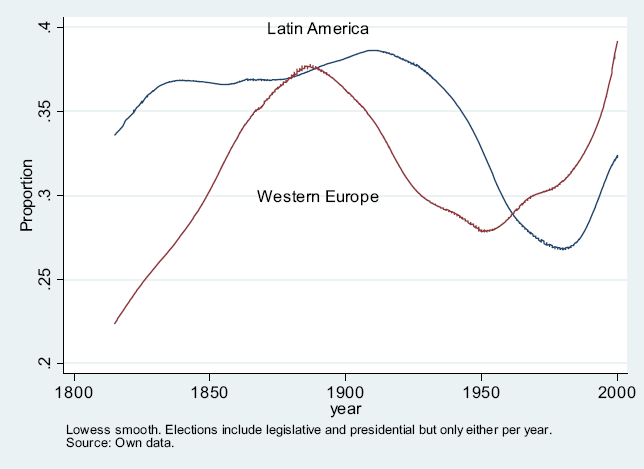
Proportion of Countries Holding Elections, by Year
Figure 2 shows the timing of different franchise rules. Note in particular that while universal male suffrage (category 7) arrived more or less at the sametime in Western Europe and Latin America, the latter continent enfranchised earlier all “independent” males (category 6). 14 The operative category that qualified for suffrage in Spanish America was vecino (literally neighbor): someone who had a regular source of income, had a permanent residence in a community, and was not dependent on others. 15 As several essays in Sabato (2003) emphasize, this was a sociological, not a legal, concept: a vecino was simply someone who had a standing in a local community. Moreover, while the early constitutions attempted to define this concept by phrases such as
According to Sabato (2003: 8), “Lejos de producirse un proceso gradual…, en buena parte de Iberoamérica la independencia introdujo un concepto relativamente amplio de ciudadano…”
The equivalent term in early North American history was “inhabitant,” defined in New Jersey in 1766 as a “Freeholder, Tenant for years, or Householder in Township or Precinct” (Klinghofer and Elkis 1992: 190n).
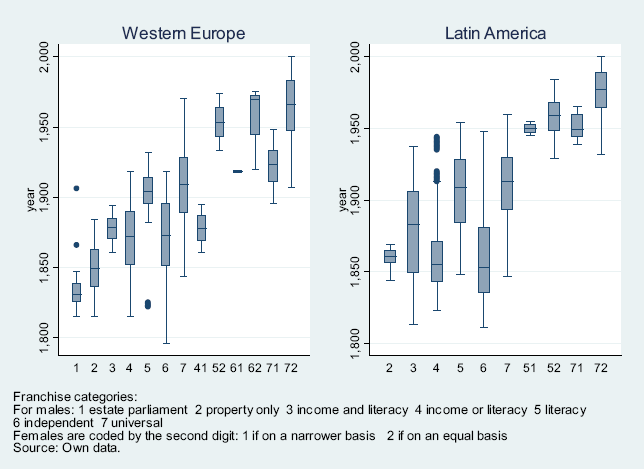
Years When Particular Franchise Rules Were in Force
“Having a property, or exercising some profession, or a skill with a public title, or having an occupation in some useful pursuit, without subjection to another as a servant or day worker”
(Peru in 1823) or such as “exercising some useful occupation or having known means of subsistence” (Costa Rica in 1824), 16 because eligibility was determined by local authorities, the application of these criteria was informal and permissive. As Canedo (1998: 188-9) recounts, if Pedro was known to be a good person by members of the local electoral table, he was a vecino. In these countries, the nationalization of citizenship (about which see Annino 1995, 1998), which transformed it from a social to a legal concept, meant replacing these vague criteria by specific income or tax thresholds, sometimes combined with the literacy requirement, which were more restrictive. Thus of the 18 countries in which the first qualifications gave the right to vote to all “independent” males, suffrage was subsequently restricted in 15.
In the original: “Tener una propiedad, o ejercer cualquiera profesión, o arte con título público, u ocuparse en alguna industria útil, sin sujeción a otro en clase de sirviente o jornalero” (Perú). “Son ciudadanos todos los habitantes de la República naturales del país, o naturalizados en él, que fueren casados, o mayores de diez y ocho años, siempre que ejerzan alguna profesión útil o tengan medios conocidos de subsistencia” (Costa Rica).
The consequence of these rules, as applied given the economic and educational contexts, was the proportion of the population that was enfranchised, shown in Figure 3. While it may appear that eligibility was more extensive in Europe, this result is due to the fact that the European series includes everyone who was eligible to vote given the franchise criteria while the Latin American series mix numbers for eligible and for registered voters, and this difference is a source of bias (see Przeworski 2009). Correcting for this bias would generate series that would be almost identical.
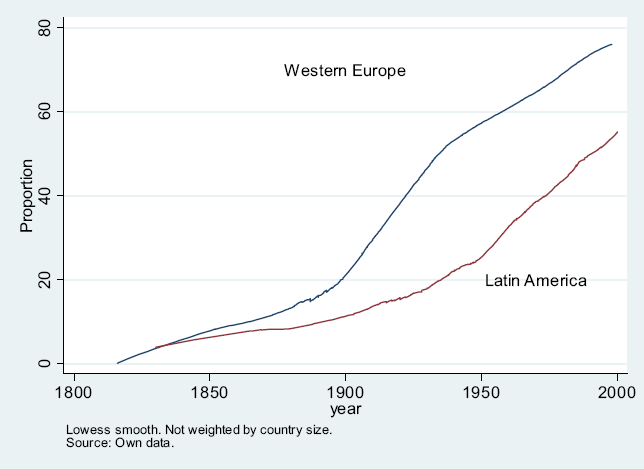
Proportion of Population Eligible to Vote, by Year
This much with regard to chronological timing: elections were more frequent earlier in Latin America, suffrage rules earlier included poor males, and the proportion of the population enfranchised was about the same.
Comparisons with regard to the level of development are difficult, because time series for income (from Maddison 2003) are available for Latin America basically only after 1870. Yet we know that Latin American countries were poorer than Western European already by 1820, so that they held more elections at lower income levels.
Per Capita Incomes 1700-2000
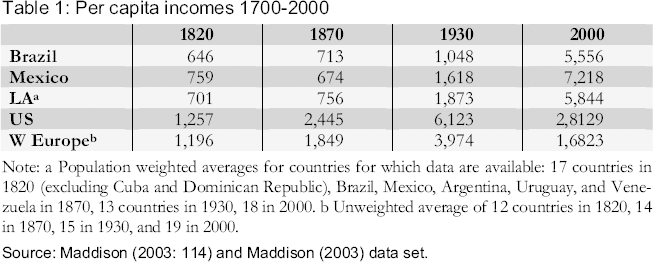
Note: a Population weighted averages for countries for which data are available: 17 countries in 1820 (excluding Cuba and Dominican Republic), Brazil, Mexico, Argentina, Uruguay, and Venezuela in 1870, 13 countries in 1930, 18 in 2000. b Unweighted average of 12 countries in 1820, 14 in 1870, 15 in 1930, and 19 in 2000.
Source: Maddison (2003: 114) and Maddison (2003) data set.
Post-1870 data show that the frequency of elections was almost identical in the two continents until Latin American countries reached the income of about 5,000 USD. 17
These are 1996 G-K purchasing power parity dollars from Maddison (2003). To get a sense of 5,000 USD, this was the income of Costa Rica in 1979 and 1992, Mexico in 1974, Argentina in 1949, Chile in 1966 and 1982, Colombia in 1993, and Uruguay in 1951 and 1973.
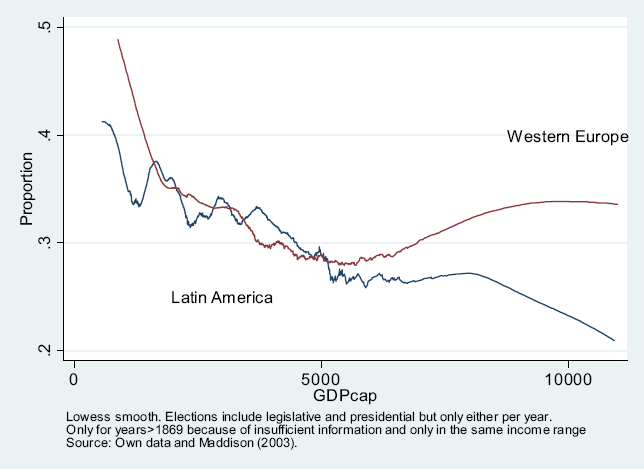
Proportion of Countries Holding Elections, by GDPcap
The proportion eligible to vote in Latin America was higher until an income of about 6,000 USD. (Remember that the Latin American series is downward biased.)
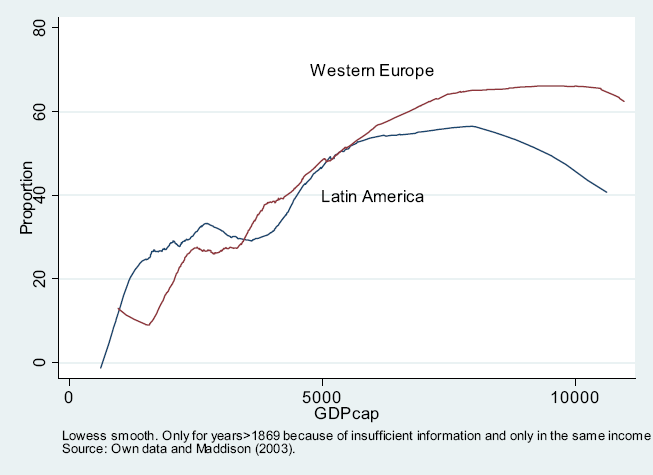
Proportion of Population Eligible to Vote, by per Capita Income
On the average, then, Latin American countries held more elections, and with a broader electorate, at lower income levels.
To summarize separate aspects of political development, we can think in terms of two types of political regimes. In one, there is some institutionalized pluralism: the constitutionally designated chief executive is elected, there is a legislature, and electoral opposition to the incumbent government is tolerated. In the second, power is held by force: either the chief executive is not elected or he rules without a legislature or no opposition is tolerated. The first regime is a “polyarchy.” But Dahl (1971) used this label in a much broader sense. Perhaps the best term to identify it would be “el gobierno constitucional,” but this term in turn does not travel well outside the Latin American legal tradition. 18 It is a system in which plural oligarchies attempt to process their conflicts using rules, specifically elections and legislative control over budgets. The second type of regimes is perhaps less controversially recognizable as “autocracy.”
“Oligarchical republic,” a term frequent in Latin American historiography, does not work here because we need to also include monarchies of Western Europe. Note that the prime minister (or equivalent) is considered as the chief executive in the latter systems even if the constitution specifies that this power rests with the king.
Since I will continue labeling the first system “democracy,” it may be useful to reflect about the aspects in which it need not be democracy as we now understand the term. One criterion which it need not satisfy is universal suffrage, an emphasis of Dahl (1971). The second aspect that may be missing is the possibility of partisan alternation in office: we have seen that during most of the nineteenth century incumbents were almost certain to win elections. But note that, as defined, these regimes do comprise systems in which political rights are universal and elections are competitive.
However one labels these regimes, the fact that matters is that Latin America attempted to institute constitutional systems providing for elections and tolerating at least some opposition at income levels lower than in Western Europe. Figure 6 shows the probability that a country attempts to institute such a system at particular levels of per capita income. (The acrossregion difference between these probabilities is statistically significant at 0.10 whenever the gray areas around each local regression line do not overlap.)
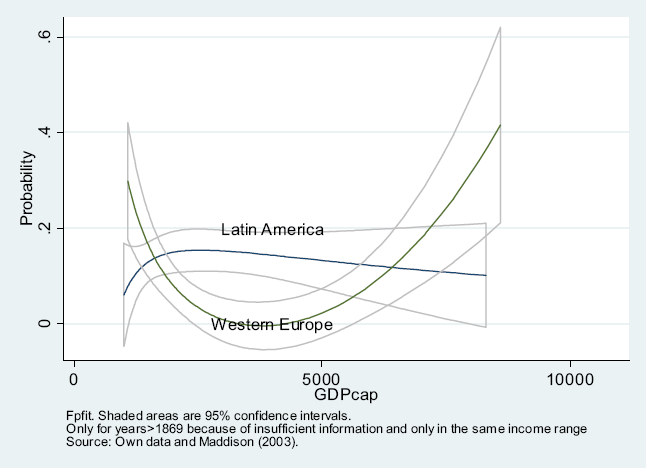
Probability of Transition to Democracy, by per Capita Income
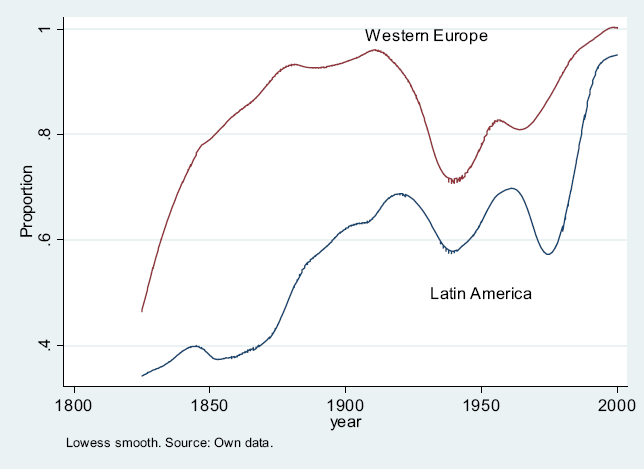
Yet, and here is the puzzle, democracies were less frequent in Latin America at all income levels.
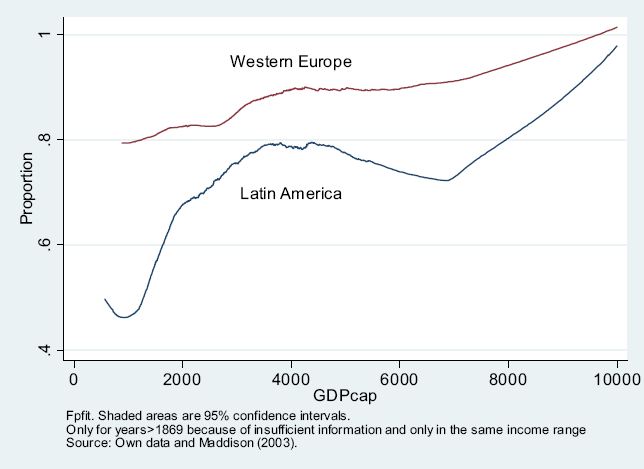
Democracies as a Proportion of Regimes, by per Capita Income
Now, how is it possible that Latin American countries attempted to institute democracies at lower income levels but ended up with fewer of them at all levels? To explain the difference between Latin America and Western Europe, we need to introduce two general facts: (1) the probability that, once in place, a democracy survives increases steeply in per capita income, converging to certainty when income is sufficiently high, and (2) both democracy and autocracy are less likely to survive when a country has experienced at any time in the past transitions to autocracy or, which is the same, completed spells of democracy. 19
Think as follows: At some time in a sufficiently distant past, all countries had autocratic regimes. Some of them attempted to institute democracy. If they had done so and the attempt was unsuccessful, both the subsequent autocracy and any future democracy are less durable.
Here is the evidence. Figure 8 shows that what matters for transitions to democracy is only the number of past visits to democracy (stra, which is a mnemonic for the sum of transitions to autocracy) but not income.
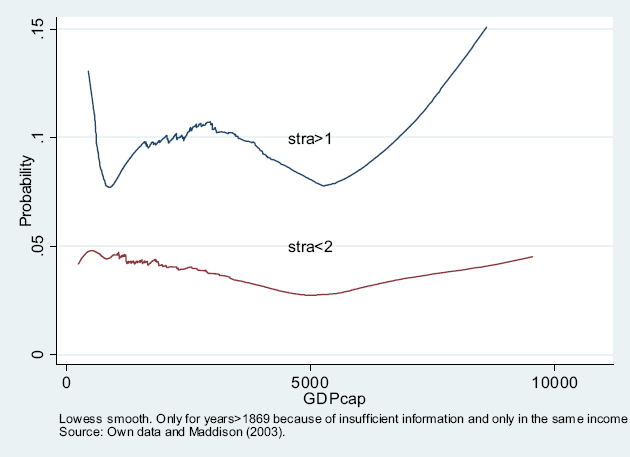
Probability of Transition to Democracy, by GDPcap and Past Spells of Democracy
Figure 9, in turn, shows that transitions to autocracy become sharply less likely as income increases but below a certain income level they are more likely if a country had visited democracy in the past.
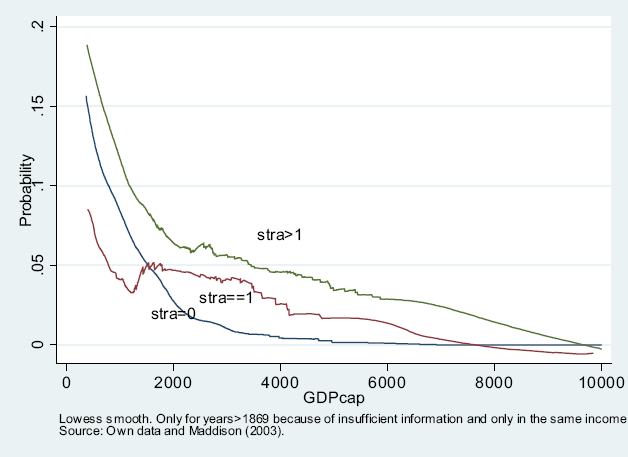
Probability of Transition to Autocracy, by GDPcap and Past Spells of Democracy
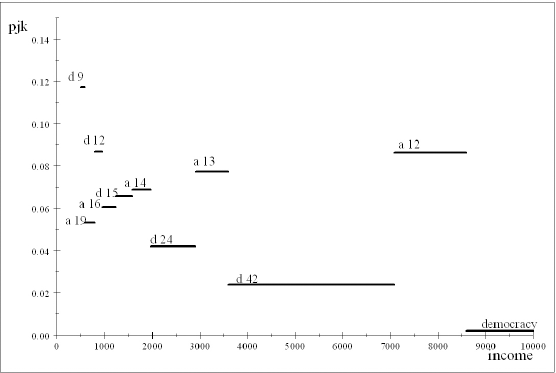
A Stylized History of a Country
Now, to put two and two together, take a country that enters democracy at a low income level. At such a level, the probability of democracy falling is quite high. Suppose this democracy falls. The probability that the subsequent autocracy survives is then lower, so that the probability that this country will try democracy again is higher, but the probability that the second democracy survives is also lower. This sequence can be repeated several times, so that if per capita income were constant, both regimes would become increasingly unstable. But income matters: if the economy grows in the meantime, the probability that a democracy dies declines in spite of the past regime instability. And at one time, income passes a threshold above which democracy is impregnable, so that once it is installed it lasts for ever.
Here is a schematic history of such a country, one that for the first time enters democracy when it has per capita income of 500 USD; assuming that throughout the period per capita income grows at the annual rate of 1.63; which is the average for the entire set of observations. 20 The probability that this democracy dies in the first year is pda = 0.1171: The expected life of this democracy is about 9 years, at which time the country becomes an autocracy with an income of 578 USD. Given that this country already visited democracy once, the probability that this autocracy would die during the first year is pad = 0.0530, with an expected life of about 19 years. It now enters democracy again, at the income of 786 USD but with the history of a previous visit to democracy. The probability that this democracy would die is now pda = 0.0867 < 0.1171, which indicates that the effect of increased income is greater than that of the previous visit to democracy. The expected life of this democracy is 12 years and the country re-enters autocracy at the income of 954 USD with a history of two visits to democracy. Because income does not affect the probability of autocracy dying but past visits to democracy increase this probability, pad = 0.0605 > 0.0530, and the expected life of this autocracy is 16 years. Figure 12 shows the transition probabilities (for the years the country enters a particular regime) and the expected durations of each regime, as income increases. The duration of democratic spells becomes longer and of autocratic spells shorter, until the country enters democracy at an income level when it is certain to survive. Note that this country will have experienced 11 regime spells, including a bout with autocracy at a relatively high income level (about that of Argentina and Uruguay in 1976).
The dynamic would be more complex if the regimes had an impact on growth rates. Specifically, if poor autocracies caused incomes to decline, there would exist a low level trap of increasing instability of both regimes and an oscillating low income. But neither previous research nor explorations of this data set support a view that there is a systematic difference between regimes.
In contrast, consider a country that first enters democracy at 2,000 USD. This democracy has an expected life of 38 years and the country enters autocracy with the income of 3,697 USD. After 21 years of autocracy, the country re-enters democracy with the income of 5,192 USD when pda = 0.0088 and the expected life is 114 years. Short of a highly unlikely event during the first years of this democracy, therefore, this regime lasts for ever.
Note that the reasons autocratic spells become shorter and democratic spells longer at higher incomes are different. Autocratic spells are shorter almost exclusively because countries that have higher incomes have accumulated more visits to democracy, and such visits destabilize the subsequent autocracies. 21 Democratic spells are longer, however, only because democracy lasts longer at higher income levels. Although past visits to democracy do destabilize subsequent democratic regimes, this effect is small, while the effect of income is powerful.
Since higher income masks past experiences with democracy, several researchers mistakenly attribute the shorter life of autocracies in wealthier countries to income. See, for example, Boix and Stokes (2001).
To see it in aggregate terms, assume that in one region half of the countries first enter democracy with per capita income of 500 USD, while in the second region half of the countries first experiment with incomes of 1,500 USD. Figure 11 shows the proportion of democracies in the two regions over time.
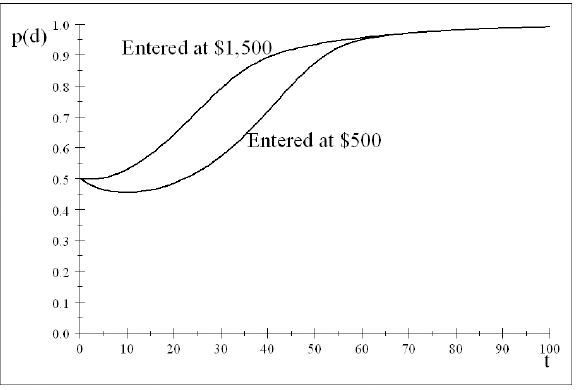
Probability of Democracy by Years Since the First Entry and the Income Level at First Entry
Democracies as a Proportion of Regimes, by Year
Hence, the puzzle is unraveled. Countries that experiment with democracy below some income level are unlikely to sustain it. Hence, they become autocracies, while countries that embraced democracy at higher income levels continue as democracies. Past experiences with democracy destabilize both regimes. Yet although countries that embrace democracy when they are poorer experience more regime instability, as their incomes increase, each subsequent democracy is more durable. In the end, regardless of the initial income levels, when their income becomes sufficiently large, all countries reach a situation in which democracy lasts for ever.
Since these intuitions are far from obvious, the argument is developed formally in the Appendix.
The dynamic of regimes is driven by two mechanisms: the probability of democracy dying declines in per capita income and past visits to democracy destabilize both regimes, but particularly autocracies.
One explanation of the dependence of democratic stability on income goes as follows. Think of democracy, and more narrowly elections, as a method for processing conflicts according to rules. The politically relevant groups – those that have some capacity to mobilize force – can either obey the outcomes that result from applying rules, again more narrowly the result of an election, or rebel, at a risk of being defeated by force. Now, assume that when people enjoy higher incomes, they care less about whatever they could gain by using force, 22 while they care as much as poorer people about avoiding violence. This is sufficient to generate the conclusion that above some income level, perhaps different in different societies, the potential gain from rebelling against outcomes generated by rules is valued less than the risk of violence. When this is true for all the politically relevant groups, democracy survives.
Technically, the utility function is concave in whatever arguments that may be affected by rebelling.
This explanation is obviously schematic and incomplete, but it can be fleshed out in a variety of ways. Moreover, whatever details one adds, the basic intuition survives (See Przeworski 2005; Benhabib and Przeworski 2006; Przeworski 2006). This is also why the results presented here are not sensitive to definitions of democracy. As long as the very possibility of conflicts of interests or values is admitted by allowing even a minimal opposition, conflicts must be processed according to some rules, however biased they may be in favor of the current power holders. And as long as there are rules, political forces – both those currently in power and those out of power – must repeatedly decide whether or not to accept the results the application of these rules generates. Indeed, I replicated some of the analyses coding as democracies only those regimes in which chief executives entered and exited from office according to previously established constitutional norms and, even more narrowly, as only those regimes in which the incumbent governments were at times defeated at the polls and peacefully left office. All the patterns described here hold for these successively narrower definitions of democracy.
Why both regimes are less durable when they follow failed experiments with democracy, I find more puzzling. To the extent this effect concerns autocracies, one may invoke “democratic traditions”: if a country experienced democracy (or several democracies), it is more likely to seek it again. This line of thinking was influential in some studies of transitions to democracy: Chile, with its long democratic tradition, was said to be better disposed to restore democracy than, say, Argentina. Yet the fact that democracies that follow past failed attempts are also less durable, even if the numerical effect is smaller and in the end dominated by income, puts the first explanation in doubt. If there is any political learning, it seems to cut both ways: under autocracy people remember democracy, but under democracy they know by experience that and how it could be overturned. 23
Just think how amateurish were the Russian golpistas of August 1991: they did not cut telephones, did not introduce a curfew, and did not even prepare a declaration of the new government. Their experienced Latin American soul brothers must have sneered with scorn.
A more plausible explanation concerns the role of the military. To consider this role, we need to take a detour. A hypothesis rival to the mechanics proposed here would be that the regime instability in Latin America is due to the fact that all Latin American democracies were presidential, and presidentialism makes democracy more brittle. Yet Cheibub (2007) decisively refuted this explanation, pointing out that the difference in the longevity of parliamentary and presidential democracies vanishes when we consider whether the dictatorship preceding the current democracy was civilian or military. In the end, Cheibub (2007: 140) concludes, “what kills democracies is not presidentialism but their military legacy.” In turn, using a somewhat more restricted definition of democracy, Przeworski (2004) discovered that all dictatorships in countries that had more than one past visit to democracy were military. Finally, extensive literature documents that the military frequently takes over with a transitional mission of “reestablishing order” and withdraws back to the barracks having killed a sufficient number of people (Finer 1976; Nordlinger 1977; Permlutter 1977). Hence, past visits to democracy may shorten the lives of subsequent regimes because, on the one hand, democracies following military dictatorships last shorter while, on the other hand, dictatorships following completed spells of democracy tend to be military, and military dictatorships also last shorter.
While they go a long way, these two mechanisms are not sufficient to explain fully the difference in the longevity of democracy in Western Europe and Latin America. Not all is mechanical. The sudden eruption of political instability in mid-1920s, both in Europe and Latin America, 24 was in most countries associated with economic crises but the resulting reductions of income were not large enough to significantly affect the probability that democracy would survive. Hence, this widespread contemporaneous collapse of democracies in different parts of the world requires a separate analysis. Perhaps, as Weyland (2008) argued with regard to the revolutionary wave of 1848, diffusion played a role independent of local conditions. In turn, while on both continents democracy became more frequent again after 1946, Greece was the only Western European country where it subsequently collapsed, while not a single democracy that existed in Latin America as of 1946 survived. While the difference in per capita incomes explains some of this contrast, the different fates of democracy on the two continents must be in part due to the outcome of the war. The Second World War resulted in defeat of authoritarian forces in Western Europe, while it left them intact in Latin America, which also meant that in its struggle against communism, the United States were forced to seek alliance with centrist political forces in Europe, while it could and did rely on the right-wing in Latin America (Cheibub 2007).
According to Rouquie (1994: 223), “Between February and December of 1930, the military were involved in the overthrow of governments in no fewer than six, widely differing Latin American nations – Argentina, Brazil, the Dominican Republic, Bolivia, Peru, and Guatemala. The same year also saw four unsuccessful attempts to seize power by force in other Latin American countries. Over the following years, Ecuador and El Salvador in 1931, and Chile in 1932, joined the list of countries in which military-provoked political shifts and unscheduled changes of the executive had taken place.”
In sum, here is the story of regime dynamics in Latin America. Latin American countries emerged as a consequence of revolutions against colonial rule, while European countries experienced a gradual devolution of power from monarchs to parliaments. As a result, Latin American countries attempted to introduce representative institutions at lower levels of income than European ones. Since these institutions are less stable at low income levels and since past experiences with democracy destabilizes regimes, representative institutions alternated intermittently with autocracy. Only when incomes became sufficiently large did democracy become more stable in Latin America. But these general patterns do not tell the entire story: the widespread collapse of democracies on both continents during the inter-war period remains puzzling while the instability of democracy in Latin America after the Second World War was due to the survival of authoritarian forces on this continent.