



Abstract
What explains electoral success in Mexico's gubernatorial elections after its transition to democracy? And to what extent did governors shape electoral outcomes in this period? This paper argues democratic competition, combined with the decentralisation of resources to the states, reinforced authoritarian-era practices like clientelism and the discretionary use of public funds by incumbents. As a result, electoral success was driven less by government performance and more by the support candidates received from the incumbent governor. Candidates from the governor's party were more likely to win because governors could deploy public resources, channel funds, or pressure local electoral authorities to tilt the playing field in favor of their co-partisans, thereby diminishing the relevance of performance-based voting. The analysis draws on a dataset of 238 candidates nested in 98 gubernatorial elections held between 2000 and 2017, along with interviews with gubernatorial candidates that shed light on the mechanisms behind the incumbency advantage.
Keywords
Introduction
Governors play a central role in federal systems, where power is shared between the national government and states. They oversee state governments, implement policies, and represent their state's interests in interactions with both the federal government and other states. In Mexico, informal institutions under the PRI's one-party rule produced a highly centralised system in which power flowed from the periphery to the center. However, the processes of democratisation and increased political competition led to both political and policy decentralisation (Beer, 2003), ultimately strengthening the authority of governors (Cantú and Desposato, 2012; Langston, 2017). Today, governors are responsible for managing fiscal policy, and variations in their ideological orientations influence spending patterns and the provision of public goods and services (Sánchez, 2023). Therefore, shedding light on the determinants of victory in gubernatorial elections is essential for better understanding democratic representation and for improving democratic accountability. The way governors are elected has far-reaching implications for representation and accountability, and it can also illuminate potential obstacles to democratic consolidation.
Gubernatorial elections in Mexico were always won by the PRI until 1989. By the early 1990s, however, elections had become increasingly competitive. By 1995, the PAN had won governorships in Baja California, Chihuahua, Guanajuato, and Jalisco (Beer, 2003). This trend towards greater competition continued after the country's democratic transition in 2000. Yet despite this increasingly competitive landscape, we still lack a comprehensive understanding of the factors that contributed to success in gubernatorial elections during the early years of the democratic period. Conventional wisdom in Mexico holds that support from governors is key for the performance of parties in subnational elections. News coverage reflects this, with headlines such as “The Power of Governors: The ‘Lords of the Gallows and Knife’ Elected by Mexico,” 1 or “The Second Transition to Democracy in Mexico: The new alternation governors could adapt to authoritarian structures in order to govern.” 2 However, we lack systematic evidence of the extent of this influence. What explained electoral victory in subnational contests in Mexico? To what extent did governors influence outcomes of gubernatorial elections in a post-transition context?
While many studies offer detailed accounts to explain the results of individual gubernatorial elections in Mexico, few have systematically assessed the myriads of variables that could explain success in gubernatorial elections. Additionally, theories commonly used to explain gubernatorial election outcomes in established democracies, such as the impact of incumbency advantage in the United States (Abramowitz, 1991; Piereson, 1977), may not be fully applicable to newer democracies like Mexico. Under the PRI's one-party rule, the president controlled the selection of gubernatorial candidates, whom most likely would be elected as governors. Some studies explain how, after the transition, parties began selecting candidates with more subnational experience and linkages to their states (Beer, 2003; Langston, 2017). However, we still know little about what factors could explain electoral success in post-transition contexts like Mexico. This paper contributes to the literature on subnational elections in emerging democracies by systematically analyzing the factors that influenced gubernatorial election outcomes during Mexico's first three democratic presidencies (2000–2017) and by examining the impact of incumbency advantage. How political regimes are born shapes their future trajectory; thus, the early democratic period provides crucial insights into the consolidation, or stagnation, of democratic practices. This era was characterised by a stable three-party system (Greene and Sánchez-Talanquer, 2018) and high levels of partisan identification among voters (Moreno and Méndez, 2007). These conditions fostered distinct patterns of party competition, which were later disrupted by the rise of Morena and broader realignments in the party system after 2018 (Aguiar Aguilar et al., 2025). Therefore, this study focuses on elections held between 2000 and 2017, before these fundamental changes took place.
I argue that Mexico's political parties inherited voter-mobilisation strategies from the authoritarian period and, following the decentralisation of fiscal and political resources, incumbent governors across major parties adopted practices that had previously sustained the PRI's dominance. As a result, even as electoral competition increased, gubernatorial election outcomes became driven less by government performance and more by the support candidates received from incumbent governors. Given that governors are constitutionally barred from seeking reelection, many used their influence and control over state resources to support their party's candidates. Likewise, when opposition parties gained control of state governments, they often replicated these strategies, deploying public resources in ways reminiscent of those used by the hegemonic PRI. A second mechanism reinforcing incumbency advantage involved the control of state electoral authorities. Governors could influence appointments, budgets, and institutional powers, thereby compromising the neutrality of these bodies. This control created opportunities for bias in the organisation of elections, further tilting the playing field in favor of the ruling party in each state. Together, these features of Mexican subnational politics generate a systematic advantage for candidates who share partisanship with the incumbent governor. A first glance at the data indicates that incumbent parties hold a clear electoral advantage, with 60.61 per cent of state contests being won by candidates who belong to the party of the departing incumbent. One observable implication is that, because parties recognise gubernatorial support as a decisive electoral asset, incentives for good performance diminish, weakening electoral accountability and reducing society's capacity to sanction poorly performing governors.
The paper proceeds as follows. The first section of this paper provides a summary of the main factors that could contribute to victory in gubernatorial elections. These theoretical insights are then adapted to Mexico's political context to generate the core hypothesis of this article: candidates from the incumbent governor's party are expected to have a clear advantage. The third section outlines the empirical strategy, including the construction of a new dataset of 98 governor's elections for the 31 Mexican states and Mexico City between 2000 and 2017. This dataset includes variables related to candidate quality, party strength and access to resources, and several measures of the performance of incumbent governors. This quantitative section is used to assess the impact of the incumbency advantage on the probability of winning. Then, I draw on 21 interviews with former gubernatorial candidates to illustrate the mechanisms through which the incumbency advantage could be translated into electoral victories. The paper concludes with a discussion of the main findings and their implications for democratic accountability in new democracies, along with suggestions for future research.
Party Strategies, Voter's Choice and Electoral Success
Explaining electoral success is a multicausal task, but it can be broadly understood as the interaction of two components: parties implementing mobilisation strategies and voters making choices. The literature identifies two primary approaches to building linkages between parties and voters. The first is programmatic appeals, through which parties cultivate a reputation for implementing specific policies and rational voters select the option that maximises their utility (Downs, 1957; Kitschelt et al., 2010). The second is clientelism, where parties offer targeted private or club goods in exchange for political support (Kitschelt and Wilkinson, 2007).
From the programmatic linkage perspective, voters support parties they believe will deliver the greatest expected utility (Downs, 1957). They are conceptualised as rational actors – “omniscient calculators” (Lupia et al., 2000) – who weigh costs and benefits and prospectively choose the option that maximises their welfare. Fiorina's reward–punishment model adds a retrospective dimension: voters update a “running tally” of party performance and reward or punish accordingly (Fiorina, 1981). A related distinction in economic voting contrasts egotropic evaluations of personal economic conditions with sociotropic assessments of the broader economy. Evidence suggests voters often rely more on sociotropic judgments, though both logics may coexist in Latin America (Singer and Carlin, 2013; Weyland, 2003). Together, these models portray elections as mechanisms that align public preferences with government outputs and enforce accountability (Cleary, 2007).
Clientelism offers an alternative mobilisation strategy. Parties provide excludable benefits to specific voters in exchange for political support, under the assumption that recipients will reciprocate with votes (Kitschelt and Wilkinson, 2007). These benefits may include cash transfers, subsidies, credit, or land titles (Magaloni, 2006). While often associated with authoritarian regimes that aim to monopolise mass support (Magaloni, 2006), clientelism is also common in democracies (Kitschelt and Wilkinson, 2007) and tends to flourish where political competition is intense, poverty is widespread, party organisations can monitor exchanges, and parties control key resources (Kitschelt and Wilkinson, 2007). Parties may rely on programmatic or clientelist strategies or combine them.
Beyond party strategies, it is essential to consider how voters respond to these efforts and make electoral decisions. While voters may attempt to rationally evaluate parties’ strategies, whether programmatic or clientelist, they also frequently rely on non-rational or affective linkages. Political experience often serves as a heuristic: voters interpret it as an indicator of competence and suitability for office (Portmann, 2022). Likewise, voters can also exert a summary judgement about the candidate's suitability for office from their physical appearance, making “better” looking candidates more likely to win (Lawson et al., 2010). These attributes, experience and appearance, are factors that parties can strategically manage when selecting candidates.
Party identification is another powerful affective attachment: voters develop enduring attachments to political parties, typically beginning in childhood and reinforced through socialisation. These attachments tend to persist over time and shape voting behavior in a self-reinforcing way (Lewis-Beck et al., 2008). Party identification is emotional in nature and serves as a cognitive shortcut that significantly influences vote choice (Green et al., 2002; Lewis-Beck et al., 2008). This dynamic benefits parties operating in institutionalised party systems, where parties have deep societal roots and voting patterns are more stable (Mainwaring, 2018). Although party identification is an individual-level variable, aggregate analyses often use previous vote share as a proxy for this attachment (Magar, 2012).
Finally, incumbency advantage is one of the most robust predictors of electoral success. In the United States, incumbents benefit from name recognition, access to resources, and credit-claiming opportunities, which increase their likelihood of reelection (Abramowitz, 1991; Piereson, 1977). In Latin America, evidence is mixed and varies across institutional contexts (Schiumerini, 2025). Incumbents often leverage public resources, social programs, and patronage networks, particularly where party institutionalisation is weak or the electoral playing field is uneven (Calvo and Murillo, 2004; Stokes, 2005). Some studies find strong incumbency advantages – either Argentinian mayors (Núñez, 2018), Brazilian and Argentinian governors (Schiumerini, 2025) – while others find disadvantages, as in the cases of Mexican mayors (Lucardi and Rosas, 2016) and Brazilian mayors (Schiumerini, 2025).
In sum, electoral outcomes are shaped by a complex interplay of factors. To fully understand them, one must consider not only the mobilisation strategies that parties adopt, whether programmatic or clientelist, but also the affective linkages that guide voter decision-making. These include the candidate's charisma, personal traits such as experience and appearance, and voters’ long-standing partisan attachments.
Electoral Success in the Mexican Context
What explains electoral success in Mexico's gubernatorial races during the early democratic period (2000–2017), and how did incumbent governors shape these outcomes? This section builds on previous theoretical frameworks to propose specific expectations about the determinants of victory in Mexico's gubernatorial elections.
A first step is to determine whether Mexico operated as a candidate-centered or party-centered system. This distinction matters because if incumbency advantages stem from governors’ use of public resources, political pressure on electoral authorities, or other mechanisms to support co-partisan candidates, such support is typically channeled through party structures. This allows us to differentiate between personal or party incumbency advantage (Schiumerini, 2025). Although gubernatorial elections select individuals, and personal traits such as experience or perceived competence can matter (Lawson et al., 2010; Portmann, 2022), Mexico during this period functioned largely as a party democracy. Since the early 1990s, subnational elections displayed stable patterns of competition with parties anchored in distinct regional bases (Klesner, 2005), and until Morena's rise in the late 2010s, the system was a relatively institutionalised three-party configuration (Greene and Sánchez-Talanquer, 2018). This institutionalisation contributed to strong partisan identification: according to several national surveys, around 60 per cent of voters self-identified with a political party during this period (Moreno and Méndez, 2007).
Institutional features of the electoral system also strengthened party control. Unlike the United States, where candidates raise their own funds, public financing in Mexico is managed by parties. PRI leaders exploited election reforms in the 1990s to secure public funding for campaigns and party activities through the Federal Electoral Institute (IFE), regardless of being in power or not. When the PRI lost the presidency, this gave the party leadership an advantage, as they controlled public funding (Langston, 2017). Parties also controlled ballot access: independent candidates were not allowed federally until 2012, and gubernatorial races used single-member districts, which tend to privilege party reputation over individual traits (Carey and Shugart, 1995). Taken together, stable partisan competition, strong identification, and institutional incentives indicate that Mexico was better characterised as a party-centered system.
A second step is determining whether parties relied primarily on clientelistic or programmatic mobilisation. Historically, governors have been pivotal actors in Mexican politics. Even under the PRI's hegemonic rule, governors exercised considerable autonomy as long as they maintained political order in their territories (Langston, 2017). They controlled candidate selection for municipal elections, and mobilised resources for PRI victories. For the specific case of the PRI, when the party lost the presidency, and with no national president to appoint gubernatorial candidates, this role was filled by PRI national leadership and incumbent governors (Langston, 2017). Although the PRI was the most powerful party, its weak territorial structure made it dependent on governors to deliver votes (Langston, 2017).
Clientelism was central to the PRI's dominance. Vote buying, enabled by control over fiscal resources and targeted transfers, was a core strategy (Magaloni, 2006; Magaloni et al., 2007). One of the key shortcomings of Mexico's democratisation process was that political parties failed to build programmatic linkages with voters. Instead, decades of authoritarian clientelism left enduring legacies that persist alongside new democratic practices (Serra, 2016). Even after democratisation, all parties engaged in vote buying to varying degrees (Beltrán and Castro Cornejo, 2019; Cantú, 2019; Greene and Simpser, 2020; Serra, 2016).
Two main factors explain the persistence of clientelism under democracy. First, clientelism can be regarded as an authoritarian inheritance. This concept is associated with authoritarian successor parties, which are parties that emerged from authoritarian regimes and that were able to survive after a transition to democracy (Loxton, 2018). The PRI fits this definition. This type of party can inherit resources and portable skills from the authoritarian period that help them thrive under democracy; among the typical authoritarian inheritances we find party branding, territorial structures, financial resources, and clientelist networks (Loxton, 2018). In the case of clientelism, skilled political actors are likely to maintain clientelistic practices they have mastered and that continue to serve their interests. If such strategies were successful – as they were during the final years of PRI dominance (Garrido de Sierra, 2019; Magaloni, 2006) – parties have little incentive to abandon them. According to Kitschelt et al. (2010, 23), political actors will only invest in alternative modes of mobilisation “when other, more expedient and direct linkages such as clientelism, are unattractive to most voters.”
The second factor that may explain the persistence of clientelism is the decentralisation of resources that accompanied Mexico's democratisation. This expanded governors’ control over fiscal resources, enabling them to distribute pork and support co-partisan candidates (Cantú and Desposato, 2012). This behavior has been common among governors from all parties since democratisation, as they all used state funds and bureaucratic power to support their co-partisans (Beltrán and Castro Cornejo, 2019; Serra, 2016). Following the PRI's loss of the presidency in 2000, major institutional reforms led to substantial decentralisation of power and resources (Beer, 2003; Cantú and Desposato, 2012; Langston, 2017). Governors are therefore incentivised to preserve these resources for their parties, frequently channeling them to benefit co-partisan candidates. Additionally, as former PRI politicians defected to opposition parties, they brought their clientelist networks with them, allowing new parties to build their own machines (Garrido de Sierra, 2019). Thus, the decentralisation of resources transformed clientelism from an authoritarian legacy exclusive to the PRI into a tool available to all major political actors. This would lead us to expect incumbent parties, regardless of partisan affiliation, to enjoy a clear electoral advantage.
Another advantage incumbents may hold over other parties is the ability to influence local electoral management bodies when their autonomy is not adequately protected. In such contexts, governors can pressure electoral authorities to interpret and apply rules in ways that favor the incumbent party, engage in administrative irregularities, or even overturn election results. One institutional solution is for incumbents to credibly commit not to manipulate elections by delegating their administration and certification to an independent electoral body (Lehoucq, 2002; Magaloni, 2010). However, during the period under study, prior to 2014, governors had substantial influence over the appointment of members of the electoral management bodies’ governing boards, effectively making electoral councilors agents of the governor rather than neutral and independent officials. Based on the previous arguments, the following hypothesis is proposed:
In contexts characterised by the two conditions outlined above – clientelism as an authoritarian legacy and the decentralisation of resources – incumbent politicians’ access to discretionary funds should generate a clear electoral advantage for incumbent parties. When governors frequently and systematically intervene in state-level electoral processes, and when all major parties depend heavily on clientelistic mobilisation, a key implication is that the programmatic dimension of political representation becomes substantially weakened. As a result, patterns of accountability are also expected to be seriously undermined. This leads to the following hypothesis:
Data and Methods
To test these hypotheses and focusing on the period after the transition to democracy and before the rise of Morena, I use electoral data from all gubernatorial contests held in the 31 states and Mexico City between 2000 and 2017. The unit of analysis is each candidate who competed in these elections and received at least 10 per cent of the vote share, nested within each election. This produces a panel of 238 candidates across 98 gubernatorial elections. Candidates running under coalition banners were counted only once.
The dependent variable is binary, coded as 1 if the candidate won the election and 0 otherwise. My main independent variable is a dummy indicating whether a candidate belonged to the incumbent governor's party, allowing me to test whether this affiliation provides an electoral advantage (H1). To account for the influence of candidate-level characteristics and party-related factors on the probability of victory, I include two sets of control variables. The first set captures individual candidate attributes: Elected experience, Degree, Skin color, Woman and Age. Elected experience is an additive index measuring a candidate's cumulative experience in popularly elected positions prior to the election. 3 This measure follows Langston and Aparicio's (2008) emphasis on the importance of prior experience in Mexican political career trajectories. Alternatively, I also measure experience by simply counting the previous Number of elected positions, which facilitates substantive interpretation versus the index. The inclusion of experience is supported by evidence that voters use it as a heuristic for candidate competence (Portmann, 2022). Degree is an ordinal variable capturing the highest level of formal education attained by the candidate: one for a college degree, two for a master's degree, and three for a PhD, and zero otherwise. Skin color is an ordinal measure of skin tone coded by a team of research assistants using the color palette developed by the Project on Ethnicity and Race in Latin America (PERLA). The palette includes eleven skin tones, with one representing the lightest and eleven the darkest. 4 This variable is included because prior research shows that skin color affects the vote share received by candidates in Mexico and Brazil (Aguilar et al., 2015). I also include a dummy variable identifying whether the candidate is a Woman, and I control for the Age of the candidates.
The second set of controls captures party-related characteristics. Party Strength is measured as the share of seats won by the candidate's party (or coalition) in the previous local legislative election, included to account for stable patterns of electoral competition. Coalition vs. incumbent is a binary variable indicating whether the opposition formed a coalition to challenge the incumbent party. This reflects the increasingly competitive environment in Mexico, where parties often build coalitions for instrumental, vote-maximising purposes regardless of ideological distance (Méndez de Hoyos, 2012; Spoon and Pulido, 2017). 5 Campaign cost captures the financial expenditure of each campaign. 6 Higher spending generally enhances name recognition, voter outreach, and narrative control, all of which are associated with improved electoral performance (Greene, 2011; Kam and Zechmeister, 2013). Despite its intuitive appeal, campaign spending has not been systematically tested in the context of Mexican gubernatorial elections. Run before is coded as 1 if the candidate previously contested the same governorship in the preceding election. Former losing candidates often perform better in subsequent attempts due to accumulated experience, established networks, and increased visibility (Haime et al., 2022). This is classified as a party-related variable since parties ultimately decide who appears on the ballot. Presidential coattails measure the vote share of a co-partisan presidential candidate in concurrent elections, taking a value of zero in elections without a concurrent presidential race or without a co-partisan candidate. This variable is informed by evidence of coattail effects in Mexican congressional elections (Magar, 2012). Finally, to capture party ideology, I follow Sánchez (2023), who classifies Mexican parties as left, center, or right. The right category includes PAN candidates and PAN–PRD alliances that nominated PAN candidates. The center includes PRI candidates and independents with no prior party affiliation. The left includes PRD candidates, PAN–PRD alliances whose candidates previously held positions with left-wing parties, and Convergencia/Movimiento Ciudadano. Three dummy variables identify whether the candidate is classified as left, center, or right.
To test H2, which posits that the past performance of political parties has no effect on the probability of wining gubernatorial elections, I include five indicators of government performance. GDP change captures shifts in the state economy by subtracting the GDP growth rate in the year prior to the election from the GDP growth rate in the election year. 7 Evidence from four federal Latin American countries, including Mexico, suggests that state-level economic performance tends to influence gubernatorial vote intentions more than national trends, although the magnitude of this effect is generally moderate (Gélineau et al., 2025). A second economic indicator is the Unemployment rate, measured as the percentage of the unemployed population over the economically active population in the trimester preceding the election. 8 However, because subnational unemployment data in Mexico are only available beginning in 2004, including this variable reduces the sample from 238 to 179 observations. Given that victimisation and insecurity have been shown to shape voting behavior in Mexican presidential elections (Altamirano and Ley, 2020), I also include the Murder rate, measured as the number of homicides per 100,000 inhabitants in each state. 9 The inclusion of this control is justified since public safety in Mexico is constitutionally a shared responsibility between the Federation, municipalities, and the states. To capture government spending priorities, I include two additional variables. Transfers, Allocations, Subsidies, and Other Assistance measures “allocations granted directly or indirectly to the public, private, and external sectors, as well as to parastatal organizations and enterprises, and to support programs that form part of the government's economic and social policy” (CONAC, 2010). This category includes subsidies for housing, private consumption, welfare, and pensions. Public investment, refers to “allocations designated for contracted works, productive projects, and promotional or development activities” (CONAC, 2010). Both spending variables are measured as a percentage of total state expenditures in the year before the election. 10 Because a central implication of my argument is that accountability mechanisms are weakened under strong incumbent advantage, I expect none of these performance indicators to significantly affect the probability of winning a gubernatorial election. Table A1 in the Appendix displays the descriptive statistics for all variables included in the analysis.
Results
Because my dependent variable is dichotomous, I estimated a logistic regression model with robust standard errors clustered by election to address potential heteroscedasticity. Table 1 reports the results. Model 1 presents a simple bivariate specification assessing the effect of incumbency on the probability of winning the election. Model 2 incorporates all candidate and party level controls, while Model 3 excludes campaign spending, which reduces the sample from 238 to 175 observations. Model 4 adds the performance variables, and Model 5 replicates Model 4 without campaign spending. Across all models, the incumbency variable is positive and statistically significant, confirming H1: candidates affiliated with the incumbent governor's party enjoy a substantial electoral advantage. Even Model 5 – estimated with a reduced sample of 140 observations and including five interaction terms that decrease the degrees of freedom – shows a positive and statistically significant incumbency effect (p < 0.10). This finding is consistent with prior research showing that governors can deploy public resources and mobilise local bureaucracies to benefit their co-partisans (Cantú and Desposato, 2012; Langston, 2017).
To facilitate interpretation of the magnitude of the effects, Figure 1 displays the Average Marginal Effects (AMEs) for all variables in Model 3, holding covariates at their observed values and averaging across observations. 11 Candidates from the incumbent governor's party enjoy a large electoral advantage, increasing their probability of winning by approximately 42 percentage points on average. The qualitative section offers a deeper exploration of this finding, drawing on interviews with gubernatorial candidates.
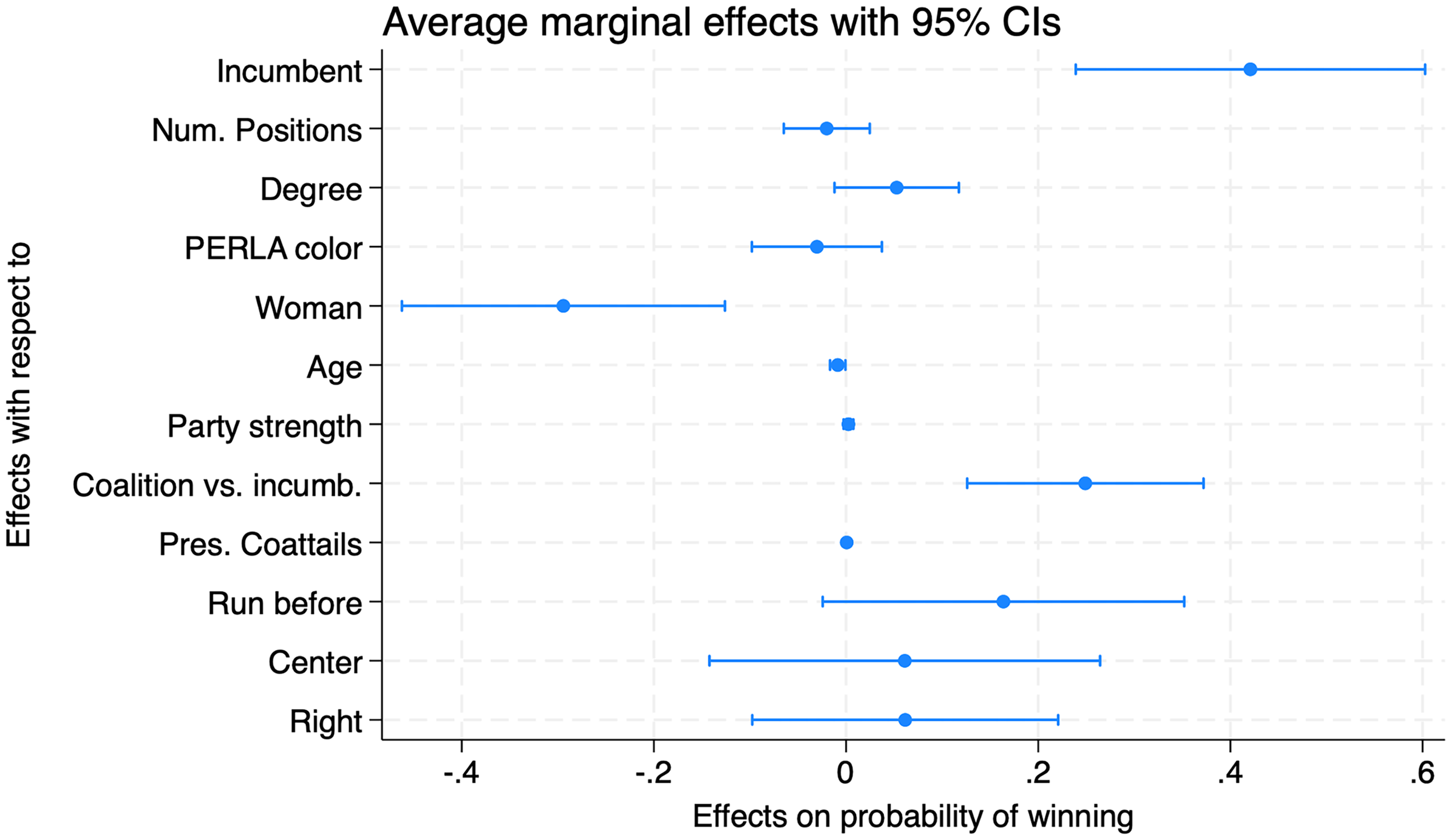
Average Marginal Effects of the Probability of Winning a Gubernatorial Election. Source: Author's Dataset. Note: Prepared by the Author Based on Model 3.
Turning to the control variables, Degree is only weakly associated with the probability of winning, suggesting that voters may view higher educational attainment as a signal of competence. On average, each additional degree level increases the probability of victory by 5.2 percentage points. Some candidates, such as Samuel García in Nuevo León, appear to have recognised this perception and accumulated multiple graduate degrees, sometimes from institutions of questionable academic rigor. Contrary to expectations, the coefficient for Number of elected positions is negative, though not statistically significant. 12 Skin color is not statistically associated with the probability of winning gubernatorial elections, except in Model 5. This null finding may reflect the candidate-selection process, in which local ties and political experience are central and may overshadow other individual-level traits (Langston, 2017). Nonetheless, prior research shows that skin tone affects electoral outcomes for other offices, such as federal deputy and senator (Campos Vázquez and Rivas Herrera, 2019). The dummy variable for Woman is negative and statistically significant in all models, indicating that women were less likely to win gubernatorial elections during the period analyzed. On average, female candidates have a 29-percentage-point lower probability of winning, holding all else constant. Age is also negative and statistically significant in most models. Each additional year of age is associated with a 0.8 percentage point decrease in the probability of winning, on average.
Among the party-related variables, the most consistent finding concerns opposition coalitions. When opposition parties form a coalition to run against the incumbent, their probability of winning increases by 24.9 percentage points on average. This pattern mirrors findings from legislative elections (Méndez de Hoyos, 2012; Spoon and Pulido, 2017) and suggests that coalition-building is an effective strategy for defeating incumbent-party candidates. The remaining party-level variables do not yield notable effects.
Models 4 and 5 evaluate whether incumbent performance conditions the electoral advantage of incumbent-party candidates. Models 2 and 3 establish the baseline incumbency effect net of candidate and party controls. I then introduce interactions between the incumbency indicator and the performance variables to test whether retrospective evaluations shape electoral outcomes. Models 4 and 5 support H2: neither economic performance nor public security outcomes, nor spending on public investment or transfers, significantly affect the probability of wining an election. These results align with Cleary (2007), who finds no relationship between electoral competition and government responsiveness at the municipal level.
As a robustness check, I re-estimated the models in Table 1 using state and year fixed effects to exploit between-election variation and to control for time-invariant state characteristics and national or regional shocks by year. The incumbency effect remains statistically significant across specifications, except in Model 4, where the reduced sample and inclusion of five interactions substantially decrease degrees of freedom. Results for the remaining variables remain consistent. Full results appear in Table A2 in the Appendix.
Logit Regressions of the Probability of Winning a Gubernatorial Election.
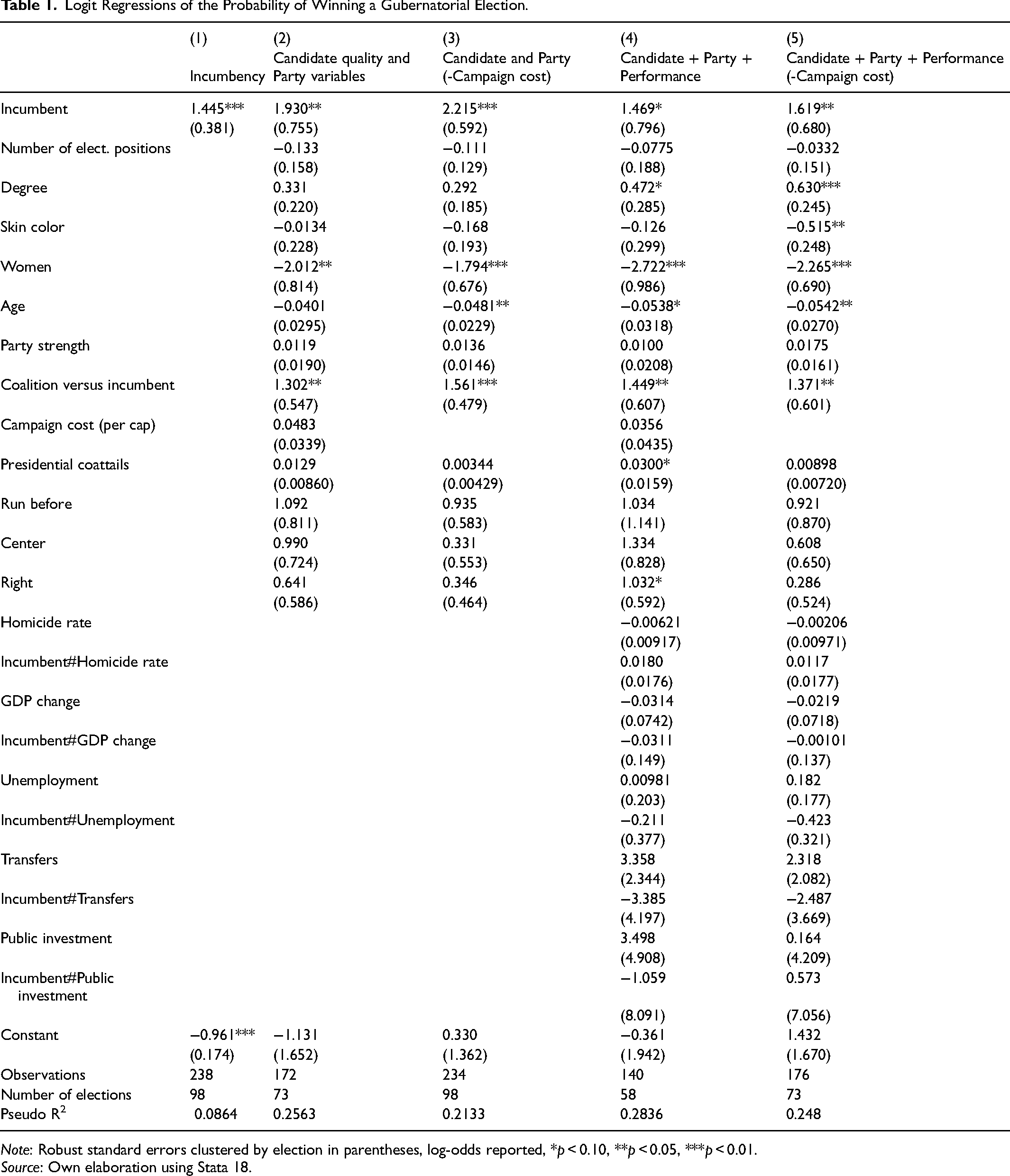
Note: Robust standard errors clustered by election in parentheses, log-odds reported, *p < 0.10, **p < 0.05, ***p < 0.01.
Source: Own elaboration using Stata 18.
To further assess whether performance variables influence electoral outcomes, I estimated separate models for each performance dimension rather than including all interactions simultaneously (see Table A3 in the Appendix). This approach reflects both theoretical and statistical considerations. Substantively, economic growth, unemployment, public security, and spending priorities represent distinct accountability mechanisms that may not operate jointly. Statistically, estimating multiple interaction terms in a single nonlinear model with a limited number of elections reduces statistical power and inflates standard errors. Examining each interaction separately enhances parsimony and interpretability, while showing that the main incumbency effect remains robust across specifications. However, none of the interaction terms between incumbency and performance variables are statistically significant, indicating that gubernatorial performance does not affect the probability that the incumbent party wins. These results are replicated using state and year fixed effects (see Table A4 in the Appendix). Taken together, these findings raise important questions: Why do performance and electoral outcomes appear unrelated at the aggregate level, while individual-level analyses (Altamirano and Ley, 2020) confirm the central role of economic issues in voting behavior? In a democracy, elections are intended to serve as mechanisms of accountability, allowing citizens to reward or punish politicians based on their performance. If elections fail to serve this function, it signals a troubling disconnect between citizen preferences and political outcomes.
The Incumbency Effect
The strong substantive effect of belonging to the incumbent governor's party on the probability of being elected calls for a deeper examination of why this advantage is so pronounced. As previously discussed, governors control significant resources, and there are strong incentives to keep these resources within the same party, as doing so enhances the power and prominence of party members. But what mechanisms do incumbent governors use to provide their co-partisans with an electoral advantage? Based on 21 interviews conducted with gubernatorial candidates from various political parties between September and December 2013 (see Table A5), 13 I found two recurring concerns raised by candidates regarding the quality of local elections in Mexico: (1) the lack of autonomy of local electoral authorities and their subordination to the governor; and (2) the excessive and unlawful interference of incumbent governors in the electoral process. When asked about the most serious flaws in the electoral system, one candidate summarised it this way: “The problem is the lack of autonomy of the [electoral] commissions. […] The most severe issue is the use of public funds to finance the campaign of the governor's favored candidate” (Interview 21).
The first major problem, identified almost unanimously by the candidates, was that local electoral management bodies and local electoral courts were frequently perceived by candidates as operating in close alignment with incumbent governors (Interviews 1, 2, 3, 4, 5, 6, 7, 8, 9, 11, 12, 13, 15, 17, 18, 19, 20, 21). Principal–agent theory, as applied to politics by several scholars (Kiewiet and McCubbins, 1991), accurately captures this relationship. Prior to the 2014 electoral reform, governors exercised substantial influence over the appointment process for local electoral management bodies and electoral courts. They also had access to ample information to monitor the behavior of these agents, as well as the capacity to reward or punish them accordingly. As a result, governors could reasonably expect these authorities to act in alignment with their interests.
Although most state constitutions in Mexico mandate that the appointment of electoral authorities be shared among different branches of government, 14 in practice, governors have dominated this process. In nearly 60 per cent of the states, governors controlled a majority in the local legislature, effectively allowing them to control these appointments. 15 As a result, there were instances in which local electoral management bodies or electoral courts were led or staffed by political operators of the incumbent government, 16 former staffers of the governor, 17 or family members of the governor. 18 This issue has been documented in the literature. Using data from the 2006–2011 period, Méndez de Hoyos (2013) finds that local electoral management bodies generally perform poorly in terms of independence and impartiality towards political parties. Nineteen states exhibited a high degree of partisanship in their electoral bodies, and 11 showed a medium level. Of the 19 highly partisan states, 10 also experienced direct influence from the governor. Regarding de jure independence, that is, the formal institutional mechanisms designed to safeguard autonomy, 15 states had low levels, and 11 had a medium level of independence.
Governors also had the capacity to monitor and discipline the behavior of local electoral authorities. The 2003 gubernatorial election in Colima offers a striking example. After the PRI was declared the winner of the July election, the PAN contested the result in court, arguing that the governor had intervened excessively to favor his party. The state's electoral tribunal upheld the PRI's victory. 19 However, the Federal Electoral Court overturned this decision in a close 4–3 vote, nullifying the election due to multiple irregularities committed by the incumbent governor. 20 A new election was held on December 7, 2003, and once again, the PRI candidate emerged victorious. This time, the PAN/PRD coalition challenged the result, and on December 23, the local electoral tribunal issued a 2–1 ruling nullifying votes from 60 polling stations in Tecomán, thereby invalidating the election. The next day, however, Magistrate Gonzalo Flores Andrade reversed his position during a public session: “I said and I reiterate it now, the votes in polling stations 277 to 336 should not have been declared null for many reasons. […] What we signed yesterday was a resolution that you [Magistrate Ruiz] presented, which we later realized declared null all the polling stations in Tecomán.” Tribunal President María Elena Ruiz Visfocri replied: “Then, don’t you even read what you sign?” Magistrate Flores responded: “When you said here that we were not declaring null all of them [the polling stations] I trusted you.” As tensions rose both inside and outside the courtroom, the session was briefly recessed. Upon returning, Magistrate Ruiz lamented that Magistrate Flores had changed his position due to receiving death threats. 21 His reversal meant that the previously annulled votes were reinstated, securing the PRI candidate's victory. The Federal Electoral Court upheld this decision on December 30, 2003. 22 This episode illustrates the vulnerability of local electoral authorities to external pressures that may affect their decision-making in politically salient cases.
In general, candidates consistently expressed low levels of confidence in the impartiality of local electoral courts. At the end of each interview with the candidates, I asked them to rate the impartiality and independence of local electoral courts on a scale from 0 to 10, where 10 indicates full impartiality. The average score was just 2.7. By contrast, candidates gave the Federal Electoral Tribunal an average score of 7.6, citing its professionalism and better-justified rulings. They also emphasised that federal magistrates “are not moved by the inertia of the local electoral campaigns” and “the distance and being outside of the state boundaries” gives them more objectivity (Interviews 7 and 18). Nevertheless, some candidates acknowledged that even the magistrates of the federal court are subject to political pressures and “have friends” to please (Interviews 6, 12, 21).
Candidates also described a pattern of cooperation between governors and electoral authorities, grounded in the expectation of political rewards. According to several interviewees, governors would offer public positions to electoral officials, or to their relatives, in exchange for loyalty (Interviews 1, 2, 3, 7, 11, 13, 21). One major consequence of this dynamic, they noted, was that electoral authorities were described as inconsistently enforcing electoral regulations, often in ways perceived as disadvantageous to opposition candidates. Some candidates reported documenting clear violations of campaign spending limits by the governor's preferred candidate, simply by tallying the number of billboards used and their estimated cost. Yet no sanctions were imposed (Interviews 1, 4, 5, 11). Others spoke of being targeted by negative campaigning, despite such tactics being constitutionally banned since the 2007 electoral reform. In some cases, complaints they filed backfired: rather than punishing the perpetrators, electoral authorities fined the complainants for “slandering” the incumbent's candidate (Interviews 4, 10, 11).
The second most frequently cited problem by candidates was the use of public funds by governors to support their preferred candidates. Eight of the interviewees raised this concern (Interviews 1, 3, 5, 7, 15, 18, 19, 21). Although widespread, this practice is difficult to prove. The most sophisticated forms of electoral manipulation tend to operate covertly, leaving little or no trace. In cases of illegal campaign financing with public resources, cash transactions are commonly used to avoid creating electronic or written records. This is further facilitated by the fact that many local governments collect a significant portion of their revenue in cash (Casar and Ugalde, 2019). Despite the inherent challenges in documenting this practice, one exceptional case emerged in Veracruz. An opposition candidate intercepted phone calls from the sitting governor, in which the governor explicitly coordinated the use of public funds to support the PRI candidate. 23 The recordings were presented to the electoral court as evidence of the governor's intervention in the electoral process. However, the tribunal rejected them on constitutional grounds, arguing that illegally obtained private communications cannot be admitted as evidence.
A second illustrative case occurred during the 2009 gubernatorial election in San Luis Potosí. Unusually, the incumbent PAN governor did not support his party's candidate. Instead, he backed the PRI candidate. Both the runner-up and the third-place candidates denounced the governor for using state-run social programs to pressure voters into supporting the PRI. The PRD candidate even complained that “a series of events were carried out in favor of the PRI candidate by the municipal officials and the governors of Tamaulipas, State of Mexico, and Oaxaca, especially in the last days of the campaign, buying votes and with that restricting the freedom of the voters from rural and popular colonial communities, everywhere they could do it.” 24 Nevertheless, as in the Veracruz case, the electoral tribunal found insufficient evidence to confirm the alleged interventions of the incumbent governor. A similar pattern was observed in the 2010 election in Tlaxcala. There, the PAN candidate accused the sitting PAN governor of secretly supporting the PRI candidate, arguing that both politicians belonged to the same powerful local political faction (Interview 20). These cases suggest that governors across party lines engaged in practices that closely resembled the electoral strategies used by the PRI during Mexico's authoritarian period. These two strategies together, the subordination of local electoral authorities to the wishes of the governor and the use of public funds to benefit their co-partisans, could help explain the substantial impact of incumbency on the probability of winning a gubernatorial race.
Conclusion
This paper has offered a systematic analysis of the determinants of victory in Mexico's gubernatorial elections. Two primary findings emerge. First, one of the strongest predictors of electoral success is whether a candidate is affiliated with the incumbent governor's party. The quantitative analysis shows that this variable has the largest substantive effect on the probability of winning: on average, candidates running under the governor's party enjoy a 42 per cent higher probability of victory. The qualitative evidence helps explain this pattern. Interviews with gubernatorial candidates indicate that incumbent governors often intervene directly in elections – mobilising public resources or pressuring electoral authorities – to benefit their co-partisans. Securing the incumbent governor's endorsement substantially increases a candidate's chances of winning. Second, in this uneven playing field, where incumbent governors deploy public resources and exert political pressure to maintain partisan dominance, programmatic appeals lose relevance. When government performance ceases to be a meaningful input in voters’ decision-making, it is unsurprising that the past performance of political parties has no effect on the distribution of votes. The quantitative evidence confirms this expectation: neither economic performance nor public security outcomes, nor spending on public investment or transfers, significantly affects the probability that the incumbent party wins. As a result, the democratic principle that citizens should reward or punish elected officials through elections appears to be weakened.
What can be done to revert these worrisome tendencies? The 2014 federal electoral reform was an important first step. It addressed two critical issues: (1) reducing governors’ influence over local electoral management bodies by transferring appointment powers to the independent and technically oriented National Electoral Institute (INE); and (2) strengthening local campaign spending auditing by also transferring responsibility for this task to the INE. However, political parties must also recognise that relying on clientelistic appeals and the influence of incumbent governors may yield short-term electoral gains but ultimately undermines their long-term viability. These strategies depend heavily on the use of public resources for party goals and on receiving the favor or the incumbent. If parties do not strengthen their ideological and clientelistic appeals, their very survival is at stake. A democracy cannot function when votes are shaped primarily by money and the influence of public officials rather than by evaluations of government performance.
Although the period analyzed corresponds to a political and party system that no longer exists in its previous form, its study remains relevant for several reasons. Informal practices, such as the misuse of public resources and pressure on electoral authorities, do not disappear simply because party systems change. Analyzing this period helps explain how such practices may persist under new party labels, including Morena, which may have inherited or adapted these strategies. Also, the theoretical contributions, and the mechanisms identified here – elite coordination, resource mobilisation, and institutional capture – are not time-bound. They may inform broader comparative theories about electoral advantage, authoritarian legacies, and democratic erosion. Finally, if incumbent support is so crucial, how did Morena win so many gubernatorial races after 2018? The theoretical insights offered here could help to answer that question. It has been documented that many governors, possibly under pressure from President López Obrador, refrained from mobilising their party machines to support their own co-partisans, increasing the chances that Morena could win those elections. In return, PRI and PRD governors were rewarded with appointments as ambassadors or consuls (Ortiz, 2023). These facts are consistent with the main finding of this paper: gubernatorial support is a decisive factor in subnational elections.
While this paper represents an important first step towards understanding the systematic determinants of gubernatorial victory in Mexico, several avenues for future research remain. First, it is essential to examine whether the affirmative action measures adopted in the late 2010s have increased women's representation in leadership and decision-making positions, particularly in governor's offices. This is especially relevant given that, during the period analyzed, female candidates were on average 29 per cent less likely to win. Second, although this study finds no evidence of racial bias against dark-skinned gubernatorial candidates, such effects have been documented in other political contexts in Mexico and Latin America (Aguilar et al., 2015), warranting further investigation. Third, future research should explore why economic and security performance appear unrelated to electoral outcomes in aggregate-level analyses, even though individual-level studies detect clear performance effects. Perhaps some individuals are capable of attributing responsibility to public officials, but at the aggregate level most voters are not able to make this connection.
Despite decades of experimentation with democratic rules and institutions, Mexican democracy struggled to develop programmatic political parties capable of linking citizens to government. Instead, traditional parties often operated as vehicles for electoral victory by replicating the strategies that once benefited the PRI: manipulating electoral institutions and using state power to support their co-partisans. Several factors contributed to this failure. The transition to democracy coincided with significant decentralisation of resources to state governments, giving governors access to public funds that facilitated clientelistic practices. Moreover, reliance on electoral mobilisation strategies that had proven effective in the past created little incentive to strengthen programmatic parties or improve government performance.
Supplemental Material
sj-pdf-1-pla-10.1177_1866802X261430766 - Supplemental material for Authoritarian Legacies and Incumbency Advantage in Mexico's Gubernatorial Elections: Party Machines Over Performance
Supplemental material, sj-pdf-1-pla-10.1177_1866802X261430766 for Authoritarian Legacies and Incumbency Advantage in Mexico's Gubernatorial Elections: Party Machines Over Performance by Víctor Hernández-Huerta in Journal of Politics in Latin America
Footnotes
Acknowledgements
I thank the research assistance of Valentina Ramírez Reynoso, Nicolás Ortuño Hidalgo, and Andrés Portos Pérez Salazar. I am also thankful to Joy Langston, Aníbal Pérez-Liñán, Aldo Ponce, Peter Siavelis, and two anonymous reviewers for their valuable and constructive feedback.
Data Availability Statement
The dataset used in this paper will be made publicly available on Harvard Dataverse upon publication.
Funding
The author received no financial support for the research, authorship, and/or publication of this article.
Supplemental Material
Supplemental material for this article is available online.
