



Abstract
In Brazil and Mexico, presidents failed to take swift, national action to stop the spread of COVID-19. Instead, the burden of imposing and enforcing public health measures has largely fallen to subnational leaders, resulting in varied approaches within each country and conflicting messaging from elites. We likewise see variation in compliance with social distancing across subnational units. To explain this variation, we contend that citizen responses are driven both by the comprehensiveness of state policies and whether they take cues from national or subnational elites. We hypothesize that support for national and subnational elites, and the nature of the state-level policy response, affect citizen compliance with public health guidelines. In both countries, we find that support for the governor has an interactive relationship with policy response. In Brazil, support for the president is associated with lower compliance. In Mexico, this effect is not present. We argue that these distinct relationships are due to the different cues emerging from each leader.
Introduction
On January 30, 2020 the World Health Organization (WHO) declared SARS-CoV-2, the virus that causes COVID-19, a public health emergency of international concern, its highest level of alarm. Following this declaration, the global public health community increasingly promoted social distancing measures, including stay-at-home orders, travel restrictions, and mandatory business closures. Despite this urgent declaration, global leadership, and in turn their citizens, responded in a multitude of ways. Some nations enacted coordinated lock-downs, while others enforced piece-meal, lackluster measures. Among the latter category were many federal nations who struggled to effectively coordinate responses and contain the virus (Bennouna et al., 2021; Giraudy et al., 2020; Huberfeld et al., 2020; Knaul et al., 2021; Touchton et al., 2021). In response, subnational actors, such as governors, were often left to decide whether or not to implement containment measures to protect their citizens. This resulted not only in uncoordinated policy across subnational units, but often significant within-country variation in how citizens responded to the pandemic.
In this paper, we build on a growing literature on the politics of the COVID-19 pandemic with an in-depth examination of two federal countries, Brazil and Mexico. These two countries not only account for over 50 per cent of the total population of Latin America and the Caribbean (World Bank, 2020), but, as of September 2021, they also accounted for over 55 per cent of total COVID cases in this hard hit region (World Health Organization, 2021). Additionally, in both countries, the central government exhibited limited or no sense of urgency in responding to the virus. Following the WHO’s declaration, both President Jair Bolsonaro (Brazil) and President Andrés Manuel López Obrador (Mexico), often referred to as AMLO, bucked public health guidance and refused to take swift, national action. As a result, the nations were left to rely upon governors to respond comprehensively to the virus. The reliance on subnational governments resulted in a range of policy strategies and diversity in policy stringency within both countries. Unsurprisingly, the public’s response and compliance with social distancing norms also differed significantly across states. In some states, citizens quickly changed behaviors to limit their movements by staying at home. In others, they continued working in person, eating at restaurants, and engaging in public activities. Ultimately, this paper seeks to explain this variation in public behavior. We ask: under what conditions do citizens significantly reduce their movement in compliance with global public health norms?
To answer this question, we explore how (1) the stringency of policies adopted at the state-level and (2) contradictions in messaging between central and state leadership both influenced public behavior. Contradictions in messaging often occurred as many governors implemented strict measures to contain the virus by limiting residents’ mobility, but presidents continued to downplay the severity of the virus and dismiss information from the scientific community.
But, an exploration of these factors must be nuanced. We contend that to understand public behavior, both the degree of formal restrictions in place in each state and the public’s political sympathies must be taken into consideration. While we expect that in states where there are stronger, formal restrictions in place, citizens will follow public health guidelines the most, we argue that this response is likely to be tempered by political allegiances. Given the conflicting messages citizens often receive in these federal systems, we examine political sympathies with both national and subnational elites. First, we examine citizen sympathies with their governors, arguing that states will see greater compliance with public health guidance if the governor holds more support, regardless of policy comprehensiveness. However, in states where formal policies are comprehensive, but support for the governor is low, we will not see significant behavior change. We propose this interactive hypothesis because the majority of policies enacted, and the variation in such policies, can be attributed to state leadership. Thus, this interactive relationship captures the complexity of both variation in policy response and variation in support for the governor.
We also examine public support for the president, and argue that this effect is dependent on country context. Although both presidents predominantly bucked public health guidelines, we show substantial differences in messaging between AMLO and Bolsonaro. AMLO, in particular, often oscillated between advocating for citizens to lead life as normal and for them to follow the guidance of public health officials. On the other hand, Bolsonaro’s cues were quite clear and never wavered from a consistent, strong position against the guidance of scientific authorities. Thus, we expect that in Brazil, state-level support for the president will have a strong and negative effect on policy compliance. In Mexico, we likewise expect a negative effect, but a weaker one.
We focus our attention on the initial phase of the virus—extending up until 45 days after the first recorded case in each state. We choose this timeframe as it involved the most rapid change in both government policymaking and citizen behavior. In addition this is a crucial period of the pandemic for determining each country’s future public health trajectory. Government response during this phase heavily influenced the severity of the pandemic in months to come. Early adoption of, and compliance with, social distancing policies is associated with both lower mortality rates in the following months (Fuller et al., 2021) and decreased spread of the virus (Li et al., 2021; Good and Hawkes, 2020). Furthermore, compliance during the initial phases of the virus helps to predict other key outcomes such as willingness to receive a vaccination (Latkin et al., 2021). Understanding in which cases such policies were, or were not, effective in accomplishing their goal can shed more light on explanatory factors for these subsequent trends at both the national and subnational level. This article contributes to this understanding.
To test our arguments, we rely upon data from the University of Miami’s Observatory for the Containment of COVID-19 in the Americas (The University of Miami, 2021) (from here on out referred to as “the Observatory”). We use the Observatory’s mobility index, which is based on Google Community Mobility reports, to examine changes in aggregate-level citizen mobility compared to a pre-pandemic baseline. This index tracks changes in citizen movement outside of their residences, aggregated up to the state-level. In addition, we use the Observatory’s detailed information about state-level responses to the virus over time in both countries. The Observatory’s data set includes a policy index based on methodology from the Oxford COVID-19 Government Response Tracker. 1 We use this variable to capture the nature of policy enactment in each state; it reflects the promptness, strictness, and complexity of a state’s response to the virus on a daily basis. In addition, we collect data on state-level indicators for each country, including support for the president and governor, socioeconomic characteristics, and state capacity. With this data, we conduct a statistical analysis to understand predictors of mobility changes across states.
Our results support our hypotheses and point to important distinctions between the two cases. When examining explanations of state-level citizen compliance with social distancing policies, as measured by changes in aggregate mobility, we find that country context matters. In Brazil, our hypothesized relationships are upheld: we find that the public’s support for both the president and governor help to explain changes in citizen mobility at the state level. Support for the president has an overall dampening effect on compliance, while support for the governor has an interactive relationship with the policy response. In Mexico, we find similar evidence of an interactive effect between the policy response and the governor’s support, but no evidence of a significant effect of presidential support. Further, we provide a brief examination of Argentina, which we introduce as a shadow case. In this case, federal action was swift and strong. In turn, contradictions between subnational and national leaders were limited. We show that in this scenario, approval for governors and the president does not affect citizen mobility.
The remainder of the paper will proceed as follows: First, we discuss our case selection and provide a brief overview of the COVID-19 pandemic and government response, both national and subnational, in both countries. We then discuss relevant literature and present our hypotheses. We review our data, present our modeling strategy, and review the results in turn for each analysis. Finally, we discuss our results and conclude.
Brazil and Mexico: Elite Cues, COVID-19 Response and Citizen Mobility
COVID-19 came to Latin America following massive outbreaks in China and Italy. The delay in the virus’s arrival should seemingly have given the region time to prepare and to learn from the experiences of earlier hit countries, yet this is not always what occurred. While some countries in the region, such as Argentina, responded with swift, nationally coordinated responses, the presidents of both Brazil and Mexico instead denied the seriousness of the disease. The response to the pandemic would be challenging in both cases given each country’s size, high levels of inequality, and under-resourced health systems, but was further complicated by the lack of coordination across their respective territories. Unlike many other countries in the region, Brazil and Mexico are federal systems that provide substantial policy authority to subnational governments. As a result, when national leadership failed to act, subnational leaders, notably governors, took action as they saw fit. While perhaps suboptimal from the standpoint of disease control, such variation provides useful case studies for examining how citizens behave in complex information environments.
In this section, we provide an overview of the COVID-19 outbreaks and governmental response in each of our cases. We begin by looking at the national response in each case. As we demonstrate, neither president took decisive action to control the virus, instead sending cues to their citizens that the virus was not serious and public health measures were unnecessary. As is evident in our discussion here and in our more detailed analysis provided in the Online Appendix, Bolsonaro emitted particularly strong cues while AMLO was somewhat less consistent in his messaging. These lackluster national responses left governors to pursue their own policies resulting in 27 and 32 separate pandemic responses in Brazil and Mexico, respectively. Following our discussion of the national responses, we review these varied subnational responses and consider how citizens in each state reacted in the face of often conflicting cues.
The National Response to COVID-19 in Brazil
Brazil’s first confirmed COVID-19 case was reported on February 26, 2020, detected in a man who had recently traveled to Italy, a virus hotspot at the time. Soon after, the virus rapidly spread throughout the country. Poorer regions, such as the state of Amazonas, made international headlines as hospitals became overwhelmed with cases and the state struggled to keep up with burials (Hicks et al., 2020). By May 2020, the Pan American Health Organization declared Latin America the epicenter of the pandemic driven in large part by Brazil’s rising cases (Etienne, 2020).
Despite rising cases and deaths, President Bolsonaro consistently provided clear cues that the virus was not serious and worked to discredit officials who contradicted him. For example, on March 7, 2020 he encouraged citizens to attend pro-government rallies the following week despite rising cases in Brazil (Paraguassu and Samora, 2020). He then attended one of these rallies and took photos with supporters despite the fact that he was supposed to be quarantined following a likely COVID-19 exposure (Mandl and Caverni, 2020). Likewise, he called the virus a fantasy promoted by the media, and deemed it nothing more than a “little flu.” He stated that it was not a risk to Brazilians as they never catch anything and were likely already immune (G1, 2020; BBC News, 2020; Phillips, 2020).
In addition to dismissing the severity of the virus, when public health or elected officials tried to promote social distancing and draw attention to the gravity of the virus, Bolsonaro quickly pushed back. For example, on March 24, 2020 in a nationally televised address, he called on mayors and governors to roll back their restrictions (Bolsonaro, 2020). He later stated that the implementation of distancing measures by those officials was a crime. Before the end of March 2020, Bolsonaro claimed São Paulo’s governor, one of his noted opponents, inflated the number of cases in his state for political motives. Bolsonaro then entered into a conflict with his first health minister who he would fire by mid-April of that year (Maia and Gullino, 2020; Chaib and Uribe, 2020).
With the lack of a comprehensive response coming from the national executive branch, Brazil’s state governors took the response into their own hands, often butting heads with Bolsonaro as they went along. In many cases, historical allies of Bolsonaro even challenged his response by enacting a series of public health measures to control the virus (e.g. Governors Marcos Rocha of Rondônia and Ronaldo Caiado of Goiás). This left citizens in a complex information environment, with often conflicting cues from government leadership. In this environment, citizen response to the virus in turn also exhibited high levels of variation.
The National Response to COVID-19 in Mexico
Mexico’s first case was reported just a day after Brazil’s, on February 27, 2020. While Mexico experienced fewer cases than Brazil, by December 2020 it had the highest mortality rate from the virus, nearly double that of the next closest country (Johns Hopkins University, 2021). A close examination of the national-level response in Mexico suggests that cues from AMLO and his cabinet members were less consistent than cues from Bolsonaro. While Mexico’s initial response to COVID-19 was hardly comprehensive or sufficient, the national government took some actions which suggested to citizens that the virus should be taken seriously. For example, on March 20, 2020, Mexico’s Secretary of Education announced schools would close for a month to help prevent the spread of the virus (Borunda, 2020). That month, the government also began a publicity campaign featuring a virus-fighting superhero, SuSana Distancia (which translates to “your healthy distance”) and encouraged Mexicans to maintain a safe distance from others (Martyr, 2020).
Although AMLO created some distance between himself and these actions (they were often announced by members of the cabinet) he did, at times, speak in support of such measures. For example, on March 20, 2020 AMLO posted a video on Twitter where he told a young girl who had just praised the president that he wanted to give her a kiss, but he could not because he had to maintain a healthy distance (El Universal, 2020). Similarly on March 29 of the same year, in the face of rising cases, AMLO encouraged Mexicans to stay home. He, however, was inconsistent in following his own government’s guidance as he attended rallies, shook hands, and kissed supporters (Orsi, 2020; Phillips, 2020). On March 22, 2020, he posted a video to Facebook telling Mexicans to “live life as usual,” and encouraged them to continue going to restaurants. He similarly suggested that he did not need to worry about the virus because he was protected by religious amulets (López Obrador, 2020).
Similar to Brazil, state leadership across Mexico often also contradicted AMLO’s messaging and in many cases enacted rather comprehensive public health guidelines. Even AMLO’s allies, such as the Head of Government of Mexico City, Claudia Sheinbaum, quickly passed measures to limit the spread of the virus. Similar to their Brazilian peers, Mexican citizens were often confronted with conflicting guidance from authorities and highly variant policies across state lines.
Subnational Policy and Mobility Trajectories in Brazil and Mexico
As noted, while both Brazil and Mexico’s national responses to the pandemic left much to be desired, both are federal countries where subnational governments maintain significant policy responsibilities. In the face of this lacking national response, subnational leaders, particularly governors, were left to bear the burden of imposing social distancing measures to curb the spread of the virus. As a result, in both cases, we saw great variation in the degree of restrictions imposed. Furthermore, the public’s response to such policies were also mixed, as they often received contradictory signals from their president and state leadership as to how to respond. In this section, we provide a brief overview of both the variation in subnational policy responses to COVID-19 and citizen responses as measured by state-level changes in mobility.
Figures 1 and 2 plot both COVID-19 containment policy adoption and mobility levels across all states in Brazil and Mexico. These plots rely on data from the University of Miami’s COVID-19 Observatory, as will be discussed in our analysis section. Higher numbers for the policy index signify that a state responded more rapidly, with a greater number of policies, and with more stringent policies. Lower numbers for the mobility index reflect states where citizens more greatly reduced their mobility to destinations such as the grocery store, the workplace, and public transportation stations in comparison to their pre-pandemic baseline mobility levels.
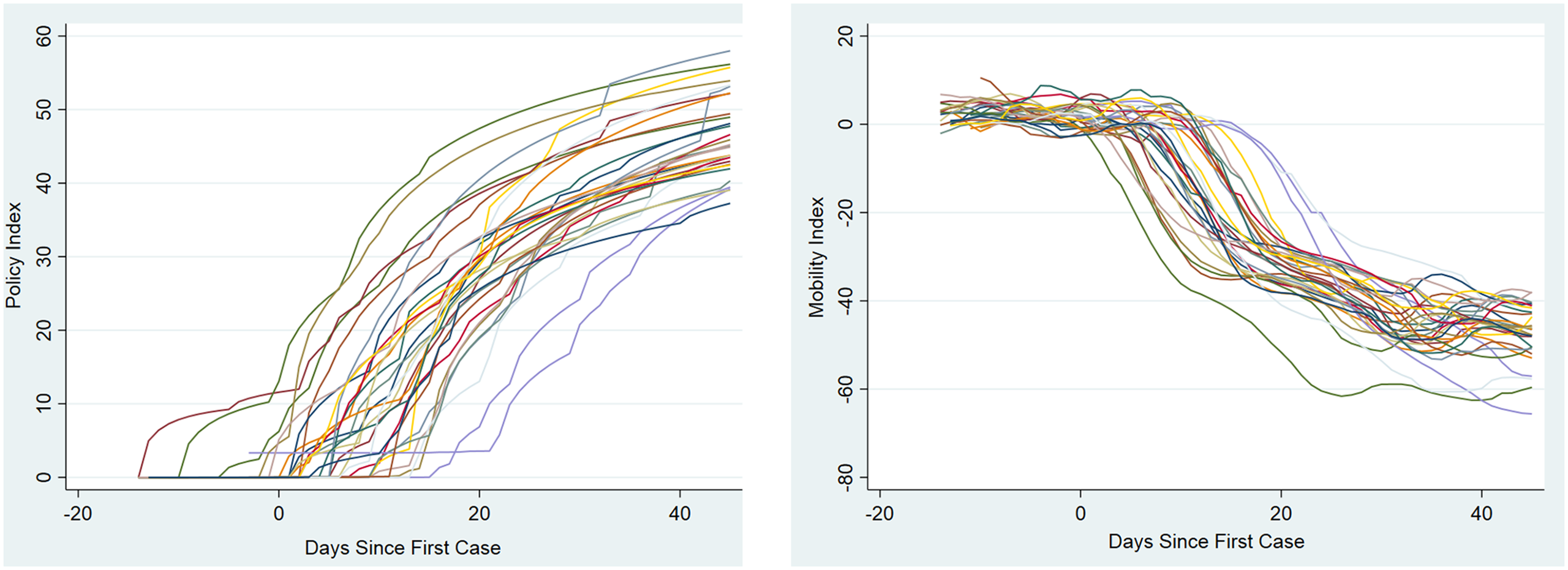
Mexico Policy and Mobility Indices (University of Miami COVID-19 Observatory Data).
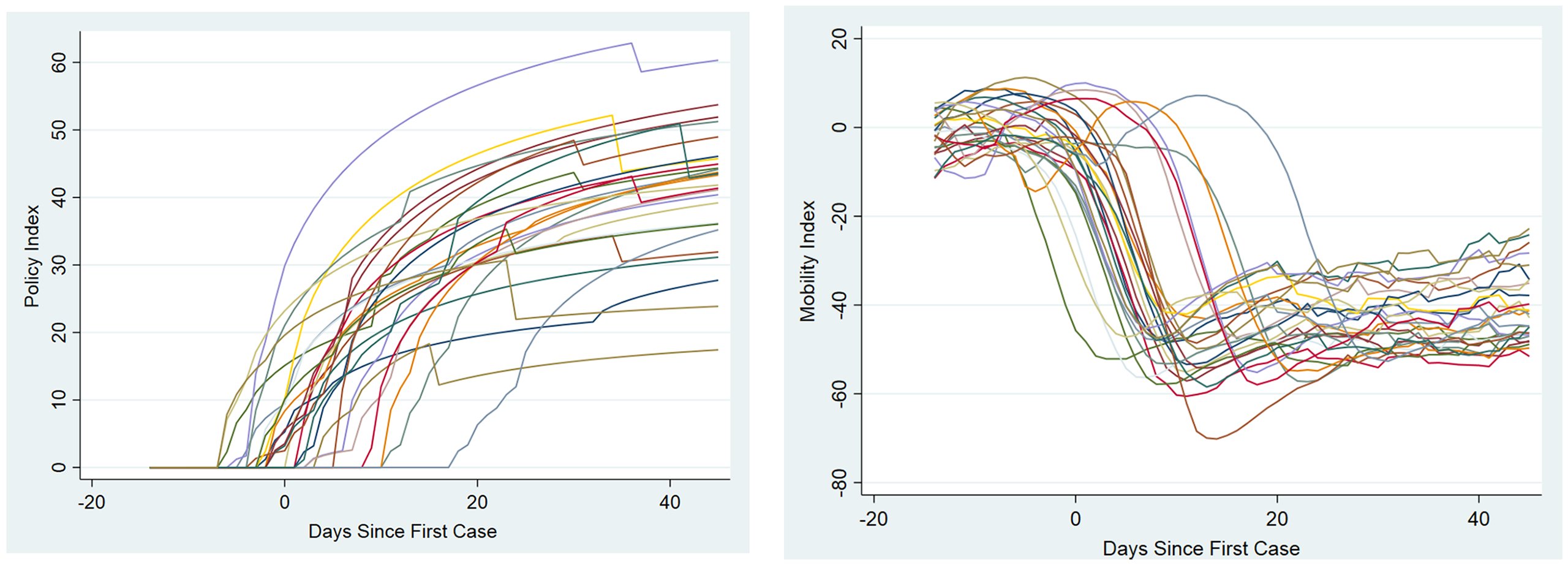
Brazil Policy and Mobility Indices (University of Miami COVID-19 Observatory Data).
In both country contexts, we see substantial variation in terms of average change in mobility from the pre-pandemic baseline. In Brazil during the 45-day time period, Mato Grosso do Sul sees the smallest average change from the baseline, with a 21.02 per cent decrease. Ceará, on the other hand, experienced the greatest change, with an average decrease in mobility of 39.05 per cent. We also see substantial variation in Mexico. Mexico State saw the smallest average change in mobility, with only an average decrease of 14.6 per cent. Meanwhile, citizens in Baja California Sur decreased their movement on average by 35.03 per cent. In the Online Appendix, we include tables examining states in each country with the greatest reduction in mobility. These tables demonstrate that these states are relatively diverse in terms of a variety of factors, including the size of the informal economy, population, region, and urbanization.
In the next sections, we attempt to explain citizen response in light of the varied policy and information environments in both countries. We outline a theory to explain variation in state-level citizen mobility, focusing not only on the nature of policy, but also differences in support for both the president and governor across these subnational units.
Literature and Theory
Federalism
Our theory draws on several literatures. First, since we are interested in the varied responses within countries, we consider factors that made such within-case variation possible. Notably, both Brazil and Mexico are federations. Federalism does not inherently prevent decisive action in response to a national crisis and can even help facilitate a successful response. For example, Latin America’s third largest federation, Argentina, took decisive national action by implementing a nation-wide lockdown and providing social policies to soften the financial burden caused by such an approach (Blofield et al., 2020).
Scholars, however, have pointed to federalism as a potential hindrance to cohesive national action as such a system creates veto points which can prevent the effective implementation of national policies (Diaz-Cayeros, 2020; Castles et al., 2005). Conversely, federalism may also leave countries susceptible to crisis when leaders in power lack the incentive or desire to take strong centralized action. While it may be seen as beneficial that subnational governments can step up in the face of a lacking national response, it has also led to a piecemeal approach and inconsistent messaging (Blofield et al., 2020; Touchton et al., 2021; Knaul et al., 2021).
This article contributes to this literature by examining two cases where federalism appears to have led to a suboptimal policy response in the face of a crisis. We show that the political dynamics of the federal systems in these cases not only had consequences for elite behavior (in terms of policy response), but also for citizen behavior.
Partisanship and Politicization
Given that the federal structure of both Brazil and Mexico allowed citizens to receive conflicting messages, we aim to understand how citizens interpreted such messages. Which message did they choose to follow? Specifically, when did they choose to reduce their mobility in line with subnational messaging?
Scholars examining citizen behavior during the COVID-19 pandemic have pointed to a range of factors that influence the public’s shifts in mobility and policy adherence. Evidence from the United States demonstrates that partisanship and political ideology are important determinants of compliance with public health measures, including social distancing policies. In this context, states with more individuals that are unaligned with the president exhibit higher levels of compliance with public health guidance in the form of mobility reduction (Grossman et al., 2020; Bisbee and Lee, 2020).
Although this evidence is helpful, the contexts of Brazil and Mexico suggest that this relationship is more nuanced. Similar to the United States, presidents failed to respond swiftly and strongly to the virus, and governors were often the first to enact social distancing and containment policies. Not only did presidents present a lacking response, but they also actively advocated for citizens to behave in ways contrary to the guidance of subnational policies. However, partisanship in Mexico and Brazil is comparatively lower than that of the United States, with fewer individuals actively identifying with a party (Lupu, 2015). Further, the nature of the multi-party system in each country leaves room for fewer co-partisan relationships between the president and governor. In addition, governors who are co-partisans of the president in each country often acted out of step with his rhetoric, leaving partisan cues less clear. While the political opposition in Brazil appeared more likely to impose stricter policies than those aligned with Bolsonaro (Touchton et al., 2021), there are some clear outliers. As a result, statistical analysis of the determinants of the policy index in Brazil have found no evidence that President Bolsonaro’s co-partisans took a less comprehensive policy approach compared to other parties (see Bennouna et al. (2021) and the Online Appendix). While there is some evidence that, in Mexico, National Regeneration Movement (MORENA) governors may have implemented weaker policies than governors of other parties (Bennouna et al., 2021), we do not find that MORENA governors took a significantly different policy approach than those of other parties (see the Online Appendix). Thus, guidance as to how to respond to the virus, and the partisan platforms regarding such responses, appears more muddled. In such situations, where citizens received mixed guidance from government leadership and the partisan ties between leadership are unclear, we ask: to whom do citizens listen?
Elite Cues
Given the context of weaker partisanship in both Brazil and Mexico as well as the recent shocks to the party system in both countries (Greene and Sánchez-Talanquer, 2018; Samuels and Zucco, 2018), we expect partisanship to matter less than the influence of individual leaders. In particular, evidence strongly suggests that in such environments, partisan cues have little effect on nonpartisans (Samuels and Zucco, 2014), the proportion of which has grown significantly in recent years (Lupu, 2015; Samuels and Zucco, 2018). In such an environment, we argue that instead citizens' allegiances to specific politicians—in this case the governor or the president—should dictate the degree to which they adhere to public health guidelines.
The study of elite cues is somewhat limited in the context of Latin America, although some existing research has explored this topic in the region. Scholars have demonstrated that elite cues exert significant influence on a variety of policy and issue areas such as gender attitudes (Morgan et al., 2008; Morgan and Buice, 2013), support for authoritarianism (Stein, 2013), and trust in the police (Liebertz, 2020) across various country contexts in the region. We build on this work to consider how elite cues may influence aggregate-level behavior during the COVID-19 pandemic.
Generally speaking, cues are known to be an important source of information and a decision-making tool for the public. In particular, they serve as a heuristic tool, where citizens rely on simple rules of judgement, as they evaluate issues. These heuristics allow for the extension of citizens evaluations of leaders to the policies these leaders propose and with which they are associated (Mondak, 1993) and allow citizens to form opinions about an issue without significant knowledge (Eagly and Chaiken, 1993). Public opinion, in turn, often follows elite discourse (Zaller, 1992). Beyond the individual-level, evidence suggests these elite cues can have aggregate-level effects (e.g. state-level effects) (Mondak, 1993). Elite cues have tangible effects even in contested information environments, such as the one present during the COVID-19 pandemic where officials often contradicted both scientific evidence and each other. Research indicates that elite cues which counter expert opinion lead citizens to go against such guidance (Darmofal, 2005) or at a minimum hold equal weight in citizens minds (Bullock, 2011). Further, explicit information or expert opinion about an issue does not make citizens less likely to follow an elite cue (Agadjanian, 2020). Rather than adjusting their opinion of a policy based on its content, citizens tend to first choose a politician whose position best aligns with their own, and subsequently adopt that politician’s policy views (Lenz, 2013). Support persists even when politicians offer opinions which their constituents previously opposed (Broockman and Butler, 2017). This evidence suggests that even during the COVID-19 pandemic, when expert opinion and scientific evidence encouraged citizens to stay at home and engage in social distancing, elite cues which contradicted this information could still hold the most influence.
Further, not only do elite cues often outweigh expert opinion in the minds of citizens, but approval for such elites is also an important factor. Elite cues and their public support have a tangible dual effect. Although elite cues affect collective policy support on their own, support for policies is also strongly influenced by approval for the elite in question. For example, support for the president highly influences the effect of his or her cues on policy support (Mondak, 1993; Mondak et al., 2004). This suggests that in the contexts we explore, citizen behavior may not only be affected by cues themselves, but also the degree to which citizens support the politician providing a cue.
Finally, recent research has pointed to the importance of elite cues in the context of the COVID-19 pandemic specifically. Variations in elite cues appear to play a key role in whether or not COVID-19 becomes politicized. For example, in Canada, political elites came to a consensus about the severity of the virus and promoted social distancing. As a result, throughout the initial months of COVID-19’s presence in the country, partisan differences in views of the pandemic were nearly nonexistent among Canadian citizens (Merkley et al., 2020). Such consensus was not seen in the highly polarized case of the United States, however. For example, Bisbee and Lee (2020) show that counties in the United States with higher vote shares for Trump in the 2016 election were more responsive to his cues regarding the virus. In general, these counties were initially less likely to shelter in place. However, in response to shifts in Trump’s messaging to follow public health guidelines, these counties increased their sheltering behavior at the aggregate level. Also in the United States, Grossman et al. (2020) demonstrate that political preferences strongly influence whether or not individuals abide by state-level social distancing policies. Although this evidence is presented from a highly partisan context, it suggests subnational variation could be explained by political allegiances.
Research about the COVID-19 pandemic in the context of Latin America has explored the effect of elite cues on citizens perceptions of the severity of the pandemic (Calvo and Ventura, 2021; Aruguete et al., 2021) and citizen actions such as mobility reduction (Testa et al., 2021). Such work, however, has predominantly focused on cues coming from the president. Given the importance of subnational actors in responding to the pandemic in Brazil and Mexico, we believe it is necessary to expand on such literature by bringing in a consideration of cues from subnational actors as well. Examining subnational cues is particularly important in these cases since, as we noted, even co-partisan governors often acted out of step with presidents creating a more complex information environment for citizens.
Hypotheses
With these previous findings in mind, we consider how not only the formal policies in place, but also aggregate-level sympathies with political leaders, can help to explain policy success across subnational units in Brazil and Mexico. We suggest that state-level citizen mobility during the initial phases of the pandemic helps to capture the success of these social distancing policies. First, we expect policy success, measured as greater declines in state-level movement as will be discussed, to be affected by the extent of a state’s policy response. In line with this, we first propose:
H1: States with a more comprehensive policy response will experience larger reductions in mobility.
However, given that previous research has found support for political elites to be instrumental in understanding citizens’ views and behaviors, including at the collective level, we also consider citizen alignments with political leaders. Based on the evidence from elite cues research, we expect the effect of policies to be conditioned by the strength of the governor’s position in his or her state. In the wake of little presidential guidance, previous research suggests that we should expect higher levels of social distancing policy compliance in states that strongly support their governor, but less compliance among states with a greater mix of supporters and opposition. Thus, we predict that in terms of mobility patterns, both the nature of the governor’s policies and his or her aggregate support among citizens are key. We expect a governor’s support and his or her policy response to have an interactive effect, as most policies originated from the state leadership.
H2: We expect there will be an interactive effect between the state-level policy response and the governor’s level of support.
H2A: Where the state-level policy response is not comprehensive, the effect of support for the governor will be minimal. Regardless of level of support, mobility should change little from the baseline.
H2B: Where the state-level policy response is more comprehensive, the effect of support for the governor will be strong. As governor support increases, the change in mobility from the baseline should also increase (greater declines in mobility).
In addition to the role of the governor, we also expect aggregate-level citizen alignment with the president to impact state mobility patterns. As discussed, in addition to each presidents’ lacking response to the pandemic in its initial phases, AMLO and Bolsonaro often also advocated for citizens to not comply with social distancing orders or down-played the severity of the virus. The presidents emitted their own cues contrary to public health guidance. Furthermore, each state contains a number of citizens who support the president. With this in mind, we examine the degree to which the cues from the president have an effect on state-level policy success. Notably, this relationship is not interactive; we do not expect presidential support to interact with policy comprehensiveness at the state level. This relationship may be interactive at the national level, generally speaking, however in these cases the national-level policy implementation was very minimal and experienced little change compared to subnational policy.
2
While neither president promoted strict adherence to distancing policies, as our earlier discussion highlights, there were some key differences in the presidents’ cues in each case. In particular, the early messaging from President Bolsonaro was more consistently opposed to following scientific guidance, therefore sending a clearer cue to his supporters. AMLO’s early messaging was somewhat more mixed; the national government took some actions suggesting citizens should take the virus seriously while simultaneously the president promoted the opposite view through his own discourse and actions. We claim then that AMLO sent somewhat less clear cues to his supporters about how to respond to the virus. Detailed tables of actions taken and messaging shared by the national governments are included in the Online Appendix.
Based on this information, we predict the following:
H3A: In Brazil, presidential support will have a positive effect on mobility (will dampen policy compliance).
H3B: In Mexico, presidential support should have a positive effect on mobility, but to a lesser degree than in Brazil (there will be a weak dampening effect on policy compliance).
Data and Analysis
Data
Our analysis looks to determine what factors influence state-level compliance with public health measures during the pandemic. To examine this, we consider changes in collective citizen mobility, using a mobility index originally collected by Google and further developed into an aggregate measure by the University of Miami COVID-19 Observatory (The University of Miami, 2021). The data is collected from Google Maps users’ location history on their cellular devices and is aggregated and anonymized. With this information, Google provides daily, state-level changes in movement to categories of locations, such as grocery stores, retail, parks, transit, and workplaces compared to before the pandemic (reference period of January 3–February 6, 2020). In both Brazil and Mexico, this information is available at the state level. The index developed by the Observatory from this data captures the reduction in citizen movement across all non-residential categories and is a seven-day moving average. 3
As discussed, we hypothesize that states with higher levels of support for the governor will exhibit more compliance with his or her guidance, as evidenced by greater reductions in mobility. We introduce an interactive hypothesis, where reductions in mobility are dependent on both the nature of the governors’ policies and his or her approval. To quantify the nature of each governors’ policies, we rely upon the policy index created by the Observatory. Following the Observatory’s coding scheme, the policy index score is based on the following three factors: (1) the number of measures undertaken from a list of ten recommended measures, (2) the stringency of each measure, and (3) the number of days since the first case of COVID-19 in the country and the adoption date of each measure. A higher score (between 0 and 100) indicates a state which acted more comprehensively, completely, and quickly.
To measure the governors’ approval within his or her state, we utilize two measures. For Mexico, we use the governor’s approval rating from February 2020, immediately prior to the widespread onset of the pandemic in the country. 4 Ideally, we would rely upon recent approval measures for both cases; In presidential systems such measures are shown to more accurately reflect recent citizens assessments of leaders (Carlin et al., 2012) and are consistently relied upon across studies examining support for executives in Latin America and elsewhere (Cohen et al., 2000; Corrales, 2016; Enns and Lagodny, 2021). However, similar data is unfortunately not available for Brazil. As a result, we turn to election results to approximate the governor’s political support. Specifically, we calculate the governor’s margin of victory in the most recent elections which took place at the end of 2018. 5 In both cases, data on governor support precede the period of analysis to prevent potential endogeneity concerns.
We also hypothesize that the president’s support within each state will influence the degree of compliance with social distancing and containment measures. To measure alignment with the president, we follow the same strategy we use for governors. In Mexico we use approval ratings from February 2020. In Brazil, while national-level approval ratings for the president are published with some frequency, the breakdown in approval by state is not; thus, we use the president’s margin of victory (or loss) in each state from the second round of the 2018 elections. As stated previously, this hypothesis is not interactive, thus we do not interact presidential approval or margin of victory with the policy index. We expect states with higher levels of presidential approval or margin of victory to have higher levels of collective mobility, although this effect should be less prominent in Mexico.
Although the two support measures (approval in Mexico and margin of victory in Brazil) are not completely comparable, these measures still provide a consistent understanding of approval for both the president and governors. In Brazil, presidential and gubernatorial elections occurred during the same time (October 2018) within two years of the beginning of the COVID-19 pandemic. In Mexico, governors were not all elected in the same year. Because of this, the margin of victory is not a consistent measure in Mexico, and approval ratings are better suited for our analysis. 6 Further, as will be discussed below, we run separate models for both Brazil and Mexico, ensuring we do not mix measures in the same model.
We also include a series of controls. First, we include the percent of the population living in poverty. Our expectations for this variable are mixed, but its importance is clear. Some argue that high poverty contexts experience lower reduction in mobility, particularly in work-related mobility as the economically vulnerable must continue income-generating activities outside the home to survive (Bargain and Aminjonov, 2021). However, others argue that socio-economically vulnerable areas are more likely to enact strict measures and reduce mobility, particularly early in the pandemic (Rocha et al., 2021). Furthermore, the ability of the poor to stay home is dependent on economic assistance, which varies by state and country context (Lustig et al., 2020; Blofield et al., 2020). Thus, we do not have a clear hypothesis for this variable, but contend it likely explains a degree of mobility variation across states. Because research demonstrates that urbanization can have differential effects on the impact of the virus, the ability of individuals to effectively socially distance, and the activities they may or may not engage in (Diez Roux et al., 2020), we include a control for urbanization. In more urban areas citizens’ mobility may be inherently lower as they can travel shorter distances to accomplish tasks. In addition, urban areas were often hit harder by the pandemic, particularly in the early days of its spread. In turn, we may see differential patterns in mobility across more urban states as citizens responded differently to their unique circumstances (Mishra et al., 2020).
In addition, we include two measures of state capacity. First, we include a general measure for each state. We use Lee and Zhang (2017)’s measure of state capacity which is available at the subnational level for both Brazil and Mexico. 7 We also include the number of hospital beds per 100 thousand people. This measure is more specific to the capacity of the state to respond to a health crisis. Here, we argue that a state’s capacity may influence the degree to which it can implement and enforce the social distancing measures enacted, as has been evidenced in other country contexts (Capano, 2020). Research indicates that the ability to enforce social distancing measures is a key predictor of COVID-19 contagion, suggesting state capacity strongly influences mobility (Casares and Khan, 2020). We expect states with higher generalized state capacity to see lower levels of mobility among citizens. However, the number of hospital beds in a state may have a positive relationship with mobility. Evidence suggests as citizens perceive their health care systems to be less prepared to care for the sick, they decrease their mobility more (and vice versa) (Chan et al., 2020).
Finally, we control for the caseload in each state over time, measured as the number of confirmed positive COVID-19 cases per 100 thousand individuals in each state. We lag this variable by five days, with the assumption that individuals often respond to caseload data from the recent past, and to control for reverse causality. We expect that states with a higher caseload will experience lower levels of mobility. Pandemic severity has been shown, on its own, to have some negative effects on mobility (Rahman et al., 2020). In addition, as the pandemic worsens, private entities limit their services or allow their employes to work remotely, reducing the opportunity for individuals to be mobile. 8 Evidence also shows that individuals respond on their own to the intensity of the pandemic, limiting their movement out of fear of catching the virus (Goolsbee and Syverson, 2020).
Analysis
To test these hypotheses, we use mixed effects generalized linear models, including random intercepts by state and random slopes by week. 9 Mixed effects models help to account for non-independencies in our data, as opposed to standard linear models which require this assumption. As each state includes multiple observations, many of which are dependent on each other, a standard linear model is not appropriate and rather a mixed effects model should be used (Winter, 2019). Further, this type of model allows us to specifically model out, rather than control for, differences among our grouping units (states) and thus understand the meaningful differences between these units (Bell and Jones, 2015). 10 Random intercepts by state allow us to account for this variation due to differences unique to each.
Random slopes by week are also a key element of this modeling structure and allow us to account for varying effects of time on the outcome variable. When variation in slopes occurs, but is not accounted for, coefficient estimates become more uncertain and standard errors can become anticonservative (Bell et al., 2019). This significantly affects the reliability of the results. Given that we know our outcome of interest (mobility) is highly variable over time, including random slopes by time is necessary. This overall modeling strategy also allows us to incorporate both time-variant independent variables (e.g. caseload) and time-invariant variables (e.g. hospital beds, percent in poverty).
For this analysis, we run models separately for Brazil and Mexico to identify how the effect of our covariates may differ in the two cases. We include two separate time periods for each analysis: 14 and 45 days following the first case in each state. Each sample includes 14 days prior to the first recorded case in the state, but adjusts the time frame after the first case (e.g. 14 or 45 days). We utilize the same pre-first case time frame as the data does not extend beyond 14 days prior to the first case in many states. Examining two time frames allows us to also determine how the effects of our variables may change as the pandemic progresses and circumstances change. In addition, these time periods capture the most dynamic part of the pandemic in terms of policy response. 11 We also include a series of alternate model specifications in the Online Appendix as robustness checks. In particular, we run multilevel Bayesian regression models (implemented with the brms package in R) and Prais-Winsten regressions with panel corrected standard errors.
Results
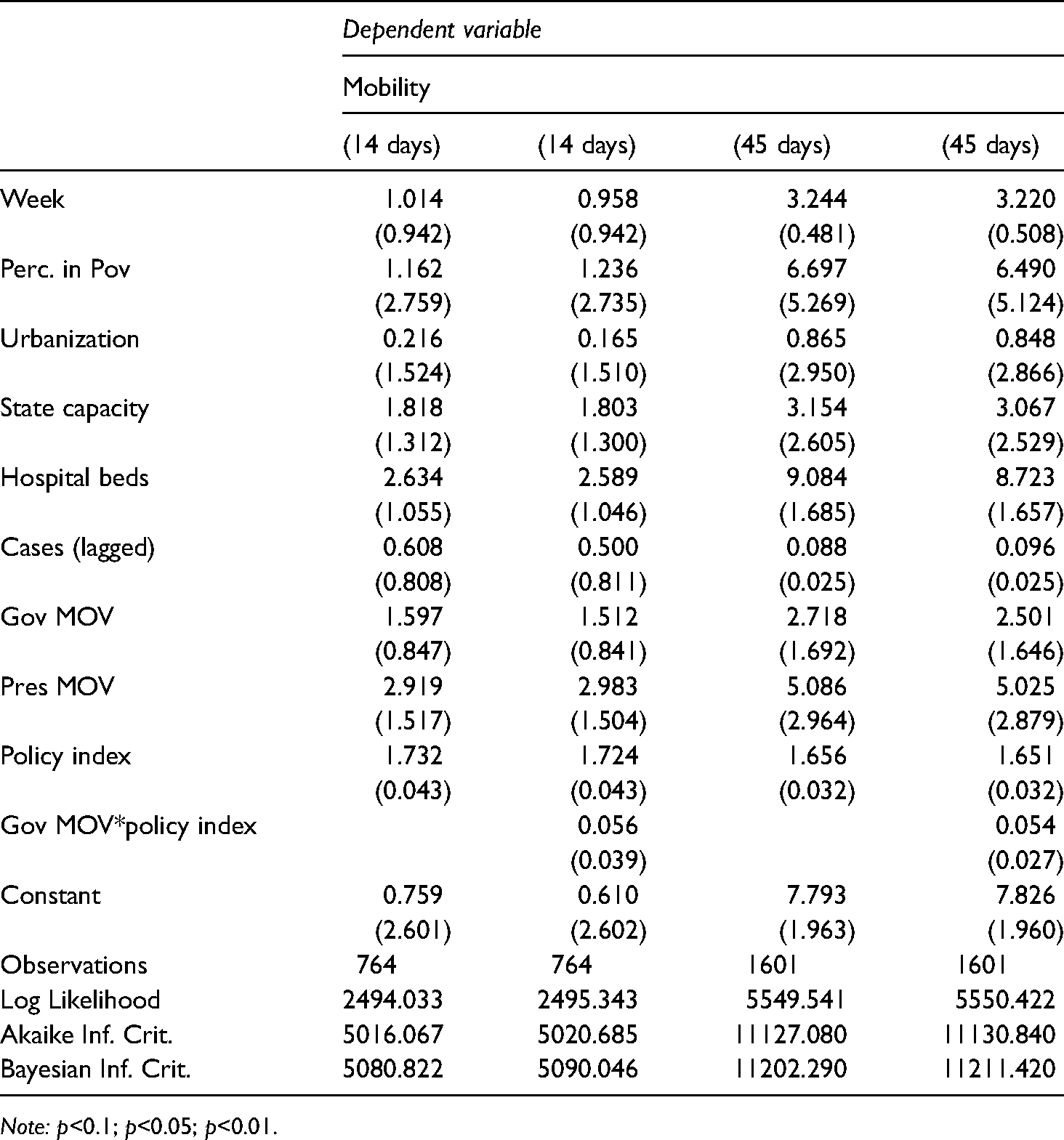
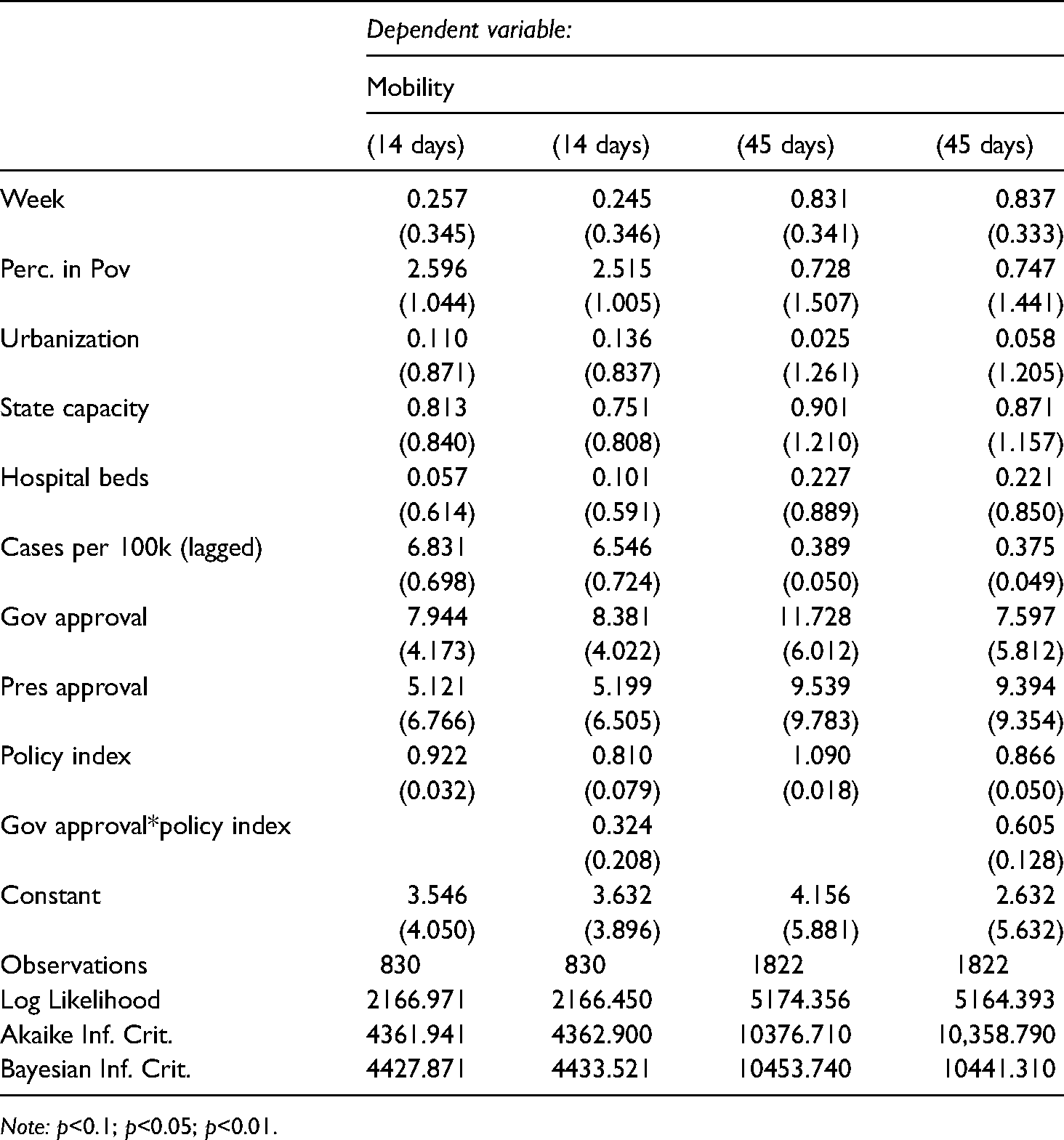
Examining results of our statistical analyses, we see compelling evidence for our hypotheses with some variation between our cases. First, in both countries, we see support for Hypothesis 1: as the policy index increases, state-level citizen mobility decreases. This effect holds across time periods in both Brazil and Mexico. But, when examining support for the governors and president in each country, we find nuanced results between countries, as expected. Full results can be seen in Tables 1 and 2.
Determinants of mobility reduction in Brazil.
Note:
Determinants of mobility reduction in Mexico.
Note:
In Brazil, the interaction between the governor’s support and the policy index is a statistically significant determinant of mobility in our 45-day sample, though it fails to reach significance in the 14-day sample. To fully understand the interaction between these two variables, we plot the marginal effect of governor margin of victory and the policy index in Figure 3 for both the 14-day and 45-day window. These plots, particularly the 45-day plot, support our hypothesized relationship. In Brazil, states where governors both see more support (larger margins of victory) and a higher score on the policy index experienced the largest reductions in citizen mobility. On the other hand, governors with lower levels of support who also had comprehensive policy responses (high scores on the policy index) do not see significant reductions in mobility. Unsurprisingly, regardless of level of support, mobility decreases the least in states with few and lenient policies.
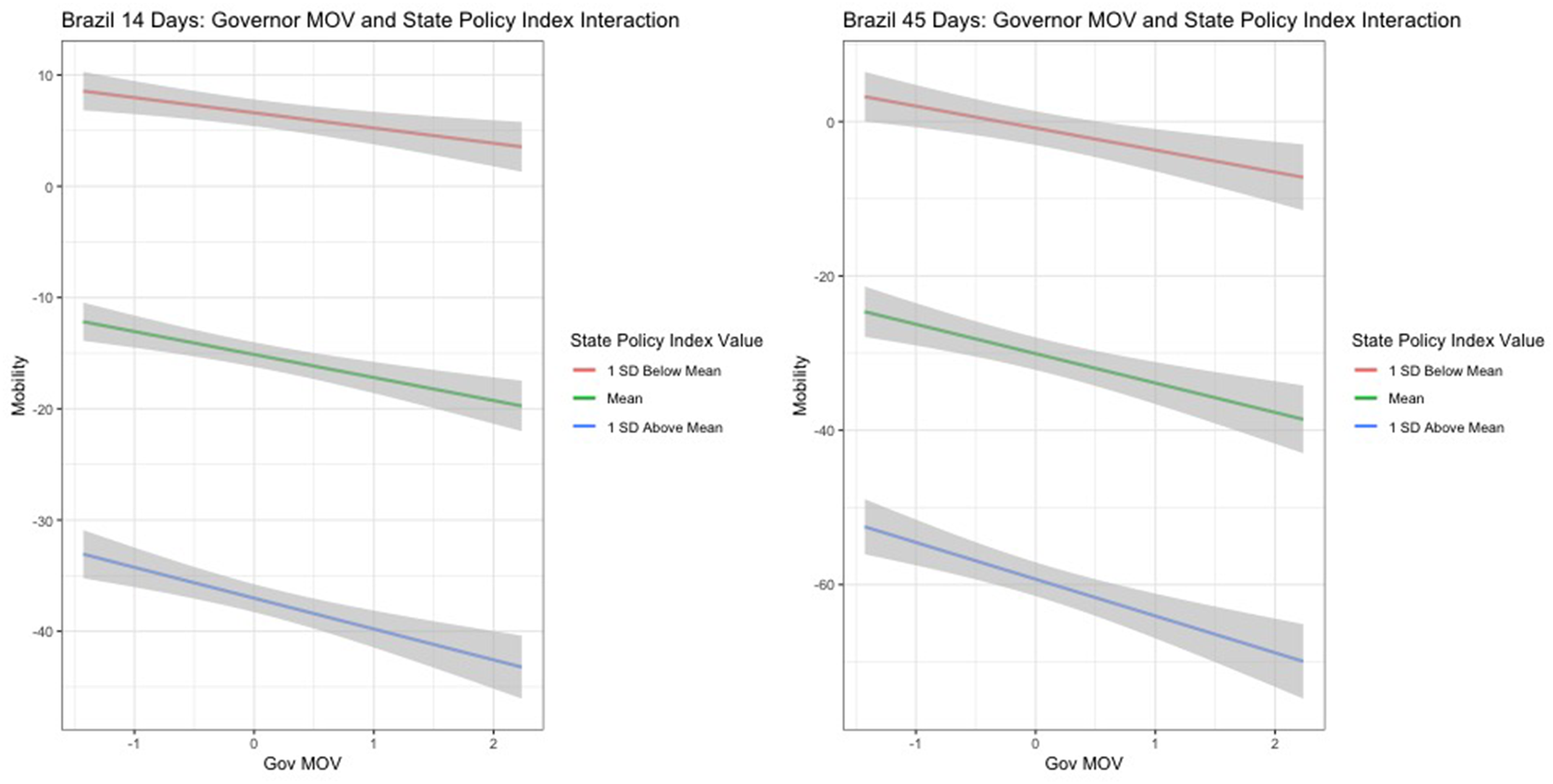
Marginal Effect of Governor MOV and Policy Index on Mobility: Brazil.
The case of Brazil also supports our hypotheses about presidential support. Across both time periods explored, states where the president had a larger margin of victory see higher levels of mobility (or smaller changes from the pre-pandemic baseline), even when controlling for the state-level policy response. With the exception of the third model in Table 1 which is not fully specified, the coefficient is positive and significant. This finding supports our hypothesis that states with more citizens who support the president will follow his signalling even if it is contrary to state-level guidance. Given that Bolsonaro consistently advocated for limited social distancing and argued the virus was not severe, it is no surprise we see states with more Bolsonaro voters heeding his guidance by not limiting their mobility to the extent seen in other states.
In terms of our control variables, the per cent of citizens in poverty, a state's level of urbanization, and a state’s capacity does not have a strong effect on mobility in Brazil. However, the number of hospital beds does have a positive and statistically significant relationship with mobility across both time periods. Caseload only seems to negatively affect mobility during the 45-day time period. This may suggest that citizens did not experience significant concern about the virus until caseload reached a certain threshold.
In the case of Mexico, our hypotheses are supported, but our results differ somewhat from the case of Brazil. Similar to the Brazilian case, we find evidence of an interactive effect between governor support (here, measured as approval in February of 2020) and the extent of the policy response for the 45-day sample. In the 14-day sample models, the interaction again fails to reach significance, however, the marginal effects plots (Figure 4) suggest a possible difference depending on the value of the policy index. When examining the marginal effects plot for the 45-day sample, the expected relationship is strong and clear. Across states with lower policy index levels, governor approval has little effect on state-level mobility. However, across states with higher policy index levels, governor approval strongly affects mobility. Where approval is high, aggregate mobility decreases more significantly, demonstrating higher levels of policy compliance. Where approval is low, changes in mobility are much lower (policy compliance is low).
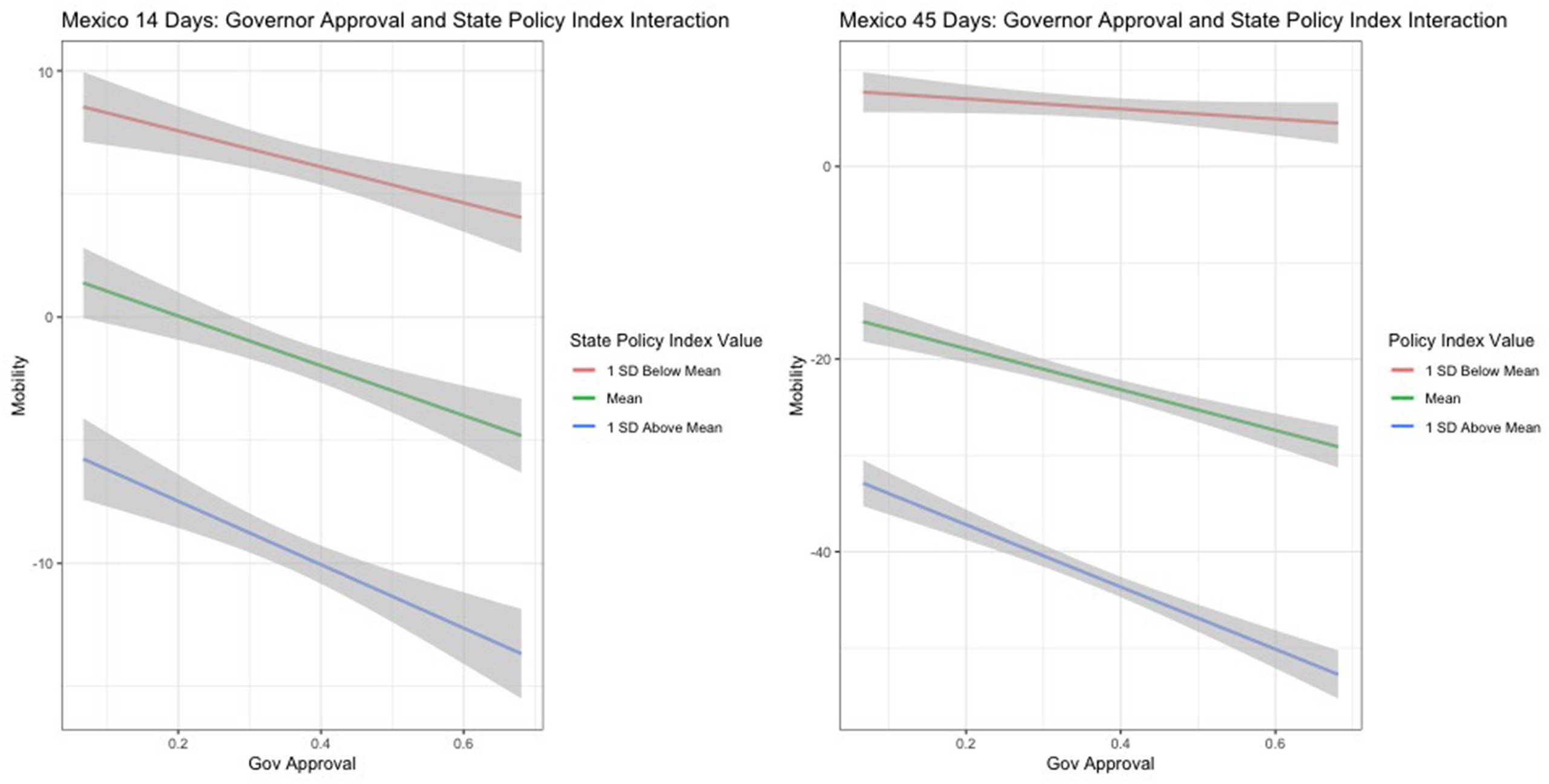
Marginal Effect of Governor Approval and Policy Index on Mobility: Mexico.
Notably, in the Mexican case, the president’s approval does not have a significant effect on mobility. Based on our qualitative assessment of differences in messaging between Bolsonaro and AMLO, we expected to see less of an effect of presidential support on citizen mobility. The results shown in Table 2 show that, in fact, there is no effect. While the coefficient on presidential approval is positive in both the 14-day and 45-day samples, it fails to reach significance at any level in either case.
Beyond our main hypotheses, we only see some statistically significant relationships between mobility and our controls in Mexico. In particular, caseload has a negative and statistically significant relationship with mobility; this supports our expectations. Further, the percentage of citizens in poverty negatively affects mobility in the first 14 days since a recorded case. Most other control variables, including urbanization, state capacity, and the number of hospital beds do not have significant relationships with mobility in Mexico.
Discussion
The above results point to the importance of political alignments in understanding collective citizen responses to the COVID-19 pandemic in Brazil and Mexico. In both cases, we find evidence of an interactive effect between a state’s policy response and the governor’s support. To understand the effect of policies, it seems, we also need to consider the public’s political allegiances.
Our models show that the effect of presidential support varies by case. In Brazil, we see our expected relationship; higher support for the president results in more limited reductions in movement. However, in Mexico we see no effect. Our original discussion of qualitative differences between the messaging of Presidents Bolsonaro and AMLO help to explain these differences. In the case of Brazil, presidential messaging regarding the virus was consistent and strong. Bolsonaro consistently stated that the virus was not serious and citizens should not abide by public health guidelines. In Mexico, although AMLO did not respond strongly to the virus originally, his messaging was notably less consistent. Thus, we see that the effect of presidential support on disregard for public health measures seems to differ between the two countries, along the lines of our expectations.
In addition to our results in these two countries, we also entertain how these effects may or may not differ in another Latin American federal nation: Argentina. To further support our theory and conclusions, we show how these effects strongly differ in a case where centralized action was strong and there was little conflicting guidance between subnational and national units. In the following section, we explore this case and demonstrate further evidence for how our theory helps to explain state-level (province-level in Argentina) citizen mobility in federal nations, demonstrating that in a case of strong federal action, support for the governor influences citizen mobility significantly less (if at all).
Argentina
Here, we explore the degree to which support for the president and governor influenced province-level mobility in Argentina. During the initial phases of the pandemic, the central government of Argentina acted in a manner quite opposite to those of Mexico and Brazil; it acted quickly and attempted to limit the impact of the virus within its borders. By March 12, 2020 the government stopped issuing visas to travelers from many countries affected by the outbreak (Garda World, 2020) and on March 19 a nation-wide lockdown was enacted (Reuters, 2020). This lockdown was later extended, and many major cities stayed in lockdown through May 10, 2020.
Not only were federal measures strict, but the nature of Argentina’s federal system allowed for less deviation across provinces. Regional authority measures indicate that provincial governments in Argentina are weaker than state governments in Brazil and Mexico, so a strong national response overrides the ability of governors to act out of step with the president (Hooghe et al., 2021; Giraudy et al., 2020). Although provincial public health measures were enacted, the variance across provinces was much lower. In the Online Appendix, we also demonstrate that provinces converged on similar policy index scores.
As the federal response is significantly different than both Brazil and Mexico, we treat Argentina as a shadow case (Soifer, 2015) and explore the degree to which our results change. In this case, we would expect public support for governors to have significantly less impact on adherence to public health measures. This is because most messaging and measures restricting movement originated from the president and federal government, and few measures, comparatively speaking, originated from provincial authorities. Furthermore, there was significantly less conflict between federal and provincial guidelines, creating a clearer information environment in which authorities consistently advocated for adherence to public health measures. Support for the president may have an effect on aggregate mobility, as many measures originated from President Fernández 12 . However, because the virus was politicized little in the initial days, and authorities at various levels of government and across parties similarly advocated for adherence to these guidelines, we do not expect presidential support to have a strong effect on mobility.
To test these expectations, we run the same generalized linear mixed effects models for the case of Argentina for both 14- and 45-day time frames (data discussed in the Online Appendix). Results are presented in the Online Appendix. As can be seen, in both time frames, presidential and governor approval rates have no statistically significant effect on provincial-level mobility. The interaction between governor margin of victory and the policy index is also not significant. Here we show that where the public receives a more consistent message, both the approval of federal and state-level executives have little influence on the degree to which social distancing measures are effective. This suggests our results in Brazil and Mexico are indeed a product of the complex cue environment and citizens’ differential assessments of the president and governors.
Limitations
This study demonstrates important consequences of conflicting elite cues in federal systems on compliance with commonly accepted public health measures to combat the COVID-19 pandemic. However, our analysis does face certain limitations. First, there are shortcomings in utilizing the Observatory’s mobility measure to approximate public health measure compliance, but we argue it is the best subnational measure available. Unfortunately, the data only captures the movement of those who have smartphones and utilize Google Maps. This is a limitation, as it cannot capture some, such as the poorest citizens. However, although it is difficult to determine the exact percentage of the population that utilizes Google Maps, we know that smartphone ownership in the region is high. In 2020, both Mexico and Brazil were among the top ten countries with the highest smartphone penetration, both boasting at least a 50 per cent penetration rate (for comparison, Germany has an approximately 77 per cent rate) (Newzoo, 2020). 13 This and similar cell phone location measures have also been used widely by the scientific research community to track compliance with social distancing measures and movement patterns during the pandemic (Frey et al., 2020; Yilmazkuday, 2020; Bennouna et al., 2021; Bargain and Aminjonov, 2021; Rocha et al., 2021; Castro et al., 2021). There are few other existing measures of policy compliance that utilize similar methodology across both country and state lines, and capture both Android and iOS smartphone users.
Furthermore, the aggregated state-level data may obfuscate patterns at the municipal or individual level. Unfortunately, there is limited data regarding individual or municipal-level policy compliance. 14 Our state-level analysis may also obfuscate micro-level patterns which occur at the municipal or local level; data at this level is also limited. Despite these challenges, our aggregate analysis bolsters and expands upon other findings about political influences and individual-level behavior during the pandemic (e.g. Bicchieri et al., 2021; Pagliaro et al., 2021; Koetke et al., 2021; Gramacho et al., 2021; Calvo and Ventura, 2021), and suggests such patterns may be observable across geographic units and affected by state-level political dynamics.
Our analysis also is limited in its ability to draw direct, causal conclusions. Coefficient estimates should not be interpreted as causal effects, but rather associational relationships. As discussed, data regarding public behavior during the pandemic (particularly the initial phases) is limited. Thus, we rely upon observational data to come to empirical conclusions. Data included in this paper only reflects that which was available during the time of publication; it is possible new data sources which may allow for better causal identification will be released as time passes. However, our analysis still provides a useful contribution which can assist further scholars in developing theories regarding the influence of elite cues in such a complex information environment. It may also help practitioners better understand aggregate-level public behavior in such climates. For example, it may prove useful in understanding responses to conflicting cues continue to emerge globally regarding vaccination against the virus.
Conclusion
COVID-19 took the world by surprise in early 2020 and governments across the world struggled to respond to a virus about which we knew little. Many nations responded with urgency and their governments quickly issued strict and coordinated distancing measures. To varying degrees, their citizens followed. In this paper, we explore two countries, Brazil and Mexico, where we did not see a strong national-level response to the virus. Instead, subnational governments were left to take their own measures and to compete with contradictory messaging from the president. This resulted in both varied policy at the state level, and a complex information environment for citizens. As a result, we see high levels of variation in the extent to which the public complied with public health measures, such as social distancing policies, at the subnational level. In this paper we seek to explain this variation in aggregate-level citizen response and hypothesize that public behavior will be affected by the cues that leaders, namely the president and governors, emit.
We argue that the public will respond based on both the extent of policies in place in their state of residence, but also to elite cues. At the state level, policy success will depend greatly on the public’s allegiance to key political actors. First, we examine support for the governor, proposing an interactive hypothesis. We contend that in states where support for the governor is high and state-level policies are timely, strict, and complex (as measured by the policy index we utilize), mobility will decrease the most. But, where support is low and the state-level policies fit this category, mobility will change little. In other words, we expect policy compliance to be low in states with fewer citizens who support the authority enacting them. We find support for this interactive hypothesis in both Brazil and Mexico. However, this effect is only present during the 45-day time frame explored, and is not present when we examine only 14 days following the first recorded case.
We then examine support for the president. We argue that in states where support for the president is high, at the aggregate level, citizens will comply less with public health measures, as both presidents advocated little for strict adherence to social distancing measures. As a result, changes in mobility from the pre-pandemic baseline will be low. However, we contend that this effect should be less prominent in Mexico, as AMLO’s cues were often contradictory and varied between both supporting and opposing public health guidance. Ultimately, we find that our expectations are supported in the context of Brazil. In Mexico, we actually find no effect of presidential support. This somewhat supports our expectations, but does indicate AMLO’s suggestions to buck public health guidance were less powerful than we originally hypothesized.
In addition, we briefly explore Argentina as a shadow case in our analysis. In this case, federal action was strong and swift. In turn, both the variation in subnational policy and citizen movement varied significantly less than these trends in Brazil and Mexico. We show that in such a scenario, support for both the president and governor seem to have no significant effect on mobility. Rather, the nature of policies strongly affects mobility across both time periods explored.
Our results contribute a new point of view regarding subnational public responses to elite cues during the COVID-19 pandemic. We show that when partisan cues are not clear, at the aggregate level, citizens often default to the guidance of individual leaders they most support. Additional individual-level research should look more into this issue. Our research also suggests several possible avenues for future research. We find that subnational variables matter significantly. Beyond state or provincial units, it is also possible that municipal governments in each country have taken on different roles. Although data on municipal-level mobility patterns is sparse, this could be a fruitful area of exploration. Indeed, existing research suggests that municipal responses have also been quite disjointed (Inácio et al., 2021), creating a potential additional layer of complexity to the information environment in which citizens operate. Finally, future analysis could consider how political allegiances and elite cues affect subnational trends in other relevant domains, such as willingness to receive a COVID-19 vaccine.
Though this paper focuses only on two cases during a specific crisis, we believe our findings may be useful for understanding the effect of elite cues in other contexts as well. In particular, we expect that our findings should help us to better understand how citizens interpret cues in federal systems more generally. It is not uncommon for different levels of government to send citizens competing messages and our findings contribute to a broader understanding of how citizens determine which cues to follow. Our findings may also be applicable to understanding behavior in countries that are not formally federal, but that have decentralized. During the pandemic, countries like Bolivia relied heavily on subnational governments to carry out the pandemic response (Hummel et al., 2021). Beyond the pandemic, decentralizing reforms have become common in Latin America with Chile, Colombia and others taking steps to empower lower levels of government. Our findings also contribute to understanding these cases and can help policymakers think through potential consequences, both positive and negative, of such reforms.
Supplemental Material
sj-tex-1-pla-10.1177_1866802X211057135 - Supplemental material for State-level Citizen Response to COVID-19 Containment Measures in Brazil and Mexico
Supplemental material, sj-tex-1-pla-10.1177_1866802X211057135 for State-level Citizen Response to COVID-19 Containment Measures in Brazil and Mexico by Claire Dunn and Isabel Laterzo in Journal of Politics in Latin America
Footnotes
Acknowledgements
The authors thank Evelyne Huber, Jonathan Hartlyn, Guadalupe Tuñón, Elizabeth Zechmeister, Cecilia Martínez-Gallardo, Santiago Olivella, Sara Niedzwiecki, and the anonymous reviewers for their helpful comments on earlier versions of this paper. They are also grateful to panel participants for their feedback provided at the 2021 Latin American Studies Association Annual Congress, the 2021 Southern Political Science Association Annual Meeting, and the Duke-UNC Latin American Politics Working Group Mini-Conference.
This class file was developed by Sunrise Setting Ltd, Brixham, Devon, UK.

Declaration of Conflicting Interests
The authors declared no potential conflicts of interest with respect to the research, authorship and/or publication of this article.
Funding
The authors received no financial support for the research, authorship and/or publication of this article.
Supplemental Material
Supplemental material for this article is available online.