



Abstract
This article studies the continued existence of subnational undemocratic regimes in Argentina and Mexico, two countries that have recently experienced national democratization. The first part of the article offers a conceptualization of subnational democracy and measures its territorial extension across all subnational units. The second part explores a common, albeit not systematically tested explanation about subnational undemocratic regime continuity, namely, that these regimes persist because they meet national incumbents’ strategic political needs. This claim is tested using statistical analyses to contrast patterns of spending across undemocratic subnational units during the presidencies of Menem (1989-1999), De la Rúa (2000-2001), Duhalde (2002), and Kirchner (2003-2007) in Argentina, and Fox (2000-2006) in Mexico. Contradicting conventional wisdom, the results show that presidents only reproduce a handful of subnational undemocratic regimes, as not all of them can meet presidential needs. In addition, the results reveal that the strategic calculation of presidents regarding this reproduction is dictated by factors that have been largely overlooked by the literature.
Introduction
During the past two decades a growing number of Latin American countries have transitioned away from autocracy and authoritarianism towards democracy. 1 However, as several works show, much of this democratic advancement has been territorially uneven and mostly limited to the national level. 2 As a result of this phenomenon, many new democracies are characterized by what scholars have referred to as “regime juxtaposition”: the prevalence of subnational undemocratic regimes alongside a democratic national government. 3
For their excellent comments on previous drafts I thank Juan Bogliaccini, Todd Eisenstadt, Eugenia Giraudy, Florencia Guerzovich, Jonathan Hartlyn, Evelyne Huber, Sandra Ley, Lars Schoultz, John D. Stephens, and two anonymous reviewers.
See Eisenstadt (2004); Snyder (1999); Solt (2003); Gibson (2005); Gervasoni (2010 in this issue); Montero (2007, 2010 in this issue); Behrend (2008); Fenwick (2010 in this issue); Durazo Herrmann (2010 in this issue); Benton forthcoming, among others.
In these subnational regimes, elections are severely manipulated, civic liberties of the local populations are partially suppressed, varying degrees of harassment and violence skew the playing field in favor of incumbents, and incumbents exert a tight grip over the Legislative Branch, local agencies of control, subnational party organizations, and the local media, as well as local civic organizations.
The existence of regime juxtaposition has presented analysts with the twofold challenge of defining and measuring subnational undemocratic regimes (SURs), 4 and advancing general explanations to account for the causes of SUR continuity. With the exceptions of Solt (2003) and Gervasoni (2010 in this issue), however, researchers have devoted little attention to issues of conceptualization. As a result of this neglect, SURs have not been clearly defined, and for that reason have been largely misidentified and misclassified. In terms of explanations, scholars have produced compelling and rich accounts to address the causes of SUR continuity. These explanations, nevertheless, have been mostly drawn from case studies and small-N works, and have rarely been tested using the totality of existing SURs. As a result, these accounts have fallen short of providing general explanations that are valid for the universe of SURs. This lack of theory testing has had two main drawbacks: little accumulation of replicable findings on the causes that explain SUR continuity, and an under-specification of the scope conditions that guide these explanations.
Unless otherwise specified, the term “subnational” only refers to state/provincial-level (rather than municipal or lower-tier) governments/regimes/politicians.
Drawing on Argentina and Mexico, this paper seeks to contribute to the study of regime juxtaposition in Latin America in three ways. Conceptually, the article advances a careful characterization and operationalization of subnational political regimes. In doing so, the paper helps researchers “map the terrain” and spell out more clearly what we talk about when we talk about SURs. Empirically, the article measures the level of democracy in all Argentine and Mexican subnational units. In this way, the paper not only helps distinguish between democratic and undemocratic subnational regimes, but also singles out the universe of SURs (in each country) upon which theories of regime juxtaposition should be applied. Theoretically, the study refines and specifies the scope conditions of the so-called strategic calculation explanation, which posits that SURs continue to exist because they meet national incumbents’ strategic political needs. To test the strategic calculation explanation about SUR continuity, the paper focuses on the allocation of federal transfers, as this distribution is one of the potential mechanisms through which national politicians can help reproduce SURs. Using time-series statistical analyses to contrast patterns of federal spending across all Argentine and Mexican SURs, the article shows that national incumbents only help reproduce a handful of SURs, as just some, and not all, can meet presidents’ strategic political needs. More importantly, the study finds that these regimes are not reproduced exactly for the reasons stipulated in the literature.
The article is organized as follows: The first section conceptualizes and measures subnational democracy in Argentina and Mexico. The following section presents the tenets of the strategic calculation explanation and specifies its scope conditions by carefully defining the main factors that shape presidents’ strategic calculi about SUR reproduction. Building on this theoretical specification, a set of hypotheses about SUR reproduction is subsequently spelled out. The next two sections discuss the measures of the dependent and independent variables, as well as the analytic technique used to test the hypotheses. The results of the study of the universe of SURs in each country and their discussion are presented in the subsequent section. The final section closes with a brief discussion of the implications of this study for future research on regime juxtaposition and intergovernmental relations.
Subnational Democracy in Argentina and Mexico: Conceptualization and Measurement
The definition of democracy adopted in this article follows the tradition of Joseph Schumpeter (1947), who understands democracy in procedural terms. Yet unlike some leading analysts, who adopt a procedural minimal definition of democracy (Collier and Levitsky 1997; Diamond et al. 1999; Mainwaring, Brinks, and Pérez-Liñán 2007), this article subscribes to Przeworski et al.'s (2000) procedural subminimal, or electoral definition of democracy. 5 Accordingly, democracy is conceived of as having three constitutive elements: a) fully contested elections (for both legislative and executive posts), b) clean elections, and c) alternation (turnover) in office. Figure 1 outlines in graphic terms the operationalization of democracy used in this article and provides a brief description of the aggregation procedure. Table 1 discusses the indicators that were employed to measure subnational democracy.
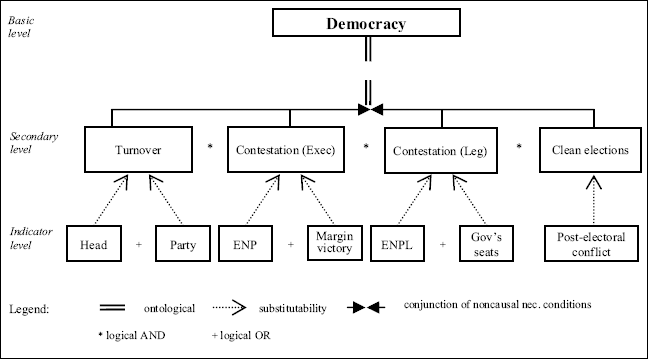
A Necessary and Sufficient Concept Structure of Subnational Democracy
Indicators of Subnational Democracy, Calculation, and Data Sources
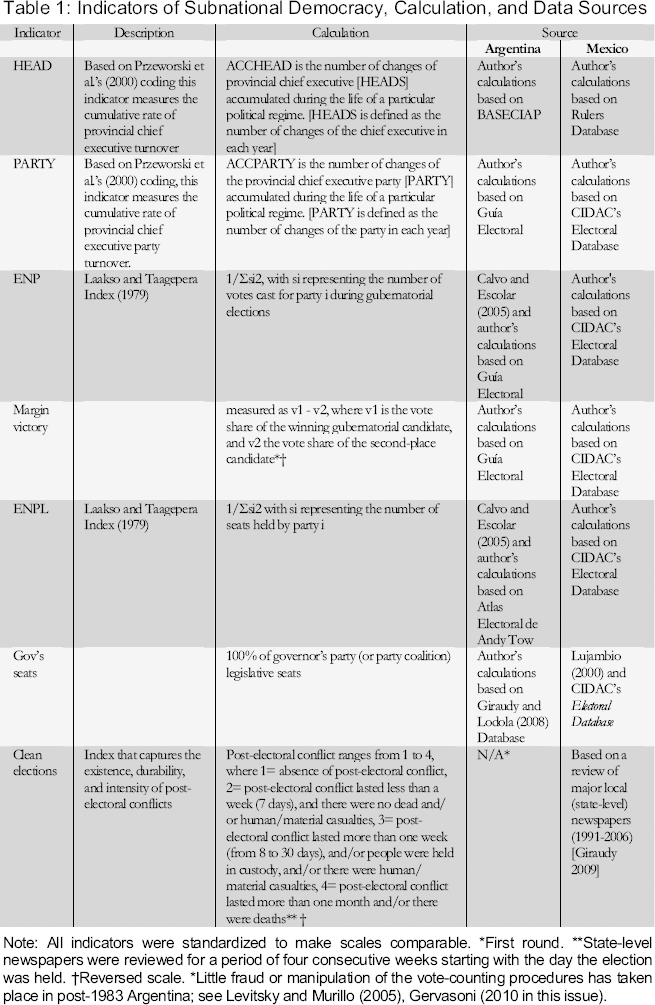
Note: All indicators were standardized to make scales comparable. *First round. **State-level newspapers were reviewed for a period of four consecutive weeks starting with the day the election was held. †Reversed scale. *Little fraud or manipulation of the vote-counting procedures has taken place in post-1983 Argentina; see Levitsky and Murillo (2005), Gervasoni (2010 in this issue).
The decision to adopt a subminimal definition of democracy responds mostly to data availability problems. The inexistence of subnational data to measure, for instance, freedom of speech and assembly, or human rights violations prevents an operationalization of democracy along the minimal standards.
The definition of democracy adopted in this study uses the “necessary and sufficient condition” concept structure (Goertz 2006). Therefore, in order for a subnational political regime to be conceived of as democratic, a number of conditions must be present (i.e., are necessary), and these conditions in turn, are jointly sufficient to make a given polity be classified as democratic. If any of these conditions is absent, the subnational polity cannot be conceived as democratic. To translate a necessary and sufficient concept structure into mathematical terms without violating concept-measure consistency multiplication is used, this study follows Goertz’ (2006) suggested aggregation procedure of multiplying (rather than adding) individual indicators. Consequently, as Figure 1 shows, contestation (for both executive and legislative posts), clean elections, and turnover – i.e., the necessary conditions – are “connected” via the logical AND – a first cousin of multiplication (denoted with the * symbol).
The dataset used to measure subnational democracy covers 24 provinces in Argentina, and 32 states in Mexico. The data span the 1983-2006 period in Argentina, and 1997-2006 in Mexico, with time intervals in each country starting with the onset of the (latest) transition to democracy at the national level.
The results presented in Figure 2 and 3 show that, consistent with the trend observed in previous small-N and case-studies, democracy in Argentina and Mexico has not trickled down evenly. In fact, at least five, out of 24 provinces in Argentina (20.83 percent) – La Rioja, San Luis, Santiago del Estero, Santa Cruz, and Formosa – have remained undemocratic (i.e., obtaining scores close to zero), indicating a sustained democratic deficit over time. By contrast, only five provinces (20.83 percent) – Mendoza, San Juan, Ciudad de Buenos Aires, Chubut, and Entre Ríos – have reached high and sustained levels of democracy throughout the 1980s, 1990s, and the first decade of this century. In other provinces, such as in Chaco, Jujuy, and Salta, democracy has made some mild progress and also suffered setbacks, indicating that subnational democracy is not static, but rather that it ebbs and wanes.
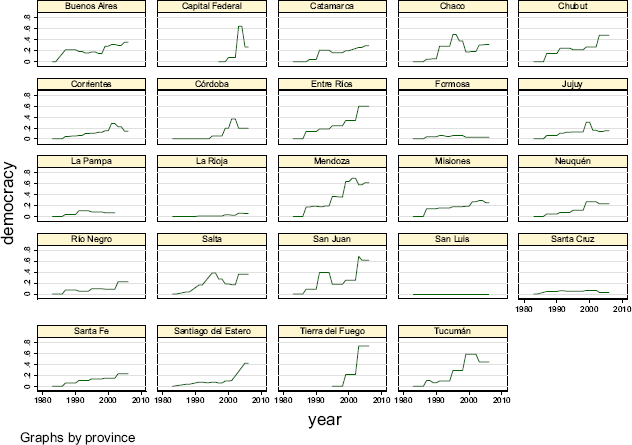
Subnational Democracy in Argentina (1983-2006)
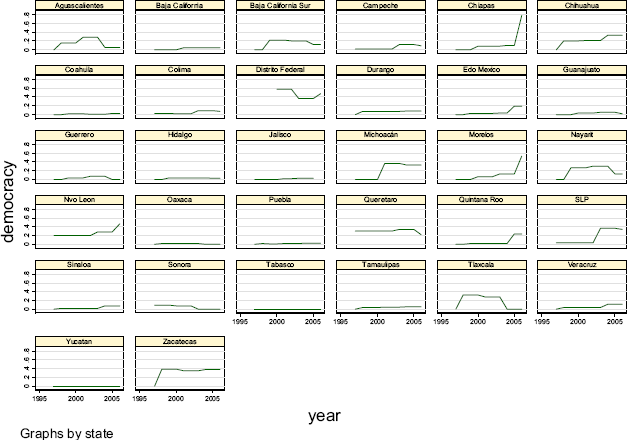
Subnational Democracy in Mexico (1997-2006)
A similar pattern of democratic territorial unevenness can be observed in Mexico, where at least ten out of 32 states (31.25 percent) have remained undemocratic (i.e., score near zero), and only six states (18.75 percent) have experienced some political liberalization. The states of Oaxaca, Puebla, Baja California, Coahuila, Colima, Hidalgo, Tabasco, Tamaulipas, Veracruz, and Yucatán show that democracy has not made inroads in all districts, whereas the states of Chihuahua, Querétaro, Michoacán, Nuevo León, Mexico City, and Zacatecas present a pattern of progressive democratization. In between these two extremes, a group of states – Tlaxcala, Aguascalientes, and Nayarit – show that the pattern of regime evolution has been more erratic, in that democracy has undergone progress and retrenchment.
Altogether, the results of Figures 2 and 3 show that the territorialization of democracy in Argentina and Mexico is generally uneven. The data also reveal that since the onset of the latest democratization process in Argentina and Mexico, many subnational units have never experienced democratic progress, thus highlighting that undemocratic regimes in these countries are “sticky.” The remaining part of this article explores the scope of one common explanation employed to address this regime resilience.
Theory, Scope Conditions, and Hypotheses
Several studies show that undemocratic governors in Latin American countries are key partners for electoral coalition-making (Hagopian 1996; Snyder 1999; Gibson 1997, 2005; Hunter and Power 2007). Indeed, with their tight control over local party machines, governors from SURs can help deliver votes that have decisive impact on general and mid-term national elections (Snyder 1999; Gibson 2005). Furthermore, undemocratic governors may provide invaluable legislative support for the passage of bills that are central to national incumbents’ political projects. 7 Finally, these governors can help maintain political stability and manage security threats, thus assisting presidents in areas that are strategic to national security and governability. For instance, recalcitrant governors, who usually control paramilitary forces, can be charged, as Snyder (1999) points out, with the presidential “mission” of managing security threats on key geographic areas.
Additionally, governors from SURs become attractive partners for legislative coalition-making because they usually rule small and underpopulated provinces/states, which are overrepresented in National Congress, and whose legislative votes weigh far more heavily than those of larger and more democratic districts (Samuels and Snyder 2001; Gibson and Calvo 2001, Gibson 2004; Jones and Hwang 2005).
The evidence presented in these works lays the groundwork for the strategic calculation explanation, which posits that SURs in nationally democratic countries continue to exist because they often meet national incumbents’ strategic political needs (Fox 1994; Cornelius 1999; Gibson 2005). Underlying this explanation is the idea that federal incumbents opt to reproduce these regimes because the political costs of challenging them outweigh the benefits of leaving them intact. Since undemocratic governors can provide much valued political support and stability, democratically elected national politicians have strong incentives to sustain the very same regimes that keep these governors in power.
This explanation, however, has not been tested beyond the specific case-studies or small-N works from which it is drawn. Thus, one central question is the extent to which it is valid when the universe of SURs (in any given country) is taken into consideration. This article claims that democratically elected national politicians do not always have incentives to contribute to SUR reproduction, as differences across SURs alter the strategic calculations of presidents regarding SUR maintenance. In other words, presidents opt to sustain some, but not all, SURs because only some of these regimes can or are likely to meet federal incumbents’ strategic political needs.
To explore whether or not this is the case, this article draws on the universe of SURs present in Argentina and Mexico and retests the main hypotheses derived from the strategic calculation explanation. Before turning to this analysis, the next section specifies the scope conditions of the strategic calculation explanation by carefully defining the main factors that shape presidents’ strategic calculi about SUR reproduction in Argentina and Mexico. Hypotheses about SUR reproduction are subsequently spelled out.
From the literature on federalism and legislative politics we know that governors’ ability to deliver legislative support stems from their capacity to discipline legislators’ voting behavior. Several studies show that provincial/state-level executives in Argentina and Mexico can influence legislative behavior simply because they control legislators’ political careers (De Luca, Jones, and Tula 2002; Gordin 2004; Jones and Hwang 2005; Samuels 2003; Díaz-Cayeros 2006; Langston 2004, 2005; Langston and Aparicio 2008). This capacity to influence legislators’ votes converts governors into legislative brokers and key partners for legislative coalition making, as they can ensure presidents the delivery of congressional support.
Yet undemocratic governors differ considerably in their ability to deliver legislative votes. Because their capacity to ensure votes depends on their ability to control legislators’ political careers, governors can only exert leverage over deputies and senators who belong to their own political parties. They cannot, by contrast, influence the voting behavior of opposition legislators, simply because governors do not control their political careers. It thus follows that provincial executives’ capacity to ensure and deliver legislative support is determined by the share of legislators that belong to his or her party. Governors who control the bulk of the legislative delegation (i.e., the largest share of copartisans) and who in turn can secure national incumbents more legislative votes, should be substantially more attractive to presidents than provincial executives who control small shares of legislators. For instance, Oaxaca's Governor Ulises Ruiz from the Partido Revolucionario Institucional (PRI), who between 2006 and 2009 only controlled 21 percent of Oaxaca's PRI national deputies (i.e., four out of 19 deputies), and 33 percent of the senators (one PRI senator out of three), was less attractive than, for instance, PRI Governor Manuel Ángel Núñez from the state of Hidalgo, who controlled, and thus could secure the votes of five PRI deputies, that is, 50 percent of the state's legislative delegation. 8 On these grounds, it can be hypothesized that presidents will reproduce SURs where governors control a larger share of copartisan federal legislators, as these governors are in a better position to ensure the delivery of legislative votes.
Strictly speaking, Ulises Ruiz had control over three PRI federal legislators. The fourth deputy was his predecessor, José Murat, upon whom Ruiz could not exert any leverage.
The disciplining capacity of governors over legislators is also mediated by electoral institutions and campaign financing rules that are specific to each country, which is why undemocratic governors from some, but not all, federal countries can ensure the delivery of legislative support. The case of Mexico nicely illustrates how electoral rules can limit governors’ capacity to ensure legislative support. Mexico has a mixed electoral system, with 300 of the 500-member Chamber of Deputies filled through plurality races in single-member districts (SMDs) and 200 through closed proportional representation (PR) lists. Voters in Mexico cast only one ballot to choose SMD deputies and do not participate directly in selecting PR deputies. In this context, as noted by Langston and Aparicio, “PR deputy candidates do not run electoral campaigns; if they are placed high enough on the closed list, they will enter the Chamber” (2008: 9). SMD legislators, by contrast, must win plurality races, and thus are interested in running successful campaigns. Given that successful campaigns entail access to resources, SMD candidates are dependent on the national party headquarters and, above all, on governors for a good deal of their campaign funds (Langston 2005). Governors, then, become candidates’ lenders of last resort, and consequently stand in a position to make SMD deputies far more beholden than PR deputies. These electoral and campaign rules limit considerably the capacity of Mexican governors to guarantee the votes of both SMD and PR deputies. Hence it is expected that presidents in Mexico will only contribute to the reproduction of those SURs where governors control the largest share of copartisan SMD deputies.
In the same way that not every undemocratic governor is by default an efficient provider of legislative support, not all undemocratic governors are attractive partners for electoral coalition building. Undemocratic governors, who exert power within the context of patrimonial state administrations, and who, as a result, monopolize political authority, command extensive clientelistic and patronage networks, and control state agencies as well as state resources, can easily manipulate voters and guarantee presidents the delivery of solid electoral majorities. 9 By contrast, undemocratic governors who exercise power within bureaucratic state administrations and thus concentrate far less political authority over persons, state resources, and state agencies, are less capable of mobilizing the electorate and influencing voters’ behavior. 10 Given that patrimonial, undemocratic governors are more likely to deliver solid electoral majorities on Election Day than bureaucratic undemocratic governors, it is expected that presidents will contribute to reproduce SURs ruled by governors who concentrate, rather than disperse, political authority.
Examples of governors who rule within the context of patrimonial state administrations can be found in La Rioja, Santiago del Estero, and Formosa in Argentina, and Oaxaca, Tabasco, and Guerrero in Mexico (see Gibson 2005, Leiras 2006, Lakin 2008, Giraudy 2009, Durazo Herrmann 2010 in this issue).
For a classification of patrimonial vs. bureaucratic SURs in Argentina and Mexico, see Giraudy (2009).
Undemocratic governors are, in principle, strong and well-entrenched provincial bosses who are hard to discipline. As such, they are prone to challenge presidential orders, and to refuse to meet presidential strategic political needs. In the best of cases, they may use their entrenched political position as a bargaining chip to support a president's agenda in exchange for important concessions from the federal government. However, not all undemocratic governors are equally powerful in the face of national ruling elites. They simply are not because, as discussed in detail below, other variables unrelated to the political regime – such as copartisanship and financial dependency on the national government – render subnational undemocratic incumbents vulnerable vis-à-vis central state elites and susceptible to be induced to meet presidential political strategic needs. It is thus expected that presidents will only contribute to the reproduction of SURs if they are ruled by governors upon whom national rulers can exert effective control and disciplinary power.
From the literature on political parties we know that partisan organizational structures facilitate national incumbents’ capacity to discipline and control subnational copartisans (Mainwaring 1999; Stepan 2000; Samuels 2003; Wibbels 2005; Levitsky 2003; Leiras 2006). The mechanisms through which parties exert control over low-level copartisans are manifold and depend on the internal organizational structure of each party. 11 Regardless of which partisan mechanism is put in place to discipline lower-level copartisans, the important point is that governor-president copartisanship should induce presidents to reproduce SURs ruled by copartisan governors, as these are more likely to be controlled and disciplined via partisan mechanisms, and are, in turn, more prone to be induced to meet presidents’ strategic political needs.
For instance, centralized and bureaucratic parties, which tightly control local party branches, are more likely to discipline, and thus induce, the cooperation of copartisan undemocratic governors (Levitsky 2003). Similarly, national party leaders who exert leverage over the selection, nomination, and appointment of candidates can easily control copartisans by determining the fates of their political careers (Samuels 2000; De Luca, Jones, and Tula 2002; Garman, Haggard, and Willis 2001).
SUR financial dependency on the central government also enables presidents to exert control and induce the cooperation of undemocratic governors. From the literature on fiscal federalism, we know that highly indebted or financially profligate governors, who depend on the central government for their subsistence, can be expected to comply with the central government's political demands for fear of being deprived of funds (Wibbels 2005; Falleti 2005). By contrast, governors from fiscally responsible and low indebted SURs or those who rule undemocratic provinces which amass abundant revenues, due to efficient tax collection or to the existence of profitable natural resources, enjoy greater financial autonomy from the federal government, and thus more independence vis-à-vis national incumbents (Giraudy 2009). On these grounds, it can be hypothesized that presidents will reproduce SURs that are in financial dire straits, rather than SURs that are financially sound, as the latter are more likely to refuse cooperating with the federal government, rather than meet presidential strategic political needs.
Finally, presidents’ calculations regarding SUR reproduction may also be shaped by municipal factors. Democratically elected national politicians may have more incentives to reproduce SURs where the president's party has a strong municipal presence. At least two reasons may lead presidents to act in this way. First, keeping loyal copartisan mayors in office may be key to increasing presidents’ electoral success, as mayors usually command substantial distributive resources (i.e., public positions and subsidies) and thus can deliver support during electoral races and primaries (De Luca, Jones, and Tula 2002; Jones and Hwang 2005). Indeed, in many instances, the support of mayors, rather than that of governors, is central to winning on Election Day.
Second, presidents may have an interest in enhancing local copartisan structures because this facilitates presidential penetration in subnational undemocratic arenas, and consequently empowers presidents to challenge and control undemocratic governors from within. In effect, these national-local alliances may result critical to put pressure on and induce undemocratic governors to meet presidential political needs. On these grounds, it can be hypothesized that national executives will have incentives to reproduce SURs in which the share of municipalities that belong to the presidents’ party is higher, as these regimes are more likely to meet the strategic political needs of presidents.
Before exploring the validity of these hypotheses, a caveat about presidential strategies of SUR reproduction is in order. There are different ways through which presidents can help sustain SURs in power. Presidents can, for instance, veto legislative pieces such as a declaration of federal intervention to overturn undemocratic regimes in specific subnational units, or discourage bills or veto laws intended to create conditions that would eventually democratize subnational districts. Alternatively, they can prevent federal agencies of control, such as the Supreme Court or federal auditing agencies, from sanctioning undemocratic governors for their abuses of power and financial misdoings, thus helping to prevent SURs from weakening. Lastly, presidents can also actively sustain SURs in power by benefiting them economically. They can, for instance, reward SURs with additional subsidies or with special federal transfers and programs through which they help consolidate and maintain these regimes in power.
This article focuses on the latter type of presidential strategy of SUR reproduction. Several empirical studies show that national politicians in Argentina and Mexico allocate a wide variety of federal resources and programs in a discretionary manner to meet their political strategic needs. 12 Drawing on this evidence, the next section explores whether the allocation of two specific federal transfers – 1) funds for public works and 2) financial subsidies (PAFEF in Mexico and ATN in Argentina) – has also been used to sustain SURs that were more capable of meeting presidents’ strategic political needs.
See Porto and Sanguinetti (2001); Gibson and Calvo (2000); Gibson, Calvo, and Falleti (2004); Díaz-Cayeros (2004, 2006); Lodola (2005); Weitz-Shapiro (2006); Magaloni, Díaz-Cayeros, and Estévez (2006); Giraudy (2007), among others.
Measures of the Dependent and Independent Variables
The Programa de Apoyos para el Fortalecimiento de las Entidades Federativas (PAFEF), the Aportes del Tesoro de la Nación (ATN), and funds for public works (i.e., the dependent variables) were selected because of their propensity to be distributed in a discretionary manner. Previous works show that each of these funds has been allocated on the basis of political rather than universal criteria (see Díaz-Cayeros 2006; Giraudy 2006; Cetrángolo and Jiménez 1997; Gibson and Calvo 2000; Bonvecchi and Lodola 2008). There are thus good reasons to suspect that these programs might have been used by presidents to reproduce SURs from above. All federal transfers are measured as a percentage of provincial/state-level total income (see Table 2 for a detailed description of each variable and its source).
Variable Descriptions and Data Sources
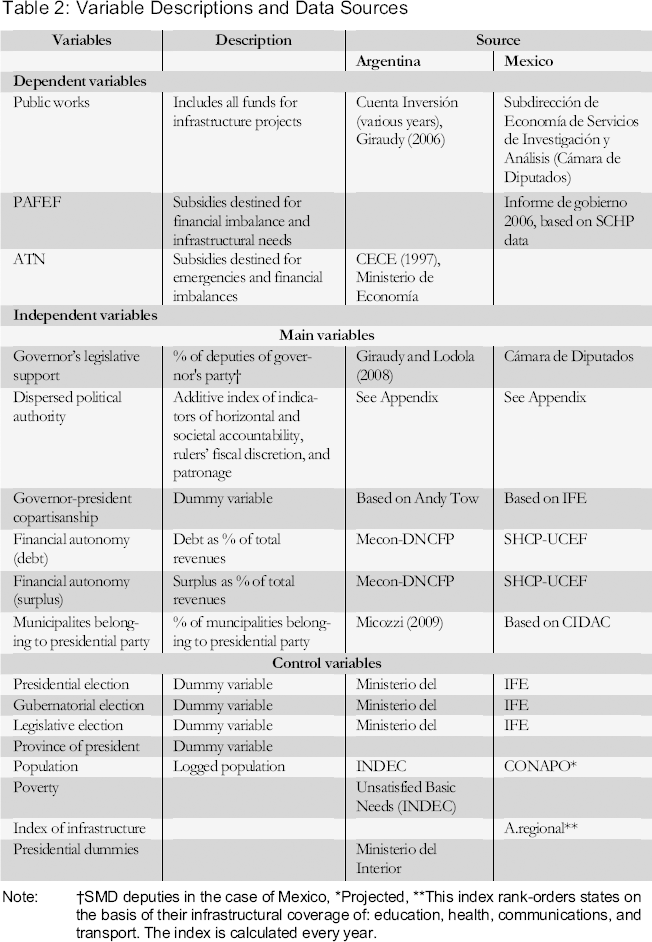
Note: †SMD deputies in the case of Mexico, *Projected, **This index rank-orders states on the basis of their infrastructural coverage of: education, health, communications, and transport. The index is calculated every year.
The first independent variable of theoretical interest, governor's legislative support, is calculated as the percentage of copartisan federal deputies who belong to the governor's legislative delegation. 13 For the reasons outlined above, in Mexico, this measure only includes federal SMD deputies.
The focus is on deputies, rather than senators, because senators are usually prominent political figures, who are less susceptible to follow governors’ orders. For instance, Senator Carlos Menem (ex-president), Senator Francisco Labastida (PRI 2006 presidential candidate and ex-governor of Sinaloa), Manlio Fabio Beltrones (ex-governor of the state of Sonora) are examples of senators whose voting behavior was not influenced by the Governors of the districts they represented.
The second variable of theoretical relevance, dispersed political authority, is measured using Giraudy's (2009) additive index of patrimonial and bureaucratic state administrations which combines indicators of horizontal and societal accountability, rulers’ fiscal discretion, and patronage (see appendix for a detailed explanation of how the index was built). The index ranges from zero to one, where zero denotes higher concentration of political authority (i.e., higher levels of patrimonialism) and one indicates more dispersed authority (i.e., higher levels of bureaucratization).
The third independent variable, copartisanship between presidents and undemocratic governors in Argentina is measured using a dummy variable that scores one when the presidential party equals a governor's party, and zero otherwise. For the case of Mexico, where some governors of the Partido de Acción Nacional (PAN) have come to power through electoral coalitions with other national parties, two dummy variables were created. The first variable captures Panista governors who governed without a coalition (i.e., governor-president copartisanship [non-coalition]) and the other gauges Panista governors who won elections, and thus governed in coalition (i.e., governor-president copartisanship [coalition]). Each of the dummies scores one for the years in which each of these two types of PAN governors ruled a given state, and zero otherwise.
Two indicators, debt and surplus, are used to tap a subnational unit's financial autonomy from the federal government. Both predictors were calculated as the percentage of state/province's total revenues. High scores of debt indicate higher levels of indebtedness (that is, lower financial autonomy), whereas higher scores of surplus reveal greater financial autonomy. 14 The fifth variable, municipalities belonging to presidential party, captures the president's partisan presence at the local level. It is coded as the percentage of municipalities controlled by the president's party in any given year.
Data on provincial debt in Argentina are only available after 1996. For this reason, the Argentine models only include deficit.
When appropriate, the models were run with additional control variables. The distribution of funds for public works should, in principle, be determined by infrastructural needs. Other things being equal, one would expect that states and provinces which lag behind in terms of infrastructural development should receive a greater proportion of funds for public works than subnational units whose infrastructure is more developed. Similarly, highly populated districts, where the demand for infrastructure (sewage, housing, and paved roads) is higher, should also receive more funds for public works. To control for these effects, an index of infrastructure was employed in the Mexican models, and necesidades básicas insatisfechas (unsatisfied basic needs) – a proxy for poverty – was used in the Argentine regressions. Lastly, the variable population was included as an additional control.
The argument about presidents reproducing SURs suggests that this reproduction holds regardless of electoral cycles. In other words, SURs should be reproduced not only during electoral years, but instead on a constant basis (i.e., every year). Thus, no effect or a negative effect of electoral processes is expected on presidents’ decision to sustain SURs. To control for the effects of electoral cycles three dummy variables – gubernatorial, presidential, and legislative election – were included in the models. Each variable was coded as one in the year in which presidential, legislative, or gubernatorial elections were held, and zero otherwise. Given that electoral calendars across levels of government differ in each country (i.e., staggered vs. concurrent electoral calendars in Mexico and Argentina, respectively), different combinations of these three electoral variables were included in each country model. 15
The existence of concurrent national and subnational elections in Argentina yields high correlations across the three electoral variables. Thus, one or two (at best) dummy variables were included in the models. By contrast, the staggered nature of electoral calendars in Mexico permits the inclusion of the three electoral variables.
Presidents who are native to SURs, such as Carlos Menem from La Rioja or Néstor Kirchner from Santa Cruz, may have a strong inclination to channel funds to their strongholds not only to sustain SURs but also for personal reasons. For instance, as former President Menem noted,
an outstandingly large amount of money was sent to La Rioja [one of Argentina's SURs] not so much to keep the regime alive but also to reward the loyalty of former staffers and to improve the wellbeing of my Riojanos (interview by author, La Rioja, May 9, 2008).
To control for these effects, a dummy variable, province of President, was included. Finally, the time span analyzed in Argentina (1990-2006) covers four presidencies. Dummy variables were included to control for political and partisan effects occurring during the presidencies of Menem (baseline), De la Rúa, Duhalde, and Kirchner.
Data and Analytic Technique
The balanced panel dataset used for the statistical analyses comprises all Argentine and Mexican SURs – that is, the states and provinces that score a perfect zero (see Figures 1 and 2). 16 The existence of cases that rank just above zero, such as the Argentine province of La Rioja which gets an average score of 0.006, or the Mexican state of Oaxaca, with an average score of 0.009, makes it hard to exclude these districts from the group of SURs. Thus, these cases were also included in the dataset. 17 Data span the period 1990-2006 (Model 1), 1996-2006 (Model 2), and 2000-2006 (Models 3 and 4). 18
Data in each country are analyzed separately, not pooled.
Cluster analyses were employed to set the cut-off points between states and provinces that rank zero or near zero from those ranking higher on the democracy scale. In a scale that ranges from zero to one, the cutoff point was set at 0.17 in Argentina and at 0.08 in Mexico. This means that all Argentine provinces and Mexican states scoring below 0.17 and 0.08, respectively, are included in the dataset (see Figures 2 and 3). Results of cluster analyses are available from the author.
Time periods for Argentina (Models 1 and 2) differ because data for the dependent variable were available for varying time points.
When data are pooled across time and units, several of the ordinary least squares (OLS) standard assumptions are violated, and consequently the usual procedures for hypothesis testing are no longer appropriate (Long and Ervin 2000). Authors have provided alternative solutions to deal with these violations, including fixed-effects and random-effects models (FEM and REM, respectively), panel-corrected standard errors (PCSE), lagged dependent variable (LDV) models, and autoregressive (AR) models with corrections for first-order autoregression (AR1) (see Beck and Katz 1995; Achen 2000; Huber and Stephens 2001; Plümper, Manow, and Troeger 2005, among others).
Some of these analytic techniques, such as PCSE and AR models, are inappropriate, because the data used in this study are not temporally dominated (i.e., t>N), but rather cross-sectionally dominated (i.e., N>t). Other techniques, such as FEMs or LDV models, are also inadequate given that several key independent variables have level effects and are relatively time invariant (i.e., they only change at a slow pace). In the presence of such variables, a FEM will improperly absorb the significance of these predictors (Plümper, Manow, and Troeger 2005; Achen 2000).
For all these reasons, the problem of correlated errors in panel data is addressed using a combination of OLS estimation of the regression coefficients with a robust-cluster estimator of the standard errors. The robust-cluster variance estimator, as noted by Huber et al., “provides correct coverage in the presence of any pattern of correlations among errors within units, including serial correlation and correlation attributable to unit-specific components” (2006: 957).
Results and Discussion
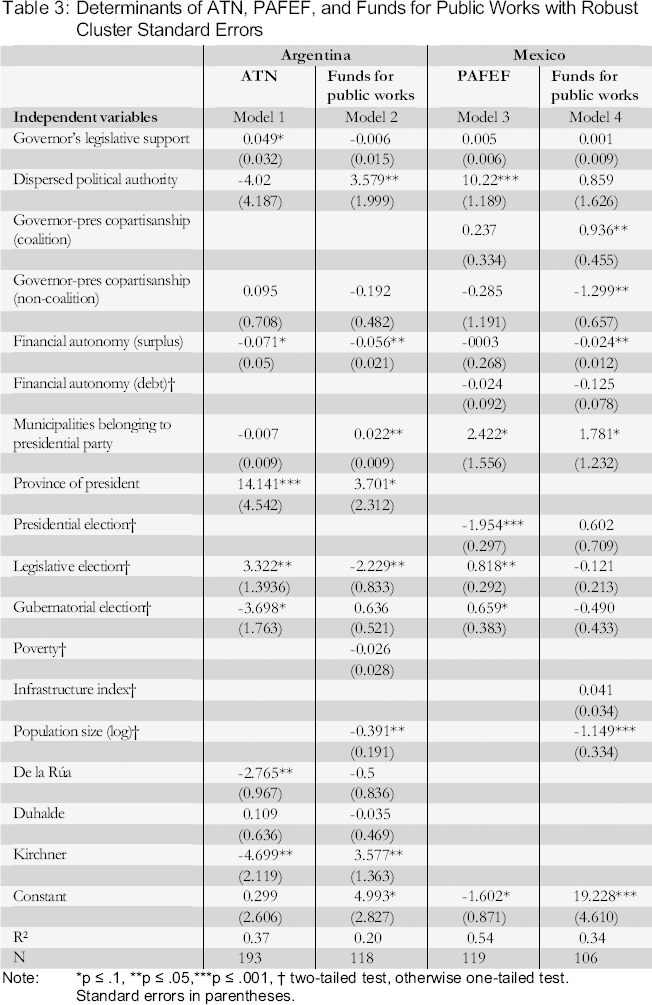
Table 3 shows that one of the article's main finding of theoretical interest is that, contradicting conventional wisdom, national incumbents do not have incentives to benefit, and thus help sustain, every single existing SUR. Rather, the analysis reveals that when the universe of cases (in Argentina and Mexico) is taken into consideration, presidents only contribute to the reproduction of the SURs that serve them politically well. A second major finding of this study is that SUR reproduction is not necessarily driven by the potential legislative and electoral support that undemocratic governors may deliver. By contrast, other political factors, such as dispersed political authority, financial dependency on the federal government, and the share of municipalities belonging to a president's party, strongly shape presidents’ strategic calculi regarding SUR reproduction.
Determinants of ATN, PAFEF, and Funds for Public Works with Robust Cluster Standard Errors
Note:
p ≤ .1
p ≤ .05
p ≤ .001
two-tailed test, otherwise one-tailed test. Standard errors in parentheses.
The lack of incentives for presidents to benefit, and thus help reproduce SURs which may eventually deliver legislative support is confirmed by the fact that the governor's legislative support variable only comes out positively signed and statistically significant in Model 1, where an increase of 1 percent in governor's legislative support, which equals a one point increase in the share of deputies belonging to the governor's partisan congressional delegation, is associated with an increase in ATN allocation of 0.04 percent of undemocratic provinces’ total revenues. By contrast, both Mexican regressions and Argentine Model 2 show that undemocratic governors who control the bulk of their legislative delegation, and who in turn stand in a better position to secure more legislative votes, are no more attractive to presidents than governors who control small shares of loyal deputies.
The fact that both Mexican models invalidate the legislative aspect of the strategic calculation explanation, and that Argentine Model 1 substantiates it, points to important cross-country differences regarding the capacity of Argentine and Mexican governors to discipline legislators. In Argentina, as numerous studies show, provincial executives are the main principals exerting leeway over deputies (Jones and Hwang 2005; Gordin 2004). In Mexico, by contrast, a multiplicity of principals, including party leaders in Congress, the national party leadership, and governors, have control over deputies’ behavior (Casar 1999; Langston 2005; Langston and Aparicio 2008). These cross-country differences may explain why presidents in Argentina (i.e., Model 1) favor SURs on the basis of the potential legislative support that may accrue from these districts and why Mexican presidents abstain from benefiting SURs on the basis of the potential legislative support, which undemocratic governors can secure.
The refusal of Argentine and Mexican presidents to reproduce SURs that are in a position to ensure the delivery of electoral support is evidenced by both the positive sign and statistical significance of the dispersed political authority variable in Models 2 and 3, and its statistical insignificance in Models 1 and 4. 19 Models 2 and 3 show that undemocratic regimes where political authority is more dispersed (i.e., where governors control smaller provincial/state-level patronage networks, have less capacity to discretionally distribute state resources, and are checked by more autonomous subnational agencies of control) are rewarded with more federal transfers than regimes that concentrate more political authority, and thus stand in a better position to ensure presidents’ solid electoral majorities.
Dispersed political authority in Model 3 has a strikingly powerful effect on the dependent variable: a unit increase in this independent variable results in an increase in PAFEF spending of 10.22 percent of the SURs’ total income.
This counterintuitive finding may be explained by at least four reasons. First, presidents may attach less value than previously thought to the capacity of governors to deliver electoral support, as they may be less efficient to provide solid electoral majorities than other brokers, for example mayors (see below). Second, the refusal of presidents to benefit governors who concentrate political authority and exert power in a patrimonial way, may respond to presidents’ aversion to enhance the position of already territorially and politically powerful bosses, who could eventually challenge presidential authority. Third, actively sustaining clientelistic, illiberal, and patrimonial governors, who plainly violate democratic and human rights standards such as Governor Carlos A. Juárez in Santiago del Estero or Governor José Murat in Oaxaca (Gibson 2005), may also impose high political and reputational costs on presidents, as these governors are usually regarded as unpopular political actors. By contrast, while supporting undemocratic governors who exercise power in a more bureaucratic manner may bring about fewer electoral benefits, it may also be less costly in terms of the reputational and political price that presidents may be willing to pay. Finally, the fact that SURs that concentrate political authority get a lower share of transfers may also be explained by ideological factors. Indeed, from studies conducted in Mexico we know that presidents who advanced technocratic and neoliberal agendas, such as Presidents Salinas (1988-1994) and Zedillo (1994-2000), refrained from empowering and siding with entrenched traditional and antineoliberal governors, the so-called dinosaurios (dinosaurs), as they systematically opposed presidential initiatives and federal-led projects (Centeno 1994; Eisenstadt 2004; Hernández Rodríguez 2008).
The results presented in Model 3 indicate that similar ideological factors may have shaped presidential behavior vis-à-vis SURs during the years of the first Panista administration. Several studies show that Fox's political weakness, which largely stemmed from the fact that 21 (out of 32) governors belonged to the PRI, and from the lack of majorities in both chambers of Congress, led him to build legislative and electoral alliances with PRI undemocratic governors (Hernández Rodríguez 2008; Madrazo 2007). These alliances, however, were selective in that they were struck with PRI undemocratic governors who shared and upheld the PAN's business-oriented, neoliberal, and technocratic worldview, that is, governors who ruled states where political authority was exercised in a more bureaucratic (rather than patrimonial) manner. In fact, as Gibson (2005), Giraudy (2009), and Durazo Herrmann (2010 in this issue) show, Fox refrained from siding with traditional, patrimonial, and highly clientelistic undemocratic governors, such as the Governor of Oaxaca, as these governors’ behavior was largely incompatible with the PAN's ideological stance.
Models 2, 3, and 4 show that presidents channeled more funds to SURs where the share of municipalities belonging to the presidential party was larger. Indeed, a 1 percent increase in the share of municipalities belonging to the president's party is associated with an increase in public works spending of 0.02 percent of the SURs’ total income in Argentina (Model 2), of 2.44 and 1.77 percent of the SURs’ total revenues in Mexico (Model 3 and 4). These result indicate an important and often overlooked aspect of presidents’ strategic calculi regarding SUR reproduction, namely, that federal incumbents opt to benefit and thus sustain copartisan local structures, as these structures, and not state-level/provincial patronage networks controlled by governors, may be more effective to deliver electoral support during Election Day. 20 Recent events in Argentine politics substantiate this finding, as evidenced by former President Néstor Kirchner's strategy of striking electoral coalitions with mayors of undemocratic districts and not solely with patrimonial governors (Leiras 2006).
The transfers analyzed in this study can flow directly to municipalities (as is the case of ATN and PAFEF) or be earmarked for specific municipal infrastructural projects. As such, they can be used to strengthen local governments without necessarily empowering undemocratic governors.
The greater share of federal transfers flowing to SURs where the share of municipalities belonging to the presidential party is higher may also respond to presidents’ strategy of strengthening local copartisan bases of support. As noted earlier, local copartisan structures are “springboards” that facilitate presidential penetration in subnational undemocratic arenas, and thus serve as key vehicles to gain leverage to both challenge and control undemocratic governors from within. It is by applying pressure from within that presidents can further induce provincial/state-level ruling elites to deliver strategic political support to advance the presidential agenda. Evidence from Mexico indicates that President Fox rewarded SURs where the share of PAN-ruled municipalities was high because by strengthening and expanding the PAN local presence he could challenge opposition governors’ territorial power and, eventually, constrain undemocratic governors’ authority from within (Giraudy 2009). 21 Altogether, the impact of municipal aspects on presidential strategies of SUR reproduction underscores that researchers of regime juxtaposition, as Fenwick (2010 in this issue) notes, may need to scale further down to the municipal level to uncover how local aspects determine the political fates of SUR reproduction.
It should be noted that the enhancement of local copartisan structures may eventually help presidents to topple SURs, in which case national incumbents would be contributing to subnational democratization and not SUR reproduction. This phenomenon, however, occurs in t 2, and not in t 1 – the period which this study focuses on.
Casting doubt over previous theoretical expectations, the negative sign and statistical insignificance of the governor-president copartisanship variable in both Argentine regressions (Models 1 and 2), and Model 3 in Mexico, shows that governor-president copartisanship does not necessarily determine presidents’ strategy of cross-SUR federal funds allocation. Even though no conclusive (statistical) assertion about the role played by copartisanship on SUR reproduction can be made, qualitative evidence indicates that both Argentine and Mexican presidents have helped sustain, and thus reproduce, SURs from the opposition. Several works and reports conducted in Argentina show that presidents were eager to strike coalitions with opposition undemocratic governors who were willing to meet presidential strategic needs. President Menem's strategy of delivering selective benefits to SURs of the opposition in exchange of support to pass key pieces of legislation to implement his neoliberal agenda (Botto 1998; Gibson and Calvo 2001), as well as President Néstor Kirchner's multiparty coalition, the so-called Concertación Plural (plural agreement), which entailed alliances with opposition undemocratic governors in exchange for legislative and electoral support, 22 are some cases in point. A similar relationship between opposition undemocratic governors and presidents was observed in Mexico during the presidency of Vicente Fox, when the federal government rewarded undemocratic PRI governors, such as the rulers of Puebla, Veracruz, Hidalgo, Sinaloa, and Sonora, with subsidies and special transfers in exchange for electoral and legislative support (Madrazo 2007). In consonance with these findings, the statistical results presented in Model 4, show that SURs ruled by PAN governors who came to power in an electoral coalition are associated with an increase in public works transfers of 0.93 percent of state's revenues. By contrast, in SURs governed by non-coalitional PAN governors a decrease in public works funds of 1.29 percent of state total income was recorded.
Diario Río Negro (2006), February 23, 24, 26, and March 10.
The negative sign and statistical insignificance of the governor-president copartisanship variable may also indicate that Argentine and Mexican parties’ internal organizational structures are not effective enough to enable presidents to control and discipline provincial/state-level copartisans, and thus induce their cooperation. Studies have shown that the internal organization of the Peronist party in Argentina, which is both informal and decentralized, is largely inoperative to exercise control over provincial branches and lower-level copartisans (Levitsky 2003). In a similar fashion, the PAN's organizational structure, despite being far more institutionalized than the Peronist party in Argentina, prevents national party leaders from exerting control over governors, as the party's rank and file, and not national party leaders, determine Panistas’ career paths (Mizrahi 2003; Langston 2004).
Lastly, one of the most consistent findings of this article is that, ceteris paribus, presidents reward SURs that are in financial dire straits. In effect, increasing provincial surplus in Argentina by 1 percent leads to a decrease in ATN spending of 0.07 percent of the SURs’ income (Model 1), and to a decrease in public works spending of 0.05 percent of the SURs’ total revenues (Model 2). Likewise, a 1 percent increase in state-level surplus in Mexico results in a decrease in public works spending of 0.02 percent of the SURs’ income (Model 4). The presidential decision to allocate more funds to SURs that have larger deficits and which are ruled by profligate undemocratic governors substantiates the theoretical claim that presidents opt to reward governors who are more susceptible to being controlled and induced to meet presidential strategic political needs. As noted earlier, financial dependency on the federal government not only seriously limits undemocratic governors’ capacity to challenge and oppose the presidential agenda, but more importantly, it poses strong constraints on provincial incumbents to follow presidential orders. 23 Qualitative and quantitative evidence presented by Wibbels (2005) and Giraudy (2009) in analyses of several undemocratic profligate Argentine provinces reveal that governors from these districts are forced to support most presidential initiatives for fear of being deprived of financial resources. The results presented in this paper reveal that this claim also holds true when a larger set of SURs is taken into consideration.
Another possible interpretation of the greater share of ATNs flowing to profligate SURs is the president's determination to ensure national macroeconomic stability.
Conclusion
This study has contributed to knowledge accumulation in the area of regime juxtaposition by conceptually defining and measuring subnational democracy in all Argentine provinces and Mexican states, and by identifying the regimes that comprise the universe of SURs in these two countries. It has also made an important contribution by retesting and specifying the scope conditions of the strategic calculation explanation. Building on statistical analyses to contrast patterns of spending across SURs, the paper shows that, contrary to conventional wisdom, national incumbents have incentives to reproduce only a handful of SURs, as not all of them can meet presidential needs. In addition, the paper shows that the strategic calculation of presidents regarding this reproduction is not necessarily dictated by governors’ capacity to deliver legislative and electoral support, but rather by factors that have been largely overlooked by the literature.
Three important implications for the study of regime juxtaposition follow from this article. First, the results show that presidents help sustain SURs that are easily controllable and penetrable, such as those that are financially weak and where copartisan mayors exist. This finding reveals that presidents’ decision to reproduce SURs is shaped, to a very large extent, by presidents’ capacity to exert leverage over undemocratic governors. Instances that facilitate financial and political control, either from above or from within, over recalcitrant rulers and which, in turn, give presidents additional instruments to induce their political cooperation seem to be important determinants of SUR reproduction. More studies are needed to explore how specifically the possibilities of federal control (or lack thereof) over SURs affect the prospects of their continuity and change, and how the existence of different mechanisms of control, that is, political or fiscal, shape presidents’ strategies of SUR reproduction.
Secondly, this study reveals that under certain circumstances, presidents are active promoters of SUR continuity. The fact that national actors shape the prospects of SUR sustainability underscores, as many studies have already pointed out, that subnational political processes are not impervious to the political dynamics that take place at the national level of government; quite to the contrary, they are greatly shaped by events occurring at higher levels of government (Gibson 2005, 2008; Montero 2010 in this issue). Future theories about SUR continuity or change necessarily have to assess and theorize about the impact of both national and subnational variables, as their combined interaction is crucial to the understanding of how and why these regimes continue to exist or not.
Finally, this study has shown that the pattern of interaction between presidents and undemocratic governors varies from SUR to SUR. Differences across these subnational regimes have important consequences for presidents’ strategic calculations regarding regime reproduction. Extant explanations about SUR continuity, however, tend to overlook these subnational differences, taking for granted that SURs within countries are homogenous or uniform entities, all deemed to be analyzed and treated as equivalents, especially with regard to the relation they maintain with national rulers or national institutions. On these grounds, existing explanations infer that the causal mechanisms that shape the interaction between one or several SURs and national government/institutions (i.e., the mechanisms that account for regime reproduction) are generalizable across all SURs. As a result, most accounts about SUR continuity remain largely incomplete and theoretically underspecified. By showing that the causal mechanisms that account for regime resilience are not homogenously valid across the universe of SURs, this study not only points to the perils of assuming unit homogeneity across subnational units, but also makes an important contribution to advance more complete and specified explanations about SUR continuity in nationally democratic countries.
Footnotes
Appendix
Context specific indicators were used in each country.